



Abstract
What ‘nature’ is being commodified in carbon markets, and why does it matter? How are carbon commodities and ecologies of repair co-produced through carbon forestry? Are the Polanyian notions of ‘fictitious commodification’ and ‘embeddedness’ appropriate for thinking about carbon forestry and voluntary carbon market (VCM) offsets? This article addresses these questions and extends the critical understanding of conservation in the ‘repair mode’ through an analysis that delves deeply into the black box of value production in the VCM. Focusing on the interplay of ‘virtuality’ and ‘virtue’ in the production of one variety of so-called ‘boutique’ blue forest carbon offset, this analysis demonstrates the technical abstractions needed isolate ‘carbon’ and force it into the commodity form create slippages between concrete socio-natures and geographies of offsetting and the imagined natures and geographies of a market environmentalist model of the world. This politics facilitates a dual pathway of accumulation via the material extraction of nature to feed the expansion of industrial growth (the subject of Polanyi’s critique) and, in parallel, through feeding new growth markets for nature-based commodities such as the VCM. These markets promise to repair the damage caused by industrial growth, but can only ‘work’ in the abstract, virtual realm despite entanglement with underlying concrete ecologies of repair. Based on this analysis, this article argues that the widespread view of carbon offsets as ‘embedded’ Polanyian fictitious commodities is incomplete, based on an ontological fallacy that conflates the ways in which concrete and abstracted, virtual ‘natures’ are used to produce value in the contemporary restoration economy. This fallacy implicitly reifies the central fictions and contradictions of carbon markets and the market environmentalist model more broadly. Considering VCM carbon forestry in terms of ‘scale-making’ and ‘world-making’ projects, the article presents an alternative conceptualisation of VCM carbon offsets as intangible ‘frictitious’ commodities that inhabit a complicated and only provisionally stabilised commodity form.
Introduction
In the preface to a 2009 report titled Blue carbon, Achim Steiner, the then-UN Under-Secretary General and Executive Director of the UNEP, declared that: If we are to tackle climate change and make a transition to a resource efficient, Green Economy, we need to recognize the role and the contribution of all the colours of carbon. Blue carbon, found and stored away in the seas and oceans, is emerging as yet another option on the palette of promising opportunities and actions, one that can assist in delivering a bright rather than a dark brown and ultimately black future.
In recent years, a neo-Polanyian revival across the social sciences has influenced debates on the commodification of nature, climate policy and carbon markets. Voluntary carbon market (VCM) carbon offsets are now frequently described in the literature as examples of Polanyian ‘fictitious commodities’ (cf. Brockington, 2011; Descheneau, 2012; Edstedt and Carton, 2018; Kaup, 2015; Milne, 2012; Osborne, 2015; Osborne and Shapiro-Garza, 2017; Stuart et al., 2019). In this framing, ‘carbon,’ as a socially and ecologically ‘embedded’ entity, cannot be forced into the ‘true’ commodity form. Fictitious commodification is used to explain many well-documented contradictions and failures associated with the commodification of nature and the techniques of abstraction that are seen as attempts to ‘disembed’ carbon offsets from their situated relations in the context of carbon offsetting projects. This work often seems to assume that agency across human–nonhuman relations and the embeddedness of carbon and or carbon markets can mitigate negative consequences and impacts of carbon forestry projects over time.
Polanyi’s critique, including the idea of fictitious commodification, sought to unmask contradictions of the model of the ‘self-regulating market’ in the context of industrial-extractive capitalism. However, capitalism and dynamics of value creation, as well as the form, scale and framing of environmental crises in which carbon forestry and the VCM are situated have evolved a great deal since the 1940s. Changes are reflected in the evolution of resource governance, state-capital relationships and synergies between industrial and financial globalisation. Market value is still created from nature through damaging industrial-extractive means, but also through technologies of financial extraction. As explored in the contributions to this special issue, recent work on ‘accumulation by restoration’ (AbR) shows that capital’s enclosures are not only expanding towards non-marketised realms of nature and social life, but in doing so technologies and discourses of ‘repair’ increase the potential scope and scale of both industrial and financial value extraction. This ‘repair mode’ is at work in Steiner’s statement about ‘blue carbon’ quoted above.
The premise that underlies environmental offsetting, carbon forestry and other forms of conservation in the repair mode is that environmental crises arise because nature is a neglected dimension of an ‘immanent market-world’ (Huff and Brock, 2017; McAfee, 2014: 239). Environmental and social crises result from ‘externalities’ – framed as economic and technical problems arising from accounting, governance and market failures (Kosoy and Corbera, 2010; Lohmann, 2005, 2010a; Pearce, 2002). The solution, it follows, is to correct market failures through market expansion: creating new markets, financial instruments and commodities that will bring unpriced and thus neglected aspects of nature and social life into the market gaze (Cavanagh and Benjaminsen, 2014; Hardt and Negri, 2018: 417; Robertson, 2006; Sullivan, 2013). Making nature ‘visible’ to capital will bring it in to economic decisions, creating sustainable future growth and delivering ‘win–win–wins’ in the present whilst neutralising, repairing, restoring or replacing elements of the natural world that have been harmed or destroyed by extractive-industrial globalisation (Lohmann, 2010b).
The VCM is an example of the repair mode in practice. Through the practice of offsetting, the VCM offers corporations, governments and private consumers a means to compensate for or ‘neutralise’ their own greenhouse gas emissions through the consumption of offsets (Watt, 2021). Carbon offsets are usually issued as certificates that represent a claim to quantified units of environmental impact assessed in tons of carbon dioxide equivalent (tCO2e). In spite of its prominence in climate policy, corporate social responsibility directives and public discourse around neutralising greenhouse gas emissions, offsetting can only ‘work’ as a calculation on balance sheets because of a central fiction at the heart of the VCM – that one ton of tCO2e – is always considered (1) commensurate, or equivalent and (2) fungible, or substitutable, with another no matter how or where in the world it is sequestered or emitted. Many researchers studying the commodification of nature have shown how this central commodity fiction of commensurability and fungibility is created in carbon markets through processes of abstraction that are rendered through techniques, devices, policy instruments and accounting and management tools (Castree, 2003; Lohmann, 2009a, 2009b; Lovell and Liverman, 2010; MacKenzie, 2008, 2009; Stephan, 2013).
In light of this, the aim of this article is to revisit the idea of fictitious commodification and the question of ‘what “nature” is being commodified?’ in and by the VCM (Castree, 2003), but to also extend our understanding of AbR by exploring how ‘natures’ – in terms of both commodities and ecologies of repair – are being co-produced through conservation in the repair mode. A close examination of carbon offset production raises the question of whether the Polanyian critique and associated notions of the ‘embeddedness’ and ‘fictitiousness’ are appropriate for conceptualising carbon forestry and offsets. Are carbon offsets commodities ‘like any other’ (Newell and Paterson, 2010: 86)? Are they fictitious commodities? Or, like knowledge, might carbon offsets and other ecosystem service-based commodities enter or exceed the status of ‘genuine,’ fictitious or other type of commodity through different entanglements at different moments in their production and circulation as market objects (Jessop, 2007)? What, exactly, is being commodified?
To explore these questions this article delves into the ‘black box’ (Lohmann, 2011a) of value production in the VCM by focusing on the production and marketing of one variety of so-called ‘blue forest’ carbon offset. Since the late 2000s, ‘blue carbon’ has become the industry term for atmospheric carbon stored in oceans and coastal ecosystems, and ‘blue forests’ refers specifically to mangroves. Mikoko Pamoja (‘Mangroves Together’ in Kiswahili), located on Gazi bay on the southern coast of Kenya, is the first carbon forestry project in the world to be funded through the sale of ‘blue forest’ carbon offsets (in the form of Plan Vivo Certificates). It is an exceptionally virtuous project, bringing together a complicated web of actors, organisations, ecological elements and technologies to produce a singular variety of what have been called ‘boutique,’ ‘gourmet’ or ‘premium’ carbon offsets (Bumpus, 2011; Lehmann, 2019; Lovell and Liverman, 2010; Paterson and Stripple, 2012; Wang and Corson, 2014).
In contrast to most VCM carbon offsets, which are disassociated with information about their production and are abstracted to the notion of a price, the exceptional virtue and market value of Mikoko Pamoja’s boutique offsets seems to arise from two key attributes: First, their appearance to be ‘embedded within the socio-natural systems’ of the sites of intervention (Osborne and Shapiro-Garza, 2017: 1) and second, the appearance that their consumption cultivates intimate relationships between people and nature, buyers and sellers, across vast spatial and social distances. These attributes, in addition to the project’s transparency and accessibility on-the-ground make it an ideal case to explore both offset production and how particular carbon forestry projects enmesh broader-scale dynamics of the repair mode.
Based on review of project literature and results of fieldwork conducted in 2016 focused on the project-based production of offsets, the analysis presented below applies a framework for understanding nature commodification in this project setting based on an extension of Marx’s (1999 [1887]) notion of the ‘commodity fetish.’ The commodity fetish is a set of ‘fictions’ constructed in the process of commodification and which conceal the ‘real’ social and material dynamics underlying capitalist value production (Böhm and Dabhi, 2009: 80). Herein, the analysis conceptualises the commodity fetish as produced through the interplay of ‘virtuality’ (techniques of abstraction that make something appear to conform to an idealised model) and ‘virtue’ (the production of moral and ethical qualities) across different ‘moments’ in offset production at the project level (Paterson and Stripple, 2012). While helping to explore and address the questions posed above, this analysis also illuminates the unique nature of the fetish (Cook and Crang, 1996; Kosoy and Corbera, 2010; Lyons and Westoby, 2014; Marx, 1999 [1887]) that the repair mode facilitates – the commodity fictions and value relations that layers of abstraction selectively enable and obscure.
This article presents an argument in four parts. First, that Polanyi’s immanent critique of market liberalism and notion of fictitious commodification are situated in a specific moment, institutional configuration of capitalism and logics of value extraction. They are not sufficient for capturing how technologies of extracting value from nature have evolved. Second, as a result, the widespread representation of VCM carbon offsets as ‘embedded’ fictitious commodities is based on an ontological fallacy. It conflates how different ‘natures’ are constructed and made to produce market value for conventional markets versus the VCM, which reifies central fictions and contradictions of carbon markets and the model of the market-world envisioned by dominant market environmentalist ideology more broadly. Third, exploring virtuality/virtue dynamic in project context shows that this fallacy is masked by the fetish. The forms of abstraction needed to construct the commodity work through both disruptive and productive politics that create slippages between concrete and imagined natures and geographies of development and repair. Fourth, and in conclusion, considering the fictions of the VCM alongside the ‘frictions’ that emerge in the context of making the ‘blue forest’ as a project of scale-making and world-making (Tsing, 2000: 347), I argue for an alternative, post-Polanyian conceptualisation of carbon offsets as frictitious commodities that inhabit a complicated, only provisionally stabilised and transient commodity form.
Fictitious commodities, carbon offsets and accumulation by restoration
The concept of fictitious commodification was introduced by Karl Polanyi in The Great Transformation, an historical analysis of the rise of market liberalism, the ideology of the ‘self-regulating market’. Polanyi’s analysis was an immanent critique that focused in particular on the role of commodification in shifting relationships between capital and society to reveal contradictions of the market liberal model (Burawoy, 2010; Polanyi, 1957 [1944]). Polanyi considered market liberalism rely on ‘crude fictions’ needed to make the market economy appear self-contained, self-regulating and detached from other societal institutions at the macro level (Krippner and Alvarez, 2007: 223, 228). In Polanyi’s analysis, these systemic fictions are also reflected or reproduced in the form of commodities.
What Polanyi called ‘fictitious commodities’ were especially reflective of the broader fictions of market liberalism and revealing of its contradictions. Polanyi argued that labour, land (or ‘nature’) and money are not ‘true’ commodities, even though they are market objects and appear as commodities in their circulation. This is because they are not in fact produced (through a labour process) for sale, but exist prior to the market, ‘embedded’ in and emerging from particular types of relations – as ‘human beings, their natural surroundings, and productive organizations’ respectively (Polanyi, 1957 [1944]: 68). As a result, they cannot be forced into the true form of commensurate and fungible commodities without destroying them and, by extension, destroying the basis of society and production. In other words, the appearance that land, labour and money are commodities is ‘fictitious’ because these things are not produced through, but rather are the material and social bases of society and production relations. As a result, their commodification is inherently crisis-laden and can only be incomplete. Polanyi predicted that the problems inherent in attempts to commodify nature, labour and money presented so great a danger to society and production that it would trigger protective or regulatory counter-movements – what he called the ‘double-movement’ – by the state and civil society (Polanyi, 1957 [1944]: 73, 131, 163).
Following Polanyi’s arguments, carbon offsets are often discussed in the literature on the commodification of nature as fictitious commodities that can never be fully ‘disembedded’ from their generative social, biological or ecological relations (Basu, 2018; Lohmann, 2010b: 2; Jessop, 2007: 1; Steiner, 2003). Authors support this argument with evidence on the volatility of carbon markets and by documenting failures, instabilities and social hazards associated with carbon forestry projects around the world. These range from failure to deliver promised local benefits, inequitable shifts in rights or resource access, criminalisation of livelihoods and economic displacement to outright eviction (Beymer-Farris and Bassett, 2012; Corbera, 2012; Corbera and Brown, 2008; Fairhead et al., 2012; Nel and Hill, 2014; Osborne, 2015; Tienhaara, 2012). Systemic inequalities and the uneven geography of carbon forestry mean that even ‘community-based’ or ‘community-led’ projects with social safeguards must contend with the fact that participants often encounter barriers to knowledge about carbon markets as well as constraints to negotiate contracts and influence project design and decision-making (Carton and Andersson, 2018; Osborne and Shapiro-Garza, 2017).
Milne (2012) argues that forest carbon should be considered an ‘embedded’ entity because its production is characterised by struggles over material resources, especially land, and therefore is a product of place-based dynamics and contestations. In line with this, comparative research of carbon forestry projects in Mexico has shown that so-called ‘disembedding’ market mechanisms can create trade-offs between market efficiency and delivery of development co-benefits to residents, leading to negative impacts (Osborne, 2015). In contrast, projects that seek to ‘embed’ carbon markets in local institutions and attract buyers specifically interested in project co-benefits can lead to a higher perception of project benefits by residents of project areas (Osborne and Shapiro-Garza, 2017).
Others argue that carbon offset projects must contend with ‘the problem of nature’ (Boyd et al., 2001). This refers to the idea that natural materials can be sources of unpredictability and resistance to management (Bakker and Bridge, 2006: 18; Carton and Andersson, 2017). ‘Carbon’ has been described as particularly fickle and ‘uncooperative’ with technologies of commodification to differing degrees (Bumpus, 2011; Wang and Corson, 2014). Osborne and Shapiro-Garza (2017) and Milne (2012: 705) argue that this is a consequence of offsets’ socio-ecological ‘embeddedness’: ‘[B]ecause these offsets are actively produced when carbon is sequestered in trees, they have an unbreakable and continuous bond to living biomass and can therefore never be fully divorced from the place of production or the people who produce them’ (Osborne and Shapiro-Garza, 2017: 4).
However, seen through an AbR lens, the conceptualisation of carbon offsets as fictitious commodities and embedded entities is incomplete. At the root of this problem is an ontological fallacy that conflates how different ‘natures’ are constructed and made to produce market value for conventional capitalist markets versus the VCM, as I discuss in the next section. This is important because such a fallacy reifies and thus side-steps deeper critical engagement with the central fictions, contradictions and – as Fraser (2014) emphasises, forms of domination – associated with the commodification of nature and value production in the repair mode more broadly.
From a model of market liberalism to one of nature in a market world
Polanyi’s critique of fictitious commodification was situated in a specific institutional configuration and formulation of capitalism. In the ‘North’, this was associated with a regulatory state, industrial-extractive growth and the ‘extensive’ production of nature, based on the geographical spread of extractivism to feed industrial production and growth markets (i.e. colonisation, industrial globalisation) (Carton and Andersson, 2017: 831; Smith, 2007: 36). But the political logics of capitalism, ways of framing and addressing environmental problems, regulatory capacities of states and civil society, and the ways that nature is enrolled in value production are all constantly co-evolving. All have undergone significant changes since Polanyi’s time, notably but not only due to processes of neoliberalisation (Fraser, 2017: 31; Smith, 2007).
The idea that environmental problems should be addressed using state regulation was shifting to solutions based on economic instruments as early as the 1970s. This was associated with fuel crises and environmentalists’ warnings of coming collapse resulting from ‘limits’ breached by population and industrial growth causing resource depletion (Kopnina, 2012; Huff and Mehta, 2019; Meadows et al., 1972; Mehta, 2010). Environmental issues that were once treated largely as localised policy and regulatory failures were reframed in terms of quantified global aggregates, breached planetary boundaries, market failures and engineering or accounting problems. This has shifted normative understandings of causality from specific actors causing harm in specific places and affecting specific landscapes and populations to a generalised ‘humanity’ whose collective over-indulgence has resulted in existential and intractable ‘global’ crises. In parallel, as ecological and social consequences of globalisation and growth have become ever more urgent and difficult to ignore, the language of marketisation and financialised valuation practices have increasingly found their way into environmental policies (Chiapello, 2015).
Questions of how to directly regulate and prevent harmful environmental impacts of industrial development have given way to questions of how to bring both policy processes and ‘external’ or ‘background conditions’ of social life and non-market nature into alignment with language, operating logics and disciplinary mechanisms of markets and finance on a global scale (O'Connor, 1994: 106; Chiapello, 2015). Consequentially, the growing financial-extractive tendency in capitalism (i.e. financial globalisation) is transforming relationships between people, markets and the natural world, which are increasingly mediated by technologies and techniques to identify, abstract and govern new market objects ‘from above’, and to extract value at a distance (Hardt and Negri, 2018: 417).
This deepens the ‘integration of nature into capital’ to produce a virtual nature that can serve as the basis of new sectors of not just production and growth, but also of ‘repair’ (Carton and Andersson, 2017: 831; Cavanagh and Benjaminsen, 2014; Smith, 2007: 36, 38). Smith (2007: 36) felt that this intensive production of nature has increasingly ‘challenged and increasingly superseded’ the extensive, but work on AbR and the repair mode suggests that ‘nature’ – in both already-existing and ‘virtual’ forms – can be co-produced and enlisted in a dual pathway of accumulation. Through conventional extraction, the extensive production of nature creates, from the land, the sea and the sky, the ‘resources’ that feed industrial expansion and growth. But at the same time, virtual nature is produced through technologies of repair in the form of new financial instruments and commodities to feed the expansion of new growth markets that promise to re-create, repair or restore the damage caused by industrial expansion and growth (Brock, 2020; Huff and Brock, 2017; Huff and Orengo, 2020; Smith, 2007: 38).
Virtuality, virtue and the carbon fetish
Paterson and Stripple (2012) use the term ‘virtuous carbon’ to capture the interplay of ‘virtuality’ and ‘virtue’ in the construction of carbon markets (Dalsgaard, 2014). Virtuality, or virtualism, refers to the techniques of abstraction or ‘pixilation’ that are used to make the world around us seem to conform to an idealised model of it (Carrier and Miller, 1998; Cavanagh and Benjaminsen, 2014; Corson et al., 2013: 160). As discussed above, in this case, we are speaking not of the model of ‘the market’ as an ostensibly self-regulating domain as Polanyi was, but of an evolved model and the logics of the ‘market world’ imagined by contemporary market environmentalism.
In the context of carbon forestry, the application of marketising technologies such as ‘Net Carbon Benefit’ through discursive framings and techniques of abstraction, create ruptures and slippages that work to disentangle and distance ‘things’ from their generative social and ecological contexts to produce commensurable market objects (Carton and Andersson, 2017: 830). In this way, virtuality is a mechanism of what Marx (1999 [1887]) called the ‘commodity fetish.’ The fetish is a situation in which the socio-natural relations that underlie commodity production – its value relations – are obfuscated, masked or invisibilised for consumers through the process of commodification. This process subordinates a rich and diverse array of values, value practices and social relationships inherent to that thing, to a single and totalising metric – price (Çalışkan and Callon, 2010; De Angelis, 2007; Graeber, 2001, 2005).
Virtuality is also associated with a productive dimension of the fetish, but ‘virtue’ plays a dominant role. Virtue refers here to the contested yet seemingly self-evident values and moral-ethical qualities that seem to inhere in carbon markets, offsets and other ‘green’ consumer products. Cook and Crang (1996: 135) describe this dimension as the ‘second’ or ‘double fetish,’ and it is particularly relevant to ‘boutique’ goods and ‘charismatic’ commodities, such as the ‘blue forest’ carbon offsets produced by Mikoko Pamoja. The second fetish involves the virtual re-materialisation of the commodity through marketing imagery that emphasises virtues, goodness, affective attachments, more-than-market social values and, in the case of offsets and similar products, geographic and development imaginaries of policymakers and consumers through the construction of ‘fictive place’ (Cook and Crang, 1996; Overton and Murray, 2016).
Paterson and Stripple (2012) used the virtuality/virtue dynamic to explore the construction of carbon markets and show how knowledge, techniques, and practices applied at different ‘moments’ in the process of commodifying carbon give rise to different classes of assets and varieties of offset with different characteristics, applications and consumer appeal. With particular attention to the slippages enabled by processes of abstraction, the analysis presented below extends these insights to revisit Castree’s (2003) question of ‘what nature is being commodified?’ by carbon forestry, clarifying distinctions between the extensive and intensive production of nature and market value in the repair mode. These distinctions are the key to both addressing the ontological fallacy underlying the notion of offsets as Polanyian fictitious commodities and to informing alternative conceptualisations of offsets and similar environmental impact commodities.
The case presented below is based on qualitative content analysis of project literature and documentation, as well as of data collected in the context of institutional ethnographic research focused on the social, technical and ecological dimensions of mangrove carbon forestry and VCM offset production (Smith, 2005). Data were collected by the author in collaboration with a researcher based at the African Centre for Technology Studies in Nairobi, Kenya, and in partnership with Mikoko Pamoja project managers, affiliated research scientists from the Kenya Marines and Fisheries Research Institute (KMFRI), members of the Mikoko Pamoja Community-Based Organisation (MPCBO) and other local groups in Gazi and Makongeni villages where the Mikoko Pamoja project is based. Fieldwork involved participant observation with the Mikoko Pamoja project coordinating team in addition to in-depth interviews, focus groups, landscape walks and ethnographic observation involving diverse groups of scientists, policy experts, government actors, market actors, students, members of civil society groups, resident laypersons and leaders of the villages of Gazi and Makongeni, the nearby town of Ukunda and the Kwale County Government Headquarters based in Kwale Town, Kenya from May through to August 2016.
Entangled in the ‘blue forest’
‘I want to know everything,’ replied Carl, when I asked him about the aims of his visit. ‘What works? What doesn’t? What is going well? What are the challenges?’ Carl was the first carbon broker I had met. He worked with ZeroMission, a small Swedish brokerage that helps corporations develop bespoke ‘greening’ strategies for their operations.
Carl arrived in at the KMFRI offices in Gazi on a balmy evening in early June. He was tired from travel but excited for a few days packed with activities in the project villages of Gazi and Makongeni before he would move on to visit another project north of Mombasa. He sat in on staff meetings, visited mangrove plantation and nursery sites accompanied by the British marine biologist who was interning with the project for the summer and who explained the science behind the project. The local project coordinator, born in Makongeni village, served as a translator and guide, accompanying Carl to survey local development projects – the repaired school buildings and water pump houses – that the PES scheme had financed once the village assemblies had decided how to spend the funds. Carl took photos, jotted notes and asked questions. Visiting the project, he said, helped him to build the story to tell potential investors so that they could then become part of it by purchasing Mikoko Pamoja offsets.
At a special meeting convened on his behalf by the MPCBO on the second morning of his visit, Carl was asked to explain his reasons for visiting to the assembled village representatives and leaders, Steering Group members, project staff and visiting PhD researchers: I have a meeting with a big company next week. I can say to this Swedish person: last week, I was in Kenya. I met these people … they are really concerned about climate change and they are working hard to conserve the mangroves!
‘A Kenyan community fights climate change with mangroves,’ reads the sub-title of a spectacular photo essay published by the UNDP (Mrkusic et al., 2018). ‘The coastal Kenyan villages bringing their mangrove forest back to life’ teases a Guardian headline (Langat, 2016). The IUCN praises the local NGO Gazi Women as a positive example showing that women are ‘the drivers of change toward conservation, sustainable development and their own sustainable livelihoods’ (Blum and Herr, 2017). The project is a winner of the 2017 UN Equator Prize for ‘outstanding community efforts to reduce poverty through the conservation and sustainable use of biodiversity’ in line with the SDGs (Equator Initiative, 2020). The UNDP praises the project’s approach to restoration, highlighting the propagation of native species using natural reproductive cycles. Mikoko Pamoja is a beneficiary of the Leonardo DiCaprio Foundation, which lauds the equitable way that the project’s PES scheme is managed. The foundation’s web site features a photo of smiling schoolchildren holding up a sign that says, ‘Thank U Mikoko Pamoja, from Gazi Kenya’ (Figure 1) (Lopez, 2019).

Photograph of schoolchildren from Gazi village, featured on the Leonardo DiCaprio Foundation website (2019).
Mikoko Pamoja, meaning ‘mangroves together’ in Kiswahili, is the first carbon forestry project in the world to be funded through the sale of ‘blue forest’ carbon offsets on the VCM. Despite the well-known volatility of the VCM and the frequent failure of PES to deliver, Mikoko Pamoja is a success for the industry by a variety of measures. Most of its offsets are sold, and often for relatively high prices. For example, in 2015–2016, Plan Vivo Certificates issued for the project (Figure 2) were selling at an average of about $8 per tCO2e, just above the average of $7.60 per tCO2e for Plan Vivo Certificates. This was at a time when 52% of the total VCM offsets worldwide went for less than $3 per tCO2e and the VCM average price was $3.30 per tCO2e (Hamrick and Goldstein, 2016). Reinforcing the project’s virtuous character, Mikoko Pamoja’s offsets cannot be bought off the shelf through an online VCM platform. Part of their appeal lies in the fact that the project’s market, like other aspects of its operations, is cultivated with care. In 2015–2016, most buyers were individual project supporters and research groups, most of whom have made small batch purchases in multiple years. Larger batches went to the Earthwatch Institute, a long-time supporter of research into carbon cycling at Gazi Bay, which used them to voluntarily offset travel-related emissions, the Marine Section of the Society for Conservation Biology, and to Carl’s firm ZeroMission (Abdallah et al., 2016). As the website for ACES, the Scotland-based charity that sells the project’s offsets states:
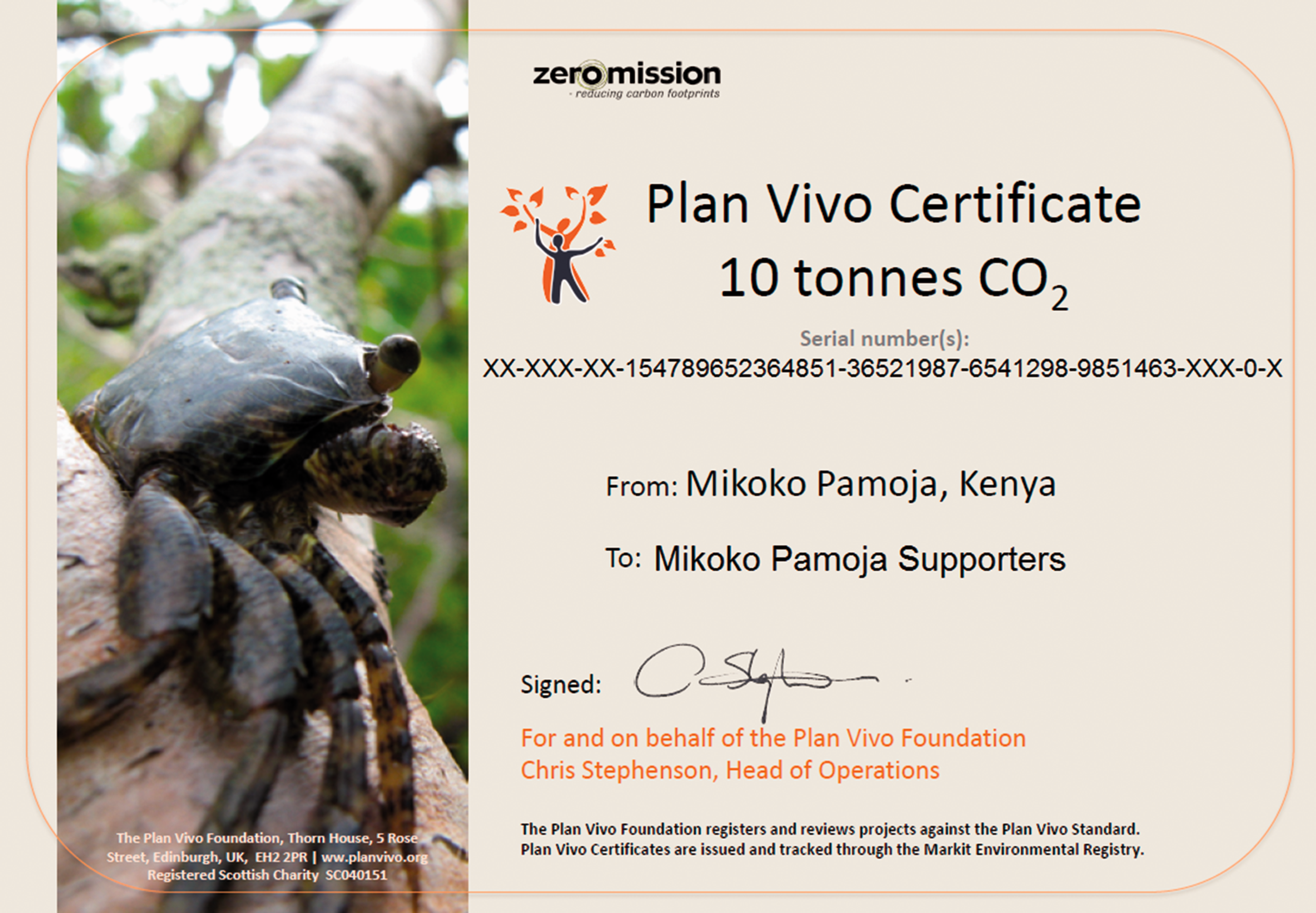
Sample Plan Vivo certificate, featured on the website of the Association for Coastal Ecosystem Services (2017).
We like to get to know our clients and ensure that we’re providing them with the assurance that their contributions will make a real difference. We want to work with environmentally, socially and ethically-driven buyers, not big polluters whose offsetting simply ticks a box.
Making mangroves fit the model
Like all VCM carbon forestry projects, mangrove projects must follow industry standards for setting baselines, creating additional carbon storage, controlling leakage and demonstrating permanence of ‘emissions reductions’ in a delineated area to obtain third-party verification (Figure 3). However specific requirements vary based on the verification standard applied. Plan Vivo requires that potential projects submit detailed plans in the form of a Project Idea Note, a Technical Specification and a Project Design Document (PDD), in order to demonstrate how the project’s activities will apply the technology of ‘Net Carbon Benefit,’ a description of project risks, and description of metrics, indicators and methods of monitoring (Berry, 2017). Net Carbon Benefit is calculated based on annual reports and using a simple formula: total emissions reductions compared against the baseline scenario, after estimated losses from leakage are subtracted (Berry, 2017: 3–4).
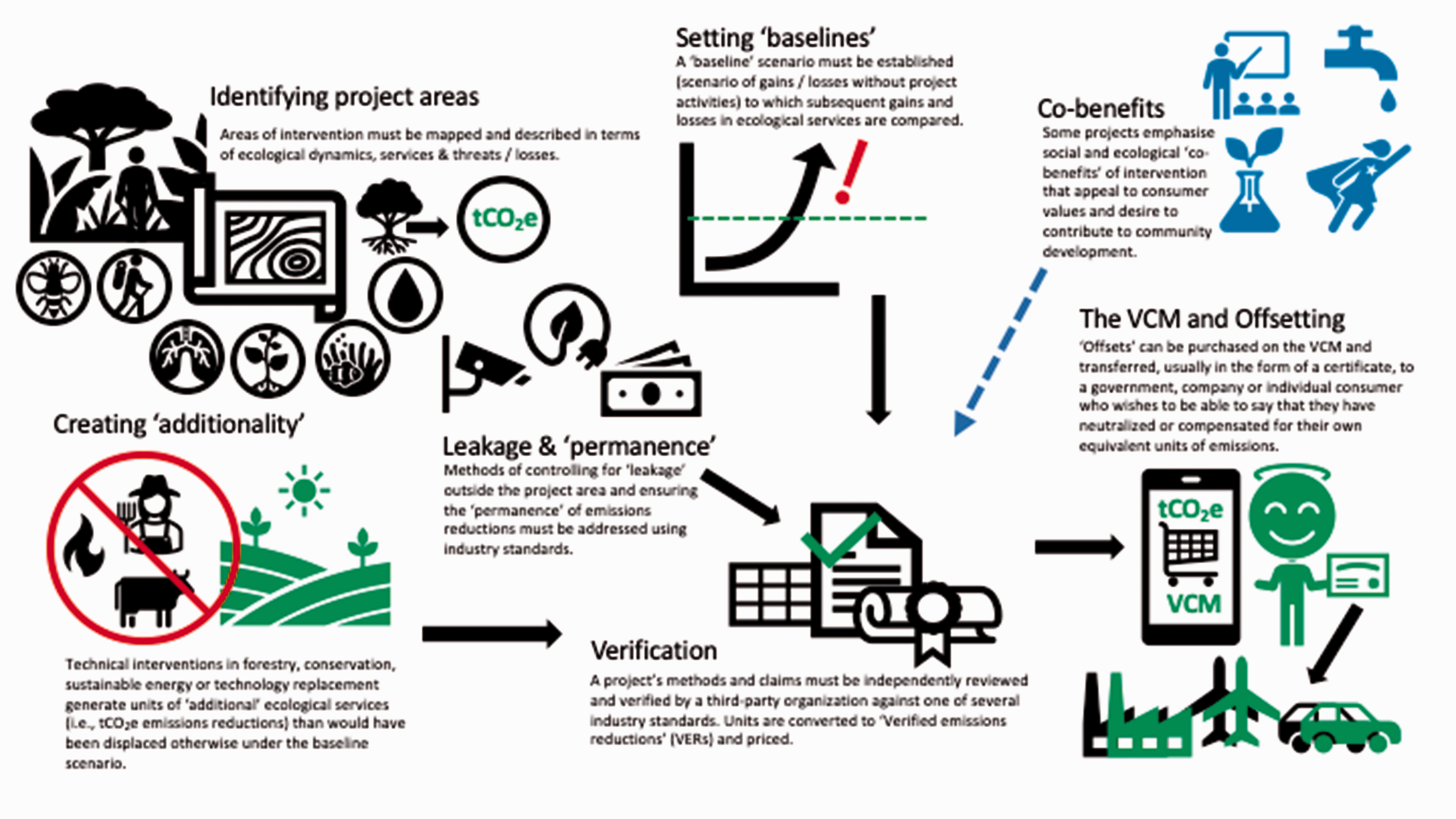
General technical aspects of project-based production of VCM offsets.
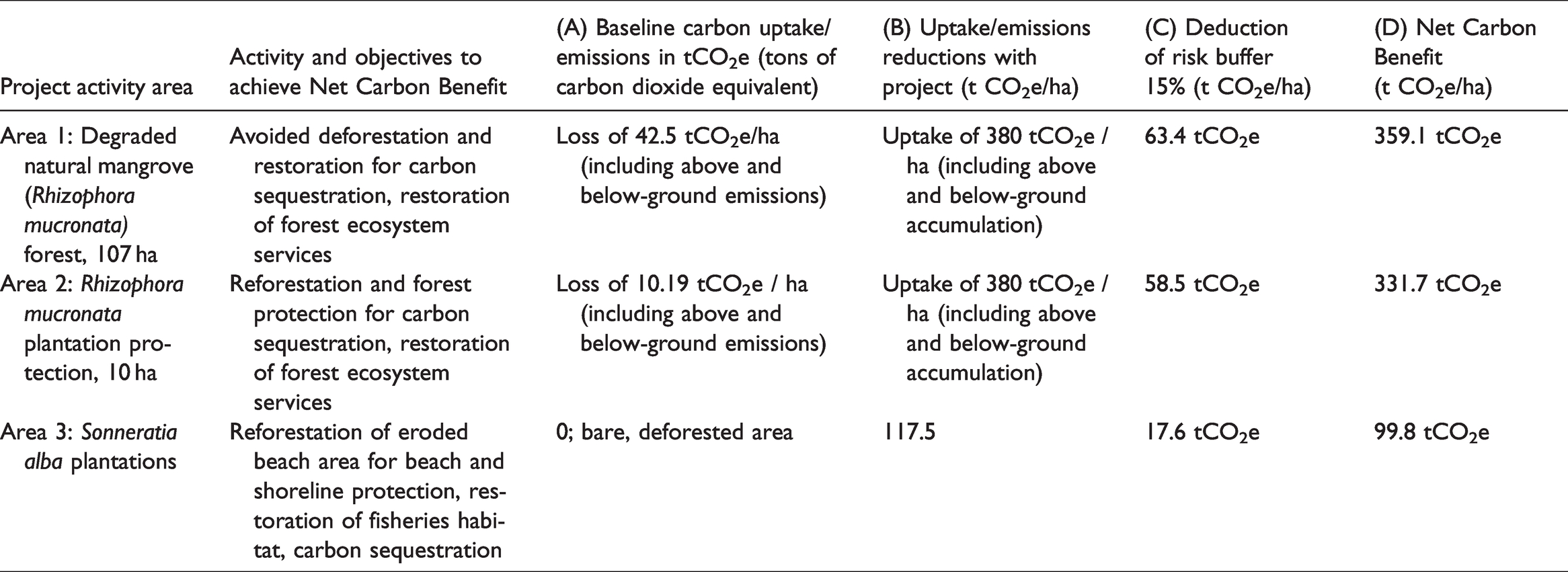
The Gazi mangroves involved in the project were sub-divided into three project areas, subject to different management activities to achieve emissions reductions over a 20-year forecast period. The project areas include natural mangrove forest (107 hectares), previously cultivated plantation stock (10 hectares) and areas that are to be gradually expanded through new plantations at the rate of 0.4 hectare per year. To control leakage, the project established a local woodlot planted with 3,000 fast-growing Casuarina equisitifolia (Australian pine) seedlings to provide fuel wood and timber for local building needs, with sales of wood providing income for the MPCBO-managed development fund (Huxham, 2011, 2013). Drawing from the Mikoko Pamoja PDD, the project technical specification and results of interviews with members of the Steering Group, the estimated baseline, emissions reductions and Net Carbon Benefit for each activity area over the projected 20-year certification period are presented in Table 1. The procedures for mapping project areas, estimating baselines, assessing losses, calculating risks and management techniques proposed to achieve Net Carbon Benefit are discussed in detail in the publicly available PDD and Technical Specifications document (see Huxham 2011, 2013).
Summary of project activities, baseline and project carbon uptake/emissions reductions per hectare over the 20-year crediting period. Calculations of Net Carbon Benefit assume that project activities neutralise losses of baseline scenario, therefore [Neutralised losses (A) + Uptake (B)] – [Risk buffer (C)] = Net Carbon Benefit (D).
A review of these documents might make the production of offsets seem a more-or-less straightforward matter of planting trees, applying the right technical tools with rigor and introducing new management practices to any landscape. However, by delving below the surface of the technical operation, applying these measures in context becomes significantly more complicated. Once established, the project has required a significant amount of bureaucratic work, skilled scientific labour and manual labour to maintain. Gathering information for annual reports means that community meetings, economic and social activities of the project and their impacts must be meticulously documented. Project staff, international research volunteers and trained local volunteers must regularly measure and document mangrove losses through ‘stump counting’ and assess carbon storage by measuring mangrove tree growth and below-ground biomass.
Meeting plantation quotas means that each year 4000 new mangrove seedlings must be carefully gathered, planted in nursery plots, and then protected until they can be transplanted to plantation areas. Many mangrove conservation and rehabilitation projects around the world use non-native species for plantation monoculture due to differential ease of propagation. In contrast, because a stated aim of Mikoko Pamoja is restoration, all mangrove plantation activities involve propagation of native species (mostly Rhizophora mucronata and Sonneratia alba). This requires the enrollment of already existing forest stands in the technical plan because natural forest is more productive than plantation. However, the natural forests are also more sensitive to changes in seasonality and other fluctuations in the environment (Ingwall, 2005). There is no guarantee that enough seedlings will be produced annually to meet plantation quotas, and seed production and germination cannot be ‘forced.’
Making the ‘blue forest’
Before there was a research station, a project, or a ‘blue forest,’ mangroves were the centre of the commercial and subsistence economies of people living around Gazi Bay for generations. The harvest and export of mangrove ‘poles,’ valued for their strength and sturdiness in building construction, has been an important part of markets and cultural networks linking East Africa and the Persian Gulf for millennia (Curtin, 1981). During the colonial period in Kenya, mangrove pole, charcoal and firewood exports became important sources of revenue for the British colonial government and middlemen despite volatile markets. All mangroves were declared to be property of the Crown and colonial authorities instituted a concessionary system of exploitation with permits for individual harvesters (Dahdouh-Guebas et al., 2000). Following Kenyan independence, mangrove pole exports were banned due to subsequent deforestation of mangrove areas, re-allowed, and then banned again in the 1980s (Dahdouh-Guebas et al., 2000). Throughout, people of the Swahili Coast have used mangroves directly as a source of materials to build houses, furniture, fences and fishing boats; fuelwood; tannins; medicine; fodder for livestock; honey and other foraged foods and as fertile fishing and marine foraging grounds (Ingwall, 2005; Kairo et al., 2009).
When ‘blue carbon’ appeared on the climate policy agenda in 2009, the 615 hectares of mangrove forest at Gazi Bay were arguably already the most thoroughly researched mangroves in Africa and among the most well researched on Earth (Huxham, 2011). This is because, from the early 1990s, in line with Kenya’s aims to enhance the national forestry sector and coinciding with early experiments in forestry-based voluntary emissions offsetting by US-based firms, the KMFRI initiated trial mangrove plantations, and Gazi Bay was selected as a pilot area (Bellassen and Leguet, 2007; Kairo, 1995b; Watt, 2021). Members of mangrove-adjacent communities were encouraged to create plantations using native varieties (Rhizphora mucronata, Ceriops tagal, Bruguiera gymnorrhiza, Avicennia marina and Sonneratia alba) in areas that had been severely disturbed or deforested in the 1970s (Ingwall, 2005).
As the concept of ecosystem services grew in popularity in the early 2000s, so did the interest of a variety of international partners and donors in developing and refining new ecological assessment and accounting techniques catered to different ecological areas (Ring et al., 2010; Sukhdev et al., 2014; WAVES, 2014). Kairo and colleagues (2009) estimate that by 2006 over one million mangrove seedlings had been planted in Gazi Bay pilot areas, demonstrating the feasibility of mangrove afforestation, rehabilitation and restoration using plantations, and techniques had been pioneered specifically for valuing a variety of mangrove-based ecosystem services, including carbon sequestration based on assessment of above- and below-ground biomass (see, for example, Chmura, 2005; Fujimoto et al., 2009; Twilley et al., 1992).
Because of this, at the turn of the decade, Kenyan and international researchers, policy professionals and donors saw the communities and local mangrove forests of Gazi Bay as well-positioned to serve as the model ‘blue forest.’ Key infrastructures and capacities on which the Mikoko Pamoja project would be built were already in place: knowledge and technical infrastructure and international partnerships accumulated over more than a decade of research (Kirui et al., 2008, 2012; Tamooh et al., 2008). Second, physical infrastructure including a mangrove research station, laboratory and dormitories already existed in Gazi village, maintained by the KMFRI. Third, past research had established rapport among researchers and people living in mangrove-adjacent villages around Gazi Bay through a legacy of incorporating residents’ and forest users’ participation in mangrove research and forestry activities (Huxham, 2011; Kairo, 1995a).
Making ‘the community’ and co-benefits
Projects with Plan Vivo verification must show ecological and social co-benefits. Specifically, they must enhance biodiversity and other ecosystem services at the project- and landscape level, and demonstrate a high degree of ‘Community Ownership’ alongside ‘Net Carbon Benefit’ (Plan Vivo, 2010). Because mangroves provide a wide range of ‘ecosystem services’, including coastal protection, supporting biodiversity, providing nursery habitat for fisheries and water purification, preserving and restoring them is considered to bring multiple additional ecological benefits and satisfy this requirement (Huxham, 2011). Establishing community ownership was somewhat more complicated, and changes to two dimensions of property relations had to be made before full project activities could begin. First, ‘the community’ needed to be created and made able to make legally binding decisions about mangrove management. Second, ‘the community’ must have a legal claim – resource rights – to the tCO2e sequestered in those mangroves, allowing the PES mechanism to be implemented and to deliver benefits from the sale of offsets back to ‘the community’. ‘The community’ in relation to both dimensions of property and in its common usage by the Steering Group refers to the MPCBO.
This situation came about due to the decision to institutionally ‘embed’ the project in Kenya’s forest management regime. In addition to essentially re-defining forests in terms of ‘ecosystem services’, the sweeping reforms of Kenya’s Forest Act no 7 of 2005 had created space for the co-management of forests between forest-adjacent communities and the new Kenya Forest Service (KFS, 2020; Ludeki et al., 2006; Republic of Kenya, 2005). The 2005 reforms created Joint Forest Management as a mechanism to facilitate partnerships between local level groups and extra-local stakeholders in local Community Forestry Associations (CFAs), who would then partner with the KFS an implementing partner. JFM is formalised through Forest Management Agreements (FMAs), which specify users’ rights, responsibilities, and entitlements to benefits (Banana et al., 2013).
The MPCBO was granted status as a Community-Based Organisation (CBO) by the Ministry of Gender, Children and Social Development in 2012. Comprising thirteen volunteer individuals – six from Gazi village, six from Makongeni village and one chairperson – the MPCBO serves as a proxy group for their respective village populations in matters of project governance. In line with the 2005 reforms, the MPCBO was conceptualised as a sub-organisation in a larger CFA, the Gogoni-Gazi Community Forest Association (GOGACOFA), under a an FMA with the KFS which still needed to be established, which was challenging and expensive. The Steering Group member who led this process said that establishing new local level governance institutions and developing the management plan required about USD $30,000 of external funding and substantial contributions from residents, project staff, international experts, and a core technical team that included representatives of Kenya Wildlife Service, the KFS, the KMFRI, the World Wide Fund for Nature (WWF), the nearby Base titanium operation and members of existing forest user groups and conservation groups (KFS and GOGACOFA, 2013).
In October of 2013, the CFA entered into formal co-management with the KFS (KFS and GOGACOFA, 2013). This granted the MPCBO tenure of project areas and the carbon rights to which the project’s PES scheme is anchored. It also established the legal mechanism by which funds from project-based carbon sales go directly to the MPCBO development fund. In exchange, the agreement devolves a substantial level of responsibility and accountability to the MPCBO. They must coordinate voluntary work by townspeople to monitor areas under protection, expand plantations, police project areas, ensure that rules about resource use are adhered to, and manage funds and community development projects associated with the PES scheme. If they fail to effectively constrain mangrove wood extraction in protected plots, the highly militarised KFS is authorised to step in and enforce the prohibitions.
Normalising ‘blue carbon’: transforming values in vivo
At a communal evening meal to break the Ramadan fast hosted by several members of Gazi Women, a local NGO that maintains the Gazi mangrove canopy boardwalk and serves catered Swahili cuisine for ecotourists, one of the hostesses explained that mangroves ‘have always been our life.’ Going around the circle, the women listed the many uses of mangroves – for poles to build their own houses and furniture, but also extracted in bulk and sold for cash by professional pole-cutters; a source of fiber for weaving mats and baskets and for making rope; firewood for cooking; a source of medicines; supporting local fisheries and providing food for local populations. In addition to aesthetic and cultural values associated with mangrove forests, their commercial value lay in the significant income derived from the sale of raw forest materials, products produced locally from them and fishing yields.
Some of the most lucrative commercial activities were associated with main drivers of forest and coastal degradation identified by natural scientists affiliated with the project, including wood extracted by licensed and illegal pole cutting, conversion pressure from aquaculture projects and pollution. In order to produce offsets, the majority of residents who have long been dependent on local mangrove extraction – particularly pole extraction – for daily needs and income – faced three possible situations simultaneously: exclusion and economic dispossession as pole-cutting became criminalised; acceptance of the commercial logic of the VCM and offsetting, and making the choice to adapt their activities in accordance; or persuasion that the collective benefits of a population-wide transition to carbon forestry could eventually balance, outweigh or supplement the loss of pole cutting locally. Facing the first situation, some pole cutters found replacement work in manual labour or the service sector of the tourist economy, but most were not so fortunate. Jobs were scarce due to what many residents of Gazi described as a depressed regional tourism economy, mainly due to fear around terror-related events in Kenya in recent years.
Regarding the second, the Steering Group implemented a programme of voluntary education and training to sensitise people to the idea of ecosystem services, carbon markets and carbon forestry practices, including offering training and volunteer work using techniques of measuring and monitoring mangrove cover (see Cousins et al., 2017). While participation has been high, the accessibility and uptake of knowledge about carbon forestry has been very uneven. Many people in Gazi and Makongeni said during interviews that the project has helped them learn more about the local ecology and the importance of conservation, but even some members of the MPCBO say that they really do not understand carbon offsetting, why Europeans do not just grow their own forests, how offsetting relates to climate change or even what, exactly, is meant by ‘this invisible carbon.’
Considering this, the flow of tangible incentives is important for maintaining residents’ cooperation and the Steering Group has tried to incentivise compliance by supporting a variety of grassroots development initiatives by local associations (such as the ecotourism boardwalk) and through the PES scheme, even considering offering start-up loans for local enterprises. The steering group, with support of the MPCBO, coordinates educational activities, such as visiting scientist presentations, science, math and English lessons for school children and special events like an annual beach clean-up day. The MPCBO and project staff support alternative livelihood projects (usually initiated by the county government or other national NGOs) and create occasional paid work opportunities when funds are available.
Despite this, the MPCBO must work continuously to sustain project support among residents of Gazi and Makongeni villages, ensure compliance and demonstrate diligence around rules about mangrove resource extraction. Arguably, the MPCBO’s most important work relative to maintaining broader incentives is management of PES funds. Revenues are far too low to provide individual or household payouts, so the prevailing rules on how funds from the PES scheme will be spent are that (1) funds are divided equally between the two villages, (2) projects are decided through a public consensus process in the context of open democratic assemblies, or baraza and (3) that projects must provide benefits that are accessible to all village residents, with benefits to children considered de facto to be shared by all. Prior to 2016, projects had included the installation of electrically powered water pumps in the two villages, repairs to local school buildings and the purchase of textbooks. A project nominated during the summer of 2016 was to repair the leaking roof of the local madrassa.
The promise of reliable, and possibly increasing, funds flowing from offset sales to the PES scheme are the primary motivation for most residents of Gazi and Makongeni villages who are not part of the MPCBO to accept the project at all. As explained in the special meeting called by the MPCBO when Carl, the visiting carbon broker from ZeroMission, asked the assembled group, ‘What would happen if carbon payments stopped?’ an elder member of the MPCBO responded plainly, ‘if the payments stop, the mangroves will be cut down in a day.’ He went on to explain that even though people know more now about the mangrove ecology, ecosystem services, and fisheries than before, the forests would be lost rapidly because of people’s immediate needs.
Whether this would happen or was positioning on the part of the committee member is up for debate, but this exchange highlights major tensions between the project and residents more broadly. In an interview, the project coordinator further explained, ‘the money from carbon sales is what has brought people together as “the community” more than anything else. We did not have that before.’ He explained the precarity of this situation for the project in the simplest terms: ‘[ … ] if the funds are lost, we lose the community.’ The implication was that if the PES scheme were compromised, then local support and compliance pressure, the enabling formal governance structures (the CFA and MPCBO), and the primary source of the project’s social co-benefits that make the project’s offsets attractive to buyers and politicians, would collapse.
Fictions and frictions in the commodification of boutique ‘carbon’
The commodification of virtual nature
Gazi Bay’s mangroves have always been subject to management and materials extraction, and have always been part of commercial markets, capitalist and otherwise. However, producing carbon offsets involves fundamentally different technologies and techniques than conventional ways of extracting economic value from nature. In the case presented, we see this in the repair technology of ‘Net Carbon Benefit’ and in the types of knowledge and inscription, metrological and governance techniques that are minimally required to render the central fiction of tCO2e and bring a ‘project area’ into the space of the globalised repair economy. The introduction of this technology has facilitated what we should think of as the re-commercialisation of Gazi’s mangroves. It has done this by instituting new management logics that go far beyond simply ‘re-branding’ or filling a ‘charisma gap’. It has facilitated the (non-consecutive) processes and degrees of technical abstraction required to produce a new, freed-up virtual nature that is the basis of commodity production in the VCM.
All processes of commodity production involve degrees of abstraction. Commercial wood harvesting in the extensive mode ‘detaches’ the asset from its entangled and generative relations through a literal cut and physical removal process. An old growth tree is felled or uprooted and as part of this extraction process and is redefined in anthropocentric terms as part of the general category of ‘timber.’ In this example, the market object of timber or eventually lumber would be a product of fictitious commodification by Polanyian standards, associated with the extensive production of nature.
In the intensive mode, however, this process is achieved through a discursive ‘cut’ that frees or disentangles the idea of a qualitative object (e.g. a defined type of biomass) from its situated relations so that its properties can be re-defined in anthropocentric and economistic terms as ‘ecosystem services’ (e.g. carbon sequestration) and beneficiaries (Castree, 2003; Kay, 2016; Osborne, 2015). This creates a simplified and standardised object that is visible to policy and the VCM gaze, but not yet a commodity. In the context of Mikoko Pamoja, this ‘cutting’ commenced in the decade of prior research that was specifically focused on re-framing Gazi Bay mangrove ecology in terms of ecosystem services and ‘natural capital.’ Re-commercialisation in this instance is a moment when concrete, bio-geo-physical nature and its properties are subsumed, defined as a resource and drawn into a new virtual form and value framework (Boyd et al., 2001; Carton and Andersson, 2017).
The object of the ecosystem service also must be made bureaucratically legible to legally establish the PES scheme. While mapping boundaries and describing the project areas, constitutive species and natural processes and specifying methods for achieving additionality shifted the ecosystem service from a qualitative set of properties to measurable and quantifiable substances, the co-management agreement created the asset or property relation. This had similar effects to privatisation in that it formally allocated rights to manage, make decisions about and derive market value from the ecosystem service of carbon sequestration (Bakker, 2005; Kenney-Lazar, 2012; Mansfield, 2009). Even though it might seem to be as a straight-forward process of legal rationalisation, ‘abstraction captures the totality of this process’ (Kenney-Lazar, 2012: 1022).
Further abstraction is required to render the basic commodity form as ‘tCO2e’ – one ton of carbon dioxide equivalent, itself an abstract construct (cf. Lohmann, 2009a; 2011b; Lovell and Liverman, 2010; MacKenzie, 2009) – and bring it into pre-defined asset class as a priced substitutable unit of climate impact. This happens through verification – when proposed metrics, project timeline and calculative methods are approved by a third-party organisation such as Plan Vivo. Based on annual reporting, the project’s progress toward its promised cumulative target of additional impact is verified by Plan Vivo, and this is the basis on which the priced offsets are issued in the form of Plan Vivo Certificates. In this way, verification brings virtual nature into the VCM, confirming its commensurability and fungibility, that a ton is a ton like any other.
These dynamics constitute what I described as ‘disruptive’ dimension of the fetish, the virtuality that breaks down qualitative socio-nature and re-materialises it as quantitative impact, and which is the fictional and contested foundation of making nature restorable, repairable and offset-able. Recognising the work of virtuality makes visible and de-fetishes the complicated technical means of making a nature that fits easily into the market environmentalist model. It clarifies how virtual nature is constructed through a chain of technical renderings, each of which creates rupture and greater ‘distance’ as we move from already existing, situated, qualitative and often ‘uncooperative’ ecological relations to categories of greater and greater abstraction and calculability.
This understanding what ‘nature’ is being commodified in the VCM is relevant to exploring the question of fictitious commodification in the context of carbon forestry. In Polanyi’s analysis, fictitious commodification was not simply a definition, but was a relational notion embedded in a broader imminent critique focused on the contradictions involved in attempts to commodify entities that exist prior to the market, background conditions of life and social reproduction, ‘intertwined human, communal, and natural activities of repair, renewal, regeneration, and reproduction’ (O'Connor, 1994: 106). This analysis demonstrates that VCM carbon offsets are not in fact ‘actively produced when carbon is sequestered in trees’ (Osborne and Shapiro-Garza, 2017: 4) – this is spectacle that masks the deeper technical transformations addressed above. Rather, as a product of virtual nature, in their basic form VCM carbon offsets are disembedded, spectacular, intangible commodities. There is no underlying concrete asset, only an imaginary. They can only be created in the context a project designed to materialise the unrooted and substitutable nature imagined by market environmentalism. They are not fictitious commodities; they are a ‘fix’ for the crises and contradictions of fictitious commodification and subjecting the nature to the ravages of the ‘satanic mill’ that Polanyi was concerned with in the first place.
The values and volatilities of virtuous carbon
Mikoko Pamoja’s claims to singularity are based on scientific rigor, ethical practice, transparency, cultivated relationships, development benefits and landscape level ecological repair channeled into global climate change mitigation in line with the market environmentalist discourse. The project’s marketing tells a story of an impact commodity that is inseparable from its ideal relations of production. These include, at the centre, an ambitious East African community that is thriving because it has come together and embraced the values and potential of the repair economy to lift people out of poverty whilst helping northern consumers tackle the global challenge of climate change. Narratives about women’s and youth empowerment, local development, alternative livelihoods and education construct the image of a project that is embedded in both endogenous ‘community’ institutions and ecologies.
Of course, ‘community’ is notoriously tricky term, but its use in development discourse implies ‘a people-centred, participatory, or grassroot-level approach’ that conveys ‘a “moral license” that supposedly guarantees that the actions being taken are genuinely people-centred and ethically justified’ (Titz et al., 2018: 70). I can and should acknowledge very real care and conscientious work of the Mikoko Pamoja Steering Group, members of the MPCBO, women’s organisations and others involved in the project whilst at the same time recognising that, like ‘Net Carbon Benefit,’ ‘Community ownership’ is a marketising technology that creates abstraction and brings unevenly allocated benefits and risks. It is important to the charisma of the offsets, indicating to buyers that ‘the local people’ have been empowered and stand to benefit. Regardless of appearances, contradictions of the intensive production of nature create a ‘faltering materiality’ (Nel, 2017) that is inherently unstable, in part because it masks the sorts of contestations, hazards and risks that can arise in project settings and among a project’s broader web of relations. These sorts of contestations, hazards and risks characterise the repair mode in a general sense.
For example, the construct of ‘ecosystem services’ implies that nature itself is doing the ‘work’ to create the ecosystem service that underlies the offset. However, careful and constant work by people has gone into bringing about alignments among global conservation and development organisations, researchers, policy professionals, security forces, corporate actors, diverse groups of village residents, brokers and government actors who play a role at a number of levels. Maintaining the project relations and mangrove plots requires a great deal of voluntary labour, from planting and re-planting seedlings to documenting carbon storage to mobilising local support to policing illegal extraction. Yet, according to the KFS and members of the Steering Group, while the revenue from donations and the PES scheme is incentive, it is insufficient to compensate people for the work that they do and the livelihood benefits that they have consented to forego in the hope of future, bigger, project benefits.
One clear example of this materiality is the construction of the co-management contract. Projects and governance contracts are not created in a vacuum. Situated regimes of property, land use, labour and production are reinterpreted and reconfigured through universal, abstract notions of conservation and plantation propagation, ‘proper’ land use, management tools, inclusions and exclusions. This in turn alters which resources are prioritised, how they can be used in household production and who is entitled to use them (Kenney-Lazar, 2012). In terms of deriving value or benefits at the project level, the co-management process described in the case pertains primarily to the abstract entity of the ‘ecosystem service’ of carbon sequestration. Related land and forest use and values are constrained by a governance framework decided by the KFS and dictated by the market model. While seeming to grant ‘local people’ tenure over forests and forest resources, the co-management arrangement involves a tricky set of trade-offs. It allowed the PES mechanism to be introduced, but at the same time formally cedes significant control and authority to the militarised KFS. The tenure granted through co-management is conditional and provisional, not the same as ownership. A situation in which MPCBO fails to manage in ways that are acceptable to the KFS, even if due to factors beyond their control, could precipitate a move to securitise the gazette at Gazi Bay by the KFS. This could in turn open up possibilities for new exclusions, environmental threats and potential violence, both within mangrove-dependent villages and between residents and government actors.
The construction of fictive place through the application of Community ownership creates additional points of slippage between emplaced experienced reality and imagined geographies of virtuous development and global climate change mitigation. Attention to this ‘second’ dimension of the fetish shows how the virtuality/virtue dynamic can be productive, not just of market value but of a governmentality that works at different scales by enabling the performance of virtuous ‘sustainable’ consumption and rural ‘development’ at a great social and geographic distance from concrete sites of intervention. Simultaneously it creates unseen risks, not just at project sites, but also within the ‘global’ political ecologies of repair that they enmesh.
As Cavanagh and Benjaminsen (2014: 56) have suggested, the production of carbon offsets is co-dependent on the globality of relationships between those who emit, those who sequester, and the ecosystems and technologies enrolled by both. If one of these components functions as required but another falters, the carbon offset unravels as an entity and its value evaporates. Politically, the virtuality/virtue dynamic intervenes in public and policy debates by reinforcing the normativity and ethical imperative of carbon markets as the response to climate change whilst it incentivises continuing emissions, undermines consideration of alternative pathways and neutralises critique of policy instruments and hazards associated with the carbon economy and specific projects (Paterson and Stripple, 2012: 569).
Conclusion: Of fictions and frictions
The carbon economy of repair presents the opportunity and challenge to critically explore and extend our understanding of the commodification of nature and the co-production of market value and ecologies of repair. By opening up the black box of value production in the VCM, we can see that carbon forestry is particularly saturated with virtuality. The moments of abstraction highlighted in this case each demonstrate in different ways how the virtuality/virtue dynamic can work at and beyond the project level, through both disruptive and productive politics of the fetish, to co-produce the spectacular and layered fictions and points of slippage that stabilise the ‘virtuous’ carbon offset, the VCM and the market-world model more broadly (Callon et al., 2002: 197; Corson and MacDonald, 2012: 162; Kosoy and Corbera, 2010: 1229).
These slippages are not simply conceptual abstractions. This politics supports a dual pathway of accumulation via the material extraction of nature to feed the expansion of industrial growth (the subject of Polanyi’s critique) and, in parallel, through new growth markets that promise to repair the damage caused by industrial growth but can only ‘work’ in the abstracted, virtual realm despite entanglement with underlying concrete ecologies of repair. These politics create ‘fictions’ but they also create ‘frictions’ as they work to restructure nature-society relations and to provisionally stabilise a model of reality that is laden with contradiction. This creates a social and technical mediation of society–nature relationships, facilitated through processes of ‘scale-making’ that grow from ‘spatially far-flung collaborations and interconnections’ among diverse infrastructures, organisations, territories, ideas and people coalesce around and enmesh particular VCM initiatives (Tsing, 2000, 2005: ix). Thus, considering the ‘blue forest’ as a project of ‘scale-making’ and ‘world-making’ (Tsing, 2000: 347), I suggest that carbon offsets can be better understood in a post-Polanyian sense, as frictitious commodities that inhabit a complicated, contradictory and only provisionally stabilised commodity form.
Rather than addressing root drivers of social, economic and ecological crises or even supporting incremental steps towards decarbonisation, in capitalising on the downsides of growth, we can see that the institutionalisation and normalisation of logics of the repair mode have involutionary effects that serve to reproduce and intensify social and ecologically detrimental value relations. Carbon markets can only be seen to represent evolution towards the protective Polanyian ‘double movement’ if we disregard societal changes, accept these underlying value relations as ‘natural’ and overlook the fictions, spectacular politics and contradictions of ‘sustainability’ in the repair mode.
Highlights
The widespread view of carbon offsets as Polanyian ‘embedded’ ‘fictitious commodities’ is incomplete, based on an ontological fallacy. This view conflates concrete and abstract ‘natures’ and how they are used to produce commodities, which reifies the central fictions and contradictions of carbon markets and market environmentalist ideology. VCM carbon forestry exemplifies conservation in the ‘repair mode,’ enabling accumulation via the extensive as well as intensive extraction of value from nature. The politics of ‘accumulation by restoration’ and conservation in the ‘repair mode’ incentivise continuing ecological harm whilst creating a governmentality that undermines consideration of alternative pathways. Even exceptionally ‘virtuous’ (community-driven, care-based and socially responsible) carbon forestry projects must contend with the broader hazards and contradictions of carbon markets and the market environmentalist model.
Footnotes
Acknowledgements
Many thanks to the people who supported and facilitated fieldwork, writing and revision of this article, including Harriet Dudley, Parveen Mungroo and Nathan Oxley of the ESRC STEPS Centre; Charles Tonui and Joanes Atela of the African Centre for Technology Studies in Nairobi; James Kairo, Mark Huxham, Salim Abdullah, Anne Wanjiru, Caroline Wanjiru, Molly Czachur and other Mikoko Pamoja steering group members, student researchers and staff; members of the Mikoko Pamoja Community Based Organisation; Gazi Women and other groups in Gazi and Makongeni villages for their hospitality, patience and assistance. Thanks as well to Ian Scoones, Zach Anderson, Patrick Huff, Eve Chiapello, Anita Engels, Andrea Brock and anonymous reviewers for feedback on various drafts.
Declaration of conflicting interests
The author(s) declared no potential conflicts of interest with respect to the research, authorship, and/or publication of this article.
Funding
The author(s) disclosed receipt of the following financial support for the research, authorship, and/or publication of this article: This work was supported by the ESRC STEPS Centre at the University of Sussex under Grant ES/I021620/1. Open access publication was supported by the UKRI Open Access Block Award 2021 (EP/W522788/1).
