




Abstract
‘Nature-Based Integration’ (NBI) has been proposed as a solution to two prominent issues in contemporary Nordic societies: increasing separation from nature among ‘modern’ societies; and the need to ‘integrate’ groups of diverse newcomers. This article examines NBI activities in Örebro County, central Sweden, exploring how these practices seek to bring immigrants into a shared Swedish experiential landscape that forms part of the work of ordering Sweden as a community. These activities form part of an ordering project, within which ‘Swedes’ and ‘newcomers’ are situated, drawing on extant nationalist orderings. Likewise, it represents part of an effort to enact a sustainable Sweden in an international world. Drawing on research on environmental racism and (in)justice, this article homes in on the norms implicit and explicit to this ordering. It then discusses the implications of this, highlighting (arguably unavoidable) coercive elements. Furthermore, the long history of outdoor lifestyle as a pillar of Swedish nationalism and the embracing of such activities by the Swedish far right highlight that nature may also become a site of conflict as much as conciliation. Finally, the article considers the types of environmental action arising from the NBI orderings and the likelihood of meaningful environmental change.
Introduction
Migration has become a prominent political topic in many Western countries, often framed as a ‘problem’, presenting myriad challenges for welfare states and national identities (Schierup et al., 2006). Sweden is no exception to this; since the early 1990s migration and integration issues have been a prominent part of the political landscape, with populist parties rising and exerting considerable influence on migration policy (Salmonsson and Hedlund, 2018). While the arrival of groups of migrants has provoked conflict and backlash, with violence directed at newcomers (Arora-Jonsson, 2017; Hirvonen, 2013), the idea of ‘cultural diversity’ and support for immigrants’ rights remain popular (Ahmadi et al., 2016). Large numbers of people continue to seek asylum in Sweden, 2015 being the highest on record with 163,000 applicants, 70% originating in Syria, Afghanistan and Iraq (Salmonsson and Hedlund, 2018: 526). This influx of people has provoked creativity in responses to the various challenges including various programmes aimed at helping newcomers to ‘integrate’; these range from local government employment schemes to church-run ‘language cafes’ to name but two examples. This article focuses on another set of schemes, a series of Nature-Based Integration (NBI) projects in Örebro County, central Sweden.
NBI comprise a nascent and diverse body of practices increasingly prominent across the Nordic countries (Gentin et al., 2018; Pitkänen et al., 2017). These range from schemes to encourage immigrant employment in the agri- and horticultural sectors (Johnson et al., 2017), to urban gardening projects, to various forms of ‘nature-based outdoor recreation’ (friluftsliv) (Gentin et al., 2018). Despite this diversity, NBI are defined as a ‘process in which an immigrant gets familiarized with the local environment, through activities that take place in a natural environment…’ (Gentin et al., 2018: 17). In the case of this article, the NBI projects described comprise several activities based around guided-walks and ‘nature interpretation’ (naturvägledning). I analyse data drawn from these projects in the form of participant observations; interviews with nature guides and others involved with NBI; and project documents that were successful in garnering funds. NBI appear to be increasingly popular. Inquiries to the Swedish Centre for Nature Interpretation report that a majority of Sweden’s 33 naturum (visitor centres in nature) are involved in some form of NBI (personal communication).
Integration ‘commonly refers to both the socio-economic incorporation of immigrants in the host society, and to their socio-cultural adaptation to that society’ (Saharso, 2019: 1). It thus involves meetings of migrants and ‘natives’. However, while it is acknowledged that host societies are not unchanged, integration is often something that newcomers are taken to do (Klarenbeek, 2019). In this research case, ‘newcomers’ and ‘Swedes’ 1 are to become integrated through NBI activities. In this article, I examine NBI as projects in ordering (Kendall and Wickham, 2001). Through sociomaterial action NBI order the Swedish environment, with ‘newcomers’ and ‘Swedes’ situated. I argue that concomitantly NBI are attempts to enact normative ideas about appropriate behaviour in Swedish nature and society with regard to goods and entitlements, seeking to create a society of ‘green citizens’. I thus aim to describe ongoing NBI ordering projects in Örebro, Sweden. I then analyse the consequences of these projects drawing on literature on environmental racism and (in)justice. The article is structured as follows: the next section outlines theoretical tools drawn from the sociology of culture and environmental sociology. After this, I present the fieldwork-based methods assemblage utilised. I then draw on empirical material to describe prominent aspects of the NBI ordering and how they are enacted. Subsequently, I provide a concluding discussion of implications of this ordering arguing that the NBI ordering has inherently coercive elements and these should be acknowledged and borne in mind moving forward.
Order! Order! Theoretical frames
The ontological starting point of this research is the idea that humans, as cultural beings, make sense of complex, messy reality through ordering. The social world is emergent and emerges within self-generating orderings (Law, 2004: 15). This is ordering in the sense of control or management (Kendall and Wickham, 2001: 21), the aspiration for which is something that sociologists have argued is integral to modernity (Law, 1994). All ordering projects aim at objects, but all objects are subject to multiple ordering projects and ordering projects may also be objects. Ordering is thus both a social and material process, a dynamic activity, with multiple ordering projects extant in any given situation. The narratives and stories humans construct about objects and the world are usually based on groups of overlapping ordering projects, termed modes of ordering (Kendall and Wickham, 2001: 44–45). Ordering is an inherent part of human social life, but is not a neutral process. Enacting an ordering is a deeply political action – different agents struggle to enact their competing orderings of a situation. ‘Ordering always takes place in a contested space and, at the same time, paradoxically, the fact of such contestation makes ordering necessary’ (Kendall and Wickham, 2001: 37). This is not simply a social process, orderings enmesh ‘a wide variety of objects, machines, systems, texts, non-humans, bureaucracies, times, without which [orderings] would not happen and could not become what [they are]’ (Franklin, 2004: 279). Furthermore, different modes of ordering may interact or collide in unpredictable ways. As messy, on-going, imperfect, limited projects, one can assess their different implications – i.e. what do particular orderings enable or constrain and what is made known by an ordering?
Utilising this ordering lens, NBI are understood to be the product of a mode of ordering drawing together different projects seeking to order the human population and landscape in Sweden interpellated with a set of tools for action – the NBI activities themselves. I thus focus upon how NBI is done in practice and concomitantly how the world is ordered. This mode of ordering enacts distributions of environmental access and use, with concomitant consequences for the distributions of benefits and costs of any action. Furthermore, it entails self-orderings creating different groups (guides and participants, Swedes and newcomers) as components in processes of ordering and disordering (Kendall and Wickham, 2001). Likewise, this mode enacts normative distributive structures of rights, responsibilities of these groups within Swedish society. I thus also explore the ordering effects of NBI. In this article, I utilise theoretical lenses drawn from across environmental sociology, broadly defined. These include literature on environmental justice and racism and (environmental) citizenship. I now discuss these in turn.
Research on environmental justice is an increasingly prominent multidisciplinary subfield of environmental social science, originating in research on racism in the early 1980s. Environmental justice is ‘the study of the interactions between a differentiated society and a differentiated environment. That is, different social groups are differentiated in their access to resources, power, privilege, and opportunities’ (Timmons Roberts et al., 2018: 235). In terms of orderings, nature and society are interpellated with ordering projects, which produce disparities in power and outcome for groups that are ordered. Such orderings may or may not be consciously formulated. However, such orderings may well be discriminatory (e.g. in the case of racist orderings), with hierarchies integral to society's structures and systems (Delgado and Stefancic, 2001; Pulido, 2000). Examples of research in this field (and the related field of political ecology) have described how conservationist orderings may be continuations of historical and contemporary acts of dispossession (e.g. Neumann, 2002) or contain integral moral orderings of ‘the West and the rest’. Similarly, the costs and benefits of new construction are not distributed evenly, with research showing that new hazardous facilities tend to be located in poorer areas, disproportionately populated by people of colour (Mohai and Saha, 2015a, 2015b).
The constitution of social groups themselves is also a product of ordering projects. Modes of ordering demarcate the rights and responsibilities of people subject to it. As such, citizenship behaviours – rights and responsibilities, what is considered ‘participation’ and other identity practices (cf. Tonkiss and Bloom, 2015: 838–839) – are also coproducts of ordering projects. As is more fully discussed below, many NBI activities contain environmental messages aiming to influence participants’ behaviour in a more environmentally friendly direction, to act as ‘environmental citizens’, with particular relationships to the natural world (Dobson and Bell, 2006; Gabrielson, 2008; Schild, 2016), locally and globally (Szerszynski, 2006). What constitutes environmental behaviour and how an individual ‘does’ environmental citizenship are thus themselves the products of modes of ordering, with diverse implications.
The effects of particular orderings are seldom simple, and indeed the concept of modes of ordering suggests they may interact in complex ways. It is not simply a matter of paying attention to how e.g. an ordering project affects ‘poor people’. Care must be taken not to essentialise ordered categories, separating from their historical and social contexts (Delgado and Stefancic, 2001). Likewise, one needs to examine how actors strategically employ essentialisms within political conflicts (Gaard, 2001).
In sum, this article examines NBI as an ordering project, ‘a way of making the world different, a way of ordering the objects of the world in a new way – and not just human objects’ (Franklin, 2004: 279). This overlaps with and may be subject to other ordering projects. Indeed, I also discuss the other ordering projects NBI activities are dependent on and part of. I then assess the effects of efforts to enact the NBI ordering drawing on writing on environmental justice, racism and citizenship.
Materials and methods
Welcome to Örebro: The case
This article looks at NBI activities ongoing in Örebro County, central Sweden. Örebro is a medium-sized city that in 2018 had a recorded population of 153,367 inhabitants, approximately half of Örebro County’s population of 302,252. Within the same set of statistics, 50,033 of the county’s population are recorded as foreign-born (Statistics Sweden, 2019). In recent years, Örebro municipality has emphasised developing the area’s outdoor recreation potential. The city has 22 nearby areas classified as either nature (20) or cultural reserves (2). These are free to access by any members of the population. This emphasis is recognised nationally, with Örebro crowned Sweden’s ‘outdoor municipality’ four times in recent years (Svennebäck, 2017). It is as part of this emphasis that NBI activities have begun in Örebro.
Several different NBI projects were examined in this article. Among these, each had slightly different foci but had many commonalities. In each case, the main activities that occurred can be summarised as guided walks in nature around Örebro County. 2 In the vast majority of cases, participants were led through a nature reserve, periodically stopping to carry out a set of pre-arranged activities. These varied from walking-quizzes, to language learning exercises, to investigating local nature with tools (e.g. binoculars or telescopes), to meditation, to gathering mushrooms or lighting fires. Many of these activities entailed collective work, fun and engaging with nature utilising a range of senses away from but often by forest tracks. The information that was conveyed during NBI guided walks varied, often a certain amount of botanical information was provided along with some local history. For a fuller description of the observed activities, see Singleton, 2020). Guided walks were often organised around one or two of the ‘universal access laws’ (allemansrätt, Naturvårdsverket, n.d.). These laws (distinctive to Sweden, although neighbouring Nordic countries have similar rules) accord considerable rights to roam and collect resources in the countryside. As such, the activities selected during a walk, for example quizzes, are designed to educate participants and instil a respect for the rules. Indeed, all observations in this study took place in protected areas, where rules are more stringent. Guides would endeavour to inform participants how rules were at variance with the allemansrätt and to encourage them to familiarise themselves with the different levels of protection in Swedish nature. With ‘nature-based outdoor recreation’ (friluftsliv) framed as an important part of modern Swedish identity (Sandell and Öhman, 2010:115–116), the universal access laws are popular (Sandell, 2006). Nature-based outdoor recreation thus has symbolic importance to many Swedes (cf. Beery, 2013). Indeed, to an extent it embodies societal egalitarianism, at least among the middle-class (Dahl, 1998: 300–301).
The studied NBI projects are largely the products of two environmental NGOs, the Swedish Society for Nature Conservation, Örebro County (Naturskyddsförening Örebro län) and Hopajola, which both seek to encourage use of nature. Activities largely began in 2015, when newcomers were trained to become nature guides. Consequently, the municipality hired two trained guides (originating from Syria and Kosovo). Since then, the guides themselves state they have guided in various languages over 2300 people, primarily groups of schoolchildren. They also provide guiding services to adults, including foreign visitors, Swedish-language learners and a series of ‘Nature experiences in several languages’ (Naturupplevelser på Flera Språk (NFS)) aimed generally at all members of local society and funded by Örebro city. This formed part of various municipal, regional and state initiatives to encourage outdoor lifestyles. Similar to NFS is the project ‘Chat between the pines’ (Språka Mellan Tallarna (SMT)). The idea behind SMT is that of a ‘language-café’ in nature. A single person (from Afghanistan) was hired to organise and conduct guided SMT excursions. Other language cafes in Örebro were generally provided through churches. SMT were funded with money from Örebro County’s Wildlife and Nature Conservation Committee (Region Örebro läns Vilt- och naturvårdskommitté). SMT continue periodically round Örebro County largely organised by the participants of a third project ‘Education for nature interpretation in several languages in Örebro County’ (Utbildning Naturvägledning på Andra Språk i Örebro län (ENL)). This was organised by Swedish Society for Nature Conservation, Örebro County and funded from the Swedish Environmental Agency’s ‘Local Nature Conservation Initiative’ fund (LONA-Bidrag). ENL comprised four three-day courses variously in the towns of Nora, Karlskoga and Kopparberg.These differed somewhat from the other activities in terms of length but also because participants received a certificate upon completing a course and conducting a guided activity. Course organisers explicitly framed this certificate as a useful tool for seeking work. As such, ENL resembled other integration initiatives that focus on involving newcomers in the labour market (Grip, 2010).
Data collection and analysis
Research on orderings generally follows three methodological protocols: ‘describe appearances’, ‘describe the appearances of systems of thinking and knowledge’ and ‘describe the uses of appearances’ (Kendall and Wickham, 2001: 79). However, the research process itself is an ordering process. As such, it is important to detail the particular ‘method assemblage’ from which analysis is drawn (Law, 2004) as all knowledge is situated (Haraway, 1991). Indeed, this research ordering is itself a personal experience but one that I am trying to share (Law, 1994). In this article, nature-based integration is understood as something that is done within particular contexts. Several different data collection techniques were thus employed, which are described below. Overall, one can say the project aspired to be ethnographic. Ethnography has been pithily described as ‘immersion in the practical world, being caught up in the incessant flow of everyday life’ (Pálsson, 1994: 920). I wanted to experience the NBI ordering in the contexts it is performed. This called for data collection in situ (Kusenbach, 2003), and methods which could take into account repeated, multi-phasic, affective experiences through time (Bolger et al., 2003; Stewart, 1998; Watson, 2012).
As such, data were collected over the period December 2017 to February 2019 primarily through observations and interviews. As Table 1 outlines, this involved observation data on 18 separate occasions. I recorded NBI activities in a field diary, and on a camera and portable voice recorder, which I collated into relatively unstructured field notes for analysis. Repeated engagement with NBI activities facilitated the building of social relationships, particularly with guides, and allowed me to attend related events outside of NBI projects that respondents were involved with and spend time in the office where they planned activities, giving a sense of the wider contexts within which NBI take place.
Observations collected.
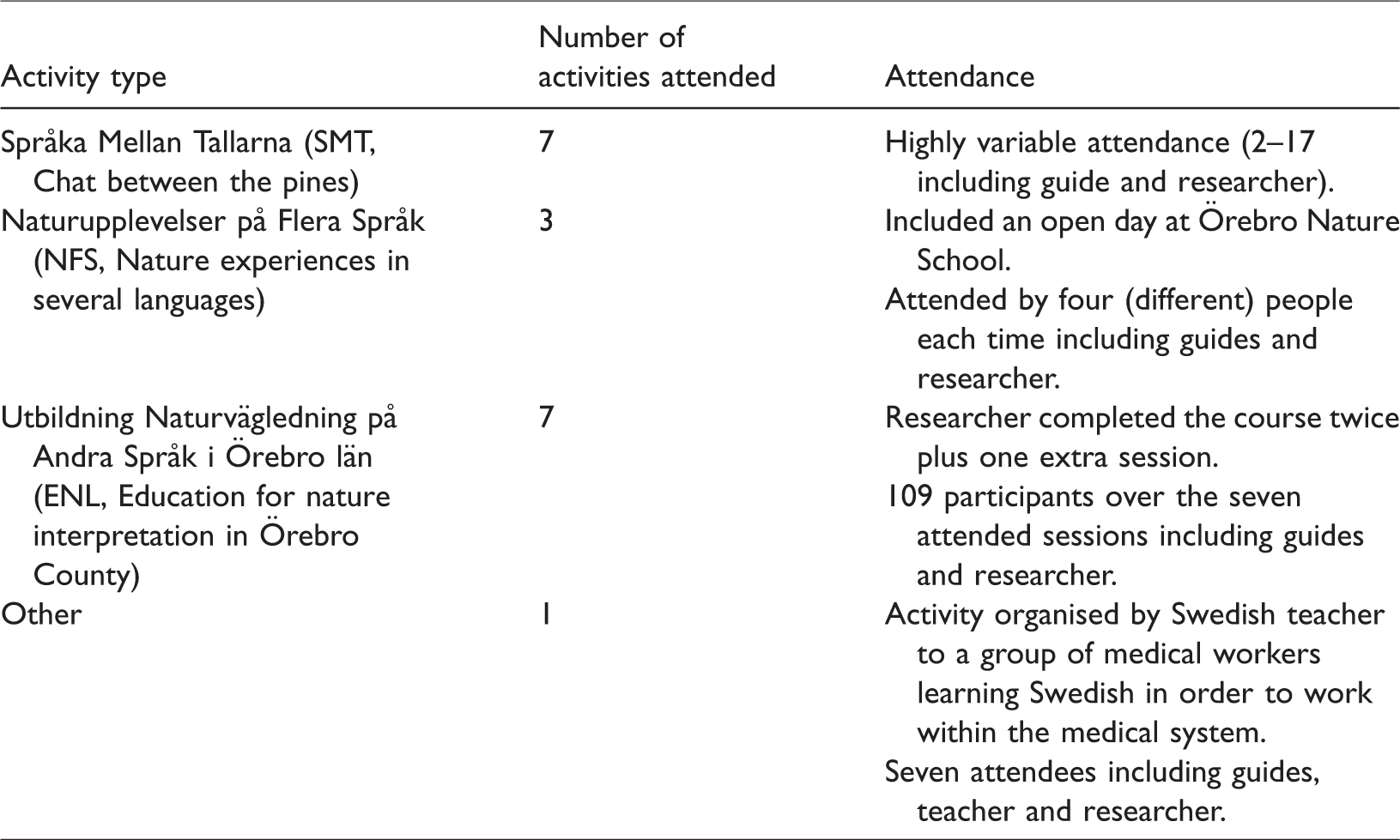
Overall, the number of participants was quite variable, with one SMT session attended only by a guide and myself.ENL course days enrolled many more people, notably 21 attendees including teachers on two of the days in Nora. Most of the time, newcomers outnumbered Swedes. Exceptions were a snowshoe expedition, which was fairly evenly mixed between Swedes and newcomers and an SMT session dominated by Swedes. Over the whole dataset were people originating in 15 different countries. The largest group of newcomers came from Syria (primarily from Assyrian [Christian] background), with Afghans second. The proportion of men to women varied considerably, although participating Swedes were mainly women. Newcomer attendees of SMT, NFS and Other activities were most often men (although with some variation), whereas participants of ENL courses were more evenly mixed. In terms of age, participants ranged from children to retired individuals, with most however at working age as many of the projects predominantly targeted adults. I initially hoped to interview activity-participants. However, the sporadic nature of people’s attendance and variability among respondents rendered this difficult, which also limited the demographic information that I could collect. Indeed, several Swedish participants declined interview invitations. As such, I solicited participants’ views through informal conversations within and around guided activities. It was difficult to judge the length of time each participant had lived in Sweden, in some cases it was long enough to acquire enough Swedish to benefit from language exercises, whereas others preferred activities in other languages. Participants on ENL courses had to have reached a particular level of Swedish and received a formal right to remain in Sweden as condition for participation, a sometimes-lengthy process.
Contacts made during observations generated opportunities for data collection through nine semi-structured interviews. Interview respondents are divided into two groups. Firstly, all those who acted as guides on the aforementioned NBI activities were interviewed (Interviews 1–5, three newcomers, two Swedes). It should be noted that many of these respondents had roles in planning and winning funding for the projects examined. The second group of interviews comprised Hopajola’s then Project Leader (Verksamhetsledare) (Interview 8, a Swede), two Swedish-language teachers that have booked guiding services (Interviews 6 and 7, both Swedes) and a municipal ecologist tasked with maintaining online information on local nature and culture reserves that guides (among others) drew upon (Interview 9, a Swede). Each interview took 45–90 min in the language of each respondent’s choosing (eight in Swedish, one in English), transcribed and checked. I gathered further information online and from project application documents.
I entered these combined data into Nvivo for ease of juxtaposition and analysis, utilising consistent codes (Paulus et al., 2014). Advocates of ordering approaches argue a researcher should try to avoid a priori social categorisations. In practice, this is challenging, one seldom truly begins with a blank slate. In the case of this paper, the realisation that NBI practices exist acted as a spur for this project. As such, from this starting point, I generated data coding categories in an abductive fashion. This was entailed moving data and literature in dialogic manner as I perceived patterns in the data. Categories thus emerged, with e.g. demarcation of groups and their concomitant attitudes towards nature coming into focus.
Reflexivity
A feature of (ethnographic) fieldwork is the researcher is in a web of social relationships, affecting and affected by the contexts within which data are collected. There is thus a need for reflexivity regarding the researcher’s impact on the field in terms of affecting data presentation and respondents (Agar, 2008; Ortbals and Rincker, 2009). As a newcomer to Sweden, I did not feel my presence was disruptive as I tried to act as any other participant. However, there are obviously diverse intersectional impacts and interactions of these aspects of my identity (Crenshaw, 1991), and readers must be conscious a person in a different situation would have different experiences (cf. Henderson, 2009; Ortbals and Rincker, 2009: 288–289). A woman researcher, from a more obviously non-Swedish background, might have noticed different dimensions of NBI work to me. As a white, Swedish-speaking, male, European participants periodically misidentified me as a Swede. In order to ameliorate this, I sought to distance myself from guides and other authority figures by announcing myself to respondents and also by physically distancing myself from guides during activities, taking up position among the group of participants. A concern to avoid appearing overly prying was also a factor in decisions around interviewing group participants. Immigration and immigration status are sensitive topics and thus I have rendered respondents anonymous in the text, with data collected regarded as confidential. This is in order to minimise any risk of harm to respondents. Finally, in an effort to ensure that the results of this research did not simply become another output, I endeavoured to share and discuss results with respondents both in public and in private, with the aim of constructive action around NBI (cf. Ybarra, 2014).
Results: The NBI ordering
The ordering of NBI demarcates several categories of objects, human and non-human and ways of being-in-the-world based drawing on a particular narrative (cf. Franklin, 2004: 286). Two groups of participants – ‘newcomers’ and ‘Swedes’ – meet and thus ‘integrate’ through shared enjoyable experiences in a shared location, ‘nature’. Furthermore, within this space ‘learning’ will take place. This resonates with other studies of NBI (cf. Gentin et al., 2019).This section describes the appearance of the ordering and systems of knowledge and thinking.
Ordering groups
NBI largely order the myriad diversity of the Swedish population into two groups, newcomers and Swedes. In the organisation of NBI activities themselves, participants were also ordered into two roles – guides and participants (cf. Singleton, 2020). Newcomers and Swedes were both largely homogenised but essentialised with different characteristics. Furthermore, in general, respondents asserted newcomers were disadvantaged vis-à-vis Swedes in several ways. Newcomers were ordered as facing injustice in terms of access to both wider Swedish society and nature. This was due variously to iniquitous circumstances and/or the unwillingness of some migrants to integrate with the Swedish community (Interview 2). On one level, NBI activities seek to address this imbalance, hopefully rendering newcomers equal to Swedes.
Specifically referring to access to nature, respondents gave several reasons for newcomers’ difficulties. At times this was a practical issue – many newcomers have fled to Sweden with limited resources and thus struggle to participate in activities that require specialist equipment e.g. clothes suitable for the hiking in the Swedish winter. Indeed, it was often notable that whereas Swedes and guides would often wear specialist branded outdoor wear, newcomers were usually clad in their ordinary clothes, which on ENL courses included several hijabs (Islamic headscarves) worn by older Somali women. The two ordered groups thus often manifested physically by their dress if not necessarily by their role or obvious ethnicity.
At other times, respondents saw newcomers’ ability to access nature being dominated by fears of various dangers (of becoming lost, of freezing or of wild animals). Guiding choices were thus made to confront these fears, for example, one SMT excursion involved a snowshoe expedition at a considerable distance from any town, chosen to show that fun activities are possible in such wild places. On other occasions, guides directly contrasted Swedish nature with other countries where one might be afraid to go into nature: In Sweden, one can go out without fear that one will meet very dangerous animals or … that you will become lost. Where we go there is sufficient information [that one can use]. (Interview 1) They are scared to go into the forest for fear of becoming lost. Sometimes they are scared that there are dangerous animals, because you know that in the hot lands of the Middle East forests are so wild. Really wild and inaccessible – there are no paths and dangerous animals. There are so many snakes, and different predators. And they think that Sweden is the same…. (Interview 2)
At other times, newcomers’ inability to access nature was considered a product of understandable ignorance about the rights and rules of the Swedish countryside. One interview respondent told a story about a woman who had liked to walk in their homeland becoming inspired to start walking again in Sweden – they had not known who to ask permission or pay (Interview 5). What emerged was thus an ordering of newcomers as a largely homogeneous, similarly disadvantaged group that were cut off from Swedish nature. Not only could they not avail themselves of available opportunities but also did not necessarily fully understand what to do or found that the expected infrastructure was absent. [For example] when I say “we’ll have a coffee break now” and there aren’t any tables or chairs. For me it is obvious that one sets oneself down on the ground or on a stump or a stone but for others it’s very strange. And this is because I grew up with nature as something obvious. (Interview 5)
There were several perceived implications of this. Firstly, respondents saw this as contributing to newcomers’ broader isolation from Swedish ‘outdoor society’ (see below), ordered as ‘out there’ in nature. Secondly, this prevented newcomers from receiving the mental and physical health benefits of visiting nature. … there is a need for me to visit nature. I feel good to [go there]. If I don’t have greenery around me I feel mentally unwell. And there is of course much research on how nature is good for our health. If one looks at people who have come from war, who are collected in one place together, they live and work in their own community, so I see a great need for them to break out, to come into Swedish society…. (Interview 8) … for Swedes participating in nature-based outdoor recreation and nature are important. It is a part of our history … There has been outdoor recreation research that says “Swedes are an outdoor recreation loving people” and it feels like an important part of integration work to get newcomers to experience [it] and not be scared to come in. The threshold [to join society] is pretty high otherwise. (Interview 8) I believe we have a nature view with us in our culture that we are not so conscious of, that we take for granted. And it is a little exciting, because at the same time it is also a reason why so many are attracted … and perhaps want to come to Sweden because we have nature that is accessible to everyone and that one can be out in nature in safety. (Interview 8) I think the sociocultural context of Sweden includes so much nature … To meet Swedes I believe one must understand Swedish nature. (Interview 6) Nature-based outdoor recreation and the universal access laws and … gathering food from nature … So it’s an important part of our culture in Sweden. (Interview 5)
Newcomer guides would characterise Swedes as having higher levels of knowledge about the biological and legal aspects of nature use than the bulk of newcomers – Swedes knew which berries could be picked and where. They were also presented as more rule-abiding than newcomers, willing to clean up after themselves and to ensure that they obeyed the golden rule of Swedish nature ‘do not disturb, do not destroy’ (stör inte, förstör inte), which was regularly mentioned during NBI activities. This was periodically echoed by newcomers: one ENL participant marvelled at the rule-abiding nature of Swedes, drawing a negative comparison to people from her own continent: ‘especially in Africa, we don’t totally give a shit about the nature. It’s because [of] how we grow up, that’s not our fault. It’s because there’s not [something] they care about …’ (field notes). One Swedish-language teacher echoed this: ‘… in Sweden … we have many laws. But we also have many rules. Including unwritten rules’ (Interview 7). The Swedish respondent then went on telling a story about an amusingly anarchic situation in an area of Örebro with a high immigrant population. Him and his son were forced to abandon their instinct to queue up at a funfair in an orderly fashion as nobody else was bothering and instead had to elbow their way to the front. Such rule-abiding behaviour was important as in practice there was little scope for prosecuting crimes committed out in the countryside. Ordering (and disciplining) behaviour was therefore integral to NBI (Interview 7), with Swedes placed in the role of teachers to newcomers. We have a game … about building birds’ nests … People should come and pick up sticks and stuff … Integration was when a Swedish family tells another family who are not Swedish that “these are called ‘sticks’” and when the family tries to pull a stick from the tree and [the Swedes] try to tell them “you can’t do that.” (Interview 1) When we gather [Swedes] with newcomers, [the Swedes] will then give their perspective to the others. … Newcomers ask the Swedes “but why do you respect? … Why are these dogs always with you [on a lead]?” … They begin to discuss with one another. And in general the Swedes know more than newcomers, and sometimes they know more than us [guides] as well. (Interview 2) One cannot live in Sweden like in Syria. One cannot [say] ‘I don’t want to eat that, I don’t want sit with them … integration means one must adapt oneself to the new society one moves to’ … For example, in our homeland one does not respect timekeeping, for example. [In Sweden] one must respect timekeeping.
4
You are not in Syria. You are not in Iraq. This is Sweden.
Orderings of ‘nature’ and society’s relationship to it
Interpellated with orderings of newcomers and Swedes were also normative conceptualisations about the concept of ‘nature’, which was broadly defined. Several respondents agreed that as ‘nature’ covered a large proportion of the country in the form of forest and water, it was important for inhabitants of Sweden to know about. Several respondents voiced personal preferences for ‘wild’ isolated nature, but they also reiterated that nature was diverse and could even be found in cities (e.g. in gardens or parks). Nature can be very different [laughter]. In my country, when you say nature, they think about the mountain, the stones, the waterfall and maybe a few plants. And when I say nature in Sweden, maybe it will be more trees, green places, a lot of plants and mushrooms [laughter]. (Interview 3) Nature can be a park in an urban area just as well as it can be by a lake or a big forest, but it must always somehow go from some nature. Planted by people or not. The majority is planted by people today. (Interview 4) We try to break the loneliness and isolation that [a person] builds round themselves. We collect them as a group. Then they talk with one another, drink with one another, have coffee with one another, play with one another. Then [the person] will not feel alien any more … for there is a group one can connect with. There is a place, [a] fine place where one can sit and watch and enjoy and forget. I believe that one can grow roots in this country. New country, new homeland, one can say. Yes for me it is a new homeland. (Interview 2) For me personally, I think it is important, yes, partially for cultural-historic [reasons] and that one can access it. That everyone can pursue a nature-based outdoor recreation lifestyle. One may fish … and anyone may pick berries and such … And if we want to have this then there must be an understanding, including among those who come here. Therefore, we should protect it. But also for the basic continuation of the ecological system …. We must work with popular education the whole time. So all citizens have that basic knowledge. (Interview 5) For many pupils [sorting rubbish and recycling] are of course new. I don’t believe that one sorts rubbish so much in Syria. (Interview 7) We also teach a little about ecosystems. [Newcomers] ask sometimes “why do Swedes love bumblebees more than people?” They don’t love bumblebees more than people but people are the most dangerous, dangerous organisms. While bumblebees are so important. Without bumblebees, without bees you cannot eat. (Interview 2)
This was also not an issue solely for newcomers. Several Swedish respondents argued that increased urbanisation increasingly cuts off Swedish society from nature and its benefits.In a sense, the ordering of Swedishness with environmental knowledge was threatened. Modern, heavily urbanised Sweden, was seen as problematic, with little reference to different preferences among the Swedish population: But we have a problem in Sweden and that is urbanisation … that we as a people have urbanised. That is why Hopajola work not only with newcomers, but also those of us who begun to lose contact, contact with nature. That people in towns don’t go outside. Children today eat fish fingers and believe it is a fish …. So it is a problem in Sweden as well, that Swedes have distanced themselves from nature. (Interview 8) … It is important, and [nature] is a cultural treasure that we protect, even though we don’t use it the same way anymore, so it goes. But we take it for granted. Our starting point is that it should be there for us, absolutely. (Interview 4) As a citizen I think [connection to nature] is important as both a democratic and ecological question. (Interview 5)
To summarise, NBI are founded on an ordering of ‘nature’ as a positive site providing numerous individual and societal benefits. It was conceived as a neutral place where diverse groups could meet, integrate and acquire an environmental mind-set. Thus in the background of NBI planning was the idea that much of the message of NBI was not just pertinent to newcomers but of broader societal relevance as efforts continue to render Sweden sustainable. Thus, a greater ordering of environmental citizenship emerged, with newcomers and (to a lesser extent) Swedes needing to be converted to the cause. This last point highlights a potential contradiction within NBI – it frames certain environmental knowledge and values as Swedish but also acknowledges that not all Swedes hold this knowledge. This also speaks to the fact that different environmental values are extant in Swedish society. While beyond these data, it is possible to consider how the values of Swedish industrial forestry and hunting communities in different parts of the country may differ over what environmental knowledge is important.
Discussion: The effects of the NBI ordering
Examining the empirical material utilising an ordering lens brings into focus several normative frameworks. Within the NBI ordering, Swedishness is interpellated with access to certain practices. NBI activities are predicated on the idea that newcomers face an environmental injustice and NBI’s role is to help make up for this shortfall (cf. Gentin et al., 2019). However, certain normative values about society and environment are also present, and the NBI ordering draws upon scientific orderings about people’s need for nature and also nationalist orderings. This section thus discusses the two ordering substrates upon which NBI rest and then the effects of the ordering performed through NBI activities drawing on different theoretical tools.
The NBI ordering, with its demarcation of different groups has its roots in the wider nationalist orderings, certain people, places and lifestyles ‘belong’ to particular spaces. Furthermore, the movement of incomers is ordered as changing Sweden and this change needs to be managed. Regarding NBI in particular, I would argue that these activities draw on extant Swedish nationalist orderings even if respondents (above) at times sought to avoid voicing an explicitly nationalist rhetoric. Within historical and contemporary Swedish nationalist narratives, Swedish outdoor lifestyles (friluftsliv) and representations of those lifestyles are prominent and often exulted (Sandell and Öhman, 2010; Tordsson, 2008). Likewise, national orderings were prominent in inventorying Swedish nature and in concerns regarding ongoing changes in Swedish society around industrialisation. As such, particular outdoor lifestyles were ordered as important to the health of the nation, with organisations such as the Scouts appearing in order to promote this (Sandell and Sörlin, 2008). At the same time, despite a history of diverse populations, ‘Swedes’ were ordered as a homogenous group. Within NBI, access to nature becomes part of the everyday geographies of Swedish nationhood, emergent in everyday life, interpellated with particular affective and embodied knowledge and memories (cf. Edensor and Sumartojo, 2018). It is not just newcomers who are the objects of this, the co-ordering of particular lifestyles and Swedishness, manifests in concerns of access to nature for all Swedes (Sörlin and Sandell, 2008). Indeed, it is often embodied in the facilities of Swedish nature reserves: NBI guides on several occasions pointed out where landscapes had been altered to make them wheelchair accessible or where information and paths had been designed for the blind or special trails had been designed to teach children to orient themselves if lost.
Also underpinning the NBI ordering, are orderings about the appropriate relationship of people (both individuals and society as a whole) and ‘nature’. NBI thus seek to order particular interrelationships between society and nature or perhaps more accurately society and nature’s interrelation (see Caselunghe, 2018 for a review; cf. McPhie and Clark, 2018). This manifests in the form of behavioural prescription: This is our main task in nature, to explain to them what their rights are and what are their responsibilities. One must not litter, one must not dirty nature. One must follow all the regulations … . (Interview 2) The project is also an education for all the participants where they know what they should do, what they shouldn’t do in the nature, and how they can keep it beautiful or clean for others to come and enjoy the same feeling or the same place clean and tidy. (Interview 3)
Integral to this ordering of ‘socionature’, are narratives about citizenship, democracy and governance. Within NBI activities, ‘nature’ became one of the ‘fora’ where citizens should meet and discuss societal issues. This resonates with research that has explored the democratic potential of curated encounters in nature (Caselunghe et al., 2019). However, in practice, this highlighted the limits of the NBI ordering as little deliberation about society manifested during observed activities.
Integral and emergent to the NBI ordering is a particular notion of self. Thus, respondents framed an emergent social movement that they hoped could be produced through NBI based on a shared (environmentalist) identity. Concomitant with this identity was an ecological consciousness; many NBI activities sought to engender a broader ecological understanding in participants (cf. Sandell and Öhman, 2013: 43). Many NBI exercises are understandable as exercises in ‘pointing and naming’ (Milstein, 2011). Rather than an undifferentiated background to society, individual environments gained particular histories, within the broader story of ‘Swedish nature’. Likewise, facilitating the identification of different species and environments is interpretable as efforts to foster feelings of place-boundedness. Concomitant to this was an effort to instil reflection of and care for human–nature connections – a reframing of people’s ecocultural identities (cf. Milstein and Castro-Sotomayor, 2020). As such, guides stressed the linkages between nature and urban society – participants were encouraged to consider issues such as the temporal breakdown of waste or the role of insects in human agriculture. Respondents envisaged a stewardship relationship with nature and participants were encouraged to make lifestyle changes (clean up after themselves, set up ‘bee hotels’, care for local habitats) accordingly. NBI thus linked to national and global orderings about society and the environment (cf. Dobson, 2003: 120).
The ordering practices of NBI activities have several consequences: the ‘pointing and naming’ also applied to different practice groups, with different behaviour in the forest given an integrally moral component and ascribed to different groups in essentialistic manner. Firstly, integral to the ordering is an unequal relationship between Swedes and newcomers. While respondents on several occasions described how ‘integration’ was a two-way process (i.e. Swedes need also to accommodate newcomers), few examples emerged of Swedes making changes. At best, it was argued that Swedes should be trying to take newcomers by the hand, helping them to access nature and working to inculcate the ‘correct’ values (above).
This echoes other integration orderings in Sweden: Swedes (or those successfully integrated) should ‘enlighten’ newcomers (Dahlstedt and Hertzberg, 2007: 175). Several respondents acknowledged this and considered it perhaps unavoidable. One respondent described having to confront some newcomer youths who were leaving mess in a nature reserve, despite having some qualms about it: ‘We must say when one does something wrong or when one does something right … because when we go to other countries it is different’ (Interview 8). As such, a hierarchy emerged alongside a place-boundedness of Swedish nature as a place for doing (and not doing) particular things, which in turn become group boundary markers. This is an interesting dynamic, as a popularly essentialised aspect of Swedish (white) nationality identity is antiracism (Hübinette, 2014). However, the positioning of Swedes in the role of enlighteners places them as the definers of correct civil and environmental behaviour in Swedish society, with minority groups struggling to achieve parity and the right to demarcate mainstream values. As such, the nature of Swedishness itself was seldom up for discussion within NBI and the possibility of a new, truly inclusive Swedishness largely absent (cf. Hübinette, 2014 for fuller discussion relating to this point).
NBI ordering practices also entailed coercion regarding appropriate landscape usage (cf. Arora-Jonsson and Ågren, 2019). The socionatural landscape encourages or discourages certain things. This may be in the form of rules but also in terms of the materiality of Swedish nature. For example, most places visited during this research had multiple seating and barbecuing areas, with nearby facilities for disposing of rubbish. The infrastructure provided largely embodied ‘Swedish’ ‘values such as silence, solitude, hardiness and amateur scientific interest in flora and fauna’ (Lisberg Jensen and Ouis, 2008: 179). However, alternative orderings of appropriate activities in nature may see visiting nature as highly social events, something reported among newcomers (Blomqvist, 2003). One can thus consider whether a large family barbecue is harder to have without disturbing others and the landscape than more discrete ‘Swedish’ activities. Similarly, another respondent spoke that with the abundance of nature, Swedes often seek to avoid having other people around them when engaging in nature-based recreation (Interview 8). Elsewhere, the spatial practices of immigrant groups have collided in surprising fashion with the normative Swedish assumptions about proper and improper behaviour (Mack, 2017: 136). Thus, in enacting an integral socionature, NBI ordering demarcates Swedish and newcomer landscape use. Indeed, it was a notable feature of many of the SMT activities that it was often hard to bring groups of Swedes and newcomers together (although attendance generally was variable), arguably reflecting different orderings of appropriate uses of nature.
Linked to issues of coercion is the extent that the NBI orderings differentially impact upon different members of society (e.g. women) (MacGregor, 2006). To put it another way, encouraging picnics in nature reserves is all very well but the labour involved may not be distributed evenly. As such, while the narrative of general access to nature is egalitarian, the practices integral to the NBI ordering are rendered invisible. As such, in environmental justice terms, while iniquities between Swedes and newcomers are made explicit, the iniquities that support ‘Swedish nature use’ are not. Likewise, normative valuations about what activities are ‘right’ in nature are concealed. Similarly, it also became clear at times that NBI favoured certain personal characteristics. For example, the only regular attendees of SMT apart from myself were the family of the guide. Likewise, when asked to provide examples of ‘successes’ – which included groups of participants organising their own outdoor activities or joining local conservation societies – closer scrutiny revealed that Swedish social capital and extant groupings appeared to have played a role. For example, the fact that most Syrian-born respondents seemingly hailed from the Assyrian community likely reflected the background of one of the guides. This suggests that the ability to avail oneself of NBI among newcomers is differential rather than homogenous (Singleton, forthcoming: p.X).
Arguably, there are also several other blind spots within the NBI ordering narratives. For one thing, while NBI activities promote an ecological consciousness, the actions that tend to follow on are often both local and individual. Individuals should pick up their litter, but there was seldom much interrogation of bigger environmental questions such as the fossil fuel industry. One respondent expressed frustration over the limits to politicisation in much of their work, including in NBI activities (Interview 4). Although to counterpoint this, another respondent felt that such action was beyond the function of NBI – NBI are to create a starting point for the emergence of a new environmental politics (Interview 5). Two questions for consideration emerge from this: firstly, by ordering action on a micro-level do NBI this thus simply maintain the overarching ordering of modern, unsustainable, capitalist society (cf. Meletis and Campbell, 2009)? Throughout the research, there was seldom discussion explicitly on Sweden and Swedish people’s lifestyles impacts elsewhere in a globalised world. Indeed, when shifting to a planetary scale, there was a tendency to view humanity as largely an undifferentiated whole, with little discussion of Sweden and other industrial nations’ disproportionate responsibilities for environmental damage in comparison to some of the lands participants hailed from (cf. Lidskog and Waterton, 2016). As such, do NBI participants become environmental citizens or tourists within the dominant ordering (cf. Franklin, 2004) and/or do NBI simply play a part in greenwashing the differential environmental impacts of Swedish society?
Finally, ordering Swedes as ‘enlighteners’ collides with alternative nationalist ordering practices. One newcomer guide once told me of an experience that disturbed him when guiding an elderly Swede in nature who had not realised that the guide was foreign. Upon discovering that the guide was a newcomer, the participant exclaimed that before there were NBI initiatives ‘the nature was ours’, i.e. for Swedes (field notes). In this alternative ordering narrative, newcomers take something that belongs to Swedes (cf. Lisberg Jensen and Ouis, 2008: 175). Contemporary Swedish anti-immigrant far-right narratives likewise draw on Swedish nationalist orderings and thus bear certain similarities to the discourse of NBI. For example, the national socialist group, the Nordic Front, exults outdoor lifestyles in balance with nature (Westberg and Årman, 2019). Similarly, the right-wing Sweden Democrat party glorifies previous times where Sweden was supposedly culturally continuous and unified (Elgenius and Rydgren, 2017, 2018). Integral to both NBI and far right orderings is thus a narrative that the movement of certain people to certain places is problematic and requires action even though NBI’s intensions are not exclusionary (cf. Snow and Bernatzky, 2018). Likewise, both orderings delimit periods of time when socionatural relations were ‘better’ (the past) or ‘worse’ (now) (cf. von Essen and Allen, 2017). I would expect many respondents of this study to blanch at the comparison of their work with far-right ordering projects, the point is to highlight that they are rooted in the same ordering substrate – of nations, nationalities and national landscapes and practices. Thus, while NBI activities seek to ameliorate the environmental injustice of unequal access to nature in Sweden, they are also interpellated with contemporary race, class and gender iniquities integral to modern, capitalist society. In a similar fashion to debates within Critical Race Studies, it is worth considering the extent that change is possible within an iniquitous system, i.e. the balance between reform and revolution (Delgado and Stefancic, 2001: 59–63). Similarly, the enactment of NBI ordering should not be expected to occur automatically or peacefully (Lisberg Jensen and Ouis, 2008).There will be conflicts between opponents performing different sets of orderings. As such, NBI advocates should be conscious that they may be moving immigration conflicts from the streets to the forest. This will need to be managed if peaceful integration is desired (cf. Hallgren et al., 2018).
Conclusion
This article has examined NBI as an ordering of Swedes, newcomers, nature and society. This has revealed the ordering’s normative underpinnings, rooted in particular nationalist and environmentalist ordering projects. The NBI project orders groups of people within particular spaces and seeks to deal with the ‘problem’ of the movement of people into spaces others consider theirs. This narrative also situates nature–society relations as problematic, and previously better. NBI thus form part of a greater ordering project of Swedish and global socionature. Put differently, NBI form part of a drive for an environmentally friendly, ecologically minded Swedish society – more than simply sensitising newcomers, it is intended to change society from the bottom up.
Examining the narratives and effects of the NBI raises a series of critical points. Firstly, normative conceptualisations of appropriate uses of Swedish nature entail the acceptance and assimilation of preconceived attitudes towards nature and society. In this case, integration entails newcomers to change, rather than a collective, compromise perception to be created. Newcomers are to be disciplined to internalise ‘Swedish’ norms. Secondly, there may well be gendered implications in the distribution of labour concomitant to certain spatial practices within the NBI ordering. Ordering appropriate practice in nature also orders whose labour is required and/or recognised. As such, projects aimed at addressing an apparent environmental injustice (access to nature) may have other effects in wider society (creating possible labour injustice or conflicts over resources). Likewise, in embracing extant nationalist orderings of particular populations in particular spaces, NBI at times echo the rhetoric of far right movements in exulting particular outdoor activities and integrally ‘Swedish’ behaviours.
Another point relates to how environmental action is ordered through NBI and the extent that it represents a radical reordering of environmentally unsustainable capitalist society. By individualising environmentalist behaviour, NBI potentially may encounter similar criticisms as ecotourist orderings (see Singleton, 2016, for a review). As Dobson points out: ‘remedying injustice is not simply a matter of lifestyle changes, but of commitment to changing the institutional structures that underpin and serve to reproduce the injustice’ (2007: 281).
Finally, the NBI ordering places Swedes (and ‘the integrated’) in the role of teachers and leaders. A concern with this is the extent that the ordering actually reflects Swedish people’s variable lifestyles (cf. Saharso, 2019). Indeed, if modern societies are increasingly separate from nature (as advocates of environmental citizenship suggest) this arguably means that newcomers are pushed to adapt to norms of varied adherence and relevance within wider society (cf. Singleton, forthcoming).
For those involved in planning and conducting NBI, several points merit consideration regarding future activities:
NBI entail an inherently coercive element. Newcomers largely learn and adapt to Swedish ways, and newcomer groups are under a certain pressure to assimilate. The imposition of values may provoke resistance as much as acceptance. Different landscape usages have different social and material impacts. Swedish infrastructure based on dominant norms of Swedish landscape use (such as solitude) may be inadequate/insufficient for other activities. Linked to this, contact between Swedes and newcomers may lead to integration or disintegration, depending on what occurs. Conflict over landscape use or other aspects of the NBI ordering represent a potential flashpoint (cf. Singleton, 2020 for further examples). The narrative of NBI draws upon extant orderings of Swedish nationalism and nature. Far right groups also draw upon such orderings. NBI practitioners should be conscious of the overlaps in their rhetoric and practice with those of anti-immigrant groups.
Highlights
This article interprets NBI as an ordering project situation ‘Swedes’ and ‘Incomers’.
At the same time, NBI also form part of an attempt to enact a sustainable Sweden.
Integral to NBI are implicit and explicit norms about ‘Swedes’ and ‘newcomers’; nature and its use.
There is an integrally coercive element to this and ignores that ‘Swedes’ may see newcomer nature-use as a threat.
There are also concerns about the type of environmental action that NBI engender and whether it risks greenwashing contemporary society.
Footnotes
Acknowledgements
I am most grateful to all respondents. Also to Erica von Essen who commented on an earlier version. Parts of this paper were written while working as a guest researcher at the Institute of Social Sciences, University of Lisbon.
Declaration of conflicting interests
The author(s) declared no potential conflicts of interest with respect to the research, authorship, and/or publication of this article.
Funding
The author(s) received no financial support for the research, authorship, and/or publication of this article.
