




Abstract
This article outlines a novel framework for investigating complex intersections among divergent approaches to enacting environmental governance. I term this the study of “diverse ecologies.” The framework builds on J.K. Gibson-Graham’s influential “diverse economies” perspective but seeks to integrate this with research in political ecology that devotes greater attention to issues of structural power. In particular, the article draws on growing analysis of environmental governance as a form of “environmentality” building on Foucault’s influential governmentality analytic. While early literature in this area overlooked the multiple forms of environmentality that may intersect within a given context, more recent research emphasizes this diversity. Integrating multiple environmentalities and diverse economies perspectives thus provides the grounding for the “diverse ecologies” framework outlined herein. The framework’s application is illustrated through analysis of a popular payment for environmental services program in Costa Rica.
Introduction
Debate persists concerning how to analyze and interpret the diverse forms of environmental governance in operation throughout the world. Much of this contention concerns the widely documented discrepancy between what Carrier and West (2009) term “vision” and “execution” in such governance, with best laid plans frequently producing something quite different than intended in the course of implementation. This is particularly evident in research documenting the growing prevalence of ostensibly “neoliberal” forms of governance in environmental policy and practice worldwide (Büscher et al., 2014; Heynen et al., 2007). As in research concerning neoliberalism more generally (Brenner et al., 2010), within studies of environmental governance it is increasingly recognized that processes of neoliberalization materialize quite differently in diverse contexts (Castree, 2010). Some have therefore questioned the validity of designating these diverse manifestations aspects of the same general phenomenon.
All of this has led to ongoing debate concerning whether a given policy or mechanism is truly neoliberal or not—and if not, how exactly one should label it. Agreeing on appropriate terms is more difficult still in situations whether different forms of governance are espoused by various organizations and actors and hence overlap within a particular context. This article asserts the need for a common conceptual language to cut through this confusion and complexity. One of the main aims of research concerning environmental governance, after all, is to ascertain which strategies are most effective, under what conditions, in which contexts, and why, in pursuit of the elusive goal of greater sustainability. Without a common set of conceptual categories as the basis for discussion of these urgent issues, researchers will be condemned to forever talk past one another.
I therefore propose a novel conceptual framework offering a set of categories intended to parse complex forms of environmental governance in both policy and practice. I call it the study of “diverse ecologies,” building on the influential “diverse economies” perspective pioneered by J.K. Gibson-Graham (esp. 1996, 2006). Elsewhere I have outlined elements of this framework for understanding complexities of variegated neoliberalization generally (Fletcher, 2019). Here I build on this to emphasize investigation of diversity in forms of environmental governance specifically. To do so, I also integrate my previous research applying Foucault’s (2008) recently published expansion of his popular “governmentality” analytic to describe the multiple overlapping governmentalities, or—when applied to the ecological realm—“environmentalities,” at work in a given context (see Fletcher, 2010, 2017).
While this framework takes neoliberalism as its starting point, it can be used to analyze governance approaches that contain no neoliberal elements at all. It can be applied to complex configurations at various scales, from on-the-ground project implementation at the community level to auditorium-based policy discussions in global governance fora, as well as to explore interconnections across these different scales. It seeks to illuminate both material and discursive dimensions of these processes, articulating the diverse modes of natural resource management that different forms of environmental governance prescribe with the particular constellations of beliefs, ideas, and values informing these. In this way, the framework lays the foundation for rigorous, comparative investigation of the diverse ways that environmental governance is unfolding and transforming in the world at present.
I begin by outlining the synthetic theoretical perspective grounding the framework. I then introduce ongoing debate concerning the nature of ostensibly “neoliberal” forms of environmental governance to which the framework speaks. Following this, I outline the different elements from which the framework is assembled, moving from discussion of variegated neoliberalization to multiple governmentalities then diverse economies. After developing the framework, I show how it can be productively applied in empirical study by offering a schematic analysis of a payment for environmental services (PES) program in Costa Rica. I finish by pointing to other potential uses of the framework for future research concerning environmental governance and its discontents.
A synthetic theory of environmental governance
Challenging the common depiction of capitalism as a monolithic system, Gibson-Graham (2011) instead envision a “landscape of radical heterogeneity populated by an array of capitalist and non-capitalist enterprises; market, non-market, and altermarket transactions; paid, unpaid, and alternatively compensated labor; and various forms of finance and property—a diverse economy in place” (2). They thus describe capitalist relations as merely the tip of an economic iceberg concealing a wealth of alternative arrangements illuminated by micro-analysis of the multi-dimensional “community economy” operating beneath the visible surface. These diverse practices, however, “have been relatively ‘invisible’ because the concepts and discourses that could make them ‘visible’ have themselves been marginalised and suppressed” (Gibson-Graham, 1996: xi). This marginalization is seen to result, in large part, from what Gibson-Graham (1996) call “capitalo-centric” thinking: ascribing what they consider a false homogeneity to a given situation such that “other forms of economy (not to mention noneconomic aspects of social life) are often understood primarily with reference to capitalism: as being fundamentally the same as (or modeled upon) capitalism, or as being deficient or substandard imitations” (6).
Gibson-Graham’s perspective has become quite influential within human geography and related fields, having been supported and extended by a substantial body of research conducted by the founders’ students and others (e.g. Cameron and Gibson, 2005; Hill, 2011; Pavlovskaya, 2004; Roelvink et al., 2015; St Martin, 2005). Yet it has also been criticized on a variety of grounds, particularly in terms of (1) its potential to impart an inflated sense of potential to ostensibly postcapitalist practices; and (2) difficulty in distinguishing progressive forms of diverse economy from oppressive ones (e.g. Castree, 1999; Kelly, 2005; North, 2008; Samers, 2005). White and Williams (2016), on the other hand, fault the framework for not presenting this liberatory potential strongly enough. Meanwhile, others have taken similar forms of analysis in different directions, producing more variegated diverse economies perspectives (see Gritzas and Kavoulakos, 2016 for a recent review of this growing literature).
Taken to extremes, proponents of this perspective even assert that the ostensive global domination of the capitalist system described by world system theorists and others is largely a fabrication conjured by such theorists themselves who thereby imbue it with an exaggerated power and coherence. Yet there remains a tremendous amount of exploitative wage labor in the world. In the face of such assertions, therefore, I agree with Jodi Dean (2012) that “in a world where one bond trader can bring down a bank in a matter of minutes … the dominance of capitalism, the capitalist system, is material” (4, emphasis in original).
To mediate these divergent perspectives, we need to find an appropriate middle ground between the extremes of abstract structure and autonomous agency. To take issues of structural power seriously, I therefore complement Gibson-Graham by drawing on political ecology, an approach that investigates the complex and multi-dimensional relationship among environmental, political-economic, and cultural forces (Bryant, 2015; Perreault et al., 2015). Importantly, political ecology emphasizes the interconnection among the various stakeholders involved in environmental governance at different scales—from global to regional, national, subnational, and local—that may influence seemingly spatially bounded situations, as well as negotiation and contestation among actors at each of these (Watts, 2000). Despite the evident complementarity between the two approaches, however, “scholars are just beginning to explore the potential synergies between the diverse economies project and political ecological work” (Burke and Shear, 2014a: 140). The framework advanced here thus builds on a nascent effort to integrate the two perspectives (see Burke and Shear, 2014b; Escobar, 2008; Shear, 2014) to map a similar diversity in environmental governance strategies that Gibson-Graham has provided for the conventional economy. The resulting synthesis lays the basis for a rigorous, comparative investigation of the complexities of environmental governance both in abstract policy discussions and on-the-ground implementation that should prove useful to other researchers as well. In the next section, I outline the problematic introduced at the outset that this framework can help to resolve.
Vision and execution in (and beyond) neoliberal governance
In emphasizing the essentially variegated, context-dependent nature of neoliberalization understood as a processual unfolding, Brenner et al. (2010) insist that recognition of the diversity of “actual existing” forms does not challenge a conceptualization of these as mere variants of a more general process. Indeed, they assert that one of the features that most characterizes neoliberalization is precisely its inherent flexibility and adaptability to local circumstances. The authors thus contend that: empirical evidence underscoring the stalled, incomplete, discontinuous or differentiated character of projects to impose market rule, or their coexistence alongside potentially antagonistic projects (for instance, social democracy) does not provide a sufficient basis for questioning their neoliberalized, neoliberalizing dimensions. (2010: 332)
For Barnett (2010), this raises the question of how far analysis of neoliberal variegation can be extended before it becomes untenable: What remains unclear is why, if neoliberalism never appears in pure form, and when it does appear it is always a compound with other projects and processes, the outcome of any neoliberal ideational project should continue to be called “neoliberalization.” What is it that makes the hybrid compounds through which these specific ideologies make themselves felt always liable to be named “neoliberal,” if this is only one of their components? (8–9)
Considering all of this, some go so far as to suggest, a la Gibson-Graham, that the very concept of neoliberalism may be merely a fiction conjured by critical analysts themselves. Castree (2006) thus deems neoliberalism a “necessary illusion” for critical researchers: “something we know doesn’t exist as such, but the idea of whose existence allows our ‘local’ research finding to connect to a much bigger and apparently important conversation” (6). Others take this critique even further. Birch (2015), for instance, asserts that “we have never been neoliberal” at all since policies labeled neoliberal have so often diverged so substantially from the way the concept is commonly characterized. What we call “neoliberalism,” he contends: has always been evolving, becoming something new, something different. Thus we can’t actually be neoliberal because we can’t identify a neoliberal rationality as opposed to neoliberal rationalities – there are too many choices, too many changes, too many variations on a theme to make any sensible claim otherwise. (Birch, 2015: 51)
This perspective is echoed by Weller and O’Neill (2014), who contend in their “argument with neoliberalism” that Australia, at least, has also “never been neoliberal” (106) and thus assert: instead of expanding the varieties of variegated neoliberalism to accommodate all manner of events and processes in all sorts of places, our task should be to recognize those instances where social, political, cultural or economic changes settle capitalism’s contradictions in ways that diverge from neoliberal frameworks and expectations. (105)
Yet others maintain that this critique goes too far. Springer (2014), indeed, considers Weller and O’Neill’s perspective itself a form of “neoliberalism in denial” in its effacement of the neoliberal aspects of the very dynamics it addresses. In response, he calls for exploration of an “articulated neoliberalism” (Springer, 2011) that “attempts to locate neoliberalism within a particular context as but one component to the unfolding of a complex political economic story” (Springer, 2014: 156). In his own, more measured critique of the neoliberal lens, Castree (2006) had earlier advocated investigation of “articulation between certain neoliberal policies and a raft of other social and natural phenomena” (4). Many others have also advocated studying articulation between neoliberal and other forms of governance (Lockie and Higgins, 2007; Lockwood and Davidson, 2009; McGuirk, 2005), an approach termed institutional “blending” (Hodge and Adams, 2012) or “bricolage” (De Koning, 2014).
Processes of neoliberalization within environmental governance specifically have a long history of discussion within political ecology and related fields (see esp. Büscher et al., 2014; Heynen et al., 2007). Within these discussions, debates concerning the nature of neoliberalism are replicated inter alia in studies addressing “payment for environmental services” programs, in which landowners are commonly paid to conserve the “services” their land is seen to provide. These have become a popular means of addressing environmental degradation worldwide, with more than 500 programs currently in operation (Salzman et al., 2018). Ongoing debate contests the extent to which PES can be considered an inherently neoliberal form of environmental governance. In response to early research characterizing PES as a quintessentially neoliberal “market-based instrument” (MBI) (Pagiola et al., 2002; Wunder, 2005), subsequent analysis showed that in practice few “actual existing” PES programs contain much direct market exchange, being instead mostly funded through state-based financing (Fletcher and Breitling, 2012; McAfee and Shapiro, 2010; McElwee et al., 2014; Milne and Adams, 2012; Van Hecken et al., 2015). Consequently, some researchers concluded that this meant that PES is not necessarily a neoliberal mechanism at all (Dempsey and Robertson, 2012; McElwee et al., 2014; Muradian and Gómez-Baggethun, 2013; Van Hecken et al., 2015). Responding to this, Fletcher and Büscher (2017) assert that PES can still be considered neoliberal in its overarching aim to incentivize conservation via monetary payments even if such payments commonly lack significant market engagement. Yet Van Hecken et al. (2018: 316) consider this position tantamount to “essentializing a ‘neoliberal’ monster into being,” contending that research should accept “the plurality of PES praxis without privileging any one form of theory over another in explaining observed outcomes.”
I will return to this debate toward the end of the article. Suffice it to point out here that such dispute demonstrates the need for a conceptual framework within which the nuances of the phenomena in question can be discussed and debated in common terms. What we require, I propose, is a conceptual framework capable of riding the fine line between the two extremes of expanding a processual neoliberalization to encompass an increasing range of disparate projects and pronouncing the whole exercise a work of imaginative fiction, one that recognizes the contingency and specificity of particular projects “at all geographical scales” (Castree, 2006: 4) while appreciating the commonality and interconnection among them as well. Fortunately, we already have the building blocks of such a framework at our disposal, some of the most useful having been provided by Castree (2010) himself. In the face of the debates outlined above, Castree and others have sought to clarify what exactly the term of contention designates. In what follows, I endeavor to bring these different discussions together to develop a comprehensive framework for understanding how different forms of environmental governance articulate in both vision and execution.
Conceptualizing diverse ecologies
Variegated neoliberalization
The framework begins with a Foucauldian understanding of neoliberalism as a novel “governmentality” aiming to “conduct the conduct” of target populations (see Foucault, 1991, 2007, 2008). In the more common understanding of this contentious term in the copious literature that has developed around it (see Rose et al., 2006 for a useful overview), governmentality is viewed as a form of governance in which power is exercised via indirect means (schools, hospitals, scientific texts, etc.) that compel individuals to internalize control rather than merely obeying direct commands from without. A specifically neoliberal governmentality, by contrast, aims to construct and manipulate the external incentive structures in terms of which individuals, conceived as self-interested rational actors, evaluate the costs versus benefits of alternative courses of action (Fletcher, 2010; Foucault, 2008). This is, Foucault (2008) explains, “an environmental type of intervention instead of the internal subjugation of individuals” (260); “a governmentality which will act on the environment and systematically modify its variables” (271). Seen from this perspective, neoliberalism is not merely a form of capitalism (Harvey, 2005) but an overarching approach to human motivation and governance in general that can inhere within but is not reducible to capitalist production and social relations (see Fletcher, 2010).
This broad understanding of neoliberalism as a particular governmentality can then be combined with Castree’s (2010) more refined distinction among what he terms the “3 p’s” of the project as simultaneously: (1) an overarching philosophy or worldview, (2) a general political-economic program, and (3) a set of specific policies or mechanisms. In Castree’s formulation, of course, these various dimensions of neoliberalization can be differentially emphasized in particular variegated projects. Yates and Bakker (2014) add to the discussion by distinguishing between neoliberal principles and practices, the former corresponding roughly to elements of Castree’s general program and the latter to his policies as well their on-the-ground effects. When merged with a Foucauldian framework as described above, these categories can be understood as quite similar to a common distinction within governmentality studies among an overarching governmentality (philosophy), the particular forms of rationality (principles) this embodies, and the specific technologies (policies) through which it is implemented (see esp. Miller and Rose, 2008). Yet governmentality studies offer an important additional dimension to this typology, emphasizing the particular forms of subjectivity that a given governmentality seeks to cultivate as well (something Castree (2010), following Larner (2005), also highlights as an aspect of neoliberalization yet includes within his program category instead).
Synthesizing these different interventions thus yields a four-part heuristic typology of neoliberalism as: (1) an overarching philosophy, (2) a set of general principles through which this philosophy is expressed, (3) the concrete policy instruments via which these principles are implemented, and (4) the forms of subjectivity nurtured in this way. As a general philosophy or worldview, neoliberalism is in the first instance a theory of political economic practices that proposes that human well-being can best be advanced by liberating individual entrepreneurial freedoms and skills within an institutional framework characterized by strong private property rights, free markets and free trade. (Harvey, 2005: 2)
More specifically, neoliberalism can be seen to pursue a set of interrelated principles that Castree (2010) summarizes as: (1) privatization, (2) marketization, (3) deregulation and reregulation (both away from and through state actors), (4) commodification, (5) use of ‘market proxies’ in state processes, and (6) encouragement of civil society “flanking mechanisms.” To these could be added what Turnhout et al. (2014) call “measurementality” defined as “privileging scientific techniques for assessing and measuring the environment as a set of standardized units which are further expressed, reified, and sedimented in policy and discourse” (583). As a variegated process these different principles are not necessarily always bundled together in a single package but may be variously emphasized and combined in particular projects (Larner, 2003, 2005). Moreover, particular principles (e.g. marketization) may also be enacted in various ways (Birch and Siemiatycki, 2016).
In terms of specific policies, Castree (2010) distinguishes a wide variety of modalities advanced within particular neoliberal programs. These include:
Macro-economic policies Industrial and business policies Labor market policies Education and training policies Social policies Civil rights policies Governance policies
Neoliberal environmental policies in particular emphasize MBIs, which Pirard (2012) divides into six main categories:
direct markets (e.g. ecotourism) tradable permits (e.g. cap-and-trade systems) reverse auctions (in which landowners bid for specific land use rights) Coasean-type agreements (e.g. in which price, supply, and demand are negotiated through market engagement) regulatory price signals (e.g. ecological taxation schemes); and voluntary price signals (e.g. fair trade certification).
With respect to subjectivities, neoliberalism is commonly understood to promote (although certainly not always succeed in cultivating; cf. Barnett, 2005, 2010) Homo economicus: an understanding of people as rational actors who coolly “assess the costs and benefits of a certain sort as opposed to other alternative acts” (Lemke, 2001: 201). As Foucault (2008) phrases it, under neoliberalism subjects are encouraged to become “entrepreneurs of themselves.” A penchant for competition is thus key to this subjectivity as well. Castree (2010) further points to neoliberalism’s promotion of “‘free’, ‘self-sufficient’, and self-governing individuals” (10), while Lemke (2001) emphasizes a neoliberal focus on “personal responsibility” and “self-care” (203). A number of researchers have explored how these characteristics manifest in diverse combinations in and through the life projects of actors negotiating neoliberalism in different contexts (e.g. Fletcher, 2014; Freeman, 2007; Han, 2012: Martin, 1994; Yanagisako, 2002).
While these various categories are largely arbitrary and the distinctions among them certainly not absolute, the typology provides a useful heuristic to distinguish different dimensions of a variegated project. Understanding neoliberalism in this multi-dimensional perspective thus allows us to avoid dichotomies and strict limits, to sidestep the impossible task of adjudicating whether a given situation is or is not neoliberal in its entirety and instead assess which particular elements of a given process—at different scales and in different dimensions—reflect common neoliberal tendencies. Importantly, this also allows us to highlight disjuncture among these different dimensions in implementation of a particular project. While Weller and O’Neill (2014) contend that “[f]or a regime to be adjudged neoliberal, it has to demonstrate the presence of articulated economic, political and social actions involving neo-liberal logic in both intention and enactment” (110), from the perspective advanced here a given regime could in fact be neoliberal in any one these dimensions in either intention or enactment alone.
While this typology affords a fine-grained view of the ways that different elements of neoliberalization may mix and match in particular contexts and projects, we lack a similarly refined tool for comparative analysis of non-neoliberal processes and institutions with which neoliberal elements may (or may not) articulate. Hence, while we can now parse the particular components of neoliberalization within a given process, we lack similar vocabulary to understand the alternative forms of governance with which these may interact, risking the impression that these are merely “residual” phenomena grafted onto a neoliberal core. Moreover, even this expanded conceptual framework describes merely the design of neoliberal policy, lacking a similarly nuanced means to describe and document the diverse ways that such policies actually play out in practice. The next section therefore integrates this multi-dimensional typology for understanding neoliberalization with other perspectives offering tools to better illuminate these important dynamics.
Diverse governmentalities
In The Birth of Biopolitics, Foucault (2008) contrasts the neoliberal governmentality he outlines there with the more conventional form developed in his earlier discussion extracted from his previous year’s lecture series (see Foucault, 1991, 2007). While there remains disagreement concerning how Foucault (1991) intended his governmentality concept (see esp. Lemke, 2012; Rose et al., 2006), initially situated within his iconic “sovereignty–discipline–government” triad (102), it has been widely interpreted to operate according to his Panopticon model of power compelling subjects to internalize societal norms and values by means of which they discipline themselves and others (Foucault, 1977). This can thus be understood as a disciplinary governmentality. Distinguishing this from his novel neoliberal governmentality, Foucault (2008) then goes on to identify two additional “arts of government”: a sovereign form entailing top-down creation of command-and-control regulatory structures; and what he calls “art of government according to truth,” defined as “the truth of religious texts, of revelation, and of the order of the world” (311, emphasis added). In this way, Foucault (2008) arrives at a fourfold typology of distinct governmentalities that are seen to “overlap, lean on each other, challenge each other, and struggle with each other” (313). Indeed, Foucault suggests that what we call politics consists largely of debates concerning the relative merits of—and potential for combining—these different strategies.
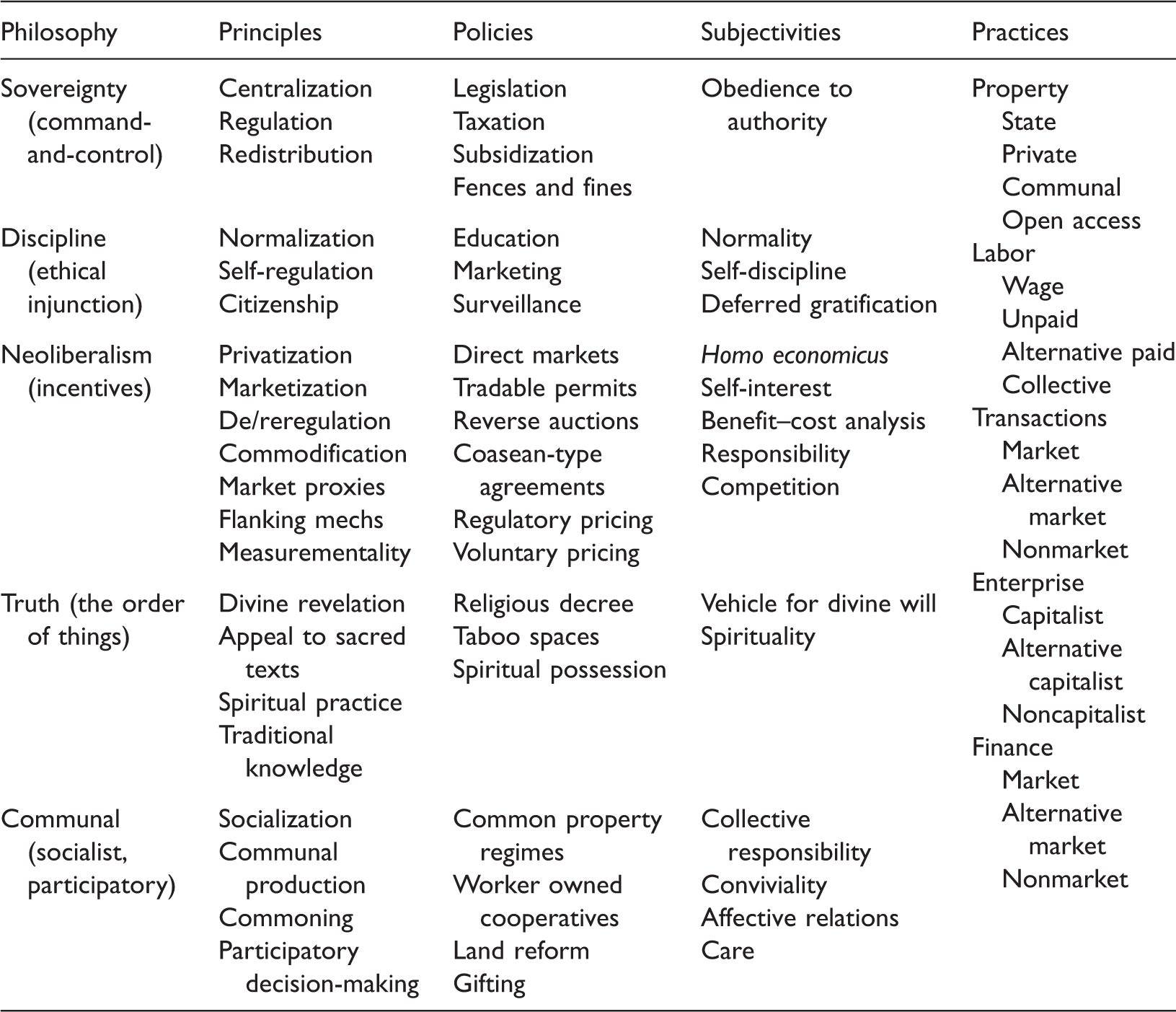
Within this expanded perspective, the meaning of governmentality thus “progressively shifts from a precise, historically determinate sense, to a more general and abstract meaning” (Sennellart, 2007: 388; see also Elden, 2007), becoming something of a generic category encompassing a variety of particular strategies for the conduct of conduct. In the process, Foucault’s “sovereignty–discipline–government” triad collapses as well, with sovereignty and discipline instead becoming distinct governmentalities in their own right. When integrated with the multi-dimensional framework for analyzing variegated neoliberalization outlined in the previous section, disciplinary, sovereign, and truth governmentalities can all be viewed as alternative philosophies contrasting with the neoliberal form previously outlined. Each of these different philosophies, then, can be understood to prescribe their particular principles, policies, and forms of subjectivity as well. This integrated perspective thus provides us with a fine-grained framework for analyzing how different dimensions of these various modes of governance may articulate (or compete) within complex political-economic constellations.
Recently, however, Foucault’s governmentality analytic has become subject to increasing criticism that, even in an expanded understanding, it still privileges the top-down exercise of power and thus underappreciates how subjects may exercise agency to self-govern collectively in the absence of external authority (Barnett, 2005; Cepek, 2011; Forsyth and Walker, 2014; Haller et al., 2016; Singh, 2013). These are the sort of dynamics explored as common property regimes (CPRs) by Eleanor Ostrom and others (see, e.g. Agrawal, 2003; Ostrom, 1990). Yet in his Biopolitics lectures Foucault (2008) had in fact already pointed toward the possibility of understanding such arrangements as an additional, alternative art of government, which he called a “a strictly, intrinsically, and autonomously socialist governmentality” (94) and Ferguson (2011) terms a “left art of government.” Such a governmentality, Foucault (2008) pointed out, does not yet exist in widespread form and “is not hidden within socialism and its texts. It cannot be deduced from them. It must be invented’ (94). Others, however, have begun to explore what this type of alternative, more “bottom-up” governmentality emphasizing democratic self-governance and egalitarian distribution of resources might look like (see esp. Haller et al., 2016; Singh, 2013). Hence, we might add a fifth category to our expanded conceptual framework designating this an alternative, communal governmentality as a catch-all term for the diverse forms of self-governance prescribed by various communitarian projects (differences among which would still require additional specification).
Integrating these multiple governmentalities with the multi-dimensional typology previously outlined, we can productively describe how different modes of governance articulate, coexist, and compete within particular institutions and processes. As alternative governing philosophies, different governmentalities can be understood to embody divergent principles or rationalities that in turn prescribe different policies and forms of subjectivity. A classic sovereign governmentality, for instance, commonly endorses “command-and-control” intervention manifest in policies emphasizing direct regulation, such as taxation for centralized appropriation and distribution of funding, as well as creation of subjects who are principally expected to obey external commands under threat of sanction. A disciplinary governmentality, by contrast, characteristically promotes a particular value orientation through education and other soft power mechanisms intended to produce subjects who self-regulate via an internal ethical compass. Governmentality “according to truth,” on the other hand, tends to be grounded in a conviction that one is acting in accordance with the order of the world, as revealed through sacred texts, divine revelation, traditional knowledge, and so forth. The subject who follows from this is one who can recognize this truth and serve as a vehicle for its execution. In terms of potential for an emergent communal governmentality, Yates and Bakker (2014) highlight principles of “(1) re-socialization through redistributive policy and practice; and (2) the deepening of democracy by establishing greater autonomy … and self-governance … through processes of cultural self-determination at a variety of scales” (70). In line with this, Singh calls for a new subject that transcends “political-economic rationalities” to emphasize “affective relations” (2013: 197) grounded in a “logic of gift, reciprocity” and care (2015: 59). More on all this in the “Conclusion” section.
Yet even this more refined framework remains limited in its emphasis on the design of different governance strategies rather than complexities of their execution in practice. A governmentality perspective, after all, characteristically seeks less to understand “what happened and why” than “to start by asking what authorities of various sorts wanted to happen, in relation to problems defined how, in pursuit of what objectives, through what strategies and techniques” (Rose, 1999: 20). To encompass the common gap between design and execution in governance projects noted earlier, therefore, we must include a nuanced understanding of the diverse forms of practice related with different governance strategies as well.
Diverse economies
The diverse economy.
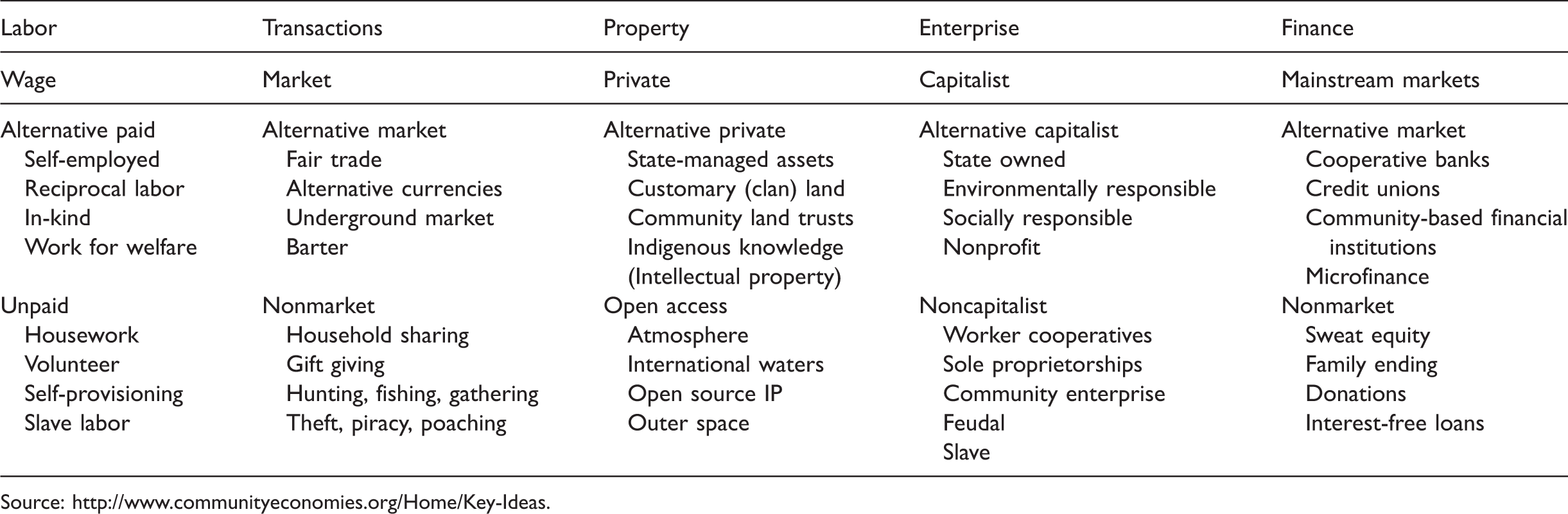
In terms of property, Gibson-Graham distinguishes private, alternative private, and open access forms. Yet the CPR literature previously mentioned has highlighted the need to further distinguish between truly open access regimes and communal property—commons—in which access to and use of land is regulated by local norms and institutions (Feeny et al., 1990). This is currently included within Gibson-Graham’s “alternative private” property modality, as is state-managed land, which the CPR discussion designates as its own category as well. Combining these perspectives, therefore, yields a four-part property typology comprising private, state, communal, and open access forms.
Integrating Gibson-Graham’s typology into our synthetic framework affords a detailed investigation of the diversity of practices constituted in relation to particular regimes of governance, highlighting, as Gibson-Graham do so well, potential disjunctures between governmental visions and the actual outcomes they engender. From this perspective, different governmentalities can articulate with diverse arrangements of labor, enterprise, property, and so forth in more or less conventional or radical forms. These diverse economic formations may, in turn, embody different governmentalities, prescribing distinct strategies for how to implement the particular arrangements envisioned.
Yet there remains an important issue to address. As noted in the “Introduction” section, within the prolific literature that Gibson-Graham has inspired, environmental issues have been relatively neglected until quite recently (a notable exception is Escobar (2008)). Acknowledging this, Gibson-Graham (2011) themselves called for a “more than human regional development” that explores: how “we” (that is, all the human/non-human participants in the becoming world) organize our lives (or how life organizes us) to thrive in porously bounded spaces in which there is some degree of inter-connection, a distinctively diverse economy and ecologies, multiple path-dependent trajectories of transformation and inherited forms of rule. (5)
Mapping diverse ecologies
In debates concerning appropriate forms of environmental governance, different strategies are commonly understood as primarily material interventions, proposing changes in the physical modes of interaction between humans and nonhumans (i.e. creating a national park to curb illegal timber extraction or wildlife poaching). Often overlooked in such debates, therefore, is that these different governance strategies can also be understood as different conceptual perspectives, embodying divergent philosophies concerning human behavior and motivation as well as appropriate human–nonhuman relations. As Salafsky (2001: 185) points out, after all, environmental interventions “are primarily designed to modify human behaviors that affect biodiversity” and other ecological dynamics. Hence, contestation among different approaches to environmental governance often implicitly concerns not only their material impacts but also the legitimacy and appropriateness of the particular discursive perspectives they exemplify (see, e.g. Escobar, 2008; Forsyth, 2003; Goldman et al., 2010).
Political ecology offers a variety of lenses through which this dynamic could be examined. Of the various options, I elect to draw on a growing body of research framing environmental governance as a form of “green governmentality” or “environmentality” (Agrawal, 2005a, 2005b; Fletcher, 2017; Rutherford, 2007). In a formative contribution to this discussion, for instance, Agrawal (2005a, 2005b) describes an environmentality intended to create “environmental subjects—people who care about the environment” (2005b: 162). Yet this designates only a conventional, disciplinary governmentality while the expanded perspective outlined earlier affords a broader understanding of the full range of ways that green governmentality/environmentality may be enacted. In previous work, I have thus built on Foucault’s multiple governmentalities framework to outline an analogous set of environmentalities, highlighting, in addition to Agrawal’s disciplinary form, alternative neoliberal, sovereign, and truth-based modes. Moreover, I have pointed to the possibility of a fifth, “liberatory” modality, akin to the communal governmentality proposed earlier, building on the commons literature as well as Peet and Watts’ (1996) influential call for a “liberation ecology” promoting “liberatory or emancipatory potential of current political activity around environment and resources” (2). As previously noted, others have developed similar models of a “bottom-up” environmentality—what Haller et al. (2016), building on a tradition of commons research, call “constitutionality”—as well (see also Forsyth and Walker, 2014; Singh, 2013).
All of these “diverse” environmentalities can be identified within forms of contemporary environmental governance. Agrawal’s disciplinary environmentality is widespread, paradigmatic of community-based natural resource management as well as much environmental education, while a neoliberal environmentality is of course fundamental to the neoliberal environmental governance mechanisms described earlier (and further below). Foucault’s sovereign governmentality is characteristic of state-centered command-and-control approaches to resource management, such as classic “fortress” conservation (see Brockington, 2002), while governmentality “in accordance with truth” is exemplified by indigenous self-governance grounded in traditional ecological knowledge (Berkes, 2008) or forms of “spiritual ecology” (Sponsel, 2012).
As with Foucault’s multiple governmentalities, these environmentalities may overlap as well. For example, I have previously described ecotourism as a form of environmental governance combining disciplinary and neoliberal elements in its promotion, on the one hand, as an ethical practice intended as a form of environmental education and as an economic incentive for conservation, on the other (see Fletcher, 2014). Similarly, Li (2007) describes the “will to improve” underlying conservation and development efforts in Indonesia, observing that such efforts proceed “by educating desires and configuring habits” while at the same time describing them (with reference to Bentham) as “artificially arranging things so that people, following their own self-interest, will do as they ought” (5). In terms of the framework advanced here, these could be viewed as two different yet overlapping governance strategies (disciplinary and neoliberal, respectively) pursued simultaneously in this context. Analysis in the terms proposed here thus helps to illuminate distinctions among different approaches to environmental governance that might otherwise be conflated. A rapidly growing body of research has begun to further explore how various combinations of environmentalities may overlap in diverse other contexts and processes as well (see Fletcher, 2017 and the other articles in this issue).
Integrating ecology and economy
Having mapped the different forms of environmental governance at work within a given context, the task is then to link these with the diverse economic arrangements highlighted by Gibson-Graham to illuminate the specific articulations occurring within this complex whole. After all, central to most forms of environmental governance today is a concern to merge ecological and economic concerns, conservation and development, so as to increasingly make ecological action itself the basis of economic opportunity (Büscher and Fletcher, 2015).
Linking ecology and economy within a cohesive framework thus suggests important amendments to Gibson-Graham’s perspective, integrating consideration of the different governmentalities expressed via the diverse economic arrangements the authors highlight. For instance, different labor arrangements (wage, alternative paid, and unpaid) may be pursued via various governance strategies, including state-centered (sovereign), incentive-based (neoliberal), and appeals to ethical standards (disciplinary). Such diverse labor arrangements may also be included within different forms of environmental management subject to various modes of governance. The resulting formations can range from voluntary labor recruited for a weekend road-side trash collection through a state-sponsored “Good Samaritan” campaign to private finance mobilized for a community-based carbon sequestration project within an international cap-and-trade scheme. A diverse ecologies framework thereby affords a detailed parsing of the specific dynamics embodied within the complex, multi-dimensional processes characterizing many forms of environmental governance today.
As with Gibson-Graham’s more conventionally economic processes, then, on-the-ground practices of environmental management can be similarly subdivided into mainstream capitalist, alternative capitalist, and radical forms. Mainstream capitalist practices would comprise, for the most part, conventional extractive industries, including logging and mining along with industrial agriculture, cattle production, and the like. Alternative capitalist modes would encompass, for example, most of the MBIs intended to harness capitalist forces in the interest of sustainability, including such diverse practices as organic agriculture for commercial sale, sustainable forestry (e.g. FSC-certified timber), fair trade products, ecotourism, carbon markets, wetlands and species banking, and so forth. Radical modes of environmental management, finally, would include those that seek to break with capitalist markets in any form, ranging from some commoning practices (Agrawal, 2003; Roelvink et al., 2015) and land reform programs (Akram-Lodhi, 2013) to calls for more widespread ecosocialist transformation (Magdoff and Bellamy Foster, 2011).
Diverse ecologies.
Return to PES
The diverse ecologies framework’s utility for analysis of articulation among diverse governance approaches is illustrated by a case study of Costa Rica’s PES program, a focus of my own empirical research (Fletcher and Breitling, 2012). Called Pago por Servicios Ambimentales, or PSA, Costa Rica’s program is often considered to have “pioneered the nation-wide PES scheme in the developing world” (Daniels et al., 2010: 2116; see also Pagiola, 2008). As with PES generally, at the outset PSA was explicitly designed as a neoliberal MBI (see Heindrichs et al., 1997; Pagiola, 2008). Both the program and law that founded it were in fact instituted as part of the conditionality attendant to a structural adjustment loan in the mid-1990s (Daniels et al., 2010). But like many other programs, in its subsequent implementation PSA has come to rely primarily on state-based distributive funding rather than the international carbon markets it intended to harness (Fletcher and Breitling, 2012).
What does this mean concerning the program’s erstwhile neoliberal character? The multi-dimensional framework outlined above helps to clarify this issue. In PSA development, a strongly neoliberal vision endorsed by the World Bank and other influential actors was countered by an entrenched sovereign perspective on the part of some state representatives, resulting in a mechanism (and the legal regime establishing it) embodying both approaches at once (Brockett and Gottfried, 2002). This hybrid governance philosophy is expressed in an equally hybrid set of principles embodying, on the one hand, core neoliberal rationalities including privatization, marketization, commodification, reregulation, and development of civil society “flanking” mechanisms in paying landowners to conserve. At the same time, however, the program expresses key sovereign principles of direct regulation and centralized resource appropriation and redistribution via a legal prohibition on land use change and funding through mandatory taxation (Sánchez-Azofeifa et al., 2007). This has led to the development of a constellation of more specific policies in which PSA functions in part like Pirard’s (2012) Coasean-type agreement and in part like his regulatory price signals, while also going beyond this to dispense with markets entirely in exercising direct regulatory control over private land use decisions.
But the situation is even more complicated than this, since several actors involved in PSA administration claim that the mechanism is not only intended to incentivize forest preservation but that it is also expected that payments will eventually convince landowners, and then the general public, of conservation’s intrinsic value (what economists call “crowding in” motivation; Rode et al., 2015). In this way, neoliberal governmentality is effectively promoted as the precondition for a disciplinary strategy as well. Three distinct governmentalities, in short, are advanced as complementary within the program’s overall administration.
In PSA’s actual practices, moreover, the situation becomes more complicated still. With respect to finance, for instance, the program is grounded in a classically welfare state mechanism whereby a mandatory tax on fossil fuel use is collected then redistributed for various uses including funding PSA. In the program’s initial neoliberal framing, however, this was intended as merely seed money to get the initiative up and running, after which it was expected to be replaced by direct market transactions whereby polluters (both domestic and international) would pay to offset their negative impacts. Such market transactions never developed on a significant scale, however, so reliance on the fuel tax has instead become institutionalized as a foundational funding source (Daniels et al., 2010). Yet even so this provides less than half the program’s total required revenue, hence it is supplemented by various other founts, including a more recent tariff on water use (which as Matulis (2013) points out is more neoliberal in its targeting particular watersheds), a tax on vehicle registration, a voluntary contribution from private bank transaction, grants and loans from IFIs, and offset payments from other national governments. As with the initial fuel tax, these funds are commonly justified in neoliberal terms as temporary support until a substantial market for actual offset payments finally develops. Additionally, of course, a small percentage of funding does come from direct market transactions, both domestic (e.g. payments from private hydroelectric plant operators and beverage manufacturers) and international (offset purchases on the voluntary carbon market). In Gibson-Graham’s terms, then, we can observe in PSA finance a complex combination of market, alternative market, and nonmarket sources.
Then there are the program’s property relations to consider. The main purpose of PSA has been to encourage conservation on private land beyond the state’s direct dominion, and this is indeed the dominant form of property the program encompasses. But it also includes a significant portion of parcels managed by nonprofit organizations, in addition to land held communally by peasant farmers as well as indigenous peoples occupying state-designated reserves, and even some private land that is also officially included in the national system of protected areas via the National Wildlife Refuge modality (which regulates land use in exchange for reduced property tax). Thus, various forms of private, communal, and even nominally state property (although this last is technically excluded) are included in the program.
In terms of transactions one finds similar diversity. Most, as I have shown, are decidedly nonmarket, comprising taxes, tariffs, grants, and other forms of direct finance. Most voluntary offset payments can be considered alternative market transactions since they are neither mandated nor usually direct benefit–cost decisions but intended to address environmental damage from an ethical or aesthetic perspective. Domestic payments from hydroelectric producers, on the other hand, are closer to conventional market transactions since they are ostensibly about preserving production inputs in pursuit of direct business interests. Offset payments from foreign states can be considered something in between all of the above—partial or pseudo-market transactions—since they are for services rendered, in a sense, yet are conducted between national governments, thus representing state marketization more than market transactions per se.
This analysis, while schematic and cursory, demonstrates the utility of the conceptual framework developed in this article, offering a fine-grained description of the ways that different combinations of philosophy, principle, policy, and practice intersect in particular ways within this popular initiative. Rather than simply calling all of this variegated neoliberalization, or conversely denying the existence of neoliberalism entirely, a multi-dimensional perspective affords a much more nuanced analysis of the specific ways that different forms of governance articulate within concrete institutions and processes.
Conclusion
The analytical framework proposed in this article offers a relatively comprehensive foundation for analyzing the complexities of contemporary environmental governance, serving as the basis for site-specific study as well as comparative analysis across cases at different governance levels in both material and discursive dimensions. It is grounded in a combined conceptual perspective linking political economic structures with collective discursive formations and the beliefs/desires of discrete subjects. More modest combinations of a subset of various of these elements can be examined as well. The framework thus has potential to afford fine-grained analysis of the complex intersection among overlapping approaches to governance within a given context as well as among interrelated sites. In more practical terms, by highlighting differences in governance strategies and the structures through which specific approaches are enacted, the framework can facilitate understanding of conflicts and/or miscommunications that may arise among various planners on the basis of fundamental differences in belief and values of which they themselves may be unaware.
Of course, this framework is only one of many possible ways through which the dynamics in question could be analyzed. A framework that did not start with variegated neoliberalization and Castree’s (2010) typology for analyzing it would likely look quite different, just as Gibson-Graham’s categories might look otherwise if they did not take capitalism as the baseline from which they map degrees of divergence. The framework’s utility will thus depend on the extent to which researchers find it helpful in providing a common foundation for discussion of difference, rather than on whether its categories most accurately map the territory to which they refer. I hope that researchers do find it useful and that in the process of applying it they also alter and refine it to serve their purposes best.
A second potential space for elaboration concerns the role of nonhuman materiality within the framework. How nonhumans exert influence on human institutions and assemblages has become a popular area of inquiry throughout the social sciences (Whatmore, 2006), and while the framework proposed here has not yet directly addressed this issue there is space within it for greater treatment of this materiality within the modes of governance it outlines (see also Lemke, 2015). This would be another fruitful avenue of future research and development.
Ultimately, the goal of an emancipatory politics, like Gibson-Graham’s community economies project, must be to support initiatives that challenge the dominant neoliberal capitalist order, helping to develop an open space for imagination and enactment of viable “alternatives,” both those already existing in the institutional interstices and those that have yet to be manifested. In this sense, the overarching aim must be to champion direct democratic decision-making and egalitarian distribution of resources. Identifying and nurturing elements of such a “communal” or “liberatory” governmentality (and associated policies, practices, and forms of subjectivities) is thus the grandest ambition of the multi-dimensional framework proposed in this paper. How to achieve this remains a vital question for future research and practice that I hope will be further pursued as well.
Highlights
Proposes a novel conceptual framework for analyzing complexity in environmental politics Integrates diverse ecologies and multiple environmentalities frameworks into a novel synthesis Moves beyond discussion of variegated neoliberalization to address articulation with alternative modes of governance Applies the diverse ecologies framework to analyze PES in Costa Rica
Footnotes
Declaration of conflicting interests
The author(s) declared no potential conflicts of interest with respect to the research, authorship, and/or publication of this article.
Funding
The author(s) received no financial support for the research, authorship, and/or publication of this article.