




Abstract
Picking up on the manifestation of state intervention following the 2008 financial crisis, we argue that the recent trend towards remunicipalisation underlines but also problematises the thesis of new state capitalism. Remunicipalisation refers to a process whereby towns, cities and sub-national regions take previously privatised services and infrastructures back into public ownership. Remunicipalisation has led to the emergence of regionally- and municipally-owned state enterprises across a wide range of sectors including water, energy, waste, transport, education, (tele)communications, and health and social care. Engaging with the nature of the ‘new’ state capitalism, and particularly challenging its theoretically restrictive understanding of the state as ‘market enabler’, we highlight that remunicipalisations have often emerged in response to the failed promise of neoliberal capitalism to improve the quality and efficiency of public services through the (supposed) competitiveness of the free market. Like neoliberalism, remunicipalisations take spatially diverse and variegated forms as market-driven logics interact with other political and economic determinations. As such, remunicipalisations often encompass critiques of neoliberal governance and market volatility, and instead focus on the potential of regional wealth creation as well as stabilising local market dynamics through diversifying ownership forms. Drawing upon our ongoing empirical work on German remunicipalisation, we aim to foreground how multiple determinations at work in the German political economy at different spatial scales shape its particular trajectory out of neoliberal mutation. We show how the remunicipalisation of energy provider TEAG has enabled the local state to intervene and diversify the uneven economic geographies in the state of Thuringia.
Introduction
As Alami and Dixon (2019b) rightly point out, the ‘new state capitalism’ seems to be everywhere and nowhere. The term is utilised to theorise phenomena ranging from China's growing (geo)economic power, the appearance of various hybrid forms of state-owned capital such as sovereign wealth funds and state-owned enterprises, the array of state interventions in capitalist markets following the 2008 financial crisis, to the more visible role of the state in capitalism in the global north, but crucially, the term lacks conceptual and analytical clarity (Alami and Dixon, 2019a, 2019b).
In this study, we present two interventions towards contemporary new state capitalism literature. We begin with a call for a more nuanced, multiply the determined sense of state capitalism, one that is alert to the heterogenous forces at work in both capitalism and the state more broadly, and how these take diverse spatial forms. In this context we also critique the overly nationed, that is, nation-state focused, narratives and methodologies of state capitalism in the existing literatures. A nationed reading of state capitalism ignores the uneven geographical and economic developments at play in capitalism as a whole, thus obscuring the multiple spatialities of capitalism (and its alternatives) at scales other than the nation state. In the existing literature, this issue comes up in two problematic ways. Firstly, overly nationed readings are found in the primary case study choices and foci on national state actors, especially China and the BRICS (Alami and Dixon, 2019a; cf. Bremmer, 2010; McNally, 2013). And secondly, nationed readings can also be found in the subsection of state capitalism literatures that focus on the post-2008 emergence of state-owned enterprises, which usually refers to national-level enterprises, ignoring public companies at different scales of ‘state’ ownership, especially municipally- or regionally-owned enterprises.
Our second and related intervention concerns the existing over-reliance on false dichotomies in much of the new state capitalism literatures (Bremmer, 2010; Miron, 2015; see also: Alami and Dixon, 2019b). These are especially apparent when coupled with the first point, by for example designating Chinese state capitalism as ‘bad’ and ‘dangerous’ for the supposedly ‘good’, free market capitalisms of the West. Not only are these dichotomies oversimplistic, but they also obscure the role that state spaces (at the national or local scale) play in supporting, challenging, and rethinking capitalism. Here, we suggest opening up the state to its multiple determinations and combinations (Gramsci, 1971; Hall, 1988). Instead of a one-directional reading of the nation state, we recognise the state as a combination of multi-scalar institutional spaces (Brenner, 2004; Jessop, 2002) through which different actors, processes, and relations operate.
Drawing upon strategic relational approaches to the state (Jessop, 2002), we explore the role of the local state within a political-economic conjunctural analysis that frames the state as a set of diverse and multiple determinations, situated within a particular historical-spatial trajectory and context. In this case, we situate what we call spaces of the local state, such as municipalities, in a context and trajectory of wider German socio-economic history, including Germany's social market trajectory and social welfare obligation (the concept of Daseinsvorsorge), the phenomenon of remunicipalisation, and broader neoliberal logics and forces at play.
We begin this article with a brief overview of recent literature on the new state capitalism and position our work in relation to this, framing our own approach within a regulation school perspective of capitalist states. We also introduce German remunicipalisations as local state interventions in capitalist economies. Following section, The local state and the mandate of Daseinsvorsorge in Germany, introduce our empirical foundation beginning with a discussion of the local state in German constitutional law, the mandate of Daseinsvorsorge, and its implications for the economic activity of the state in advanced capitalism. In the next section Local state capitalism? The remunicipalisation of TEAG, we present evidence from German-based empirical work and explore discussions around Daseinsvorsorge, the local state, and remunicipalisation through the example of the inter-municipal remunicipalisation of Thuringian energy services and infrastructures (TEAG). Final section TEAG: regional provision, local values, market intervention? returns to earlier theoretical discussions on the nature of the local state, and links these with TEAG's ambitions around local value and wealth creation and the diversification of local economies. We conclude by calling for more nuanced readings of both the state and capitalism in new state capitalism literatures that are attentive both to the multiple determinations at work through the state and capitalist political economy, and the diverse spatialities evident in the playing out of multiple determinations through time and space.
‘New state capitalism’, the transformation of state spaces under neoliberalism and the variegated terrain of remunicipalisation
In their review of new state capitalist literatures, Alami and Dixon (2019b) correctly highlight the false dichotomies produced by most of the popular literatures on the topic (cf. Bremmer, 2010; Miron, 2015), as they posit state capitalism as antithetical to free market capitalism (Kurlantzick, 2017), and further impose geopolitical categories of the ‘good’ liberal free market capitalism in the West and the ‘illicit’ strongman state capitalism in the East, particularly focussing on China and the BRICs (e.g. Miron, 2015, cf. Alami and Dixon, 2019b). They also highlight the lack of a critical understanding of the nature of the state and its complex workings in contemporary global capitalism (Alami and Dixon, 2019b), calling for a better theorisation of new state forms, with a greater understanding of temporal framings and geographical situatedness.
Endorsing this critique, our aim is to go beyond a largely outward-looking perspective on new state spaces, concerned with the competitive dynamics of global capitalism and contemporary geopolitics (e.g. McNally, 2013; Schmidt, 2009; Van Apeldoorn et al., 2012). We engage with a different set of ‘new state spaces’ (Brenner, 2004) apparent at the local scale in the recent global trend of remunicipalisation: the taking back of formerly privatised assets into municipal forms of public ownership (Kishimoto and Petitijean, 2017; Kishimoto et al., 2020). In this context, we draw on the work of Jessop, Brenner, and others (e.g. Brenner, 2004, 2009; Jessop, 2002; Jessop et al., 2008) within a regulation school perspective, which usefully reminds us that processes of neoliberalism and globalisation lead to a transformation of state forms rather than their erosion: ‘The nature of the state form under global capitalism is better understood in terms of [an] emerging multi-layered socio-spatial matrix than through the unilinear trope of the nation state's demise’ (Brenner, 1997: 275).
Western European governance, in particular, was transformed from a broadly redistributive, though largely national-centric and directed, set of state welfare logics—labelled the Keynesian Welfare National State in the post-1945 era—towards much more competitiveness or ‘Schumpeterian’ driven form with the growing ascendancy of neoliberalism from the mid-1970s onwards (Jessop, 2002). This approach emphasises how the establishment of a neoliberal governance hegemony imposes a multi-scalar competitiveness agenda—through the rescaling of state functions—across Europe. This was most notably achieved through increased marketisation and privatisation dynamics, as well as an increasingly aggressive, supply-side based local and urban economic development approach. As Brenner (2009: 44) explains: “This ongoing rescaling of statehood has not only eroded the nationalised formations of urban governance and the redistributive forms of state spatial policy that prevailed during the Fordist-Keynesian period. It has also entailed the consolidation of new interscalar rule-regimes (Peck, 2002) that have enhanced fiscal constraints and competitive pressures upon European cities and regions…”
This is useful as a broader analysis of the local shift from regimes of urban managerialism to urban entrepreneurialism (Brenner, 2009; also: Harvey, 1989) as part of dynamic multi-scalar processes of statehood—and there is some recognition that ‘centrally delegated programs to create new forms of regional economic governance may generate radically divergent policy agendas in different locations due to the impacts of place-specific industrial conditions, institutional legacies and political alliances’ (Brenner, 2009: 48), but, there is a tendency to perhaps over-simplify and elide over diverse spatial trajectories, configurations, and emergent political forces. This becomes particularly apparent when stepping outside the Anglo-American heartland of neoliberalism.
With regard to Germany, there was no ‘Kohlism’ as a state restructuring project in the 1980s in the way that there was a ‘Thatcherism’ in the UK, which is indicative of a more gradual, negotiated change in the political economy during the shift towards a broader neoliberal regime rather than the more catatonic ruptures elsewhere (see: Jessop and Sum, 2006: 123–151). This is not to deny a decisive shift towards a German variant of a neoliberal Schumpeterian state, symbolised for example by the repressive Hartz IV welfare reforms introduced in the 2000s, but rather to be attentive to how elements of the neoliberal project intersect with pre-existing spatial, political, economic, and social formations (Jessop and Sum, 2006). Below the national scale, Germany has had its own reconfiguration of national-regional-local relations away from the post-1945 commitment to addressing spatial inequalities and creating national solidarity and cohesion, towards a greater emphasis upon encouraging inter-urban competition and a focus on core growth regions in the face of increasing global competition (Brenner, 2000; Jessop and Sum, 2006). There has also been increased focus on urban and regional competitiveness agendas at the level of the local state (Brenner, 1999) alongside pressures to privatise and introduce broader marketisation cultures in the context of debt concerns (Schipper, 2014; Streeck, 2014).
However, it is important not to too readily read off the way that local state actors are universally and unproblematically enrolled into broader national and international competitiveness agendas and hegemonic projects, or to dismiss pre-existing multi-scalar state institutional structures and processes that persist alongside and in tension with neoliberal logics. In this respect, the focus of the neoliberal state-rescaling literature tends to overemphasise the competitiveness and economic development aspects of the state in its mission to support capital, neglecting the continuing importance of the state's social role (even in capitalism's own terms) in providing a sustainable ‘spatial fix’ (Harvey, 1989). These contradictory tendencies are most evident locally where attempts to marketise and extract exchange value through privatisation of assets and infrastructures come up against state obligations to citizens to provide basic and essential services.
In this context, we highlight the growing role of the local state, its actors and institutions (particularly in the global north) in engaging with processes of deprivatisation, that is, taking previously privatised services and infrastructures at all scales back into public ownership, and in particular, the phenomenon of (re)municipalisation at municipal, intermunicipal, and regional levels. Remunicipalisation thus refers to a global process evident since the early 2000s, for local state authorities to take previously privatised services back into the forms of local public ownership (Cumbers and Becker, 2018; Cumbers and Paul, 2021). This has resulted in the re-emergence of regionally- and municipally-owned state enterprises across a range of sectors. Germany has been the ‘epicentre’ of remunicipalisation (e.g. Hall et al., 2013) with more cases than any other country.
The global remunicipalisation wave can be seen as the manifestation of the central contradiction between state-public provision and private profit maximation; an element of broader challenges of privatisation and neoliberalism as their negative effects in delivering basic social needs proliferate. However, an important analytical point that we emphasise here is not to read off local events (such as remunicipalisations) as part of a broader neoliberal script with local variations, but rather to view German remunicipalisation as its own distinctive conjuncture (see: Cumbers and Paul, 2021) where these dynamic and evolving contradictions are reproduced, resolved, and re-emergent through active struggles. In particular, here, our interpretation requires continued attention to key features of the post-1945 West German social state settlement, and more specifically the institution of Daseinsvorsorge, as well as the ways these have been eroded but not eradicated by neoliberal logics. The continuing legacy of Germany's social market economy and its social welfare obligations has provided a platform for remunicipalisation and the possibilities of an alternative set of public and community values beyond neoliberalism.
The local state and the mandate of Daseinsvorsorge in Germany
In Germany ‘regional administrative bodies’, which include municipalities, cities, and rural authorities, fulfil many state roles that would be performed at higher levels elsewhere. They are not technically states in their own right (despite having constitutions and democratically-elected representative bodies), but are public bodies with legally enshrined self-administrative abilities. Here, we nevertheless use the term ‘local state’, not as a descriptor of legal status (which it is not) but to highlight the concept of German municipal autonomy over administrative tasks (Brenner, 1997). In German, this framework is called Kommunale Selbstverwaltung (municipal self-government) and describes the process of transferring administrative tasks to a juridical person—in this case, regional administrative bodies—in order to enable autonomous local government and administration. This idea dates back to the end of the second world war, when the allied forces saw municipalities, both pragmatically as the most intact level of governance, and politically as the most apt to build democracy from below. Municipal self-government is anchored in Article 28 of the German constitution (Grundgesetz), which states: “Municipalities must be guaranteed the right to regulate all local affairs on their own responsibility within the limits prescribed by the laws” (Article 28, Paragraph 2, GG)
1
However, in formulating municipalities’ ability to self-govern, Article 28 simultaneously restricts these powers. Most importantly, the note ‘within the limits prescribed by the laws’ restrict municipalities to law-making abilities that are not already determined through other laws (e.g. Länder laws, federal German laws, and EU laws), and/ or only laws that allow for local configuration. This becomes relevant when municipalities attempt to make changes to their local economies, including through remunicipalisation as we explore below. Relatedly, the phrasing ‘all local affairs’ is important as it gives municipalities universal responsibility over their affairs; however, being restricted by the subsidiarity clause in German and European law (German: Subsidaritätsklausel) which designates the law of the Länder, the federal republic, and the EU above those at the municipal level. In terms of a multi-scalar governance framing, German municipalities, while having relative autonomy, are thus still constrained by national and EU legislation, themselves shaped by competitiveness or Schumpeterian (Jessop and Sum, 2006) agendas, which results in the emergence of distinctive trajectories and diverse relations between multiply determined state spaces. In this context, we are specifically interested in the powers of municipalities to manage their finances and economic activity in order to provide essential services. Here, the concept of Daseinsvorsorge is fundamental.
Daseinsvorsorge, or the mostly used ‘öffentliche Daseinsvorsorge’, translates, literally and effectively, to ‘public (well-)being provision’ (Cumbers and Paul, 2020; Wollmann and Marcou, 2010). While used widely in administrative and increasingly public and political discourses, the term Daseinsvorsorge lacks a clear legal definition and is subject to recurring debates concerning its reach and meaning (Dümke, 2015; Mause, 2018). At a basic level, Daseinsvorsorge ‘encompasses the assurance of general and non-discriminatory access to essential goods and services including their provision as necessitated by the needs of citizens’ (Schäfer, 2020). The term can be traced back to the middle of the 19th Century. Ernst Forsthoff 2 , a member of the Conservative Revolution 3 and scholar of constitutional and administrative law, first coined the term through his study (e.g. Forsthoff, 1938, 1958). Forsthoff linked the need for Daseinsvorsorge to the joint developments of technology, urbanisation, and industrial capitalist production over the 19th and into the 20th centuries, arguing that these transformations of the nation state made it impossible for citizens to individually provide, for themselves, all necessary means to sustain their ‘being’ (such as individually supplying themselves with water, heating, and waste management) (Meinel, 2007). This in turn mandates the state to assume the responsibility to provide citizens with essential services, the fulfilment of which Forsthoff called ‘Daseinsvorsorge’ (Forsthoff, 1958; Schäfer, 2020; see also: Meinel, 2007) although he was more concerned with the stability of the (authoritarian) state than citizens’ well-being (Caldwell, 1994; Meinel, 2007). Unlike more contemporary understandings of Daseinsvorsorge, the term's etymology is thus surprisingly anti-democratic (see also: Folkers, 2017).
Building on these foundations, Schäfer (2020) suggests that today, the responsibility of the state to provide citizens with Daseinsvorsorge is two-fold: first, to deliver essential services, and secondly, to reserve or implement the necessary infrastructures for service provision (such as utility plants, road and rail networks, administrative offices). However, under the mandate of Daseinsvorsorge, the state or local state (e.g. the municipality)—while having the responsibility to assure that a service is provided and infrastructure is in place—does not need to provide the service itself. This also relates to our understanding of the situatedness of the local state in Germany vis- à-vis the wider neoliberal agendas across the EU (cf. Brenner, 2009; Harvey, 1989). While Germany has undoubtedly seen a shift towards neoliberal governance and particularly also privatisation agendas at the end of the 20th century, these were much more ‘cautious’ than elsewhere, and more focussed on certain sectors (e.g. the energy sector) as opposed to the UK's blanket approach of selling assets and services across a range of sectors (Gamble, 1988). The ‘opening up’ of Germany's energy sector can be traced to EU liberalisation agendas at the time (see: Brenner, 2000; Heddenhausen, 2007), and was implemented with concession contracts in place which allowed for large-scale remunicipalisation of energy infrastructures and services in the 2010s.
Daseinsvorsorge, marketisation, and the limits of private provision
In the context of Daseinsvorsorge, the distinction between the responsibility over service provision and the actual provision of services is important, as it allows for private market competition for (parts of) service provision, and, respectively, a wide range of legal structures (including private, public limited, and public companies, public–private partnerships, and cooperatives). An example of this is contemporary energy provision. Having been a core component of public service provision, and intrinsically understood as a tenet of Daseinsvorsorge, for most of the 20th Century, the EU-wide liberalisation of energy markets from the mid-1990s onwards encouraged competition and effectively privatised energy services across Europe (Rodi, 2016). The experiences of private energy provision have been the subject of contemporary debates around the state's (and local state's) role regarding Daseinsvorsorge (see Dümke, 2015).
This distinction between responsibility and actual fulfilment could theoretically even lead to a completely ‘out-sourced’ service delivery model where the state merely supervises (but holds ultimate responsibilities for) the private delivery of all public services. There are, however, two key reasons why Daseinsvorsorge, by default and design, cannot be left to the private market alone. Firstly, the aim of Daseinsvorsorge is that citizens’ essential needs are met, which means that the primary concern (for any provider) is always the provision of services, not the profitability of providing them. Even Forsthoff, who later described the concept of the social (or welfare) state as an illegitimate means of wealth redistribution (Joerges, 2009), nevertheless specifically included a social dimension in his writing, recognising the importance of the conditions under which Daseinsvorsorge is provided to citizens. He emphasised that most conditions will not create profitable returns, and at times, will even require risks that economic actors would be unlikely to take, thus making them ill-suited to provide Daseinsvorsorge privately (Forsthoff, 1958, quoted in Mause, 2018; Schäfer, 2020). A key point to take away here is that the multi-scalar spaces of the German state, including the municipal, regional, and federal levels, continue to have relatively strong regulatory requirements around social needs and limits to marketisation through the continued importance of Daseinsvorsorge and the remnants of its social market economy. This again highlights the difference between for example the UK's neoliberal state regulating or correcting for market failure of privatised utilities, and Germany, where private actors are brought into a system still considered essential as an element of social provision (see also: Jessop, 2002; Jessop and Sum, 2006).
The second reason is a more practical one. While the provision of certain services might always generate profits in some places; the example of telecommunication services in urban centres (Schäfer, 2020); and thus theoretically achieved profitability for the private provider as well as satisfying the state's service provision responsibilities, profit and social provision are less likely to coincide in more rural or poorer urban areas. In such cases of such ‘market failure’ (or ‘unfavourable conditions’ in Forsthoff's terms), the state needs to fulfil both its responsibility of organising service provision and necessary infrastructures, as well as providing service in order to address the existing uneven economic conditions created under neoliberal capitalism (Mattert et al., 2017). The idea of Daseinsvorsorge can thus be, and increasingly is, understood and mobilised as an equalising mechanism that addresses and challenges the more brutal side effects of ‘free’ market capitalism and the accumulative logics of neoliberalisation.
Daseinsvorsorge today: Scope and contemporary debates
The canon of Daseinsvorsorge, at the municipal level, usually covers similar sectors across all German states (Länder); however, the specifics vary between individual states and are usually defined in the respective municipalities codes. While municipalities fulfil the bulk of Daseinsvorsorge provision, the Länder and the federal state, too, have mandated responsibilities in certain sectors, such as fire and rescue services and civil protection. Because Daseinsvorsorge has not been seriously overhauled since Forsthoff's initial conception in 1938, it is unsurprising that, with technological, social, and political changes, calls have emerged to reassess what counts as ‘essential needs’ in modern societies. Over the past two decades or so, this discussion naturally focussed on widening and guaranteeing digital access and infrastructures as they became increasingly essential to public and private life (e.g. Steinführer and Küpper, 2020). However, there have also been political debates around protecting or ‘defending’ public services from the effects of austerity policies and neoliberal market failure (Paul, 2020; Schäfer, 2020). Today, Daseinsorsorge is understood to be both a legal and administrative as well as a socio-political term, and as such, is part of wider public discourse. Since 2017, a German-wide day of action called the ‘Day of Daseinsvorsorge’ is held yearly on 23 June, underlining increasing awareness and politicisation of the concept, having evolved from Forsthoff's authoritarian-minded conceptions.
As the socio-political understanding of Daseinsvorsorge grew so did wider public agreement that ‘öffentliche Daseinsvorsorge’ (more so than English language discourses around ‘public services’ or ‘public management’) is not compatible with private profit logics (Mattert et al., 2017; Schäfer, 2020). While Daseinsvorsorge is in many ways synonymous with the internationally used ‘public services’, and often interchangeably used with ‘öffentliche Dienstleistungen’ (which is the literal translation of public services), we argue that the specific German socio-political understanding of Daseinsvorsorge is more deeply embedded in a pro-public ethos. Topically, the COVID-19 pandemic has further highlighted the importance of a well-functioning public sector demonstrating the weaknesses and shortcomings of private health and social care systems (e.g. Laschet, 2020). Relatedly, as a concept, Daseinsvorsorge is understood to signal the responsibility of care that a state or local government holds for its citizens (Paul, 2020). Furthermore, and as we argue elsewhere (Cumbers and Paul, 2020), Daseinsvorsorge has been described as a ‘mandate of public trust’ with related discussions around trust and transparency feeding into the wider politics of remunicipalisation in Germany (Cumbers and Becker, 2018; Cumbers and Paul, 2020; Mattert et al., 2017).
Local state capitalism? The remunicipalisation of TEAG
Remunicipalisations, as local level deprivatisation processes, have to be understood in relation to the underlying logics of the neoliberal encroachment on capitalist economies across the world. Globally, energy markets were a popular target for deregulation and privatisation due to their strategic importance for most aspects of social life, which was simultaneously a counter-argument by privatisation opponents at the time. However, with the aim to break the ‘natural’ monopolisation that had occurred across the continent, and supposedly, an attempt to equalise conditions for energy access across the single market, the European Union began liberalising its member states’ national energy markets from the mid-1990s onwards (Rodi, 2016). But there are growing tensions at European and national scales between neoliberal inspired marketisation agendas and the continuing policy aspiration (and in the case of social market economies like Germany constitutional mandates) of universal cheap access to essential energy services. As explored above, the idea of liberalised and thus competitive energy markets and the existing framework of öffentliche Daseinsvorsorge were not mutually exclusive (Dümke, 2015), as the mandate of Daseinsvorsorge remained intact (elevating the mandate or responsibilities of Daseinsvorsorge over actual provision). There were at least no major legal barriers to energy liberalisation in Germany, but the increasing contradictions and tensions between marketisation and social as well as ecological needs have become increasingly evident in practice.
More than two decades on, and in the face of undelivered promises regarding quality, cost, and efficiency of service provision in private hands, public and political discussions around a return to public ownership and provision have grown. The wave of remunicipalisations in Germany is connected to the expiration of concession contracts between public authorities and private providers, especially from 2010 onwards (Cumbers and Paul, 2021; Kishimoto and Petitijean, 2017), which, unlike other forms of contracts such as lease or management contracts, allowed for a more straightforward return of services and infrastructures into public ownership. Faced with dissatisfaction and rising costs of private provision, many municipalities have thus not renewed concessions with private contractors, leading to hundreds of remunicipalisations of energy services and/ or infrastructures in Germany over the past decade (see also: Public Futures database).
Next to a wave of remunicipalisations across Germany, the continued existence and sound performance of never-privatised municipal energy providers, as well as the creation of new municipal providers (‘municipalisations’)— despite the continued push for liberalisation and privatisation by the EU (and global organisations such as IMF and World Bank)—have prompted debates about both the failures of neoliberal agendas and the importance of the (local) state in energy provision (Becker et al., 2015; Dümke, 2015; Mattert et al., 2017). The recent (re)emergence of regional or inter-municipal associations, whereby multiple municipalities cooperate, for public energy provision in Germany thus provides an interesting case study for the relationship between the different determinations of the state, the wider economy, and new articulations of Daseinsvorsorge and its relationship to local and regional wealth or value creation.
Case study: Intermunicipal remunicipalisation of Thuringian energy company TEAG
Thuringia (officially the Free State of Thuringia) is among the smallest of Germany's 16 federal states, both in terms of area and population count (ranking sixth and fifth smallest, respectively), as well as economic activity, ranking fifth smallest in GDP and third smallest in per capita income (EuroStat, 2019; Thüringer Landesamt für Statistik, 2021). Although it was part of former East Germany, Thuringia's central location within both unified Germany and the EU, alongside the well-developed road, rail, and air transport links create some favourable conditions for the industry, including logistics enterprises. This has led to positive economic benefits in some of Thuringia's districts, notably the state capital Erfurt, while others, such as the southern district of Suhl, are among the lowest-performing municipalities in Germany (EuroStat, 2019). Uneven economic development within Thuringia as well as more generally between formerly eastern and western states, alongside the Daseinsvorsorge provision is an important context to understand the political economy of remunicipalisation within the state.
Coinciding with the liberalisation agendas driven by the European Union in the 1990s, the formerly-eastern German states saw their state-owned energy infrastructures and services privatised following German reunification (Heddenhausen, 2007). In Thuringia's case, the existing energy providers were sold to private corporations and their organisational structures changed to publicly traded companies. Having to make considerable investments into updating infrastructures, the new energy companies performed poorly on the free market in the 1990s, leading to frequent ownership changes. In 2000, energy giant E.ON was founded following the fusion of two other energy providers, who had both owned shares in Thuringia's then separate electricity and gas providers. As a consequence, E.ON became the majority shareholder in both the Thuringian electricity provider and the Thuringian gas provider until the corporation decided to fuse them, creating TEAG in 2005 (then known as E.ON Thüringer Energie). Today, E.ON is one of four market-dominating energy providers in Germany, alongside Vattenfall Europe, RWE, and EnBW.
The main empirical focus of this study is the remunicipalisation of TEAG, short for Thüringer Energie AG (Thuringian Energy Public Company). The findings reported here come from our ongoing research on a broader remunicipalisation project of which Germany is a key focus. Thus far, we have conducted a desk-based analysis as well as 20 qualitative, semi-structured interviews with stakeholders across Germany in 2019-2020 (prior to lockdown) on topics of remunicipalisation, public ownership, and Daseinsvorsorge. To date, the majority of this research has focussed on the state of Thuringia, where we have, among other cases, explored the remunicipalisation of TEAG, Thüringer Energie AG (Thuringian Energy Public Company). Specifically for the TEAG case, five in-depth, semi-structured, qualitative stakeholder interviews were conducted with two (anonymous) representatives of the Thuringian Ministry of the Interior, one (anonymous) representative of the Thuringian State Administrative Office, as well as three individuals who are or were key stakeholders and/or experts on the remunicipalisation of TEAG: Frank Kuschel, an expert on remunicipalisation and municipal management as well as a longstanding politician for the Thuringian Left Party; Steffen Harzer, who was a member of the Board of Supervisors of KEBT AG (who are the municipal majority owners of TEAG) during the TEAG remunicipalisation; and Peter Hengstermann, the current Chairman of the Board of Supervisors of KEBT AG. The interviews were conducted across Thuringia in January 2020 and supplemented by further desk-based research drawing on TEAG's financial reports (see: KDGT, 2018, 2020), news coverage, opinion pieces, and policy and political publications. Interviewees were approached based on their specific knowledge of the case of TEAG, either through their direct involvement in the process or the nature of their work and professional activities. The interviews were arranged with the help of Frank Kuschel, who acted as a liaison between our research project and various actors in Thuringia's political landscape, building on his decades of experience and connections through his work as a parliamentarian in the state.
In 2013, an inter-municipal group of Thuringian cities and municipalities took back ownership over their energy infrastructure and services, making history as both the largest such deprivatisation project and one of the largest municipally-owned integrated energy providers in Germany (KDGT, 2020). TEAG is now majority-owned by around 850 Thuringian municipalities. The remunicipalisation came at a cost of about €950 million (Schäfer and Stoffels, 2016), and because of the considerable size and cost of the take-over, attracted media and wider public attention across Germany. The decision to remunicipalise TEAG was made in 2012, following discussions with private owner E.ON, who wanted to part with some of their subsidiary companies. Thus, this particular privatisation is a more ‘passive’ type of private withdrawal through sale, unlike others, which involve active political decision making and/ or citizen mobilisation (e.g. Becker et al., 2015; Paul, 2018). E.ON did not disclose a reason for the sale, but it can be assumed that costs associated with Germany's Atomausstieg (nuclear phase-out) and ambitions to expand its operations into Eastern Europe, for which E.ON needed to reduce existing debts, were key reasons to part with a range of subsidiary companies including TEAG (GIB, 2013). Furthermore, the existing minority shares held by Thuringian municipalities (amounting to 47% in 2012), and their associated veto powers, had repeatedly led to conflicts between the municipalities and E.ON (Personal communication with Frank Kuschel, January 2020).
E.ON's decision to sell off its subsidiary E.ON Thüringer Energie was communicated to the Thuringia-based KEBT AG (Kommunale Energie Beteiligungsgesellschaft Thüringen Aktiengesellschaft; Municipal Energy Affiliate Company Thuringia Public Limited Company). KEBT AG is a public affiliate and limited company that already managed the existing shares Thuringian municipalities held of E.ON Thüringer Energie, which amounted to a minority share of 47% in 2012. Around 800 Thuringian cities and municipalities were part of KEBT AG at the time (KDGT, 2018). At an annual general meeting in June 2012, the municipal shareholders of KEBT AG decided, with a 90% majority vote, to buy back the remaining 53% shares from E.ON. This decision would make KEBT AG (and by extension, the Thuringian municipalities) the sole and majority shareholder of TEAG, and thus, remunicipalise energy services and infrastructure in the state of Thuringia (Interview with Peter Hengstermann, January 2020). The €950 million remunicipalisation of TEAG is one of the most expensive public take-overs in Germany with financing it becoming a key issue and a point of contention for the Thuringian municipalities at multiple points during the deprivatisation process (Interview with Frank Kuschel, January 2020; also: Meves, 2017). It soon transpired that the best financing option for the considerable sum needed was Kommalkredite (public sector loans), as interest rates and conditions for public loans were favourable at the time with fewer barriers compared to private financing options, particularly for the more cash-strapped municipalities involved. However, in order to access the public sector loans, the municipalities needed to form a special-purpose administrative association of municipalities, also known as an inter-municipal union, called Kommunaler Energiezweckverbund Thüringen (Inter-municipal Energy Union Thuringia, short: KET), which was founded on 20 November 2012 4 .
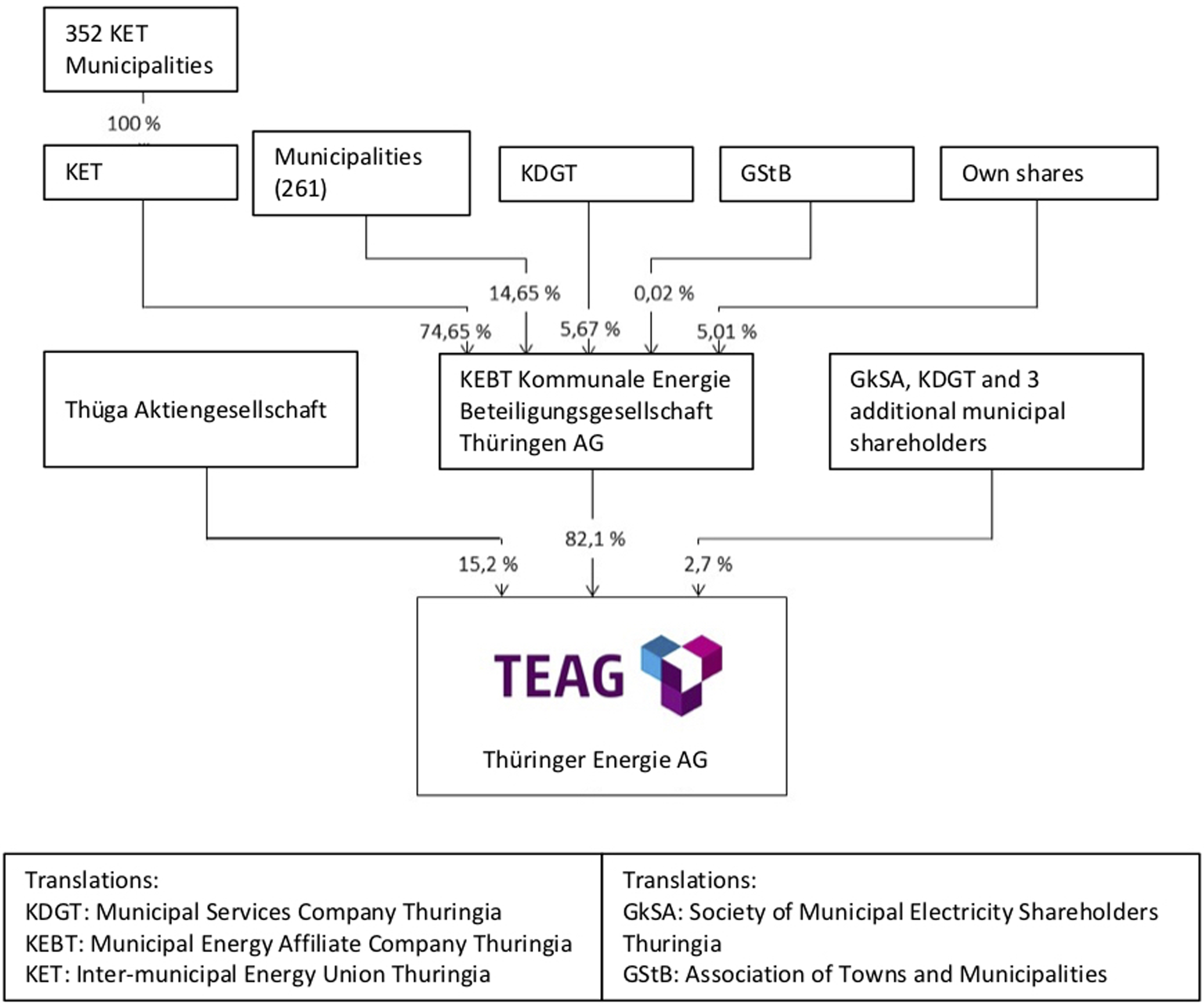
Shareholding structure of KEBT AG as of 31 December 2019, reproduced from KDGT (2020) with author translations.
Limited space here only allows for a brief organisational overview of TEAG's ownership structures (see Figure 1). TEAG's remunicipalisation was finalised in 2013, and it is now an unlisted corporation under German law, which means that its shares are not traded on stock exchanges and the company has a limited number of shareholders. As can be seen in Figure 1, majority ownership of TEAG is in the hands of the municipalities of Thuringia that own 84.8% of TEAG (made up of 82.1% shares held by KEBT AG and 2.7% shares held by a grouping of smaller municipal actors), while the remaining 15.2% shares are held by Thüga Aktiengesellschaft. Thüga Aktiengesellschaft is part of the Thüga Group, a well-established network of municipal enterprises in Germany. Thüga was approached during the TEAG buy-out preparations as a strategic partner and advisory body to the Thuringian municipalities. Steffen Harzer, who was a member of the Board of Supervisors of KEBT AG at the time of TEAG's remunicipalisation explains: “From the beginning we said that we wanted a municipal majority but we needed a minority partner who had an idea of the métier. Because we knew—we are all mayors or local politicians, we aren’t businessmen, we don’t run corporations, and we certainly don’t know anything about running an energy business. […] So we had a number of options but in the end our preference was Thüga, because Thüga is also a 100% municipal enterprise… and they even had experience dealing with E.ON.” (Interview with Steffen Harzer, January 2020).
While the planning and process of TEAG's remunicipalisation encountered surprisingly little resistance in general, the main criticism was directed at the financial risk involved in taking on public sector loans of the required magnitude. In terms of political opposition, there was some ‘expected’ criticism from the neoliberal FDP (Free Democratic Party), who attempted, largely unsuccessfully, to involve the Chamber of Industry and Commerce (IHK), who are notoriously opposed to state ‘intervention’ of most kinds (e.g. Schipper, 2014). The cross-partisan support of TEAG's remunicipalisation is interesting, as even large parts of the CDU (the conservative Christian Democratic Party) either supported or did not oppose the plans, which also speaks to our previous arguments around multiple determined state spaces and the diverse agencies of actors within the local state. The main reservations towards TEAG's remunicipalisation concerned the risk of taking on public sector loans and thereby increasing the existing debt of the municipalities (Börse Online, 2015; GIB, 2013). These reservations about financial risk were voiced by actors in Thuringia's Ministry of the Interior, the State Administrative Office (Landesverwaltungsamt), and the State Audit Office (Landesrechnungshof). As borrowing was tied to the intermunicipal union (KET) and not to the economic performance power of the individual municipalities, which varied from strong to very weak, the institutions shared the concern that the liability of public sector loans taken on by an intermunicipal union such as KET would ultimately lie with the municipalities within KET. If KET would not be able to pay off the loans, all municipalities would become liable, and it was clear that not all municipalities in economically uneven Thuringia would have the means to pay off the debt themselves (Interview with Steffen Harzer, January 2020).
As time has shown, fiscal reservations were unfounded. The interviews conducted in Thuringia revealed that (as of early 2020) TEAG's remunicipalisation is now seen as a highly successful project by actors across the political, financial, economic, and administrative spectrum in Thuringia, including the initially ‘fiscally-concerned’ Ministry of the Interior and State Administrative Office (Interviews with Frank Kuschel, Peter Hengstermann, Ministry of the Interior, State Administrative Office, all January 2020; see also: Schäfer and Stoffels, 2016). Under public ownership, TEAG has registered growth in user numbers and profits across its operations and the municipalities are well on their way to repay their debt, having already repaid €300 million of debt while the company's value has increased (Interview with Peter Hengstermann, January 2020). The loans taken on by intermunicipal union KET are repaid by the municipalities through capping their dividend pay-out at 4.50 Euros per share (as opposed to their ‘full’ value of 24.20 Euros at the time of interviews) with the difference going into debt redemption. Contrary to fears, redemption is above average so that the municipalities can expect to be debt-free before 2030 (Interview with Steffen Harzer, January 2020).
TEAG: regional provision, local values, market intervention?
At first glance, TEAG seems to be set up as, and perform like, a typical if not textbook example of the state capitalist corporation. The company's organisational structures, established under E.ON's private ownership, were largely kept in place following the remunicipalisation, and further avenues for investment and business were explored and built up. All former E.ON staff were retained, with only the highest-ranking staff and its board of directors being replaced (Interviews with Peter Hengstermann and Steffen Harzer, January 2020). All three members of TEAG's ‘new’ board of executives have business backgrounds; some have even worked for E.ON previously. However, Steffen Harzer explains that while TEAG certainly is a well set-up corporation, there was a conscious and deliberate process of ‘detangling’ the new publicly owned company from its E.ON past: “TEAG is the biggest employer in Thuringia, the biggest company in Thuringia, has multiple business branches now, and is properly organised as a corporation. That was also an extensive matter, to separate all the interfaces with E.ON—software, sale, human resources. And the rest of it.” (Interview with Steffen Harzer, January 2020)
Taking a closer look, it becomes clear that TEAG has made a number of clearly ‘regionally-minded’ strategic decisions with regard to its business expansion. Firstly, TEAG attempted to bring areas of business and operation, that had previously been outsourced under E.ON's ownership, back into Thuringia, both geographically and organisationally, in order to build a local and regional knowledge base as well as increase employment opportunities. TEAG's employment numbers have grown from 1607 in 2016 to around 1800 by 2020 (KDGT, 2020). TEAG's workforce is well-unionised and regulated through the German-wide collective agreement for public sector workers, which is generally seen as above-average pay with good and clearly defined working conditions. TEAG also trains 230 apprentices a year, more than under private ownership (all data from the interview with Peter Hengstermann, January 2020). Another important aspect of this is that TEAG has employed specialist staff who can advise on and quickly react to changes in administrative and legal circumstances, such as EU or federal German laws that affect TEAG through the aforementioned subsidiarity clause. This is something that safeguards the municipal owners from costly legal battles and ‘futureproofs’ municipal energy provision. Less ‘high-profile’ remunicipalisations cases often cite a lack of specialised staff, particularly for legal or administrative matters, as one of the main hurdles to providing services as effectively as possible.
Secondly, TEAG has increased both profits and investments since its remunicipalisation. Peter Hengstermann cites a rise in sales revenue from €1.59 billion in 2016 to €1.71 billion in 2018, as well as just under €100 million of investments in 2019. Of these investments, much goes into the upkeep and modernisation of existing technical facilities and systems. However, new investments are also being made with wider social, political, and environmental goals in mind. TEAG has, for example, reinvested its profits into areas that align with wider German environmental and social policy aims such as the Energiewende and digitalisation agendas: “Under E.ON there was no mobility planning, no fibre glass wiring, there was no wind energy… they didn’t do anything with photovoltaics either. So, there was gas provision and energy provision, which still exists today, but all these other important pillars of business that TEAG has built up since did not exist then.” (Interview with Peter Hengstermann, January 2020).
As is clear from the quote, remunicipalisation has involved a step-change in infrastructure, investment geared to post-carbon transition, which ties in with the well-established critique that has been made of the foot-dragging and even obstructionism of the larger private utilities with their interests in nuclear, gas, and coal-fired energy sources (Becker, 2018; Kungl, 2015). More broadly, the stakeholder interviews highlighted that for TEAG and the municipalities behind it, there is no point in pushing for profit maximation. Instead, there is a general consensus that the company needs to work well for the municipalities, fulfil their current energy needs, and plan effectively for a socially and environmentally sustainable future (Interviews with Peter Hengstermann and Frank Kuschel, January 2020).
Local value creation and the diversification of capitalist market economies
TEAG's ambition to create value (in the form of knowledge base, employment, as well as financial profits) locally, in the municipalities as well as for the state of Thuringia can, in this sense, also be understood as a form of state anchoring (DeFilippis, 1999) around a local publicly owned institution. Given TEAG's position as one of the largest economic actors in the state, its business strategy to build and create value locally, and to prioritises the local and citizen's needs, ahead of profit maximisation has an impact on the wider economic landscape in Thuringia (see also: Cumbers and Paul, 2020; Guinan and O’Neill, 2019; Paul, 2020). The social aspect of Daseinsvorsorge maintains that all citizens, irrespective of the uneven economic geographies at play in their municipalities, should be able to access public services. While Daseinsvorsoge in the context of energy provision has become somewhat sidelined by the liberalisation of EU markets, remunicipalisation initiatives such as TEAG allow local actors to use Daseinsvorsorge conventions as a means to promote an alternative agenda around social and ecological values in opposition to exchange value and profit maximation. Additionally, by working in the interest of the municipalities first, and profits second, TEAG plays a redistributive role in combatting unequal geographies within Thuringia. Once the debt of the municipalities is fully paid off, this ‘equalising mechanism’ will most likely accelerate, not just in attempting to tackle Thuringia's uneven economic landscape, but actively generating wealth for some of Germany's most disadvantaged municipalities (see: EuroStat, 2019).
There is a second interesting dimension at play here which concerns the stabilising effect that diversification of ownership structures, such as remunicipalisation or co-operatisation, in a predominantly private economic sector such as energy, can have on local economies. As Frank Kuschel explains: “Where municipalities take back control, they notice that it leads to Marktberuhigung [lit: market ‘calming’]. Where different ownership forms exist in parallel—for example in finance with public banks, cooperative banks, and private banks, or in the housing sector with municipal, cooperative, and private housing… when there is a balance, it has a reassuring effect on markets. That is why the municipalities are well-advised, so to say, to utilise their economic activities to contribute to this Marktberuhigung.” (Interview with Frank Kuschel, January 2020)
Therefore, in capitalism's own terms, remunicipalisations can have a stabilising effect on local and regional economies, helping to ameliorate some of its own contradictions that have been more fully opened up through neoliberalising marketisation processes, essentially new forms of new state regulation that correct for governance failures (Jessop, 2009). The evocation of Marktberuhigung here as a means of market calming—through diverse forms of ownership, not all driven by private profit concerns—can also be read off within a regulationist account of the state. The more one-sided an economy is—in prioritising accumulation dynamics over social reproduction—the more volatile and capricious it is.
However, recognising the particular features of German political economy, and the continuing social state imperatives for Daseinsvorsorge, the impulses behind remunicipalisation here suggest also the reimposition of a longer-standing German social market mentality into key aspects of the local economy, coupled with a desire for more local value creation. But at a more fundamental level, the ambition to create a proliferation of non-profit oriented local state and cooperatively owned enterprises also suggest the potential in the words of the late Erik Olin Wright to use state power to ‘expand the space for building alternatives to capitalist economic relations from below in ways that, over time, encroach on the dominance of capitalism’ (Wright, 2019: 120–121).
There is always an ambivalence and a tension in initiatives such as remunicipalisation to socialise the economy; as we have noted, they can correct for capitalism's contradictions and help stabilise or as one of our respondents puts it ‘calm’ markets. This is very much in line with a regulationist account of the role of the state under capitalism of course (Jessop, 2002). There are also limits to what such local initiatives can achieve within a broader landscape of capitalism and neoliberalism. Nevertheless, TEAG's role in ‘expanding the space’ of social values over narrower capitalist ones, and its success locally in developing a broader political and social base of acceptance for remunicipalisation, is significant in showing how in Wright's terms local action through state spaces can ‘encroach’ upon pro-market neoliberal discourses.
Conclusion
We conclude by calling for more nuanced readings of both the state and capitalism in new state capitalism debates. The renewed attention to the state in recent years, and its continuing and possibly increased role in the global political economy requires further clarification and theorisation. There is a distinct need, in particular, to pay attention to the multiple determinations at work through the state and capitalist economy, as well as to acknowledge the diverse spatialities and specific trajectories of state-economy-society relations. While much of the existing work relates to positioning the state within a broader geopolitical economy framing, we have drawn attention here to a particular form of local state reconfiguration: the global phenomenon of remunicipalisation. The pushback against privatisation and the re-emergence of local state enterprises at municipal, intermunicipal and regional scales is an important element of wider neoliberal mutation (Cumbers and Paul, 2020).
Through our focus on the local state, we have engaged here with the new state spaces studies of Brenner (2004) and Jessop (2002), in particular, with their emphasis on the multi-scalar dynamics at work in the shift in state forms from a Keynesian welfarist regime for a more competitive Schumpeterian focus under neoliberal hegemony. While emphasising the importance of seeing the state as an institutional form through which dynamic and contested social relations operate, there is a tendency, however, in this approach to pay too much attention to the role of the state in providing the conditions for competition and marketisation, and perhaps less attention to the continuing requirement for states to produce stable ‘social regimes’—that will necessarily be variegated and divergent across space and time.
Paying attention to these ‘multiple determinations’ of the state (Gramsci, 1971; Hall, 1988), our exploration of remunicipalisation in Germany, the particularities of state obligations under the trajectories of social market policy and the Daseinsvorsorge, demonstrates some of the ongoing contradictions at the heart of the local state under capitalism. Our case study of energy provider TEAG in Thuringia, Germany, which was deprivatised through large-scale intermunicipal cooperation in 2013, speaks to the above arguments in two key ways. Firstly, it highlights how local state actors have successfully intervened in the local economy by drawing on the long-standing mandate of Daseinsvorsorge and German social provision to both criticise and mobilise the negative effects of neoliberal capital accumulation, and to highlight the need for public provision. Secondly, and relatedly, the case study has shown how TEAG is utilising its economic potential for local value creation as well as diversification, and thus, stabilisation of local economic activity in the state of Thuringia.
More broadly, it is important to think critically about what kind of new local state space is being enacted here through the form of remunicipalisation taking place. In the first instance, the state is coming back correct for neoliberal policy failures, not only around social provision but also around the unwillingness of private energy providers, to effectively deal with a post-carbon transition. This would be in keeping with our broader regulationist understandings of the role of the state within capitalism, recognising its social and stabilising role alongside its economic ‘entrepreneurial’ side in correcting for capitalism's own contradictions and creatine new spatial and scalar fixes (Brenner, 2004; Harvey, 1989). Second, the TEAG case, and indeed German energy remunicipalisations more generally (see Cumbers and Becker, 2018), illustrate the spatially variegated and multi-scalar embeddedness of local state action; broader global capitalist dynamics and neoliberal tendencies intersect and are in tension with the social obligations of the German state and its institutional structures. The particularities of German Energiwende politics are also driving social and political mobilisations through the state that are spatially distinct. Third, and adding more nuance to a more conventional regulationist accounts of the state, the new forms of local state spaces emerging through remunicipalisation are both open to contestation by progressive actors and capable of evoking the kinds of anti-capitalist values envisaged by Wright (2019).
Footnotes
Declaration of conflicting interests
The author(s) declared no potential conflicts of interest with respect to the research, authorship, and/or publication of this article.
Funding
The author(s) disclosed receipt of the following financial support for the research, authorship, and/or publication of this article: This study was supported by the H2020 European Research Council (grant number 789100).