




Abstract
This paper critically examines how capitalist, alternative capitalist and non-capitalist ontologies and relations are negotiated in a hybrid makerspace that hosts both for-profit and non-profit entities and integrates community and commercial aspects. Despite a growing body of knowledge on the distinct characteristics of non-commercial makerspaces, few scholars have analysed them in relation to capitalism. This applies even more to commercial or hybrid makerspaces that remain so far under-researched in diverse economies literature. These spaces, however, can be of increasing interest given what we know about makerspaces as hubs of budding entrepreneurship and that some makers avidly pursue entrepreneurial objectives while others are reluctant to even consider commercialising their projects. In this paper, I employ an extended framework of diverse economies that understands capitalism as not only a form of socio-economic organisation but also a cultural and political architecture. Followed by an overview of existing literature that sheds light on beyond-capitalist dimensions of makerspaces, I explore a case study of the Keilewerf, a hybrid makerspace situated in Makers District in Rotterdam, the Netherlands, disentangling how capitalist, alternative capitalist and non-capitalist ontologies of sustainability-oriented makers co-exist and conflict with economic relations, knowledge production and relations with the state.
Introduction
The quest for thriving human and non-human life within the planetary boundaries becomes increasingly urgent as scientists warn of business-as-usual practices taking us on a trajectory to higher social inequalities and, within two decades, to a global warming exceeding safe level of 1.5° (IPCC, 2021; Randers et al., 2019). An increasing number of studies explain the lack of progress towards socio-ecological sustainability by demonstrating its incompatibility with the current economic system founded on capitalist cultural and political architecture, which prioritises the imperative of endless economic growth and is characterised by a tendency to shift environmental problems in space and time (e.g. Brand et al., 2019; Hickel and Kallis, 2020; Klein, 2015; Menton et al., 2020).
Albeit crucial in terms of human needs satisfaction, the manufacturing sector exemplifies capitalist logic and its negative ecological and social impacts. Operating under the imperative of growth and profit maximisation, some manufacturing companies employ practices such as planned obsolescence that contribute to natural resource depletion, ecosystem disruption and the overproduction of waste (Guiltinan, 2009; Pope, 2017). Non-technological production factors (i.e. labour and the environment) often become marginalised in mainstream manufacturing practices (Balakrishnan et al., 2003), and global production ends up with ‘faceless, nameless, anonymous and often exploitative employment practices’ (Luckman 2015: 133).
At the same time, making remains critical in the discussion ‘about how we connect the (over)-production of stuff with the climate change discourse, and how we comprehend alternatives within the exigencies of everyday life and work’, especially given the volatile future being engendered by global warming-induced changes (Carr et al., 2018: 105). In this regard, it is noteworthy that more socially and ecologically embedded types of making have always existed alongside industrial manufacturing. Depending on the historical period, such forms have been discussed under the labels of arts and crafts movement, hippie movement, maker movement or ‘craftivism’ (Hofverberg et al., 2017).
In the recent years, scholars have been increasingly looking at makerspaces as places that hold the potential to prefigure more socially and ecologically embedded production. Makerspaces are often defined as places in which ‘people with shared interests, especially in crafts, technology, design and product development can gather to work on projects while sharing ideas, equipment and knowledge’ (Hennelly et al., 2019: 540). At the same time, the term ‘makerspace’ is often used as an umbrella term for hackerspaces, fablabs, repair cafes, among others, and refers to a wide variety of spaces that can range from inclusive to exclusive, from commodified (e.g. corporate) to decommodified (e.g. educational) (Budge, 2019; Hennelly et al., 2019; Rieken et al., 2019; Smith, 2017a; Wolf and Toxler, 2016; Wolf-Powers et al., 2017). These spaces consist of heterogeneous communities of ‘do-it-yourself hobbyists, engineers, artists and crafters, hardware hackers, students and educators, self-employed small business owners, prototyping entrepreneurs, technology inventors, corporate innovators, and a new breed of manufacturers’ (Browder et al., 2019: 461). There is no predefined set of tools that a makerspace must have in order to be defined as such. Furthermore, the thematic interests of makerspaces encompass diverse spheres ranging from digital fabrication to design, arts, biohacking and craftsmanship, among others (Rosa et al., 2017).
Makerspaces have the potential to be ecologically and socially sustainable by improving subjective well-being (Carucci and Toyama, 2019), strengthening communities, cultivating post-consumer identities (Smith and Light, 2017), supporting learning and innovation (Niaros et al., 2017). At the same time, some manifestations of makerspaces are critiqued for being dominated by privileged hobbyists, mostly men, who overly rely on technological narrative of change and reproduce norms of individualism and exclusion (e.g. Davies, 2018; Hira & Hynes 2018; Johns and Hall, 2020; Smith and Light, 2017). Furthermore, some scholars argue that the narrative of making as individual response to sustainability crisis could be connected to corporate interests, which raises questions about the ethos that makerspaces are cultivating and whether they could be considered as places of alterity (for more critical reflections, see e.g. Willett, 2016).
Makerspaces are also sometimes perceived as hubs for innovation and entrepreneurship that can contribute to the reproduction of existing economic systems. For instance, Wolf-Powers et al. (2017) created a typology to differentiate between makerspaces depending on product type (e.g. bags, food or software) and their contribution to local and regional economic development. Hennelly et al. (2019) discuss three types of makerspaces’ business models and their potential local social and economic impacts, including economic growth.
This article suggests looking at makerspaces through the lens of diverse economies to ‘read for difference’ (Gibson-Graham, 2006) and thereby identify their potential to transform rather than conform to dominant economic structures. A few scholars have already studied non-commercial makerspaces from post-capitalist perspective. For example, Mazzilli-Daechsel (2019: 248) argues that makerspaces exemplify how ‘the cultivation of a new relationship between technics and humans is hampered by an economic system that limits leisure time and encourages professional and educational specialisation’. While Smith (2020: 607) uses a case study of a Hacklab in Edinburgh to argue that alternative economic practices are being enacted daily next to capitalist forms of doing and organising as a ‘quiet form of activism’.
There is still a lack of in-depth, case study work that provides an understanding of potentials that ‘lie within [makerspaces] for the performance of collaborative, more sustainable and enchanted “other worlds”’ (Smith, 2017b: 149). This applies even more to commercial or hybrid makerspaces that remain so far under-researched in diverse economies literature. Herein, I aim to address this research gap by posing the question: How are capitalist, alternative capitalist and non-capitalist relations and ontologies negotiated in a hybrid makerspace that integrates both community and commercial aspects? This question is of increasing interest given that the phenomenon of makerspaces is growing and some makers avidly pursue entrepreneurial objectives while others are reluctant to even consider commercialising their projects (Browder et al., 2019).
Empirically, this paper looks at the Keilewerf, a makerspace founded in 2014 in Makers District in Rotterdam, the Netherlands. The case study was selected due to the hybridity between its commercial and non-commercial character manifested through: (i) organisational forms that co-exist in the Keilewerf: from private firms to social enterprises and non-profit foundations; (ii) the different types of makers that it attracts, ranging from professionals to amateurs; (iii) a combination between privately rented spaces with almost no shared equipment and a curated community of like-minded creatives with a high level of social collaboration and knowledge exchange. This hybrid character of the Keilewerf holds a potential to expand our understanding of makerspaces and enactments of diverse economies in them.
The theoretical basis of this article is an extended framework of diverse economies that understands capitalism as not just a form of socio-economic organisation but also a cultural and political architecture (Koretskaya and Feola, 2020). This article contributes to the literature by applying for the first time an extended version of the framework of diverse economies to a hybrid makerspace to more systematically analyse diversity beyond capitalism in terms of ontologies of makers, economic practices, as well as knowledge production and relation with the state. The paper speaks to the growing body of scholarship that explores sustainable practices and mindsets that go beyond capitalist ways of doing, thinking and organising, expanding therefore ‘spaces of possibilities’ and the ability to imagine credible alternatives to the status quo (e.g. Gibson-Graham, 2006).
In what follows, first I give an overview of the extended framework of diverse economies and existing literature that sheds light on beyond-capitalist dimensions of makerspaces. Then I present methodology and results in which I apply the extended framework of diverse economies to the Keilewerf. In the discussion and conclusion, I reflect on the negotiation of capitalist, alternative and non-capitalist relations and ontology, highlighting tensions and synergies between these modes.
Framework for recognising diversity beyond capitalism and its application to makerspaces
This article suggests looking beyond decommodified makerspaces and explore how diversity beyond capitalism is manifested in a hybrid makerspace. The paper builds on an extended framework of diverse economies (Koretskaya and Feola, 2020) that understands capitalism as a cultural and political architecture as well as a form of socio-economic organisation. It includes dimension of economic relations as developed by Gibson-Graham (2006; 2011) and differentiates between capitalist, alternative capitalist and non-capitalist types of enterprise, labour, economic transactions, property and finance (see Table 1). Moreover, as Koretskaya and Feola (2020) suggest, this article accounts for cultural dimensions in concrete socio-economic entities – ontological perspectives on time, space, human nature and the logics of relations – as well as political dimensions – relations with the state, participation in regulation and legitimation, and knowledge production (see Table 1). One of the key premises of the framework is that it ‘neither assumes nor supports the idea that any given scale (e.g. local), social logic (e.g. cooperation), or form of exchange (e.g. market) is a priori better or worse than others’ (Koretskaya and Feola, 2020: 304). In addition, the framework does not imply that initiatives, that showcase non-capitalist elements, are motivated by a deliberate desire to counter capitalism.
Framework for recognising diversity beyond capitalism in socioeconomic entities.
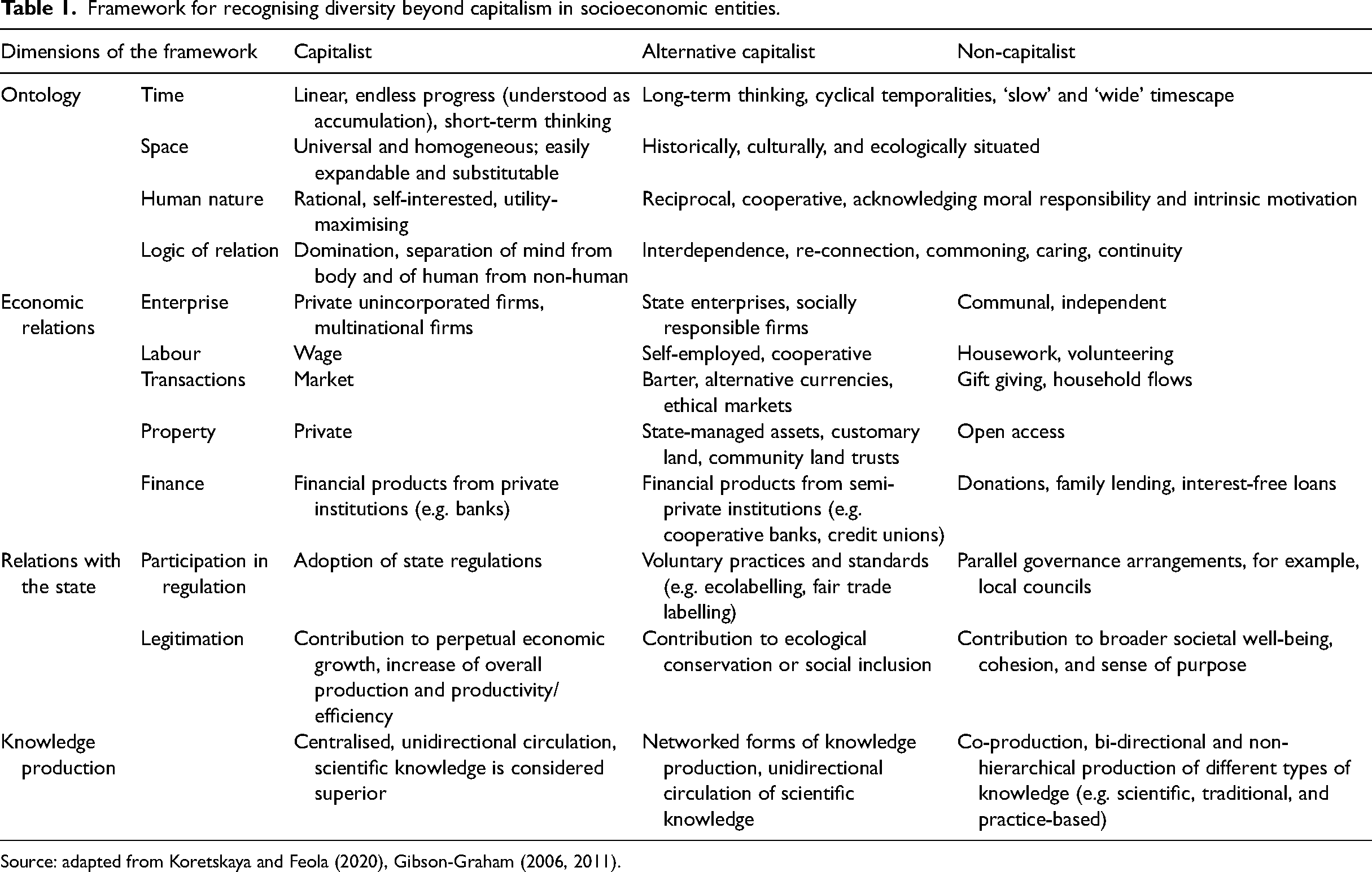
Source: adapted from Koretskaya and Feola (2020), Gibson-Graham (2006, 2011).
The framework proposed by Koretskaya and Feola (2020) was originally applied to the food sector and illustrated through cases of community supported agriculture (CSA). However, the framework's dimensions were informed by poststructuralist theories of capitalism and other analyses and critiques of capitalism, and the authors suggested that it ‘has applicability beyond agri-food systems’ (Koretskaya and Feola, 2020: 310). I believe that the framework is suitable to study makerspaces as they represent initiatives that are diverse in governance and commercial structures and rely on different types of knowledge. Moreover, makerspaces are inspired by a post-consumerist ethos (Dougherty, 2012), thereby offering an interesting basis for exploring synergies and contradictions between beyond-capitalist ontologies and practices. Although some dimensions of the framework have already been observed in various case studies on makerspaces and makers, these have done so in a disjointed way. Below, I provide an overview of the framework and illustrations from previous studies on community-led, commercial or hybrid makerspaces. These examples do not have an ambition to cover the whole range of existing makerspaces. Instead, they help to situate the framework for recognising diversity beyond capitalism in the literature on makerspaces and show diversity that was already documented by previous research.
Ontology
Capitalist ontology posits that progress is linear and – in principle – endless (Kolinjivadi et al., 2020); space is universal and homogeneous, open for the expansion of the market economy (Moore, 2015), and human subjects are rational, self-interested and utility-maximising (Siebenhüner, 2000). In this worldview, relations between people and between people and nature are predominantly built on separation and domination.
In diverse economies, relational logics rests on interdependence, caring, and continuity (Siebenhüner, 2000). A ‘more-than-human world’ is among the terms used to describe a complementarity, a co-fabrication, a ‘working together’ to maintain the rootedness, embeddedness and richness of space (Lefebvre and Nicholson-Smith, 1991; Whatmore, 2006). Relational notions of human nature foreground humans’ predisposition to reciprocate and cooperate, to create rather than merely profit, and to consider the interests of larger societal groups, including future generations (Escobar, 2019). This wider timescape opens new sources of solidarity and support and makes long-term thinking a part of daily decision making (Macy and Johnston, 2012).
In the existing literature on making, much attention has been given to the values of makers and their relations with the community. For example, Taylor et al. (2016) and Wolf and Troxler (2016) argue that profit maximisation is a secondary motivation for makers, whereas openness, skill sharing and fairness and reciprocity in community interactions comprise a guiding ethos. The connectedness of makers is manifested through local and translocal collaborations and fluid projects such as the Maker Faires in Shenzhen, Tokyo, and San Francisco (Lin, 2019). Makers pursue their occupations to invent new things, do what they love, be creative and support others (Hofverberg et al., 2017). Some explicitly reject corporate greed (Carr and Gibson, 2016); however, not all makerspace members necessarily share ideas of altruism and connectedness, as they have also been shown to reproduce norms of competition and individualism as well as limited gender, race or class diversity (Johns and Hall, 2020; Smith and Light, 2017).
In the context of logics of relations and ontological perspectives on time and space, Thorpe (2012) argues that direct experience with making might cultivate more caring material cultures. In some cases, quality handmaking occurs as a direct response to a world of ‘too much stuff’ and concerns about the climate crisis (Luckman, 2018). Wolf-Powers and colleagues (2017) and Luckman (2018) argue that makers focused on craft production operate within their local regions and self-impose limits to business growth in order to directly engage with the manufacturing process. Kohtala and Hyysalo (2015), however, discovered a gap between different maker subcultures in their sustainability orientations and competences.
Economic relations
Gibson-Graham (2006, 2011) define capitalist, alternative capitalist and non-capitalist forms of economic relations, namely enterprise, labour, transactions, property and finance. Private firms, for example, are categorised as capitalist enterprises, whereas non-profits and socially responsible companies are considered alternative capitalist, and communal enterprises as non-capitalist – with ownership being a key factor in this classification. Capitalist labour is remunerated exclusively in financial terms, based on ‘market prices’ or wages, whereas alternative paid labour includes, among others, cooperative wage and in-kind remuneration, and non-capitalist labour includes volunteering, among others. Following the same logic, in a capitalist economy, transactions are restricted to financial market exchanges, whereas alternative and non-capitalist transactions include alternative currencies and barter as well as household flows (see Table 1). Property schemes in diverse economies encompass not only private assets, but also assets and resources that are open within socially-defined boundaries as well as fully open access. Financial instruments range from capitalist (e.g. products from private banks) to alternative capitalist (e.g. products from cooperative banks) to non-capitalist (e.g. family lending) forms (Gibson-Graham, 2011).
Economic relations in makerspaces are less documented than ontologies. Makerspaces have varying ownership structures ranging from for-profit firms to non-profit organisations and state-funded spaces that offer lectures and events for the makers community (Lin, 2019; Wolf-Powers et al., 2017). Decommodified makerspaces typically have a membership policy whereby anyone can join and pay the monthly membership fee. In some cases, non-members are invited to come and use the space and equipment for free (Phillips and Jeanes 2018). Unlike specialised labour in capitalist manufacturing enterprises, makers often play multiple roles in makerspaces, such as technological assistants, resource providers or enabling entrepreneurs (Lin, 2019). In some cases, makerspaces have a distinct commercial character and receive funding from corporations such as Exxon, which is seen by some scholars as a sign of corporate co-optation (Smith, 2017a).
Relations with the state
As a political architecture, capitalism rests on state structures that participate in its reproduction (Fraser, 2017). The state ensures functionable institutions for organising capitalist production and exchange such as property rights. Socioeconomic entities mostly adopt policies and regulations issued by the state. In this system, legitimation is often primarily based on the contribution to largely accepted measures of economic progress, including economic growth and increased production and consumption (Jessop, 2002).
In alternative capitalist and non-capitalist modes of regulation, a larger number and more diverse range of actors are involved in the creation of rules and regulations that extend beyond state legislation, such as voluntary practices and standards. Relations with the state are established and maintained through political legitimation that comes from social or ecological contributions to perceived societal issues. Non-capitalist modes of political legitimation foreground contributions to broader societal well-being and sense of purpose (Koretskaya and Feola, 2020).
There is evidence of state authorities perceiving makerspaces as tools for economic development, fostering entrepreneurship and innovation (e.g. Fu, 2021), even though in practice this contribution can be limited and some makers show resistance to the idea of commercialising their hobbies (van Holm, 2017). Some scholars (e.g. Taylor et al., 2016) argue that making is often a political act that can lead to social and urban transformation. Makerspaces can be sites of resistance with alternative discourses and hubs that provide technical support for progressive social movements (Lin, 2019). In these cases, makers derive their legitimacy from knowing their tools and materials and creating wellbeing rather than contributing to the economy in a formal sense, that is, through profit making and expanding production (Hofverberg et al., 2017).
Knowledge production
Knowledge is another essential component of the cultural and political architecture. The capitalist mode of knowledge production is largely centralised within authoritative and legitimate institutions – such as conventional universities or research and development centres, from which scientific knowledge is usually distributed from in a unidirectional manner, as it is considered superior to other types of knowledge (Moore, 2015; Weis, 2010). In diverse economies, a greater variety of actors have legitimacy to produce knowledge in its manifold forms: for example, traditional, practice-based or scientific knowledge. Co-production is pivotal for removing barriers between traditional knowledge producers and consumers, thereby allowing for public ownership of information, skills or practices (Weis, 2010).
Arguable, the democratisation of innovation is a key characteristic of the makerspaces (Fiorentino, 2018). They create an infrastructure for mutual learning by sharing information about practical knowledge on how to produce things as well as strategic knowledge on how to connect with stakeholders outside the makerspaces (Smith and Light, 2017). Communication channels used by makers (e.g. personal interactions, social media, commons-based platforms) usually facilitate horizontal exchanges among people with diverse backgrounds, thereby breaking through expert silos (Lin, 2019; Hofverberg et al., 2017). Browder et al. (2019) posit that when commercial projects and entrepreneurship outcomes emerge from makerspaces, they often do so because of knowledge exchange in combination with access to technology and community.
Methodology
In this article, I explore how different dimensions of the above-described framework can co-exist in a single hybrid makerspace and the trade-offs and synergies between them. A qualitative case study research design is employed to provide an in-depth understanding of the selected makerspace, namely the Keilewerf in Rotterdam, the Netherlands. Empirical data was collected from the following sources: semi-structured interviews with Keilewerf makers and founders; 116 articles about the Keilewerf extracted from the Nexus database as of April 2021; book published by Keilewerf (Keilewerf, 2019), which provides an overview of five years of the makerspace's operations; and the Keilewerf website and social media accounts. The goal of the data triangulation was to ensure broad understanding of the overall dynamics within the makerspace as well as individual experiences of makers and their daily practices.
The Keilewerf is home to over 80 makers and creatives; however, only a fraction of them explicitly incorporate principles of environmental or social sustainability. As the goal of the present analysis is to identify diversity beyond capitalist ways of doing, thinking and organising that hold potential for more sustainable becomings, the sampling was reduced to 17 makers. The chosen sample also enables a deeper exploration of negotiations between capitalist and beyond-capitalist practices and ontologies, as sustainability-oriented makers might deal with them more often. Eleven interviews were conducted before the data saturation was reached, which aligns with findings indicating that saturation typically occurs within the first twelve interviews, whereas basic elements for meta themes are present as early as at six interviews (Guest et al., 2006). The interviewed makers included either founders or active members of a diverse set of socio-economic entities ranging from non-for profits to for-profit companies with a sustainability focus. Interviews were transcribed verbatim by Trint software and checked by the researcher for accuracy.
NexusDB was searched with key term ‘Keilewerf’ in all available materials, which resulted in 170 documents. After duplicate documents were grouped, 116 items were left. The vast majority of documents were published in Dutch (n = 114) and in newspapers (n = 104), and the remainder were published in web-based sources (n = 6) and magazines and journals (n = 5).
Collected data was screened for potential biases, for instance, newspaper articles were treated as background information to avoid over-reliance on materials that might give too optimistic view on the makerspace. Interviews were used as the main source for analysis. Directed content analysis was applied for processing the data, as this method allows a researcher to study the text to validate or extend conceptually a theoretical framework (Assarroudi et al., 2018; Hsieh and Shannon, 2005). The data were iteratively coded in Atlas.ti. The above-described theoretical framework (Koretskaya and Feola, 2020) served as a point of departure for categorising and clustering information (see Table 1 for operationalisation of the framework). The codes corresponded to the dimensions of the framework (i.e. time, space, finance, property etc) and were adjusted whenever the empirical material offered new insights; for instance, the code ‘business-as-usual critique’ was added after multiple respondents cited their dissatisfaction with the status-quo as a motivation for action. The headings for empirical sub-sections presented below were generated in the result of the data analysis which followed the structure of the framework.
Case study
The Keilewerf was founded in 2014 in Rotterdam's Makers District, which offers affordable physical spaces and a business climate that stimulates and strengthens cooperation and innovation. It consists of two main areas: Merwe Vierhavens (M4H), which is welcoming to ‘pioneering and artisanal manufacturing firms…creative entrepreneurs and companies in the eco-manufacturing industry’; and Rotterdamsche Droogdok Maatschappij, which is the hotspot for innovation in the port (Rotterdam Makers District, 2021). The M4H, where the Keilewerf is located, was previously used for fruit throughput, which largely disappeared in 1990s and 2000s as a consequence of containerisation. This resulted in ‘rising building disuse, area decline and impoverishment, and ensuing problems of social marginalisation’ (Jansen et al., 2021). Today, with the help of Rotterdam Municipality, the Makers District is increasingly developing into a vibrant area with housing, a wide range of enterprises, amenities, culture and events.
The Keilewerf began as an empty warehouse of 1000 m2 and now represents a breeding ground for more than 80 creative entrepreneurs spread across two buildings with a total of 6000 m2. Keilewerf 1 was constructed from a former wharf, and Keilewerf 2 was transformed from a former office building. Residents of the Keilewerf include, among others, steel workers, furniture makers, upholsterers, surfboard makers and artists. The Keilewerf facilitates studio spaces for individual makers and groups who are permanently based in the makerspace. In addition to individual studio spaces, there is a Building Academy in Keilewerf 2 for the unemployed to learn building skills and increase their potential for the job market.
Each maker has their own network of customers and runs their own company. They work with diverse materials and tools such as electrical metal and woodworking tools, 3D printers, laser and CNC machines. Makers also work with hand tools, which allows them to breathe new life into old crafts. About 70% of makers are men, and most residents are between 26 and 35 years old, with the second most populous age group being 36 to 45 years old (Keilewerf, 2019). The concept of the Keilewerf, its realisation and management are in the hands of one company: Keilewerf BV, which rents the buildings from the municipality of Rotterdam. These are short-term contracts that have been extended a couple of times – the latest contract ends in 2023 with a subsequent demolition of buildings to free up the space for growing demand in the housing market.
Ontologies of making together: from an empty warehouse to ‘the coolest place for makers’
The Keilewerf is a place for makers who are mostly beginning entrepreneurs or are just about to launch their own business or organisation. For many residents, the Keilewerf became their first workshop space; settling there ran parallel to registration in the Chamber of Commerce. Makers who rented at the Keilewerf early on also helped to connect it to necessary facilities and create a suitable working environment: When we first moved into the building in 2014, the warehouse was empty. There were only a few lamps. There was no running water, no plumbing. But what we did have was a space of 1000 m2 that we could furnish according to our own insight into one of the coolest places for makers in Rotterdam. (Interviewee 1)
The emerging community of makers was kept busy creating common working space, and many people voluntarily devoted hours to make it more functional, safe and beautiful. Makers who joined later had to build their own workshops, studios or office spaces (Figure 1). Most construction was done with second-hand materials: I really loved it that I could build my own workshop. I was collecting materials for one or two months, and then I could start building. Because every workshop is different, when you come in, you can immediately feel that this is a place where there’s a different kind of mind working here. (Interviewee 3)
The Keilewerf co-founders select makers such that not too many people with the same profession work in a single building, thereby limiting competition and facilitating a collaborative working environment. The co-founders also take into consideration makers’ motivations and whether they see themselves as fitting into the existing community. This approach results in multiple collaborative projects for the Keilewerfers; they join forces when a commercial project is too big or they need complementary skillsets.
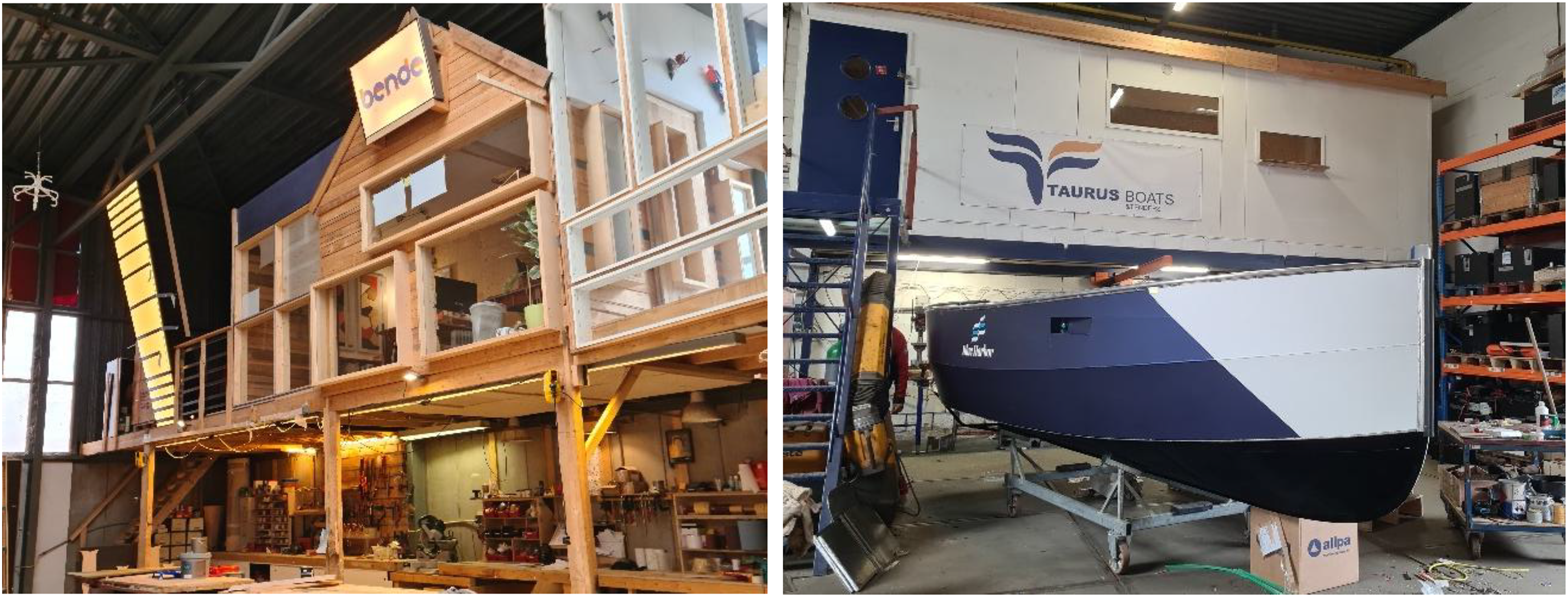
Studios in the Keilewerf (photo credit: author).
Self-interested and selfless reasons to make
What unites interviewed Keilewerfers is the enjoyment of making, which is the primary reason that they engage in their occupations. Profit is seen as a necessary condition to make a living; many interviewed makers are well aware that their job ‘won't make them rich’. Some invest a substantial amount of unpaid time in learning and perfecting skills. They also prefer taking a longer time to ensure higher quality of the product rather than finishing it quickly. Being either self-employed or having private companies with two-three people, many interviewed makes keep their businesses small even when their work is highly demanded, showing dedication to making and slower timescape: This might be a shock to you. But listen, number one, we want to have fun and make people happy and fix their problems. Number two, we want to do this our way, our way of communication, take time for people, explain stuff. And number three, we have to make money because we want to live. So money is not the most important thing. But no, no investors. No one is welcome. We’re not interested in all those promises because we don’t want to turn into a company in which people work for the company, but the company is not working for the people. (Interviewee 7)
I want to have maybe one-two people working for me. It shouldn’t be turning into a factory. I want to keep it small and real, just to be able to give the quality. (Interviewee 10)
The same respondents explained that they deliberately refuse some orders so as not to overcrowd their schedule and ensure high quality of the product. One of the interviewees admitted that due to the flexible schedule on some occasions, they offer their services without charge to poor people who could not otherwise afford repairs, which is in line with ‘relational’ or ‘non-capitalist’ logic of relations (Siebenhüner, 2000).
Another interviewed sustainability-oriented maker on the contrary, overtly exhibited evidence of a capitalist ontology, in particular, time (Kolinjivadi et al., 2020) and human nature (Siebenhüner, 2000) – the company expected employees to spend more than eight hours a day working to keep up with production deadlines. Although environmental sustainability was an important element of the company's vision, the social dimension was overshadowed by the short-term goal of business growth and related market pressures. The Keilewerf also aims to grow as a company; however, it chooses to do so in a different way, namely by replicating its model in places outside Rotterdam: We want to grow. But still, I think it’s very good because one of the strongest points of our business is that we work very place-based. Our main network is around the building, and we expand connections between the neighbourhoods. (Interviewee 1)
Buurman, one of the interviewed companies, has already successfully implemented the same growth strategy while remaining locally embedded. In 2019, a new branch of Buurman was opened in the Hof van Cartesius in Utrecht, and a branch in Antwerp, Belgium opened in the beginning of 2021. They all have the same concept: selling affordable residual materials with a story and offering workshops to both individuals and groups around recycling and woodworking.
Struggles with and against business-as-usual
Frustration with business-as-usual practices contributes to makers’ motivation to choose more local, embedded types of production and experiment with new ways of doing and organising. For instance, some express disapproval that it is cheaper and more convenient for businesses to be wasteful, to throw away parts when they slightly deviate from market expectations (e.g. a bicycle saddle with small holes) or to buy cheaper, lower-quality materials because they are easily replaceable. A lot of big companies have a CNC machine that cuts out exactly the shapes [of the furniture]. And then all you have to do is put it together. So you can create a product faster, but the problem is it takes away that human element, the handmade kind of idea […] Also it is a lot of waste, which is not so good. (Interviewee 9)
Interviewed Keilewerfers observe that most sustainability-related elements of commercial projects are disregarded by mainstream businesses when it comes down to time or money. However, it is not easy for respondents to fully implement sustainability or circularity principles in their production. The provenance of materials is not always clear; some waste is unavoidable, and sustainability and quality are not always compatible in existing products. One customer wanted a book wall and it had to be white, so I had to make it from MDF. It’s really shitty for your own health when you cut it, but also for the environment because there’s a lot of like epoxy resin kind of things. But that customer specifically asked for the variant without the dangerous things, and I was like, OK, cool, it’s like five times more expensive, but let's do this. And when I tried to cut it, I found out that the quality of supply was just so poor. And it was really because of the lack of all the chemicals. Sometimes it is really difficult to be completely environmental friendly and also have the best quality materials. (Interviewee 10)
Guided by their ontology, respondents make choices about types of materials, ways to process them, and ways to design their final product. Some makers posit that they are driven by economic reasons to choose for circular design, such as value of scarce materials that can be reused and remoulded multiple times, whereas other makers claim that sustainability is a philosophy they live by. I love to reuse. It’s my natural habit, and I really don’t like to waste. So I’m always thinking, how can I repurpose things, turn them into something totally different. And this is a way you can look at your whole life, it’s more of a philosophy. If you are open for what things can become, your whole life will be much richer. (Interviewee 5)
A number of interviewed makers also strive to produce goods that can ‘survive their owners’, such as bags made of firehoses, thereby manifesting a long-term mentality. They appeal to customers by creating a story or emotional bond behind the product. For example, upcycled wood is seen as a great means to bring a piece of Rotterdam history into people's homes.
However, external conditions – such as the Keilewerf's short-term contract with the municipality – force makers to operate within the frame of one to two years of planning. For example, the Keilewerf's co-founders have postponed the implementation of more sustainable solutions for the building until they obtain a more permanent rental contract. As a result, building conditions are not always very comfortable – it can get very cold in winter and hot in summer.
One space, multiple economies: economic relations when reciprocity and profit co-exist
The majority of the companies in the Keilewerf operate as private enterprises. There are also a few tenants who operate as private persons and a couple of non-profit organisations, such as Give a Bike foundation and Pixelbar Hackerspace. All Keilewervers combined have a turnover of between 3.2 and 6.6 million euros per year, with an average turnover of 55.000 euros per year (Keilewerf, 2019).
A survey conducted by Keilewerf among its residents shows that 72% of them work full-time on their own company (Keilewerf, 2019). Among the part-timers, 47% also have another company or are employed elsewhere. Companies work with 178 self-employed individuals and freelancers who are not located in the Keilewerf. These are not all full-time appointments; some are professionals coming for project-based work and others are interns or volunteers. However, it can be difficult to find motivated volunteers who commit for a prolonged period of time due to financial and time constraints that people experience in daily lives, such as full-time employment, family obligations etc. A number of respondents prefer collaborating with people who are at some distance from the labour market – they come regularly to master new skills while also helping for free or for a small compensation as they learn.
Respondents are embedded in the capitalist market and engage in multiple financial transactions with their suppliers, customers and partners. Market transactions also occur within Keilewerf; for example, if something in the space needs to be fixed, makers can get paid to do so. Keilewerfers are sometimes each other's customers, and they pay market price for the procured goods. However, they also participate in alternative capitalist and non-capitalist exchanges. For instance, Keilewerfers exchange time when they help one another on their projects, and they borrow equipment for free or on a barter basis. Gift-giving also often occurs – some companies obtain some materials for free, such as firehoses that have reached the end of their lifespan, used wood and wood cut from sick trees are considered waste and are therefore given away for no charge. In rare cases, makers who operate commercially also provide ‘gifts’ for their customers. For example, one of the interviewed makers is offering free repair services for hotels during of the Covid-19 pandemic: We want to maintain a nice working relationship with them, and we trust them. You need some trust; we trust them not to misuse our generosity. And I think they actually want to help us as well by hiring us. It will cost some money, of course, and they’re helping us making money. And so we’re helping each other. But it’s also because we are who we are, and we know they need the help and we can help. (Interview 7)
Gift-giving and barter are much more common in non-commercial organisations. Pixelbar purposefully rejects commercial applications of ideas born within the hackerspace, as the founding members perceive that behaving otherwise ‘can ruin everything’. It can afford complete detachment from the market due to regular subscription fees from its members. However, Give a Bike Foundation cannot rely on regular voluntary donations and is therefore experimenting with commercial add-ons to maintain their core activity while enabling staff to make a living.
Rent below market price, which is provided by the Keilewerf due to an agreement with the municipality of Rotterdam, helps both commercial and non-commercial residents keep their operations going. There are a lot of creative startups in Rotterdam which are really struggling. I mean, I know many companies who are super, super busy but don’t earn a dime because of their expenses, because the rent is so high. I could have built my company because of the low costs here. (Interview 10)
Unlike other types of makerspaces, the Keilewerf does not offer shared equipment. Most of the equipment is privately owned with the exception of big machines, which are collectively procured by makers who need them. A few organisations – such as Pixelbar, a hackerspace, and Buurman, a DIY store for second-hand materials and workplace accessible to the wider public for a fee – have equipment that is shared among members of the community or workshop participants. Having access to shared tools across the Keilewerf would ease the burden of initial investment for makers.
Despite the fact that makers have to put money into their own equipment, they avoid commercial loans, instead organically growing their businesses ‘step by step’. Business models centred around recycling, upcycling or repurposing ‘waste’ materials help by facilitating access to free or cheap resources. Crowdfunding and family-lending are also used to raise the initial capital – sometimes out of necessity. It is difficult if not impossible to access traditional banking products without a clear idea of the profit sources or initial capital to fund the business plan.
Relations with the state: in-out-and beyond
The Keilewerf's rent is subsidised, and due to its location in a developing area with many new real estate projects, the co-founders have to legitimise their activities in order to ensure continuous support from the authorities. To convince the municipality to offer a subsidised rent, the co-founders had to collect data about size, the revenue of the companies located in the makerspace, the number of employees, and projects implemented in the city as well as the quality aspect the place brings to the city and local economy. In communications with the larger public, they position themselves as a place for sustainable and circular furniture pioneers and architects who have turned a desolate area – which previously had the image of a red light district – into an accessible, energetic place.
At the time of writing, the Keilewerf has a rent extention until the year 2023. In the meantime, the co-founders are looking for a more secure long-term residency that will enable them to implement more sustainable solutions for the building and give certainty for makers while still preserving affordable rents for all Keilewerfers. It’s [our] main goal, it’s the whole philosophy of the company to offer affordable renting spaces. It will never be too commercial […] [a mix between commercial and non-commercial makers] is a good economic model because it’s not too much profit; we are here not for a quick win, but for a long-term win, for a good, affordable city. (Interviewee 1)
From the perspective of the applied theoretical framework, therefore, the Keilewerf co-founders would seem to accept a capitalist way of legitimation to fit in the system, and, at the same time, go beyond the system by expanding the narrative of strictly economic development with ethos of affordability, quality and sustainability. Some respondents go one step further with an attempt to transform the system and posit that more systemic interventions such as a labour tax reduction or a sustainability tax are needed. The former would make hand-made craft products more available for customers from different income groups, and the latter would incentivise more businesses to incorporate circularity or sustainability principles even if they do not have a guiding sustainability ethos.
Yet, the majority of the interviewed makers are not actively pursuing relations with the state, as they are not always aware of existing or potential policy instruments that could support their activities. Regardless of either they are at an early business stage or at a more advanced level with a set organisation/production structure, these makers are focused on their core activities – designing and making – and perceive policy area as too distant to act upon.
Learning together: knowledge production in the Keilewerf and beyond
In the Keilewerf, makers exchange knowledge in a non-hierarchical mode; they often learn from each other and from other colleagues in the industry as well as from open-source knowledge (e.g. via Internet). Mostly practice-based, tacit knowledge is accumulated. Interviewed makers explain that they can easily approach others within the Keilewerf to seek advice on particular skills or materials. Knowledge exchange is facilitated by existence of shared spaces, such as kitchen and room with a shared CNC machine, and by social proximity of makers. Within hackerspace Pixelbar and social enterprise BouwAkademie the knowledge exchange has even fewer boundaries as people come to these places with the aim of learning and sharing. Academic knowledge is also applied, however, it is difficult for some makers to obtain formal high-quality training in their specialisation, such as restoration of furniture or production of modular, circular boats, which also makes it challenging to find skilled employees.
Knowledge produced externally to the makerspace – for instance, how to grow from a solo entrepreneur to a company with several employees, identify opportunities to collect ‘waste materials’ for upcycling, recycling or refurbishing, or organise production in sustainable way – is not readily available. Due to the restricted access and knowledge hierarchies of such knowledge, respondents prefer to seek out alternatives. Interviewed makers often have to employ informal networks, that is, colleagues and acquaintances, to obtain needed information.
In their turn, makers are very open to sharing their knowledge with the public. Every year, the Keilewerf opens its doors to the public by organising festivals, holding open days, and taking part in Rotterdam-wide Art Weeks. Up to 20,000 people visit the space annually (Keilewerf, 2019). Hackerspace Pixelbar, tandem bicycle company Spaak Rotterdam and Buurman attract the most external visitors. For instance, Buurman focusses on recycling and reusing discarded building materials and organises an accessible workspace with workbenches and tools for rent. In its hardware store, workshops are conducted where people learn to design and make their own furniture, such as a dining table or a cabinet. Buurman also provide guidelines on how to get started at home.
Discussion and conclusion
In this article, I applied an extended framework of diverse economies (Koretskaya and Feola, 2020) with the aim of understanding how capitalist, alternative capitalist and non-capitalist ontologies and practices are negotiated in a hybrid makerspace. To summarise, the contribution of the paper is threefold: (i) it presents empirical data on an under-researched hybrid type of makerspaces that hosts both for-profit and non-profit entities and integrates community and commercial aspects; (ii) it employs and elaborates on an extended framework of diverse economies, that understands capitalism as not just a form of socio-economic organisation but also a cultural and political architecture, and illustrates the potential application of the framework to makerspaces by providing examples from previous research; (iii) it applies the framework to a hybrid makerspace, which, in the spirit of Gibson-Graham (2006, 2011), opens more spaces of possibilities in terms of how we look at makerspaces and what research subjects we choose to investigate diversity.
I chose a case study of the Keilewerf, a makerspace located in Rotterdam, the Netherlands, due to its set-up of hosting both commercial and non-commercial entities within its walls. This paper focused on a sub-community of makers within Keilewerf who explicitly incorporate social or environmental sustainability principles in their work. The extended framework of diverse economies proved to be useful, as it enabled the revealing and unpacking of a multiplicity of ways in which makerspace and makers operate in and beyond capitalism. In the case study, diversity beyond capitalism could be observed on all dimensions of the framework: ontology, economic relations, relations with the state and knowledge production. Dimensions of ontology and knowledge production show the greatest degree of diversity: manifestations of time, space, human nature, logic of relation and knowledge production range from capitalist to non-capitalist, however, for the interviewed makers, non-capitalist manifestations are more prominent. For instance, almost all respondents mentioned enjoyment of their occupation as their primary reason for making. This finding corresponds with previous research on community-based makerspaces (Wolf and Troxler, 2016) and publicly accessible workshops (Taylor et al., 2016) which identified that primary motivation of makers derives not from profit but rather from interest in the process of creation, fairness and reciprocity. Wolf-Powers et al. (2017: 369) studied for-profit spaces and had a similar observation that ‘maker-entrepreneurs become business owners reluctantly or accidentally […] many makers focus more on products than markets; many assert that making things itself constitutes a valuable end’.
From the perspective of the theoretical framework, respondents from the Keilewerf case study can be seen to integrate capitalist, alternative and non-capitalist economic relations into their daily activities. For example, market transactions are often combined with gift-giving practices and barter, and private property is combined with shared assets and open-access resources (e.g. knowledge, free ‘waste’ resources). While capitalist forms of enterprise (e.g. private firm) were predominantly chosen by interviewed makers, they played an instrumental rather than hindering role in respondents’ enactments of alternative ontologies. This co-existence between different types of ontologies and practices within separate socio-economic entities could point towards potential complementarity rather than contradiction between capitalist and beyond-capitalist modes.
However, makerspaces exist in ecosystems of local and wider communities connected through porous boundaries (Budge, 2019), and the success or failure of a makerspace depends on how well the ecosystem can accommodate the initiative. Data from the Keilewerf suggests that the capitalist cultural, economic and political architecture create multiple constraints and tensions for enacting alternative ontologies and practices and include, among others, competitive pressures and consumers’ expectations with regard to price and speed of production, high taxes on labour and second-hand materials, and restricted access to knowledge produced in a capitalist mode (see Table 2).
Negotiating tensions and constraints of the capitalist cultural, economic and political architecture. Examples based on the Keilewerf case study.
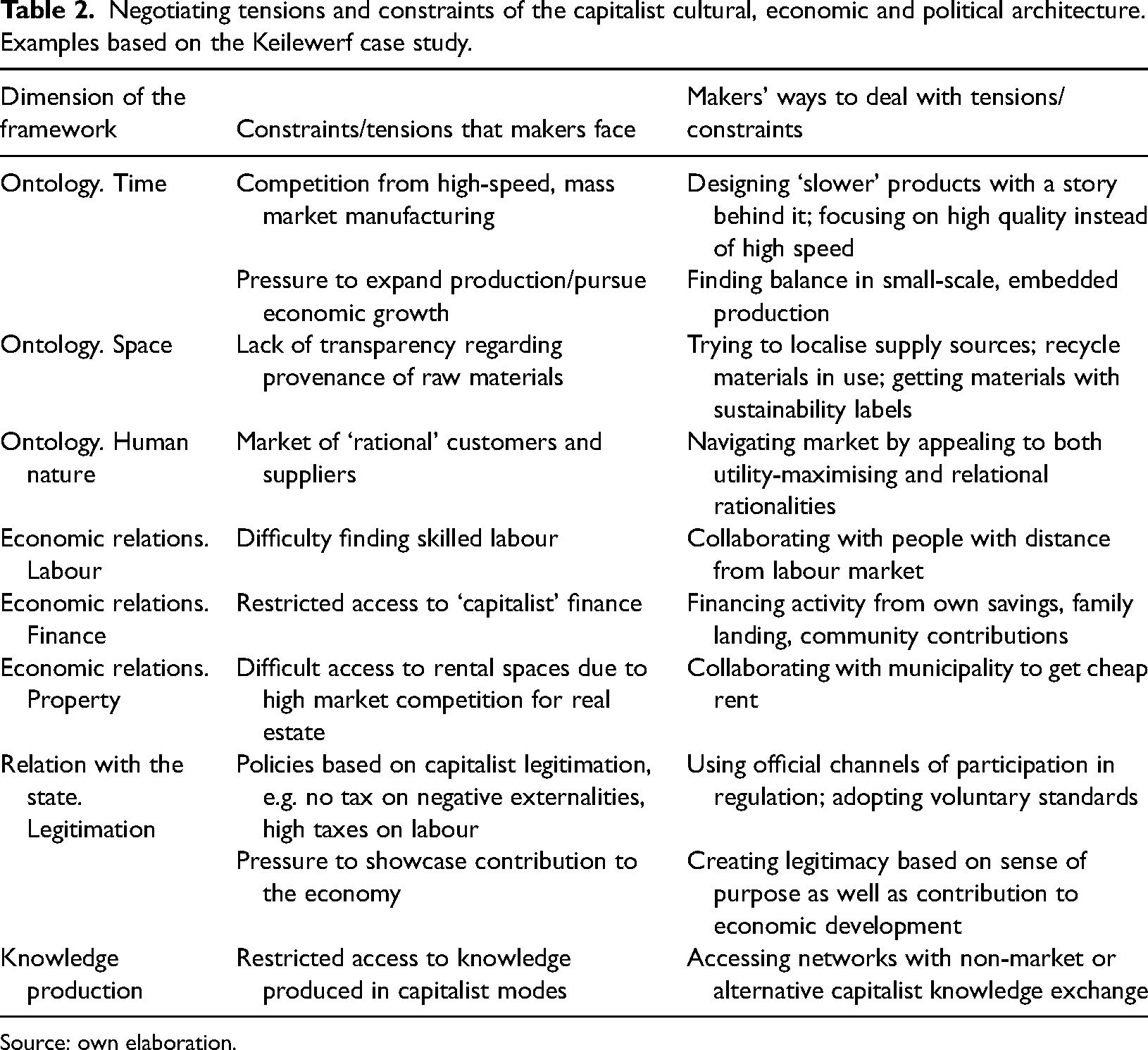
Source: own elaboration.
These tensions could point towards transitional state in which interviewed makers are situated. Embedded in capitalist cultural, economic and political realities, makers carve ontological and material spaces of alterity in domains that allow for autonomous decisions, such as, on how much to produce, with what quality, what financial and knowledge networks to access. At the same time, in the institutionalised domains, interviewed makers seem to employ various tactics to enable their alternative ontology to fit the reality of capitalist society. For instance, they create legitimacy based on contributions to economic development and appeal to the capitalist values of customers.
It is important to reiterate that the vast majority of interviewed makers did not frame their activities as opposing capitalism. Some of them acted out of dissatisfaction with the mainstream manufacturing, others organised their practices around concerns over social or environmental sustainability. Most respondents were focused on their individual response to sustainability crisis without engagement with wider socio-political concerns. This approach can either be seen as a ‘quiet form of activism’ (as earlier observed by Smith, 2020) or criticised for placing too much responsibility on personal production and consumption choices. This paper aims to unpack different realities of makers and interpret them from the perspective of diverse economies without assessing the transformative potential of the makerspace.
This knowledge could serve as a stepping stone to investigate in the future research the question of transformation towards beyond-capitalist society, and inquire into whether pre-existing capitalist structures offer little room for enactment of alternative ontologies and practices or whether they can be organically combined with beyond-capitalist cultural and political architecture. Future comparative analysis could be carried out on different types of makerspaces – commercial, community-led, hybrid – to understand which types or combinations thereof are more conductive to opening up spaces of possibilities for thinking, doing and organising in ways that go beyond capitalism. Hybrid makerspaces could be of special interest due to (i) proliferation of commodified manifestations in shared working spaces, and (ii) contested nature of hybrid spaces where commodified and non-commodified relations intersect and interrelate. I suggest that a deeper understanding of tensions and complementarities between capitalist and beyond-capitalist modes could provide valuable insights into how a transition to a beyond-capitalist economy can become feasible and desirable in the face of the social and environmental challenges of the 21st century.
Footnotes
Acknowledgements
The author sincerely thanks Amanda Brandellero, Giuseppe Feola and two anonymous reviewers for their very useful comments on the article.
Declaration of conflicting interests
The authors declared no potential conflicts of interest with respect to the research, authorship and/or publication of this article.
Funding
The authors disclosed receipt of the following financial support for the research, authorship and/or publication of this article: This publication is part of the project ‘Crafting future urban economies’, grant number VI.VIDI.195.160 led by Dr Amanda Brandellero, financed by the Dutch Research Council (NWO).
