



Abstract
While the physiology, histology and stem cell biology of smell are active fields of contemporary research, smell is probably the sense that physicians knew the least about prior to the 20th century. Joseph-Hippolyte Cloquet (1787–1840) was an anatomist who, in 1815, defended a singular doctoral thesis—On odours, the sense of olfaction and the olfactory organs—then went on to publish, in 1821, the first complete treatise on rhinology. In our biographical sketch, we focus on Cloquet’s significant contributions to olfactory anatomy and physiology. His realization that odours are chemical and molecular in nature led him to formulate an accurate functional theory of the olfactory mucosa. Following a historical introduction, we review contemporary literature on the anatomical–functional understanding of olfaction and propose a (possibly debatable) theory for the lexical deficits one encounters when trying to describe the sense of smell.
‘Olfaction can be seen at every turn of the labyrinth’. To explain the purpose of his doctoral thesis, Joseph Hippolyte Cloquet (1787–1840) (Figure 1) used this clever expression, thereby linking three of our five senses: sight, smell and hearing. But beyond this concise formulation (also a nod to Aristotle) what we attempt to highlight here is the scientific relevance of this physician and his pioneering work at the start of the 19th century in the fields of smell and general rhinology. 1 It bears noting that our contemporary electronic universe is geared toward sight and hearing and that virtual olfactory avatars have yet to be created. As Cloquet suggested in 1815, anatomy and physiology help explain a function, but its origin can only be understood through comparative zoology, in which Cloquet took a keen interest. We hope to present a wide range of historical data, brought together for the first time, and thus to contribute to the debate about how the understanding of smell developed during the 19th century. 2
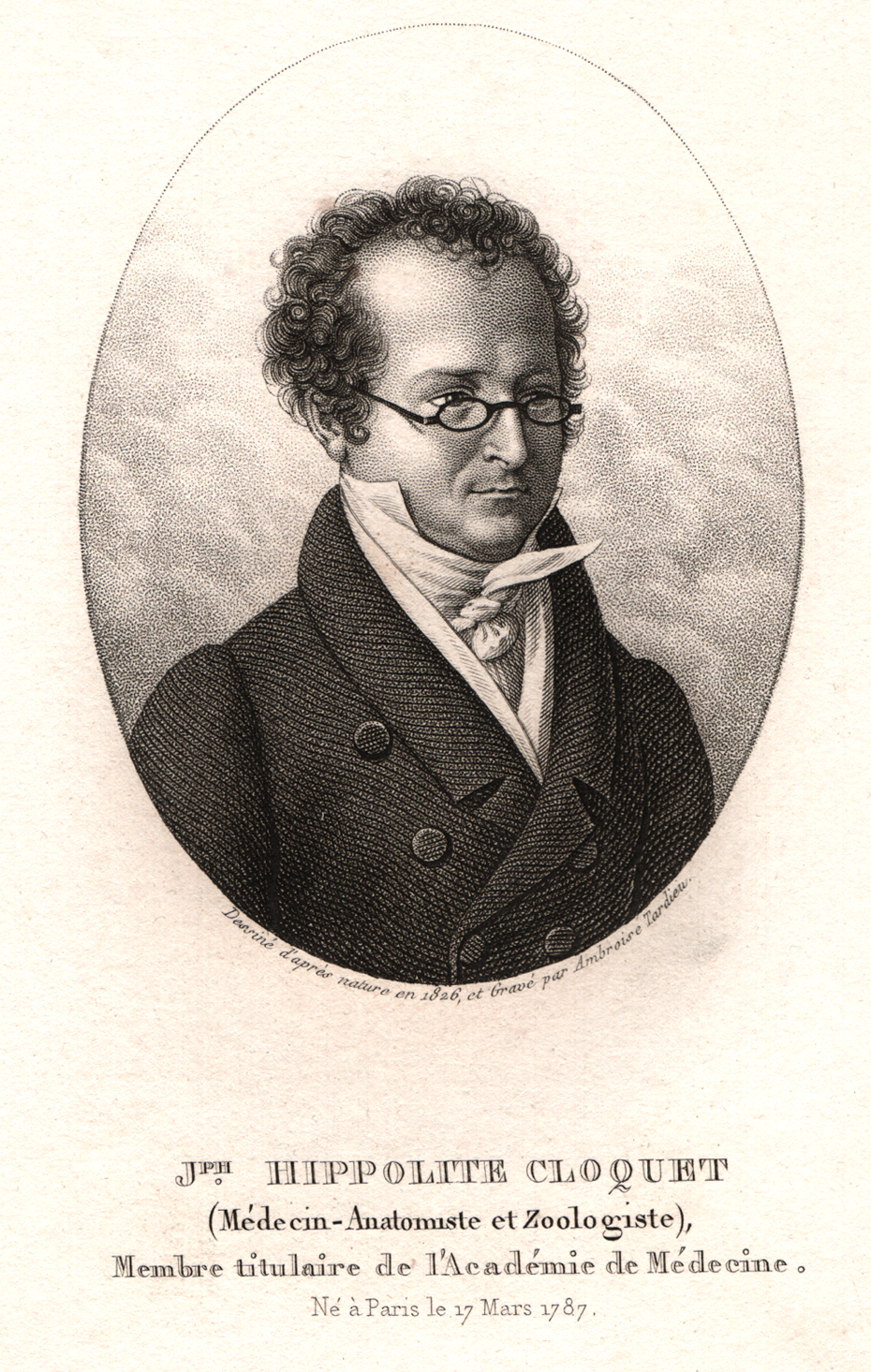
Portrait of Joseph Hippolyte Cloquet (1787–1840). Private collection of the author.
Sensualism
In 1767 Claude-Nicolas Le Cat (1700–1768) noted that ‘everyone knows that the organ of smell is found inside the nose, but few realise the ingenuity with which this interior is constructed to receive this sensation’.
3
He added that ‘the olfactory nerve is the first pair of nerves that leave the skull and project to the olfactory mucosa. It has a great number of nervous filaments’. Le Cat, like all philosophers, took an interest in perception (our interactions with objects and the world around us) and gave an overview of the five senses in his 1767 Traité des sensations. In 1774, Jean-Jacques Rousseau (1712–1778) elaborated on the ideas of his predecessors: The sense of smell is to taste what vision is to the sense of touch: the former sends signals or alerts the latter as to how a given substance will affect it, and prepares for either use or avoidance of this substance, based on anticipatory impressions.
4
Cloquet was also influenced by John Locke (1632–1704) on ‘understanding’, and by Etienne Bonnot de Condillac (1714–1780) and his proposal to replace metaphysics with scientific observation and rigorous factual study.
Cloquet was the first physician to undertake an in-depth study of olfaction, making him a pioneer of scientific psychology as he followed the footsteps of his teacher, Pierre Jean Georges Cabanis (1757–1808). As both a physician and a sensualist philosopher, Cloquet attributed perception to cerebral activity, whose purpose he explained this way: To distinguish pleasure and pain, and thus to desire or not desire, which is to say, once alerted to the presence of an object, to draw it near or push it away, to approach or leave or flee, depending on the possibilities of danger or enjoyment […]. It is evident that these two faculties, the purpose of which is to protect the individual, originate with sensations or with continual action of external bodies on the organs of animate beings; sensations thus become the true cause of most of what constitutes existence for these beings.
5
The Cloquet family: Artist-physicians, anatomists and physiologists
What do we know of Joseph-Hippolyte Cloquet, the man? His father, Jean-Baptiste-Antoine Cloquet (1748–1828), was a Parisian with family origins in the Champagne region. In addition to his career as an engraver, he taught draughtsmanship at Collège Saint-Barbe; among his students was Pierre-Fidèle Bretonneau (1778–1862), 6 also a close friend. He is known for his treatise on perspective written for artists Traité élémentaire de perspective à l’usage des artistes 7 and for the precision of his colour drawings of geological samples and fossils. Cloquet the father taught his two sons to draw; in addition to becoming physicians, both used their artistic skills to illustrate anatomy books, which explains their lasting fame. 8 The younger son, Jules-Germain Cloquet (1790-1883), a distinguished anatomist and surgeon, 9 illustrated his 1817 thesis, known for its seminal description of the macroscopic anatomical pathology of inguinal hernias. 10 He became a medical school professor as well as a baron during the Second French Empire.
Joseph Hippolyte Cloquet was the older son born in Paris on 17 May 1787. He won a Latin discourse competition in 1805 11 and took great interest in the natural sciences, which led him to study medicine as well. He passed the house officer exam for the Paris hospitals in 1809 (as his brother did in 1810) and the following year, he won an anatomy and physiology prize. 12 His anatomy professor was André-Marie Constant Duméril (1774–1860), whom he met in Rouen at the Ecole d’anatomie artificielle, where he studied wax modelling with the surgeon Achille Cléophas Flaubert (1784–1846), father of the famous writer Gustave Flaubert (1821–1880) (note 1). Cloquet worked as Duméril’s secretary from 1812 to 1816. On 21 February 1815, he defended his thesis dedicated to Cabanis, his Latin teacher. 5 Entitled ‘Dissertation sur les odeurs, sur le sens de l’olfaction et les organes de l’olfaction’, his thesis was the beginning of more than 10 years of research focused on the anatomy, physiology and pathology of olfaction and the nose (Figure 2). After working as an anatomy preparer at the medical school, he became a clinical medical assistant (note 2), then passed the agrégation exam to become a professor in charge of anatomy classes. On 6 February 1821, the same day as his brother, he was elected member of the Royal Academy of Medicine. He went on to teach physiology at a Paris teaching establishment, the Athénée Royale de Paris (note 3). On the title page of his books, he included a list of the many learned societies of which he was a member. Cloquet died in 1840 from complications due to his alcoholism. Gustave Flaubert praised him but with this acerbic witticism: ‘A brilliant physician, immersed in science but no less so in wine’. 13 Will this explain the absence of an obituary in the medical press of his time?

Front cover of Cloquet’s thesis. 1815. Private collection of the author.
Louis-André Ernest Cloquet (1818–1855), his son, pursued the same area of study, defending his thesis in 1846. 14 After working as an anatomist, he left for Tehran to serve as the doctor for a diplomatic mission. Moḥammad Shah Qājār kept him on as his court physician, which he remained after the Shah’s death, under the aegis of the vizier Mīrzā Taqī Khan who made him a minister as well as a professor of medicine. He eventually married an Iranian Armenian woman. After an attempted coup d’état, he was able to save the Shah by extracting the bullet. 15 He continued his diplomatic activity by remaining in contact with the French authorities in Paris until his death in Tehran, the result of a poisoning that was never fully elucidated. His monumental grave can still be visited today in Doulab Catholic Cemetery in Tehran. 16
A selection from Joseph-Hippolyte Cloquet’s books
Unfortunately, the records in the medical school and university libraries and in the National French Library are not consistent with their attribution of the books written by the two Cloquet brothers. Many of those written by Joseph-Hippolyte were printed with the author’s name abbreviated as J.-Hippolyte which, in the records, is shown as Jules-Hippolyte Cloquet, thereby attributing authorship to the younger brother, Jules. What makes the records even more confusing is that both brothers wrote richly illustrated anatomy books.
‘My work is mainly intended for students beginning their study of medicine’, noted Joseph-Hippolyte in the introduction of his Traité d’anatomie descriptive, 17 the first edition of which was published in 1816. The six successive editions, the English translation 18 by the Scottish anatomist Robert Knox (1791–1862), 19 also a fine artist, and the Italian translation by the Naples anatomist Francesco de Lisio 20 are indicative of the book’s success. Cloquet also noted, ‘Only one skilled with the scalpel can write a proper anatomy book’; but his drawing materials were also essential for the anatomical atlas he published in 1831, complete with multicolour lithographs. 21 When Félix Vicq d’Azyr (1748–1794) died, leaving his four-volume Système anatomique unfinished, it was Cloquet who saw to the publication of the final volumes (the first came out in 1792 and the last in 1830). 22
Convinced that ‘natural history is the most precious instrument we have for perfecting hygiene and treatment’, 5 Cloquet published an extensive work in eight volumes from 1822 to 1827, Faune des médecins ou histoire des animaux et de leurs produits. 23 His stated goal was to contribute to ‘to the well-being of my fellow men’. Drawing inspiration from Pliny the Elder (23–79), Cloquet ambitiously examined a multitude of plants and animals to better understand human physiology through comparative anatomy and physiology; he also sought new treatments while identifying potential poisons. The multivolume work proposes a comparative zoological approach and was strongly influenced by Diderot’s Encyclopaedia. It laid groundwork for Charles Darwin (1809–1882) and his Theory of Evolution. Cloquet pursued his ideas in a work published in 1826: Traité complet de l’anatomie de l’homme comparée dans ses points les plus importants, à celle des animaux, et considérée sous le double rapport de l’histologie et de la morphologie (Complete treatise of human anatomy, with the most significant points compared to that of animals and studied relative to both histology and morphology) 24 with impressive drawings that give the book undeniable artistic value. Another noteworthy work is Cloquet’s 1822 study of fish. 25
Because of his extensive knowledge in many fields, he wrote articles for various encyclopaedic dictionaries, in great demand during the first half of the 19th century. For example, Dictionnaire des sciences naturelles 26 and Encyclopédie méthodique. 27 He also worked with Pierre-Auguste Béclard (1785–1825) on his medical dictionary. 28 In 1818, he translated The Modern Practice of Physic by Robert Thomas (1753–1835), 29 and in 1820, Elementi di farmacia by an Italian, Castanelli (Reference cited by J-Hippolyte, which the author was unable to locate).
Smell
From an evolutionary perspective, the sense of smell is essential for individual protection against predators as well as a species’ continuance, during mating rituals, for example. When sight or hearing are ineffective, at night or during loud natural events, animals have only olfaction to ensure their survival. To recognize and approach sexual partners, most animal species rely on smell. Smell can also protect animals from potentially harmful substances, including toxins and disease agents. Animals avoid nauseating odours because they emanate from waste and materials in decomposition and thus may contain toxins and/or lead to disease. For humans, smell is also important for relationships with others, for body self-perception, for perception in natural or urban environments, for a certain type of time perception and in various forms of aesthetic assessment. 30
Whereas animals are macrosmatic, humans are microsmatic (note 4). Rouqier et al. demonstrated that over 70% of human olfactory receptor genes have become non-functional pseudogenes, leading them to hypothesize that the reduced sense of smell could correlate with the loss of functional genes. They hypothesize that under relaxed selective constraints, primates would have progressively accumulated pseudogenes with the highest level seen in hominoids and that the fraction of pseudogenes in the olfactory receptor gene repertoire could parallel the evolution of the olfactory sensory function. 31
For humans, perfumes have been important socially since ancient times. ‘The sense of smell is a rich source of pleasure […] it procures delicate sensations, linked to the sweetest of memories’, Cloquet noted in his thesis. 5 ‘Olfaction can also be highly useful to physicians in the practice of their art’—an apothegm explained in depth in 1789 in a long treatise by Jean-Joseph Brieude (1719–1812) who examined the diagnostic use of odours emanating from patients. 32 Jean-Noël Hallé (1754–1822), the first to hold the chair of public hygiene created in Paris in 1794, was the first to analyse morbid smells 33 and was a sworn opponent of the city’s nauseating odours. 34 This embryonic phase of public health, coinciding with the revolution, drew on the work of several philosophers, primarily Rousseau, Locke and Condillac who, pursuing the ideas of Antoine Maubec in 1709, 35 developed ‘sensualism’; they were also the first to propose putative olfactory mechanisms but without precise chemical, anatomical or physiological correlates.
Hippocrates proposed a basic anatomical description of the nose. In 1489, Leonardo da Vinci (1452–1519) accurately described the nasal conchae and the sinuses. Nathaniel Highmore (1614–1685) located the opening of the maxillary sinuses (Highmore’s antrum) in 1651. 36 Medical rhinology, 37 however, probably did not start until the operations performed by Louis Lamorier (1696–1777), a surgeon in Montpellier who, in 1743, was the first to surgically open the maxillary sinus to drain pus. 38 His method would be used throughout Europe for several decades. 36 The first to attempt sinus irrigation through the middle meatus was Anselme Louis Bernard Bréchillet-Jourdain (1734–1816), in 1760. 39
In 1789, Antonio Scarpa (1752–1832) published the most precise anatomical descriptions to date of the nasal cavities, the sinuses and the inner ear. 40 This was followed by a thesis on rhinosinusitis in 1804, defended by Jacques-Louis Deschamps 41 ; shortly thereafter it was published in book form as a treatise. 42 Deschamps mentioned pathological loss of olfaction without going into physiological detail. As for Cloquet, he cited two German predecessors. The first was Konrad-Victor Schneider (1614–1680) who correctly described the anatomy of the olfactory mucosa in 1660 (which certain anatomists referred to as Schneider’s membrane 43 from that point forward); he also predicted its physiological role and sought to correct ‘an error of ancient medicine, whereby the nose was considered the emunctory of the brain’. 44 Waste was thought to be drained through the cribriform plate of the ethmoid bone, which led to the use of the term ‘head cold (rhume de cerveau)’. 45 It has been recently noted that cerebrospinal fluid (CSF) is mainly formed and reabsorbed across the walls of central nervous system blood capillaries and that the lymphatics may play a more significant role in CSF absorption. The CSF drainage pathways encompass a direct drainage through the cribriform plate in anatomically defined channels that connect with the nasal lymphatic. In this way, ancient views are once again of interest and may be more accurate than previously thought. 46 The second German predecessor was Johann Friedrich Blumenbach (1752–1840) in Gottingen, whose description of nasal cavity vascularization was an important contribution. Blumenbach also identified ‘rootlet endings of the first nerve pair’ in the olfactory mucosa and correctly described olfactory receptors but without elucidating endocranial neural pathways. 47
Using the findings of two chemists, Antoine-François de Fourcroy (1755–1809) 48 and Claude-Louis Berthollet (1748–1822), 49 Cloquet was the first in the medical field to propose that the odorous substrate is molecular in nature. ‘We have good reason to believe that there are no specific aromas or substances that comprise odours, and that they are explained by molecules emanating from the very substance of odorous bodies’; this in turn explained that ‘each of them [odours] seems to result from a specific substance that floats in the atmosphere, subject to atmospheric impulsions’. He gave credit to his sources: ‘Berthollet seems to have proven that odours are nothing other than the molecules that emanate from odorous bodies’. Based on this chemical principle, Cloquet developed a physiologically consistent osmology (or ‘osphresiologie’). ‘We have been able to establish generally that the nasal cavities and olfactory mucosa are clearly where olfaction takes place in humans and most vertebrate animals, and where the work of the sense of smell is carried out’. In 1824, Eugène Michel Chevreul (1786–1889), in his Considérations sur l’analyse organique, correctly attributed the physiological role of both taste and smell. 50
After his classification of odours, Cloquet proceeded with a meticulous description of the nasal cavities, the sinuses and the nose, covering the muscles of the nose as well! His description of ‘the organization of the olfactory mucosa’ is only macroscopic, but certain passages are almost poetic, that is, ‘it could rightly be called velvet-smooth’. Because he lacked microscopic data, in his thesis Cloquet erroneously attributed the functional area of olfaction to all areas of the mucous membrane in the nasal cavities and the sinuses. In his 1821 book—Osphrésiologie ou traité des odeurs, du sens et des organes de l’olfaction
51
(Figure 3)—he corrected this error and limited the functional area ‘to the upper regions: the exact location of the sense of smell’. In fact, it was not until 1862 that Max Schultze (1825–1874), an anatomy professor in Bonn, described the olfactory sensory cell
52
at the ‘yellow spot’ of the olfactory mucosa, which only covers around 3 cm2, lining the roof of the nasal cavity and continuing down the upper concha and the upper part of the septum.
53,54
Cloquet differentiated between two distinct types of innervation: ‘The first serves the sense of smell and consists in branches of the olfactory nerves (first pair); the second serves to maintain the membrane and arises mainly from the sphenopalatine ganglion and the ophthalmic nerve of Willis’. He described the contributions of various anatomists in detail and compared their data to his own observations. For example, he agreed with the position of Johann Friedrich Meckel (1724–1774) in Berlin, who was the first to describe the sphenopalatine ganglion (or pterygopalatine ganglion), but he opposed the position of Xavier Marie François Bichat (1771–1802) who argued against Meckel: ‘I believe this ganglion to be absolutely identical to the other nervous ganglia’. In 1818, Cloquet added to the scope of his thesis with his Mémoire sur les ganglions nerveux des fosses nasales (Figure 4). Therein he proposed an anatomical corollary to elucidate the physiology of nausea resulting from unpleasant odours: By proving that 1) the correlations between the senses of taste and smell depend on the presence of certain nervous ganglia; and that 2) these ganglia communicate amongst themselves and with neighbouring ganglia, might we not provide a demonstration useful to anatomy and physiology?

Front cover of Cloquet’s book on the new science of olfaction named ‘opshrésiologie’. Private collection of the author.

In 1818, Cloquet added to the scope of his thesis with his Mémoire sur les ganglions nerveux des fosses nasales. Private collection of the author.
He also revised his description of a nasopalatine ganglion, which he noted as unknown before his thesis (even though Deschamps had already mentioned it in his 1804 thesis 43 ), and attributed to it ‘the formation of sympathetic phenomena that link taste and smell; this to some degree explains how substances on the palate act on the olfactory mucosa and vice versa’. 55
In 1991, Richard Axel and Linda Buck (Nobile Prize winners 2004) discovered how hundreds of genes in our DNA code for the odorant sensors located in the olfactory sensory neurons of the nose. Each receptor is a protein that changes when an odorant attaches itself to it. This causes an electric signal to be sent to the brain. Small differences between different odorant sensors mean that certain odorants cause a signal to be released from a certain receptor. Smells are composed of a large number of different substances and the brain interprets the varying signals from our receptors as specific scents.
56
Cloquet’s representation of physical olfactory phenomena is in agreement with these recent discoveries: Once odorous molecules are in the nasal cavities, they spread throughout the area, facilitated by their passage through a narrow opening into a more spacious cavity; according to all laws of hydrodynamics, these conditions should slow their movements and prolong their contact with the olfactory mucosa. They then combine with the mucous, which seems to have physical properties such that the affinity with the odorous molecules is greater than that with the air. The mucous thus separates them from this fluid and traps them on the membrane, where they act on the olfactory nerves, which in turn transmit to the brain the impression received.
Olfactory nerves
Regarding the isolation and identification of the olfactory nerves, Cloquet began by reviewing all of the analytical difficulties that anatomists faced, from Andreas Vesalius (1514–1564) to Thomas Willis (1621–1675) as well as the range of their observations. As a learned zoologist, Cloquet carried out a vast comparative study on the anatomy of olfactive structures in reptiles, fish, birds and mammals. Cloquet described the olfactory nerves as follows: [they] are found in a special fissure of the brain; the arachnoid mater provides no sheath and only lines them on one of their surfaces; they have no neurolemma; they do not anastomose with any other nerve; they exit the skull through numerous holes. the roots of the olfactory nerves consist of three rootlets, two of which are made up of the white matter of the brain […]. Work has been conducted to follow the path of these roots below the surface of the brain, deep into its substance.
Was he referring to the olfactory bulb (rhinencephalon) and its lateral, intermediate and medial olfactory striae? At this point in his descriptions, there is too much confusion to tell. Cloquet seemed to consider the descriptions of Vicq d’Azyr
57
and Giovanni Domenico Santorini (1681–1737)
58
creditable, even though they are approximative at best. It was not until the end of the 19th century that Camillo Golgi (1843–1926), Santiago Ramón y Cajal (1852–1934), Arthur van Gehuchten (1861–1915), and Rudolf-Albert von Kölliker (1817–1905) began to accurately chart olfactory pathways.
53
Even today, our understanding remains incomplete. Projections from the olfactory striae innervate temporal and medial areas of the cerebral cortex that are phylogenetically old (prepiriform area, entorhinal cortex, amygdalae, precommissural septum, subcallosal area, paraterminal gyrus, etc.). From these primitive cortical areas, information is sent to the thalamus, then to the neocortex. This organization is unique because in all other sensory systems, information first transits through the thalamus, before any of the cortical areas. Associative fibres leave the olfactory areas for autonomic centres such as the habenula and the reticular formation, the salivatory nuclei, the dorsal nucleus of the vagus nerve (X) and the hypothalamus.
59
The anatomy of these centres, unknown to Cloquet, explains salivation in response to an appetizing smell, nausea in response to putrefaction, and the possibility that an odour may sharpen awareness. In his osphresiology book, Cloquet was seeking through anatomy the connection between olfaction and associated behaviours which he called ‘sympathetic phenomena located in or caused by the olfactory organs’. While he initially admitted the existence of ‘an unknown link between two or more of these organs, a correspondence such that the affection of one is transmitted to the other or others’, he later added: we can only base our understanding upon our anatomy, which establishes the foundations of positive physiology from our organisation; I propose that the communications I have brought to light between the various ganglia of the nasal cavities may serve us in this manner, and may even one day shed new light on the functions of these ganglia, which to date are more subject to speculation than demonstration.
In Cloquet’s osphresiology book, the chapter on the ‘effects of odours’ has only historical value today, with its focus on legends and popular beliefs, like other writings of his day. 60 The fact that infectious diseases are contagious seems to explain the evils Cloquet attributed to odours. Money may be odourless but pus certainly isn’t! The last third of this 1821 book covers pathologies of the nose and sinuses (along with their treatments): fractures, external and internal tumours, polyps, coryza (also blennorhinies in French) and haemorrhage (hemorrhinies). Cloquet’s book stands out as the first treatise on rhinology.
A sense without language
In 1789, Jean-Joseph Brieude, cited above, made an incisive remark that Cloquet did not mention: Even with a solid understanding of odours, we would still struggle to make this knowledge known, given that appropriate words for its expression is lacking. Like other modern and classical languages, French has few expressions for the sensory experience of smell […]. It is thus very difficult to establish a clear and distinct idea for each odour. It is equally difficult to pass on any knowledge one acquires, due to the dearth of suitable words.
32
The neuronal circuits associated with language are widely distributed in the frontal, temporal and parietal cortices. The lower and medial parts of the temporal lobe process semantic information related to sight and writing. The regions adjacent to the left Sylvian fissure play a key role in naming. 64 The anterior part of the lower frontal gyrus is involved in lexicosemantic selection and/or verbalization. The upper temporal gyrus is responsible for the phonological processing of naming and other verbal tasks. Finally, the left temporal pole is important in linking lexical representations with representations of sensory data. 65 Olfactory information (Figure 5) is initially received by the piriform cortex which transforms the chemical molecular information into an electrical influx and ensures the link with information on the ‘substrate’ from which the smell comes (food, body, etc.). 66 The piriform cortex is mainly connected to the limbic and paralimbic emotional areas but is also directly connected to the orbitofrontal cortex (OFC), with no thalamic relay. 67 A secondary circuit from the OFC projects to the medial dorsal thalamus indirectly. 68 The piriform cortex is also linked to the left anterior temporal pole, namely, the cortical areas where lexicosemantic integration and verbalization related to olfaction may take place. 69,70 One argument that confirms this is the neuropsychological exam of patients with progressive primary aphasia (Mesulam syndrome). 71 The tests identify the inability to name odours as the initial deficit of the disease, for which visual clues cannot compensate.

The olfactory nerve and tract and the olfactory pathway. Baehr/Frotscher, Duus’s Topical Diagnosis in Neurology (4th edition, © Georg Thieme Verlag, Stuttgart. New York. 2005). With kind permission.
The absence of an initial thalamic relay to transfer sensory information from nasal membrane receptors reduces access to many widely distributed circuits. As a result, olfactory information undergoes little processing compared to visual information, for example, 72 but it can nonetheless impact behaviours that lie entirely outside any conscious perception. 73 Smell professionals or ‘noses’, such as oenologists, wine stewards and perfumers have thicker OFC and reduced thickness in the piriform gyrus, which results from a heightened ability to mentally represent odours, relative to non-experts. 74,75
The direct access between sensory information and areas associated with emotion tends to simplify the corresponding qualifiers into binaries (pleasant/unpleasant – agreeable/disagreeable), as already noted by Plato (428-348). 76 This simplification speeds processing, which is critical for an individual to protect itself against predators. In line with the theory of evolution, this mechanism makes individuals more fit to survive by simplifying memorization of the odorous signal itself. 77 In reality, this memory is enriched by extra-olfactory multimodal sensory acquisitions that give it the sensibility and specificity necessary for useful recall. 78 These processes offer an explanation for the use of comparative terms to describe odours (note 5), 79 and the potential for the rich emotional associations of olfactory memories, such as the famous ‘madeleine’ cakes in the work of Marcel Proust (1871–1922). 80 Recent discoveries point out that some forms of learning can in fact drive stimulus-specific changes very early in sensory systems, including not only primary sensory cortices but also precortical structures and even the peripheral sensory organs themselves. Is this a new way to understand why impaired olfaction can be a leading indicator of certain neurodegenerative diseases, notably Parkinson’s disease and Alzheimer’s disease? 81
Though we are still learning about the sense of smell, clear progress has been made since the pioneering work of Joseph-Hippolyte Cloquet!
Box for complementary data
Initial stages of olfaction
An odorous substance that reaches the nose enters into contact with the sensory endings of the olfactory receptor neurons (ORNs) in the olfactory epithelium. Each ORN expresses only one receptor subtype of around 1000 possible receptors in rats (380 in humans). A specific odour may have a strong affinity for a specific receptor subtype and vice versa.
A single odorous molecule can bind to several receptor subtypes, and a single receptor can bind to several different odorous molecules. In the mucosa, the distribution of sensory cells for a given odour can be mapped to show the activity of neurons specific to the corresponding odour. In other words, each odour has its own pattern for activating the olfactory mucosa.
From the receptors, the axons extend to specific structures in the olfactory bulb known as olfactory glomeruli. The axons establish synaptic contact with the dendrites of second-order neurons known as mitral cells and with the dendrites of tufted cells.
The olfactory bulb also contains several classes of GABAergic interneurons, including granule cells, which receive centrifugal stimulation from the upper centres and inhibit certain mitral cells. By this retroactive mechanism, the afferent olfactory messages are cortically modulated from the beginning of processing.
The number of specific receptors distinguishes animal species as macrosmatic (higher number) or microsmatic (lower number).
Footnotes
Acknowledgements
The author thanks all the anonymous reviewers for their critical reading and their thoughtful, pertinent comments.
Declaration of conflicting interests
The author(s) declared no potential conflicts of interest with respect to the research, authorship, and/or publication of this article.
Funding
The author(s) received no financial support for the research, authorship, and/or publication of this article.