



Abstract
Background:
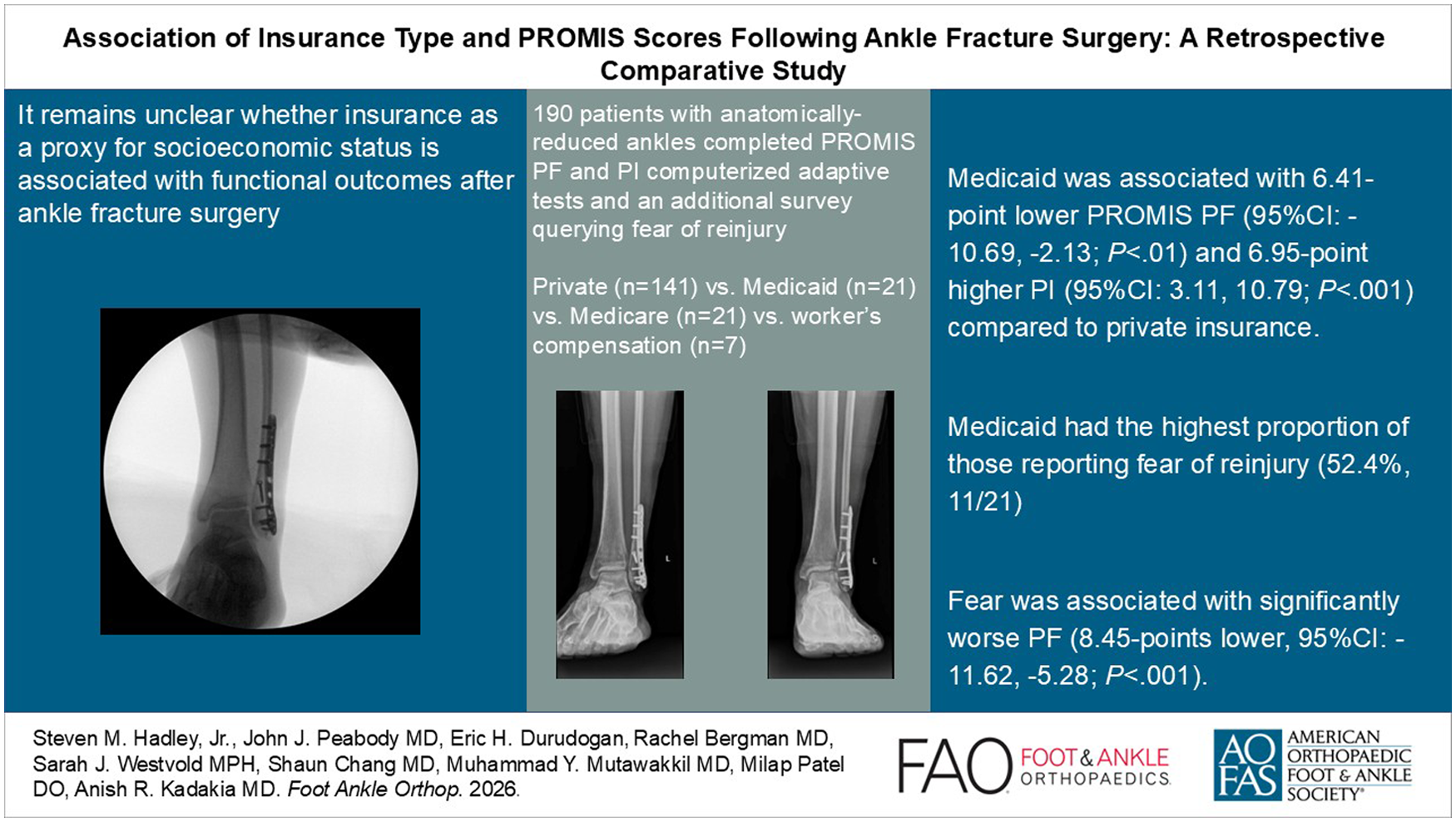
It remains unclear whether insurance as a proxy for socioeconomic status and social determinants of health is associated with functional outcomes after ankle fracture surgery. This study assesses the association between insurance and Patient-Reported Outcomes Measurement Information System (PROMIS) measures of physical function (PF) and pain interference (PI) after ankle fracture surgery.
Methods:
All patients who underwent ankle fracture surgery (2016-2021) were reviewed retrospectively. Multiple injuries, open fractures, pilon variants, and nonanatomically reduced fractures were excluded. Final analysis included 190 patients at minimum 1-year follow-up who completed postoperative surveys querying PROMIS and fear of reinjury. Insurance was categorized as “private,” “Medicaid,” “Medicare,” or “worker’s compensation.”
Results:
Twenty-one of 190 had Medicaid, 21 of 190 had Medicare, 141 of 190 had private, and 7 of 190 had worker’s compensation. Mean clinical follow-up was 32.1 months for Medicaid, 39.2 Medicare, 45.0 private, and 56.3 worker’s compensation. Mean PF (P < .01) and PI scores (P < .01), respectively, were 47.7 ± 9.1 and 53.9 ± 8.1 for Medicaid, 47.6 ± 10.6 and 48.9 ± 10.9 Medicare, 53.9 ± 9.3 and 47.1 ± 7.8 private, and 51.3 ± 10.5 and 51.5 ± 10.5 worker’s compensation. In adjusted models, compared with private, Medicaid was associated with 6.41 points lower PF (95% CI: −10.69, −2.13; P < .01) and 6.95 points higher PI (95% CI: 3.11, 10.79; P < .001). Worker’s compensation and Medicare were not associated with significant differences in PROMIS compared with private (P > .05). Differences in proportion of patients with fear of reinjury were significant (P < .01): fear was highest in Medicaid (52.4%, 11 of 21) and lowest in Medicare (9.5%, 2 of 21). Fear was associated with significantly worse PF (8.45 points lower, 95% CI: −11.62, −5.28; P < .001).
Conclusion:
Medicaid patients report significantly worse PROMIS scores than those with other insurances following ankle fracture surgery. Fear may be a primary driver of worse PF, as a significantly higher proportion of Medicaid patients experience fear, and fear is associated with significantly worse PF. To improve outcomes, fear and worse functional outcomes in Medicaid patients should be addressed.
Level of Evidence:
Level III, retrospective comparative study.
Introduction
Insurance—a social determinant of health—impacts access to health services and influences health care utilization.1 -4 Overall, 54.5% of Americans have private insurance, 18.7% have Medicare, and 18.8% have Medicaid. 5 Understanding insurance effect on outcomes is essential for addressing health care disparities.
Often associated with insurance, socioeconomic status (SES) is a risk factor for poorer outcomes following various orthopaedic injuries, including ankle fractures.6 -14 Lower SES has been associated with worse patient-reported outcomes (PROs) as measured by the validated Patient-Reported Outcomes Measurement Information System (PROMIS) computerized adaptative tests (CATs) of physical function (PF) and pain interference (PI) following foot and ankle injuries.7,14 Lower SES has also been associated with higher complication rates following lower extremity fractures compared with those with higher SES.9,11,13,15
Despite evidence indicating low SES negatively impacts outcomes, limited data exist on whether insurance impacts outcomes following ankle fractures. Kirchner et al 15 found that insurance is a risk factor for amputation in diabetic patients following ankle fractures. However, to our knowledge, no study has evaluated the association between insurance on PROs measured by PROMIS following ankle fracture surgery.
Unlike many commonly used legacy instruments in foot and ankle orthopaedic surgery, such as Foot and Ankle Ability Measure, Foot Function Index, American Orthopaedic Foot & Ankle Society (AOFAS) scores, and visual analog scale, PROMIS consistently demonstrates reliability.16 -21 PROMIS exhibits lower floor and ceiling effects and better time efficiency compared with these other scales.16 -21
Because PROMIS is a validated measure of clinical outcomes, our study aims to determine the relationship between insurance and PROMIS among patients who have undergone ankle fracture surgery.16 -21 We hypothesized that PROMIS would not significantly differ between groups among anatomically reduced fractures when stratified by insurance as a proxy for SES.
Methods
Population
This was an institutional review board (IRB)–approved retrospective review of all patients who underwent ankle fracture surgery at a single institution (2016-2021). Two investigators independently reviewed all radiographs, stratified them by Weber fracture subtype, and determined reduction quality at final follow-up.22,23 Patients with multiple injuries at time of presentation, pilon variants, open fractures, Maisonneuve fractures, less than 1-year follow-up, and fractures with non-anatomic reduction at latest follow-up were excluded. Anatomic reduction was determined via standard radiographic criteria and judged independently by 2 foot and ankle fellowship-trained orthopaedic surgeons. 24 Any cases with a disagreement regarding the reduction quality were excluded. A total of 587 patients meeting eligibility criteria were contacted to complete postoperative surveys for a total of 5 attempts (email and phone call). Contact attempts were made by S.M.H. and J.J.P. during April-June 2023; an additional round of attempts in September-October 2025 was done by E.H.D.. One hundred ninety completed surveys containing PROMIS as well as an additional, separate survey querying whether patients experienced any self-reported, at time of survey completion, fear of reinjury with a binary yes/no response option via REDCap. 25 Although the survey assessing fear was done at the same time as the PROMIS assessment, the surveys were separate and independent of each other. These 190 with anatomically reduced fractures were included for final analysis. This survey response rate meets the acceptable response rate reported in the literature for orthopaedic trauma cases. 26 Insurance information at time of surgery and patient characteristics were collected from patients’ charts. Insurance was categorized as “private,” “Medicaid,” “Medicare,” and “worker’s compensation.” Clinical follow-up was defined as time from surgery to survey completion. Radiographic follow-up was defined as time from surgery to most recent radiographs obtained.
All fractures were operatively repaired according to the AO-guidelines with fluoroscopic guidance. When indicated, syndesmotic fixation was accomplished with Syndesmosis TightRope XP (TightRope), InternalBrace (Arthrex), or syndesmotic screws. 27 When indicated, the deltoid was repaired with DX FiberTak all-suture anchor (Arthrex). 28 The deltoid ligament rupture was radiographically identified by injury films with 2-mm difference between the superior clear space and the medial clear space, or stress positive with same criteria. 28 Patients received preoperative antibiotic prophylaxis prior to incision. Anatomic reduction and adequate fixation were achieved and confirmed intraoperatively prior to wound closure. Postoperatively, the ankle was placed in short leg plaster splint in neutral position. Patients were instructed to remain nonweightbearing with use of assistive devices until clinic postoperative evaluation. All patients were treated with thrombosis prophylaxis during immobilization. Patients began weightbearing under physical therapy supervision following transition out of the splint.
Outcomes
Primary outcome was differences in PROMIS scores between insurances.
PROMIS demonstrates high generalizability and can effectively detect clinically important differences in function following ankle fractures. 17 Both measures correspond to age-matched norms for US general population mean score of 50. 19 Higher PF designates better physical function; higher PI indicates more pain.18 -20,29,30
Statistical Analysis
Hypothesis-driven testing analyzed with R Version 4.3.0 (R Foundation for Statistical Computing) was used. Hung et al 19 reported a minimal clinically important difference of 3 to 30 for PF and 3 to 25 for PI. Myhre et al 30 reported an MCID of 5.05 to 5.43 for PF.
The nonparametric Kruskal-Wallis test was used for unadjusted bivariate comparisons of PROMIS across groups.
Multivariable linear regression was used to assess an association between insurance and PROMIS, adjusted for age and fear of reinjury.
Older age is a risk factor for poorer functional outcomes following ankle fracture surgery.31,32 As patients with Medicare are primarily aged ≥65 years, 33 adjustment for age accounts for potential confounding present because of effects of age alone.
Because fear limits functional outcomes following ankle fracture surgery, 34 adjusting for fear enabled better assessment of the effect of insurance on PROMIS. Fear was not part of the PROMIS survey. It is a separate assessment.
We did not adjust for fracture subtype because prior literature demonstrates that among anatomically reduced fractures, subtype does not impact functional outcomes.35,36
Results
Of the 190 patients, 21 were Medicaid, 21 Medicare, 141 private, and 7 worker’s compensation (Table 1). Aside from age (P < .001) and the proportion of patients experiencing fear (P < .01), there were no significant differences in baseline characteristics. Medicare had the oldest age (mean age 68.6 years), and Medicaid had the highest proportion of those experiencing fear (52.4%, 11 of 21). There were no significant differences in clinical or radiographic follow-up between groups (P > .05). Mean clinical and radiographic follow-up times (months) were, respectively, 32.1 and 12.0 Medicaid, 39.2 and 12.2 Medicare, 45.0 and 12.1 private, and 56.3 and 14.6 worker’s compensation. There were no significant differences in PF (P = .60) or PI scores (P = .64) by length of clinical follow-up beyond one year.
Patient Characteristics. a

Abbreviation: BMI, body mass index.
Unless otherwise noted, values are n (%).
Unadjusted analysis of PROMIS scores of the total cohort are displayed in Table 2. PF and PI were statistically different between groups (P < .01 and P < .01; Table 2). Mean PF and PI, respectively, were 47.7 ± 9.1 and 53.9 ± 8.1 for Medicaid, 47.6 ± 10.6 and 48.9 ± 10.9 Medicare, 53.9 ± 9.3 and 47.1 ± 7.8 private, and 51.3 ± 10.5 and 51.5 ± 10.5 worker’s compensation.
Mean (SD) PROMIS Physical Function and Pain Interference Scores (N = 190).

Abbreviation: PROMIS, Patient-Reported Outcome Measures Information System.
In adjusted analysis (Table 3), Medicaid was associated with significantly worse PROMIS when adjusting for age alone. Medicaid was associated with a 6.41-point lower PF (95% CI: −10.69, −2.13; P < .01) and 6.95-point higher PI (95% CI: 3.11, 10.79; P < .001). When adjusting for both age and fear of reinjury, differences in PF were no longer significant for Medicaid (−3.49, 95% CI: −7.64, 0.66; P = .10) but differences in PI remained significant for Medicaid (4.66, 95% CI: 0.87, 8.45; P = .02). Worker’s compensation and Medicare were not associated with significant differences in PROMIS compared to private insurance in any of the adjusted regression models.
Multivariable Linear Regression Models for PROMIS Physical Function and Pain Interference.

Age was divided by 10 for interpretability. The effect associated with age is per 10-year increase in age.
Differences in proportion of patients with fear of reinjury were significant (P < .01; Table 1): Fear was highest in Medicaid (52.4%, 11 of 21) and lowest in Medicare (9.5%, 2 of 21). Fear was associated with significantly worse PROMIS in unadjusted analysis (PF 45.7 ± 6.6 vs 52.8 ± 12.9, P < .001; and PI 54.0 ± 7.5 vs 45.1 ± 11.5, P < .001; Table 2). Fear was associated with significantly worse PROMIS PF in adjusted analysis as well (8.45 points lower, 95% CI: −11.62, −5.28, P < .001). PI was not significant (0.62-points higher, 95% CI: −0.33, 1.57, P = .20; Table 3).
There were no significant differences in PF or PI by Weber fracture subtype (P = .39 and P = .28, respectively; Table 2).
Discussion
Across all insurances, Medicaid had the worst functional outcomes; private had the best. Medicare and worker’s compensation did not have scores that were significantly different from private. Medicaid was associated with significantly worse PROMIS scores than private insurance, exceeding the established minimally clinically important difference minimal clinically important difference.17,19 Our results, therefore, suggest that patients with Medicaid may suffer from worse functional outcomes despite anatomically reduced ankles.
Two prior studies suggest lower SES measured by income bracket and zip code are associated with lower PROMIS PF compared with PF of those with higher SES.7,14 In their retrospective review of patients with various foot and ankle pathologies, Bernstein et al 7 found that those in the income bracket less than $25 000 had significantly worse mean PF compared to those in the greater than $100 000 bracket (40 vs 45). Similarly, Wright et al 14 reported that patients from zip codes consistent with more social deprivation experienced significantly lower PF compared to those from zip codes with less social deprivation (38 vs 43) following various injuries. However, these 2 studies included a wide variety of injuries—not just ankle fractures—and these reported scores are lower than PROMIS described in the literature for operatively fixed ankle fractures.7,14,32,35,36 Therefore, because insurance may serve as a predicate of income and labor, our results contribute to the body of literature suggesting that those with a lower SES suffer from worse functional outcomes postoperatively. Importantly, as the first evaluating PROMIS to focus solely on ankle fractures, our findings bolster the connection between lower SES and worse functional outcomes in ankle fractures specifically.
Patients with Medicaid likely report worse PROMIS following ankle fractures because these patients more likely experience inability to modify lifestyle to promote optimal recovery and rehabilitation out of financial necessity. The most common jobs held by Medicaid patients—cashiers, janitors, cooks, waiters/waitresses, supermarket employees, and construction laborers—require physical labor and continual weightbearing. 37 Additionally, 46% of Medicaid workers do not have access to paid sick leave. 37 Therefore, returning to work too quickly, not having time or financial resources to prioritize adequate rehabilitation, and not being able to modify work requirements in order to complete assigned tasks on the job because of financial necessity may contribute to poorer physical function and higher pain levels experienced by these patients. These patients often cannot afford to, or are not able to, take adequate time off work or adjust daily activities to optimize recovery, which may explain the worse PROMIS scores postoperatively among patients with Medicaid.
Fear of reinjury was associated with both statistically and clinically significantly worse PROMIS PF scores (8.45 points lower), which exceeds the PROMIS minimal clinically important difference. 19 Those with Medicaid disproportionally reported higher rates of fear (52.4% of Medicaid). Therefore, given the significant role of fear in recovery, fear may be a primary driver of the worse PF found in Medicaid patients. As further evidence of this point, when adjusting for fear of reinjury, differences in PF between groups were no longer significant. It may also be concluded, therefore, that among anatomically reduced ankles, patients achieve similar physical function regardless of insurance type when fear of reinjury is excluded.
Interestingly, differences in PI were still significantly worse even after adjusting for fear, which may suggest that despite achieving similar function when fear is excluded, these patients still suffer higher pain levels. The higher PI, therefore, may be due to the inability of Medicaid patients to prioritize recovery and rehabilitation and having to weightbear too soon out of financial necessity.
Because fear significantly impacts functional outcomes and a significantly higher proportion of Medicaid reports fear, these findings suggest that the psychological barriers of recovery are inadequately addressed in this population. Medicaid likely has the highest proportion of patients who express fear because reinjury results in more severe consequences with regard to financial stability. If half of the patients on Medicaid cannot take paid sick leave, then reinjury for many of these patients means risking losing their job, resulting in reduced income and potentially translating to inability to provide for themselves and others. These consequences may be more severe compared with consequences of reinjury for those with private insurance who work white-collar jobs that provide not only paid sick leave but allow for lifestyle modulation to promote optimal recovery. Medicare patients, who reported the lowest rate of fear of reinjury, tend to be an older population, many of whom are retired. 33 Thus, reinjury does not translate to missing work and associated income, which may explain why fewer Medicare patients experience fear.
This study is the first to describe higher levels of fear of reinjury in Medicaid compared to those with other insurance types. This study also builds on research evaluating the same cohort of patients in which fear of reinjury was first described to impact outcomes negatively following ankle fracture surgery. 34 In this other study, 2 of 3 patients who failed to return to preinjury level of activity expressed limitations because of fear of reinjury. 34 Because it was previously unknown that fear had such a profound impact on patient functional outcomes postoperatively, this study team could not implement strategies to combat fear and could not evaluate any such strategies. Future interventions from this study team will look to screen patients for fear by discussing fear with patients in clinic (especially those who may not be progressing as expected), work closely with physical therapists who see the patient frequently in the postoperative period and may be able to identify certain movements or activities in which patients have deficits because of fear, and connect high-risk patients with sports psychologists. Some evidence might also suggest that comorbid depression and anxiety may play a role, as prior literature indicates that those with comorbid psychiatric illness suffer from worse outcomes following ankle fractures. 38 In the Medicaid population specifically, it may be important to connect them with social work to address any social concerns that may also be contributing to higher rates of fear. Now that this study identified fear of reinjury as a problem in Medicaid patients and that this study suggests that fear may be a primary driver of the worse PF following ankle fracture surgery in this population, we can start to develop solutions to enhance outcomes for these patients. Fear is ultimately an issue in orthopaedics that is inadequately addressed, and if we do start addressing the psychological component of recovery, we can seriously improve outcomes for these patients.34,39
Weber fracture subtype did not significantly impact functional outcomes. Even patients with higher level of injury Weber C fractures with greater soft tissue trauma achieved population mean function and pain compared to those with lower level of injury Weber B fractures.27,40 This finding is consistent with prior literature suggesting that anatomic reduction of ankle fractures—regardless of injury severity—results in patients achieving population mean functional outcomes.27,28,35,36
This study has limitations, including the retrospective design. It is possible that the worse PROMIS in Medicaid are due to poorer baseline function and our study design does not permit our investigating this possibility. Thirty-two percent (190 of 587) of patients responded to the survey, potentially introducing bias. However, this rate meets the acceptable survey response rate reported in the literature for orthopaedic trauma and, specifically, ankle fractures. 26 This response rate is also higher than another retrospective study of ankle fractures evaluating patient survey responses to PROMIS CATs published in Foot & Ankle International (27%). 30 Comparing baseline characteristics between those who responded to the survey (“responders”) and those who did not respond (“nonresponders”) revealed that there were a higher proportion of females and privately insured patients in the responder group (Supplementary Table S1), which may indicate some nonresponse bias, especially for an underrepresented number of Medicaid patients. Moreover, patients may also have interpreted survey questions differently, which introduces measurement bias. Despite patients having adequate follow-up and no significant differences in follow-up between groups, patients were necessarily at different time points postoperatively when responding (patients did not all fill out surveys at 1 year postoperatively for example), which may introduce measurement bias. However, there was no significant difference in PROMIS by length of follow-up beyond 1 year, which suggests that the function and pain of patients were similar at 1 vs 2 vs 3, etc years postoperatively. Additionally, a potential confounding factor is that some people with low SES have private insurance. Because we are using insurance as a proxy for SES, we cannot be sure that patients in other insurance categories do not have the same SES-related variables that may negatively affect PROMIS scores. Older age is intrinsic to the Medicare population, so outcomes in this population may be influenced by older age rather than insurance type as a proxy for SES.
Nevertheless, this study has many strengths. This study is the first to identify the association between Medicaid and higher postoperative pain, lower postoperative function, and higher rates of fear of reinjury following ankle fracture surgery. Our study is also the first to capture PROs measured by validated PROMIS scores of patients who underwent ankle fracture surgery by insurance type and the first to evaluate PROMIS by insurance type among patients with anatomic reduction of the ankle specifically. Future research should focus on better understanding the relationship between insurance type, socioeconomic status, and functional outcomes, as well as implementation of strategies to mitigate higher postoperative pain levels, worse physical function, and higher rates of fear of reinjury among Medicaid patients.
Conclusion
Patients with Medicaid reported higher PI, lower PF, and a higher proportion of fear of reinjury postoperatively, which may originate from a larger proportion of these patients having jobs requiring physical labor and constant weight-bearing and being unable to modulate lifestyle to promote optimal recovery because of financial necessity. Fear of reinjury may serve as a primary driver of the worse average PF scores seen in patients with Medicaid, as a significantly higher proportion of those with Medicaid report fear, and fear was associated with both statistically and clinically significant worse PF.
Supplemental Material
sj-pdf-1-fao-10.1177_24730114261425651 – Supplemental material for Association of Insurance Type and PROMIS Scores Following Ankle Fracture Surgery: A Retrospective Comparative Study
Supplemental material, sj-pdf-1-fao-10.1177_24730114261425651 for Association of Insurance Type and PROMIS Scores Following Ankle Fracture Surgery: A Retrospective Comparative Study by Steven M. Hadley, John J. Peabody, Eric H. Durudogan, Rachel Bergman, Sarah J. Westvold, Shaun Chang, Muhammad Y. Mutawakkil, Milap Patel and Anish R. Kadakia in Foot & Ankle Orthopaedics
Footnotes
Appendix
Characteristics of Responders vs Nonresponders.

| Overall, |
Nonresponder, |
Responder, |
P Value | |
|---|---|---|---|---|
| Age, y, mean (SD) | 44.3 (16.5) | 44.7 (17.3) | 43.5 (14.9) | .38 |
| Sex | <.01 | |||
| Female | 350 (59.6) | 220 (62.9) | 130 (37.1) | |
| Male | 237 (40.4) | 177 (74.7) | 60 (25.3) | |
| Body mass index, mean (SD) | 30.0 (9.6) | 30.1 (10.5) | 29.9 (7.1) | .78 |
| Diabetes | .99 | |||
| No | 567 (96.6) | 384 (67.7) | 183 (32.3) | |
| Yes | 20 (3.4) | 13 (65) | 7 (35) | |
| Smoking status | .46 | |||
| Current or former | 117 (19.9) | 83 (70.9) | 34 (29.1) | |
| Never smoker | 470 (80.1) | 314 (66.8) | 156 (33.2) | |
| Weber class | .77 | |||
| Weber B | 463 (78.9) | 315 (68) | 148 (32) | |
| Weber C | 124 (21.1) | 82 (66.1) | 42 (33.9) | |
| Syndesmotic rupture | .12 | |||
| No | 325 (55.4) | 229 (70.5) | 96 (29.5) | |
| Yes | 262 (44.6) | 168 (64.1) | 94 (35.9) | |
| Fracture subtype | .41 | |||
| Bimalleolar | 157 (26.8) | 110 (70.1) | 47 (29.9) | |
| Fibula only | 252 (43) | 168 (66.7) | 84 (33.3) | |
| Lateral and posterior malleolar | 76 (13) | 46 (60.5) | 30 (39.5) | |
| Trimalleolar | 101 (17.2) | 72 (71.3) | 29 (28.7) | |
| Insurance type | <.01 | |||
| Medicaid | 101 (17.2) | 80 (79.2) | 21 (20.8) | |
| Medicare | 85 (14.5) | 64 (75.3) | 21 (24.7) | |
| Private | 378 (64.4) | 237 (62.7) | 141 (37.3) | |
| Worker’s compensation | 23 (3.9) | 16 (69.6) | 7 (30.4) |
ORCID iDs

Ethical Considerations
This study received ethical approval from the Northwestern University IRB (STU00218343) on November 29, 2022.
Informed Consent
All patients included in this study gave written informed consent for their participation.
Funding
The authors received no financial support for the research, authorship, and/or publication of this article.
Declaration of Conflicting Interests
The authors declared the following potential conflicts of interest with respect to the research, authorship, and/or publication of this article: Anish R. Kadakia, MD, reports disclosures relevant to manuscript of Arthrex: consultant, royalties, speakers bureau; DePuy Synthes: royalties; Elsevier: royalties. Disclosure forms for all authors are available online.
Data Availability Statement
Please contact the corresponding or senior author.
References
Supplementary Material
Please find the following supplemental material available below.
For Open Access articles published under a Creative Commons License, all supplemental material carries the same license as the article it is associated with.
For non-Open Access articles published, all supplemental material carries a non-exclusive license, and permission requests for re-use of supplemental material or any part of supplemental material shall be sent directly to the copyright owner as specified in the copyright notice associated with the article.
