



Abstract
Three-dimensional (3D) bioprinting has become mainstream for precise and repeatable high-throughput fabrication of complex cell cultures and tissue constructs in drug testing and regenerative medicine, food products, dental and medical implants, biosensors, and so forth. Due to this tremendous growth in demand, an overwhelming amount of hardware manufacturers have recently flooded the market with different types of low-cost bioprinter models—a price segment that is most affordable to typical-sized laboratories. These machines range in sophistication, type of the underlying printing technology, and possible add-ons/features, which makes the selection process rather daunting (especially for a nonexpert customer). Yet, the review articles available in the literature mostly focus on the technical aspects of the printer technologies under development, as opposed to explaining the differences in what is already on the market. In contrast, this paper provides a snapshot of the fast-evolving low-cost bioprinter niche, as well as reputation profiles (relevant to delivery time, part quality, adherence to specifications, warranty, maintenance, etc.) of the companies selling these machines. Specifically, models spanning three dominant technologies—microextrusion, droplet-based/inkjet, and light-based/crosslinking—are reviewed. Additionally, representative examples of high-end competitors (including up-and-coming microfluidics-based bioprinters) are discussed to highlight their major differences and advantages relative to the low-cost models. Finally, forecasts are made based on the trends observed during this survey, as to the anticipated trickling down of the high-end technologies to the low-cost printers. Overall, this paper provides insight for guiding buyers on a limited budget toward making informed purchasing decisions in this fast-paced market.
Introduction
Three-dimensional (3D) bioprinting is the process of fabricating anatomically correct tissue constructs via computer-guided deposition of cells embedded in biomaterials (collectively known as “bio-ink”) to specific locations. Due to its potential for high-throughput biomanufacturing of complex organs and tissues with both precision and accuracy, the technology has been quickly emerging as a major competitor to conventional tissue engineering methodologies.1–4 In fact, the global market share for 3D bioprinting is expected to break into the ~$1.5 billion (USD) range in the mid-2020s, almost 30% of which is attributed to North America.5–7 With such explosive growth, all of the 3D bioprinting sectors are expected to witness a high volume of expansion, especially in medical and dental areas (
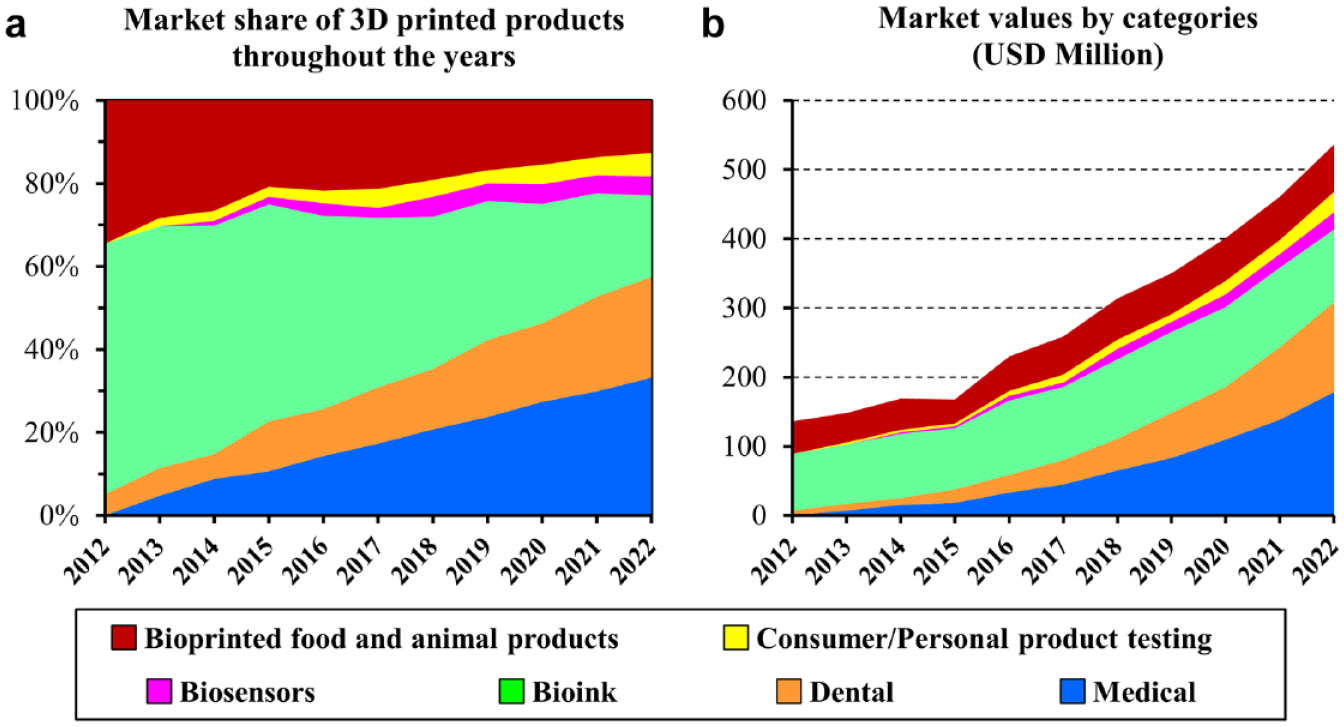
Market share of 3D bioprinting sectors during 2012–2022: (
Recently, however, a wave of new start-up companies has begun to introduce low-cost bioprinting solutions to the market. Due to their affordability, these systems hold a tremendous potential for the development of regenerative medicine technologies. Yet, due to the novelty of this niche market, no bioprinter reviews that we could find focus on the latest commercially available low-cost systems. Specifically, the previously published reviews either give an overview of the entire bioprinting field (with a focus on the evolution of the printing technologies),9–13 review bio-inks,14–27 or discuss specific applications (e.g., cardiovascular tissue models,14,28–35 bone tissue models,36–48 cartilage tissue models,42,47,49–52 nerve tissue models,53–61 skin tissue models,48,62–66 and in vivo bioprinting67–69). We have found only one review that discusses the commercially available machines and profiles their manufacturers. 70 However, this publication is already 3 years old. Many new companies and 3D printer models have been introduced to the market since 2018. Furthermore, none of the above reviews focus on the low-cost systems, which is now an emerging 3D bioprinter market.
Consequently, due to the fast-paced evolution of these technologies, combined with the lack of an established reputation by the companies (many of which are start-ups) developing them, it may be challenging for an inexperienced customer to make an informed purchasing decision. This is significantly exacerbated by the fact that many systems claim to have similar printing resolutions and other specs. Therefore, for these reasons, the key goals of the paper over previous reviews are to (1) provide the latest snapshot of the technologies and machine models currently available in the low-cost 3D bioprinter market segment; (2) profile the scholarly impact, market presence, and maturity of the companies that manufacture the low-cost printers, in order to help an inexperienced buyer mitigate the risks (e.g., delayed delivery time, poor part quality, lack of technical support, and unstable warranty) associated with their potential investment; (3) compare and contrast the technical features between the low-cost and high-end printers, in order to help the reader to understand the main differences between what the models can offer them; and, finally, (4) highlight the emerging technologies used by the high-end printer space, in order to forecast their trickling down to the low-cost machines in the near future.
To that end, the organization of this paper is as follows: First, we provide a brief snapshot of the 3D bioprinter market, which shows how the technologies vary based on cost among all (i.e., both low-cost and high-end) of the models currently available for purchase. Then, we give a detailed overview of the low-cost 3D bioprinter market segment, which we cluster by the three predominant technologies used in these machines: microextrusion, droplet-based and light-based. This is followed by a brief overview of the high-end 3D bioprinter market, where we summarize the main advantages of these pricier machines over their cheaper counterparts. Additionally, this section introduces the emerging microfluidic print head technology. Finally, the paper is concluded with projections of how the low-cost 3D bioprinter market will evolve in the near future, based on the expected trickling down of the technologies currently used in the high-end machines.
Snapshot of the 3D Bioprinter Market
In order to define what a low-cost bioprinter is, we first looked at the price distribution of the currently available commercial models and binned them into two halves (
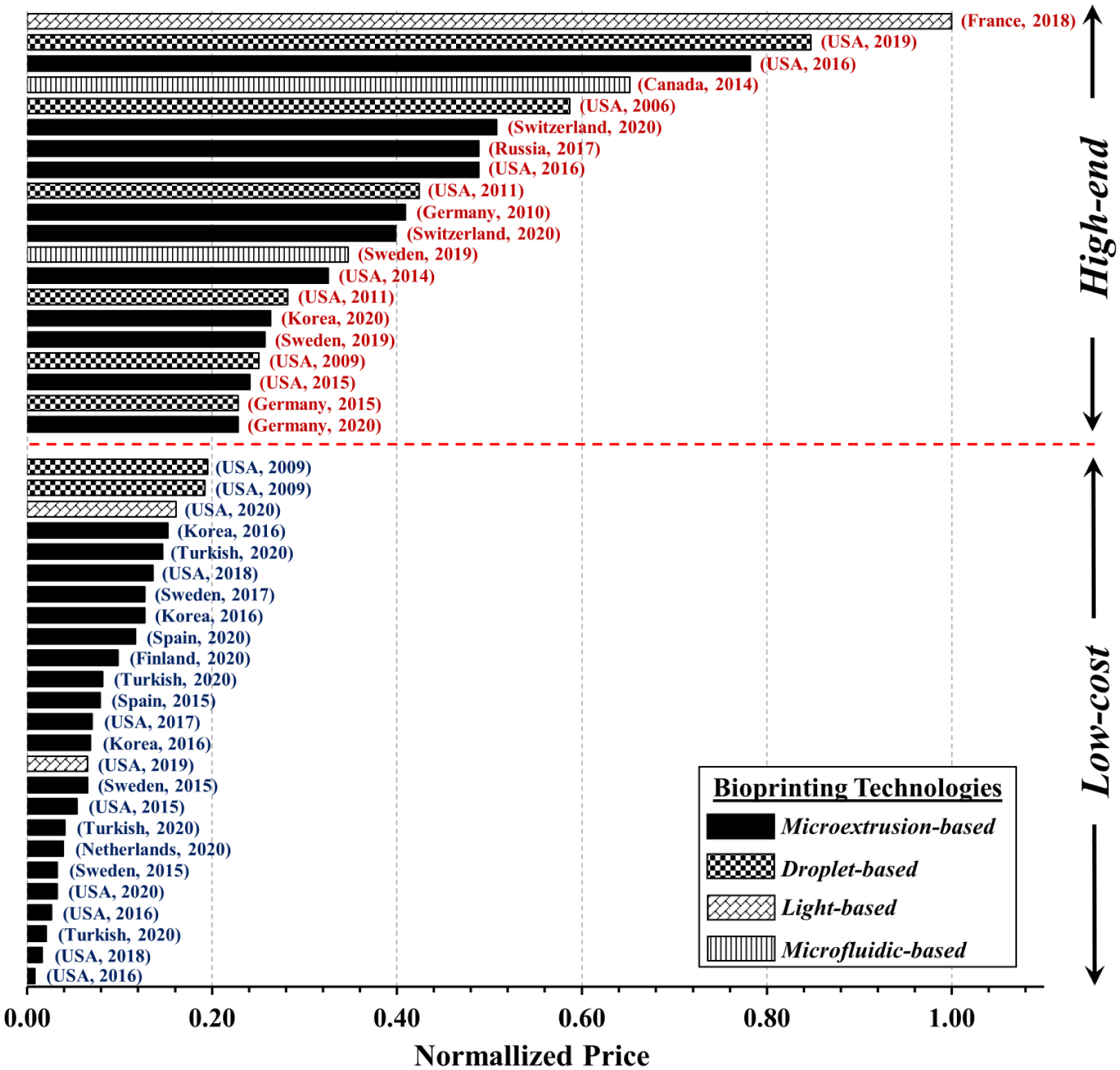
Cost comparison for 3D bioprinter technologies currently available on the market. Specific company and machine model information has been anonymized so as to not interfere with their pricing strategies. Furthermore, the prices have been normalized to the highest-cost printer for the same reason. *For consistency, the shown prices include only the base price of each printer, while additional costs may be incurred via optional accessories, such as compressed air pump and software. The prices were collected either from the companies’ websites listed in this paper, via direct quotation, or through direct contact with companies’ sales representatives during the fall of 2020. They are meant to serve as a relative ballpark cost comparison between the bioprinter technologies. Note: Some of the low-cost manufacturers may offer 10%–50% discounts for collaboration promotion or academic/holidays discounts. These were not accounted for by our search. Company/model names and prices are concealed to preserve confidentiality. Readers interested in seeing them should contact the corresponding author directly.
Furthermore, it can be seen from Figure 2 that North America, Europe, and East Asia are currently the main leaders in providing 3D bioprinters. Interestingly, our market search also showed that most of the recently released models belong to the low-cost category: for example, BIO X, Allevi 1, Allevi 3, BIOBOT BASIC, Lulzbot Bio, Lumen X, Felix BIOprinter, STEMAKER, REG4LIFE, and AXO A1-A6. This suggests that the bioprinter space is undergoing a dynamic shift toward low-cost solutions and that, over time, the increasing availability of such machines will change the landscape of the 3D bioprinting market.
The technological differences between the printer models can be largely attributed to the product specifications desired by the end user. For example, the major machine attributes that should be considered when making a purchasing decision include the underlying printing technology (broadly classified into microextrusion-based, droplet-based/inkjet, and light-based crosslinking), positional accuracy, build volume, print bed and/or print head temperature control, material compatibility, calibration automation, and customizability. 71 Furthermore, the printing method is essential for the efficacy of the bio-ink because the cells within it have to survive and remain undamaged through the printing process to remain viable postfabrication.
Although the high-end models excel at most of the above characteristics, the low-cost bioprinters are beginning to offer many of the similar (at least on paper) features as their more expensive competitors. Yet, the price disparities remain and can be as large as two orders of magnitude; therefore, it is important to understand the differences between the bioprinters available in the two price brackets, as well as the main trade-offs characteristic of each respective market segment. To that end, the section entitled “A Detailed Overview of the Low-Cost 3D Bioprinters” overviews what is currently available in the low-cost bioprinter space, while the section entitled “A Brief Overview of the High-End 3D Bioprinters” contrasts these machines to their established high-end competition in the upper price bracket.
A Detailed Overview of the Low-Cost 3D Bioprinters
Although there are many excellent general reviews of the available bioprinter technologies,4,72–75 here, we focus on highlighting and comparing some of the low-cost models’ key features.
A critical difference between them that is most immediately apparent to the eye is that some of the printers adopt an open-frame style, while others have a closed frame. The trade-offs between them are that the former allows easier access for observation, interaction (e.g., experiment customization), and printer head maintenance, while the latter is meant to mimic the sterile environment of a biohood via a built-in sterile chamber, with high-efficiency particulate air (HEPA) filters, a UV-C lamp (e.g., 254, 265, or 275 nm) for disinfection, and transparent windows for observation. Although the open-frame printers are typically small enough to be placed inside of a biohood, the vibrations caused by its large air pump can be disruptive to a high-resolution printing process. Therefore, the onboard sterility chamber of the closed-frame printers is typically designed to have lower vibrations when compared with those of a conventional biohood. Additionally, a sterilizing UV lamp is sometimes added to the closed-frame models by the manufacturer. Finally, another peripheral consideration is that some of the platform configurations are integrated with a liquid crystal display (LCD) and USB port, which allow these printers to work independently from a computer. This can be an important consideration in case it is not practical to maintain a physical connection with the printer when placing it inside of a biosafety cabinet (BSC), given the wire may obstruct its hood from closing.
Furthermore, the low-cost bioprinters are commonly equipped with light-emitting diodes (LEDs), which enable the crosslinking of the bio-ink materials (e.g., a hydrogel mixed with a photoinitiator) upon the extrusion. Popular light sources used in this process are ultraviolet (UV) 365 nm and blue 405 nm wavelengths. Temperature control is also typically included via a heating or a cooling jacket around the syringe. This can be useful for maintaining physiological culturing conditions, for cell preservation via cooling, and/or for changing the viscosity of the bio-ink. Moreover, some models come with a cooled/heated print bed (also to help maintain the 37 °C body-like temperature and/or switching between solid/liquid stages of the thermosensitive biomaterials), which is sometimes shaped, or include the adapters for standard-sized petri dishes, well plates, and microscopy slides.
Finally, some printers are equipped with a filament extruder, which allows the printers to print melted thermoplastic (cell-free) filament. This is especially useful for the fabrication of scaffold support for cell-laden tissues by enabling the deposition of the “scaffolding” thermoplastic materials in tandem with the cell-laden “bio-ink.” Optionally, inspection cameras are also included in order to provide the user with a zoomed-in observation of the printing process. An overall summary of the low-cost bioprinters’ technical features and attributes is presented in
A common pattern that can be observed from
Microextrusion-Based Bioprinting Technology
Microextrusion-based 3D bioprinting technology is beneficial for the rapid fabrication of large (>1 cm3) and complex cell-laden/cell-free structures composed of more than one material or cell spheroids.
77
This technology works with a wide range of materials with a viscosity of ~30 mPa/s to >6 × 10⁷ mPa/s
18
and has the advantage of precise deposition/controllable cell distribution.
74
The microextrusion-based 3D bioprinting is usually clustered into two main categories: mechanical and pneumatic extrusion, as illustrated in
Figure 3
. In mechanical extrusion, the process is typically driven by a stepper motor, which turns a threaded screw (
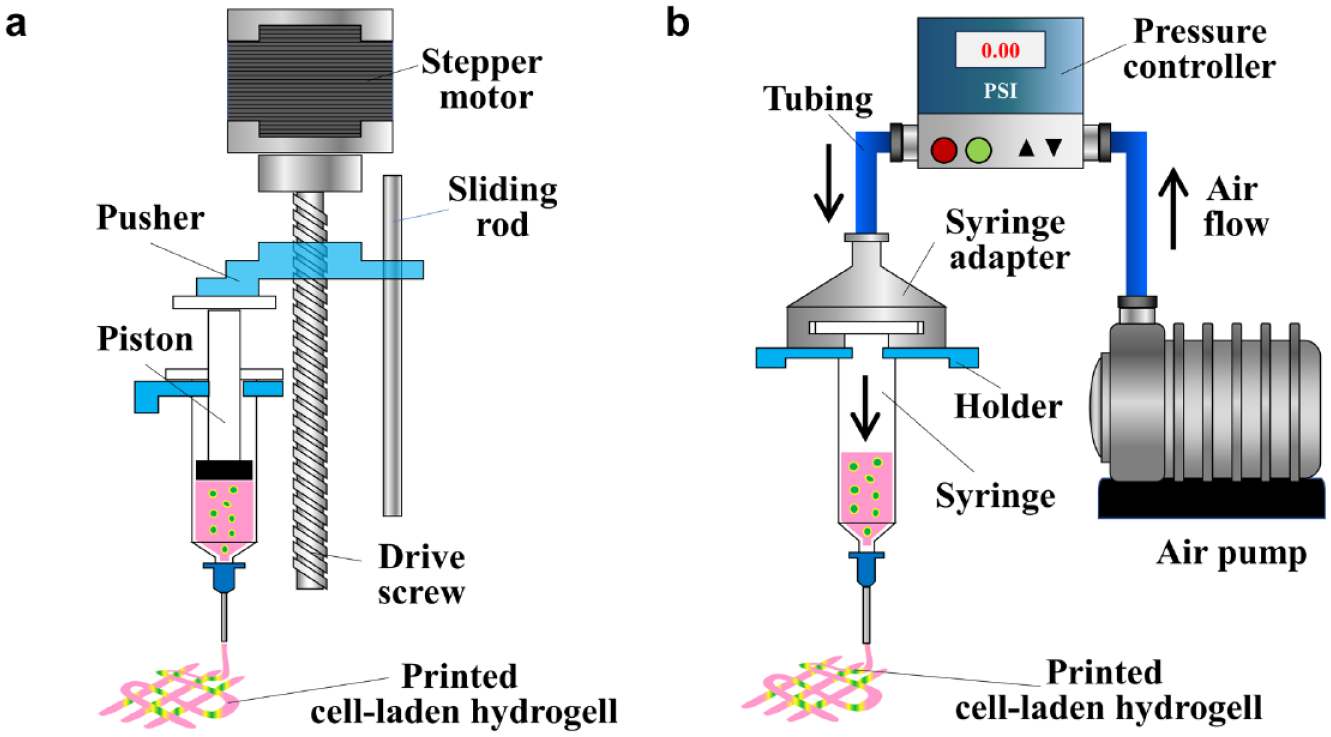
Illustrations of the two popular dispensing mechanisms used in microextrusion-based low-cost 3D bioprinting: (
Pneumatic extrusion, on the other hand, is actuated by means of compressed air (or another gas, e.g., a blend of air and CO2 for the culture pH control), which is pushed through by a pump (
Low-Cost Microextrusion-Based Bioprinters
3D Cultures’s Tissue Scribe
According to our market search, Tissue Scribe is the most economical and compact single-nozzle 3D bioprinter on the market. It was first released in 2017 by an American-based start-up company with around 10 employees (3D Cultures). The Tissue Scribe is a single-nozzle mechanical extrusion-based printing system with a starting price of ~$1500 (publicly available online) and no additional cost for the control software. Each Tissue Scribe unit is equipped with one extruder, which has a housing slot for a fixed syringe volume. There are three modular print heads available to be selected: a mechanical extruder with a housing slot for a 1 cc syringe, 3 cc syringe, or 10 cc syringe. Furthermore, all three modular print heads can be purchased separately for an extra cost of $750 each. Additionally, the bioprinter system can be converted to a conventional polymer melt 3D printer by replacing the mechanical extrusion head with a pellet extrusion tool for an additional cost of $1000.
The Tissue Scribe’s XYZ position accuracy is 100 × 100 × 44 µm. Therefore, the 3D bioprinter is suitable for any starter and research lab without the need for a major financial investment. The Tissue Scribe is integrated with an LCD display, interactive control knob, and panel for easy adjustments and calibration. The advantage of this system is that it has temperature control for both the print bed (up to 60 °C) and the printing head (up to 70 °C), which can be tuned to a physiological temperature at ~37 °C to work with temperature-dependent hydrogel/materials or sample with cells. With a small footprint of 29 × 19 cm2, the Tissue Scribe is able to fit in most BSCs for sterile printing. It can print directly from .gcode file on a microSD card (which does not require a continuous connection to your computer). Gcode files can be generated from the open-source software (e.g., Cura or Repetier-Host) and downloaded to the microSD card for subsequent loading onto the printer.
The Tisue Scribe has been used for various applications in tissue engineering, dental, and materials testing/optimization research, such as is used in biofabricating 3D tumor models, 79 cell-laden hydrogels for cell–cell interaction study, 80 nanocomposite hydrogels for cell migration study, 81 gelatin hydrogel properties and 3D bioprinting process optimization, 82 highly elastomeric and property-tailorable hydrogels, 83 3D printed smart dental implants, 84 biomaterials and 3D/4D printed thermosensitive and photoactivated smart materials,85,86 and 3D printed porous structures with shape memory properties.87,88
Advanced Solutions Inc.’s BIOBOT BASIC
BIOBOT BASIC is the world’s first polar coordinate bioprinter, 89 introduced in 2019 by an American company, Advanced Solutions Inc. The company offers both high-end (BioAssemblyBot) and low-cost (BIOBOT BASIC) 3D bioprinter systems in its product catalogs. At a starting price of ~$5000 (publicly available online), the BIOBOT BASIC is a versatile benchtop 3D bioprinter that comes with a patented unique revolver-inspired pneumatic extrusion head with a working pressure range of 0.5–85 psi. This tool can print up to five different biomaterials without the need to disrupt the extrusion process by manually switching bio-ink cartridges. Instead, the turret has a turbine-like drum with five mounting slots for 10 cc syringes, which are automatically rotated in and out of the dispensing position during the printing process. The positional repeatability and resolution of the BIOBOT BASIC is 10 µm in both the rotary and Z directions.
Furthermore, unlike the other machines on the market, whose printer heads follow linear XYZ motion on a stationary print bed, the BIOBOT BASIC’s extruder tool is constricted to the Z direction. In contrast, its bed moves in the radial and rotary fashion during the printing process, which provides a relatively large print space while maintaining an overall small footprint on the platform. With a maximum print size of diameter 19 × 10 cm (which corresponds to a maximum build volume of 1134 cm3 within the print area), the system can deposit the designed structure directly on glass slides, petri dishes, or multiwell plates. Moreover, the system utilizes a laser-based calibration system mounted on one side of the print bed, which can automatically scan and take XY positional measurements of the nozzle and calibrate itself for different materials and needle sizes. It is not restricted to the nozzle length and gauge; however, ½- or ¼-inch-long needles are recommended by the manufacturer.
Even though the BIOBOT BASIC does not have temperature control for either the extrusion system or the print bed, it is considered to be an excellent entry-level, low-cost 3D bioprinter system that can fit most BSCs/fume hoods. Moreover, it can be operated and monitored by Advanced Solutions’ Tissue Structure Information Modeling (TSIM) software. TSIM allows the user to either create 3D computer drawings of the desired tissue structure from scratch or import them from magnetic resonance imaging (MRI) or computed tomography (CT) scans. The images can then be freely manipulated to add or remove components or assign material properties to different geometry sections. The BIOBOT BASIC’s purchase includes a 1-year TSIM software trial, followed by an annual subscription. The machine has been recently used for 3D printing and characterization of human nasoseptal chondrocyte-laden, dual-crosslinked, oxidized alginate–gelatin hydrogels for cartilage repair approaches. 90
Hyrel 3D’s Engine SR and Engine HR
The Engine SR and HR are highly affordable and compact 3D bioprinters produced by Hyrel 3D Inc., a small US-based company founded in 2012 with around 100 employees in four countries. The company has seen much popularity in both the bio and nonbio printing research fields, with more than 216 publications and documents using the Hyrel machines, according to their website (as of December 2020).
91
Their major applications include bone tissue engineering92,93 and electronics.94,95 The Engine SR is one of the most affordable bioprinters on the market, with only ~$2500 as its price tag (publicly available online). In comparison, the Engine HR is a more compact, more expensive version (~$8000) of the SR model. Both the Engine SR and HR are equipped with an integrated camera and a touch screen Windows 10 tablet personal computer (PC), with all the software included in the purchase price. In addition, compared with other printers on the market, the Engine SR offers a very large build volume of up to 20 × 20 × 20 cm3 (
The major selling point of the Hyrel 3D’s machines is the high level of customization that they possess. For example, customers can select modular print heads of interest from a wide range of options, such as syringe-based extrusion, filament extrusion, and photo-crosslinking heads. Hyrel 3D offers the widest variety of modular print heads from any other company that we have surveyed for this paper. Additionally, the company develops on-demand custom-built print heads. One such example is their “on-the-fly” microfluidic mixing, extrusion, and UV crosslinking one that were developed for the fabrication of heterogeneous tissue scaffolds in collaboration with Professor Hala Zreiqat’s group from the University of Sydney. 96
Among the assortment of Hyrel 3D’s modular printer heads, the Syringe Dispensing System (SDS) is the most relevant to bioprinting. However, a Crosslinking Dispensing System (CDS) modular head is also available at different wavelengths, such as 280, 310, 365, 405, and 450 nm. The SDS heads cost $400, while the CDS heads cost $550; both are made for single 5, 10, 30, or 60 cc syringes. Moreover, the 1:1 dual 25 cc syringe head or the programmed ratio dual heads are capable of printing up to two different materials simultaneously and can be purchased for $500. Other modular heads enable the operator to create more intricate fabrications using nonstandard scaffold materials, by drilling the scaffold or etching it using a laser. 97 This range of modular heads makes the Engine SR and Engine HR machines a lot more versatile than just a conventional bioprinter.
Finally, it is noteworthy to mention that Hyrel 3D has two other models, which are compatible with all of their print heads (including those capable of printing bio-ink): the Hydra 16A and the System 30M. However, these models are too large to fit into a standard BSC, and they are not equipped with a sterile printing environment. Therefore, we did not review these models.
Lulzbot’s 3D Bioprinter
Lulzbot Bio is the first open-source Fluid Deposition Fabrication 3D bioprinter that is manufactured by Aleph Objects. Founded in 2011, Aleph Objects is a reputable 3D printer manufacturer that has been on the market for the past decade. The machine is available for purchase at ~$10,000 (publicly available online), making it one of the most affordable on the market. This model has a small footprint (46 × 41 cm2); therefore, it can fit in most BSCs. Lulzbot Bio’s maximum build volume is 16 × 16 × 8.9 cm3, and its XYZ position accuracy is 10 × 10 × 5 µm. The bioprinter system is equipped with one mechanical extruder without temperature control, an SD card slot for easy operation without the need to be tethered to a computer, a user-friendly interactive LCD touch screen for print bed temperature control and calibrations, and preconfigured material profiles in Cura LulzBot open-source software. Moreover, its freely licensed designs and specifications allow modifications and improvements to both the software and hardware. All of the machine’s parts/components are freely available for purchase on Lulzbot’s Open Hardware Assembly Instructions website.
Furthermore, for the printer’s creation, Aleph Objects partnered with a 3D printing services company, FluidForm, because of its innovative proprietary FRESH (Freeform Reversible Embedding of Suspended Hydrogels) technology.98–100 The advantage of this process is that it allows for the 3D bioprinting of soft cell-encapsulated materials, such as collagen or alginate. This is achieved by embedding them in a hydrogel (composed of processed gelatin microparticles) that serves as a temporary, thermoreversible support, which is then washed away after the printing. In order to melt the hydrogel, the printing bath is warmed up to ~40 °C, which is well tolerated by the cells. For this reason, the bioprinter system is equipped with a thermoregulated print bed and is capable of printing soft materials with an elastic modulus <500 kPa. 98
Allevi’s 1, 2, and 3
Allevi, formerly known as BioBots, is a company with around 12–15 employees founded in 2014 in Philadelphia, Pennsylvania, out of the University of Pennsylvania. 101 Allevi is currently offering three versatile, accessible desktop 3D bioprinters: Allevi 1, Allevi 2, and Allevi 3. All three models fall into the low-cost bioprinter market segment, with no additional costs required for the company’s Bioprint Essential software. The product’s name, Allevi 1, 2, or 3, represents the number of autocalibrated pneumatic microextruders that are equipped with each model: one, two, and three, respectively. All the Allevi models fit into a space of 1 ft 3 , allowing them to operate in any BSCs.
The Allevi 2 is the most economical bioprinter from the series. It provides a 7.5 × 7.5 × 5 µm XYZ precision accuracy and is equipped with visible light photocuring at 405 nm and heated pneumatic extruders (RT through 70/160 °C) (
Alternatively, the Allevi 1 and 3 offer better XYZ precision accuracy: 5 × 5 × 5 µm and 1 × 1 × 1 µm, respectively. Also, the Allevi 1 and 3 are equipped with cooled/heated pneumatic extruders, which can regulate the printing material’s temperature from 4 to 160 °C. Therefore, it is compatible with a wide variety of hydrogels, from collagen to poly (lactic-co-glycolic acid) (PLGA). Among the three Allevi bioprinters, the Allevi 3 is the only model with a thermoregulated print bed (RT through 60 °C) and a pneumatic pump with very small pressure variance ± 0.1 psi (instead of ± 1 psi in the Allevi 1 and 2). Additionally, Allevi has just released a new high-temperature (RT through 255 °C) print head that is compatible with the Allevi 1 and Allevi 3 bioprinter models and works with high-melting-temperature thermoplastics, such as poly(lactic acid) (PLA), polystyrene, acrylonitrile butadiene styrene (ABS), polyether ether ketone (PEEK), polycaprolactone (PCL) and custom composites.
Regemat 3D’s BIO V1 and REG4LIFE
Founded in 2015, Regemat 3D is a Spain-based company that offers the more economical BIO V1 3D and the more advanced REG4LIFE 3D bioprinters. Regemat 3D is specialized in providing custom-designed 3D bioprinters with personalized configurations for each specific application. They offer a wide range of customization in their software, printing speed, resolution, material frame, print bed’s cooling/heating thermoregulation system with a glass platform or a 3D printed platform adapter for the placement of the cell culture substrates (e.g., well plate, petri dish, glass slide, etc.), and so forth. Regemat’s software allows the customer to control the deposition of materials in the desired manner. For example, the “injection pore filling” option directs the printer to lay down cells into only the selected pores and, by using controllable deposition amounts, in patterns unique to each layer. Conversely, the “injection volume filling” is a feature that will fill all the void space in every layer of the scaffold with bio-ink. The machine’s standard speed is 10 mm/s for the syringe-based extrusion, 20 mm/s for individual pore filling/injection filling, and 20 mm/s for the filament. However, the customer can choose a different gear ratio to attain a custom desired printing speed. Similarly, selecting stepper motors with a smaller <9° step angle can help to increase the resolution relative to that of the default setting.
Moreover, Regemat 3D’s 3D bioprinters can be configured with different interchangeable modular print heads: cooled/heated mechanical extrusion for single syringe or coaxial syringes, photocuring (UV, blue, and/or infrared light), and single/dual thermoplastic extruders (up to 250 °C) (filament and/or pellet). Furthermore, the calibration for the Z axis is automatic; however, manual adjustment is required after each extrusion head is changed. Additionally, the machine allows for a precise adjustment of any printing process on different surfaces: in a well-plate, in a petri dish, in a glass slide, and so on. In terms of applications, the printer has been used in basic scientific research such as cartilage tissue engineering 115 and has been cited in several peer-reviewed articles.73,116 It has also been sold in more than 25 countries. 117
ROKIT HEALTHCARE’s DR. INVIVO 4D2
DR. INVIVO 4D2 is a tabletop affordable model introduced by ROKIT HEALTHCARE Inc., a bioprinting and biotechnology company based in South Korea. The company originally built its reputation as a manufacturer of nonbio 3D printers. However, after having received a $3 million government grant to co-develop an in situ 3D bioprinting system for skin regeneration in 2015, ROKIT HEALTHCARE launched its first ROKIT INVIVO Bioprinter model in 2016.
118
Currently, it offers three DR. INVIVO 4D2 versions at different price points: a standard version, an upgrade version, and a premium version. When compared with the other bioprinters on the market, DR. INVIVO 4D2 offers several benefits, such as being in an enclosed sterile chamber with an H14 HEPA filter, a 253 nm disinfection UV lamp, a large XYZ build volume (10 × 10 × 8 cm3), high XYZ movement precision (1 × 1 × 10 µm), automated calibrations, and free specialized software (
Both the standard and the upgrade versions are equipped with one mechanical syringe extruder and one thermoplastic extruder (up to 250 °C), making it suitable for scaffold-based and cell-laden tissue fabrication. The premium version is equipped with three different extruders: a mechanical syringe extruder, filament extruder (up to 250 °C), and hot-melt pneumatic extruder (up to 350 °C and 900 kPa maximum operating pressure). The standard version does not have a mechanical print head, photocuring, or temperature control for the print bed. However, for the higher price points of the upgrade and premium versions, a UV LED 365 nm (405 nm optional) for photo-crosslinking and an inspection camera with a Wi-Fi connection are integrated into each unit. Additionally, a digital thermometer is also integrated into the premium version.
As shown in
Axolotl Biosystems’ AXO A1, AXO A2, AXO A3, and AXO A6
Axolotl Biosystems is a privately held Turkish company founded in 2016 with about 10 employees. In 2020, they released three fully customizable and affordable desktop 3D bioprinters: AXO A1, AXO A2, AXO A3, and AXO A6. A bio-ink starter kit, a UV curing kit, and a scaffold starter kit are also included in any 3D bioprinter purchase.
Despite the price gaps, all three models are designed to achieve a high-precision XYZ movement of ~1.25 µm and have a modular structure for interchangeable print heads. According to our market search, the AXO A1 is currently one of the top 5 most affordable 3D bioprinters on the market. The machine is equipped with sockets for interchangeable print heads. The basic unit includes a heated pneumatic print head (RT through 210 °C), heated print bed (RT through 60 °C), UV crosslinking tool head, air compressor for a working pressure range of ~14–145 psi, individual digital temperature indicator for each of the print heads, nozzle autocalibration, and free control software that works with .stl and .gcode files. Even though the AXO A1’s chamber is not enclosed, it is a very compact bioprinter with a dimension of 34 × 34 × 35 cm3. This means that it can fit into most BSCs for a sterile working condition when handling the bio-ink with cells. The AXO A2 shares the same basic configuration as the AXO A1; however, it has been upgraded to work with two different print heads to deposit multiple materials interchangeably. At the higher price tags, the AXO A3 has three available sockets for the modular tool heads, and the AXO A6 has six available sockets for the modular tool heads. The machine comes with a heated print head (RT through 210 °C), extra heated print head (30–265 °C), cooled print head (3–65 °C), 405 nm UV curing tool head, high-definition (HD) camera tool head, and cooled/heated temperature-controlled print bead (5–60 °C). The AXO A2, AXO A3, and AXO A6 models are stand-alone benchtop 3D bioprinters that are equipped with a HEPA filter that has a 0.2 µm filter membrane and with an enclosed chamber for providing sterile conditions during the bioprinting process (without the need for a BSC).
Axolotl Biosystems also offers a compatible melt electrowriting system for an additional cost and an extra cooled print head, as well as a cooled print bed system. Moreover, additional modular heads are also available for purchase: an extra heated pneumatic print head, a mechanical extrusion print head, a solution electrospinning print head, an HD camera tool head, a 200 mW UV curing tool head 405 nm, a 50 mW UV curing tool head 405 nm, and a 10 mW UV curing tool head 365 nm. Given the novelty of these machines and the newly released 2020 models, there is only a study that used AXO A2 for developing UV curable and bioprintable new bio-ink. 133
FELIXprinters’ FELIX BIOprinter
Founded in 2011, FELIXprinters is a Netherlands manufacturer with about 10 years of experience developing robust and cost-effective (nonbio) 3D printing solutions. In collaboration with TRAINING4CRM and the Technical University of Denmark, FELIXprinters launched its first affordable 3D bioprinter in 2020. 134 The FELIX BIOprinter is a compact model (43 × 39 × 55 cm3 in XYZ dimensions) that can fit under any BSC/fume hood. The machine is utilized with two cooled/heated sterilizable mechanical extrusion print heads with linear motors that can print using two bio-inks interchangeably (7 × 7 × 1 µm XYZ resolution; XYZ positional accuracy can be fine-tuned to ±10 µm); a temperature control print bed; a UV 365 nm LED for photocuring; automatic bed leveling and calibration with nozzle probing; a transparent cover (optional); a 5 MP webcam for monitoring the prints remotely from a smartphone or PC; a user-friendly LCD touch screen with Wi-Fi connection, and open-source software. The mechanical extrusion print heads are compatible with any standard 5 mL syringe and are designed to work with a wide range of materials (with viscosities up to 64,000 mPa/s).134,135 The temperature control range for both the print head and the print bed is 0–50 °C, with a variation of 0.5 °C. FELIX BIOprinter is also designed for fitting standardized petri dishes and comes with an adapter for culture plates.
In terms of applications, FELIXprinters’ machines have been used for the development of 3D cell culture scaffolds/systems;136,137 precise positioning of a picosecond-pulsed electrode for targeted electrostimulation; manipulation of cell proliferation; and inducing lineage-specific gene expression in neural and mesenchymal stem cells.138–140
Brinter’s Bioprinter
Brinter is a 3D bioprinter manufacturer based in Finland, which is a spin-off from another company called 3DTech Ltd. Brinter released its first versatile benchtop machine in 2020. Brinter 3D’s platform is a revolutionary modular machine offering versatile printing modalities in a single product. The company offers a unique patent-pending modular concept for an easy-to-change dispensing tool, which is a cost-effective way to make future dispensing head application updates without the need to purchase a new printer. As with the other modular print head machines, the concept offers a high degree of customization tailored to the customer’s unique needs. Brinter’s product is affordable, and the prices are clearly disclosed on the company’s website. For example, the base Brinter system cost ~$30,300 (publicly available online). There are currently nine different modular print heads available for purchasing: no temperature control Pneuma tool (~$910); heated Pneuma tool (~$2400), no temperature control Microdroplet tool (~$1500), Heated Mircrodroplet tool (~$2400), UV/Vis Light Module (~$2300), Microline tool (~$5950), Visco Tool (~$5950), Heated Visco tool (~$8300), and Pneuma Triaxial Pro tool ($5300).
The Brinter enables bioprinting with up to four different materials using the different modular heads, which can be used to print more complex structures (e.g., highly organized tissues and organs). Prior to the printing process, the modules can be preinserted into four sockets that are mounted inside a protective door. The Brinter’s software will then identify which attachment has been mounted. Both the print heads and the materials are interchangeable during the printing process. Then the motor can locate and pick up the targeted module automatically, followed by quick nozzle autocalibration, which allows the printing process to proceed without any manual interventions. Given that the Brinter is relatively new to the market, there are not many appreciable literature bodies with their mentions yet. The Brinter has been used in the novel bio-ink, for example, photo-crosslinkable methacrylated polypeptides and polysaccharides for casting, injecting, and 3D fabrication. 141
CELLINK’s INKREDIBLE, INKREDIBLE +, and BIO X
CELLINK is a Sweden-based company founded in January 2016 whose business became rapidly successful and went public in less than 10 months. 142 Most recently, Professor Robert Langer from the Massachusetts Institute of Technology—one of history’s most prolific inventors in medicine—has joined its Scientific Advisory Board. 143 According to our market search, CELLINK’s first 3D bioprinter model, INKREDIBLE, is one of the most cost-affordable machines currently available on the market. It is equipped with a dual extruder pneumatically driven by an isolated pumping system and has built-in UV crosslinking at 365 nm LED (405 nm is optional, for an additional cost). However, the INKREDIBLE does not have thermal regulation for both its print bed and its extruders. The compact nature of the printer (37 × 33 × 38 cm3) makes it preferred by many researchers, especially those with small lab space, as it can fit well in most BSCs.
The more advanced INKREDIBLE+ is an improved version of the INKREDIBLE. It comprises all the important features of the cheaper version but is further upgraded with a sterile chamber and an H13 HEPA filter, allowing the printer to work without the need for a regular BSC. The machine also comes with a built-in UV crosslinking system that uses 365 and 405 nm wavelengths. Furthermore, the dual pneumatic extruders of the INKREDIBLE+ can be heated from RT to 130 °C, thereby making it possible to work with a wide range of thermally sensitive biomaterials and/or to maintain ~37 °C during the printing process in order to maximize the cellular viability. A built-in temperature control print bed option is also available as an add-on for the INKREDIBLE+. Even though its price is roughly double that of the economical version, the INKREDIBLE+ is still considered to be affordable for many laboratories. Expectedly, it was found to have been used in many scientific research publications, some of which target a variety of tissue types, such as cartilage,144–146 musculoskeletal, 147 and bone, 148 and use a wide range of biomaterials.149–151
The BIO X is a more recent product from CELLINK. It was released in 2017 and offers several advanced features compared with those of the INKREDIBLE and INKREDIBLE+. For example, the printing resolution is increased four times (XYZ precision accuracy: 2.5 × 2.5 × 1 µm) compared with that of its predecessors (XYZ precision accuracy: 10 × 10 × 2.5 µm) (
All CELLINK’s bioprinter models come with an intuitive LCD controller, nozzle length autocalibration, and manual pressure regulators for precise regulation of any dispensing process. Additionally, the BIO X comes with autobed leveling. Finally, the software bundle (including Slic3r, Repetier-Host, and HeartWare) is included at no cost.
Droplet-Based Bioprinting Technology
The droplet-based bioprinting systems commercially available today typically use two drop-based technologies. The first is piezoelectric drop-on-demand (PDOD) technology, in which a piezoelectric actuator is used as a droplet generator (
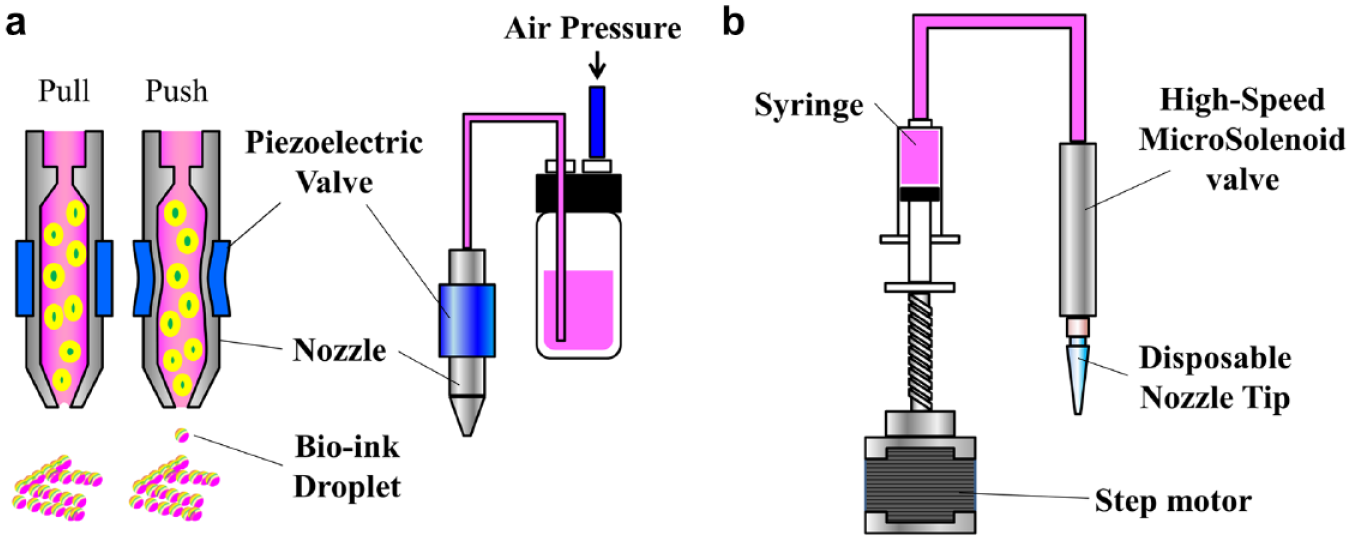
Illustration of droplet-based technologies employed by commercial 3D bioprinters. (
Compared with the microextrusion methods (see the “Microextrusion-Based Bioprinting Technology” section), the main advantage of droplet-based bioprinting is its ability to fabricate high-resolution constructs, while at the same time maintaining a high cell viability of ~80–95%.18,152 For example, the latter technology was used to fabricate constructs at a very high cell density (tissue-relevant densities of ~107 cells/mL) and droplet resolution of 1 nL, while maintaining a cell viability of ~90%. 77 This is largely due to the fact that the droplet-based machines use lower-viscosity bio-inks, which impose less shear stress on the cells and provide a higher printing resolution (droplet size as small as ~50 µm), greater accuracy, and faster dispensing speed than the extrusion-based competitors.153,154
Conversely, the microextrusion technologies lack the ability to control droplet size and are thus forced to utilize more viscous bio-inks (squeezed out in the shape of a filament). This necessitates the use of higher dispensing pressure in order to push the material through a small “nozzle,” which in turn leads to significant cell damage due to the elevated shear stresses (>10 kPa) experienced during the passage of the bio-ink through the needle tip’s narrow opening. Consequently, decreases in cell viability and proliferation are experienced with the use of small (e.g., an inner diameter <200 µm) needle sizes,77,155 and as a result, a printing resolution <100 mm is difficult to achieve using microextrusion.153,154
Nonetheless, despite the advantages of being able to maintain both high cell viability and a high resolution simultaneously, the droplet-based printers are also limited in that they can only use lower (3.5–12mPa/s)-viscosity materials, such as alginate or collagen. 18 The use of low viscosity also leads to the difficulty of building supporting frames or structures. This makes it challenging to fabricate tall 3D prints.
Additionally, nozzle clogging is a common problem for droplet-based printing techniques that handle high-cell-density suspensions. 156 However, when the needle size is smaller than 150 µm, clogging becomes a major problem for the extrusion-based methods as well.157–159
Low-Cost Droplet-Based Bioprinters
Droplet-based (i.e., inkjet) technologies were first used for cell patterning77,152,160 and ultimately served as the foundation for the early commercial bioprinters back in 2005.
4
Their main advantages over microextrusion-based 3D bioprinters (
FUJIFILM Dimatix’s DMP-2850
FUJIFILM Dimatix is one of the world’s largest suppliers of inkjet printing technology based in the United States. The company was formerly known as Spectra Inc. when it was founded in 1984. It was acquired by the Japanese FUJIFILM Holdings Corporation in 2006 and became known as Fujifilm Dimatix Inc. The company focuses on designing, developing, and producing PDOD print heads in tandem with providing 3D bioprinting systems. FUJIFILM Dimatix’s DMP-2850 (formerly DMP-2000), released in 2009, is one of the only few drop-based printers that falls into the low-cost category. It includes a drop watcher, fiducial cameras, a PC, and drop manager software. This printer is highly compact (W × D × H dimension: 67 × 58 × 42 cm3) and can fit in any standard BSC/fume hood. It is compatible with various substrates, such as glass slides, petri dishes, and multiwell plates. Moreover, the machine can handle a large build volume of up to 20 × 30 × 2.5 cm3 at ±25 μm unidirectional repeatability. The vacuum platen’s (which secures the substrate in place) temperature can be adjusted up to 60 °C. The printer’s fiducial cameras provide the DMP-2850 with many advantages, such as alignment using reference marks, positioning of the print’s origin to match the substrate’s positioning, measurement of resulting features and their locations, image capture and inspection of the printed pattern or drops, cartridge alignment when using multiple ones, and matching drop placement to a previously patterned substrate. 161
The DMP-2850 uses microelectromechanical system (MEMS)-based disposable cartridges of 1.5 mL usable volumes, which allows users to fill their own media-like bio-ink or hydrogel–cell suspensions. The MEMS-based disposable cartridge has 16-nozzle heads with 254 µm spacing in a single row, with a drop volume available in either 1 or 10 pL. With the 1 pL nozzle, one can deposit features as small as 20 µm in size, making it suitable to aid the fabrication of microelectronic devices, as well as DNA patterning in biotech applications. Furthermore, the droplets coming out from the nozzle can be fine-tuned using a built-in waveform editor and monitored using the drop-watch camera. 162
As shown later in Figure 6 , FUJIFILM Dimatix’s DMP-2000 series printer has had a significant impact on academic research, with almost 670 hits resulting from our keyword search using Google Scholar since 2006. Notably, this is even more impactful in facilitating basic scientific research than many of the high-end bioprinters that we have surveyed, and the machine is undoubtedly the uncontested winner within the low-cost market segment. However, the DMP-2000 series printer is one of the few products that have been on the market for a long time (since 2005, to be exact); therefore, this is also one of the reasons contributing to why this product is more highly cited than those of the competitors. Furthermore, it is difficult to isolate how many of these citations belong to the bioprinting applications, given that the machine is also used for MEMS fabrication. Nonetheless, it currently stands as the most impactful low-cost model out there.
MicroFab’s jetlab 4 and jetlab 4xl
MicroFab is a U.S. company that has been providing piezoelectric inkjet-based dispensing instruments since 1984. The company’s focus is primarily on the research and development of inkjet solutions that meet the microdispensing requirements of a wide variety of large and small customers. For example, MicroFab has successfully demonstrated droplet-based printing with more than 500 specialty fluids, ranging from gases at cryogenic temperatures to melted solder at over 300 °C. 163 The company also provides hardware customizations such as single-fluid (one-nozzle) or four-fluid (four-nozzle) print heads with various heating, filtering, and orifice (e.g., 20–80 µm diameter) configurations, and bio-ink cartridge volumes ranging between 0.5 and 30 mL, with an optional stirring capability. In 2006, it introduced a line of inkjet printers called jetlab 4. Within the series, there are four models that are available at different price ranges. However, only the jetlab 4 and jetlab 4xl have price tags that are within the upper boundary of the low-cost bioprinter category.
Both of the jetlab 4 models are equipped with a CCD camera for droplet observation, an enclosure chamber (without a HEPA filter), and a panel PC. The Z-height adjustment of the print head and the pneumatic control must be done manually. The print heads for all models can operate with the same travel speed of 5 cm/s (15 cm/s2 acceleration) and can deposit bio-ink in two printing modes: print on-the-fly (straight and/or curved in any direction) or point-to-point. The jetlab 4 is capable of printing a 16 × 12 cm2 area at ±30 µm positioning accuracy and ±20 µm repeatability. The CCD camera on the jetlab 4 is mounted at a 15° angle for drop impact observation and coarse substrate alignment. The jetlab 4xl is basically an upgraded model of the jetlab 4 to handle a larger build area of 21 × 26 cm2. Additionally, the CCD camera on it is mounted on an XY stage for horizontal drop observation, which gives the jetlab 4xl more options to work with MicroFab’s high-temperature and multichannel print heads.
The jetlab 4 models have been used in more than 23 countries, and they have been highly impactful in the research field with ~85 citations (
Light-Based Bioprinting Technology
There are two main light-based technologies that commonly appear in the commercial 3D bioprinters listed in
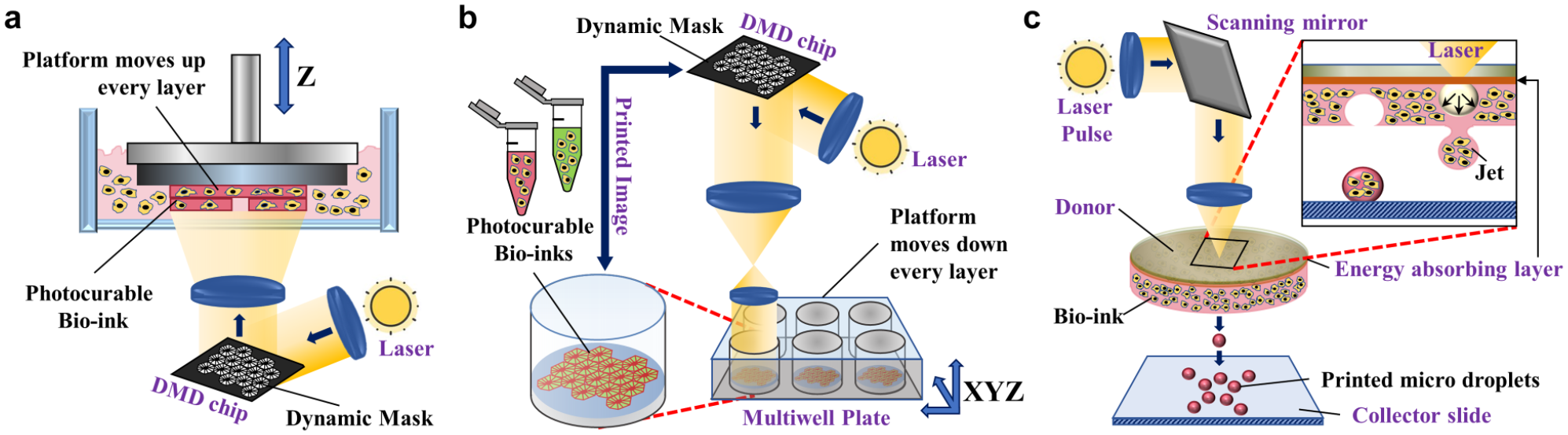
Schematic illustration of light-based technologies commonly employed by the commercial 3D bioprinters: (
There are currently only two DMD-based 3D bioprinters on the market that we could find, both of which fall into the low-cost range (see the “Low-Cost Light-Based Bioprinters” section). In comparison to the two other printing methods (i.e., microextrusion and inkjet), discussed in the “Microextrusion-Based Bioprinting Technology” and “Droplet-Based Bioprinting Technology” sections, the light-based 3D printing technology is the most advanced method because it is capable of rapid fabrication of 3D cellular structures with both high resolution (~20–50 µm) 153 and cell viability (75%–90%). It has the additional advantage that it is compatible with any photocurable bio-ink, regardless of the material’s viscosity. 18 Therefore, it is possible to fabricate viable high-cell-density constructs with high precision, and without the need to worry about damage from shear stresses (like with microextrusion). However, the light-based 3D printing methods are limited by the fact that the bio-ink/cells (if any) must be loaded into the printing bed a priori. This means that although the crosslinking can be done at any desired location, the cell/bio-ink’s positions can only be manipulated by combining the DMD with a secondary technology (e.g., microextrusion) either before or during the printing process. Otherwise, any changes to the bio-ink must be done by manually replacing the contents of the print bed.
Low-Cost Light-Based Bioprinters
CELLINK’s Lumen X 3D Bioprinter
Lumen X is another affordable benchtop 3D bioprinter released in 2019 by CELLINK. This was done in collaboration with Volumetric, a U.S.-based start-up. Unlike the other extrusion-based 3D bioprinters from CELLINK, Lumen X is a digital light processing (DLP) bioprinter that enables high-speed light-based crosslinking, which has been shown to be 50 times faster and more consistent than extrusion-based machines. The projected light wavelength used in the Lumen X is 405 nm. Additionally, CELLINK and Volumetric also offer their proprietary GelMA PhotoInk bio-ink, whose curing speed has been optimized to have little to no impact on cell viability. This enables the printing of various bio-inks, such as cell-laden hydrogels/microfluidics and macroporous structures.
Furthermore, the machine can achieve a feature resolution of ~50 µm in the XY plane, while the Z resolution of 5 µm is dictated by its stepper motor. It takes approximately 10 s to crosslink each XY layer. The max build volume is 6.5 × 4 × 5 cm3, which means that this machine can also be used to construct lab-on-a-chip microfluidic devices. Also, its build platform is small. Therefore, the printing can be performed inside a 10 cm petri dish in order to minimize the amount of bio-ink needed per job. Moreover, the build platform is designed with a quick-release mechanism that makes it easier to swap for a new one. Additionally, CELLINK offers two different options for improving the adhesion of the printing construct to the print bed: a glass build platform for working with hydrogels and a metal build platform for working with resin-based materials.
Overall, the Lumen X is a very compact machine (W × D × H dimension: 24 × 43 × 41 cm3) that can fit into any BSC for a sterile bioprinting process. It has been used for fabricating highly complex tissue structures, such as hydrogels with functional vascularized alveoli, 170 implantable hepatocytes in a prevascularized hepatic hydrogel, 170 a hydrogel scaffold with the controlled spatial distribution of bioactive molecules along aligned microchannels for neurite outgrowth in brain tissue generation, 171 and 3D patient-specific models of a developing human heart. 172
Allegro 3D’s STEMAKER Model D 3D Bioprinter
Stemaker Model D is a DLP bioprinter from a U.S.-based company called Allegro 3D. The printer is designed for high-throughput automated printing directly in multiwell (e.g., 6-, 12-, and 24-well) plates. The latter minimizes product damage and/or contamination by eliminating the need to transfer the resulting products from the printer to a culture dish. Furthermore, the STEMAKER Model D offers rapid bioprinting at a 1000× faster speed and a 10× better resolution (~10 µm) than the traditional extrusion-based bioprinters. Thus, this machine enables high-throughput tissue printing within a very short turnaround time.
Like the Lumen X from CELLINK, the STEMAKER Model D also uses the 405 nm light for photocuring projection. Furthermore, it has a compact design (W × D × H dimension: 45 × 36 × 44 cm3), allowing it to fit into all major BSC models. Additionally, the STEMAKER Model D utilizes a built-in computer and a 10-inch glove-friendly touch screen. The machine supports .stl files, which can be loaded through a USB port. The user can then specify the working locations in each of the multiwell plates, as well as the individual printing parameters (e.g., light intensity, printing speed, and section height) for each one.
Additionally, the STEMAKER Model D has temperature control (RT through 60 °C) to provide optimal thermal printing conditions for specific bio-inks. The company also sells glass-bottom-coated multiwell plates for high-resolution imaging and better adhesion of the 3D printed tissues. Multiple other bio-inks and 3D printed parts are also available for sale on Allegro 3D’s website. In terms of the Model D’s applications, it is worth noting that Allegro 3D reported a successful fabrication of an induced pluripotent stem cell (iPSC)-derived human liver tissue that mimics the hepatic lobule microarchitecture. 173
Brief Overview of the High-End 3D Bioprinters
According to Figure 6 , the high-end printers are more popular than the low-cost ones among the research community. This can be attributed to several reasons: (1) they were the first on the market and have thus benefited from a longer adoption time; (2) these machines may be housed by shared facilities, thereby making them more accessible to users who would not otherwise be able to afford them; and (3) some of the manufacturer companies also provide printing services to customers who choose not to buy their own hardware. For example, such customers can rent the system for less than 50% of the cost without having to commit to a purchase. Alternatively, the companies may support the customers’ fund-raising efforts (e.g., grant writing) for a printer’s purchase. In fact, together these strategies provide significant advantages over buying low-cost printers, considering that the latter are newcomers to the market and their performance has not yet been characterized by the user. Therefore, in order to provide a comparison of how low-cost bioprinters measure up to those from their high-end competitors, the following section reviews the latter in more detail.
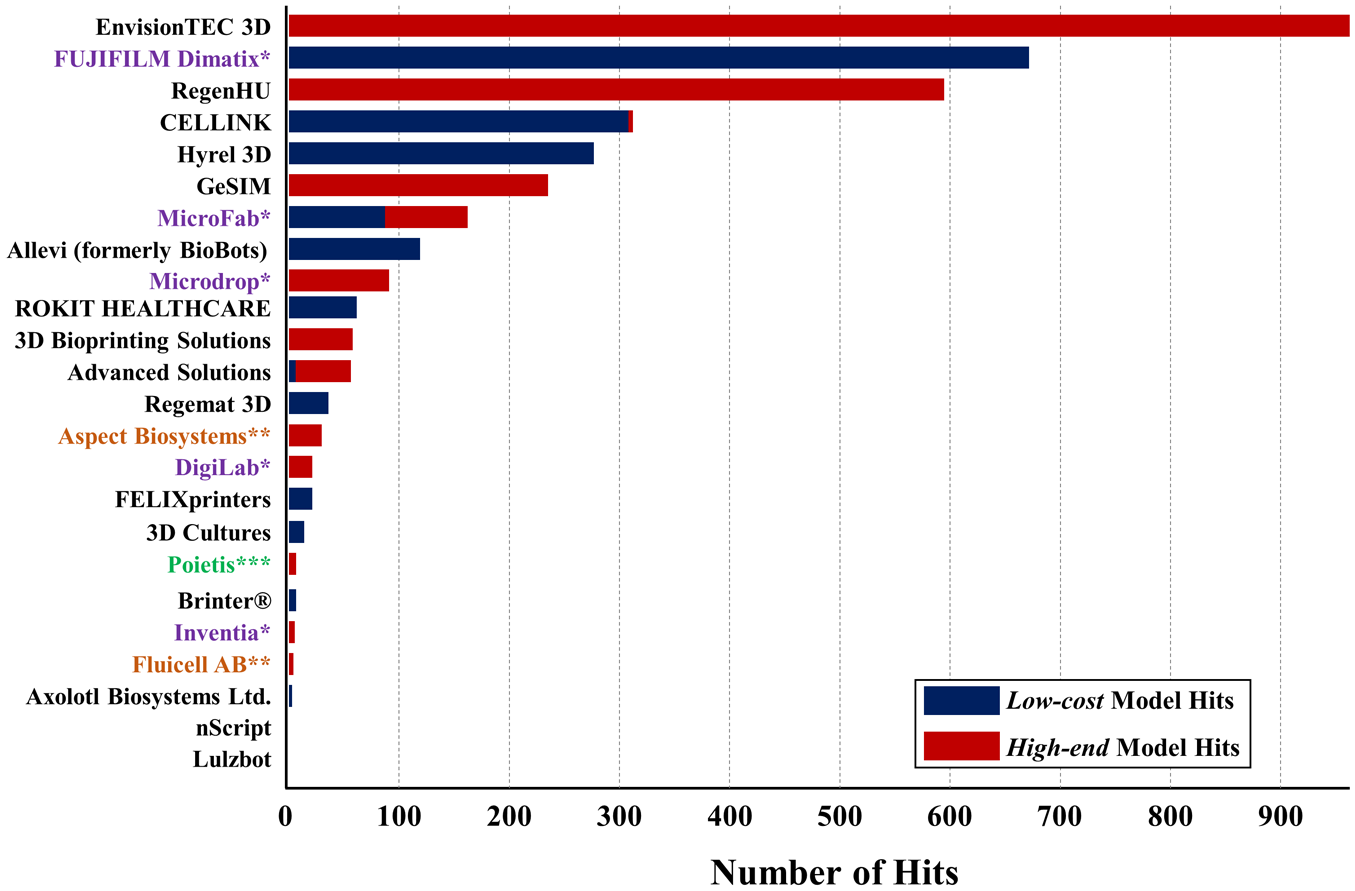
Scholarly impact of the surveyed bioprinters’ manufacturers. The literature search was performed using Google Scholar in April 2021. The number of hits (i.e., search results) is clustered by manufacturer, which represents the total number of found publications that use either low-cost category and/or high-end category bioprinters from a specific company. When a company sells models that fall into more than one category (i.e., both low-cost and high-end), two different colors within a single bar are used to signify the proportion of hits belonging to each of the respective market segments. The term “3D” in combination with “printer-name” and “company name” was the keyword used in the search. On the Y axis, black labels are for microextrusion-based bioprinters manufacturers, purple* labels are for droplet-based bioprinters manufacturers, orange** labels are for microfluidics-based bioprinters manufacturers, and green*** labels are for laser-assisted droplet-based bioprinter manufacturers. Note: The result for Hyrel 3D was generated by adding the searches for “Hyrel 3D” and “Hyrel3D.” Allevi is formerly known as BioBots Inc., and Dimatix’s DMP-2850 is formerly known as Dimatix’s DMP-2800. Hyrel 3D’s result was generated by using the combination of “3D,” “Invivo,” and “Rokit” as keywords. DigiLab’s result was generated by adding the searches for “celljet” and “cell jet.” The result for MicroFab’s jetlab 4 was generated by adding the searches for “jetlab 4” and “jetlab IV.” Finally, the result for MicroFab’s jetlab II was generated by adding the searches for “jetlab II” and “jetlab 2.”
Furthermore, it is expected that some of the high-end technologies may trickle down to low-cost machines in the near future. This makes it even more important to understand the high-end technologies to forecast the upcoming low-cost printer trends. To that end, this section summarizes the technical characteristics of the high-end bioprinters that are currently available on the market.
High-End Microextrusion-Based Bioprinters
As shown in
Figure 6
and
EnvisionTEC’s 3D Bioplotter Starter, Developer, and Manufacturer
EnvisionTEC is one of the largest players in the 3D printer manufacturing industry, with headquarters in Germany. It has been in operation since 2020, has more than 250 employees,
174
and accounts for roughly a quarter of the 3D bioprinter market.
175
The company’s size can partly be attributed to the fact that EnvisionTEC does not solely deal with the 3D bioprinting sector but also is involved with various nonbioengineering 3D printing. Some of these include medical devices, hearing aids, dental, orthodontic, jewelry, aerospace, and automotive. The company offers three models of the 3D Bioplotter bioprinters: 3D Bioplotter Starter, 3D Bioplotter Developer, and 3D Bioplotter Manufacturer. All three models employ pneumatic extrusion print heads. However, the Developer and Manufacturer have modular temperature-controlled (both in the parking position and during the printing process) and UV crosslinking print heads. Also, the Developer is capable of operating with up to three modular simultaneous print heads, and the Manufacturer with up to five (
Another significant difference between the three models is the level of available automation that comes with the printer; for example, the Starter only has an automated nozzle cleaning feature, while the material calibration and print bed height control are manual. In contrast, the Developer has an automated Z-height adjustment and nozzle cleaning, but its material calibration is still manual, and it has no photographic logging of the layer inspection during the printing. Finally, the Manufacturer is the most automated of the three; it has a substrate height sensor, a finely tuned temperature-controlled build platform, four external temperature sensor ports, a semiautomatic camera-assisted material calibration, an automated nozzle cleaning mechanism, and a background recalibration of the critical hardware settings during regular use.
The Bioplotter series is designed to work in both cooled (as low as –10 °C) and heated (80 °C) environments and is compatible with a wide range of materials, including thermoplastics (e.g., PLA, PCL, poly-l-lactide acid (PLLA), polyurethane (PU) and ABS), hydrogels (e.g., agar, alginate, chitosan, and gelatin), and ceramic/metal pastes (i.e., HA, titanium, and tricalcium phosphate). Some applications of these machines include bone regeneration,176–179 drug release,180–182 tissue fabrication,183–185 and materials science.186–188 Overall, the EnvisionTEC bioprinters have turned out to have the most significant scholarly footprint, yielding ~960 hits in our scientific literature search (
RegenHU’s R-GEN 100 and R-GEN 200
Like the EnvisionTEC, RegenHU is also one of the largest players in the 3D bioprinting market. The company was founded in 2007 and is headquartered in Switzerland. However, unlike its competitor, RegenHU is much a smaller company, with about 20 employees, and it focuses on producing hardware and software exclusively for bioprinting. Therefore, RegenHU’s products provide a very powerful solution for tissue fabrication with a series of bioprinting workstations.
Until the fall of 2020, RegenHU’s most popular models were the BioFactory (discontinued in early 2020) and the 3D Discovery Evolution. These two professional systems were meant to accommodate both the high-throughput demands of the manufacturing industry and the small lab-scale environment of academic tissue engineering research and development. However, recently RegenHU has upgraded its product line by introducing two brand-new models: a lab-scale compact tabletop R-GEN 100 and a bigger R-GEN 200. These are fully customizable with multiple modular print head technologies available in a single 3D bioprinting platform, such as a pneumatic strand dispenser, a pneumatic drop dispenser, a pneumatic melt dispenser with or without an electrowriting module, a volumetric strand dispenser with or without an electrowriting module, a light curing tool, and a microscope tool. Both the R-GEN 100 and R-GEN 200 have five available tool slots for housing these print heads, which enables them to build a range of simple and complex constructs.
Moreover, their work zone (i.e., print bed) comes in four different options: standard, electrowriting and spinning, physiological temperature (5–40 °C), and high temperature (RT through 80 °C). While the standard configuration has no temperature control and the electrowriting and spinning come with built-in heating, the two latter options require an external liquid temperature control unit. This unit can also be used to control the temperature of the bio-ink cartridges and the extrusion nozzles. Thus, the R-GEN 100 and R-GEN 200 are compatible with a wide range of bio- and nonbiomaterials, like Collagen, elastin, alginate, cellulose, hyaluronic acid, silk fibroin, gellan gum, chitosan, peptide gels, decellularied extracellular matrix (ECM), graphene, gelatin, Matrigel, PEG, gelatin methacryloyl (Gel-MA), methacrylated hyaluronic acid (HAMA), photocurable silicones, poloxamer, polyvinylpyrrolidone (PVP) and carbone nanotubes. Furthermore, the R-GEN 100 comes with a HEPA filter, while R-GEN 200 has a Class II BSC. Therefore, both provide sterile conditions for printing cells and/or cell-laden materials.
Overall, RegenHU’s bioprinters have seen extensive use in research over the last few years. Their products have been cited ~600 times (
Main Advantages over the Low-Cost Microextrusion-Based Bioprinters
As mentioned previously, we have chosen not to focus on the reported resolutions of the bioprinters because (1) they are often reported in different ways, making it difficult to draw a fair comparison; and (2) they are rarely achievable in a practical setting by the nonexperts. We will simply state that in our experience, the high-end companies appear to be more transparent about their positioning accuracy and printing resolution claims, which makes it likelier that their product can achieve what is promised. Aside from this, the following are the major differences that we observed between the low-cost and high-end microextrusion printers.
High-End Droplet-Based Printers
MicroFab’s jetlab 4xl-A, jetlab 4xl-B, and jetlab II
According to
Figure 6
, MicroFab’s droplet-based bioprinters are the most highly cited machines among the other inkjet printers in the research field. Since its founding in 1984, the company has become one of the world’s leaders in PDOD technology (see
The jetlab II is the most expensive of the three models due to its higher level of automation, larger print area, linear motorized stages that provide precise positioning (±4 µm accuracy and ±2 µm repeatability), and a fast travel speed of 10 cm/s (40 cm/s2 acceleration). The highly automated features of this model include electronic pressure control, jet alignment, and an inspection option that works through image analysis. The jetlab II has been used for various applications like developing a new inkjet printing approach for the facile fabrication of microscopic arrays of biocompatible silk nest arrays for cell hosting; 193 studying fast, flexible inkjet printing methods for patterning dissociated neurons in culture; 194 micropatterning living cells into a cell culture medium by co-printing different cells into various designs, such as complex gradient arrangements; 195 creating printed dual cell arrays for multiplexed sensing; 196 and developing inkjet-based cell printing with a 30 μm nozzle diameter for cell-level accuracy. 197
Microdrop Technologies GmbH’s Autodrop Bioprinters
Microdrop Technologies GmbH is a Germany-based company founded in 2005 with less than 100 employees. 198 Like MicroFab, Microdrop Technologies is another leader in inkjet printing applications and advanced microdispensing technologies. It offers the following droplet-based models: Autodrop Compact, Autodrop Gantry II, and Autodrop Gantry. The Autodrop Compact has a relatively large build volume (21 × 21 × 11 cm3) with a ±25µm accuracy, a ±10 µm repeatability, and a travel speed of 7.5 cm/s (50 cm/s2 acceleration). Compared with the Compact model, the Gantry II and Gantry models have larger printable areas of 30 × 30 × 10 cm3 and 36 × 60 × 10 cm3, respectively. Furthermore, the Gantry II has an improved repeatability of ±5µm and a faster travel speed of 10 cm/s (100 cm/s2 acceleration). Meanwhile, the Gantry model comes with the best positioning: a ±10 µm positioning accuracy, a ±3 µm repeatability, and the highest travel speed of 50 cm/s (100 cm/s2 acceleration).
Furthermore, the Autodrop systems use exchangeable nanojet dispenser heads with piezo valves, or picoliter dispensing pipettes, for compatibility with a wide range of material viscosities (0.4–10,000 mPas) and droplet volumes (0–380 pL). This makes them suitable for many applications, such as studying the effect of biocompatible surfactants on PDOD inkjet printing of living cells in order to improve the reliability of droplet formation and cell viability;
199
developing a new approach to inkjet printing of single-cell cultures using a liquid hydrophobic barrier that prevents sample dehydration and enables spatially addressable arrays for statistical quantitative single-cell studies;
200
developing large-scale size-controlled pancreatic progenitor cell clusters as a potential cell-based therapy for diabetes;
201
studying reversible calcium alginate hydrogel porogen beads for direct control of macropore size on a scale relevant to cell culturing and tissue engineering;
202
and fabrication and testing of an aptasensor with printed poly(3,4-ethylenedioxythiophene) polystyrene sulfonate electrodes for influenza A virus detection.
203
Overall, the Autodrop systems have been used widely in research, with 89 hits generated by a Google Scholar search (
Additionally, Microdrop Technologies GmbH offers nanojet dispenser heads with a microsolenoid valve (
Digilab’s Celljet Live Cell 3D Bioprinter
Similarly, the Celljet Live Cell 3D Bioprinter, produced by a U.S.-based company, Digilab Inc. founded in 2001, is another high-end droplet-based option that employs solenoid valve nanojet dispensing technology for droplet generation with a liquid delivery range from 10 nL to 1 mL. The Celljet Live Cell Bioprinter is capable of holding up to 16 individually addressable channels at a time, which are designed for high-throughput manufacturing with a very high positioning accuracy (± 1.3 μm) and repeatability (± 10 μm). Therefore, the Celljet is mostly used for live cell bioprinting studies for high cell viability and evaluation of bio-ink properties in the 3D bioprinting process, with around 20 hits resulting from our keyword search using Google Scholar (
Main Advantages over the Low-Cost Droplet-Based Bioprinters
The following are the significant differences between the low-cost (see the “Low-Cost Droplet-Based Bioprinters” section) and high-end droplet-based bioprinters uncovered as part of our survey:
Another interesting observation is that none of the low-cost models come with a motorized Z stage, while all the high-end droplet-based bioprinters come with a software-controlled XYZ-axis system.
2
3
4
High-End Light-Based Printers
Poietis’s NGB-R
Poietis is a company that was founded in 2014 as a spin-off from the INSERM Research Institute and the University of Bordeaux, France. It has about 35 employees and holds more than 52 patents. Among some of the products that it sells is a printed human skin model called Poieskin, which some of the world’s leading companies, like L’Oréal, Servier, and BASF, use for cosmetics and pharmaceutical in vitro testing purposes. Poietis currently offers two 3D bioprinter models: NGB-R is intended for small lab-scale research, and NGB-C is designed for large-scale manufacturing (so it is not discussed here). These are the only two bioprinters on the market that use laser-assisted droplet-based bioprinting technology (see the “Light-Based Bioprinting Technology” section), to which the company holds worldwide exclusive intellectual property rights.
Laser-assisted droplet-based bioprinting technology was already briefly discussed in the “Light-Based Bioprinting Technology” section and shown in Figure 5c . The detailed description is as follows: Per Figure 5c , the printing is accomplished by loading the desired concentration (up to 100 million cells/µL) of bio-ink on a donor plate/ribbon. After that, the cell droplets are formed by pulses of laser energy and are transferred to the substrate via pressure buildup in the resulting bubbles. The laser beam is directed via a fast scanning mirror to deposit the droplets in a predetermined pattern with a rapid printing speed of up to 10,000 drops/s.
The advantage of this technology is that it allows the controlling of numerous parameters, like cell concentration, droplet volume/size, printing pattern/deposition location with high precision, repeatability, and reproducibility of the process. Additionally, the fact that it is a nozzle-free technique means that the cells are not damaged by flow shear stresses, compressive forces of extrusion, or phototoxicity. In fact, it has been shown that the cell viability using this printing method is above 95%. Furthermore, the number of cells per droplet can be controlled for achieving a single-cell resolution, and the droplet volume is also tunable from picoliters to nanoliters. Ideally, about 1–100 cells/droplet can be printed at a ~10 µm precision using this technology. However, one drawback of this printing technique is that the compatible bio-ink viscosities are limited to 1–300mPa/s. 18
Based on our market search, the NGB-R is one of the most expensive 3D bioprinters on the market. However, this may be because the machine is an all-in-one bioprinting platform that comes with a six-axis robotic arm (for precise automated motion), a class II BSC, a control panel with a large touch screen, and so forth. Furthermore, in addition to the droplet-based technology, the NGB-R can be equipped with up to three extrusion-based and/or microvalve printing heads. There are also several customizable options for UV crosslinking/photopolymerization, thermal regulation, a cellular-level microscope, and so on.
Some of the applications that the NGB-R has been used for include the creation of a high-cell-density printed tissue, 204 cell patterning studies for organotypic, 205 and printing mesenchymal stroma cells for in vivo bone regeneration studies. 206 However, according to Figure 6 , Poietis’s NGB Systems are not highly cited (our Google Scholar survey turned up just five publications) in the research field. This is likely due to the machine’s cost being prohibitive to many academic labs. In line with that logic, it can be speculated further that most of Poietis’ customers are industrial and do not publish their results as much.
High-End Microfluidics-Based Printers
Aspect Biosystems’ Lab-on-a-Printer RX1
Aspect Biosystems, founded in 2013, is a privately held company based in Vancouver, Canada, with about 49 employees,
207
that is pioneering microfluidics-based lab-on-a-printer technology. It has received a $1 million investment from Genome British Columbia,
208
and was involved in a $2.2 million project seeking to find new treatments for cancer in collaboration with two of the world’s largest pharmaceutical companies: Merck and GlaxoSmithKline.
209
The innovation behind its RX1 3D bioprinting platform is that it uses microfluidic devices for bio-ink extrusion (see
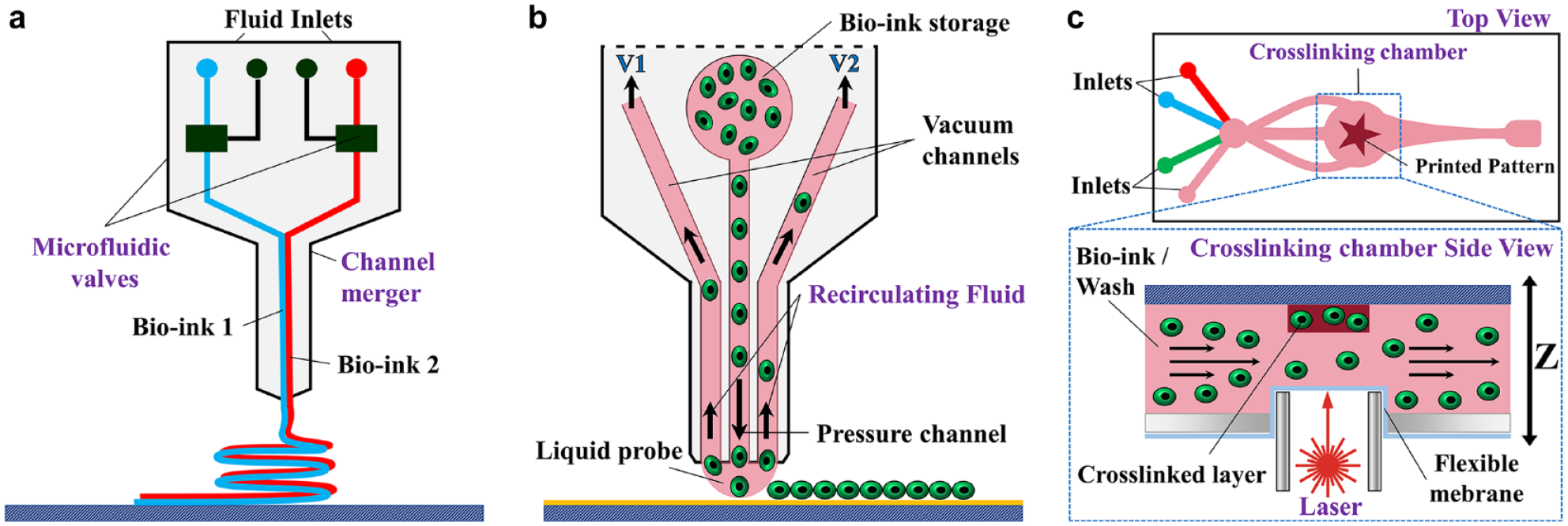
Illustrations of the different types of microfluidic print head technologies currently used in 3D bioprinters. (
Not only does this unique printing approach allow the machine to work at fast speeds while maintaining high cell viability, but also it enables it to have precise control over the bio-ink deposition with a nearly single-cell printing resolution. Additionally, the microfluidic heads can be used to mix multiple materials in a continuous manner with concentration profiles that can be programmed to change over time. This “on-the-fly” printing avoids time-consuming bio-ink substitutions and favors the chemical crosslinking of the mixed materials. Moreover, the chip can also serve as a multiplexer that is capable of merging laminar flows in a controlled ratio. This allows for various extrusion styles to be made available using this system programmatically, for example, cell encapsulating droplets; a dual filament composed of two different nonmixed materials, with a discrete boundary between them (as shown in
However, one problem with microfluidic bioprinting today is that the cost of these systems remains higher than that of most conventional bioprinters. Nonetheless, Aspect Biosystems is currently offering collaborative opportunities and help in preparing grant funding applications in order to assist with purchasing its system.
It is also worthy to note that the company uses its printers to make for-sale bioengineered products, such as the 3DbioRing—an extremely customizable and physiologically relevant muscle tissue platform that exhibits highly physiological contraction and relaxation responses in an in vitro setting. 211 This makes Aspect Biosystems more versatile than just a hardware company, which in turn increases the likelihood of its continued financial stability and innovation in the microfluidic bioprinting space.
Fluicell AB’s Biopixlar
Fluicell AB is a ~20-employee Sweden-based company spun off from the Chalmers University of Technology (Gothenburg, Sweden) to become an independent entity in 2012. It has mainly focused on providing platforms for studying single-cell behavior in drug development, cell biology, and tissue engineering. 212 However, in 2014 Fluicell AB also released its first 3D bioprinter, the Biopixlar, which is capable of printing cell suspensions directly inside of the culture media/buffer, without the need for any supporting gel or matrix biomaterials. The machine is equipped with a three-axis micromanipulation robotic arm and a motorized sample holder stage, which has a high movement precision of ~2 µm. The unit also comes with an integrated inverted bright field/fluorescence microscope that has three fluorescence excitation wavelengths, a 10× objective, a high-sensitivity camera, a heated print head, and an optional UV disinfection light.
For its printing technology, the Biopixlar uses a “microfluidic hydrodynamic confined flow” technology for building biological tissues from individual cells.213–215 Specifically, the printer nozzle, in this case, is essentially a microfluidic device whose tip has one outflow channel in the center and two inflow ones at the sides (
The print head that contains the microfluidic device consists of a housing, which also holds multiple wells for storing the different bio-inks, cell adhesion enhancement agents, and washing solutions. These chambers are enclosed in a pneumatic solenoid manifold. During the printing process, the cell suspension and/or the attachment agent solution are pressurized to flow through the microfluidic circuit toward the print head’s tip. This is accomplished by actuating the corresponding solenoid valves in the manifold. The printed cells are then delivered through the positive pressure-controlled outflow channel to the substrate, while the unattached cells are recirculated back into a collection chamber inside of the device via the negative pressure-controlled inflow channels.
As shown in a recent publication, 214 the Biopixlar was able to print up to three different cell types for fabricating 2D/3D complex tissue structures at a single-cell resolution. The printing process was shown to have maintained ~96–97% cell viability at 2 h postfabrication and a higher than 99% cell survivability after 24 h, when skin cancer (A431) and epithelial (HaCaT) cell types were used. However, its maximum printing volume is currently limited to the size of the cell loading chambers (~35 µL) on the print heads and is only compatible with bio-ink viscosities less than 500 mPa/s (which is a major limitation if the creation of rigid scaffolds is required by the application). Nonetheless, the technology is one of the unique novel developments in the field of microfluidic bioprinting; its liquid probe is different from the continuous filament extrusion produced by the microfluidic print head of the Aspect Biosystems’ Lab-on-a-Printer RX1, and it is also not similar to the droplet-based bioprinters discussed in the “Low-Cost Droplet-Based Bioprinters” and “High-End Droplet-Based Printers” sections. Therefore, we believe that this technology holds the potential for revolutionizing the low-cost bioprinters of the future.
Conclusions and Future Projections for Low-Cost 3D Bioprinter Trends
Recently, there has been an ever-increasing demand for ex vivo biological models for drug and toxicity testing (e.g., cosmetics), driven by both ethical concerns and the high costs of in vivo experiments. Furthermore, companies, universities, and hospitals are in a race to engineer artificial tissues and organs. Bioprinters enable significant time and cost savings by automating the biofabrication process while at the same time offering the advantage of dispensing a range of cells and materials at precise positions dictated by the user. Considering this demand, the high price of professional bioprinters, and the explosion of start-ups trying to fill the low-cost niche, it is expected that high-end technologies will trickle down and become more accessible to everyone. Furthermore, with universities now introducing 3D printing courses, it is also likely that the next generation of the biotechnology workforce will encounter these machines in their jobs. Therefore, it is important to highlight the current bioprinter trends and forecast how the technology will change in the future.
In this paper, we have provided an overview of the currently available commercial low-cost printers that utilize different fabrication technologies: microextrusion-based, droplet-based, light-based, and microfluidics-based. Furthermore, we contrasted them against some of the more expensive high-end models to make projections regarding the evolution of the low-cost bioprinter market. As expected, the low-cost bioprinters remain minimalistic, have lower-quality parts and a poorer assembly, and provide an inferior resolution and less automation than the higher-priced instruments. Most of them use extrusion for the method of dispensing the bio-ink, which results in a roughly similar order of magnitude printing resolution: ~100 microns. However, this resolution appears to be enough for most customers, given that it is comparable to the size of a single cell. A case in point is Figure 8 , where we show that prints with quality that is comparable to that of the high-end machines can be achieved using the low-cost models across all three of the main technology types: microextrusion, droplet-based, and light-based.
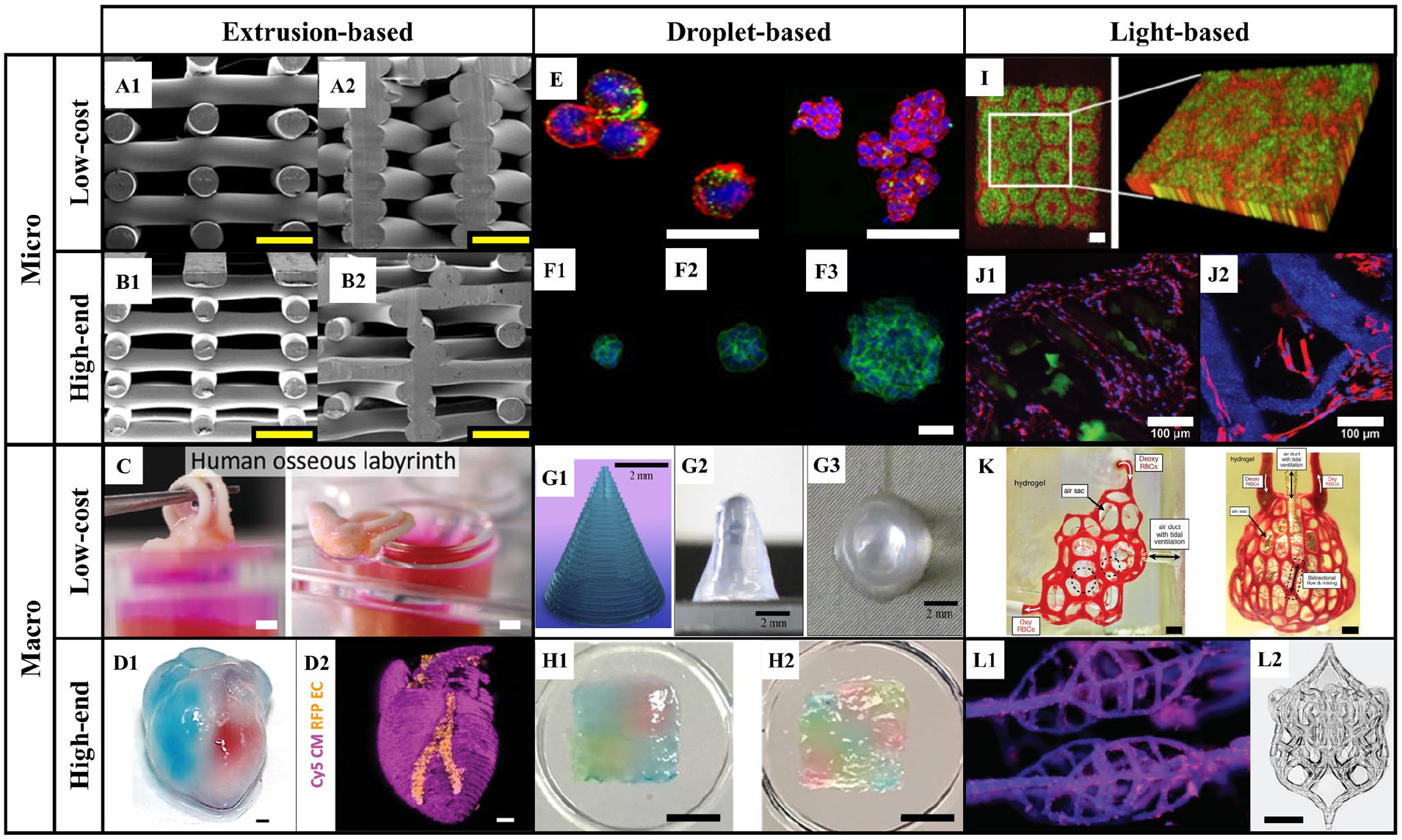
Product quality comparison between the low-cost and high-end machine models for micro- and macro-sized state-of-the-art applications using each printing technology type. (
The higher-end machines also tend to offer more automation (e.g., calibration, monitoring/inspection), a larger build space with a superior nozzle positioning and/or multiaxial travel, and HEPA filtration for a sterile onboard environment. Additionally, the high-end manufacturers tend to be established, which translates into faster delivery, better technical support, and a more reliable warranty for the customer. Finally, at least on paper, the printing resolution specifications for these machines are almost identical to those of their low-cost competitors. It is more likely that the high-end models can achieve them in practice due to the higher-quality components and more extended optimization.
Nonetheless, we anticipate that the low-cost market will develop vibrantly in the near future. To that end, the following sections outline the major trends that we expect will play a role in the upcoming evolution of this sector.
Modular Print Heads
A 3D bioprinting system consists of two main components: the printing tool’s (e.g., nozzle’s) motion and material dispensing/solidifying. While the former is generally an inherent property of the system, the print heads responsible for the latter are becoming “modular.” This means that they can be substituted for other print heads, which use a different bio-ink and/or printing technology, or even carry an additional tool (e.g., a camera, curing light, or fan) all together (
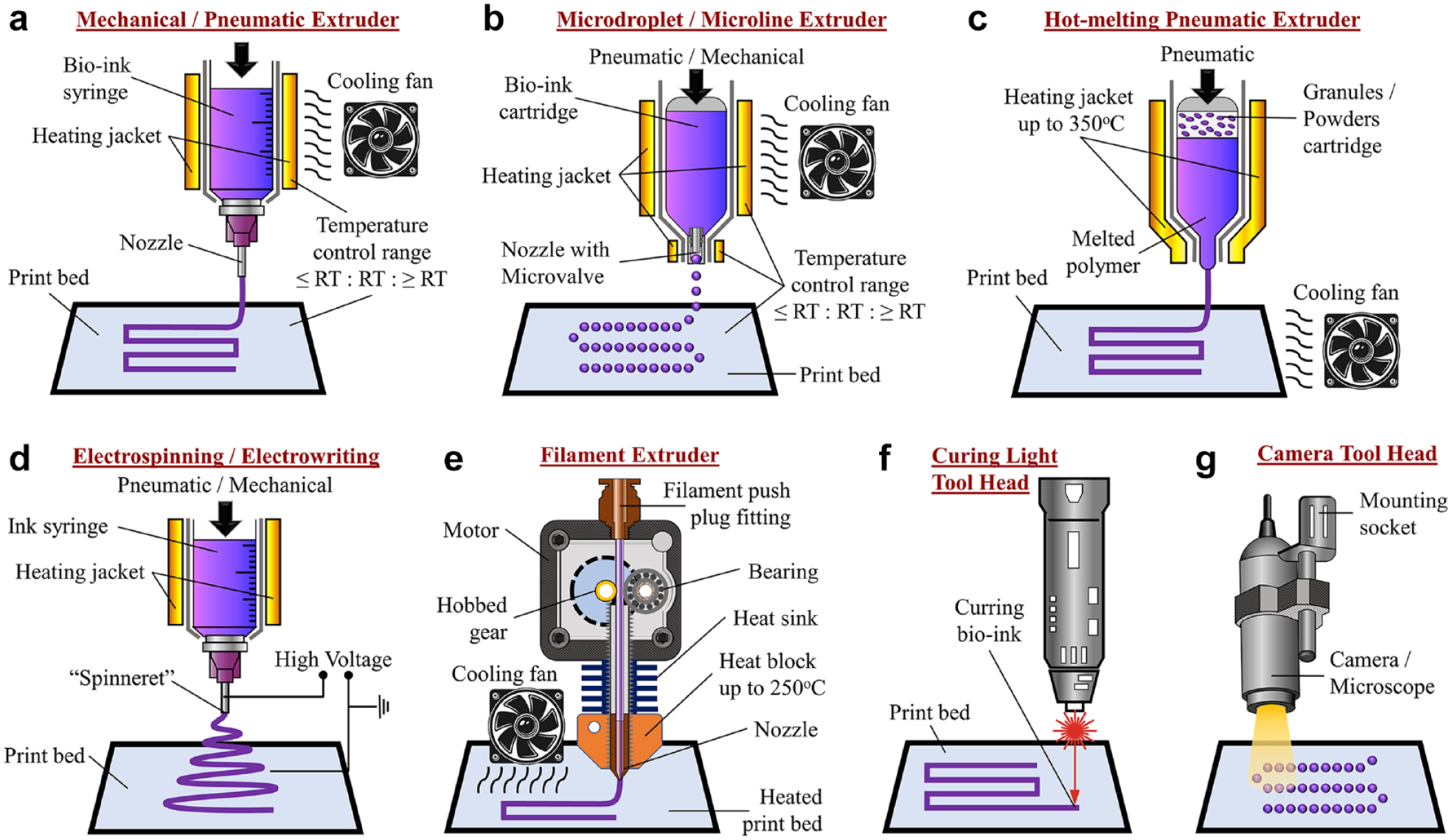
Illustrations of state-of-the-art print head technologies: (
Figure 9 summarizes the state-of-the-art print head technologies, specifically:
- The mechanical/pneumatic extruder print heads (
- The microdroplet/microline extruder print heads (
- The hot-melt pneumatic extruder print heads (
- Another type of extruder is the electrospinning-electrowriting print head (
- Like the hot-melt extruder print heads, the filament extruder print heads (
- Furthermore, additional accessories, like fans, curing lights (
In our opinion, Hyrel 3D is leading the modularity trend by allowing its customers to select relatively cheap print heads from the widest range of choices (
Microfluidic Print Heads and Scaffolds Integrated with Microfluidic “Nozzles”
Recently, the advancement of microfluidic plumbing technologies has increasingly led to their use in synthesizing biomaterials, 216 printing high-throughput assays, 217 and seeding cells in engineered tissues. 218 Likewise, microfluidic print heads have demonstrated great potential in replacing the traditional extrusion-based and droplet-based technologies due to numerous advantages, such as fast continuous switching and mixing of materials, high-resolution bio-ink deposition, and reducing the shear stresses experienced by the extruded cells (see the “High-End Microfluidics-Based Printers” section for more details).219,220 These new capabilities can potentially revolutionize the 3D fabrication of artificial tissues by enabling the generation of highly organized and patterned microenvironments and organoids using multicell/multimaterial bio-inks.
The industry leaders, like Aspect Biosystems and Fluicell AB, have already implemented the microfluidic printer heads in their commercially available RX1 and Biopixlar platforms, respectively. Yet, the high cost of these novel machines is still unaffordable for a typical-sized academic laboratory. Nonetheless, the components required to make the PDMS printer heads are cheap. Hence, the current high cost of the microfluidic bioprinters is likely due to their novelty. Consequently, they are expected to fall in price steadily as the technology adoption continues. Moreover, given the apparent rise of Aspect Biosystems and Fluicell AB, and the versatility of their business models (i.e., products ranging from hardware to bioengineered platforms), it is expected that these companies will continue to flourish and drive the industry standard toward making microfluidic printer heads mainstream. For these reasons, we project that microfluidic technologies will soon appear in the low-cost bioprinters as well.
Furthermore, alternative microfluidic bioprinting technologies are being developed that use the device as the photo-crosslinking print bed (as opposed to as a nozzle) (
However, with the use of PDMS as the print heads’ material, several disadvantages should be considered. First, it has a high hydrophobicity, which makes PDMS absorb active agents from the bio-inks. This can potentially alter the printer head’s own composition and consequently worsen its performance. Moreover, PDMS is prone to swelling and is gas permeable. These factors can contribute to the deformation of the print head’s geometry, which makes it difficult to sustain an accurate deposition of the bio-ink over time. Hence, the long-term use of the PDMS print heads is not straightforward, and the inside of their channels must be protected with a special coating to overcome these problems. Yet, even with these workarounds, it is still recommended to replace the microfluidic print heads after every 8–9 h of use, which makes the consumable costs associated with these printers significant. Therefore, some lingering challenges still need to be solved before these technologies can be fully adopted by low-cost bioprinters.
Support-Free Multiaxial Printing
A common feature of the low-cost 3D bioprinters surveyed in this paper is that their bio-ink deposition tools tend to be constrained to linear motion in the X, Y, and Z planes. However, such setups have limitations with respect to the type of geometries that they can produce. Additionally, they typically require the formation of support structures simply because the deposition is made in one direction (e.g., top-down). The need to produce the latter wastes material, slows down the printing time, and may require additional postprocessing to get rid of the support structure.
One possible mechanical solution to this problem is the introduction of two or three more rotational degrees of freedom, either to the motion of the deposition tool or of the sample itself (by moving its bed). 232 This approach enables the creation of complex and intricate geometries without compromising surface quality or adding extra supports. For these reasons, the higher-end bioprinters, like the six-axis BioAssemblyBot, implement this solution. However, the machine dynamics become much more complicated than with the three-axis printing. Also, the slicing process becomes problematic because most software assumes that the layers are built up in a single direction. Nonetheless, this technology results in higher-quality prints and holds a lot of potential for in vivo applications.68,233–235 For example, although some devices currently used for printing into open wounds are either three-axis 68 or handheld 234 (which is effectively a manual six-axis configuration), several five- to six-axis robotic arms 235 have also been introduced. Therefore, multiaxial configurations are expected to eventually appear in the low-cost bioprinters as well.
High-Resolution Printing Using Focused Light
Photo-crosslinking technologies are widely used in bioprinting to obtain solidified structures from the cell-laden bio-ink gels. For this purpose, many of the low-cost machines are equipped with onboard LEDs that travel together with the nozzle and expose the extruded material as it is being deposited. However, for cost-saving reasons, typically these lights are not focused on using high-fidelity optics, and the resulting printing resolution is effectively determined by the nozzle diameter.
Yet, building structures via focused light photo-crosslinking (which is typically done without the extrusion) offers significant improvements in the printing speed and resolution relative to the conventional machines that deposit the bio-ink material via nozzles. Furthermore, this approach improves product viability, given that the cells do not experience the mechanical stresses resulting from being squeezed through a small opening. However, the trade-off is that they must be present in the bed of the crosslinkable bio-ink a priori; for example, the high-end machines, like CELLINK’s Holograph X, are beginning to implement this approach of building the scaffolds via photo-crosslinking in a bed of bio-ink (that has been premixed with cells). Yet, this means that the cell positions are not manipulatable. Alternatively, the cells must be seeded into the resulting scaffold structure after it has been created via curing. This can be done through a combination of processes executed in a sequence; for example, an application from the same company first uses their Lumen X machine to photo-crosslink a scaffold and then deposits cells onto its surface using the nozzles of their BIO X printer. Furthermore, the steps can be combined in a layer-by-layer fashion to seed the cells inside of the scaffold as it is being built. However, this would require a machine to have both nozzles and high-fidelity focusing optics (possibly as different modular printing heads).
Another limitation of the focused light-based printing is that the crosslinking is typically limited to the XYZ directions, which suffers from drawbacks like those of the three-axis extrusion. An interesting solution to this problem is the recently developed computed axial lithography (CAL), which enables synthesizing support-free geometries volumetrically via 3D photopolymerization.236,237 This is done by essentially inverting the process of tomographic reconstruction commonly implemented in CT scans. Specifically, a 3D energy dose is delivered to a photo-crosslinkable material as a set of 2D images projected from different angles, while the sample is rotated in front of a stationary light projector. This approach overcomes many limitations of conventional layer-based techniques; for example, it is able to create objects that enclose existing ones without any support structures, can print into high-viscosity fluids or even solids, is scalable to larger print volumes, and is several orders of magnitude faster, under a wider range of conditions. Additionally, the resulting structures have smoother surfaces than what can be achieved with the typical light-based 3D printers. The latter could be helpful for manufacturing optical components (e.g., tissues of the eye).
Other volumetric photopolymerization approaches, like using holographic patterning of light fields, are also being developed. 238 Furthermore, like the multiaxial technologies, photo-crosslinking has found potential for in vivo applications as well.68,69 Therefore, we foresee that as new volumetric printing developments (e.g., CAL) enter the higher-end bioprinters, the existing focused light photo-crosslinking technologies (e.g., CELLINK’s Holograph X) will cheapen and begin to appear in the low-cost machines.
Monitoring and Automation
High-resolution printing requires an accurate calibration/alignment and close monitoring of the printing process. Thus, a 3D bioprinter should come with a monitoring module such as a high-resolution camera, sensors, and probes. However, per
Sterilization
Whether or not a laminar-flow chamber with a HEPA filter is needed for a low-cost bioprinter is debatable. On the one hand, having a BSC built in provides users with a higher level of flexibility. On the other hand, it significantly increases the cost and the dimension of the unit without improving the printing quality. Also, since most bioengineering labs are equipped with BSCs that are large enough to fit small machines, printers without a built-in BSC may be preferred as a cost-saving measure. Overall, our observation has been that the machines on the market either have a footprint small enough to fit in a BSC or come with onboard sterilization. We anticipate that this trend will remain as is.
Open-Source Do It Yourself (DIY) Community
Given the recent popularity of bioprinting, there is a push toward making the technology universally available. For example, low-cost methods for modifying a standard desktop 3D printer with a bioprinter head have recently been published.239,240 Likewise, Aleph Objects’ Lulzbot open-source business model is a step in the right direction. Furthermore, some community-driven open resources are also becoming available. 241 However, they do not yet appear to be as well developed as their analogs in other disciplines (e.g., OpenSpim website for DIY microscopy). 242 Therefore, is expected that this area of low-cost bioprinting will grow in the future.
Supplemental Material
sj-pdf-1-jla-10.1177_24726303211020297 – Supplemental material for Review of Low-Cost 3D Bioprinters: State of the Market and Observed Future Trends
Supplemental material, sj-pdf-1-jla-10.1177_24726303211020297 for Review of Low-Cost 3D Bioprinters: State of the Market and Observed Future Trends by Anh Tong, Quang Long Pham, Paul Abatemarco, Austin Mathew, Dhruv Gupta, Siddharth Iyer and Roman Voronov in SLAS Technology
Footnotes
Supplemental material is available online with this article.
Declaration of Conflicting Interests
The authors declared no potential conflicts of interest with respect to the research, authorship, and/or publication of this article.
Funding
The authors disclosed receipt of the following financial support for the research, authorship, and/or publication of this article: This work was supported by the Gustavus and Louise Pfeiffer Research Foundation’s Major Investment Grant; and New Jersey Health Foundation Research Award - Grant #PC 22-19. Roman Voronov has established a nondisclosure agreement with Aspect Biosystems regarding a microfluidic technology created in his laboratory. 231 However, this does not affect his perspective of the company’s products.

References
Supplementary Material
Please find the following supplemental material available below.
For Open Access articles published under a Creative Commons License, all supplemental material carries the same license as the article it is associated with.
For non-Open Access articles published, all supplemental material carries a non-exclusive license, and permission requests for re-use of supplemental material or any part of supplemental material shall be sent directly to the copyright owner as specified in the copyright notice associated with the article.
