




Abstract
This commentary is focused on the requirements and general strategy of designing a multiparameter monitoring wrist-worn prototype. The solution is based on an innovative hardware approach to ensure the safety of working conditions through environmental parameter measurement. In some cases, exposure to environmental parameters for a long time can endanger an individual’s health (e.g., exposure to toxic gases or sound level beyond a certain threshold). Therefore, measuring the environmental elements can protect individuals’ health as well. In this work, we emphasize that a new approach and strategy in wearable devices, multiparameter monitoring, miniaturization, sensor integration, data fusion, and system adoption within the Internet of Things (IoT) is necessary according to today’s demands.
The Importance of Efficient Wearable Devices in Safety Monitoring and Healthcare
The main focus of healthcare is gradually shifting from traditional treatment (treatment after diagnosis) to preventive medicine. Prediction and prevention according to the historical tracking record of an individual is the fundamental concept of the new era of healthcare. In the comprehensive monitoring of healthcare, four general parameters are involved (stress level, vital signs, ambient parameters, and daily motion activities), and the monitoring of environmental physical and chemical parameters (hazardous/toxic gases, noise, UV index, air temperature, humidity, and pressure) is one of the major considerations. The environment is of serious concern due to rapid industrialization and urbanization in the modern world. Environmental monitoring can be widely applied in different applications, from industrial condition monitoring, occupational health, and ecosystem changes to safety observation in chemical laboratories. After promising experiences with electronic health (e-Health) and mobile health (m-Health), medical treatment is on its way to a new generation of systems, called the Internet of Things (IoT). 1 Some researchers are oriented toward IoT-based systems that are widely spread over all fields of applications. IoT, in concept, is a palm that links all fingers of different sizes and characteristics. The penetration rate of technologies of various scales and types (smart city, home, healthcare, etc.), characterized by comfort, flexibility, smart decisions, and control in conjunction with ease of use, motivates many people to use wearable smart devices in different areas. In particular, in healthcare and ambient parameter monitoring (the focus of this paper) sensor integration, multiparameter monitoring, centralized data collection and accessibility, secure transmission, and ease of use are the most important requirements of many users. IoT is the concept that may bring all these demands together under the same umbrella by means of wearable devices and advanced communication protocol technologies. In this work, we pay more attention to the wireless sensor network (WSN) as the first tier of IoT. WSN is a spatially distributed network of autonomous sensors for the monitoring of environmental conditions, such as toxic gases, UV index, temperature, sound level (noise), pressure, and humidity. The WSN is built of “nodes”—here wearable. However, the WSN might be extended by adding nodes in healthcare, motion tracking, and other fields. To conclude, the design of an efficient wearable device for environmental monitoring and in general, all fields related to real-time healthcare monitoring play an important role in WSN and, consequently, comprehensive parameter monitoring and IoT.
An environmental monitoring device can contribute to the routinization of workplace safety and to the collection of important health indicators. A wearable device capable of data transmission and communication with a gateway (e.g., smartphone) cloud facilitates a suitable fusion with other sensor nodes within IoT. Therefore, the first step is to design an efficient wearable device for environmental monitoring with a special focus on wearability, prolonged operation, multiparameter monitoring, and data transmission.
Comparison of the State of the Art and Current Requirements
Currently, there is an extensive competition among manufacturers of wearable devices in this constantly growing market. The available ambient monitoring devices are mostly limited to portable (handheld/waist-worn) and single-task devices. In particular, these devices are associated more often with hazardous gas detection and noise monitoring. Many of these devices are unaffordable to the average consumer, especially when the intention is multiparameter monitoring (several single-task devices are required). In addition, multiparameter monitoring by several single-task wearables reduces user convenience (e.g., interfering with daily routine activities) and increases the final cost. 2 Statistics on the market for wearables indicate that many individuals from different professions and ages are highly interested in using wearables for ambient and healthcare parameter monitoring. These users mainly want wearable (form factor and convenient), prolonged, multiparameter monitoring and cost-effective tools that do not interfere with daily routine activities. Sensor and device configurability, data acquisition, ease of data monitoring (e.g., on a smartphone), secure and straightforward data transmission (e.g., star configuration), data loss protection (e.g., storage in an external memory), and early user notification of abnormal status (e.g., beeper) are expected as the major features of an efficient wearable device (in environmental monitoring) based on a new approach for easy adoption in IoT. Healthcare parameter monitoring is not restricted to a special group of people and is important to everyone. Thus, to reach more users, the device must be affordable. In addition, a long monitoring time is essential. 3 To conclude, a device with multiparameter monitoring, a suitable form factor (lightweight and compact), and a convenient mode of wearability (wrist-worn), besides prolonged monitoring and being cost-effective, is more attractive to users. These are the missing points in many manufactured products from industry.
Discussion: Strategy and Approach
To achieve the aforementioned requirements, a careful hardware design based on efficient electronic circuits and appropriate component selection is considered. Software development and task distribution between software and hardware may reduce the hardware complexity and fulfill the criteria. In recent decades, semiconductor technology has been significantly improved, but reaching promising points of size reduction in wearable technologies will require more time. For instance, to obtain a better gas sensor with a lower response time, higher resolution, and smaller size, the membrane technology will need to be more advanced. The alternative to waiting for future developments is to design a wearable device according to a tight strategy.
3D Space Utilization
We concentrate on the concept of 3D space utilization as the infrastructure to design a wearable in ambient parameters monitoring. This strategy is implemented according to a multilayer approach. In this approach, each group of parameters from the same category is monitored by a modular physical layer enriched with required sensors. Depending on the number of parameters and layers, each physical layer is located on top of another. Our intention is to implement a device for everyone, everywhere, for everything. If the wearability and multiparameter monitoring are given the highest priority at the outset, several drawbacks (form factor, weight, size, comfort, and user-friendliness) will be tackled behind the scenes. In spite of many traditional structures, in our approach the hardware expansion is not done in the x-y plane. The physical layers for different tasks are stuck one on top of the other through a board-to-board connector in the z direction. As a result, the final scale of the x-y plane is maintained constant (based on the initial basic platform) and is adequate to be considered a wrist-worn device. However, the height of the device is slightly expanded while still keeping the solution compact. Designers believe that every tiny space must be utilized for component placement. A qualified initial basic platform that is compatible with the requirements (dimension, data transmission, capable of hardware expansion, and integrated sensors) is chosen to host the physical layers. This host platform is enriched with the integrated ambient physical sensors, distributed on both sides. A gas sensor node is placed on the top layer of the device for easy exposure, and a notification driver for early user warning of an abnormal status is located on the bottom layer. The heart of this design is a hardware interface located between the host platform and the gas sensor node. The noise, UV index module, and display are linked to the host platform through the hardware flex. The hardware interface is capable of linking more sensors to expand the wearable. The gas sensor layer consists of a universal gas sensor driver (compatible with two- or three-lead gas sensors) and the gas sensor itself ( Fig. 1 ). To provide multigas monitoring (one a time), the gas sensor layer is replaceable with other two- or three-lead gas sensors (this is easily done by the user). To complete the multigas observation, sensor selection/activation is performed by the user sending a command from his or her smartphone to the device. This feature can add several advantages to the wearable, such as lower power consumption, a compact form factor, and prolonged ambient monitoring. In this design, data are always protected from loss, whether by sending it to a smartphone or storing it in an external memory (when Bluetooth Low Energy [BLE] is disconnected). It is noteworthy that real-time data monitoring via a display or smartphone is supported. This wearable is modular and can also operate independent of a smartphone.4,5
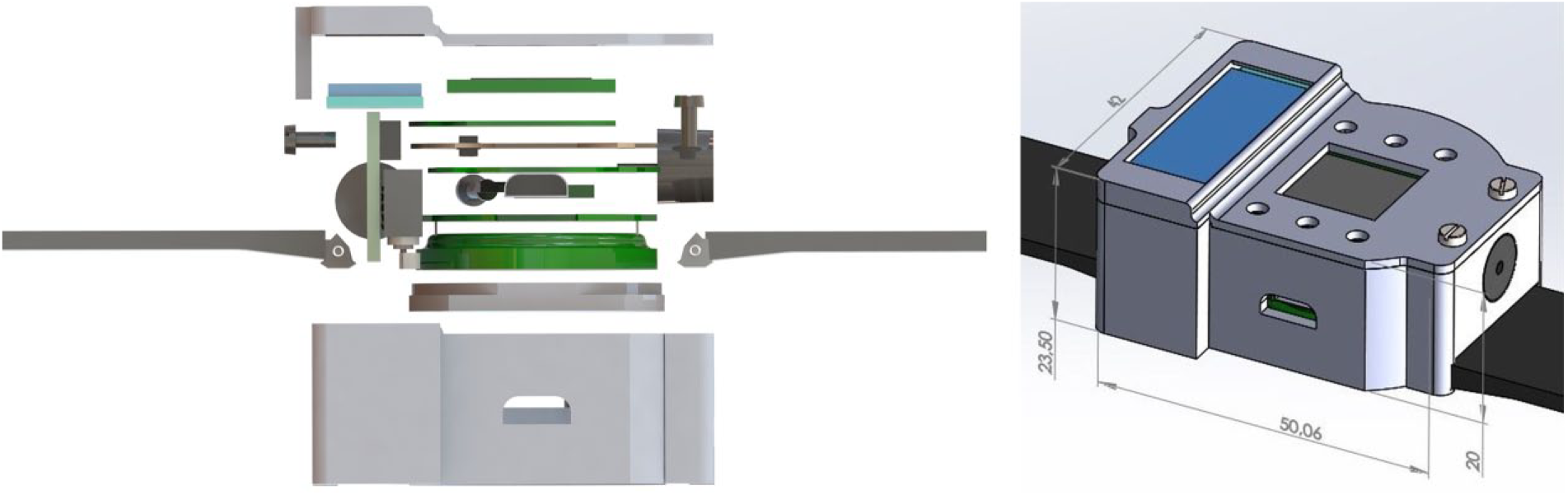
Graphic design of the device in solid work, layers, components (left), and completed in its case (right). (1) Top part of 3D housing, (2) gas sensor, (3) display, (4) gas sensor driver, (5) sound module, (6) screw of 3D housing, (7) hardware flex interface, (8) host platform and charging USB, (9) on/off button of 3D housing to the host platform, (10) vibrating motor, (11) screw of 3D housing, (12) battery holder, (13) coin cell battery, (14) bottom part of 3D housing to cover the battery, (15) the main part of 3D housing to hold the prototype, (16) bracelet.
We intend to link the current version to future development, which will lead to comprehensive healthcare monitoring (motion tracking and vital signs).
We have succeeded in covering the majority of ambient parameters for monitoring, but this is only one piece of the puzzle in healthcare. The monitoring of daily a motion ctivities through integrated 9 degrees of freedom sensors is the second piece.
Due to this adequate approach and a modular design, vital signs (e.g., heart rate and skin temperature) are in the radar of this prototype as a new physical layer added to the current version.
To extend the battery life, power harvesting by natural resources/body heat is a potential possibility. This device as a multiparameter wrist-worn monitor is capable of bidirectional data transmission. Therefore, it has the ability to be used in IoT.
If this device is widely used for environmental monitoring by individuals during their daily routine, the collected data by the server (wearable gateway server) from each individual can be utilized for the evaluation of very small-scale areas in urban environmental parameter evaluations (e.g., a street). This may overcome the issue of stationary climate sites, which are rare in cities due to their size, cost, and maintenance.
Footnotes
Declaration of Conflicting Interests
The authors declared no potential conflicts of interest with respect to the research, authorship, and/or publication of this article.
Funding
The authors disclosed receipt of the following financial support for the research, authorship, and/or publication of this article: This work was funded by the Ministry of Economics, Employment and Health of the government of Mecklenburg Vorpommern (Germany) under project number MV (TBI-V-1- 127-VBW-044).