




Abstract
With the stimulating demand of consumers for personalized garments, mass customization is gradually becoming prevalent. However, the automatic generation of personalized garment patterns remains core to mass customization. In this article, we propose a novel parametric apparel pattern-making method and achieve the automatic generation of personalized garment patterns in batches. First, we review the basic principle of biarc and present a new parametric pattern-making method based on biarc and ezdxf. Second, 1000 3D human models randomly generated by the SMPL-X parametric human model are clustered into 10 classes with the k-means clustering method, and 10 representative human models are selected from each cluster to generate their personalized garment pattern. Finally, the rationality of the personalized garment pattern is verified by virtual fitting. Our method has several advantages: (1) the proposed parametric biarc can be easily used to build parametric garment patterns without being limited by the style of the garment, (2) the proposed method is capable of generating personalized garment patterns in batches by imputing measurements from large numbers of individuals, and it only takes very little time, and (3) the personalized garment patterns can fit human bodies very well. The proposed method can be used to build parametric garment patterns and to achieve the batch generation of personalized patterns, improving the efficiency of garment customization and the quality of final products.
Keywords
Introduction
In today’s apparel market, the traditional way of large-scale ready-to-wear manufacture cannot meet customers’ demand for well-fitting clothing, mass customization is becoming a promising trend in the field of apparel, and many apparel companies are increasingly committed to providing customized apparel products as a new and unique way to satisfy the personalized needs of consumers.1,2 However, garment customization means an increase in production costs. Accordingly, price of clothing products will also increase, which limits the development of garment customization. One of the important reasons for the high cost of garment customization is that the customized garment pattern needs to be constructed one-on-one by experienced pattern makers, which takes a lot of time and money. Therefore, it is essential to develop new production techniques to quickly and automatically generate individualized patterns to meet the demands of different body types.
With the development of digitalization technology, the clothing industry has introduced many new technologies, such as 3D body scanning for anthropometry, artificial intelligence for fashion design and manufacture, and virtual try-on technology, which has greatly pushed forward the apparel industry. Among them, the technology to construct personalized garment patterns remains critical and core to garment customization.
To automatically design garments of the same style for different human bodies, the traditional grading technique is the most practical method because of its simple theory, with which pattern masters are familiar. 3 The principle of the grading technique is to use either basic patterns or graded patterns in conjunction with sizing and alteration tables to alter patterns to fit a person with specific body measurements. 4 Therefore, this approach has some drawbacks. On the one hand, the grading pattern is tailored to fit a person with an average body measurement, not, for example, taller, thinner, shorter, or larger-than-average people. On the other hand, this method will result in the redundancy of apparel pattern information and increase the workload for pattern masters or designers. 5
For the past decade, apart from conventional grading techniques, many researchers have developed different approaches for generating individualized patterns. These approaches can generally be divided into the 3D–2D method and 2D–2D method. 3
The 3D–2D method is to flatten a 3D surface into 2D garment pattern and can be divided into two methods. One method is to flatten the surface of 3D human model into 2D clothing pattern. Kim and Kang 6 developed an automatic garment pattern design system using 3D body scan data. Huang et al. 7 attempted to generate 2D block patterns by directly flattening the shape of the three-dimensional human body surface. Kim 8 developed a torso surface analysis software to automatically analyze the surface of a 3D human body and flatten it into 2D patches. The other method is to flatten the surface of 3D clothing model into 2D clothing pattern. Wang et al. 9 studied the development of 3D surfaces into flat patterns using the energy method. They also tried to provide an integrated solution for the design automation of customized apparel products.10,11 McCartney et al. 12 tried to project 3D shapes into flat patterns using darts and gussets. Yang and Zhang 13 proposed creating a 3D prototype pattern based on an individual three-dimensional (3D) virtual dummy and then transforming the 3D surface of the prototype garment into 2D cutting pattern. Kim et al.14,15 used a similar approach to generate basic garment pattern by flattening the 3D virtual garment into a 2D pattern. Wang et al. 16 presented geometrical modeling of 3D virtual garments based on constrained contours and style curves. Zhang et al. 17 proposed an integrated method for 3D garment design. The method provides an efficient tool to design 3D garments and 2D patterns for fashion designers and computer artists.
Although several commercial 3D apparel systems have utilized the flattening technique, they are unsuitable for generating individualized patterns for mass customization. For the method of either flattening the surface of a 3D human model or flattening the surface of a 3D clothing model, there are still some limitations: (1) it is unsuitable for garments of complex style and loose style; (2) the amount of ease allowance between the human body and garment cannot be accurately determined; (3) the surface of the human body and garment is very complex, which will produce local deformation and distortion when flattened; and (4) the flattened pattern may not be suitable for production.
The 2D–2D method is the construction of 2D pattern templates, which can be driven to generate personalized garment patterns by adjusting certain rules or algorithms. It can be divided into artificial intelligence-based and parametric design-based according to the different methods used. AI (artificial intelligence) is increasingly used in apparel design, pattern construction, production planning, marker planning, sewing floor, sales forecasting, and supply chain management. A number of AI techniques such as expert system, neural network (NN), fuzzy logic (FL), genetic algorithm (GA), evolution strategy (ES), artificial immune system (AIS), and multiagent system (MAS) are used in clothing manufacturing. 18 The pattern generation based on artificial intelligence has received extensive attention and been studied by many researchers. For example, Ng 19 based on the FL implementation achieved the fitting alteration or the fine-tuning of the flat pattern to extract the fuzzy production rules according to the responses of the wearers. Fang and Ding20,21 developed an expert knowledge-based system to generate the basic patterns automatically. Similarly, Hu et al. 22 developed an interactive CAD system to create various patterns for a garment. Liu 23 proposed a back propagation artificial neural network (BP-ANN) model to predict pattern-making-related body dimensions by inputting a few key human body dimensions. It can reduce the experience requirements for the generation of pattern based on AI. 24 Meanwhile, a great number of experiments should be conducted for each garment with different styles to create their knowledge databases.3,25
The method based on parametric design is to build a parametric pattern by defining and constraining the relationship between the position of each part of the pattern through some key parameters related to human body measurements, and then generate a personalized garment patterns by adjusting the key parameters. Xiu et al. 26 proposed a novel approach based on variable and geometric constraints to develop a parametric pattern-making model. Harwood et al. 27 have introduced JBlockCreator, a Java-based software application, and API for automatically generating pattern blocks from body measurement data. Han et al. 28 proposed the parametric sleeve patternmaking method that enables mass customization. Kang et al. 29 developed a parametric garment pattern design system that can utilize anthropometric data for consumer-oriented garment pattern design.
Previous research shows various apparel pattern-making methods, which are unsuitable for mass customization. For the 3D–2D method, it is unsuitable for the generation of personalized garment patterns because of some limitations. For the 2D–2D method, the parametric design-based approach is still considered an important solution for the automatic generation of personalized garment patterns. Moreover, this method is not limited by the style of garments, and it can be used to generate personalized garment patterns of any style by adjusting the parameters of the garment pattern linked to the measurements of the human body. While a large variety of parametric pattern-making techniques have been available, it is still not easy to quickly and easily generate personalized clothing patterns in batches with some measurements of the human body and without the complicated processing of building parametric garment patterns. Along with the recent development of information technology and the introduction of concepts such as the smart factory, garment pattern generation must not only meet personalization requirements but also be automated and fast. 30 Hence, the main focus of this article is not only on the personalization of garment patterns but also on automatically generate personalized garment patterns in batches.
In this article, we propose a new parametric apparel pattern-making method and utilize anthropometric data for the automatic batch generation of personalized garment patterns. The parametric pattern-making method can be used to build parametric garment patterns without being limited by the style of the garment. The method is capable of batch-generating personalized garment patterns by imputing measurements from large numbers of individuals. This process takes very little time to generate 1000 personalized garment patterns. We also performed three-dimensional virtual fitting to demonstrate the fit of patterns. The proposed method in this article can significantly improve pattern generation efficiency and also contribute to the sustainable production in the apparel industry.
Biarc
Curves in Apparel Pattern
From the view of geometry, apparel patterns are considered as a set of geometric elements, such as points, lines, and curves. Here we only take into account the two geometric elements, lines and curves. The principle of parametric pattern-making consists of constraining the geometric and dimensional relationships between geometric elements in a garment pattern by defining some key parameters. Once the parametric pattern is built, it can be driven to generate a personalized garment pattern by adjusting key parameters. In particular, the parameterization of the garment pattern is the parameterization of lines and curves in the garment pattern. Since the parameterization of straight lines is relatively simple but the parameterization of curves is more complex, here we only consider how to parameterize curves.
In garment pattern-making, there are two methods of drawing the apparel pattern curves, manual drawing on paper and drawing in professional computer garment-aided design (CGAD). When drawing a curve in an apparel pattern on paper, the pattern-maker mainly uses a curve board or other tools to smooth curves according to personal experience and aesthetics. When drawing a curve in CGAD, the contour curve is drawn through the curve drawing tool provided in CGAD, such as spline curves or arcs. To our knowledge, the most widely used software, AutoCAD, provides a novel function of parametric design which is only available for constraining lines and arcs. Therefore, we also consider drawing the curves in the garment pattern with arcs, which may be more suitable for building parametric garment patterns. Since a single arc cannot meet the needs of the curves with different shapes, we consider using biarc to draw the curves in the garment patterns.
The first researcher that proposed the concept of biarc is Bolton, 31 then other researchers have also carried out some research, such as Yong32,33 and Su and Liu. 34 Biarc has received extensive attention from many researchers because the fitting and approximation of various types of curves are becoming more and more important with the wide application of CAD/CAM in shipbuilding, aviation, automotive, and mechanical industries. Biarc has some advantages, such as simplicity and intuitiveness, ease of implementation, geometric invariance, and good smoothness. Biarc is commonly used in computerized numerical control, mechanical manufacturing, and 3D modeling fields, but less so in the apparel industry.35–37 Recently, Lou 38 detailed the basic of biarc, such as the type and composition of the biarc in different conditions by a graph method, and introduced biarc to the construction of garment patterns. Inspired by Lou, this article proposes constructing parametric garment patterns based on biarc and ezdxf.
A biarc is a smooth curve formed from two circular arcs, which is defined as: given two points P1 and P2 and the tangent vector t1 and t2, draw two arcs A1 and A2 so that they satisfy: (1) A1 starts with P1 and has a tangent vector t1; (2) A2 ends with P2 and has a tangent vector t2; and (3) A1 and A2 are tangent at the connection point. The combination of arcs A1 and A2 is called a biarc, and the two arcs A1 and A2 have the exact same tangent at the connecting point where they meet. Bi-arc is G1 continuous, and it is divided into two types—C-shaped and S-shaped, as shown in Figure 1.
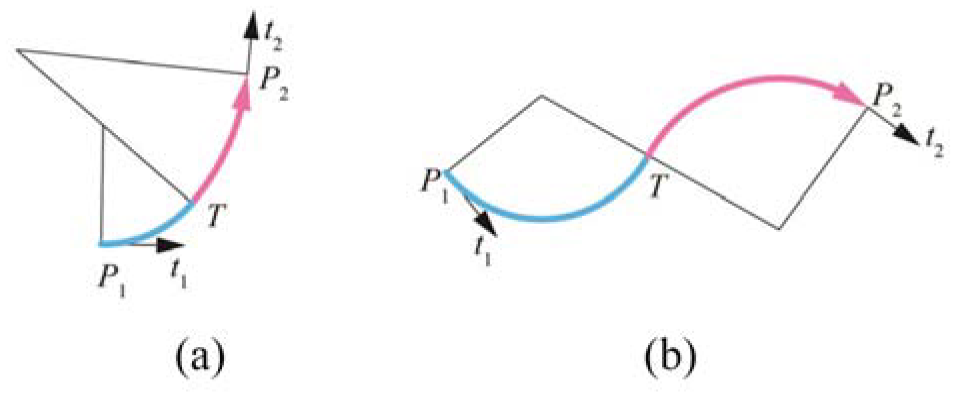
Biarc. (a) C-shaped biarc. (b) S-shaped biarc.
Three conditions uniquely determine a single arc in a plane. Therefore, the biarc has six degrees of freedom, but only five degrees of freedom are used in the definition of the biarc, which means that the common tangent point is not unique. Therefore, between the two points P1 and P2 in a plane, there are an infinite number of biarcs, which form a family of biarc.
We know that an arc greater than a half-circle is called a superior arc, and one less than a half-circle is called an inferior arc. Therefore, either a C-shaped biarc or an S-shaped biarc has six cases, namely, inferior arc and inferior arc, superior arc and inferior arc, superior arc and superior arc, half-circle and superior arc, half-circle and inferior arc, half-circle and half-circle. As the curve of the garment pattern rarely exists in the case of superior arc, we only discuss the cases of the inferior arc and inferior arc. In the next section, we will discuss in detail the principles and properties of biarc.
C-Shaped Biarc
According to the intersection position of the tangent vector t1 at start point P1 and the tangent vector t2 at end point P2, the C-shaped biarc can be divided into three cases. In the first case, the tangent vector t1 and the tangent vector t2 intersect and t1 points to the intersection K, the opposite direction of t2 points to the intersection K. In the second case, the tangent vector t1 and the tangent vector t2 intersect and the opposite direction of t1 points to the intersection K, t2 points to the intersection K. In the third case, the tangent vector t1 and the tangent vector t2 are reverse parallel without intersection. The literature shows that the connection points trajectory of each C-shaped biarc is a circle, as shown in Figure 2.
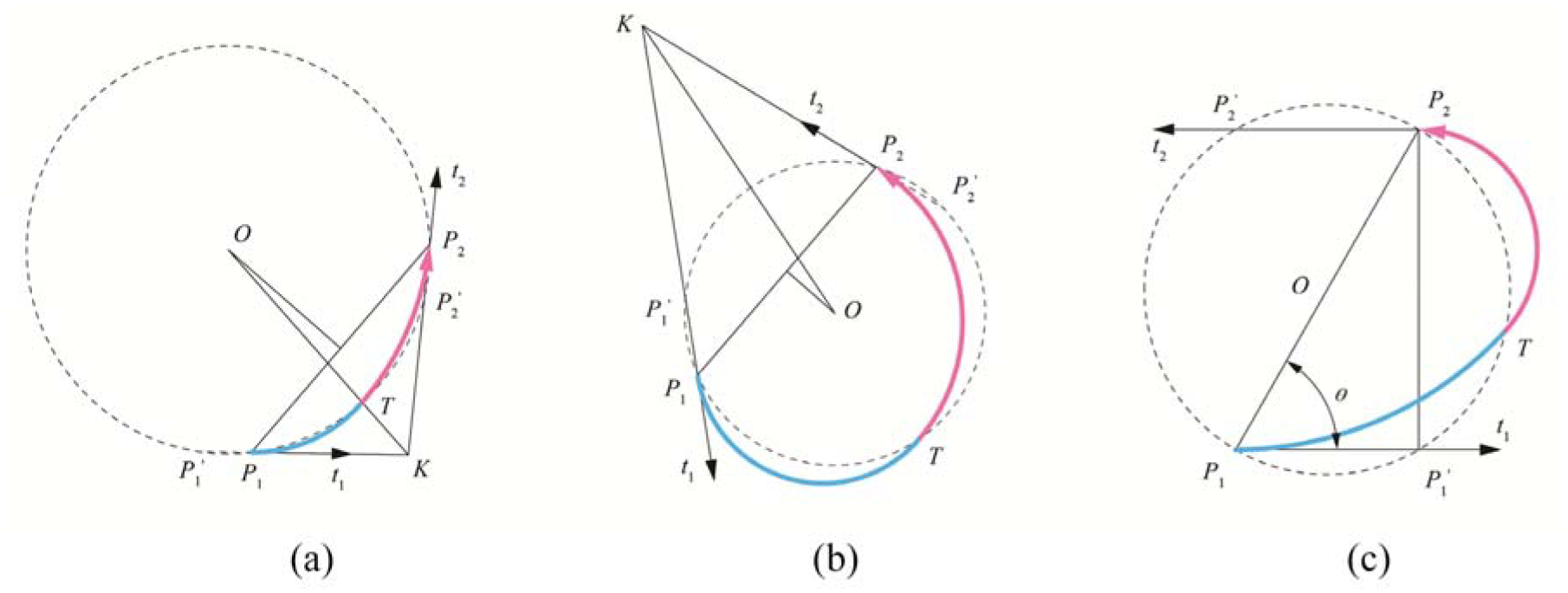
Basic of C-shaped biarc. (a) The first case of C-shaped biarc. (b) The second case of C-shaped biarc. (c) The third case of C-shaped biarc.
The First Case of C-Shaped Biarc
In the first case, the tangent vector t1 and the tangent vector t2 intersect and t1 points to the intersection K, the opposite direction of t2 points to the intersection K, as shown in Figure 2(a).
Determine the points on the circle of the connection points trajectory. When KP1 < KP2, take a point P2′ on the line KP2 so that KP1 = KP2′, and take a point P1′ on the line KP1 extension so that KP1′ = KP2, then point P1, point P1′, point P2, point P2′ are all on the circle of the connection points trajectory. When KP1 > KP2, the points on the circle of tangent points can be identified in the same way.
Determine the center and radius of the circle of the connection points trajectory. The intersection point O of the angle bisector of angle P1KP2 and the perpendicular bisector of P1P2 is the center of the circle of the connection points trajectory, and OP1 (or OP2, OP1′, OP2′) is the radius of the circle of the connection points trajectory.
Draw a biarc. Taking any point of T in arc P1P2′, a C-shaped biarc can be drawn, as shown in Figure 2(a).
The Second Case of C-Shaped Biarc
In the second case, the tangent vector t1 and the tangent vector t2 intersect and the opposite direction of t1 points to the intersection K,t2 points to the intersection K, as shown in Figure 2(b).
Determine the points on the circle of the connection points trajectory. When KP1 > KP2, take a point P1′ on the line KP1 so that KP1′ = KP2, and take a point P2′ on the line KP2 extension so that KP2′ = KP1, then point P1, point P1′, point P2, point P2′ are all on the circle of the connection points trajectory. When KP1 < KP2, the points on the circle of tangent points can be identified in the same way.
Determine the center and radius of the circle of the connection points trajectory. The intersection point O of the angle bisector of angle P1KP2 and the perpendicular bisector of P1P2 is the center of the circle of the connection points trajectory, and OP1 (or OP2, OP1′, OP2′) is the radius of the circle of the connection points trajectory.
Draw a biarc. Taking any point of T in arc P1P2′, a C-shaped biarc can be drawn, as shown in Figure 2(b).
The Third Case of C-Shaped Biarc
In the third case, the tangent vector t1 and the tangent vector t2 are reverse parallel without intersection, as shown in Figure 2(c). The angle between the tangent vector t1 and P1P2 at the beginning of the biarc is θ. The value range of θ is (0, 90).
Determine the points on the circle of the connection points trajectory. Take a point P1′ along t1 direction such as P1P1′⊥P2P1′ and take a point P2′ along t2 direction such as P2P2′⊥P1P2′, then point P1, point P1′, point P2 and point P2′ are all on the circle of the connection points trajectory.
Determine the center and radius of the circle of the connection points trajectory. The midpoint of P1P2 is the center of the circle of the tangent points trajectory and OP1 (or OP2, OP1′, OP2′) is the radius of the circle of the connection points trajectory.
Draw a biarc. Take any point of T in arc P1P2′, a C-shaped biarc can be drawn, as shown in Figure 2(c).
S-Shaped Biarc
According to the intersection position of the tangent vector t1 at start point and the tangent vector t2 at end point intersecting, the S-shaped biarc can be divided into three cases. In the first case, the tangent vector t1 and the tangent vector t2 intersect, and the opposite direction of t1 and t2 points to the intersection K. In the second case, the tangent vector t1 and the tangent vector t2 intersect and t1 points to the intersection K, t2 points to the intersection K. In the third case, the tangent vector t1 and the tangent vector t2 are parallel in the same direction and have no intersection, as shown in Figure 3.
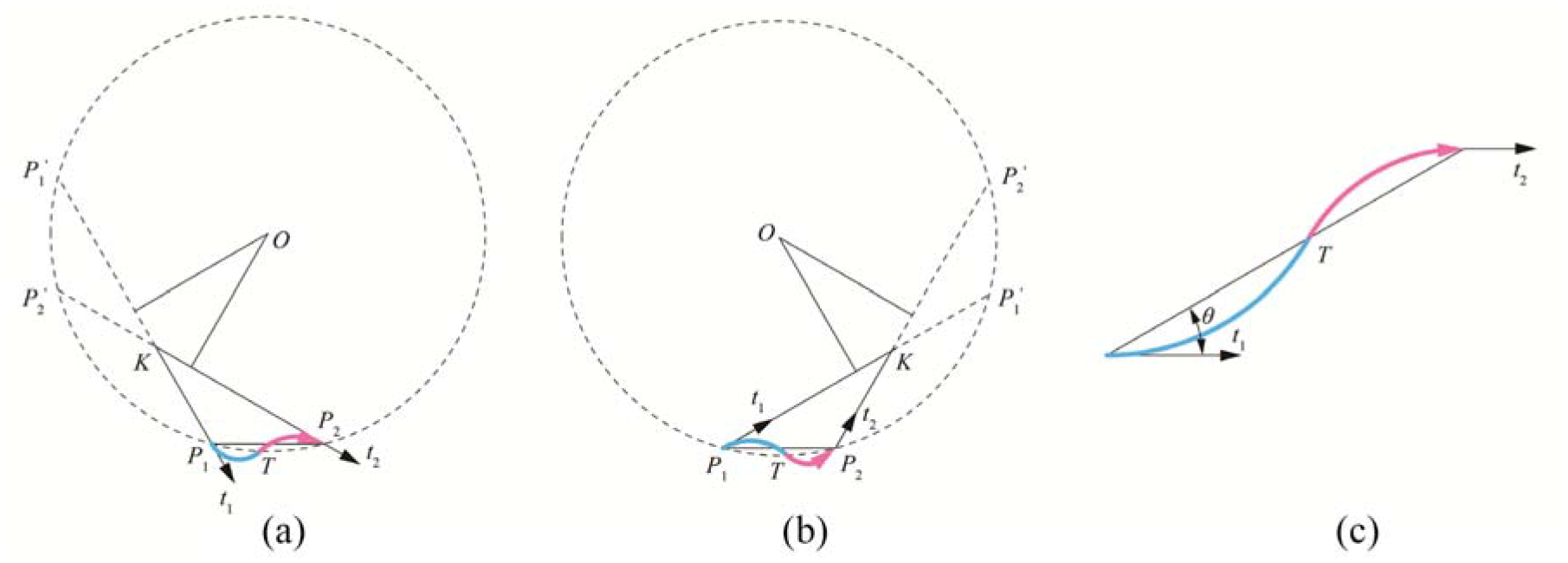
Basic of S-shaped biarc. (a) The first case of S-shaped biarc. (b) The second case of S-shaped biarc. (c) The third case of S-shaped biarc.
The First Case of S-Shaped Biarc
In the first case, the tangent vector t1 and the tangent vector t2 intersect, and the opposite direction of t1 and t2 points to the intersection K, as shown in Figure 3(a).
Determine the point on the circle of the connection points trajectory. When the opposite direction of t1 and t2 points to the intersection K, take a point P2′ on the reverse extension of line KP2 so that KP2′ = KP1, and take a point P1′ on the reverse extension of line KP1 so that KP1′ = KP2, then point P1, point P1′, point P2, point P2′ are all points on the circle of the connection points trajectory.
Determine the center and radius of the circle of the connection points trajectory. The perpendicular bisector of P1P1′ and the perpendicular bisector of P2P2′ intersect at point O. The intersection point O is the center of the circle of the connection points trajectory and OP1 (or OP2, OP1′, OP2′) is the radius of the circle of the connection points trajectory.
Draw a biarc. Taking any point of T in arc P1P2, an S-shaped biarc can be drawn, as shown in Figure 3(a).
The Second Case of S-Shaped Biarc
In the second case, the tangent vector t1 and the tangent vector t2 intersect and t1 points to the intersection K, t2 points to the intersection K, as shown in Figure 3(b).
Determine the point on the circle of the connection points trajectory. When t1 points to K and t2 points to K, take a point P2′ on the reverse extension of line KP2 so that KP2′ = KP1, and take a point P1′ on the reverse extension of line KP1 so that KP1′ = KP2, then point P1, point P1′, point P2, point P2′ are all on the circle of the connection points trajectory.
Determine the center and radius of the circle of the connection points trajectory. The perpendicular bisector of P1P1′ and the perpendicular bisector of P2P2′ intersect at point O. The intersection point O is the center of the circle of the connection points trajectory and OP1 (or OP2, OP1′, OP2′) is the radius of the circle of the connection points trajectory.
Draw a biarc. Taking any point of T in arc P1P2, an S-shaped biarc can be drawn, as shown in Figure 3(b).
The Third Case of S-Shaped Biarc
In the third case, the tangent vector t1 and the tangent vector t2 are parallel in the same direction and have no intersection, as shown in Figure 3(c). The angle between the tangent vector t1 and P1P2 at the beginning of the bicircular arc is θ. The value range of θ is (0, 90).
When the tangent vector t1 and the tangent vector t2 are parallel in the same direction and have no intersection, the connection points trajectory is a line through points P1 and P2. As shown in Figure 3(c), the angle between the tangent vector t1 and P1P2 is θ, whose values ranged from 0 to 90. Take any point of T on P1P2, an S-shaped biarc can be drawn.
Parametric Pattern-Making Method
Python is an easy-to-use programming language, and ezdxf is a third-party library of Python that can be used to create and modify DXF drawings. In this paper, a new method to construct parametric garment patterns through the ezdxf library was proposed. Our specific approach is as follows. First, a garment pattern can be considered a collection of straight lines and curves. Therefore, straight lines can be drawn by the self-contained line drawing function in the ezdxf library, and curves can be drawn through the basic with the ezdxf library. Second, a parametric garment pattern can be constructed by defining some key parameters associated with the key measurements of the human body. Finally, a personalized garment pattern can be generated by adjusting the key parameters of the parametric garment pattern.
The basic of parametric biarc. In the ezdxf library, there are many ways to draw a single arc but no direct functions to draw a biarc. Hence, we built a complete basic method of parametric biarc. A biarc with different types and shapes can be drawn by setting some parameters to meet the demand for different curves in the pattern.
Three conditions can uniquely determine a single arc in a plane. That is, to uniquely determine a biarc requires six conditions. Therefore, we use six parameters to determine a biarc uniquely. The six parameters are respectively start point, end point, start angle, end angle, and two center angles of biarc. Either the three cases of C-shaped biarc in Figure 2 or the three cases of S-shaped biarc in Figure 3 can be uniquely determined by these six parameters, as shown in Figure 4. Different shapes of C-shaped biarc and S-shaped biarc can be drawn by setting different parameters and the specific parameters are shown in Table 1.
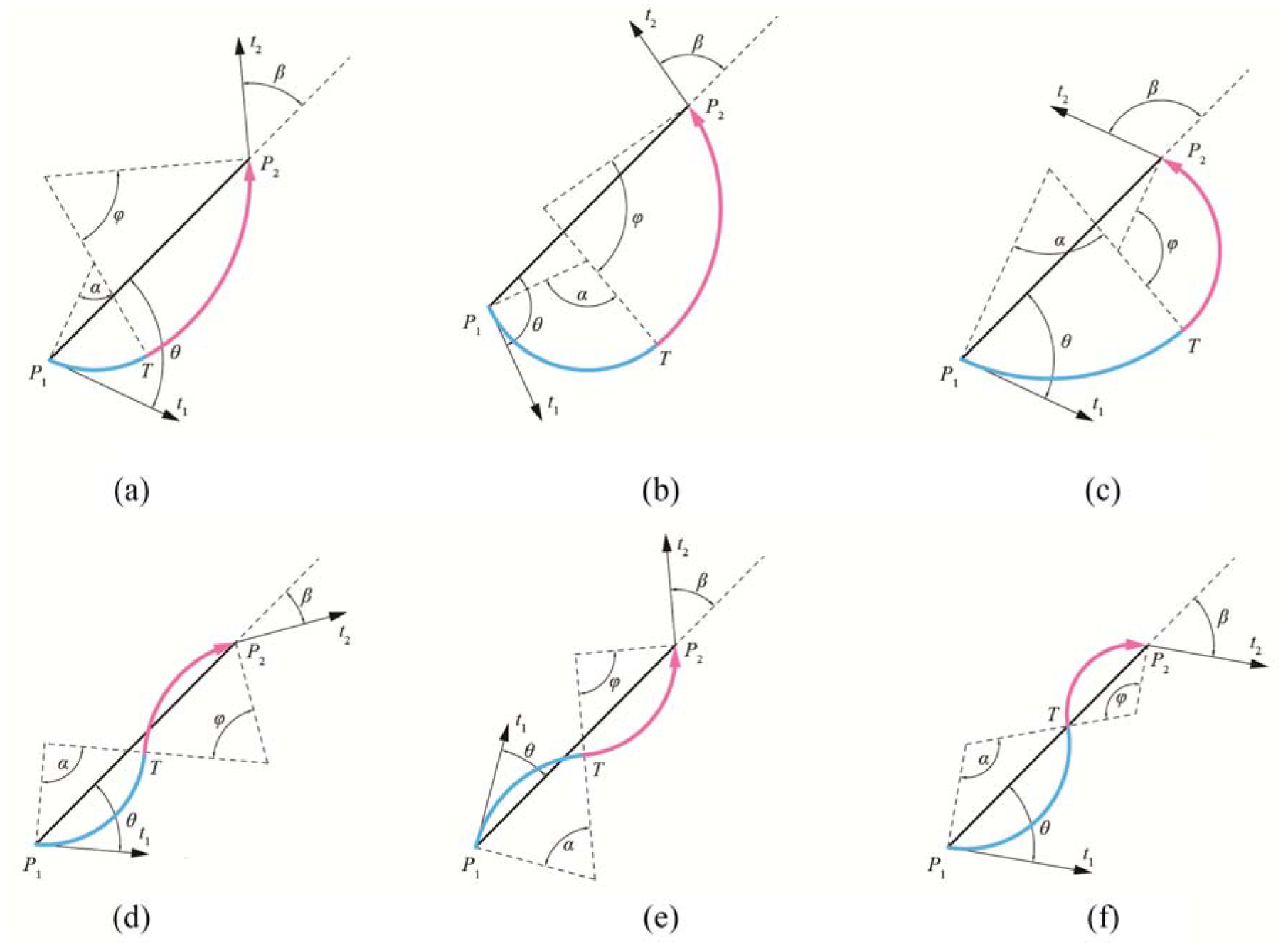
Basic of parametric biarc. (a) The first case of C-shaped biarc. (b) The second case of C-shaped biarc. (c) The third case of C-shaped biarc. (d) The first case of S-shaped biarc. (e) The second case of S-shaped biarc. (f) The third case of S-shaped biarc.
Parameters of C-shaped and S-shaped biarc.
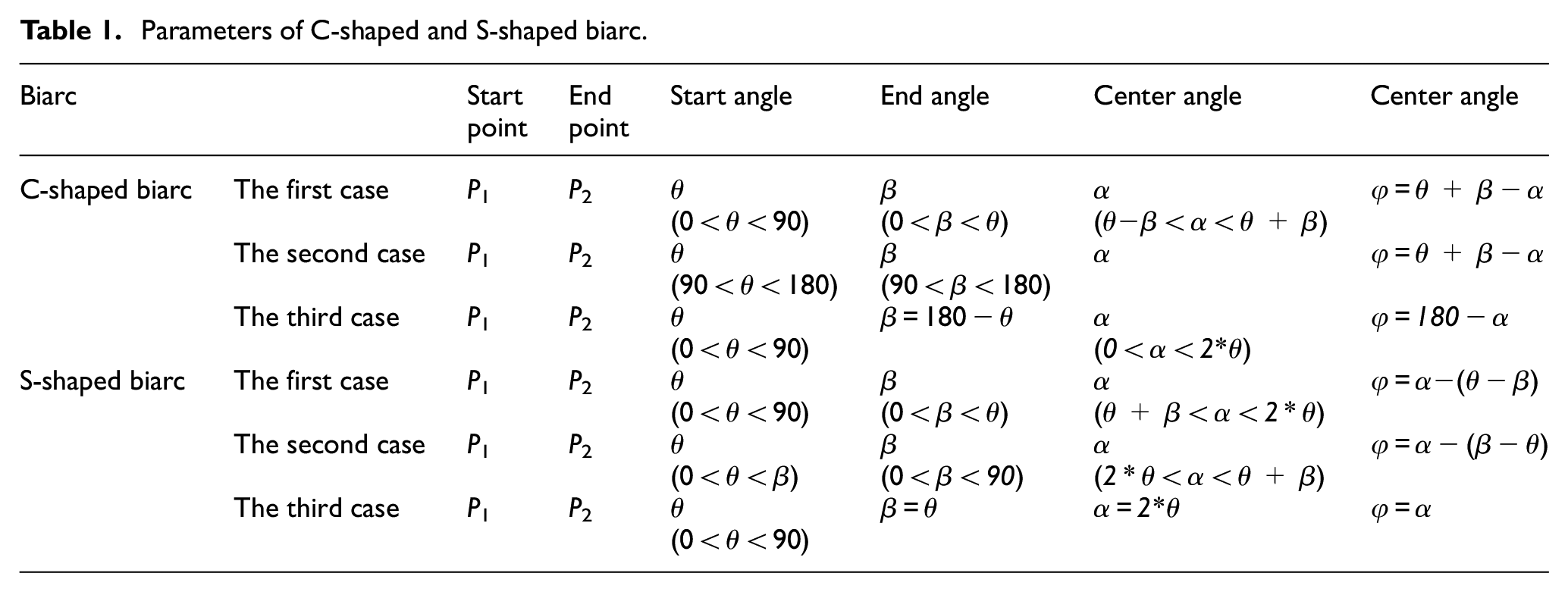
As can be seen from Table 1, once the start angle θ, end angle β, and center angle α are determined, the center angle φ can be calculated from the geometric relationship. Therefore, we only need to define five parameters, namely, start point P1, end point P2, start angle θ, end angle β, and center angle α, to uniquely determine a biarc. The position of the biarc is determined by the start point P1 and end point P2. The tangent direction of the biarc is determined by the start angle θ and end angle β. The position of the connection point T of biarc is determined by the center angle α. Different shapes of the biarc can be drawn by adjusting the value of the center angle α. The examples of a biarc can be seen from Figure 5. When start point P1 and end point P2 are determined, different shapes of C-type biarc and S-type biarc can be drawn by setting different start angle θ, end angle β, and center angle α, so it can be used to meet the demands of curves with different shapes in garment patterns.
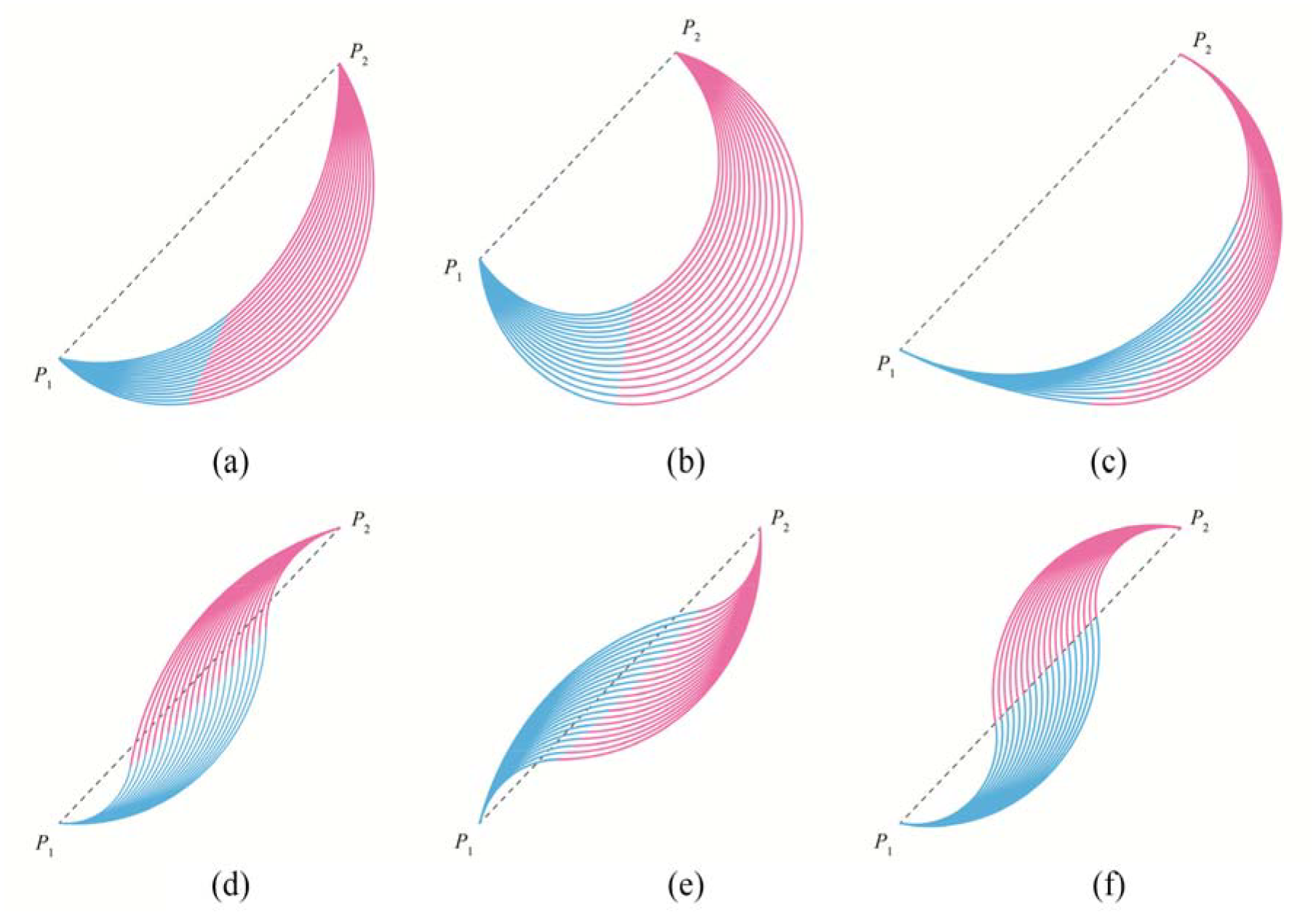
Examples of biarc. (a) The first case of C-shaped biarc. (b) The second case of C-shaped biarc. (c) The third case of C-shaped biarc. (d) The first case of S-shaped biarc. (e) The second case of S-shaped biarc. (f) The third case of S-shaped biarc.
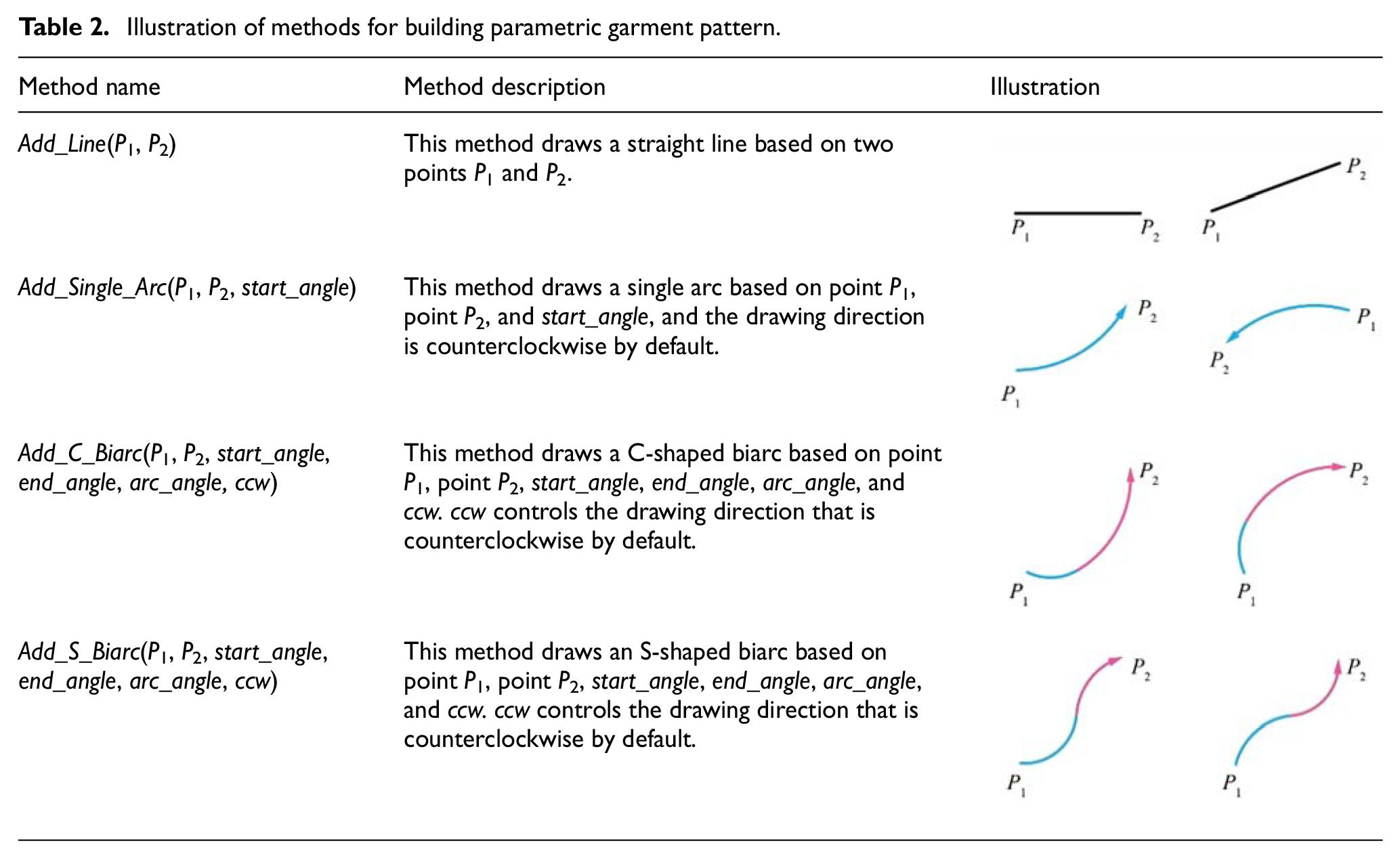
The basic method of parametric pattern-making. With reference to the theory of parametric biarc, we can draw curves with different shapes in the garment patterns with the ezdxf library, so that we can build parametric garment patterns quickly and easily. In order to facilitate the construction of parametric garment patterns with the edxf library, we have built four main drawing functions, namely Add_Line(), Add_Single_Arc(), Add_C_Biarc(), and Add_S_Biarc(), as shown in Table 2. With these four functions, we can draw straight lines and curves with any shape in garment patterns.
Illustration of methods for building parametric garment pattern.
Parametric Garment Pattern
Building Parametric Garment Pattern
We have built a complete set of parametric pattern-making methods based on the biarc and ezdxf library. Our parametric pattern construction method is specified as follows. First, determine the key parameters of the parametric pattern, such as bust circumference, waist circumference, garment length, and sleeve length. Second, draw a complete garment pattern with straight lines and biarcs in CAD according to the key parameters to determine the coordinates of each key point and the shape of the curves in the pattern. Third, draw the straight lines and curves in the pattern with the help of ezdxf and biarc, so as to build the parametric pattern. Finally, a personalized garment pattern can be generated by adjusting the key parameters of the parametric garment pattern.
In fact, we realize the generation of personalized garment patterns in batches by inputting the measurements of a large number of personalized human bodies. In addition, all of the personalized garment patterns can be saved in the industry standard AutoCAD-DXF file format, and the whole process takes very little time.
In building the parametric pattern of female body prototype, we define five key parameters, namely bust B, waist W, back length BL, ease allowance of bust B_ease, and ease allowance of waist W_ease. Different sizes of personalized prototype patterns can be generated by setting different values of the five parameters. Here, we set B_ease to a fixed value of 10 cm and W_ease to a fixed value of 5 cm. For different sizes of the human body, we only need to input the personalized B, W, and BL to generate a personalized prototype pattern that fits the body.
In the parametric pattern of female body prototype, the front collar curve is drawn with a biarc, the back collar curve arc is drawn with a straight line and a single arc, the front and back arm hole curves are drawn with a biarc and a single arc, and all other parts are drawn with straight lines, so that the construction of the parametric pattern of female body prototype can be completed. The pattern of female body prototype is shown in Figure 6(a).
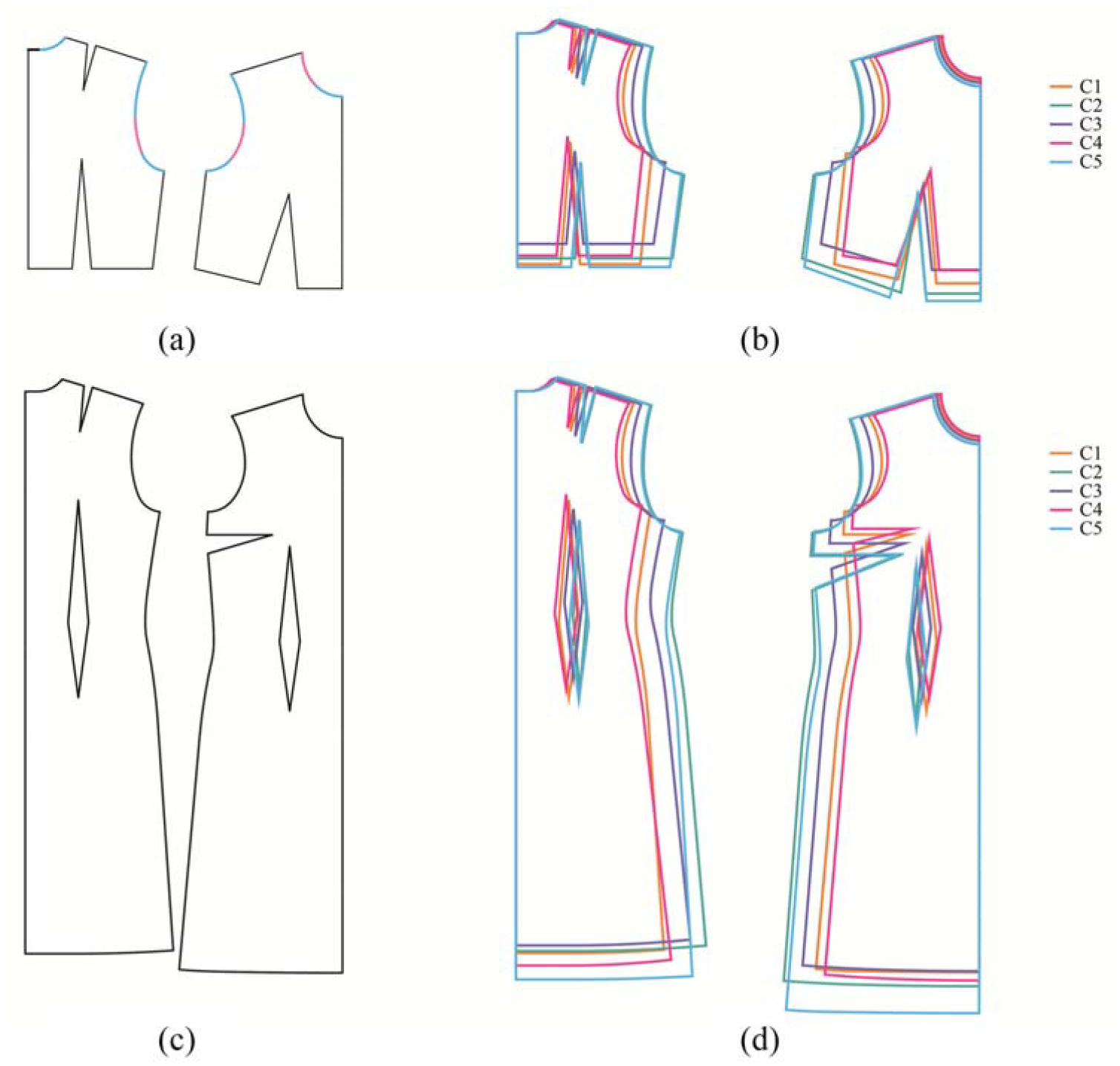
Garment pattern. (a) Pattern of female body prototype. (b) Comparison of personalized patterns of female body prototype. (c) Pattern of dress. (d) Comparison of personalized patterns of dress.
Verify Parametric Garment Pattern
SMPL 39 is one of the most widely used parametric human models in industry and academia, which is a realistic parametric 3D human model learned from thousands of high-quality 3D scanned human bodies based on masking and blending shapes. The SMPL-X 40 model is developed from the SMPL model. In order to verify the rationality and applicability of the parametric pattern, we randomly generated 1000 3D human models of different body shapes and sizes with the help of the SMPL-X parametric body model. Then, we use a clustering method to select 10 representative bodies from 1000 human models and perform virtual fitting on these 10 representative bodies to verify the reasonableness of the personalized garment pattern. Our specific approach is as follows.
Generate a human dataset. 1000 3D human models in different body shapes and sizes are randomly generated with the help of the SMPL-X plug-in of Blender software.
Extract measurements of 3D human models. We automatically extracted measurements of 1000 3D human models with the written plug-in. The measurements included height, weight, bust, waist, hip, and back length.
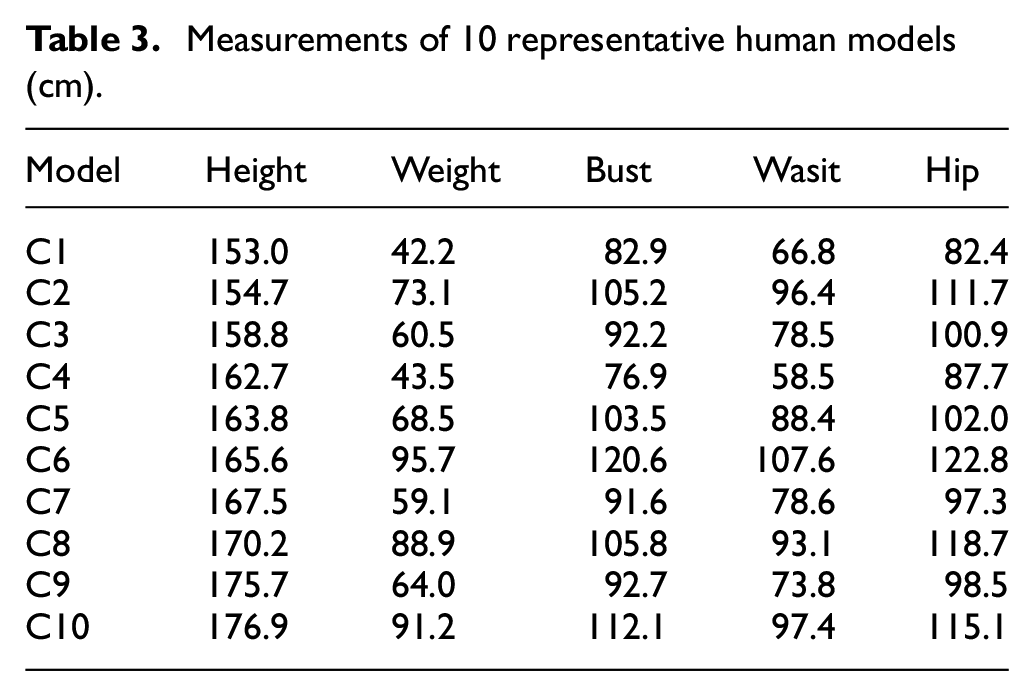
Based on the height and bust measurements, 1000 3D human models were clustered into 10 classes using the K-means clustering, and the 10 human models closest to the center of the clusters were selected from each class as representative human models. The clustering result of 1000 3D human models is shown in Figure 7. The measurements of 10 representative human models are shown in Table 3. The 10 representative human models are shown in Figure 8(a).
Generate the personalized garment pattern of the 10 representative human models through the parametric garment pattern, and conduct virtual fitting on the 10 representative human models through CLO 3D software to check the rationality of the personalized garment pattern.
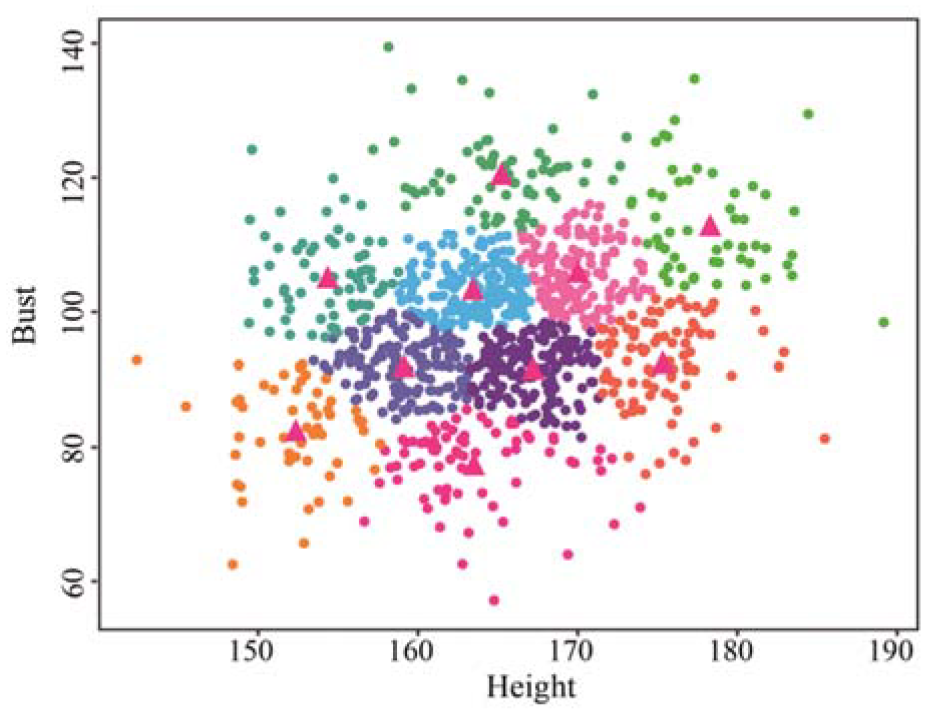
Clustering result of 1000 3D human models.
Measurements of 10 representative human models (cm).
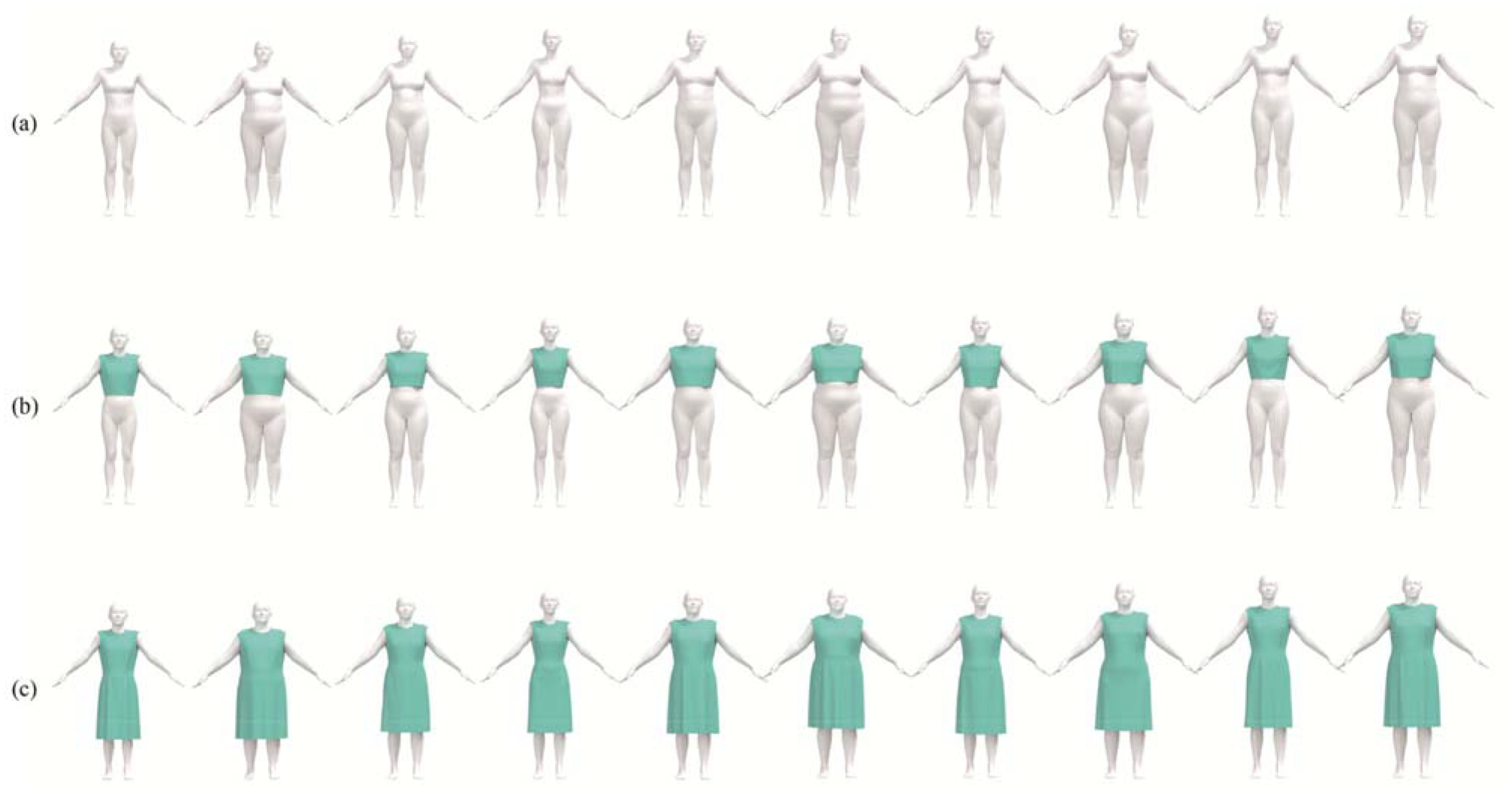
The result of virtual fitting. (a) Ten representative human models. (b) The result of virtual fitting of female body prototype. (c) The result of virtual fitting of dress.
Results and Discussion
In order to achieve the rapid generation of personalized garment patterns, we built a complete set of parametric pattern-making methods based on the biarc and ezdxf library. We constructed a parametric garment pattern of a female body prototype and realized the batch generation of personalized prototype patterns. The results show that the generated patterns can meet the individual needs of different body types.
In building the parametric pattern of the female body prototype, we only used five parameters, namely bust B, waist W, back length BL, ease allowance of bust B_ease, and ease allowance of waist W_ease. Here, B_ease was set as a fixed value 10 cm and W_ease as a fixed value 5 cm. Personalized prototypes for different sizes of the human body can be generated by using the three parameters of B, W, and BL. One thousand 3D human models in different body shapes and sizes have been randomly generated with the help of SMPL-X parameterized human model and have been clustered into 10 classes with K-means clustering method. Then, we selected 10 representative human models from these 10 classes and conducted virtual fitting for these 10 representative human models to verify the rationality of the personalized prototype. The comparison of personalized patterns of female body prototype is shown in Figure 6(b), and the result of virtual fitting is shown in Figure 8(b). The result of virtual fitting shows that personalized patterns of prototypes can fit very well human bodies with different shapes and sizes, which indicates that the prototype generated by the parametric pattern meets the personalization requirements. In addition, 1000 personalized prototypes are generated by adjusting the parameters of the parametric prototype, and the results demonstrate that it only takes less than 20 s.
We also constructed a parametric pattern of the dress using the parametric method and conducted virtual fitting on 10 representative human bodies. The pattern of the dress is shown in Figure 6(c). The comparison of personalized patterns of the dress is shown in Figure 6(d), and the result of virtual fitting is shown in Figure 8(c). The result of virtual fitting shows that personalized patterns of dress can fit human bodies very well.
Although we have achieved batch generation of personalized garment patterns, we still have some limitations. One is that we do not consider fabric parameters during virtual fitting. The other is that we propose a set of perfect parametric pattern-making theory and realize the generation of individualized garment patterns in batches, but how to constrain the size of each part of the garment pattern so that the individualized patterns can meet the personalized need for more human bodies with different shapes and sizes, it still needs to rely on the analysis of a large number of body data and the experience of the pattern maker. Therefore, in future work, we will take fabric parameters into consideration and link the measurement of more body parts with the size of each part of the pattern so that the generated personalized pattern can be more suitable for the personalized human body.
Conclusion
The main purpose of this article is to achieve the batch generation of personalized garment patterns. We presented a novel parametric pattern-making method based on biarc and ezdxf. This method can greatly improve the efficiency of personalized garment pattern generation.
We elaborated on the basic principle of the biarc and proposed the parametric biarc. Combined with the ezdxf library, we build a set of parametric pattern-making methods. Practice shows that the biarc can meet the needs of different curve shapes in the garment pattern, and the parametric biarc can be greatly used to build a parametric garment pattern. The result of virtual fitting shows that the generated pattern can meet the individual needs of the human bodies with different shapes and sizes.
Our contribution consists of the following aspects. First, we constructed a new and complete parametric pattern construction method based on the biarc and the ezdxf library. Second, we proposed a method to validate the rationality of the personalized pattern with the SMPL-X parametric human model and virtual fitting. Third, we obtained the generation of personalized patterns of female body prototypes in batches, and it takes very little time to generate personalized garment patterns in batches by our method.
For practical applications, our method can be easily used to obtain the batch generation of personalized garment patterns, which will be beneficial to mass garment customization and production.
Footnotes
Declaration of conflicting interests
The author(s) declared no potential conflicts of interest with respect to the research, authorship, and/or publication of this article.
Funding
The author(s) disclosed receipt of the following financial support for the research, authorship, and/or publication of this article. They would like to acknowledge the financial support from the Fundamental Research Funds for the Central Universities (Grant No. 2232020G-08).
