




Abstract
A smart vest that can monitor the respiratory rate of the human body has been developed based on flexible sensing technology. Using carbon nanotubes/polyurethane conductive film/yarn electrode flexible pressure sensors, different sizes of smart underwear for men and women have been developed. These smart vest have the characteristics of being detachable and capable of real-time monitoring of human breathing frequency signals. The characteristics of the smart underwear are characterized by the resistivity change curve of the flexible sensor, and the influences of the style, size, and working position of the sensor on the performance of the smart underwear are studied. The most reasonable sensor configuration of the smart vest of each size is obtained. For the female S size it is on the chest. For the female M size it is on the abdominal muscles. For the male XL size it is on the midriff. For the male XXL size it is on the abdominal muscles. The smart vest is comfortable, fits the body and satisfies the daily needs of washing. It will have good application prospects in sports health and medical care, providing new design ideas for the research and development of smart vests.
Introduction
With the development of wearable devices in the medical and health fields, the research on smart clothing for real-time monitoring of human health physiological parameters has received extensive attention in the recent years.1,2 Clothing has the advantages of thinness, flexibility, and large contact area with the human body. It has become one of the best carriers for wearable health monitoring systems. 3 Smart clothing based on sensor technology can respond to the external environment or internal physiological stimuli in a timely manner and can be used to assess the physiological condition of the human body in real time. As early as 2003 Weber et al. 3 proposed smart clothing (VTAM) for telemedicine, which integrated dry electrodes, pressure sensors and temperature sensors for measuring electrocardiogram (ECG) signals. Guo et al. 4 developed a smart vest to monitor human breathing. Researchers have used nylon/Lycra fabric as a substrate and silicone as a coating to make a flexible sensor. The coated pressure sensor is integrated into the vest to achieve long-term monitoring of breathing signals, which can be used in home medical treatment. In 2020, the team of Academician Wang Zhonglin of the Chinese Academy of Sciences and Professor Yang Jin of Chongqing University 5 developed smart clothing for breathing and pulse detection based on a multifunctional pressure full-fabric sensor.
At present, most of the existing wearable products directly embed electronic devices into clothing. 6 The processing technology of this type of smart clothing is complicated, and cannot meet washing resistance and comfort performance requirements, and the measurement stability is insufficient.7,8 In order to improve the comfort of the user and ensure the accuracy of the collected breathing signals, flexible sensors are the key technology to achieve this requirement in the health monitoring system of wearable devices.9–11 Physiological parameter monitoring of smart clothing mainly includes heart rate, electrocardiogram, respiration, pulse, body temperature, and posture.1,12 Among them, respiration is one of the key indicators of human vital signs, and the monitoring of human respiratory system signals is very important to the medical and health care fields. Accurately grasping the measurement of respiratory signs has great reference value in adjusting respiratory rate and monitoring respiratory diseases.
Experiment
Style and Specification Design of Respiratory Monitoring Smart Vest
The key muscles of the human body involved in breathing activities include the diaphragm, intercostal muscles, abdominal muscles, and scalene muscles. 13 Due to different reasons such as people’s age, gender, body shape, and living habits, there are also great differences in breathing methods. Under normal circumstances, breathing is mainly divided into three forms: thoracic, abdominal, and thoracic-abdominal. 14 Thoracic respiration is caused by the expansion of the two ribs to cause the thoracic lateral expansion. Abdominal respiration is caused by the thoracic-abdominal respiration, which is caused by the joint action of the two ribs and the diaphragm, and longitudinal expansion and contraction. According to the muscle movements in different positions caused by these three breathing methods, this article sets up flexible pressure sensors on the chest, diaphragm, and abdominal muscles respectively and conducts experiments to find the optimal position of the sensors (Figure 1).
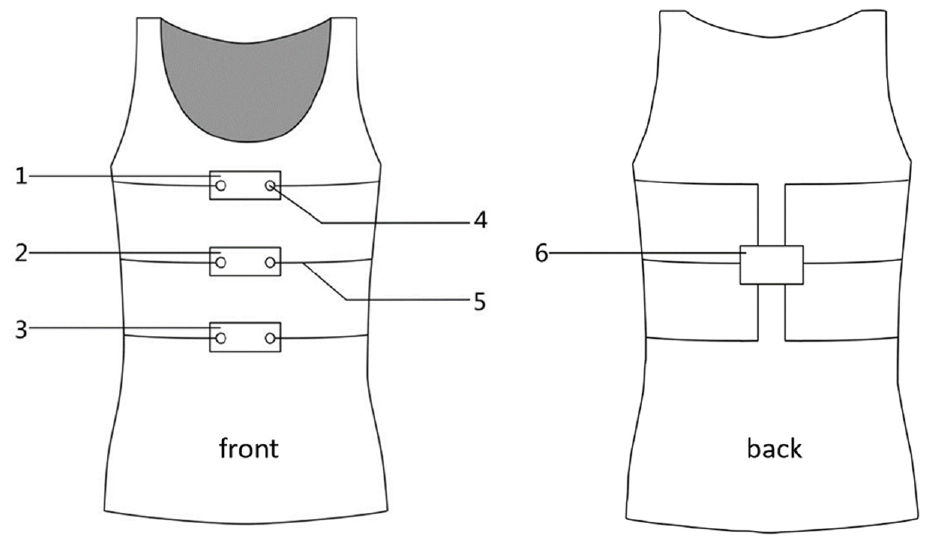
Smart vest style diagram: 1, flexible pressure sensor (upper); 2, flexible pressure sensor (middle); 3, flexible pressure sensor (lower); 4, copper pin button electrode; 5, silver-plated conductive yarn; and 6, constant current power supply and wireless transmission equipment.
Configuration Scheme of Flexible Pressure Sensor and Electrode
The schematic and physical drawings of the flexible sensor and electrode are shown in Figure 2. The laboratory-made carbon nanotube/polyurethane conductive coating is cut into a rectangle of 2*8 cm, and the adhesive interlining is cut to 4*10 cm. 15 The conductive yarn is used to stitch the copper button, the adhesive lining, and the conductive coating together, and the adhesive lining is thermally pressed to complete the production of the flexible pressure sensor. The flexible pressure sensor is installed in a specific position on the smart vest through a copper snap button device.
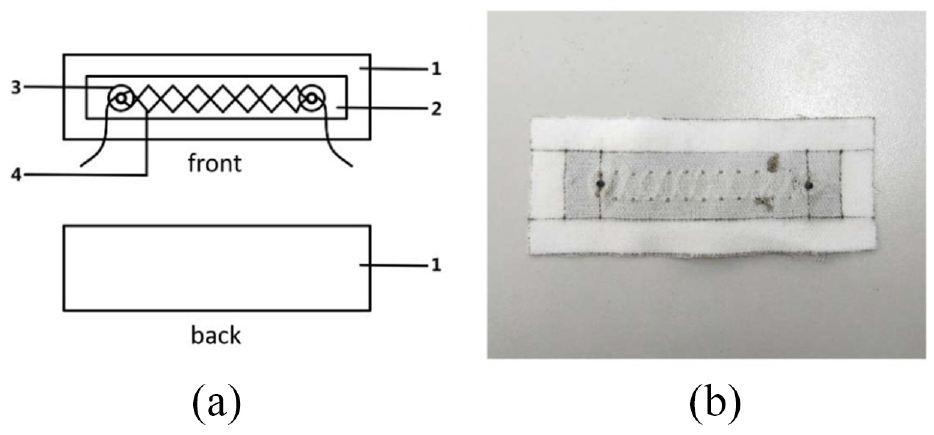
Flexible pressure sensor: (a) schematic diagram of flexible strain sensor and electrode. 1, Fusible interlining; 2, conductive coating film; 3, copper snap button; 4, silver-plated yarn. (b) Physical image of the flexible strain sensor.
Integration of Vest and Flexible Sensors
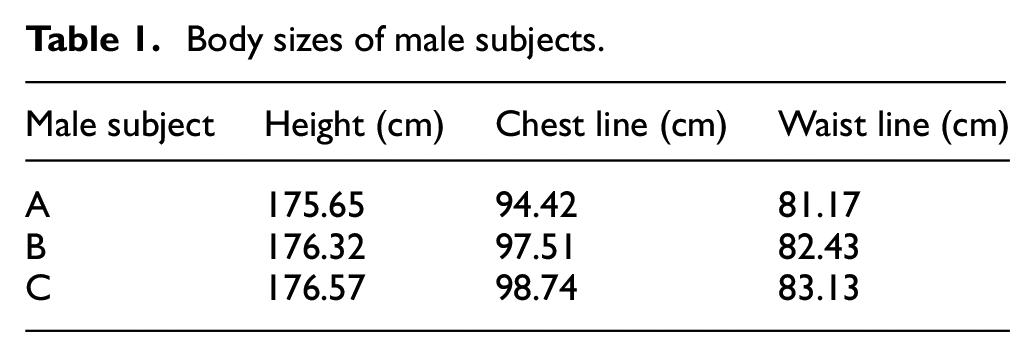
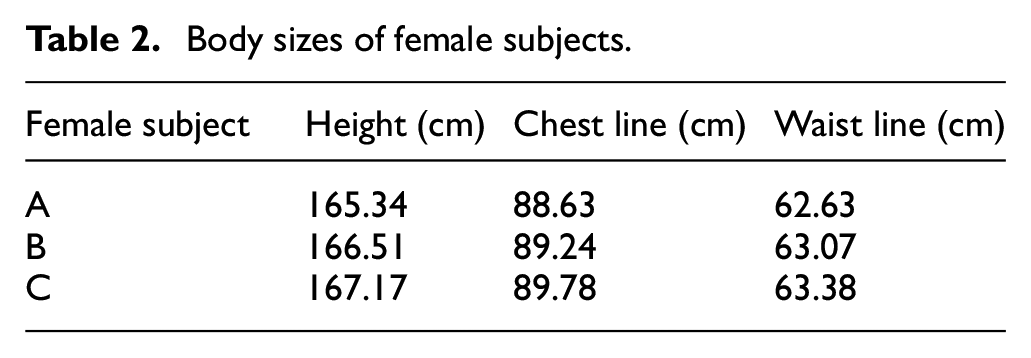
In order to improve the universality of the experimental samples, this article selects the most commonly worn women’s vest in S size and M size and men’s XL size and XXL size vest for sensor testing. Their size specifications are shown in Tables 1 and 2.
Body sizes of male subjects.
Body sizes of female subjects.
Copper buckles are placed on the upper chest, diaphragm, and abdominal muscles of the inner layer of the vest, and the effective distance between the two ends is 6 cm. The integration of the flexible pressure sensor completes the production of the smart vest. The physical picture is shown in Figure 3.
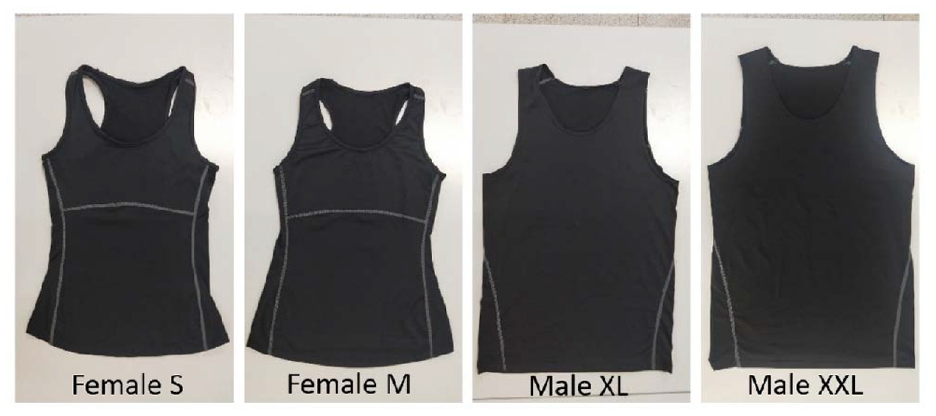
Physical image of smart breathing vest.
Results and Discussion
Performance Test of Breathing Monitoring Smart Vest
The experimental principle is shown in Figure 4. The flexible pressure sensor is connected to a constant current power supply through a copper button electrode and a silver-plated conductive yarn. When the wearer is breathing, pressure will be generated on the flexible pressure sensor, which will change the resistance value. By using the KEYSIGHT 34972A multi-channel resistance acquisition software to record the real-time resistance changes of the flexible pressure sensor and then analyze the data, the purpose of real-time monitoring of respiratory activity is finally realized.
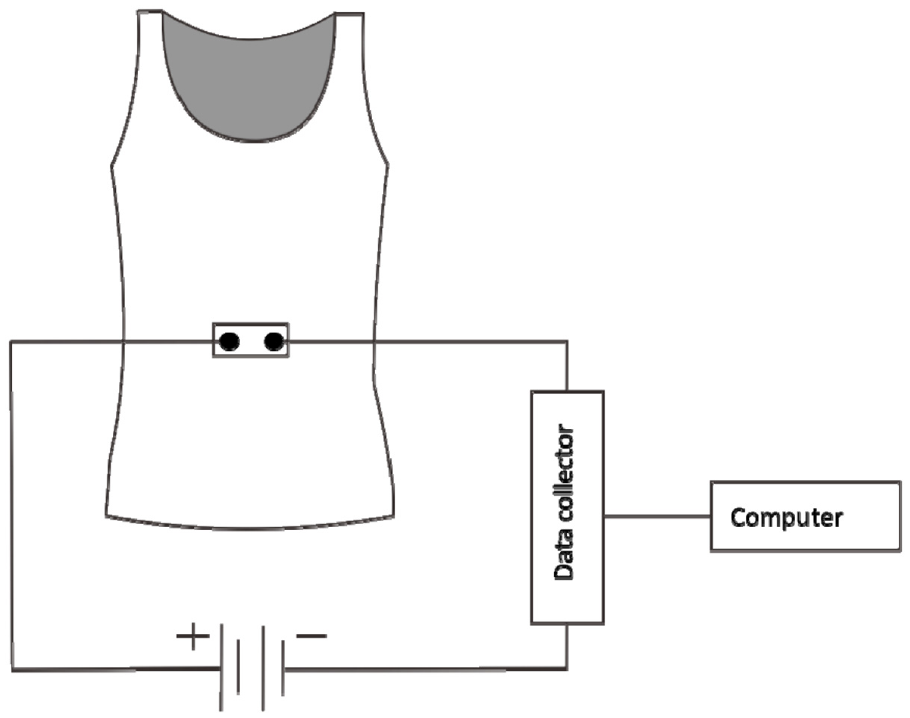
Test principle diagram.
Performance Test of Smart Vest Under Normal Conditions
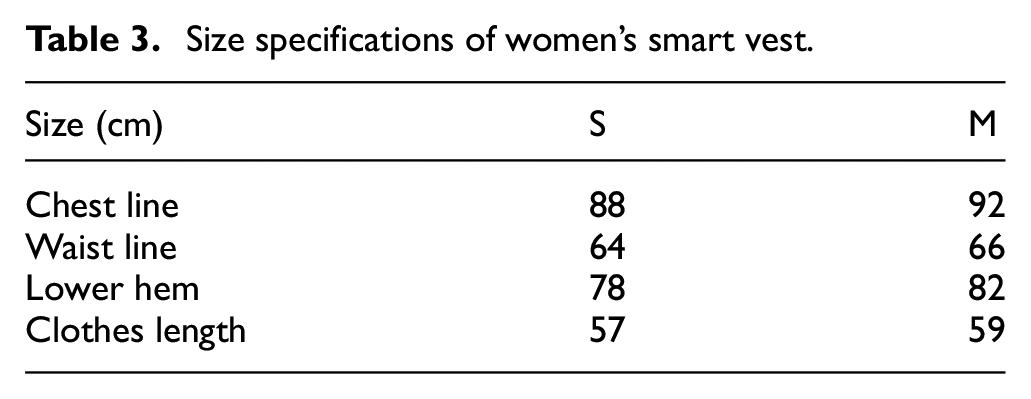
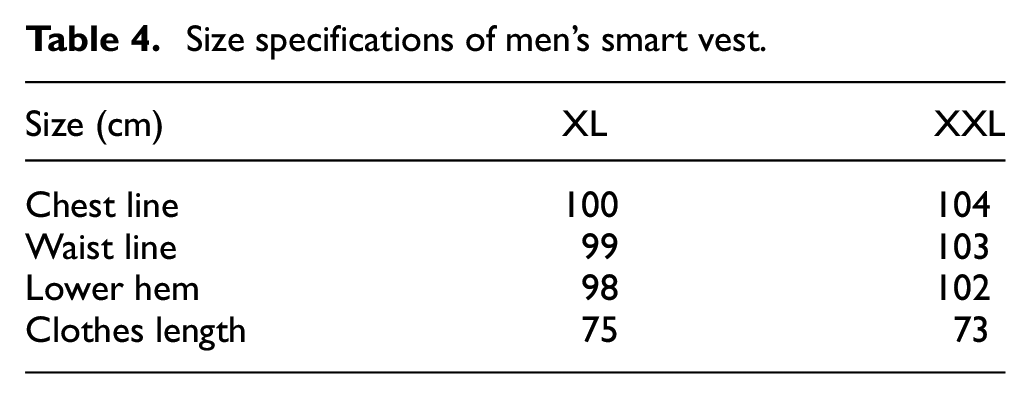
In this thesis, experiments were carried out on smart breathing vest in sizes S and M for women and XL and XXL sizes for men. In each group of experiments, the positions of the upper, middle, and lower three sensors were measured to explore the effect of setting sensors on the upper chest, diaphragm, and abdominal muscles on the performance of the smart breathing vest. Six subjects of general body size were selected for this trial, including three males and three females. The body sizes data of the subjects are shown in Tables 1 and 2. A total of 36 experiments were carried out. Six male and female subjects wore the smart vest with the specifications shown in Tables 3 and 4, and performed breathing rate tests in a standing state. Each test time was 3 minutes, and 10 sets of breathing cycles were completed every 40 s. The article uses the sensitivity index of the flexible sensor to characterize the performance of smart clothing. The change relationship between the resistance change rate (ΔR/R0) and time (T) represents the sensitivity index. When the human body inhales, the flexible sensor is gradually stretched and deformed, causing its resistance value to gradually increase, and the resistance change rate increases. When exhaling, the flexible sensor gradually returns to its original length, causing its resistance value to decrease, and the resistance change rate curve shows a downward trend.
Size specifications of women’s smart vest.
Size specifications of men’s smart vest.
Standing female subjects wore a smart vest (S size) for measurement (Figure 5(a)). The response curves of sensors in different working positions are different. From the perspective of the curve fluctuation range, when the sensor’s working position is on the upper part of the chest (upper), its resistance change rate curve has the largest amplitude. The working position is second in the abdominal muscles (lower). When the working position is on the diaphragm (middle), the curve amplitude is relatively flat. The experimental results show that when the tested female subjects wear a size S smart vest, the sensor working position is the upper part of the chest (upper) for the best signal. The experimental results show that when the tested female subjects wear an S size smart vest, the best working position of the sensor is the upper part of the chest (upper) (Figure 5(b)).
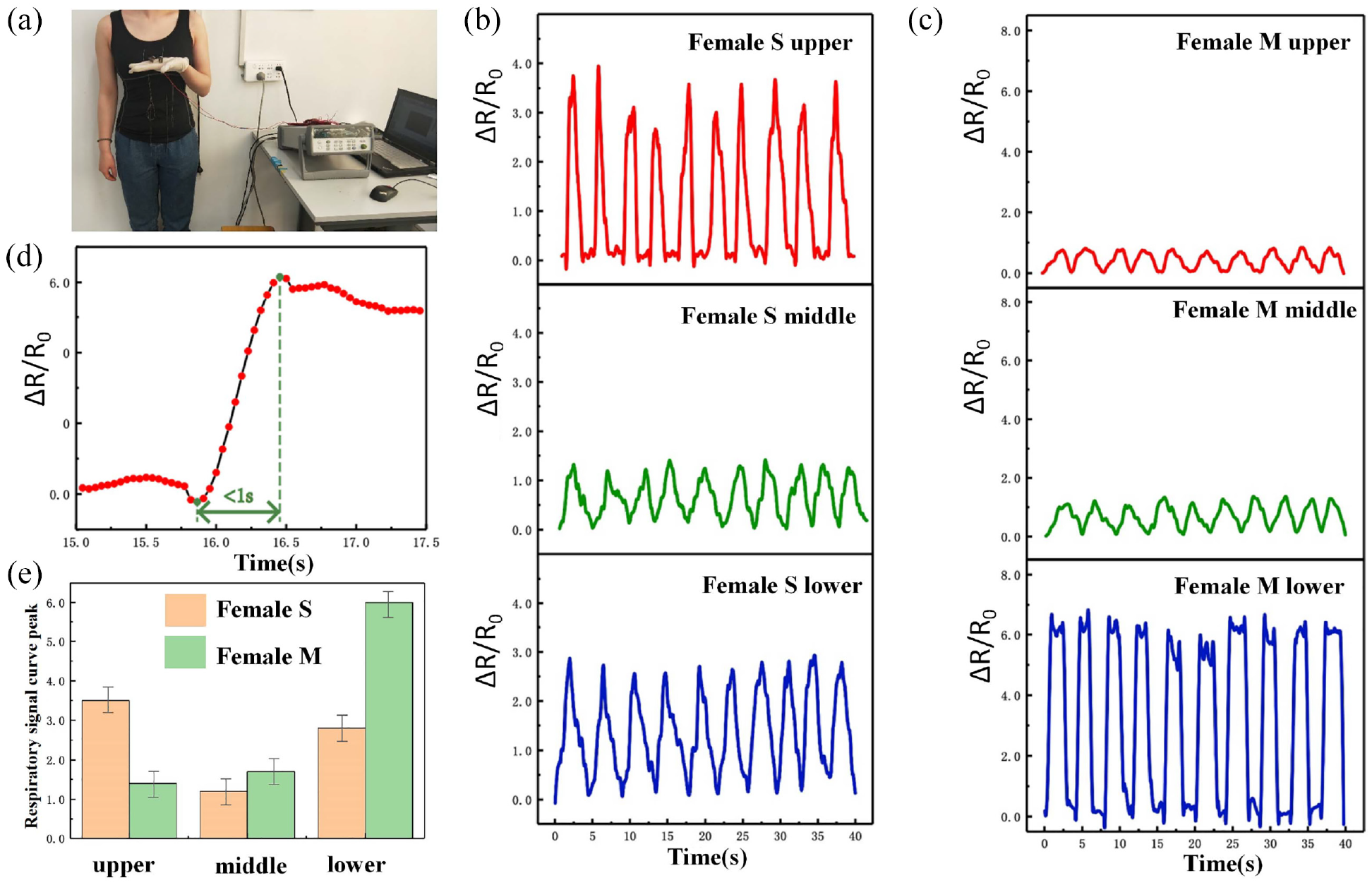
The influence of the flexible sensor’s working position on the performance of the female smart vest: (a) respiratory rate measurement for women’s smart vest, (b) the sensor resistance change rate–time curve of the chest, midriff, and belly working positions of female subjects wearing a size S smart vest, (c) female subjects wearing an M size smart vest, and the sensor resistance change rate–time curve at different working positions of the chest, midriff, and belly positions, (d) the response time of the flexible pressure sensor of the female M size abdominal muscle to the inspiratory signal, and (e) the subject wears a female S size and M size smart vest, the peak value of the sensor resistance change rate.
When female subjects wore a smart vest (M size) in a standing state, the response curves of sensors in different working positions were also different. From the perspective of the curve fluctuation range, when the sensor’s working position is on the abdominal muscle part (lower part), the resistance change rate curve amplitude is the largest. When the working position is on the upper chest (upper) and the diaphragm muscle part (middle), the curve amplitude is relatively flat. The experimental results show that when the tested female subjects wear M size smart underwear, the best working position of the sensor is the abdominal muscles (lower).
In this smart vest, the response time of resistance changes due to human respiratory activity is an important indicator to characterize the sensitivity of a flexible pressure sensor. In this experiment, since the flexible pressure sensor of the female model M size abdominal muscle part has the best response to the respiratory signal, the response curve of the female model M size abdominal muscle part during the fifth inhalation process is from the trough to the peak. Time is the representative. It can be found that the response time of the female model M size flexible pressure sensor to the inhalation signal is less than 1 s, and the sensitivity is relatively good (Figure 5(d)). Based on the above conclusions, this article further compares the response curves of the sensor breathing signals of the female smart breathing vest with S and M sizes. The peak value of the female S size abdominal muscle is about 2.8. The peak value of the M size abdominal muscle is about 6. Taken together, the peak value of the response curve of the flexible pressure sensor in the abdominal muscles is higher, and the response to the respiratory rate test is better (Figure 5(e)).
Male subjects wore smart vest (XL size) and measured their breathing rate while standing (Figure 6(a)). The response curves of sensors in different working positions (Figure 6(b)) were obtained. From the perspective of the curve fluctuation range, when the sensor’s working position is on the diaphragm (middle), the resistance change rate curve has the largest amplitude, followed by the working position in the upper part of the chest (upper), and the working position in the abdominal muscle (lower) has a higher curve amplitude. The experimental results showed that when the male subjects under test were wear the XL size smart vest, the best working position of the sensor is the diaphragm (middle).
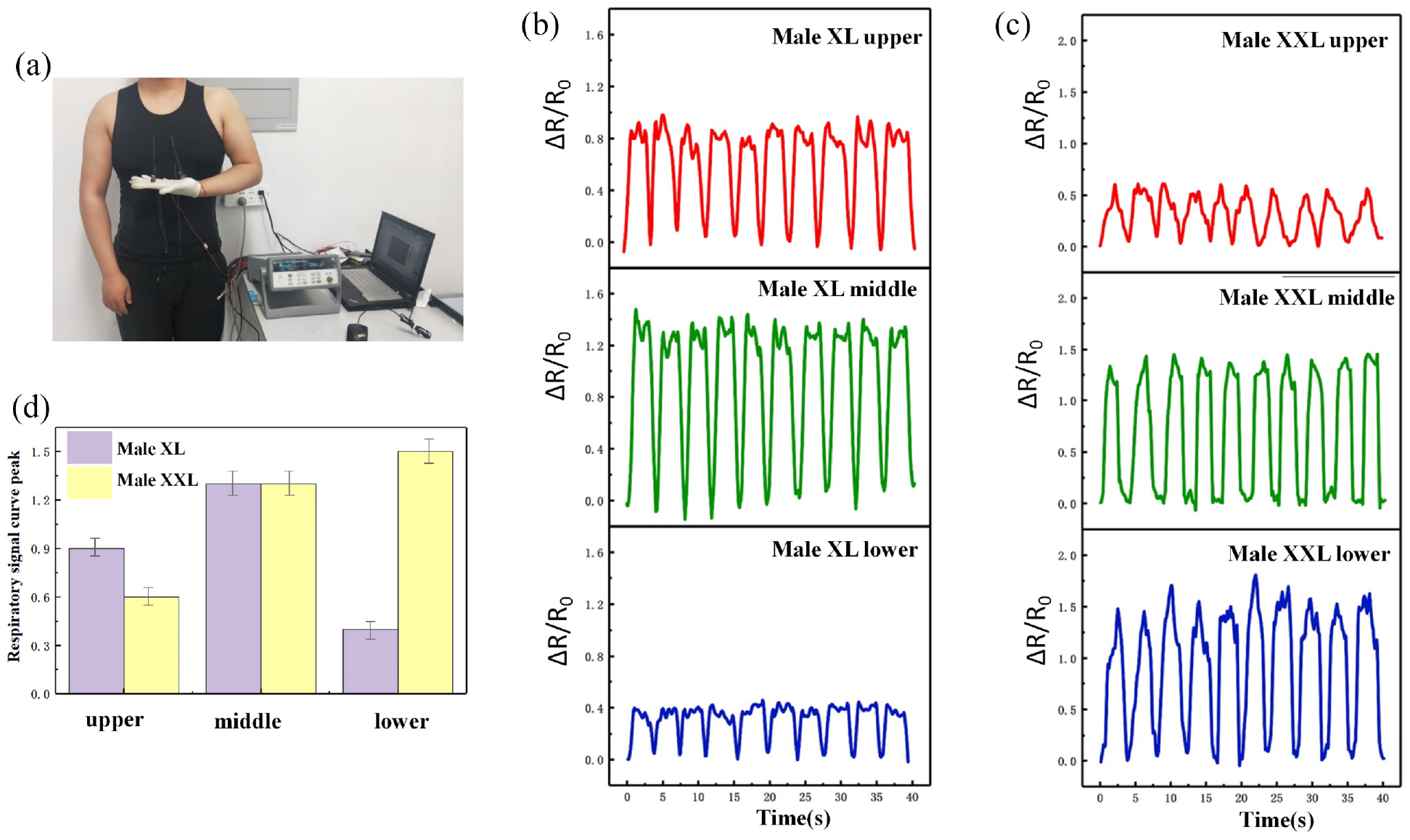
The influence of flexible sensor’s working position on the performance of the male smart vest: (a) men’s smart vest breathing rate measurement, (b) male subjects wearing an XL size smart vest, and the sensor resistance change rate–time curve at different working positions of the upper, middle, and lower working positions, (c) male subjects wearing an XXL size smart vest, and the sensor resistance change rate–time curve at different working positions of the upper, middle and lower working positions, and (d) the subject wearing a male smart vest with XL size and XXL size, the peak value of the sensor resistance change rate.
Male subjects wore smart vest (XXL-size) and measured their breathing rate while standing. The response curves of sensors in different working positions (Figure 6(c)) were obtained. From the perspective of the curve fluctuation range, when the sensor’s working position is in the abdominal muscle part (lower part), the resistance change rate curve amplitude is the largest, followed by the working position in the diaphragm muscle part (middle), and the curve amplitude is relatively larger when the working position is in the upper chest (upper). The experimental results show that when the male subjects under test wear the XXL-size smart vest, the best sensor working position is the abdominal muscle part (lower).
Compare the response curve of the sensor breathing signals of the men’s XL size and XXL size smart breathing vests (Figure 6(d)). It can be found that the peak value of the sensor in the diaphragm of the male XL-size smart underwear is about 1.5. The peak value of the sensor in the diaphragm of the XXL-size smart underwear is about 1.3. On the whole, the flexible pressure sensor on the diaphragm has a higher response curve, and the response effect to the respiratory rate test is better.
Performance Comparison of Flexible Sensors in the Smart Vest
The optimal position of the sensor for the female S size smart vest is the upper part of the chest, with a peak value of about 3.5. The optimal position of the sensor for the female M size smart vest is on the abdominal muscles, with a peak value of about 6.0. The optimal location of the sensor for the male XL size smart vest is on the diaphragm, with a peak value of about 1.3. The optimal position of the sensor for the male XXL size smart vest is on the abdominal muscles, with a peak value of about 1.5. It can be found that the female smart vest responds better to the respiratory rate test than the male smart vest, which is related to the male and female body shape and breathing style (Figure 7(a)). In terms of body size, the difference in the contours of the chest and abdomen between men and women can lead to greater deformation of the chest and abdomen when women breathe. As for the breathing method, men generally use abdominal breathing. When breathing, the abdominal muscles mainly move, so the ups and downs of the chest and abdomen are relatively small. Women’s breathing is mainly thoracic breathing. When breathing, the muscles of the chest and diaphragm are mainly moved, so the ups and downs of the chest are relatively large.
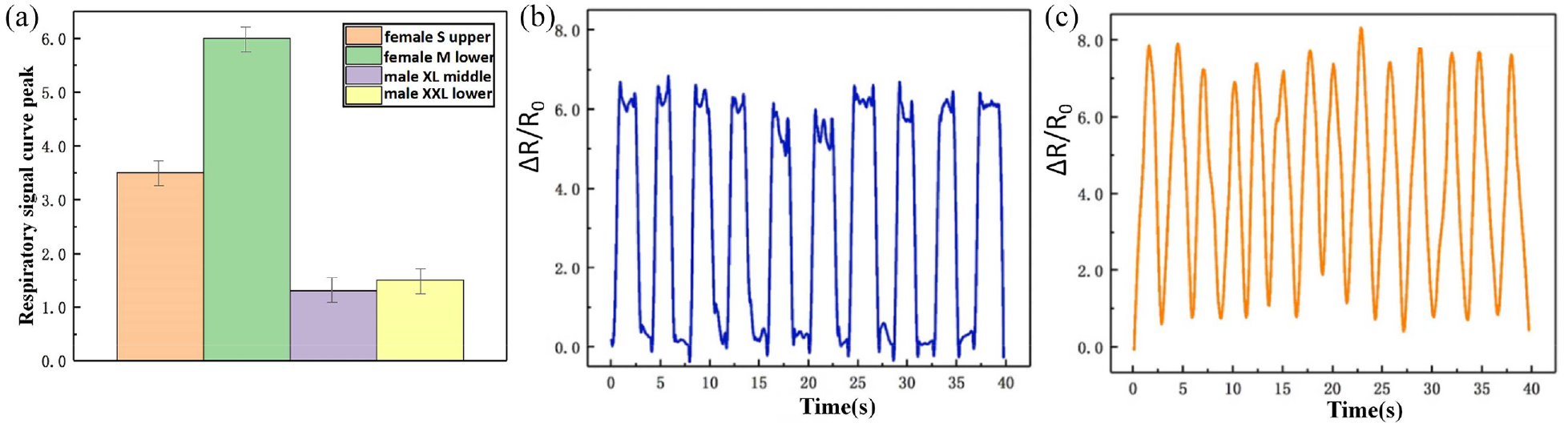
Performance comparison of flexible sensors in the smart vest: (a) performance comparison of flexible sensors of men’s and women’s smart vests, (b) under normal conditions, the resistance change rate–time curve of the female M size abdominal muscle sensor, and (c) under exercise, female model size M abdominal muscle sensor resistance change rate–time curve.
In order to further compare the performance of normal breathing and exercise breathing, this study carried out a performance test of the sensor performance of the abdominal muscles of the female smart vest under the stepping state. The subjects were required to wear a smart vest to perform in-situ stepping exercises. The test time was 3 minutes, and the final result was the respiratory cycle signal completed within 40 s. The amplitude of human respiration under exercise is greater than that under normal conditions: the peak value is about 6.0 under normal conditions, and the peak value is about 7.5 under exercise conditions, and the time required for the breathing cycle is shorter. The female model M size abdominal muscle sensor is more sensitive to this change (Figure 7(b) and (c)).
Conclusion
As the key technology of wearable and intelligent clothing, flexible sensing technology is worthy of our in-depth exploration. The vest is a close-fitting garment that people wear every day, and it is an ideal carrier for flexible sensors. Therefore, this article designs a smart vest that uses flexible piezoresistive sensors that can be used to monitor breathing rate. In this article, flexible sensors are integrated in the upper chest, diaphragm, and abdominal muscles of the four vests in S size and M size for women and XL and XXL size for men, to realize the wearable breathing monitoring equipment. This article sets up variables such as male and female styles, sizes and different positions to study the breathing rate test performance of the smart vest. It is found that the optimal position of the sensor for the female model S size is the upper part of the chest, and for the M size it is the abdominal muscles. The optimal sensor configuration for the male XL size is the diaphragm, and that for the XXL size is the abdominal muscles. Through comparison, it is found that the female smart vest responds better to the respiratory rate test than the male smart vest. This may be related to the male and female body shapes, breathing styles, and other reasons. This smart vest can collect breath data conveniently and dynamically. It is beautiful and comfortable, and fits the body, meeting the requirements of detachable washing.
Footnotes
Declaration of Conflicting Interests
The author(s) declared no potential conflicts of interest with respect to the research, authorship, and/or publication of this article.
Funding
The author(s) disclosed receipt of the following financial support for the research, authorship, and/or publication of this article: The work was supported by the National Natural Science Foundation of China (No. 51473122), the Postdoctoral Science Foundation of China (No. 2016M591390) and the Natural Science Foundation of Tianjin (No. 18JCYBJC18500).