




Abstract
The impact of stitch density and seam type on tactile properties of seams has been investigated. Lapped seam 1 (LSa-1) using stitch class 605 and superimposed seam (SSa-2) using stitch class 514 (ASTM 6193) were constructed with four different stitch densities, namely, stitches per inch (SPI) 10, SPI 14, SPI 18 and SPI 22, and the tactile properties of seams examined by evaluating the characteristics of seams such as seam compression, seam thickness, seam bending behaviour and surface friction of seams. From the study, the optimized stitch density has been identified as SPI 10 for producing soft seam. Seam class and stitch density play a vital role in determining seam comfort properties.
Introduction
The seam is an assembly of two or more pieces of fabrics by a row of stitches to make a three-dimensional (3D) garment. There are four important materials involved in preparing a seam: fabric, sewing threads, seam types and stitch types. Regarding the garment performance during intense activity, seam strength and its performance are very important. 1 Proper selection of fabric, sewing thread with adequate tensile strength, and the selection of seam types and stitch types greatly influence the wearer’s comfort and the garment’s aesthetic and functional requirements. 2 During intense activity, the wearer tends to sweat a lot, so clothing should have the capability to transfer body heat and sweat quickly to the environment. 3 There are garments with greater numbers of seams. Many previous research studies were mainly focused on improving the fabric comfort properties. However, the seam has a multilayer in it, and the fabric comfort character is different from the seam comfort character. There are studies concerning seam construction in optimizing the stitch density to enhance seam strength, seam slippage strength and overall seam efficiency. For instance, seam strength and seam slippage strength improve when the stitch per inch is increased. 4 Stitch density influences seam strength and seam elongation for woven muslin cloth. 5 It is also stated that the seam resistance is mainly influenced by sewing needle size, sewing thread size, stitch type and stitch density. 6 However, studies related to seam comfort properties especially using knitted fabrics are limited. When the seam is continuously rubbed against the skin, it causes skin damage; hence, a smooth seam is required to avoid skin damage.
Textile materials with various surface characteristics are available. The most commonly used concept for the evaluation of tactile properties of the textile material is ‘Fabric hand’. The hand of a textile material refers to the total sense experience when the fabric is touched by a finger. The sensation may be pleasant or unpleasant. The most common unpleasant feeling or discomfort that occurs to the skin is because of continuous rubbing with clothing. 7 Fabrics with poor sensorial comfort may be pricky, tickling, rough, craggy, scratchy, itchy, picky and sticky to the skin. 8 Knitwear with a smooth appearance and that is comfortable, light and very soft is produced from the bulky yarn, as well as its exceptional regularity.
Purane and Panigrahi 9 clarify that microfilament draw-texturing will need a lower draw ratio than the prescribed draw ratio, which will result in fewer broken filaments, reduced tenacity, increased extension and a better twist level, all of which will result in greater and better bulk. The textured microfilaments attributed special character traits to the fabric, such as soft touch and lightness, due to the microfilaments’ low flexural rigidity; light and heavy volume; special surface properties and silk-like appearance; simple pliability/compatibility to cotton, rayon, wool and other fibres; good drapeability and pliability; good wear properties ranging from ultra-light costume content and underwear to wind- and water-repellent sportswear; and novel applications.
In tight-fit garments, the pressure on the bulky seams along with sewing threads makes the seam rough and causes skin injuries. 10 Therefore, research on the thermal-mechanical properties of the seam is also important for improving the wearer’s comfort. The touch and feel of any material are technically termed the tactile properties. The tactile properties are analysed subjectively and objectively. 11 In this study, the tactile properties of the seams are analysed in terms of physical properties objectively by measuring seams’ smoothness, softness, warmness and total hand value for various stitch densities and seam types. The study also analyses thermal properties, air permeability and moisture vapour transmission rate, and data analysis was carried out to find out the reliability of the results.
Materials and Methods
Fabric
Commercially available 100% polyester single jersey knitted fabric of 150 GSM was used for making seams. Fabrics were relaxed fully before and after seam preparation and the testing process. Seams were prepared with standard sewing thread with 100% spun polyester yarn from the brand Madura coats with a specification of 024 tex and ticket number 120. Lapped seam 1 (LSa-1) using stitch class 605 was constructed using the Juki 5 thread flat lock sewing machine, and superimposed seam (SSa-2) using stitch class 514 (ASTM 6193) was constructed using the machine 4 thread overlock industrial sewing machine. Both the seams were constructed for four different stitch densities, namely, SPI 10, SPI 14, SPI 18 and SPI 22.
Seam Preparation
Figure 1 shows the seam classes LSa-1 and SSa-2 per ASTM D6193-11. LSa-1 seam is a lapped seam formed by overlapping two or more layers of fabric joined by two rows of stitches. SSa-2 is a superimposed seam formed by superimposing two layers of fabrics joined by two rows of stitches
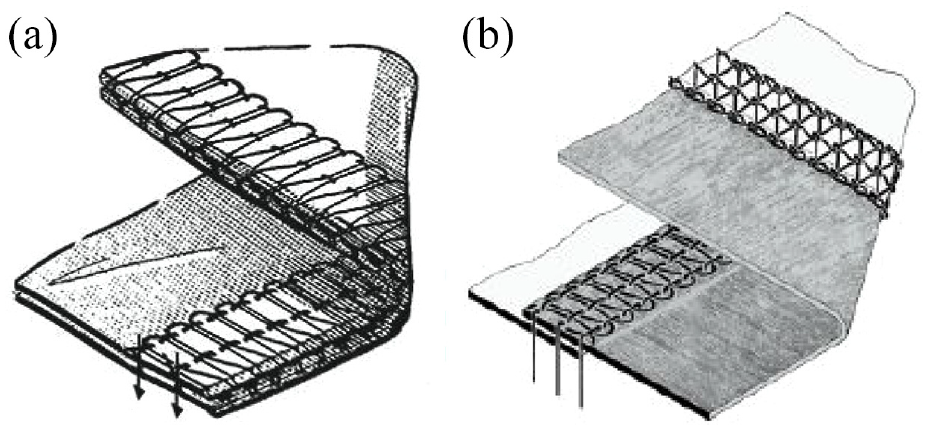
Seams: (a) superimposed seam 2 (SSa-2) – 514 and (b) lapped seam 1 (LSa-1) – 605.
Increasing the number of seams within the sample increases the impact of seams on the overall test results. Thus, several seams were incorporated within the sample by maintaining the gap between the seams as 1 inch and the seam allowance as 6 mm for all the constructed seams.
Testing Methods
Fabric Touch Tester
The mechanical properties of the seamed fabric were evaluated using the instrument Fabric Touch Tester (FTT) (Figure 2). The FTT is a device that measures physical qualities associated with touch sensations of fabrics in four different modules: compression, bending, thermal and surface friction. Seams were introduced in the sample along the course-wise direction (L-shaped with 20 cm arms). All the seams are positioned on the bottom plate and extended arms are positioned next to them. The centre square portion of the sample will be pushed lower, causing the two arm parts to extend horizontally. The centre portion was measured by compress and thermal modules, while the arms parts were examined by bending and surface modules. All the samples were relaxed under standard atmospheric condition before testing.
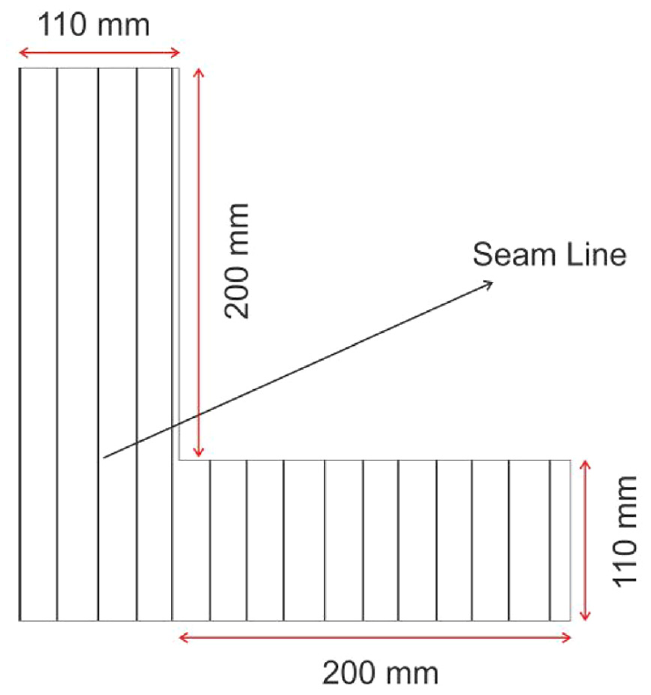
Seamed fabric sample for fabric touch tester.
Compression Interface
To compress the sample, the FTT used two plates. The stretchable device causes the top plate to travel downwards while conveying a constant force ranging from 0 to 70 gf/cm2. Three force sensors were connected to the bottom plate. The bottom plate is connected with sensors that continuously record the compression forces. Simultaneously, a laser distance sensor was used to measure the distance between upper and bottom plates and convert the same into sample thickness. Pressure was measured from the compression force (gf/mm2). A laser distance sensor was used to constantly measure the distance between two plates. Two indices, compression average rigidity (CAR) and recovery average rigidity (RAR), were determined based on the degree of pressure during compression and recovery.
Thermal Interface
The cool sensation is a result of heat transmission between clothing and the human skin. Temperature variations between skin and clothing are around 10 K. Heat transfer occurs at the moment fingers touch clothes. The temperature of the top plate was heated more than the temperature of the bottom plate (up to 10 K), which makes the bottom maintain skin temperature. Heat flux through the fabric is continuously recorded throughout the compression process. Thermal conductivity through compression (TCC) and thermal conductivity through recovery (TCR), respectively, were calculated. They reported the warmth-keeping capacity of samples, taking into account the effect of thickness. The maximum thermal flux while measuring the entire thermal process is termed the Thermal Maximum Flux (Qmax), which serves as a direct reference for the sensation of coldness.
The relation of thermal resistances with thermal conductivity can be expressed as follows: 12

where R is the thermal resistance, h is the fabric thickness (m) and λ is the thermal conductivity (W/mK).
Bending Interface
When attempting to distort textiles, another reaction is to apply bending forces. Bending characteristics are thought to reflect stiffness sensation. Proprioceptive sensations received by human skin include this form of force. To imitate this process, the FTT bent the other end of the fabric while holding one end. The bottom plate and the bending bars are positioned at equivalent height. To convey the bending forces, they are dragged downwards during the test. The active bending forces are recorded using force sensors placed beneath the bending bar. Accordingly, two indices named Bending Average Rigidity (BAR) and Bending Work (BW) are calculated from the bending graph generated by the device.
Surface Interface
Textile surface qualities are related in terms of texture and smoothness. Surface irregularities are most prone to create irritants or painful stimuli. These qualities can be assessed by touch and feel when a finger moves across the fabric surface. The fabric friction and roughness qualities are measured by the FTT surface module. These modules are just nearer to the bending modules. On the platforms, samples were placed horizontally. A freely movable metal detector was used to measure fabric surface friction. A sensor is installed in the device which helps to measure the friction between the metal surface and the fabric surface. A roller was used to apply a normal force of 1405 gf on the sample. The fabric surface unevenness (roughness) was measured using a different needle-shape detector. Laser sensors are used for detecting the detectors travelling, similar to the one employed in the compression module, using a lever system. The sensors were employed to detect the surface variation in the surface of the sample. Surface friction coefficient (SFC), surface roughness amplitude (SRA) and surface roughness wavelength (SRW) were then numerically calculated from the curve generated in the device.
The expected touch/hand feel of samples is depicted by FTT principal hand values. A smoother surface is specified by a bigger value of fabric primary touch/hand – smoothness; a softer sample is specified by a bigger value of fabric prime touch/hand – softness; and a warmer sample is specified by a bigger value of fabric primary touch/hand – warmness. Primary hand feel refers to the sensations experienced when actively contacting materials, that is, hand evaluation. As a result, FTT tests the fabric’s physical qualities on both the top and bottom sides. The results from the surface side are utilized to calculate hand feel, while the results from the bottom side are used to calculate touch feel. The whole level of comfort in both situations is also assessed. The 13 physical indices are used for the calculation of smoothness, softness and warmth, which are the primary sensory indices (PSI). The total Hand/Touch value is calculated using PSI data. The FTT instrument also provides the relevant grading (very low to extremely high).
Results and Discussion
We studied the influence of stitch density on physical properties such as bending, compression, surface roughness and maximum heat flux through which the total hand value of seams was tested.
Influence of Stitch Density on Seam Bending Behaviour
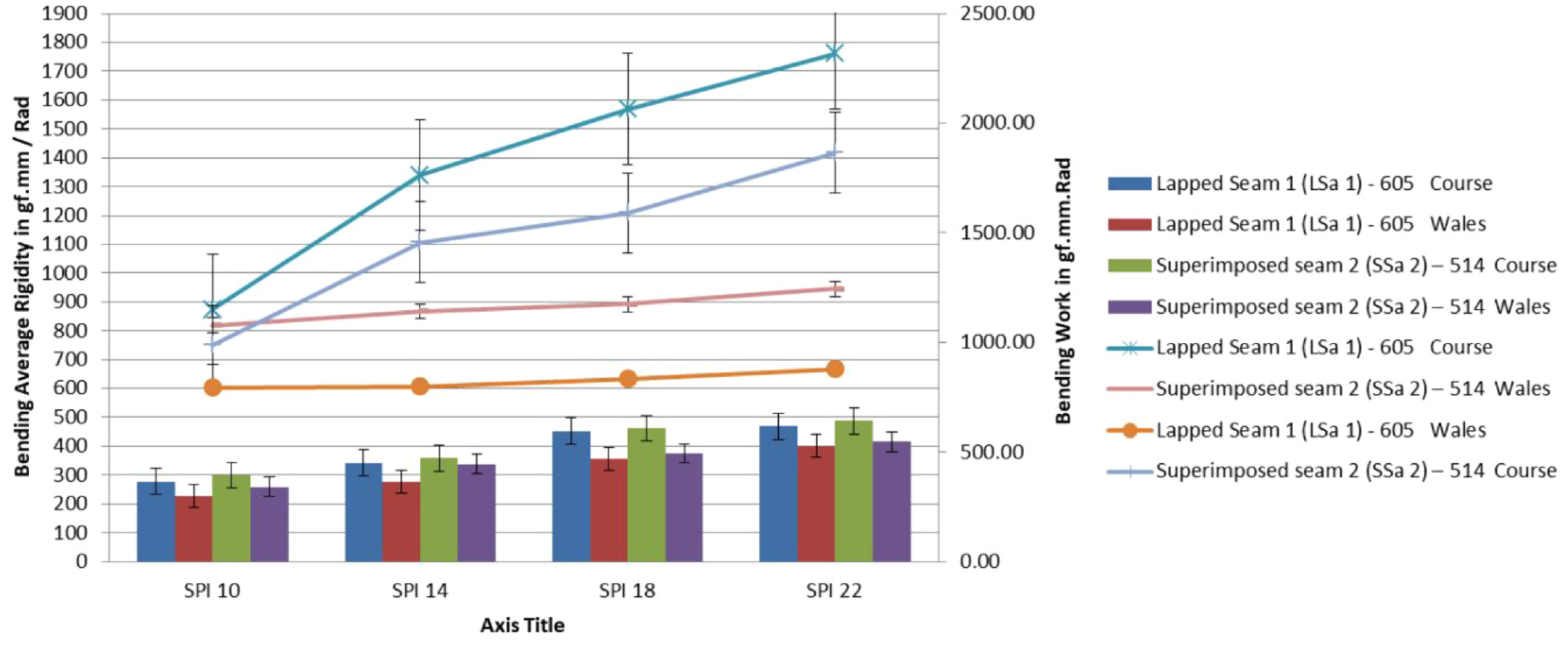
The bending behaviour of a specimen is determined by two physical properties – bending average rigidity and bending work – in both course and wales directions.
The force required to bend per radian of a specimen is termed the bending average rigidity, which is expressed as gf mm/rad. The higher the value, the higher the rigidity of a specimen. Bending works indicate the total work needed to bend a specimen. Bending average rigidity and bending works are similar concepts that give the average and total works needed to bend a specimen, respectively.
From Figure 3, it can be seen that the lapped and superimposed seams made with the highest stitch density SPI 22 required more force to bend when compared with seams made with the lowest stitch density SPI 10. This is due to the increase in seam bulkiness due to layering and the presence of dense stitches on the seam line. This indicates that the higher the stitch density, the higher the seam stiffness.
Bending average rigidity (BAR) and bending works (BW) of seams of various stitch densities.
Hu and Chung 13 observed that the seam bending behaviour is greatly influenced by seam allowance, seam thickness and stitch densities of seams. It is also observed from Figure 3 that seams need less force to bend in the course direction than in the wales direction. This is similar to the results given by Asfand and Daukantienė, 14 where the bending stiffness is lower in the course direction than in the wales direction.
Influence of Stitch Density on Seam Compressions
Seam compressions were measured by four indices such as compression works, compression average rigidity and recovery average rigidity, which are given in Figures 4 and 5 respectively. It can be seen from Figure 4 that the force required to compress the seam constructed with SPI 22 is higher than that for the seam constructed with SPI 10. The compression recovery rate is higher for the seam with SPI 10 when comparing all other seams. Related trends were seen in both lapped and superimposed seams. It has been stated by Chavhan and Naidu 15 that the needle and bobbin thread tension significantly affects the seam compressions. Another study by Amirbayat and McLaren Miller 16 shows that the total seam compression is a result of the pressure created by the number of fabric plies and the sewing thread used in the assembly. Despite maintaining the sewing thread and needle thread tension uniformly during the preparation of seams, compressions on the seams were different for different stitch densities due to different stitch classes, variations in the number of plies on the seam types and pressure created by the stitches on the seam line. It was observed from the analysis that the seams with the highest stitch density SPI 22 required more force to compress and has less recovery rate. Due to variations in the number of fabric plies between lapped and superimposed seams, lapped seams required less work to compress and the recovery rate is higher when compared to superimposed seams.
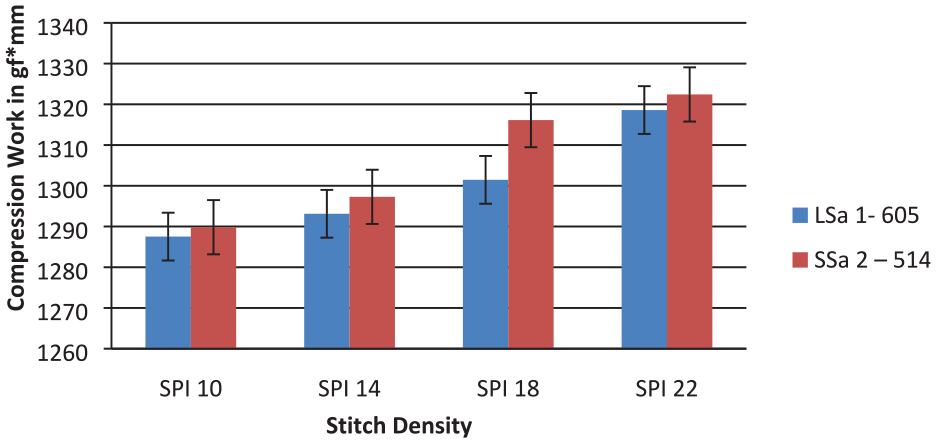
Compression works (CW) of seams of various stitch densities.
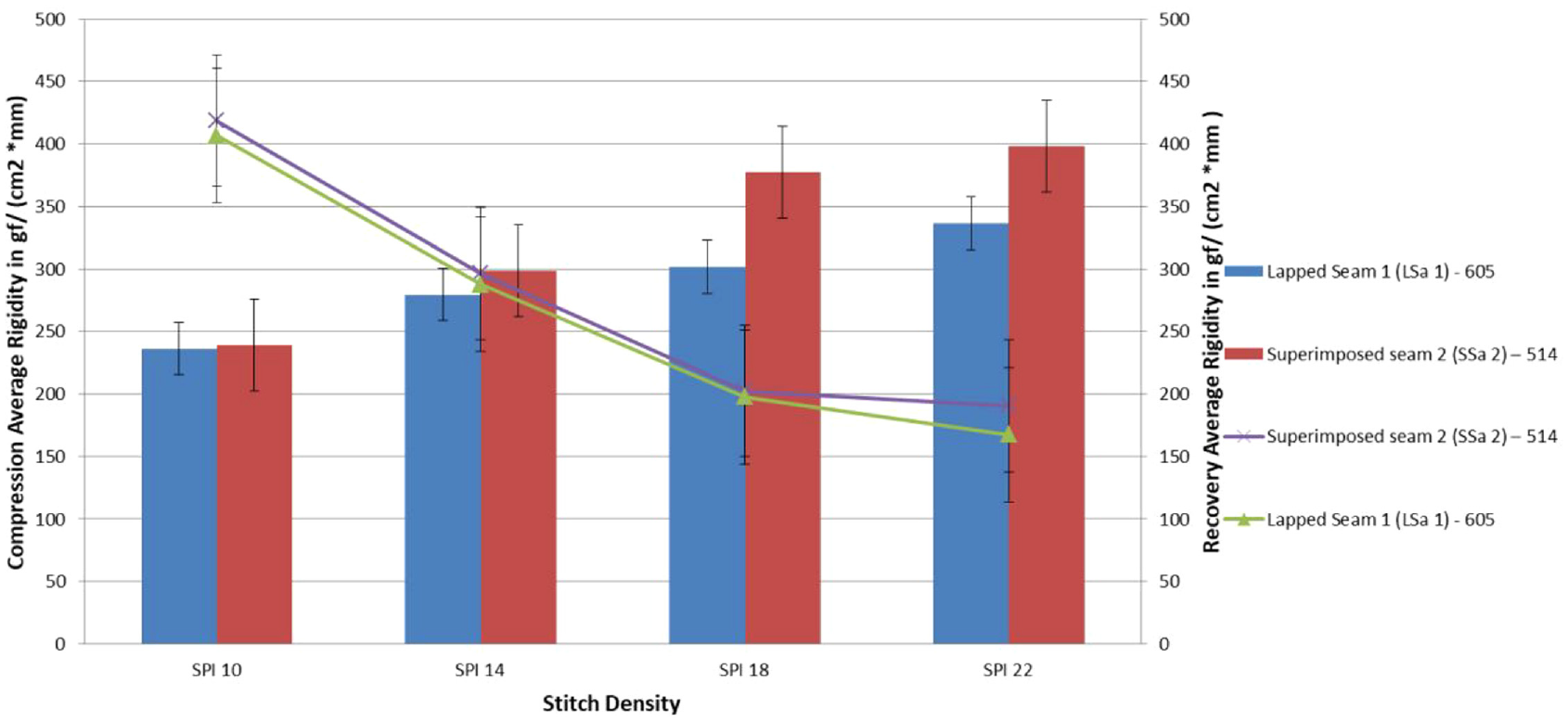
Compression average rigidity and recovery average rigidity of seams of various stitch densities.
Influence of Stitch Density and Seam Type on Seam Roughness
The surface friction force of a specimen was determined by three surface indices, namely, surface friction coefficient, surface roughness amplitude and surface roughness wavelength, in both course and wales directions. The results of the surface friction coefficient are shown in Figure 6. The higher the friction coefficient, the higher the fabric roughness. From Figure 6, it can be seen that the seam constructed with SPI 10 had the lowest SFC value among the given samples, which indicates the seam will give the wearer a smooth-to-touch feel and vice versa.
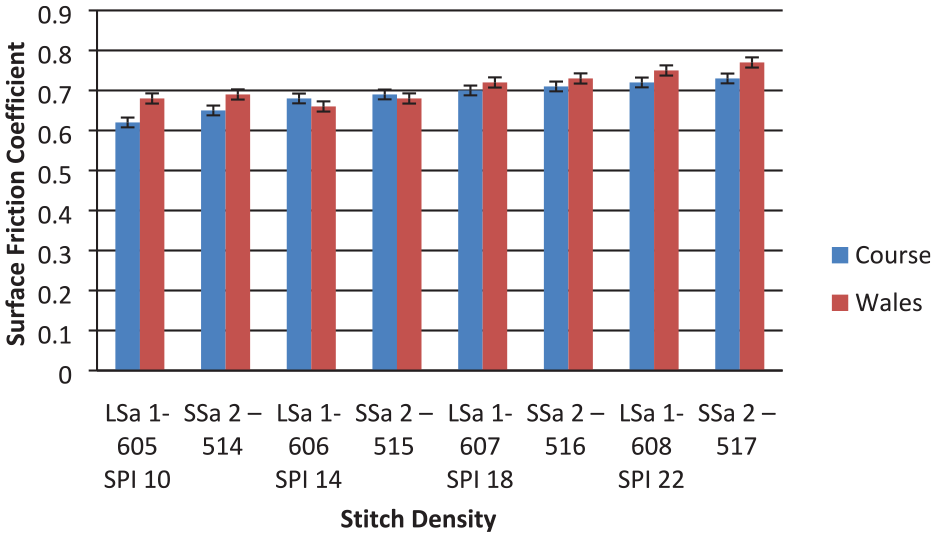
Surface friction co-efficient of seams of various stitch densities.
The seam surface roughness is found to decrease when the stitch density is decreasing. This may be due to the seam losing its smoothness when more sewing threads are present on the seamline for increased stitch density and selection of stitch class. Bubonia 17 stated that the flat seam gives less abrasion to the skin, especially for tight-fit garments since it has a low profile with minimal thickness.
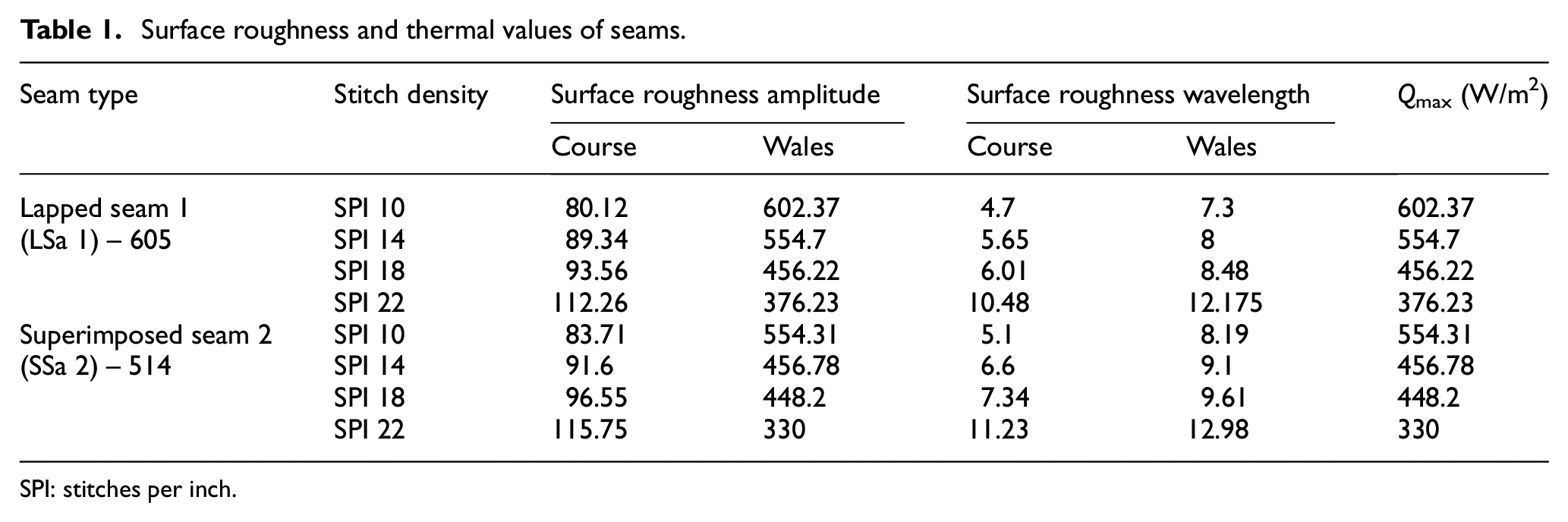
Table 1 shows the surface roughness amplitude and surface roughness wavelength, respectively. Values of surface roughness amplitude indicate the irregularity of roughness amplitude curves, and the results of the surface roughness wavelength denote the irregularity of roughness wavelength curves. The higher the value of SRA and SRW, the more the irregularity there is in the surface of the samples and the irregularity values are higher for the seams constructed with the maximum SPI – SPI 22. It is also mentioned by an industry (Coats) that the roughness in the seam is significantly affected by fabric, unbalanced stitching, and stitch type and oversewing.
Surface roughness and thermal values of seams.
SPI: stitches per inch.
Influence of Maximum Thermal Heatflux (Qmax) of Seams of Various Stitch Densities
Q max denotes the maximum heat transfer that occurs during compression. From Table 1, it can be seen that seam with SPI 10 (lowest stitch density) shows higher thermal conductivity. The results may be due to the variation in the seam thickness for different stitch densities. Fabric thickness is the most important factor in deciding the thermal properties of fabric. 18 It is also stated by Vasile et al. 19 that heavyweight fabrics show lower heat flux values and vice versa. It is also observed that the fabrics that are rigid to compress showed less thermal conductivity and vice versa.
Influence of Primary Hand Values of Seams of Various Stitch Densities
From Figure 7, it can be seen that grades were improved for smoothness from SPI 22 to SPI 10 for both the lapped and superimposed seams. 20 The softness, warmness and total hand values are also improved gradually from SPI 22 to SPI 10 for both seam types.
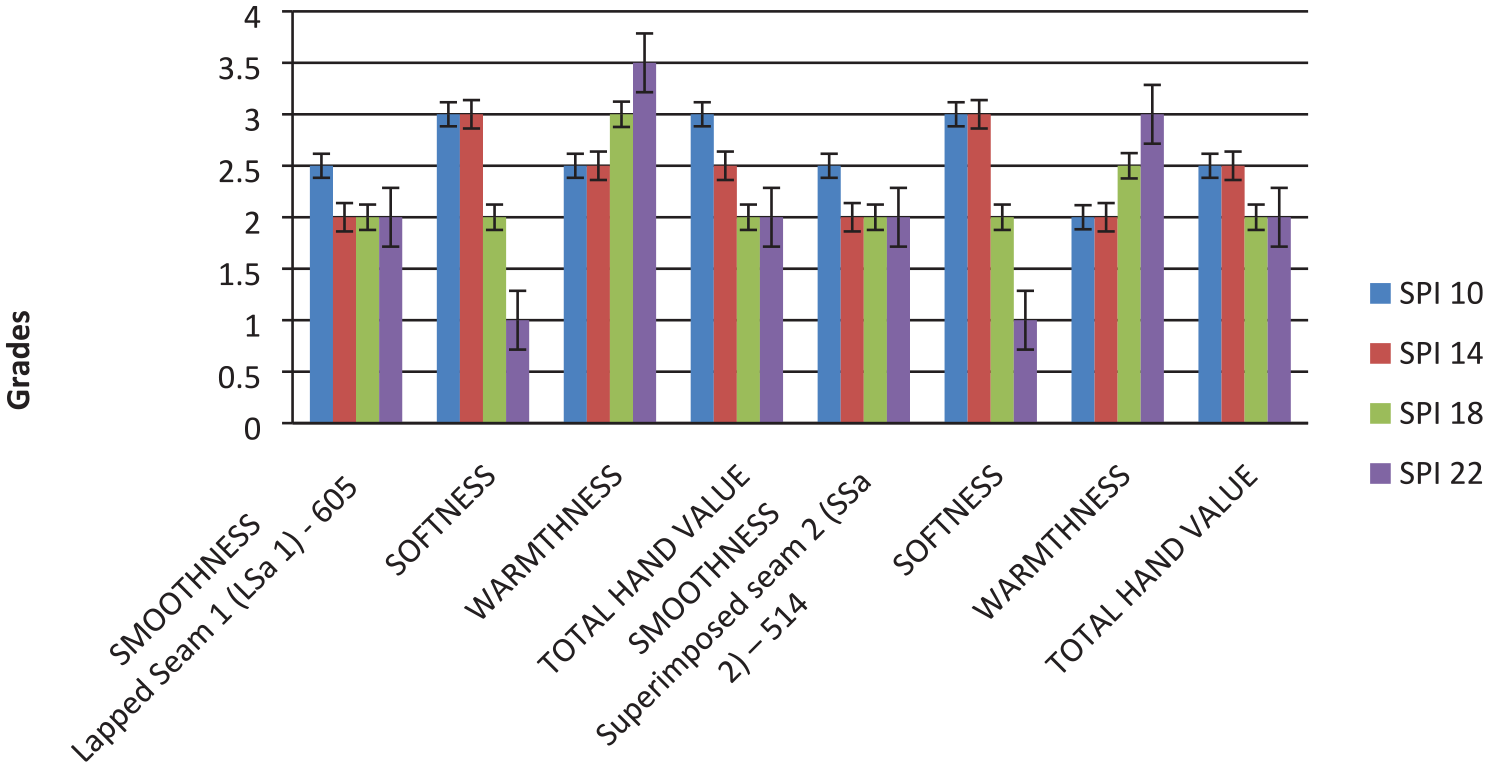
Influence of primary hand values of seams of various stitch densities.
Conclusion
An increase in stitch density of seams has a significant influence on the overall seam thermal comfort properties such as thermal properties, bending, compressions and surface roughness. Similar results were observed for both lapped and superimposed seams for all the stitch densities. There is no consistency in the increment of seam thickness when the stitch density is increasing for both the seam types. Thus, seam thickness is not affected significantly when the stitch density is increasing. Comparing all the seams, it was concluded that the seam constructed with SPI 10 had given an optimum level of thermal comfort and better hand value properties. Seam class and stitch density play a vital role in determining seam comfort properties.
Footnotes
Declaration of conflicting interests
The author(s) declared no potential conflicts of interest with respect to the research, authorship and/or publication of this article.
Funding
The author(s) received no financial support for the research, authorship and/or publication of this article.