



Abstract
Objective
Binge drinking and heavy alcohol use are highly prevalent among college students. During the COVID-19 pandemic, due to lockdown restrictions and other challenges, many college students were burdened with loneliness, which can contribute to chronic stress, and substance use. The current study explores the association between loneliness and various levels of alcohol use among college students in the rural, underserved region of Central Appalachia, USA.
Methods
Data were collected from a regional sample (n = 320) of college age adults, age 18-25 in the Central Appalachian region. The UCLA-3 item Loneliness Scale (UCLA-3) was used in the study to evaluate loneliness. Logistic regression analysis was conducted to assess the association between levels of loneliness and three separate outcomes, including past year binge drinking, past year heavy alcohol use, and past year weekly alcohol use.
Results
Overall, 25.5% of the participants reported severe loneliness, 33.6% reported moderate, and 40.9% reported low levels of loneliness. Results of the adjusted models revealed that severe loneliness was associated with higher odds of heavy alcohol use (AOR = 1.89, 95% CI [1.02, 3.50]) and binge drinking (AOR = 2.96, 95% CI [1.16, 7.51]), and not associated with weekly alcohol use.
Conclusion
The study found that higher levels of loneliness were linked to both binged drinking and heavy alcohol use. Further efforts for counseling and treatment among college students who are burdened with severe loneliness should be considered. The chronic stress associated with severe loneliness needs to be further addressed, particularly among emerging adults.
Keywords
Introduction
According to the 2020 National Survey on Drug Use and Health (NSDUH), 51.5% of young adults aged 18-25 drank alcohol in the past month, and the highest percentage of heavy alcohol use (8.6% or 2.9 million people) and binge alcohol use was seen in this age group (31.5% or 10.3 million people). Data from NSDUH and Monitoring the Future suggest that approximately 65% of college students drink alcohol in a given month. According to the National Institute on Alcohol Abuse and Alcoholism (NIAAA), alcohol use disorder (AUD) is a highly prevalent and disabling condition among college students. 1 Along with AUD, college students are heavily burdened with binge drinking and heavy drinking.2,3 The NIAA defines binge drinking as a pattern of consumption that causes blood alcohol concentration to rise to .08%, this typically occurs after a female consumes four drinks or a male consumes five drinks within a 2-hour period.4,5 Alcohol use and loneliness have been a major public health problem among college students.6,7 Loneliness is defined as a state of being without company, being cut off from others, being sad from being alone, or a feeling of bleakness or desolation.8,9 Social isolation can be defined as the lack of social contacts and having few people to interact with regularly. 10 Loneliness is the subjective perception of social isolation, which are interrelated but not the same as social isolation. For example, one can perceive themselves as lonely, and be objectively surrounded by other people.11-13
During the COVID-19 pandemic, research revealed that alcohol consumption increased especially in adolescents and college students.14,15 This was determined by factors such as stay-at-home policies, social isolation, and the relaxation of alcohol restrictions during the pandemic.16,17 Personal effects of the pandemic such as becoming sick or experiencing the loss of close social contacts contributed to feelings of loneliness and depression, which resulted in increased rates of alcohol consumption. 18 Alcohol use in college students has significant health, behavioral and social impacts, and is a significant risk factor for poor academic performance and risky sexual behavior. 19 Several risk factors determine alcohol use and its subsequent impacts. Poor economic background, influence from peer groups, parental monitoring, and perceptions are some of the determining risk factors for alcohol use.20-22
Unlike objective solitude and social isolation, loneliness is a sense of deprivation and need for social connection that has been associated with substance use, depression, overall health, and mortality. 8 Young adults comprise the population with the highest prevalence of loneliness, despite the widespread use of social platforms.8,23 A growing body of evidence indicates that social isolation and loneliness are associated with adverse mental health outcomes over time. 13 This association of social isolation and loneliness with mental health has been established in a variety of populations and subpopulations. 24
Few studies have elucidated loneliness, social isolation, and alcohol use in mutually adjusted analyses among college students.6,7 College students are often faced with several changes in their level of social contact, and such changes may trigger feelings of loneliness which may then serve as a risk factor for alcohol consumption. Such knowledge has important implications for planning specific intervention and prevention initiatives across the target population. The current study explores the association of loneliness and alcohol use in a college-based sample from the rural, underserved region of Central Appalachia, USA. 25
Materials and Methods
Subjects
The current study involved data collected among college students aged 18-25 during 2020-2021 in Central Appalachia, TN. The total sample consisted of 320 participants, of which 10 were excluded due to missing data, for a sample size of n = 310. All procedures that involved human subjects, including consent from all participants 18 years of age and older, were approved by the Institutional Review Board at the ***** University.
Measures
Loneliness
The UCLA-3 item Loneliness Scale (UCLA-3) was used in the study to evaluate loneliness. The UCLA-3 asks how often respondents feel: (1) left out, (2) lack of companionship, and (3) isolated from others. For each item, possible responses were “never or hardly ever” (3 points), “some of the time” (2 points), and “often” (1 point). Responses were then reverse-coded and summed to a score ranging from 3 to 9, with higher scores indicating greater loneliness. For the purpose of this study, we classified participants into three categories based on their score: 3-5 = low loneliness, 6-7 = moderate loneliness, and 8-9 = severe loneliness.
Covariates
We selected covariates that are known to be associated with alcohol use and misuse. Models included participant report of regular lifetime smoking (11 or more times), income, education, 26 age, and race.27,28 Low income was coded as 1 representing income of < $30,000, and 0 representing income >= $30,000, and was based on household income of parent/caregiver prior to age 18. Rurality was based on the following question “How would you describe the area you grew up in,” with rural representing 1 and urban or suburban representing 0. Education was coded as 1 representing less than a college degree, and 0 representing college graduate, based on highest educational attainment by a parent/caregiver prior to age 18. Self-report of race and ethnicity was coded binary with race/ethnic minority representing 1, and White representing 0. Gender was coded binary with female representing 1 and male and other gender representing 0.
Outcome Variables
Three primary outcomes were separately assessed including (1) heavy alcohol use, (2) weekly alcohol use, and (3) binge drinking. Heavy alcohol use was based on the following question “During the past 12 months, how many alcoholic drinks did you have on a typical day when you drank alcohol?” with 1 representing report of 4 or more drinks on a typical day for males, and 3 or more drinks for females representing, and 0 representing less than the specified quantities. Weekly alcohol use was based on the following question, “During the past 12 months, on how many days have you had an alcoholic drink?” Weekly alcohol use was coded binary, with once a week or more representing 1, and 2-3 times per month, once per month, and < 12 times in the last year representing 0. Binge drinking was based on the following question, “During the last 12 months, how often did you have 5 or more (for males) or 4 or more (for females) drinks containing any kind of alcohol in within a two-hour period? [That would be the equivalent of at least 5 (4) 12-ounce cans or bottles of beer, 5 (4) five-ounce glasses of wine, or 5 (4) drinks each containing one shot of liquor or spirits.”, with 1 or more times representing yes and 0 representing no.
Data Analysis
All coding was conducted in SAS 9.4 (SAS Institute, Cary, NC), with analyses conducted in Stata Version 17 (Stata- Corp LP, College Station, TX). Three separate logistic regression models were run that tested the association of loneliness with heavy alcohol use (Table 1), weekly alcohol use (Table 2), and binge drinking (Table 3), respectively. We controlled for age, sex, race/ethnicity, lifetime regular smoking, household income, level of education, and rurality in each model.
Results of logistic regression analyses predicting past year heavy alcohol use.

AOR = adjusted odds ratio, CI = confidence interval, Ref = reference category * = significant (P < .05).
Results of logistic regression analyses predicting past year weekly alcohol use.
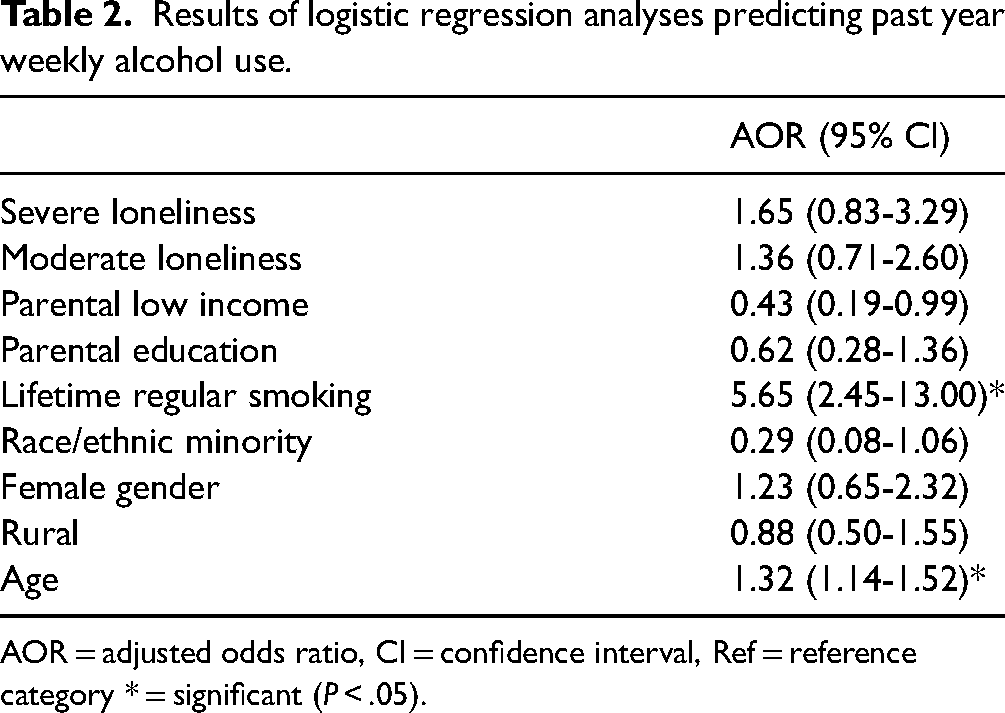
AOR = adjusted odds ratio, CI = confidence interval, Ref = reference category * = significant (P < .05).
Results of logistic regression analyses predicting past year binge drinking.

AOR = adjusted odds ratio, CI = confidence interval, Ref = reference category * = significant (P < .05).
Results
Table 4 provides information about the demographic characteristics of our study sample. Prevalence of alcohol use included: weekly alcohol use 25.5% (n = 79), binge drinking 11.0% (n = 34), and heavy alcohol use 40.1% (n = 127). Severe loneliness was reported by 25.5% (n = 79) of participants, 33.6% (n = 104) reported moderate loneliness, and 36.5% (n = 113) reported low levels of loneliness.
Descriptive statistics and sample characteristic of population (n = 310).
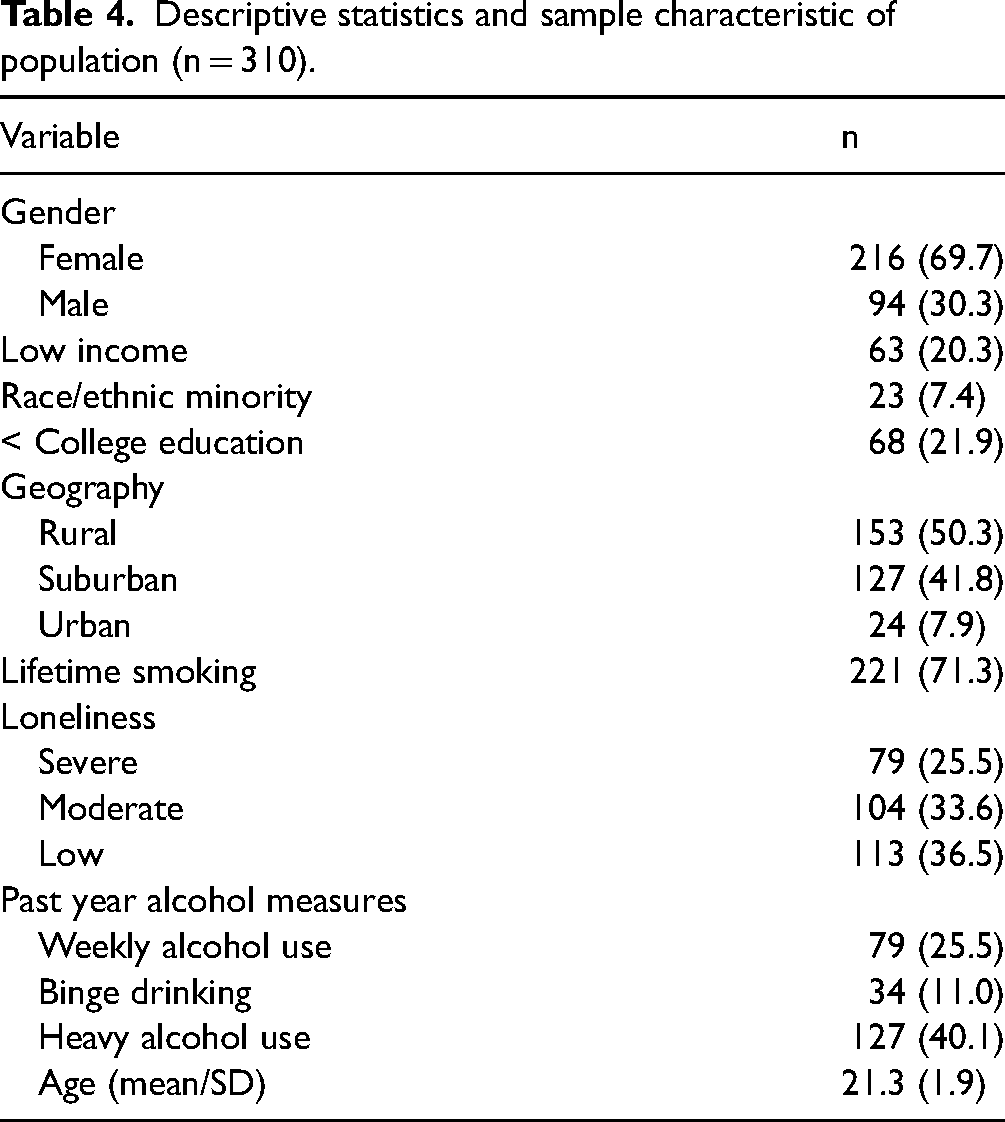
Table 1 shows the results of the regression models examining the association between loneliness and heavy drinking in the past year. Severe loneliness (AOR = 1.89, 95% CI [1.02, 3.50]) and lifetime smoking (AOR = 4.38, 95% CI [2.84, 15.38]) were associated with higher odds of heavy alcohol use. Loneliness was not associated with weekly alcohol use; however, age (OR = 1.32, 95% CI [1.14, 1.52]) and lifetime smoking (OR = 5.65, 95% CI [2.45, 13.00]) were associated with weekly alcohol use. Severe loneliness (AOR = 2.96, 95% CI [1.16, 7.51]) and lifetime smoking (OR = 4.68, 95% CI [1.85, 11.81]) were associated with increased odds of binge drinking.
Discussion
The goal of this study was to examine the association between loneliness and alcohol use outcomes using a sample of college students from Central Appalachia, USA. The findings of this study suggest that severe loneliness was linked to more severe forms of alcohol use, including binge drinking and heavy alcohol use, while significant associations were absent when examining weekly alcohol use. Loneliness has emerged as a major societal issue, particularly among younger populations. 12 These problems were further exacerbated during the COVID-19 pandemic. In particular, college students struggled to put down their roots without a sense of belonging and were burdened with feeling socially isolated and lonely. In addition, loneliness has been linked to poor health behaviors including drug and alcohol use. 29 Since links between loneliness and alcohol use are already known, the current study examined the levels and frequency of alcohol use, which are important to understand, particularly for interventions. Appropriate screening in primary care settings can help identify treatment goals. Treatment should be geared towards restoration of medical and social well-being by control of drinking and its consequences.
In addition, college students who reported greater loneliness were at a greater risk for reporting heavy alcohol use and binge drinking, but not weekly alcohol use. In other words, loneliness was associated with greater quantities of alcohol use in one setting, but not greater frequency of use over time. This is consistent with previous literature that found that college men who were lonely consumed more alcohol 30 and individuals with perfectionistic tendencies and loneliness reported more hazardous drinking. 31 Previous authors who found no association between loneliness and the number of binge drinking days among college students suggested that college students may not drink to cope with loneliness. 5 However, our results suggest that loneliness increases the risk for drinking in greater amounts rather than an increased risk for drinking more often (ie, frequency).
Finally, college students who report experiencing greater loneliness may be drinking to cope or alleviate the negative affect associated with loneliness. This is important because a large body of literature indicates that individuals who drink to cope report heavier drinking and experiencing more alcohol-related consequences. 32 College students who experience loneliness may also use alcohol as a social mechanism to facilitate greater feelings of connectedness with others. Previous research demonstrates that individuals who drink for social motives report greater alcohol consumption and hazardous patterns of drinking. 33 Taken together with the current results, future research should examine drinking motives as a potential mediator between loneliness and drinking behavior among college students.
These findings should be interpreted with consideration of the limitations of the study. First, data from this study was cross-sectional, and thus this study is unable to establish temporal relationships. As part year alcohol consumptions were included in the study, the timing of loneliness was not assessed. Second, the study was conducted during the COVID-19 pandemic, as drinking patterns or loneliness were not assessed prior to the pandemic. Due to this limitation, we were unable to assess the relationship between loneliness and alcohol use prior to the pandemic as a comparison group. Third, there may be self-report bias, as the results are based on participant response, rather than screening of individuals. In light of these limitations, the study highlights the importance of the potential consequences of loneliness and the importance for addressing these issues. More research is needed on older adults and substance use and deciphering which chronic diseases pose the most risk for negative healthcare outcomes.
Conclusion
Binge drinking, heavy drinking, and loneliness can have a profound impact on the well-being of college students and contribute to their chronic stress. The COVID-19 pandemic has left many students feeling isolated and disconnected, making them more susceptible to feelings of loneliness. To cope with these emotions, some students turn to binge drinking as a temporary escape from their struggles. However, this behavior comes with serious health risks. Binge drinking and heavy drinking can cause severe damage to the liver, increase the likelihood of accidents and injuries, impair cognitive function, and even lead to alcohol poisoning. Additionally, it can worsen existing mental health issues like depression and anxiety, creating a harmful cycle of loneliness and substance abuse. It is crucial for healthcare providers to approach these issues with empathy, actively screening for binge drinking and loneliness, and offering personalized interventions and support. By promoting healthier coping mechanisms, healthcare providers can help safeguard the physical and mental well-being of college students during these challenging times.
Footnotes
Declaration of Conflicting Interests
The authors declared no potential conflicts of interest with respect to the research, authorship, and/or publication of this article.
Ethical Approval
Ethical approval was provided by the East Tennessee State University Institutional (IRB) committee (approval 0221.16e-ETSU).
Funding
The authors disclosed receipt of the following financial support for the research, authorship, and/or publication of this article: This work was supported by the Research and Development Committee, East Tennessee State University, (grant number RDC #20-014SM).
