




Abstract
The text consists of an analysis of how the classical Greek sites of Marathon, Thermopylae, Delphi, Olympia and Mycenae are staged and presented to the public. This analysis is focused upon how the cultural heritage management views the authenticity of these sites and their physical remains, (i.e., as genuine) phenomenon firmly, and solely, belonging to the past, and how these attitudes are materialized in the form of presentations at information boards and in the physical staging of the sites. The materialization of this attitude constitutes the conditions for the public’s physical and imaginative access to the sites and for the public’s possibility to reflect critically around them. Thus, the sites are products of the past, but their authenticity is in parallel also a product of its role in present negotiations of interpretive supremacy, control, power and politics. The article further stresses that a changed attitude towards authenticity is crucial also for a development of a constructive relationship between heritage management and the public. In accordance with this, the article also presents a reconstructed view of authenticity—as the cultural process constituting both humans and material remains.
Introduction
Since the end of the nineteenth century, a quite unproblematic attitude to the content of the concept of authenticity has existed within the fields of antiquarianism and heritage management in the Western world. The authenticity of objects and physical remains has been based on an assessment of whether they are considered original, genuine and true witness of the past or not. This in the sense that they are truthful in relation to their origin concerning chronology, material, shape, primary-context and use (cf. Holtorf, 2013; Jokilehto, 2006; Jones, 2010; Pye, 2001). This attitude implies that authenticity is something that the object or remain carries in itself as an essence. Given the strong status that this view holds, it is not surprising that it also has formed the basis for UNESCO’s work on World Heritage sites (Petzet, 2004; Pye, 2001). Not at least in the development of the ‘authenticity tests’ and the Operational Guidelines which was, and still is, a key tool in the assessment of nominations to the World Heritage List and where the evaluation of authenticity is based on the four parameters: design, materials, workmanship and setting (Jokilehto, 2006; McBryde, 1997; UNESCO, 2018a). Thus, in this view of authenticity, there reigns a strong focus on materiality and authenticity is regarded only as something that the materiality carries in itself.
During recent decades, this view of authenticity has been criticized as too generalized and entrenched in Western thought (cf. Holtorf, 2005; Harrison, 2012; Holtorf & Schadla-Hall, 1999; Jones, 2010; Lowenthal, 1985, 1997; Shanks, 1998). This has led to a number of UNESCO-funded conferences, where one of the goals has been to find a suitable definition of the concept of authenticity that can be used globally in various heritage management contexts. A turning point in these discussions is undoubtedly the Nara Conference on Authenticity which was held in 1994 and that leads to a relativizing of the contents of the authenticity concept through an acceptance of the fact that the attitude towards authenticity must be placed in a historical and cultural context and that authenticity, therefore, can and may mean different things (Larsen, 1995; Lowenthal, 1995; Jokilehto, 1995). The results of this conference are manifested in the Nara Document on Authenticity that stresses that authenticity should be regarded as a cultural product and that authenticity can be linked to a range of information sources (UNESCO, 2018b). However, this document is ambiguous since the traditional view of authenticity is questioned through a relativizing and a contextualization of the content of the concept, while the evaluation criteria predominantly are traditional. Despite this, the results of the conference have been central in discussions regarding authenticity during the last two decades and its reasoning of the relative nature of authenticity is repeated in a variety of documents, for example, in; the Burra Charter and the Convention for the Safeguarding of the Intangible Heritage (ICOMOS, 2018a; Smith & Akagawa, 2009). In 2008, ICOMOS ratified the Charter for the Interpretation and Presentation of Cultural Heritage Sites (often called the Ename Charter), which seeks to find common globally valid ethical principles for public communication and presentation of cultural heritage sites. In this, issues concerning authenticity, and the tension between heritage management and audience, as well as the preservation and accessibility, public tenant and participation in cultural processes are approached (ICOMOS, 2018b). This, since the charter considers all types of conservation-and management-processes at prehistoric, remains as a contemporary socially and contextually influenced communicative act. The interpretation of the charter therefore is an attempt to translate the Nara Document and the Operational Guidelines into practice. The document focuses on: the communicative relationship between heritage management and public, people’s participation, the public’s interpretation and use of the cultural heritage throughout history. Moreover, the acceptance of alternative viewpoints and stories about the remains, and the realization that cultural heritage sites are included in social, economic and political contexts, means at the same time that the authenticity is relativized in line with the Nara Document. These discussions have also, primarily from the 2005 version, in varying degrees, come to settle in the Operational Guidelines (UNESCO, 2018a). Alongside the traditional authenticity criteria, there are now also other important sources of information, which suggests a broadening, where authenticity is not only regarded as bound to objects, materials or places, but that it also consists of people’s approach to objects, materials and locations (Alberts & Hazen, 2010). The discussions of the content of the concept of authenticity have thus, since 1995, been a central theme in the discussion, but these normative efforts do not seem to have had a major practical impact.
These discussions, coincide with, and have connections to, the overall academic anchored archaeological discussion, where traditional orientations and approaches from the middle of the 1980s have been challenged by, and supplemented with, various forms of critical and reflexive reasonings. These approaches focus on both the interpretation of the past and on the politically and ideologically influenced relationship between past and present, and the ideological and political use and abuse of the past and its materiality in contemporary creation of identity on different levels (cf. Hodder, 1992a, b; Shanks, 1992; Shanks & Tilley, 1987a, b; Tilley, 1993). That different aspects of heritage, its construction and contemporary use at regional, national and global levels represent a growing archaeological research field is in this context unsurprising. And it can be concluded that these discussions have come to approach a wide range of topics related to various forms of heritage and its place in contemporary society (cf. Biehl, Comer, Prescott, & Soderland, 2014; Carman, 2005; Grundberg, 2000, 2004; Harrison, 2010, 2012; Holtorf, 2005, 2007, 2011; Schofield & Cocroft, 2007; Skeates, 2000; Smith, 2004, 2006; Smith & Waterton, 2009; Waterton, 2010). One theme that has been discussed within the framework of this heritage-oriented research approach is the question of the content of the concept of authenticity and the cultural heritage sector’s attitude towards it. As we have seen above, until the mid-1990s, the heritage management generally had a material and objective attitude towards authenticity where authenticity was seen as the originality, genuineness and truthfulness of an object or remain and as something that the object or remain carried in itself as an essence. This attitude has, however, been challenged by a reflective constructivist approach that asserts that all types of material expressions originating in the past, is a part of contemporary cultural processes where they are interpreted, staged and communicated in the context of specific contextual anchored approaches, meanings and narrations. This reasoning means that the authenticity of material expressions is not a phenomenon that they carry with them on their own, rather that, specific contemporary interpretation acts and cultural processes construct their authenticity. These arguments are also often anchored in a critical approach that emphasizes that the power of the interpretations of the past, and thus also of the material remains, lies in the hands of the heritage management and that the public and other interest groups are excluded from the opportunity to create their own understanding and their own conclusions. The prehistoric remains are therefore seen as the scene of a power struggle between the professional heritage management and other stakeholders and authenticity is used as an argument by the former to dominate the latter (cf. Gustafsson & Karlsson, 2004a–d, 2006, 2008, 2012; Guttormsen & Fageraas, 2011; Harrison, 2010, 2012; Hafstein, 2004; Holtorf, 2005, 2013; Holtorf & Schadla-Hall, 1999; Jones, 2004, 2009, 2010; Lowenthal, 1985, 1997; Smith, 2004, 2006). This is an important issue since heritage sites at different levels contribute to the creation of identity in the contemporary world, an identity which on the individual level can be filled with different contents and make the public passive receptive or active reflexive, depending on the attitude towards authenticity that are highlighted on the sites. The central problem with a purely constructivist approach is that it runs the risk of leading to a Western-anchored subjective anthropocentrism, where the individual act of interpretation is implemented without much regard to the interpreted materiality. This means that in more extreme forms, that materiality becomes secondary in relation to the culturally anchored interpretation, which is a gross simplification of the relationship between people and things.
At first glance, it might seem that these two perspectives—a material essentialist and a reflective constructivist—to the content of the concept of authenticity are impossible to reconcile. However, the last few years have seen a number of interesting contributions on a general theoretical level regarding ‘symmetrical archaeology’ and ‘flat ontology’ and the circumstance that in our being-in-the-world we are crucially interwoven with and related to long dead human beings as well as their material belongings on a basic existential level. Therefore, we need to deconstruct the opposition between humans and things and approach things, and our relationship to them, in a more profound manner that hitherto done (cf. Harrison, 2012; Hodder, 2012; Olsen, 2010, 2012; Olsen, Shanks, Webmoor, & Witmore, 2012). These approaches seem to be able to go beyond the dichotomies between subjectivism and objectivism, and material essentialism and reflective constructivism, and they may be of great value when discussing the concept of authenticity. This is not explicitly done, but there have also been interesting contributions trying to break down these dichotomies when it comes to the content of the concept of authenticity (cf. Holtorf, 2013; Jones, 2009, 2010). In short, neither Jones nor Holtorf are completely able to break free from the positions they criticize. This, since Jones, seems to end up in a softer form of material essentialism and Holtorf in a redefined version of constructivism. Despite this critique, which we present without going into details, it shall be underlined that both Jones’ and Holtorfs’ approaches are valuable contributions to this important discussion.
The Staging of Authenticity
The discussion of authenticity and its conditions may take place on a purely theoretical level, but the most effective way to get at the issue is to approach, visit and analyse heritage sites, where the ideas of authenticity and cultural heritage and its management are put to practice. At these sites, it is possible to examine the materialization of the attitudes to authenticity and how these attitudes influence the public’s physical and imaginative access to the remains. Thus, it is also possible to analyse in which manner the public receive possibilities for reflecting critically round the remains at the site, as well as the communicative relationship between heritage management and the public, and the impact of policy documents.
With this intention, we have visited and analysed five classical Greek sites of historical significance. The sites analysed are Marathon, Delphi, Olympia, Thermopylae and Mycenae. In various ways, these places and their material remains have been ascribed a huge historical significance for Western culture. They do also play a central role in literature and art, as well as in different kinds of popular culture such as TV-series, movies and computer games.
Methods
When we carried out our case studies, in May 2018, we decided, on the theoretical and methodological level, to take our departure in the approach of Ethnography of Archaeological Practice (cf. Edgeworth 2003, 2006). The general starting points are here that as a scientist trying to turn the archaeological gaze towards the own business practice and treat it with the same starting point as if it were a temporally or geographically alien culture. If we try to turn our outward looking gaze inwards and reappraise our everyday activities, we could conclude that archaeology (not least in the form of the practical management of cultural heritage) contains a tremendous amount of unusual and strange socially and culturally embedded rituals and activities. These produce not only material culture (artefacts) in various forms, but also specific social relationships between different actors. In recent decades, different aspects of these socially and culturally embedded archaeological activities and their material remains have been studied within the framework of different reflexive approaches and methodologies that, on a general level, have a common ground in ethnographical ideas and methods (cf. Carver, 2004; Edgeworth, 2003, 2006; Gero, 1994, 1996; Goodwin, 1994; Gustafsson & Karlsson, 2004a–d, 2006, 2014; Holtorf, 2002, 2005, 2012; Jones, 2004, 2006, 2010; Karlsson, 2008; McClanahan, 2004; Olsen, 1993; Shankland, 1997; Yarrow, 2000). If one visits and approaches heritage sites in an ethnographical way, the routine activities carried out by contemporary heritage management practitioners at some of these sites can seem very strange. However, if we only look at these activities as archaeologists, we run the risk of becoming culturally and contextually blinded. We are convinced that an ethnographical approach, and ethnographical methods, if applied to archaeology on a general level, can teach us something about ourselves and about archaeology as a social, cultural and existential activity carried out in the present. In an ethnographical approach towards our own cultural practice and everyday activities at heritage sites, we can use a number of methods that are quite unconventional for archaeology. For instance, participating observation, analyses of socio-geographical movements of visitors, questionnaires, interviews, text analyses of information and information-boards, pamphlets, etc. (cf. Carver, 2004; Edgeworth 2003, 2006; Gustafsson & Karlsson, 2004a-d, 2006, 2014; Jones, 2004, 2006; Karlsson, 2008). In this study, we will not use the whole arsenal of methodologies within the approach, since we will stick to on-site surveys of: text analyses of information-boards and ocular observations of the physical staging of the sites.
The approach is not without theoretical and methodological problems. Questions concerning participant observation, ethical considerations in the study of active people in the cultural heritage management and the problems of self-liberation from what one is studying are common (ibid.). During our on-site visits, we tried to approach the sites as ordinary visitors, which naturally contain a number of methodological problems, but despite these shortcomings, we have found this approach very fruitful. Specifically, we focus the physical staging and content of information boards at the sites and at each site, these phenomena have been analysed within the framework of the four variables (some of those gathered directly from the Ename charter): (a) general information, (b) staging (physical access), (c) content of information boards texts (imaginative access), (d) threats and safeguards. These variables are subdivided into a number of categories, but it would lead too far to present them all in this context. There are of course other aspects that could have been taken into consideration when visiting the sites, but we judged the ones chosen as the most obvious during the visits as well as when recapitulating on it afterwards. And we feel that the aspects, phenomena and material considered contributes to a picture concerning the materialization of the attitude towards the content of the concept of authenticity held by the cultural heritage managements at the sites.
Analysis of the Sites
We visited the Greek sites of Marathon, Thermopylae, Delphi, Olympia, and Mycenae in May 2018. We can conclude that there are both similarities and differences when it comes to their physical staging and the content of their information boards. This is since three of them; Delphi, Olympia and Mycenae are classified as World Heritage sites, while the other two, Marathon and Thermopylae, do not have this classification. Thus, there exist both general similarities and important differences concerning the attitudes towards the content of the concept authenticity, as well as in the materializations of these attitudes. These materializations take on the form of a physical staging that constitutes the conditions for the public’s physical access to the remains, as well as the content of the texts on the information boards that influences the public’s imaginative access to the remains. Thus, it is possible to analyse in which manner the public receive possibilities for reflecting critically round the remains, how the relationship between the heritage management and the public looks like, and to what extent, the post-Nara discussions and the Ename Charter are implemented at the sites. However, let us return to this discussion after a brief presentation of each site.
Marathon
At the plain of Marathon, in 490
Today, the plain of Marathon holds a number of remains and memorials, for instance, ‘the Trophy of the Marathon victory’ and ‘the Tumulus of the Marathon warriors’. The Trophy, that is a 10 m. high column of white marble is fully accessible, and it is accompanied by two information boards, that, among others, tells the visitor that it was ‘erected near the spot of the final destruction of the Persians’ some years after the battle.
Ill. 1. The Trophy of the Marathon Victory.
The text also tells that the actual Trophy is a reconstruction, and that some parts of it historically have been used in a nearby church, and that parts of the original reside in the nearby museum, but it is unclear when it was reconstructed. In this case, it is the spot and its surroundings, not the actual monument, which is authentic. The phrase ‘near the spot’ does also implicate an openness concerning the fact that there does not exist a totally secure localization. Temporality and the continuous use of the Trophy by various groups throughout history are also presented as something valuable. The visitor can also approach the Trophy and its surroundings without any hindrances.
Concerning the Tumulus, it is located adjacent to the municipality of Marathon, it is surrounded by a high fence, and the visitor must both pass and pay at the entrance gate. Close to the entrance is a bronze statue of a classic Greek soldier in full battle gear. Even if it is not stated, it is evident that the Greek general Miltiades, who lead the forces at Marathon, or it can be an ordinary soldier that is portrayed.
Ill. 2. General Militades or an Ordinary Soldier.
Ill. 3. Signpost at the Tumulus of the Marathon Warriors.
At the entrance, a signpost tells the visitor how to behave at the site, and the visitor are guided to the tumulus via gravel paths, no drinking or eating, no smoking, no pets, no handbags, and no climbing on the monument. The Tumulus itself consists of an earthen mound that is said to hold the remains of the Greek soldiers that fell during the battle of Marathon.
Ill. 4. The Tumulus of the Marathon Warriors.
The two remains visited at Marathon show that the heritage management has different attitudes towards the authenticity of these remains. The view of authenticity materialized at the information board at the Trophy is more open and relative, while the materialization at the Tumulus holds a more traditional and closed view of the concept. This leads to differences concerning both the physical and the imaginative access that the public has to these sites. We will return to this below.
Thermopylae
At Thermopylae, in 480
Today, a motorway divides the plain of Thermopylae, but it holds a number of remains and monuments both from the battle in 480
Ill. 5. The Battlefield at Thermopylae.
The monument consists of a c. 20-m-wide and c. 3-m-high marble wall adorned with statues and friezes and coroneted with a bronze statue of King Leonidas, in full battle gear and with a raised javelin, in its centre.
Ill. 6. The King Leonidas Monument at Thermopylae.
Ill. 7. The Information board Adjacent to the Monument.
The text at the adjacent information board presents the visitor with information concerning the battle and its phases, and this is done in a clear nationalistic and self-assured scientific, manner. For instance, the text is not critical to the historical sources such as Herodotus information that the Persian army consisted of 1,700,000 soldiers, something that seems as a grave exaggeration. The nationalism comes forward in phrases such as:
/…/decided to fight against the Persians and win or die defending the freedom of their country/…/the Persians asked the defenders to give their arms up, but Leonidas replied to them with the heroic phrase COME AND GET THEM. This phrase has been, and will always be, a bright example for generations to come, of one’s doing his duty for his country. After a desperate fight the Spartan leader died. The rest of the Greeks, who had escaped death defending themselves, retreated to the hill of Kolonos. There, all of them fell fighting bravely. During the 1st century A.D., the philosopher Apollonios Tyanefs visited Thermopyles. Someone asked him which was the highest mountain in the world. He answered: “Kolonos is the highest mountain in the world, because on this mountain the law keeping and the noble self-sacrifice have put up a monument, which has its base on the earth and reaches the stars”.
Ill. 8. Kolonos Hill, with the Absent Inscription.
Ill. 9. Signpost.
Temporality and the continuous use of the site as a battlefield at various occasions throughout history are also presented as something valuable. Thus, the attitude towards authenticity materialized in the information board is influenced by a secure scientific tone, and nationalistic arguments, and the visitor´s imaginative access to the site is hampered since there are no openings for critical reflection. At the other hand, the physical access to the monument, the area of the battle and the Kolonos hill are totally open, and there are just a few signposts mentioning dos and don’ts. Thus, the staging and materialization of the view of authenticity at the site of Thermopylae show a closed imaginative access, but at the same time an open physical access. We will return to this further on.
Delphi
The site of Delphi was a central religious and political centre in prehistoric, as well as classical Greek and Roman times, and it was in function during the period of c. 1400
Since 1987, UNESCO has classified the ancient remains at Delphi as World Heritage and this has led to a high level of protective measures. One must both pass and pay at the entrance gate, where a signpost tells the visitor of the dos and don’ts at the site, and wires/fences, stairs, paths/roads and signposts lead the visitor to a well-designed odyssey around the enclosed site and its central monuments. The visitor walks both up and down the slope of the site at the only transitable pathway. This hinders the visitors’ free movement on, and physical access to, the site since it can only be experienced in a predesigned manner.
Ill. 10. Signpost at the ‘Sacred Way’.
Ill. 11. The Temple of Apollo.
The site contains a high number of enlightening information boards, but at the same time, the site and its different remains and structures are presented in a self-assured scientific manner, that leaves no doubts or openings for reflections. A number of the boards emphasize the importance of Delphi for humanity, for instance its ‘impact on the progress of civilization’. The temporality and the continuous use of the site by various cultures throughout history are also presented as something valuable. It is also interesting to note that the third language besides Greek and English is French, something that reflects the French archaeological interest in the site. The statement is that the site was excavated in the late nineteenth century, but none of the information boards mentions the modern reparations and renovations undertaken at the remains of the site. The absence of this information gives the visitor the impression that the site has been unmanipulated since ancient times.
Ill. 12. Information Board at the ‘Sacred Way’.
Ill. 13. Modern Reparations.
Adjacent to the site, but outside the enclosed area, lies the archaeological museum that exhibits artefacts from the site, and there are also a souvenir shop and a restaurant. Thus, the site of Delphi holds a traditional view of the content of the concept of authenticity as materialized in the physical staging of the site as well as in the content of the texts at the information boards.
At Delphi, there are clear manipulations and staging of the site in such a way that the public’s physical and imaginative access to, and experience of, the site is limited in various ways. The texts at the information boards do also present the public with a self-assured scientific language without ambiguities or uncertainties and there is no room for local traditions or narrations or for a presentation of the present political and social context of the site. Nor is there any room for the visitor’s own interpretation, reflections and/or unexpected ideas.
Olympia
Olympia was an important religious and political centre during the classical Greek and Roman period, and it is perhaps most famous for the athletic games that were organized at the site every fourth year during the period of c. 800
Ill. 14. At the Entrance to the Site of Olympia.
In 1989, the site and its monuments were classified as World Heritage by UNESCO and with this followed, as in the case with Delphi, a high level of protective procedures. One must both pass and pay at the entrance gate, where a signpost tells the visitor of the dos and don’ts at the site. Paths and roads exist at the site, and some areas and monuments are inaccessible, but it is possible for the visitor to use this intern infrastructure freely and approach different structures and remains from different directions. Thus, the visitors’ physical access to the site and its monuments is open. One can, for instance, take a run on the stadium.
Ill. 15. Information Board at Olympia.
The site contains a number of educational information boards, but at the same time, as was the case at Delphi, the site and its different remains and structures are presented in a self-assured scientific manner, which leaves no doubts or openings for reflections. A number of the boards stress the importance of Olympia for humanity, and for the present society. For instance, it is stated, that Olympia:
/…/was the cradle for ideals, which characterized the Humanity through centuries, such as noble rivalry and fair playing. By implanting these values, Olympia, since antiquity and to eternity, teaches the mankind to seek and achieve moral ‘kotinus’—triumphs.
The temporality and the continuous use of the site by various cultures throughout history are also presented as something valuable. The third language besides Greek and English is German, something that reflects the German archaeological interest in the site. However, none of the information boards mentions the excavations taking place at the site since the late nineteenth century, and that modern reparations and renovations have been undertaken at structures and monuments. The absence of this crucial information gives the visitor the impression that the site has been unmanipulated since ancient times.
Ill. 16. Visitors Adjacent to the Temple of Zeus.
Ill. 17. Modern Manipulations at the Temple of Hera.
Close to the site, but outside the enclosed area, an archaeological museum is situated, which exhibits artefacts from the site, and there is a souvenir shop. It is interesting to note that the museum does not exhibit any form of remains from the athletic activities at the site, and that these activities are downplayed on behalf of architecture and art. A welcome centre is in full decay between the museum and the site, probably remains from the Olympic game in 2004 when both the men’s and women’s shot-put competition take place at the stadium.
Thus, the site of Olympia holds a traditional view of the content of the concept of authenticity as materialized in content of the texts at the information boards. At the same time, the physical staging of the site materializes the same attitude towards authenticity, but in a more open manner. There are clear manipulations and staging of the site in such a way that the public’s physical, but foremost their imaginative, access to, and experience of, the site is limited in various ways. The texts at the information boards do also present the public with a self-assured scientific language without ambiguities or uncertainties and there is no room for local traditions or narrations or for a presentation of the present political and social context of the site. The focus is on the relevance for humanity. Nor is there any room for the visitor’s own interpretation, reflections and/or unexpected ideas.
Mycenae
In the 2nd millennium
In 1999, the site and its monuments were classified as World Heritage by UNESCO and with this followed, as in the case with Delphi and Olympia, a high level of protective procedures. The visitor pays at the entrance gate, where an informative signpost tells about the dos and don’ts at the site. Paths and roads exist at the site, and some areas and monuments are inaccessible, but it is possible for the visitor to use this intern infrastructure freely and approach different structures and remains from different directions. Thus, the visitors’ physical access to the site and its monuments is open.
Ill. 18. Information Board at Mycenae.
The site contains a number of educational information boards. Some of them present the site and its different remains and structures in a self-assured scientific manner that leaves no doubts or openings for reflections, while others show some ambiguities concerning the interpretation of certain structures.
Preserved to the south of the water-tanks are large porous blocks, probably belonging to a building of sacred character dedicated to either the hero Perseus or the Goddess Hera.
A number of the boards stress the importance of Mycenae for humanity. For instance, it is stated, that;
The two most important centres of the Mycenaean culture dominated the Eastern Mediterranean from the fifteenth to the twelfth centuries BC and played a vital role in the development of the culture of Classical Greece. The two citadels are indissolubly linked with the Homeric epics, the Iliad and the Odyssey, that affected European art and literature for more than three millennia.
Ill. 19. Visitors at Mycenae.
Ill. 20. Information Board at Mycenae.
The long temporal use of the site is presented as something valuable. Thus, the site of Mycenae holds a traditional view of the content of the concept of authenticity as materialized in the content of the texts at the information boards as well as in the physical staging of the site. Generally, the texts at the information boards do present the public with a self-assured scientific language without ambiguities or uncertainties and there is no room for local traditions or narrations or for a presentation of the present political and social context of the site. However, there are also information boards that show ambiguities. This at the same time as the physical staging of the site materializes the same attitude towards authenticity, but in a more open manner. There are clear manipulations and staging of the site in such a way that the public’s physical, but foremost their imaginative, access to, and experience of, the site is limited in various ways. The focus is on the relevance for humanity.
Discussion
UNESCO classifies three of the sites (Delphi, Olympia and Mycenae) as World Heritage sites and therefore they have much in common when it comes to the view of authenticity and the materialization of this attitude in the publics’ physical and imaginative access to the sites. This at the same time, as two sites (Marathon and Thermopylae), does not hold this classification. However, there are also a number of similarities between these two types of sites. We would therefore like to classify the five sites in a common scheme according to their openness and closeness, by focusing on the view of authenticity as materialized in the public’s physical and imaginative access to the remains (see Table 1).
We refer to closed (C) as a materialization of the traditional view of the content of the concept of authenticity in the form of a closed physical and imaginative access to the remains, and to semi-open (SO) and open (O), where there exist ambiguities in the texts at the information boards, and/or in the public’s possibility to access the remains at the sites more freely.
The Openness and Closeness of the Sites
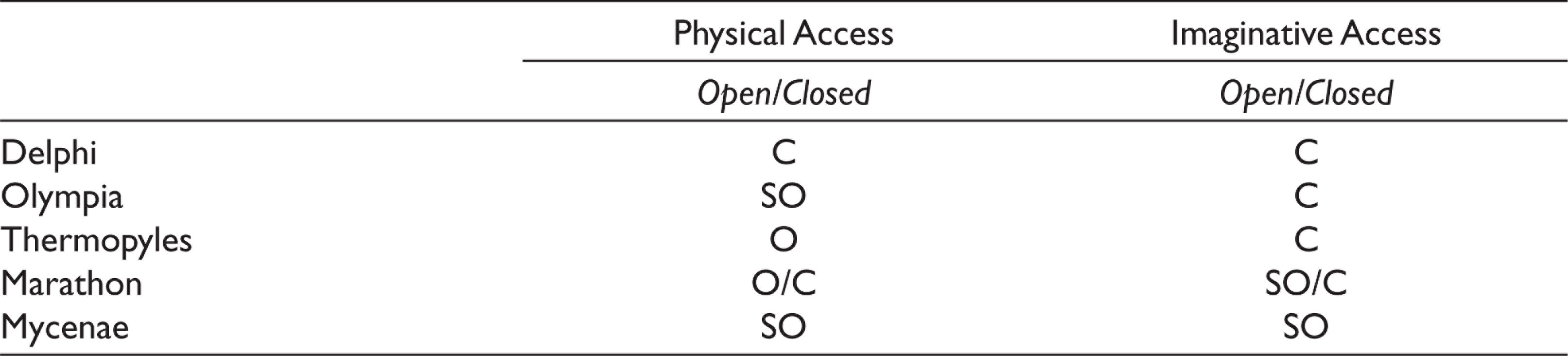
Generally, it can be said that the main source of information at all of the sites is the texts presented at information-boards. All of the sites demonstrate a traditional view of the content of the concept of authenticity as materialized in the text content of the information boards and they therefore hamper the visitor’s imaginative access to the remains of the sites. At Delphi, Olympia, Thermopylae and at the Tumulus at Marathon the texts stresses the site’s uniqueness and importance for humanity. At Olympia, the importance is directed towards the development of human ideals and their value for the contemporary society, at Delphi towards the progress of civilization, and, at Thermopylae, the significance of the site is presented in nationalistic terms. At these sites, the texts do also present the public with a self-assured scientific language without ambiguities or uncertainties and there is no room for local traditions or narrations or for the present political and social context of site. The exception is the nationalistic language and references in the text at Thermopylae. However, this authoritarian language does not open up for ambiguities or reflections. Nor is there any room for the visitor’s own interpretation, reflections and/or ideas. This monolog voice deepens the contradiction between past and present, between preservation and access, and between ‘experts’ and the public in a number of ways and these confident interpretations do also limit the public’s experience of, and imaginative access to, the site in various ways. However, the temporality and the continuous use of the sites by various cultural groups throughout history are presented as something valuable. Consequently, these sites are closed concerning the imaginative access of the visitor—the visitors are not encouraged to reflect about its own beliefs of the remains and they are not provided with a meaningful relation to it. Nor is the public stimulated to further learning or to its own interpretations. For the public, it is therefore not a question of using history and its material culture, and to be a part of living cultural processes, but rather about passively responding to the handling and staging of history and material culture by the experts of the heritage management. Thus, at these sites, and in accordance with the materialization of authenticity, we see nothing at all that recognizes authenticity as something ambivalent that can be viewed and understood from different perspectives as stated in, for instance, the Nara Document or the Ename Charter, nor do we see the communicative setting strived for in the later charter. However, exceptions can be found at the Trophy at Marathon and at some information-boards at Mycenae. At Marathon, the text indicates an openness concerning the fact that there does not exist a totally secure localization of the last stand of the Persians, and at Mycenae, there are ambiguities in what manner some structures at the site shall be interpreted. This is just small fragments of an invitation to the visitor to reflect around the remains, and they do not challenge the traditional view of authenticity, but in comparison with the other sites, it implies a step forward towards a more communicative relationship as strived for in the Ename Charter.
Delphi and the Tumulus at Marathon are clearly manipulated and staged in such a way that the public’s physical access to, and experience of, the remains of the site are limited in various ways. The public is distanced from the remains since wires/fences, stairs, paths/roads and signposts lead him/her at a well-designed odyssey around the site. It is a controlled odyssey; signposts guide the way and explain what behaviour is allowed, or rather not allowed. The possibilities for visitors to approach the remains from different directions, or in unexpected ways, are limited. It can be argued that this staging is done to strengthen the public’s access to site. Nevertheless, the remains are accessible even without ramps, paths/roads, signposts, etc. It may be that these arrangements are more of a way to control the visitors and their access to, as well as their experience of, the physical remains, and means to protect them. The same can partly be said concerning Olympia and Myceane. At these sites, the visitor must both pass and pay at the entrance gate, where signposts tell about the dos and don’ts at the site. Paths and roads exist at the sites, and some areas and monuments are inaccessible, but it is possible for the visitor to use this intern infrastructure freely and approach different structures and remains from different directions. Thus, the visitors’ physical access to these sites and their monuments is open. The difference is however obvious if comparing the sites above with the Trophy at Marathon and Thermopyles since at the sites the physical access to the former battlefields are very open and there are just a few signposts mentioning the dos and don’ts. Thus, at most of the sites, and in accordance with the materialization of authenticity, we do not see much that recognizes authenticity as something ambivalent that can be viewed and understood from different perspectives as stated in, for instance, the Nara Document or the Ename Charter, nor do we see the communicative setting strived for in the later charter. However, exceptions can be found at the Trophy at Marathon and at Thermopyles since at the sites the visitor is invited to experience the physical remains at the sites in a his/her own manner. This is just small fragments of an invitation to the visitor to reflect around the remains, and they do not challenge the traditional view of authenticity, but in comparison with the other sites, it implies a step forward towards a more communicative relationship as strived for in the Ename Charter.
We have already pointed towards the fact that the emphasis on a traditional material essentialist views on authenticity has come to be the basis for the Western antiquarian work and thus also for the construction of the World Heritage Convention. We have also stressed that since the middle of the 1990s there is a development towards a situation where the key policy documents regard authenticity from a wider perspective, and in a more relativized manner than is the case in the previously dominant perspective. Despite these legislative efforts towards a broader definition of the concept of authenticity and the trends towards greater public accessibility at heritage sites, we mean that the underlying perception of authenticity, as it is expressed in the antiquarian practice at the five sites analysed, still points to the concepts genuine, authentic, original and reliable. In our case studies, we have shown that this is the case since the traditional attitude towards the content of the concept of authenticity is to be found at a dominant part of the sites we have analysed. We have also shown that this attitude towards the content of the concept of authenticity is materialized in a physical staging that limits the conditions for the public’s physical access to remains at the sites, and in the content of the information board texts in such a manner that the public’s imaginative access to remains at the sites are restricted. Thus, the visitor’s possibility to reflect critically about the site and its remains is not encouraged at most of the sites. This means that even if there are promising developments, it is from our horizon clear that the full impact of the attitude towards authenticity as found in key policy documents such as the Nara Document, the Operational Guidelines and the Ename Charter has not yet been applied in practice at the five sites we have analysed.
However, at a majority of the five sites analysed, temporality and the continuous use of the sites by various groups and cultures throughout history are presented as something valuable. The acceptance of a longer temporality, and the historical and contextual dimensions of the sites and their remains, indirectly opens up for a notion that authenticity may also be culturally embedded in the present. The presence and acceptance of temporality and of a long cultural use of the sites and their remains are fruitful conditions for a relativization of the attitude of the concept of authenticity as well as for the key policy documents to be put to practice. At the sites analysed, the concept of authenticity is synonymous with long temporality and a continuous use. Most of the sites have a long temporality and all of them are still used in contemporary society. This in such a way that they are embedded in, and constitute important entities in, contemporary cultural activities, contexts and processes consisting of visitor flows, interest from different stakeholders, as well as academic work and interpretations, etc. This means that the content of the concept of authenticity at these sites can be considered to consist of the continuous relationship, and cultural process, between humans and the remains at these sites.
Conclusion: Towards a Renewed Attitude of Authenticity
We mean that the content of the concept of authenticity can be renewed and radicalized in a way where authenticity is considered as the continuous temporal relationship, and the cultural process, between humans and material culture. Here authenticity cannot be found in the material culture from the past or in the contemporary act of interpretation but in a fusion of these horizons. This attitude to authenticity means that authenticity can be materialized in new ways at heritage sites in such a manner that the public’s physical and imaginative access to the remains are widened and opened. This in a manner where past and present are not regarded as completely isolated entities and where the boundaries between professionals and the public are less marked. By emphasizing the historical dimension of the present, the interpretation of prehistory is not an exclusive right for the scientists (or for the cultural heritage management that handle it within the framework of key policy documents), and in a situation where both present and future for the visitor of heritage site seems perfectly possible to influence and change. This in a way were the public actively are using history and its material culture, and where the public is a part of a living cultural process together with the material remains. In short, this renewed attitude to the content of the concept of authenticity creates opportunities for the visitor of heritage sites to reflect critically in a manner where the present and the future are possible to influence and change. This alters the existential identity of the visitor in a radical way. We also mean that this renewed attitude towards authenticity is crucial for the future success of the Ename Charter, and other key policy documents and if it shall be possible to put them into practice at heritage sites or not, as well as for a future constructive relationship between heritage management and the public.
Footnotes
Declaration of Conflicting Interests
The authors declared no potential conflicts of interest with respect to the research, authorship and/or publication of this article.
Funding
The authors received no financial support for the research, authorship and/or publication of this article.