




Abstract
Indigeneity, as manifested in predominantly intangible African heritage, stands at odds with the modern heritage management style that, in South Africa, remains entangled in colonial practices. Like in other former colonies, commuting this distance between indigenous knowledge systems and Western-influenced heritage management practices is a treacherous endeavour that often opens a pandora’s box of issues relating to idealism versus practical applications, as well as the perceived chasm between decoloniality and professionalism in heritage management. In this article, we explore indigenous perspectives on understanding and managing cultural heritage in the Mapungubwe and Makgabeng cultural landscapes in South Africa. We explore missed opportunities and the remaining scope for incorporating indigeneity in state-based management systems that historically excluded indigenous communities from interpreting and presenting their past. We acknowledge the inherent difficulties in pursuing indigenously sensitive management systems after years of exclusion of indigenous people. As noted in our semi-structured interviews and focus group discussions (FGD), it is easier to accuse than to fix, but with a rich pool of collective memory, ritual practices and indigenous knowledge systems to draw from, those who dare to attempt this difficult task are poised to reach a vein of enriching archaeological heritage managements that state-based heritage management alone cannot access. Beyond idealism, the article still advocates for inclusive approaches to archaeology and heritage management as therapeutic strokes that can reduce the current distance between Western notions and indigenous perspectives of heritage management in South Africa.
Keywords
Introduction
In many postcolonial countries, authorized heritage discourse (AHD) still drives heritage practice (Smith & Waterton, 2012). Laurajane Smith defines AHD as the dominant Western discourse about heritage which focuses on (physical) things and is dominated by notions of monumentality and aesthetics (Smith, 2006, p. 4). By being ‘things-centred’, state-based heritage management tends to be exclusionary and not accommodative of indigenous input from local communities. Unfortunately, the exclusion of indigenous communities’ perspectives creates a palpable sense of loss that is felt when one zooms into heritage inventories, as well as heritage management philosophies, approaches and presentations (Chirikure & Pwiti, 2008; Jopela, 2023; Ndlovu, 2009; Ndoro, 2001). However, decolonizing heritage management, though necessary, is not always straightforward and easy. In this article, we explore how indigenous voices and collective memory (or indigenous knowledges) could inform professional heritage management in South Africa. Additionally, we explore the missed opportunities when heritage management was modernized and entrenched in state systems in South Africa and how the difficult task of incorporating indigenous voices in the heritage management system could be done.
In much of Africa, heritage and archaeology are disciplines with several concepts that remain etched in foreign (Western) concepts (De Cesari, 2010). Western notions of heritage are often skewed in favour of fancy objects of knowledge and aesthetic pleasure at the expense of others (Choay, 2001). This focus is detrimental to indigenous perceptions of heritage that focus on ritual and spiritual engagements (Ndlovu, 2009; Smith, 2006). While Smith (2015) posits that all heritage should be understood and appreciated as immaterial and intangible, many now agree that African heritage from non-literate societies is embedded in indigenous knowledge systems, in which the past is stored and shared through names, songs, poems, totemism, rituals/taboos, storytelling, landscape/memory mapping, folklore, traditional rites, heroism, sacrifices, negotiations and games (Pwiti & Ndoro, 1999). It is clearly not always possible to retrieve all these, but the exclusion of indigenous perspectives only impoverishes the reader.
The present study attempts to retrieve some of these indigenous forms of heritage to relate them to the state-based heritage statuses of the Mapungubwe and Makgabeng cultural landscapes in northern South Africa. These areas were chosen because they both have long histories of archaeological research and heritage management (Manetsi, 2023; Ndlovu, 2009).
The history of heritage management in South Africa, in general and the areas of study, in particular, is very telling. Archaeology was conceived at the height of prejudiced European colonial expansion, making it easier to overlook local African expressions while imposing foreign views and methods (Atalay, 2019; Manetsi, 2023; Williamson, 2020). Colonial and apartheid regimes in South Africa tightly controlled archaeological practices and heritage management (Tiley-Nel, 2018). During this period, indigenous people were often seen merely as labourers, and their contributions were disregarded (Manetsi, 2023; Ndlovu, 2009). Research findings, including those from Mapungubwe, were published in Afrikaans, a language that excluded non-Afrikaans speakers, such as indigenous and English-speaking communities (Tiley-Nel, 2018). Additionally, archaeologists sometimes concealed information about research sites to protect them from perceived threats (Marshall, 2002; Ndoro & Pwiti, 2001; Shepherd, 2003).
The apartheid expropriation of archaeological sites such as Mapungubwe by the state excluded and denied access to indigenous people who had an interest in the sites (Ndlovu, 2009; Tiley-Nel, 2018). This was compounded by the involvement of the military in the Mapungubwe Cultural Landscape during the height of apartheid and made the landscape a no-go area for indigenous people who had an interest in their ancestral sites (Meskell, 2012; Tiley-Nel, 2018). This segregationist philosophy limited indigenous participation in heritage management while commodifying the past for elite consumption (Byrne, 1991; De Cesari, 2010).
The discovery of gold objects at Mapungubwe in the 1930s generated public excitement and led to extensive archaeological expeditions, but South African heritage legislation at the time primarily supported colonial white supremacy and Afrikaner nationalism (Tiley-Nel, 2018). Thus, Mapungubwe Hill became a national treasure, for the colonial regime at a time when indigenous people could not have played any significant role in the research and management of archaeological sites in South Africa (Tiley-Nel, 2018).
Heritage Management in the Post-Apartheid Era
The eventual waning of colonial political power in South Africa did not reverberate to every sector (Ndlovu-Gatsheni, 2015). To begin with, an unfamiliar political system with entirely new boundaries and mandates than existed prior to colonization, ensued. The heritage sector, which had lost its traditional and localized management systems during colonial times, never regained its precolonial status but continued to be recognized and managed following Western notions adopted under colonial and apartheid rule. However, national and international legislations and conventions became the standard frameworks for engagement and operations (Manetsi, 2023; Seyhan & Russo, 2020). Opportunities for resetting the rules of engagement went begging as these legal frameworks fed off each other. Thus, the South African Heritage Resource Act of 1999 drew a lot of its inspiration from the United Nations Educational, Scientific and Cultural Organization (UNESCO)’s approaches for categorizing and prioritizing cultural heritage (Manetsi, 2023; Seyhan & Russo, 2020).
This South African heritage management involves planning by a government authority (South African Heritage Resource Agency (SAHRA) and its provincial agencies) mandated with the responsibility for setting goals and implementation without involvement of stakeholders (Smith, 2006; Seyhan & Russo, 2020). In keeping with state-based approaches that empower the national authorities’ powers to assign heritage perceptual values (Smith, 2006), SAHRA and its Provincial Heritage Resource Agencies (PHRAs) have not yet developed mechanisms to incorporate intangible heritage in their management framework (Jopela, 2023). Additionally, state-based heritage management is problematic as it relies on authority’s power to determine sites’ inclusion, which is influenced by lobbying and voting for its inclusion (Escallón, 2020)
This article argues that South Africa’s archaeological heritage management has largely relied on international and national organizations like SAHRA, causing decisions to be made by authorities rather than indigenous communities (Jopela, 2023). This has led to some heritages being omitted or considered irrelevant (Zhang, 2022). This could be true for the Makgabeng Plateau which, despite the numerous and magnificent rock art sites, took until recently to be nominated for national heritage status by SAHRA.
Despite increased calls for a bottom-up approach in heritage management, its operationalization has yet to be realized (Zhang, 2022). This is probably because many heritage managers and experts often lack the skills for effective community engagement, especially when in situations where communities may have conflicting agendas and interests (Chirikure & Pwiti, 2008; Holtorf, 2006; Jopela, 2023; Jopela, & Fredriksen, 2015; Mosheneka & Dhanjal, 2001; Pikirayi & Schmidt, 2016). All the same, Jopela and Fredriksen (2015) argue that undermining and sideling community input because of complex and competing interests is not the solution. There is a need to open the pandora’s box and explore ways to reconcile Western notions of heritage management with indigenous perspectives. For example, SANParks has made efforts to involve descendant communities in managing Mapungubwe (Mlilo, 2023). Nonetheless, indigenous communities are invited to contribute under existing power structures, without challenging the core issues of such hierarchical management (Zhang, 2022). This article explores the need for deeper integration of indigenous communities in the research, management and presentation of heritage (Watkins, 2005; Watkins & Nicholas, 2014). In the context of heritage, what then is indigeneity and how can this be reconciled with modern state-based heritage management? At the risk of reducing complex notions to monolithic frameworks, indigeneity can be simplified as indigenous understandings and perspectives of archaeological cultural heritage (Ndoro, 2001). The additional caveat to indigenous heritage notions is vested in locating and retrieving the past through non-written forms of the past, such as songs, folklore, poetry and names (Harrison, 2010; Zhang, 2022). Because heritage values are culturally ascribed by particular people at a particular time and for various reasons, heritage management should aspire to connect with indigenous communities (Harrison, 2010; Smith, 2006).
Materials and Methods
The study explores the integration of indigenous knowledge and perspectives on heritage research into the AHD at two case studies in northern South Africa. The chosen cases are Mapungubwe and Makgabeng cultural landscapes.
Case Study 1: Mapungubwe
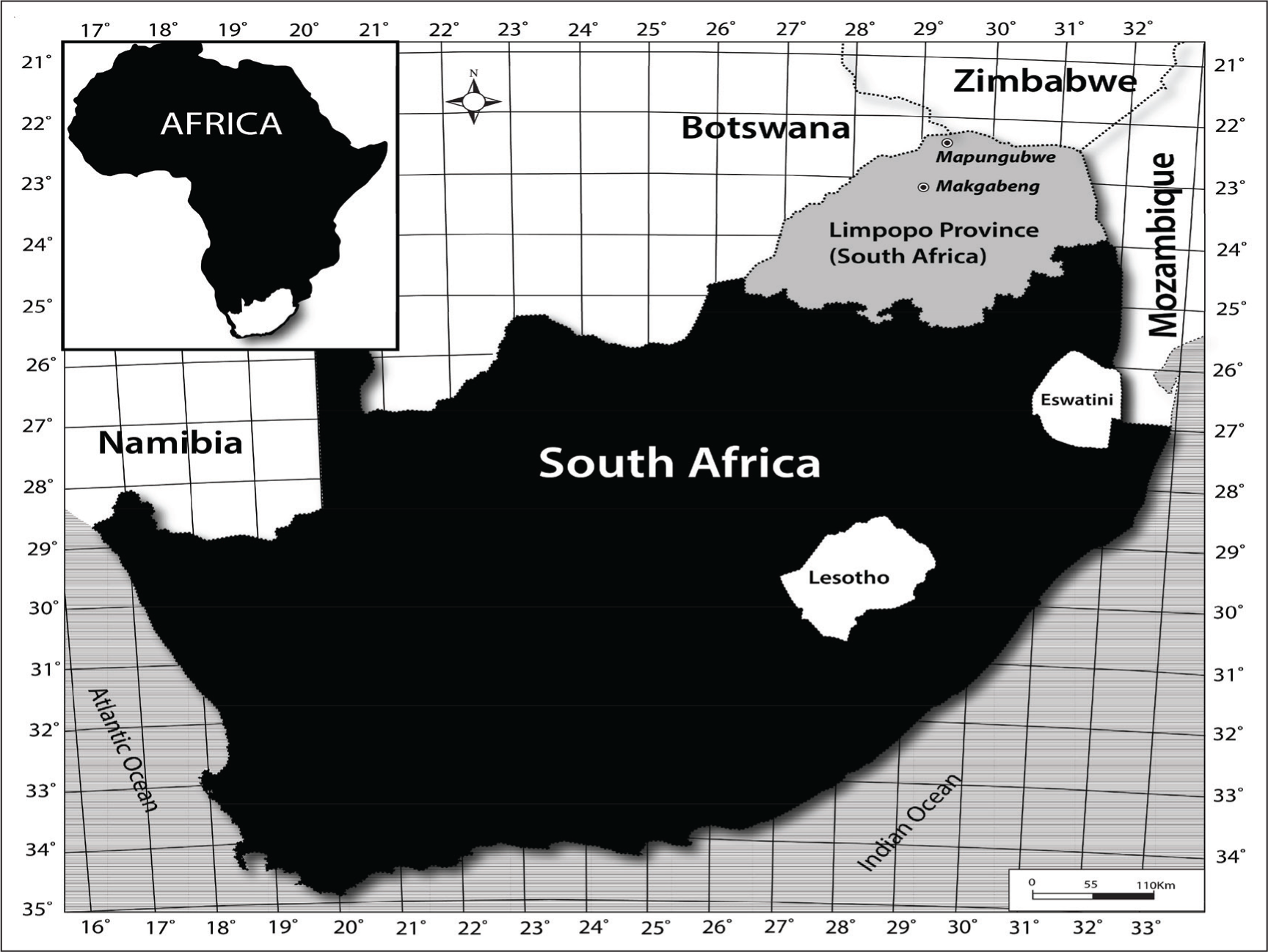
Mapungubwe is situated at the confluence of the Shashe and Limpopo rivers on South Africa’s northern border with Botswana and Zimbabwe. The area is archaeologically significant, particularly for the Mapungubwe site, a National and World Heritage estate located within Mapungubwe National Park, which is centred around Mapungubwe Hill (Huffman, 2005; Smith, 2006). Established as part of the Dongola Botanical Reserve in 1922 and later becoming a wildlife sanctuary, the area has undergone several name changes, culminating in the declaration of Mapungubwe National Park in 2004 (Carruthers, 2006). What is of significance in the context of this article is that during all this, at no stage were the inputs of indigenous communities considered (Meskell, 2012). The park is managed by SANParks, the South African Heritage Resources Agency and the Department of Environmental Affairs, and has experienced restrictions placed on access by the South African army in the 1970s and 1980s.
The archaeological record in the park dates to the Early Stone Age, with evidence left by various groups, including lithics, bone tools and rock art (Hall & Smith, 2000; Pollarolo & Kuman, 2009). The Late Stone Age communities likely integrated with Iron Age farmers around 900
Case Study 2: Makgabeng Plateau
The Makgabeng Plateau (Figure 1) is located on the western end of the Soutpansberg Mountain Range, southwest of Mapungubwe. The area is approximately 225 km² and has interesting geological phenomena with aeolian sediments dated around 2,000 million years (Eriksson et al., 2000). It was originally inhabited by the Stone Age people before the arrival of Iron Age communities around
Location of Area of Study.
Research Design
The study explores indigenous input in the face of state-based heritage management in South Africa. The article is based on a two-year ethnographic study conducted from 2022 to 2023, involving interviews, focus group discussions (FGDs) and limited participant observation during frequent visits to the Mapungubwe and Makgabeng Cultural Landscapes. Our interest in the study areas was inspired by Cultural Resources Management work conducted between 2008 and 2018, but both of us grew up experiencing similar heritage issues on the Zimbabwean side of the same landscape.
Sampling
The interviews focused on two broad groups: indigenous community members, on the one hand, and heritage practitioners (from SANParks and Blouberg Local Municipality) on the other. Participation was entirely voluntary, with 68% (n = 42) of participants coming from Makgabeng and 32% (n = 20) from Mapungubwe. Although the sample size was limited due to its voluntary nature, it was deemed representative of broader perspectives when analysed with hermeneutic methods. Purposive sampling was used to select participants based on age, knowledge, expertise and membership in community forums related to Mapungubwe. All participants were elderly, aged between 50 and 80, chosen for their extensive traditional knowledge of cultural heritage and management.
Data Collection Methods and Analysis
The methodology involved creating an interview guide that was translated into SePedi and TshiVenda, outlining the research purpose and voluntary participation criteria, as well as the research questions. Semi-structured, open-ended questions were used. FGD complemented individual interviews by bringing together individuals with shared experiences in indigenous heritage management (Sullivan, 2010).
SANParks heritage practitioners, familiar with their protocols, assisted in organizing interviews with descendant communities in the Mapungubwe Park Forum. Interviews and FGDs in the Makgabeng Cultural Landscape were organized through two key informants, Felix Mosebedi (a local resident) and Nguako Jonas Tlouama (tourism officer for Blouberg Local Municipality). Felix also assisted our seSotho translator (Lesiba Phahladira) during the interviews. Our choice of respondents grew from the snowballing process in which next interviewees were identified with the help of previous ones. Two FGDs were held in Makgabeng, one in each of the two villages (New Jerusalema and Ntabanantlana), while another two were conducted in the Mapungubwe Cultural Landscape, as well as one with the four heritage practitioners at SANParks.
The interviews and FGDs addressed several topics, including the identification, interpretation, evaluation, presentation, preservation and management of heritage sites, as well as opinions on heritage legislation and the role of descendant communities. The data were transcribed and analysed using thematic content analysis, focusing on patterns and themes (Burnard, 1991; Nowell et al., 2017). Common themes were coded after transcription. Ethics clearance for the study was granted by the University of Witwatersrand in May 2022.
Findings
This study investigates how indigenous perspectives could influence research, management and presentation of cultural heritage in South Africa. It compares indigenous forms and systems with contemporary heritage practices. Participants’ personal information was kept confidential as requested.
Physical Manifestations
All indigenous community participants stated that physical manifestations are proxies for the identification, interpretation and evaluation of components of heritage. One participant in particular (a 54-year-old Sotho-speaking man from the Mapungubwe forum group of Machete) went on to elaborate in an almost textbook fashion:
We identify sites through items like potsherds, grave markers, and old structures. Even cattle kraals can be seen at abandoned homes, cattle dung can be visible showing the shape of a kraal which will be big round or circle and no trees and grass growing.
The statement, though it might seem academic, reflects common knowledge among those from rural areas. Indigenous participants noted that everyday activities like navigating cultural landscapes, herding, gathering firewood and collecting berries or medicines often led to significant discoveries. As a Sematla participant (age 61) expressed, these routine tasks frequently resulted in noteworthy finds.
it is not only what you see at this sites, but also what you don’t see, such as plastic, written glass and metal cans, that tell you that you are looking at an old place from deep time.
In Makgabeng, indigenous participants noted that because rock art has not been practised in recent memory, so when they encounter it, they immediately know this is an old manifestation of culture. Physical features are obvious and easier to identify, but the reading of time, along with the interpretation based solely on the physical characteristics, is less palpable. One male participant from New Jerusalema village in Makgabeng, aged 78, said:
We can see that this was a big homestead for a polygamist, traditional healer, or chief by the location of the site and layout of the remains of structures.
Encounters of human activities away from modern habitation spaces always attract the attention of indigenous communities, as stated by one participant from (Sematla) Mapungubwe, aged 78.
All abandoned homes such as Mapungubwe, are still the abode of the homeowners’ spirits and their ancestors.
Thus, physical manifestations are inadvertent pointers to heritage.
Ritual Sites
Participants highlighted that many ritual sites in the Mapungubwe and Makgabeng Cultural landscapes are unknown or undervalued by heritage managers. These sites, which may be natural or man-made, are often only identifiable with the assistance of local indigenous people who use them. For example, in Sotho culture, certain natural shrubs are significant as they represent the spirits of the dead, a detail that outsiders might not recognize. A participant from the Makgabeng Plateau noted this cultural context:
This shrub is for my father; we took his sprit to guard us here at the home. Ancestral sprits reside in graves, mountains, caves, trees, boulders and animals such bulls.
Participants said the lack of knowledge by state heritage managers results in some sacred sites being destroyed or neglected by those who manage them. For instance, a male participant aged 56 from Mapungubwe gave an example of his ancestor’s grave, which was destroyed by SANParks employees.
SANParks employees destroyed the grave of Mosiri because they did not know the burial site. I know the site because my grandfather showed me the site where they conduct clan rituals.
This quote supports the fact that a lack of indigenous involvement can result in the destruction of heritage.
In terms of evaluation of cultural sites, all the indigenous participants affirmed that when it comes to physical manifestations of heritage, the size of the site or feature does not necessarily translate to higher significance because ‘It is the king that makes a place a palace, and not vice versa’, said one female interviewee (81-year-old) from the Makgabeng. They said, traditionally, cultural sites become important because of their spiritual significance. As one male participant from Mapungubwe, aged 78, explained, the ‘discovery’ of Mapungubwe through the local guide owes more to the place’s spiritual significance than physical manifestations because
Mapungubwe does not have major features and structures, it is a sacred site where our ancestors were buried, and we conducted rituals at the hill. Before the site was defiled supernatural sounds, such as the bellowing animals, the beating of drum and ululations were constantly heard. The name says it, it is the hill of bellowing jackals not a hill of kings. Do you think the archaeologists would have found it by looking for potsherds? It was my uncle Mokwena who showed Mapungubwe Hill to the settler farmers.
In the Makgabeng Plateau, local people, guided by ancestral teachings to respect rock art, helped discover some of these sites. A 66-year-old from the Thabanantlana village highlighted that knowledge about sacred sites is communally shared, with each household tasked with educating children about these places. The community collectively suffers from the consequences of desecration, like drought. Participants at the Thabanantlana FGD also noted that certain areas require permission from local custodians before visiting.
Participants lamented that many of their indigenous games and recreational activities have been lost because of modernism, for instance, their children cannot play games which their ancestors enjoyed, such as Morabaraba. One participant from Mapungubwe said, ‘Go to Mapungubwe hill and surrounding areas, you will see grooves on the rocks where our ancestors used to play the game’.
Indeed, participants confirmed that the game was popular and important to the past generations. Such an important dimension of the Mapungubwe cultural heritage landscape has not featured prominently in the archaeological research and presentation of the site.
Names
Participants stated that their system of naming things, places and people is also a heritage identification tool, and names collectively tell the stories of the landscape. Thus, some layers of Mapungubwe’s heritage lie hidden in local names. For instance, the FGD at Mapungubwe exposed the presence of sacred pools near Mapungubwe:
Nyende is a place that was used by rain makers. Nyende means place of more water in Kalanga. All places here have indigenous names which have meanings to us, but those names have been replaced by foreign names for example Hamilton, Samaria, Danstart and so on.
Participants from Mapungubwe lamented that their cultural landscape no longer reflects their heritage because of the use of foreign names which have no relevance to them. They said heritage managers can only understand the cultural landscape if they consult them to understand how they named the sites.
The participants discussed the significance of names in cultural landscapes, such as ‘Nyende’ in Kalanga, which signifies a place of abundant rain and respect, and ‘Litsigili’, a deep, never-drying rock pool believed to be protected by a sacred python. A story was shared about herd boys who were killed by the python for their misconduct at the pool, and ‘Litsigili lakapedza vana’ in Kalanga translates to ‘the monster that killed the children’.
Presentation
Participants noted that information about Mapungubwe is often derived from books rather than from those with ancestral ties to the area. A 58-year-old participant from Mapungubwe pointed out that many sites and oral histories, including sacred pools along the Limpopo River, are missing from the official historical accounts and are seldom acknowledged by heritage managers and archaeologists.
Yes, there are pools along the Limpopo river which were used for ritual purposes such as Mmbambwe, Masubelele, Masidopwe and Masivhundi. For instance, Mmbambwe is derived from mmba which means a house and mbwe (stone), Mmbambwe is a house of stone.
Participants complained that these sacred pools associated with the Mapungubwe Cultural Landscape are not mentioned in the official Mapungubwe narratives because SANParks ignores such knowledge.
Spirit Mediums
Participants noted that spirit mediums, who inherit their authority from ancestors, serve as custodians of sacred sites. They identify, interpret and inform the community about important ritual locations. They feel they are not adequately recognized and should be the ones to guide people to these sites rather than government representatives. For instance, an elderly local Sangoma (traditional healer) emphasized this point: ‘we were never involved in establishment of the park that enclosed our sites’.
Participants from Makgabeng emphasized that consulting spirit mediums is central to their belief system. These mediums play a crucial role in identifying and interpreting heritage sites that may be unknown to the current generation. They can reveal unknown sites and explain their significance to clans or families, often using local indigenous place names that may have been forgotten or are no longer official. For example, a 56-year-old participant from Samaria in the Mapungubwe Cultural Landscape shared this perspective: ‘When spirit mediums are possessed, they speak in the original language of the clan and refer to indigenous place names’.
Genealogy and Praise Poetry
With much of indigenous history unwritten, the recounting of genealogies and praise poetry is a very important way of delving into African heritage. One interviewee (a 66-year-old male from Mapungubwe residing at Alldays) noted how the changes in the language (from Sotho to Kalanga) of his own praise poetry help to connect the dots to his clan origins:
We are known as Mirwa original descendants of Mukalanga (Kalanga western Shona) people under Mambo but now known as Mokwena or Mohurutsi or Morolong or Bohlokwa. For example, I am Kgomotso. Kgomotso is the child of Phalandwa. Phalandwa child of Salupa, and Salupa, is child of Zengeni then Nteteleke which is Kalanga. When I talk about Salupa just know its Kalanga now no longer Sotho showing that we are originally Kalanga People.
To their credit, archaeologists have attempted to connect the Shona migrations to this area using ceramic culture histories (Huffman, 2007), and this new information from praise poetries thus strengthens the case.
Discussion
Despite the impact of education, religion, politics, colonialism and apartheid, some local communities maintain distinct indigenous approaches to heritage management. The study found that while indigenous practices involve identifying, interpreting and evaluating heritage through physical artefacts, legends, oral histories and other traditional methods, there is a minimal integration of these perspectives with the practices of heritage professionals. Indigenous knowledge systems emphasize the transmission of heritage management skills through generations, whereas heritage practitioners primarily rely on physical features for site identification and management. The study reveals a limited overlap between indigenous and state-based heritage management approaches (see Figure 2).
Ven Diagram Showing Indigenous and Modern Perspectives of Heritage Management.
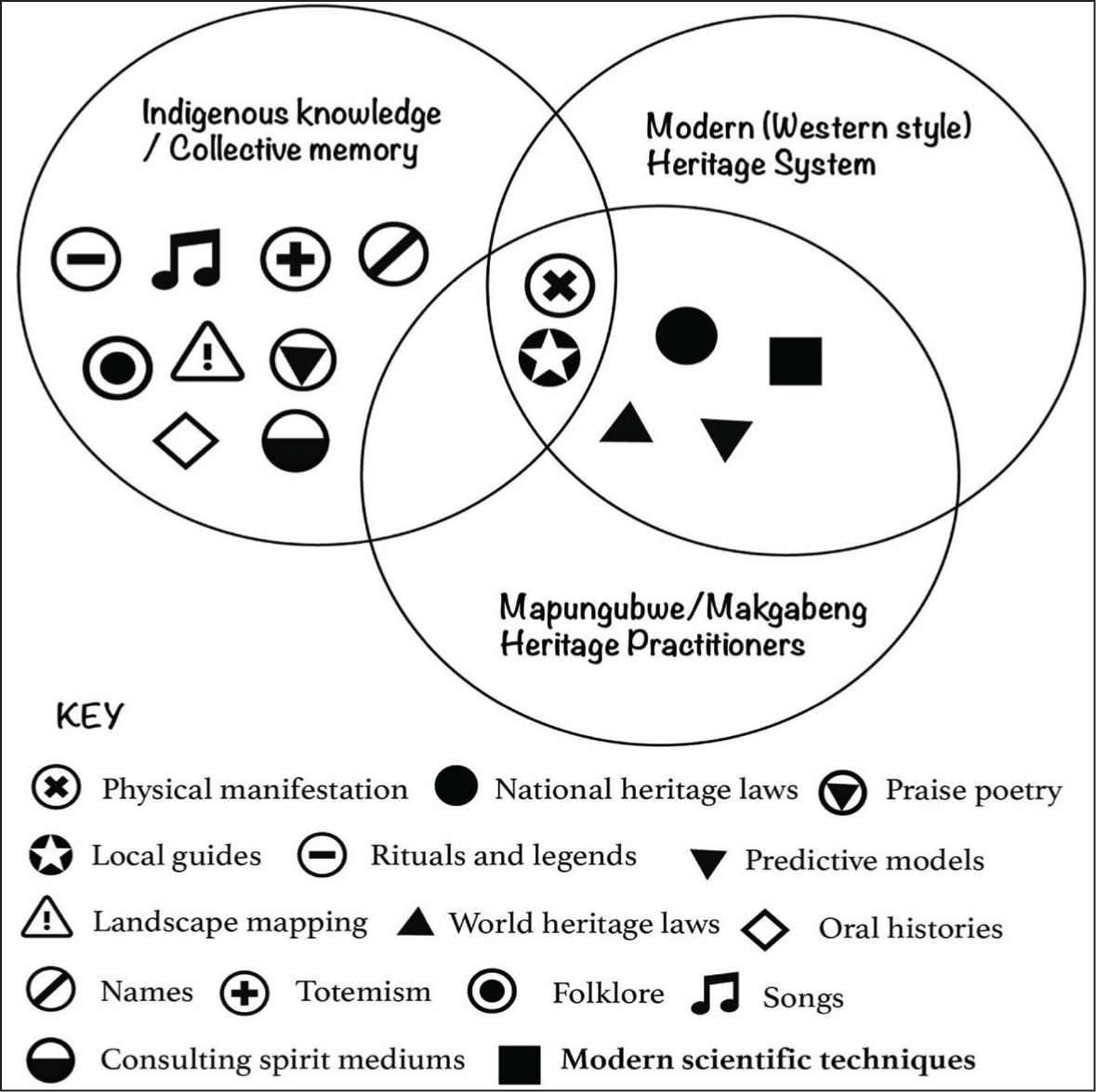
Western notions of heritage management primarily focus on physical evidence and scientific techniques, occasionally consulting local guides for initial site identification and tours (Figure 2). However, once sites are identified by local informants, their insights on interpretation and management are often overlooked. For example, after Mokwena guided archaeologists to Mapungubwe, his knowledge of nearby sacred pools was ignored and not included in official records. This approach highlights a gap in modern practices, which fail to fully incorporate intangible heritage and dismiss valuable indigenous perspectives, resulting in a loss of detailed knowledge that oral histories can provide.
Oral histories and praise poetry often feature physical landmarks such as hills, rivers and place names that create a mental map linking to historical aspects. While minor details may change, major landmarks anchor these stories, which should be included in the interpretation of Mapungubwe. Current interpretations focus mainly on physical material culture, neglecting intangible elements of sacred pools, games and recreational activities that were integral to past societies. These aspects are documented in ethnographic archives but are frequently overlooked by academics (Tiley-Nel, 2018).
When compounded with the colonial displacements that left people in unfamiliar relationships, the arrogance of modern practice further negated learning opportunities by privileging current settlement and landownership patterns over historical evictions. Thus, when Mapungubwe was being nominated, white farmers and mining companies who owned the land near the site were the key stakeholders in terms of the South African legislation and the 1972 World Heritage Convention (Masuku Van Damme & Meskell, 2009). Given the history of displacements in the colonial and apartheid eras, indigenous communities in the Makgabeng Plateau have been protecting heritage which is not their own. This is like the Hwesa people in Southeastern Zimbabwe, who confirm that although their ancestors did not build the Zimbabwe Culture stone buildings in their area, the sites are still important as heritage, and thus, they place value on them and how they are managed (Pwiti et al., 2012).
The Makgabeng communities of New Jerusalema and Thabanantlana are now associated (by proximity) with less familiar rock art heritage, making them stakeholders according to the South African heritage legislation. The legitimate authors of the numerous rock art sites are the KhoiSan, who can no longer be traced. The archaeologists and heritage managers’ arrogance of not linking archaeological sites with specific clans only impoverishes the reader because indigenous voices add so much to heritage management processes.
The study revealed that indigenous communities can identify, interpret, evaluate and manage the heritage in the sense of tangible and intangible heritage. Even in instances where indigenous people lack intimate knowledge about certain aspects of heritage, this study has shown the sensitivity of local African people to manifestations of heritage. For instance, the BaHananwa people in Makgabeng confirmed that they do not have clarity on the dating and authorship of most of the rock art sites in the plateau (having been told by the archaeologists about the art’s national importance), but they still have systems in place for their traditional protection. Therefore, the Western thinking that local communities must be separated from heritage places to ensure the preservation of sites is misplaced.
Praise poetry and genealogy are a source of historical knowledge, for example, the narrative by one of the informants. These are some of the knowledge sources that should be incorporated in the Mapungubwe presentation and interpretation.
A cursory assessment would then conclude that nothing is lost by ignoring or inadvertently not consulting on such types of heritage. However, if one is to learn from the Mapungubwe example, where the site survived as ‘clan memory and name’ until its ‘rediscovery’ with the help of clan-members’ guidance, about 700 years later, its value goes beyond the rich gold objects and other materials from archaeological excavations. As such, Western science’s overreliance on one dimension of physical manifestations of heritage leaves much of both the tangible and intangible heritage unexplored.
There are challenges of site grading following formal ways because this excludes their spiritual significance, which is the core of indigenous heritage. Much of indigenous African heritage comes with family/clan/chiefdom/kingdom or regional relevance. Such hierarchies do not necessarily confer a higher grade. For instance, Queen Nandi’s grave is important to the Zulu nation and to the immediate family. The site is a National Heritage Site and open to the public, against the wishes of the family (
The other quandary of the South African three-tier grading system is its reliance on political boundaries. These boundaries often lack any historical alignment with cultural heritage. Political boundaries and the associated prejudiced policies of alienation dissected cultures into fractions while combining others into ‘rainbow nations’ that did not necessarily have historical connections. Accordingly, heritage experts may end up elevating sites of very little indigenous appreciation or relegating what local communities hold in the highest regard. With relocations, some surviving descendant communities simply cannot remember much about their original area (Mudzamatira, 2019). It is no wonder that the Makgabeng Plateau (with more than a thousand rock art sites and several Late Iron Age sites) has not yet been graded. By comparison, Wonderwerk Cave in the Northern Cape is a Grade 1 heritage site based on a single rock art cave.
The exclusion of communities in site nomination that has been witnessed at places such as Mapungubwe need not be cast in stone. For their part, heritage experts at Mapungubwe have attempted to involve sections of local communities as registered forum groups in terms of biodiversity conservation. The fact that the communities are recognized in terms of biodiversity, not cultural heritage, leaves a lot to be desired. Such attempts have been made successfully in Australia’s Uluru-Kata Tjuta National Park, where heritage sites that were already recognized for their tangible heritage were reassessed to incorporate social values previously overlooked (Kasiannan, 2011).
The management system in South Africa still needs to be transformed to meet the needs of indigenous people. The use of indigenous knowledge systems has contributed significantly to the management of Tsodilo Hills in Botswana (Parkington, 1999; Thebe, 2003). In this regard, the inclusion of collective memory and indigenous knowledge systems has the potential to contribute to a broader understanding of indigenous heritage and heritage management.
A similar misunderstanding of intangible heritage also occurred at Njelele, a sacred site in Zimbabwe where ICOMOS declined to include it as part of the nomination of the Matobo Cultural Landscape (Makuvaza, 2008; Ndoro & Wijesuriya, 2015). The failure to recognize both sites on the same landscape meant that the rock art found within the Matobo was of far greater value to the world than the rituals and religious values of Njelele, which was considered by some experts as a pagan site.
Our indigenous participants from Mapungubwe lamented that the presentation of the site leaves out some important sites and features which are linked to the landscape. There are sacred pools in the Limpopo River which are important to the indigenous people, such as the Sematla. They also lamented that even the cultural significance of wildlife and geographical features is not presented to the visitors. A quick review of information pamphlets at the Mapungubwe Museum confirmed that wildlife and vegetation are presented from a biological perspective using Latin terms. With indigenous landscape mapping, local communities clearly have significant input in heritage identification.
While the identification and management of tangible heritage have gained remarkable consideration, management of intangible heritage has been lagging (Scheermeyer, 2005). It has taken SAHRA and stakeholders long to develop mechanisms to promote and enforce the inclusion of intangible heritage in the management of heritage in South Africa. It is evident that intangible heritage cannot be promoted without the inclusion of indigenous people in the identification, interpretation and management of cultural heritage. At the national level, the lack of community participation in most places is exacerbated by the fact that the PHRAs and local heritage offices, which are supposed to spearhead this process, are non-functional (Jackson et al., 2019).
Conclusions
The study investigated the relevance of indigenous perspectives in contemporary heritage practices, focusing on case studies from northern South Africa and personal experiences. It aimed to test whether indigenous people still possess crucial heritage-altering information despite historical alienation, colonization and modernization. The research compared indigenous heritage production methods with state-based practices, using South African heritage legislation and the management of key archaeological sites like Mapungubwe and Makgabeng as primary examples.
The literature review indicates that while there is increasing academic interest in decolonizing heritage management, there remains a significant gap in integrating collective memory and indigenous knowledge into heritage management planning. Historical and current heritage legislation in South Africa has largely ignored indigenous input, leading to fragmentation and alienation of communities from their heritage. Qualitative research involving 62 individuals from the Mapungubwe and Makgabeng cultural landscapes revealed that mistrust between heritage professionals and indigenous communities has hindered knowledge sharing (Shabalala & Simatele, 2019; Taruvinga, 2019). This has resulted in a heritage management focus predominantly on tangible aspects, neglecting the valuable insights indigenous perspectives could offer. Incorporating these perspectives could address this imbalance and enhance the significance of sites like Mapungubwe by acknowledging their spiritual and cultural dimensions.
Footnotes
Acknowledgements
We extend our heartfelt thanks to the Mapungubwe and Makgabeng communities for their participation in our interviews and focus group discussions (FGDs), providing invaluable knowledge for this study. We appreciate South African National Parks (SANParks) and Blouberg Local Municipality for granting permission and facilitating our research with their community groups. Special thanks to Felix Mosebedi and Lesiba Phahladira for their translation and transcription work and to Nguako Jonas Tlouama for coordinating with the Makgabeng communities. We also want to thank Thabani, Moses, Zaba and Joshua for assisting with the data collection. We also honour the late Chrispen Chauke, our key informant and former SANParks Heritage officer, who passed away before the study’s completion.
Declaration of Conflicting Interests
The authors declared no potential conflicts of interest with respect to the research, authorship and/or publication of this article.
Funding
The authors disclosed receipt of the following financial support for the research, authorship, and/or publication of this article: This research was funded by the National Research Foundation (NRF), grant number 0000-0002-0722-2779