




Abstract
The study explores the heritage management framework established by the Bopiliao Historic Block in Taipei, Taiwan, looking primarily at the methodologies employed to address the competing tensions between stakeholders. Through creative economy and heritage tourism, paved the way for cultural governance to become a significant tool of sustainable heritage management. The central purpose of the study is to present a case analysis of the Bopiliao Historic Block in Taipei, Taiwan, and the district of Escolta in Manila, Philippines, to demonstrate how cultural governance can generate a sustainable community-based cultural heritage preservation framework. Using the research methods of archival research and participant observation, the study was able to identify factors from the success story of the Bopiliao Historic Block in Taipei, Taiwan that can serve as learning points for the Escolta district in Manila, Philippines, to consider. The findings of the study reveal that it requires more than just the active participation of the civil society to develop a sustainable heritage management framework. Instead, it requires support from all the key stakeholders, and though the levels of support may vary, the major deciding factor is the recognition and acceptance of the historic and cultural value of the community.
Keywords
Background
One notable characteristic of most Asian countries is their rich colonial history. Such is mostly attributed to its abundant resources and massive land mass, which made it a prime target of global and regional colonization from the sixteenth century until the late nineteenth century. Such has been the history of the Philippines and the Taiwan. The Philippines has an extensive colonial history after being colonized by Spain, America, and Japan, while Taiwan had its colonial experience from the Dutch, Portugese, Spanish, and Japanese occupations. The colonial histories of both countries culminated when the Japanese imperial forces were defeated in WWII. The Philippines finally got its independence from colonial powers in 1946 after the United States recognized Philippine independence under the Treaty of Manila, while Taiwan’s colonial history ended after the Japanese left the country in 1945.
Nevertheless, both countries’ histories present a very rich cultural heritage anchored on the remnants of their colonial past and its struggles in formulating and fortifying their own identity or imagined community and character apart from their colonial history (Anderson, 1991). In the Philippines, the long history of colonization has provided many places with abundant cultural treasures. One of which is the district of Escolta in Manila, formally established in 1594 and serving as the commercial district of the city during the Spanish occupation due to its proximity to other commercial districts and the popular Galleon Trade. In Taiwan, the streets of Bopiliao in Wanhua district in Taipei manifested a good representation of its colonial past. The historic block, founded in 1799, contains structures dating back to the seventeenth-century Qing Dynasty and the Japanese colonial era in the late nineteenth century.
However, the cultural significance of both heritage districts was undermined as forces of globalization called for better market-driven economic development. As for the case of most newly industrializing countries, where the demand for a rapid transition from a pre-industrial to a post-industrial stage is great, this resulted in the marginalization of the non-commercial sections of the community, which include historical blocks and heritage places. Most threats were due to the pressures exerted by urban renewal projects and comprehensive land-use zoning, which overshadows the presence and sustainability of old districts (Chen, 2014). Unlike in developed countries where heritage protection has been seamlessly integrated into the concept of good governance and funding is not the foremost issue, the case of developing nations like the Philippines and Taiwan is completely different.
By examining the interplay of actors and events that took place in the case of Escolta in Manila, Philippines, and the Bopiliao Historic Block in Taipei, Taiwan, this study seeks to address this central question: ‘How does cultural governance generate participatory development towards the successful management of cultural heritage?’. Specifically, the relationship between competing social actors and governance institutions will be assessed to identify limitations and issues that hinder a successful community-based cultural heritage preservation initiative.
The tension between competing stakeholders in the realm of heritage management has been widely discussed in many studies, including that of Iaione et al. (2022) and Soka et al. (2021). The diverse personal and collective interests of all social stakeholders, which include the government (national and local), private owners of heritage properties (business sector and residents), and civil society groups, all contributed to the social imbalance that makes heritage management problematic.
Framework of the Study
Bang (2004, pp. 157–159) in Schmitt (2011) perceives cultural governance as a form of political management and leadership concerned with how political authority operates through capacities for self- and co-governance that necessitate the reformation and utilization of individual and collective behaviour of stakeholders so that it can be amenable to its rule. Schmitt (2011), on the other hand, looks at cultural governance as an over-arching concept that includes varying sets of institutions, practices, rules, and actions that must not be considered alone but should be approached in the light of conflicting and often overlapping fields of governance, as shown in Figure 1.
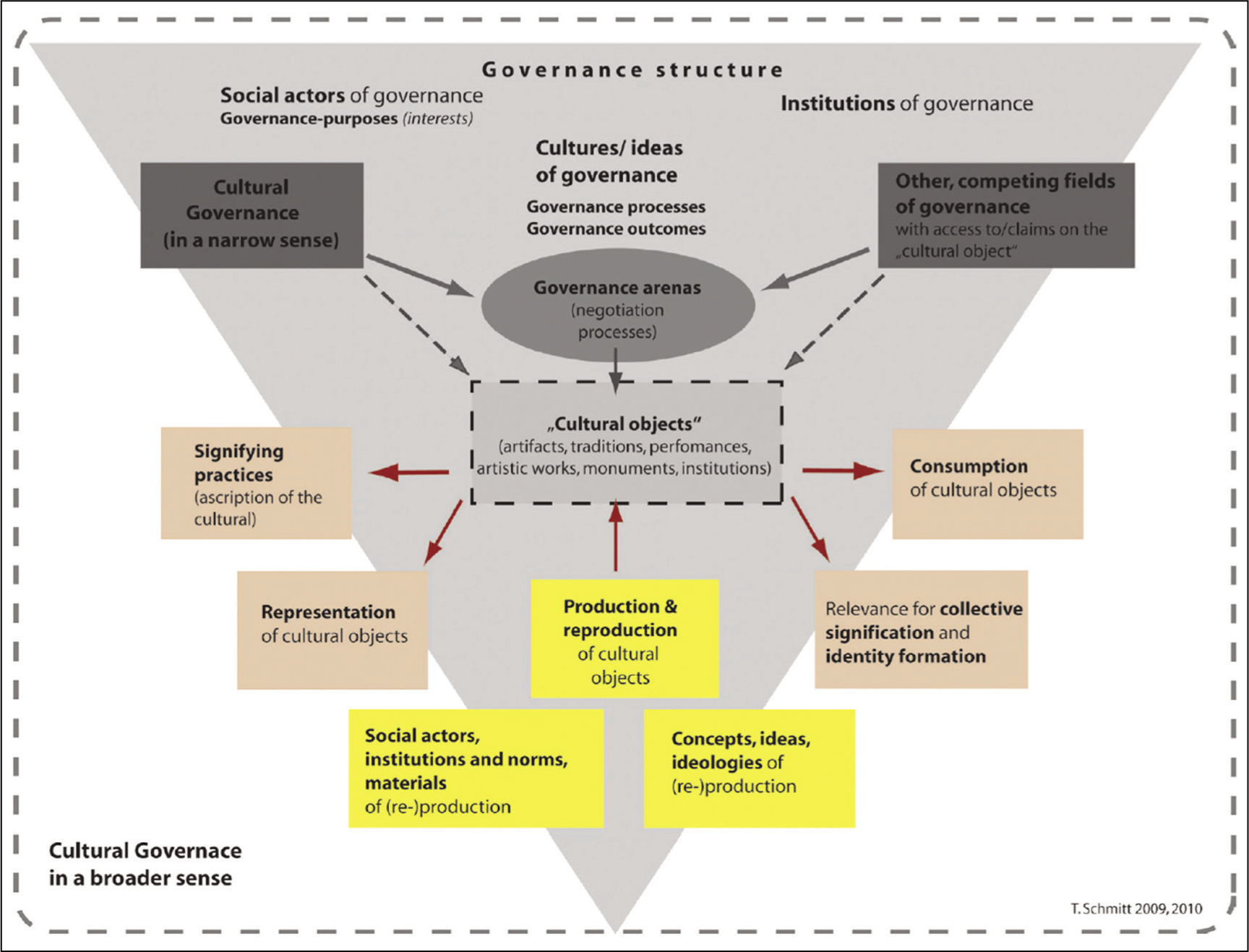
Adapting the cultural governance framework of Schmitt (2011), this study suggests that cultural governance can serve as a legitimate source of power that will emancipate the community towards the effective preservation of cultural heritage. Nonetheless, cultural governance, as Wang (2013) suggests, is not limited to the management of cultural affairs and heritage preservation; instead, it implies finding symmetry to the competing interests of social actors and governance institutions to establish a system of sustainable governance through culture. It is based on the principle of culture as the ‘fourth pillar’ of sustainable development on top of the social, environmental, and economic pillars (Astara, 2014; Bandarin et al., 2011; Hawkes, 2001; Nocca, 2017; Sabatini, 2019; UNESCO, 2012; Zerrudo, 2020).
As this study suggests, the cultural governance framework provides for a participatory approach to heritage management. It creates a mechanism for community emancipation to make them vital components of cultural heritage management. Instead of the usual top-down approach to heritage conservation in which policies and programmes are mandatorily enforced on the community, cultural governance encourages active participation from all social stakeholders through the form of public–private community partnerships.
With culture as the fourth pillar, a paradigm of culture-oriented economic development 1 is established that considers cultural heritage as its core principle which will enable development interventions through heritage-based tourism and creative economy (Russo & Van der Borg, 2006). Such market-driven opportunities will in turn encourage heritage-driven development 2 contributing to an overall community-based sustainable heritage management practice (Zerrudo, 2020).
Methods
The central purpose of the study is to present a case analysis of the Bopilao Historic Block in Taipei, Taiwan, and the district of Escolta in Manila, Philippines, to demonstrate how cultural governance generates participatory development towards the successful management of cultural heritage. During the data collection, archival research of relevant secondary data was applied, which includes news reports, journal articles, tourist blogs, documentaries, and government publications. Additionally, participant observation was performed to observe the contemporary appearance, setting, and functionalities of the heritage site. For both methodologies, the Bopiliao Historic Block and the district of Escolta served as the research samples.
Moreover, the study presents a stakeholder analysis of social, political, economic, and cultural actors and institutions of governance to determine the stakeholders’ level of cultural appreciation and correspondence in the Bopiliao Historic Block Redevelopment and the Escolta, Manila Revival Project.
The Stakeholders of Cultural Governance and Heritage Management
The principle of cultural governance is not entirely a new concept; it has been implemented by many developing countries as a way of promoting heritage conservation. Cultural governance strikes a balance between contrasting political and economic dynamics to establish a sustainable mechanism of cultural heritage preservation (Wang, 2013).
The Case of the Bopiliao Historic Block Redevelopment
The Bopiliao Historic Block is part of the Wanhua District (Mengjia Area), otherwise known as Monga, which is one of the early-developed settlements in Taipei dating back to the Qing Period. It has a trading port of its own, making it a vibrant commercial district. Nonetheless, the area of Bopiliao was designated for expansion use of the nearby Laosong Elementary School in the 1950s during the Japanese colonial period. The area was reorganized by the Japanese following the modern spatial governance implemented predominantly by the Japanese government in most of its territories. However, the newly formed street blocks designed by the Japanese resulted in the overshadowing of the area when the Japanese government cast a different land-use plan for the Bopiliao Historic Block after they categorized the area as a ‘reserved designated area for future expansion’ of the Laosong Elementary School located on the north side of the district (Mii, 1998 in Wang, 2013). After the Japanese left, the city government opted to maintain the land-use plan drafted by its predecessor, casting a time-freeze spell over the area, made worse by the limitations implemented by the government on major property renovations and new property developments. Such resulted in an overall deterioration of the area, which is very far from its original state, comprised of a busy street life and dynamic community. On a positive note, it became the reason why the area was able to maintain its original composition, an amalgamation of structures from the Qing Dynasty and the Japanese colonial period.
The conflict started to unfold when the government unveiled its plan in 1988 to combine the Laosong Elementary School with the Bo Pi Liao area to accommodate the growing number of students brought by the huge wave of rural-urban migrants. Although the exercise of the state’s power of eminent domain and the awarding of just compensation to owners of affected private properties, mostly commercial and residential, were completed in 1989, construction plans faced significant delays. Meanwhile, the residents were still allowed to occupy their place on the condition that no major residential renovations and constructions could be initiated.
However, the existence of a Taiwan law that provides for a 10-year prescription period for government-acquired lands disturbed the existing status quo. The law provides that if the acquired land has not been utilized after 10 years, residents are given the buyback option for their properties. Such that by the end of 1997, the Department of Education already has already sounded the alarm and finally informed the communities that all properties should be vacated by the first day of May 1998 to pave the way for the demolition of all standing structures and the start of the construction activities.
The heritage preservation advocacy of the Bopiliao Historic Block in Taipei started from a personal interest-driven motivation to a general community cultural heritage awareness. It began with a group of residents resisting the execution of a demolition order of expropriated private properties to stop the long-overdue expansion plan of the nearby Laosong Elementary School. Such resistance eventually became the ground for the community’s realization of the cultural value of their living place and memories in Bopiliao, leading to the safeguarding of the historic block. Eventually, cultural governance in the case of the Bopilao Historic Block evolved from cultivating nationalism and promoting artistic appreciation into a culture-oriented economic development led by a market-driven creative economy (Wang, 2013).
A key to the success of the Bopiliao Historic Block was the proactive stance of the community towards preserving the collective memory associated with the historic place. On one side, the affected community members started to petition the local government offices to halt the demolition of settlements. Predominantly, resistance is not due to the community’s recognition of the historic value of Bopiliao but can be greatly attributed to personal interests and motives.
On the other side, other community members began renewing calls for the groundbreaking of the long-delayed construction of school facilities, citing the deprived benefits to education, while some reiterated the unlivable state of the dilapidated structures, condemning them as unsafe for public use. Moreover, the historical value of the structures was likewise questioned. Hence, tension between education and heritage preservation started to build up.
The assistance extended by heritage advocates, mostly from the academe, was very significant. It led to the formation of the Association for the Promotion of Historical Preservation of Bopiliao, which engaged in historical research and oral interviews to establish the historical and cultural value of the Bopiliao area. Sooner, their efforts garnered support from some members of the City Council after getting critical media coverage, which generated added pressure on politicians since an election is forthcoming. Such events provided the leverage needed by heritage advocates to sway the political dynamics to their side, prompting the mayor to express support for the preservation of the historic block. Although some residents were forcefully evicted and some structures whose historical value cannot be established were demolished, the extensive media coverage helped nurture the culture of cultural governance. The political, social, and cultural dynamics were greatly altered when the central government and its attached agencies committed their support to the preservation and coexistence of the school’s land use plans and heritage preservation.
Hence, construction activities finally commenced in 2003. After 3 years, the Heritage and Culture Education Center of Taipei was finally constructed on the east side, serving as an activity centre open to the public. It took another 3 years to complete the renovation of the west side, serving as exhibition halls and arts venues. Finally, in 2010, the city government came true to its promise by classifying the Bopiliao structures as historic buildings and cultural assets protected under the Cultural Heritage Conservation Law of Taiwan (Wang, 2013). In the same year, the historic block further gained prominence when it became the setting of the Taiwanese film, Mongga, which showcased the culture and heritage of Taiwan and its people. Hence, more than knowing about the heritage of Bopiliao as a historic block, tourists flock to the area to relieve the scenes captured in the blockbuster film.
Today, the Bopiliao Historic Block is one of the famous tourist attractions in Taipei, providing a glimpse of the past in the heart of a very busy modern Taipei city. It continues to serve as one of the pillars of cultural promotion in the district as the Heritage and Culture Education Center of Taipei continues to rehabilitate the area to promote cultural heritage preservation through its cultural theme displays as well as educational exhibits and activities (Sima & Wang, 2017). The interchange of forces between the different stakeholders engaged in the preservation of the Bopiliao Historic Block resulted in the positive turnaround of the existing political, social, and cultural dynamics taking place in the community.
The Case of the Escolta, Manila Revival Project
The tale of Escolta in Manila takes a different turn as the community gradually and continues to lose its foothold in preserving what is still left of the war-torn district. Escolta is one of the major districts of the capital city of Manila, Philippines. It is among the early communities established by the Spaniards, designating it as a commercial area due to its proximity to the trading port that showcases the popular Galleon Trade and to the other major districts of the area, including Intramuros, the core of the Spanish settlements in the country, and Binondo, the settlement occupied by Chinese merchants. Nevertheless, the district of Escolta rose to fame when the Americans took over the country, which paved the way for the early manifestations of capitalism and globalization. Numerous commercial structures were brought in by the Americans, providing Escolta with the largest collection of America’s finest commercial structures, including an ice cream parlour, department store, cinema and theatre houses, and first-ever elevator-operated buildings. Such dubbed Escolta as the Queen of Streets of Manila (Cruz, 2022).
Nonetheless, in an assessment conducted by Coconuts Manila in 2014, the media group revealed in their findings the presence of at least nine under threat culturally significant built heritage structures. The list includes the El Hogar building, the Capitol Theatre, the Uy Chaco building, the Ides O’Racca building, the old HSBC building, the Pacific Commercial building, Don Roman Santos building, the Manuel F. Tiquia building, and the Regina building. Adding to the list are other heritage structures that can be located in the area that are likewise on the brink of being forgotten, such as the First United building, the Burke building, the Calvo building, the Philippine National Bank building, and the original Savoury restaurant. While most of these buildings resemble the famous Art Deco design, the majority of the structures were founded during the early twentieth century American occupation, hence having a lifespan of at least 50 years 3 (Cruz, 2017). Unlike in Bopiliao, where community members eventually recognized the importance of incorporating cultural value and historical significance into the national consciousness, the community members of Escolta, Manila, are gradually giving up on their dreams of preserving the past for the future.
Escolta, Manila, began to lose its cultural importance after WWII, leaving the district almost a complete wreckage. Such prompted the merchants and business enterprises to move to suburban areas with improved facilities, readily available infrastructure, and existing transport systems as everyone scrambled to jumpstart the long-stalled social and economic activities. The gentrification made the situation worse for the district as economic life further deteriorated, taking for granted the once vibrant district, with much of the old grand structures converted to warehouses or condemned for demolition due to safety and security issues.
Once dubbed as The Queen of Streets of Manila, there have been numerous attempts by various stakeholders to revive the lost glory of Escolta as a heritage-centric urban community boasting an art deco boulevard that rivals the popular streets of Brussels in Belgium and Madrid in Spain. However, most efforts end up futile, as the much-needed support from the government and authorities is largely missing. Recently, the undying efforts of heritage advocates in the area, spearheaded by the Heritage Conservation Society, Renacimiento Manila, and the Escolta Commercial Association Inc., started to gain momentum as they were able to solicit support from independent and not-for-profit heritage artists and merchants as they started hosting weekend bazaars, bi-monthly parties, and heritage tourism walks to rekindle the revival of Escolta. Furthermore, the hard work of one of the original residents of Escolta paid off after the Syliangteng family successfully orchestrated the adaptive reuse of their old building in Escolta, the First United Building, which now hosts a museum showcasing the heritage of Escolta and offers office and commercial spaces for start-ups and collaborators.
Undoubtedly, residents and business enterprises are active participants in the Escolta Revival Movement; nevertheless, it is the proactive stance of the government that is lacking in comparison to the role it played in the successful preservation and conservation of the Bopiliao Historic Block in Taiwan. Since 2013, under the administration of Manila Mayor Joseph Estrada, there have been attempts to revive the historic district of Escolta. But the lack of concrete plans and budgets has derailed all plans. In 2014, a proposal of the organic government of the Metropolitan Manila Development Authority that will create the Escolta Redevelopment Administration, a dedicated government agency that will focus on the revival of the area as a transport, tourism, and business hub was rejected by the local government of Manila due to overlapping of functions and conflicts of interest. Meanwhile, a new mayor was elected in 2019, Mayor Francisco ‘Isko’ Moreno, who explored the idea of capitalizing on Manila’s heritage as its greatest economic asset. However, the vision blurred out when Mayor Moreno decided to join the 2022 presidential race in a losing effort. In the same election, a new mayor was elected, Mayor Honey Lacuna, whose heritage preservation advocacy remains to be identified. To date, despite the endless campaigns mounted by heritage advocates, it remains unclear to what extent is the local government of Manila is willing to support such heritage revival advocacy. Furthermore, the National Commission for Culture and Arts, as the lead agency for the national government has performed limited efforts in ensuring the conservation of heritage properties in Escolta, Manila. To date, the remaining heritage of the Escolta district of Manila continues to crumble as most structures succumbed to urbanization.
The Participatory Development of Cultural Heritage Management
Stakeholder’s Analysis
Table 1 shows the comparison between identified key actors for the preservation of the Bopiliao Historic Block, Taiwan, and Escolta, Manila, with their respective levels of cultural recognition and heritage conservation participation level. The case of Bopiliao presents a holistic participatory approach from all key actors that led to the successful preservation of the historic block.
Stakeholders’ Analysis Matrix.
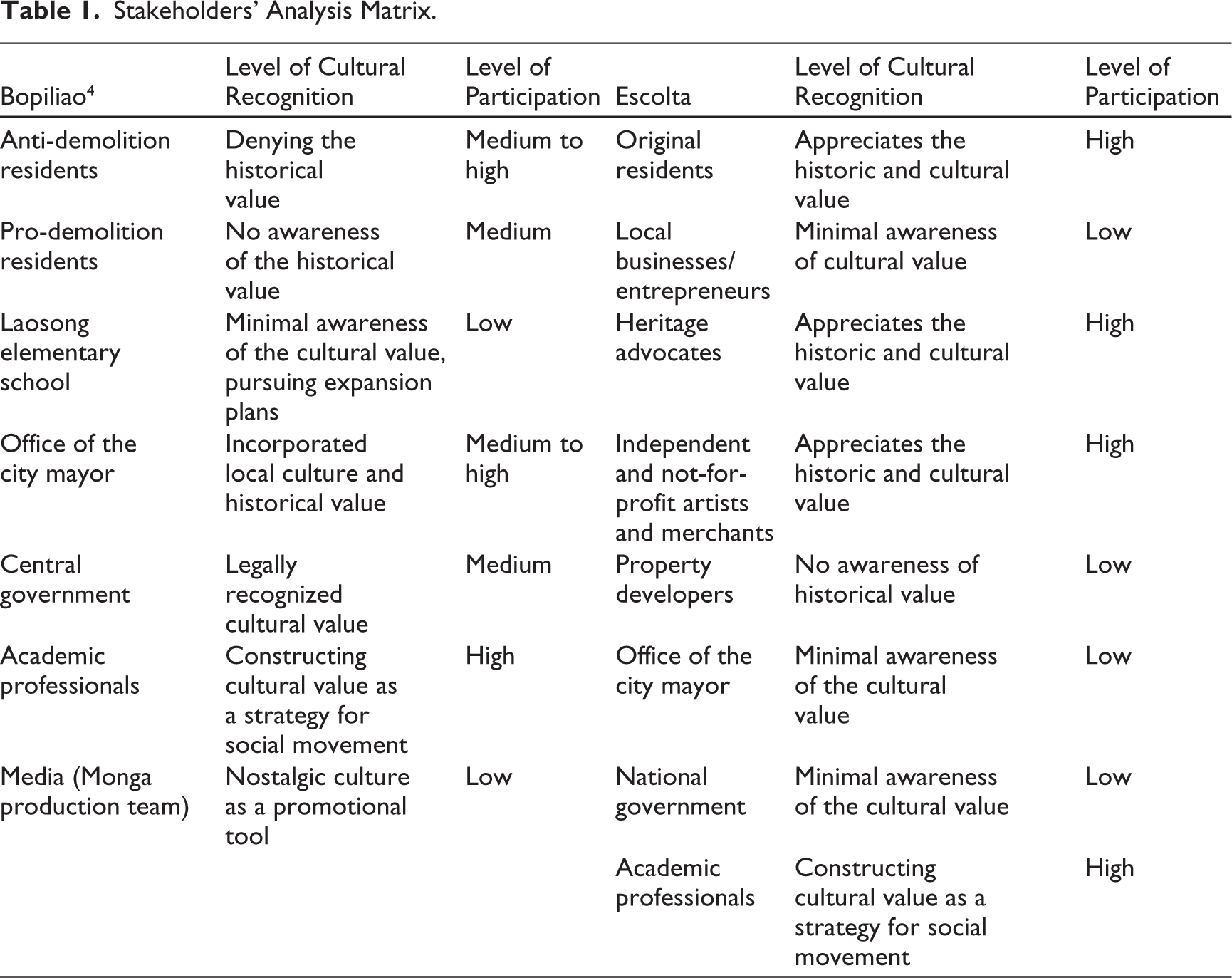
In the beginning, there was a perceived tension between the contrasting interests and level of cultural recognition among the residents, as well as the Laosong Elementary School as the direct beneficiary. The situation was further complicated by the minimal level of interest displayed by the government. Initially, the anti-demolition residents were campaigning against the demolition of the historic block for personal reasons instead of heritage preservation. But as soon as they realized the cultural value and the nostalgia that coincided with the place due to the perseverance of heritage advocates, their interest gradually became a heritage advocacy.
Moreover, as the persistence of heritage advocates, headed by academic professionals, paid off, enhanced by a very active social media presence that was further enriched by the possible vote implications of the upcoming election, the then passive interest of the local government in heritage preservation was reassessed to become supporters and promoters of cultural and historic value. The initiative of the local government became the catalyst that stirred the interest of the central government, paving the way for the declaration of the Cultural Heritage Preservation Act in 2016.
Among the social actors, the Monga Production Team and the Laosong Elementary School manifested the lowest participation levels. On one hand, the Monga Production Team was more interested in capitalizing on the growing popularity of the historic block than the idea of historical preservation, such that the film and its production team were likewise criticized by heritage advocates for deviating from the original cultural heritage context of the Bopiliao Historic Block for the sake of cinematography. However, the contribution of the film to the growth of public interest in the preservation of the Bopiliao Historic Block should not be disregarded as well. Despite the criticisms, the production team was able to demonstrate the potential economic value of the historic block in addition to its cultural heritage value. On the other hand, the Laosong Elementary School, as the beneficiary of the expansion project, was less likely to be interested in the preservation of the historic block.
More than just political dynamics, the social and economic factors generated by the creative economy and heritage tourism contributed a lot in helping the community appreciate the value of their culture and history, hence encouraging everyone to contribute to the successful preservation of the Bopiliao Historic Block.
Similarly, there is a high level of community members’ participation in the case of Escolta Manila, as original residents, heritage advocates, independent and not-for-profit artists and merchants, and academic professionals offer dedicated support and recognition to the community’s historical and cultural value. Moreover, the local businesses/entrepreneurs and property developers have a different perspective on cultural heritage as they are leaning towards its commercialization and commodification.
However, on the contrary, it is the lack of support from the local and national governments that stands out as the difference. If elections for the case of the Bopiliao serve as a leverage tool to mount pressure for government support, they failed to generate the same political dynamics in the case of Escolta, Manila, as demonstrated by the absence of clear and concrete heritage conservation plans by the three administrations starting from 2013 up to the present. Elections provided less pressure on local government administrators to adapt heritage preservation practices; instead, the frequent changes in governance administration contributed to the absence of heritage conservation policy continuity.
The same is the case for the limited action done by the national government in ensuring the protection and preservation of heritage structures. The landmark legislation, the National Cultural Heritage Act, has done little to ensure heritage conservation. Primarily, the legislation was able to provide safeguards against the potential destruction of old properties of at least 50 years with presumed cultural value, but it failed to provide sufficient mechanisms in the form of subsidies and incentives to encourage stakeholders to pursue heritage conservation. The minimal awareness of the national and local government to the significance of cultural heritage has been a big factor in their low level of participation.
Comparative Analysis
In comparison, what sets the case of Escolta, Manila, apart from the success story of the Bopiliao Historic Bloc, Taiwan, is the level of participation between the central and local governments. For the former, the community stakeholders failed to generate enough pressure to convince the government to reconsider their cultural heritage preservation policies. For the latter, the active pressure generated by community stakeholders was able to initiate the necessary wake-up call for government administrators to reconsider the potential contribution of heritage conservation to development.
Nabatchi (2012), in her modified version of The Public Participation Spectrum developed by The International Association for Public Participation, provided five modes of public participation, in which the level of participation involvement increases relatively with the degree of deliberative communication, as illustrated in Figure 2.
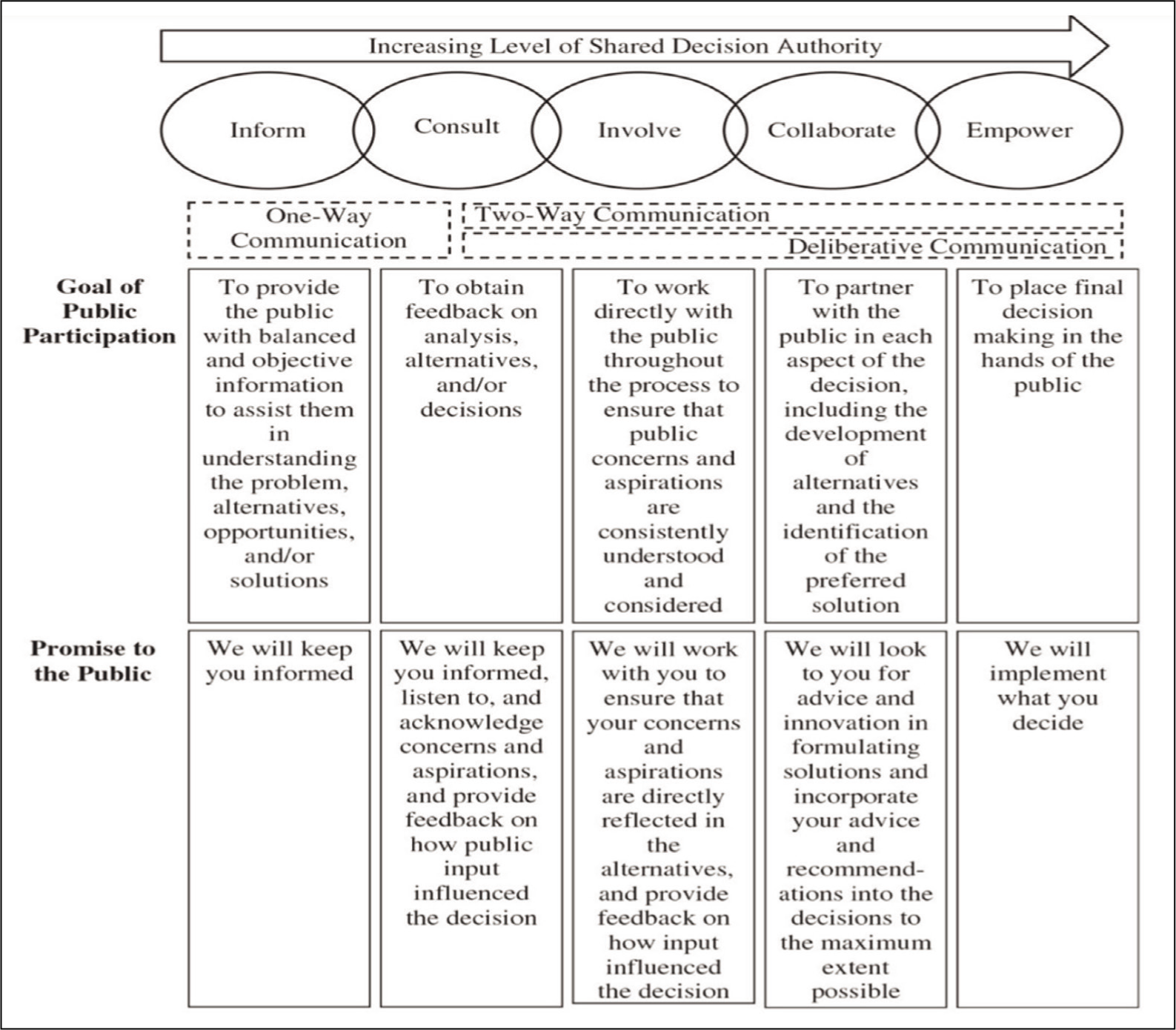
The case of the Bopiliao Historic Bloc is a perfect manifestation of cultural governance finding symmetry between social actors and governance institutions in which all five modes of public participation were achieved. The governance institution was able to ensure deliberative communication between all involved social actors and provided sufficient avenues of collaboration leading to empowerment as the local government adhered to the advice of the residents in reconsidering the preservation of the Bopiliao Historic Block, thus in effect placing the final decision-making in the hands of the public.
On the contrary, the case of Escolta, Manila Revival Project manifested a minimal participation level exemplified by the one-way communication between the social actors and governance institutions. Based on the spectrum, participation has been limited to the Inform mode, as keeping the social actors aware of the existing heritage issues is the only accomplishment that can be noted. Though in some instances, there was consultation, it did little to develop involvement and maintain a collaborative environment.
In this case, the heritage advocates, residents, and the academe failed to mount enough pressure to make their voices heard and solicit the government to ask for their concerns. Relatively, Zerrudo (2020) identified four levels of community involvement as part of a heritage conservation management framework, with heritage awareness as the first level, appreciation follows, leading to heritage protection, and culminates with heritage utilization. The Escolta, Manila Revival Project manifested only the first level of cultural awareness but has failed to successfully progress towards developing a culture of heritage appreciation, protection, and utilization. This coincides with the overall notion of cultural heritage as a liability and misses the potential benefits that it can contribute to economic empowerment and sustainable development. Thus, in such cases, cultural governance failed to generate empowerment as it manifested a top-down scale of governance.
Conclusion
As the principle of cultural governance suggests, there should be symmetry between all involved social stakeholders and governance institutions. The success story of the conservation Bopiliao Heritage Block presents a sample of how cultural governance can lead to the emancipation of the community as active participants in a sustainable heritage management framework. It highlights that for a heritage management framework to be efficient and sustainable, it has to have the support of all key actors. Though the support levels from each key actor may vary, what is important is that all stakeholders recognize and appreciate the cultural and historical value of the community. Every stakeholder should be able to realize the perceived benefits of heritage preservation. Moreover, the case of the Bopiliao Historic Block was able to demonstrate how to manage the tension between the key actors and divert the focus towards heritage preservation.
Such a factor is missing in the case of Escolta, Manila. Despite the efforts and high level of participation from the civil society, it failed to generate enough pressure to catalyze governance institutions to reconsider their cultural heritage preservation programmes and policies. As Zerrudo (2020) emphasized, social actors need to be able to be persistent and consistent so that awareness campaigns can be translated into purposeful actions of heritage appreciation, which in turn will generate heritage protection initiatives leading to heritage utilization. Additionally, the absence of support from both the national and local governments has been the greatest hindrance to the success of the Escolta, Manila Revival Project. A sustainable heritage management framework will not be feasible unless complementary institutional frameworks are present.
The cultural governance framework of Schmitt (2011) provides that cultural heritage can serve as a participatory link connecting the social, environmental, and economic pillars of sustainable development, therefore serving as the ‘fourth pillar’. As institutions of governance serve as the arena for competing interests to be addressed and mediated, all social actors must realize the potential benefits of cultural heritage. If community members can perceive the potential economic benefits of cultural heritage, it will serve as motivation for people to appreciate heritage to pursue its preservation. Once attained, the social dimension of heritage preservation will likewise be realized, as people will gradually recognize the psychological benefits that coincide with it, such as pride and identity recognition and the development of self-understanding and honour (Chohan & Wai Ki, 2005; Hiyari, 2012). But for such to happen, institutions of governance should likewise generate initiatives that will support and motivate social actors to pursue heritage preservation. Once available, an overarching culture of heritage conservation can be established, paving the way for sustainable heritage management.
Particularly in the case of Escolta, Manila, the absence of clear-cut guidelines on heritage conservation has resulted in its overall obsolescence. Though the National Cultural Heritage Act chartered the course of heritage conservation in the country, factors of the political economy still come into play. There is a great need for policies that can supplement the guarantees offered by the Heritage Act.
Seemingly, most of the heritage buildings and houses are owned by private entities, thus in effect limiting the actions the government can opt for. The situation highlights the need to offer incentives for heritage property owners to conserve their structures rather than think of ways to generate income from usually idle and tax-burden properties (Palaña, 2015). Ever since heritage advocates have been intensively aspiring for national legislation that will offer tax incentives to property owners whose property was declared as heritage or national cultural treasure. Additionally, exemption from inheritance taxes for families that participate in heritage conservation is also being requested since the usual dilemma is when heritage properties are passed on from one generation to another, the heirs decide to put the property on sale due to inheritance tax and capital gains obligation, much like the situation of the El Hogar Filipino Building in Escolta, Manila. Lobbyists were also proposing tax incentives to businesses and entrepreneurs who would choose to locate or relocate their businesses in heritage buildings or properties, thus incorporating adaptive re-use of such properties, further stressing that what is good for business is good for the community and vice versa (Palaña, 2015).
In conclusion, it requires more than just the active participation of civil society to develop a sustainable heritage management framework, as demonstrated by the success of the Bopiliao Historic Block Redevelopment. Instead, it requires support from all the key stakeholders, and though the levels of support may vary, the major deciding factor is the recognition and acceptance of the historical and cultural value of the community.
Footnotes
Declaration of Conflicting Interests
The author declared no potential conflicts of interest with respect to the research, authorship and/or publication of this article.
Funding
The author received no financial support for the research, authorship and/or publication of this article.