




Abstract
This study examines how socio-spatial inequalities are associated with population concentration and de-concentration processes shaped by residential mobility. The study explores whether the patterns of residential mobility vary in different settlement system contexts. It reviews the cyclical urbanization models and the inequality of opportunities they provide in urban, suburban, and counter-urban contexts for individuals in various life stages. The theoretical models are tested by analysing individual-level data covering the entire populations of Estonia and Lithuania – two countries with similar social but different settlement system contexts. The study utilizes linked individual-level data from the 2011 and 2021 censuses, and harmonized variables in the two countries. The results show that individuals engaging in concentration, suburbanization, or de-concentration have distinct characteristics, with little differences between countries characterized with different settlement systems. While the life-course approach assumes that young people are most likely to urbanize (concentrate), those in family ages shift towards suburbanization, and older individuals tend to counter-urbanize (de-concentrate), our findings challenge these assumptions, demonstrating that young adults have a high likelihood of migration in all three directions. These findings call for more in-depth studies on the interplay between age and migration patterns that would go beyond the life-course approach and delve deeper into the residential decision-making of young people.
Introduction
There is a long-standing interest in the evolution of urban systems, how people at different life stages experience opportunities in various residential environments, and the role of residential mobility in shaping population concentration and de-concentration processes within urban regions and at the national scale. The unequal distribution of different population groups across cities and regions, driven by their residential choices, directly affects social and spatial inequality, impacting individuals’ quality of life and their access to opportunities such as employment, education, healthcare, and leisure activities (see, e.g., van Ham et al., 2021). Over the last decades, several models have been developed to capture urban change as a result of intra-metropolitan and nation-wide residential concentration and de-concentration processes. Birch (1971) introduced the Stages of Urban Growth theory, which was developed into the Stages of Urban Development model by Klaassen et al. (1981) and van den Berg et al. (1982). This model characterizes changes in the population redistribution within the metropolitan regions (MRs) over time in terms of urbanization (concentration of population to cities), suburbanization (de-concentration of population into suburbs), and counter-urbanization (de-concentration of population away from major MRs). Additionally, Geyer and Kontuly (1993) proposed the Differential Urbanization model to characterize changes in the nation-wide population redistribution within the settlement system over time. These models have inspired numerous studies to empirically test changes in the population redistribution both in MRs and across the settlement system, as well as its variations among population groups (Kabisch and Haase, 2011; Turok and Mykhnenko, 2007; Wolff and Wiechmann, 2018), over the life course (Kulu and Milewski, 2007; Lindgren, 2003; Sandow and Lundholm, 2023), and in relation with urban scaling and inequalities (Arvidsson et al., 2023; Sarkar, 2019).
Most research on the stages of urban growth and decline are based on aggregated data on population change across different parts of the MRs and settlement systems. Such data categorizes individuals by age, gender, ethnicity, and other individual characteristics available from census records (Champion and Shuttleworth, 2017; Tammaru et al., 2023). These studies typically show that migration patterns within MRs and the settlement system tend to change over the life course (Kulu and Milewski, 2007). Young people often move to urban areas in search of educational and career opportunities and potential relationship. Those in childbearing age frequently choose suburban living, seeking more space while remaining close to schools, workplaces, and family-oriented facilities. As individuals age, counter-urbanization becomes more prevalent as they rely less on the location of schools and workplaces (see Tammaru et al., 2023).
However, not all studies detect clear-cut phases of residential relocations over the life course. For example, Haase et al. (2012) introduce the term “transitory urbanites” based on a study in the Czech Republic and Poland, arguing that many young people, including students, professionals, or cohabiting couples move to central cities only temporarily, but later seek homes elsewhere in the city or suburbs. Using individual-level data from Northern Ireland, Stockdale and Catney (2012) struggle to detect the expected life-course migration to urban and counter-urban areas. Instead, they find that many younger people move to rural areas, with a decline in the likelihood of this type of moves with age. The authors attribute this unexpected finding to the particular features of Northern Ireland’s settlement system, rural planning policy, and family farming traditions. Moreover, Sandow and Lundholm (2023) report an increase in young families leaving the MRs in Sweden, many of them moving to their birth regions to reconnect with extended family. Thus, individual-level studies from very different contexts – Czech, Polish, Dutch, Northern Irish, and Swedish – challenge the assumption of a clear life-course pattern where younger people are more likely to move to cities, followed by moves to suburban and counter-urban areas together with the progression of the life course. It seems that the relationship between age and migration patterns may be more complex than what is revealed by aggregate-level data studies or studies undertaken within the life-course perspective.
This study aims to examine how socio-spatial inequalities are associated with the population concentration and de-concentration processes shaped by residential mobility. Specifically, our focus is to revisit the discussion on how age – the key individual characteristic shaping residential mobility – relates to the processes of population concentration and de-concentration both within the MRs and within the settlement system. Although migration destinations may change as people get older, so does the probability to move (Kulu and Milewski, 2007). Hence, it may be that different patterns of residential mobility emerge. On the other hand, it may still be a universal phenomenon that young people play a major role in all types of moves contributing to population concentration and de-concentration processes, including those to cities, suburbs, and counter-urban areas (cf Rogers and Castro, 1981). These migration patterns may also be influenced by individual characteristics like ethnicity or social status (Finney, 2011). In this light, our study tackles the following knowledge gaps. Firstly, it addresses the scarcity of comparative studies examining migration patterns across different settlement types, shedding light on the dynamics of population concentration and de-concentration processes. Secondly, it underscores the typically understated role of geography in the context of life-course migration studies. Thirdly, it contributes to our understanding of how socio-spatial inequalities evolve during population concentration and de-concentration processes, by examining residential mobility patterns associated with key individual characteristics such as, age, ethnicity, and social status.
We draw our empirical evidence from Estonia and Lithuania, two closely related countries that share many similarities but have different settlement systems. These countries, formerly part of the Soviet Union until 1991, have undergone significant social and spatial transformations (see, e.g., Gentile et al., 2012). While both countries exhibit features of liberal welfare regimes, high levels of income inequality (Uplift, 2021), and homeownership, their settlement systems differ (Hess and Tammaru, 2019). Estonia has a monocentric settlement system, with Tallinn and its urban region serving as the dominant hub and centre for economic activities. In contrast, Lithuania has a polycentric settlement system, with Vilnius as the primary political and economic centre, complemented by strong regional centres that provide competing opportunities for individuals seeking education and employment. Our study focuses on the capital cities where migration patterns tend to be stickier over economic cycles compared to smaller second tier cities. Consequently, we use a simplified binary distinction between capital city metropolitan area and the rest of the settlement system.
Cyclical urbanization models and changing migration in the life course
We start our paper by revisiting the Cyclical Urbanization Models that are most widely used as frameworks in empirical research related to metropolitan-level and nation-wide residential relocations: the Stages of Urban Development model (Klaassen et al., 1981; van den Berg et al., 1982) and the Differential Urbanization model (Geyer, 1996; Geyer and Kontuly, 1993). The Stages of Urban Development model proposes that urban development goes through recurring stages of change: urbanization, suburbanization, disurbanization, 1 and reurbanization. Generally, this model asserts that the population in the main city (urban core) and its suburban ring (defined by commuting patterns) is expected to grow and decline in certain stages. The Differential Urbanization model links together the processes of urbanization, polarization reversal, 2 and counter-urbanization (Geyer, 1996; Geyer and Kontuly, 1993). Urbanization or settlement system wide population concentration is characterized by a positive relationship between city size and net migration rate, while counter-ubanization or settlement system wide population de-concentration is characterized by a negative relationship between city size and net migration rate (Champion, 1989; Fielding, 1989). Both models depart from the Mobility Transition concept of Zelinsky (1971) that claims that settlement systems go through a similar and universal evolutionary development together with the demographic transition. As demographic transition starts, people begin to move from rural to urban areas. This is followed by a saturation of the settlement system as the demographic transition ends and populations start to age; mobility rates decline and the direction of migration flows become more diverse and unexpected (Zelinsky, 1971: 248). Thus, urbanization, suburbanization, and counter-urbanization may occur simultaneously, and different population groups moving on different reasons could be shaping the formation of these flows (Bernard et al., 2014; Jansen, 2020; Tammaru et al., 2023).
Different parts of the settlement system offer different opportunity structures regarding education, jobs, housing, and other amenities. According to Geyer (1996), these opportunities can be generalized into two groups when it comes to understanding of the population concentration and de-concentration processes, productionism and environmentalism. Productionism refers to those motives of migration whereby people seek opportunities to improve their material well-being, such as aspiring for better education, employment opportunities, or income (Geyer and Kontuly, 1996). These factors – city lights – are especially important among younger people, and tend to facilitate moves towards major cities. Migration reflects uneven labour market opportunities between urban and rural areas, with large cities acting as escalators for socially upward-aspiring young adults, promoting their careers (Fielding, 1997). Professionalization of the urban workforce and the rise in house prices and rents go hand in hand, implying that, increasingly, only higher-income earners are able to afford homes in large cities (Rodríguez, 2024; Sarkar, 2019). Environmentalism refers to those motives of migration whereby people improve their social and residential well-being, such as seeking opportunities for larger homes, safer neighbourhoods for raising children, or more pleasant and quiet environment (Geyer and Kontuly, 1996). These factors become more important with age and drive relocations from major cities, both to the suburbs as well as to non-MRs (Feijten et al., 2008; Jauhiainen, 2009; Kontuly and Tammaru, 2006). However, as house prices in large cities continue to rise, lower-income households and young people seeking affordable housing may find themselves priced out of the housing markets in large cities (Rodríguez, 2024). This aligns with the findings of Tammaru et al. (2023), who observed a trend of younger individuals moving away from major cities over time. This trend is likely influenced by the increasing number of young people who are able to perform their work tasks remotely, leading to a reduced necessity to reside in major cities.
In addition, intergenerational housing inequality impacts residential relocation patterns among younger people. Rising house prices and rents pose challenges for lower-income earners and younger individuals seeking affordable urban housing. The demand for urban housing is increasing due to various long-term and short-term residents. Airbnb and similar platforms add pressure to urban housing markets (Barron et al., 2019). Furthermore, gentrification drives house prices in major cities worldwide (Lees et al., 2010; van Ham et al., 2021). The chances of finding affordable housing in large cities affects the patterns of residential mobility of young people (Hess et al., 2022). The study by Hochstenbach and Boterman (2015) in Amsterdam concludes that the gap between young people’s preference for inner-city locations and their opportunities to access these locations is widening, making their housing careers increasingly “chaotic.” Hochstenbach and Musterd (2016) add that the decreasing housing affordability makes younger people to seek affordable housing outside the cities. Similarly, in Estonia and Lithuania, massive housing price differences exist between the capital and peripheral regions, as well as within metropolitan regions (Kährik and Pastak, 2023). In Tallinn and Vilnius city centres, apartment prices per square meter often exceed 4000 EUR, while prices in the peripheral rural regions can fall below 100 EUR per square meter. Lithuania and Estonia experienced among the most substantial increases in house prices and rents in Europe between 2010 and 2022 (Eurostat, 2024). The residential moves that are triggered by different opportunities and constraints related to housing affordability might further differ in different settlement system context. A monocentric settlement system with one strong economic hub is highly attractive for young people as well as people earning higher incomes. A polycentric settlement system is characterized by a more even distribution of education and job-related opportunities that may result in more diverse patterns of residential mobility (cf. Bocheński, 2023; Myrdal, 1957).
This may imply that new forms of socio-spatial inequality are about to form together with the growing concentration of higher occupational groups in major cities and lower occupational groups in more peripheral areas, both within the suburbs and beyond. There is also evidence suggesting that families are diversifying their residential decision-making. Hochstenbach and Boterman (2015) discuss the suburbanization of poverty as lower-income families and young people seek affordable housing outside of cities. Hence, the role of housing in moving to suburban and exurban areas has become more complex than proposed by the life-course approach. Sandow and Lundholm (2023) find that counter-urbanization is experienced among families with children in Sweden, and people often move back from large cities to their regions of birth to reconnect with family members left behind. The study by Tammaru and colleagues (2023) in Estonia reveals that the relocations of families towards the Tallinn MR and away from it has evened out in Estonia as the number of families are moving beyond the capital city’s region has grown. No specific occupational group is over-represented among those leaving Tallinn. The authors suggest that both high housing costs for lower-income families and the impact of the Covid-19 pandemic, which accelerated digital transition and teleworking, now enable higher-income households to diversify their residential choices. As the workforce is quickly professionalizing in large cities around the world (van Ham et al., 2021), not all of them stay necessarily in cities, thus contributing to moves beyond urban regions and processes like rural gentrification (Herrero-Jáuregui and Concepción, 2023).
To conclude, various structures of opportunities and constraints may make the residential relocations of young people and families more nuanced than assumed by the life-course perspective. New layers of socio-spatial inequality seem to be emerging, with large cities becoming increasingly exclusive residential spaces due to high house prices and rents, which reduce the opportunities for younger people and lower-income households to find a home. Settlement structures, as argued by Stockdale and Catney (2012), further influence people’s residential relocations. For example, in monocentric countries with one dominant city and in polycentric countries with many larger cities, the opportunity structure for urbanization, suburbanization, and counter-urbanization may vary, especially across different age groups. In a monocentric settlement system, a single large and highly dynamic labour market draws individuals due to economic factors, whereas a polycentric settlement system offers more alternatives for those seeking economic opportunities. To examine the role of a settlement system, a comparative study design is necessary.
Case study contexts: Settlement systems and population dynamics in Estonia and Lithuania
This paper draws its empirical evidence from Estonia and Lithuania. The current settlement configurations and migration patterns in both countries originate from the Soviet period when centralized decision-making aimed for socio-spatial equality (Bertaud and Renaud, 1997; Sjöberg, 1999). Interestingly, despite sharing socialist planning principles, the two Baltic States developed into different settlement systems – polycentric in Lithuania and monocentric in Estonia – which persist to this day (Ubarevičienė, 2018; Figure S1). Since regaining independence in 1991, both countries have undergone shifts in their socio-spatial organizations, characterized by depopulation, 3 increasing concentration of people in the capital city regions and rising spatial and social inequalities within cities and between regions. Thus, in recent decades, Estonia and Lithuania have undergone a development trajectory that indicates their gradual convergence towards more similar socio-spatial organizations. The trends observed in the Baltic countries, particularly regarding increasing socio-spatial inequalities, also resemble those observed in Western countries.
Studies have shown that residential relocations, given their selective nature, play an important role in shaping population concentration and de-concentration processes within the Baltic settlement systems (e.g., Tammaru et al., 2023; Ubarevičienė and van Ham, 2017). Undoubtedly, migration has a significant influence on the social and spatial structures of inequality. Based on data from Estonia and Lithuania, this study examines whether internal migration flows and composition differ across various settlement systems, with a particular focus on age differences in residential relocations. We expect that greater monocentricity is associated with more selective migration, potentially leading to heightened levels of inequality at both MR and national scales as younger people and those in more privileged socio-economic positions cluster stronger to the capital MR. Given Estonia’s monocentric system, we anticipate Tallinn’s significant role in attracting young, highly educated, and skilled individuals from all over the country. Conversely, in Lithuania, where Vilnius faces competition from other sizable cities for such residents, incoming migration flows are likely to be less selective. We anticipate that suburbanization will follow its usual patterns and be similar in both countries. However, we lack clear expectations regarding the outflows from MRs in polycentric versus monocentric systems, as these outflows are likely to be influenced by various factors, including economic opportunities and lifestyle preferences, particularly among younger generations, which impact individuals’ residential choices.
Data and methods
We adopt a longitudinal perspective in our study by linking individual-level data from the 2011 and 2021 censuses in Estonia and Lithuania. The study focuses on residential relocations, specifically examining concentration, suburbanization, and de-concentration. In this context, concentration is defined as migration towards the capital MR from all levels of the settlement system hierarchy. Suburbanization refers to migration from the capital city to its surrounding areas, defined as the region where at least 30% of the working population commuted daily to the capital city in 2011. De-concentration includes any move from the capital MR to other parts of the settlement system.
We analyse individuals present in both censuses, and we track changes in their residential locations between 2011 and 2021. To avoid over-representation of (larger) families moving together, we include one member aged 18 or older from each multi-person household. 4 Given these criteria, our research population includes approximately 900,000 individuals in Lithuania and 500,000 individuals in Estonia. The study does not capture moves within cities, suburbs, and non-MRs, multiple moves, as well as births, deaths, and international migrations. A potential data limitation, which remains uncontrolled, is that not all individuals provide their actual address, a common issue encountered in many similar studies.
We apply binary regression models on our data to investigate migration towards the MRs, suburban areas, and migration away from the MRs (The descriptive statistics regarding the size of the migration flows and their composition by age is provided in Figure S2). Separate models are run for each migration flow and for both Estonia and Lithuania. The models estimate how personal characteristics affect the probability of moving to different destinations. We are particularly interested in how age influences the likelihood of moving in different directions and therefore, we run a separate model for young adults aged 18–29 (Model 3). Population characteristics like age and ethnicity are measured at the 2011 census. We also analyse time-varying variables, including changes in individuals’ family status, education, and labour market positions between the censuses (see Tables S1 and S2 for more details). Odds ratios and significance levels are provided when reporting the results. However, since we analyse the entire population rather than a sample, the significance levels may not be relevant, and we can interpret them with more flexibility. In addition, to gain more insights into the potential impact of settlement types on migration patterns and inequality formation within countries, we employ cartographic techniques to visually illustrate the migration patterns of young adults with varying labour market statuses.
Results
Nation-wide population concentration
Concentration – logistic regression models of moving to the capital metropolitan region between 2011 and 2021.
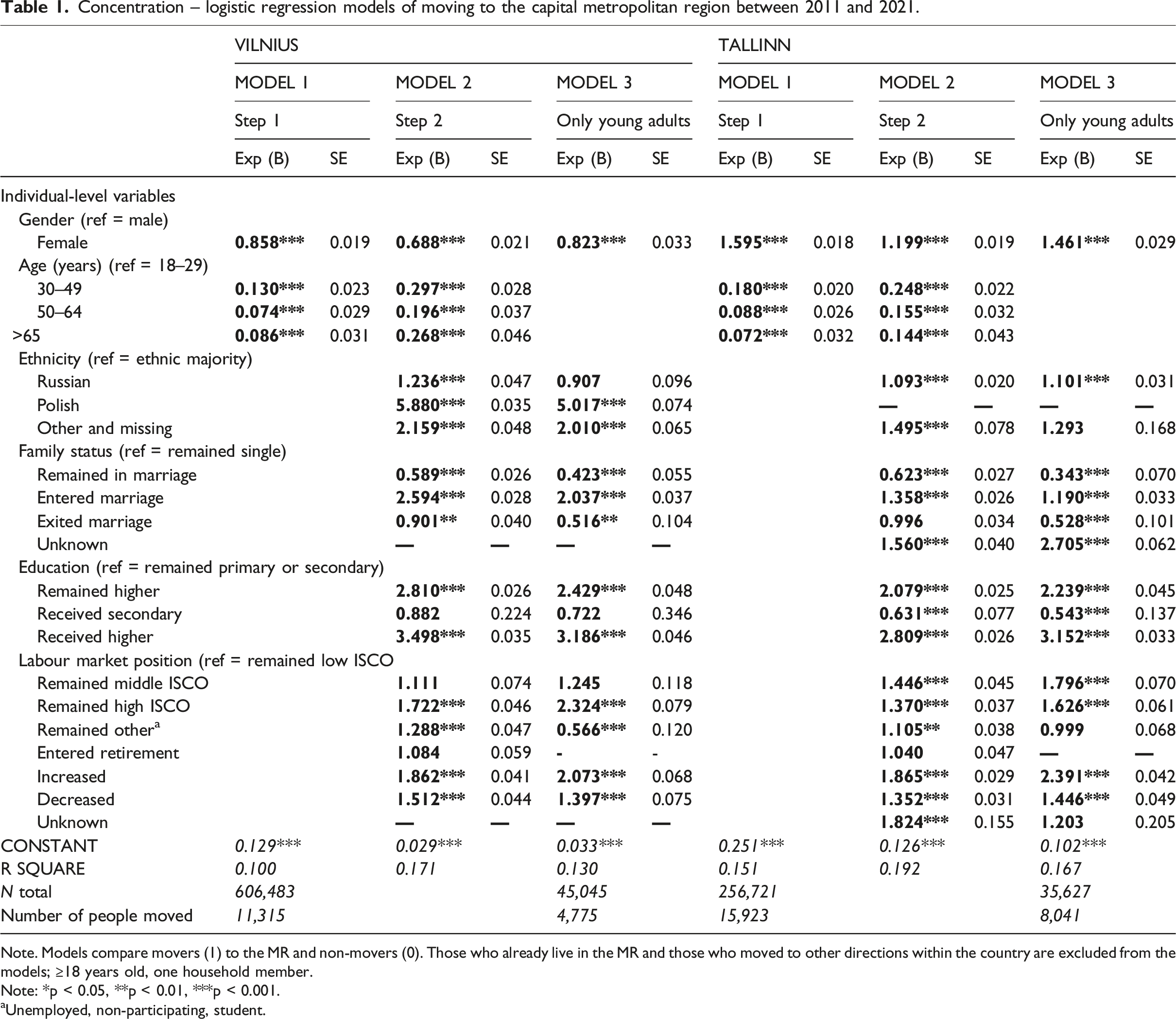
Note. Models compare movers (1) to the MR and non-movers (0). Those who already live in the MR and those who moved to other directions within the country are excluded from the models; ≥18 years old, one household member.
Note: *p < 0.05, **p < 0.01, ***p < 0.001.
aUnemployed, non-participating, student.
In Model 2, we include additional individual characteristics. It is important to note that Lithuania and Estonia have distinct ethnic landscapes. In Estonia, ethnic minorities, primarily Russians, comprise 32% of the population, with Russian speakers making up 44% of Tallinn’s residents, while rural areas are mainly Estonian. In Lithuania, ethnic minorities make up 16% of the population, with Poles and Russians almost equally represented. Most of these minorities are concentrated in the Vilnius region, with Poles dominating in some areas around Vilnius city. The results of Model 2 show that ethnic minorities, particularly Poles in Lithuania, are more likely to migrate to Vilnius MR. While migration probabilities vary less among different ethnic groups in Estonia, minorities still tend to move to the Tallinn MR. This pattern is not surprising – in most countries, larger cities serve as concentration areas for minorities. In the Baltic capitals, Russians (also Poles in Lithuania) have long-established activity spaces with educational systems, social networks, and job opportunities that facilitate the use of their native language (for more general discussion – Massey and Denton, 1993; for Baltics – Mägi et al., 2016; Ubarevičienė et al., 2015).
Next, we examine time-varying characteristics and changes during the migration period (2011–2021). Regarding family status, the results indicate that in both countries, remaining single or getting married is positively associated with migration to the MRs, while being married prior to migration is negatively associated with it. Higher education or obtaining it during the migration period as well as better position in the labour market is associated with migration to Vilnius and Tallinn MRs. In line with our literature review, people with higher educational and occupational status are more likely to migrate to and remain in cities, drawn by the superior education, job opportunities, and higher income that (capital) cities offer. The models show that changes (either increase or decrease) in a person’s labour market position during the analysed period increase the likelihood of moving towards MRs in both countries. As there is a clear link between job change and mobility (Clark and Lisowski, 2017), it is not surprising that labour market position change brings along higher likelihood to move towards capital MR compared to stable labour market position.
Although the characteristics of individuals moving towards the capital MR are similar in both counties, interesting differences emerge in migration flows by age groups and the importance of different types of moves (see Figure S2). As expected, young adults are the most active migrants in both countries (45% of all movers), while the elderly are the least active (7% of all movers). However, moving towards the capital MR is more prevalent among young adults in Estonia (44% of all young adults’ moves compared to 37% in Lithuania). In Lithuania, most young adults move away from the capital MR (51% of all young adults’ moves), contrasting significantly with Estonia (29% of all young adults’ moves). These differences may be related to different settlement systems: Lithuania’s polycentric system offers more opportunities for young people also outside the capital MR. In Estonia, other regions struggle to compete with Tallinn MR in offering diverse opportunities.
Now we take a closer look on young adults aged 18–29 and their migration to the MRs. Interestingly, the individual characteristics associated with migration remain largely unchanged compared to Model 2, confirming that young people play a prominent role in migrating to MRs. Notably, the impact of education on migration towards the capital MR strengthens in Estonia and weakens in Lithuania when analysing young adults exclusively, aligning with expectations regarding settlement type influence on migration patterns, as discussed in the earlier section of this paper concerning the case study contexts.
Overall, young, single, well-educated individuals with good labour market positions are most likely to move to the MRs. Such migrations are also associated with increased odds of forming marriages, improving education, and enhancing labour market positions. Our results align with the life-course literature and confirm that migration to the MRs is driven by productionist motives and is associated with significant life events. We anticipated migration flows to Vilnius MR to be less selective compared to Tallinn MR, since Vilnius might face competition from other large Lithuanian cities for newcomers. However, the modelling results are rather similar in both countries, despite their different settlement systems, thus indicating that in both countries, capital cities play a dominant role in attracting new residents with higher occupational status.
Suburbanization or population de-concentration in metropolitan regions
Suburbanization – logistic regression models of moving to the suburbs of the capital metropolitan region between 2011 and 2021.
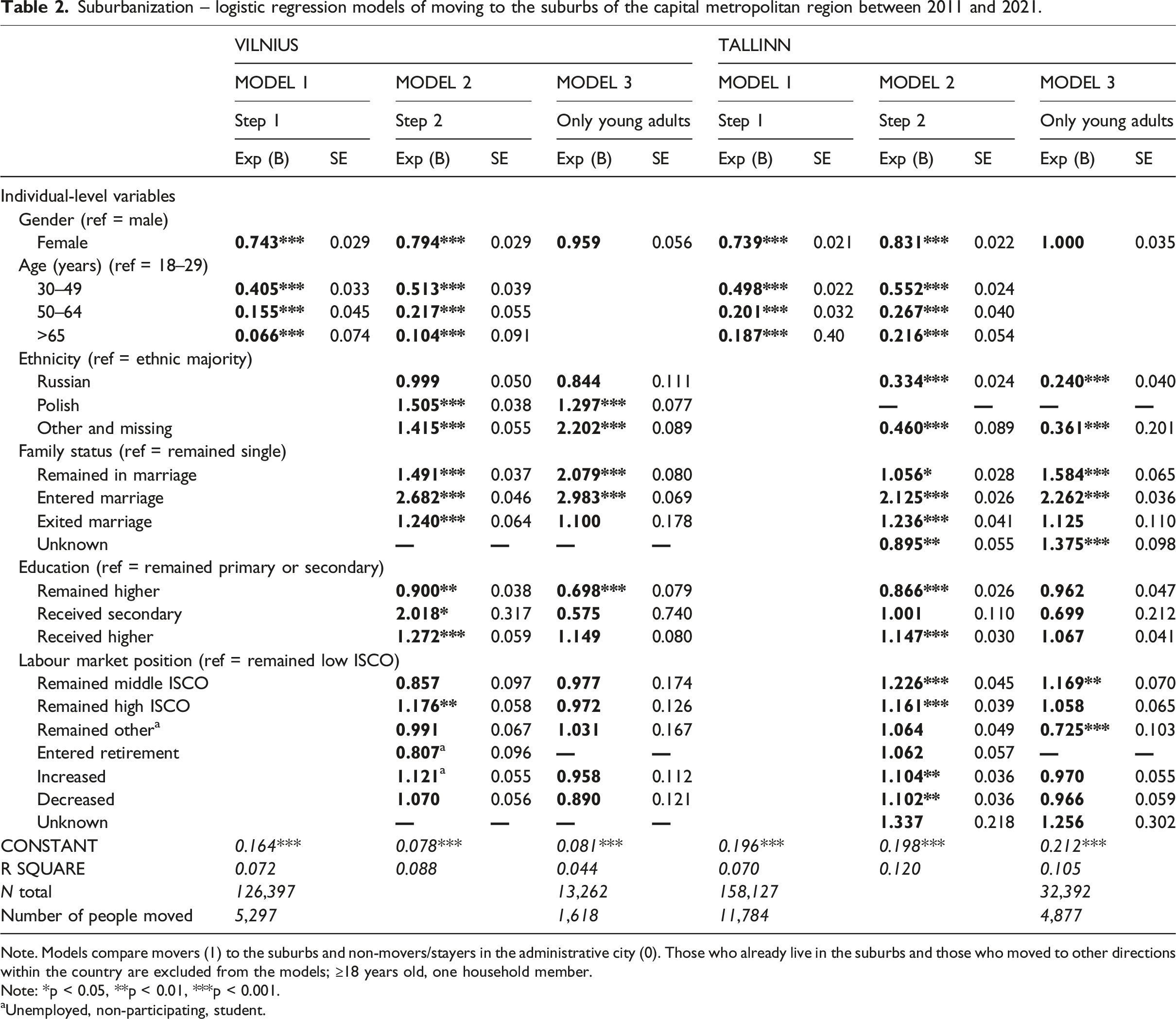
Note. Models compare movers (1) to the suburbs and non-movers/stayers in the administrative city (0). Those who already live in the suburbs and those who moved to other directions within the country are excluded from the models; ≥18 years old, one household member.
Note: *p < 0.05, **p < 0.01, ***p < 0.001.
aUnemployed, non-participating, student.
In Model 2, age’s impact remains unchanged after controlling for other factors. The ethnic landscapes of Lithuania and Estonia, as discussed above, clearly manifest in the ethnic dimension of suburbanization. When controlling for other factors, Polish and other non-Russian minorities have a higher likelihood to suburbanize around Vilnius; this is attributed to the historical concentration of ethnic minorities, particularly Poles, in the region (Ubarevičienė et al., 2015). However, in terms of absolute numbers, ethnic Lithuanians make up the majority of suburbanizers at 61%, while Poles constitute only 22%. In Estonia, ethnic minorities are less likely to suburbanize compared to the majority population, consistent with prior studies (Tammaru et al., 2013). Next, results indicate that individuals who remained single between the two censuses had the lowest likelihood of suburbanization compared to all other family statuses. In both countries, the probability of suburbanization declines with a higher level of education, but an increase in education between 2011 and 2021 is positively linked to suburbanization. Probabilities of suburbanization among individuals with different labour market positions are quite similar, and only minor nuances exist between countries. In Lithuania, individuals in top occupational positions and those experiencing an upward change in their status have a higher likelihood of suburbanization compared to others. In Estonia, individuals in middle or top occupational positions and those experiencing either an increase or a decrease in their status are more likely to suburbanize. The way labour market change categories (‘increase’ and ‘decrease’) function in the suburbanization model is probably related to their inherent mobility-related attributes, as seen in the urbanization models. Overall, individuals tend to maintain their labour market positions when moving to the suburbs, irrespective of their prior positions. In Model 3, when focusing to only young adults, we see that the effect of ethnicity remains the same: minorities in Lithuania have a relatively higher likelihood of suburbanization, while in Estonia they have a lower likelihood. Family status is an important predictor of suburbanization among young adults. Specifically, individuals who got married or were already married during the analysed period have 2–3 times higher odds of suburbanization compared to singles. Focusing on young adults notably impacts the effects of education and labour market position, compared to the model which includes all ages. In Vilnius, the likelihood of suburbanization decreases with higher education, but this effect is absent among young suburbanizers in Tallinn. There is still a positive association between receiving higher education and suburbanization in both countries, albeit weaker compared to the previous model. When examining young adults, the trend of individuals with different labour market positions having similar probabilities of suburbanization becomes even more pronounced.
In summary, our findings suggests that demographic (age, ethnicity, family status) rather than economic-based (education, labour market position) factors play a more significant role in the young adult’s decision to suburbanize. This trend aligns with the life-course literature (Rossi, 1955), which suggests that individuals in the family formation stage are more likely to choose suburban living. As discussed in the literature review, suburbanization contributes to populations de-concentration from major cities, driven by environmentalist motives (see Geyer and Kontuly, 1996). Regarding suburbanization, as we expected, the model outcomes show similarities in both countries, despite their different settlement systems.
National-wide population de-concentration
De-concentration – logistic regression models of moving to the non-metropolitan region between 2011 and 2021.
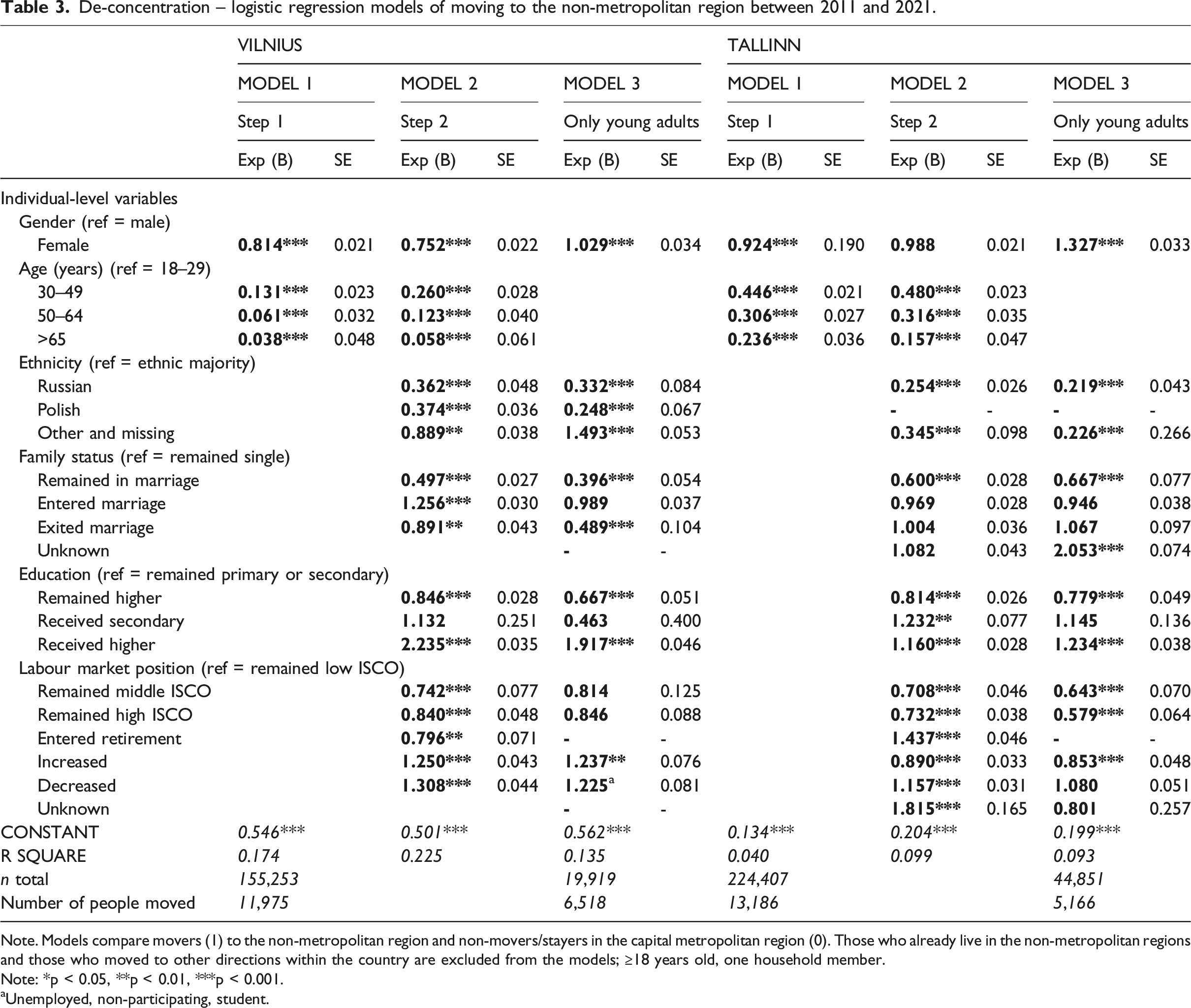
Note. Models compare movers (1) to the non-metropolitan region and non-movers/stayers in the capital metropolitan region (0). Those who already live in the non-metropolitan regions and those who moved to other directions within the country are excluded from the models; ≥18 years old, one household member.
Note: *p < 0.05, **p < 0.01, ***p < 0.001.
aUnemployed, non-participating, student.
Model 2 shows that the impact of age remains robust even when controlling for other characteristics. The model also shows that ethnic minorities are much less likely to leave capital MRs. This finding aligns with previous results indicating the preference of ethnic minorities for larger urban areas over smaller, remote locations within the countries. Regarding marital status, being single or getting married during the analysed period is associated with an increase in the likelihood of moving from the capital city MR, compared to those who are already married. In both countries, individuals with lower education are less likely to leave capital city MR, but an increase in education between 2011 and 2021 is positively linked to de-concentration. Although a lot of those who move towards capital city MRs to study also stay there, many also move back to their home regions or to some other places after having received their degree (Rérat, 2014), as also observed in our analysis. Population de-concentration away from the capital city MRs is also connected to lower occupational positions. Individuals employed in lower occupations are more likely to leave capital city MRs compared to people working in middle- and higher level of occupations. Lower-income earners indeed appear to be priced out of the capital city housing markets in both countries, as individuals whose occupational status decreased have a significantly higher probability of leaving capital city MRs as well. However, our findings reveal an additional nuance. Individuals who experienced an increase in their occupational status are more likely to de-concentrate in Lithuania but less likely to do so in Estonia. It is possible that the more diversified opportunity structure in Lithuania’s polycentric settlement system offers more opportunities for higher-income earners to obtain attractive jobs compared to the mono-centric settlement structure in Estonia. Furthermore, in Estonia, there is a positive association between de-concentration and retirement, while in Lithuania, this association is inverse. In Model 3, the effect sizes of the variables ethnicity, family status, education, and labour market position on migration remains similar with those in Model 2. An interesting finding is that de-concentration of young adults is not much associated with the family-building behaviour – regarding marital status, individuals who remained single were more likely to leave the capital city MR, while those who were married were less likely to move away in both countries. Meanwhile attainment of higher education of young adults is positively associated with de-concentration. This migration may entail single (recent) graduates moving back to home municipality. Young people employed in lower occupations are, similarly to workers in general, more likely to leave capital city MRs compared to people working in middle- and higher level of occupations. We also find it interesting that the probability of experiencing an increase or decrease in occupational status during the analysed period differs between the two countries. We will further investigate this finding in Section 6.4.
In summary, the results of the models suggest that population de-concentration in Estonia and Lithuania is not primarily driven by environmentalist or productionist motives. Furthermore, our results show that young adults exhibit the highest likelihood of moving away from MRs, also comprising the majority of individuals moving to this direction (see Figure S2 in the supplementary material). This contradicts the assumptions of the cyclical urbanization models and life-course approach that suggest that older people are most likely to move over this direction (see Geyer and Kontuly, 1996). Notably, our analysis shows that migration in this direction is relatively more common in Lithuania than in Estonia, as indicated in Figure S2. This difference may be linked to their different settlement types. In Lithuania, multiple regional centres compete to attract individuals in search of education and employment opportunities. In Estonia, Tallinn has virtually no competitors, except for Tartu, which is a significantly smaller university city.
Migration, socio-spatial inequality, and type of the settlement system
We were particularly intrigued by the findings of the nation-wide de-concentration model. It became evident that young people have a higher propensity to move away from the capital MRs compared to older individuals. This finding contradicts the assumptions of theoretical models that explain life-course migration patterns. However, it aligns with Rogers and Castro (1981) migration age schedules and Stockdale and Catney (2012) findings that in Northern Ireland the probability of counter-urbanization (de-concentration) decreases rather than increases with age. The later authors attributed these unexpected results to the unique settlement system in Northern Ireland. Our study compares two otherwise similar countries with distinct settlement systems.
We now delve into the nation-wide de-concentration of young people, aiming to understand whether their residential relocations differ in different settlement contexts. Through the use of maps, we visually represent the migration patterns of young adults with varying labour market statuses (Figure 1). On the maps, the circles represent the number of young adults who left from Vilnius MR and from Tallinn MR to other places within each country between 2011 and 2021, and the shades of grey depict the distribution of higher and lower occupational groups in each country (as of 2011). In both countries, a greater proportion of individuals who ‘de-concentrated’ had high or increased occupational status compared to those with low or decreased status. Notably, in Lithuania, the disparity was significant, with three times as many individuals holding high or increased status compared to those experiencing low or decreased status. In Estonia, this contrast was more moderate, with a 1.5-fold difference. Although the absolute numbers of young migrants with high or increased occupational status are bigger, the likelihood to move out from Tallinn metropolitan region is highest for those young people whose occupational status remained low or decreased (Table 3, Model 3). This again indicates that young people with higher labour market position are more likely to stay in capital MR, and people with lower labour market position are more likely looking for opportunities (e.g., housing) outside the capital MR. Despite that and regardless of their occupational status, individuals moving away from the capital MRs demonstrated nearly identical destination patterns. This spatial pattern, though, is rather standard – the larger the settlement and the higher the proportion of residents with high occupational status there, the greater the influx of newcomers from both higher and lower occupational statuses. In other words, young people seek residential opportunities to second and third tier cities rather than from rural areas. Interestingly, it appears that migrants with low occupational status tend to “avoid” destinations where people with low occupational status is overrepresented. These patterns are consistent across both countries and appear unaffected by the type of settlement system (monocentric vs polycentric). Only relatively minor differences between Estonia and Lithuania can be observed. For example, individuals from Vilnius MR with higher occupational status more often migrate to larger cities, while migrants with lower status more evenly distribute throughout Lithuania. In Estonia, individuals of both higher and lower occupational status migrate from Tallinn MR to other cities and towns. However, compared to Lithuania, there is a slightly higher proportion of higher status individuals migrating to settlements at lower hierarchy levels (towns and small cities), possibly due to increased remote work opportunities in Estonia. Overall, the type of settlement system appears to have minimal impact on migration flows and characteristics of migrating population. Migration of young adults with high or increased labour market positions (left) and low or decreased labour market positions (right). Note: The maps depict a subset of the research population included in the models, not all individuals who moved; only migrations of five or more individuals are displayed.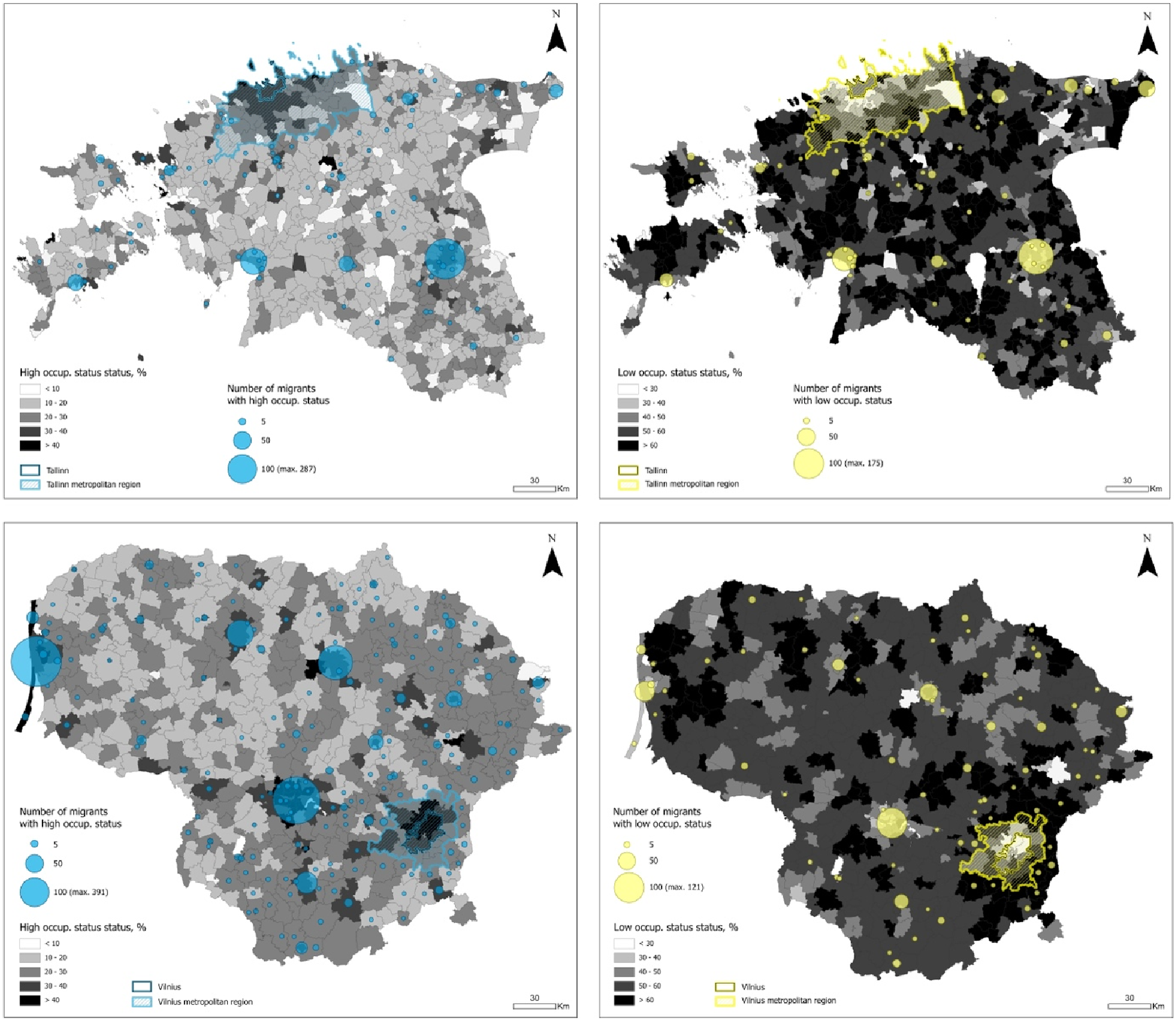
Discussion and conclusions
Our study builds upon cyclical urbanization models and the life-course approach, proposing interconnected patterns in cyclical urban growth and migration destinations based on individuals’ life stages (Kulu and Milewski, 2007). It is assumed that younger individuals are attracted to cities for economic reasons (productionist motives), while older individuals favour non-MRs for environmental factors (environmentalist motives) (Geyer, 1996; Geyer and Kontuly, 1996). However, the idea of clear-cut migration phases over the life course has been challenged by Haase et al. (2012) and Stockdale and Catney (2012), who argue for a more complex relationship between age and migration patterns. There is growing evidence that new forms of socio-spatial inequalities are emerging as the housing markets in large cities are increasingly pricing out middle- and lower-income earners, as well as younger individuals seeking their first homes (Rodríguez, 2024; Tammaru et al., 2021). This is also supported by the literature connecting urban scaling and inequalities. Sarkar (2019) analyses the link between city size and urban inequalities and concludes that the concentrations of high-income and high housing costs in large cities displace lower- and middle-income earners. Similarly, Arvidsson et al. (2023) find that urban elites benefit the most in large cities, while most residents only partially access urban growth advantages. We contribute to this literature by undertaking a study on the residential concentration and de-concentration processes in a comparative research setting. We studied Estonia and Lithuania, both sharing similarities but diverging in settlement systems: Estonia is monocentric, while Lithuania is polycentric.
More specifically, we focussed on moving towards the capital MR and away from it, both to their suburbs and beyond. We expected that different migration directions would be associated with distinct individual characteristics, leading to unequal population distribution and the consequent development of socio-spatial inequalities. We also anticipated the settlement system to play a role in migration patterns as geography of opportunities is more limited in a monocentric settlement system where capital city dominates, concentrating the bulk of most attractive jobs, while in the polycentric system, economic opportunities are dispersed across multiple urban centres, potentially influencing migration patterns in distinct ways. However, our results diverged from our expectations and theoretical frameworks. We found that young adults showed the greatest propensity for migration in all directions in both countries. Age differences in moving to capital MRs and from them (to suburbs and beyond) persisted even after accounting for other individual characteristics. This challenges the conventional life-course pattern where younger individuals are more likely to move to cities, followed by suburban and counter-urban areas as they age. On the other hand, we did observe that migrations to MRs were driven by productionist motives, while migrations away from MRs had a weaker influence of these motives. Among young adults, migration to MRs was associated with significant life events such as marriage, pursuing higher education, and career advancement. When it comes to suburbanization, demographic and possibly environmental factors played a more significant role than economic-based factors. Although non-productionist motives should get stronger with age, we did not find evidence supporting this trend.
Our findings on de-concentration, which refers to migration away from the MRs, are particularly intriguing. Interestingly, this destination is more prevalent among young adults (especially in Lithuania) and lower-income families. Our results suggest that young and financially constrained individuals are priced out from urban housing markets, while higher-earners are more likely to move to the capital cities. While differences in the settlement systems of Lithuania and Estonia are somewhat reflected in the migration flows of various age groups, our findings indicate numerous similarities in migration patterns and the characteristics of movers. One notable exception is that in Lithuania, individuals with high or increased occupational status are more likely to move to second-tier cities, offering attractive job opportunities alongside Vilnius. In Estonia, an increase in occupational status is not related to population de-concentration. However, young people in both Estonia and Lithuania seek opportunities in second and third-tier cities, offering more affordable housing than the capital city MRs. Economic activities, educational networks, infrastructure, connectivity, demographics, and other factors might also influence migration patterns, regardless of settlement systems. This broader perspective may shed light on why residential mobility patterns are similar in many respects in two countries.
In conclusion, our study found that young people are most likely to urbanize, suburbanize, and counter-urbanize. However, population de-concentration (leaving from larger cities) may result from younger individuals and lower-income families being priced-out of capital city housing markets. Second and third-tier cities become attractive alternatives for those leaving capital cities due to the combination of quite dynamic labour market and more affordable housing. Hence, the finding by Stockdale and Catney (2012) that counter-urbanization decreases with age may not be as context specific as the authors discussed, given the distinct settlement context of Estonia, Lithuania, and Northern Ireland. Yet, it is notable that all three countries are geographically small, potentially influencing migration patterns, warranting further investigation. Another puzzling finding deserving attention in future research is the gender differences in migration behaviour. Despite serving as a control variable, gender emerged as highly significant factor, revealing notable differences in migration probability and destination preferences between the two countries.
Supplemental Material
Supplemental Material – Residential mobility and new forms of spatial inequality in the settlement system: A comparative study of Estonia and Lithuania
Supplemental Material for Residential mobility and new forms of spatial inequality in the settlement system: A comparative study of Estonia and Lithuania by Rūta Ubarevičienė, Kadi Kalm, Maarten van Ham, Tautvydas Žinys, Jaak Kliimask, and Tiit Tammaru in Journal of Environment and Planning B: Urban Analytics and City Science.
Footnotes
Acknowledgements
We are grateful to Statistics Lithuania/State Data Agency for granting access to the State Data Management Information System, serving as the primary data source and statistical analysis platform (in the case of Lithuania). Your support and cooperation significantly contributed to the successful completion of this study.
Declaration of conflicting interests
The author(s) declared no potential conflicts of interest with respect to the research, authorship, and/or publication of this article.
Funding
The author(s) disclosed receipt of the following financial support for the research, authorship, and/or publication of this article: This work was supported by the Lithuanian Research Council [S-MIP-21-57: ‘Peripheral Regions in Lithuania: Migration and Local Communities’], Estonian Research Council [PGR1996 “Living segregated lives: Exploring changes in spatial inequalities in digitally transforming societies”], the Estonian Ministry of Education and Science [Centre of Excellence in Energy Efficiency and the Infotechnological Mobility Observatory ( )], and Estonian Academy of Sciences [Research Professorship of Tiit Tammaru].
Data availability statement
Data sharing not applicable to this article as no datasets were generated or analysed during the current study.
Supplemental Material
Supplemental material for this article is available online.
Notes
References
Supplementary Material
Please find the following supplemental material available below.
For Open Access articles published under a Creative Commons License, all supplemental material carries the same license as the article it is associated with.
For non-Open Access articles published, all supplemental material carries a non-exclusive license, and permission requests for re-use of supplemental material or any part of supplemental material shall be sent directly to the copyright owner as specified in the copyright notice associated with the article.
