




Abstract
Urban re-orientation on feeding the city in a city-region context has encouraged local policies to spur urban agriculture by stimulating bottom-up citizen participation in urban food production. However, in real life, tensions occur between policies and practices. The misalignment of policy goals with planning instruments and the needs of practitioners in urban agriculture hampers the development of substantial urban food production. This paper introduces Oosterwold, a new peri-urban area of the Dutch city of Almere that pivots urban agriculture. Oosterwold is a unique experiment in which a top-down policy goal – producing 10% of the future urban food needs – is handed over to the self-organisation of new residents, who are bound by the rule to allocate 51% of their plot to urban agriculture. This study deploys a social practice theory–informed analysis to appraise the performance in urban agriculture. Novel in our methodology – combining an online survey (n=111) with an analysis of aerial photos (n=199) – we unpack the unruly nature in which urban policy and planning are shaping up through bottom-up citizen participation. Our study demonstrates that (i) it takes time for residents to adopt urban agriculture as a substantial practice in their heterogeneous lifestyle and (ii) that a focus on bottom-up approaches, such as Oosterwold residents’ self-organisation, does not imply laissez faire from planning and policy. It is inferred that a balance in policy goals, planning instruments, and the needs of the practitioners requires a shared vision and builds on supportive conditions.
Introduction
Bottom-up governance in urban agriculture is increasingly receiving attention, with cities as the fulcrum for a transformation towards new paradigms in ‘feeding the city’ (Morgan 2014; Sonnino et al. 2019; Valley and Wittman 2019; Zasada et al. 2019). However, how this is effectuated within a top-down routine in urban planning is still largely uncharted territory. What happens when bottom-up and top-down meet each other in a peri-urban development that pivots urban food production? This paper addresses the tension between top-down policy goals and planning rules, and bottom-up practice in urban agriculture in a shared desire to ascertain new paradigms in feeding the city.
Many cities have set goals to stimulate the practice of urban agriculture, through a diverse set of tools such as plans, regulations, and inventories (Prové 2018). However, in real life, a tension is present between these policy ambitions and everyday practice of urban agriculture (Moragues-Faus and Morgan 2015; Reed and Keech 2019; Halvey et al., 2021; Langemeyer et al., 2021). This tension stems from an imbalance between these policy ambitions ‘on paper’ and the difficulty to perform in real life. The imbalance is linked to various incentives: (i) the priorities given to build-up areas and other economically prioritised functions in spatial planning (Jansma and Wertheim-Heck 2022), (ii) a lack of understanding of the multifunctionality of urban agriculture (Langemeyer et al., 2021), (iii) the complexity of a functional integration of urban agriculture in the urban green space (Rolf et al., 2020), (iv) departmental fragmentation, variety, and complexity of regulations and limited access to supportive means (Halvey et al., 2021), (v) the disparity between the informal food movement and the formally regulated planning (Hardman et al. 2018), and (vi) a misunderstanding of motivations of practitioners in urban agriculture (Kirby et al. 2021). A wide range of scholarly evidence stresses that successful policies coining at local food agendas should build on a mode of “concerted action” of local policy, planning, and populace working towards “place-based” solutions through co-creation (Bendt et al. 2013, Moragues-Faus and Morgan 2015: 1569, Sonnino et al., 2019: 115). Critically, this mode implies an active participation of local communities in (spatial) planning. The underlying rationale is that the local communities of practitioners best understand their own needs which are reproduced in their everyday practices (Shove and Walker 2010; Torres et al., 2018).
Over the last two decades, spatial planning developed various instruments in response to the increasing demand for active participation of citizens and societal groups in co-shaping the urban space, for example, in urban agriculture (Certomà and Notteboom 2016; Rauws and De Roo 2016; Horst et al., 2017; Zhang et al., 2019; Halvey et al., 2021; Lachmund 2022). Instruments range from a distant consult of target groups towards participative collaboration in (urban) living labs (Horlings et al., 2021). These living labs act like spaces for real-world experimentation in which citizens are actively engaged in the co-creation of solutions to urban challenges and in which local authorities act as enablers and process facilitators (Gamache et al., 2020; Mahmoud et al., 2021; Brons et al., 2022). The challenge of this real-world experimentation is in the balance between policy goals, planning instruments, and citizens’ needs and wishes (Janin Rivolin 2012). However, how this balance is effectuated in urban agriculture, where the food growing movement predominantly operates in the informal sphere “outside of, or in conflict with current city planning models” (Coles and Costa 2018: 1), is still largely unexplored. Moreover, what happens if a food producing ambition is formally taken to the level of a (peri-) urban area and the residents – the residential households – are obliged to co-shape this ambition in their daily practice? What does this imply for the planning instruments on the one hand and how are these ambitions effectuated in the residents’ urban agriculture practice on the other hand? In brief, how does the balance between policy goals, planning instruments, and residents’ needs and lifestyle work in the real world of urban agriculture?
This paper centres Oosterwold, a new peri-urban district of the Dutch city of Almere, 30 km east of Amsterdam. In Oosterwold (the next section details this further), top-down policy goals and planning instruments meet bottom-up urban agriculture practices of its new residents. Oosterwold thus is a unique living lab to uncover how municipal planning polices and the accompanying planning instruments shape the residents practice of urban agriculture. Our study provides empirical evidence of residents stepping in on urban agriculture practices, 5 years after they first settled in Oosterwold. Whether and how will Oosterwold residents produce food for the city region of Almere? By focussing on the diversity of the urban agricultural practices, our aim is to appraise how the policy goals and planning instruments are balanced with residents’ everyday rationalities and needs in producing food. We deploy a practice theoretical lens to study the balance between planning and practice of urban agriculture in Oosterwold. The methodically vetting of the practices provides a deeper understanding of how urban agricultural shapes up the way it does in the context of Oosterwold. This understanding informs future policies in planning for urban agriculture as a potential pillar of the aspired new ‘feeding the city’ paradigm.
The paper sets out to describe our case in more detail. Subsequently, it continues with our social practice theory–informed methodological approach. Finally, we present our findings, analyse and mull these findings, and infer that a concerted action to co-create a food producing area requires a shared vision, time, and supportive conditions to obtain a balance between policy goals, planning instruments, and residents’ needs.
Living lab Oosterwold
Oosterwold encompasses a 4300 ha peri-urban development east of the city of Almere (220,000 residents in 2022) at which 15,000 new homes are foreseen (Figure 1). Almere policy set the ambition to produce 10% of future food needs of Almere in Oosterwold. Although the Almere policy steers for this 10% ambition, the planning instruments of Oosterwold are limited. These instruments revolve around a basic set of top-down established living rules, of which residents’ self-organisation has a pivotal position (Cozzolino et al., 2017; Testi 2022). A key living rule in the context of this paper is that each resident should devote at least 51% of their property to food production, that is, urban agriculture (Jansma and Wertheim-Heck 2021). Map of the development of peri-urban Oosterwold, a new residential area of the city of Almere (NL). The detailed map illustrates the three steps of development of the area: 1a (700 ha) started in 2016; 1b (350 ha) started in 2021; while 2 (2850 ha) is projected after 2024 (Map: Almere (2012); detailed map: Oosterwold Development Authority).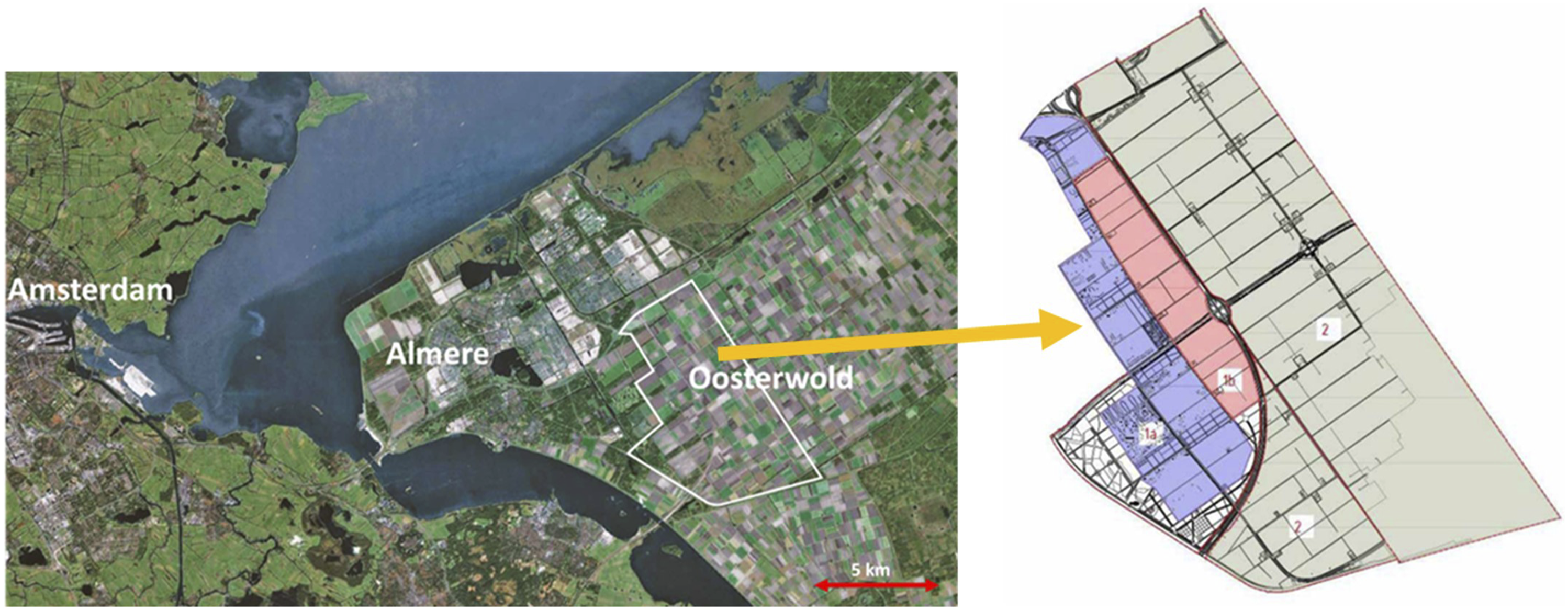
Oosterwold opened for residential participation in late 2015. All new residence, whether single family, collective (e.g. as in collective private ownership), or property development, have to complete an admission procedure before being permitted to purchase land. Part of this procedure is the submission of a plan on how they aim to develop their plot including urban agriculture. Because Oosterwold highly relies on the self-organisation of the residents, it takes time to complete the admission procedure and subsequently to organise and develop the home, its auxiliaries (infrastructure, sanitation, electricity, etc.), and the other parts of the plot, including the urban agriculture. Notwithstanding this time-consuming process, by 2020 readily 420 homes were developed accommodating around 1600 residents (data acquired from Oosterwold Development Authority (ODA)). Since 2020, the number of residents has been doubled. By the end of 2022, Oosterwold accommodated nearly 1000 homes and about 3300 residents (Almere 2022). The Supplementary file provides more details of the Oosterwold residents.
Social Practice Theories
To study the performance of urban agriculture in Oosterwold, we deploy a social practice theoretical (SPT) perspective (Reckwitz 2002; Spaargaren and Oosterveer 2010; Shove et al., 2012). Our empirical focus is on the practice of urban agriculture as being performed by the Oosterwold residents. Though practice theoretical approaches predominantly foreground well-established, routinised behavioural patterns (like commuting, showering, or shopping), this study concerns the emergence of urban agriculture in a new residential area. By zooming in on the versatile performative manifestations of urban agriculture in Oosterwold, we aim to uncover the modes of engagement (in urban agriculture) of the residents. We follow Shove et al. (2012) in specifically paying attention to the amalgamation of meaning (e.g. visions of and discourses in urban agriculture), competence (e.g. understanding of and skills in urban agriculture), and material (e.g. available infrastructures, equipment, and tools) as indicators of the shaping up of the practices of urban agriculture in Oosterwold (Figure S1). The development of and connection between these three elements gives an understanding of why and how a practice is performed as it is (Shove et al., 2012).
SPT does not prescribe a unifying methodology – instead it allows for methodological eclecticism (Warde 2014). The wide range of SPT informed empirical studies demonstrates a preference for in-depth investigation by qualitative research methods (Halkier 2011; Spaargaren et al. 2016). Practice theorists importantly make use of discussant techniques for inquiry; for instance, interviews are considered helpful to reveal practice compositions and arrangements, while reflexivity on routinely enacted behavioural performances can be provoked. In addition, practice theories utilise a broad range of observational methods, ranging from shadowing to photo-elicitation, which offers a direct access to the observable practices. In this study, we deviate from these generally accepted methodological approaches and combine a quantitative online survey with a qualitative aerial photo analysis (Table S1).
Although quantitative survey methods are critiqued for their methodological individualism and thus considered incompatible with the ontological and epistemological premises of SPT (Halkier and Jensen 2011), an emerging body of work pays specific attention to methodological combination (mixed methods), underscoring that quantitative methods (like a survey) are also applicable to social practice theories (Browne et al., 2013; Kennedy et al., 2013; Wertheim-Heck et al., 2014). This interest in quantitative methods is based on their potential to reveal social differentiated patterns and trajectories of practices (Cochoy et al., 2022), and for enabling cross contextual comparison (Zollet et al., 2022). Our choice of an online survey was both practically and analytically informed: practically, because the limitations to social interaction during the COVID-19 pandemic did not allow for in-depth face-to-face inquiry and observational methods and analytically, the survey method was considered relevant for two reasons: firstly, in tracing and understanding the different elements (meaning, competence, and material) that blend the urban agricultural practices in Oosterwold and, secondly, by including urban agricultural practice imaginaries of residents not yet (fully) residing in Oosterwold.
However, surveys are limited, for example, in the sense that questions and response categories are predefined and these might trigger socially desirable ‘sayings’ – say what you do – rather than a reflexive evaluation of the ‘doings’ – the actual performance in situ. It is not only what residents say that matters in SPT but also how they actually perform in the unruliness of daily life. We thus deemed it essential to follow up with empirical research that allowed qualitative access to the practices as being performed. In our approach, we replaced the ‘usual’ (in SPT methodology) interviewing and observational methods with an analysis of the doings in urban agriculture by means of high-quality aerial photos. The photos helped us to examine the actual performances at a moment as the circumstances (COVID-19) didn’t allow for other more in-depth qualitative methods. In addition, the photos offered us an interface to comprehensively and instantly appraise the diversity of urban agriculture in situ, uncovering temporal, organisational, and functional dimensions.
Methods
Survey
The survey was composed of open and closed questions about respondents’ general personal background and living conditions, performance of urban agriculture, motivations, means and knowledge of urban agriculture, and requirements and constraints of living in Oosterwold. We used Qualtrics XM software to compile an online questionnaire which was available to respondents between 7th of May and 8th of June 2020. A link to the survey was circulated at several online platforms within the area. The raw data were filed in a Microsoft 365 Excel (16.0) spreadsheet. We removed all trials, and incomplete datasets, which left us with 111 complete records (representing 26% of the Oosterwold residential households in 2020). Subsequently, answers to open questions were removed from the data base. Questions with non-numerical values (like in ‘Totally disagree’, ‘Disagree’, ‘Neutral’, ‘Agree’, and ‘Totally agree’) were given a numerical value (respectively, 0, 2.5, 5.0, 7.5, and 10). The data interpretation was carried out using statistical software of Genstat for Windows 21st Edition (VSN International). We used the statistical software to estimate per question the frequency distribution of the answers over the classes and to approximate the mean using the numerical values mentioned above. Subsequently, a non-hierarchical cluster analysis was carried out with a selected subset of 31 variables about respondents’ ideas on living in Oosterwold as well as their experiences with and the meaning they attribute to (their) urban agriculture in Oosterwold. The online questionnaire and the anonymised dataset are available in the repository linked to this document.
Photo analysis
ODA provided us with 356 high-quality (>8000 MB) aerial photos of properties (plots in all stages of development) in Oosterwold. These photos were commissioned by ODA and taken with a drone during the peak of the growing season, that is, 24th and 25th June 2021. The drone photos were captured from a bird’s eye view camera position, offering a different perspective compared to the typical vertical position of satellite images. The collection of photos provided us with detailed material that enabled a thorough examination of the performance of urban agriculture performance at the individual plot level. We selected 199 unique residential plots (nearly 30% of the 680 households of Oosterwold in 2021), that is, home (and sheds) or cluster of homes with garden or field that is recognised as a single and unique plot with a postal address. For the purpose of the analysis, we excluded the photos of plots that didn’t (yet) show any residential development activity. The photo analysis was executed by the first author, who for many years is familiar with the development of urban agriculture in Oosterwold and is educated as an agricultural engineer. Notwithstanding the high level of detail the images offered, there were certain aspects that required estimation. Due to the oblique perspective it was not always possible to distinguish between different types of vegetation, such as trees, shrubs, and vegetable beds, or the type of livestock kept. In addition, the surface allocated to urban agriculture was based on first authors’ estimate. The observations were recorded in a Microsoft 365 Excel (16.0) spreadsheet, which, together with a detailed description of the assessment procedure taken, is available in the repository linked to this document.
Results
Survey
General findings
With a focus on the practitioners to capture distinct patterns in urban agricultural practices in Oosterwold, we first provide a profile of the respondents in relation to urban agriculture. Most respondents (95%) had their employment background outside the food sector (whether as an employee, an independent freelancer, or a retiree). This was reflected in the assessment of their own competence in urban agriculture, which they predominantly judged moderate. During the survey, 65% of the respondents inhabited their plot, while the other 35% were in a (pre-) phase of developing the plot. Residents claimed that the urban agriculture at their plots predominately ranged between 500 and 2500 square metres. 96% of the respondents indicated to have planted fruit/nut trees on their plots and that vegetables (96%), berries (96%), flowers/perennials (84%), and herbs (93%) were grown. Lesser numbers stated to have beehives (9%), vines (20%), and chicken or other livestock (51%). About 50% of the respondents were residing long enough in Oosterwold to have had at least 1 year of harvest from their plot. The harvest was predominantly consumed or processed at home or shared with the neighbourhood. Only a minority sold or bartered the harvested and/or processed products.
In performing the agricultural practices, the respondents indicated that it is largely their individual activity though also with receiving support from their families or partners. The ‘pre-COVID-19’ time devoted to urban agriculture was estimated in the same order of magnitude as that to social life and leisure activities but much less than the time they spent on their job and family life. Respondents indicated that COVID-19 had a positive impact on their interest in producing food and gardening as well that it offered more room to spend time on urban agriculture. Time for farming appeared as an important constraining issue, with respondents commenting that ‘in an ideal world’ they would spend more time on farming their plot at the expense of work and travel. Besides more time devoted to urban agriculture, the residents considered training/courses, knowledge infrastructures, coordination of production and sale, and a processing facility as potentially enabling the development of urban agriculture in Oosterwold.
Respondents gave great importance to urban agriculture in general terms like in the reduction of the dependency on the global food system and the reduction of the gap between production and consumption, as well as its contribution to a greener city and its educational function (Table S2). However, they discriminated in the local importance of it. Urban agriculture was considered highly relevant to Oosterwold but not that much important to local networks in food as well as to the city region of Almere.
Typology of practices of urban agriculture in Oosterwold
The four clusters of typologies and their dimensions (n=111).
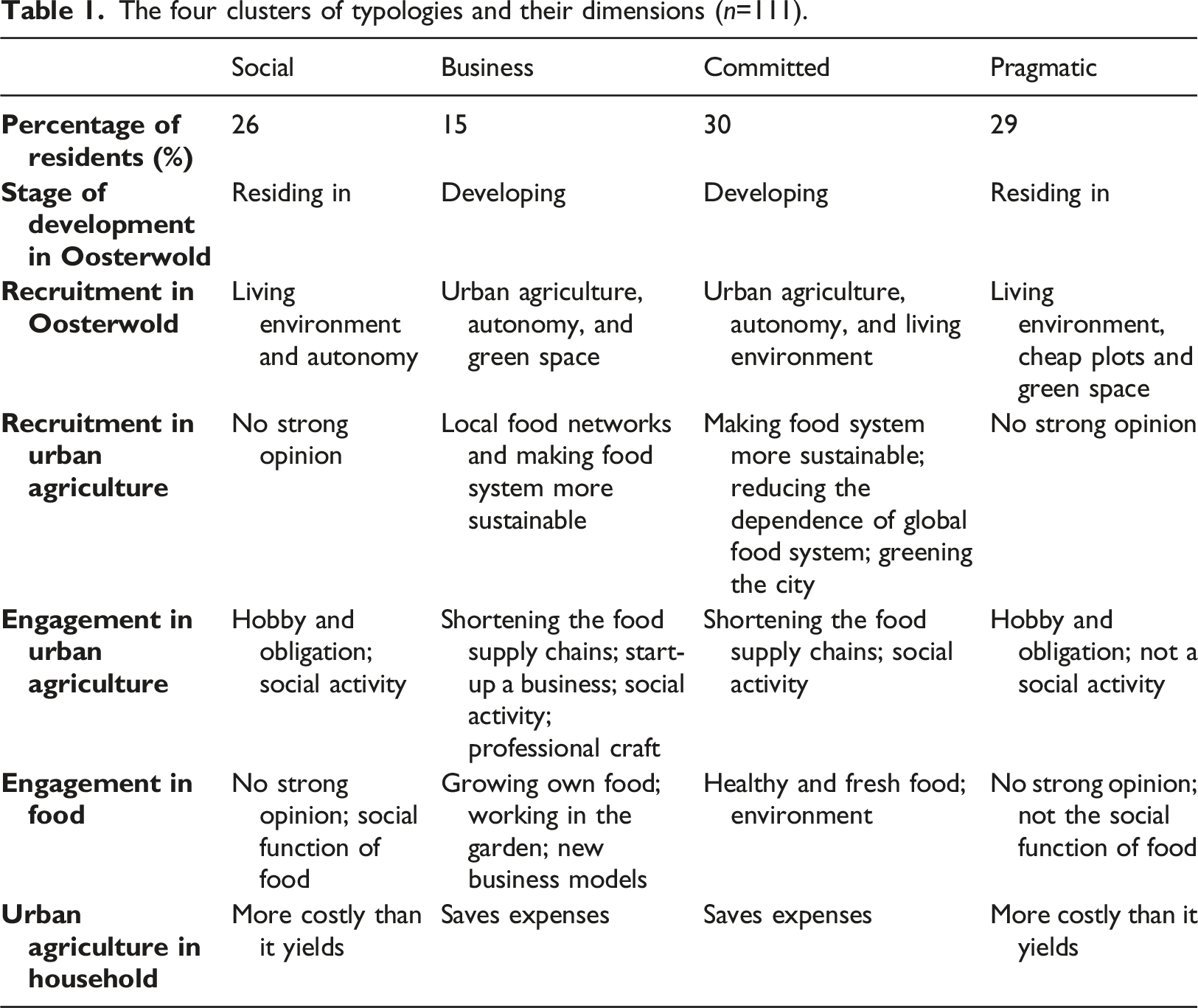
Photo analysis
We analysed the urban agriculture performances at two scales: firstly, we zoomed in on individual plots and, secondly, we zoomed out for a clustered orientation of multiple plots.
Assessment of individual plots
Results of photo analyses of individual plots (n=199) in Oosterwold. The upper – overall – row is a sequential overview of all the 199 plots. In the two lower rows this overall impression is split in, respectively, the group with (n=93) or without (n=106) a dominant lawn.

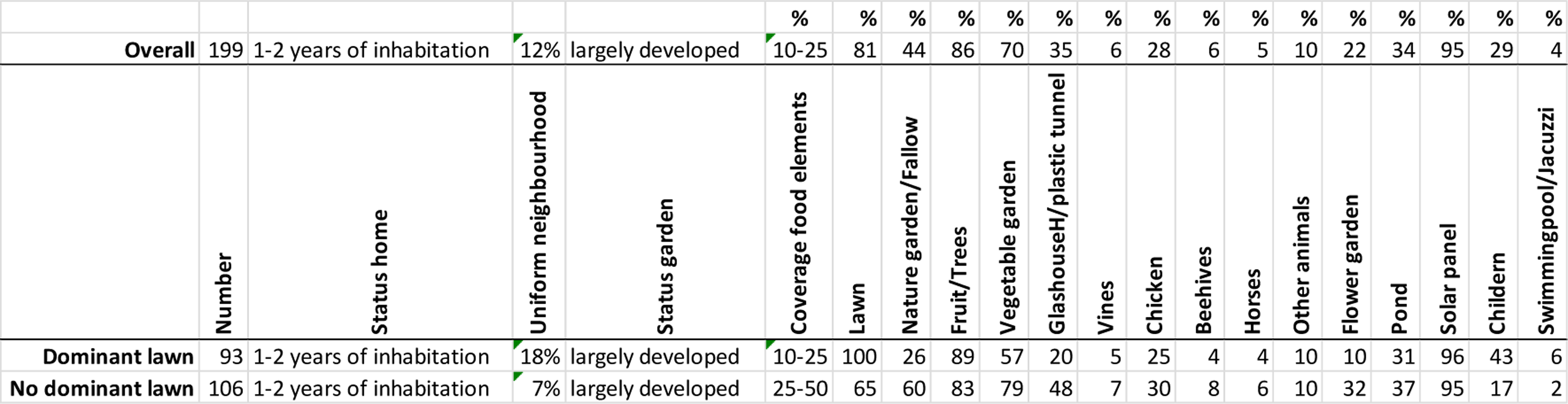
The limited space allocated to food-related practices was not revealed by the survey but evidenced from the aerial photographs (Table 2). On average, the space allocated to food amounted to an estimated 10 to 25% of the plot, which is considerably lower than the formally required 51% spatial designation to urban agriculture. Urban agriculture appeared to compete with other activities in daily life. The photographs portrayed lawns, flower beds, ponds, swimming pools, hot tubs, and substantial areas covered with tiles. Some residencies were shown to keep (riding) horses and/or other pets. The presence of children was visible, with 29% of the gardens showing garden play equipment, such as a trampoline or a swing. The seemingly low portion of urban agriculture can also be explained by the stage of development. We estimated that most of the pictured plots were only recently inhabited, on average 1 to 2 years, and that most gardens seemed not yet fully developed, retained as lawn, or in some cases even appeared as fallow or nature/wild garden.
The aerial photo analysis disclosed a relative dominance of meadows and lawns in Oosterwold. Nearly half (47%) of the analysed plots were predominantly covered by a lawn or a meadow (in Table 2: Dominant Lawn – DL). Also, among the other plots (in Table 2: No Dominant Lawn – NDL), lawns were still visible, though smaller in size and spatially not dominant. Both groups were visually indistinguishable in the level of development of home and garden as well as in percentage solar panels (nearly all homes had solar panels on their roof) and ponds. However, on some critical points, there were clear differences between the two groups. Nearly 20% of the DL plots were situated in a neighbourhood with a uniform type of houses, and the remainder were individual or so-called collective private ownership plots. A much lower percentage of the NDL-group habited a uniform neighbourhood. Remarkably more plots from the DL-group had elements indicating the presence of children. Both groups displayed urban agriculture; however, the appraised coverage of urban agriculture was in the group with a dominant lawn much lower than the group with no dominant lawn. Urban agriculture in the DL-group generally showed a lawn with some fruit trees and one or a few raised beds with vegetables. Plots belonging to the NDL-group clearly showed larger spatial allocation to urban agriculture, such as vegetable gardens, fruit trees, and greenhouses or plastic tunnels. Moreover, the NDL-group demonstrated a higher portion of space allocated to flower and nature/fallow gardens.
Assessment of multiple plots
Zooming out from assessing the individual plots to a multiple orientation, taking a wider area perspective, three dimensions were identified as being influential to the performance of urban agriculture in Oosterwold: (1) a temporal, (2) an organisational, and (3) a functional dimension.
Temporal dimension
Regarding the temporal dimension, two patterns were observed: the stage in plot development and the stage of Oosterwold area development. The stage of the development of the home is the first pattern that is influential to the performance of urban agriculture. The primary focus of the new residents is obviously the construction of their home(s). Because Oosterwold highly relies on residents’ self-organisation, including the construction of both houses and infrastructures (such as sanitation), this construction requires individual effort and usually extends over a long period of time. As such, after purchasing the plot, it generally takes residents a year or more to construct their residence. In nearly all observations, only after the house is finalised the garden, and thus urban agriculture, gradually comes into play (Figure S2).
The second pattern regards the distinction between sites in the Oosterwold area developed before 2019 and sites where development started in more recent years. The analysis (Figure S3) highlighted that in the ‘older’ part of Oosterwold, the individual plots are on average larger in size, which resonates with the soaring square metre tag per plot after the first years of the development. Larger plots obviously offer more space for a diverse interpretation of the urban agriculture rule. Moreover, the newer parts accommodate relatively more uniform neighbourhoods. Some neighbourhoods have smaller individual plots because (a part of the) the urban agriculture is outsourced to a farmer outside the neighbourhood (see next section). It seems that residents of these more uniform neighbourhoods are less interested in agriculture themselves.
Organisational dimension
In relation to the above, the photo analysis revealed an organisational dimension of the urban agriculture practices (Figure S4). This dimension has two influential patterns: the organisation of the plot as a whole and the organisation of the urban agriculture at the plot. The analysis reveals that the organisation of the plot can be outsourced to a real estate developer, to a farmer, or privately executed as an individual or as a collective. The other pattern is the actual organisation of urban agriculture, which is carried out individually, as a collective and/or is outsourced to a farmer from within or outside the area.
Functional dimension
Furthermore, the photo analysis revealed that performance has a functional dimension, reflected in two axes: (1) level of execution (limited vs fully) and (2) level of professionalism (hobby vs (semi-) professional) (Figure 2). A wide range of factors influences how and to what extend urban agriculture activities are executed within the realm of both axes. These factors can be lifestyle elements, like having children (Photo 2) and/or riding horses (Photo 4), or like creating a nature garden (Photo 3). Note that, although there are some examples of keeping riding horses, the ODA does not consider it an urban agriculture activity; thus, it is not part of the 51% rule. There are only a limited number of (semi-) professional urban agriculture activities in Oosterwold, like Photo 8 (vineyard and lodges) and Photo 9 (nursery of ornamentals). Full professional urban activities, like in Photo 7 (40 ha crops as well as beef cattle), are scant. Reversely, there are substantial examples with no to limited urban agriculture activities, as Photos 4, 5, and 6 illustrate. Although Photo 10 illustrates a professional activity (landscaper/horticulturist), the plot itself has only few elements that mark food production. Functional dimension of urban agriculture in Oosterwold in two axes: (a) level of execution: fully versus limited (horizontal) and (b) level of professionalism: hobby versus (semi-) professional (vertical). Photos: Copyright Municipality of Almere, Oosterwold Development Authority, June 2021).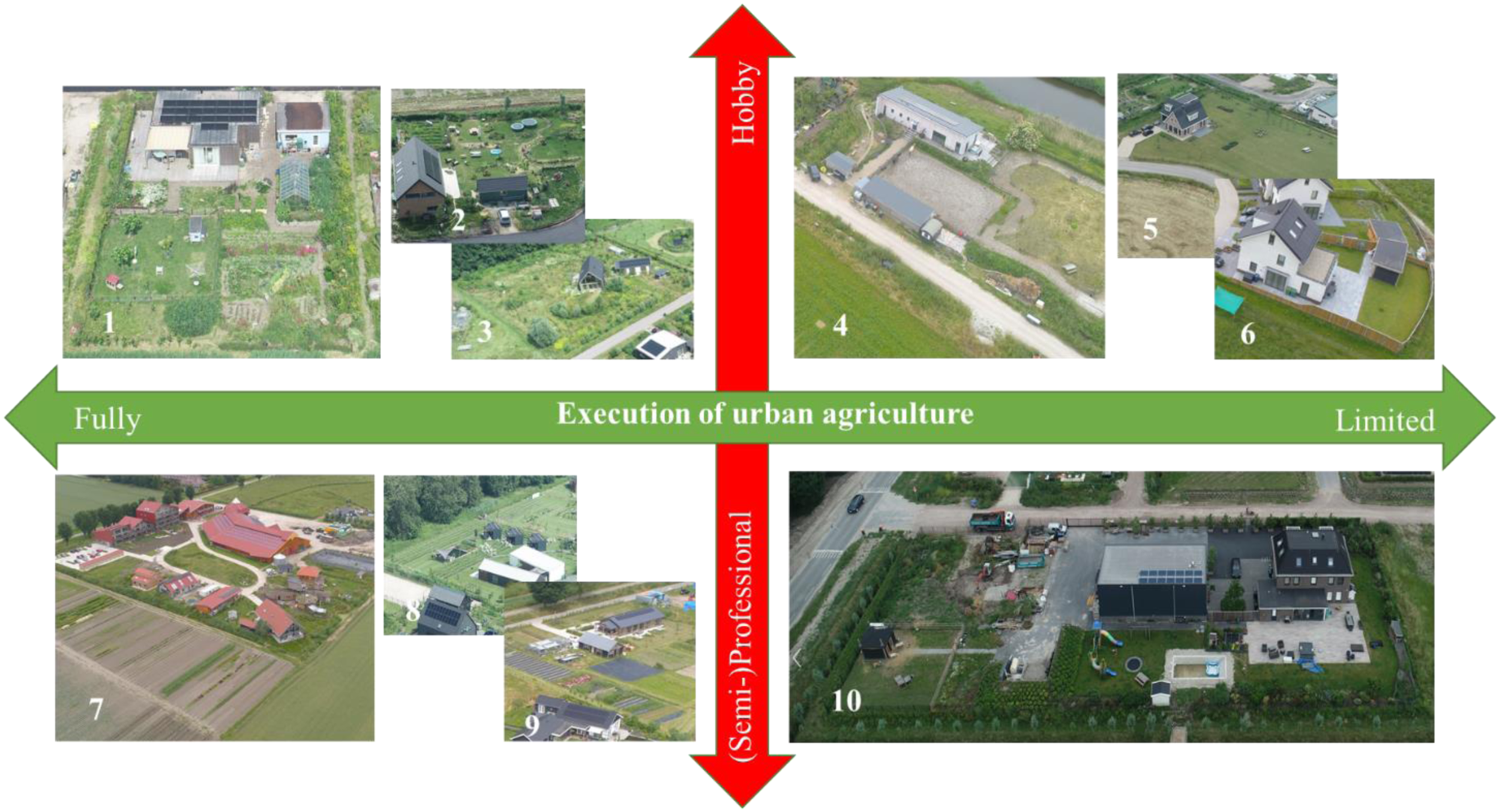
Discussion
We applied an SPT-informed approach to analyse how and why the urban agriculture practices amalgamate with the daily reality of the Oosterwold residents. To deconstruct the urban agriculture practices, we deployed a sequential mixed-method design that combined a quantitative (an online survey) with a novel qualitative method (an analysis of aerial photos). The conducted survey proved valuable in providing a socially differentiated perspective on urban agriculture in Oosterwold, while it also highlighted the generally shared meaning attributed to urban agriculture. However, a survey as a sole method is limited in uncovering the more routinely enacted and lifestyle embedded elements in the urban agriculture performances of the residents. The photo analysis helped to bypass these limitations. Moreover, the photos offered us the opportunity to analyse nearly 200 practices at the same moment in time, an analytical scale nearly impossible to organise in a face-to-face interview or observational setting. Still, we acknowledge that these photos are instant snapshots of the urban agriculture practices. They thus do not provide complete understandings of how urban agriculture practices evolved at a specific plot, which could be revealed through interviews and home visits. However, the diversity in stages of development helped shed light on the evolving urban agriculture in Oosterwold.
Our mixed-method approach was useful for studying the performativity of urban planning in practice, zooming out from individual household performances to the shaping up of a wider area. It revealed the unruly nature of bottom-up citizen participation in a top-down feeding the city realm. The survey highlighted the significance residence attributed to urban agriculture in Oosterwold. Residents stated to practice farming by growing fruit trees and vegetables, with ambitions to complement this with vines, chickens, bees, and other animals. However, despite the significance expressed in the survey, the actual ‘doings’ portrayed at the aerial photos often show a lesser degree of engagement in the implementation of urban agriculture. The photo analysis revealed rather limited urban agricultural activities with a spatial allocation not exceeding one quarter of the plot, which is far below the 51% rule. The survey revealed that residents consider time and knowledge important constraints. Farming between 500 and 2500 square metres land requires skills and a considerable investment of time and toil which competes with other lifestyle elements like jobs, social life, and children. For instance, the photos uncovered a higher share of children-oriented (garden) play equipment on the plots dominated by lawns (DL-group), illustrating competing claims in space and time between urban agriculture and caring for children. The photo analyses also revealed competition in the allocation of time and effort in relation to the stage of development of the plot. Residents prioritise constructing houses, with the lawn acting as interim place maker of urban agriculture. Only when the home is in a final stage, the garden comes into play and residents start to organise the production of food. All these aspects not only influence the course of the stages of the newly arrived residents but also how the food production eventually (or not) evolves on the plot, that is, ranging from a lawn with some fruit trees to a full fletched food garden or an urban farm.
A kind of realism pours in the moment the residents reside in the area. A realism that farming is more complex and time consuming than initially assumed and that it is difficult to fit in the complexity of everyday life. With this realism, the 51% rule gets out of focus. It is not helpful in this context as the authorities do not monitor, facilitate, or enforce (with a timeframe) residents’ performances in urban agriculture. Under the pretext of self-organisation, authorities have strictly transferred all responsibilities to the individual – the residents of Oosterwold (Cozzolino et al. 2017; Testi 2022). However, as this study highlights, the complexity of performing urban agriculture requires a joint effort. Without a joint effort it is obvious that the 10% policy goal will get out of reach, which could ultimately lead to a cul-de-sac for urban agriculture in Oosterwold.
So how could ODA – the Oosterwold Development Authority – take a more balanced position in urban agriculture? They could start with acknowledging that self-organisation is not a goal in itself, but rather find “the right balance between planners’ decisions and spontaneous self-organising process” (Testi 2022: 366). Moreover, planners of ODA have to consider that the urban agriculture in Oosterwold is a ‘proto’ practice, that is, a practice in which the elements meaning, competence, and material exist but are not (yet) fully developed and connected (Shove et al. 2012). For example, residents attribute a meaning to urban agriculture but this does not match their competence (e.g. experience in farming) nor the material (e.g. their garden). Finding a right balance thus could start with the involvement of the residents in the debate what urban agriculture means to Oosterwold residents. So far, the residents have not been included in such a debate. Carving out the same turf commits all stakeholders involved to the development of urban agriculture in Oosterwold, an urban agriculture that matches local needs and expectations and concomitantly highlights omissions in competence and material (Akimowicz et al., 2020; Albrechts et al. 2020). Such a debate is a recurring process because new generations of residents will engender new needs and expectations. The debate should also acknowledge that farming in the urban realm is a highly diverse practice (Müller et al. 2022) and that motivations of practitioners in urban agriculture go beyond the mere production of food (Kirby et al. 2021). Hence, the 10% goal should be part of this debate. “As Valley and Wittman (2019: 42) put it, ‘the challenge [to transform urban landscapes to produce food] lies in not letting the conversation stay within city limits [to produce food]’”. Lingering in the 10% policy goal might hamper a real debate about the future of urban agriculture in the area, putting a blind eye to a wider interpretation as well contribution of urban agriculture. Needless to say that a wider interpretation which is in line with local needs and expectations is not necessarily supportive to the policy goal of feeding the city.
Finding a balance also implies acknowledging that it takes time to adapt urban agriculture as a practice and that a focus at residents’ self-organisation does not imply a laissez faire from planning and policy side. Each resident steps in with a different level of expectations and skills at a different moment in time. Do not expect full fletched urban agriculture from day one and differentiate expectations. Most Oosterwold residents originate from an urban background and consider themselves as rather inexperienced and unskilled in urban agriculture. These new residents have to incorporate food production in their daily life besides taking care of jobs, kids, and other pressing tasks like constructing a new home. Oosterwold planning could organise competence and material to support the residents with performing urban agriculture, for example, a knowledge exchange application for peer groups, or supportive infrastructures and equipment, like a physical community centre for urban agriculture which also could serve as location to process, store, and sell products under the valid Dutch regulations. As such, ODA could reinforce their support to the Oosterwold food cooperative that sells food produced in Oosterwold. (Jansma and Wertheim-Heck 2022). Oosterwold planning unintendedly offered another interesting pathway, that is, the outsourcing of the urban agriculture practice to professionals within or outside the community. This pathway is enforced by the rising price tag of land. Offering room to develop larger hamlets with small individual plots provides enough space for professional farming within the 51% rule.
Zooming in on new residents’ engagement in urban agriculture, our study revealed the tension between planning for bottom-up citizen participation and the actual performance of these participants in defiance of everyday reality (Zhang et al. 2019). This study shows the residents evolving endeavour of incorporating – whether successfully or not – urban agriculture practices in their lifestyle. Zooming out to a wider area perspective, a similar incremental process holds for the urban agriculture in the planning of the area. The planning of urban agriculture began as a bold process enforced by politicians and planners who were passionate about the idea ofbridging the gap between the city and its agricultural hinterland (Jansma and Wertheim-Heck 2021). The planning of urban agriculture of the area appeared malleable at the moment the first residents stepped in and started to perform urban agriculture (Jansma and Wertheim-Heck 2022). This study illustrates that a malleable position of urban agriculture does not suffice to overcome the tension between planning and everyday reality in the development of urban agriculture. In 2022, Oosterwold planning invited residents to debate about the future of urban agriculture in the area. This debate led to a set of requests, including continuing and extending the debate, and organising knowledge infrastructures and other supportive conditions. These requests on the one hand address the needs of the residents but are on the other hand a clear signal of residents’ wish to be part of the planning of urban agriculture. This wish should rouse a process of negotiation between policy, planners and populace of Oosterwold about balancing the respective roles and responsibilities in the areas’ planning of urban agriculture.
Conclusion
This paper questions what happens when top-down policy and planning meet bottom-up participation in a peri-urban living lab that pivots residents’ urban agriculture? Five years after the first residents settled in Oosterwold, we appraised residents’ practices in urban agriculture and examined the tension between planning for feeding the city and partitioners’ everyday performance in food production. Our social practice–informed analysis uncovered a dissonance between these new residents’ sayings and their actual doings in food production. Although the new residents have a positive attribution to (practicing) urban agriculture, the complexity of the daily reality hampers their performance. Our study demonstrates that (i) it takes time for residents to adapt to urban agriculture as a substantial practice in their heterogeneous lifestyle and (ii) that a focus on bottom-up approaches, such as Oosterwold residents’ self-organisation, does not imply a laissez faire from a more top-down planning and policy side.
Living lab Oosterwold is a one of a kind in the planning of urban agriculture; however, it provides planning (and policy) generic pathways in retrieving a balanced and place-based action towards feeding the city. The Oosterwold case offers four pathways to consider. Firstly, create a shared vision of what urban agriculture should entail for all stakeholders involved. Oosterwold illustrates that a lack of a shared vision induces a distance between the practitioners and planning in terms of understanding urban agriculture. A shared vision helps to guide the development of urban agriculture. It might also lead to an interpretation of urban agriculture, related to its intrinsic diversity of practices, that might redirect the initial objectives of feeding the city. Secondly, planning should acknowledge that new urban entrants in urban farming (and most are) have to find ways to incorporate agriculture in their lifestyle. Planning could facilitate and encourage these new entrants by creating supportive conditions. Thirdly, developing urban agriculture is a shared effort. Allocating space to urban agriculture is not the endpoint of planners’ responsibility, but rather a starting point of a dynamic process in balancing roles and responsibilities. Consequently, co-creating urban agriculture is a recurrent process of negotiating the conditions that support residents in their daily agricultural practices. These conditions should be adjusted to residents’ diversity in stage of development, skills, motivations, and expectations but also to (unforeseen) external conditions. A recurrent process is also vital to include new generations of residents in the urban agriculture. Fourthly, while acknowledging that not all new residents want to (and/or are able to) practice urban agriculture themselves, planning could further explore the pathway of the outsourcing of food production to professionals within or outside the community. Guiding conditions could link these professionals to the local community.
In the co-creation of feeding the city, planning plays a pivotal role as intermediate between policy (objectives) and local needs and expectations. Induced by the involvement of the residents, Oosterwold planning evinces a transition in the position of urban agriculture. Its position started as an enforceable asset in the planning of Oosterwold, that is, the 10% goal and the 51% land earmarked to urban agriculture. With the residents stepping in Oosterwold realm, urban agriculture changed to a malleable asset in the planning. This study illustrates that, in the co-creation of a food producing area, urban agriculture should evolve to a negotiable asset that reflects a balance in role, responsibility and position of each stakeholder in the planning process. It is further inferred that a balance in policy goals, planning instruments and the needs of the practitioners requires continuously staying attuned to a shared vision while iteratively assessing and creating supportive conditions.
Supplemental Material
Supplemental Material - A city of gardeners: What happens when policy, planning, and populace co-create the food production of a novel peri-urban area?
Supplemental Material for A city of gardeners: What happens when policy, planning, and populace co-create the food production of a novel peri-urban area? by Jan Eelco Jansma and Sigrid CO Wertheim-Heck in Environment and Planning B: Urban Analytics and City Science
Supplemental Material
Supplemental Material - A city of gardeners: What happens when policy, planning, and populace co-create the food production of a novel peri-urban area?
Supplemental Material for A city of gardeners: What happens when policy, planning, and populace co-create the food production of a novel peri-urban area? by Jan Eelco Jansma and Sigrid CO Wertheim-Heck in Environment and Planning B: Urban Analytics and City Science
Supplemental Material
Supplemental Material - A city of gardeners: What happens when policy, planning, and populace co-create the food production of a novel peri-urban area?
Supplemental Material for A city of gardeners: What happens when policy, planning, and populace co-create the food production of a novel peri-urban area? by Jan Eelco Jansma and Sigrid CO Wertheim-Heck in Environment and Planning B: Urban Analytics and City Science
Supplemental Material
Supplemental Material - A city of gardeners: What happens when policy, planning, and populace co-create the food production of a novel peri-urban area?
Supplemental Material for A city of gardeners: What happens when policy, planning, and populace co-create the food production of a novel peri-urban area? by Jan Eelco Jansma and Sigrid CO Wertheim-Heck in Environment and Planning B: Urban Analytics and City Science
Supplemental Material
Supplemental Material - A city of gardeners: What happens when policy, planning, and populace co-create the food production of a novel peri-urban area?
Supplemental Material for A city of gardeners: What happens when policy, planning, and populace co-create the food production of a novel peri-urban area? by Jan Eelco Jansma and Sigrid CO Wertheim-Heck in Environment and Planning B: Urban Analytics and City Science
Footnotes
Acknowledgements
Thanks to EU H2020 project Desira (grant agreement 818194) we could collect additional data in (online) meetings with residents of Oosterwold. We greatly value Gebiedsteam Oosterwold (ODA) for providing us with a dataset of the demographic of Oosterwold residents as well as with the set of aerial photos. We highly acknowledge Dr Wim van den Berg (1957-2023✝) for his statistical analysis of the survey. Notwithstanding his health issues, he carried out the analysis with care and patience. We appreciate Prof. Dr Peter Oosterveer’s comments on the final draft of this paper.
Declaration of conflicting interests
The author(s) declared no potential conflicts of interest with respect to the research, authorship, and/or publication of this article.
Funding
The author(s) disclosed receipt of the following financial support for the research, authorship, and/or publication of this article: This paper is part of a PhD research programme that is carried out within and funded by the Flevo Campus of the Municipality of Almere (the Netherlands).
Supplemental Material
Supplemental material for this article is available online.
Data Availability Statement
 (NL). As a sociologist, her research departs from situated perspectives on socio-technical transformations in which evolving practices and arrangements locally are tightly interlinked with the national and global scale. Her interest in urban food systems informs her agenda on the relationship between urbanisation, food provisioning, and food consumption. Projects across Asia, Africa, and Europe bring together three areas of research, namely, sustainable and equitable food consumption, governance practices, and global-local dynamics.
References
Supplementary Material
Please find the following supplemental material available below.
For Open Access articles published under a Creative Commons License, all supplemental material carries the same license as the article it is associated with.
For non-Open Access articles published, all supplemental material carries a non-exclusive license, and permission requests for re-use of supplemental material or any part of supplemental material shall be sent directly to the copyright owner as specified in the copyright notice associated with the article.
