




Abstract
In this paper, we provide an update of recent developments and forthcoming challenges in the field of planning support systems, following earlier reviews in 2003 and 2009. The rationale for this update is the rapid development of information and communication technologies and their impact on planning support systems. After a brief retrospective assessment of past planning support system developments, the paper presents a synthesis of the experiences and views of a worldwide sample of invited planning support system experts, whose innovative contributions comprise a new Handbook of Planning Support Science. The developments documented by the experts together substantiate our impression that a fundamental transformation is taking place – a paradigm shift – wherein the field of planning support systems is maturing into a planning support science. From this perspective, it is expected that planning support systems will become indispensable instruments in the planning process in the not too distant future. The signs of this maturation are already visible in research, education and practice.
Introduction
The purpose of this paper is to provide an update of ongoing developments and upcoming challenges in the field of planning support systems (PSS 1 ). Over 15 years ago, the first worldwide inventory of systems dedicated to planning support was published (Geertman and Stillwell, 2003), and six years later, a second global inventory was assembled (Geertman and Stillwell, 2009), which suggested that although some progress was evident, the field of PSS still had a long way to go to reach maturity. Given the enormous technological changes that have taken place over the last 10 years, a new inventory of ongoing developments has been prepared (Geertman and Stillwell, 2020), which provides novel and innovative contributions by key players in the field of PSS from all around the world. This paper is based largely on the contributions of these experts.
As individual researchers, we tend to belong to multiple fields of science, frequently characterized by having significant overlap with other fields with boundaries that are often difficult to specify precisely. While Kuhn (1970) stipulates that new fields of science should have a coherent paradigm, and Darden (1978) refers to a common problem with a set of facts relating to that problem, associated goals, techniques, methods, concepts, laws and theories, Casadevall and Fang (2015), more recently, have argued that ‘a scientific field is a collection of individuals with a common interest in some aspect of science who interact on a regular basis. The interaction may be social, professional and/or through the act of publication’ (2). This definition implies that a sociological dimension is associated with the recognition of a new field of science, where individuals with common interests or pursuing common problems organize themselves into coherent interactive units. The primary aim of this paper is to identify the contemporary developments in applications, governance and instrumentation, which comprise what we now refer to as a new scientific field, planning support science (PSScience).
We begin in the next section with a short discussion of past PSS developments. Thereafter, the dimensions of PSScience that underpin a new paradigm are considered in the ‘PSScience’ section, while in the ‘PSScience: Developments and challenges’ section, we identify some of the ongoing developments and forthcoming challenges in the field of PSScience research and practice. This evidence, together with the growing number of papers in scholarly journals (e.g. Environment and Planning B: Urban Analytics and City Science; Applied Spatial Analysis and Policy; Computers, Environment and Urban Systems), sessions in regular conferences (e.g. Computational Urban Planning and Urban Management, the Association of European Schools of Planning and the Association of Collegiate Schools of Planning), edited collections of papers (e.g. Brail, 2008; Geertman et al., 2017, 2015, 2013; Geertman and Stillwell, 2003, 2009; Geertman et al., 2019; Klosterman and Brail, 2001), new postgraduate programmes and other communication networks such as email lists, adds up to the existence of a new field of science that has growing intellectual coherence and vibrancy as well as a truly international community of researchers and practitioners.
PSS
PSS were first recognized in the late 1980s, as described by Harris and Batty (1993). They emerged through a convergence of efforts being undertaken in the areas of geographical information systems (GIS), large-scale urban modelling and decision support systems. While numerous definitions have been offered in the literature, in broad terms, PSS are computer automated tools that can assist planners to more effectively undertake their day-to-day professional tasks; they are instruments that add value to planners’ work processes and include components such as spreadsheets, websites, GIS, visualization methods and modelling systems (Couclelis, 2005).
Initially, PSS were in some ways a response to the backlash from planners to the top-down, comprehensive, black-box models that were being run to optimize city development. The limitations of these models were resoundingly articulated in Lee’s (1973) famous ‘Requiem for large-scale urban models’, limitations that Lee (1994) reconfirmed in a study 20 years later. In contrast to these models, PSS were regarded as tools that would support planning activities in a much more dedicated and transparent way. In the 1990s, a number of PSS were developed, which enabled planners to interact with these tools themselves through user-friendly graphical user interfaces, changing parameters by using slider bars and drop-down menus and exploring the likely implications of these changes through map and graphic visualization (Klosterman, 1997).
Vonk et al. (2006) distinguished three categories of PSS based on their prime application orientation. One category includes systems that are designed to fulfil predominantly the task of ‘information provision’, described as one-way interaction from sender to recipient, for which examples can be found on thousands of websites that provide information on spatial plans and developments. A second category includes systems that are meant primarily to support ‘communication processes’, and thus focus on the support of two-way interaction, for example a map-based touch table to support collaborative design or websites to support direct communication between citizens and local government. PSS, in the third category, are dedicated to accomplishing ‘analysis functions’, including land-use modelling (e.g. cellular automata) or ‘design functions’ (e.g. scenario building). Examples of different types of PSS can be found in Brail (2008).
Early PSS included systems for modelling land-use change such as What if? (Klosterman, 1999) and UrbanSim (Waddell, 2002), systems for measuring conditions and change such as INDEX (Allen, 2001) and systems for encouraging community participation such as CommunityViz (Kwartler and Bernard, 2001). It was apparent from our initial inventory that PSS used in practice were primarily experimental and tended to be restricted to land-use and/or transportation planning; many were still prototypes and most of their applications were one-off experiments. Five years later, several PSS seemed to have taken the step from prototype to becoming fully developed products, e.g. UrbanFootprint (http://urbanfootprint.com), although few had become off-the-shelf proprietary software.
While the application range had broadened to include fields like environmental planning, tourism planning and public health service planning, one of the key criticisms of PSS in the early days was that they were primarily technology-driven (supply-driven), resulting in the so-called PSS implementation gap, which has been documented by various scholars (including Geertman, 2017; Geertman and Stillwell, 2009; Vonk et al., 2005). In short, this refers to the fact that planners remained in need of better support from planning instruments to be able to cope with the ever-increasing complexity of present-day, real-world planning problems. A small number of PSS of this generation have withstood the test of time and, in their various incarnations, are still used in planning practice 20 years on, such as the open source online version of What if? (Pettit et al., 2015) and the cloud-based UrbanSim (https://urbansim.com).
Over the last decade, fundamental changes have taken place resulting in recognition that if PSS are to play a serious role in the planning process, much greater consideration needs to be given to aspects beyond simply the instruments themselves. Changes have occurred in the spatial planning process itself which now involves a wide diversity of stakeholders and interested parties as well as the professional planners. This trend is not restricted to western planning practice; there are examples from elsewhere in which neighbourhood committees make use of self-build PSS to advocate their cases to their local municipalities (e.g. Zhang et al., 2019). Changes have occurred too in the methodologies with which planners and analysts make use of supportive instruments like PSS, underpinned by concepts like systems theory, and associated frameworks like geodesign (e.g. Steinitz, 2013) and scenario planning have become common practice. Significant changes have also taken place in information and communication technologies (ICT) that are having an increasing impact on the context in which planners have to operate. Of particular importance for PSS, among the many emerging technologies, are artificial intelligence, the Internet of Things, collaborative technologies, cloud computing, geo-spatial technologies, big data and smart cities. Digital technologies such as these are increasingly providing us with the mechanisms through which human systems such as cities can be analysed, monitored and simulated to increase our knowledge and understanding of their workings (Jeffrey and Ramuni, 2018). All these changes, collectively representing a shift in paradigm, have been reported in numerous scholarly publications by an ever-expanding community of PSS researchers and practitioners.
An increasingly demand-driven approach to PSS developments and the widening range of applications, together with the necessity to embrace the changes in planning that relate to our transformation to a digital world, have demanded a much wider understanding of PSS and acknowledgement of a new science of human intervention that has been termed PSScience (Geertman, 2013). In the next section, we review what constitutes PSScience in more detail.
PSScience
While most research and development work in the early days of PSS concentrated on the instrument, the focus has changed to one in which we question how PSS can be embedded in a specific application field, what role can PSS play given the particular governance procedures in force, what methodological relationships exist between PSS and other associated instruments and what impact does the contextual setting have on PSS design and use. These questions translate into three dimensions of PSScience and the (dynamic) spatial, temporal, environmental and socio-political context in which they exist (Figure 1).
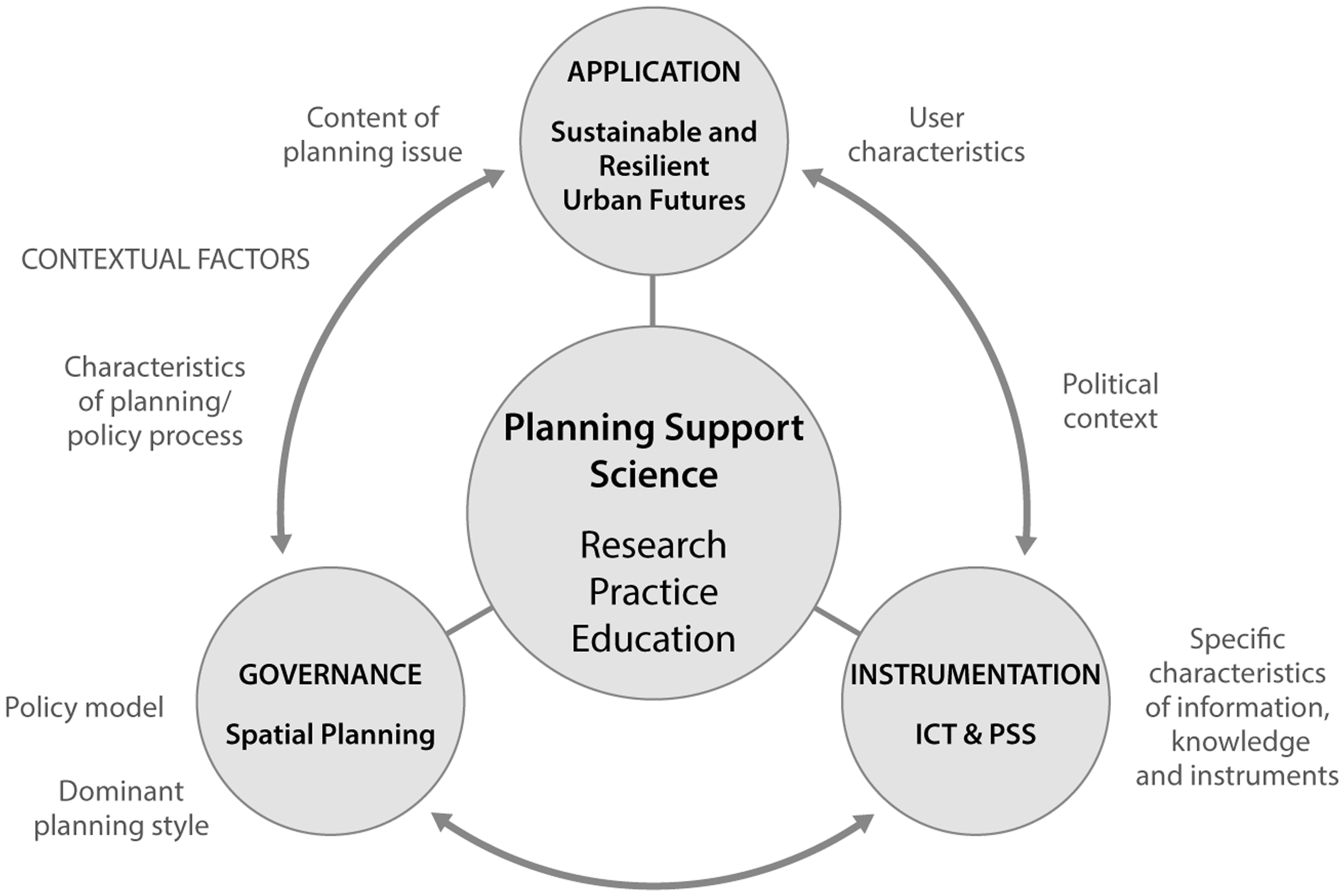
PSScience, dimensions and context. Source: Adapted from Geertman (2006, 2016).
The first component is the application dimension, which is the object-oriented goal of PSScience and which can be referred to in general terms as striving for ‘sustainable and resilient urban futures’. Planning is an intrinsically future-oriented activity, focused on urban and regional issues, in which the general quest for sustainability and resilience is at the core of the activity in which a balance is sought between ecological goals (‘planet’), economic prosperity (‘profit’) and social justice (‘people’) (see, for instance, the United Nations’ Sustainable Development Goals at https://www.un.org/sustainabledevelopment/sustainable-development-goals/). There is no fixed end state – ‘the sustainable and resilient urban future’ – nor one which is uniform in place and/or time. Instead, ‘sustainable and resilient urban futures’ consist of dynamic processes, flows of people, traffic, consumer goods, raw materials, waste, information, etc., each with its own pace and dynamics, interacting and heading for a sustainable balance on the one hand and able to deal with change and continue to develop (be resilient) on the other, as identified in the research field of urban metabolism (Dijst et al., 2018). Distinctive urban contexts show substantial differences in historical background, in pressure for economic prosperity, in expectations for social justice, in determination of achieving ecological goals, in cultural appreciation and in institutional settings. Sustainable and resilient solutions in one context are rarely transferable to other contexts without adaptation.
The second dimension refers to the governance field of spatial planning, which concerns the process-orientation of PSScience. In general, spatial planning refers to approaches used by the public sector and/or the private sector and/or civil society to influence the spatial organization and spatial activities of people at various spatial/policy scales. In the western world, this dimension has undergone substantial changes in the past decades – with local variations – which have exerted significant impact on the support role of information, knowledge and instruments. Up to the 1970s/1980s, spatial planning was primarily a rational governmental activity performed by well-educated planning experts. Based on extensive scientific research and theory, as part of a well-structured planning process, a blueprint of the foreseen future end-state was composed that would be implemented accordingly. An optimistic belief in the malleability of society and its spatial organization was at the heart of this approach. In the 1980s/1990s, due to fundamental changes in society (including, for example, democratization, financial crisis), this optimism turned into the recognition of a range of uncertainties and the acknowledgement of the overall complexity of the spatial planning task (‘wicked problems’). The result was a transition from expert-oriented, blueprint planning to process-oriented, collaborative planning, the so-called communicative turn in planning (Healey, 1996), accompanied by a recognition of the normativity of the planning activity. Since then, spatial planning is no longer envisaged as an activity conducted by a governmental group of experts but as a process that should incorporate the opinions of a wide diversity of actors from other governmental organizations, private parties, non-governmental organizations and civil society (Van Bueren, 2015). As an implication, knowledge is no longer considered to be an absolute and unified truth but is socially constructed, resulting in the recognition of distinctive forms of information/knowledge in spatial planning: scientific versus lay experiential; explicit versus implicit (e.g. Healey, 2008). Moreover, one of the biggest challenges has been to navigate, integrate and test different forms of knowledge (Rydin, 2007).
The third dimension of PSScience refers to instrumentation, which is summarized as ICT and PSS. The past 10 years have produced much more positive stories about the uptake of PSS in practice (Pelzer et al., 2014; Te Brömmelstroet, 2015), although it is evident that there is still quite a long way to go before a stage of full implementation is reached, as reported by Russo et al. (2018). Parallel to this positive turnaround in the PSS field, the attitude in general to the position of ICT within a policy environment has undergone a fundamental improvement too, as have the skills and expertise of the practitioners. Over the past 10 years all around the world, we have experienced the emergence of the concept of ‘smart city’ (Batty et al., 2012), the rapidly increasing role of big data and data analytics in research (Kitchen, 2014), and the penetration of the Internet and social media into our everyday lives (DiMaggio et al., 2001). All these developments have changed our attitude towards and the use made of ICT in general and PSS in particular. In this context, we do not comply with the meaning of a ‘smart city’ as a neo-liberal technology-driven city, fully captured by large corporations. For us, a truly smart city is a socio-technological entity, in which human capital in its broadest sense is collaborating with the help of technologies to achieve more sustainable and resilient urban futures for everyone (e.g. Wijs et al., 2016).
The three dimensions outlined in Figure 1 form part of the field of PSScience. Crucial therein is the close collaboration of research, practice and education. PSScience research requires links with practice, and at the same time practice, like research, requires educated minds able to realize the potential that the new science has to offer. Along with these dimensions, three more features can be identified. First, these dimensions are interconnected: a particular sub-goal of ‘sustainable and resilient urban futures’, such as a transformation to renewable energy production and consumption, will have a particular governance setting, for instance, one in which all stakeholders associated with this transformation are actively involved in the spatial planning process. This stakeholder involvement may be supported by instruments like a map-based design table on which different options for the realization of the envisaged transformation can be designed and assessed. The associated planning process needs to be designed in such a way that the instrument can play a supportive role so as to reveal and not obscure possibilities, and in doing so, fuel the discussions among the participants with distinctive options.
Second, while it is generally acknowledged that a supply-driven approach can be useful in the first developmental stages of a new technology, a key requirement is to use a demand-driven approach, in other words, to ask stakeholders in policy settings about their actual needs and to involve them in the process from the outset, such as in the geodesign approach of PSS (Trubka et al., 2016). This implies a need to reconceive the role of PSS instruments; the development of instruments for planning support is not a goal in itself, but a means to achieve the goal of effectively supporting the planning process (Geertman, 2006).
Third, it should be acknowledged that PSScience is intrinsically context-specific. This implies that both the outcomes of planning support and the process – the methodology to arrive at planning support – are both context-specific and one PSS cannot be adopted within a different context without adaptation. This is summarized in Figure 1 where it is acknowledged that a range of contextual factors are mutually interacting and are likely to influence the support role of PSS and its resulting information/knowledge. In this, one can think of contextual factors like characteristics of the policy process (e.g. time pressure), user characteristics (e.g. familiarity with technology or functional preferences), and political, institutional and cultural contextual factors (Geertman, 2006). For illustration purposes, this was clearly revealed at a PSS workshop in Utrecht in 2015 with a diversity of participants representing the factor of ‘user characteristics’. Some of the participants, particularly the more research-oriented planners, were very happy with the analytical and visualization utilities offered by the available PSS, Urban Strategy, in this case, while others, particularly the design-oriented planners, felt hugely restricted in their possibilities to express their creativity using the same PSS, due in their eyes, to its very restricted design utility. More explicit attention to these contextual factors is considered a first step to overcome the PSS implementation gap and to make sure that PSS application in planning practice will be more aligned with evidence of producing value for professional requirements.
PSScience: Developments and challenges
In 2018, we invited a number of PSS experts from academic institutions or businesses from around the world to contribute to a PSS handbook. These experts represented a cross-section of the global PSS community and included individuals or groups from a wide range of backgrounds and with differing areas of interest/application. In total, 88 individuals at varying stages in their careers (from early career researchers to retired professors) have contributed. Based on the experiences of experts whose contributions were assembled in our Handbook of Planning Support Science (Geertman and Stillwell, 2020), this section attempts to answer two associated questions. First, what is the state-of-the-art in PSScience in 2020? Second, what associated challenges might be forthcoming? To structure the discussion, we use the three dimensions shown in Figure 1, acknowledging that some of the issues documented are equally appropriate for inclusion under more than one of the headings.
Applications
In almost all the contributions provided by the experts, while ‘sustainability’, ‘resilience’ and ‘urban futures’ were orientations at the core of their specific PSS applications, it is clear that there is now a much wider range of applications in fields that include, for example, retailing (Newing et al., 2020) and education (Boden et al., 2020). It is also apparent that more and more PSS are becoming fully dedicated to the specific demands of the particular application at hand, i.e. more specialization is taking place that is driven by demand.
In terms of challenge, several experts refer to the need for a widening of the knowledge base for extant PSS. For instance, Silva et al. (2020) identify the need for extra knowledge on behavioural theory for incorporation in geocomputation: ‘It is difficult to extract detailed rules from behavioural theories that can be represented in mathematical equations or language-based rules such as if-then/else statements’ (53). In the same vein, Hamerlinck (2020) identifies an urgent need for better understanding and more object-based knowledge about rural environments, about their unique cultural, economic and institutional characteristics and about associated rural planning.
Governance
The governance component is gaining increasing attention. No less than a quarter of all the contributions in the Handbook deal explicitly with the ‘communicative turn’ in planning and its consequences for planning support. In general, these contributions show an enduring discourse on the possibilities and restrictions of collaborative planning and, therefore, the potential of ICT in general and of PSS in particular. For instance, Lieske (2020) points to a number of societal trends that are antithetical to effective and impactful PSS implementation in (collaborative) planning practice, in particular the change in politics from managerialism to entrepreneurialism, ‘… which prioritizes market-led development and economic growth but has little room for information and alternative perspectives’ (270). According to Lieske, this entrepreneurialism has prevented effective implementation of PSS in planning practice and has limited the planning support role of information and knowledge.
Kingston and Vlastaras (2020) suggest that despite 20 years of experience with collaboration supportive instruments, ‘the socio-political impediments still remain a challenge and many planners are sceptical or oblivious to many of the technical tools available’ (336). This statement resonates with empirical observations made by others (e.g. Witte et al., 2020), who conclude that within their particular (Dutch) political context, smart governance applications that result in smarter urban collaboration are still almost entirely absent from planning practice.
Other authors identify challenges but focus attention on ways to improve collaborative planning processes despite opposing political attitudes. For instance, Goodspeed and Pelzer (2020) stress the importance of a proper workshop setting for the application of PSS in collaborative planning practice. They conceive of workshops as socio-technical settings in which the characteristics of PSS instruments are mediated by different factors like group dynamics, group facilitation and tool involvement by participants, which justify their explicit attention. These experts stress the need for repeated and reflective empirical PSS workshop evaluation studies. In the same vein, Staffans et al. (2020b) envisage collaborative planning processes as ongoing collaboration arenas in which large-scale public participation processes to identify innovative ideas are followed-up by small-scale expert collaboration processes to select and work on the proposed ideas. Referring to the city of Helsinki, they suggest that crucially important is that ‘… more attention in communication should be put on the link between the produced knowledge in the public participation process and the content and solutions of the plans’ (321). Interesting in this respect is that this statement appears to have validity in very different planning contexts. In one Chinese context, for example (Wang et al., 2020), it is acknowledged that different actors with distinctive positions within the decision-making system can have different perspectives on the evidence put forward, which can lead to different decisions being taken or alternative expectations being considered.
Another strand of research concerning the governance component of PSScience focuses on particular parts of planning processes. Daniel (2020) identifies a neglect in continuous monitoring and post-implementation evaluation of planning decisions, concluding that while lots of attention is focused on supporting decision-making processes, the critical assessment of PSS implementation and impact is missing. In response, it is proposed to make use of recent improvements in GIS, artificial intelligence and image recognition for monitoring spatial developments in a relatively automated way.
Instrumentation
A key observation made by many of those who contributed to the Handbook is the increasing crossover between PSS developments and innovative developments in the field of smart cities/smart governance and big and/or open data and data analytics. Present-day big data environments open-up many more possibilities for detailed analysis of complex real-life processes. Data integration plays an increasingly important role, such as linking together data from social media, web browsing behaviour and loyalty card transaction patterns to be able to identify patterns of consumption and sales opportunities for retailers. It becomes clear from the many examples of integration of data analytics, spatial informatics and PSS, that planning support is entering a new and exciting era of application possibilities. For example, Newing et al. (2020) show how users’ tweets can be used to build retail centre catchment areas and how the UK retailer M&S has used Twitter data to understand its consumers’ origin locations and derive catchments at the level of individual stores.
The challenging question in this context is how ICT and PSS developments will coincide in the future. Most experts see this relationship as bidirectional: positive contributions are foreseen for PSS due to ICT developments, like real-time data availability, better tools for communication and visualization and more insights into consumer behaviour, while it is also recognized that PSS will help in what some (Zheng and Sieber, 2020) refer to as deflating the hyperbole about smart cities. In general, however, experts take a critical stance too: ‘in the current smart city era, the essential concerns of employing technologies in planning remain the same. Humans and messy politics matter. Technocratic and data-driven approaches should not supplant communicative and democratic methods in urban planning’ (Zheng and Sieber, 2020: 208).
Alongside the increasing integration of innovative ICT and PSS developments, one can observe a growing number and diversity of PSS worldwide. Two developments in the instrumentation component of PSScience can be distinguished. On the one hand, as indicated earlier, more specialized or dedicated PSS are coming to the fore. Examples of dedicated systems include TAPSS, an integrated transport accessibility analysis tool for use in an urban strategy-making context (Lock et al., 2020) and Penciler, an online platform for analysing the development feasibility of building sites for multi-family affordable housing (Waddell et al., 2020). Although developers for each of these PSS are currently looking for ways to enhance the applicability of their systems – at other scale levels, in other contexts, with additional utilities – their original starting point to construct a specialized PSS is still valid for intended future developments.
On the other hand, occurring in parallel with the development of these specialized instruments, one can identify the growth of more general PSS frameworks – ICT infrastructures – that offer a range of possibilities to fulfil a wide variety of calculations and manipulations; in general terms, this involves software to ‘manage’ a diversity of data and to answer an array of research questions in diverse application fields. For example, Li and Yeh (2020) introduce GeoSOS, which is a GIS and cellular automata based PSS with the capability of simulating, optimizing, predicting and visualizing geographical processes within a diversity of application fields. An even more comprehensive general PSS framework is the Australian Urban Research Infrastructure Network (AURIN) (Pettit et al., 2020), which contains open access data, open source software and cloud computing, and can be considered an example of a complete PSS and data release and delivery service for researchers and governmental institutes at local, state and federal level in Australia. According to the developers, AURIN is connecting communities of researchers and decision makers nationally, enabling fast-tracked access to urban data, greater transparency and more consistency in decision support for public policy.
Besides the growing diversity of instruments in PSScience, one can identify growing attention to methodology. After distinctive periods in time when planning has been dominated either by qualitative methods, like social discourse analysis, or by quantitative methods, like mathematical modelling, now it seems that with the increase in data availability, mixed methods approaches are gaining substantial ground (Silva et al., 2020). An important example of such a mixed method approach in planning is the upcoming field of geodesign where both modelling exercises (quantitative), like those adopted for forecasting future trends, and deliberative design approaches (qualitative), like those used for developing future spatial scenarios, are combined to deliver enhanced outcomes. Several experts reflect on geodesign’s history, methods, technologies and applications (e.g. Campagna, 2020). Others direct their focus on the geodesign–PSS relationship and express a positive view about integration: this will decrease project and/or plan complexity and reveal the trade-offs between tactics and strategies. It also moves the realm of PSS application beyond the field of planning and extends the possibility to a range of other fields and disciplines (such as Landscape Architecture and other design disciplines), and a variety of organizations (environmental groups), scientists, stakeholders and community residents. (Gu and Deal, 2020: 128)
PSScience
With regard to PSScience as a whole, one ongoing development has been a clear transformation from experimental, one-off laboratory-based applications in which a lot of ‘external’ factors were taken for granted or ignored to PSS grounded in a specific application field, within a particular governance process, supported by particular ICT/PSS, and attuned to the context at hand. As a consequence, contextual factors are identified more of relevance than ever before (Flacke et al., 2020). Musakwa and Moyo (2020) indicate that, in South Africa, municipal managers are often not championing the use of ICT and PSS in municipalities due to scarcity of financial capital and the fear that they threaten jobs. Other authors (e.g. Tomor and Geertman, 2020), comparing the Netherlands, Scotland and Brazil, stress in particular the decisive impact of the political context on the way of handling PSS and its outcomes in the decision-making process. Likewise, Biderman and Swiatek (2020: 267) state that ‘technological innovation … is impossible without robust political backing’ and illustrate this with an example of how changes in power structure following elections in local government in the city of São Paulo in Brazil resulted in a substantially different role of PSS in practice, from public participatory support into economic business support.
Distinctive chapters in the Handbook clearly illustrate the value of each of the other contextual factors shown in Figure 1. For instance, some of the contributors stress the contextual impact of the ‘content of the planning issue’ like the specifics of rural planning (Hamerlinck, 2020); others put emphasis on the ‘characteristics of the planning and policy process’ in their acknowledgement of the role of citizens in communicative and democratic planning processes (Zheng and Sieber, 2020). Some other experts focus on the contextual role of the ‘user characteristics’ in their quest to ‘… contextualize PSS by establishing a closer link between the worlds of academics and practitioners’ (Luque-Martín and Pfeffer, 2020: 291), while others stress the impact of the ‘dominant policy model’ when they characterize this as entrepreneurialism (Lieske, 2020), or the contextual impact of ‘specific characteristics of information, knowledge and instruments’ within the ‘dominant planning style’ of collaborative planning, as expressed by Staffans et al. (2020b) as ‘knowledge is embedded in social relations and generated in knowledge networks which make communicative actions substantive in planning processes’ (310).
To overcome the PSS implementation gap, it is of major importance to pay more explicit attention to these and other contextual factors (e.g. like scale) and their impact on information, knowledge and instruments for planning practice. To accomplish this, fine-tuning of the particular ICT/PSS to the specific application field and within a particular governance process, adjusted to the context at hand, is pertinent. In fact, this fine-tuning of components of PSScience within a particular context can be considered one of the biggest and hardest challenges to accomplish for the future.
Associated with the need for proper fine-tuning of PSScience components within a particular context, another challenge can be identified, frequently referred to as the ‘triple or quarto helix’. Close cooperation and collaboration between governmental institutes, private sector organizations, knowledge institutes and/or civil society is a prerequisite to accomplish fine-tuning in a satisfactory way. Many invited experts support this idea, although place different emphasis within the collaboration. Goodspeed and Pelzer (2020) state ‘that researchers and practitioners have developed a rich repertoire of practices to introduce complex PSS into various settings, effectively linking technical analysis with the social contexts of planning’ (349). Biderman and Swiatek (2020) stress the need for and added value of collaboration between politics and knowledge institutes, i.e. ‘… evidence-based public policy making in partnership with research institutes and universities’ (267). In the same vein, Luque-Martín and Pfeffer (2020: 292) promote ‘bridging academia and practice’ and advocate that ‘academics and practitioners should join efforts in testing and researching the development and application of the different PSS components as an effective way to realize the desired outcomes of planning practices’.
Conclusions
Over the last three decades, PSS have evolved from prototypes to fully developed products, while their applications have transitioned from essentially experimental projects within quite traditional fields like transportation and land-use planning to much more widely applied PSS within alternative fields such as retail planning, housing and education. The so-called PSS implementation gap remains to be fully overcome although the emerging field of big data and smart cities has contributed substantially to PSS’ visibility and uptake in planning practice, as reported in Pettit et al. (2018). As the range of systems and applications has broadened and increased attention has been given to other related elements such as context, methodology, governance, collaboration and impact, there is increasing recognition of this field as PSScience, with an emphasis on the goals of support instead of focusing just on the means of support. This is also an expression of the increasing demand-driven approach of PSS developments and applications in contrast to the former technology focused supply-driven approach. We believe that, in particular, discussions about the PSS implementation gap have reinforced this transformation from PSS to PSScience (Geertman, 2013, 2016; Te Brömmelstroet, 2017) and that, in doing so, stimulated its maturation.
The evidence suggests that PSScience involves three components, positioned within a contextual framework. The contributions to the Handbook suggest both an ongoing broadening of and a specialization within the PSS application field and a new challenge concerning the need for strengthening its knowledge base to be better able to perform the planning support task. The experts reported the need for maximizing transparency in the translation of knowledge from the public participation process into the outcomes of the decision-making process, the need for more attention to working methods like PSS workshops, besides the need to pay more attention to the stage of monitoring and evaluation within planning processes and the role of PSS therein. Finally, the experts stressed the ongoing development and upcoming challenge of increasing integration of innovative ICT (particularly in relation to smart cities and big data analytics) and PSS developments, besides two parallel developments: system specialization vis-à-vis the introduction of general PSS frameworks with a wide diversity of data and instruments. Moreover, the experts clearly showed that besides a focus on the instruments themselves, attention is moving to the methodological side of the instruments with more mixed methods approaches now being commonly accepted. And with regard to the integrative PSScience itself, the fine-tuning of the components of PSScience within a particular context is identified as one of the hardest challenges to accomplish while the experts recognized the associated need for close cooperation and collaboration between different stakeholders as a prerequisite to accomplish the required adjustment in a proper way and to be able to speak of a truly PSScience.
Within PSScience, the need for close collaboration of research, practice and education, underpinned by conceptual and theoretical frameworks, is crucial. With regard to research in connection to practice, we identified an increasing mutual attunement of application, governance and instrumentation within the specifics of the particular context. A very good example of this is the strategic planmaking for the Finnish capital of Helsinki, in which a lot of technological instruments have been applied in very close cooperation with dedicated collaborative governance practices to arrive at policy recommendations for the sustainable future development of the city (see Staffans et al., 2020a). Still, our view is that much more frequent and widespread and explicit mutual attunement is needed to be better able to show that PSS really do add value in practice (Pelzer et al., 2014; Te Bröemmelstroet, 2017). It remains a real drawback that a lot of smart city developments are quite counterproductive in this respect due to their primarily technology-driven character, although recently we do see more demand-driven smart city developments (e.g. Cardullo and Kitchin, 2018). PSS in association can contribute to this by providing the specific planning support tools and the knowledge of how to handle these (methodologies) for particular application fields, governance settings and contextual specifics. The PSS implementation gap can and increasingly will be overcome, not so much for the sake of PSS but primarily for the sake of better evidence-based and transparent decisions that ultimately lead to better city and regional planning.
Associated with this, we are in need of well-educated generalists who are able to connect knowledge of application fields, insights into governance processes, instrumental technological skills and a feeling for the potential and restrictions offered by contextual factors. Recently several universities worldwide have started undergraduate and postgraduate programmes in which these knowledge components are offered in an integrated way. For example, MIT in Boston started a new BSc degree in ‘Urban Science and Planning with Computer Science’, 2 while the Hong Kong Polytechnic University launched a similar programme at MSc level: ‘Urban Informatics and Smart Cities’ 3 and UNSW Sydney began a similar ‘Master of City Analytics’ programme 4 in 2018, joining an evergrowing list of masters programmes at universities in the USA, like New York University, Northeastern and Cornell Tech, and in the UK at University College London and Kings College London, for example. It will be interesting to see what kind of students these educational programmes will attract: primarily science students who want to widen their application perspective or primarily planning students who consider ICT indispensable for future developments? For the moment it seems that the first category outweighs the second; without any doubt this will be a directive for the kind of graduates these programmes will deliver and for the direction of the outcomes of the proclaimed increasing mutual attunement of PSScience components for applications in practice.
So, where does this leave us, given this latest survey of expert opinion? First, it is apparent that PSS have achieved a more established (increasingly indispensable) position in a broadening diversity of PSS application fields (professionalization). Second, the sub-fields of PSS and smart city and big data (analytics) are becoming more and more integrated, which makes it exciting to consider where this convergence will lead to over the coming years. Third, the identified contextual factors are playing a much more important role in the scientific and/or practice-oriented discussions than ever before, which forms a clear expression of the maturation of the field. And fourth, the increasing acknowledgement of the need to consider application, governance, instrumentation and context in an integrated manner is a clear indication of the need for close cooperation and must surely stimulate collaboration between governmental institutes, market parties, knowledge institutes and/or civil society in the field of PSScience. This all provides further proof for our earlier contention that a fundamental transformation is going on – a paradigm shift – in which the field of PSS has matured into a PSScience.
Footnotes
Acknowledgements
The authors are very grateful for the comments of two anonymous referees on an earlier version of this paper.
Declaration of conflicting interests
The author(s) declared no potential conflicts of interest with respect to the research, authorship, and/or publication of this article.
Funding
The author(s) received no financial support for the research, authorship, and/or publication of this article.