




Abstract
The advent of the COVID-19 pandemic and the subsequent lockdown has reshuffled our daily routines and activity spaces. The home and its immediate environment have attained a critical role in coping with the confinement both as living, working and recreational space. Drawing on a longitudinal survey from greater Oslo, we analyze shifts in residential preferences amidst COVID-19. Given the pandemic induced movement restrictions, we pay special attention to the mediating role of perceived accessibility on the link between several sociodemographic/locational/housing characteristics on preference shifts. Amidst a drop in perceived accessibility, outdoor assets like gardens or balconies, and motility by car and public transport are amongst the residential and locational amenities that have gained most in people’s considerations for a new dwelling peri-pandemically. Dwelling satisfaction and preferences with regard to neighborhood density, dwelling size, and work-proximity, have remained largely unchanged despite a clear trend towards more teleworking. Our results can be understood as a nod of approval to contemporary compact urban planning. Nonetheless challenges as to bolstering its resilience still linger and more needs to be done to mitigate the inequalities in (perceived) access to in-home, near-home, and mobility assets that we have also observed to have (re)-immerged in the wake of the pandemic.
Keywords
Introduction
The health threat posed by the COVID-19 pandemic and the efforts to contain it, have strongly enhanced the significance of the home zone (the residence and the immediate environment) in everyday life for healthy and safe living (Zarrabi et al., 2021). This paper explores the potential impacts of the pandemic and the subsequent restrictive measures imposed on mobility and daily activity participation on people’s preferences for residential and neighborhood amenities.
People’s choice of both the unit of residence and the neighborhood where the residential unit is located are a result of a multi-criteria (socio-economic, cultural, demographic, idiosyncratic factors such as taste, etc.) trade-off and selection process. This selection process often involves evaluating contrasting and mutually exclusive alternatives (Cao X., 2008; Filion et al., 1999; Schwanen and Mokhtarian, 2004; Wolday et al., 2018). Residential location choices are largely long-term decisions, with enduring influences on daily habit formations and the consolidation of those habits into time-bound routines. These habits define to a large extent how people travel, do-shopping, recreate, and generally live about their daily life. As such, residential relocation is costly to the individuals involved, and therefore usually occurs infrequently. Yet, when there is cause for residential mobility, for example, due to major life course events or other unforeseen disruptions, it carries a potential to reconfigure established daily routines and travel habits.
The contemporary urban planning paradigm of dense, mixed-use, transit-oriented, and human scale cities and neighborhoods is widely promoted to combat car dependency, CO2-emissions, congestion, noise and air pollution, obesity and other automobility-related negative externalities. Meanwhile, the intended environmental sustainability objectives of compact cities can only be viable as long as these compact urban designs are perceived as attractive living and working environment. Disruptions in residential preference that could lead to residential relocation patterns away from dense and transit-oriented neighborhoods may thus cause a significant shock to the widely held and practiced contemporary urban planning ideal.
How big and lasting a nudge the COVID-19 experience will elicit in terms of current and future relocation decisions is yet to be empirically established. However, the agility of the virus as evidenced by the recurring waves of infections suggests greater likelihood of a prolonged stay under the shadow of COVID-19. With a growing number of scientists converging on the proposition of COVID-19 becoming endemic (Kissler et al., 2020; Shaman and Galanti, 2020), the protracted stay of the pandemic and the prolonged restrictions imposed as a public safety measure may likely consolidate nascent coping mechanisms into long-term decision criteria on issues about urban living, working, and mobility conditions that may in turn trickle down to residential mobility. Yet, perhaps regardless of endemicity, the genie may already be out of the bottle when it comes to the reshuffling of face-to-face working practices and mobility with the now increasingly institutionalized practices of teleworking likely to retain a firmer presence. Such consolidated coping mechanisms carry a significant potential for major paradigm shifts in established urban planning practices regarding transportation, urban design, and housing. The wider urban planning community is therefore better served by proactive efforts to understanding residential coping in times of COVID-19 and guides the transition towards resilient, safe, livable, and climate friendly urban spaces. This study contributes towards such a proactive effort by providing timely analysis on the dynamics of residential preference during the pandemic.
Our understanding of how attitudes are formed and how they may potentially change (Ajzen, 1991; De Vos et al., 2020; Gärling et al., 1998), and more specifically the intersection between built environment, travel attitudes, and travel behavior (Cao X. & Chatman, 2015; De Vos et al., 2020; De Vos et al., 2018; Schwanen and Mokhtarian, 2005), enlightens us that people’s coping mechanisms during COVID-19 outbreak are likely to have reverberating influences on how we use space, travel and also probably strengthen entrenched attitudes regarding residential location choice.
This paper has the overall objective to examine potential residential and locational preference shifts during the pandemic in a comprehensive way, by analyzing the multi-dimensionality of such shifts, its underlying inequalities in access to in-home, near-home, and mobility resources, and its mechanisms of mediation through perceived accessibility 1 and residential satisfaction. The paper draws on a longitudinal survey from greater Oslo, Norway, analyzed in Structural Equation Models (SEM). The remainder of the paper is organized in four additional sections. The next section presents the nascent literature on residential mobility during COVID-19 and contextualizes it on the broader residential preference and mobility discourse. Data and methods are introduced following the literature review, followed by the discussion and results section. The final section covers concluding remarks and reflects on the significance of the findings for contemporary urban policy and planning, and for future research.
Literature review
The debate on whether high density megacities exacerbate infection rate and hamper pandemic control (Hang, 2020) or, whether diligent management in disease control combined with proximity accorded by dense cities can in fact contribute to better overall disease control (Badger, 2020) and reduce confinement-related mental health impacts, may not settle any time soon. On the positive perks of density, Badger (2020) asserts that proximity makes diverse facilities accessible, enables alternative delivery ways when people cannot leave homes for essentials and allows for shared individual mobility devices. Nonetheless, whichever direction the pointer tilts in this debate, one thing is certain, that the pandemic is poised to have its footprint on urban planning discourse and practice. As Klaus (2020) states “part of the history of urbanization is building and managing your way out of infectious diseases.”
There is little dispute that continued high density urbanization is here for the longer haul. Even so, the prolonged lockdown following COVID-19 is nonetheless destined to have certain attitudinal and behavioral implications relating to residential choice, telework and travel practices (Jones and Grigsby-Toussaint, 2020; Salama, 2020). As an additional affirmation of the potential long-term effects of the pandemic on travel behavior and activity participation, Van Wee and Witlox (2021) undertook a multi-perspective review based on theoretical concepts from various disciplines. Based on their review, they anticipate the likelihood of COVID-19 leading to lasting behavioral change. Nonetheless, the extent and severity of impact from this extraordinary situation in altering ingrained attitudes and practices will largely depend on the longevity of the pandemic and planed responses from urban planners in fostering livable urban development and abating fear driven negative spillovers.
Residential mobility decision is a long-term and binding undertaking, not least due to the monetary costs involved and the lasting implications to social networks. Testament to this, residential mobility decisions are considered in response to major transition in one’s life such as changes in life course (Coulter et al., 2015; Feijten and Van Ham, 2007; Michielin and Mulder, 2008), work life (Dieleman and Mulder, 2002; Mulder and Hooimeijer, 1999), income differentials (Galster and Turner, 2017) and lifestyle choices (Ærø, 2006). Once location decision is settled, the location of residence vis-à-vis other destinations attains immense significance in how travel patterns are shaped and daily life organized (Ellegård and Vilhelmson, 2004).
Above and beyond these ordinary triggers of residential mobility, the extraordinary shock induced by COVID-19 is akin to a lifestyle shock (like childbirth) that could influence residential preferences which may potentially trigger residential mobility. Since the outbreak of the pandemic, research uncovered certain factors as main triggers of residential mobility associated with the COVID-19 situation. The dominant among them include unsuitability of the home as a work and residence space (Duque-Calvache et al., 2021; Rogers and Power, 2020), economic hardships (Jones and Grigsby-Toussaint, 2020), fear of contracting the virus (Kang et al., 2021), and psychological distress (Devaraj and Patel, 2021).
Whether the COVID-19 induced triggers lead to the actualization of residential mobility as a coping response and whether the coping mechanisms are of a temporary or long-term nature depends on various factors such as, sociodemographic and economic conditions, access (or lack thereof) to housing and neighborhood amenities, availability of alternative mobility options, possibility for teleworking to name but a few. Admittedly, the quarantine intensity enacted to curb COVID-19 and the resulting prolonged homestay is likely to influence the in-home and around-home (neighborhood) experiences of residents. However, whether these developments change residential preferences in a manner that is profound enough to trigger residential mobility is an outstanding empirical question.
In a recent study conducted April–May 2020 in Spain, respondents were asked about reasons for residential moving during COVID-19 and the most common reply (46.7%) was the search for greater comfort (Duque-Calvache et al., 2021). The study also gave some interesting perspectives on residential coping and the disparity among various groups. Residential movers during COVID-19 tended to be young (a high mobility group also prior to the pandemic), but the effect of age was not linear as older respondents were more likely to move than middle-aged individuals. Respondents living alone and in non-family households were more prone to have moved. Conversely, children anchored families to their homes. Besides, students and respondents who telework had higher likelihood of residential mobility. In this study, gender did not significantly contribute to moving. In another study on resilience during COVID-19-induced lockdown, women were found to be significantly resilient compared to men (Fernández-Prados et al., 2021).
Coping mechanism may also reflect, permeate, and sustain pre-existing inequalities. Access to private cottage was found to contribute to greater comfort and reduced distress resulting from the ability to evade the negative impacts of the lockdown without having to permanently relocate (Duque-Calvache et al., 2021). Access to private outdoor amenities were also associated with higher residential wellbeing during the pandemic (Lehberger et al., 2021; Poortinga et al., 2021). For poorer individuals and families with limited access to these amenities, COVID-19-related residential mobility ends up being an obligation in response to the economic, health or, at times, psychological problems arising from a situation (Duque-Calvache et al., 2021).
Another structural factor whose relevance was significantly highlighted during COVID-19 has been the access to parks and urban greenery near the residence. A recent study in Oslo investigated a five-year (2016–2020) tracking data and found that outdoor recreational activity increased by 291% during lockdown relative to a 3-year average for the same days. Also, that recreational use of neighborhood green areas and city parks intensified nearly as much as in the forested zone. The study also highlights areas with lower population densities as having greater pedestrian and biking activity counts (Venter et al., 2020).
Residential location and preferences influencing location choices are among the frequently investigated issues in travel behavior studies because home is where daily life is planned, travel scheduled, family life organized, and not least it is the origin and ultimate destination of most of daily travel activities. The focus of this research is inspired by the same sense of purpose and enhances the existing literature in several novel ways: first, it incorporates perceived accessibility during the pandemic as an indicator of residents’ vulnerability following the physical confinement. To our knowledge, this has not been attempted before. Second, the study addresses pandemic induced potential shifts in dwelling and locational preferences in a comprehensive way by analyzing the multi-dimensionality of such shifts, its underlying inequalities in access to in-home, near-home and mobility resources, and its mechanisms of mediation through perceived accessibility 2 and dwelling satisfaction in a structural equation modeling (SEM) framework. Third, this article provides empirical basis in addressing widespread concerns that the pandemic might compromise compact urban development paradigm. Earlier attempts to address this last issue were limited scenario analysis based on theoretical reviews (Van Wee and Witlox, 2021). To our knowledge, this paper is the first to empirically explore the mediating effect of perceived accessibility and dwelling satisfaction during COVID-19 to untangle pandemic induces residential preference change in SEM framework.
Data and method
Study area and data
This study is situated in the Norwegian capital Oslo and its surrounding municipalities. The region is the largest urban conurbation in Norway with over a million residents in its continuous built-up area. Residential conditions in Oslo are characterized by high property value, greater incidence of living in crowded 3 dwelling relative to the adjacent municipalities. Statistics Norway’s data show that a little over 13% of households which amounts to about 21% of Oslo municipality’s residents are categorized as living in crowded dwellings (Statistics Norway, 2020). Moreover, low-income families, and families with small children have a greater incidence of residing in crowded dwellings. Comparing Oslo municipality with the adjacent municipalities, the number of persons, households, and families with children living in crowded dwellings is twice as high in Oslo.
The data utilized in this study were obtained via a self-administered longitudinal survey conducted in June 2020 and in June 2021. The study was tailored to examine general socio-economic, health, wellbeing, and mobility impacts of COVID-19. Questionnaires were sent to a sample of respondents above the age of 17, stratified by geography 4 and mobility 5 characteristics, but otherwise randomly recruited from a questionnaire agency’s internet-based panel 6 . A total of 1,232 respondents participated in the survey in 2020, with a response rate of 63%. Of them, 916 also participated in 2021. The survey yielded a net response of 858 from respondents that were present in both waves of the survey and who had valid answers on all variables in this study.
Besides socio-demographic and socio-economic background information, the survey collected data on residential and neighborhood attributes, access to mobility resources, teleworking frequency, dwelling satisfaction during the pandemic, a four-period longitudinal measurement of perceived accessibility, as well as stated housing preference changes compared to before COVID-19. The latter three comprise the key mediating and dependent variables in this study, which will be introduced and discussed in more detailed in sections 3.2 and 4.1, respectively.
The survey data were complemented with urban form attributes linked to respondents’ geolocated residential addresses. Using geographic information systems (GIS), distances are calculated between residential locations and the nearest local- as well as Oslo-center zones, which serve as indicators of the proximity to shops, services and amenities around the home or lack thereof. In addition, population density is summarized over 250 × 250 m grid cells (2019 data, supplied by Statistics Norway) that intersect with an 800 m buffer around each respondent’s residential location. Alternative 400 and 1200 m buffers have also been tested, but the 800 m buffer was ultimately selected as it best comprises the walkable home zone of significance in pandemic times, which is attested by a superior model fit. Other urban form attributes calculated similarly for the same 800 m buffer around the place of residence, such as employment density, business establishment density, building use diversity and share of green space have also been tested. These have ultimately been excluded for multicollinearity reasons, for not yielding significant effects on any of our dependent variables, and/or for resulting into poorer overall model fit.
Descriptive statistics and modelling techniques
Independent-variable descriptives and study area population statistics.
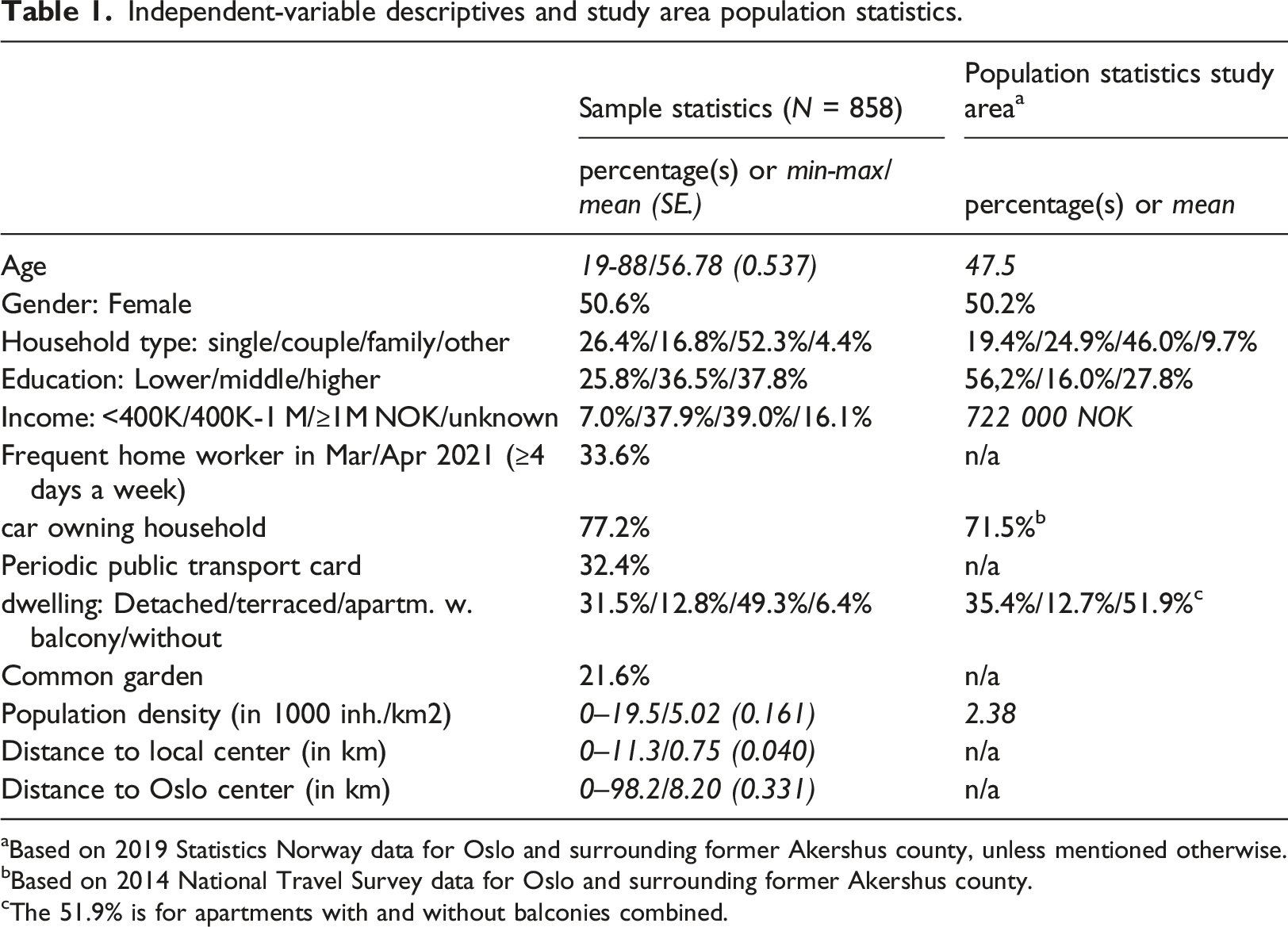
aBased on 2019 Statistics Norway data for Oslo and surrounding former Akershus county, unless mentioned otherwise.
bBased on 2014 National Travel Survey data for Oslo and surrounding former Akershus county.
cThe 51.9% is for apartments with and without balconies combined.
The analysis is carried out using structural equation modeling (SEM) in Stata (a software package). SEM, besides its reputed ability to be comprehensive, mitigates for statistical blind spots/fallacies when theoretical foundation for causal flow between investigated variables is shaky. More specifically, SEM allows us to: a) estimate the simultaneous effects on multiple correlated dependent variables; b) directly integrate a latent construct factor model (for PAC) with the rest of our structural regression model; and c) distinguish between direct effects, indirect effects via mediating variables and non-causal statistical correlations between the residuals of non-independent items or variables. SEM is thus ideally suited for the analysis carried out in this paper both for its comprehensiveness and to reduce misspecification bias. Figure 1(d) visualizes our final structural equation model structure (Figures 1(a), (b) and (c) are discussed in more detail in section 4.1). Besides the causal relationships displayed with arrows and correlations displayed with double arrowed curves, the model also includes correlations between the residuals of our six final housing preference change variables, as well as between the residuals of PAC items 3 and 4. Descriptive statistics of mediators and the SEM model structure.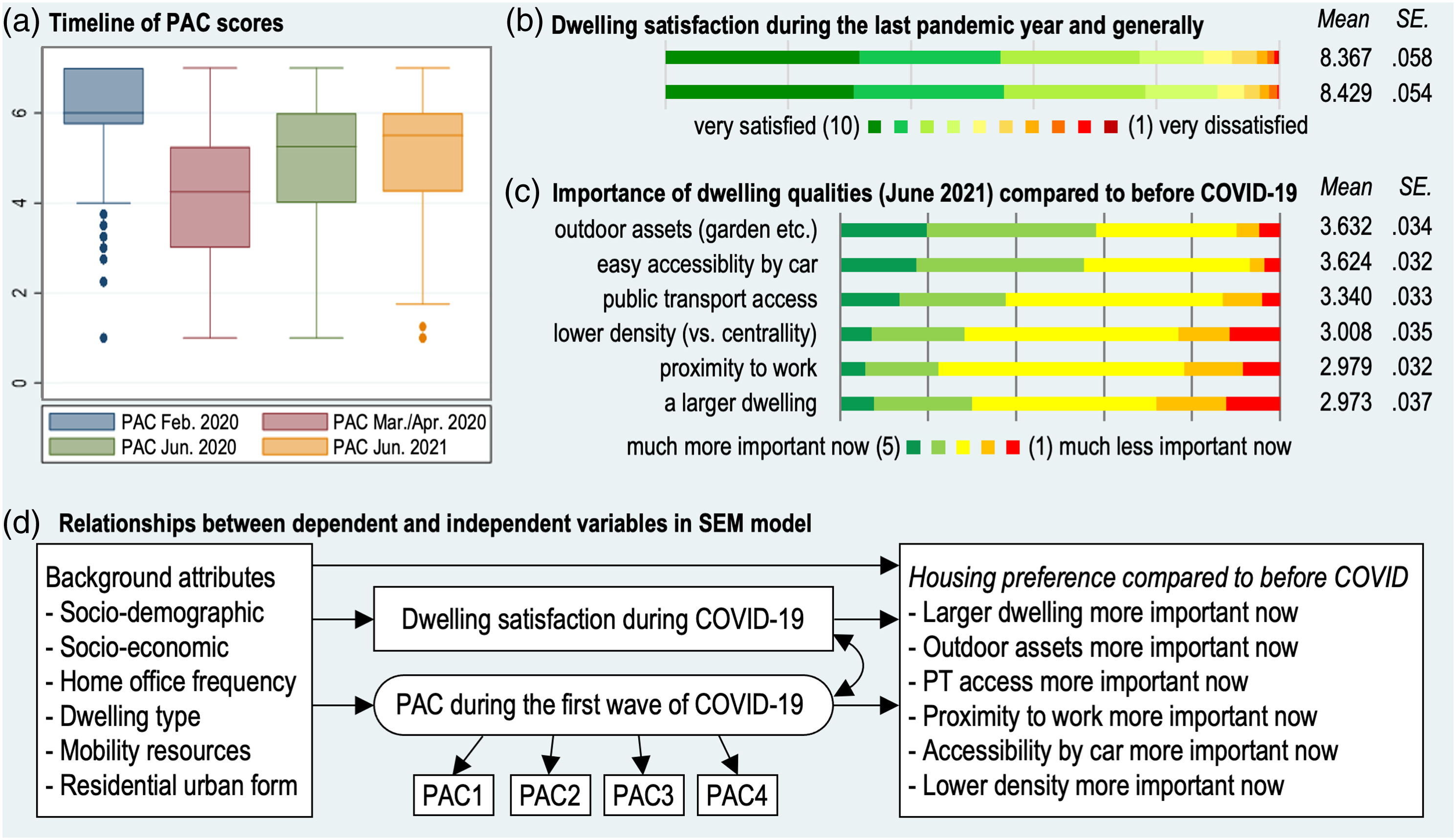
The study analyzes the simultaneous effects of all independent variables listed in Table 1, on six dependent variables concerning housing preference changes. We also estimate two factors that could mediate these relationships. The six dependent housing preference change variables were obtained in the last survey round in June 2021 by asking respondents to respond to the question “If you were to choose a new home and residential area now, would the pandemic have changed anything in your dwelling and locational preferences?” Respondents were asked to answer this questions by attesting to what extent they agreed on a five-point Likert scale with the following statements: 1) “Living in low density areas is more important now compared to before the pandemic”; 2) “A larger dwelling is more important now compared to before the pandemic”; 3) “Outdoor assets (balcony, terrace, garden) are more important now than before the pandemic”; 4) “Proximity to the workplace is more important now than before the pandemic”; 5) “Easy access by car and good parking opportunities are more important now than before the pandemic”; and 6) “Good public transport access is more important now than before the pandemic.”
The first of the two mediators, pandemic dwelling satisfaction, is measured on a ten-point scale ranging from “very dissatisfied” (1) to “very satisfied” (10)—a subjective satisfaction assessment scale often used in housing and neighborhood satisfaction studies (e.g., Permentier et al., 2011; Brazil, 2019). Respondents stated their satisfaction in response to the question “how satisfied have you been with your dwelling in the last year during the pandemic?”
The conspicuous reality under COVID-19 had been the profound constraint it imposed on accessibility to various daily life activities. Under this new reality, people are expected to experience varying degrees of access to daily facilities depending on residential and neighborhood amenities, urban structural factors, mobility resources, and so on. To capture this, a second mediator was constructed to measure respondents perceived accessibility during COVID-19. We use a scale for perceived accessibility (PAC) developed by (Lättman et al., 2018; Pot et al., 2021). The scale is estimated as a latent construct based on four items PAC1-“ease to conduct travels”; PAC2-“ability to live ones desired life”; PAC3-“ability to partake in desired activities”; and PAC4-“access to all ones needs.” Respondents repeatedly reported their subjective assessments on these items when asked to “consider how [they] travelled in” four time periods: pre-pandemic February 2020; first-wave March-April 2020; post-first-wave June 2020; and second-wave June 2021. Answers considering the first two time periods were asked retrospectively along with answers to the third time period at the first time of survey in June 2020, while the fourth time period was asked at the time of survey in June 2021. It is therefore important to note that items reported for the first two time periods, albeit relatively fresh in memory, may have been subjected to some recall bias. Although we report on the development of the PAC indicator through all four time periods in §4.1, our final multivariate analysis in §4.2 only includes PAC during the first wave in March–April 2020. After testing multiple alternative model configurations with PAC values and value changes measured at and between different time periods, PAC during the first wave period was ultimately selected as it provides the best model fit, but also because it marks the most memorable initial shock of when COVID-19 first hit. Before adding the latent first-wave-PAC construct into our analysis, we first established through factor analysis that all four items load well on one single construct and that internal consistency is good with a Cronbach’s alpha of 0.861.
Result and discussion
Descriptive findings
The fear of contracting the virus coupled with the lockdown measures have extended the functions of the dwelling and its emediate private, shared or public environs beyond the ordinary. The dwelling and dwelling surroundings’ amenities had to accommodate all aspects of daily life as a working and living environment, in many instances for all household members simultaneously. For many households, a mismatch between what was demanded of the dwelling during lockdown and what it actually was able to offer may have been expected. Nevertheless, our survey results point out that satisfaction with the dwelling during the last pandemic year (asked in June 2021) is quite high (mean of 8.367 on a 1–10 scale) and actually not much lower compared to respondents satisfaction with their dwelling generally (mean of 8.429). One thing to note here though, the dispersion of dwelling satisfaction ratings has increased mildly during the pandemic, with ratings at both the highest and the lower ends of the spectrum being somewhat more prevalent (Figure 1(b)).
Another important aspect of daily life which is expected to have instantaneously been altered due to COVID-19 is perceived accessibility (PAC): one’s subjective assessment of being able to conduct travels, partake in activities, access ones needs and live a desired life considering the way one travels on a daily basis (Lättman et al., 2018). During periods of confinement and lockdown, PAC may have been suppressed as a consequence of the avoidance of nearby attractive public spaces, neighborhood green pockets and facilities, whether as a result of fear of contracting the virus, as obligated by the authorities, and/or as a form of voluntary societal contribution to the containment of the spread of the virus. Figure 1(a) shows how PAC, calculated as a mean score across the four PAC items, has evolved from early 2020 through the summer of 2021. PAC scores for February 2020, retrospectively reported in June 2020, are used as a pre-pandemic benchmark.
As can be seen from the box plots, the distributional pattern and magnitude of PAC varies markedly between pre- and post-lockdown periods. Perceived accessibility took a significant decline immediately after the first lockdown, but somewhat recovered in the succeeding months. By June 2021 the PAC score of the 75th percentile (Q3) corresponded with the pre lockdown median score. Moreover, interquartile and minimum-maximum ranges for PAC are substantially larger during different stages of the pandemic (especially during its first wave) than for the pre-pandemic benchmark. This shows that there are larger variations in how respondents have perceived peri-pandemic PAC, which may indicate that the pandemic has hit people (and/or places) unevenly in terms of everyday activity and travel opportunities, especially in the earliest stages of the pandemic.
To shed light on whether and how the pandemic may potentially trigger shifts in relocation behaviors with urban planning ramifications, this study has developed a multidimensional measurement instrument to capture shifting dwelling and locational preferences. Figure 1(c) shows the degree to which different dwelling and locational amenities are considered more or less important in a (post-)pandemic world. It is not so much a larger dwelling, but especially the presence and quality of private outdoor assets, such as a garden, terrace, or balcony, that have become of higher significance. This is in line with earlier findings by Lehberger et al (2021) and Poortinga et al (2021). With everyday life evolving more in and around the home, this preference shift could indicate a way for people to secure access to nature and fresh air directly at the place of residence, as an alternative for their reduced out-of-home (travel) activities.
Tightly following is a stronger consideration for residential environment that offers easier parking and accessibility by car. This aligns with evidence from around the world that people resort to private automobility as their main alternative to public transport in a (post-)pandemic world, at least for longer distance trips (e.g., Thombre and Agarwal, 2021; Harrington and Hadjiconstantinou, 2021). There is also a motility aspect to this locational preference shift. Motility is a concept that relates to the value that people attached to the potentiality of travel options (Kaufmann, 2002). People in a (post-)pandemic world may attach higher value to the resilience of having the possibility and flexibility to park and drive a car as an alternative to public transport (PT), without necessarily committing to do so on a regular basis. Following this line of reasoning, it appears that people want options when faced with pandemic uncertainty. This turns out to include also PT. Rather than having given up on PT, people actually value PT accessibility higher (albeit not as high as they do for car accessibility), possibly seeking residential environments that offer them shorter, more seamless PT options than they may have today.
There has been ample discussion on whether people still want to live in compact cities. With a mean of 3.008 indicating near-absolute neutrality, we do not find pandemic induced significant shift towards lower density areas (versus more central locations). Also, despite the prospect of enhanced teleworking in a (post-)pandemic society, proximity to work seems to neither have lost much of its significance. However, this is only indicative (not conclusive) as Figure 1(c) does not account for respondents’ residential neighborhood when reporting.
It is important to note that the average scores for dwelling satisfaction, PAC, and housing preference shifts discussed above hide a substantial amount of variation between respondents in our sample as indicated by the class distributions in Figure 1. A subsequent multivariate analysis will be deployed next to examine how peri-pandemic PAC, dwelling satisfaction, and housing preference shifts vary across social and spatial categories. The mediating effect of peri-pandemic PAC and dwelling satisfaction on the potential shifts in dwelling and locational preferences will also be investigated by means of SEM analysis.
Multivariate SEM analysis
SEM model outputs.
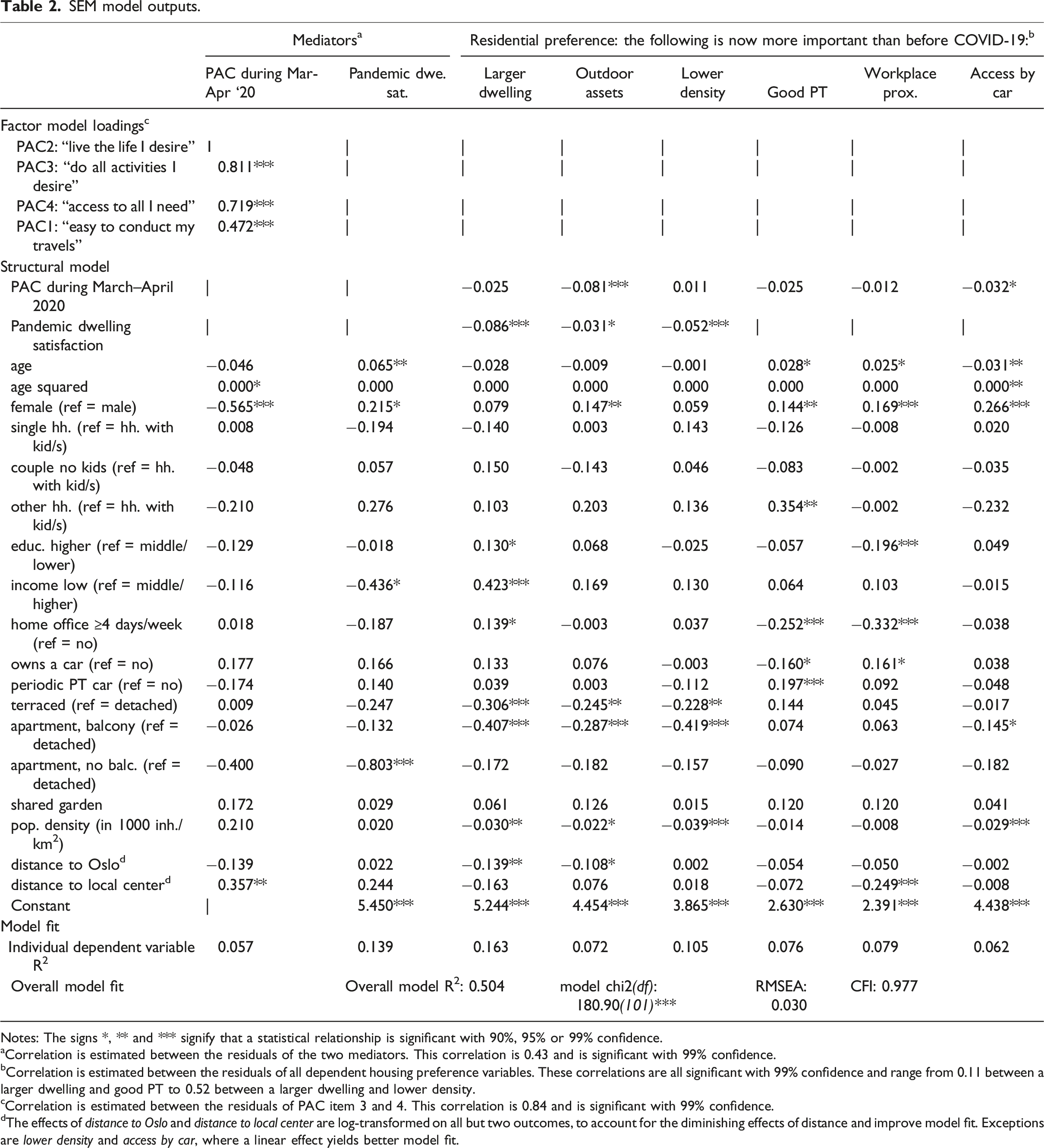
Notes: The signs *, ** and *** signify that a statistical relationship is significant with 90%, 95% or 99% confidence.
aCorrelation is estimated between the residuals of the two mediators. This correlation is 0.43 and is significant with 99% confidence.
bCorrelation is estimated between the residuals of all dependent housing preference variables. These correlations are all significant with 99% confidence and range from 0.11 between a larger dwelling and good PT to 0.52 between a larger dwelling and lower density.
cCorrelation is estimated between the residuals of PAC item 3 and 4. This correlation is 0.84 and is significant with 99% confidence.
dThe effects of distance to Oslo and distance to local center are log-transformed on all but two outcomes, to account for the diminishing effects of distance and improve model fit. Exceptions are lower density and access by car, where a linear effect yields better model fit.
Looking at the effects on PAC during the first wave of the pandemic in March–April 2020, it appears that women experienced a sizable decline in PAC when the pandemic first hit. This is in line with a host of studies indicating the uneven gendered impacts of this pandemic on mobility and mobility experiences (e.g., Caselli, et al., 2021; De Paz, et al., 2020). In addition, those with a location of residence in closer proximity to local centers appear to experience lower peri-pandemic PAC than those who live further away from local centers. While this may seem counter intuitive as it counters the accessible opportunities afforded by proximity to local centers, the effect could possibly be explained from the likelihood that those who live more peripherally relative to local centers are perhaps those who are most car dependent in their everyday mobilities, hence less impacted by the pandemic than others.
With regard to pandemic dwelling satisfaction (pandemic dwe-sat), our results indicate that older adults were better satisfied with their dwelling during the pandemic than younger adults. A sensitivity analysis with age categories using linear regression, not presented in this paper, confirmed the same finding. Moreover, apartment dwellers without a balcony experience significantly lower pandemic dwelling satisfaction relative to residents in all other housing categories, but especially compared to those residing in detached houses. This emphasizes the importance of residential amenities generally, and outdoor assets in particular, during lockdown.
Variation amongst dwelling and locational preferences is explained as follows. Respondents who experienced lower dwelling satisfaction during the pandemic and those in low-income households would now in (post-)pandemic times more-strongly consider a larger dwelling. On the contrary, residing in high-density neighborhoods and in areas that are closer to central Oslo appear to reduce the desire to move to larger dwelling. Also, residents in terraced housing and apartments with balcony tend to exhibit reduced preference for larger dwellings. Looking at total effects (not presented in Table 2), residing in an apartment without a balcony significantly raises the desire for larger dwelling relative to those in detached houses. This effect is, however, entirely mediated by the earlier finding that those without a balcony have substantially lower dwelling satisfaction.
Preference for outdoor assets is higher among women and individuals who reported low perceived accessibility when COVID-19 first hit. Residents in terraced housing and apartments with balcony have a lower preference for outdoor assets relative to those in detached houses. Private outdoor assets such as balcony, terrace, and garden are associated with enhanced residential wellbeing both prior to and during the pandemic (De Bell et al., 2020; Lehberger et al., 2021; Poortinga et al., 2021). Townhouses and apartments with balcony are urban dwelling types with that little extra in the domain of private outdoor assets. The fact that these dwelling types display lower preference to outdoor assets compared to detached houses highlights the contribution of minor outdoor assets such as balcony and small backyards associated with terraced houses in enhancing the resilience of urban dwellings during the pandemic. It can also be seen as a proxy for the type of neighborhoods these types of houses are more prevalent. Apartments and terraced houses are more prevalent in urban than suburban areas, while the opposite is true with detached houses.
Respondents who reported dissatisfaction with their dwelling during COVID-19 have a higher preference for dwellings in lower density neighborhoods as compared to more centrally located areas. Conversely, residents in high-density neighborhoods, as well as those residing in terraced houses and apartments (with a balcony) relative to those residing in detached housing, display less of a need to trade their location in preference for a lower density neighborhood.
Residential preferences reflecting good public transport services, proximity to workplace or easy access by car address various dimensions of accessibility. As expected, women, households without children and those that are frequent public transport users have a greater tendency to indicate higher preference for good public transport service during the pandemic. These are among groups with traditionally good public transport patronage (Grimsrud and El-Geneidy, 2014; Levin, 2019). Besides, frequent teleworking reduces the relevance of good public transport accessibility for a potential (post-)pandemic residential choice. Preference for improved accessibility by car declines with age and higher population density. Women on the other hand deem easy access by car and good parking opportunities as more preferable during COVID-19 than previously. This is likely associated with the constraining effect of the pandemic that appears to have been felt by women as indicated by the significant decline in perceived accessibility.
Proximity to the workplace is closely associated with available mobility options, and the possibility of teleworking as expected. The highly educated and those that are frequently teleworking have a lower preference for residential proximity to the workplace. For women, proximity to the place of work during COVID-19 is more important than for men. This is in line with their significantly reduced perceptions of accessibility when the lockdown was imposed. Moreover, it may be related to pre-existing gendered employment divisions (e.g., Begeny et al., 2020), including an overrepresentation of women who work in critical sectors like health that were never locked down, or in employments that are less easy to do on a teleworking basis.
Concluding remarks
The advent of COVID-19 and the subsequent restrictions have the potential to compromise, at least in theory, compact urban development as a planning ideal by partially nullifying the desirable qualities of dense, transit-rich, and walkable neighborhoods. One way to understand the resilience of compact urban development in the face of COVID-19 and its aftermath is to investigate or debunk potential shifts in residential preference trade-offs that the pandemic may have triggered. This study analyzes (post-)pandemic preference shifts with regard to an array of dwelling and locational attributes, its underlying inequalities, and mechanisms of mediation via peri-pandemic perceived accessibility (Lättman et al., 2018) and dwelling satisfaction, drawing on longitudinal survey data analyzed in a structural equation model (SEM). Our results show that outdoor assets (e.g., gardens and balconies) and motility (not only by car but also by PT), are amongst the residential and locational amenities that have gained most in significance peri-pandemically. Preferences with regard to neighborhood density, dwelling size, and work-proximity, have remained largely unchanged, despite a clear trend towards more teleworking.
Behind these averages lay substantial heterogeneities and inequalities between spatial and social categories. Our analysis shows a clear gender divide on the constraining effect of the lockdown and residential qualities that are deemed more attractive during COVID-19. Women have experienced a greater decline in perceived accessibility during the pandemic. This is consistently reflected in women’s tendency to value access to outdoor assets, good public transport, better accessibility by car, and proximity to workplace as more important during COVID-19 as compared to men. It is also noteworthy that younger adults and residents in apartments without a balcony experienced lower dwelling satisfaction during the pandemic. And those with lower satisfaction during the pandemic tended to prefer larger dwellings and lower density residential areas. Moreover, low-income households would more than higher income groups consider an increased need for larger dwellings. This may correspond with property values in the study area that lay more than 50 per cent above the Norwegian average (Krogsveen, 2021), which has culminated into a prevalence of dwelling crowding among low-income households that is equally high and above the nation’s average (Statistics Norway, 2021).
Residents in high density neighborhoods display significantly lower preferences for larger dwelling, lower density neighborhoods and access by car, which all attribute to predominantly exurban neighborhoods. Moreover, dwellers in terraced houses and apartments with balcony have a significantly lower preference for low-density neighborhoods and private outdoor assets such as private garden compared to those in detached houses. This could be understood as an affirmation that the pandemic has not (yet) eroded the attractiveness of living in a compact city, at least not amongst those who do so today. Ironically, it is amongst those living in detached housing and lower-density neighborhoods where the desires for better private outdoor assets and lower-density living are most prevalent. If anything, the pandemic appears to have reaffirmed rather than shifted existing variations in preferences for compact city living.
Overall, the empirical findings show that so far urban dwellers are content with their residential conditions despite the restrictive pandemic measures that had the potential to change how the residence is used and perceived. This can be understood as a nod of approval to the resilience of the contemporary urban planning paradigm. Rather than abandoning their sustainability ambitions, urban and transport planners, designers and property developers may want to bolster the resilience of compact urban living by ensuring that residential environments have access to mobility resources and residential qualities, such as fresh air, nature and outdoor amenities, and that affordable housing is in the mix of urban housing stock.
COVID-19 is still raging. How attitudes and coping mechanism evolve with time is thus still a developing story. Therefore, it is important to take the findings of this paper as a suggestive but not conclusive appraisal of the high density, transit-rich, and compact urban development paradigm. Besides, studies that focus on residential preference are indicative but not conclusive as they tell only part of the story. Comprehensive future analyses should track the development of residential preference shifts towards a firmer established new normal over time, and also examine whether such preference shifts are strong enough to trigger actual structural changes in urban residential mobility patterns.
Footnotes
Declaration of conflicting interests
The author(s) declared no potential conflicts of interest with respect to the research, authorship, and/or publication of this article.
Funding
The author(s) disclosed receipt of the following financial support for the research, authorship, and/or publication of this article: The Norwegian Research Council (grant no. 316126) funded the project on which this study is based.
