




Abstract
Life satisfaction and motives for moving home are complex entanglements, reflecting multiple desires and experiences. The aim of this paper is to show that a focused analysis of satisfaction with particular life domains can prove that changing a place of residence is not only a life stressor, but also a positive means leading to enduring improvements in individual satisfaction. Using the British Household Panel Survey we examine overall life satisfaction and satisfaction in various life domains such as housing, job, social life, household income, spouse/partner and health, both prior to and after moving. A temporal pattern of movers’ satisfaction for a number of years before and after the move is derived employing a fixed-effects panel data model. Our results reveal that residential relocation increases housing satisfaction considerably. The positive effect of moving on housing satisfaction is much stronger and endures longer for those with a sustained desire to relocate ahead of movement. Despite some decrease over time, five years after moving survey respondents still had significantly higher housing satisfaction than before their move. Changes in satisfaction with other life domains are much less pronounced and no lasting improvements in satisfaction are observed for them.
Introduction
Each year in the period 1996–2008 roughly one-third of United Kingdom (UK) adults expressed a desire to move home, according to the British Household Panel Survey (BHPS). A surprising revelation is that less than one-fifth of those who wish to relocate actually fulfil their desire (Coulter, 2013). At the same time many individuals who change their place of residence have no prior preference to do so. People who wanted to move constitute only 60% of all movers. The vast majority of these moves are residential relocations within the urban environment. In this study we consider, however, all changes of usual residence (address) and hereafter we will refer to them as ‘(residential) relocations’, ‘moves’ or ‘migrations’. A person who relocates will hereafter be called a ‘mover’.
The clear discrepancy between desires and behaviour of residential relocation is now well-documented in the literature (Coulter and Scott, 2015; de Groot et al., 2011; Lu, 1998, 1999). What is not evident is whether fulfilment of perceived needs and desires through changing place of residence leads to lasting improvements in people’s subjective wellbeing (SWB) and also whether residential relocation can give rise to satisfaction of those who move home with no prior desire to do so. It seems plausible that when moving desires and subsequent actions coincide then relocation should boost the mover’s satisfaction. According to some theories of SWB individuals become more satisfied when they reach their desired goals (Diener, 1984). Satisfying the needs of others may be even more rewarding (Aknin et al., 2012).
Life satisfaction and motives for migration involve complex entanglements. They reflect a multitude of needs, preferences and values not only of individuals but also of the linked lives of those who share in household practices, as well as others such as next of kin who are not domiciled at the same address. Moreover, moving home is often accompanied by major life events (Feijten et al., 2008) such as forming or dissolving a partnership, having children or losing a loved one, and these events usually influence people’s sense of wellbeing (Lucas et al., 2003). Residential histories are, therefore, closely interwoven with personal satisfaction and wider webs of wellbeing.
The objective of this paper is to investigate how migration impacts an individual’s assessment of life satisfaction both before and after a move. In particular, the study looks at whether residential relocation can serve as an effective and positive means of achieving enduring enhancements in individual SWB. In order to give a comprehensive picture of the SWB arising from migration, both overall life satisfaction and domain-specific satisfaction measures are used as indicators of SWB. It is in the latter area (life specific domains) that this paper makes its distinctive contribution showing the significance of housing as an arena where relocation can result in lasting gains in satisfaction (unlike many other life domains). As it is common in the literature, we use the terms SWB and life satisfaction interchangeably but note that life satisfaction is only one of the components of SWB (positive and negative affect are the other two).
The paper first provides an overview of approaches to analysing causes and consequences of geographical mobility. Using results from 13 waves of the BHPS, it then evaluates the relationship between life satisfaction and domain satisfaction for movers compared with stayers. Next, it sheds light on the interplay between satisfaction, desire to move home and actual migration, with a particular focus on the housing domain. Finally, it presents satisfaction trajectories before and after movement and illustrates the impact of a sustained desire to move on mobility outcomes based on housing satisfaction patterns. Urban studies researchers have long-recognised both the importance of the housing system in affecting the quality of life of city residents and also of residential mobility as an adaptive strategy for those who are unhappy about their living environment (Musterd et al., 2014). This paper reveals strong quantitative evidence that residential relocation can produce enduring improvements in housing satisfaction, an outcome that is not replicated for most other life domains.
Life satisfaction and geographical mobility
There is a long history of research that represents geographical mobility as a behavioural response both to individual characteristics and to external circumstances, such as those shaped by housing and labour markets. The behavioural research tradition emphasises the economic dimensions of the costs and benefits of mobility (such as wages and house prices), while on the other hand representing the act of moving home as a means of removing a range of stresses (such as living in an undesirable urban neighbourhood) and replacing the stresses with a variety of positive ‘place utilities’ (Wolpert, 1965). Many empirical studies posited that residential (dis)satisfaction is one of the key determinants of mobility (Lu, 1998; Speare et al., 1982). Household needs and external opportunities, which influence personal satisfaction, were initially analysed in relation to the lifecycle as individual families formed, grew and later declined in size and consequently adjusted to their housing needs (Rossi, 1955). Later research recognised the greater fluidity of household formation, growth and dissolution and noted that a range of mobilities could be observed over the life course (Stone et al., 2014), reflecting changes for example in marriage and divorce behaviour, partnering and having children, life expectancy and the changing housing needs of older people (Bailey, 2009). Others researched the links between ‘life transitions’ and housing pathways or ‘housing careers’ (Clapham, 2005; Feijten, 2005; Wulff et al., 2010), focusing on the relation between housing market processes and residential mobility.
The brief account of geographical mobility presented above, maps a shift towards recognition of the complex contexts in which movement decisions are taken. In parallel, researchers have increasingly argued that the motives underpinning mobility cannot be reduced to a single dominant factor. Instead the meanings associated with mobility are deep-rooted and complex, involving many inter-related factors (Coulter and Scott, 2015) that change in significance over the life course (Geist and McManus, 2008) and involve an understanding of the complicated negotiations that take place between people within a household (Cooke, 2008; Mulder and Cooke, 2009). Analysis of the mobility of couples also illustrates that moves often take place which are desired by one member of a household, but not by others. Meaningful analysis of motivations for, and satisfaction with, mobility experiences therefore needs to be sharpened by focusing on movers who actually desire to move rather than, as is so often the case, analysing the ‘reasons’ and ‘experiences’ of all movers in an aggregated and uniform fashion (Coulter et al., 2011).
Researchers have increasingly recognised that population mobility is motivated not only by economic factors, but also by social and cultural forces (Findlay et al., 2015), and that often people’s emotional attachments to social networks rooted in place help explain mobility as well as immobility (Lundholm and Malmberg, 2006). The intensity of local bonds is reflected in overall life satisfaction and well-satisfied individuals will not consider moving even if to do so might be beneficial for them in economic terms. Life satisfaction and quality of life factors have increasingly been recognised as key drivers of mobility, especially between cities and also within the residential neighbourhoods of an urban environment (Frijters et al., 2011). Moreover, Coulter (2013) has argued that desire to move amongst older people may not decline as much as was once anticipated, and that it is possibly increased obstacles (such as poor health or the lack of availability of suitable urban housing stock) to mobility that results both in the increased abandonment of the desire to move.
Pioneering work by Nakazato et al. (2011) has examined the effect of mobility on life satisfaction in a German context. They argue that life satisfaction varies over time in relation to residential relocation. They observe that although no increase in ‘overall life satisfaction’ emerges, there is a ‘strong and persistent increase in average levels of housing satisfaction’ associated with residential relocation (Nakazato et al., 2011). This suggested that satisfaction with other life domains (such as social life) map differently on to the relationship with residential mobility. They note that while individuals report little variation in ‘overall life satisfaction’ over time, the same is not true for housing satisfaction which is deemed to be ‘highly unstable’.
These observations of the relationship between life satisfaction and mobility, therefore usher in the recognition that it is not only the motives underpinning movement that are complex and entangled. The same holds for the life domains that drive life satisfaction. Lundholm and Malmberg (2006) provide evidence that different life domains correlate unevenly with movement behaviour. Although there is research that argues that measures of overall life satisfaction can be seen as an aggregate of people’s satisfaction with various aspects of their life (Schimmack, 2008; van Praag et al., 2003), in-depth analysis by González et al. (2010) and Rojas (2006) provides evidence that there is no simple relation between overall measures of life satisfaction and people’s satisfaction with individual life domains such as housing. One might summarise these arguments by saying that people who are happy with life in general are not happy with everything in their lives and that people who are satisfied with specific aspects of their lives are not necessarily happy overall. Not surprisingly, therefore, there is an argument that researchers need to dig deeper in investigating the complex ways in which satisfaction with specific life domains impact on human mobility (and vice versa), rather than relying solely on broad-brush indicators of overall life satisfaction to reach conclusions about how social and cultural dimensions of people’s life courses affect and are affected by the act of relocation.
An approach that recognises the value of disaggregating measures of life satisfaction in relation to specific domains has the advantage of making possible analysis of how life domains vary between people and also over the life course (McAdams et al., 2011). Moreover, such an approach makes possible examination of the ways in which some variables such as improved income have only a transitory impact on life satisfaction (Kahneman et al., 2006), while improvements in non-economic domains such as marriage and housing (Lucas et al., 2003; Nakazato et al., 2011) have been suggested to be more enduring in their effect on wellbeing (Easterlin, 2006). To ask whether ‘migration makes one happy’ (Nowok et al., 2013) in an enduring fashion is therefore a very complex question. It is not only difficult to unpick the meanings and motivations underpinning migration, but it is also necessary to recognise that mobility can be viewed both as a response to negative concerns about certain life domains and also as a positive strategy for those seeking increased life satisfaction. Whether enhanced life satisfaction endures following a relocation will be dependent on which specific life domains have driven an initial desire to move as well as which life domains turn out to be most affected by mobility.
Drawing on this research literature in relation to the objective of this paper (to investigate how residential migration affects life satisfaction over time) leads to three main research questions.
Are movers different from stayers in terms of domain and overall life satisfaction?
Do people who desire to change residence have characteristic patterns of (dis)satisfaction associated with particular aspects of their life?
Is residential relocation associated with lasting changes in life satisfaction in relation to different life domains or are effects temporary?
The BHPS as a data source for analysing migration and wellbeing
The study uses 13 waves of the BHPS, covering 1996 to 2008. These are waves of the original panel for which data on life satisfaction were collected. The BHPS is a nationally representative sample of about 5500 private households with approximately 10,000 adults recruited in 1991. The adult members of the same sample of households are interviewed every year. An attempt is made to follow up all movers who remain in the UK. If an original panel member forms a new household, then all adult members of the new household are also interviewed. The BHPS was also augmented by regional geographical samples. Therefore in 2008 the total sample size was around 9000 households including some 15,000 individuals.
Migration (move) is defined in this study as a change of residence (address) between two consecutive interviews and migrant (mover) is a person who moves house at least once during the observation period. This definition produces approximately 21,000 events in the data set. Unless stated otherwise, all observed moves, regardless of reason, distance and recurrence of a relocation are used in the analysis. For selected domain-specific satisfaction, however, the number of moves studied can be considerably lower, since, for instance, moves of single individuals are not considered in the analysis of spouse/partner satisfaction. Note also that the number of observations may vary between subjects, thus the panel is unbalanced.
Population mobility was identified combining the information contained in two different variables from the data set. The BHPS provides a derived individual mover status variable indicating whether sample members have moved location since the last interview. Panel members are also directly asked whether they still live at the same residence as before 1 September of the previous year. In the case of change of residence, information on month and year of the move is collected along with information on reasons for reported move. Respondents are first asked to indicate whether movement was for reasons associated with a person’s own job. Thereafter they are invited to name the other main reasons for moving. There is also information on mobility preferences of the interviewed individuals, which enables us to distinguish desired moves from other moves. In addition, we differentiate between movers with a sustained desire to relocate (measured as a consistent desire to move home for at least four years) and those with a short-term desire (expressed in an interview immediately preceding relocation). A prolonged period of desiring to move home is likely to reflect people’s constrained freedom to relocate that can be caused by e.g. limited financial resources, strong local ties such as children of school-age or unfavourable situation on housing and labour markets. We expect that a long-awaited migration is associated with greater changes in satisfaction than an immediate one.
Participants rate their satisfaction with life in general and with specific life domains. The satisfaction with life in general is measured by the question: ‘How dissatisfied or satisfied are you with your life overall?’. In the BHPS data set eight separate life domains are distinguished. Respondents are asked to report how dissatisfied or satisfied they are with their health, house/flat, husband/wife/partner, job (if in employment), social life, the income of their household, the amount of leisure time they have and the way they spend their leisure time. There are seven possible response options ranging from ‘not satisfied at all’ (one) to ‘completely satisfied’ (seven). A neutral point on the scale (four) indicates that respondents are neither satisfied nor dissatisfied.
Methods of analysis
The Goodman-Kruskal gamma statistic is used to measure the strength of the association between the ordinal-scale satisfaction variables. The impact of various aspects of life on a movers’ overall satisfaction is estimated using an ordinal logistic regression with the overall life satisfaction as a dependant variable and domain satisfaction scores as independent ones. The multicollinearity is tested using a variance inflation factor (VIF).
The changes in domain and life satisfaction relative to the time of relocation are derived applying fixed effect panel models, separately for each domain. A fixed-effects specification was favoured over a random-effects one based on the Hausman test. To capture the time path of the movers’ satisfaction a series of dummy duration variables are created. They denote the number of years before or after a move. The details of dealing with individuals who migrate more than once are presented below. The model is specified as:

where
Note that multiple migrants add a major complication to the analysis, because years between two subsequent migrations are both before and after a ‘move’. We assume that there is only one effect for each year either in anticipation of or adaptation to a move. An anticipation effect takes precedence over the adaptation effect back to year
This modelling approach originates from economic literature on earnings losses of displaced workers (Couch, 2001; Couch and Placzek, 2010; Couch et al., 2011; Jacobson and Lalonde, 1993; White, 2010). In analysis of life satisfaction similar models were used by Clark et al. (2008) and Frijters et al. (2011) to evaluate the effects of major life events (a change of residence was included in the latter study) on overall life satisfaction. A study by Nowok et al. (2013) focused exclusively on the effects of migration. For ease of interpretation and as suggested by Gelman and Hill (2007) for ordered categorical data with reasonably large and actually used number of categories that can be considered equally spaced we use a linear model. Ferrer-i-Carbonell and Frijters (2004) and Clark et al. (2008) show, in a similar context, that using linear regression intead of an ordered response one has a negligible impact on substantive results.
Movers, stayers and satisfaction with different life domains
Relationship between life satisfaction and domain satisfaction for movers and stayers
Movers are, on average, significantly less satisfied with their lives than stayers. The average overall life satisfaction judgements for movers and stayers are respectively 5.17 and 5.29 on the seven point scale used by the BHPS. Movers are also, on average, less satisfied than stayers with specific life domains, except for health facet. Table 1 includes the eight life domains for which the BHPS collects detailed information presented in order of the movers’ satisfaction level. It can be seen that, for both movers and stayers, only satisfaction with spouse/partner and with housing exceeds the score for overall life satisfaction.
Average domain and life satisfaction of movers and stayers.
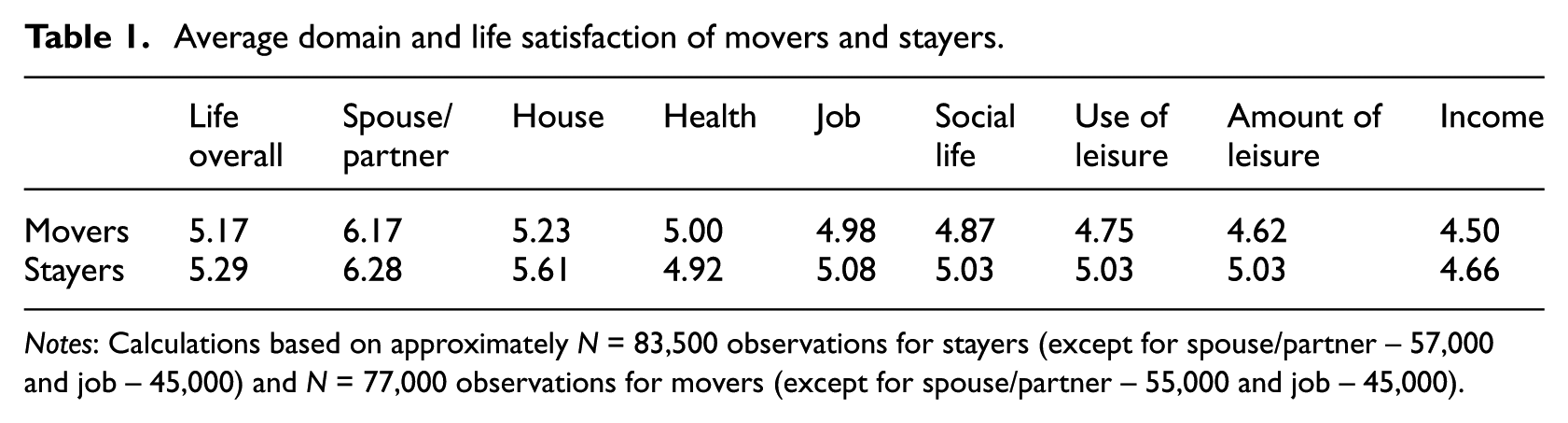
Notes: Calculations based on approximately N = 83,500 observations for stayers (except for spouse/partner – 57,000 and job – 45,000) and N = 77,000 observations for movers (except for spouse/partner – 55,000 and job – 45,000).
From the perspective of this paper, of greater interest than noting the low levels of satisfaction with amount of leisure or income, is the difference between mover and stayer satisfaction for each domain. The greatest statistically significant absolute differences are recorded for housing, amount of leisure and use of leisure. Since housing is one of the most significant differences, this is the main focus for our analysis later in this paper. Prior to this, to get insights into the relationship between life satisfaction and domain satisfaction of movers we examined the correlation between satisfaction judgements. Correlations of satisfaction across domains of life and life overall are all positive (Table 2). This confirms a general tendency found in the literature (Schimmack, 2008). Positive correlation values indicate that, in general, if individuals are satisfied with some aspects of their life they are also satisfied with others and with life overall. Note that most of these associations are significantly (at 1% level) weaker for movers than for stayers but detailed results are not presented here for space reasons.
Correlations of satisfaction across domains of life and life overall for movers (Goodman-Kruskal gamma). a
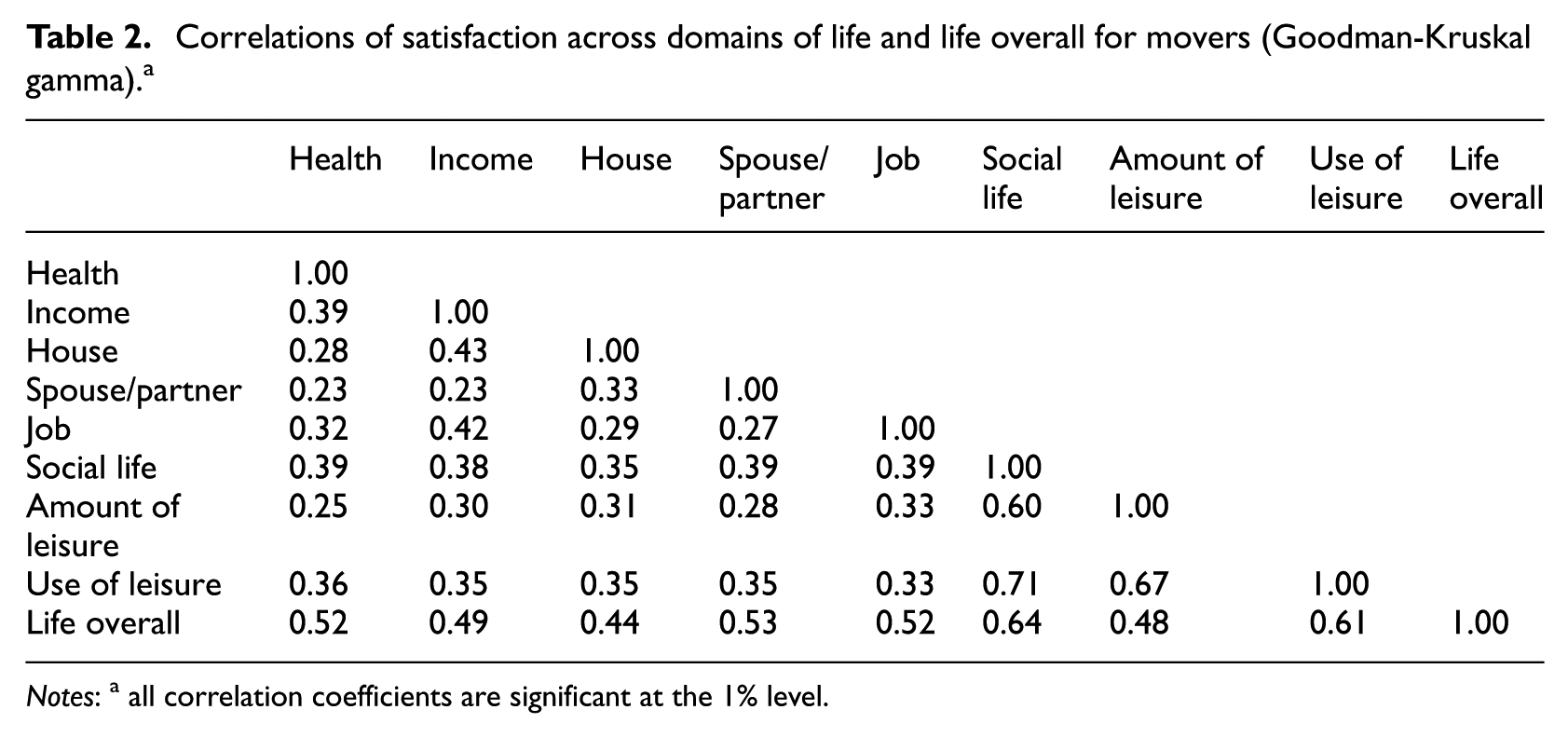
Notes: a all correlation coefficients are significant at the 1% level.
Overall mover’s life satisfaction correlates most strongly with their social life satisfaction. The correlation coefficient equals 0.64 and is significantly higher than correlation coefficients for other life facets. Nonetheless, the relatively high values of coefficients for other domains suggest that each of them may provide additional useful information. For most domains, the correlation with overall life satisfaction is the strongest one. The exceptions are the variables of social life, amount of leisure and use of leisure which are strongly correlated with each other. By contrast housing satisfaction is much less strongly correlated with other variables, although the coefficients remain significant at the 1% level. Movers’ housing satisfaction is more closely correlated with overall life satisfaction and income than with any other variable. This raises the issue of the direction of any causal links between these variables, an issue discussed by other researchers such as Cohen (2000), Rojas (2006) and González et al. (2010).
In order to evaluate in a more systematic way the importance of different domains for the overall life satisfaction of movers and acknowledge their heterogeneity, we estimated an ordinal logistic regression model in subgroups by desire to move with the overall life satisfaction as a dependant variable and domain satisfaction scores treated as independent ones. Owing to a multicollinearity problem between the ‘social life’, ‘amount of leisure’ and ‘use of leisure’ variables, the latter two were dropped from the model and further analysis. Variance inflation factors (VIF) for the remaining variables were lower than 1.2. Results show that satisfaction with each domain considered had a significant positive effect on overall life satisfaction (Table 3; domains are presented in descending order of importance for movers with no or a short-term desire to move).
Ordinal logistic model of overall life satisfaction for movers (by desire to move) and stayers in relation to satisfaction with different life domains. a
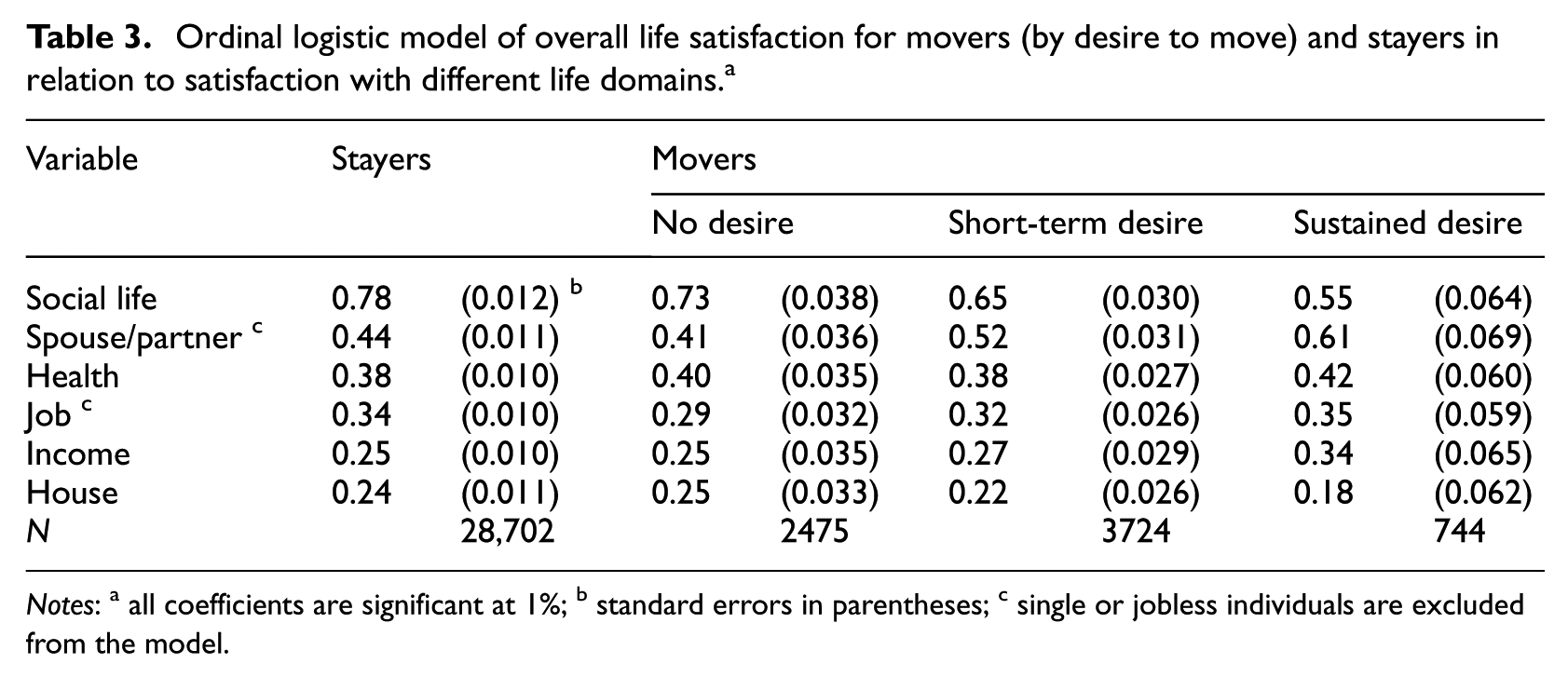
Notes: a all coefficients are significant at 1%; b standard errors in parentheses; c single or jobless individuals are excluded from the model.
For movers with no sustained desire to relocate, overall life satisfaction is most closely associated with their social life but not as much as for stayers. The higher coefficient for stayers than for movers is not surprising since social ties are one of the most important factors that prevent people from moving. Movers seem to value their spouses/partners more highly than stayers and movers with a sustained desire to move value them even more than social life. This may seem intuitive because a spouse/partner would probably be the most important social connection that a mover continued to have after relocating, while for stayers other aspects of their social network would not have been ruptured. Table 3 suggests, perhaps surprisingly, that housing was the least important domain of life satisfaction for both movers and stayers. In the case of movers this may seem remarkable, given that in the BHPS many movers claimed to be motivated by housing considerations (Coulter and Scott, 2015). What is even more surprising is that the more desired a move is, the less important the housing is for overall satisfaction. Increasing desire to move is associated, however, with the growing importance of job and income domains.
Relationship between desire to change residence, relocation and satisfaction
We turn now to analysing the relationships revealed by the BHPS about respondents’ expressed desire to move and their observed mobility. The correlation coefficients between satisfaction in various facets of life and desire to move were all significantly lower than zero (Table 4). Logically, the less satisfied people were, the more they desired to move. Especially those dissatisfied with housing demonstrated a strong preference to move. Correlations between satisfaction in various domains and movement were statistically significant but their values were close to zero. Patterns of housing satisfaction, by contrast, remained distinctive with the strongest inverse association (−0.37), indicating that those most dissatisfied with their housing were amongst those most likely to move. Dissatisfaction in the housing domain was therefore the most powerful trigger both for ‘desire to move’ and also for actual migration.
Correlation coefficients for expressed desire to move, migration and a range of life satisfaction variables (Goodman-Kruskal gamma). a
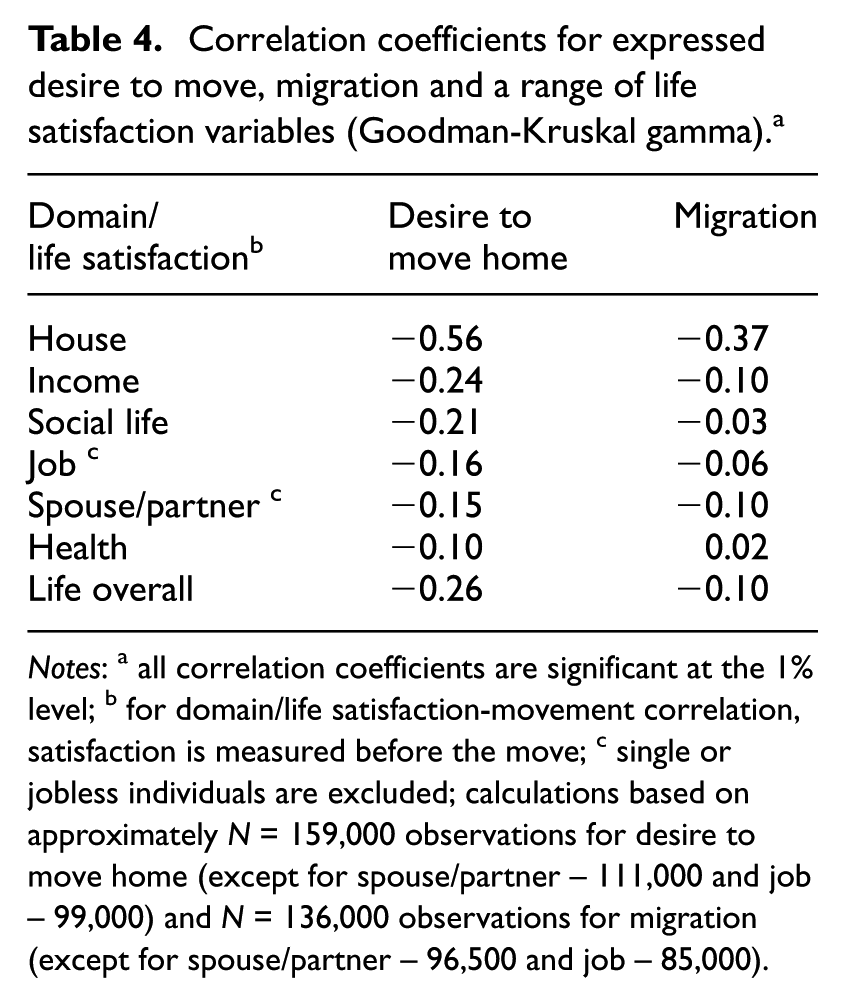
Notes: a all correlation coefficients are significant at the 1% level; b for domain/life satisfaction-movement correlation, satisfaction is measured before the move; c single or jobless individuals are excluded; calculations based on approximately N = 159,000 observations for desire to move home (except for spouse/partner – 111,000 and job – 99,000) and N = 136,000 observations for migration (except for spouse/partner – 96,500 and job – 85,000).
In the previous paragraph we showed that some differences are evident in the BHPS between ‘desire to move’ and the actual process of migrating (Table 4). Extending this point, the researchers noted a significant difference between those having a sustained desire to move (a consistent desire to move for at least four years) and other movers, in terms of a reported switch in housing satisfaction before and after a move. About 68% of those who reported a sustained desire to move were happier with their house after moving than before, which is approximately 20 percentage points higher than for other movers who had no long established desire to move. For other life satisfaction domains a sustained desire to move had a much smaller impact on the percentage of respondents reporting increases and decreases in wellbeing (Figure 1). Amongst those who reported a sustained desire to move, housing emerges as the life domain that produces the most significant increase in wellbeing. Logically, this may result from the relatively high chance of ‘desire to move’ and subsequent movement being motivated by housing dissatisfaction. A desired move for a housing reason should bring the highest gains in housing wellbeing because of the prioritisation of this domain over other domains.
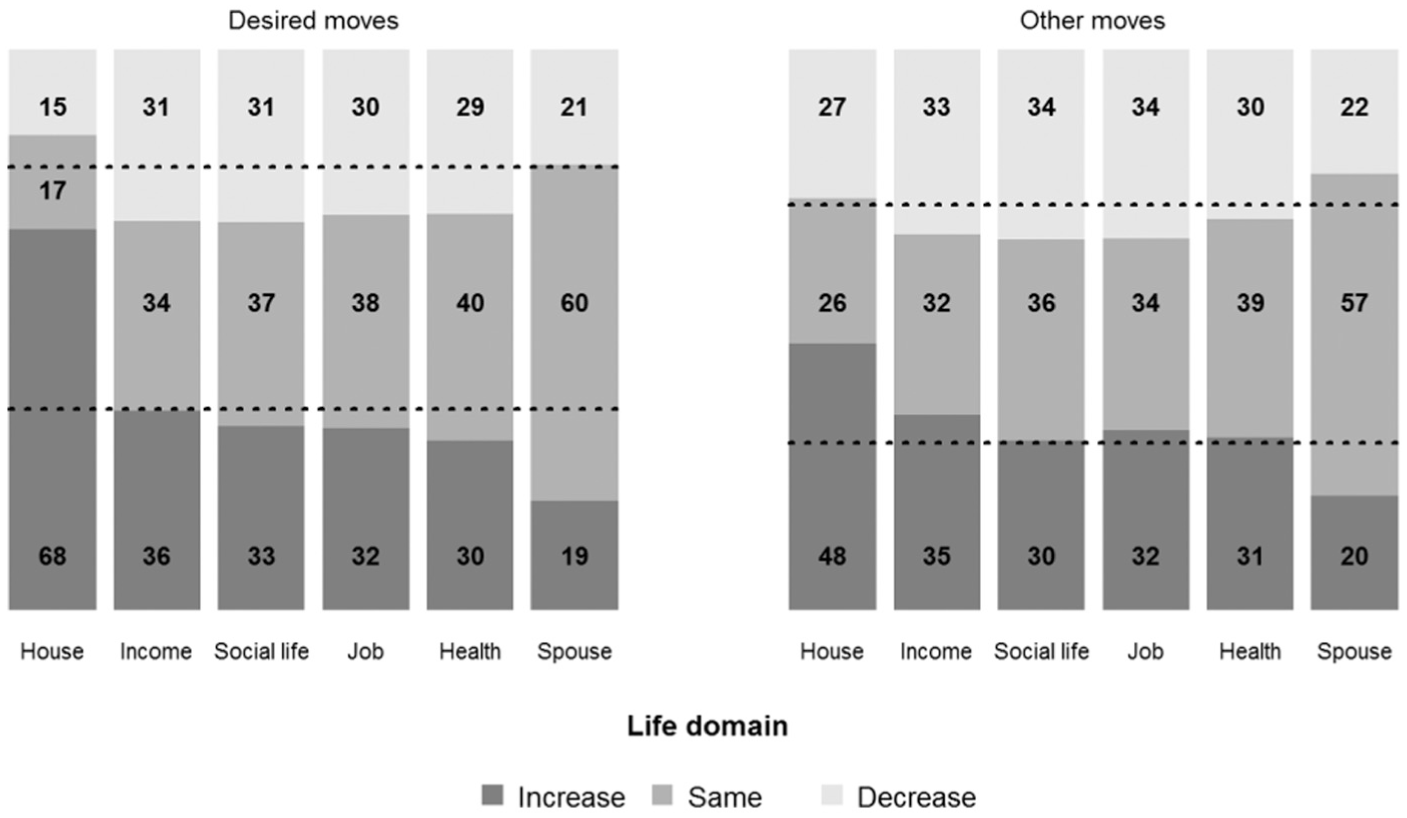
Percentage of movers who reported increased, decreased and the same domain satisfaction level after moves compared to before it (left panel – movers with a sustained desire to move, right panel – other movers); dotted lines indicate percentages for satisfaction with life overall.
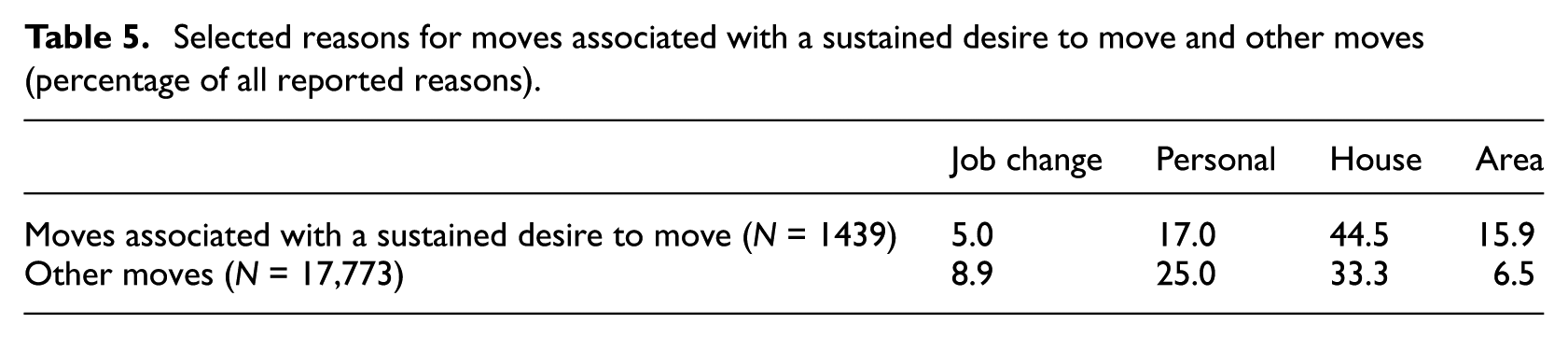
In the BHPS data set, most individuals with a sustained desire to change place of residence (60%) wanted to do this because of housing or ‘area’ considerations (Table 5). Those with a sustained desired to move are less often motivated by personal and job reasons than is true for other moves. This should not be surprising since when a family moves for ‘job reasons’ this usually reflects a job change for just one member of the household, leaving other members of the household engaging in an undesired move. Similarly moving for ‘personal reasons’ includes a mix of positive and negative circumstances such as divorce or downsizing of a house following death of a partner.
Selected reasons for moves associated with a sustained desire to move and other moves (percentage of all reported reasons).
A comparison of housing satisfaction in terms of percentage of respondents whose wellbeing increased or decreased after moving suggests that, regardless of the reason, people who had a sustained desire to move had a higher chance of increasing their satisfaction with their housing through relocation than most other movers (Figure 2).
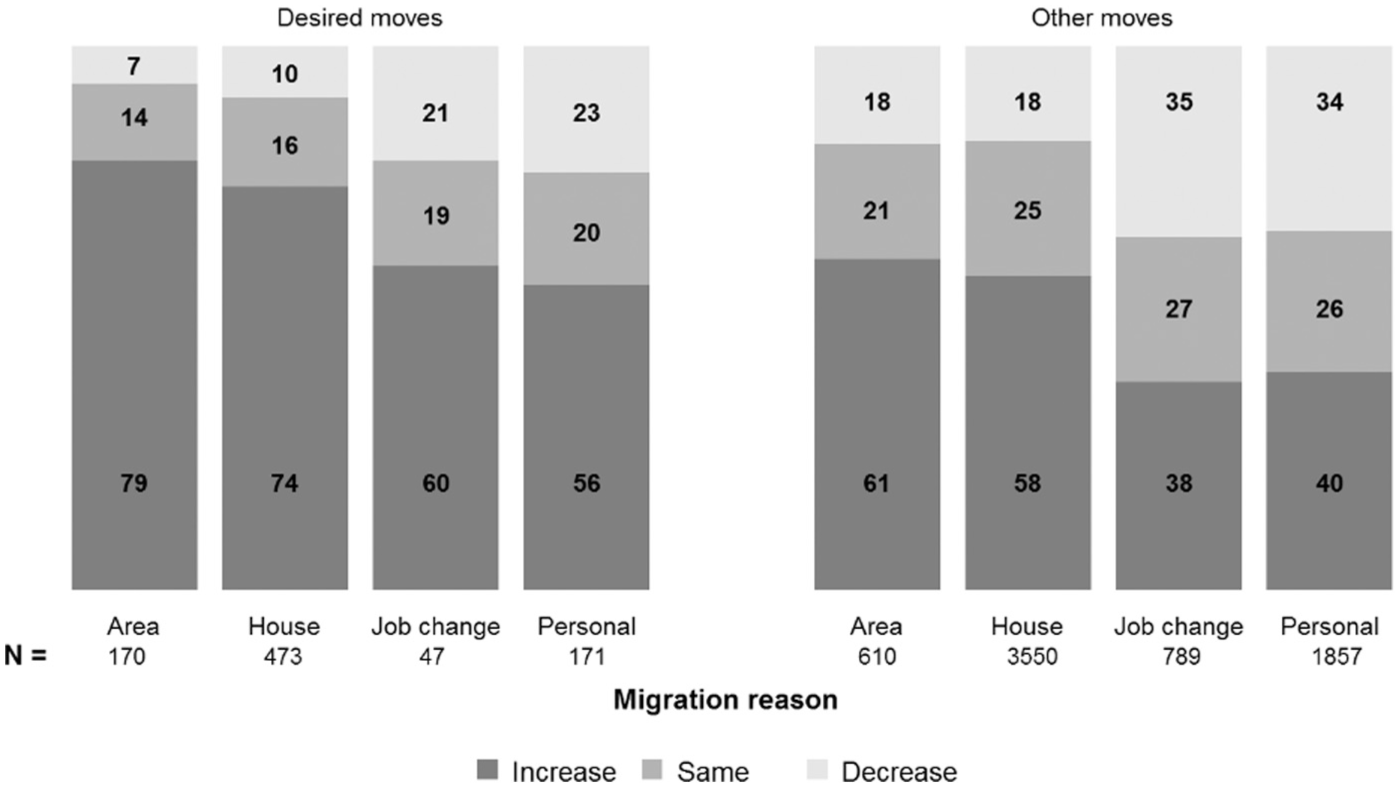
Percentage of movers who reported increased, decreased and the same housing satisfaction level after moves compared to before it, by migration reason (left panel – movers with a sustained desire to move, right panel – other movers).
Figure 2 also shows that even for those that did not wish to move, movement generally resulted in a greater satisfaction with housing. For those with a sustained desire to move for area- and house-related reasons the chance of being worse off after move was only 7% and 10% respectively.
Satisfaction trajectories before and after residential relocation
One key relationship worthy of analysis was whether movement is associated with enduring improvements in how people feel about different aspects of their lives. It is entirely possible that the changes in satisfaction observed just after relocation (as reported in the previous subsection) could be only transient. Analysis of satisfaction with specific domains reported a number of years before and after movement using a fixed-effects panel model revealed significant changes in housing satisfaction relative to the timing of moving. Figure 3 graphs the coefficients of the fixed-effects model for the five years before and after migration. Not surprisingly, people were getting dissatisfied with many aspects of their life before migration, but Figure 3 hints that housing dissatisfaction was particularly problematic and that dissatisfaction entered a distinct trough in the year before an individual’s move. To facilitate legibility, Figure 3, only charts migration in relation to three life domains, but the researchers analysed all the domains reported in Table 1, and only in the case of housing was a high positive coefficient achieved both in the year of relocation and in the subsequent two years. Changes in satisfaction with other life domains were much less pronounced at the time of migration and no long-term improvements in satisfaction were observed for other domains in the years following migration.
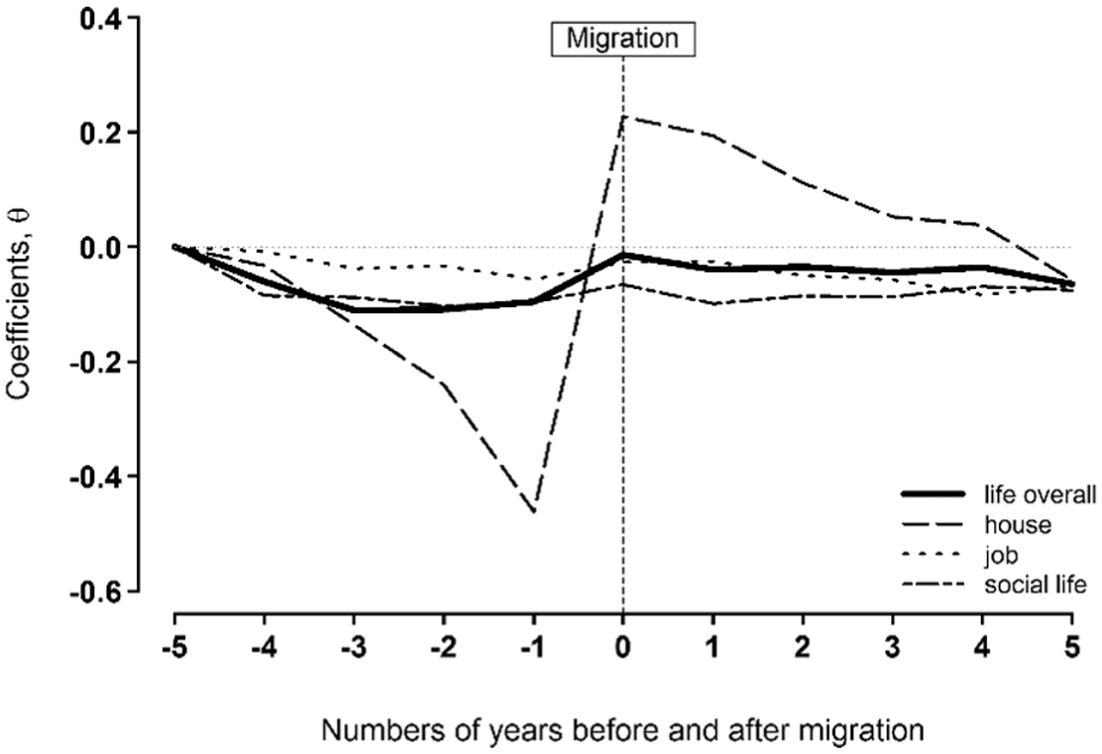
Dynamic effect of movement (all movers) on life satisfaction in relation to selected life domains.
Moving into a new home increased housing satisfaction considerably. If mobility initially had a very positive effect on housing satisfaction, this tends to decrease over time and five years after migration housing satisfaction is similar to the levels recorded initially. This could be a logical outcome, since with the passage of time life course changes, amongst other factors, mean that the ‘new home’ no longer matches a mover’s needs quite so well (e.g. if a couple experience the growth of their family as a result of having more children) as at the time of the move.
Focusing on relocation and life satisfaction in relation to the housing domain is, however more complex than this. Figure 3 has only examined the relationship for all moves, regardless of motivation for moving and does not focus on many key aspects of mobility recognised by migration theory. One key refinement is to analyse mobility separately for long- and short-distance moves, on the grounds that most moves that are motivated by, for example, housing needs in an urban context are very short-distance, while long-distance moves are more likely to be labour market-linked. Indeed separate analysis of long- and short-distance moves emphasises the importance of housing adjustment motives in short-distance residential mobility (Figure 4). The pre-move drop, and consequently the post-move gain, in housing satisfaction for local movers is considerably larger than for those who relocate at least 25 km. Long-distance moves, more often influenced by job opportunities, show some positive changes in job satisfaction after relocation, but there are no significant fluctuations in satisfaction with other life domains either around the time of the move or at a later date.
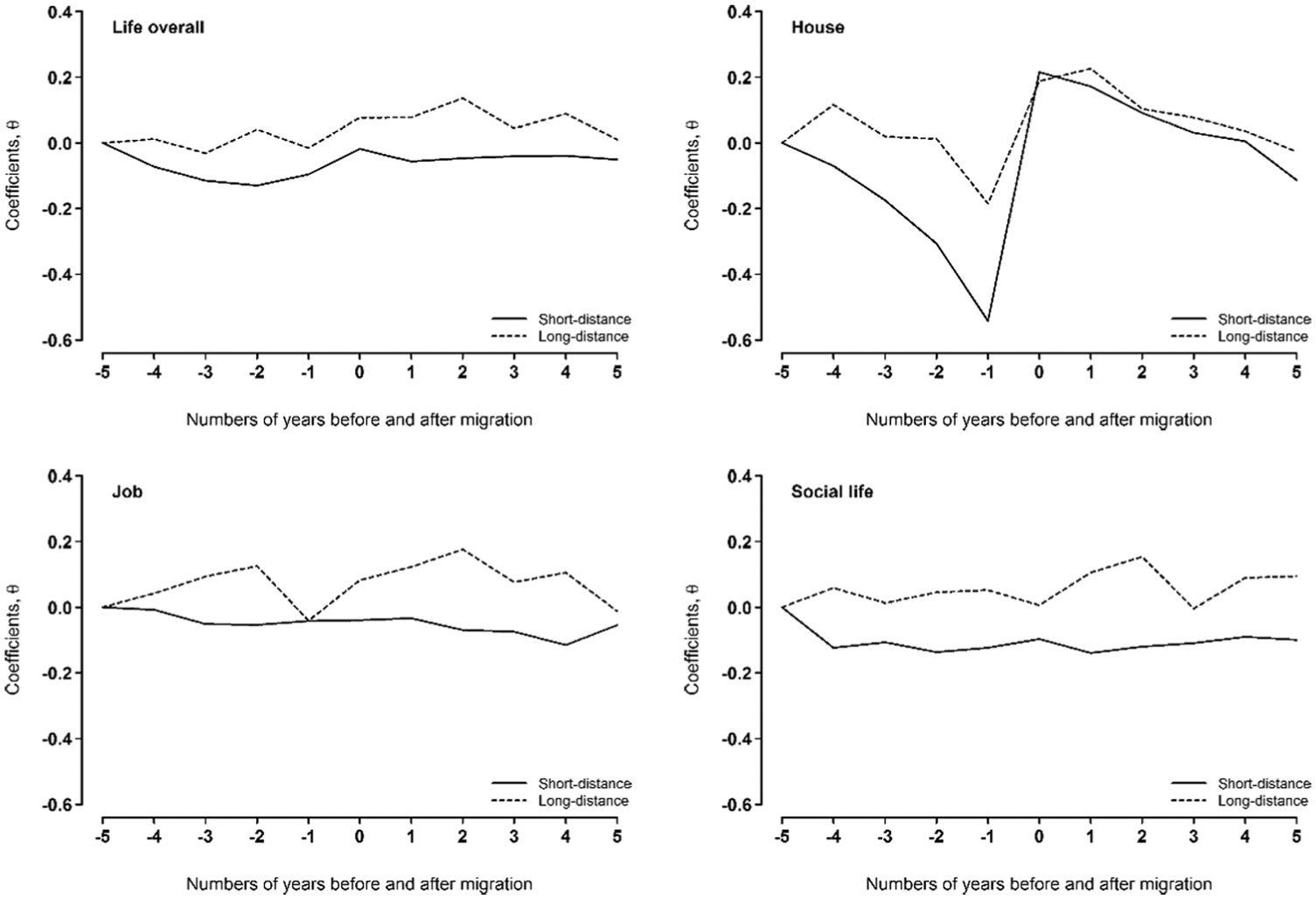
Dynamic effect of movement (all moves) on life satisfaction and selected life domains for short- and long-distance moves.
A further refinement of the analysis of residential moves is to consider tenure shift. From the housing career perspective it is a salient factor affecting how individuals perceive their new housing conditions. Because of the prevailing preference for home ownership in the UK, which is also supported by public policies, we expect that moving from renting to owning is particularly likely to produce positive satisfaction effects compared with other tenure shifts. Figure 5 shows paths of housing satisfaction (left panel) and life satisfaction (right panel) for most frequent tenure shifts. As illustrated by the dotted line, transitions from rented dwellings to home ownership with mortgage lead to substantial and lasting improvements in housing satisfaction that are incomparable with other moves. Opposite shifts in tenure are associated with decreasing house satisfaction both before and after the move. These moves are probably not voluntary, which is reflected in significantly decreasing satisfaction with life overall prior to relocation. Moves between privately rented dwellings brings house satisfaction back to its initial level but the positive effect is temporary. The long-term effect of the relocations between rented housing must be treated, however, with caution. There is a possible selection bias due to relative high frequency of such moves.
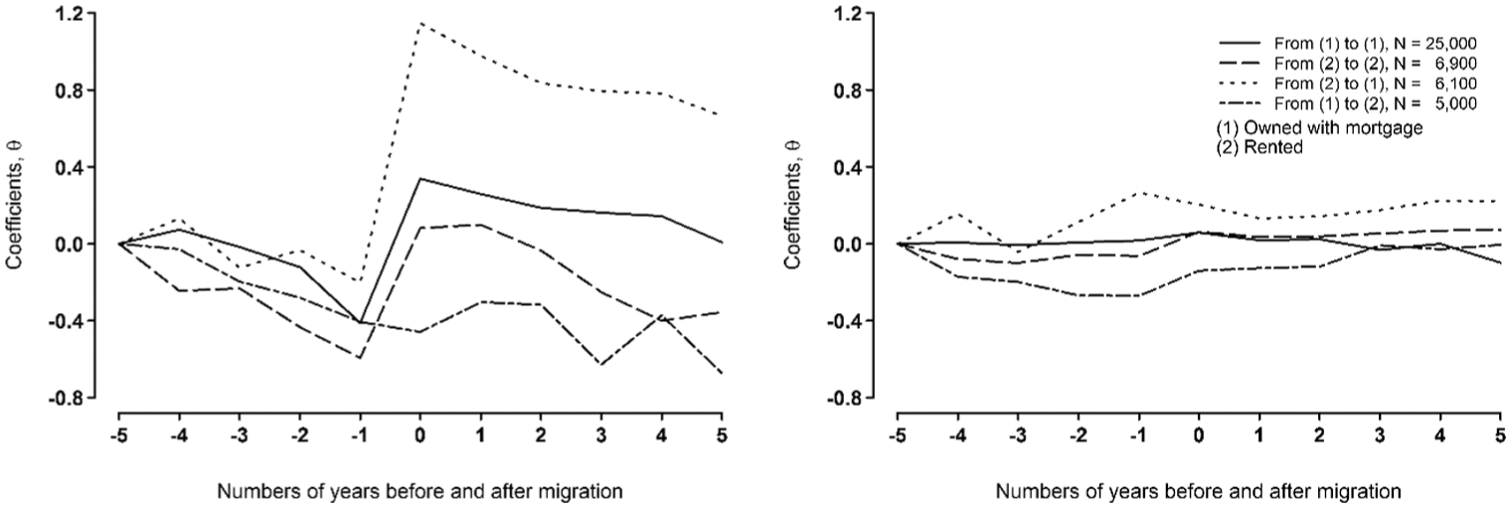
House and life satisfaction of movers (left and right panel, respectively) around the time of movement for selected tenure changes.
An additional refinement of the analysis is to examine those who had a sustained desire to move from those that moved but had no sustained desire to do so. As Figure 6 (left panel) shows, the positive effect of mobility on housing satisfaction is much stronger and endures longer for those with a sustained desire to change residence. Therefore, a sustained desire for relocation was not just a reflection of stress factors, but appeared to be associated with enduring benefits for the mover in terms of their life quality many years afterwards. A sustained desire to move did not appear, however, to have as strong and enduring an effect when the measure of overall life satisfaction was used (Figure 6, right panel). Nonetheless, a sustained desire to move had a short-term positive effect on wellbeing, which was not the case for the other moves.
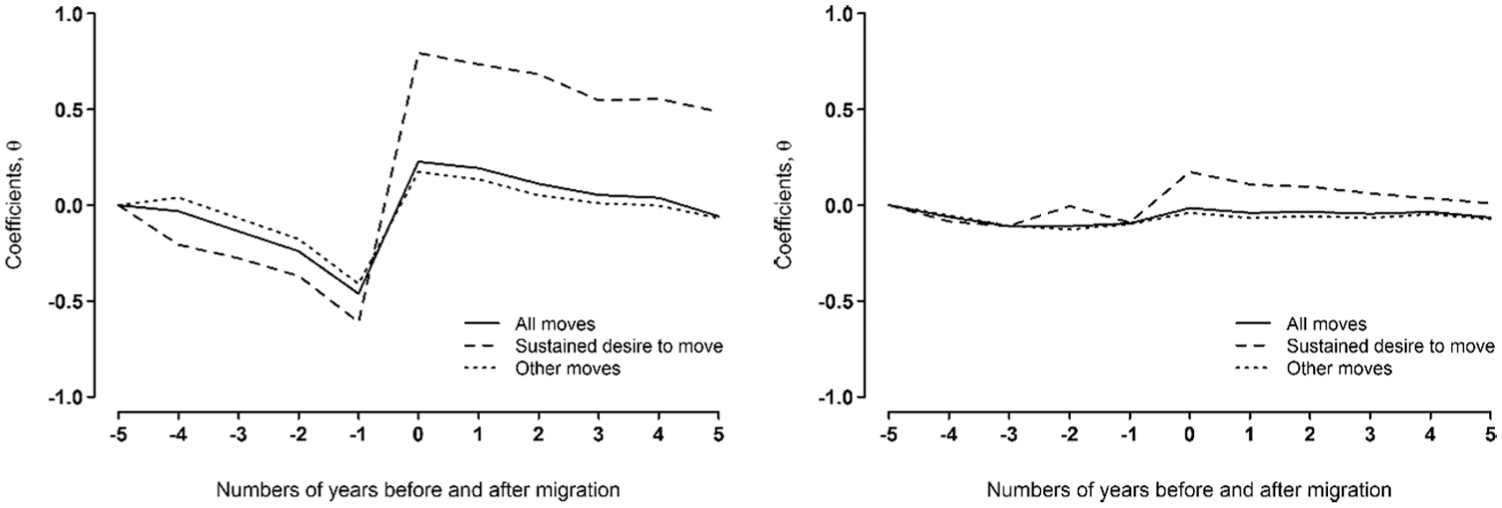
Dynamic effect of movement on satisfaction with the housing domain (left panel) and life overall (right panel) by desire to move.
However, people who did not express a desire to move, but despite this eventually moved (for example because of a spouse/partner’s job relocation) also became more satisfied with their housing conditions, but the statistically significant positive effect disappeared after three years (Figure 6 and Table 6). Moreover, the range of changes in housing satisfaction was much smaller than for those with a sustained desire to move. The fact that desired moves are preceded by a significantly larger drop in housing satisfaction than other moves also contributes to the resulting differences.
Fixed-effects models of housing and life satisfaction; the coefficient estimates for those with a sustained desire to move and for other movers.
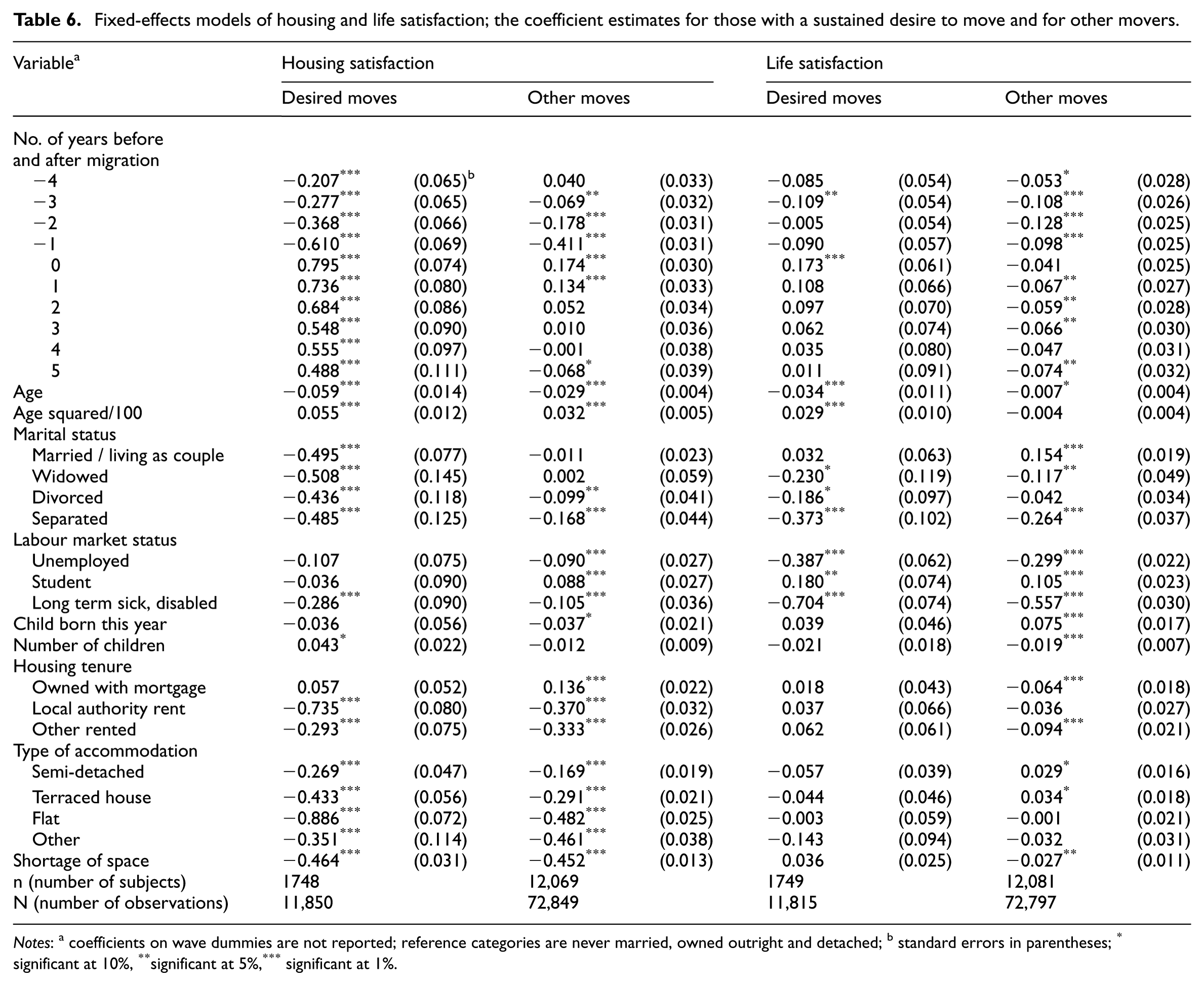
Notes: a coefficients on wave dummies are not reported; reference categories are never married, owned outright and detached; b standard errors in parentheses; * significant at 10%, **significant at 5%,*** significant at 1%.
Table 6 includes coefficient estimates for a set of control variables. People living in a flat are significantly less satisfied with their housing than those living in a detached house. Similarly, living in a property rented from a local authority is associated with lower housing satisfaction compared with living in an owned property. These relations are stronger for those who desire to move. Thus, a sustained desire to move may reflect a desire to live in one’s own house. Besides, among those who desire to move, those never married report significantly higher housing satisfaction than other groups. For other movers we observe a significant negative impact of being divorced or separated, which suggests that people forced to move for personal reasons end up living in a less satisfactory dwelling. The effects of the control variables on overall life satisfaction largely confirm previous findings: there is a large negative impact of unemployment and long-term sickness, being separated or widowed is associated with the lowest level of satisfaction and there is an indication of a U-shaped relationship with age.
Discussion and conclusions
The long history of research on residential relocation has received a major impetus in recent times with the availability of longitudinal data sets that have permitted new insights into the correlates of people’s mobility histories. In place of cross-sectional analysis of the relation between movement and a range of features such as quality of life, it has become possible to analyse mobility longitudinally (Findlay et al., 2015) and to show how the drivers and experiences of moving alter over time. The growing availability of longitudinal data sets has opened the possibility of new conceptual insights that link residential dissatisfaction (Diaz-Serrano and Stoyanova, 2010), moving desires (Ferreira and Taylor, 2009) and the final action of subsequent moving to another location (Lu, 1998).
The potential of longitudinal data has also meant a methodological shift in favour of approaches that control for unobservable heterogeneity across individuals (Boyce, 2010). In migration research this has brought the exciting prospect of being able to model how the drivers of residential mobility and the life experiences of movers change over time. The major contribution of this paper has been to undertake this exercise for a UK panel data set that has permitted investigation of the variation of people’s expressions of life satisfaction in eight different domains both before and after residential relocation. This has opened up the possibility to ask whether moving makes people more stressed or more content than they were beforehand, in relation to features as diverse as their housing situation and their social life. The research benefitted from using the BHPS also in being able to identify people who desired to move from others in the population. This allowed to test if ahead of and after movement those who desired to move held specific patterns of life (dis)satisfaction.
Below we discuss our key longitudinal findings but some results of the comparative analysis of movers and stayers are worth noting. First, movers are, on average, significantly less satisfied with their lives in general and also with specific life domains than stayers. Satisfaction with health is the only exception to this generalisation, which may be indicative of health-selective migration. Second, movers’ social life is less important for their overall life satisfaction than it is for stayers and for movers with a sustained desire to move it is even less important than their spouses/partners. Finally, housing is the least crucial domain of life satisfaction for both movers and stayers. This may explain the limited effect of residential relocation on life satisfaction compared with changes observed for satisfaction with housing.
The very pronounced changes in housing satisfaction, not occurring in any other life domain, may be also explained by the fact that dissatisfaction with housing is the most powerful trigger not only for desire to move home but also for actual change of residence. Ahead of migration people’s housing satisfaction drops significantly but moving into a new home leads to an improved housing wellbeing. The level of changes and long-term effects vary depending on more nuanced migration characteristics. For instance, for short-distance moves, which can predominantly be seen as housing adjustments, the drop in housing satisfaction prior to relocation is more substantial than for long-distance moves. This general pattern of changes does not hold, however, for moves from owned (with mortgage) to rented dwellings for which a decreasing trend in housing satisfaction continues also after relocation. Opposite shifts in tenure are associated with substantial and persistent improvements in housing satisfaction. Similar strong and enduring benefits are observed for migrations preceded by a sustained desire to move. Wellbeing in this instance endures long after the move and at a level of wellbeing that is significantly higher than existed five years before the event. For other moves the initial positive effect on housing satisfaction tends to decrease over time and five years after migration it is similar to the starting point.
Long-term improvements in housing satisfaction observed in some circumstances described above contradict hedonic treadmill theory which suggests that adaptation to a new quality of life means that only short-term changes in wellbeing are possible (Brickman and Campbell, 1971; Lykken and Tellegen, 1996). By contrast a similar housing satisfaction pattern to that found by the current authors was reported by Nakazato et al. (2011) for Germany. Human mobility is, therefore, not merely an external stressor but a potentially positive process. By seeing it as a process imbued with meaning by movers and non-movers alike, one can come closer to comprehending why SWB varies not only immediately before and after the event of relocation, but also over the longer run in relation to the lived experiences of those contemplating a move and those experiencing the consequences of a move. Those fulfilling their sustained desire to move experience very substantial and lasting improvements in housing satisfaction as they move through the life course (Bailey, 2009). Nonetheless, increases in housing satisfaction are found also for other movers. Moving home may be seen as a means to housing improvements regardless of the primary motive for relocation.
Stepping back from the specific empirical conclusions, the wider significance of the paper lies in its contribution to the growing field of studies that take a longitudinal view of both of residential mobility and also of international migration (Lundholm, 2007; Rabe and Taylor 2010; Stone et al., 2014; Wingens et al., 2011). These studies recognise that in the context of changing life-course trajectories, a diversity of mobility paths are emerging that require analysis of time-linked measurements associated with population movement. To be able to research the complex relations between people’s desires, experiences and mobility aspirations as well as their physical movements from one address to another is a rich opportunity that researchers in the past could only theorise. Current panel data and longitudinal data sets offer the prospect of researchers achieving exciting new understandings of mobility based on a strong evidence, and this in turn promises more rapid conceptual advances than ever before in mobility studies.
Footnotes
Acknowledgements
We thank three anonymous referees for their helpful comments and the UK Data Archive for access to the BHPS data.
Funding
We gratefully acknowledge financial support for this research from the Economic and Social Research Council (ESRC) Centre for Population Change (grant number RES-625-28-0001).