




Abstract
Urban climate experiments are considered as key vehicles for testing and materialising alternative futures. Yet, the capacity of experiments to be transformative and to go in the direction of greater justice is far from evident. While the debate on experimental governance hints at transformative challenges of urban experiments, scope of this paper is to make such challenges explicit, observing how they can constrain but also enable experiments in contributing to more socio-ecologically just change. To achieve that, this paper frames transformative challenges of urban experiments as critical governance tensions. The concept of tension illuminates the dialectics between limits to transformative action on the one hand, and opportunities to enhance scopes of action on the other. By analysing and connecting among each other key strands of debate on experimental governance, the paper identifies three main types of tensions characterising the governance of urban climate experiments, that is, socio-material, organisational and institutional (governance tensions). The analysis of the tensions is further developed by embedding a socio-ecological justice lens. Indeed, drawing insights from literature on urban climate justice, the paper shows how key dimensions of justice – namely distributive, procedural, recognition and restorative justice – run transversal to the three types of tensions. As a result, by experiencing and learning from governance tensions urban climate experiments can envision opportunities to better embed justice in their governing practices.
Introduction
Part of the debate on urban experimentation recognises how, in a societal context characterised by looming socio-ecological emergencies, not least the climate change challenge, urban climate experiments hold potentials for steering more sustainable and just urban transformations (Castán Broto and Bulkeley, 2013a; Monstadt et al., 2022). In fact, experiments such as living laboratories, pilots, testbeds and similar, are increasingly adopted by cities in Europe and globally (Bulkeley and Castán Broto, 2013) as key arenas in which actors engage in forms of collaborative governance, in order to co-shape alternative solutions to social and environmental challenges (Bulkeley et al., 2018). While urban climate experiments often feature as small-scale initiatives prefiguring and materialising alternative futures here and now, these initiatives also aspire for systemic chance and impactful (urban) transformations (Meyer, 2023; Sengers et al., 2020).
Besides the tendency to overemphasise the transformative potentials of urban climate experiments, however, what also emerges from the literature on experimentation is that the capacity of experiments to be radically transformative and to foster greater justice should not be taken for granted (Hodson and Marvin, 2010; Karvonen et al., 2014). Some scholars have for instance underlined how, behind the narrative of innovation and change, urban experiments risk to reproduce the status quo and to generate social and material outcomes that go against greater justice (Tozer, 2019).
Overall, the literature has referred to transformative challenges of urban climate experiments from at least three angles. First, the challenge to prefigure alternative solutions by concretely implementing them in the materiality of the city, producing tangible and, potentially, more just socio-material outcomes (Bulkeley et al., 2014a; Bulkeley et al., 2016). Second, the challenge to build networks and to develop adapted organisational strategies so as to diffuse innovative experimentations in wider spatial-institutional settings, going beyond isolated experiments (von Wirth et al., 2019; Sengers et al., 2020). Third, the problem of influencing urban governance and planning processes and co-constructing more enabling and just institutional and political frameworks that allow for experimentation and innovation (Madsen and Hansen, 2019; Moloney and Horne, 2015). These issues respectively hint to key (socio)material, organisational and institutional viewpoints through which understanding transformative challenges of urban experiments. While these viewpoints have been largely treated separately, there is a need for a more integrated and reflexive analysis of governance dynamics within urban experiments, particularly regarding their intersection with justice-related concerns. Specifically, this paper argues that justice should not be viewed as an external target but rather as an inherent component of both the internal and external governance dynamics of urban experiments. Consequently, reflecting on the interrelations between governance challenges and justice dimensions can enhance the reflexivity and awareness of actors involved in experimentation and sustainability governance, fostering a deeper engagement with justice issues.
This paper seeks to articulate the urban experimental governance and justice nexus through the following strategy. First, by carrying out a critical analysis of key (sub)strands of literature on experimental governance, this work advances a socio-political perspective on how key challenges are experienced and negotiated by actors involved in experiments. Indeed, referring to the concept of governance tensions, the analysis points to contradictions and dilemmas actors go through in the politics and governance of experimental initiatives. The dialectic character of the concept of tension implies that tensions usher both, barriers and dead-ends variably constraining or de-politicising transformative action, but also constructive and (pro)positive ways forward that enhance scopes of action. Reflecting the challenges highlighted above, tensions are framed in terms of socio-material, organisational and institutional (governance) tensions (see sections ‘Methodology’ and ‘Unraveling governance tensions’). Second, drawing on key pillars of the urban climate justice literature, this paper shows how justice is embedded within the three types of tensions and how urban experiments can enable transformative approaches that provide opportunities to fully address justice. In particular, by giving accent to key dimensions of justice emerging from the debate – namely, procedural, distributive, recognition and restorative justice – the analysis highlights how revisiting governance tensions through a justice lens can enhance actors’ awareness about justice-related contradictions and potential pathways forward (see section ‘Connecting governance tensions with socio-ecological justice’).
Methodology
The methodological strategy aimed at identifying and analysing sub-strands of debate on urban (climate) experiments and experimental governance with the purpose to: (a) understand in what ways literatures on urban experimentation have framed transformative challenges of urban experiments; and (b) grasp whether and how issues of justice are embedded in such analyses. In particular, drawing on core scientific contributions and systematic literature reviews on urban experimentation (see for instance Kivimaa et al., 2016; Sengers et al., 2019; Sengers et al., 2020; Ehnert, 2022; Sierhuis et al., 2023), a first distinction was made between two primary strands of scholarship on urban experimentation and its link to transformation. A first strand comes from literatures on socio-technical innovations and sustainability transitions, which have greatly influenced theories and practices on experimentation (Brown and Vergragt, 2008; Nevens et al., 2013; Sengers et al., 2019; see also Sierhuis et al., 2023). Broadly speaking, this literature strand puts preeminent focus on the organisational strategies, or mechanisms, through which bounded experiments scale out and up, generating broader transformation processes (Brown and Vergragt, 2008; Sengers et al., 2020). Thus, although not necessarily addressing issues of politics and governance, this scholarly community’s focus on the processual dynamics of experimentation enabled a preliminary re-framing of transformative challenges of experiments as tensions in organisational governance – specifically, how actors form networks and coalitions to scale and expand place-based experiments. A second strand consists of the urban environmental governance literature (Bulkeley and Castán Broto, 2013; Eneqvist and Karvonen, 2021; Madsen and Hansen, 2019). While this literature shows analogies with the sustainability transitions perspective in unravelling how experiments organise themselves and seek to amplify their action, urban environmental governance gives a stronger socio-political accent to these types of transformative dynamics. In particular, this community puts greater focus on how actors involved in experiments interact with wider governance arenas and institutional settings (Kronsell and Mukhtar-Landgren, 2018). As a result, by highlighting issues of power, politics, and socio-institutional change, this body of literature enabled the development of the analytical category ‘institutional governance tensions’. These are broadly defined as barriers and opportunities for experiments to drive change in institutional apparatuses and planning frameworks (see section ‘Unraveling governance tensions in urban climate experiments’). Digging deeper into urban experimental governance and its link to transformation, a further step in the analysis has been the identification of a third (sub)strand of debate. While intersecting with both, the urban environmental governance and the transition literatures, this third strand also features as a distinct line of debate. It observes how experiments face challenges to implement solutions in the material and social structures of cities (Bulkeley et al., 2014a; Rutherford, 2014; Tozer, 2019). Focusing on infrastructures such as energy, greening, mobility, and others, this literature put socio-material aspects into the foreground. Such a focus on (socio)material dynamics allowed for an understanding of how organisational and institutional processes do not happen in a vacuum; on the contrary, they occur in place-based socio-material settings posing specific challenges to experimental transformations. This understanding inspired the concept of socio-material governance tensions as integrating and complementing organisational and institutional aspects. This third category of tensions is broadly defined as actors’ struggles to cope with the social and the material realities in which experiments navigate (see section ‘Unraveling governance tensions’; see Figure 1 for a schematisation of the tensions).
Finally, with respect to questions of justice, the analysis highlighted how, on the one hand, there is a conspicuous debate on urban climate justice. This debate mainly investigates justice in relation to climate adaptation and mitigation policies (Anguelovski et al., 2016; Bulkeley et al., 2013) and to urban greening strategies (Anguelovski et al., 2020; Rice, 2014). Yet, on the other hand, despite relevant exceptions (see for instance Bulkeley et al., 2014b; Bulkeley and Castán Broto, 2014; Sovacool et al., 2019), scarce contributions connect justice with urban experimentation and experimental governance. More specifically, there is lack of conceptual analysis of how justice can be more purposely embedded in the governing practices of actors involved in urban climate experiments. This gap urges a more in-depth consideration of how socio-material, organisational, and institutional governance tensions relate to justice. In fact, linking with key dimensions of justice, governance tensions can be viewed both as drivers of unjust dynamics and as levers for addressing critical justice challenges. Section ‘Connecting governance tensions with socio-ecological justice’ aims to tackle these issues. Schematisation of governance tensions and literature foci.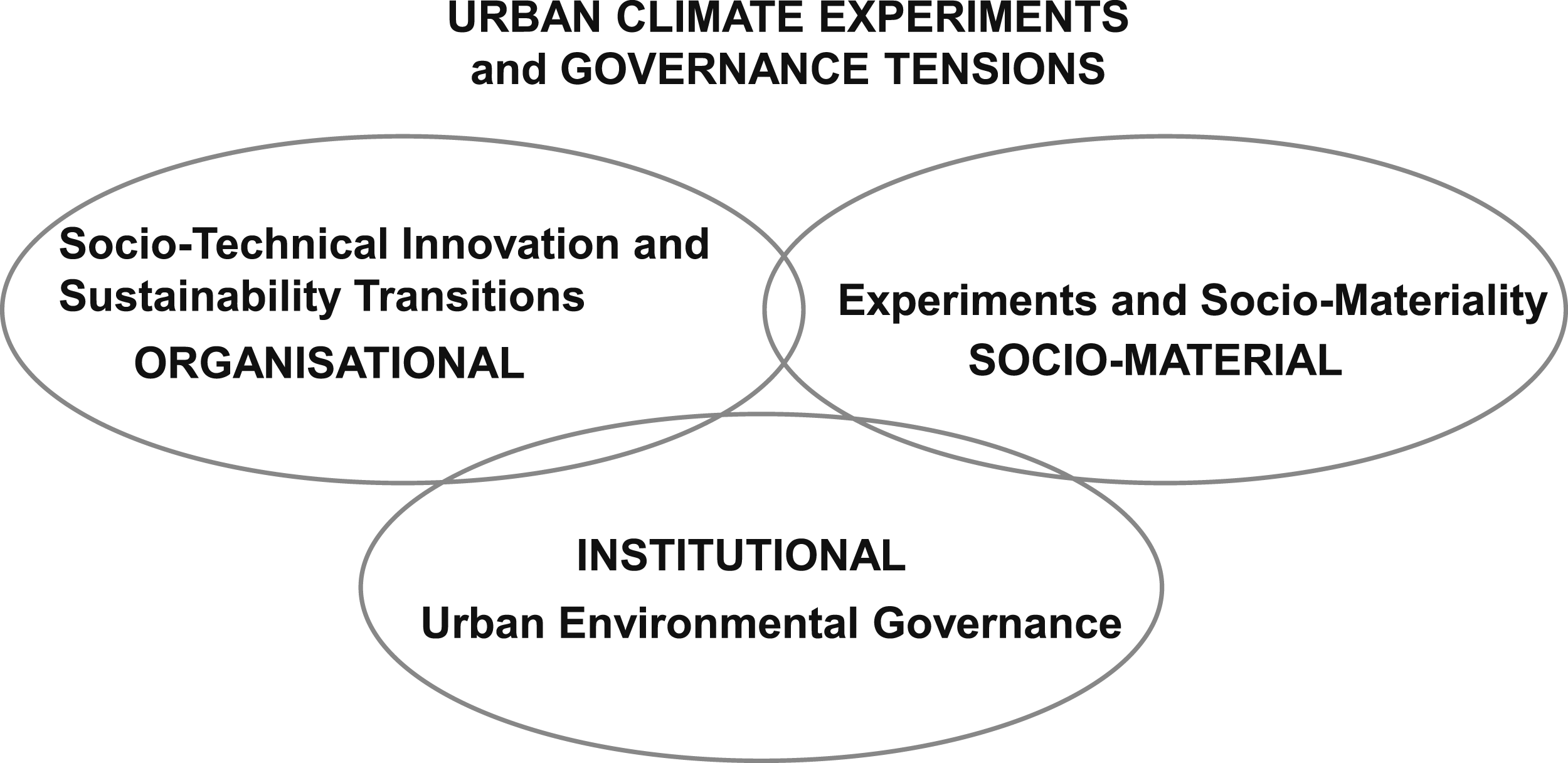
Unravelling governance tensions in urban climate experiments
Different (sub)strands of debate help to characterise the governance of urban climate experiments and the struggles of these initiatives to engender wider transformative processes. Traditionally, theoretical perspectives on socio-technical innovation and sustainability transitions refer to experiments as small-scale initiatives, also called niches, where actors work out alternative socio-technical configurations (Brown and Vergragt, 2008; Kivimaa et al., 2016). Examples of these niches in the field of energy are, for instance, renewable technologies, such as solar panels, wind turbines, or smart grids. These technologies are experimented on a small scale, e.g. by means of piloting or demonstration projects (Ryghaug et al., 2019), which are spaces of experimentation and learning. Yet, the challenge is to devise mechanisms to scale experiments up, engendering wider transformative processes in regime actors and institutions 1 (Fuenfschilling et al., 2019; Sengers et al., 2020). Embracing a stronger socio-political perspective, other scholarly contributions have highlighted dynamic and contested modes through which experiments unfold. In particular, pointing to the limits of global coordination and (hierarchical) governance structures dominated by the national level, the debate recognises how climate change governance and planning also manifests in a place-based, piecemeal and informal manner (Bulkeley, 2023). Thus, the existence of fluid arenas of action, falling outside formalised spaces of political authority, is emblematic of how climate governance dynamics actually occur (Bulkeley, 2023; see also Castán Broto and Bulkeley, 2013a). These considerations have brought the literature to understand urban experimentation as a veritable mode of governance. According to this perspective, experimentation reflects the complex, contingent and situated character of climate change challenges and provides alternatives to top-down and absolutist approaches to climate change governance (Meyer, 2023). Thus, the challenge is to transform governance itself, also by confronting with more or less enabling institutional and power structures (Madsen and Hansen, 2019). As part of the literature highlights, such a socio-political understanding of experimental governance should not overlook the concrete material realities – made up of places, artefacts, social and technical infrastructures – where urban climate experiments become embedded and in which they seek to carve out spaces of action (Bulkeley et al., 2015; Bulkeley et al., 2016).
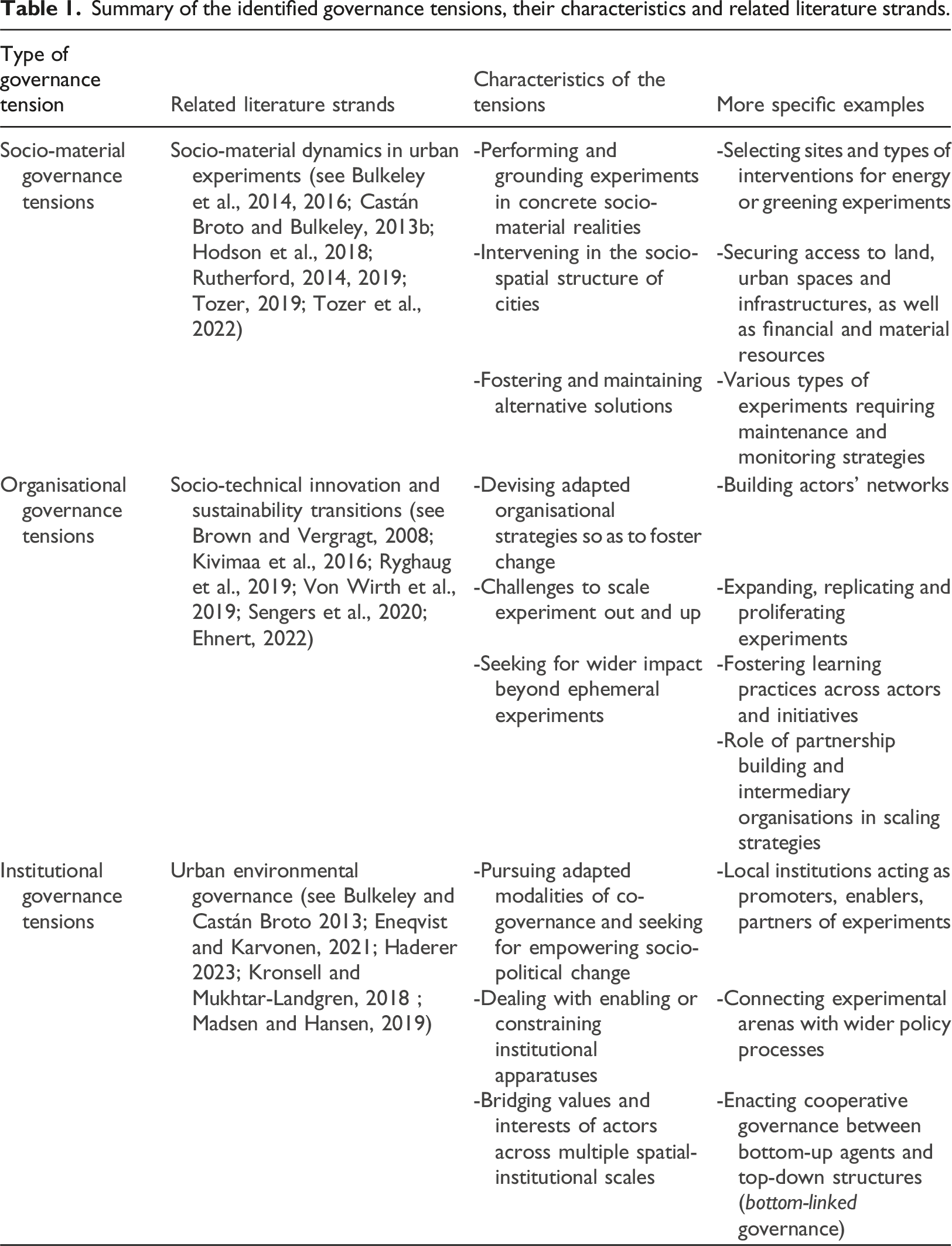
Building on such a dynamic and integrative perspective, I propose a characterisation of governance that reveals the material, organisational and institutional aspects producing barriers to the transformative potentials of urban climate experiments, but also fostering promising ways forward to engender more sustainable and empowering urban transformations. Based on diverse strands of debate on urban experimentation, the following paragraphs will examine these aspects and their inter-relations in a more in-depth way, by illustrating three types of governance tensions, that is, socio-material, organisational and institutional governance tensions (see Table 1).
Socio-material governance tensions
Socio-material governance tensions can be defined as both, the ensemble of barriers encountered by actors when performing urban experiments in the in the materiality of urban areas, but also modalities to overcome or address such barriers, learning from experienced tensions and working out productive ways forward. Drawing from the so-called ‘material turn’ in urban studies (Lees, 2002; MacLeod and Jones, 2011), a sub-strand of debate on urban climate governance has begun to focus on the (socio)materiality of urban climate initiatives in general and experiments in particular (Bulkeley et al., 2014a; Hodson et al., 2018; Rutherford, 2014, 2019). These studies observe the ways in which experiments concretise, negotiating their place within the materiality of the urban and aspiring to effect impactful change (Bulkeley et al., 2016; Stripple and Bulkeley, 2019; Tozer et al., 2022). Thus, key merit of this strand of debate is to shed light on the processes through which experimental interventions materialise and deal with the mundane practices with which socio-material realities are constituted (Bulkeley et al., 2016; Stripple and Bulkeley, 2019). Doing so, the literature hints at how socio-material tensions manifest and play a role in conditioning experiments in their attempts to intervene in the socio-spatial structure of cities. Tensions for instance materialise as experiments need to deal with access to land or other urban spaces, such as neighbourhoods, buildings, rooftops, and so on, where experiments such as open-air laboratories or pilot interventions situate and are maintained (Bulkeley et al., 2015). Referring to an example of energy experiment in Sydney and Newcastle Metropolitan region (Australia), Bulkeley et al. (2016) show how the practice of selecting sites and types of interventions is intrinsic part of the ‘material politics’ of actualising smart electricity grids. In particular, the authors show how the challenge of finding suitable spaces within a dense urban fabric is part and parcel of the political struggles of actors involved in experiments, such struggles significantly conditioning the further adoption of experimental practices (Bulkeley et al., 2016). More broadly, referring to a green housing development in the periphery of Bangalore (India), Bulkeley and Castán Broto (2014) highlight “tensions arising between the aspirations to provide a ‘self-sufficient’ development and its embedding within existing urban landscapes” (Bulkeley and Castán Broto, 2014: p. 405).
Alongside these aspects, socio-material governance tensions also emerge from the practices of actors dealing with the fostering of alternative solutions and sustaining them through time, beyond the limited timeframe of urban experiments (Castán Broto and Bulkeley, 2013b; Sengers et al., 2020). Among others, this implies conceiving adapted modalities of intervention, including maintenance and monitoring strategies (Castán Broto and Bulkeley, 2013b). Rutherford (2014) illustrates these aspects referring to the simultaneous expansion and decarbonisation of Stockholm´s district heating system. More precisely, the author notices how socio-material tensions related to implementing alternative decarbonisation pathways and alternative energy mixes become manifest, particularly involving state authorities and the private company co-owning the infrastructure. The ways in which concerned actors deal with these tensions have consequences not only for the physical aspect of the system, but also for the ways in which energy services are provided to citizens and users, that is to say, through more or less transparent and accountable resource provision systems (Bulkeley and Castán Broto, 2014; Rutherford, 2014, 2019). In summary, as Bulkeley et al. (2016) put it, performing urban experiments with the purpose of prefiguring and implementing alternative solutions in specific localities implies a continuous process of “ongoing negotiation, compromise and adaptation in light of the urban (socio)materialities in which projects are enacted” (Bulkeley et al., 2016: p. 1718, word in brackets added).
Overall, the above insights show how analysing socio-material governance tensions means diving into the ‘everydayness’ of urban experiments and their intention to generate long-lasting and impactful socio-material effects (see Manganelli, 2024). While the literature has implicitly hinted to such tensions, there are opportunities to investigate how they can be destructive or, besides, constructive of new ways forwards and modalities to materialise transformative change, potentially contributing to more just socio-material outcomes (see section ‘Re-reading governance tensions under a justice lens’).
Organisational governance tensions
As experiments unfold, tensions manifest in devising adapted organisational strategies so as to foster change and instigate transformations that go beyond the limited scope and timeframe of experiments. Referring to ‘upscaling’ and ‘outscaling’ challenges, the sub-strand of literature on urban experimentation deriving from the tradition of research on socio-technical innovations and sustainability transitions hints at organisational governance tensions (Ryghaug et al., 2019; von Wirth et al., 2019; Ehnert, 2022). In particular, this literature seeks to unravel how experimental initiatives (struggle to) scale out or up, percolating different socio-institutional contexts (Kern, 2019; Smeds and Acuto, 2018) and seeking for an impact that goes beyond limited experimental frameworks (Ryghaug et al., 2019; Sengers et al., 2020). Thus, scholarly contributions within this strand of debate have concentrated on empirical analyses of upscaling processes, also proposing guidelines on how constraints on upscaling can be anticipated and overcome (Dijk et al., 2018). For instance, von Wirth et al. (2019) illustrate how organisational strategies such as actors’ networks activation, the replication of experimental formats, the fostering of learning practices, played a role in the context of Urban Living Lab experiments in Rotterdam (the Netherlands) and Malmö (Sweden) (von Wirth et al., 2019). Furthermore, Sengers et al. (2020) focus on the notion of embedding in order to unravel the key strategies through which local initiatives diffuse and foster broader systemic change beyond the boundaries of localised experiments (Sengers et al., 2020). More specifically, the authors identify four mechanisms of embedding, consisting of: replication and proliferation (diffusion of experiments in other institutional settings); expansion and consolidation (purposive enlargement of actors and scopes of the initiative); challenging-reframing (engendering transformation in existing rules, institutions and governance arrangements); and circulation-anchoring (transmission of knowledge and learning across actors and practices).
These reflections on the expansion and ‘embedding’ of experiments provided by the sustainability transitions community leave space for a socio-political analysis of how tensions are experienced and governed in the life-course of experimental initiatives and of what adapted organisational strategies actors work out as a result of the tensions. One type of strategy, for instance, can consist of building local or regionally-based networks in order to increase capacity and scope of action (Moloney and Horne, 2015). A further strategy can be mobilising advocacy coalitions or engaging into horizontal partnerships that seek to align actors towards a common vision (Bulkeley et al., 2018). Indeed, partnership building can be a way through which local initiatives strategically link with state and non-state actors, amplifying their voices and reinforcing their political networks. Moreover, these organisational strategies are also instrumental to negotiate stable access to funding and resources (Bulkeley et al., 2018; Hodson et al., 2018). In fact, the role of intermediary actors or organisations can be pivotal for both, leveraging multiple resources as well as providing a backbone for the implementation of alternative solutions (Bulkeley et al., 2018: p. 324).
Thus, it can be argued that, analogously to socio-material tensions, organisational governance tensions are not only vehicles of barriers and constraints. In fact, such tensions can resolve into opportunities to strengthen alliances, associational networks and collaborative relations, working out promising ways forward. Gopakumar (2014), for instance, highlights how divergences among actors concerning the development of water-supply infrastructures in Bangalore, have opened opportunities for alternative organisational strategies to emerge. One strategy consists of expanding the water infrastructure system in a top-down way, while a second alternative strategy concretises in the development of bottom-led solutions to water supply, adapted to community needs (Gopakumar, 2014; Putri and Moulaert, 2017). In sum, organisational governance tensions invite a deeper scrutiny of how experiments deal with pressures to work out adapted organisational strategies, which can also go in the direction of greater inclusivity and justice (see section ‘Re-reading governance tensions under a justice lens’).
Institutional governance tensions
Institutional governance tensions can be defined as tensions in pursuing adapted modalities of co-governance among actors, seeking for empowering socio-political change. Part of the debate on urban experimentation has begun to observe experiments in relation to institutional processes (Eneqvist and Karvonen, 2021; Fuenfschilling et al., 2019; Haderer 2023; Madsen and Hansen, 2019; Schreiber et al., 2023) and in connection to capacities for political change beyond the status quo (Haderer 2023; Sierhuis et al., 2023) In general, what emerges from the literature is how administrative and institutional apparatuses can exercise an enabling or a constraining role in the unfolding and further embedding of experimental initiatives (Eneqvist and Karvonen, 2021; Moloney and Horne, 2015; Scholl and de Kraker, 2021). For instance, experiments aiming at testing and introducing renewable energy devices in neighbourhoods can encounter the support of (institutionalised) actors such as local energy utilities, or developers (Fuenfschilling et al., 2019). Administrative departments or other institutionalised agents can sustain experiments by for instance steering collaborative frameworks, facilitating access to funding, or simplifying procedures for the use urban land and infrastructures (Eneqvist and Karvonen, 2021). Studying the role of municipal authorities in European Urban Living Laboratories, Kronsell and Mukhtar-Landgren (2018) observe how local institutions can act as promoters, enablers and partners in experimental initiatives (Kronsell and Mukhtar-Landgren, 2018). Yet, despite proving support in the short term, state authorities and other institutionalised agents can pursue a business-as-usual logic in the long term (Karvonen et al., 2014). Furthermore, as Haderer (2023) underlines, in certain circumstances the proliferation of experiments as forms of governance ‘beyond the state’ can legitimate governments’ liberation from responsibilities. In synthesis, institutional governance tensions point to constraints, but also to opportunities to establish links with institutional frameworks so as to foster cooperation and politicise change in established institutional systems.
It is arguable that institutional governance tensions become even more visible as urban experiments aim to amplify their impact, reaching out to wider spatial-institutional settings (Evans et al., 2021; Smeds and Acuto, 2018). Indeed, bridging values and interests of actors across multiple spatial-institutional scales are among the challenges (Moloney and Horne, 2015). Often experiments face constraints in overcoming a fragmented and piecemeal action, which remains at the fringe of local or higher-level policy frameworks (Smeds and Acuto, 2018). Moloney and Horne (2015) effectively illustrate this point in the case of Melbourne (Australia). As the authors show, despite the proliferation of a variety of local experiments aiming at transforming energy generation and use, dominant land-use planning systems do not privilege smart urban growth, and wider level policy frameworks continue to support the coal-based fossil fuel industry for energy generation (Moloney and Horne, 2015). Thus, as the authors underline, this reality creates barriers to a “shift from a number of local, unconnected actions to a more coordinated set of actions and policy responses across a range of governing scales” (Moloney and Horne, 2015: p. 2438). After all, time and efforts needed to create value alignment, change cognitive frames, and foster joint visions across policy levels, stand in contrast with the limited funding horizons of urban experiments (Smeds and Acuto, 2018). Thus, questions and dilemmas pop up concerning modalities to connect experimental arenas with wider policy processes, accelerating change and producing a long-term impact.
Yet, besides constraints, institutional governance tensions can also produce opportunities for collaborative and empowering action, by for instance stimulating forms of cooperative governance between bottom-up agents (e.g., grassroots initiatives, citizens) and top-down political structures (local/higher level state authorities) (Eizaguirre et al., 2017; Moulaert et al., 2019). Theories on governance and social innovation name such cooperative arrangements as ‘bottom-linked’ institutions that connect local experiments with top-down policy structures (Moulaert et al., 2019). Opportunities emerge to analyse how these kinds of collaborative arrangements operating within and beyond experimental frameworks can also incorporate questions of justice, channelling resources and developing operational frameworks accordingly (see section ‘Re-reading governance tensions under a justice lens’).
Connecting governance tensions with socio-ecological justice
By bringing socio-ecological justice at the urban scale, the urban climate justice debate sheds light on who benefits and who does not from climate interventions, unravelling how such interventions can serve to reproduce or, rather, to subvert existing inequities in cities (Anguelovski et al., 2016; Bulkeley et al., 2014b). Thus, there are opportunities to deepen the comprehension of both justice and governance dynamics, by connecting key insights from urban climate justice to the analysis of governance tensions. This connection enables reflection on how actors involved in experiments can learn from confronting with key tensions and explore ways to turn such tensions toward a better account for justice.
Key Insights from the climate justice debate
The urban climate justice debate recognises how any initiative seeking to engender socio-ecologically transformative dynamics in complex and uneven societal settings needs to confront with issues of justice (Heynen et al., 2006). Indeed, acting at the cross-roads between the material and the social, the natural and the urban, environmentally-driven interventions such as mitigation, adaptation or greening strategies, can give place to differential outcomes in terms of justice, by for instance privileging certain types of socio-ecological configurations over others (Graham and Marvin, 2001; Hodson and Marvin, 2010). Authors have documented such dynamics, underlining how environmentally-led initiatives risk to reproduce or exacerbate socio-spatial inequalities affecting disadvantaged urban neighbourhoods and urban social groups (Anguelovski et al., 2020). Connected to these aspects, some contributions have concentrated on dynamics of ecological gentrification fostered by greening initiatives in urban areas (Anguelovski et al., 2020; García-Lamarca et al., 2021). Adopting critical lenses such as urban political ecology and environmental justice, which goes back to the tradition of civil right movements (Agyeman et al., 2002; Schlosberg and Collins, 2014), these contributions have documented how environmental initiatives in the form of greening strategies can overlook demands for social justice. Indeed, neoliberally oriented value systems often lay behind greening interventions promoted by state or market actors (Rice, 2014). As a consequence, without a proper account for (social) justice, these values and strategies concretise in negative material outcomes, such as disparities in access to ecological amenities, raises in property values and energy prices, triggering further marginalisation and displacement of vulnerable urban groups (García-Lamarca et al., 2021).
Alongside considerations of social justice, (radical) environmental justice frameworks informing the urban climate justice debate have shed light on how ecological aspects of justice should be also considered (Schlosberg, 2013). Indeed, it has become clear that laying the basis for a healthy environment is a necessary pre-condition for the realisation of social justice (Schlosberg, 2013; Agyeman et al., 2016). Perspectives on ‘just sustainabilities’ have stressed this point by underlining the need “to ensure a better quality of life for all, now, and into the future, in a just and equitable manner, while living within the limits of supporting ecosystems” (Agyeman et al., 2016: p. 28). These considerations suggest that embedding justice in the governance of urban climate initiatives, including urban climate experiments, means considering both, human and non-human, social and material (or ecological) aspects as matters of justice (Yaka, 2019). After all, the need to lower carbon emissions, repair environmentally damaging practices, regenerate soil and degraded resources, restore ecosystems, and so on, should be also part of the missions of urban climate initiatives, and experiments among them.
A further approach that seeks to advance transformative justice is fostered by the ‘just transitions’ debate (or ‘just urban transitions’ when related to the urban scale) (Hughes and Hoffmann, 2020; Stark et al., 2023; Swilling and Annecke, 2012). Informed by multiple theoretical strands on low-carbon transitions and justice – and aligning with key tenets of (urban) climate justice – just (urban) transitions imply the ‘fusion of climate action and justice concerns (at the urban scale)’ (Hughes and Hoffmann, 2020: p. 2, brackets added). Specifically, a key element that qualifies the just transitions perspective is its normative orientation, tailored to operationalise justice (Avelino et al., 2024). In essence, just transitions approaches aim to outline specific pathways – such as policy measures, design principles, governance practices – towards achieving more equitable low-carbon futures. Close to the perspective advanced in this paper is the intention to integrate different dimensions of justice – such as distributive, procedural, recognition justice – within a framework (Stark et al., 2023; see the following section). Furthermore, emphasis is placed on the pursuit of justice within the context of change-driven urban experiments, exploring how such experimental approaches can work towards advancing justice more effectively. Yet, this paper contends that pathways to achieving justice should not be pursued through ‘one-size-fits-all' strategies or pre-determined solutions. Instead, justice objectives should be addressed through adaptive modalities of (co)governance, tailored to the specific socio-material contexts in which they are enacted. By focusing on the socio-material, organisational, and institutional tensions, actors can gain a deeper understanding of the contextual conditions and dynamics that may either hinder or facilitate the pursuit of justice.
A multi-dimensional conception of justice
Besides raising awareness about the need to combine social and ecological justice concerns, a further insight of both, urban climate justice and just transitions is the need to consider socio-ecological justice from a multi-dimensional perspective (Svarstad and Benjaminsen, 2020). Such a perspective, should, at least, consider distributive, procedural, recognition and restorative justice as interrelated dimensions (Schlosberg, 2007) 2 .
In particular, distributive justice focuses on equity in outcomes, that is, in the fair distribution of costs and benefits of climate interventions. Contributions on urban climate justice focusing on distributional aspects put the finger on how urban climate initiatives can fail to address rooted inequities such as access to ecological amenities, or the distribution of services and infrastructures, by disadvantaged urban communities (Anguelovski et al., 2020). Indeed, the literature highlights how governance and planning frameworks used to redress socio-spatial inequities are very often embedded in the “very institutions and development processes that reproduce uneven risk exposure and socio-economic vulnerability” (Anguelovski et al., 2016: p. 333). As a result of these processes, some scholars underline, climate initiatives are likely to incur in “acts of commission”, where negative effects of climate interventions primarily affect disadvantaged social groups, and “acts of omission”, where marginalised citizens get the lowest benefits.
Procedural justice brings to the fore problems of fairness, in terms of representation, transparency and accountability, in processes that condition the distribution of ‘goods’ and ‘bads’ in climate initiatives. As the literature highlights, especially in a context of neoliberally-driven climate-friendly urban development (Rice, 2014), interests of residents, minorities, or vulnerable urban communities lack adequate representation (Castán Broto et al., 2013). Consequently, what deserves attention are not only distributive outcomes, but also how people are listened and empowered through the very processes of devising and implementing new initiatives. As a result, the question is how actors can improve processes and decisions in urban climate initiatives, in order to account for the need and identities of the most affected communities (Meerow and Newell, 2019).
Recognition justice gives accent to the recognition of underlying drivers of vulnerability that particularly affect marginalised communities and thus, that contribute to generate unequal processes and outcomes (Fraser, 2005; Schlosberg, 2007). Therefore, being closely connected to distributive and procedural aspects, recognition justice stresses the importance of recognising social, cultural or political factors that shape differential capacities to access resources and benefit from climate interventions in different social groups (Anguelovski et al., 2020; Svarstad and Benjaminsen, 2020). These differential capacities are based on income, race, class, or gender lines, and may be affected by historical injustices that, for instance, condition differential vulnerabilities across diverse communities. Thus, according to this perspective, enhancing justice means recognising these differences and trying to address “underlying social structures that contribute to unequal distribution” (Meerow et al., 2019: p. 797).
Restorative justice starts from the understanding that logics of consumption, domination and resource extraction qualifying our Anthropocene era, have radically damaged ecosystems and radically altered our relations with the non-human world (Braithwaite et al., 2019). Consequently, restorative justice pleas for recognising and taking initiative to repair inequities that equally affect environments and disadvantaged social groups, such as minorities and indigenous people bearing historic inequities. Thus, restorative justice brings the entanglement between human and non-human, social and material (or ecological) spheres at its core. Although the debate on urban climate justice addresses restorative justice in a lower degree than the other three dimensions, restorative justice is increasingly permeating the wider environmental justice debate (Forsyth et al., 2021).
Re-reading governance tensions under a justice lens
Socio-ecological justice and its different dimensions run transversal to the three types of tensions and allow to better highlight the dynamic interrelations among them. Indeed, distributive and restorative dimensions of justice connect to the limits and potential of urban climate experiments to be conducive to more just socio-material (including ecological) outcomes (link to socio-material governance tensions). Procedural dimensions of justice connect with rethinking processes and organisational modalities through which experiments seek to scale out or up, potentially allowing diverse actors to benefits from processes, but also outcomes, of experimental interventions (link to organisational governance tensions). Alongside that, recognition and restorative aspects of justice allow to revisit experiments as reflexive arenas in which underlying socio-environmental inequities, as well as institutional and power structures reinforcing them, are recognised and addressed (link to institutional governance tensions).
Socio-material governance tensions and opportunities for justice
Summary of the identified governance tensions, their characteristics and related literature strands.
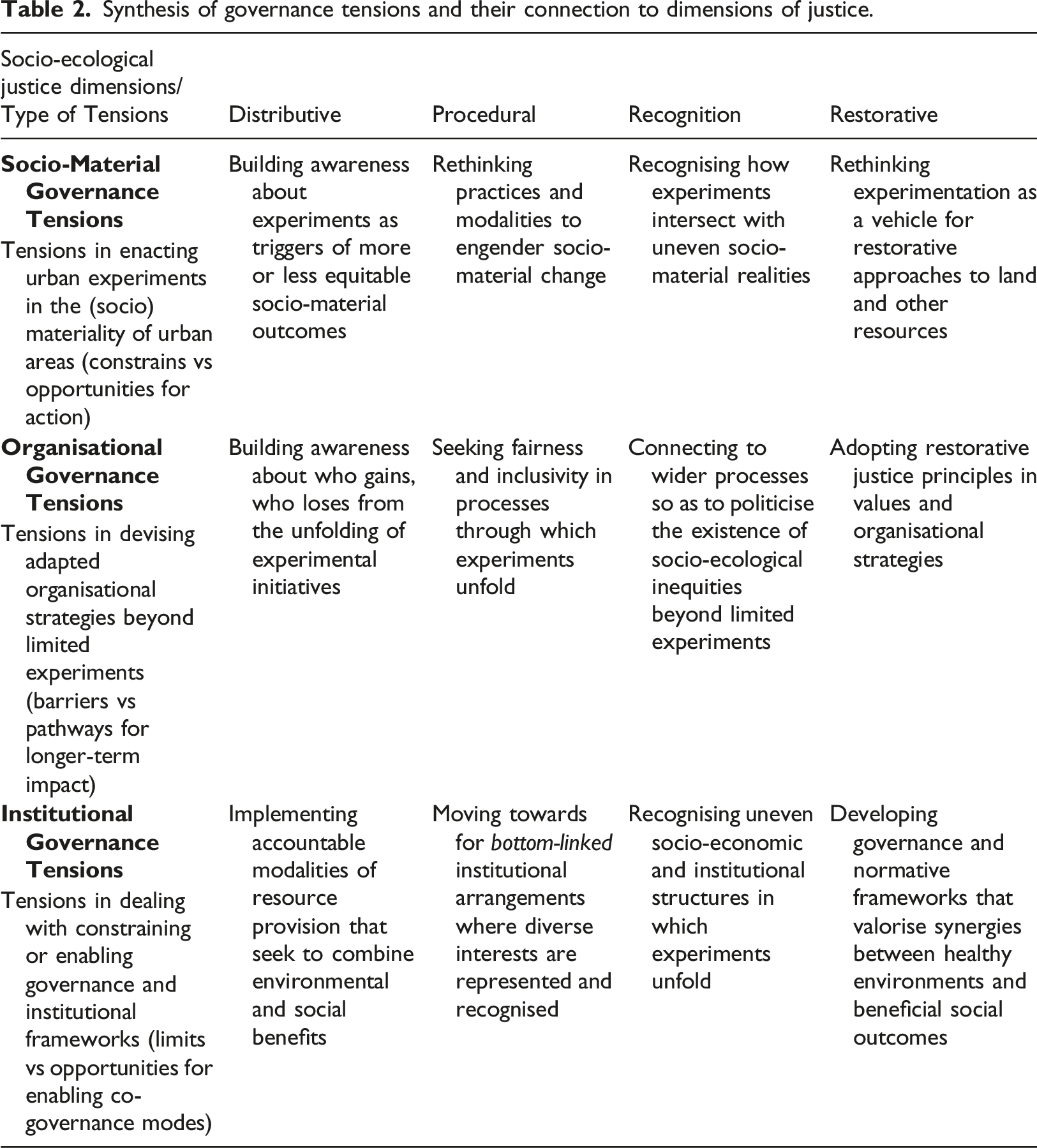
Synthesis of governance tensions and their connection to dimensions of justice.
A justice lens to organisational governance tensions
Organisational aspects of the tensions are very relevant in terms of justice, because bounded initiatives such as experiments can easily overlook issues of inclusivity and justice in processes and outcomes (Karvonen et al., 2014). In particular, pilot initiatives such as experiments or other co-production projects face structural limits to politicise issues of inclusivity and justice beyond their boundaries (Turnhout et al., 2020). In fact, while experiments function within their contained spaces, they risk to leave wider power structures unaltered. This realty can prevent “societal transformation because actors and interests outside project boundaries are not included or transformed” (Turnhout et al., 2020: p. 18). An illustrative example of how justice can be overlooked, also generating consequences that go beyond bounded projects, is provided by Bulkeley et al. (2015). Referring to the Berlin Solar Atlas experiment, the authors illustrate how this initiative aims at expanding the use of solar thermal and photovoltaic installations on rooftops, pushing owners and tenants to reduce their reliance on fossil fuels for energy provision. Yet, despite the intention to be universally applicable, the Solar Atlas fails to involve urban tenants, who lack the rights to claim for the use of solar and photovoltaic systems (Bulkeley et al., 2015).
Given this background, and considering the widespread adoption of experimentation as a way of diffusing alternative solutions to socio-ecological challenges, it is absolutely imperative that experiments workout ways to embrace relevant dimensions of justice in their organisational strategies (see also Table 2). This consideration invites to dig deeper into key values, motivations, and objectives, driving the agency and the organisational strategies of actors involved in experimental initiatives and beyond (Bulkeley and Castán Broto, 2014). There is scope for further inquiry about how, by going through organisational governance tensions, actors (can) become more aware about the existence of inequities and how experimental initiatives intersect with them (Long et al., 2020; Rice, 2014). Thus, as experiments unfold, promoting greater justice in processes and outcomes can become part of the core values and objectives. As a result, experimental initiatives can devise organisational strategies – such as partnerships, collaborative networks, joints projects, advocacy coalitions, and so on – and establish links with other actors in order to advance socio-ecological justice beyond experimental boundaries. Thus, despite their limited temporality and scope, experiments can connect to wider processes and work out ways to develop organisational structures that support social innovation and empower diverse communities to address local urban sustainability challenges, thus going in the direction of promoting greater justice (Ehnert, 2022).
Unplugging justice through institutional governance tensions
Embracing justice beyond punctual experiments also means understanding how experimentation can be an arena in which actors evaluate, put into question, and revise, existing institutional and normative frameworks affecting possibilities to advance justice (Evans et al., 2021; Turnhout et al., 2020, see also Table 2). In other words, there is scope to investigate how actors and organisations involved in experiments (and beyond) can activate political arenas where established institutional and normative apparatuses are politicised, thus disclosing new opportunities for expanding ecologically and socially beneficial initiatives (Fuenfschilling et al., 2019; Sierhuis et al., 2023). The literature offers several examples of experimental initiatives, such as Urban Living Laboratories or others, seeking to establish more circular and sustainable resource uses. Yet, opportunities to uptake these experiments and to monitor their ecological and social outcomes, are often constrained by disenabling institutional apparatuses and conservative political systems that do not reach further than single political mandates (Bulkeley, 2023).
These challenges are at the core of the dialectics of institutional governance tensions. While political and institutional structures can overlook aspects of justice, there is scope to investigate how institutional governance tensions can usher actors to become more reflexive about issues of justice (Manganelli, 2020). This reflexivity can lead to the development of more transparent and empowering institutional designs where needs for justice are represented. For instance, actors and coalitions within and beyond experiments can push for bottom-linked arrangements where diverse interests are represented and recognised (Eizaguirre et al., 2017; Moulaert et al., 2019). These arrangements can be accountable for the delivery of environmental stewardship, or compensation measures that tackle disadvantaged social groups; or the implementation of transparent and accountable modalities of energy and resource provision that seek to combine environmental benefits with the interests of disadvantaged communities (Rutherford, 2014). In short, institutional governance tensions can open up pathways to meet recognition and restorative justice in processes and outcomes. In summary, actors and organisations dealing with institutional governance tensions can aspire to scale up their agency, going in the direction of influencing dominant politico-institutional structures, or developing alternative arrangements, that go in the direction of a better account for social and ecological justice.
Conclusions
This paper has mobilised the notion of governance tensions and applied it to the governance complexities of urban climate experiments. The concept of governance tensions conveys a dynamic and socio-political understanding of the governance reality in which experiments navigate. Such a dynamic view highlights the compresence of constraints and barriers to transformative action on the one hand, but also of ways forward and opportunities to enlarge scopes of action and exercise transformative political agency, on the other (see section ‘Unraveling governance tensions’). Shedding light on three types of governance tensions has allowed to reinterpret and re-organise key sub-strands of debate on urban experimentation, developing such literature towards a clearer understanding of the tensions and their potentials for analyses and practices. In particular, the analysis of socio-material governance tensions allowed for a more careful scrutiny of how socio-material aspects interact with the transformative aspirations of urban experiments leading to different outcomes as experiments unfold and seek to carve out spaces of action. Organisational governance tensions shed better light on how actors are ushered to devise organisational strategies as experiments develop and seek to leave a legacy that goes beyond ephemeral initiatives. Institutional governance tensions illuminated the constraining or enabling role of political arenas and institutional structures in which experiments navigate.
The additional contribution of the paper was to bring on board debates on urban climate justice connecting insights from this literature to the transformative ambitions of urban climate experiments. In particular, the climate justice debate stresses the urgency to develop a socio-ecological justice lens that tackles different dimensions of justice, such as distributive, procedural, recognition and restorative justice (see section ‘Connecting governance tensions with socio-ecological justice’). Re-framed under this multi-dimensional justice perspective, governance tensions can be instrumental to make forms of inequities visible and, thus, to instigate questions of justice and normativity in the governing practices of experiments. Ultimately, the paper invites to reflect on how, by going through different tensions, actors can re-assess their practices and become reflective on issues of justice, envisioning opportunities to embed socio-ecological justice in transformative targets.
There are at least three ways in which the conceptual analysis carried out in this paper can be applied and developed. First, there is scope to explore how the intersection of justice and governance tensions unfolds in diverse contexts and across different types of urban climate experiments. For instance, the way in which socio-material governance tensions and related dimensions of justice are articulated is likely to vary between climate change experiments conducted in regions facing high levels of poverty and resource securitisation, such as cities in the Global South, and those situated in the Global North (Bulkeley and Castán Broto, 2014; Castán Broto et al., 2013). Furthermore, ways in which actors experience and negotiate specific socio-material governance tensions, such as fair access to land and distribution of resources, is likely to vary depending on the type of urban experiment, whether it involves, say, nature-based solutions, net-zero districts, or car-free neighbourhoods.
Second, more work can be done at the intersection of diverse types of governance tensions and their impact on justice. Empirical analyses could for instance explore how socio-material governance tensions contribute to reproduce particular injustices and what organisational governance strategies can be activated to tackle them. Relatedly, studies can interrogate what kind of socio-material consequences are provoked by the (lack of) upscaling of urban climate experiments within specific contexts. Do experiments trigger socio-ecologically unjust effects as they replicate and expand? Most of all, are actors aware about those tensions and prone to tackle them through context-specific strategies or tactics?
Third, further analyses can begin by identifying key contradictions between different dimensions of justice and examine their impact on the governance of urban experiments and beyond. For example, ecologically-driven experiments mainly focused on restorative justice – aimed primarily at repairing environmental inequities such as soil contamination, air pollution, and the like – may, for the sake of efficiency, overlook aspects of procedural justice. These contradictions can generate conflicts which, in turn, produce specific organisational and institutional governance tensions. This type of analysis can inform contemporary studies that look at the nexus of various understandings of justice (Anguelovski et al., 2020; Avelino et al., 2024). It sheds light on the challenges of integrating various dimensions of justice while also identifying opportunities to develop context-specific approaches that effectively recognise and address governance tensions as they arise.
Footnotes
Declaration of conflicting interests
The author(s) declared no potential conflicts of interest with respect to the research, authorship, and/or publication of this article.
Funding
The author(s) disclosed receipt of the following financial support for the research, authorship, and/or publication of this article: This work was supported by the Deutsche Forschungsgemeinschaft (DFG) under Grant number 445103843 – GRK 2725.
