




Abstract
Since the early 2000s, the two largest cities in Colombia have been lauded as success stories of urban transformation. However, there is a tension between urban transformation narratives disseminated in international media and political discourse, and the realities of ongoing violence and insecurity. Drawing on ethnographic research following creative arts projects, this article offers empirical detail on how people negotiate this tension in marginalised urban neighbourhoods, which are often the most affected by overlapping forms of violence while being key sites of transformation policies. Through in-depth interviews and participant observation in Bogotá and Medellín, we show the complexities of how grassroots creative projects both mobilise transformation politics and negotiate violence in everyday life. By focusing on the local scale, we consider both the important gains that have been made since urban transformation became a key tenet of local government policy, particularly around challenging stigma, and the challenges that local populations continue to face. Ultimately, we argue that the experiences of the creative organisations we speak to reflect the need to negotiate ongoing structural violence and fluctuating support from the state. In contrast to depoliticised transformation narratives, this has implications for understanding the state’s role in the reproduction of violence in everyday life and appreciating the limitations of aesthetic transformation in marginalised urban communities.
Introduction
As is common in cities with deep inequalities and high levels of rapid urbanisation around the world, Colombia’s cities are spatially segregated. Geographical divides separate the rich from the poor, and informal or marginalised neighbourhoods are marked in urban imaginaries as violent and ‘other’ to the more central-, middle- or upper-class areas. Since the late 1990s and early 2000s, though, a transformation narrative has shifted the representation, and experience, of living in Bogotá and Medellín. Within the global narrative of urban transformation, Colombia is often signalled as one of the main success stories. Its cities have received accolades and awards, with Medellín, for example, being named the Most Innovative City in 2013 and winning the Lee Kuan Yew World City prize in 2016, while Bogotá was awarded the Golden Lion for Cities at the Venice Biennale in 2006. For a time, the leaders of the cities’ urban transformation projects were invited speakers around the globe, sharing their expertise with governments and institutions hoping to set up similar projects. The narrative that Bogotá and Medellín were transformed from epicentres of drug-related violence, street crime and poverty to sites of cultural and technological innovation is still a favourite trope of news, culture and political media. Not only are these cities now presented as safer for visitors, but the visible outcomes of transformation policies, particularly those in public spaces, are part of the attractions on offer for tourism and business investment.
Inherent to the marginalised neighbourhoods of Colombia’s two largest cities is a complexity that stems from the contradictions of life within supposedly transformed sites. At once the recipients of highly publicised and lauded transformation policies, such neighbourhoods continue to negotiate ongoing violence and stigma. Our experiences of Ciudad Bolívar in Bogotá and Comuna 13 in Medellín, and the conversations we had within them, illustrate the complexity of the relationship between transformation and violence at the so-called margins of the cities. Despite widely publicised transformation projects, such as the library parks in Medellín or community arts projects in Bogotá, we were often warned away from these ‘dangerous’ areas, or at the very least cautiously advised to protect our belongings and keep an eye out for an unspecified danger. Entering these spaces, however, was not the unsettling experience that we had been warned about. Walking through the neighbourhoods we passed murals adorning the walls of the buildings, community gardens flourishing with flowers and vegetables, and met residents actively engaged in local community projects.
Creative projects were especially common, from breakdancing and graffiti workshops to circus classes, puppet making and painting. Encountering a sense of the urban everyday by participating in such events helped us to comprehend the complexity of these sites. It was easy to forget whilst wandering amidst the vibrant streets in such moments that these places had been, and at times still were, the sites of extreme violence. However, the warnings we had been issued indicated the symbolic placement of such neighbourhoods within persistently fragmented cities despite decades of transformation policy. More importantly, these contradictions were constantly negotiated by creative organisations and residents within these neighbourhoods, as they tried to find a balance between celebrating a positive cultural identity while ‘living alongside’ (Lizarazo 2018) the everyday violence that continues and is at risk of being obscured by the very same transformation policies that are so lauded in the press.
This article explores the tensions between ongoing violence and transformation narratives, focusing on the everyday experiences and activities of those who live with, and negotiate, urban violence as well as the government policies supposedly in place to tackle it. Two cultural projects in particular help to show how residents engage with the transformation narrative: Museo Libre in Ciudad Bolívar and Carnaval de la 13 in Comuna 13. While the focus here is on the muralism that emerged from Museo Libre and the carnival celebrations of Carnaval de la 13, the projects actually encompass an array of artistic and creative practices, from community muralism to parades, puppet-making, dance and theatre. The range is significant, as the politics embedded in these practices is often not related to the specific artform, but instead to the process of appropriating public space, engaging the community and performing a positive cultural identity linked to local demographics. They therefore represent the diversity of community organising and the multifaceted creative actions taking place in marginalised neighbourhoods in Colombia under the impetus of urban transformation. Through this range of actions, they challenge stigma and encourage the appropriation of public space to reconfigure spatial identities in the city and improve community cohesion. Acting at grassroots level, these cultural organisations encourage a re-thinking of the top-down transformation narratives that dominate social and political imaginaries of these cities and show the agency of local populations to appropriate state discourse and resources. As we show in this article, though, they still have to negotiate ongoing threats of violence from criminal actors and manage expectations of what these cultural projects are capable of changing in the face of embedded structural violence. Indeed, the ambiguous relationship that many of these projects have with the state reveal the precarity of government support and lead us to question the commitment of the state to real transformative change. This has implications for appreciating the depth of structural violence in marginalised urban communities and how aesthetics can both obscure and reveal the nuances of everyday life in contexts of violence.
Before turning to the creative organisations we worked with in Ciudad Bolívar and Comuna 13, we first offer a theoretical reflection on the relationship between violence and transformation, and situate the analysis of Ciudad Bolívar and Comuna 13 within Colombia’s broader urban transformation project. This is followed by an explanation of our methods and the benefits provided by an ethnographic approach to urban space to understand lived experiences in violent contexts. The two neighbourhoods studied here are particularly relevant as they have been sites of extreme violence and are still stigmatised in the urban imaginary but have also produced creative organisations working to change social expectations. Thus, the first section of the analysis focuses on the positivity expressed by Museo Libre and Carnaval de la 13 as a response to territorial stigma. The second section explores the politics of their actions in further depth, specifically as they relate to the appropriation of public space. The final section highlights the challenges the creative projects face as they negotiate expectations of their success amidst ongoing violence and deal with the shifting priorities of the local government. We conclude by reflecting on the problem with narratives of transformation and how they obscure the nuanced realities of living alongside violence.
Theorising violence and transformation in urban contexts
The Colombian case is notable for enacting a broad project of urban transformation against a complex background of overlapping violence and inequalities. As with many other Latin American cities, Bogotá and Medellín have been associated with high levels of violence related to criminal activity, including drug-related crimes, gang violence, street crime and the complicity of state and non-state armed actors in such violence (Koonings and Kruijt 2007). Sometimes termed ‘new violence’, these manifestations overlap with interpersonal conflict, social cleansing, account settling and politically motivated attacks, and are concomitant with democratic institutions and processes, at least at face value (Koonings and Kruijt 2007; Arias and Goldstein 2010, Wilding 2010). As Wilding persuasively argues, though, the ‘newness’ of such violence can be questioned as they intersect with ongoing structural inequalities that reinforce rather than create the violence that is embedded in everyday life for particularly vulnerable sectors of society (Wilding 2010: 725). Indeed, structural violence is key to understanding the complexities of different expressions of violence as they manifest in urban centres in everyday life, in Colombia and beyond. For Wilding, focusing on structural violence allows for a more complex understanding of the continuation of violence and inequality that might explain the emergence of particular forms of criminal activity, such as gang violence, while also drawing attention to the violence that persists in social structures, such as gendered inequalities and the diverse ways in which they intersect with more ‘obvious’ or public manifestations of urban violence (Wilding 2010: 726). The notion of a ‘continuum’ of violence is useful here as it draws attention to the relationship between structural, direct and cultural violence, as they emerge in everyday life, at times of conflict, in interpersonal relations and through institutions, as well as the ways in which they are normalised (Kelly 1987; Galtung 1990; Scheper-Hughes and Bourgois 2004). In urban contexts, this entails a recognition that different sectors of society enjoy different opportunities in access to employment, healthcare, welfare and cultural provision that might be offered by the city. They may have differentiated access to state resources and protection, as well as facing different levels of potential violence in public and private domains. In relation to Bogotá and Medellín, the continuum of violence also helps to recognise that some sectors of society are more vulnerable to such overlapping inequalities and more likely to be exposed to the forms of urban violence described above, which is particularly true of those on the urban margins (Auyero et al., 2015).
In the context of such a range of deeply rooted forms of violence, the concept of transformation must be equally broad and wide-reaching if it is to achieve the stated aim of ameliorating urban conditions of violence. This has parallels in feminist literature on gender violence, where the idea of transformation and transformative justice has been used to signal the need for structural changes to society in order to effectively (rather than superficially) address diverse forms of harm (Boesten and Wilding 2015). In peace research, too, Galtung’s formulation of the relationship between direct forms of harm, structural inequalities embedded in social structures and the cultural mechanisms that normalise violence has profound implications for the possibility of imagining a transformed society where ‘peace is absence of violence’ (Galtung 1969: 167). Using the specific dynamics of urban space to analyse the socio-spatial impact of capitalism’s fundamental inequalities, Harvey and Lefebvre have been influential in theorising the transformation of the urban (Lefebvre 1996; Harvey 2008, 2012). Lefebvre’s famous political and theoretical project of the right to the city encourages an urban revolution, where the demands of capital are replaced by direct participation and representation of the working classes in the decision-making processes around how urban space (and therefore urban society) is managed. Underpinning this is a recognition of the depth of structural inequality in capitalist society and the Marxist imperative that human beings need access to a full range of activity in order to reach their potential, including opportunities for play and creativity as well as work, for security and unpredictable openings, for exchange and encounter as well as privacy (Lefebvre 1996: 145). In contexts of structural inequalities and deep-rooted violence, these opportunities are not available to all. Not only are most people not directly involved in the decision-making processes that affect their environments, but the threat of violence leads to fear and anxiety, the pressures of low-paid work and infrastructural deficiencies lead to reduced hours for leisure and the realities of state violence and corruption lead to disenchantment in political participation. Thus, the transformative potential of the right to the city is linked inextricably to the manifestations of urban violence and its impact on people’s everyday life. Notably, a key part of the success of the right to the city is the appropriation of urban space by those who inhabit the city, moving beyond Lefebvre’s focus on the working classes to extend to those who are marginalised and disenfranchised in diverse ways (Purcell 2002: 106). As a concept and rallying cry for activists, then, the right to the city has served to direct political action and assert the rights of vulnerable sectors of society and those at risk of violence, from activism around the rights of homeless people to securing women’s safe access to public space. An important question to ask, however, is how these theoretical approaches to transformation relate to the more policy-oriented discourses of urban transformation across the globe.
Despite the positivity of urban transformation narratives and the celebration of cities such as Bogotá and Medellín, as described in the opening to this article, the specific policies of urban transformation projects have come under scrutiny, not least because of the association with neoliberal urban governance. Within urban planning, transformation largely refers to sites where development and regeneration models have been implemented in urban centres with the aim of social change (Brand 2013; Garcia Ferrari, Smith et al., 2018; Bottero et al., 2020). Such policies often combine physical changes in the built environment with broader social and cultural provisions ‘to foster social cohesion’ (Degen and García 2012: 1023). These include housing developments, environmentally friendly schemes such as greater cycling provisions, improved mobility through public transport infrastructure or the ‘renovation’ of urban public spaces, including public art projects (Golub et al., 2016; Kuyucu and Ünsal 2010; Schacter 2014; Hollands 2019). Although the beneficiaries are supposed to be the greater urban public, many authors argue that such transformation projects also lead to gentrification practices that displace the more economically vulnerable in favour of the urban middle classes, either through raised housing prices or the ‘clearing’ of public spaces of ‘undesirables’ in the name of improved security (Delgado 2012). Often these are not incidental but rather the consequences of what Cairns et al. (2022) describe as the overlapping imaginaries behind narratives of urban transformation, which represent significantly different visions of the transformed society and who it will benefit. At the core of such complaints is a critique of neoliberal urban governance. This takes shape through market-driven housing and creative policies and subsequent gentrification practices, as described above, but also through the displacement of responsibility for key resource provision from the state to private companies or even to residents themselves (Sletto and Nygren 2016).
Another facet of neoliberal urban governance is the elision of context-specific conditions. The notion of a model in the discourse of urban transformation suggests that successes in each city are transferable to other contexts (Pérez Fernández 2010), and it is reinforced both by the cities’ own narratives and external actors, such as the international press (Duque Franco and Ortiz 2020). They each have a role in perpetuating transformation myths, including the idea that the policies have indeed effected change, that such change is always for good and that the benefactors are urban inhabitants. The problem with the ‘model’ concept is that it implies that the process of change is complete and there is a ‘one-size fits all’ prototype that can merely be applied to different contexts. Urban transformation within a neoliberal framework, then, becomes part of an ‘anti-politics machine’ where decisions made about changes to urban spaces are depoliticised and discursively detached from local state dynamics through technocratic language (Ferguson 1990). In fact, the specific contexts in which transformation policies are implemented inform their impact, including the dynamics of the urban area as well as the priorities of the governments and agencies implementing them (Pérez Fernández 2010). Instead of dismissing the notion of urban transformation altogether, though, it is worth paying attention to changes in specific urban environments and exploring their impact on the lived experiences within those places. Indeed, Zeiderman (2018) argues that it is equally, if not more, important to pay attention to the social lives of our key concepts and the political consequences of their articulation, as it is to worry about their definitions.
Turning to Bogotá and Medellín, then, it is important to recognise that significant changes have occurred under the impetus for urban transformation, while remaining attentive to criticisms made of it. While the specific policies of successive mayors in each city have varied, revealing their own priorities and alliances, there are some general trends that characterise the Colombian approach to urban transformation and recognise both the depth of violence in the city and the need for a broad concept of transformation. Thus, there has been an increased emphasis on a social agenda, engaging with questions of inclusion and accessibility as city governments have attempted to understand and address complex challenges. Planning has become more concerned with the heterogeneity of the city, recognising that different social groups (along the intersections of class, ethnicity, gender and sexuality amongst other factors) have very different experiences of the city and that previous interactions between people were often fraught and needed to be improved. In both Bogotá and Medellín there has been a strong emphasis on integration, public space and convivencia (harmonious coexistence) as key components of transformation policies that aim to reduce levels of violence. Antanas Mockus represents the starting point for this approach to urban governance, implementing various projects in Bogotá in the late 1990s and early 2000s to enhance ‘cultura ciudadana’ (citizen culture), essentially changing the behaviour of unruly citizens and encouraging the development of a stronger sense of belonging in the city. Described by Berney (2011) as ‘pedagogical urbanism’, the project included a strong performative element, from mimes mocking bad behaviour at traffic lights to a gun amnesty and symbolic destruction of the firearms collected (Mockus 2012). Despite the paternalistic approach, the cultura ciudadana agenda was successful and inspired similar projects in both Bogotá and Medellín. The idea behind them has been that changing the behaviour of citizens in public space, and their experiences of public space, can lead to a shift in the urban imaginary and thereby address some of the deep-rooted problems of alienation, social segregation and aggression in the street, which would then have a wider impact on social relations.
Recognising the imbrication of structural, direct and cultural violence, local government policies have also engaged with structural facets of urban transformation. Alongside the attempts to transform the culture of urban life in both cities, numerous social and infrastructural projects emerged under the banner of urban transformation. Improvements in public transport, for example, have been key. In Bogotá, the Transmilenio bus system was designed to connect the sprawling neighbourhoods to the city centre, although it is only recently that some of the most marginalised neighbourhoods have been provided access via cable cars connecting to the main stations. New plans for a metro system have consistently been a topic of debate during local elections and almost every candidate promises its forthcoming construction. In Medellín, the public transport system has been more successful, as, under mayor Alonso Salazar, cable cars and outdoor escalators connected marginalised neighbourhoods to the city centre and encouraged other urban residents to access these neighbourhoods. A number of social aims, too, have been at the core of the two cities’ transformation project. In Bogotá, under Lucho Garzón in the early 2000s and Gustavo Petro between 2012–2015, policies focused on symbolically reaching out to the more excluded in society. This took place through participatory council meetings in the south of the city, social welfare policies addressing poverty, hunger and drug rehabilitation, conservation of wetlands in the city, and cultural projects aimed at promoting ‘nuevas ciudadanías’ (new citizenships) through appeals to youth, LGBTQ+, Afro-Colombian and Indigenous communities. Medellín’s own brand of ‘social urbanism’ emphasised inclusive and active citizenship, including the introduction of (limited) participatory budgeting, and gender mainstreaming across government departments and education. Thus, in principle, there has been a recognition of the need for wide-reaching transformation and participatory decision-making to address structural issues of violence, particularly around gender and social inclusion.
In relation to violence, radical improvements have been celebrated in both cities, with reductions in homicide rates being the most common indicator of change, as they were seen to decline at a drastic rate, even in comparison with other areas of the nation (Gutiérrez Sanín, Pinto et al., 2009; Garcia Ferrari, Smith et al., 2018). Reductions in street crime and increased access to public space are also important facets of the transformation of the cities, particularly in their urban centres. However, despite the significant changes in both Bogotá and Medellín since the 1990s, there are also numerous critical engagements with their trajectories that have illuminated a lack of sustainability (Gutiérrez Sanín, Pinto et al., 2009; Garzon-Ramirez 2018). Continuing spatial divides and imbalances between rich and poor, ongoing gang presence and related insecurities including extortion, forced displacement and disappearances are highlighted to indicate the shortfalls of the urban transformations, and the tendency for such changes to primarily benefit the already privileged (Berney 2011; Abello Colak and Pearce 2015; Sotomayor 2017). Others have argued that transformation was stymied by corruption and ineffective governance (Gilbert 2015). A more fundamental critique of the transformation narrative comes from Zeiderman, who argues that the ‘uplifting tale of nationwide urban regeneration’ actively excludes and occludes the inconvenient truths that challenge Colombia’s reputation of ‘enlightened urban innovation’ (Zeiderman 2018: 4).
Rather than assessing the overall transformations of these cities, this article understands urban change as a complex series of successes and failures. Indeed, cities are dynamic and constantly in flux, albeit within particular and often largely rigid social conditions; the social fabric is always unfolding so a simple linear progression of transformation is unrealistic (Massey 2005; Sassen 2013). Furthermore, the background of violence in Colombia does not mean that all urban residents have been affected by violence in the same way nor to the same extent and so measuring the reduction of violence is complicated. Urban landscapes are divided along socio-economic lines: the ‘social geography of the city itself exacerbates the inequality and exclusion to be found there’ (Maclean 2014: 16). Close attention is therefore required to pay attention to who violence continues to affect, how and in which spaces. The urban margins are particularly beset by multiple forms of violence and the state has been a key component of this reality. As Auyero and Berti note, this is not solely due to state absence but rather to the ‘intermittent, selective, and contradictory’ governance of marginalised urban areas across Latin America (2015: 109). At the same time, there has been a recent focus on urban margins not just as sites of violence but as sites of creativity. Geraghty and Massidda (2019: 23), for example, argue that there is an ‘unyielding faith in the creative potential of the urban margins’, referring to the many urban planning innovations, cultural projects and social programmes in such areas across Latin America and the different scales at which they are designed and implemented. In our research, this dynamic has informed our insistence on recognising the positive impact of transformation politics and the article focuses on the lived experiences of ‘transformation’ in marginalised neighbourhoods to show how people negotiate and collaborate with policy shifts to pursue their own projects aimed at challenging violence. Nevertheless, the need for transformative change to address the reproduction of various forms of violence and its embeddedness in the structures of everyday life remain, as becomes clear by focusing on the limitations of aesthetic projects.
Methods
Our aim was to understand how people at a local level in Bogotá and Medellín interpret the role of aesthetics and creative practices in contexts of violence and against a backdrop of urban transformation narratives and policy. In order to conduct a study of lived experience, we had to grapple with the complexity of the city and the challenges that not just dynamism, but size, density and diversity pose to ethnographic approaches (Duneier et al., 2014). Rather than situate ourselves exclusively in marginalised neighbourhoods, we spent time travelling through both cities between 2015 and 2017, getting to know their different neighbourhoods and talking to people about how they imagined their local communities and the city as a whole. This not only helped to get a sense of the diverse dynamics of the city and its different communities, but also provided an insight into the broader imaginaries of urban space and the aesthetics of different neighbourhoods.
This was particularly important for contextualising our findings from Comuna 13 and Ciudad Bolívar, as their symbolic status as places of violence and transformation informed our experiences in those places and the ways in which local people talked about their neighbourhoods. Ciudad Bolívar and Comuna 13 are two of the many vulnerable and marginalised neighbourhoods where multiple forms of violence compound, including that which is related to the armed conflict. San-Javier, or Comuna 13 as it is more commonly known, is on the western outskirts of Medellín, built up via informal settlements on the slopes, some of which face the environmental risk of landslides. There is limited access to the city centre as, until recently, there has been a lack of investment in transport in the area and precarious living conditions include a lack of stable employment opportunities. With the historic absence of the state, the area has been the site of multiple armed actors trying to control the neighbourhoods, including paramilitary and guerrilla groups. At the same time, Comuna 13 is one of the most lauded sites of Medellín’s urban transformation initiative and has received increased attention from the government and other institutions. Infrastructural projects, including cable cars and outdoor escalators, aim to improve access to and from the city centre, and a number of cultural centres, libraries and community organisations have been built or received increased funding to improve everyday life in the area and attract both local and international visitors.
These contradictions are mirrored in Ciudad Bolívar, although to a lesser extent than in Medellín as the urban transformation project has focused primarily on city centre initiatives. It lies in the south of Bogotá and has also suffered from its own forms of armed group activity (both guerrillas and paramilitary, as well as criminal networks) and the lack of state presence. As with Comuna 13, many of the neighbourhoods were built up by migrants from around the country, forcibly displaced through the armed conflict or other forms of violence, including structural poverty and discrimination. Some of the neighbourhoods still lack access to basic services and roads and, again, are at risk of environmental damage such as landslides and pollution from the nearby extractive industries of CEMEX and Holcim. Nevertheless, many neighbourhoods in the area have benefitted from the local government’s social agendas, with increased access to healthcare, education and cultural provisions. Urban infrastructure improvements have been seen along Transmilenio and more recent cable car routes, although they are also accused of driving up the rent and the cost of public services. Likewise, there have been a number of initiatives designed to support cultural and community projects in the area and the long history of local community organising means that existing groups have been able to capitalise on some of the urban transformation policies in the city (Peña 2014). A poignant reminder of both the structural inequality in the area and the strength of community organising came during the COVID-19 pandemic. The precarious employment of many people meant that they didn’t have any savings to rely on during lockdowns. In the face of inadequate government provisions, red flags marked the houses of those suffering most from hunger and they relied on community support to keep them alive.
To try and understand the role of creativity against this complex background of violence and inequality, our methods included participant observation, in-depth interviews and a continued engagement with the cultural organisations through social media. We spent time in the neighbourhoods both during and outside of the cultural events we describe here, to understand the dynamics between people, the way people moved through space and how they interacted during workshops and festivals. However, the cultural events were key moments for understanding where violence and transformation intersected, as following the organisers while they set up and ran the events revealed moments where they had to negotiate threats and manage expectations of the activities. Given the centrality of aesthetics to the cultural organisations, taking photos during the events and analysing the visual output of the projects allowed us to explore the kinds of topics that were being represented, either on the walls in the murals or through the costumes, dances and music of the carnival. The insights that we gathered were compared to the responses from interviews, at times corroborating our ‘outsider’ interpretations of the dynamics at play and at others showing the discrepancies between what we observed and the narratives of our participants, as is common to ethnographic methodologies. Nevertheless, interviewing organisers of the events provided a crucial space to explore their motivations and hopes for the activities, as well as explaining in more detail the challenges that they face and adding depth to our observations of their actions. Additional interviews on the street provided an opportunity to gauge how people living in the neighbourhoods perceived the area around them, including the aesthetics of the neighbourhoods, as well as broader urban imaginaries of violence in the city.
Notably, it was by engaging with people directly and expressing our interest in a rounded and more complex picture of these neighbourhoods that we tried to avoid the justifiable suspicion of researchers briefly visiting such areas to produce either a romanticised report of the supposed transformation of the cities, or a crude retelling of crime, violence and poverty. Such an approach risks reproducing harmful territorial stigma and fails to consider the complexities of living alongside violence, whereby survival is about negotiation rather than actively opposing or resisting violence (Alape 2006; Lizarazo 2018). While there are always limits to how well an ethnographer can understand the everyday dynamics of a particular place that they are not deeply rooted to, we hope to show that close dialogue with participants can fill those gaps. Our interest in ethnographic practice is inspired by protagonist-driven ethnography and throughout our research process we have tried to discuss our findings with participants rather than merely observing and then writing about them (Cobb and Hoang 2015). Thus, in our analysis we focus on the perspectives of the community in interpreting the role of aesthetics and creativity, including local inhabitants and the organisers of the projects. This approach provides a greater understanding of everyday life in these areas and, particularly, the complexity that they felt around negotiating violence and stigma. It also recognises that the changes that have happened have not been solely because of the local government. Rather, there have been many community networks and groups working in these areas to try and improve the situation and tackle various issues.
De-stigmatising Ciudad Bolívar and Comuna 13
Museo Libre, in Ciudad Bolívar, and Carnaval de la 13, in Comuna 13, are independently led cultural projects that have benefitted from increased funding through state-led transformation policies. Museo Libre has been transforming a number of neighbourhoods in Ciudad Bolívar into an open-air urban art gallery since 2013, inviting graffiti and street artists from around the city (and further afield, when they can) to come and decorate the houses and buildings of the communities in La Esmeralda, Vista Hermosa, Nutivara, Nueva Colombia, Manitas, Villa Gloria and Juan Pablo II. Organised by the street art collective, SURVAMOS, the festival has adapted and diversified over the years, evolving, as they put it, ‘from being an urban art and muralism project to an open community school, gradually implementing […] circus-performance, tours of the neighbourhoods, urban community gardens and seed-exchanges’ (SURVAMOS 2021). In Comuna 13, the Carnaval de la 13 festival has been running since 2007 and is organised by Corporación Cultural Recreando, a local arts NGO that has a closer relationship with the government and receives funding from them for their community projects. In the earliest years of the carnival, though, the organisation and artists were still negotiating a great deal of instability in the area, with Comuna 13 known primarily for extremely high levels of violence until the mid-2010s. As such, the emphasis of the carnival came from the community’s own drive to overcome stigma and violence, later combining with and capitalising on greater changes in the neighbourhood itself and the investments from the local government.
The two cultural events are notable because they mobilise the idea of transformation, particularly seeking to present a more positive image of the neighbourhoods, and they highlight the potential of art and culture to do so. In both cases the focus surrounding the events is on joy and celebration, with very little mention of violence. Such an aim was palpable during the 2015 version of Museo Libre. The buzz of a festival was in the air and the locals whose houses and businesses had been painted waited anxiously for their artists to turn up and get working, while encouraging others to sign up to the project as well. ‘Where’s the Mexican?’ the local shop owner called out each time the organisers passed that day, ‘he’s coming, he’s coming’, the guys from SURVAMOS assured him. At one house that they were hoping to sign up, a young woman answered the door and considered the proposal carefully. Very carefully. She looked at the paperwork explaining the project. She looked at the photographs from previous years. Eventually she seemed to agree but was concerned about what would be painted on her walls. It’s up to her and the artist to come to an agreement was the answer. What she didn’t want was anything with a ‘tema de violencia’ (theme of violence). As the murals took shape and took their place alongside the artwork from previous years, it became clear that there was a noticeable absence of temas de violencia, especially compared to the graffiti and street art in the city centre that frequently referenced the armed conflict, amongst other realities of violence. In Ciudad Bolívar, though, the shop owner eventually received his artist, who spent the day painting a beautiful bird on the outside wall of the establishment. Magical scenes started to adorn the walls of people’s houses; fantastical images of humans, animals and mythological creatures, enacting a fusion of the natural world with the built environment (see Image 1). Elaborate throw-ups and pieces of graffiti writing were situated alongside images of dogs, people and birds, against brightly coloured backgrounds and abstract patterns. Against this backdrop, people hung out, talking to the artists or bringing them food and something to drink, while children played in the street. Graffiti artwork by Ambs depicting a mermaid on the front of a house in Ciudad Bolívar. Photo by Alba Griffin.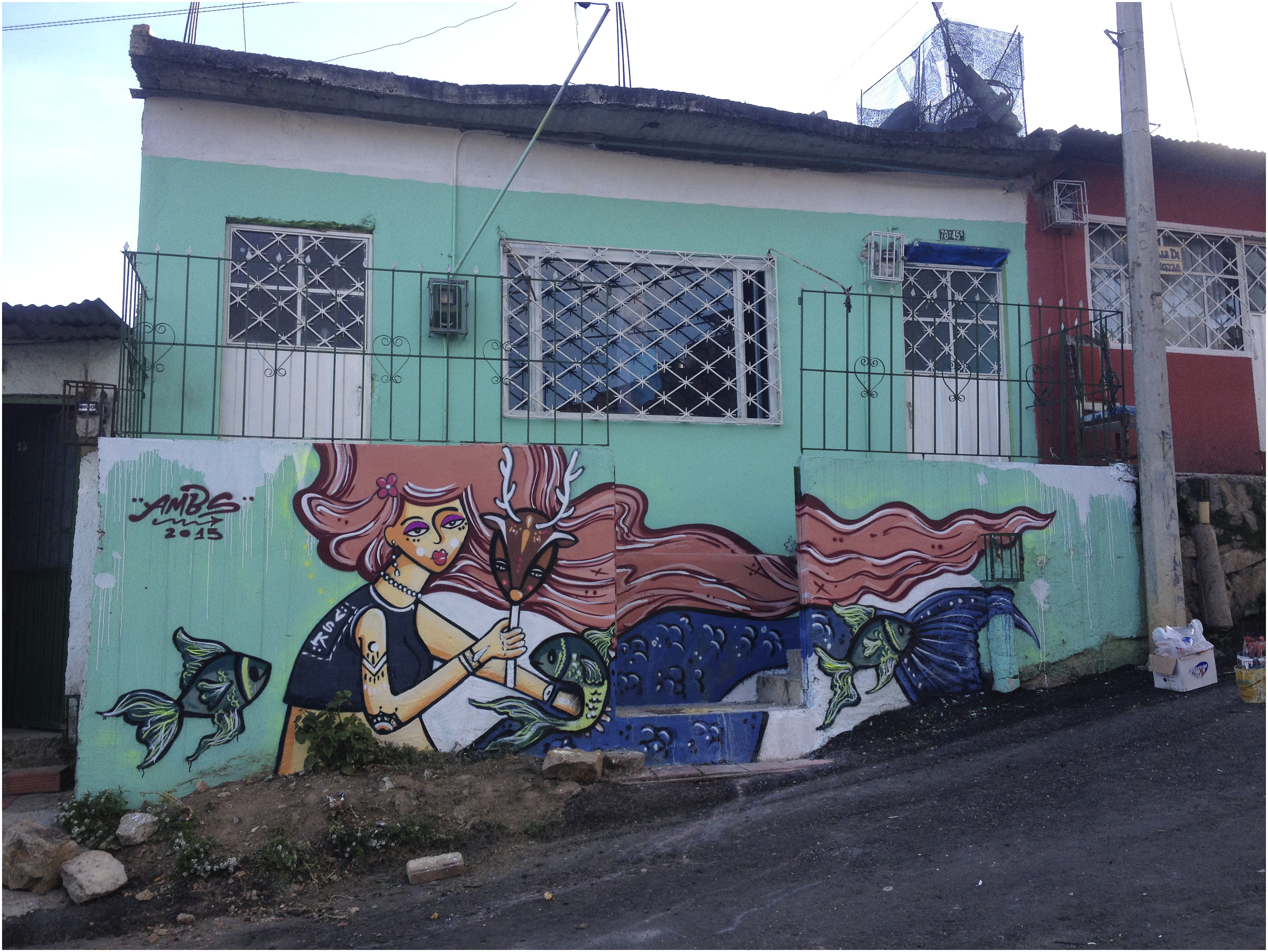
A similar scene took place in Comuna 13 for the Carnaval. Following events over 10 days and in various locations across the neighbourhood, the celebrations culminated in a parade on 29 October 2017 with a range of dance, theatre, circus, and music. On a main thoroughfare through the neighbourhoods, the first performers emerged on the brow of the hill, holding up a huge banner printed with “Carnaval de la 13” and wearing huge smiles on their brightly painted faces. In a procession that toured around the Comuna, over thirty groups joyfully paraded through the streets, cheered on by locals out to watch the spectacle (see Image 2). Notably, the procession displayed an array of colourful costumes, music, and dancing in order to celebrate the diversity and creativity of the neighbourhood. Performers represented a range of ages, ethnicities, social backgrounds and cultural traditions, including clowning, traditional Afro-Caribbean dance, indigenous clothing, puppetry and marching bands. A group of performers parading down a central road in Comuna 13 in bright costumes and walking on stilts. Photo by Alexandra Young.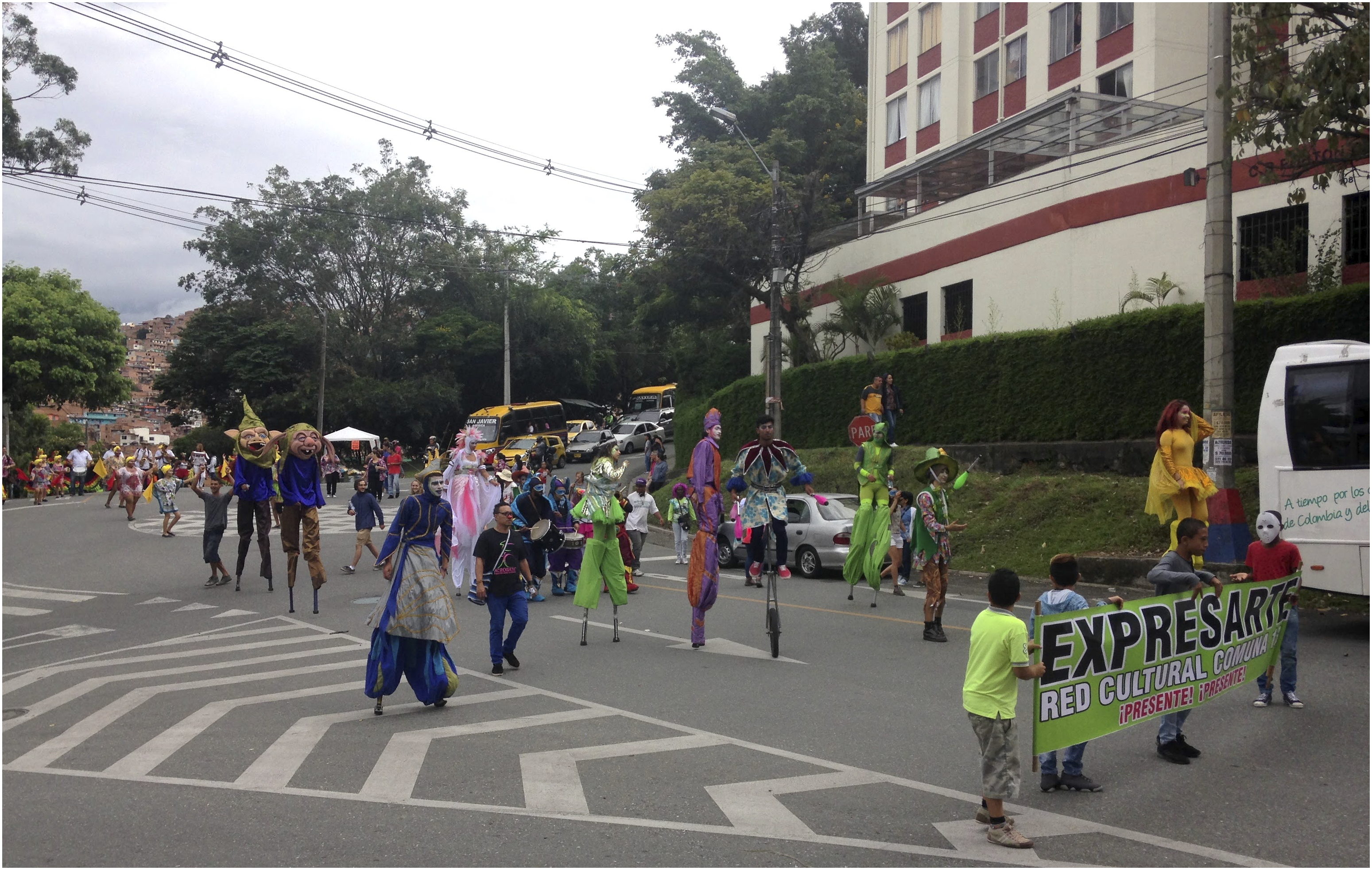
The absence of violence in these two cases reflects the desire to move away from the association with violence, which is also embedded within transformation narratives. In order to reassure the neighbour wary of ‘temas de violencia’, the artists from SURVAMOS explained that their aim was to celebrate the neighbourhood and all that is good about it, not reinforce its negative image. The carnival, too, explicitly contests Comuna 13's association with violence. It encapsulates a rejection of the narrative of violence and danger, instead emphasising the creativity, joy and vitality of the neighbourhood and its residents through the visual alteration of the landscape and the celebration of diversity. Indeed, in both cases there are frequent references to diversity as a positive attribute. In the imagery of the carnival and the street art, for example, the beauty of the natural world is embraced, referencing the fact that the local communities in these areas are formed from rural to urban migration, including relatively recent arrivals from Colombia’s diverse rural landscapes. Similarly, there is a celebration of Afro-Colombian and indigenous traditions in the dance and music presented at the events, which notably emphasises that these identities contribute positively to the urban landscape, rather than merely representing marginalised populations marked by violence, crime and poverty. One of the organisers of the carnival represents the broader imperative of challenging imaginaries of violence and reveals a shared wariness of stigmatising associations when he explains that ‘a positive aspect [of Comuna 13] is the richness of the multiculturality…. There are such interesting processes, community initiatives, art, music, expressions of dance, theatre, rock, hip-hop… People here don’t like to speak of pain. They don’t want to speak of violence… They want to show other things’. The emphasis upon creativity and richness therefore emerges as an organic collective desire of the neighbourhood, specifically a multicultural and multidimensional neighbourhood that has more to show than the singular association of violence with which it has traditionally been associated.
To contextualise the positivity running through these projects, it is important to consider the intersection between urban violence and territorial stigma. These are both areas that can be described as vulnerable or marginal, which is not to imply that they are somehow separate to the city ‘centre’ or that they are not strategic or integral to the city. Rather, it denotes the ways in which they have been affected by various forms of inequality: materially, socially and symbolically (Geraghty and Massidda 2019). As Auyero et al. insist, to analyse violence at the urban margins is not to draw a necessary line between poverty, racial/ethnic minorities and the presence of violence; instead, it is vital to recognise the economic and political factors that ‘produce the urban margins and foster the violence that pervades them’ (2015: 2–3). Nevertheless, the social spatialization of Bogotá and Medellín has typically manifested itself in the identification of marginalised neighbourhoods in each city as being inherently violent, and Ciudad Bolívar and Comuna 13 hold a mythic status as notorious sites of violence. Geographies of urban space, as often emphasised in Latin American cities, are significant markers of their fragmentations and divisions; rapid urbanisation, displacement, and vast inequalities have led to exclusionary cities, defined by inequality, informality and violence (Koonings and Kruijt 2007, 2009). Alongside material and social forms of marginality, the symbolic dimension means that these neighbourhoods have traditionally figured in urban imaginaries as ‘territories of fear’ (‘territorios del miedo’). Residents have been stigmatised not only as poor, but as uncivilised, immoral, dangerous and, ultimately, ‘disposable’ (Alape 2006). This has led to a form of socialised spatial segregation reproduced in urban imaginaries, as people in other parts of the city avoid going to the areas at all costs: common sayings include ‘the only law in Ciudad Bolívar is the law of gravity’ and we repeatedly came across excuses offered by people for not knowing such areas, including media coverage that seems to daily report news stories of violence in the areas. While people may know that the bad things you hear about marginalised neighbourhoods don’t necessarily reflect everything, the myths are enough to discourage them from going. In the prestigious and centrally located Universidad de los Andes in Bogotá, for example, students revealed the ambiguous but performative power of such myths: ‘You have no reason to go and check, once they’ve said it, why would you go?’, ‘Why expose yourself?’, ‘It’s more of an urban myth', I would say. You know what they say about over there… right? And that’s it, finished. The place is vetoed, a no-go area, you’re never going to go.’
Significantly, the imagination of violence is influenced not necessarily by experience but by stories of past events, news reports, rumours and other collective representations, which consequently inform everyday spatial practices, including tactics designed to avoid certain spaces (Ochs 2013). Furthermore, the process of imagining places through narratives of violence extends to the people in them and contributes to assumptions about the violence of the ‘Other’ (Springer 2011: 94). Thus, being associated with working-class barrios becomes a powerful territorial stigma, or a ‘taint of place’ that compounds structural inequalities related to, for example, gender, wealth, age or race (Wacquant 2008; López Castañeda and Myrttinen 2014; Viveros-Vigoya 2016; Sotomayor 2017; Baird 2018). Within the multiple strands that comprise the overall project of urban transformation, the organisers behind Museo Libre and the Carnaval de la 13 are particularly focused on inverting the territorial stigma that is attached to their communities. In both Comuna 13 and Ciudad Bolívar, territorial stigma takes the form of a singular account of danger, denying the diversity of life experiences within the communities. In Comuna 13, the impact of such stigma can be felt in the way people talk about space in the neighbourhood. Public spaces in particular have been overwhelmingly associated with insecurity and violence, and even residents would pass through with caution and fear. Moreover, the stigma of violence attached to Comuna 13 was widespread throughout the city and beyond, and residents explained that they had often felt the need to hide their addresses from colleagues and friends so as not to be associated with the violence of the area. The same story is true of Ciudad Bolívar, where people complained that the neighbourhood shouldn’t be labelled as especially violent or insecure because ‘good people also live there, and they are honest, hardworking people’. They said that it was stereotyped purely for being in the south, and one woman laughed that ‘they think we’re so bad’. They argue that the violence associated with them is based on a misperception, or at least one that is not the whole truth; according to this logic, there may be violence and street crime, but that is the same everywhere.
Part of the challenge in transforming urban space, then, is about transforming the way that spaces, and the people within them, are perceived. Within this context, the focus on joy and positivity in the cultural activities of the graffiti festival and the carnival serve multiple purposes: to persuade people from across the city that these neighbourhoods have changed and are worth getting to know, to provide the local communities with an output for their cultural identities that goes beyond fear and victimisation, and to justify the state’s investment in these areas, showing that urban transformation benefits the city.
Creative appropriations of public space
The events described above support the idea of transformation in that they insist on moving beyond violence, on focusing on the positive characteristics of these urban spaces. However, by listening to people and paying close attention to the local scale of these activities, you also get an insight into why and how these activities work to transform spaces. There is more to it than claiming that transformation has happened. The process is significant, particularly the appropriation of public space.
In Medellín, the carnival’s website, for instance, states that ‘the collective action of the cultural and artistic organisations breaks the invisible barriers that exist in the neighbourhoods, barriers imposed by the armed groups’. The route taken through the neighbourhood was intentionally designed to use roads and paths that had been particularly known for violence, crossing several fronteras invisibles (invisible borders) between rival armed groups. These routes had been off-limits or severely restricted for inhabitants for many years; even for those living there, traversing their own neighbourhood was perceived to be dangerous. Thus, using the routes for the parade was a way of consciously reclaiming them, and the carnival aimed to challenge violence by bringing the neighbourhood’s public space back into public ownership. Indeed, the performative component of such actions and its intended reach is clear in the statement of one of the members of the organising committee that the ‘recognition of the strength of community organising here [in Comuna 13] spreads far beyond the Comuna’. While the neighbourhood now generally enjoys improved security and stability, which has allowed the parade to expand, this has been achieved not only through government interventions, but also through the actions of the grassroots movements who have consistently challenged and reclaimed these kinds of spaces.
That the Carnaval de la 13 and Museo Libre both re-purpose public space and reclaim it for non-violence is significant. Public space is frequently considered to be an acutely political space, dynamic and participatory, holding political potential and encompassing multiple dimensions that shape political and civic possibilities (Amin 2015). Notably, its political potential resides in the fact that it is frequently a site of collectivity, where different publics can congregate, interact with one another, or use space to express their cultural identities (Iveson 2007). Thus, Sassen highlights that the ‘city, and especially the street, is a space where the powerless can make history. Becoming present, visible, to each other can alter the character of powerlessness’ (2013: 213). The cultural activities in Ciudad Bolívar and Comuna 13 are not making overtly political statements, the possible reasons for which we discuss in the following section. Nevertheless, both the Carnaval de la 13 and Museo Libre can be seen to appropriate public space in a political sense to the extent that they shift the social interactions within, and forms of engagement with, the neighbourhoods. Indeed, part of the aim behind Museo Libre is to encourage forms of engagement between people and the spaces around them. For one of the members of SURVAMOS, Museo Libre should be framed through their intention to ‘promot[e] the construction of a new imaginary of the territory’, arguing that graffiti and street art can provide the means to foster encounters both with and within the space. The desire stems from personal experience; he explained that it was through graffiti and street art that he began to explore Ciudad Bolívar more, having previously only travelled between school and home because he had internalised the idea that he lived in a dangerous area. Thus, their motivation to set up Museo Libre was precisely to encourage a greater understanding of the area, both by inviting other people to visit and by urging local people to appropriate the spaces around them.
As the festival has grown, Museo Libre has ‘evolved from being an urban art and muralism project to an open community school’ (SURVAMOS 2021). They have branched out to different artistic forms, including poster and fanzine production, silk-screen printing, performance and theatre, all the while retaining the close relationship to the neighbourhood through activities that take place in public space: circus-performance, tours, community gardens and seed-exchanges. Pedagogy is a key part of their more recent practice, embedded in the specificities of the local community: This diversification was simply the manifestation of our own process of maturing, related especially to managing such community projects. In the barrio this process was most visible when we peaked at just under 300 murals and pieces from artists from many parts of the world were being appreciated on a daily basis by locals. These were furthermore created under the guise of a specific call for proposals, providing artists with specific themes, for example, memories of our community’s rural roots, biodiversity, the social struggles and fight for recognition of the local area etc. This meant that the murals became more than an adornment and instead contributed to the multiplication and construction of knowledges, based on a critical reflection of our territories (SURVAMOS 2021).
Alongside the diversification of the group’s activities and the intensification of their connection to the local community, the reference to ‘territory’ here is significant. With roots in the Colombian Constitution of 1991, the vocabulary of territorio recalls the state’s recognition that Colombian people of Indigenous and African descent had their own rights based on their collective experiences and relationship to land. Thus, mobilising the notion of ‘territorio’ brings into play a whole background of social and political claims to spatial identity in Colombia. Here, the symbolic recognition of people’s cultural identity in Ciudad Bolívar and Comuna 13 is tied to their relationship to land, not just the land that they or their family members might have been displaced from, but the land that they have appropriated in the city and worked to make their own through such cultural initiatives.
Of course, the use of art is not inherently liberating. Numerous scholars have shown how artistic expression can further legitimate inequality, especially when those on the periphery of Latin American cities are still made the subject of exhibitions and images of their marginalised communities are primarily addressed to ‘secondary audiences’ (Kwon 2004). Kalkman (2019), for instance, problematises depictions of Rio de Janeiro’s favelas, even when created by residents of those neighbourhoods, because they are so frequently produced and displayed within conventional art institutes for a middle-class audience and consequently further entrench, rather than challenge, difference. The examples shown here, however, do not pander to elite artistic expectations or prioritise formal gallery spaces, instead carving out their own spaces and methods for storytelling and the claiming of public space. They use art and culture to draw people to these marginalised and excluded areas, as well as providing cultural development opportunities for people who live there through the workshops and activities surrounding the festival and the carnival. Furthermore, these activities have an impact on the everyday life of inhabitants. As one of the members of SURVAMOS explained: After each version of Museo Libre we analyse what was different from the year before, and we have noticed how much people’s perspectives changed in the first, second, third version… and it has, this change has been building and people, like, respect what has been painted as ‘my block’, ‘my neighbourhood’, ‘my space where I live’, yeah? Because it’s being created through graffiti […] the fact is that it is, it is doing something to the neighbourhood that makes people appropriate it and feel, they feel a bit more love for the spaces in which they live.
As the neighbourhood fills with paintings each year, people increasingly identify the spaces around them with graffiti and street art. In the quote, the implication is that this process of painting contributes to the positive connotations of the area, feeling more love for it than they did before. The symbolic ownership suggested by the references to ‘my neighbourhood, my block’ reveals the transformative potential of the collective imagination and associates it specifically with the transformation of the urban landscape and the appropriation of public space. In areas like Ciudad Bolívar, such a potential transformation is significant considering the stigma of violence and, especially, when these stigmas are internalised. In Comuna 13, an even stronger assertion can be seen in the mural depicted in Image 3. Two young, Afro-Colombian boys hug against a background that clearly shows the city in the distance, but in the foreground the focus is on the trees, flowers and birds that surround the boys. ‘Somos transformación’ or ‘We are transformation’ is written alongside, showing how the transformation narrative has been appropriated by local people to reconfigure space as it is experienced in everyday life, but also how neighbourhoods are represented in the collective imaginary. Graffiti mural in Comuna 13, showing two young boys and the words ‘somos transformación’ (translation - we are transformation). Photo by Alexandra Young.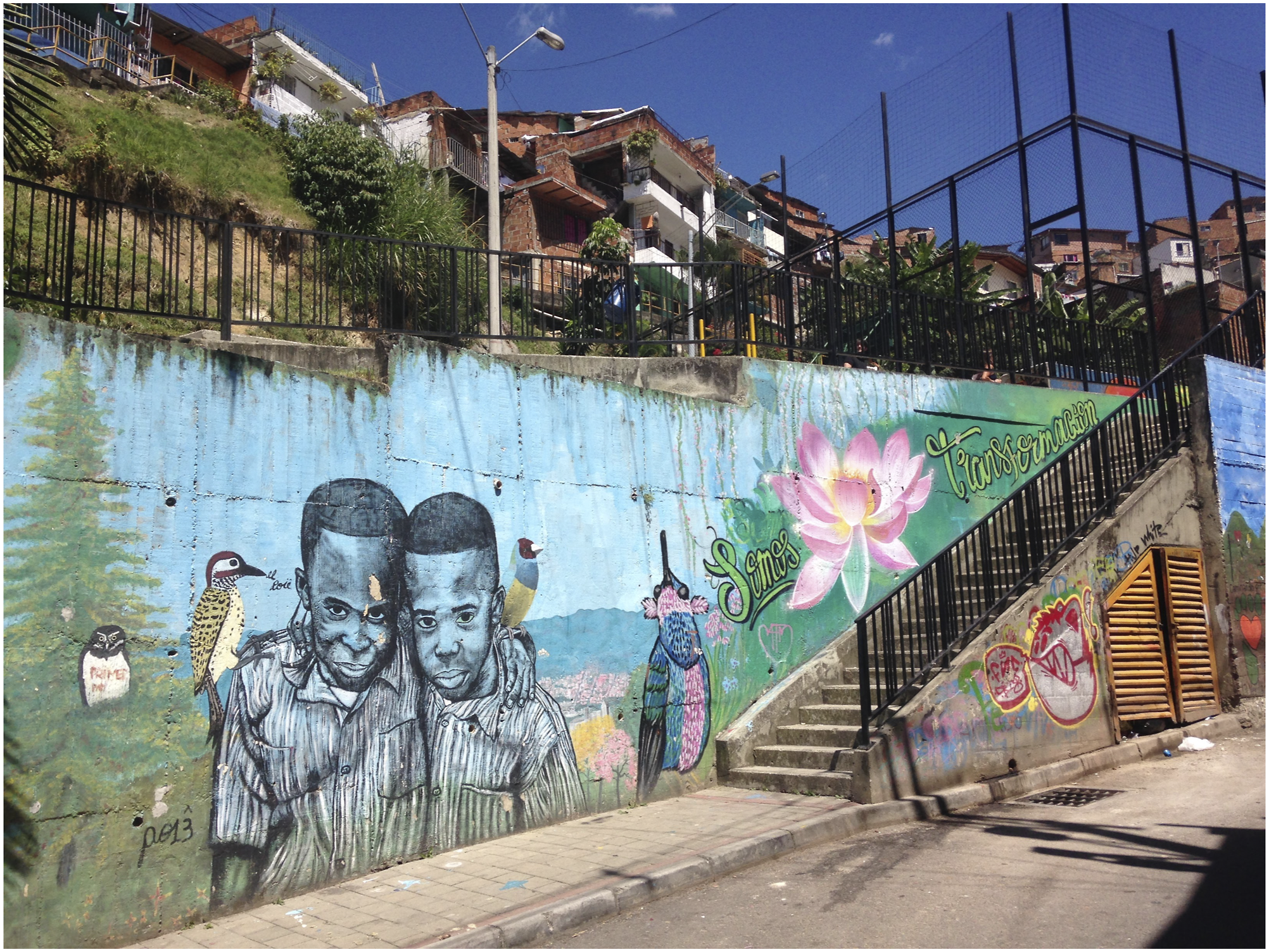
Thus, the creative use and appropriation of public space in Comuna 13 and Ciudad Bolívar indicate how such spaces can be ‘worked’, and not just by ‘professional(ised) subjects’ (Laurie and Bondi 2005: 395). As these authors argue, neoliberal governance can often deplete activism where states appropriate and co-opt the work of activist groups in specific contexts. Nevertheless, they also insist that it is equally important to pay attention to the times when people are able to subvert governance policy. The appropriation and utilisation of public resources and infrastructure by the community groups discussed here show the interrelation of policy and cultural activism. The organisers of both the Carnaval and Museo Libre have capitalised on funding made available for community groups to produce cultural events in their area, in collaboration with the local community, as well as capitalising on the discourses circulated by the government and media. Speaking to the idea of a city as a site in flux, the top-down transformation-oriented policies related to public space have opened up new opportunities ‘from below’, mobilising the concept of transformation at different scales. Notably, this has allowed a means of resisting the violence of the past in a way that emphasises the concurrent malleability of societal norms and expectations, albeit within boundaries (McDowell 1983; England 1991; Massey 1994). Moreover, they highlight how ‘non-professional’ subjects collaborate with state policies to alter the urban landscape, demonstrating the importance of looking at various scales to understand urban transformation. In their appropriation of public space, both the performers during the parade and the artists involved in the graffiti festival shape and remake the urban landscape. Crucially, though, Geraghty and Massidda (2019) also caution against a romanticised view of urban spaces associated with marginality. This is key to our approach, too, and we draw out the similarities between the two Colombian cities both in relation to creative potential and to the continued problems experienced by people in these areas. As we explore in the following section, there are limits to the supposed transformation that these changes imply, and it is precisely by listening to people and their experiences of the city that those limits become apparent.
Negotiating ongoing violence
Despite the benefits of the creative uses of space described above and their success in shifting the narrative of stigmatised communities in Ciudad Bolívar and Comuna 13, it is important to recognise that there are various forms of violence that continue to shape and reproduce the cityscape. A tension persists between the creative projects that foster a more positive engagement with these public spaces, and the need to negotiate ongoing inequalities and exclusions. The transformation of the city has opened up some possibilities but, as Sassen (2013) points out, even where there exists the potential to claim space and remake the city, this does not necessarily alter the structures of power. In the case of Museo Libre and the Carnaval de la 13, these tensions can be glimpsed through the ways in which the projects are run, their temporality and the expectations of them.
Talking to artists in Bogotá, it became clear through subtle suggestions, explicit denunciations and notable silences (Felman 1999), that there was a deeper politics to the trend of beautification. At one point during Museo Libre, for example, the site chosen for one of the murals had to be rearranged because the local drug dealers thought it was too close to their territory, although they didn’t object to the project in general. Another spot was found and nothing much happened, but their control was part of everyday life and the job of SURVAMOS was to negotiate rather than confront that threat of violence. It is worth remembering that public space is not only a space for participation and agency, it is also a space of control; at once a site of inclusion and of exclusion, a dynamic territory of power that can bring about participation, silences and/or exclusions (Phillips and Cole 2014). Consequently, in the mutual construction of space and social relations it is important to consider, as Bondi and Rose argue, ‘both the constraining and liberatory possibilities of urban public space and city life’ (2003: 236).
The sense of ambiguous and subtle control in terms of the aesthetic possibilities of creative projects extended beyond the neighbourhoods of Ciudad Bolívar and Comuna 13. Alongside the desire to speak about more than just violence, to celebrate the positive in the city, the lack of explicit references to violence in the aesthetic landscapes of marginalised neighbourhoods was also associated with the fear of reprisal. Aitue is a community-based arts organisation that works in many barrios in the south of Bogotá, and one of their artists offered one of the most explicit explanations of this form of self-censorship that was otherwise hinted at in our other interviews: In the barrio you can’t paint a mural that denounces drug dealing, trafficking, the relationship between the police and… I don’t know, like the tolerance shown by the police and the community in relation to drug trafficking and dealing. You can’t do it […] because you’re exposing yourself. Right? Because you’re exposing yourself and there is a power there that is watching, controlling and deciding what can happen and what can’t, and not even in a particularly organised way. But there’s the ‘olla’, which is where they sell [drugs], and it has its own bosses and these bosses own and control the space. It’s like the country. But we still think that in the cities this doesn’t happen and you don’t hear about it.
The potential threat of retaliation is of course heightened when the anonymity of the artist is not guaranteed, as is the case during festivals and community celebrations. It is also a risk when there are depictions of violence such as social cleansing, criminal networks and the corrupt relationships between armed groups and local politicians or police, all of which are continuing realities in marginalised areas of both Bogotá and Medellín, despite transformation policies. There is still an ‘unspoken truth’ that it can be dangerous to speak too loudly or too directly about particular realities of violence in Colombia (Taussig 1992). Despite their global presence, graffiti and street art respond to local contexts and, as such, an absence is indicative of the dynamics and possibilities of public space in specific places (Bush 2013).
Even where transformation is lauded, there is a temporality and precarity to the changes that are experienced. Although the carnival in Comuna 13 has grown as the neighbourhood has changed and become more accessible, it remains a temporary subversion of the activity in, and appropriation of, the neighbourhood’s public spaces. The carnival in this sense is a more temporary intervention than graffiti, and the space that they reclaim control of for the duration of the parade soon returns to the control of armed groups as normality resumes. One resident and campaigner from Comuna 13 maintained that despite the narrative of transformation and various positive cultural community-led activities ‘you are still living with microtrafficking, the criminal gangs still exist, you are still living with social conflicts, you are still living with poverty, you are still living with social inequalities’. Indeed, statistics from 2018 show that Comuna 13 was the eighth neighbourhood with the poorest living conditions (particularly in terms of vulnerability, environmental degradation and financial resources), in addition to the second highest rate of homicide and the third highest rate of interpersonal violence (Alcaldía de Medellín, 2019). The yearly festival is significant in its symbolic reclamation of the neighbourhood, but the appropriation of space away from violent actors is temporary and limited. In fact, Pérez Fernández argues that the controversial demobilisation of paramilitary groups through the Justice and Peace Law of 2005 was enacted in such a way that many members stayed in their neighbourhoods and became community leaders (2010: 75). While this is not something we came across in our research, it does invite further investigation into post-conflict reincorporation strategies, and potentially the ways in which violent actors adapt to shifting discourses at national and local levels rather than submit to a more fundamental transformation of their practices.
These realities of violence further call into question the transformative potential of creative cultural projects. Indeed, the limits of beautification as a means of transformation, specifically through challenging imaginaries guided by fear, stigma and prejudice, are directly associated with continuing crime. One of the members of SURVAMOS described the situation in Ciudad Bolívar: What people are thinking is that, yeah, they painted something pretty but now I’m going to get attacked against a backdrop of colours. That has happened, people have done it. And it’s sad as well because it undoes all of the Museo’s intentions, and setting it up requires loads of energy, it tires you out, the thought process, not only wearing you down physically, working, packing supplies, carrying, running, doing all of the logistics, there are only four, five of us – maximum. You’ve seen it all. It requires so much work, to then see it all undone with the simple act and ‘they painted, but nothing changed’.
After all their hard work, people still experience various forms of everyday violence in these areas, here mugging and theft, in addition to poverty, inequalities and threats from criminal networks. The interesting thing about this quote, though, is that it speaks to more than just the realities of violence in different areas of the city. Despite the celebration of projects like Museo Libre, the artist implies that there is a cynical dismissal of the project because ‘they painted but nothing changed’, which disappoints their intention to change the neighbourhood at least in the social imaginary. The hopes of aesthetic transformation are undermined, but this raises the question of what people should expect from such projects.
By listening to people in these areas, it becomes clear that they are all too aware of the myriad inequalities and exclusions that they continue to face, even if the official narrative of transformation does not address them. Alongside the issues presented by the artists and cultural organisers, people on the streets of Ciudad Bolívar pointed out that most of them don’t have the economic resources to go to university and so the area didn’t produce many professionals. They suggested that it was the lack of opportunities for people in the area that led to problems of delinquency and kids ‘following the wrong path’. While reports show that homicide rates in Bogotá are at their lowest in 59 years, in Ciudad Bolívar they have increased in recent years. The reasons suggested include the ongoing presence of illegal armed groups and, crucially, the lack of social investment or the complex obstacles people face trying to access welfare (Murillo 2021). These realities show that violence is endemic: criminal networks are intact, and this is partly because people have fewer opportunities and support systems to provide alternatives.
The imbrication of different forms of violence is significant, as evidenced not only when people make their living through crime but when subtle forms of exclusion lead to crime representing their best option after criminal actors meet too many obstacles and challenges when trying to ‘go straight’ (Bourgois 2003). The distinction between violence in the public and private realm also collapses when considering the ways in which interpersonal violence feeds on and into drug-related violence, criminal activity and state corruption (Auyero 2015). Auyero argues that politics cannot be separated from the everyday insecurities suffered by the poorest urban inhabitants across Latin America, given that their insecurity leads them to rely on the very same state that feeds this violence not just through abandonment but through corrupt complicity (Auyero 2015). These are complex issues, related to the depth of structural inequality and its urban manifestations, particularly in marginalised neighbourhoods. In Colombia, despite some increased investment from local governments pursuing a transformation agenda, in marginalised neighbourhoods this violence ‘from above’ continues in various forms, including corruption, infrastructural deficiencies, unemployment and inefficient public services, which in itself heightens territorial stigma (Wacquant 2008).
At the level of aesthetic urban transformation, there are also reminders of the state’s ambivalence towards creative projects and their de-stigmatising efforts. Despite benefitting somewhat from the state’s transformation policies, cultural organisations in marginalised neighbourhoods still have to negotiate institutional bureaucracy and the differing priorities of local administrations, which can lead to conflict. In 2019, now 6 years into the project, Museo Libre were approached by the Secretaría Distrital del Habitat (the department responsible for housing and community management) as part of their ‘Habitarte 2019’ initiative, seeking to identify and support positive cultural projects in the city’s communities. Claiming to want to protect the artworks and set up an urban art tour of the neighbourhood, they compiled an inventory of the artistic pieces that had emerged from the festival over the years. Nevertheless, their engagement with the project turned into an act of censorship, as murals were painted over in their political colours and 21 pieces were erased in total, despite attempts at dialogue from SURVAMOS. In response, the collective turned towards the community, both of artists and of the neighbourhood. Street artists from Argentina, El Salvador, Chile, Peru and Colombia returned to Ciudad Bolívar to restore the censored murals and SURVAMOS invited women artists to share stories about strength and resilience on and from the street. Finally, the local community were given kits containing canvases and paint and asked to each paint a piece of the censored murals. The pieces were then brought together, producing a jigsaw of the murals, which was exhibited in various locations within the neighbourhood. The controversies and politics surrounding mural erasure have been explored by Morrison (2020, 2022), who argues that they reveal competing perceptions of the cultural value of street art, social judgements based on a mural’s content and, ultimately, the contingency of public visibility. In the case of Ciudad Bolívar, the erasure of the murals also speaks to the contingency of urban transformation policies and the ways in which the state seeks to govern the modes of participation from such communities. Despite the explicit inclusion of cultural creativity in the transformation agenda for Bogotá, this seems to be a case of the local government actively undermining their own policies and, worse, fundamentally damaging their relationship with the communities they are supposed to be working with and for.
Conclusion
In Bogotá and Medellín, spatial forms of marginalization and exclusion are entrenched. The stigma of violence can have the effect of demonising and misrepresenting entire communities and the ways in which they interact with the spaces around them. In Ciudad Bolívar and Comuna 13 this stigma dominates urban imaginaries, which then fail to appreciate the dynamism and vitality of people living in close proximity and interacting in public space (Jacobs 2000). As a response, local artists and community organisations have capitalised on the broader urban transformation policies in each city. They use art and culture to counteract the violence of stigma and prejudice, celebrating the many positive attributes of the neighbourhoods and the people in them. In doing so, they draw attention to the community-led processes that have contributed to the broader changes in the city rather than the top-down policies for which the cities are so famous and show the potential for aesthetics to shift spatial identities and imaginaries.
Focusing on change at the local scale offers an insight into everyday appropriations of space and the opportunities that are presented through shifting urban dynamics. Nevertheless, this scalar approach also reveals the continuation of various forms of violence, exclusion and inequality in everyday life. It is important not to ignore the negative and distorting effects of stigma, but neither should the realities of structural and direct violence be ignored. The restrictions that artists experience, that they perceive or that they have to negotiate reveal the complexities of spatialized violence and the limitations of appropriating public space. Beautifying space does not rid an area of violence, it instead risks romanticising it. Similarly, the temporality of performance art in public space can be obscured within a presentation of a neighbourhood as being transformed, rather than temporarily reclaimed. Rather than reducing residents to either resistant or submissive stereotypes, the subtleties of violence require a recognition of negotiated survival strategies where people live alongside violence (Lizarazo 2018: 177). Such an approach does not negate the intentions or perspectives of those who create these cultural projects, rather it seeks to encourage greater interest in the complexities and contradictions of various forms of spatialized violence, and to underline the need to pay close attention to the lived experiences of urban policy and transformation narratives.
As the case studies presented in this article show, there is an underlying tension between urban transformation and structural violence. The vocabulary of urban transformation implies a reconfiguration of space, a transformation on a physical level of the urban area, a shift in socio-spatial relations and an improvement in the lives of the inhabitants of that space. However, if urban change is to entail such advancements and be true to spatial justice, it must include a fundamental reorganisation of social structures, with those who live in that space being active participants in the decision-making processes around space, spatial practices and spatial representations (Lefebvre et al., 1996). In a neoliberal context, however, urban transformation policy seems to reflect an urban passive revolution, in that the language changes but capitalist structural inequalities are reproduced (Harvey 2012). Consequently, the realities of urban violence stubbornly remain. Many narratives of violence in Colombia suggest that there is a cultural basis to its prevalence in the country’s trajectory; from the ‘foundational myth’ of violence disseminated in Colombian art and culture discussed by Hunt to the misinterpretation of homicide statistics that prioritise cultural behaviour in urban space over the realities of organised crime revealed by Llorente et al. (2002). This kind of mythification implies that violence is a cultural problem, not a political problem, and that it could be transformed if only people believed it possible and actively behaved in ways that are ‘less violent’.
Such a narrative has been transferred to urban space in the context of transformation. Indeed, Hunt (2015, 2017) and Restrepo (2016) have shown that the narrative of cultura ciudadana mobilised a discourse of moral panic and served to transfer responsibility for tackling violence from the state to the civilian. Thus, rather than drawing attention to the entrenched inequality embedded in urban governance, it encouraged the most vulnerable to develop their skills as citizens as a way of counteracting violence, and then ‘perform’ their newly developed, ‘peaceful’ citizenship for the collective good. Ultimately, this positions the state as an educator rather than being responsible for securing the safety of its citizens, depoliticising violence and inequality in the process. Nevertheless, the choices that politicians make are inherently political and often ideological, and the reproduction of structural inequalities in marginalised neighbourhoods is an indication of how a social hierarchy is preserved. While the cultural activities described above are clearly making the most of what they can do and acting upon space in important and positive ways, they do not aim nor claim to be resolving the structural problems of violence in the country. The problem comes when the narrative of transformation, either as a completed act or as a responsibility of the citizen, dominates discourses of urban space and excludes the ‘inconvenient truths’ that reveal more complex lived realities of negotiating ongoing violence and inequalities (Zeiderman 2018). As we argue in this article, the nuances of everyday life in contexts of violence can help to show the agency of local populations and the creative solutions that they produce in difficult circumstances, without denying the challenges that they face. The implications of this community self-reliance warrants further research, though, particularly to understand broader perceptions of the state and how much trust people have in their capacity or commitment for transformational change.
Footnotes
Declaration of conflicting interests
The author(s) declared no potential conflicts of interest with respect to the research, authorship, and/or publication of this article.
Funding
The author(s) disclosed receipt of the following financial support for the research, authorship, and/or publication of this article: This research was made possible by funding from two Economic and Social Research Council PhD Studentships at Newcastle University and the Arts and Humanities Research Council project Ordinary Citizenship at University of Leeds (AH/W002264/1).
