




Abstract
In many parts of the world, the modernist ideal of centralised and networked infrastructure provided by the state remains just that – an ideal. Instead, the reality is a patchwork of infrastructural solutions engineered by both state and private actors. While critical studies have highlighted how states use infrastructure projects to legitimize their authority, how do infrastructure projects shape relations between the state and urban residents when the state is not the sole actor in building and maintaining infrastructure? Drawing on scholarship on the socio-material dynamics of infrastructure, this article examines infrastructure’s politics in Accra’s drainage system. Studying these material interventions shows that drainage is politicised with state actors, aspiring politicians, and urban residents advancing and evaluating performances of authority in relation to this infrastructure. This politicization of drainage infrastructure reproduces patterns of urban socio-economic inequality. As residents experience the consequences of each other’s actions, they recognize the need for a centralised approach to tackle drainage problems and express a desire for the state to assume responsibility. Although ‘heterogeneous infrastructure configurations’ more accurately captures the reality on the ground in rapidly growing cities such as Accra, this analysis of everyday infrastructural politics helps explain why expectations of centrally organized drainage infrastructure persist.
Introduction
In the Ghanaian capital of Accra, drainage is high stakes for many residents. During the annual rainy season, the city often suffers from major flooding, threatening residents’ lives, livelihoods and dignity. As the impact of climate change exacerbates the inability of its technical infrastructure of storm drains to meet Accra’s rapid growth (Amoako and Boamah, 2015, Ashiagbor et al., 2019, Songsore, 2017); both local and national governments have resorted to blaming the city’s residents, focusing on the chokepoints resulting from their dumping of garbage in drains (Adogla-Bessa, 2019). Densely populated poorer districts are deemed particularly culpable, which has led to instances of forced clearance (Crentsil and Owusu, 2018). Such interventions underline the extent to which drainage infrastructure is a site of politics and state-resident relations.
Where many accounts of such politics focus on state-led infrastructural efforts, emphasizing how these can function to shape new state-citizen relations, in Accra, those living in flood-prone areas along the drains have developed their own infrastructural interventions. Although the state officially remains responsible for infrastructure, Accra’s residents have turned to a breadth of interventions including various modes of self-sufficient, public-private, off-grid, small-scale and informal strategies to prevent floods. They construct barriers along banks, dredge and divert waterways to manage the flow of water, maintain buffer zones and line drains with concrete to stabilize them and to prevent further erosion. Such material interventions – which can be preventative or reactive, recurring or incidental – tend to remain relatively fragmented, supplementing rather than replacing the state provision of public goods. During fieldwork in August 2020, an elderly man in the neighbourhood of Teshie detailed how he had strengthened the bank of the waterway adjacent to his property in preparation for the ‘tsunami’ that would come 1 day. In his description of the process, the National Disaster Management Organisation – a state institution that deals with flood management – played a supporting role. Representatives offered a few bags of cement, although it was ‘not enough’. Stories of (attempts at) collaboration between residents and state actors regarding drainage interventions recurred throughout my fieldwork.
What does it mean for state institutions to acknowledge or support a shared control of the infrastructure? How does this co-production of a critical form of urban materiality shape the political authority of state actors? Recent scholarship has begun to recognize that, in many contexts, infrastructural development and maintenance are carried out not only by the state but by non-state actors. Utilizing terms such as post-networked (Coutard and Rutherford, 2015, Jaglin, 2015) or heterogeneous infrastructure configurations (Lawhon et al., 2018), this literature emphasizes the entanglement of state and non-state infrastructural arrangements. While this recognition is an important challenge to state-centric understandings to infrastructure, it has not fully engaged with the implications of such heterogeneity for state-citizen relations.
In this article, I examine how Accra’s heterogeneous, patchwork but interdependent drainage network mediates state-resident relations, focusing specifically on the negotiation of political authority. This focus, I argue, also extends our understanding of the politics of infrastructure by highlighting the extent to which infrastructural change not only involves the crafting of new forms of citizenship (Lemanski, 2020a) but also the negotiation of authority between residents, state officials and politicians. In the sections that follow, I first discuss debates around the politics of infrastructure, focusing on the relationship between infrastructural heterogeneity and political authority. I then provide an overview of Accra’s approach to drainage and sketch the dynamics of intervention in the Kordzor waterway. In the final sections, I advance my argument that infrastructural interventions around the drain reveal how political authority is negotiated in Accra.
State-resident relations and infrastructure
Recent years have seen a burgeoning of literature across the social sciences focused on the politics of infrastructure. Much of this work takes a socio-technical approach to infrastructure (Mitchell, 2002), understanding infrastructure as the material outcome and means of political processes; both the result of and a site for negotiating, for instance, uneven development (Batubara et al., 2018), citizenship (Pilo’, 2017), governance (Doherty, 2021) and policing (Colona, 2020). Through its material form but also its symbolic meaning, infrastructure ‘allows us to understand how the political can be constituted through different means’ (Larkin, 2013: p. 329). This literature often includes a metabolic understanding of the city (Swyngedouw, 2004), emphasizing the socio-political nature of the circulation of biophysical flows that enable urban life. From this perspective, drainage infrastructure represents the circulation of power, cemented in the urban landscape.
Within this terrain, one focus of study is the role that infrastructure plays in mediating relations between the state and (urban) residents. Von Schnitzler (2013) illustrates this in her study of prepaid water meters in Johannesburg and Soweto which facilitate the state’s ‘political project’ (Pilo’ and Jaffe, 2020) of imposing authority through control over residents’ use of electricity. Her case study shows technology shaping how the state relates to residents and vice versa. Similarly, Lemanski outlines how infrastructure combines the physical and political, acting as a domain for the expression of the rights and responsibilities of both state and citizens (Lemanski, 2020b). Per Lemanski it is in the visible provision of infrastructure that the state, and its responsibilities and authority are made legible for residents.
These relationships are often defined in terms of citizenship, focusing justifiably on how negotiations over access to infrastructure and linked services represent residents’ push for their right to the city. In this paper, I draw attention to another side of this dynamic, that of political authority. The performance of said authority is pertinent for those interested in the politics of infrastructure as it contributes to our understanding of the dynamics of infrastructural provision and to (uneven) patterns of access for residents. Building on the rich literature on state formation and governance (e.g. Lund, 2006), I understand political authority as legitimate performances of control over space. This literature emphasizes authority’s role as part of a relational dynamic between heterogenous groups of state actors and residents, in which state power can become more or less legitimate over time. Legitimacy, then, can be identified through statements of trust in the state or the ‘popular response’ of urban residents to the state (Tahir, 2021). Residents’ evaluations of authority may reflect a social contract, one that shapes their expectations regarding the responsibilities of the state.
Importantly, recent literature on political authority has theorized contexts where, in addition to the state, -governmental organizations (Stel and Ndayiragije, 2014), traditional authorities (Lund, 2006) and rebel groups (Wenner, 2021) play a key governance role. This research emphasizes how the distinctions between state and non-state actors are sometimes blurred.
In situations where non-state actors might also exercise control over infrastructure provision, authority is diffuse rather than state-centred. While different actors may seek to enact performances of authority, it is in the process of successfully providing infrastructure that they are recognized. Their (in)ability to organize sufficient capital or labour to supply the infrastructure shapes how their performances of authority are received. For urban residents who need protection from flooding and erosion, material interventions that seek to remove chokepoints and enhance drainage flow are compelling.
The acknowledgement of diffuse authority is necessarily relevant in contexts of heterogeneous infrastructure configurations (Lawhon et al., 2018), those contexts where the provision of services is not achieved through a centrally organized network, also referred to as ‘post-networked infrastructure’ (Cirolia, Hailu, King, da Cruz and Beall, 2021), ‘incremental infrastructures’ (Silver, 2014) and ‘incomplete infrastructures’ (Guma, 2020). What these approaches share is the questioning of the normative understanding of how infrastructure develops: along a linear trajectory culminating in a centralized network established and maintained by the state. Rather, the authors of these concepts recognize that urban residents and other non-state actors take it upon themselves to provide the material infrastructure they need when the state does not do so; infrastructure does not develop according to a fixed logic. Often set in socio-spatial contexts outside of Europe and North America, this literature has sought to broaden our understanding of what counts as infrastructure – an antidote to modernisation imaginaries that focus on the (lack of) state provision of infrastructure while overlooking everyday, resident-led practices. Once we recognize that the building and maintenance of infrastructure often involves other actors than the state, analysis can focus on the relational processes through which infrastructure is constructed and on the lived experiences of residents negotiating the performances of authority.
Bringing together the literature on political authority and the politics of heterogeneous infrastructure enables an investigation into authority in a way that attends to materiality as well as mechanisms of legitimation. While visible and functioning infrastructures are often seen as a legitimizing tool of the state (Lemanski, 2020a, Lund, 2006) how does this play out in contexts of heterogeneous infrastructure configurations? I use the case of drainage infrastructure to consider how multiple state and non-state actors seek to claim authority and how these claims are received. By focusing on material interventions by a variety of stakeholders around the drains, I seek to further our understanding of how this heterogeneous infrastructure mediates the relationship between the state and urban residents, and the forms of unevenness this creates. In the rest of this article, I analyse everyday negotiations of authority around the drain, demonstrating how heterogeneous infrastructure configurations form the means and outcome of claims to legitimate power by multiple state and non-state actors.
Context and methods
Accra lies on a plain with hills framing the city to the north. 12 drainage basins fall within the Greater Accra Metropolitan Area, each basin with its own primary drain which flows into the sea. Drains, colloquially known as gutters, follow the natural ditches and streams in the landscape. Most of the city’s flooding occurs downstream along the drainage network; the multiple primary drains have varying degrees of intervention to transform natural drains in the landscape into an infrastructure of drainage. The city of approximately 4.9 million people is dependent on these primary drains to channel its runoff.
The empirical evidence presented in this article draws on my observations, interviews and conversations with residents and other stakeholders along the Kordzor primary drain in Accra. I began my research upstream at different tributaries of the Kordzor and worked my way downstream towards the sea, documenting interventions (specifically: construction, maintenance and repair work) and transecting the basin in the process. This approach recognizes the metabolic nature of the drainage network, following the flow of the waterway through time and space as it links places across a section of the city, and enabling insight into the patchwork of infrastructure as a whole. I mobilized the approach of following in order to discern heterogeneity in practice. Tracing flows has precedents in studies of infrastructure (Cirolia et al., 2021, Kimari, 2021), especially in studies focused on everyday practices and the “multiple technological artefacts, uses and users” that comprise heterogeneous infrastructure configurations (Lawhon et al., 2018: p. 725).
This method of examining the relationship between infrastructure and political authority along the Kordzor emphasized materiality and the mechanisms of legitimation. Directly facing (or otherwise standing in close proximity to) the drain while speaking with residents shaped my understanding of the processes at hand. My interlocutors called my attention to the size of culverts, the quality of concrete, the strength of flow or the grain of sand, explicitly narrating the relations between water, concrete, sand or other materials and political authority, described in more detail below.
The Kordzor is in a constant state of construction and is about 11 km long. While government officials aim to have its entire length lined with concrete in the yet unspecified future (Interview, Ministry of Works and Housing, 2020), concrete currently only lines intermittent sections: under bridges, in places where the threat of erosion is most dire, and where flooding has previously caused damage. Figure 1 documents the interventions I recorded during fieldwork in mid-2020. Despite the greater risk of flooding downstream, the upstream areas of the Kordzor are characterized by many interventions aimed at controlling the drain’s flow. It was not always immediately apparent who was responsible for such interventions; my enquiries were regularly met with confusion or speculation. Over time, I came to recognize through the type and quality of material which constructions had been initiated by the government and which by private parties, corroborating my hunches as much as possible through the aforementioned enquiries. Interventions made by state institutions were often larger in scope and often – but not exclusively – deployed concrete or similarly durable materials. The Kordzor waterway with tributaries and recorded interventions. Base map: OpenStreetMap.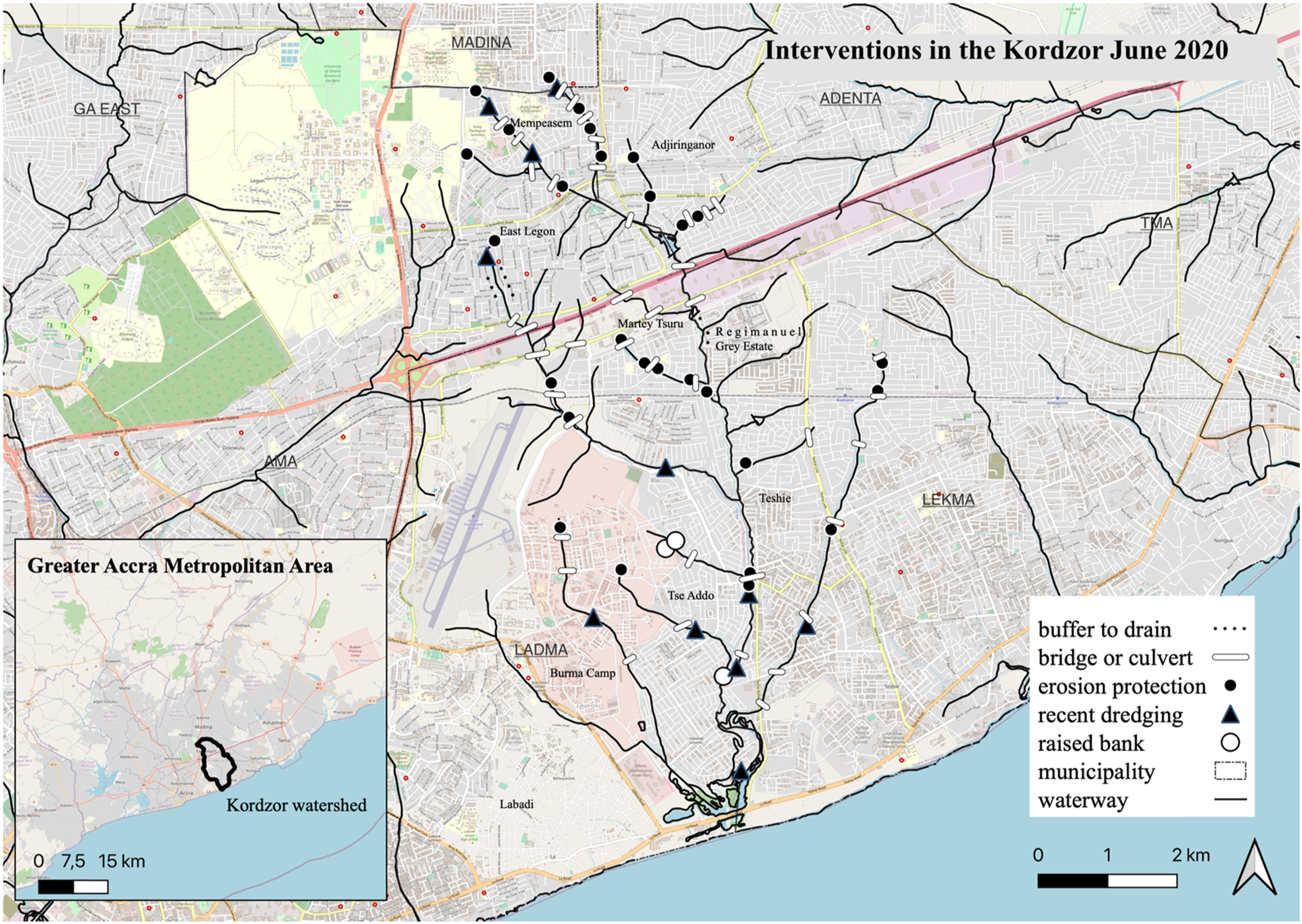
In documenting the numerous material interventions along the drain, legitimation emerged as a key theme in narratives that emphasized responsibility, ownership, and suggested relationships between various state and private actors. My research took place during the rainy season, a time when the risk of flooding is highest and discussions on dealing with the risk of flooding often centered on questions of where to locate responsibility. Following the waterway enabled me to elucidate differences between residents sharing a common vulnerability and to capture the variety of interventions and risk management strategies in different neighbourhoods.
My interlocutors included kiosk-dwellers, renters and homeowners, residents in compound houses, business owners, caretakers of uncompleted buildings, real-estate developers and salespeople. To better understand the context and technical requirements of Accra’s drainage system, I also interviewed engineers at the Ministry of Works and Housing and at a private company, municipal drainage managers from two municipal assemblies and officers of the National Disaster Management Organisation. I also studied locations along the Odaw drain, the neighbouring basin, as a point of comparison. Having lived in Accra for most of my life, many of my observations and interpretations were locally informed.
The variety of interventions along the drain reflect the socio-economic status of residents. I began my fieldwork in the upstream tributaries of the Kordzor, in Mempeasem which falls on the boundary between the communities of Madina and East Legon. An old village annexed by urban sprawl, Mempeasem today is a mix of traditional compound houses, single family mansions, apartments and hostels housing students of the nearby University of Professional Studies, and informal homes (mostly wooden kiosks). The Kordzor then continues through mostly up-market East Legon and Adjiringanor, the industrial area of Spintex, and the gated communities of Regimanuel Gray and Manet in East Airport. Across the waterway from the gated estates lie the old village of Martey Tsuru which is similar to Mempeasem in its housing composition. Next, the Kordzor flows through Agbleze, Teshie and Tse Addo. The former two are mixed-use areas while the latter, newer area contains up-market homes and apartment buildings as well as compound houses and informal living structures. Finally, the Kordzor flows into a lagoon in Kpeshie and enters the sea on the east side of the Labadi Beach luxury hotel.
Patchwork of claims in the drain
State and resident interventions
Drain construction and maintenance are officially the responsibility of the local governments (i.e., metropolitan, municipal and district assemblies) and the Ministry of Works and Housing. With regard to drainage, the assemblies are tasked with maintenance, which often entails desilting, clearing of rubbish. They do not have the funds to construct drains but may be involved in the oversight of drain construction funded by the ministry or other national government level agency. Drainage engineers in local government complained about a lack of structural funding for drain construction. While there is structural funding for maintenance, the relatively well-resourced Accra Metropolitan Assembly is only able to employ a thirteen-person team for clearing all drains in its jurisdiction. Smaller assemblies in the metropolitan area have less funds. While assemblies can contract out the sweeping of roadside drains to private waste management companies like Zoomlion (interview at AMA, February 2020), funding for drain construction and maintenance is hard to come by and the national government usually relies on donor agencies. The World Bank is currently funding the construction of new drains and retention ponds through a loan for a project called GARID (Greater Accra Resilient and Integrated Development).
The logic of the technocrats behind each drain project is to build where it is most necessary, meaning where flooding is most severe (interview at AMA, February 2020). The cost of construction is linked to the size of the channel as well as the compensation owed to residents and industry adjacent to the drain should evacuation be required. Decision-making around which section of the drain will receive investment is often political. It entails lobbying – of the donor agency for funds and of technocrats at the Ministry of Works and Housing to confirm the necessity of the intervention (Interview with drainage engineers, April 2020; Cobbinah and Darkwah, 2017).
The interventions are not always effective as can be seen in the collapsed walls and barriers where erosion has won. Constructions may collapse immediately or over time; work around the drains is therefore often recurring. Residents often pointed to culverts – the large pipes or tunnels that serve to channel the drain under bridges – as chokepoints (Figure 2). These culverts, often constructed by the state which has the remit to build roads, show that focusing on the state is not always the best way to understand how and when infrastructure works. Culvert under road, side stream joining the Kordzor in Kpeshie.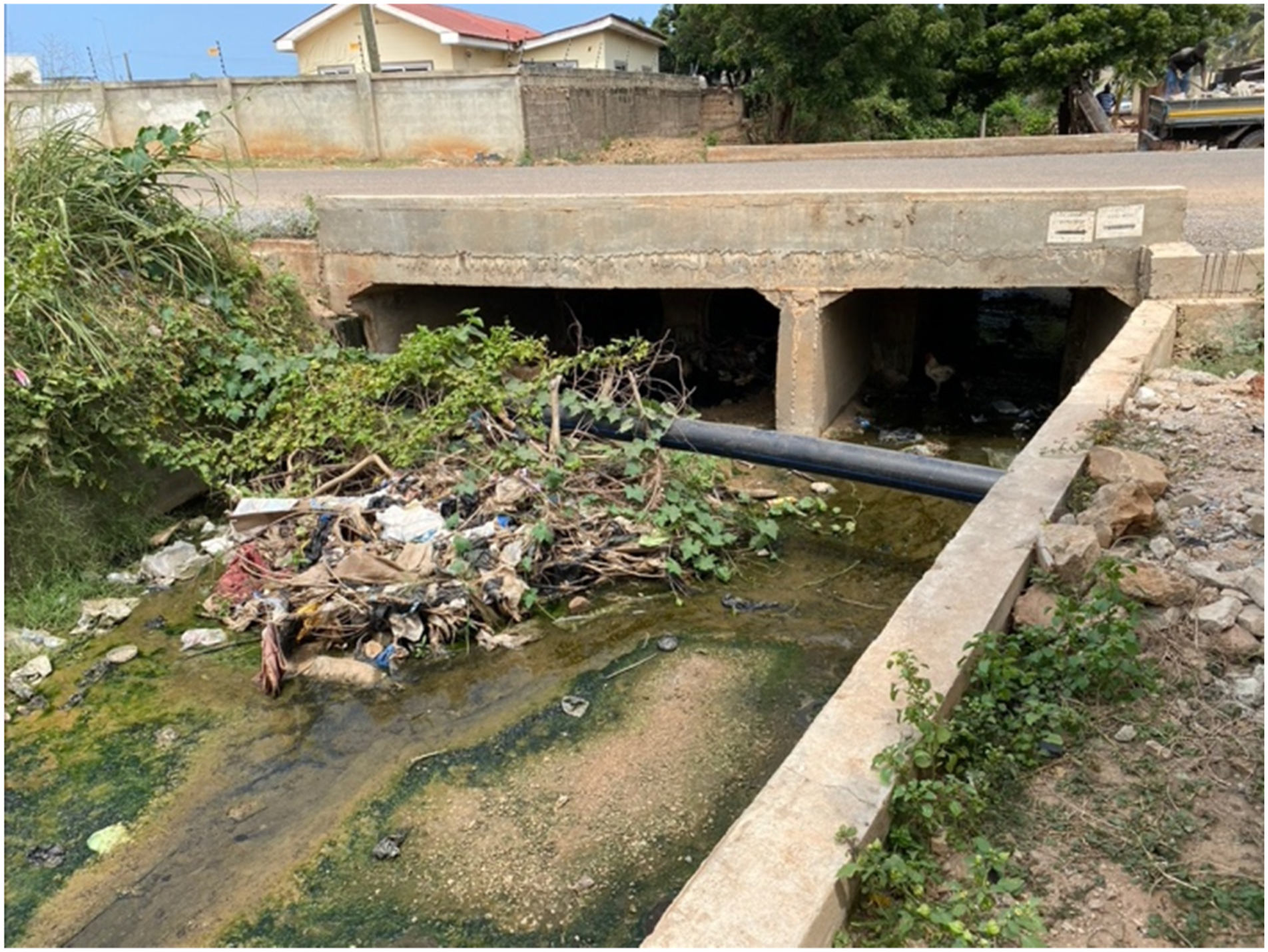
When necessary, residents turned to protecting themselves and their property from overflowing drains by fortifying banks and raising barriers. Interventions in the Kordzor enrolled numerous materials and material practices: cement and concrete, construction rubble, sand from the waterway, sacks, shovels and excavators. Countless sections of the waterway were fortified with concrete or cement blocks (Figure 3) where individual property owners had taken steps to protect themselves with a level of material investment usually reserved for the state. Meant to be permanent, such interventions underscore the heterogeneity of drainage in form as well as practice. In many places, the drain infrastructure took on the appearance of a patchwork quite literally, with sudden transitions between types of material. For example, the smooth lining of concrete extending from a culvert might transition into a stone-inlay only on the sides of the drain. In such cases, the materials spoke of their potential makers before residents did. Protection from erosion, mid-stream in Martey Tsuru.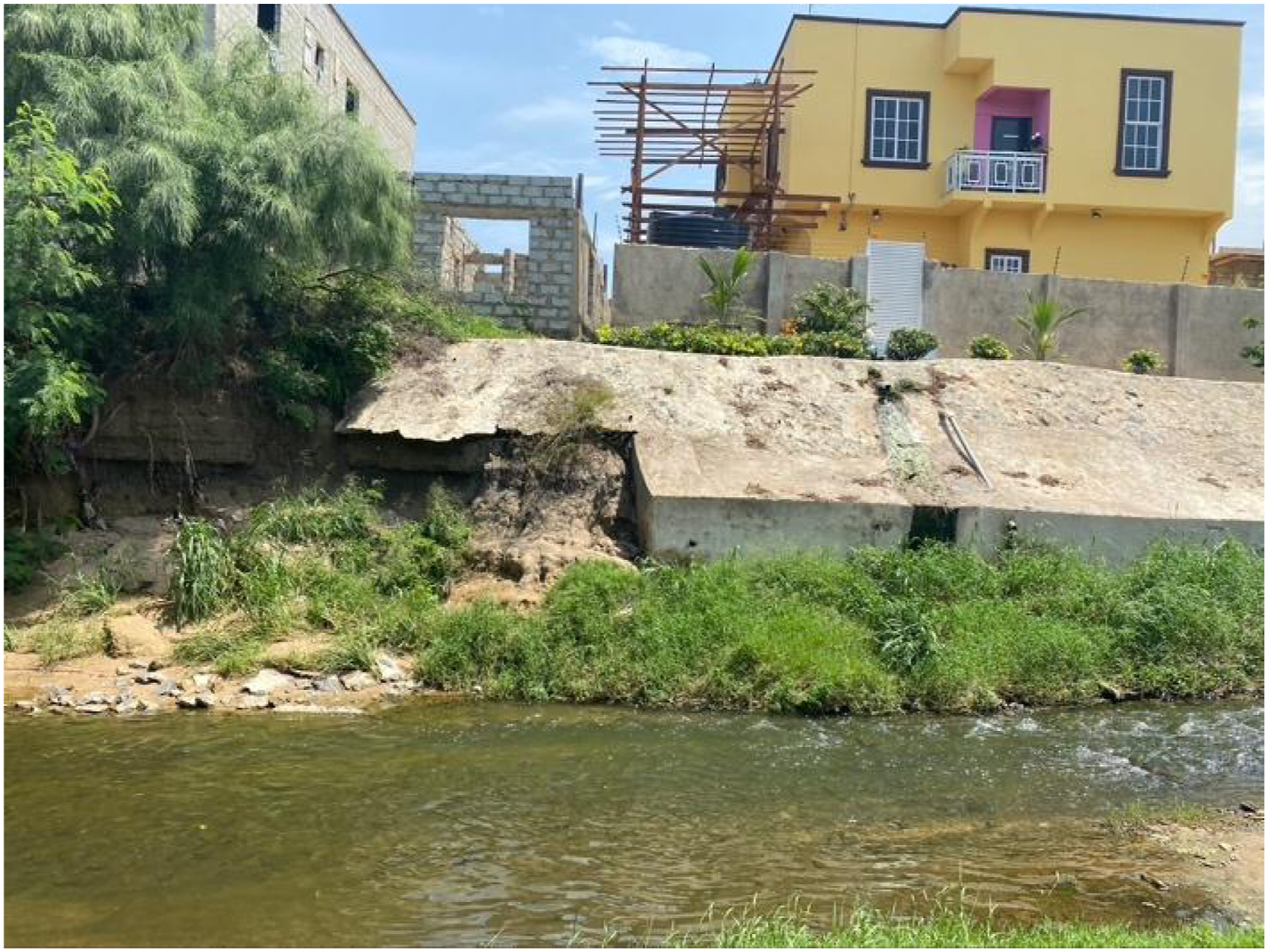
Access to tools and materials shapes people’s ability to protect themselves. Renting an excavator is expensive, as is investing in a concrete mixer. As Amoako and Inkoom (2018) argue, vulnerability to flooding is a function of socio-economic status, with marginalised people often pushed to the most hazardous areas. We see this in marginalised urban residents continuously struggling to keep their homes dry with readily available materials such as seen in Figure 4 where residents of a cluster of kiosks in Mempeasem used sacks from a construction site to fortify the banks. Initially they had filled old tyres with sand and lined them up along the bank but this solution did not prove effective for long. They did not seek help from any state or political power, unwilling to draw attention to their presence on a piece of unclaimed land. After the heavy rain of the weekend prior, the community came together again, this time to fill up nylon bags from a construction site with sand. The bags (each about a metre long) now fortified the banks. The sand came from the excavations of the waterway a year before, financed by a candidate Member of Parliament looking to woo voters. This intervention, bringing together nylon bags from one resident’s job site and sand heaped after an election cycle, emphasizes the heterogeneity of resources and materials mobilized along the waterway. Sacks filled with sand as barrier against overflow upstream. Photos by author.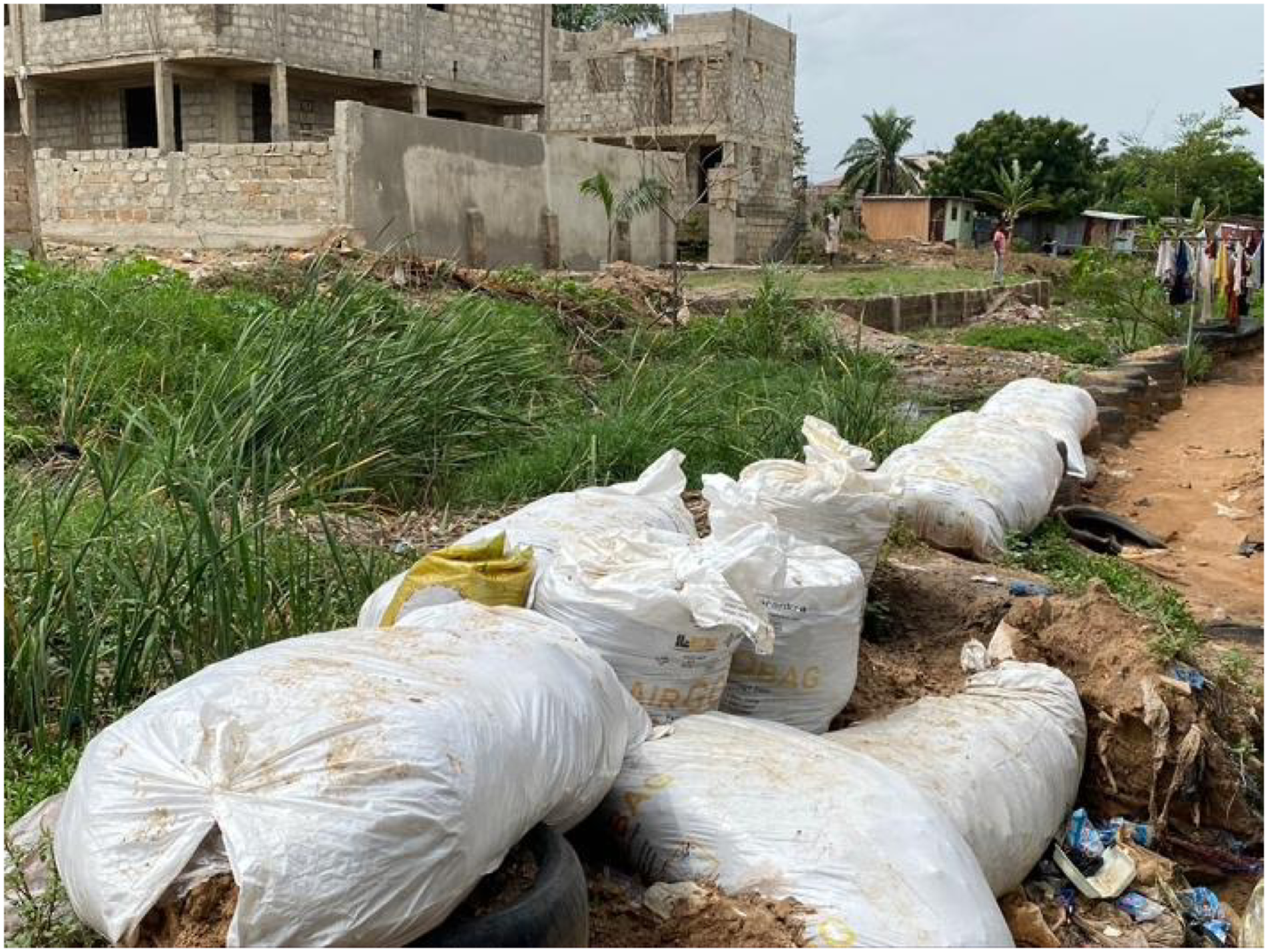
Also in Mempeasem, where the flow of the drain is relatively light, a large house was constructed over the drain. The waterway here was made into a tunnel flowing underneath the mansion’s yard, resurfacing on the next street where it continued in the open, lined with shrubs and banana trees. A neighbour behind this house was convinced that this intervention had widened the drain and was now “spoiling their building”. As a result, he planned to build a concrete wall down by the “gutter”, once he had enough money. The waterway is not meant to be built in; building permits granted here are against regulations (Interview at Ministry of Works and Housing, 2020). People with resources to mobilize bureaucratic approval can easily build in the waterway. Within the same neighbourhood, the disparities in risk were exacerbated by socio-economic standing. Amankwaa and Gough (2021) point to similar inequalities in Accra’s electricity grid.
Negotiating claims by state and residents
Municipal engineers were adamant that interventions by residents were not the right approach, primarily because they did not meet technical standards (interview at AMA, February 2020; interview at Ministry of Works and Housing, August 2020). While the engineers acknowledged the needs of residents, they saw longer-term danger in interventions falling short of technical requirements, thereby invoking technocratic claims to authority. On the other hand, the residents I interviewed generally held the state responsible for drain management but spoke of the government in resigned or cynical terms. For their part, government officials pointed to lack of capacity. The following interactions express this dynamic.
Downstream in Teshie, I spoke to a young woman named Gladys. 1 She lived in a compound house (with multiple rooms for multiple households in a single compound) owned by her mother. Between their building and the waterway was a narrow path of about a metre and a half in width. Gladys told me they had long suffered problems with overflow and erosion. As the roadside gutter was often clogged with waste from the neighbourhood, they had to call in ‘area boys’ to restore the flow. The main waterway, the Kordzor, often flooded after heavy rains as the bridge was a chokepoint under which waste would accumulate. Gladys’ mother had lined the inner bank of the waterway with concrete and stones. Despite pleas to the local government, no action ensued until a woman died when her car was swept off the bridge. Construction workers were then sent to build a larger bridge, damaging the concrete and stone lining in the process. Since then, erosion has narrowed the distance between Gladys’ building and the waterway. At first the local assembly said it would help as it had contributed to the damage, but nothing came of it, and Gladys’ mother felt compelled to do it herself. Gladys then gathered her neighbours, who would lose access to the main road should the path next to her house erode away, for a meeting. While two of them agreed to contribute to protect the bank, the direct neighbour refused. At the time of my research, negotiations were ongoing. The state generally tolerates residents’ interventions and at times even supports them. But as Gladys’ narrative suggests, there is scant confidence in the state and politicians’ willingness or capacity to help. This sentiment was echoed in conversations along the entire Kordzor. As individuals or as collectives of neighbours, residents are taking matters into their own hands to protect themselves and their property.
The failure to provide adequate drainage led many residents to question the state’s authority to levy taxes. A group of residents in the control site who had all contributed funds or labour to jointly construct a gutter told me: ‘It was all voluntary, we didn't pay anybody. Everyone was eager. The government isn't doing anything. And they will come and collect property rates, property rates for what?’ At another location, a man pouring his bathwater into the gutter he built with his neighbour told me: ‘The assembly has been coming to collect property rates. I ask them, and they said they have the right to collect property rates. Me too, I have the right to gutters.’ Property rates as a form of taxation provoked residents’ anger as there appeared to be no ‘rightful return’ of needed public goods (Kauppinen, 2020). A municipal planner whom I interviewed confirmed that many residents feel that the property rates and business taxes they pay should work for them, expecting a return on their investment.
The ‘doing’ of infrastructure is the site of negotiations between state and residents (Lund, 2006). But although the state’s responsibility to build and maintain the drains is echoed by both state actors and citizens, the patchwork of infrastructure yields mixed results. The gulf between stated ideal and everyday practice is key to understanding the relationship between the state and urban residents, between the claims and acceptance of authority.
The state’s claims to authority are supported by its claims of technical knowledge and ability. The financial investments required to make lasting interventions in the drain mean that construction and maintenance at scale can only really be done by the state. While there are differences between national and municipal levels of government and the priorities of technocrats and politicians, the structural issues of funding and capacity are routinely used to explain the inability of the state to fulfil the expectations of both state actors and residents.
The resident-led interventions and the many complaints I heard reveal frustration, disappointment and disillusion. In Paller’s words, ‘these emotions have political consequences’ (Paller, 2019: p. 18). Most of my interlocutors believed the state to be responsible for constructing and maintaining infrastructure and to ensure effective drainage. Disillusionment prompted some of them to give up on public provision, fuelling a process of fragmentation (Uitermark and Tieleman, 2021). The political implications of residents’ interventions to provide vital infrastructure are diffuse. While the embrace of self-help and the rejection of taxation, such as property rates, without its attendant benefits question state authority, infrastructures such as drainage inherently entail interdependencies across distance. Residents experience the consequences of each other’s actions and realize that a centralised approach is necessary to fulfil their needs – an awareness that points to state responsibility. Where it is lacking, it reflects poorly on the authority of the state.
The gulf between residents’ expectations and actual practice is fertile ground for the emergence of competing claims to authority. My vignettes show that state-led versus resident-led interventions can be an oversimplification, with the gulf between ideal and reality filled by material practices involving both state and non-state actors, often a community leader or politician mobilizing funds or residents to spur action from the government. These diverse encounters reflect that there are ‘multiple rationalities’ steering government actions (Anjaria, 2011: p. 64). The head of a municipal planning department told me that assemblies routinely field requests from community groups and resident associations. Although they operate under financial constraints, they can grant help in the form of dredging or contributing to drain construction or maintenance by for example loaning shovels, wheelbarrows and other equipment. Lobbying is a potential route to obtaining services for those with the means and organization, reflecting inequalities in accessing ostensibly public goods. Such state–resident relations are not limited to the assemblies as ministerial civil servants and the National Disaster Management Organisation have also been involved in interventions initiated by private parties.
Politicking around the drain
Although urban residents with little capital may have few avenues to make their voices heard, their votes are valuable. The months before parliamentary and presidential elections often see new investments in roads and other forms of infrastructure. Many of my interlocutors somewhat jokingly referred to the pre-election period as the time for building and maintaining drainage infrastructure, as campaign strategy. While critical infrastructure studies have shown how infrastructure is political, Accra’s drainage network shows that it is also actively politicized, an expression of ‘infrastructural power’ (Truelove, 2021). In the period of my fieldwork, drainage infrastructure appeared in the news as political fodder multiple times. Opposition Members of Parliament complained about the lack of resources to invest in drains while the Minister of Information dismissed a widely shared video of debris in the gutter as smear campaign against the administration (Asylum Down residents counter Minister, 2020).
The politicisation of infrastructure can be seen in how singular interventions are attributed to personalities. Residents often referred to drains by the administration under which it was constructed – a temporal reference as well as one that serves to identify the benefactor. In Martey Tsuru, a man told me how former President Mahama had been a good president because his tenure had seen recurrent dredging along the Kordzor. At another location, residents told me they had voted out their Member of Parliament because there had been no dredging during his 4-year term. If drainage is a tool for politicking, Members of Parliament play the role of development agents, their election campaigns often based on infrastructural projects and promises. It raises the question of who can afford to run for office, with campaign costs rising each election (Asante and Oduro, 2016, Nyarko, 2021). Sitting MPs can access the District Assemblies Common Fund for projects in their constituencies, shared by all municipal, metropolitan and district assemblies in Ghana. They can also lobby at the ministerial level, particularly if their political party is in power. Through lobbying and favouritism, politics comes to the fore in the implementation of development projects (cf. Nathan, 2019).
Technocrats at the ministerial and assembly levels expressed frustrations about the lack of coordination with elected politicians on drainage construction projects. Technocrats were often defensive in the interviews. While officially responsible for the drains, they often emphasized that their capacities are limited, that citizens did not cooperate, and that they were at the mercy of politics. Politics were blamed for the issuing of building permits in the waterway, for the meagre allocation of funds to drainage projects, and for the priority given to certain areas for drainage construction. In a works commission meeting I observed, assembly members and municipal civil servants argued that the Member of Parliament should consult them before initiating any infrastructural work in the assembly. While the reasoning was following needs-based protocol, it also addressed the municipal assembly’s need for legitimacy. Bureaucrats, it seemed, were struggling against politicians advancing more compelling claims to authority.
These politicized interventions clearly reveal how infrastructure is used to claim authority. By supporting infrastructure projects, community leaders and politicians can leverage their lobbying for funds. For bureaucrats, these partnerships are useful to establish their authority and counter the otherwise ubiquitous idea that the state is ineffective. The politicization of drainage infrastructure also shows the importance of recognition, of material infrastructures being ascribed to political personalities who are keenly aware of its utility in obtaining votes.
Conclusion
Accra’s drainage is a patchwork of infrastructural interventions by state and non-state actors. Drawing on a burgeoning literature on the political dimensions of infrastructure, this article showed Accra’s drainage infrastructure to be a landscape of negotiations and relationships (Lawhon et al., 2018) with state actors and urban residents struggling for political authority. An understanding of the drainage infrastructure as a heterogeneous configuration allows us to see the shifting and shared responsibilities for drainage with urban residents developing and maintaining drainage flows for themselves and for each other. This sheds light on everyday relational urban politics, the complex interlinkages between state and private actors, and how the political authority of the state is negotiated, mediated and affirmed or rejected. The analysis answers Pieterse and Simone’s (2018) call to pay attention to the paradoxes of the urban, seen here in the ambiguity of an infrastructural configuration wherein urban residents take matters into their own hands, while calling on the state to provide infrastructure and questioning its authority when it does not.
Focusing on state–resident dynamics shows that the gulf between the ideal of centrally organized infrastructure and the practice of heterogeneous infrastructure can undermine the political authority of the state. This gulf between ideal and practice could clearly be seen when individual households or neighbourhood groups took steps to protect themselves and when community leaders and politicians mobilized support in cash or kind to enable infrastructural intervention. In the former, residents explicitly questioned the authority of the state or did so implicitly through their actions. In the latter, the lack of reliable infrastructure is leveraged by community leaders and politicians to legitimize themselves and gain positions of political authority. Both state and non-state actors reproduced the narrative of relational authority where the state demands obedience in exchange for urban services that acknowledge residents’ citizenship – suggesting that the authority of the state cannot be taken for granted as a political project, but must be continuously negotiated. 2
The patchwork of drainage infrastructure is emblematic of an urban political landscape where infrastructural interventions legitimize authority. But it can also alienate some residents who become less inclined to recognize the state’s authority and engage in its legitimizing practices. Nathan (2019) frames the Ghanaian upper middle-class’ lacklustre participation in elections as a mismatch between their universalistic preferences and politicians’ particularistic strategies to appeal to the poor, not least by improving the drainage infrastructure as this article shows. The use of infrastructural interventions to buttress claims of authority also serves to reproduce inequalities, as evidenced by disparities in access to state actors and resources through lobbying and connections. Large-scale infrastructural interventions, especially of the size needed to overhaul Accra’s drainage, are expensive. The current GARID project mentioned earlier is unlikely to solve all of the city’s drainage problems. Elected politicians are aware of this, and this in part explains why residents are continuously blamed for flooding events. It is an attempt to waylay the blame, and keep their authority intact.
The range of material interventions and practices in the drain – the reality of a heterogeneous infrastructure configuration – stands in stark contrast to the formal institutional arrangement of a centrally organised, state-led provision of essential services. Nevertheless, the idea of the state as the responsible authority persisted. This was evident in the affective dimension of the interviews when residents expressed their disillusionment with the state where it had ‘failed’ and praised individual politicians for competent service delivery. The enduring appeal of the promise of infrastructure (Anand et al., 2018) was especially poignant in this post-colonial setting where notions of development and progress are challenged by drainage failure in the form of erosion and severe flooding. The desire for a centrally organized infrastructure, I argue, does not contradict the reality of heterogeneous interventions. Rather, the pragmatic practices of residents emphasize the functionality of infrastructure. Residents near the drain are more aware of the interdependence fostered by the drain whereby events upstream and downstream are connected; infrastructures such as drainage inherently entail interdependencies across distance. This breeds an awareness that individualized and hyper-local interventions are insufficient solutions and thus brings home the advantages of centrally-organized intervention.
My approach suggests the usefulness of viewing residents’ interventions as part of ‘infrastructure’. As a result, the entirety of a drainage network – in this case the over eleven-km long Kordzor – could be viewed as a single drain, a patchwork of infrastructural interventions and yet integrated by the flow of water. By focusing on residents’ practices, the materiality of interventions around this infrastructure and the meanings residents attribute to them, this article highlights how city-dwellers’ appraisals of the implications of this heterogeneous infrastructure operate as mechanisms of legitimation. This approach further underlines the insight that, despite the diversity of infrastructural interventions, residents experience interdependence and connectivity along the drain, prompting the recognition that problems of this nature are best solved centrally if not collectively.
This article lays the foundation for further analysis of the drain as metabolic infrastructure of a coastal city in a changing climate. As engineers often blamed urbanisation for flooding events, I take that to point to the need to investigate the production of nature and urban in this case. The prospect of more erratic weather under climate change highlights that the relevance of these ecological and political processes will only increase. While many studies on flooding in Accra focus on the potential for resilience and adaptation in the waterways (Cobbinah et al., 2018, Jordhus-Lier et al., 2019, World Bank, 2017), this study points to the importance of ecological dynamics in the city for understanding political processes, and the state-society dynamic in particular. A politics of infrastructural interventions to score electoral points is no match for the flows of the drain.
Footnotes
Acknowledgements
I am very grateful to everyone in Accra who shared their experiences and viewpoints with me. I would also like to thank my supervisors Justus Uitermark and Rivke Jaffe for formative feedback on this article and Carolina Frossard for feedback on an earlier version. Many thanks to the two reviewers for their generous and constructive feedback.
Declaration of conflicting interests
The author(s) declared no potential conflicts of interest with respect to the research, authorship, and/or publication of this article.
Funding
The author(s) disclosed receipt of the following financial support for the research, authorship, and/or publication of this article: This work was supported by the Nederlandse Organisatie voor Wetenschappelijk Onderzoek (OND1364556).
