




Abstract
In this article we unpack the infrastructural imaginary of urban residents in a neighbourhood in the northern periphery of Accra in Ghana, focussing on drainage. Based on interviews and observations, we describe how residents characterise their neighbourhood’s development as a linear progression in stages, each marked by the completion of different infrastructures. Our analysis brings out the visceral and affective underpinnings of infrastructure imaginaries, showing how residents sense their environment and attempt to change it. On the one hand, the aspiration towards linear neighbourhood development results in the stigmatisation of residents – referred to as ‘squatters’ even if they rent – some of whose practices are deemed unhygienic and who are therefore considered out of place. On the other hand, everyday interactions and mutual interdependence provide the foundation for collaboration and compromises across social divides. Studying how aspirations translate into neighbourhood development, we argue, requires that we engage with infrastructure as both political and pragmatic.
Introduction
In the peripheries of Accra, residents often build homes before amenities such as electricity and drains are put in place (Cobbinah et al., 2018). It is common to see flatbed trucks with water tanks slowly navigating the untarred roads as they make their way to customers, or to hear the roar of generators providing electricity once dark falls. Infrastructure in Accra’s peripheries is not necessarily centrally planned 1 and residents are involved in its construction and maintenance, a practice that highlights pragmatism (Jaglin, 2015), heterogeneity (Lawhon et al., 2018) and a continuous process of becoming (Baptista, 2019). In our study of one such neighbourhood, residents characterise their neighbourhood’s development as a linear progression in phases in which different infrastructures are completed. They often describe a checklist of services and infrastructures that need to be put in place before the neighbourhood is complete. This checklist is a representation of needs – clean and dependable water and electricity supplies, asphalted roads and working drains to channel surface water and prevent flooding and erosion – but it is more than that; it also projects an image of an ideal future.
The urban studies literature has extensively examined how futures, cities and social formations are made through infrastructure projects. It has traced the ‘political and social intentions’ (Picon, 2018: 269) of infrastructure projects, establishing how the construction of roads for example was backed by and furthered notions of ‘a better future’ (Harvey and Knox, 2015). The ideal of a modern networked city in particular has been well documented within studies of infrastructure (Coutard and Rutherford, 2015). While its utility outside of Europe and North America has been rejected (Graham and Marvin, 2022; Guma, 2022; Jaglin, 2015; Lawhon et al., 2018; Silver, 2014), the imaginary of infrastructure as a purveyor of progress remains. Critics have argued that the ideal of a modern networked city serves to pathologise places and people that do not fulfil the norm and to justify draconian or ineffective measures (Guma, 2022; Kimari and Ernstson, 2020; Monstadt and Schramm, 2017). They call for alternative imaginaries that might guide the analysis and development of heterogeneous infrastructures in southern cities (Lawhon et al., 2023).
To unpack infrastructural imaginaries is to engage with the ‘sense of desire and possibility’ (Larkin, 2013: 329) that infrastructure can evoke. However, so far infrastructure imaginaries have been studied little in settings where residents are involved in provision (Lawhon et al., 2023). In contrast to studies of large-scale (Guma et al., 2023; Lesutis, 2022), often state-controlled projects, our study looks at roadside drains some of which have been constructed by residents themselves. We are interested precisely in the question of how residents envision their neighbourhoods and how these imaginaries shape perceptions of their neighbours and inform attempts to shape the neighbourhood’s trajectory. We want to understand relations and negotiations amongst residents; how relationships are reconfigured when developing infrastructure. To do so, we examine two dimensions of infrastructural politics: the imaginary and the visceral.
Our case study shows that established residents – those with relative tenure security and higher incomes – aspire to a sanitised neighbourhood, one where waste will not be seen or smelled. They respond viscerally to transgressions, feeling that deviations infringe on their integrity and status. In this way, the infrastructure imaginary not only guides efforts to change the neighbourhood but is also implicated in everyday interactions, shaping the differentiation of groups of neighbourhood residents and the affective relationships between them; sensations around waste come to define who belongs. Meanwhile, fuelled by the same aspirations and expectations for their futures in the neighbourhood, residents across groups are solving their drainage problems in different and often collaborative ways.
In elaborating these findings, we position this article within debates on infrastructural politics. Our approach is as follows. First, we centre urban residents’ perspectives in recognition of their roles as urban makers (Kasper and Schramm, 2023; Lawhon et al., 2014; Pieterse, 2011) without romanticising the democratic potential of residents taking matters into their own hands. Rather, we wish to switch to a different mode of problematisation whereby ‘scholars set their analytical lens, not on dominant interpretations of infrastructural processes, but on how different actors navigate difficult situations and arrive at solutions that meet their needs and aspirations’ (Baptista and Cirolia, 2022: 932). Second, in aiming to understand how infrastructural imaginaries are constructed, we consider their relation to the ‘globally circulating ideal’ (Monstadt and Schramm, 2017) of infrastructural development and its consequences on the scale of the everyday (Cirolia and Scheba, 2019), particularly with regard to inequality between different groups of neighbourhood residents. Third, we respond to Pieterse’s (2011) call to mine the ‘border zone where the subjective and the material collide’ (p. 18) by considering physical infrastructures both as fulfilling pragmatic needs for infrastructural services and as discursive mediators of inequalities. We do this through the oft-neglected infrastructure of drainage. Drainage is an apt lens into visceral and affective politics as waste evokes strong feelings and marks social boundaries (Douglas, 2003).
The following section of the article establishes the conceptual foundation by discussing infrastructural imaginaries and visceral politics. We then provide an overview of our case study. The three empirical sections analyse residents’ ideas about infrastructure and neighbourhood development, their visceral responses to drainage issues, and the relationships that emerge when there’s a gap between the ideal of a fully serviced neighbourhood and the reality of heterogeneous infrastructure. We conclude by highlighting the implications of our study for understanding urban infrastructures and social relations.
Infrastructural imaginaries
Infrastructure’s entanglement with visions of the future has been well documented in urban studies and beyond. Scholars have shown how ideologies have underpinned urban development, with infrastructure serving as its manifestation (Kimari and Ernstson, 2020). They have also elaborated on the symbolic and affective dimensions, how communities’ hopes for the future cannot be divorced from the material presence of infrastructure such as roads (Arora and Ziipao, 2020; Reeves, 2017), airports (Dalakoglou and Kallianos, 2018) and piped water (Anand, 2017). By extension, the absence of infrastructure implies fears of marginalisation and degeneration (Jasanoff, 2015). These dynamics point to the interplay of the material and the symbolic; to what Larkin (2013) calls the poetics of infrastructure. These dynamics also point to the collective process of constructing these imaginaries, implying that while imaginaries shape material worlds, the environment in return also shapes the imaginaries that are constructed (Nielsen and Pedersen, 2016). In this article we build on Dalakoglou and Kallianos’ (2018) definition of infrastructural imaginaries: ‘the interweaving of diverse narratives, imaginations and technologies mobilized around and in relation to infrastructure to co-shape wider socio-political dynamics’ (p. 77).
Taking this forward we acknowledge how imaginaries are performed (Watkins, 2015). Imaginaries define an ideal image against which realities are assessed. To inquire into urban imaginaries is to acknowledge that politics is about more than physical presence and involves representations of who properly belongs (Zukin, 1996). Moreover, these imaginaries have material effects as they guide efforts to change the neighbourhood into its idealised form. In these discursive and embodied processes, infrastructure is a medium through which aspirations take shape. These aspirations reflect anxieties and desires for the future; infrastructures have anticipatory value (Reeves, 2017). To consider the infrastructural imaginary is to consider, in our case, how residents’ infrastructural practices reflect their visions of their neighbourhood and the city as a whole. 2 An infrastructural imaginary which projects ‘development’ onto the space justifies certain actions (Enslev et al., 2018). Just as they can mark divisions, imaginaries have the potential to shape a sense of community and inform collective action as Dzenovska and Arenas (2012) show in their work on Riga and Oaxaca.
While we probe the work of urban ideals as imaginaries, we stress that infrastructural politics are also visceral; they are embodied, affective and laden with meaning (Doshi, 2017). Here, we draw upon work on visceral micropolitics that examines how everyday sensory practices shape processes of belonging and non-belonging (Jaffe et al., 2020). For instance, Pow (2017) describes in their work in Shanghai the stigmatisation of those who disturb the ‘middleclass sensorium’. The respondents in the study discussed how the appearance of migrants conjured disgust, anxiety and repulsion; they were deemed to transgress socio-spatial norms, fuelling policies to keep the unwanted out of certain public spaces. In contrast, sensory experiences have the potential to create a sense of community through encounter (Jaffe et al., 2020; Pink, 2008). Affects are not separate from the materiality of the infrastructure (Tironi and Palacios, 2016), but are part and parcel of the interactions between residents, and between residents and the infrastructure. This interplay may fuel ‘sensory-spatial norms’ (Frossard, 2021) that are encoded in everyday practices and encounters.
Visceral politics is especially salient when we consider waste. Waste has been studied as political (Moore, 2012), with dirt and waste being used to define outsider groups and cleanliness conferring respectability (Blokland, 2003) and citizenship (Butcher, 2021; Jack et al., 2022). While the visceral experiences of marginalised city residents are generally neglected in studies of such revanchist strategies, Desai et al. (2015) show in their Mumbai case-study that filth and stench provoke intense disgust amongst the urban poor and lead them to avoid public toilets. As they cannot rely on private or public bathrooms, they must negotiate contradictory demands of hygiene, safety, dignity and efficiency to decide if and where they defecate. Instead of presuming that the urban poor have no sense of dignity or only experience shame, we need to study how they viscerally experience their everyday sanitation practices and negotiate their position relative to other residents. Disgust can also be mobilised by the urban poor to force their inclusion in urban citizenship. McFarlane and Silver (2017) show ‘poolitical’ strategies in Cape Town where in one example residents of a neglected informal settlement disturb the urban sensorium by dumping buckets of faeces on the steps of the legislature. In this case, they transgressed socio-spatial norms to force the government’s hand. As drainage by definition channels waste, it partakes in defining cleanliness and mediating social relationships. However, visceral politics, and in particular those shaped by disgust as exemplified above, can fuel a range of responses beyond exclusion.
Attending to visceral politics is a way to recognise that domination is multifaceted while also acknowledging ambiguities and contradictions. While disgust signifies a boundary between the established and the outsiders, it also suggests a relationality between groups (De Swaan, 1988); those stigmatised may be felt not to belong, but they are still present and visible. Disgust is therefore an ambivalent affect: it defines the powerful while suggesting power has limits. Moreover, the outsiders are not passive. While we should expect outsiders to internalise hegemonic values, they may also resist them. Even if from a subordinate position, those who are stigmatised actively partake in everyday politics, hiding practices that are deemed objectionable, finding compromises or confronting their detractors directly (Desai et al., 2015; McFarlane and Silver, 2017; Scott, 1985).
By considering the imaginary and visceral dimensions of infrastructural politics, we are able to see how the gap between what is imagined as ideal and the material reality as it actually unfolds creates a terrain for struggles over socio-spatial norms. As we shall see, residents of Accra’s periphery aspire to have comprehensive and well-functioning drainage, an aspiration and need which propel all kinds of infrastructural practices. Somewhere between pragmatic appraisal of needs and categorisation of political effects as unequal, there is potential to understand the imaginaries that people hold and show the social functions the imaginary serves other than acquiring ‘development’.
Case study and methods
The case study site is a peripheral neighbourhood in the north of the Greater Accra Metropolitan Area (GAMA), which we shall refer to by the pseudonym of Tuabodom (Figure 1). We chose this locality because it has developed in a form that appears exemplary to Accra over the past decades (Awanyo et al., 2016). The neighbourhood is composed of self-built dwellings on plots of land sold to residents by the local chief, with building occurring incrementally since 2006. The diversity in housing is notable. There are single-family houses behind gates and walls, the occasional apartment building of no more than four floors and clusters of ‘kiosks’, which are structures made from materials such as plywood, aluminium, plastic and canvas sheets that were previously used for commercial purposes but, in the context of the unaffordable housing market (Gillespie, 2020) may be used as housing. Some homes are completed, while others are in various stages of construction and may be occupied by ‘caretakers’ (Gough and Yankson, 2010). There is a variety of small-scale commercial activity, much of it retail and services, such as convenience stores and hair salons, often established in front of a residence (see also Wrigley-Asante and Mensah, 2017).
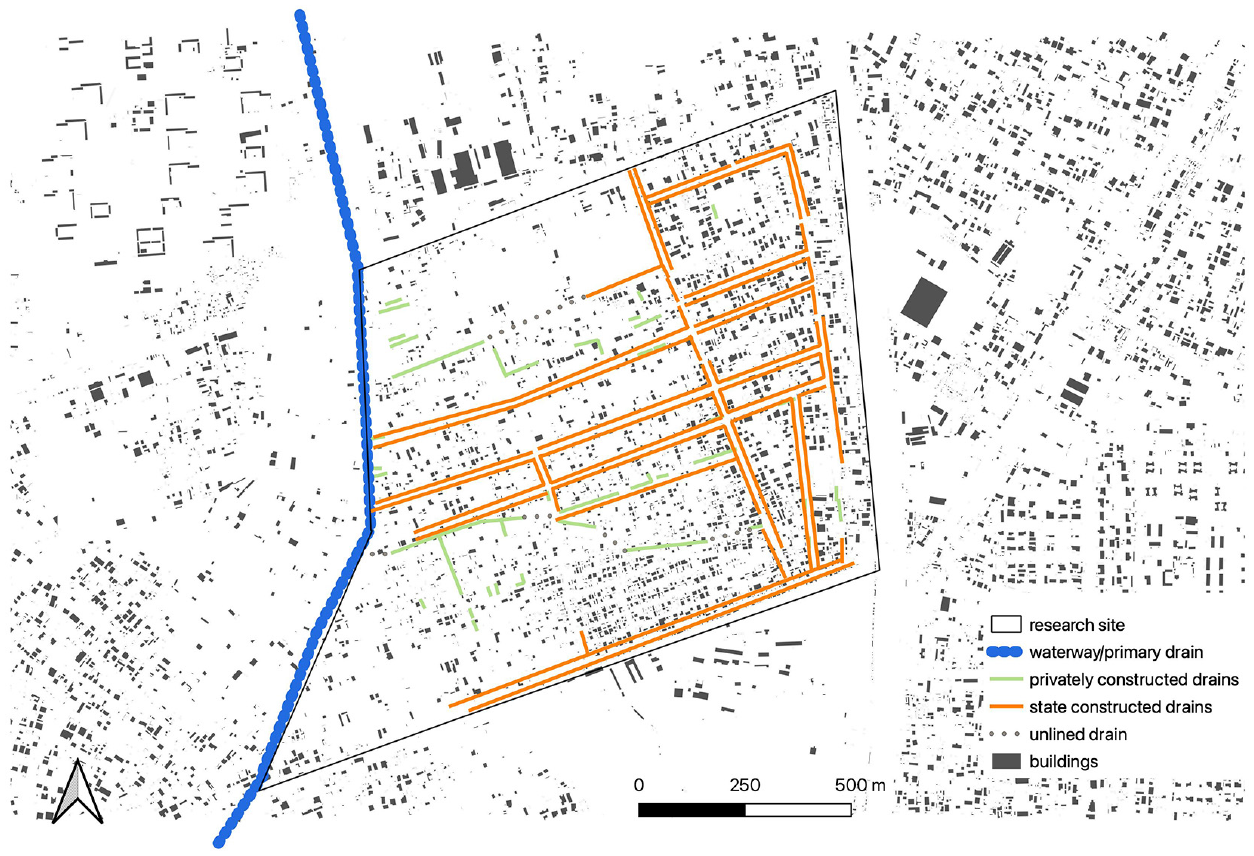
Map of neighbourhood with drains.
A resident association was established in the neighbourhood early on, as has been common in peri-urban Accra (Gough, 1999). Initially the association organised against efforts of the government to dispossess the residents; while the plots had been bought from the chief, the government did not formally allow construction, resulting in a protracted period of uncertainty. The association has fluctuated in popularity over time, however, its importance in organising for regularisation and infrastructure was affirmed by the large turnout at meetings where those topics were on the agenda. Officially, the association is a collective of property owners and tenants, although the former are most represented in practice. The organisation is also referred to as a landlord association, suggesting that it is primarily a collective of property owners. Most of these property owners live in the neighbourhood on their own plots, although there are also absentee landlords. An elected executive board heads the association; at the time of research elections were long overdue.
When the residents of Tuabodom spoke of their neighbourhood, they routinely talked about two groups: the ‘landlords’ and the ‘squatters’. The latter term refers to residents of the neighbourhood living in structures such as kiosks and containers, which distinguishes them from ‘tenants’, who rent cement-block houses. However, these so-called squatters pay rent to landlords or are employed as caretakers, meaning they are not squatting in a juridical sense. The label reflects their standing in the community rather than their legal status: the squatters are perceived as temporary residents and associated with precarity and illegality (Afenah, 2012). The tenure of Tuabodom residents living in kiosks was precarious since landlords could discontinue their leases at any point. In addition, the kiosks were occasionally targeted for removal by the government on account of planning violations or accusations that they harboured criminals (see also Dawson, 2021).
The construction of drains was an urgent topic of discussion when fieldwork started in 2021. At the time, there was no comprehensive network of drains and the roads were not asphalted (see Figure 2). There were rumours in 2021 that the Coastal Authority would ‘soon’ construct 5 km of drains, colloquially known as ‘gutters’. On transect walks, we spotted sections of drainage along segments of streets. Some had been constructed by residents to help channel rain water towards the primary drain 3 and prevent flooding of homes (see Figure 3), as can be seen in the western end of the neighbourhood (see Figure 1), as surface water flowed in that direction.
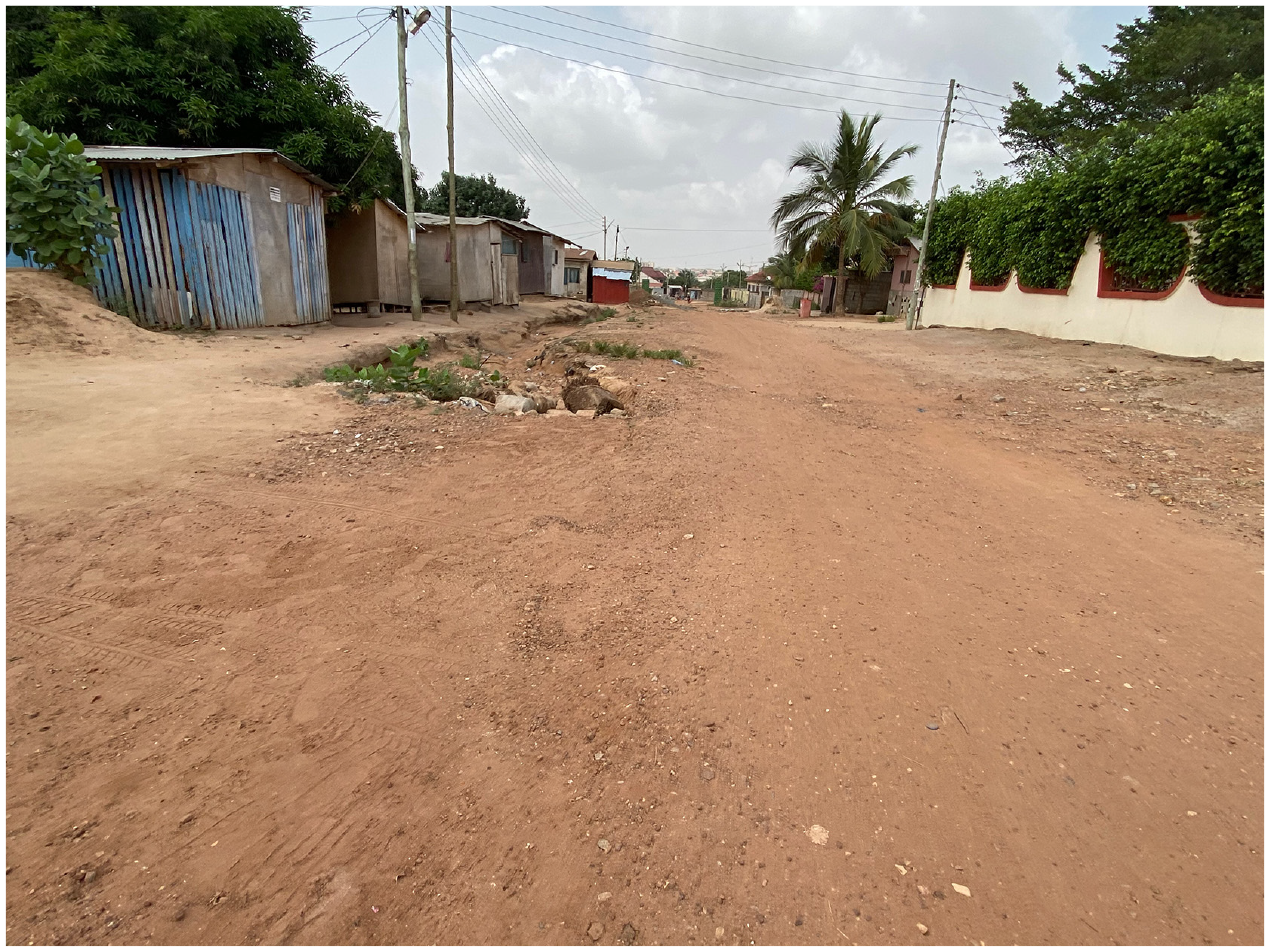
Street in Tuabodom 2021.
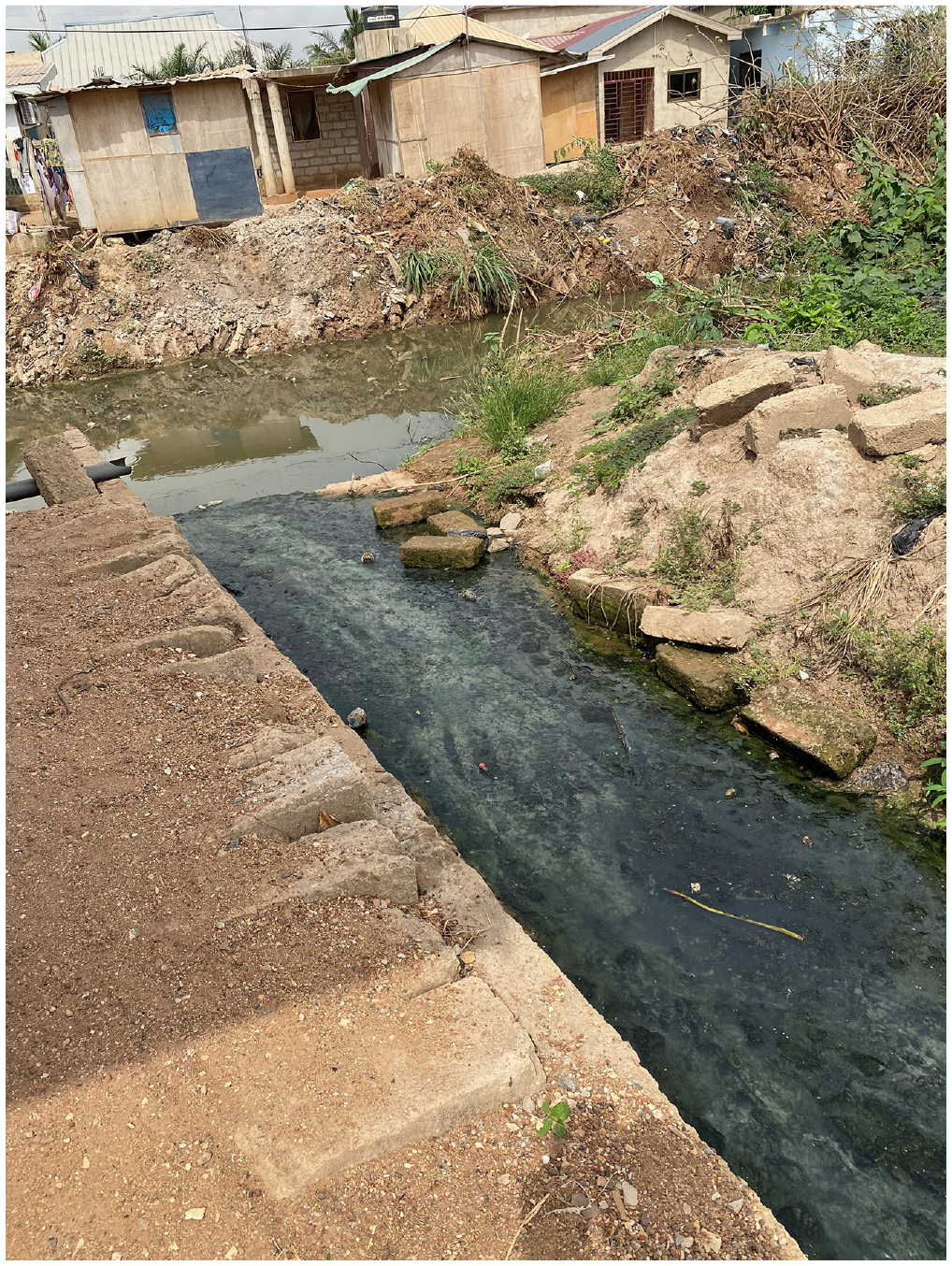
Drain constructed by group of residents, western end of Tuabodom, 2021.
Upon return in 2022, drain construction was underway (see Figure 4). Most residents were in the dark about which streets were designated for intervention, but a pattern emerged showing that most thoroughfares that stretched east–west and north–south without interruption were included. Existing gutters constructed by residents on those streets were replaced. Residents were generally pleased although concerns around the quality and speed of the work were raised, particularly with the rainy season approaching.
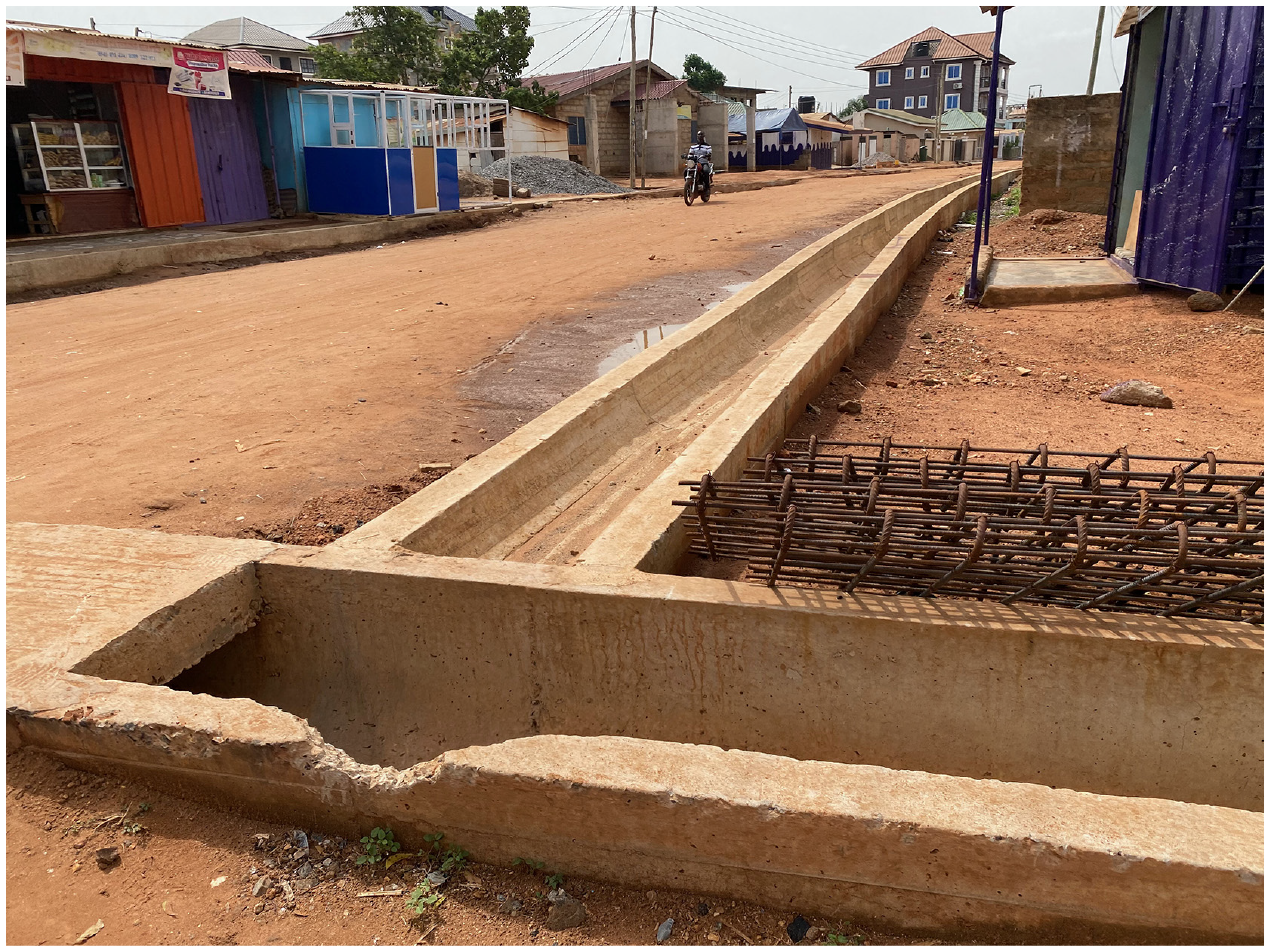
Newly constructed roadside drains in Tuabodom, 2022.
Access to drainage in Tuabodom was uneven. As Figure 1 shows, in parts of the area there was no designated channel for wastewater beyond the facilities that residents had constructed on their own property such as soakaways or manholes. 4 Residents explained that wastewater from the kitchen and wastewater from showers were not the same and may be disposed of through different channels, or into the same soakaway – if the household had one. Most property owners had these, but for those unable to construct such facilities, there was little choice but to throw wastewater on to the streets or, if in the vicinity, walk to the primary drain. Residents across the neighbourhood resorted to this, but, particularly in the dense sections in the south where lower income residents lived, these individualised wastewater management solutions were few and far between, and the area was not prioritised for drain construction.
Roadside drains are primarily meant to channel surface water. Where it fails in this main function, it leads to flooding and erosion – events that most affect the low-lying parts of the neighbourhood close to the primary drain. For some residents, drains would also serve to channel other grey water such as the effluent from bathhouses or kitchens. Most agreed that they were not meant for sewage although some residents living close to the primary drain channelled their sewage into it, which is illegal. Altogether, the drains served as a multi-functional waste channel, and residents used them in various ways.
To study infrastructural politics in Tuabodom, the first author conducted research in the neighbourhood over the course of six months in 2021 and 2022. This includes transect walks done alone or with a research assistant, in-depth and semi-structured interviews with individuals and groups of people, informal conversations with residents approached on the street, participant observation at three resident association’s meetings and discussions with key political and government actors, including three municipal employees, the (acting) chief and the assemblyperson. While we had easier access to property owners through the association, we made extra effort to speak to people renting rooms or living in kiosks who generally are in a more precarious position. We did this by approaching people during transect walks. Whenever we approached residents, we explicitly identified as researchers, indicating that we were interested in the development of the neighbourhood and infrastructure in particular. Residents generally welcomed us and found it natural that we were interested in infrastructure, since they identified this, together with the regularisation of land and housing, as the neighbourhood’s main issue of concern.
To study imaginaries, we rely primarily on interviews and participant observation. In the interviews, we asked neighbourhood residents about their life histories and perceptions of the neighbourhood. Interviewees often spoke in great detail about various types of infrastructures, both as a practical concern and as an indicator for the status of the neighbourhood. Regardless of whether they were involved in collective efforts, they gave accounts of how infrastructure had been constructed and how they envisioned the future. They almost always volunteered a vision of what the neighbourhood would look like. Such visions were also articulated in meetings of the association, with residents pointing out what they considered as problematic and proposing plans to improve the neighbourhood.
To study visceral politics, we again rely on interviews and participant observation but focus more specifically on emotions, including facial expressions, tone and word choice. Stories of encounters with neighbours foregrounded sense perception and visceral politics and led us to an ‘attunement to affective undertones of urban life’ (Fiore, 2021: 38). We often found that neighbourhood residents felt strongly about waste in their immediate environment, talking at length about the disposal of bathwater and excrement. Expressions of abjection were frequent, with interviewees categorising their neighbours according to how they managed their waste. We also talked to the precarious residents – those renting rooms and living in kiosks – about their feelings around waste. They talked about the practical difficulties they faced in properly managing waste but also often articulated sentiments around proper conduct and occasionally expressed feelings of shame, anger and frustration in relation to their status within the neighbourhood.
Breaking down the imaginary of a ‘first-class area’
‘eh you know, if you’re talking about development without infrastructure, it is meaningless. You cannot call a community developed if the drainage is bad, there are no roads and there is no light’.
When we inquired into the neighbourhood’s history and its future trajectory, residents articulated what we have come to call the checklist of development. The residents explicitly aspired to development, which they conceived as a series of ‘spatial interventions and products’ (Simone and Pieterse, 2017) that guide the neighbourhood on a trajectory from ‘bush’ to urban residential space. At every step, the residents of Tuabodom acquired the services associated with urban – as opposed to village – life. The trajectory they envisioned was that from uncultivated land to a fully connected and serviced urban neighbourhood. Not without its normative connotations, it represents an understanding of urbanisation whereby the built environment comes to replace the natural environment. As access to electricity and water had been established, residents were clear on the next phase: drains and roads.
In a meeting with the executive board of the landlord association, the president shared that their core aim was to be a ‘first-class area’. Through interviews with various members of the association, the meaning of a first-class area became clear. This vision incorporated the aforementioned checklist of infrastructure and was expressed through a comparison with high-income areas in Accra such as East Legon, Airport Residential Area and Trassaco Estate. By extension, these members expressed concerns about the neighbourhood moving in an unwanted direction; they feared it would degenerate into a ‘slum’ without intervention. The implication is that the linear development towards a first-class area cannot be taken for granted and that regression is possible. The imaginary of a first-class neighbourhood carried emotional weight and worked to motivate residents to action (Enslev et al., 2018; Reeves, 2017):
‘I took it upon myself that I would want to do this work to bring liberty to myself and the people living in the area, because it is an area that I’m going to live for a very long time. So, I have to take up that responsibility and then take the leadership role to organize the people and then push all these works to be done’.
As these quotes suggest, residents viewed infrastructure as more than a way to meet basic needs; they emphasised the liberatory potential of infrastructural development and spoke of achieving freedom. The hopes and anxieties regarding their neighbourhood’s future were sometimes explained in financial terms, as related to the investments they made as landowners (see Pow, 2017): because they were invested in the area, progress in their personal lives was tied to the neighbourhood’s development.
Drainage infrastructure featured prominently in the imaginary of a first-class neighbourhood and how it was different from what came before (‘the bush’) and what should be avoided (‘the slum’). This understanding ties into experiences of development that material infrastructures often evoke (Appel, 2018). It elicits a view of teleological progress in that it presupposes a linear and uniform, step-by-step introduction of infrastructural interventions in order of importance: electricity and water, drains and roads, streetlights. It is also reflected in the understanding of the power of infrastructure to bring ‘freedom’ (see also Anand et al., 2018). We also see a distinct fear of backsliding – the first-class area is not a sure outcome; it warrants vigilance and work.
The imaginary in practice: Visceral responses
Having established the first-class neighbourhood as the vision many residents aspired to, we turn now to the work that this imaginary does in practice. We suggest that residents viewed not only their physical surroundings but also each other through the imaginary. To understand its political implications, we delve into interactions between residents of Tuabodom, especially pertaining to drainage. Visceral responses play a role in shaping interactions as drainage functions as infrastructure of waste.
First, we see that residents were involved in acquiring development per the checklist, to varying degrees and in different ways. Established residents told stories of organising to carry poles from the main road for the electricity connection. An elderly man spoke of being involved in the demarcation of roads. A prominent member of the association had organised with a Dutch NGO which helped fund the connection to the water network. With regard to drainage, residents’ efforts extended from constructing roadside drains individually or collectively to lobbying the MP and assemblyman, and collectively funding the construction of a culvert.
Fuelled by the imaginary of the first-class area, unevenness in drainage facilities also led to disagreements between neighbours. During one walk in the neighbourhood, I encountered an older man who had a small gutter constructed on the road alongside his property. He complained about the next-door neighbour, whom he said poured their wastewater on to the road, which then flowed down in front of his house. He was annoyed and called the police, which ruined their friendship.
We went to meeting, [and we agreed] everyone should do gutter in front of their house, but [now] people said they don’t have money. It would be better if everyone does it. […]. Gutters are the main issue here.
Another resident, an active member of the association, expressed his disappointment in the drainage practices of his neighbours, who poured their water on to the street.
We discussed it at our meeting […] and everybody bore witness that that is what is happening all over the zone. And if you go and confront the person you will regret doing it because I did it and how the woman and her children insulted me
With friendships ruined and insults lobbed between neighbours, drainage is clearly a source of tension. In describing their concerns with regard to wastewater, residents displayed their sense of disgust and discomfort and condemned practices that confronted them with others’ waste. Bathwater in particular has cultural relevance: many referenced the traditional ‘taboo’ of stepping in someone else’s bathwater. Encounters with others’ wastewater may infringe on an embodied sense of status, leading to intense disagreements between neighbours.
While some residents expressed a disgust of wastewater and responded angrily, other residents had little choice but to pour their wastewater on to the road as they had no proper drainage or soakaway. Those residents, however, also reproduced the norm that their wastewater should be invisible. Some defensively pointed out that they poured water evenly so as not to create puddles, rather they were settling dust. They were aware that it was not appreciated by some residents. When asked to identify who those discontented people were, they pointed to the property owners. Two residents described them as ‘those with cars’, pointing to the class and income divides that shape both drainage practices and the linked disagreements.
Not only the sight but also the odour of particular forms of waste became unbearable and triggered conflict.
‘It’s just here, [that] restaurant. The woman started, madam, we suffered here oooh. When you reach there, you can’t [handle the smell] … fish, beans, even banku [local dish] down there so the place was really smelling. And do you know, I said this woman I will deal with her because when you confront her, I went there, she talked rubbish to me’.
From the quotes above, we can see how residents expressed indignation about what they perceived as transgressive drainage practices. They policed these norms through confrontation. Patience, who complained of both physical and verbal rubbish, made an announcement with the community-centre megaphone (run by her and her husband) that the restaurant was unsanitary and should be avoided. It had as an immediate effect that residents avoided the restaurant, a testament to Patience’s status and concerns around food-borne disease. According to Patience, the proprietor of the restaurant brought a community elder with her to mediate and apologised. Once she dug a soakaway to deal with her kitchen waste, another community-wide announcement was made to reinstate the restaurant into good standing.
We further found that drainage and waste figure into the interdependent yet asymmetric relations between the groups of residents that are labelled as ‘landlords’ and ‘squatters’. As mentioned above, the people referred to as ‘squatters’ often pay rent – the label is not a description of their legal status but rather reflects the idea that they are transient. Sanitary practices alone do not account for the status of people living in kiosks, but they play an important role. They have no or poor access to sanitation facilities. Most interviewed used the public toilets and had constructed ‘bath houses’ for showers. The bath houses were usually made of three or four plywood pieces or aluminium roofing sheet to create a shower stall with wastewater collected or allowed to flow into a gutter or on to the street. As they had no access to soakaways or manholes, conflicts around bathwater were common.
One landlord linked the kiosks to problems with the drains after explaining how she directed visitors to her home over a route that avoided most clusters of kiosks and puddles on the road. Here, Akosua (who had a soakaway in her compound) expressed shame in her tactics to distance herself from parts of the area she considered unsightly, directing visitors over a backroad into the neighbourhood. She identified messy roads without gutters and clusters of kiosks as equally problematic in the same breath. The imaginary of a developed locale that landlords described was reflected in their visceral discomfort with people living in ways that offended their sensibilities and did not match their ideal of a ‘first-class area’. Another landlord explicitly linked the development of infrastructure to the departure of ‘squatters’. As a variant of the imaginary of a ‘first-class area’, he spoke of an ‘estaterial neighbourhood’, one that reflected the qualities of a gated community, known in Ghana as an ‘estate’.
Agneta described to us how her husband had planned to construct a toilet for their cluster of kiosks, but the neighbouring landlord stopped them, concerned that the smell would become a problem. Agneta went on to share how she rushes her children to the primary drain when they have diarrhoea, as the public toilet is far, illustrating how drainage and sanitation are intertwined. Encounters like these have an emotional impact on residents living in kiosks, an impact palpable from Agneta’s frown and the way she paused washing dishes intermittently to shrug and shake her head. Caesar described the relationship between landlords and kiosk inhabitants in the following way:
‘And then the landlords do not respect people living in kiosks, they don’t care about us. They don’t respect us, like we’re nobody. So, if there is anything we cry in our heads, yeah it really disturbs us in our own mind’
Caesar’s experience illustrates the stigmatisation that the people living in kiosks had to deal with. In the absence of a comprehensive drainage system, sanitation practices became a site of contention. In the above examples, we see how visceral responses reveal dynamics of power between neighbours. For those with private bathrooms and well-functioning drainage, marginalised residents’ sanitation practices reflected a lack. The latter in turn believed that their risk of being targeted increased if they were perceived as violating norms of cleanliness.
In these accounts, the visceral sensation of waste underpins drainage’s role in shaping social relations in Tuabodom in the gap between the imaginary and the reality. Experiences of disgust, shame but also the aforementioned feeling of hope for liberation come forward and we see how affect and embodiment are central in how residents relate to each other and to their environment. While disgust and shame may trigger conflict, avoidance and exclusionary practices, hope and aspiration fuel collaboration and generosity. These sometimes-conflicting practices occur simultaneously.
Negotiating a shared imaginary
Having established the visceral aspect of the imaginary shaping social relations, we turn now to the negotiations that the imaginary prompts. While those living in kiosks experienced a profound sense of stigmatisation, there was no guarantee that there is a linear progression to a fully-serviced neighbourhood in which they have no place. In the everyday social life of the neighbourhood, relations between the groups might be tense and asymmetric, but there is a negotiated balance. Much like Tuabodom’s infrastructure itself, the politics invoke incompleteness (Guma, 2022) and heterogeneity (Pilo’, 2023).
In Tuabodom, as in many cases described in the literature, some try to collaborate with the government to upgrade their neighbourhood and displace the poor (see e.g. Ghertner, 2015; Pow, 2017). However, while landlords may confront norm violators, there is no guarantee that this will have the intended effect. In fact, there was often pushback from those who were confronted. Landlords, despite their strong statements, expressed powerlessness with regard to the drainage practices they found unacceptable. Their frustrations about disagreements with neighbours reflect the limits to their ability to shape the neighbourhood according to their imaginary.
While landlords generally imagined a future without kiosks, in practice such structures were put in place both before and after cement houses were built, suggesting that the different types of dwellings have a more symbiotic relationship than acknowledged. In fact, when looking at older neighbourhoods of Accra, we generally do not see a transition towards homogeneous wealth: unless a neighbourhood is constructed from the outset as an exclusive area and heavily policed through zoning, it is common to find poor and rich residents living in close proximity (Adugbila et al., 2023). In the case of Tuabodom and other peripheral neighbourhoods which develop incrementally, this is in part because people living in kiosks are often there because of the landlords: they pay rent to the landlords, look after landlords’ plots of land or unfinished buildings, and do domestic or construction work (Adu-Gyamfi, 2021; Gough and Yankson, 2010). The landlords overwhelmingly did not provide drainage and sanitation to these residents; in one case, the landlord explained that he believed that the residents would not keep them clean. At the same time, both groups want to find ways of preventing the most ostentatious transgressions. As a result, they negotiate, mediate and improvise until a more or less acceptable solution is reached.
The example of a conflict over a bathhouse as narrated by Caesar is illustrative. Caesar, who lived in a kiosk with his son, described one incident regarding the bathhouse where he lived. Wastewater from their bathhouse, used by all kiosk occupants on the plot, flowed freely on to the ground, by a welder’s workplace and into the street. One day, the welder decided he had had enough and plugged the hole of their bathhouse with plastic. Once the users of the bathhouse realised the welder was sabotaging it, there was a back-and-forth with the plug being removed and replaced until a solution was found: shortening the pipe leading out of the bathhouse and placing a plastic gallon underneath that could be emptied into a more appropriate place. In this example, as in many others, residents struggled with each other but also collaborated, working out a solution that provisionally resolved conflicts and reflected their asymmetric power relations.
This exchange underlines an insight into the role that compromise plays in the shared imaginary and its visceral politics. We see compromise throughout our examination of what residents found important, how they have organised and worked for infrastructural development and how they negotiated conflict in a changing situation. The arrival of drainage infrastructure, albeit non-comprehensive, raises questions about its impact on social relations mediated by the sensory-spatial norms. As the neighbourhood becomes more established over time, and more items are ticked off the checklist, what does that mean for the imaginary and its visceral politics? Residents’ initial responses sketch a dynamic whereby landlords will continue to police sensory-spatial norms, with perhaps solid-waste as the next frontier. As we consider a situation where the neighbourhood remains diverse, we also consider how the imaginary will be changed by the developments in the neighbourhood’s infrastructure.
In interviews with established residents, the modern infrastructure ideal is often articulated – they say they want to move towards a fully connected neighbourhood soon, expect the government to support them, and hope that those who are deemed out of place will leave. However, in everyday life, the imaginary is not imposed on the neighbourhood from the top-down; no comprehensive government intervention has occurred. Residents, and occasionally government agencies, work towards a better connected, more developed neighbourhood, but they do so pragmatically and incrementally. In practice, residents have what Lawhon et al. (2023) refer to as a ‘modest imaginary’. It aspires to a fully serviced neighbourhood but does so through negotiation, improvisation and compromise. The bathroom gallon, the soakaway for restaurant waste and the sprinkling of water to settle dust are negotiated practices and interventions which confirm sensory-spatial norms. They may not exemplify the realisation of the ideal of a ‘first-class area’, but they provide pragmatic solutions both to people able to invisibly dispose of their wastewater and those who are not. Such compromises smoothen relations between the different groups in Tuabodom and bring the neighbourhood one step further towards ‘development’.
Conclusion
Literature on southern urbanism has shown how normative conceptions of linear infrastructure development are not universally useful standards with which to understand infrastructure provision (Baptista and Cirolia, 2022; Guma, 2020; Jaglin, 2015; Lawhon et al., 2018). However, less attention has been paid to how imaginaries are reproduced and contested by urban residents themselves. This article has examined infrastructural imaginaries through the lens of drainage infrastructure in a neighbourhood on the periphery of Accra, where drainage infrastructure is developing and a diversity of drainage practices abound.
We have argued that residents’ imaginaries and visceral experiences should be central to understanding how infrastructures and social relations coevolve. This article emphasises the importance of studying embodiment and infrastructure together (Desai et al., 2015). We showed that established residents conceive of neighbourhood development as a linear process that should ultimately result in the departure of practices (and by extension people) they find objectionable. In this sense, the aspiration towards ‘development’ informs the stigmatisation of low-income and precarious residents who are felt not to conform to drainage norms. However, in everyday encounters, imaginaries and norms are contested and negotiated. Established residents did not have the means to simply remove low-income residents. Also, low-income residents shared aspirations to improve drainage and contributed to ways to reduce the visibility of wastewater. As they made minor and negotiated adjustments – installing pipes, using containers, etc. – residents worked towards a neighbourhood that conformed more closely to their aspirations. In the process, they encountered each other and the limits of their power.
Finally, the example of Tuabodom suggests that a neighbourhood where residential settlement is in progress (Harris, 2010), where visions for a future are in the making more visibly than otherwise, is an apt site to study urban imaginaries in practice. Much of the literature on the infrastructure imaginaries and its politics takes on large-scale infrastructure; we suggest that imaginaries are also operative at the microlevel in interactions between residents. We see these imaginaries embodied by urban residents in everyday practices and shaping urban politics. We can connect their imaginaries to widely held aspirations for the urban future in different African cities, which often refer (and defer) to foreign models, whether Western (Okoye, 2021) or cities of the Middle East and East Asia (Watson, 2014). Unlike the ‘fantasy cities’ of Watson’s study, Tuabodom residents’ imaginary of progress is greatly functional: working drainage that brings an end to erosion and flooding. That marginalisation and exclusion are among the outcomes of these efforts show that post-networked infrastructure forms are not always democratic or just (see also Amankwaa and Gough, 2021) as they are embedded within the unequal urban geography of Accra where affordable housing and land are scarce (Awanyo et al., 2016; Gillespie, 2018; Grant, 2009). At the same time, the heterogeneous practices on the peripheries suggest alternative ways of imagining and attaining progress through infrastructure: through compromise and the cultivation of truly shared norms.
Footnotes
Acknowledgements
Many thanks to our interlocuters in ‘Tuabodom’ who were welcoming and open, may your efforts to acquire drainage come to fruition. A big thank you to Eyison Yirenkyiwa for her assistance in the neighbourhood. We are grateful for the constructive comments of the Urban Studies editor and reviewers; the article is greatly improved as a result. Finally, we thank Rivke Jaffe for her comments on previous versions of the text.
Declaration of conflicting interests
The author(s) declared no potential conflicts of interest with respect to the research, authorship, and/or publication of this article.
Funding
The author(s) disclosed receipt of the following financial support for the research, authorship, and/or publication of this article: Nederlandse Organisatie voor Wetenschappelijk Onderzoek, Grant No. 452-17-003.
