




Abstract
Toxic pollution is a form of violence. This article explores the gradual brutalities that communities surrounded by petrochemical infrastructure endure over time. Contributing to political geographies of violence and environmental justice, this paper puts the concept of ‘slow violence’ into critical comparison with work on ‘structural violence’. In doing so, the paper makes two key contributions: First, it emphasizes the intimate connections between structural and slow forms of harm, arguing that structural inequality can mutate into noxious instances of slow violence. Second, the paper pushes back against framings of toxic landscapes as entirely invisible to the people they impact. Instead of accepting the standard definition of slow violence as ‘out of sight’, we have to instead ask the question: ‘out of sight to whom?’ In asking this question, and taking seriously the knowledge claims of communities who inhabit toxic spaces, we can begin to unravel the political structures that sustain the uneven geographies of pollution. Based on long-term ethnographic research in a postcolonial region of Louisiana, nicknamed ‘Cancer Alley’, this paper reveals how people gradually ‘witness’ the impacts of slow violence in their everyday lives. Finally, drawing on the notion of ‘epistemic violence’, the paper suggests that slow violence does not persist due to a lack of arresting stories about pollution, but because these stories do not count, thus rendering certain populations and geographies vulnerable to sacrifice.
The provocation of time
Time is enjoying increased attention within critical geography. Timely calls for a politics of ‘slow scholarship’ (Mountz et al., 2015), for example have been a breath of fresh air for those of us who are trying – and failing – to keep pace with the compressed timescapes of the University Industrial Complex (see Harrowell et al., 2018). Perhaps the most seismic temporal shift within geography and the wider social sciences has been the rapid uptake of the term ‘Anthropocene’, which attempts to mobilize deep time, and recast climate change from a risky future, to a very real and perilous present (Yusoff, 2018). Another temporal trope that powerfully communicates environmental threats is the Bulletin of Atomic Scientists’ ‘Doomsday Clock’. This collective of nuclear and climate experts uses the symbolism of a ticking timepiece to communicate current hazards, from nuclear conflict, to impending environmental destruction. The election of President Trump in 2016, for example saw the apocalyptic clock brought forward to ‘two and a half minutes to midnight’.
Like slow scholarship, the Anthropocene, or the Doomsday Clock, Rob Nixon’s (2011) concept of ‘slow violence’ uses time as a provocation. As Nixon (2011) explains: ‘By slow violence I mean a violence that occurs gradually and out of sight, a violence of delayed destruction that is dispersed across time and space, an attritional violence that is typically not viewed as violence at all’ (2).
The impacts of slow violence are ‘pervasive but elusive’ (Nixon, 2011: 3) and resonate with Churchman’s (1967) notion of ‘wicked problems’; they are often attritional, disguised, and temporally latent, making the articulation of slow violence a representational challenge. In a world of click-bait and 24 hour news, how do we make sense of long-form disasters that do not display themselves in spectacular moments of terror as a single event, but instead quietly accumulate and defer their damage over time? How can the delayed violence of microplastic pollution, endocrine disruptors, antimicrobial resistance, and countless other technological hazards compete with the immediacy of more cinematic threats? How do we come to terms, Nixon (2011) asks, with the toxic residues, degraded ecologies, and intergenerational harms that are ‘resistant to dramatic packaging’ (200)? Slow violence presents us with a political geography of deferred environmental threats, where violence is outsourced – not only to the Global South – but also to a Global Future. Toxic pollution, species loss, and climate change are the silent killers of our age, yet the casualties of such drawn-out emergencies appear geographically and temporally remote. As Nixon (2011) explains, ‘to confront slow violence requires…that we plot and give figurative shape to formless threats whose fatal repercussions are dispersed across space and time’ (10). I suggest that geographers are well equipped to take up this challenge; of closing the distance between cause and effect, and narrating the longue durée of dispersed environmental harm. In this article I suggest that – above all – it is the communities who are exposed to slow violence who are best placed to witness its gradual injuries. For those who live in the midst of toxic geographies and polluted landscapes, ‘everyday exposure’ (Wiebe, 2016) to the accumulations of slow violence is not necessarily a ‘formless threat’ but can be a very real and often tangible brutality.
This article unfolds in five parts. First, I situate the study of violence within human geography, and highlight the potential of slow violence within the discipline as a temporal and spatial concept. Second, I interrogate the term ‘slow violence’ (Nixon, 2011) through a detailed comparison with Johan Galtung’s (1969) influential idea of ‘structural violence’, arguing that the two conceptualizations of systemic brutality are irrevocably linked. In the next section, ‘Actually Existing Slow Violence’, I introduce an empirical case study of a polluted region in southern Louisiana, nicknamed ‘Cancer Alley’. Through indepth ethnographic research with a small community surrounded by a high concentration of petrochemical infrastructure, I reveal how the structural violence of racism and plantation geographies has mutated into noxious forms of slow violence. The penultimate section of the paper, ‘Witnessing Slow Violence’, questions the implicit invisibility of toxic geographies, and highlights the many ways local communities slowly bear witness to the attritional threats of pollution. Here, I argue that slow violence is not necessarily ‘out of sight’ (Nixon, 2011: 2) to the people it impacts, but can instead be made knowable through what I term ‘slow observations’ (Davies 2018: 1549). I suggest it is the gradual velocity of slow violence that makes this informal expertise possible. Finally, evoking Spivak’s (1988) notion of ‘epistemic violence’, I conclude that slow violence does not persist due to a lack of arresting stories about pollution, but because those stories do not count, thus rendering certain populations and landscapes vulnerable to sacrifice.
Geographies of violence
This paper contributes to growing scholarship on the geographies of violence. Geographers have focussed on violence in various insightful ways, including its representation (Gallaher, 2004) and aftermaths (Allen and Isakjee, 2015; Rice and Tyner, 2017); as well as the fear of violence (Pain, 2014a; Tyner, 2012; Valentine, 1989); the memorialization of violence (Harrowell, 2015; Sharp, 2014; Tyner et al., 2014); the geopolitics of violence (Pain and Staeheli, 2014; Woon, 2014); legal responses to violence (Blomley, 2003; Sundar, 2001); its links to neoliberalism (Cooper and Whyte, 2017; Springer, 2009, 2010, 2011; Tyner, 2016); humanitarianism (Lopez et al., 2015); healthcare denial (Davies and Isakjee, 2015; Dhesi et al., 2018; Disney, 2017; Loyd, 2009); the environment (Yusoff, 2012); urban space (Fregonese, 2009; Pavoni and Tulumello, 2018); and war (Fluri, 2011; Forsyth, 2014; Shaw, 2016); as well as related work on the geographies of peace and nonviolence (Courtheyn, 2017; Harrowell, 2018; Inwood and Tyner, 2011; Loyd, 2012; Williams and McConnell, 2011). This growing discourse is both compelling and varied, and academics have rightly argued that ‘geography must lie at the centre of any discussion of violence’ (Tyner and Inwood, 2014: 1). Thus far however, geographers have only played a limited role in exploring the notion of slow violence.
Despite geography’s fetish for thinking about space in relation to time (Merriman, 2012), geographers have, with a few exceptions (see Davies et al., 2017; Davies, 2018; De Leeuw, 2016; O’Lear, 2016; Pain, 2019), overlooked the conceptual and temporal provocations offered by Nixon (2011). Geographers of violence have nevertheless attuned themselves to temporal dimensions of violence in other ways. For example, attempts to ‘denaturalize’ violence have highlighted the specific geographic and historical contexts within which violence is reproduced (Tyner et al., 2014). Likewise, Springer (2012) rightly pushes back against static, bounded, and fixed explanations for violent outcomes, advancing the notion that violence is an unfurling and processual moment (Springer and Le Billon, 2016). By situating the fluidity of violence also in terms its relationality, Springer (2011) views violence ‘as an unfolding process, derived from the broader geographical phenomena and temporal patterns of the social world’ (90).
Recent geographical scholarship that does engage with slow violence includes O’Lear’s (2016) research into the violent implications of dominant climate science, as well as work that explores the necropolitical terror of slow environmental pollution (Davies, 2018). Geographers have also gone beyond an explicitly environmental focus in their employment of slow violence. For example, Pain (2019) uses slow violence to discuss the chronic trauma of housing dispossession, and De Leeuw (2016) uses it to examine the gradual brutalities caused by state-removal of children from Indigenous families in Canada. Meanwhile, other geographers have used slow violence in relation to migration, to articulate the delayed suffering of refugees trapped at EU borders, who are exposed to deliberately insufficient public health conditions (Davies et al., 2017). With slow violence having much to offer as a temporal and spatial concept, the door is surely ajar for more sustained engagement with slow violence from a geographical perspective.
Theorizing violence
But what do we mean by violence? Violence is simultaneously a very simple yet deceptively difficult concept to pin down. In part, this is because of the ontological status that violence is afforded, which shields the concept from further scholastic scrutiny (Laurie and Shaw, 2018; Tyner and Inwood, 2014). As critical geographers have discussed, what society includes under the label ‘violence’ is a mirror to the value system of that society. What counts as violence is therefore ‘complex, mimetic and protean’ (Springer and Le Billon, 2016). It is, as Tyner and Inwood (2014) note, ‘intimately associated with the modes of production that both constitute, and are constituted by, society’ (1). That environmental violence has largely – until now – ‘not [been] recognised as violence at all’ (Nixon, 2011: 2) reflects the diminutive status of the environment within contemporary society. The invocation of ‘slow violence’ is therefore a political attempt to counter this.
To name something ‘violent’ emphasizes two key characteristics: the presence of brutality, and the notion of intent (Mukherjee et al., 2011). At its best, the use of the term ‘violence’ to discuss disparate forms of social injustice can become a call to arms; a rallying cry for activists (and others) in their quest for political change. At its worst however, the concept of violence can be overused, diluted, and flattened beyond any point of political purchase. As Alvares (1988) wrote, ‘violence now includes new and strange forms of mutation’ (69), and when the concept of violence is extended to its outermost limits, the potency of the term evaporates. The concept of violence is amorphous and malleable, and there is a danger of stretching the metaphorical elasticity of the term to breaking point, rendering everything – and therefore nothing – the status of ‘violence’. After all, depending on how we cut our conceptual cloth, ‘we can find the ignominious expression of violence in virtually every facet of our everyday existence’ (Springer and Le Billon, 2016). As Farmer (1996) astutely observed, ‘everyone knows that suffering exists. The question is how to define it’ (261).
Violence continues to be fertile philosophical terrain for many social theorists. Scholars as influential as Arendt (1970), Foucault (1977), and Benjamin (1978) – among many others – have all tackled violence directly in their work. Despite recent scholarship arguing that violence and agonism are overplayed within geography (Bregazzi and Jackson, 2016), a vast and rich conceptual typology of violence now exists, from which geographers can theorize their research. This includes ‘structural violence’ (Galtung, 1969); ‘epistemic violence’ (Spivak, 1988); ‘epistemological violence’ (Shiva, 1988); ‘symbolic violence’ (Bourdieu, 1979); ‘cultural violence’ (Galtung, 1990); ‘administrative violence’ (Spade, 2015); ‘gendered violence’ (Pain, 2014b); ‘colonial violence’ (Fanon, 1963; see De Leeuw, 2016); ‘insidious violence’ (Marguerat, 1996); ‘normalized violence’ (Bourgois, 2001); ‘objective violence’ (Zizek, 2008); ‘banal violence’ (Yusoff, 2012); ‘infrastructural violence’ (Rodgers and O’Neill, 2012; Li, 2017); ‘silent violence’ (Watts, 2013); ‘abstract violence’ (Tyner et al., 2014); and ‘violent inaction’ (Davies et al., 2017) – to name just a few. Each one, in its own way, attempts to repackage violence, and reveal situations of injustice that are embedded in the social, cultural, legal, economic, and political frameworks of society. With this list of violent concepts seemingly endless, it is important to interrogate what ‘slow violence’ can add to this conversation. One way of doing so is to closely compare slow violence to its conceptual predecessor – structural violence (Galtung, 1969).
From structural to slow violence
As this paper will demonstrate, structural and slow violence are inextricably linked. Johan Galtung (1969) forwarded the notion of ‘structural violence’ to account for suffering caused through the denial of basic needs. He argued that violence ‘is present when human beings are being influenced so that their actual somatic and mental realizations are below their potential’ (168). According to Galtung, institutionalized forms of racism, sexism, classism, etc. not only restrict quality of life, but are violent in their outcome. Following this, Nixon (2011) makes it abundantly clear that slow violence is an inherently structural concept, by drawing closely upon Galtung’s work. 1 Nixon (2011: 10–11) directly acknowledges the influence of Galtung (1969), commenting on the overlap between structural and slow conceptualizations of violence. Both framings expand violence beyond the personal, the direct, and the immediate. They are both are an attempt ‘to complicate conventional assumptions about violence’ (Nixon, 2011: 3), and they interrogate instances of suffering that have no obvious author. Indeed, both slow and structural theorizations of violence locate sources of brutality within the routinized workings of society itself, through a systemic normalization of that suffering (Tyner and Rice, 2016).
Nixon (2011) describes slow violence as ‘out of sight’ (2), and structural violence too shares this camouflaged characteristic. As Galtung (1969) explained, ‘structural violence is silent… [and] may be seen as about as natural as the air around us’ (173). Examples of structural violence – such as the ‘unequal life chances’ (171) of marginalized populations – can be socially concealed, ingrained, and institutionalized beyond recognition. Just as the damage of slow violence can remain unnoticed – such as the deadly accumulation of toxic pollution – so too can the ‘vulgar banality’ of structural forms of suffering remain hidden in plain sight (Davies et al., 2017: 2069). In Galtung’s (1969) reworking of violence, there is an implicit immobility and entrenchment to these harmful structures; it is their very embeddedness, fixity, and ability to appear ‘natural’ that gives structural violence its silent potency.
This immobility can be contrasted to Nixon’s (2011) conceptualization of slow violence, which is less static and offers ‘broader, more complex descriptive categories of violence enacted over time’ (11). In doing so, Nixon provokes us to consider the various scales and speeds at which violence takes place, inviting us – in a very geographical sense – ‘to foreground questions of time, movement, and change, however gradual’ (11). As Nixon (2011) explains, ‘what I share with Galtung’s line of thought is a concern with social justice’ (10). I would go further, and suggest that structural and slow violence are irrevocably linked: to evoke slow violence without attending to its structural foundations is an impoverishment of the concept. In order to mobilize the concept within critical geography, it is vital to reveal the structural and political forces that permit gradual brutalities to persist. As I will demonstrate in the empirical section of this paper, structural and slow violence can be symbiotic and mutually reinforcing.
In light of Galtung’s work, we can see that slow violence is not simply about time and the uneven velocity of social harms; rather, it is also attuned to the uneven structures that allow such brutalities to gradually propagate. In this sense, slow violence is a concept concerned with ‘who gets to decide the course of human-environment relationships’ (O’Lear, 2018: 94). As Nixon (2011) makes clear, slow violence is built on the bedrock of social inequality, with ‘those people lacking resources [becoming] the principal casualties of slow violence’ (4). Just as the impacts of anthropogenic climate change will not be felt equally, nor too will other drawn-out instances of slow distress (see Sealey-Huggins, 2018). Put another way, the concept of slow violence has a purview that extends beyond the speed of social harms, and includes a desire to expose inherent inequalities. With this in mind, I wish to expand and reify this discussion through an empirical case study that showcases the lived experience of slow violence in a polluted place.
The following section focuses on ethnographic research between 2016 and 2018 with a community that inhabits a highly toxic landscape in Louisiana, USA. In doing so, I will demonstrate how structural inequality can mutate into slow violence. I will then probe the assumption that slow violence is necessarily invisible to the populations it impacts. Instead of accepting Nixon’s (2011) oft-cited definition of slow violence as ‘out of sight’ (2), we have to instead ask the question: ‘out of sight to whom?’ In asking this question, and taking seriously the knowledge claims of communities who live in toxic spaces, we can begin to unravel the power structures and politics that sustain the uneven geographies of pollution. Approaching the study of environmental injustice through a sustained ethnographic engagement reflects the gradual temporalities of slow violence and is therefore consistent with the philosophy at the centre of this paper. In doing so, the paper presents a much needed alternative to trends swept up in big data, spatial analysis, and quantitative metrics in which the lived experience of people is overlooked. This approach also complements the representational accounts of slow violence offered by Nixon’s literary focus. This paper builds on a recent body of work that explores the uneven politics of toxic geographies (Bagelman and Wiebe, 2017; Davies, 2018; Liboiron et al., 2018; Micieli-Voutsinas and Cavicchi, 2019; Nunn, 2018; Boudia and Jaz, 2014). The following ethnographic vignettes are part of a larger investigation into the experience of pollution and environmental (in)justice within the global petrochemical industry.
Actually existing slow violence
The small rural settlement of Freetown is situated on the western banks of the Mississippi River, midway between Baton Rouge and New Orleans. Surrounded on either side by rolling sugarcane fields, this superficially bucolic setting belies its industrial heritage: the lower course of the Mississippi River hosts the densest cluster of chemical facilities in the western hemisphere (Allen, 2003; Mah, 2015; Singer, 2011). Within an 85 mile stretch of riverscape, no less than 136 petrochemical plants and seven oil refineries undertake the dirty work of processing crude oil into lighter more valuable hydrocarbons – as well as heavier byproducts (Figure 1).
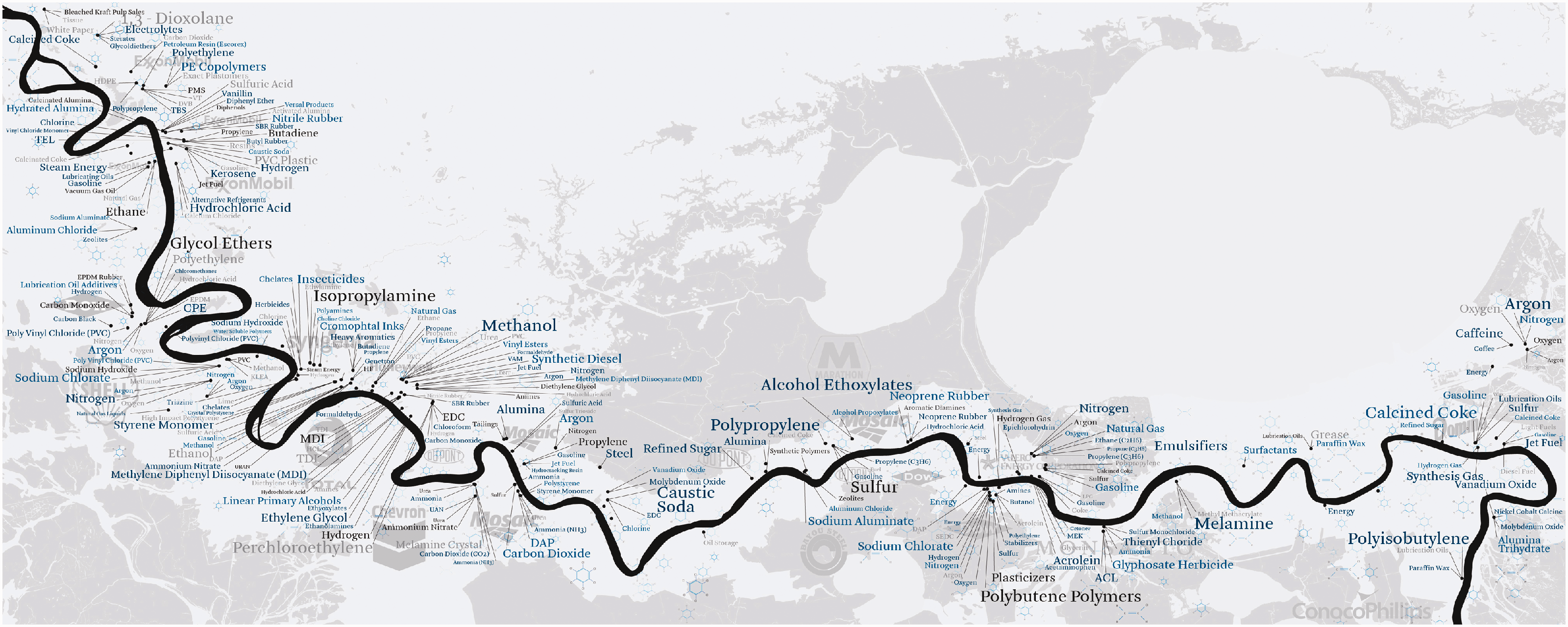
Titled ‘Petrochemical Landscape’, this map showcases the chemical geographies of Cancer Alley, along the lower stretch of the Mississippi River in Louisiana (Misrach and Orff, 2014). Source: Map courtesy of Kate Orff.
As you drive along the concrete interstates that rise above the swamps and bayous of south Louisiana, a metallic assemblage of catalytic crackers, reformers, visbreakers, and fractionating columns dot the horizon. This interconnected and sublime ‘oil assemblage’ (Watts, 2015a: 236) helps to break down – or fractionate – a cocktail of hydrocarbon molecules, from which high octane gasoline, benzene, ethylene, diesel, butadiene, methanol, bitumen, asphalt, polycarbons, jet fuel, sulphur, and solid coke are produced, among many other reactive, mundane, useful, and toxic substances. With Louisiana hosting almost one-fifth of total US oil reserves; one-tenth of natural-gas reserves; 2 and employing an estimated 16.2% of its labour force directly in the oil and gas sector (API, 2014), this petrochemical assemblage undoubtedly supports ‘a vibrant and distinctive working-class oil culture’ (Watts, 2015b: 172). Yet for some communities and environmental activists who live alongside ‘the guts of the industry’ (Appel, 2015: 18), the region between these two river-cities is regularly referred to as Cancer Alley. Indeed, a perception of increased health risks associated with the visible presence of petrochemical infrastructure is widespread in the region (Allen, 2003; Ottinger, 2013; Pezzullo, 2007).
Living slowly with pollution: Stationary displacement
Daisy 3 has lived in Freetown her whole life. For seven decades she has witnessed the slow accumulation of pollution gradually impact the local area: the invasive chemical smells, the gossiped-accounts of elevated cancer rates, and the vegetation in her garden wilting where once it thrived. At times, she explained, ‘the air is so full with gas you can hardly breathe’. Sitting in her trailer home, she handed me an old handwritten parchment. The crumpled text proclaimed, in antiquated legalese: ‘Be it known that in the month of January in the year of our Lord 1878…’. It was a succession deed that formally recognized Daisy’s forefather as the owner of the property; one of the first freed slaves to be allowed to own land in this part of postbellum Louisiana. ‘My grandparents bought this land…’, she explained: ‘…We been on this land; every generation been on this land, from eighteen-whatever-it-was when they got it’. The document, which Daisy neatly folded and placed back in her bedside drawer, might one day be crucial, if the legal cases against the surrounding petrochemical companies ever came to fruition. She wasn’t totally sure if she wanted to relocate however. For a start, where would she go? And second, ‘they’re not gonna give us the kind of money we need’. What she did know however, in the words of her local Pastor, was that: ‘If you stay here - you die’.
Looking out from Daisy’s veranda, the tall green sugarcane fields quickly give way to eight cylindrical chemical storage tanks, just some of the 118 large gas containers – known as ‘tank farms’ – that have been built within a 2 mile radius of her home in St James Parish. A sprawling petrochemical assemblage is slowly encroaching on the lives of the local community here, in gradual and intimate ways. ‘It was beautiful to live here before they started putting those tanks and things…’, she reminisced: ‘It really was. It really was a nice place to live. Everything was all healthy’. Like others in Freetown, she described how her family used to cultivate a variety of vegetables in the garden, and how – over the years – pollution had changed the way the vegetation grew: ‘the grass don’t even get green like it used to get’, she explained.
Accounts of gradual petrochemical accumulation in Freetown do not correspond to the directly ‘violent dispossessions’ (Watts, 2015a) of other oil frontiers and extractive landscapes (Tsing, 2011). Instead, the slow denigration of the environment near Freetown creates a stationary displacement, whereby pollution ‘leaves communities stranded in a place stripped of the very characteristics that made it inhabitable’ (Nixon, 2011: 19). Daisy described living slowly with pollution: the gradually changing local environment; the sporadic exposures to noxious chemical odours; and like in so many toxic geographies, the perceived yet contested impacts on human health: ‘So many people have so many cancers and diabetes, and so many have heart failure, respiratory….’ she explained, ‘…You know – it is, it’s just very disheartening. Very disheartening’. The interviews I conducted with Daisy and others in this part of Louisiana were not accounts of explicit ‘petro-violence’ (Peluso and Watts, 2001), as witnessed in the physical brutalities of other oil frontiers, such as the Nigerian Delta or Ecuadorian rainforests (Timsar, 2015). Rather, the temporalities of these ‘toxic biographies’ (Armiero and Fava, 2016: 69) spanned the distance of decades, and harked back to a time before the arrival of industry, to distant and remembered ancestors who first owned the now-contaminated land: ‘every[one] raised their own garden, most of the people lived on their own land’, she explained. Freetown was once part of the Pedescleaux-Landry Sugar Plantation and was founded by former slaves during Reconstruction in 1872, just six years before Daisy’s family bought their land.
Mutations of violence
The slow violence that the community of Freetown is facing is a form of environmental injustice that can more specifically be viewed as environmental racism (Bullard, 1990). In a pattern that is repeated the world over, environmental risks are commonly placed in the path of least resistance, near communities with the smallest reserves of political, economic, and social capital. In Louisiana, with its recent history of colonial violence, slavery, and the systemic ‘devaluation of nonwhite bodies’ (Pulido, 2017: 2), the path of least resistance has meant toxics are placed near poor and black communities; lives that seemed less worthy of protection. Environmental injustice takes place wherever social inequality and pollution collide (Davies and Mah, 2019), and scholars and activists have repeatedly demonstrated that the geography of toxicity is closely bound to the location of minority and low-income communities (Bullard, 1990; Pastor et al., 2004; Pulido, 2017; United Church of Christ, 1987; Walker, 2012). As Pulido (2015: 814) argues, environmental racism is reproduced through a spectrum of actions at multiple scales, and is not only present in overt forms of racism, but also in the structural tenacity of white privilege. As Murphy (2004: 266) argued, ‘society is set up to protect the privileged from toxic events’ (266). Yet in Freetown, like in so many other contaminated landscapes, the ‘events’ of pollution have no natural endpoint. Instead, such elongated exposures to violence are both ‘historically deep’ (Farmer, 1996) and have drawn out, uneven, and deferred consequences. In the toxic geographies of south Louisiana, pollution leaches its violence into the future.
Freetown and its neighbouring settlements between Donaldsonville and Vacherie on the west bank of the Mississippi are approximately 95% African American. The high concentration of petrochemical facilities in this area reflects accounts of environmental racism first articulated in the influential environmental justice book Dumping in Dixie (Bullard, 1990). So too did comments made by African American participants I interviewed, who described white residents being ‘bought-out’ by the neighbouring petrochemical companies, while black residents were left in place. Environmental activists have not overlooked Freetown’s plight and have attempted to use civil rights legislation to quash further industrial expansion in the area. For example, in 2016 Tulane Environmental Law Clinic submitted comments on behalf of environmental organizations and local representatives to the Louisiana Department of Environmental Quality (LDEQ), arguing that a proposed new methanol plant would contravene ‘Title VI of the Civil Rights Act of 1964’ by disproportionately affecting African American residents. As is so often the case in Louisiana however, the methanol plant received the necessary permits to begin construction, despite the concerted efforts of local activists.
This petrochemical assemblage will soon play host to the Bayou Bridge Pipeline, which will have its terminus situated near this community. Starting in Lake Charles in western Louisiana, the controversial pipeline will transfer up to 480,000 barrels (75 million litres) of crude per day to the hub of storage tanks, deep-water shipping ports, and petrochemical facilities in St James Parish, near the settlement of Freetown. The 162 mile pipeline has been nicknamed the ‘the tail end of the Black Snake’ by environmental justice campaigners, including the Louisiana-based L’eu est La Vie group (‘Water is life’). The pipeline will link up with the Dakota Access Pipeline, made infamous by police violence against a coalition of #NoDAPL protesters in 2016–2017, who were led by Standing Rock Sioux Tribal members (Whyte, 2017). According to a coalition of grassroots activists, the Bayou Bridge Pipeline will not only threaten delicate wetland ecosystems in south Louisiana, but will also expose residents of Freetown and surrounding communities to further threats of pollution. For some local residents, the potential impacts of this new infrastructure were described in terms of violence or injury. One participant said, for example: ‘Its gonna come in and do more damage…its gonna bring in more [chemical] tanks and do more harm to people’. Furthermore, highlighting the implicit environmental racism of petrochemical expansion has become a key part of resisting this pipeline. As one environmental activist who opposes the Bayou Bridge Pipeline starkly expressed: ‘when I see the people here talk about the horrors that they have to live through from extraction, you know, how is that any different from the horrors that their ancestors lived through from slavery?’
The discriminatory geographies of pollution created through environmental racism can be viewed as a form of ‘structural violence’ (Galtung, 1969). The geographic history of slavery in Louisiana makes the spatialization of this violence ever more stark. Geographers have observed that the legacy of the slave plantation ‘provided the blueprint for future sites of racial entanglement’ (McKittrick, 2011: 949). In the petrochemical landscape of Cancer Alley, with its historical topology of prodigious sugar plantations that once lined the banks of the Mississippi, this is quite literally the case: Many former slave plantations along the Mississippi were sold directly to petrochemical companies in the mid-20th century, and turned into chemical processing facilities (Allen, 2003). This exchange of land use – ‘from plantation to plant’ (United Church of Christ, 1998) – has exposed local residents, many of whom descend from slaves, to the life-limiting and protracted threat of harmful pollution. By exploring these toxic geographies we can observe how the processes of structural and slow violence can overlap, entwine, and become mutually reinforcing. Paraphrasing Murphy (2004), these two forms of violence ‘not only coexist but also touch and sustain one another’ (281).
As Galtung (1969) argued ‘problems that are not avoidable are not violence’ (Canning, 2017: 65). Environmental injustice is avoidable. Its slow brutalities and the uneven spread of toxic geographies are the product of a structural violence; a violence that renders some lives less worthy than others. In the postcolonial landscape of Louisiana, a dialectical unity exists between structural and slow forms of harm. Just as Appel (2015: 265) found in her ethnography of oil infrastructure in Equatorial Guinea, the presence of the petrochemical industry has not created entirely new forms of racial practices, but has instead ensured their continuity. In this sense, a mutation of violence from structural to slow formations can be read in the landscape of Cancer Alley. This slippage of violence – fractionating from one form to another – echoes Springer’s (2011) portrayal of violence as an ‘unfolding process’ (90). The immobile and immobilizing presence of structural violence, spatialized in the inherited plantation geographies of this region can be rendered, using Galtung’s (1969) terms, ‘as about as natural as the air around us’. Yet this political inequality sustains and provokes slower forms of violence that gradually pollute, degrade, and threaten the population, making the air – in Daisy’s words – ‘so full with gas you can hardly breathe’. And also, making the local ecology change, degenerate, and mutate before the eyes of the long-term residents.
Witnessing slow violence
Some aspects of slow violence are ‘literally hidden into the tissues of subaltern bodies’ (Armiero and Fava, 2016: 79), such as cancers and contaminations caused through exposure to toxic pollution. Even in death or diagnosis, those who have been ‘chemically wounded’ (Shapiro, 2015: 370) through the accumulation of pollution may never have the culprit of their injuries revealed or proven. After all, transforming a sick body into a political fact takes work (Armiero and Fava, 2016: 79; Iengo and Armiero, 2017). Likewise, other aspects of slow violence too may remain hard to detect, with the very materiality of many toxic substances – such as radiation or a variety of industrial chemicals – remaining beyond the grasp of human senses or understandings. In this sense, pollution produces its own agonotologies, and ‘slow violence can result from a lack of understandings of process, interactions, and effects’ (O’Lear, 2018: 95). In Freetown, the exact form of environmental brutality is gradual, sedimented, and attritional, with many aspects that pertain to ‘slow violence’ (Nixon, 2011). And yet, as interviews with people around Freetown testify, slow violence is not always an entirely invisible form of harm.
The notion of invisibility is a central concern throughout Nixon’s (2011) book. Indeed, a large amount of empirically driven and theoretically rich scholarship has been committed to revealing the politics of invisibility that sustains toxic environments (Alexis-Martin and Davies, 2017; Auyero and Swistun, 2008; Frickel et al., 2010; Goldstein, 2017; Hecht, 2012; Kuchinskaya, 2014; Landa, 2016). However, we must not overlook the situated knowledges that people who inhabit toxic geographies embody and live with. As a growing number of scholars have shown, interactions with contested toxic places can encompass a wide range of embodied ways of knowing polluted environments (Armiero and De Rosa, 2016; Fiske, 2018). For example, recent research on domestic formaldehyde exposure has suggested that bodies themselves can become attuned to the presence of toxicants (Shapiro, 2015). Likewise, critical research within nuclear landscapes has revealed how communally reinforcing practices (Davies and Polese, 2015), ‘mutant’ sensibilities (Stawkowski, 2016), as well as ‘a localized sense of place’ (Davies, 2013: 132) have all helped communities trace the seemingly invisible contours of toxic geographies.
People who live with slow violence are not always ‘unsighted’ (Nixon, 2011: 15), and there is a danger of over-determining toxic landscapes as invisible to the people who inhabit them. An emphasis on the invisible characteristics of pollution risks downplaying the political agency of frontline communities, and is myopic to the many mechanisms, embodiments, and formations of informal knowledge that allow communities to recognize and live with pollution. Going further, I suggest inhabitants of landscapes that have been subjected to slow violence can be better placed than anyone to see the brutal ramifications of pollution gradually unfold. Nixon (2011) implores us to go ‘beyond the optical facade of immediate peril’ (62). It is clear however that situations of slow peril – such as pollution, climate change, or deforestation – have their own situated, contested, and problematic optics that deserve attention.
People who live with the symptoms of slow violence are often able to gradually observe the incremental changes to their local surroundings. This form of ‘bearing witness’ as a socially engaged activity has long been part of environmental movements, first adopted by Greenpeace as an environmental tactic of resistance in the 1970s (Pezzullo, 2007). Interviewees in Freetown who had lived in the area for many years described trees gradually dying, vegetables failing to sprout, and wild animals no longer appearing in the local environment. For example, residents spoke at length about the absence of certain birds and frogs compared to decades earlier, as well as garden plants germinating in the wrong season, or not at all. These descriptions from residents, whose daily rhythms are so implicated in their chemical surroundings, reminded me of Rachel Carson’s (1962) book Silent Spring, where she paints a picture of a polluted future devoid of birdsong. Residents had not only become ‘jarringly attuned’ (Shapiro, 2015: 383) to the fluctuations of chemical smells that regularly entered their homes and bodies, but also temporally attuned to the slow denigration of the local environment. Such ‘slow observation’ (Davies 2018: 1541) allows people to bear witness to pollution, and potentially resists its recursive impacts.
In a more mundane example, other participants showed me the cracks that had gradually appeared in their wooden homes and doorframes. Evidence, they claimed, of local industry slowly encroaching around them: submerging petrochemical pipes, pile-driving foundations, and making the earth shake (see Figure 2). As Pezzullo (2007) reminds us however, ‘witnessing also exceeds the visual’ (147), and the countless stories, so common in toxic landscapes, of family members becoming ill and dying from unknown causes, were perhaps the most intimate means of noticing slow violence. As one participant explained ‘everyone round here knows someone with cancer’. During the course of this research, two participants – who had spent long hours sharing their experiences of pollution with me – were diagnosed with cancer. In other interviews, frequent reports of skin irritations, dizziness, sinus infections, and headaches were also linked to chemical pollution, forming an embodied means of beholding slow violence. Evidence, if nothing else, that the consequences of slow violence – though contested – often has a human scale. This echoes too, the ‘intimate embodied violence’ found within other geographies of slow harm (De Leeuw, 2016: 21). Slow violence is a deferred form of brutality, but for communities who live with that deferral, the attritional consequences of violence can become noticeable, vital, and manifest. I suggest that slow observations and corporeal reasoning have allowed the ‘deferred casualties’ (Nixon, 2011: 61) of toxic spaces to gradually perceive – if only partially – slow violence taking place. In highlighting these visual, embodied, and lived experiences of toxic places, we can begin to question accounts of slow violence as necessarily disguised from the people it impacts.
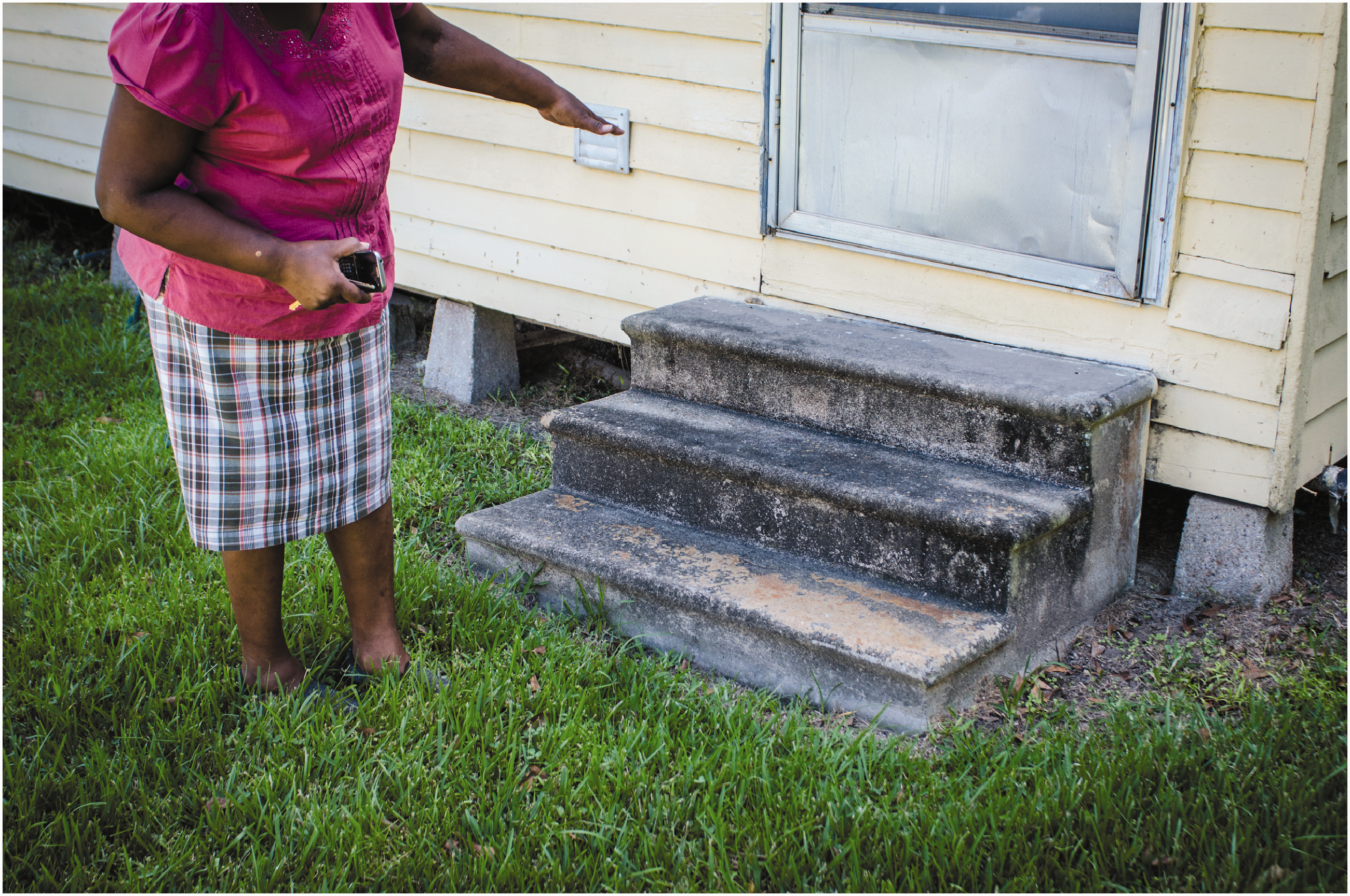
A research participant demonstrates how cracks have appeared around the doorframes of her house and the foundations have slowly subsided since industry moved in. These slow observations contribute to informal understandings of pollution. Source: Photograph: author.
Nixon (2011) argues that to confront the threats of slow violence ‘requires rendering them apprehensible to the senses through the work of scientific and imaginative testimony’ (14). In other words, it is up to scientists and writers to represent the seemingly incomprehensible; to translate what is slow and complex into something that is catchy, simple, and fast. Yet such a translation can be viewed as an invasive narrative (Lidström et al., 2015); a reworking of pollution that becomes distant from the people who are actually impacted by toxic geographies. Such a rendering would ignore the slow observations made by people in Freetown, and can ‘prevent more nuanced, disparate and varied means of conceiving of environmental change’ (Lidström et al., 2015: 28). Indeed, what this representation overlooks are the possibilities of putting the perspectives of people who co-exist with pollution at the centre of accounts of slow violence.
Discussion and conclusion
Toxic environments are not always sensuous spaces that give up their clues and dangers. Indeed, chemicals that evade human perception can often prove the most deadly. But toxic geographies are also lived environments, where people encounter hazards in their day-to-day lives, in mundane and incremental ways. It is the gradual velocity of slow violence – that communities are forced to endure over years, or even decades – that allows people to accumulate knowledge about pollution. In Cancer Alley, knowledge about pollution has been accrued through a local, lay, and inescapable ‘slow scholarship’ (Mountz et al., 2015); through observing vegetation, smells, and illness. The epistemology of this expertise is not just ‘local knowledge’ in a geographical sense, but has a distinct temporality, informed, assembled, and negotiated through years of ‘toxic mundane encounter’ (Landa, 2016). Such interactions with pollution are of course partial and highly situated. The slow ecological atrophy described by interviewees in Freetown was often unnoticeable to my eyes, being less attuned to the landscape. From my perspective, these uncanny changes were initially, in Nixon’s (2011) words, ‘unspectacular’ or ‘out of sight’. So too are these slow observations beyond the recognition of the neighbouring chemical companies, or environmental regulators such as the LEDQ, who – according to local participants – frequently ignore their complaints. But for some people who live in Freetown and other places of contested environmental injustice, slowly witnessing pollution is a vital means of making toxic places sensible.
I do not think it is, as Nixon (2011) intimates, a lack of ‘arresting stories, images and symbols’ (3) that allows instances of slow violence to persist unchecked. As ethnographers have repeatedly demonstrated (Little, 2014; Petryna, 2013; Shapiro, 2015), communities who are exposed to environmental hazards are pregnant with such narratives and testimony. In some instances, entire environmental justice movements are spurred on by stories of suffering, injustice, and ill-health. As Butler (2006) astutely observed, grief itself can have a galvanizing political capacity. Rather, slow violence persists because those ‘arresting stories’ do not count. Crucially, a politics of indifference about the suffering of marginalized groups helps to sustain environmental injustice, allowing local claims of toxic harm to be silenced.
As O’Lear (2016: 4) rightly suggests, slow violence ‘can result from epistemic and political dominance of particular narratives or understandings’. Going further, one could argue that the dismissal of local or informal accounts of toxicity is a form of ‘epistemic violence’ (Spivak, 1988). Through denying environmental justice claims, this epistemic harm sustains the banal attrition of petrochemical pollution, rendering certain populations and landscapes vulnerable to sacrifice and being ‘let to die’ (see Davies et al., 2017; Tyner and Rice, 2016); as lives and communities that are of limited value. In other words, ignoring local claims of environmental injustice helps create a self-reinforcing cycle of brutality that is structural, slow, and epistemic (see Figure 3). 4 Informal knowledge is regularly overlooked in cases of environmental risk, while exclusive scientific expertise is often required to translate pollution into legible or legal forms. As Ottinger (2017) suggests, sometimes this creates a ‘narrative mismatch’ between official scientific (‘expert’) and unofficial (‘local’) accounts of polluted places. Toxic geographies therefore remain disputed and ambiguous spaces, and the violence of these landscapes will continue to be felt by their inhabitants.
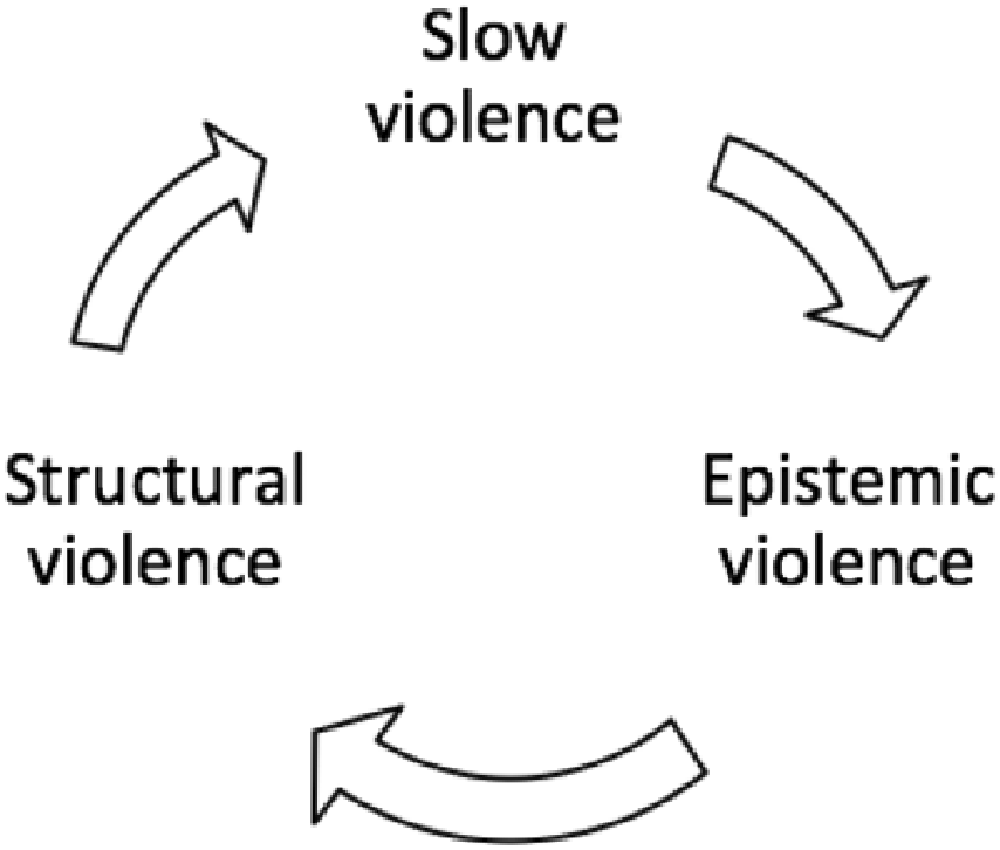
Diagram showing the cyclical links between structural, slow, and epistemic violence in contested polluted landscapes.
Much of Nixon’s (2011) argument is predicated on the assumption that slow violence is ‘spectacle deficient’ (47). Through my ethnographic research however, I caution against such a reading of gradual environmental harm, and counter Nixon’s statement by arguing that it depends on who is looking. For communities who live within toxic geographies, who are exposed to the daily traumas and uncertainties of environmental hazards, the ‘spectacle’ of pollution – if not its actual materiality – is often plain to see. Having spent almost a decade investigating the lives of communities in various toxic geographies – including Chernobyl, Fukushima, and now ‘Cancer Alley’ (Davies 2013, 2015, 2018), the last thing I would describe these spaces as, is lacking in spectacle. Communities who are exposed to the slow violence of toxic pollution are replete with testimonies, experiences, and bereavements that bear witness to the brutality of gradual environmental destruction.
In the introduction to Slow Violence, Nixon (2011) perceptively asks, ‘How do we bring home—and bring emotionally to life—threats that take time to wreak their havoc, threats that never materialize in one spectacular, explosive, cinematic scene’ (14). As an ethnographer, my immediate reaction to this question is that we must deeply engage with people who are already experiencing the drawn-out havoc of environmental pollution. As this article has attempted to show, the threats of slow violence are already emotionally alive within communities that inhabit toxic geographies. That their stories, perspectives, and knowledge claims are often overlooked highlights the second thrust of this paper: the importance of looking at structural, slow, and epistemic violence in unison. Reflecting on Nixon’s question further, the ‘we’ he is referring to is important to consider. Nixon is a literary scholar and is speaking to other people who use words to affect change. The challenge for us as geographers or ‘earth writers’ (Springer, 2017) – as well as other social scientists – is to find the right words to convey the lived experience of slow suffering, without falling into the representative traps set by our disciplines’ collective colonial inheritance (Briggs and Sharp, 2004; inter alia Spivak, 1988). I suggest this process must not overlook the actually existing experiences of slow violence that already impact lives within frontline communities. It is their knowledge that should be at the forefront of writings about violence, be it slow, fast, or superficially hidden. By interrogating the seemingly ‘out of sight’ (Nixon, 2011: 2) nature of slow violence, and instead asking ‘out of sight to whom? we can become more attentive to alternative perspectives and knowledge claims in polluted spaces. In doing so, we are also less likely to sustain the epistemic, structural and slow harms we are investigating.
Footnotes
Acknowledgements
I would like to thank the editors of this special issue, Rachel Pain and Caitlin Cahill, and the anonymous reviewers for their helpful comments. Earlier versions of this paper were presented at the ‘Rachel Carson Centre for Environment and Society’ in Munich, and at AAG 2017 in Boston. I would also like to thank Alice Mah, Colin Lorne, Arshad Isakjee, and Tom Disney for their advice on earlier drafts. Thank you to Kate Orff for allowing me to reproduce her beautiful map. Thanks also go to collaborators on twitter who responded to my ‘#Hivemind’ tweet asking for examples of how violence has been conceptualized by social theorists. These include: @AnarchistGeog, @Tynergeography, @EcoLabs, @TDisney85, @fthirlway, @SJBurgum, @JohnCNarayan, @StephMulrine, @LRigarai, @norajanechild, @LukeEdeNoronha, and @Leon_Ayo. I am especially indebted to those who shared their time and knowledge with me in Louisiana, including Travis London.
Declaration of conflicting interests
The author(s) declared no potential conflicts of interest with respect to the research, authorship, and/or publication of this article.
Funding
The author(s) disclosed receipt of the following financial support for the research, authorship, and/or publication of this article: This research was supported by the European Research Council (grant number 639583).