




Abstract
Despite a growing body of literature examining the politics of city-regionalism, the question of how local actors engage with, and challenge each other in the subnational regulatory space requires greater attention if we are to develop a more comprehensive understanding of supposedly pluralist approaches to policy making. This paper critically evaluates policy innovations in Greater Manchester (GM) that seek to steer the behaviour of economic actors towards a mutually reinforcing model of decent work and social inclusion. We argue that underneath the expansive political agenda of the GM metro mayor, what has emerged so far is a relatively shallow form of consensus-based neo-pluralism that allows for elite consultation over issues of inclusive growth and responsible business rather than more radically redistributive or participatory policies. The implications for our understanding of the changing and often contradictory role of the state in shaping subnational regulation and governance are discussed.
Introduction
There is an increasing focus on the myriad ways in which the institutions and apparatus of governance are being reconstituted at the subnational level by an increasingly diverse plurality of political, economic and social actors (e.g. Davies, 2021; Harding, 1996; Hodson et al., 2019; Hoole and Hincks, 2020; Pemberton, 2016; Rodríguez-Pose, 2008; Scott, 2001; Thompson, 2021). In the UK, given the degree of policy closure at national level around a broadly pro-business and light touch model of labour market regulation, it is at the subnational level where such pluralist policy making may take hold (Waite and Bristow, 2019). Indeed, recent years have seen the emergence of policies within city regions that seek to balance economic growth with social inclusion and equality, and increase investment in the foundational economy (e.g. Deas et al., 2021; Haughton et al., 2016; Lee and Sissons, 2016; Lupton et al., 2016; Quilley, 2000; Sissons et al., 2019). This model of ‘progressive regionalism’ has been given fresh impetus by the (partial) devolution of financial and other decision-making powers to city region metro mayors (Beel et al., 2018; Hoole and Hincks, 2020). However, the emerging positive rhetoric of city region pluralism, where the spatial and temporal peculiarities of economic transformation are separated from more fundamental issues of inequality and power in the labour market has been questioned (Martin, 2021). For example, some scholars note the limited capacities, and incentives, for ‘non-elite’ social actors to sustain positive change in a long-term context of neoliberalism, austerity and labour market flexibility (e.g. Jessop, 2002; Tomaney, 2016), particularly in those geographical areas most exposed to global competitive pressures that exert downward pressure on labour costs (Davies, 2018; Vijayabaskar, 2017; Yates and Clark, 2018).
In this paper we seek to further explore these contrasting perspectives by providing a context sensitive qualitative analysis of the dynamics of subnational economic governance and labour market regulation in England. We do this through an in-depth case study analysis of the Greater Manchester (GM) city region; a large and institutionally mature (Waite and Bristow, 2019), but also economically segmented, area in the north of England. GM has been the focus of top-down political and spatial reorganisation in recent years (Deas et al., 2021; Haughton et al., 2016; Tomaney, 2016) but has sought to develop a multi-stakeholder inclusive growth agenda in an attempt to break out of its post-industrial path dependency of low wages and low productivity (Hodson et al., 2019; Lupton et al., 2016; Yates and Clark, 2018). The paper focuses on a 3-year period (2017–2020) under the leadership of the directly elected metro Mayor Andy Burnham, from the Labour Party, who has sought to cultivate an open and ‘non-elite’ approach to policy making, while also building consensus among existing institutional actors about economic and labour market issues: “Being true to the Manchester tradition of pragmatic radicalism that we've seen through the centuries, where you don't just tear everything down, what you do is you open up the structures to people”. (Andy Burnham
1
)
We argue that, at the city region level, the contemporary neo-pluralist emphasis on building consensus around shared priorities is fundamentally in tension with the ambition to radically open up decision making to a diverse range of actors including SMEs, civil society, and ‘unorganised’ groups who still have only marginal input into economic policy (Harding, 1996). In the specific case of soft regulatory innovations, such as the GM Mayor’s Good Employment Charter, the practice of seeking common ground between legitimate insiders (Smith, 1990), such as larger Labour-party affiliated trade unions and a small cadre of enlightened employers, results in a relatively low floor of unenforceable standards and leaves aside the issue of how to deal with the long tail of poor-quality employment across the city region.
While we do not discount the possibility, and progressive potential, of shared policy making within city regions (particularly those with a tradition of close working relationships between politicians, trade unions, employers and civil society, see Davies, 2021), what has arguably emerged thus far is a largely consensual, but relatively shallow form of ‘neo-pluralism’. This allows for minimalist consultation over a relatively narrow policy agenda, and not the deeper forms of redistributive bargaining associated with some tripartite European models of social dialogue, where the state exercises a strong coordinating role within and across sectors (Crouch, 1983). While the GM metro mayor has sought to partly re-politicise policy making by placing equality and inclusion at the heart of the economic vision for the future of the city region, the lack of a strong democratic mandate and the reliance on an entrepreneurial partnership model of invited elite actors points to the further de-politicisation and de-statisation of policy development and implementation (Etherington and Jones, 2018). Pulled between progressive and entrepreneurial logics of municipalism (Thompson et al., 2020), actors within GM have sought to balance competing social and economic demands through a pragmatic neo-pluralist business case approach to higher employment standards.
If pluralism is to serve as a lens through which to analyse the contested design and implementation of economic and labour market policy in the UK, then two developments are necessary. First, there needs to be a more robust and heterodox critique of the often-nebulous umbrella term pluralism, which better integrates both multiple meanings and competing agency roles of the state at various levels. This takes us beyond the state simply seeking to design a static consensus as a balanced checklist across varied interests. Second, this conceptual framing must be complemented by a grounded perspective of ‘pluralism as praxis’ which in post-industrial city regions has to acknowledge declining collective labour representation and fragmented employer interests that undermine longer-term partnerships.
The paper starts with a review of debates that underline the increasing importance – and inconsistencies – of the city region as both a unit of analysis and a distinct scalar level of policy making. We then explore different modes of pluralism as varied enacted praxis, including the changing role of the state in (re)regulating (local) labour markets. The empirical findings are structured around a critical analysis of different forms and levels of regulation across the city region and draw out the range of procedural and substantive issues identified by key stakeholders in respect of work and employment. The paper concludes with a reflection on how the empirical findings extend debates that theorise more radically informed interpretations and critiques of pluralism as enacted policy and praxis across local city political spaces.
Devolution, subnational governance and the renewal of pluralist policy making
In a challenging context of global economic competition and regulatory fragmentation, there are long-running debates about the changing nature of state intervention in the labour market as well as the level at which such interventions operate most effectively (e.g. Jessop, 2002; MacKenzie and Martínez Lucio, 2005; Scott, 2001). Within these debates, sub-national regulatory spaces such as regions and cities have emerged as important potential sites of resistance to the global ‘race to the bottom’ on labour standards, social protection and collective worker voice (Davies, 2021; Rodríguez-Pose, 2008; Thompson, 2021). These progressive objectives have been pursued through the experimentation with alternative models of economic development, more participatory democratic structures, and increasingly fluid systems of soft and meta governance (Allmendinger and Haughton, 2009; Haughton et al., 2016; Quilley, 2000; Russell, 2019; Storper, 2013). Such pluralist approaches often go beyond the conventional boundaries of the state and are, rhetorically at least, built on communication and engagement with a wide range of stakeholders, such as organised labour and civil society, over issues of equality and social cohesion (Jones et al., 2005; Vijayabaskar, 2017).
Given the general preference for ‘light touch’ employment regulation at a national level in the UK, the scope for inclusive and pluralist approaches to governing work and employment standards may find longevity at the city-region level (Waite and Bristow, 2019). In the case of England specifically, such aspirations align with the post-2010 devolution and localism agendas that claim to support the transfer of decision-making powers from Whitehall to metro mayors in city regions. The logic is to ensure local politicians and policy makers are more closely attuned to the needs of the local electorate, while at the same time improving the fortunes of deprived local economies and boosting productivity through agglomeration and skills development (Beel et al., 2018). Although local actors have long argued for greater decision-making powers, these recent policy initiatives arguably signal a shift towards more diffuse and ‘self-regulatory’ spaces at local levels. The burgeoning inclusive growth agenda seeks to balance local economic growth and upgrading with efforts to reduce poverty, inequality and labour market exclusion (Lupton et al., 2016). Some have pushed this agenda further to grow the socially valuable, but historically low productivity, foundational economy. Borrowing from the trailblazing approach of Portland and Cleveland in the US, cities such as Preston in the UK have pursued a community wealth building approach that draws on both the investment power and market signals of anchor institutions such as municipal councils, hospitals and universities (Deas et al., 2021; Thompson et al., 2020).
Critics of the devolution agenda note that the notions of rescaling and rebalancing do not equate to more investment overall but rather a redistribution of existing (limited) resources which have been further hollowed out by a sustained period of fiscal austerity (Tomaney, 2016). Progressive regionalism is also at risk, in the specific UK national context, of being conflated with the ambiguous notion of ‘levelling up’ which promises to improve the position of deprived city regions relative to the rest but downplays entrenched geographical inequalities within city regions and between different ethnic and social groups (Evenhuis et al., 2021). Broader concerns have also been expressed about the de-politicisation of the local state arising from individualised and entrepreneurial metro mayors supported by technocratic governance structures (Roberts, 2020), particularly under a doctrine of sustained state welfare cuts after the 2008-2009 global financial crisis (Davies, 2021). The city deals that underpin devolution agreements in the UK were largely designed and negotiated behind closed doors by a small cadre of elites ‘to advance [a] narrowly defined set of business interests with very little democratic scrutiny’ (Tomaney, 2016: 550).
We share many of these concerns, and a key aim of this paper is to interrogate the apparent pluralist turn in city region policy making in respect of work and employment. Specifically, we seek to further question the concept of pluralism, which hitherto has been used to reflect a more heterodox approach to economic policy making in a general context of fragmented and contradictory neoliberalism. Within economic geography there are well-recognised pluralisms across the domains of theory, methods, and practice (see Martin, 2021). There are also distinct pluralist schools of thought within political science and industrial relations that can inform our understanding of the process and power dynamics of change (e.g. Crouch, 1983; Smith, 1990). Pluralism as a normative concept is attractive for academics, policy makers and practitioners alike in that it promises ‘a widespread diffusion of power such that no one class or group or stratum can dominate […] the rest’ (Fox, 1979: 106). Indeed, for classical British pluralists, the very complexity and interdependence of society, combined with a political system open to a wide range of non-elite interests, leads to pluralism. Classical pluralism also assumes a largely benign role for the state in seeking to build consensus and in balancing the competing objectives of different parties to serve the public interest (Smith, 1990). It is thus concerned as much with the form as the substantive content of policy debate.
‘Neo-pluralism’ has sought to integrate issues of power, conflict and the role of interest groups, such as employer associations and business lobbies into the analysis of policy making (which are largely absent from early debates around classical pluralism). Neo-pluralism acknowledges the potential for conflict between parties with different interests and recognises that while political systems are in theory open, there are ‘privileged insiders’ who exercise greater influence over policy making than ‘unorganised outsiders’, such as citizens and community groups (Smith, 1990). At the same time, neo-pluralists within the field of industrial relations (IR) often point to the relatively infrequent overt conflict between different parties such as employers and employees (although they recognise that conflict can be significant when it does occur) and emphasise the significant scope for cooperative behaviours within the employment relationship (Johnstone and Wilkinson, 2018). Ackers (2014), a leading IR advocate for neo-pluralism, charts a course for consensus based on the pragmatic development of partnership agreements between employers, employees and the state, framed by the economic and political realities of the day. However, others note that for such dialogue to exist, the political context and support for the voice of organised labour is a minimum precondition (e.g. Martínez Lucio and Stuart, 2004).
In contrast with neo-pluralist views, more critical and radical perspectives recognise the contestation of both political and materialist interests in society and the workplace, observing the underlying antagonistic nature of labour market exchanges (Edwards, 2003). Indeed, in countries with acute structural inequalities of class, power and wealth, like the UK, it has been argued that ‘neo-pluralist’ assumptions of social consensus are problematic and fail to give voice to marginalised groups (Dobbins et al., 2021). The state and powerful vested interests control access to systems of political dialogue and thus consensus may be “a sign of exclusion rather than general agreement” (Smith, 1990: 310). Against a backdrop of increasingly fragmented and financialised capitalism, employers (and the state) may find it difficult to uphold social partnership agreements in the face of market instability and increased global competition (MacKenzie and Martínez Lucio 2014). If we are to understand the limits and realities of ‘pluralism’ close attention has to be paid to the range of elite and non-elite actors involved, the power dynamics and relations that exist between them in particular contexts, and the competing roles of the state in seeking to build consensus around a particular agenda.
Progressive policy making and labour market regulation - bringing the state back in
While divergent conceptualisations of pluralism have contributed to a ‘lively and vibrant debate’ around the theoretical understanding of the relationships between state and market, and between employers and employees, pluralism in action (praxis) is neglected and differs from pluralism as a ‘concept’ (Dobbins et al., 2021). For some, ‘pluralism’ encourages us to explore “different forms of governing capital, with varying ends or outcomes in mind” (Waite and Bristow, 2019: 693), but this requires us to further articulate the powers of different interest groups, and the willingness and ability of the state to reduce inequalities and re-regulate increasingly dysfunctional markets (Etherington and Jones, 2018; Martin, 2021). Appreciating this broader political context and forms of contestation – and strategies of subversion - is essential to any understanding of the limits and realities of pluralist dialogues at the local level.
Neoliberalism is often seen as synonymous with de-politicisation, de-regulation and the withdrawal of the state but the changing structure and functioning of labour markets actually requires ever more complex and pragmatic forms of state intervention particularly at local level (Peck, 1995). The transition from a regulatory state to regulatory capitalism entails the maintenance of a rule-based system, albeit with a more indirect role for the state in terms of setting and enforcing standards, referred to as ‘steering rather than rowing’ (Levi-Faur, 2017). For example, the UK is generally considered to be an example of a de-regulated labour market, with a relatively low minimum floor of rights and significant scope for employer unilateralism in transposing legal rules into the workplace (Brown and Wright, 2018). This, however, does not mean the complete absence of regulation and state intervention (MacKenzie and Martínez Lucio, 2005), but rather a specific configuration of the re-regulation of standards and norms that serves to re-structure market relations in a particular way that emphasises employer-led flexibility, productivity growth and shareholder value at the expense of worker representation (Yates and Clark, 2018).
The key issue for our study is to map and understand different modes of governance and policy making and the spaces within which they operate. While some recent literature suggests that governance increasingly takes place beyond the state, the closer proximity of city region actors and decision makers to the lived reality of those facing economic disadvantage firmly brings processes of social dialogue and political contestation back within the state arena (Etherington and Jones, 2018). The wide range of interest groups that have a stake in local economic issues may generate counter-hegemonic movements and alternative agendas, and the more open that system becomes to other actors and interests, the more likely it is that contestation and conflict will emerge between different visions of municipalism that emphasise competitive, entrepreneurial, or progressive agendas (Thompson et al., 2020).
A key issue here is how competing visions and agendas are reconciled, and what alternative paths are considered to be legitimate within a particular industrial, social and institutional context. As Harding (1996: 639) argues, the process of agenda setting may serve to distract from the discussion of deeper issues behind closed doors: “the weak mini-elites identified by pluralists may have been decisive in disputes over issues that were on the agenda laid before them but that agenda could already have been neutralized so as to be unthreatening to the ‘real’ elite”. Again, the more pluralist policy making supposedly becomes, the more likely it is, according to some, that parties will have to make compromises to maintain consensus, resulting in a common denominator that all can live with, but with which none is entirely satisfied (Dobbins et al., 2021). Much depends on the scope and depth of involvement and the broader political context that frames the abilities and resources of different actors (Davies, 2021).
There is also the question of what delegated powers individual representatives within mini-elites possess to speak on behalf of a wider constituency (e.g. employers, trade unionists, civil society) and in turn, their ability to discipline rank and file members in order to uphold the general interest (which moves closer to authoritarian corporatism, see Crouch, 1983). While some European models of social dialogue are seen to be strongly bi-partite (e.g. employers and worker representatives negotiating directly), in many cases bargaining takes place in the ‘shadow of hierarchy’ where social partners are strongly incentivised to self-regulate to avoid further state intervention in the form of legal regulation and stronger penalties for non-compliance (Meyer, 2013). In contrast, business interests in the UK are less well organised at both national and local level, and instead rely on permissive employment rulemaking without much in the way of a state mandate (see Demougin et al., 2021). Therefore, individual employers are less likely to respond uniformly to either market signals or government policy signals promoting employment equality, representation and inclusion. Large employers may see the voluntary adoption of high road employment practices in the form of well paid, flexible jobs with opportunities to upskill to reduce turnover and boost productivity, and businesses looking to secure public sector contracts, particularly within Labour-led local authorities, may have to comply with higher minimum standards such as living wages (Johnson et al., 2021). In this way, the local state is contributing to the simultaneous de-politicisation and re-politicisation of economic governance (Etherington and Jones, 2018).
Overall, the above review of relevant literature generates three main questions that guided our research. The first question is: to what extent does the city region function as a distinct sub-national regulatory space and how has the election of a metro mayor given impetus to supposedly ‘pluralist’ and progressive policy making? The second is: what is the nature and quality of regulation within this city region space and how is consensus built over key issues such as inclusive growth and a good employment charter? The third question is: what capacities and incentives do local actors have to operationalise a high road model of social and economic upgrading at a time of sustained austerity and market instability?
Research design and methods
The research follows a qualitative case study methodology (Yin, 2003) that seeks to understand the process and dynamics of regulation at the city-region level, positioned within a wider UK context of neoliberal economic policy and labour market fragmentation. Greater Manchester (GM) is both an exemplar of devolution and often considered fertile ground for progressive policy making and therefore serves as a critical case for the purposes of developing our understanding of the theory and practice of pluralism at the subnational level. Our core proposition is that the left-wing political tradition and history of trade unionism within GM make it a potential site of resistance to national pressures towards de-regulation and market competition, while also acting as a novel space for innovation in respect of re-regulating labour markets and developing socially inclusive approaches to work and employment. At the same time, high levels of unemployment in some parts of the region, coupled with persistent and extensive problems of low paid and precarious work mean that GM is also potentially illustrative of wider issues in the UK economy.
The data reported in this paper are part of a larger multi-strand programme of research on work and employment in GM that amassed more than 125 interviews. The empirical findings analysed here draw on 33 in-depth, face-to-face, semi-structured qualitative interviews with key stakeholders from across the GM city region over 3 years (2016-2019). The research adopted a purposive sampling strategy that sought to triangulate the viewpoints of diverse stakeholders about processes of change within GM, and to reveal how local actors both shape and respond to the regulation of work and employment.
The sample of interviewees included local and city region government officers; trade union representatives from the North West Trades Union Congress (NWTUC), UNISON, Unite, GMB, and the broadcast and media union BECTU; business organisations, such as the GM Chambers of Commerce; professional HR and employment relations organisations, such as the Advisory Conciliation and Arbitration Service (ACAS) and the Chartered Institute for Personnel and Development (CIPD); civil society organisations, such as the Equality and Human Rights Commission (EHRC), Citizens Advice (CA) and the Greater Manchester Council for Voluntary Organisations (GMCVO); and a range of managers within public and private sector organisations (ranging from multinational companies to locally based SMEs).
Interviews lasted between 45 and 90 min and were audio recorded and transcribed verbatim. A systematic thematic analysis was undertaken, aligned to the research objectives and key issues identified in the literature, such as the challenges and opportunities of devolution and decentralisation, the process of formulating local economic and social policies, and the perceived effectiveness of regulation at the city region level. This was complemented with extensive desk research that examined existing local policy documents (in particular the Good Employment Charter, the GM Spatial Framework Plan and the GM Challenger Programme), recently published economic and labour market reports and data sets to identify key trends and emerging policy issues around work and employment.
What’s new? The political and institutional landscape of GM after devolution
Our first research objective is to explore the extent to which the city region functions as a distinct and effective regulatory space around issues of work and employment, and the ways in which the election of a metro mayor has given impetus to so-called pluralist progressive policy making. While much attention has been paid to city deals and the imposition of metro mayors on city regions, the regulatory landscape is much broader and more complex and draws together a wide plurality of institutional actors with a stake in issues of economic and labour market governance (Figure 1). This has created distinct tensions between the ambition to open up decision making to new actors, while also carefully controlling the policy agenda and maintaining consensus and institutional stability. A schematic map of policy actors in Greater Manchester city region.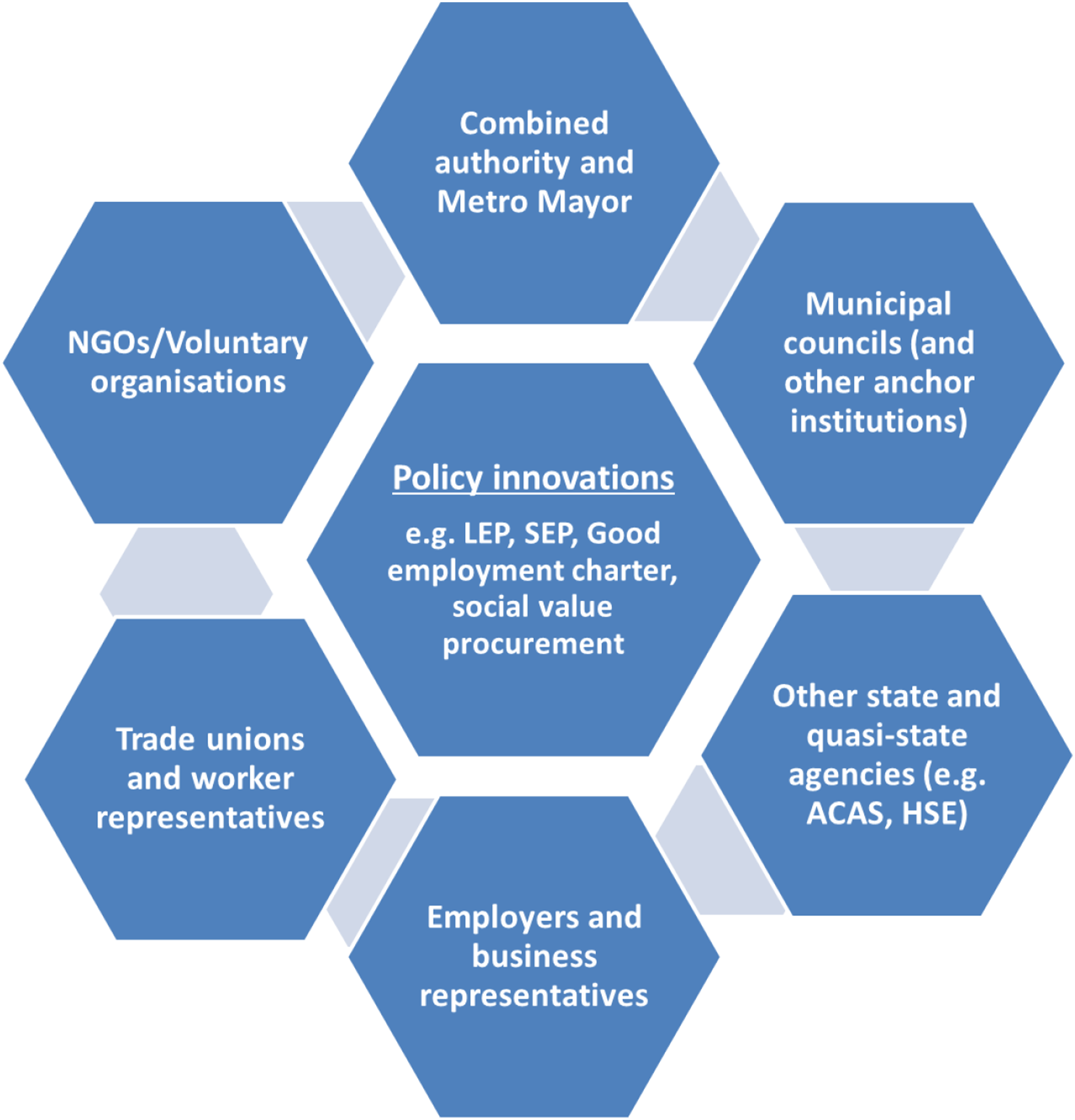
In terms of city-region political and administrative functions, the Greater Manchester Combined Authority (GMCA) is the statutory authority for the GM city region, and is made up of 11 members (10 elected members from the 10 constituent local authorities within GM plus the GM mayor) and is responsible for public transport, skills, housing, regeneration, waste management, carbon neutrality and planning permission, while also overseeing Transport for Greater Manchester (TFGM), Greater Manchester Police (GMP), and the Greater Manchester Fire and Rescue Service (GMFRS). The GMCA was formed in 2011 from the legacy structures of the Association of Greater Manchester Authorities (AGMA) that had been in place since the abolition of the GMCC in 1986. There had long been significant appetite for more formalised governance structures at the city region level, but the Localism Act of 2011 and the City Deal of 2012 triggered the first transfer of powers and resources to the newly formed GMCA in order to develop priorities around strategic issues such as housing, infrastructure and skills.
While the pooling of resources across GM as part of the 2012 city deal was generally welcomed by political leaders, there were also concerns about how the resources would be distributed across the 10 boroughs. It was assumed that the mayor would effectively become an 11th local authority leader within the GMCA, but by virtue of their higher public profile it was tacitly accepted that the new mayor would be a ‘first among equals’. An interim mayor was appointed in 2015, former Labour MP and Police and Crime Commissioner Tony Lloyd, before a full public election in 2017 which was won comfortably by Labour Party politician Andy Burnham (who was re-elected in 2021
2
). Burnham’s agenda was framed by the ‘politics of place’ rather than party politics
3
, and a recurring theme in his campaign speeches was the need to offer an alternative to the ‘failed Westminster model’ that was top down, elitist and detached from people’s everyday experiences and therefore the mayor ‘crowdsourced’ his manifesto by inviting contributions from external stakeholders and the wider public, rather than deferring to established political figures within GM. The manifesto in many ways exceeded the statutory powers of the mayor’s office and included commitments to the green economy
4
and digital industries,
5
tackling homelessness, and improving public services and infrastructure.
6
The Mayor championed the living wage in GM
7
and promised a ‘new deal’ for apprentices with higher quality training and an increase in apprenticeship wage rates.
8
A public statement in 2017 set out the new Mayor’s vision for the labour market: It’s not simply about getting more people into work – though this is important, given that our employment rate across the region is still below the national average. It’s also about improving the quality of work; creating better jobs with opportunities for people to progress and develop. That’s why we’re working towards a Good Employer Charter to encourage businesses across the region to step up
9
The Charter was in part developed by a new business advisory panel working alongside the newly formed Skills and Employment Programme (SEP) Board that included representatives from local authorities, trade unions, local employers, colleges, and the GM Chamber of Commerce. However, despite the relatively diverse makeup of the SEP, analysis of strategic documentation suggests it largely focuses on supply-side issues such as skills gaps and reducing the high share of young people across GM not in employment education or training (NEET) through various forms of active labour market policies. Similarly, the GM Local Enterprise Partnership (GMLEP) has sought to re-orient the development narrative away from property-led regeneration by emphasising the importance of sustainable growth and a good quality of life. However, the dominant position of business leaders within the LEP (11 of 16 board members are from the private sector) is likely to maintain the emphasis on creating favourable conditions for business investment and growth rather than issues of redistribution and labour rights. As such, policy development remains centred around the business-case for upgrading standards.
Much of the (largely uncontested) discussion around the future vision for the GM economy focuses on narrowing geographical and sectoral gaps in productivity and skills, and neglects the deeper rooted issues of social disadvantage and discrimination. An independent inequalities commission in 2019 revealed that 19% of jobs in the GM city region are paid at less than the hourly low pay threshold of two thirds the national median wage, which is slightly higher than for Great Britain overall at 18% (D’Arcy et al., 2019). More striking, however, is the uneven distribution of low paying jobs, with 25% of jobs in Rochdale, Wigan and Bury falling below the low pay threshold compared with just 14% in Manchester and Salford (op. cit.). The unequal spatial distribution of economic opportunity was recognised by policy makers: “…We are growing economically but we are not taking everyone with us…if we are simply looking at creating as much GVA as we possibly can, [then] we do that by creating jobs in life sciences at £200k a year. But that doesn’t help somebody who lives in Oldham or Rochdale or Tameside because they will never get those jobs…” [Policy Manager GM Growth Hub]
The GM spatial framework plan (GMCA, 2019) attempts to move away from a centralised property-led growth model (often associated with Manchester) by diversifying the city region economy, but potentially reinforces spatial and sectoral polarisation by seeking to cluster life sciences, advanced manufacturing, digital and technology firms in central parts of the city region (around universities), while creating low and middle wage logistics, transport and retail jobs in peripheral parts of the city region where levels of unemployment and precarious employment remain high. In turn, this is likely to widen rather than narrow intra-regional socio-economic inequalities.
Building partnerships for inclusive growth and good employment
Our second research objective is to critically evaluate the nature and quality of regulation within this city region space and how consensus is built between competing interests over key issues such as inclusive growth and good employment. From the outset, the metro mayor was cognisant of his limited resources and formal powers and emphasised partnership working: We recognise that our strength lies in successful partnership – not only with each other, but with other public services, businesses, local communities and the voluntary sector
10
The Mayor’s 2017 manifesto commitment to a ‘Good Employer Charter’ sought to address the gender pay gap, encourage flexible working, recognise trades unions and end the use of enforced zero-hours contracts – although, as discussed below, some of these commitments were modified under pressure from business leaders. The Charter was framed as a win-win that would deliver improved pay and conditions for workers, increased productivity for employers, more skills and investment across the region, and a reduction in demand for state support. In terms of mobilising the Charter, the mayor leveraged significant ‘convening power’ to organise working groups and public events to solicit responses from industry and academic experts and to build a ‘business-case’ for better employment. The trade unions, civil society actors, and business leaders agreed that the broad nature of the Charter allowed all parties to endorse it: “There was nothing in it you could really disagree with” [GM Chamber of Commerce Officer]
Trade union representation during the development of the charter was largely through the North West TUC and the public sector union UNISON (and not some of the smaller private sector unions), which further legitimised their nascent position within the ‘elite’ city-region policy making arena. They also felt that their significant membership and institutional reach helped to fix the real living wage as a core standard within the Charter. Conversely, the approach to employer engagement was arguably more open and reflexive. For example, the creation of a two-tier accreditation structure of ‘members’ and ‘supporters’
11
was designed to quickly recognise those employers that had achieved all of the Charter standards while also seeking to bring in a wider plurality of employers, especially small and micro enterprises and support them on a journey to full membership: “….because Greater Manchester [is] mainly SME dominated it's difficult to get some of these messages across. So, we can work with the big employers, the anchor institutions, the universities, the hospitals, but with all those thousands of SMEs it’s a bit more challenging to get these messages across…” [Policy Manager, GMCA]
At the same time, the removal of mandatory trade union recognition from the charter standards (under pressure from employers) was a missed opportunity to reverse the decline of trade unionism across GM since the 1990s. While individual unions had specific strongholds in the public sector and privatised utilities, the union movement as a whole has struggled to organise in the private service sector where nearly half of all GM’s low paid workers are concentrated, including many employed through temporary agencies. While the Mayor has established a normative consensus around the aspirations for good employment and ‘responsible business’, but the question remains as to what is ‘bad’ employment and what should be done to address it? A trade union representative argued that the sustained fragility of the labour market after the 2008-2009 crisis meant that the boundaries between good and bad jobs were becoming increasingly blurred: “People are glad to have a job so they don’t look at where their job falls in the spectrum of good to bad…” [NWTUC Representative]
Greater Manchester combined authority officers responsible for managing the Charter recognised that soft regulatory measures were unlikely to chase out parasitic businesses that survived by keeping wages low and utilising precarious forms of employment. The GM Challenger Programme is a multi-agency team consisting of specialist police officers and support staff established to enforce the 2015 Modern Slavery Act. The programme is tasked with regulating a growing informal economy where workers are trafficked by organised gangs, as well as small cash-based businesses such as takeaways and hand car washes ‘where the whole business model relies on not paying people the minimum wage’ [GM Challenger Lead] (see, also, Clark and Colling, 2019). The growth of marginal employment practices was also an issue within social care and construction where first-tier suppliers had limited oversight of their sub-contractors who often relied on various labour market intermediaries: “It’s a hire and fire mentality, still, in the [construction] industry. It is one where there’s in excess of 40% bogus self-employed. And they’re conservative figures…” [GMB officer]
Social value procurement is increasingly seen as a way to address some of these issues along public supply chains, and across GM an agreement has been reached to allocate a minimum of 20% of contract marks to non-commercial considerations, such as hiring local workers, providing training and development opportunities, and guaranteeing ‘good’ employment conditions such as the living wage. These standards have been applied to larger contracts across the GM city region such as waste disposal and major construction projects, and individual local authorities can choose to augment these standards through their own procurement processes. As of 2022 (the time of writing) only two out of 10 local authorities in GM have adopted UNISON’S ethical care charter which contains minimum standards for social care contractors including the real living wage, guaranteed hours contracts, and payment for travel time between client visits. However, these supply chains represent only part of the market for care services, which is a complex mixture of public and privately funded provision, delivered under multiple frameworks.
Municipal councils can also utilise planning and licensing powers that the GMCA and the Mayor’s office do not possess. For example, Manchester City Council used these powers to commit Amazon to directly hiring local workers when they were looking to establish a regional warehouse facility rather than relying on large temp agency contracts: “…When Amazon came to town we attached a condition to their planning to recruit locally…and they were a bit bemused actually because they hadn't worked with local authorities in this way before...” [Manchester Council Skills Lead]
This approach was successful in securing around 60% of posts for Manchester residents (with most of the rest going to GM residents), but around 40% of the 2500 total were temporary agency jobs to cover seasonal demand, and most paid only marginally above the national minimum wage. As with the GM Spatial Framework, this highlights the complex trade-offs between the number and quality of jobs that can be created and sustained in post-industrial city regions, and the limited regulatory levers available to public authorities when seeking to steer the behaviour of multi-national corporations.
Chasing the high road: a question of capacity and commitment
The third question is: what capacities, and incentives, do local actors have to operationalise a ‘high road’ model of social and economic upgrading at a time of sustained austerity and market instability? Many of the institutional and policy reforms within GM discussed so far, are fundamentally top-down in nature, driven by relatively powerful insiders such as senior politicians, civil servants, a limited number of enlightened employers along with the NWTUC and UNISON. While this can be critically interpreted as reflecting the dominant role of the state and vested interests (particularly in the British context) in setting the policy agenda, what emerged clearly from the evidence was the gap between the Mayor’s aspirations for decent work across the city region and the day-to-day realities of tackling precarity, exploitation and arbitrary management power. For example, the Modern Slavery Unit (GM Challenger Programme) draws around £300,000 of funding from the GMCA and the Greater Manchester Police also seconds several uniformed staff to oversee investigative activities. However, the unit is relatively small for a city region economy of around 125,000 businesses and over 1.3 million workers. Budget cuts by central government to inspection and enforcement agencies, such as the Health and Safety Executive and Her Majesty’s Revenue and Customs (responsible for enforcing the minimum wage), were also seen as a major challenge to the enforcement of existing workers’ rights. Where state agencies lacked the resources to proactively monitor and inspect, the voluntary sector was increasingly under pressure to compensate: “…the assumption was that somehow, if the public sector had fallen over, don’t worry, voluntary groups will pick it all up, they’ll be able to do it all instead, which, of course, is ridiculous.” [Voluntary Sector Manager]
Austerity related cuts to services such as Citizens Advice and to legal aid after 2013 have disproportionately impacted vulnerable groups who are most at risk of exploitation. Community unionism has developed only sporadically across the GM city region, and currently there are only two Unemployed Worker Centres (in Manchester and Salford) that support individuals who are pursuing claims against their employer (often for unpaid wages or unfair dismissal). Civil society networks such as the Greater Manchester Poverty Action Group (GMPAG) and the GM Living Wage Campaign have contributed to the development of the Good Employment Charter and engaged locally with large public and private sector organisations around tackling poverty pay. As with the Charter, however, the challenge they face is how to engage with ‘outsiders’ such as non-unionised small and micro enterprises that may lack the expertise to develop and sustain higher employment standards.
A particular barrier in terms of social partnership in GM is the historically fragmented and disparate nature of ‘business interests’ at local level in the UK, and the weak systems of coordination and representation (Peck, 1995). With more than 3000 members, the GM Chamber of Commerce is the largest outside of London which gives it a degree of legitimacy when discussing the ‘needs’ of employers. However, the Chamber views employment standards such as the real living wage as a free choice for individual businesses rather than something to be enforced (either by law or through public sector contracts). The GMB trade union officer argued that relying on the generosity of individual employers was risky and a potential distraction from the broader efforts to rebuild collective labour rights: “…it shouldn't be down to them [private sector employers] and if you ask them to do it voluntarily they won't do it or they will cut every corner...it needs to be part of something bigger…” [GMB Regional Official]
As a consequence, voluntarist systems of soft regulation and social partnership at national and local level in the UK are disparate and fragmented, with a strong role for employer discretion. In this context, the responsibility comes back to the public sector to lead by example: “…if we are going out there into the market and preaching it we have to start practising it…” [GMCA skills and business growth manager]
The challenge is that the historic importance of public sector employment in the city region has made it vulnerable to central government cuts since 2010 and downward pressure on labour costs. Political leaders across GM have consistently argued that austerity has disproportionately affected Labour controlled councils in deprived urban parts of the north of England, and large-scale anti-austerity protests have taken place each year in Manchester, many of which coincided with the annual national Conservative party conference. As a result of sustained budget cuts public sector employment as a share of total employment across GM dropped from 26.8% in 2010 to 22.5% in 2019.
Discussion and conclusion
Through an in-depth analysis of the GM city region, selected for investigation because it is both an exemplar of devolution and often considered fertile ground for progressive and supposedly pluralist policy making, this paper has sought to shed light on processes of policy development and regulatory renewal at the city region level, and to explore the interactions between key stakeholders around issues of economic growth, social inclusion and labour rights.
Relating the data to the extant literature, the paper makes two key theoretical contributions. The first contribution speaks to the literature on subnational policy making and in particular the growing and largely positive focus on differentiated economic growth strategies at the city region level (Hodson et al., 2019; Hoole and Hincks, 2020; Lee and Sissons, 2016; Lupton et al., 2016; Pemberton, 2016; Roberts, 2020; Sissons et al., 2019; Storper, 2013). While recognising that nearly 40 years of neoliberal policy reform have not rendered local actors completely powerless in the face of marketisation and fragmentation (see Grimshaw and Rubery, 2012), we question the often-held assumption that localism and devolution have created significant new institutional spaces for political contestation and the participation of non-elites and unorganised outsiders. Our findings show that aside from a limited number of public consultation exercises, policy making processes continue to prioritise the input of privileged insiders such as enlightened business leaders, larger Labour-party affiliated trade unions and, to a lesser extent, established civil society organisations (Smith, 1990).
Other interest groups such as private sector trade unions, non-unionised small and micro enterprises, and community groups largely remain outside of high-level policy discussions. Moreover, the fragmentation of stakeholder groups means that even socially oriented business leaders find it difficult to speak on behalf of a wider constituency (Crouch, 1983), but by virtue of the continued local state focus on a business case approach such voices are ‘amplified’ within policy-making processes (Peck, 1995).
The evidence also questions the assumption that pluralist processes of local policy making are necessarily more progressive and egalitarian (Waite and Bristow, 2019). In the case of GM, the politics of place that are often considered a positive hallmark of metro mayors are in tension with the grounded institutional politics associated with an (albeit imperfect and segmented) historical model of collective labour rights and workplace democracy (Harding, 1996). Although much has been made of inclusive economic growth and its concerns with inequality and precarious work (Sissons et al., 2019), the nascent vision for economic upgrading in GM largely reflects so-called supply-side issues such as skills, youth unemployment and improving transport links. The GM spatial framework plan largely ignores the large but low paid foundational economy, and the creation of distinct high and low wage clusters in specific parts of GM is likely to widen rather than narrow intra-regional inequalities (Martin, 2021). The challenge for city regions is to develop the political and institutional capacities needed to sustain a high road model of employment in labour-intensive industries such as retail, care and hospitality.
The second contribution of the paper is to show how soft regulation is only a partial substitute for state centred systems of regulation at national and local level with rules that are properly enforced (Brown and Wright, 2018; Meyer, 2013). In the UK context, city region actors can only encourage businesses to engage voluntarily with non-binding aspirations for good employment as opposed to setting enforceable workplace standards and strengthening collective labour rights (Hughes et al., 2017). Much depends on the ability of civil servants to clearly articulate the link between decent minimum standards in the labour market and wider processes of productivity growth and economic upgrading. In a UK context where the state does not routinely engage in tripartite processes of social dialogue with employers and trade unions (aside from the Low Pay Commission, ACAS and in designing the temporary furlough scheme in response to the Covid-19 pandemic), the continued emphasis on building policy partnerships generates a focus on lowest common denominator standards and fails to substantively reverse the long-term hollowing out of pluralist institutional structures of negotiation and joint regulation.
While a pragmatic business case approach might persuade employers to voluntarily raise standards, the obverse is also true and a business case may emerge to drive down standards, such as employer cuts to occupational sick pay for unvaccinated staff in the wake of the COVID-19 pandemic. A soft regulatory approach to employment standards is therefore constrained by a pragmatic neo-pluralist acceptance of the economic realities of the day (Ackers, 2014) namely, engrained power asymmetries, more than a decade of public sector austerity and welfare cutbacks, and a permissive regulatory context that encourages employer opportunism.
It would be easy to suggest that such challenges are indicative of ‘state failure’ in the face of neoliberal pressures and the inherently contradictory dynamics that characterise UK welfare capitalism. However, rather than looking outside or beyond the state, as is sometimes the tendency in post-political literatures, we share the view of Etherington and Jones (2018) that there is a need to re-centre the state in debates about economic and labour market governance, and to explore how the state continues to function (or not) as an arena for political contestation. Our critical case study of the Greater Manchester city region underlines that both the state and politics matter in shaping city region approaches to economic governance and labour market policy. The current metro mayor has partly re-politicised the local policy agenda and is a strong advocate for the GM city region (as exemplified during the pandemic) and, through alliances with other Labour-party metro mayors, the north of England more broadly. This entrepreneurial municipalism at city region level (Thompson et al., 2020) is underpinned by pragmatic municipalism at local authority level whereby (mostly) Labour controlled, but cash-strapped, councils attempt to anchor local economies through their investment decisions and judicious use of planning and procurement rules. At the same time, Labour party political control in and of itself has not prevented large scale job losses and restructuring within local government since 2010 (Johnson and Watt, 2022).
Returning to our overarching research aim, we do not discount the progressive potential of pluralist approaches to city region economic policy (Waite and Bristow, 2019), but by adopting a more nuanced critical perspective on institutional relations at work (Dobbins et al., 2021; Edwards, 2003) we can recognise the limitations of a model that prioritises consensus, co-operation, and stability among elite institutional actors. An alternative, radically informed praxis of collective representation would instead replace top-down policy initiatives aimed at persuading employers to voluntarily upgrade standards with policies that shore up public services and the wider foundational economy, undergirded by explicit support for trade unions, and bottom-up capacity building in the voluntary and community sector. Only by reconstructing collectivist institutions of workplace and political democracy, at the very minimum, can city regions attempt to tackle the root causes of inequality, exploitation and social disadvantage that are often found in the long shadows of seemingly progressive and egalitarian models of inclusive growth. This may rekindle the radical traditions of industrial areas such as Greater Manchester and repurpose the instruments of social justice for the challenges of a post-pandemic economic landscape: although the role of the broader context of the economy, its regulation and structure cannot be removed from such a discussion on local institutional relations.
Footnotes
Declaration of conflicting interests
The author(s) declared no potential conflicts of interest with respect to the research, authorship, and/or publication of this article.
Funding
The author(s) disclosed receipt of the following financial support for the research, authorship, and/or publication of this article: This work was supported by the Lord Alliance Strategic Investment Fund.
