



Abstract
Waves of successive Devolution Deals are transforming England’s landscape of spatial governance and transferring new powers to city-regions, facilitating fundamental qualitative policy reconfigurations and opening up new opportunities as well as new risks for citizens and local areas. Focused on city-region’s recently emerging roles around employment support policies the article advances in four ways what are currently conceptually and geographically underdeveloped literatures on employment support accountability levers. Firstly, the paper dissects weaknesses in the accountability framework of Great Britain’s key national contracted-out employment support programme and identifies the potential for city-regions to respond to these weaknesses. Secondly, the article highlights the centrality of the nationally neglected network accountability lever in supporting these unemployed individuals and advances this discussion further by introducing to the literature for the first time a conceptual distinction between what we term ‘positive’ and ‘negative’ forms of these accountably levers that currently remain homogenised within the literature. Crucially, the argument sets out for the first time in the literature why analytically it is the positive version of network accountability that is the key – and currently missing at national-level – ingredient to the design of effective employment support for the priority group of ‘harder-to-help’ unemployed people who have more complex and/or severe barriers to employment. Thirdly, the paper argues from a geographical perspective that it is city-regions that are uniquely positioned in the English context to create the type of positively networked integrated employment support ‘ecosystem’ that ‘harder-to-help’ individuals in particular require. Finally, the discussion situates these city-region schemes within their broader socio-economic and political context and connects with broader debates around the lurching development of neoliberalism. In doing so it argues that whilst these emerging city-region ecosystem models offer much progressive potential their relationship to the problematic neoliberal employment support paradigm remains uncertain given that they refine, embed and indeed buttress that same neoliberal employment policy paradigm rather than fundamentally challenging or stepping beyond it.
Introduction
Multiple and on-going waves of decentralisation are repositioning city-regions – combinations of contiguous local authority government areas – as key new scales of government in the English context. Following in the footsteps of London’s now long-standing mayoral powers, riding high on the back of ‘Devo Manc’ in Greater Manchester, and situated in the broader political context of devolution of powers to Scotland, Wales and Northern Ireland, devolution has been close to the top of the UK’s political agenda since 2010, pushed from the top by former Chancellor George Osborne and grasped from below by city-regions themselves. Driven by opaque political negotiation, a geographical patchwork of varying ‘deals’ has emerged across England’s city-regions in which variable sets of powers and resources have grown – and with generated momentum continue to grow – iteratively and unevenly across the country. This has created new opportunities for the reconfiguration, integration and alignment of local systems and budgets as well as opening up new risks around the creation of new types and sources of spatial variation and the decentralisation of new responsibilities and accountabilities in the context of significantly reduced local budgets due to central government commitment to continued austerity.
This Treasury-fuelled devolutionary zeal has been variably embraced by different central government departments and uncertain governance relationships between national government and city-regions have become the norm (Pike et al., 2015; Tomaney et al., 2013). Hence, whilst planning, skills, transport, housing and economic development have been centre-stage in these scalar shifts, responsibilities over employment support for the unemployed has until recently remained out of bounds for city-regions in the face of a highly centrist national Department for Work and Pensions (DWP). However, amidst persistently disappointing provision and outcomes performance for ‘harder-to-help’ participants – understood as those unemployed individuals with multiple and/or severe barriers to work – within large national quasi-marketised contracted-out provision, and an increasing recognition that the status quo cannot continue amidst the ever-tightening fiscal squeeze of austerity, employment support’s devolutionary moment has come.
Although still uncertain within the on-going realpolitik of central-local negotiations, there is underway in key urban city-regions the beginnings of a step-change in the spatial governance of traditionally centrist employment support policy, bringing the country closer to the multi-scalar and multi-agency governance arrangements of activation seen more usually across the OECD (Minas et al., 2012; van Berkel et al., 2011). This rescaling or, more accurately, multi-scaling of England’s employment support landscape opens up genuine new possibilities for substantive transformation towards a markedly more effective and progressive city-region model of employment support than is seen nationally either within the ultra-lean public employment service (Jobcentre Plus) or large scale quasi-marketised and contracted-out provision (e.g. the ‘Work Programme’). Whilst in principle beneficial to all unemployed individuals, this city-region rescaling offers particular transformative potential for individuals with more complex and/or severe barriers to employment given that the national system – whether through Jobcentre Plus or contracted-out provision – has amply demonstrated that it lacks the resources, integration and governance frameworks to deliver.
Demands for the localisation of employment support from the national DWP monopoly down to a local city-region model have been vocal, determined, and largely from beyond the academy (CCIN, 2015; Centre for Cities, 2014; IPPR, 2014; LGA, 2015a; ResPublica, 2015; WPSC, 2015). Hence, despite the existence of related academic literatures around ‘localism’ and ‘new regionalism’ (Cooke, 2006; Jones and Woods, 2013; Lovering, 1999), regional ‘relationality’ and ‘assemblages’ (Allen and Cochrane, 2007; Amin et al., 2003; Jonas, 2012), city-region governance (Storper, 2014) and, indeed, city-region metagovernance (Etherington and Jones, 2016; Jessop, 2008, 2011), the significant conceptual, geographical and policy implications of these scalar shifts in employment support have to date not been subjected to critical scholarly reflection. This is the task to which this article for the first time responds.
The remainder of the article is structured around four key contributions to the currently conceptually and geographically underdeveloped literature on employment support accountability levers. After briefly tracing the recent UK history of the localism agenda and the laggard, but now emerging, area of employment support within this devolutionary landscape, the discussion firstly dissects weaknesses in the accountability framework of Great Britain’s (i.e. England, Wales, Scotland) key national contracted-out employment support programme and identifies the potential for city-regions to respond to these weaknesses. Secondly, the argument highlights the centrality of the network accountability lever in supporting these participants (despite policy-makers’ obsessions with market-based accountability levers in such schemes) and advances further both by introducing for the first time a conceptual distinction between what we term ‘positive’ and ‘negative’ forms of these accountably levers that currently remain homogenised within the literature. Crucially, the argument sets out why it is the positive version of network accountability that is the key – and currently missing at national-level – ingredient to the design of effective employment support for the priority group of unemployed people with more complex and/or severe barriers to employment, in contrast to the ineffective ‘negative’ network vision seen within the national contracted-out Work Programme for this group. Thirdly, the significant geographical implications of the discussion are drawn out in terms of identifying the unique potential of city-regions to provide this type of positively networked employment support ecosystem. And finally, the discussion situates these city-region schemes within their broader socio-economic and political context and connects with broader debates around the lurching development of neoliberalism (Peck and Theodore, 2012). In doing so it argues that whilst these emerging city-region ecosystem models offer much progressive potential, their relationship to the problematic neoliberal employment support paradigm to which they respond remains uncertain given that they may refine, embed and indeed buttress that same neoliberal employment policy paradigm rather than fundamentally challenging or stepping beyond it.
Negotiated localism and the glimpse of employment support
If the UK can overall be described in comparative terms as a highly centralised political system then this caricature underplays the extent to which trends in central, regional and local powers and responsibilities have waxed and waned over the last century (NAO, 2014). Sitting in the broader context of processes of devolution to Northern Ireland, Scotland and Wales, following the election of the Conservative-Liberal Democrat coalition government in the 2010 general election the 2010 Local Growth Act, 2011 Localism Act and subsequent waves of politically negotiated ‘Deals’ between central government and English city-regions – City Deals, Growth Deals and Devolution Deals – have reconfigured the nature of spatial governance across England. Whilst regions (e.g. Regional Development Agencies, RDAs) and localities (e.g. New Deal for Communities) have been the scales of interest in recent UK employment and regeneration activity, the current devolutionary iteration follows the US focus on ‘metro’ politics through its emphasis on ‘city-regions’ – formalised collaborations of multiple constituent local authorities that are usually (but not always!) contiguous. These new city-regions together offer the necessary promise – though not always in reality (Pugalis and Townsend, 2014) – of the political, economic and social coherence and scale required to fulfil their strategic economic growth objectives.
At the heart of these shifts has been the replacement across England of large RDAs with the still evolving and uneasy smaller city-region Local Enterprise Partnerships (LEPs) governance landscape, which has, in the words of Vince Cable, the former Secretary of State heading the responsible central government department for Business, Innovation and Skills, been ‘a little Maoist and chaotic’ (Cable, quoted in Stratton, 2010: 1). Created in 2011, LEPs are business-led bodies with local authority representation that have been established at this city-region scale as they key strategic players to drive through local economic growth. To achieve their economic objectives business-led LEPs work in conjunction with political Combined Authorities (CAs) that offer a new layer of city-regional political governance with its own leadership, staff and functions and that incorporate into its governance structure the Chief Executives of the multiple (usually 6–10) constituent Local Authorities within its boundaries.
CAs vary widely in their make-up, activities and ambitions, a reflection in part of their spatially sandwiched position between central government above and constituent local authorities below and the political reality that the space that CAs are enabled to fill shrinks and expands according to negotiations with these key stakeholders in both directions. Pertinent to the present argument are the city-regions of the larger urban cores – London, Greater Manchester, Sheffield City Region, West Midlands, Liverpool City Region, and so on – who are powering ahead in terms of their devolutionary ambition and journey. Despite this continually shifting patchwork quilt of differing city-region powers, common city-region responsibilities exist around economic development, planning, housing, transport and skills. Although intimately intertwined with these devolving policy areas, employment support for the unemployed has remained largely out of scope for city-regions, a reflection both of the strong centrist tendencies of the national DWP as well as the nationally dominated policy landscape of public employment service Jobcentre Plus provision and the national quasi-marketised and contracted-out provision. In the leading urban city-regions, however, employment support is now too being dragged squarely onto the devolutionary negotiation table, with significant transformative potential resulting for its qualitative reconfiguration around better integrated support and, as a consequence, improved experiences and outcomes for unemployed individuals.
Key to that national DWP employment support offer is the contracted-out Work Programme scheme for the long-term unemployed and it is this scheme that has become the benchmark and touchstone for select city-regions’ entries into the employment support landscape. Implemented in 2011, Work Programme is a large scale quasi-marketised programme that has worked with around 2 million unemployed individuals since 2011 at a total cost of around £3–4 billion. Work Programme is structured geographically into 18 large regional Contract Package Areas (CPAs) across England, Scotland and Wales each containing two or three large and well-capitalised ‘prime providers’ to whom participants are randomly allocated after an initial period of Jobcentre Plus provision (usually following nine to twelve months of unemployment). Primes can both deliver services themselves and/or sub-contract to organisations within their supply chains. With a ‘black box’ approach the programme furnishes providers with almost complete flexibility over the type and frequency of support for participants. Outcomes rather than process is the key interest and at the heart of the scheme is a strong payment-by-results (PbR) model that is heavily weighted (and since 2014 entirely weighted) towards paying only for sustained job outcomes. Work Programme is not targeted on particular groups of unemployed people and, in recognition of the enormous variability in its participants, payment levels vary across nine payment groups to which individuals are allocated according to a crude notion of their relative distance from the labour market based on benefit type – either Jobseeker’s Allowance (JSA) or Employment Support Allowance (ESA) where claimants have officially acknowledged disabilities.
Somewhat ironically given its centralising credentials, it is Work Programme itself that has laid the groundwork for localising activation pressures due to its disappointing performance for participants with more complex and/or severe support needs in particular. Weaknesses within the programme’s accountability framework (discussed below) have left the scheme susceptible to the under-resourcing, poor performance and ‘parking’ (i.e. absolute or relative neglect) of participants considered unlikely to (inexpensively and/or securely) achieve payable job outcomes for providers. The main ESA claimant group has for example seen only 7% of claimants achieving a job outcome (measured as sustained work of three months) within a year of referral (DWP, 2015a). Nor do participants’ experiences of Work Programme inspire confidence, with basic and generic provision the norm and growing evidence of systemic ‘parking’ of harder-to-help participants (Lane et al., 2013; Meager et al., 2013; Newton et al., 2012; Rees et al., 2013).
Sitting within this context of disappointing Work Programme experiences and performance for harder-to-help participants, the calls for greater city-region involvement in employment support have been vocal, unrelenting and impossible for the DWP to ignore (CCIN, 2015; Centre for Cities, 2014; IPPR, 2014; LGA, 2015a; ResPublica, 2015; WPSC, 2015). Building on momentum created by local pilot programmes in Greater Manchester (Working Well), central London (Working Capital) and Glasgow and the Clyde Valley (Working Matters), employment support powers were a notable feature within the latest round of Autumn 2015 Devolution Deals for several of the larger, more urbanised city-region frontrunners across England. Two employment items within these deals are of particular relevance: firstly, the ability for further integrated employment support pilot programmes in other city-region areas; and, secondly, co-design/co-commissioning of the upcoming Work and Health Programme. This programme will from late 2017 replace Work Programme and the smaller Work Choice (a scheme intended for, but poorly targeted on, individuals with more severe health conditions and disabilities) as the country’s main quasi-marketised and contracted-out employment support programme, though with only a fraction of the budget of its forerunners (DWP, 2015b).
An embryonic yet radical set of shifts in the scale, qualitative configuration and quantitative performance potential of employment support are therefore underway in the more urbanised city-region areas across England, a trend sure to continue as DWP’s devolutionary inertia is gradually chipped away at and as these city-region’s await the imminent arrival of elected mayors with new powers, ambitions and public mandates. At the heart of the change is the vision from city-regions of the progressive creation of locally integrated employment support ‘ecosystems’ that strategically and operationally align and coordinate a range of what are currently siloed and disconnected key wraparound support services and budgets. These supports need to be brought together and marshalled in order to enable the delivery of whole-person holistic keyworker support packages encompassing the range of individuals’ support needs – personalised employment advice, skills, health, housing, financial advice, family support, etc. This qualitatively reconfigured locally integrated ecosystem model of employment support that city-region rescaling allows brings with it transformative potential for significant performance uplift and system savings (both centrally and locally), particularly in relation to unemployed individuals with more complex and/or severe barriers to employment.
These intertwined shifts between the geographical scale of employment support, accountability levers, and programme nature and performance remain absent from critical scrutiny within the academic literature however, despite their importance both for our understanding of shifting patterns of spatial governance as well as the linked conceptual and geographical nature of employment support accountability levers. The next section begins this discussion by considering the nature of the existing accountability mechanisms running through the national contracted-out Work Programme scheme from which the emerging city-region ecosystem models flow and to whose failings they respond.
Accountability weaknesses in the UK Work Programme: Opportunities for city-regions
To unpick city-regions’ entry point through Work Programme into the devolutionary employment support policy arena, the analytical framework of accountability mechanisms to understand the design and performance of employment support programmes is a powerful approach, but one that remains conceptually as well as geographically underdeveloped at present. Building on the broader employment support governance literature (Considine, 2001; Newman, 2001), as well as that limited literature which does focus specifically on accountability mechanisms in employment support (Jantz et al., 2015), five heuristic approaches to understanding accountability mechanisms within the field of employment support are identifiable – procedural, corporate, market, network and democratic. These can be summarised as follows:
Procedural accountability draws on rule-based principles and norms of reliability and procedural fairness where public servants follow set processes, rules and requirements; Corporate accountability utilises contractualised performance targets to monitor and compare provider performance so as to reward or punish providers accordingly (e.g. contract renewals/terminations, additional/reduced referrals or payments); Market accountability steers using levers of price and competition between providers. The provision of contracted-out employment activation schemes is equated with ‘natural’ clearing markets of abstracted rational economic theory, even if such schemes are in many ways, and with key implications, artificial quasi-marketised creations. PbR, accelerator pricing, or other financial incentives/sanctions for good/bad performance typify market accountability levers; Democratic accountability responds transparently to the views of citizens and users. Whilst Jantz et al. (2015) focus ‘top-down’ on the accountability of politicians though the electoral cycle, we would also include possible ‘bottom-up’ democratic accountability through user experience via levers of ‘voice’ (e.g. feedback, complaints, service rating) and ‘choice’ (e.g. provider and/or intervention selection and exit) to drive service quality (Hirschman, 1970). Network accountability coordinates provision across multiple, inter-dependent service providers using relationships based on trust. Softer informal levers around the collective need for organisations to protect reputations and foster on-going relationships of co-operation and co-dependence offer informal and collectively-enforced network accountability mechanisms (Olson, 1965).
Although Work Programme on paper incorporates elements from each of these five accountability types, it is in practice imbalanced and undermined by its disproportionate reliance on the market-based PbR lever. The programme is also partial in the sense that it is dependent on what we below describe as ‘negative’ defensive versions of these accountability levers, and problematic in its weak operationalisation of several of those already partial ‘negative’ accountability visions. The consequences for programme performance, for participants, and for taxpayer value-for-money have been predictably disappointing from the outset, though the lack of any robust impact evaluation makes it difficult to establish quantitatively the full scale of these weaknesses.
Procedural and democratic accountability mechanisms play a relatively insignificant role in practice within Work Programme. Procedurally, minimum service guarantees (MSGs) were submitted to the DWP by prime providers in tender documents and make promises around the frequency, type and quality of employment support to be offered to participants within their contract. These MSGs suffer however from their wide variability and frequent vagueness which hinders their standardisation, clarity and sometimes enforceability. There is also considerable variability in the communication of MSGs to participants such that programme participants are routinely not aware of the type of support they ought to expect. A clear opportunity therefore exists for city-regions to enhance the design and effectiveness of this procedural accountability lever.
In terms of democratic accountability mechanisms, although select committees and media coverage have on occasions made for uncomfortable moments for DWP ministers the effects are relatively short-term and modest. In terms of bottom-up user-led democratic accountability levers Work Programme does not attempt to enable participants to utilise ‘choice’ accountability levers, despite market logics dominating programme design on the provider side. The limits of the MSGs constrain the traction of the ‘voice’ lever. City-region schemes could think more ambitiously about how individuals might be empowered to use their agency to drive the quality and effectiveness of support, particularly via mechanisms to incorporate and utilise service user ‘voice’ (e.g. genuinely collaborative action planning, participant feedback ratings).
Corporate governance levers apply in the form of contractually prescribed minimum performance levels (MPLs) that operate across key programme payment groups. These are used by DWP to make incentive payments for exceptional performance, terminate contracts for poor performance and shift referral volumes to better performing prime providers within CPAs. A key weakness of the original MPL measure was that its numerator (job outcomes within a set period) did not relate to the same individuals as its denominator (referrals within a set period), meaning that ‘improving performance’ could, other things equal, be ‘achieved’ simply by falling referral volumes over time, which has been the trend in practice over the lifetime of Work Programme. This has not only undermined the utility of these MPLs as a corporate-based accountability lever but has also led to DWP being contractually obliged to pay incentive payments in the face of performance concerns as well as facing difficulties in terminating contracts for the most concerning primes. Unsurprisingly, the DWP have over time introduced an alternative MPL measure that was suggested to it at the outset by commentators based on the percentage of the cohort achieving a job outcome within twelve months. City-regions should adopt this cohort measure and should in addition give consideration to the inclusion of further intermediate targets around overcoming barriers and reducing the distance to paid work (as in the Greater Manchester Working Well employment support pilot) (GMCA, 2015) as well as to equity measures that compare performance between key sub-groups of interest (e.g. different types of claimants, different types of local labour markets).
It is though market levers that represent the key accountability instrument of Work Programme in the form of a heavily (and since 2014 entirely) outcome focussed PbR model of differentiated payments across the nine payments groups. This is argued by the DWP to drive performance, to deliver value-for-money and to encourage providers to work responsively and in a highly personalised way with participants with diverse support needs and costs. Work Programme PbR is, however, now widely agreed to be an overly crude and badly calibrated PbR framework both in terms of the internal heterogeneity of the payment groups as well as in the levels and sequencing of its payments (Carter and Whitworth, 2015; Inclusion and NIACE, 2015). As a result, this market accountability lever designs in rather than designs out perverse incentives for providers to systemically ‘cream’ the most job-ready participants and ‘park’ those with more complex barriers to work (Carter and Whitworth, 2015; WPSC, 2015). Starved of cash, acutely aware of risk around spend, and focused on short-term outcomes to trigger payments, prime providers have pursued risk-minimising cost-reduction strategies to profit. There is evidence consistent with the ‘parking’ of more challenging individuals and scant use of referrals to more specialist or intensive services (Meager et al., 2014; Newton et al., 2012). For harder-to-help participants a downwards spiral of underfunding, poor performance and vulnerability to ‘parking’ has been the result (Inclusion and NIACE, 2015). In response, city-regions have the opportunity to recalibrate the PbR design in order to convert the incentive framework facing providers from one facilitating ‘parking’ to one incentivising support. It is now widely accepted that the payments profile for harder-to-help participants should include a stable up-front attachment or service fee of around 20–30% of the total payment profile (WPSC, 2015) and there is little evidence to suggest that on-going sustainment payments have brought value in terms of in-work support to those who have moved into work (Meager et al., 2014). Re-weighting the payments profile in this way would help both to de-risk and increase up-front investment in harder-to-help individuals in order to support them over the main hurdle of initial entry into paid work whilst at the same time helping to squeeze far more value from the same financial spend.
Positively networked employment support, and the unique potential of city-regions to deliver it
There is then much that city-regions can improve in their localised employment support programmes in response to clear and significant weaknesses in Work Programme’s accountability mechanisms across these four procedural, democratic, corporate and market accountability spaces. Although the shoring up of these mechanisms as they are currently conceived is necessary to support harder-to-help participants, we suggest that such revisions are unable, in themselves, to be sufficient in unlocking the qualitatively and quantitatively different services required to adequately support those with more complex and/or severe support needs.
Instead, the currently nationally neglected network accountability lever becomes the key, game-changing accountability lever. Moreover, key to understanding the nature of the employment support system that is required in order to effectively support those with more complex and/or severe barriers to work is our introduction to the literature for the first time of a conceptual distinction between what we term ‘negative’ and ‘positive’ versions of each of these accountability levers that is currently absent within a literature that ignores and, arguably more dangerously, inappropriately homogenises the distinct visions and approaches to these five accountability dimensions. Introducing this conceptual distinction to the literature enables for the first time the recognition that it is specifically the ‘positively’ conceived vision of this network accountability that is the key to enabling enhanced employment support for individuals with more complex and/or severe barriers to employment, and that city-regions are uniquely able to deliver this positive network accountability in their employment programmes.
Hence, and stepping back from the paper’s specific focus for a moment, we support the need to move beyond analytically over-simplistic depictions of employment support systems in terms of singular accountability dimensions and to progress instead towards far greater attention to accountability hybridity within these complex systems (Jantz et al., 2015). More fully, however, we argue that the required sensitivity to accountability hybridity must incorporate not only the constellations of, and interactions between, different accountability dimensions but, critically, must also include sensitivity to the distinct conceptual forms that those dimensions can take as well as the related spatial scales at which they do, can, and (in terms of their effectiveness) ought to operate. Hence, in order to understand the complexities of employment support systems not only does the study of accountability need to develop analytically to understand hybridity across the five accountability dimensions, but it must do so whilst taking more seriously the complex multi-scalar interactions between conceptually distinct forms of those accountability levers.
Heuristic typology of negative and positive conceptualisations of accountability dimensions.
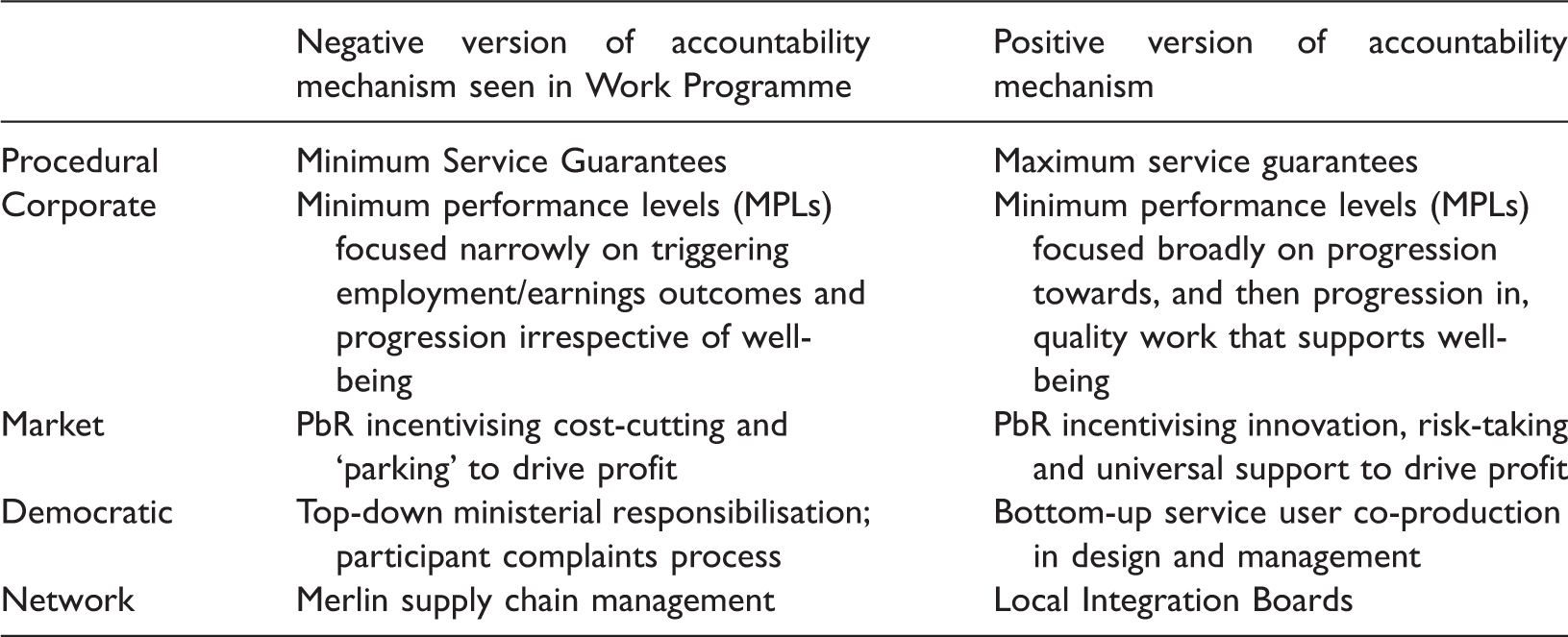
As the discussion in the previous section has outlined, Table 1 highlights the dominance of negative accountability visions within the UK Work Programme across the procedural, corporate, market and democratic accountability dimensions, though it fails to convey the design weaknesses and imbalanced reliance on the market accountability lever. The key focus here however relates to the nationally neglected network accountability dimension, and in particular the transformative potential of its positive configuration.
Focusing on this network accountability dimension, Work Programme once again displays a negative version of this lever in the form of the Merlin standard applied to prime providers’ management of their supply chains that aims to protect smaller sub-prime organisations from exploitation by their overarching prime provider. It is a moot point to what extent Merlin has been able to realise this aim. Merlin has not in practice been able to prevent the well-capitalised primes from cascading down significant financial risk to their sub-primes by simply passing down the same heavily, and then fully, outcome-based PbR terms that the DWP intended to be borne only by primes via the inclusion during procurement of a £20 million turnover threshold in relation to primes, but not to sub-primes (Foster et al., 2014: 128–130; Lane et al., 2013: 35). More fundamentally, the supply chains submitted by primes during the procurement process have in many ways not actually come to exist in practice. Primes have not referred participants to specialist providers in the volumes expected, or have disproportionately referred the most complex (and expensive) cases, starving smaller sub-prime organisations of referrals and of income flows (Foster et al., 2014; Meager et al., 2013). Where referrals have occurred there is evidence to suggest that they have been driven more by primes looking for low or no cost services (often outside of their supply chain) rather than more appropriate, specialist or intensive services (Newton et al., 2012).
Network accountability inside the Work Programme has therefore embodied another negatively configured version of this accountability dimension, and has at that failed to mitigate the downside risks and perversities that it was designed to control. Irrespective of its efficacy or otherwise this Work Programme approach to network accountability is a fundamentally negative version that never had even the potential to deliver the type of integrated holistic employment support that harder-to-help participants require as this can only be created via a positive version of this same network accountability lever. This positively configured network accountability vision instead recognises that its key function for the effective support these individuals is to create and dynamically maintain a co-ordinated and integrated employment support ecosystem. That is, a system comprising all of the holistic wrap-around services required to respond effectively to the varied set of barriers faced by this group – employment support, health, skills, housing, advice services, debt advice, food and energy security, and so on. The emerging city-region employment model can best be described in this way as the co-ordinated development of an employment support ecosystem of integrated services and budgets that are bent into, and wrapped around, participants and their keyworkers in the pursuit of sustained employment objectives.
Central government clearly recognises the need for locally integrated employment support ecosystems of this type, as seen in its creation of the joint Work and Health Unit (WHU) between the DWP and Department of Health centrally and its collaborative working with city-regions around the development of health-led employment trials, DWP’s push for service integration and co-location within its Universal Support policy, or Work and Pensions Select Committee recommendations and Government responses (WPSC, 2015). They are right to do so.
However, neither policymakers nor the academic community have yet acknowledged that the pursuit of such city-level policies necessitate far greater attention to the development of the positively networked accountability dimension. This in turn requires the creation and on-going maintenance of new formalised governance arrangements to bring it about and it is this that brings significant geographical implications around the optimal – indeed necessary – local spatial scale at which this must be cultivated. For with the exception of the positively configured approach to network accountability all negative and positive conceptualisations of all five accountability dimensions can in principle be delivered by any geographical scale.
Crucially, however, the type of positive network accountability key to the effective employment support for those with more complex and/or severe barriers to work can only be delivered at local scales for it is only at local scales that the strategic visioning, senior decision-making powers and operational responsibilities over the range of key wraparound supports reside. The new local governance structures to facilitate precisely this type of positively networked accountability – Local Integration Boards (LIBs) as they are coming to be named – are embryonically appearing across city-regions as they take forwards their Devolution Deal employment support pilot items. These LIBs perform the key function of bringing together key stakeholders from the various wraparound support systems involved (mental and physical health providers and commissioners, colleges, housing services, benefits advice, financial and debt advice, Jobcentre Plus colleagues, etc.). They provide a formalised governance mechanism to enable both senior strategic commitment to the on-going dynamic local processes of gradually increasing strategic system alignment and, where appropriate, integration (e.g. of objectives, delivery, procurement, budgeting, referrals, co-location, culture change, etc.). They also provide an operational forum for co-case management of individual complex cases in order to join up keyworkers with a whole-person holistic support package with the range of multiple wraparound support services that participants with more complex and/or severe barriers to work variously require but that remain disconnected without the concerted effort, coordination and formalised governance of LIBs at local scales.
Whilst it is clear for these reasons that the formation of employment support ecosystems is by necessity a local project, there is however a debate to be had about whether the optimal scale is that of the city-region or, rather, that of the constituent and smaller local authority (municipality) administrative unit that in the English context is the mainstay of local political power and activity. Both are in principle possible and the model that is emerging currently across the city-regions at the forefront of this activity (Greater Manchester, London, Sheffield City Region) is a sensible hybrid of the two scales in which LIB governance arrangements are formed at local authority level and with city-region CAs acting as the key co-ordinating layer at which overarching programme design, procurement, and performance management occur. The formation of LIBs at local authority levels in this way reflects both their strong political identity and the extensive organisation of staff, services, budgets and governance at this well-established scale. However, rather than rely solely on single local authorities as the scale at which to build locally integrated employment support ecosystems, CAs offer a sensible overarching coordinating scale for its development across its several constituent local authorities. This is in part a reflection of the current political reality that it is at city-region and not local authority scale that central government negotiate devolution, a situation likely to be reinforced by the imminent arrival of elected mayors with new ambitions and mandates across key city-regions. City-regions also offer an appropriate scale economically and geographically. Economically city-region geographies are built around the footprint of functional economic areas, often containing one (or more) urban core(s) and multiple surrounding areas, with strong commuter travel flows within that geography. This functional economic area offers a suitable geography from which to approach labour market policies such as these. This is particularly so when noting the centrality of demand-side as well as supply-side strategies in modern activation policies, especially in relation to people with more complex and/or severe barriers to employment. Finally, although generally not perfectly coterminous, city-region boundaries present stronger coterminosity than do local authorities to key Jobcentre Plus district boundaries and this facilitates the simplicity and effectiveness of their necessary collaboration within any localised employment activity.
City-region employment support ecosystems and the lurching development of neoliberalism
The analysis of England’s emerging city-region employment support ecosystems through the new lens of differentiated positive and negative accountability presents important insights to our understanding of city-region governance and employment support accountability frameworks as well as to the creation of transformative policy opportunities for the type of employment support that is able to be delivered for individuals with complex and/or severe needs. The analytical result is a clearer recognition of what is needed to deliver the country’s much-needed step-change in employment support programmes, experiences and performance for people with more severe and/or complex barriers to work (positively networked employment support ecosystems), why it is needed (integrated and adequately resourced services and budgets for whole-person holistic support), how it can be brought about (formalised and dynamic local governance frameworks to create and maintain multi-system strategic and operational alignment and coordination), and who in a geographic sense is uniquely able to deliver it (city-regions working in collaboration with local authorities, not central government).
For those of a centre-left disposition these emerging positively networked city-region employment support ecosystem models offer a version of employment support that may be both markedly more progressive and more effective for those with complex needs compared with a lean national offer in which average duration of advisor meetings is around four minutes. The DWP spend on employment support is around a quarter to a third of the share of GDP that comparable OECD nations spend (Eurostat, 2016), and an already lean DWP departmental budget is estimated to fall by 45% between 2010 and 2020 (Resolution Foundation, 2015).
The progressivity of these specific shifts towards localised employment support ecosystems in countering the significant failings of the Work Programme’s neoliberal approach to quasi-marketised employment support, however, also depends critically on the broader context within which these localised schemes operate. Work on neoliberalism highlights not only that it remains a ‘rascal concept’ (Peck and Theodore, 2012: 178) but also that it is a highly malleable and resilient project that thrives off its own crises such that it ‘displays a lurching dynamic, marked by social policy failure and improvised adaptation’ (Peck and Theodore, 2012: 178). Unlike its lofty, unrealistic textbook accounts, neoliberalism in practice survives by virtue of its ‘shape-shifting character’ through ‘opportunistic moments, workarounds and on-the-hoof recalibrations’ as policy-makers ‘“lean into” crises of their own making, extemporising ‘downstream’ responses in resulting disarray, but at the same time nudging the programme of liberalisation-cum-desocialisation forward on a zigzagging course’ (Peck and Theodore, 2012: 179). In this vein, it can also be argued on two dimensions that from the performance crisis of the negative neoliberalism of the national Work Programme comes a rescaled localised masterstroke for that same neoliberal paradigm of employment support rather than any fundamental progressive reconfiguration of it.
An initial dimension of consideration is the broader context of England’s spatially unequal economy within which city-region employment support schemes occupy particular geographical pockets – some economically buoyant, some far less so. Exacerbating those long-standing spatial inequalities in recent years has been the public sector budget cuts resulting from the central government policy decision of on-going austerity, an approach softened somewhat after George Osborne’s departure from the role of Chancellor of the Exchequer. Whilst it is the case that devolution creates opportunities for city-regions to work smarter and do more with less by better integrating and aligning local services and budgets, the viability of these potential efficiencies is inevitably balanced against the dramatically shrinking total resource available. Between 2010 and 2015 local authorities’ real spending per person has been cut by around 23% and with further cuts planned the total reduction between 2010 and 2020 is estimated to be 37% in real terms (LGA, 2015b: 11). In this challenging fiscal context, whilst there are important ways in which city-regions can drive economic growth in their areas they are reliant on supportive underlying macro-level trends that are largely beyond their control but that are integral to providing the economic potential with which their city-region levers can interact.
Thus, whilst the rescaling of employment support to city-region level may well be necessary to effectively support harder-to-help participants, there is also a risk that such localisation may further embed, as well as legitimise politically, already existing patterns of spatial inequality due to the tendency for devolution to unrealistically reposition city-regions as autonomous areas abstracted from broader macro-level structural patterns down to which regressively containerised economic risk and responsibility can be dumped by central government (Etherington and Jones, 2009; Peck, 2002, 2012). Work on austerity cities in the US context (Peck, 2012) conveys powerfully the socio-spatially regressive path that such a route of unrealistic economic containerisation might create for English city-regions in the future. Concerning in this regard in the English context is a notable inversion within central government framing of devolution from a logic of redistribution to one where poorer regions are instead portrayed increasingly as a millstone around the neck of more prosperous southern areas (Etherington and Jones, 2009).
A second key dimension in need of consideration for a rounded assessment of the progressivity of these city-region schemes relates to conversations around their particularised – albeit softened – adoption of the same neoliberal paradigm of employment support. Within city-region ecosystem models of employment support quasi-marketisation and PbR continue to operate, although – and importantly – with a higher weighting towards supporting all participants and secure up-front attachment payments when compared to the national Work Programme model. Crucially, however, these ‘results’ payments are received only by the contracted-out prime provider supplying the keyworkers at the heart of the model. In terms of the city-region wrap-around integrated infrastructure of support services – health, skills, advice services, housing, and so on – it is city-regions’ budgets and systems that are bent around those primes to enable them to more effectively trigger outcome payments for local unemployed residents. Those wider systems receive none of the outcome payments, justified – in part reasonably – by the expected budget savings and reductions in demand for those wraparound services as result of these positive employment outcomes.
To be sure, the type of neoliberal employment support model seen within these emerging city-region schemes is radically softer than the DWP’s national approach to contracted-out provision as depicted in the Work Programme and the expectations around the future Work and Health Programme. Yet at heart city-region rescaling tweaks rather than fundamentally reconfigures the now widespread neoliberal paradigm of employment support that has strong traction with DWP policy makers, despite the traceability of the city-region scalar fix back to the significant shortcomings of that neoliberal employment support paradigm as seen in Work Programme as well as in the broader international evidence base (Bredgaard and Larsen, 2008; de Graaf and Sirovatka, 2012; van Berkel and van der Aa, 2005; van Berkel et al., 2011). Instead, neoliberalism’s grip on England’s employment support landscape can in some ways be argued to be further embedded, buttressed and indeed subsidised through these devolutionary programmes, despite their transformative progressive intent and potential. For in seeking locally progressive alternatives within the ideological and political constraints in which these devolutionary negotiations take place city-regions inject new resources (both in-kind services and cash), new governance frameworks (for service co-ordination and performance oversight) and new logics (relationships, trust and care in the positive network accountability vision) as they seek to both better protect and better support harder-to-help individuals from the acknowledged shortcomings of the neoliberal employment support framework.
Yet they do not fundamentally step beyond it, at least not in this early wave of devolutionary employment support activity. Thus, if localisation of employment support to city-regions has been described as a scalar fix to the problems of the neoliberal paradigm of employment support then it is perhaps far from clear whether the fix is more for unemployed programme participants or for that underlying neoliberal project. The question for progressive scholars and city-region policy makers is whether the internal contradictions of the resulting city-region employment support model are worth bearing in order to better support their unemployed citizens who face more significant barriers to work.
Footnotes
Declaration of conflicting interests
The author(s) declared no potential conflicts of interest with respect to the research, authorship, and/or publication of this article.
Funding
The author(s) disclosed receipt of the following financial support for the research, authorship, and/or publication of this article: The authors gratefully acknowledge funding from the ESRC, grant number ES/J500215/1.