




Abstract
Much of the smart cities literature urges greater citizen participation in smart city innovation. However, there is often little consideration given to how citizens might be more meaningfully involved in the processes of governance around smart cities, what enables their involvement, or what might need to change in order to facilitate their participation. Taking an institutional perspective, this paper seeks to move this aspect of the smart city debate forward. Using Mexico City as an exemplar, it examines the broader institutions of urban governance within which citizen-oriented smart city activities operate, identifying those which help and hinder citizen participation. It then considers the extent to which unhelpful institutions are embedded, and to what extent they are amenable to change to allow successful smart city participation initiatives to flourish. Our argument is that when considering citizen participation in smart city activities we need to attend more closely to the institutions which represent their context and the extent to which those institutions can be changed, where necessary, to create a more conducive environment. Many institutions will be beyond the reach of local actors to change or to deinstitutionalise; thus involving citizens in the smart city is ‘easier said than done’.
Introduction
Much smart city literature notes the lack of citizen involvement in smart city activities and projects. It urges greater and more meaningful citizen participation in developing and governing smart city innovations. In a recent study of four European cities, Nesti and Graziano (2020) found that in smart city governance networks, the role of the ‘general public is relatively weak due to the lack of mechanisms that truly foster citizens’ participation, dialogue and voicing. This absence primarily comes from a policy narrative that strongly promotes economic development and that allows only limited relevant interests to participate in the governance arena’ (2020: 650). Similarly, Granier and Kudo (2016) found that in smart city initiatives in Japan, ‘citizen input is not expected beyond a very specific and limited set of expression and actions’ (2016: 72). Such critiques are often nested in broader critiques of the neo-liberalisation of the city and citizenship. For example, Cardullo and Kitchin (2019a: 817) argue that the sort of citizenship engendered in many European cities directs citizens towards a role as consumer and user of the smart city, rather than a more powerful one where they have ‘the right to the city’. City authorities, and the interests which push smart city practices, are frequently said to take a paternalistic approach, ‘deciding what is best for citizens’ (Cardullo and Kitchin, 2019b: 2). Hence the logic of facilitating greater citizen participation in the smart city is, in broad terms, that it would be geared towards ‘serving the interests of citizens’ (2019a: 825) and enable ‘democratic debate about public interest’ (Grossi and Pianezzi, 2017: 84). Such sentiments are not restricted to academic critiques. For example, a senior official at Gartner Inc., which describes itself as ‘the world’s leading research and advisory company’ (2018), has been quoted as saying:
The way forward today is a community-driven, bottom-up approach where citizens are an integral part of designing and developing smart cities, and not a top-down policy with city leaders focussing on technology platforms alone (Tratz-Ryan quoted in Gartner Inc, 2018).
It is in this context, where there is widespread agreement that citizens ought to be more involved in smart city activities, that this paper is located. We ask what enables and frustrates citizen participation in the smart city, and what are the prospects for actors to shape the environment to induce it. Taking an institutional perspective (Scott, 1995, 2017), our argument is that while encouraging citizen involvement in smart cities is a laudable aim, the institutional context within which smart city activities take place is a key variable. This context is likely to both facilitate and hinder citizen participation. Furthermore, some aspects of the institutional context are more malleable than others: while some are possible to change, others are beyond the reach of local actors to purposefully re-engineer. We illustrate our argument with a case study of Mexico City.
The analysis proceeds as follows. First, we elaborate our approach to understanding citizen participation in smart cities, drawing on the literature on citizen participation in urban policy, smart cities and institutional theory. We then discuss our case study of Mexico City and our methods and data. We then present the results of our analysis and draw conclusions pertaining to smart city development.
Understanding citizen participation in the smart city: An institutional approach
The substantive focus of this piece – smart cities and citizen participation – contains two terms over which there is considerable definitional debate. We do not intend to enter those debates, important though they are (see e.g. Hollands, 2008; Mora et al., 2019a). Nevertheless, it is important to clarify what we mean by those terms.
Some smart city definitions focus on technology, while others take a broader view. Of the former, Townsend defines smart cities as ‘places where information technology is combined with infrastructure, architecture, everyday objects and even our bodies, to address social, economic and environmental problems’ (2013: 15). In a similar vein smart cities can involve ‘the extensive embedding of software enabled technologies into the fabric of cities to augment urban management’ (Kitchin, 2015: 131). A more expansive version of the smart city is offered by Harrison et al. (2010) who describe them as “…connecting the physical infrastructure, the IT infrastructure, the social infrastructure and the business infrastructure to leverage the collective intelligence of the city” (Harrison et al., 2010). Sancino and Hudson (2020) define smart cities as ‘an umbrella concept to describe the use of technology in cities to improve public services, to increase efficiency…, to address societal challenges and to foster collaboration between citizens and government’ (2020: 701). Caragliu et al. (2011) go further and state “[w]e believe a city to be smart when investments in human and social capital and traditional (transport) and modern (ICT) communication infrastructure fuel sustainable economic growth and a high quality of life, with a wise management of natural resources, through participatory governance” (Caragliu et al., 2011: 70). There is also frequent reference to helical models of development – examples of double (public-private), triple (plus higher education institutions) and quadruple helix (plus citizens and community) approaches to smart city innovation have been identified (e.g. Mora et al., 2019b; Paskaleva et al., 2021). We find those approaches which refer to city authorities interacting with a broad range of actors helpful in locating this paper in the debate about how to move cities towards the ‘third generation’ of smart cities (Cohen, 2015), where citizens are involved in its co-creation.
We use the term citizen participation in a broad sense to indicate a degree of citizen influence and voice. To constitute participation, citizens need to be thought of as more than service users or customers, and their involvement needs to go beyond paternalistic and tokenistic practices that might require the consent or acquiescence of those in charge of smart city activities. Rather, citizen participation should entail some degree of recognition that citizens have rights to be involved and have a degree of power (Leino and Puumala, 2020; Moreno Pires, Magee, and Holden, 2017). This brings us into the realms of classic notions of citizenship and participation as envisaged by Marshall (1950) and Arnstein (1969), respectively, and recast by Cardullo and Kitchin (2019a) as about being a ‘smart citizen’. Citizen participation can refer to people taking part in formal processes led by municipal governments or refer to initiatives that are citizen-led and initiated and operate outside direct governmental channels. It can include more everyday practices where citizens use and assert their civil and political rights. Hence citizen participation in the smart city refers to the formal and informal processes by which citizens take part in and influence activities related to the use of technology in urban governance. The sort of citizen participation we have in mind is that which is described by Paskaleva et al. (2021) as being part of a ‘bottom up’ (2021: 397) process of smart city development. Rather than top-down approaches that favour ‘off the shelf’ industry or state-led technological fixes, bottom-up approaches encourage experimentation and place-specific innovation in smart city activities. The bottom-up smart city is collaborative and co-produced with citizens. Actual smart city practices therefore are numerous and varied. This sort of smart city is still emerging, and examples of citizen participation in the smart city field that go beyond the tokenistic are scarce (Cardullo and Kitchin, 2019b).
Citizen participation in smart cities takes place in an institutional context; we take an explicitly institutional approach to understanding the practices of citizen involvement in smart cities. Institutionalist analysis seeks to reveal the ‘rules of the game’, taking in formal and informal rules, accepted practices, spoken or unspoken conventions and taken-for-granted assumptions at work that explain actors’ behaviour (Greenwood et al., 2017). Hall (2010) defines institutions as ‘sets of regularised practices with a rule-like quality [that] structure the behaviour of political and economic actors’ (2010: 204). Scharpf sees institutions as ‘systems of rules that structure the courses of actions that a set of actors may choose’ (1997: 38).
We use Scott’s (2008) framework, which consists of three ‘pillars’ of institutions, to guide our institutional analysis. In this approach, ‘institutions are comprised of regulative, normative and cultural-cognitive elements that, together with associated activities and resources, provide stability and meaning to social life’ (Scott, 2008: 48). This typology is useful in demarcating different sorts of institutions, their form, logic and sanctions. The regulative pillar of institutions refers to laws, codes and rules etc that seek to regulate behaviour and can be coercive in nature. Formal sanctions might be applied to those who do not follow rules. Regulative institutions can also authorise and permit certain sorts of behaviour and thus encourage and facilitate particular courses of action. The normative pillar of values and norms rests on a sense of obligation to guide behaviour, and to establish what is and what is not appropriate. The rules under this pillar can be broader and often less tangible than those under the regulative pillar, but again they permit and prohibit certain sorts of behaviour. Breaking rules might bring about a sense of shame or dishonour. The rules under the cultural-cognitive pillar of institutions may be more elusive than the other two, as they are ‘taken for granted’ (Scott, 2008: 58), without necessarily needing to be made explicit; they are embedded in individuals’ internal cognitive world views and in broadly shared cultural understandings. Compliance, rather than resting on coercion or shame, instead is brought about through repetitive imitation of existing practices which provide a logic for action and consistency. The institutional pillars can be complementary or in tension. For example, cultural-cognitive understandings of the way the world works are likely to shape normative understandings of how it should be, which in turn may shape the form of regulative institutions.
Raven et al.’s (2019) case study work on urban innovation, taking in smart city activity, usefully showed the application of the Scott framework in this area. They found, for example, the importance of local regulative institutions in Ningbo’s smart city development. Amsterdam’s activities were underpinned by the cultural-cognitive elements of cross-sector innovation in addressing societal challenges. Most pertinent to our discussion is their analysis in Hamburg. There, the normative institutions of representative democracy limited direct citizen involvement. They found a common belief in German urban governance that in public-private partnerships, the municipality should ensure due attention is paid to ‘the public interest’ (Raven et al., 2019: 270). The impact of this norm was to exclude the participation of actors outside a relatively closed circle of expert voices, including members of the public. They found that the role of citizens ‘has been limited to providing suggestions which the municipal specialists would essentially be free to ignore’ (Raven et al., 2019: 270).
To the best of our knowledge, Raven et al.’s (2019) work is the only example of the concerted application of Scott’s institutionalism in research on smart urbanism. It is our intention to apply and develop this approach to understanding citizen participation in the smart city in Mexico City. If citizen participation in smart cities is going to take place, it will either have to align with the institutional context where these various sorts of rules operate or the institutional context will need to change to accommodate it. Our interest is in exploring, first, what factors in the institutional context help or hinder citizen participation in the smart city and, second, what needs to change in that institutional context in order to facilitate – and, eventually, embed - citizen-oriented smart city practices.
One study that applied an institutional approach to citizen participation in urban policy in the UK noted the role that formal and informal rules play in facilitating or blocking citizen participation by ‘…supporting “positive” patterns of behaviour (such as maximising access, valuing diversity or responsive decision-making) or underpinning “negative” frameworks for behaviour such as paternalism, departmentalism or social exclusion’ (Lowndes et al., 2006: 546). They suggested that policy makers ‘can shape the institutional rules of the participation game’ (Lowndes et al., 2006: 542), arguing: By framing and sustaining rules-in-use, public bodies can provide additional and malleable incentives for participation… They can also seek to establish a normative context in which participation is seen as ‘appropriate’ behaviour (2006: 559).
Our point of departure is to question whether it is so easy to engineer (or reengineer) the institutional context. Facilitating citizen participation may prove difficult because those institutions which prevent its exercise might not necessarily be malleable; their susceptibility to change may vary according to the sort of institution under consideration. Formal laws and policies may (or may not) be amenable to change. Yet other rules that are more elusive and potentially more powerful – the normative and cultural-cognitive in Scott’s schema – may be less malleable or accessible, especially in the short term and at a local scale.
Moreover, stopping existing institutions from working is not a straightforward exercise; institutions continue to exert influence rather than cease to exist (Dacin and Dacin, 2007; Thornton et al., 2012). Displacement is only one form of institutional change described by Streek and Thelen (2005). Alternatively, new rules may layer on top of existing rules; institutions may drift while the external environment changes; actors may convert existing rules by interpreting them differently; rules become exhausted only when they outlive their usefulness. The forms of deinstitutionalisation considered by Oliver (1992) (rejection, dissipation, erosion and extinction) include those brought about by major change. The point is that the considerable complexity and uncertainty in facilitating institutional change means it is a long-term and precarious endeavour, hence involving citizens in the smart city is ‘easier said than done’.
Introducing Mexico city
Mexico City (Ciudad de Mexico in Spanish, or ‘CDMX’) is the capital of Mexico and has a population of approaching 22 million people. It is one of the world’s largest cities and is of considerable cultural, historical and economic importance. It faces significant challenges including those related to air quality, transportation, urbanisation and housing, security, crime and poverty.
The capital city reflects historical-institutional legacies where corporatism, clientelism, social segmentation, organisational fragmentation and authoritarianism continue to impact on the city’s governance (De Alba-Ulloa and Arellanes-Arellanes, 2017). Over the 20th century, corporatist government-society relations developed, where different societal groups maintained relationships with the state, but through separate channels, which prevented groups from joining forces and putting overall state control at risk (Reyna, 1977). This process was complemented by deeply ingrained clientelist practices – an informal network of favour exchanges, such as access to public funds in exchange for political support. This strengthened paternalistic and protectionist relations, ultimately inhibiting citizen empowerment. Different groups stay tied to the network of power through co-option, discipline and repression, which allowed political actions of the corporatist regime to favour the interests of a small elite (Guarneros-Meza, 2009).
This regime was able to continue into the 21st century because of enduring social segmentation and organisational fragmentation. Authoritarianism also promoted organisational fragmentation in a deliberate attempt to keep power concentrated in the hands of central government (De Alba Ulloa and Arellanes Arellanes, 2017; Guarneros-Meza, 2009). The business of the city was led directly by the President of the Republic through the appointment of a regente (governor of the City) until the democratic transition in 1997. The city’s current mayor, Claudia Sheinbaum Pardo, from the left-wing populist party MORENA, was elected in 2018.
Currently, the central part of the city, comprising about eight million inhabitants, is run by a city-wide government with an elected mayor and legislative assembly. The city is divided into 16 alcaldias or district governments. Most services are provided by the city-wide government, not by the districts. The city has formal arrangements for citizens to participate in public affairs, including a network of neighbourhood committees and participatory budgeting (Valverde Viesca, Gutiérrez Márquez, and García Sánchez, 2013). While these arrangements are often criticised for being ineffective, they are long standing, and have come about partly as a result of a long-term process of social struggle to gain political rights for the capital’s residents, not only to elect a government, but to also to participate directly in the planning and development of the city (De Alba Ulloa and Arellanes Arellanes, 2017). In 2019, the Citizen Participation Law of Mexico City came into force, which modified and developed several existing citizen participation initiatives (IECM, 2019).
Internationally, Mexico City is often considered in global rankings of the world’s smartest cities, though often towards the lower end. For example, in a ‘citizen centric’ ranking produced by the IMD Business School in Switzerland, Mexico City ranked 88th of 102 cities listed (IMD, 2019). A ranking of the top 100 of the smartest cities worldwide, produced by EasyPark smart parking platform, placed Mexico City in 100th position (Easypark, 2019). Mexico City has considerable engagement with smart city policies. It also has long established and innovative processes for citizen participation. Its size and significance mean that it would appear to be ideally placed to address issues at the forefront of smart city thinking globally, and particularly contribute to debates about smart city developments in the global south.
There are many activities that fall under the smart city banner in Mexico City. Notable initiatives include (ADIP, 2020; Romero and Ellstein, 2018; Riquelme, 2019; LabCD, 2018; Government of the City of Mexico, 2020): • Free public Wi-Fi • A smart power grid • Traffic and accident monitoring • Government digitalisation, especially in the health sector • An extensive security camera network • A public transport app • A city lab • A programme of public bikes • An app to find the nearest policeman available • Supercivicos, an app that allows users to report various issues in their neighbourhoods
Mexico City has actively pursued smart city policies since at least 2012. This has been supported by city mayors Mancera (2012–18) and Sheinbaum (2018-present). Mancera created a ‘city lab’ (Laboratorio de la ciudad) as a space in which citizens, civil society, academia and government met to reflect on the city and then experiment and take joint actions, including the adoption of new technology for smart digital governance (LabCD, 2018). The city lab was abolished by the government elected in 2018. There were concerns over the impact in the utilisation of technology in the capital, as well as its use, and whether it really offered useful solutions to the citizenry of Mexico City. Since then, the public sector smart city activities have been led by the Digital Agency for Public Innovation (ADIP), which was created in 2018 by the incoming city administration. It has centralised governmental smart city activities. Districts need the approval of the ADIP to develop smart city applications. ADIP claims to have developed at least 65 different projects in the smart city field. Private sector actors with an interest in smart city activities in Mexico City include a number of different entities, from big corporations to small start-ups. These include Grupo IBI, IMSISS, COPARMEX and Revitaliza Consultores. The role of private sector actors has however been drastically reduced since 2018 with the creation of ADIP, which has taken in-house activities that were previously outsourced to the private sector. There is also a vibrant environment in Mexico City of civil society organisations. Some of these are involved in ‘smart’ activities. For example, supercivicos started as a citizen journalism initiative which has developed an app for citizens to report neighbourhood issues. It has been recognised internationally and was selected the best application for government and citizen participation during the 2018 World Summit Awards.
Methods and data
This article is based on research conducted for a project called ECOSCIM – Encouraging Citizen-Oriented Smart City Innovation in Mexico. 30 interviews were carried out with key actors in Mexico City’s governance between September 2019 and January 2020. Interviewees, who were part purposefully sampled and part snowballed, comprised nine public servants, 15 civil society activists, two academics, two politicians and two private sector actors. Interview schedules were developed to explore the institutional rules around smart city initiatives, particularly taking in citizen involvement. Data collection also took in relevant written laws and policy documents. The data were analysed with the aid of NVivo 11 software, which is widely used to analyse heterogeneous, qualitative datasets (Miles and Huberman, 2003), through a process of deductive/inductive iterations (Gioia et al., 2012). The results of the coding exercise were then mapped on the Scott’s matrix of institutional rules (Scott 2008).
Our aim is to produce a thick description (Ponterotto, 2006) of the smart city phenomenon in Mexico City, interpreted though an institutionalist lens. In doing so we hope to disentangle the complex processes at work to produce a clearer picture of the key developments and practices, including those which facilitate and hinder citizen participation in the smart city. There are, naturally, limits to what we can claim from a relatively small number of interviews, however rich the data they yielded. In addition, considering the size of Mexico City, we do not claim that our analysis is exhaustive. We are not looking to make generalisations from this single case to a broader group of cities. Rather, our focus is on the way in which the empirical analysis allows us to address the conceptual debates around which we frame our study, and the substantive issues which are the focus of the piece.
Institutional rules and citizen participation in the smart city
This section applies the Scott framework of institutional rules (regulative, normative, cultural-cognitive) to the institutions of smart city governance in Mexico City. Rather than exploring specific smart city activities in detail, the discussion centres on the institutions of governance within which citizen participation in the smart city takes place because key to our approach is the understanding the way the broader institutional context can facilitate or frustrate such activities.
Regulative institutions
Many official laws and policies appear to support smart city-type developments, and appear to support citizen participation within them. Key regulative institutions are Mexico City participation laws; laws related to scientific and technological innovation; the activities of the Public Digital Innovation Agency (ADIP); and the role and activities of the Electoral Institute of Mexico City (IECM). The most promising mechanism of participation is the participatory budget process. This mechanism appears as the natural candidate to address the design of citizens-driven smart city initiatives from the bottom-up. However, while these laws and processes exist, the bodies that are charged with enacting them are accused of acting contrary to the spirit of the laws and at times in an overtly political manner, preventing real empowerment.
The current political context is set by the new city mayor, elected as part of the ‘4T’ (fourth transformation) movement in Mexico. Claudia Sheinbaum is an enthusiastic supporter of the use of technological approaches to the problems facing Mexico City. She is quoted as saying ‘Mexico City is already a smart city’ (Manrique, 2019). Major policy initiatives have emerged under the current administration related to smart cities. For example, the Digital Operation and Innovation Law for Mexico City passed in 2018 describes an environment where: City authorities will promote an inclusive government… interaction with citizens, through digital and communication means… is carried out through the standardized use of information and communication technologies, compatible with any medium or electronic device (Government of the City of Mexico, 2018: 4).
Mexico City Participation Law states that ‘[d]igital participation platforms are a tool for the authorities… and the citizens, residents and inhabitants of the City to interact with each other’. (Government of the City of Mexico, 2019: 45). These are in addition to laws related to the participatory budgeting process. Other laws in the field also speak to inclusive activities. For example, the Science, Technology and Innovation Law aims to ‘[p]romote the participation of the public, private and third sectors in the preparation, execution and evaluation of Science, Technology and Innovation Programs’ (Institute of Parliamentary Research, 2018: 5).
Such sentiments underpin a narrative of accessibility of technology-enabled government. The Digital Innovation Law which created the ADIP talks of: … the elimination of barriers of entry to services, procedures and digital information, under the principles of progressivity and inclusion, that prioritize access of marginalized groups or those that face greater connectivity and accessibility barriers (article 6 paragraph XXXVIII Government of the City of Mexico, 2018: 7).
Its high-level support would appear likely to give ADIP considerable political weight. One interviewee talked of the ADIP having a citizen focus and wanting to ‘change the paradigm of how we interact with the citizen’ (ADIP manager). According to the interviewees working in the ADIP, since its creation the agency has attempted to gain control over the different sources of data produced by the government in the city and has created a monopoly over digitalised public services. This monopoly risks hampering the creation of start-ups that work to offer new innovative services to the city and bottom-up initiatives promoted by activist-citizens. Such a danger is exemplified by the experience in Colonia Juarez, a neighbourhood near the centre of Mexico City. The project, promoted by a local group of citizens, consisted of a proposal for an interactive app to improve the security of their neighbourhood, and allowed them to report things such as potholes, overflowing drains, overgrown trees, poorly maintained pavements and missing lights. This was to be connected to GPS and would enable users to photograph specific problems. This initiative was to be funded by the local participatory budget mechanism. It was however stopped, allegedly, by the intervention of the ADIP. Although the agency does not have the legal mandate to reallocate the participatory budget, they exerted pressure through the local municipality to divert the funds to another project. Despite having received the majority of votes in the participatory budgeting process, the project was cancelled. The decision was justified by claiming that the ADIP was developing a similar project.
The IECM also supports citizen participation in the city which can include smart city activities. It is regarded however as being ‘super bureaucratic’, and, while formally autonomous, it operates under considerable political influence – it is ‘covered by the political agenda’, according to one respondent (Manager in CDMX government). Local factions and groups within it can manipulate the participatory budget allocation. It has been accused by organisations from civil society and the community sector of blocking relevant activities related to smart city innovation.
According to many of our interviewees, in Mexico, laws related to participation are often written with sufficient ambiguity so as to hinder or impede any real transformation; they allow the appearance of participation without the sharing of power. While the constitution of Mexico City places the responsibility for encouraging citizen participation on the districts, they too are accused of blocking projects related to the participatory budgeting process. According to some interviewees, in many cases the spirit of the original projects was distorted because the districts only implement projects that are aligned to their own interests. One interviewee commented ‘[o]nce your project is approved, many things can happen. It really depends on the district’ (Manager in ICEM). Another said ‘our problem is that the citizen participation laws are written for the authorities to use, not the citizens, and that is to have the cart in front of the horse’ (Social activist). While formal mechanisms appear to allow participation, actual practice distorts it and, in many cases, disables participation in the process creating rejection and resentment among the people.
Normative institutions
Despite there being considerable difficulties with participation in practice, it is widely recognised that citizens have the right to participate in decision-making around planning in and development of the city. There has been a long-term struggle for political rights to include not only citizens having the right to elect decision-makers, but also having the right to have a voice in decision-making (Vargas Solano and Galván Gómez, 2014). Such demands have been met through the creation of different sorts of citizens’ neighbourhood committees, and through the participatory budget.
One of the features of participation in Mexico City is that it is often conceived of as a group-based rather than an individual activity (Portales Derbez and Ruiz González, 2012; Tamayo Flores-Alatorre, 2015). While participation as an individual is not out of the question, ideas of ‘asociacionismo’ abound and participation can be subsumed under collectivist notions; the accepted way for people to participate is as part of an economic, social, or geographic group. One of our interviewees explained: ‘The social analysis of Mexico has always been linked to collectives. Mexico sees itself and always analyses its society on the basis of groups and collectives, right?’ (Academic). They continued: ‘I feel that the great task that Mexico has is to consider individuals and think how the individual without being organised, without being part of any type of group, can participate’ (Academic). This point is significant for citizen participation in the smart city, as within the smart city discourse citizens tend to be conceptualised as individuals (e.g. service user, motorist, resident etc.) rather than as part of a larger group. We return to this point below.
More directly related to smart city developments is the rhetoric in favour of technocracy from the top of ADIP, which reflects a view of technology and smart city initiatives as solutions to societal problems: the narrative is that many problems in the city can be solved using data. Mayor Claudia Sheinbaum said after her election ‘[y]ou cannot think of solving environmental problems without the help of science or technology’ (Sheinbaum, cited in Manrique, 2019). ADIP sees itself as responsible for ensuring the public interests in an expert-driven way; citizen-orientation is acknowledged, but there may be little direct involvement of citizens in shaping initiatives. One interviewee from the ADIP said ‘the agency’s job is to try and interpret the needs of users’ (ADIP manager). The smart city approach is seen to be more cost effective, quicker and provides routes around the conventional political process involving politicians or citizen participation, both within and outside ADIP. One activist said: ‘Technology arrives, and in a more or less clean way, it is neutral, not messy, and I imagine, cheap and simple to do… there are simple, quick, cheap solutions, that can be used’ (Social activist). Another interviewee said ‘It is cheaper. Imagine I no longer have to see the councillor or political leader, I can grab my phone or computer and send my request. That seems to me to be a great success’ (ADIP manager). Smart city technology, in tandem with the expertise offered by ADIP, is viewed as offering a short-circuit around asking either politicians or citizens what they think.
From inside government the view is that ADIP is much cheaper than out-sourcing as a way of providing smart city initiatives. Thus, there is the view that government should be a lead provider for smart city initiatives, following previous initiatives involving private contractors that are now characterised as expensive and wasteful. An ADIP official explained: We had always outsourced the acquisition of software. Our product costs are between, between 100 and 500% cheaper than a company, [...] [we] have a team of 40 people who are software developers. I think it is the government factory, the largest factory of software in government across the country. (ADIP manager).
Cultural-cognitive institutions
Several overlapping features in the cultural-cognitive pillar of the institutional context in Mexico City largely impact negatively on citizen participation, especially via the public sector. There is a lack of trust in public institutions and the public sector is seen as being corrupt (Casar, 2016; Rodríguez, 2017; Transparencia Mexicana, 2020). The mistrust in the government has been present for many years and is illustrated by such issues as electoral fraud in 1988, the 1994 economic crisis, and the official response to earthquakes in 1985 and 2017. As one interviewee stated, Mexico ‘is a country awash with corruption’ (Social activist); many interviewees provided examples of the misuse of public funds for private gain. The belief in such practices is widespread and corruption is seen as normalised in the political process (Casar, 2016).
There is also a strong element of continuity. While new administrations come and go, the same deeply embedded practices continue. There is a sense of paternalism in the city’s governance and centralisation in the way that it operates. The authoritarianism of the past inculcated by undemocratic regimes lingers. One interviewee said: ‘The entire post-revolutionary regime was based on a corporate and clientele structure, and now famous oppositions simply reproduce and adapt that system, but they do not transform it’ (Academic). Such clientelism channels participation into political parties or politicians. The consequence is either that politicians are seen not to be delivering what is promised – ‘the authority, or politician, comes and promises, but does not comply’ (Social activist) – or that those citizens who participate will be somehow compromised; ‘they know that later they want to use them politically’ (Social activist). The result is that participation is tainted and understood to be embedded in a highly politicised process, where people ‘identify citizen participation only in political situations’ (Academic).
As a result of the understanding of the political culture as corrupt, authoritarian, and politicised, citizens are assumed to be reluctant to participate in it. One interviewees explained ‘there is simply and plainly a disaffection that is not the product of any theoretical devotion; simply from the reiteration of failure after failure and manipulation after manipulation’ (Social activist). In terms of barriers to participation, one interviewee stated that ‘the first obstacle is that people already have political apathy’ (Social activist). The issue of apathy links back to the trustworthiness of public institutions discussed above.
Enablers, barriers and institutional change
Institutions and impacts on citizen participation in the smart city.
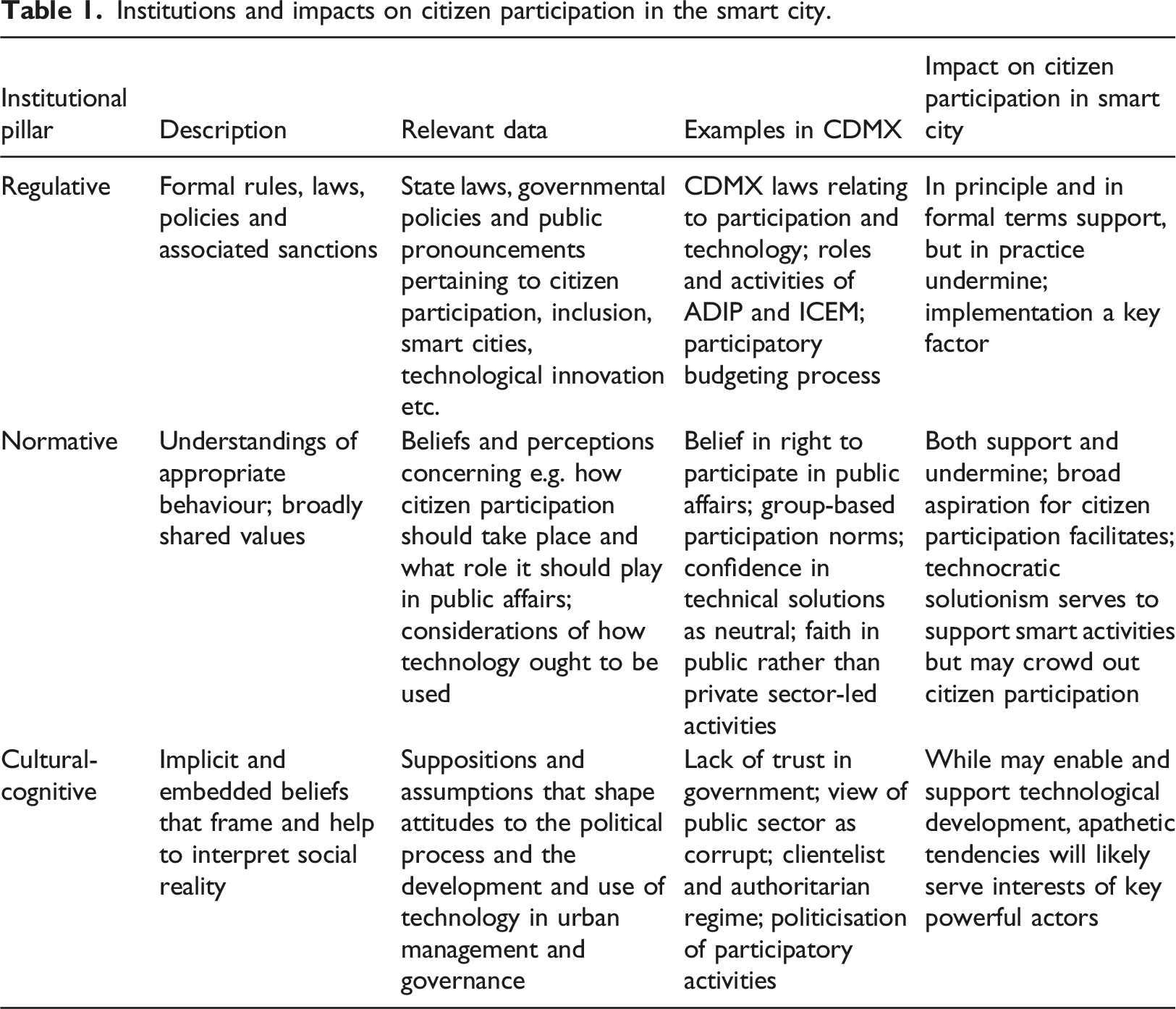
In general, we find that regulative institutions appear to facilitate citizen participation in the smart city in Mexico City, although the way they are implemented often appears not to do so; normative institutions both support and hinder such involvement; and cultural-cognitive institutions largely undermine it. The formal laws and policies outlined above would at face value appear to enable citizen-oriented smart city development, especially because the idea of Mexico City as a smart city has been supported by successive mayors. While the laws do not specifically mention ‘smart city’ (ciudad inteligente), there is a clear emphasis on inclusion and openness, which would appear to facilitate the widespread development of citizen-oriented smart activities. However, the practices of key organisations, while supporting smart-style activities, at times appear to undermine citizen participation. The fact that the ADIP has been created by the new administration, and received its public backing, would appear to give it considerable authority. Its existence, and association with particular projects, has clearly enabled specific smart innovations. Nevertheless, its centralising and controlling tendencies put barriers in the way of smart city activities both within and beyond the governmental sector.
Normative institutions appear to operate at societal level to support the idea of citizen participation as an integral part of governance processes in Mexico City. Nevertheless, normative institutions related to participation do not necessarily and unproblematically translate into participation in smart city initiatives. Such norms of participation do not have their roots in the technological/smart city sector. Rather, they are born out of long and short term contexts in favour of democratisation and political reform: it is an open question how readily they can transfer and be applied to the smart city field. These normative institutions, rather than operating at societal level, could be more field-specific than they first appear. The context for participation in Mexico City includes an embedded tendency for group-based rather than individual-based participation. It has long been recognised that democratic participation, broadly drawn, is facilitated by the existence of citizen groups (Putnam, 2000). Hence at one level it can be argued that this context favours citizen participation in smart city innovation, provided groups of citizens – and their identities, demands etc. – are targeted. Indeed, this may provide a useful counterweight to the tendency of smart city initiatives themselves to individualise citizens as end users.
At the governmental level, technocratic attitudes clearly will enable certain sorts of technology-led smart city applications. Yet the danger is that technology and data are valued to an extent which limits the space for citizen-oriented views in smart city programmes. Smart city initiatives could be geared towards solving those issues which are amenable to be addressed with data, leaving untouched those which, while important to citizens, are not (Ranchod, 2020). The normative institutions around the creation of the ADIP, that are taken to justify the centralisation technological activities in a particular agency, act as both barrier and enabler. Government-led initiatives that are seen to prevent waste and corruption legitimate state action in the smart city field. Yet, as explained above, the ADIP can and does prevent other governmental agencies from acting. Moreover, such attitudes can also spread beyond the government sector into the private sector or community sector. Hence the net effect is less smart city activity overall, because actors foresee a lack of fertile ground in Mexico City for citizen-oriented initiatives.
The centralisation and paternalism evident in the cultural-cognitive institutions of the city’s governance need not stand in the way of smart city activities. Indeed, it might facilitate them, should the city’s elites decide to prioritise smart city development. Nevertheless, it does not follow that such activities are likely to be citizen-oriented. Instead, they are more likely to be centrally-driven, top-down initiatives which reflect elite perspectives on what is good for the city, or perceived needs of citizens, or indeed what is good for the governing elite. If the view of people who are involved in the governance of the city is that there is widespread apathy amongst citizens, and that citizens think the process will be perceived as corrupt, then it would be reasonable to assume that many will conclude there is little point in investing time to develop initiatives that require citizen input. Established norms – ways of doing and ways of thinking – lead to the assumption that widespread involvement in the political process is likely to lead to little change; the clientelist processes are too deeply ingrained; participation is too politicised; and the corporatist ways that governors and governed interact are too deeply embedded at societal level. The existence of such norms and practices does not necessarily mean smart city activities will be discouraged; indeed, it might mean that they will be seen as being easier to develop because coping with the messiness of involving citizens is not seen as necessary. What it does mean, though, is that practices are unlikely to be citizen-oriented.
Any alternative to such alignment necessitates institutional disruption or transformation. One possibility is that, as has been argued in other contexts (Lowndes et al., 2006) unhelpful institutions can be purposefully changed to facilitate citizen participation. Two issues are important here. The first issue is what sort of rules need changing, and the second is who might be in a position to change them? It is clearly the case that regulative institutions are easiest to change by those in formal positions of power. It is in the gift of policy-makers, politicians and party officials to develop specific proposals and policies to effect alternative regulative institutions in a way that ordinary citizens cannot. In relation to our case study, regulative rules have changed in recent years with the arrival of the new city administration in the smart city field.
Changing embedded unwritten and unspoken understandings is less certain (Bicchieri, 2017). The question is not whether normative or cognitive institutions change – they clearly do – but to what extent such change can be engineered in predictable ways and by whom. In our research the new administration has attempted to alter the normative context by promoting a new centrally driven, technology-led approach to the smart city. Cultural-cognitive institutions, containing legacies of past practices seem relatively untouched. This is important because they present significant barriers to the type of citizen participation in smart city innovation typically envisaged in the literature. If they are out of the reach of actors to re-design, then attempts to meaningfully engage citizens in smart city innovations will be frustrated.
Further, while we might conclude that these intangible institutions need to change if citizen participation in smart city activities is to flourish, we need to recognise that existing institutions serve broader purposes and deliver benefits that can give policymakers the incentive to leave them in place. The key question is where meaningful citizen participation at field level sits within policymakers’ overall priorities. It is necessary therefore to include in the debate around smart cities not only the field-specific considerations that pertain to designing-in citizen participation in innovation but also to zoom in on specific conditions which enable that to occur. At the same time, it is necessary to zoom out and take note of the broader settings in which such innovation occurs. Zooming out to the broader societal context indicates where the more profound institutional challenges to participation lie.
One final possibility exists: the technologies that are introduced as part of smart city developments will themselves set in motion dynamics that transform the institutional context. There is already evidence that smart city practices can be disruptive to established norms and practices (Calzada, 2018). This sort of disruption can impact on the regulative, normative or cultural-cognitive institutions and practices examined above. The concept of ‘the commons’ and of platform thinking, now at the centre of many smart city conversations, could potentially act as this type of disruptor, resulting in challenge to, and ultimately deinstitutionalisation, of well-established practices.
Conclusion
Strong arguments have been advanced in favour of increased citizen participation in smart city activities. While valuable work can be done focussing the analysis at the project level and developing well-established tools such as Arnstein’s ladder of participation (e.g. Cardullo and Kitchin, 2019b), this paper has sought to explore the issue of citizen participation in smart cities through an interrogation of the institutional context. The institutions of governance around smart cities pull in different directions both across and within categories, and it cannot be taken for granted that smart city activities will embed successfully into an existing institutional context. Rather, this analysis suggests that inducing citizen participation in smart cities may be a somewhat difficult process. This aligns with much of the experience with citizen participation in urban policy more generally. While there may be very good reasons for introducing particular initiatives – say those that infuse current arrangements with new or different forms of democratic practice – these are prone to run into difficulties as pre-existing arrangements blunt and can ultimately nullify them. Yet it would be misguided to simply accept that democratising smart city practices will inevitably suffer the same fate. Given the range of smart city activities, their pervasiveness, and the potential for transformation they offer a significant route for the progressive development of cities. However, the route to delivering inclusive smart city development requires much greater attention to the precise nature and embeddedness of the institutional barriers to greater participation and concerted and sustained strategies to alter them.
Footnotes
Declaration of conflicting interests
The author(s) declared no potential conflicts of interest with respect to the research, authorship, and/or publication of this article.
Funding
The author(s) disclosed receipt of the following financial support for the research, authorship, and/or publication of this article: The ECOSCIM project is supported by the UK Economic and Social Research Council grant number [ES/S006710/1] and the Consejo Nacional de Ciencia y Tecnología de México. Mario Pansera also acknowledges funding by the ERC Starting Grant PROSPERA [GA 947713] and the H2020 grant JUST2CE [GA 101003491].
Correction (April 2025):
Journal name in the reference Raven et al., 2019 has been updated to European Planning Studies since its original publication.
