




Abstract
Planning consultants are increasingly hired to organize citizen participation processes for urban development projects. However, the ways in which planning consultants engage in and perceive the involvement of citizens in urban development projects remain relatively understudied. This article opens the black box of consultancy employees’ perceptions toward citizens in urban development processes. Employees from two consultancy firms in the Netherlands were interviewed, and several focus groups were organized. This research shows that consultants have wide-ranging views concerning the ways of incorporating citizens’ interests in urban development projects. With the use of Q-methodology, a typology of how consultants engage with citizens is proposed. Furthermore, we show that the different perceptions of consultants lead to a different approach in identifying the needs and problems of citizens. This finding gives insight into the context in which decisions about urban development are made.
Introduction
In recent years, most planning systems have placed more emphasis on citizen participation in urban development projects (UDPs). The emphasis on citizen engagement has led to the transformation of governance networks, (contractual) agreements, and professions, such as consultants who specialize in participation, in urban development. (Lee, 2015; Raco et al., 2016). Consultants are increasingly responsible for organizing participation processes; therefore, the methods of consultancy firms and their perceptions toward citizen participation (co)determine whether the outcomes of participation processes are incorporated in the (contractual) agreements that manage UDPs. A conflicting understanding of what citizen participation entails between consultants (and the developers who hire them) and citizens can undermine local democracy (Lee, 2015; Vogelpohl, 2018).
Although consultants are increasingly important in UDPs, there is scant knowledge regarding the opinions of consultants on the merits of the involvement of citizens in UDPs. This study contributes to opening up that black box. We examine the perceptions of consultants in two Dutch consultancy firms and propose a distinction in their opinions toward citizen participation. These findings can be used to further explore how consultants engage with citizens. As this study is part of a broader research project that aims to study the use of private law tools (instead of public law tools)—which are used by both public and private actors for the realization of public goods (such as urban development)—we were also interested in consultants’ notions of the use of contracts as a tool to incorporate citizens’ interests in UDPs (Camacho, 2013; Van den Hurk and Hueskes, 2017).
Privatization of participation in urban development
In UDPs, consultancy firms have various responsibilities to government agencies, market parties, and citizens, which range from making financial calculations to the drafting of strategic plans and development agreements (DAs). For this research, we regard consultancy firms as market parties that act as intermediaries for principals of the public or private sector, giving them (strategic) advice or managing their projects and processes (cf Raco et al., 2016; Vogelpohl, 2019).
Since the 1980s, the planning and realization of UDPs has increasingly become a public–private enterprise (Raco et al., 2016; Vogelpohl, 2018). The trend has at least two important indications, the first being that market parties have taken over tasks that were previously fulfilled by the public sector, including the design and planning of urban development plans and participation processes, and the second being that city governments have increasingly made use of new organizational tools from the market sector, such as performance-based indicators and bond financing, to organize their work (Boltanski and Chiapello, 2005; Janssen-Jansen and Van der Veen, 2017; Tasan-Kok, 2010). In these governance networks of public and private actors, contractual agreements are used to coordinate responsibilities and formalize relations (Janssen-Jansen and Van der Veen, 2017). The contracts, which, in the context of UDPs, can be labeled as DAs, codetermine what is being built and what is not. Hence, contracts influence how citizens’ interests are incorporated in UDPs. Because of the growing importance of contracts in urban development, this tendency has been labeled as contractualization (Lloyd, 2015; Raco, 2013; Vincent-Jones, 2007).
Outline of the research
Our focus is on the role of consultants in citizen participation processes in UDPs, and we therefore concentrate our research on planning consultants. All the planning consultants we encountered have experience in organizing citizen participation processes and have considerable knowledge about urban planning. In this article, we regard planning consultants as important but “understudied” actors in urban planning and aim to generate insight into their way of operating, their decision-making processes and their different notions by focusing on citizen participation. Therefore, we scrutinize the different perceptions that planning consultants can have toward involving citizens in UDPs. We aim to obtain a better understanding of how planning consultants operate by investigating their perceptions of citizen involvement in urban development.
We review the relevant literature in the second section to provide some more insight into the role of consultants in UDPs. In the third section, we outline the methodology that we use to answer the research question and formulate the propositions that guide our research. Then, the consultants’ perception about involving communities in urban development is described in the fourth section, followed by a reflection on the relationship between principals and consultants in the fifth section. We describe how the different perceptions of consultants toward citizens’ participation are related to the use of (contractual) agreements in UDPs in the sixth section, and the paper ends with a conclusion and suggestions for further research.
Consultancy, contracts, and urban planning
In this section, we first outline the relationship between the ongoing privatization of urban planning and the role of (planning, legal, and management) consultants in urban planning before we describe the impact that consultants have on urban planning. Finally, we discuss how contractual agreements reinforce the need for consultants, and vice versa.
The continuing privatization in urban planning has resulted in the growing involvement of consultants in urban planning, as described in the “Introduction” section. Because a wide variety of actors are involved in urban planning, the ability of consultants to solve problems related to cooperation and coordination is valuable (Grijzen, 2010). Consultants act as mediators between the actors by understanding their interests and the organizational contexts in which they operate (Caloffi and Gambarotto, 2017). It is important to note that the increased role of consultants in urban planning is not only related to market-oriented reforms; the wish to implement collaborative and communicative planning policies has inspired many planners and local administrators (Raco et al., 2016). Citizen participation in UDPs comes in many varieties, which range from consulting citizens to community-led development projects (cf Arnstein, 1969; Beaumont and Nicholls, 2008). Most planning systems in the Western world have adopted rules and procedures to ensure that affected actors are heard by the planning authorities and can make, when necessary, objections against developments through legal procedures (Innes and Booher, 2004; Michels and de Graaf, 2010).
Because consultants work on a programmatic basis, they can generate and spread ideas quickly. Consultants are known to produce “fast policies,” i.e. consultancy firms fit standardized solutions to the local context (Prince, 2012; Vogelpohl, 2017). The policies are fitted to the local context by either quantitative data or quickly gathered input from interviews with well-known actors and established decision-makers (Prince, 2014; Vogelpohl, 2018). The fast policy process changes the circumstances in which the policy is produced (Vogelpohl, 2018). Thus, not only is the policy itself changing, but the way in which the policy is produced is also altered (Swyngedouw et al., 2002). Every problem is turned into a project, thereby ignoring the structural problems in cities. After the project is finished, the consultants leave, although the problems are not necessarily solved. Moreover, governmental agencies lose the opportunity to gain expertise and practical knowledge by hiring consultants (Grijzen, 2010). Combined with budget cuts in public administration, this loss reinforces the dependence of governmental agencies on the expertise of consultants (Prince, 2012; Raco, 2013; Vogelpohl, 2019). Grijzen (2010) stresses the loss of the knowledge and the capacity to solve complex problems in (local) planning departments because of the hiring of planning consultants, which strengthens the dependence of those departments on said consultants.
In practice, consultants tend to reproduce the power inequalities between (and within) communities and the city elites. Citizens are mostly seen as passive actors who need to be taken on board (Vogelpohl, 2018). This viewpoint reproduces the existing power inequalities within cities and limits the empowering possibilities of participation processes (McCann, 2001; Vogelpohl, 2019). The main task of consultants is to fulfill the assignments of their principals. Hence, consultants have an incentive to frame the outcomes of participation processes to suit the needs of their principals. Consequently, democratic concerns may have less priority or could be discarded entirely (McCann, 2001; Vogelpohl, 2018). Moreover, developers can use the perceived impartiality of consultants to show their commitment to incorporating citizens’ interests in UDPs (Raco et al., 2016).
As we described in the “Introduction” section, the transition of urban development toward a public–private enterprise has not only increased the involvement of consultants but also the use of contracts to regulate partnerships and achieve policy goals. Contractual agreements are preferred because they are flexible tools that can be tailor-made and adapted to changing circumstances more easily than can public regulations (Boltanski and Chiapello, 2005; Vincent-Jones, 2007). In turn, consultants are hired to create and coordinate contractual agreements between public and private actors (Caloffi and Gambarotto, 2017).
While it is known that most UDPs require tailor-made governance contracts, it is not a well-established practice to form contracts with citizens. Previous research shows that citizens’ interests are often not translated into written agreements (Metzger et al., 2015; Raco, 2013; Savini, 2016). Contractual agreements are often dominated by financial arrangements instead of by social goals (Raco, 2013; Van den Hurk and Hueskes, 2017; Vincent-Jones, 2007). In previous research, we emphasized contracts as a tool for organization (Janssen-Jansen and Van der Veen, 2017). Starting from the American example of “community benefits agreements,” we studied various examples of “community contracts” (i.e. contracts with citizens and local organizations that contain the conditions for their support and their specific policy goals), and we introduced the term “project collectivity” to describe the local interests that come with UDPs.
As we believe that consultants codetermine whether such a tool is used or even considered, in this research, we asked them for their opinions regarding contracting with citizens in UDPs.
Methodology
To guide this research, we developed four propositions. The first two propositions focus on perceptions within consultancy firms, while the last two focus on how these perceptions influence the behavior of consultants. The first proposition states that the perceptions of consultants concerning the involvement of citizens in urban development differ within consultancy firms. We developed this proposition because we wanted to explore how the perceptions of citizen involvement are shared, or not shared, within consultancy firms. The second proposition roughly explores whether the expertise of a consultant is related to their perceptions as an employee of a consultancy firm. We assume that whether a consultant works for a legal department or a design department matters in how they perceive the involvement of citizens in urban development.
The third proposition states that consultants incorporate or exclude citizens’ interests in UDPs regardless of the preferences of their principals. The relationship between consultants and their principals can range from the belief that consultants are neutral actors because they are hired by their principals to the notion that consultants are a type of “shadow government” who make the behind-the-scenes decisions (Hodge and Bowman, 2006). The increased involvement of consultants in producing public policy is linked to market-style reforms and is known as the creation of a “consultocracy.” The “consultocracy” replaces traditional bureaucracies, and this process is used to depoliticize public administration. Political issues are presented as managerial and are solved by the hiring of consultants. Thus, according to this view on consultants, consultants are not neutral actors but are instead political actors (Hodge and Bowman, 2006; Saint-Martin, 1998). We developed this proposition because we wanted to explore the relationship between principals and consultants. The fourth proposition states that consultants prefer agreements that incorporate citizens’ interests into urban development that are not enforceable by a court of law. We formulated this proposition to probe which type of agreements consultants prefer to use to incorporate citizens’ interests in urban development and how preference this relates to their perceptions.
We used semistructured interviews and the Q-method to determine what perceptions consultants have regarding the involvement of citizens in urban development. The Q-method is a methodology that helps explore patterns in numerous possible perceptions on a certain topic. This method is a helpful tool to formulate typologies of perceptions concerning topics that are difficult to interpret without clear problem boundaries (Cuppen et al., 2015; Uittenbroek, 2014). Hence, the Q-method was appropriate to further explore the thought processes of consultants because there is not yet much theoretical or empirical research on this topic.
With the Q-method, respondents must sort statements within a fixed distribution that ranges from “strongly disagree” to “strongly agree.” In this study, after the statements were sorted, the existing perceptions within the consultancy firm were analyzed with the use of factor analysis. Thereafter, we asked the respondents questions in a semistructured interview using a topic list. During the interviews, we reflected on the statement sorting and focused on the way in which the consultants engage with citizens, how they make agreements with citizens and how the principal influences the relationship between the employee and the community.
The Q-method is performed through six steps. In the first three steps and the last step, the researchers need to perform interpretative work. The fourth step is performed by the respondents, and the fifth step is performed by the publicly available software PQMethod for Mac OS X version 2.35 (Kampen and Tamás, 2013; Robbins and Krueger, 2000). The first step of the Q-method is to state a research question, which here was as follows: “What kind of perceptions do employees of consultancy firms have toward the value of involving citizens in urban development?” Second, a broad spectrum of statements about the research question is created. These statements are based upon quotes from scientific articles, policy documents, and local or national newspapers. In this research, the Lexis Nexis database was used to find relevant news articles discussing community and citizen involvement in urban development.
Third, a sample of the statements is taken to function as a Q-sample. The sample aims to represent diverse opinions and a broad range of concepts. We selected statements that reflect various ways to translate citizens’ interests into agreements, the political, social, and economic aims of citizen involvement, and the role of actors concerning citizen involvement. For example, we selected statements such as “citizens should codesign UDPs” or “conflicts in urban development processes emerge from not enough effort being put into finding agreement with citizens” (see Appendix 1 for all statements). We tested the Q-sample in a workshop with practitioners and researchers. The feedback of the workshop was used to select the final Q-sample. The workshop showed that the Q-sample had too many statements that strongly valued citizen involvement in urban development; therefore, the respondents had trouble dividing the statements in the fixed distribution. As suggested by the workshop participants, statements were added that controlled for the statements that were positive toward citizen involvement.
The fourth step requires respondents to rank the Q-sample. In this study, each statement had to be arranged in a fixed normalized distribution range of nine categories, from “strongly disagree” to “strongly agree,” which forced the respondents to position the statements relative to all the other statements. This process allowed a comparison of the relative weight of each statement in the Q-sample.
In the fifth step, we examined the underlying patterns of the sorted Q-samples using a factor analysis. Because this study is explorative and we did not use existing theories about the perception of consultants, we analyzed the data with the use of a principal component analysis (PCA) and a varimax rotation. A PCA maximizes the variability within the data, and the varimax rotation is suitable to explore data without the support of theoretical knowledge (Ramlo, 2016).
A PCA extracts a wide range of factors from the data. Each factor represents a perception of respondents with a comparable perception about citizen involvement. Because we wanted to reduce complexity and have parsimonious results, factors with an eigenvalue equal to or higher than one and at least three loaded respondents were selected (Raje, 2007). Thereafter, a varimax rotation was used to find uncorrelated significant factors.
The sixth step is interpreting the data (Cuppen et al., 2015; Robbins and Krueger, 2000). For the interpretation of the data, we described the highest scoring statements of each factor, as well as those statements the respondents disagreed the most about. The semistructured interviews were also used to interpret the factors. During the interviews, we reflected on the statement sorting, asked how the consultant managed their relationship with the principal, why they were hired, what type of citizens they engaged with, and how they made agreements with citizens.
Cases: Antea Group (AG) and Over Morgen (OM)
We asked employees of two consultancy firms to participate in this cross-sectional research. All of the participants in our research are planning consultants who are familiar with urban development processes. We organized several meetings in which we discussed their work and our research. Furthermore, we worked from their offices to become familiar with their way of working. The two consultancy firms were chosen because of their size (one large, one small) and their willingness to cooperate.
The first consultancy firm is called AG, which is the biggest consultancy firm in the Netherlands, with branches all over the country and offices in France, Belgium, and the USA. The company was founded as an engineering firm but has evolved into a consultancy firm that is involved in all aspects and phases of urban development and land use. Today, over 3500 employees work for AG, with approximately 1400 of them employed in the Netherlands. The senior employees of AG selected the first eight employees to sort the Q-sample. Consultants working in different departments of AG were selected to obtain a broad range of views on citizen involvement. We used snowball sampling to find the other eight employees of AG.
The second consultancy firm is called OM, which is a small consultancy firm with approximately 50 employees. OM specializes in area development projects with a societal impact, such as urban renewal, energy transition, and legal advice. We interviewed four OM employees. Because OM does not work with different departments, we could not preselect employees from different departments to obtain a broad range of views on citizen involvement. However, the employees who participated in the study differ based on their seniority within the company.
The perceptions of consultants on involving citizens in urban development
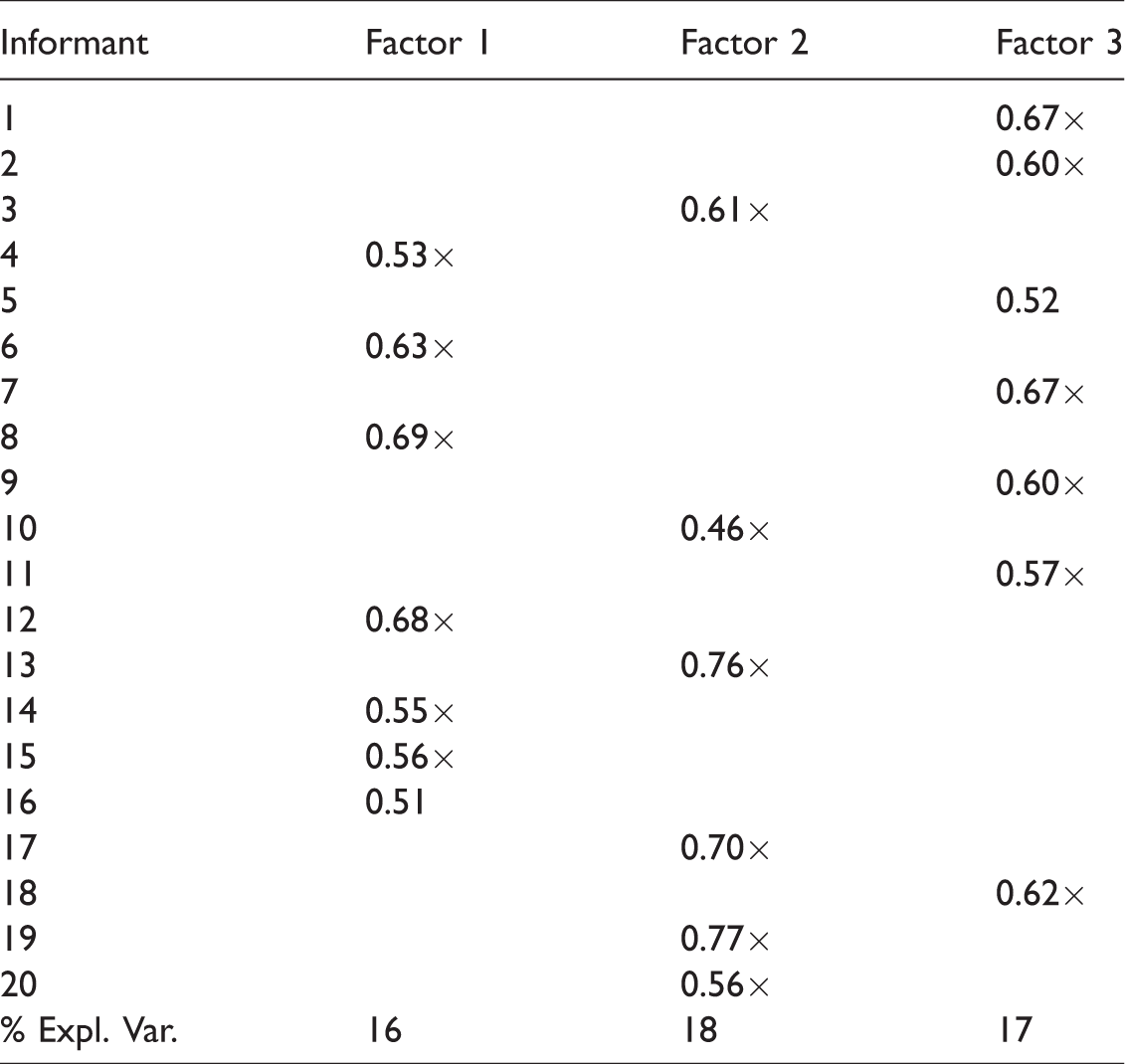
The results of the PCA showed three factors with an eigenvalue higher than one and more than three loadings. Eighteen of the twenty Q-sorts were loaded within the three factors (see Table 1). Respondents 5 and 16 loaded in more than one factor and were therefore not used to describe the factors. In the next paragraphs, we will introduce the three typologies that resulted from our Q-analysis. We describe the typologies by analyzing the statements that the respondents either identified strongly with (4) or disagreed strongly with (−4). Moreover, we use the statements that the respondents agreed or disagreed with to a lesser degree (3 or −3) for our analysis. The statements are interpreted with the use of semistructured interviews.
Significant Q-sort loadings in factor types.
Factor 1: Proceduralists
The respondents of the first factor identified strongly with statement 6, i.e. “not enough effort is put into finding agreement with citizens,” and statement 27, i.e. “citizens in UDPs only focus on their own private interests.” The respondents who identified with this perspective were relatively negative regarding the role of citizens in participation processes during the interviews. They argued that the opinions of citizens who are positive about a UDP are often overruled by outspoken citizens who are critical of a UDP. The consultants aim to make clear agreements with citizens, as without them, they fear that time and money will be wasted. Mistakes that are made early on in the urban development process can result in distrust, which can distort the urban development process as a whole.
To a lesser degree, the holders of this perspective agreed with statements 1, 8, and 18, which state that it is necessary to write down agreements with citizens or citizen representatives, that citizens should codesign UDPs and that only outspoken citizens express their opinions during participation processes, respectively. During the interviews, the consultants argued that citizens need to participate in the urban development process because they are the end users of the project. Writing down the agreements with citizens is necessary because it provides clarity during the participation process. Respondent 4 described that in her experience, only a certain group of citizens who have their own agenda attend public meetings, but this group does not represent all citizens who are affected by urban development.
The consultants who identified with this perspective argued in the interviews that outspoken citizens could negatively influence the mood of those meetings but that the meetings were needed to identify possible problems and to test plans. Alternative ways of interacting with citizens are seen as fruitful, but they often take too long and cost too much time, according to the principals.
The respondents strongly disagreed with statements 20 and 30, which state that citizens are only involved in UDPs to disguise budget cuts and that the position of citizens is best articulated by NGOs, respectively. In the interviews, the consultants often said that participation processes were expensive and that they do not go together with budget cuts. The consultants also explained in the interviews that NGOs often have different goals than individual citizens and that therefore, NGOs do not articulate the position of citizens better than citizens themselves.
The consultants who identified with this perspective also disagreed, although to a lesser extent, with statements 9, 10, and 26, which note that citizens should have the possibility to give a go/no-go for a project, that citizens should only be involved through consultation, and that the reason for not giving citizens a role in the urban development process is because they do not have the knowledge and expertise to give a meaningful contribution, respectively. The negative scores on these statements show that this group of consultants sees the role of citizens as being highly instrumental, i.e. citizens need to have a role in the urban development process because they are the end users of the project. However, the consultants explained that citizens do not need the ability to give a go/no-go for a project because they already have much influence. They fear that more influence for citizens would mean that nothing would be built anymore.
We labeled the consultants who identified strongly with this factor as the proceduralists. We chose this term because these consultants believe that much conflict within UDPs comes from not thinking enough about how agreements are made with citizens. They also assert that if citizens have too much influence, then it takes too much time to develop a project. The following quote is representative of the logic of the proceduralist consultants: As long as you know what their interests are, and if you know their struggles, then you can give them the feeling that they are being heard. You cannot develop a project that everybody likes; that is just not possible. Then you have to go into another trajectory [if citizens obstruct an UDP]; legal frameworks are available. We live in the Netherlands, luckily, where everything is neatly organized if you identify the possible threats and plan the process well. (Respondent 8, 2017)
Factor 2: Citizen empowerers
The respondents belonging to the second factor strongly agreed with statements 6 and 19, which reflect that conflicts in urban development processes emerge because not enough effort is put into finding agreement with citizens and that citizens do not have enough time to participate actively in every UDP, respectively. The respondents who identified with this perspective noted that it is important to find agreement with citizens, but citizens have many different responsibilities. Therefore, there is a limit to what you can expect citizens to do in an urban development process. Nevertheless, these consultants firmly believe that the involvement of citizens greatly improves the outcomes of the urban development process.
To a lesser extent, the consultants agreed with statements 2, 4, and 15, which state that conflicts with citizens in urban development processes can be prevented by making informal agreements, that there is a need for new legal instruments to organize the involvement of citizens better and that involving citizens in urban development makes it easier to solve political problems, respectively. In the interviews, the consultants explained that having personal contact with and making informal agreements with citizens is very important. In particular, investing in relations with citizens who are against urban development plans is important because they are knowledgeable as the users of an area. Respondent 19 also described that the internal processes in municipalities are not clear to citizens, especially because the internal departments within a municipality do not always agree with each other. When enthusiastic citizens want to participate, they are often disappointed by the slowness of those internal processes or become demotivated by bureaucratic obstacles. Respondent 10 explained that political problems are solved more easily when more citizens are involved in urban development processes because they can break through the bureaucratic bottlenecks. Therefore, new legal tools are needed to make it easier for citizens to participate.
The respondents strongly disagreed with statements 22 and 26, which state that it is more important that a UDP is beneficial for economic development than that the interests of citizens are safeguarded and that a reason to not involve citizens in UDPs is that they do not have sufficient knowledge and expertise to make valuable contributions, respectively. The consultants explained that they see the involvement of citizens in UDPs as important because they are very knowledgeable about the project; therefore, their expertise is an aspect that needs to be used during the development of the UDP.
To a lesser extent, the respondents also disagreed that the involvement of citizens in UDPs only succeeds through the help of NGOs and with statements 9, 10, and 22, which state that citizens should have the ability to decide whether a UDP is a go or a no-go, that involving citizens in UDPs is only useful through consultation, and that it is more important that a UDP adds to economic development than that it incorporates the interests of citizens, respectively. The consultants were more or less against the go/no-go ability for citizens because they argued that some projects are of importance to a larger area, thus citizens should not be the only ones who decide. However, only using citizens for consultation or economic benefit is wrong, according to the consultants. The statements show that the consultants see the involvement of citizens as something that is intrinsically valuable, rather than just instrumental.
We labeled the consultants who identified with this factor as the citizen empowerers because the respondents who identified with this factor are quite critical of the role of the government but strongly believe that citizens can greatly improve UDPs. They also think that if citizens play a significant role in the UDP, it will help to solve political problems. They see the involvement of citizens as an opportunity to break through impasses. The following quote is a good example of the logic of a citizen empowering consultant: I think that the knowledge and expertise resides with citizens instead of on the other side of the table. People know a lot, people work; they are not stupid. I really think it is ridiculous if you think like that. It is not respectful toward citizens. They know the environment and make use of it. The designs only become more beautiful. (Respondent 3, 2016)
Factor 3: Balancers
The respondents who correspond to the third factor strongly agreed with statements 18 and 39, which reflect that if citizens can become involved in an UDP, then only outspoken citizens participate and that the bureaucracy of the government prevents the involvement of citizens in urban development, respectively. The respondents who identified with this perspective noted the importance of involving citizens but also acknowledged that they do not reach every population group. In the interviews, the consultants noted that it is very hard to reach elderly people, people with lower education levels, or people with a minority background.
To a lesser extent, they agreed with statements 5, 16, and 25, which state that asking citizens to commit to legally binding agreements in UDPs discourages citizens from getting involved, that the added value of actively involving citizens in urban development is that different population groups meet, and that involving citizens in urban development is necessary as a counter power to civil servants and the private sector, respectively. In the interviews, the consultants stated that it was helpful to write down agreements with citizens but that asking citizens to commit to legally binding agreements is asking too much from them. They also stressed the importance of involving citizens in UDPs because they prevent the private sector and the government from being too dominant, and UDPs are a helpful tool for allowing citizens to meet other citizens.
These respondents strongly disagreed with statements 13 and 35, which state that citizens have enough legal and political means to influence policy and that the private sector listens better to citizens than to the government because they know what the market wants, respectively. Respondent 7 has written a book on how he was not taken seriously as a citizen when a new station was built near his home. He stated that everyone who works in urban development should participate in a whole urban development process once to learn how important it is to take citizens seriously. Respondent 11 described how political and legal instruments are mostly used by politicians, civil servants, and the private sector but not by citizens.
This group of consultants disagreed to a lesser degree with statements 2, 11, and 37, which express that conflicts with citizens in urban development processes can be prevented by making informal agreements, that citizens need to have the feeling that they are involved but real influence or codesigning responsibilities are unnecessary and that civil servants represent everybody’s interests in UDPs, respectively. The consultants who identify with this perspective explained in interviews that citizens need to be taken seriously and that sometimes civil servants or politicians prevent this because they have other interests than the citizens. It is therefore important that all the actors speak from their own expertise and that they develop a shared perspective on the UDP. Consequently, citizens need to be involved in a meaningful way.
We classified the respondents who identified with this factor the balancers because they are looking for a new balance between citizens and other actors. We chose this definition because these consultants argue that involvement in UDPs can be beneficial but that the interests of citizens should be weighed against the interests of other actors. The balancer is a consultant who sees all the competing interests in a project as a puzzle. Finding a balance between all the interests is the balancer’s main drive. The following quote reflects the thinking of a balancer consultant: If you talk about what I just said, going from your own interest for the broader community, that only succeeds when you know what the other interests are and where they come from. But then you need to see each other and speak together, and give space to each other, and feel safe to talk about it. (Respondent 9, 2017)
Reflection on the Q-sort
After the analysis of the Q-sort, we sent a short survey to the respondents, along with the research results. In the survey, we asked whether they recognized our typologies in their colleagues, whether they could recognize themselves in one of the three typologies (factors), and whether they recognized themselves in the typology in which they were loaded. The three typologies were recognized by most respondents, and they could recognize themselves in the typologies. The balancer was the typology that was least recognized; two of the four balancer respondents who reacted identified more with either a proceduralist or a citizen empowerer. In the comments, they argued that they could recognize themselves as a balancer but either as a balancer who was more positive about citizens or a balancer who was more negative about citizens. Subsequently, we organized a workshop to reflect on the typologies with the consultants. In the discussion with the consultants, we focused on better defining the balancer typology. This process resulted in formulating the balancer as a consultant who sees UDPs as puzzles of competing interests.
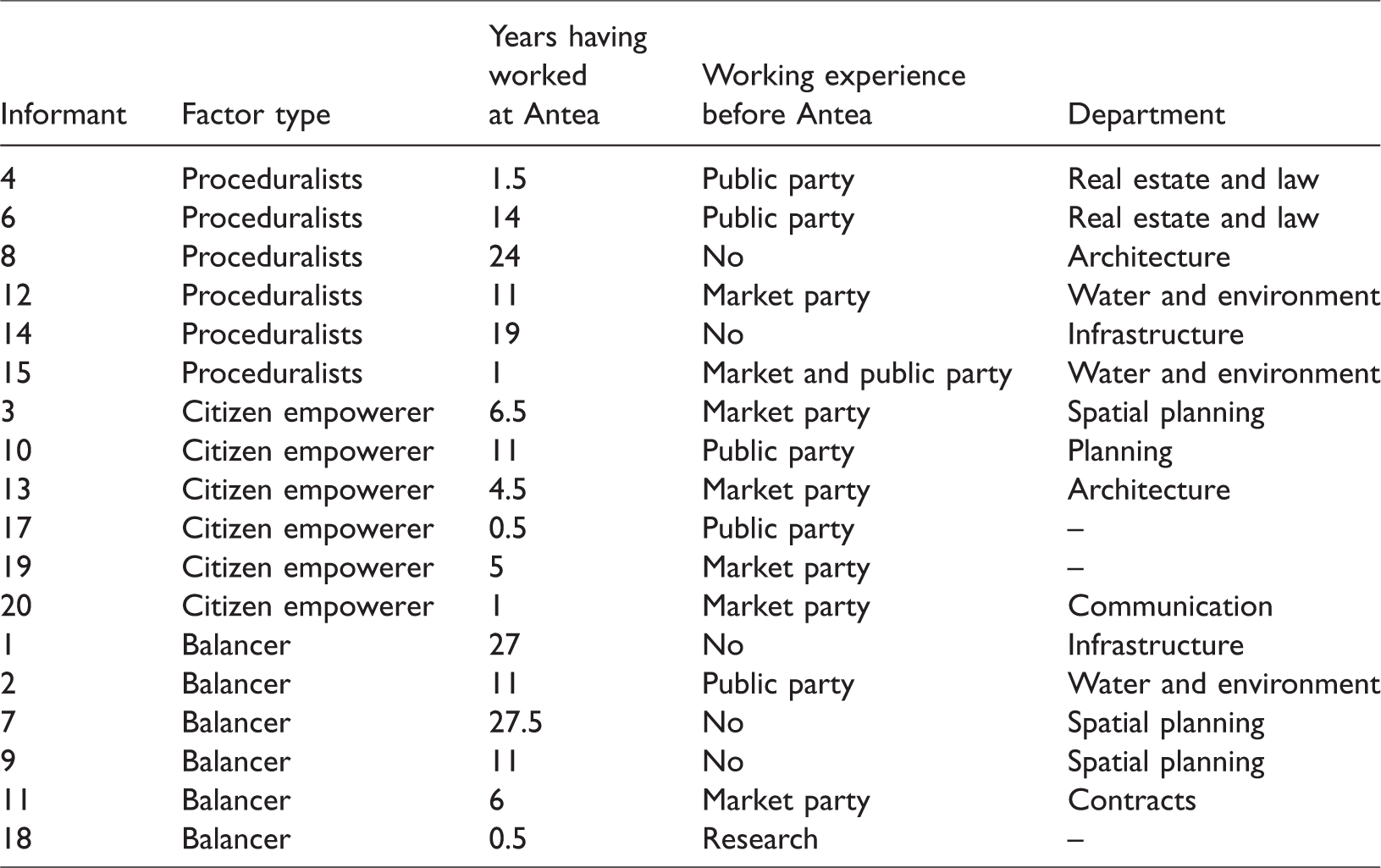
Answering the question as to why consultants identify with a certain factor type is, based on this research, difficult. First, the correlation of the respondents’ Q-sorts with the factors varies. Therefore, the results should be interpreted with caution. Second, the work experience or departments are reasonably spread across the different factor types (see Table 2). Nevertheless, the consultants who work for the real estate and law departments both share the proceduralist perspective. This outcome makes sense because their job is to give legal advice, which fits with the proceduralists’ perception that clear (written down) agreements with citizens are necessary. All three typologies of consultants are found among the employees of AG, while at OM, there are no consultants who share the proceduralist perspective. Overall, there is not a concentration of certain typologies within a department or firm. More research is needed to explain the variation of factor types within consultancy firms.
Factor types with the department and function of the respondents.
Translating citizens’ interests into (contractual) agreements
To explore how the different perceptions could influence the behavior of planning consultants, we asked how the consultants incorporated citizens’ interests into agreements. We asked what kind of agreements they used based on the distinction between agreements that are enforceable by a court or are not enforceable by a court and/or are written down or are not written down (Van der Veen, 2009). We wanted to find variation in the ways used to find agreement with communities but not necessarily in the frequency with which the consultants used different ways to find agreement.
The most common way to incorporate citizens’ interests in UDPs is through legally unenforceable agreements that are written down. The examples mentioned by the consultants were the reports of public hearings and the results of design sessions; public hearings were by far the most frequently mentioned example of an agreement with citizens. All types of consultants stated that they used this type of agreement. Citizens can submit their views on the UDP, and the developers of the UDP are legally required to comment on their views. Therefore, public meetings are often organized to consult with citizens. The consultants described how they also use public meetings to identify which citizens are enthusiastic about the project and which citizens are against the plan. The enthusiastic citizens can be an asset to the plan because they can point out which parts of the plan can be improved, while the citizens who are against the plan are identified because they can obstruct the process. Most of the consultants argued that taking the citizens who are against the plan aside and talking with them often helps to prevent them from taking legal steps against the UDP.
Another example of legally unenforceable agreements that are written down and used in UDPs to incorporate citizens’ interests is design sessions. Using design sessions to design an UDP together—or at least partially—with citizens helps to create support for that UDP.
Agreements that are legally unenforceable and not written down, such as oral commitments, are often used by all types of consultants to cater to the needs of critical citizens. In separate meetings, consultants listen to the needs of critical citizens and agree orally to incorporate some of the needs into the UDP.
Only 3 of the 20 interviewed consultants had experience with agreements with communities that were written down and enforceable in court. Interestingly, two of these consultants identified with the proceduralist perspective. The other consultant did not identify strongly with any one of the three factors. In two projects, citizens signed agreements to run public services, such as the management of green space or waste management. In one project, citizens could negotiate with the developer about the design of the project. Written down and enforceable agreements with communities are based on our empirical findings quite rare.
Legally enforceable agreements that are unwritten, i.e. oral commitments that can be proven were not used to incorporate citizens’ interests.
The interviews showed that the consultants often rely on legally unenforceable agreements with citizens. This type of agreement is used by all consultants. The consultants explained that few legally enforceable agreements with citizens were created because communities were often reluctant to sign such agreements. Interestingly, two proceduralists had experience incorporating citizens’ interests into written down, enforceable agreements. This outcome can be explained by the fact that consultants who share the proceduralist perspective value clarity during the participation process. One of the statements that they agreed strongly with is statement 6, i.e. “not enough effort is put into finding agreement with citizens.” Putting effort into finding agreement with citizens, combined with writing down those agreements, can provide clarity and prevent tensions during the participation process.
Relationship between the principal and the consultant
To scrutinize the relationship between consultants and their principals, we asked the consultants why their principals hired them and how they proceeded when they disagreed with their principals. The consultants stated that they were mostly hired because of their expert knowledge. The consultants described the expert knowledge in two ways, namely knowing how to get things done and knowing certain skills. Respondent 4, who identified with the proceduralist perspective, and respondent 7, who identified with the balancer perspective, also mentioned that they are sometimes hired because of the trust issues between communities and public authorities. The consultants are then presented as mediators between all the actors. Respondent 4 nuanced their ability to be seen as neutral actors because citizens could give them the benefit of the doubt, but that they were still seen as being intermediaries of governmental agencies or market parties.
When the consultants were asked how they disagree with the principals, they mostly answered that they give advice. The consultants present alternatives to the preferences of the principals, and they can strongly urge an alternative. However, in the end, the decisions are made by the principals. If the consultants do not agree with the principal, they discuss the situation within the firm. When asked to give examples of situations in which they had disagreed with the principals, they often gave examples where they had disagreed with politicians. Respondent 2, who identified with the citizen empowerer group, described a situation in which an alderman ignored the outcome of a participation process and the consultant had to go with the decision of the alderman. However, the consultant actively reached out to citizens to point out their rights and informed them how they could legally object to the alderman’s decision.
Thus, based on their own perception, consultants—not surprisingly—claim that the principal makes the most important decisions. When they do not agree with the principal, they give alternative advice, but in the end, they follow the instructions of the principal.
Conclusions
Planning consultants are increasingly hired to organize participation processes. However, research that investigates the interaction of consultants with citizens during development processes is rare. Our study identified three different perceptions of consultants toward citizen involvement in urban development. The study investigated the perceptions of planning consultants, which gives us insight into how planning consultants approach citizen participation.
Every UDP has different needs and problems concerning citizen participation, and our research indicates that consultants will approach those needs and problems differently. For example, consultants who share the proceduralist perspective will prefer to provide clarity about the role of citizens in the UDP, e.g. through a written down agreement. They do this to prevent tensions and identify the potential hiccups in the development process, not to give citizens influence. Their view on the involvement of citizens in urban development is thus quite instrumental. Contrary to this, consultants who identify as citizen empowerers believe that UDPs are greatly improved when citizens are involved extensively. They aim to protect citizens from bureaucratic obstacles and search for new legal tools to incorporate citizens’ interests into UDPs. They see the involvement of citizens in urban development as something intrinsically good. The consultants who share the balancer perspective weigh the interests of the citizens against the interests of the other actors and do not necessarily prioritize the problems that are identified by citizens. Thus, proceduralists, citizen empowerers, and balancers identify needs and problems during the development process differently and solve them differently.
Within consultancy firms, there are wide-ranging perceptions of citizen involvement in urban development planning. This finding underlines the first proposition, which states that the perceptions of consultants concerning the involvement of citizens in urban development differ within consultancy firms. Compared to the perceptions of the consultant, the expertise of the consultant seems to be less relevant. The second proposition states that the department or the work experience of a consultant influences their perceptions as an employee of a consultancy firm. Our research cannot support this proposition. We could not find clear patterns in the perceptions of consultants and their departments or their former work experience.
In the context of citizen participation and UDPs, the idea that a “shadow government” or a “consultocracy” exists needs to be nuanced. The third proposition stated that consultants incorporate or exclude citizens’ interests in urban development independent of the preferences of the principal. Based on the interviews, we cannot support this proposition. Consultants can challenge principals by giving advice, but in the end, they act according to the preferences of their principal. The consultants interviewed in this study all explained that their principal is the main decision-maker, and their role is only to give advice. Of course, this finding is only based on the perceptions of the consultants themselves. Hence, in the relationship between the principal and the consultant, the principal—for example, a politician—is decisive. However, the practice of hiring consultants has changed the context in which those decisions are made. This context is coconstructed through the work of the consultants. Because this outcome is only based on the perceptions of consultants themselves, this relationship needs further research.
This outcome also stresses an important point in the discussion around the role of consultants in urban planning. The involvement of consultants in urban development has been criticized because they reproduce (or increase) the existing inequalities in cities, structural problems are largely ignored because consultants leave the project when their contract ends, and such involvement increases the dependence of governmental agencies on consultants (Grijzen, 2010; Raco et al., 2016; Vogelpohl, 2018).
Consultants are hired by other parties and are bound by the contract they have with their principals. Treating consultants as “one-size-fits-all” actors will damage the legitimacy of UDPs. Therefore, those who are responsible for hiring consultants should be aware of which consultancy firm is hired and which consultant is assigned to the job.
As Raco et al. (2016) have stated, consultants are reflexive social actors with specific ethical standards. A code of conduct can outline what the responsibilities and duties of a consultant are when they fulfill public roles. The code of conduct can also be used as an evaluative and comparative tool. Periodic reviews of how consultancy firms perform and how they apply the codes of conduct could improve the firms’ transparency. Furthermore, we think it is important that governmental agencies arrange for consultancy firms to transfer their practical knowledge about citizens and their interests to the government after a project is finished. Provisions about mutual learning processes should be incorporated into contracts with consultancy firms. Vogelpohl (2018) has found evidence that predefining the role of consultants can greatly improve the degree of cooperation between all actors.
The fourth proposition is that consultants prefer agreements that incorporate citizens’ interests into urban development that are not enforceable by a law court. This proposition is supported by our empirical work; cases in which citizens’ interests were translated into agreements that are enforceable by a court were exceptions, whereas cases in which citizens’ interests were translated into agreements that were not enforceable by a court seem to be common practice.
This study is explorative and aims to open up the black box of the role of consultants in urban development. Because this topic is relatively understudied, this study is a set-up for more research. The main method used in this research was the Q-method. Although the Q-method is a helpful instrument for developing typologies, it is important to note that none of the consultants fit perfectly into one of the three typologies we developed. The loadings of the consultants in the factors can vary strongly. Furthermore, the perceptions of consultants are not static and may adapt to different situations and times/periods.
Supplemental Material
Supplemental material for Consultants as intermediaries: Their perceptions on citizen involvement in urban development
Supplemental Material for Consultants as intermediaries: Their perceptions on citizen involvement in urban development by EW Stapper, Van der Veen M Universiteit van Amsterdam, Netherlands LB Janssen-Jansen in EPC: Politics and Space
Footnotes
Acknowledgements
We want to acknowledge Geert Rovers and Jesse Stammers of AG and Lianne Hulsebosch of OM for their help with coordinating the interviews. Next, we want to thank the reviewers for their excellent comments.
Declaration of conflicting interests
The author(s) declared no potential conflicts of interest with respect to the research, authorship, and/or publication of this article.
Funding
The author(s) disclosed receipt of the following financial support for the research, authorship, and/or publication of this article: This work was supported by the Dutch Organisation for Scientific Research [438-15-159] as part of the Smart Urban regions for the Future (SURF) call.
References
Supplementary Material
Please find the following supplemental material available below.
For Open Access articles published under a Creative Commons License, all supplemental material carries the same license as the article it is associated with.
For non-Open Access articles published, all supplemental material carries a non-exclusive license, and permission requests for re-use of supplemental material or any part of supplemental material shall be sent directly to the copyright owner as specified in the copyright notice associated with the article.
