




Abstract
Stresses on water resources are considerable and will intensify in the future due to climatic and non-climatic drivers. The emerging shift from science-based command and control ‘old’ water management approach to a dynamic and integrative systems view of water—a ‘new’ water management approach—was explored using the concept of capacity, operationalized using the livelihoods capitals approach (i.e. physical, natural, financial, human and social capitals), as a conceptual lens in a multiple case study of notable cases of urban flooding from Canada and Australia. The findings show that there are changing conceptualizations of capacity in both cases over time. Physical and financial capitals have been emphasized for decades and are associated with the old water management approach, responding to major flood events with the construction of large control structures. While the importance of these capital inputs persists, the approach to building capacity under the emergence of the new water management approach places an increasing relative emphasis on social and human capitals. The lack of emphasis on natural capital persisted over time and should be considered explicitly in flood management. This study demonstrates how the capitals approach contributes to the very much needed understanding of how the shift from the old to a new water management approach is being expressed for both present-day decisions and long-term trajectories.
Introduction
In line with the intensive human-directed forces acting on our water resources, there is increasing recognition and acceptance that we have entered a new geological epoch: the Anthropocene (Steffen et al., 2007). Alongside this is the acknowledgement that stationarity—the notion that systems are inherently stable—is dead (Milly et al., 2008) and that command-and-control approaches to environmental (and water) governance are inadequate to address the complexity of modern issues (Holling and Meffe, 1996).
Since the end of World War II, science-based command and control has been the governance approach to water management (Pahl-Wostl, 2007a; Pahl-Wostl et al., 2011) and disaster governance (Cook and Melo Zurita, 2016; Dynes, 1983; Neal and Phillips, 1995) as well as for natural resource management in general (e.g. Armitage et al., 2012; Durant et al., 2004; Holling and Meffe, 1996). It assumes that variability of water systems can be estimated from observation records and models, and employed to manage water related risks. It implies that interventions can be optimized and that they are calculable, with elements of systems separated, and uncertainties ignored or addressed through established norms based on quantitative assessments (Pahl-Wostl et al., 2011). Underpinning this premise is a focus on near equilibrium steady state and efficiency of function—the degree to which a system is resilient is thus conferred by the speed with which it returns to equilibrium and its resistance to disturbance—which is understood as engineering resilience (Folke, 2006; Holling and Gunderson, 2002).
There are several reasons for contemplating the emergence of a new approach to water management. These include: the persistence of water challenges and failure of conventional approaches (Pahl-Wostl et al., 2011); growing awareness of systems complexity, uncertainty, interconnections/feedbacks, and the importance of and connections among scales (Folke, 2003; Galaz, 2007; Holling, 1995; Pahl-Wostl, 2007b; Pahl-Wostl et al., 2011; Ravetz, 1999, 2006; Smith, 2009; Smith et al., 2011); and, a newly found emphasis on human dimensions, governance and social construction as an epistemological approach (Global Water Partnership, 2000; Linton, 2014; Pahl-Wostl et al., 2011). Unlike the assumption of near equilibrium steady state, a dynamic and integrative systems view underpins this new approach. While several terms have been associated with the ‘nature evolving’ perspective, it fundamentally draws attention to an actively shifting stability landscape, feedbacks within and among scales and unpredictability (Holling et al., 2002). In the context of social-ecological resilience, it is desirable for a system to be capable of absorbing disturbances while maintaining its function, having the capability for renewal, reorganization and development (Folke, 2006; Walker et al., 2004), and the ability to create a fundamentally new system (transform) if the existing configuration becomes untenable (Folke, 2006).
Our conceptual entry point to this study is the capacity-building literature and capitals approach, especially pertaining to adaptation in the water sector. Utilizing the capitals approach as a conceptual lens, we examine how capitals are expressed over time in the context of a shift in water management approaches during past instances of urban flooding in Manitoba, Canada and the Southeast Queensland region in Australia.
Approach
Yin’s (2009) multiple case study method was followed to develop theory, select cases, design data collection protocols, conduct case study research, prepare case reports, and finally complete case analysis. The first four steps in this method are described in detail in this section in relation to this research study.
Theory development: Conceptual lens
Capacity has been an ongoing matter of great concern for the water sector. The extent of its longstanding international importance is captured by Alaerts et al. (1991), who document how decades of experiences since the 1970s and major international milestones/policy led to the UNDP Symposium in Delft, and subsequently contributed to the Dublin Conference on Water and Environment; as well as, the UN Conference for Environment and Development. In this broad international context, capacity-building was understood to be determined as a function of the capacity of people, institutions, and resources. They importantly note that: A fundamental goal of capacity-building is to enhance the ability to evaluate and address the crucial questions related to policy choices and modes of implementation among development options, based on an understanding of environmental potentials and limits and of needs as perceived by the people of the country concerned. As a result, the need to strengthen national capacities is shared by all countries. (United Nations General Assembly, 1992: 37.1)
Thinking about capacity more broadly in the era of the Anthropocene, capacity can be defined as the social-ecological conditions that facilitate adaptation, commonly referred to as adaptive capacity (Adger, 2006; Smit et al., 1999, 2000). Adaptive capacity, and capacity-building, are critical to sustain livelihoods, and the characteristics of society determine its adaptive capacity (Smit et al., 2001).
Numerous studies have employed a range of methods to assess either generic or context-specific levels of adaptive capacity (e.g. Adger, 2003; Barnett, 2002; Brooks et al., 2005; Pearce et al., 2010; Smit and Wandel, 2006; Tol and Yohe, 2007; Tompkins and Adger, 2004; Vincent, 2007), and a capitals approach has been favoured by researchers in recent years (e.g. Chen et al., 2013; Mikulcak et al., 2015). Here, we focus on the sustainable livelihoods capitals approach, as it is consistent with our focus adaptation and social-ecological systems (sensu Plummer and Armitage, 2007), but acknowledge that other, similar approaches exist (e.g. community development capitals approach [e.g. Emery and Flora, 2006]). This is consistent with several definitions of adaptive capacity in the climate change literature, which is often represented as a stock of resources (e.g. Keskitalo et al., 2011; Smit et al., 2001; Vincent, 2007).
Definitions for common capitals (Bourdieu, 1986; Costanza et al., 1997; Smith et al., 2013; Mikulcak et al., 2015).
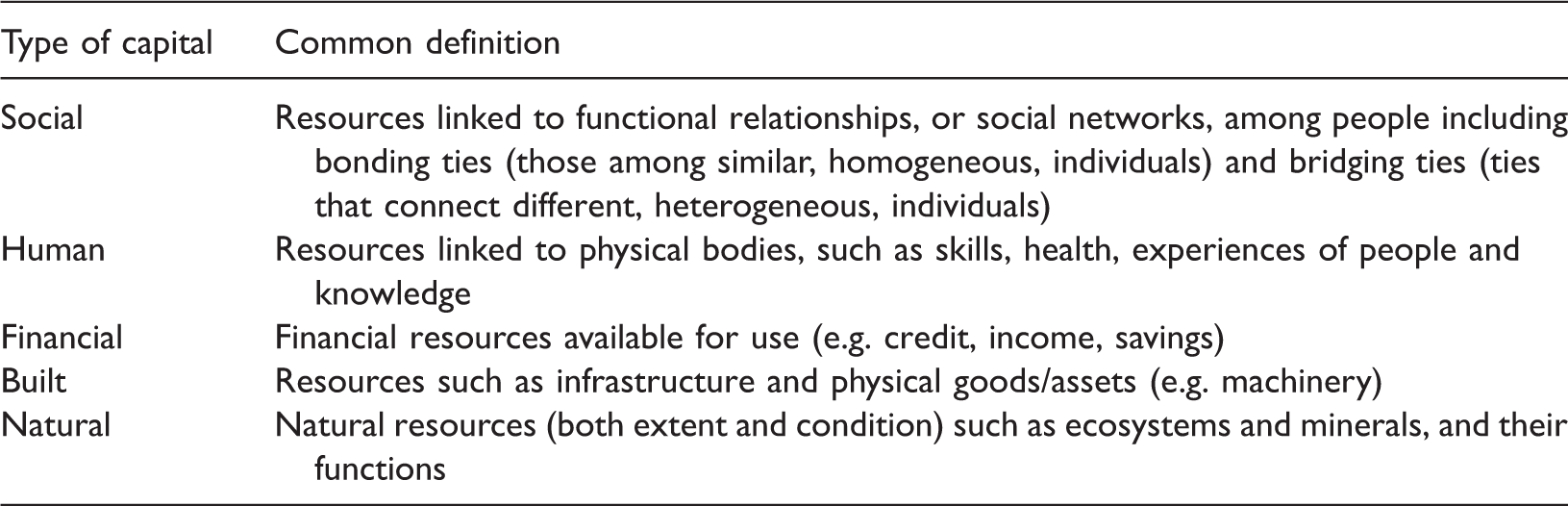
More recently, integrated approaches to assessing various capitals simultaneously have emerged in relation to climate and global change in the Anthropocene (see for example Keys et al., 2016; Nelson et al., 2010; Smith et al., 2013), which is the point of departure for this paper in relation to the exploration of how capitals are expressed in the shift to new water management approaches and instances of urban flooding. As an example of this approach, the types of capitals more strongly expressed in the old’ command and control water management approach may be: built and financial capital, as the old management approach is typified by centralized institutions and engineering solutions, while social capital may be expressed more strongly in the ‘new’ water management approach, as it is defined, in part, by adaptive capacity and learning (Schoeman et al., 2014).
The related concepts of adaptive capacity and the capitals approach have important spatial, temporal and level dimensions (Brooks et al., 2005; Mikulcak et al., 2015; Scoones, 2009; Vincent, 2007). Here, these dimensions are implicit within the analysis and identified as they were revealed in the sources drawn upon but were not an explicit focus of this study.
Case study selection
The two cases (Manitoba, Canada and Southeast Queensland, Australia) were selected for analysis because they have both experienced recent flooding as well as a history of past floods. The selected cases are also contextually similar (developed democratic federations) and flood events have been the subject of extensive recent and past investigation (e.g. Commission of Inquiry, 2012). As timely and internationally known cases they are also emblematic of the critical issues of urban flooding more broadly.
Urban flooding, while variously defined, is used in this paper in reference to situations of extreme water overflow in built environments. Different types of floods (fluvial, pluvial, failure of human systems, etc.) may impact urban areas and when compared to those in rural areas they are likely to be more costly, harder to manage, impact larger populations, and have greater intensity of damage (Jha et al., 2012). Urban flooding was selected as a focal issue among the many present and future water related challenges for several reasons. It epitomizes the interaction of climatic and non-climatic drivers relating to water stress now and in the future. For example, by 2050 it is anticipated that exposure to water stress will be experienced by 920 to 3400 million people and risk of river floods by 100–580 million people (Arnell and Lloyd-Hughes, 2014). Flooding has had, and will have, tremendous ramifications in terms of human wellbeing and the environment. For example, Jongman et al. (2012) assess damages from river and coastal flooding globally in 2010 at 46 trillion USD and projects it will increase to 158 trillion USD by 2050. Consequently, the capacity of urban areas to effectively prepare, mitigate and respond to flooding is of paramount importance.
Data collection and analysis protocol
Published literature about the two cases was used as data sources. Documents are essential to case study research as they provide stable evidence sources that record information about past events and can be used to corroborate evidence from other sources (Patton, 2002; Yin, 2009). Researchers familiar with the two cases used a systematic approach to identifying relevant scholarly and grey literature for their respective cases. Document searches were performed using prevalent academic search engines (i.e. Web of Science) and search terms associated with the main capitals framework (i.e. physical, natural, social, human, and financial capital) and cases. Sources were selected based on: breadth of information about flooding (i.e. presenting both historical and current information about flooding in the two cases); degree of relevance (high) and relative impartiality (e.g. reports vs. advocacy materials), while recognizing that all sources carry some degree of bias and were produced primarily by governments and by scholars. In keeping with our case selection approach, it was found that floods in each region have been the subject of much study. In total, after meeting the above inclusion criteria, 15 sources were identified for the Manitoba, Canada case and 19 sources were identified for the Southeast Queensland, Australia case.
Case studies were analyzed using the capitals approach as a way to structure the analysis. Content analysis (Patton, 2002) was undertaken to code text in relevant case documents based on themes and patterns that indicate forms of social, human, financial, built, and natural capitals. A two-step procedure was followed (after Creswell, 2003) that involved conducting a first reading of all documents to get an overall impression of case data, making occasional notes about initial ideas. A second reading of documents was undertaken to code words and sentences according to the capitals approach categories (supplementary material) and to identify key relationships among capitals evident from the documents. Subsequent readings enabled further classification based on descriptive wording adopted from actual texts. Factual content from the selected documents was also used to help develop a descriptive background for each case (Yin, 2009).
Sources were carefully reviewed and considered as a whole case rather than queried individually, and two questions were asked of the cases: (1) What is the relative contribution of each capital (physical, natural, social, human and financial) in recent and past flooding events; and, (2) What do the capitals tell us about the shift to a new water management approach (i.e. is there evidence of a shift using the capitals approach as a lens)? Following Yin (2009), salient implications for building adaptive capacity to urban flooding and to water resources challenges were identified as cross-case conclusions, which are presented in the concluding section.
Case studies: Building capacity for adaptation to urban flooding
In this section of the paper, we used the capitals approach as a lens to examine how the science-based command and control (old) and dynamic and integrative systems (new) water management approaches were exhibited in terms of adaptive capacity in two notable cases of urban flooding in Manitoba, Canada and Southeast Queensland, Australia. A succinct description of the history of flooding and responses starts each case. The relative emphasis placed on each capital and the relationship(s) between/among the capitals over time are considered and discussed.
Flooding of the Red River: Manitoba, Canada
The City of Winnipeg, Manitoba, located at the historic forks of the Red and Assiniboine Rivers, and several smaller urban communities typify numerous urban flood management issues in Canada. About 90% of the provincial population lives in the two basins (Simonovic and Carson, 2003). Since the early 1800s there have been 10 major flood events in the Red River Basin alone (Government of Manitoba, 2015). This number would be much higher if it were not for physical infrastructure developed to control flooding (Government of Manitoba, 2015). In particular, 1950 was a landmark flood year in Winnipeg and the Red River Basin, sparking the construction of a series of flood controls (e.g. dams, dikes, diversions, reservoirs), namely the Red River Floodway, which was completed in 1968. Flood management planning also began in 1950 in what is considered a ‘turning point in the history of flooding and flood control in Manitoba’s portion of the Red River Basin’ (Simonovic and Carson, 2003: 347). In 1997, another flood equal to that of 1950 occurred, although the effects were somewhat less devastating. Known as the ‘Flood of the Century’ 2000 km2 of land was flooded, 8600 military personnel were brought in to provide assistance, and 6000 urban residents were evacuated (28,000 individuals evacuated in total), and total damages exceed 300 million CAD. Identifying a need for additional diversion capacity, following the 1997 flood which pushed the existing flood control system to its limit (Rannie, 2016), the Floodway was expanded to handle 140,000 cubic feet per second (previous 90,000) (Government of Manitoba, 2015). This was just part of the ‘extraordinary post-flood response’, which primarily involved costly measures undertaken to improve built capital to increase flood control system capacity (see Rannie, 2016). However, despite all that has been done, flood policies still need to be improved, clarified and better coordinated as ‘the risk of failure of Winnipeg’s flood protection infrastructure is high’ (Simonovic and Carson, 2003: 349).
Without a doubt, physical flood control measures, namely infrastructure such as the Red River Floodway and diversion channels and dykes, have long been the main method favoured by engineers and planners to try to control and reduce flooding in urban areas. As highlighted in the provincial report ‘Flood Fighting in Manitoba’ (Government of Manitoba, 2015) built flood controls are preferred, most notably the 46 km long Floodway, which was the second largest land moving project (next to the Suez Canal) at the time and cost $63 million dollars to build in 1968 but was later expanded at a cost of $665 million after the 1997 flood of the century. Province-wide structural adjustments have cost an estimated 1 billion dollars (Government of Manitoba, 2015). An additional 29 km floodway known as the Assiniboine or ‘Portage’ Diversion is located approximately 100 km upstream of Winnipeg to divert flow from the Assiniboine into Lake Manitoba before it reaches the Red (Rasid and Haider, 2002). Another important example of built capital, the Shellmouth Reservoir, is also used to store water during peak flow. Numerous ring dykes and property elevations protect outlying towns and buildings (Blais et al., 2016; Rannie, 2016).
An emphasis on built capital in capacity building by the old water management approach is thus inextricably linked to financial and human capitals as enormous financial inputs are required for materials as well as the need to mobilize individuals with the necessary knowledge and skills. While the importance of the Floodway is rarely doubted due to the service it provides having saved billions in potential losses (Government of Manitoba, 2015), the importance of involving stakeholders and deliberation about built capital has emerged with the new water management approach. This has much to do with perceived effects of physical infrastructure and differential outcomes for urban and rural residents of Manitoba (i.e. some farmers and land owners feel flood controls exacerbate flooding for them (see Sinclair et al., 2003)). Historically, however, there have long been differences in understanding among residents and among officials leading to quite different valuations of built capital measures and their importance (see Stunden Bower, 2010). In fact, such differences regarding the flood management system may actually erode social capital between and among urban and rural and provincial and rural municipal representatives, as resident surveys (n = 403) indicate that there is evidence of a perceived negativity around rural flood issues, which has contributed to general a breakdown of communication and collaboration between provincial and local levels over time (Stewart and Rashid, 2010). Increasingly, it is recognized that decisions regarding physical capital now need to be considered alongside public attitudes and perceptions (see Rasid and Haider, 2002; Sinclair et al., 2003).
Despite sharing the common challenge of flooding in Red River Basin, Manitoba, North Dakota, and Minnesota have not always worked well together. Improving communication, collaboration, and coordination to improve built capital decisions (e.g. agreed upon protocols for flood system operation) is a more recent response to addressing basin-wide concerns and needs that also illustrates the application of social and human capitals. Moves to increase regional collaborative institutions indicate that many levels of government from different states/provinces and countries are increasingly recognizing the importance of mobilizing other capitals to increase flood protection and response effectiveness (see Hearne, 2007).
The strong emphasis placed on built capital is juxtaposed with the relative contributions of natural and social capitals in building capacity to address flooding of the Red River. Neither the old nor the new water management approaches emphasize natural capital. The perspectives diverge considerably on the relative contribution of social capital. While volunteer power and coordination for activities such sandbagging are an obvious and essential part of flood responses, there is no evidence that social capital was emphasized by the old water management approach per se. The marginalization of non-experts in the past under this approach minimized the importance of social capital in formal flood management and eroded potential opportunities with civil society. Conversely, the new water management approach emphasizes social capital and considers it a catalyst to mobilize human and financial capitals. New research on community strategies for flood risk communication shows that kin networks (i.e. family and friends) remain the most important source of information among the range of information sources (e.g. municipality, Manitoba Emergency Measure Organization, news media, etc.) accessed by flood plain residents (Stewart and Rashid, 2010). However, reporting and response efforts are enhanced by neighbourly relationships and pre-existing associations, medias, and technologies. Networks and relationships among communities, organizations, governments, and countries are now seen as essential to achieving integration and effective flood management (Blais et al., 2016; Hearne, 2007; Simonovic and Carson, 2003). However, local forms of social capital can also slow emergency response efforts (e.g. cause residents to disregard evacuation orders) (Buckland and Rahman, 1999).
Evidence regarding the relative emphasis on human capital and its relationship to other types suggests considerable differences between the two water management approaches. The established water management approach valued some particular forms of human capital, as identified in relation to built capital above. It is identified as insufficiently recognizing differences in knowledge and experience as it related to different parts of the same basin (Stunden Bower, 2010). The importance of lived experience and how people can understand the same system differently were not considered. Consequently, little acknowledgement occurred that observed differences were actually important to flood management efforts and maintenance of infrastructure (i.e. some believed it was important, others less so, sometimes even intentionally breaching dykes for example). A much stronger importance is assigned to basin-wide human capital under the new water management approach. ‘Municipalities in the Red River Valley are experienced and very familiar with flooding’ (Simonovic and Carson, 2003: 351) suggesting existence of common human (and social) capital. Through frequent and ongoing experience with flooding, municipal officials and residents possess a proven and high level of local knowledge that is specific to the floodplain (Stewart and Rashid, 2010). Attention is increasingly being given to human capital resources to address capacity gaps. For example, in the aftermath of the 1997 flood the ability (or lack thereof) to collect, process and share flood related information was identified as a major weakness of Red River Basin flood management system in general (Simonovic and Carson, 2003). Since that time knowledge and skilled personnel have been brought together through decision making support systems to better coordinate flood management efforts. A state-of-the-art Decision Support for Management of Floods (DESMOF) was developed as an intellectual decision support system combining human, social, built, and financial capitals. Whereas built infrastructure alone would have been the past focus, importance is increasingly placed on the ability to forecast, estimate and evaluate outcomes associated with flood management decisions (Ahmad and Simonovic, 2006). At a cost of $2.5 million, the Flood Manual geographic information system (GIS) was also developed, drawing together and mobilizing financial, human, and built capital (i.e. new technology) to better coordinate response initiatives. The system also bridges human capital to boost system resilience through the creation of a platform that provides important organizational memory to brace against personnel turn overs (Blais et al., 2016). These examples demonstrate a concerted shift to coordinate human capital responsible for management, seeing that ‘responsibility for identifying and constructing flood control structures, flood forecasting, and operation of flood control structures are carried out by separate organizations with limited interaction’ (Ahmad and Simonovic, 2006).
Flood control was underfunded, reactive and intermittent prior to the 1950 flood, which stands as an example of how ‘a catastrophic episode can prompt a period of intense innovation’ (Stunden Bower, 2010: 67). Framed as an engineering problem where controlling water levels was the main target of management, enormous investments were made to build and expand physical infrastructure on the Red and Assiniboine following 1950, and again each time serious flooding occurred: ‘all decisions regarding the capacity of current flood control works were based primarily on economic efficiency, getting the largest return for the investment’ (Simonovic and Carson, 2003: 347). While still obviously important, more emphasis is now being placed on human capital and the coordination of other capitals for prevention, monitoring, and response. Financial and built capital inputs can be reduced via prevention supported by other forms of capital better used, in particular human and social capital in combination with other built capitals, namely communications and information infrastructure.
Flooding in Southeast Queensland, Australia
While once a sparsely populated and relatively untouched landscape, the southeast region of Queensland (an area of around 22,420 km2) has been transformed since European settlement in the 1800s. Drained by a number of major river systems, it supports several major urban population centres including the rapidly growing capital city of Brisbane and the major tourism-dominated centres of the Gold Coast and the Sunshine Coast (to the south and north of the city respectively) as well as a rural hinterland. It is home to 48.3% of the 4.7 million inhabitants of Queensland (Queensland Government Statistician’s Office, 2016). The main catchment of the region is focused around the Brisbane River; a 309 km river system that includes major tributaries in the form of the Bremer River, the Stanley River and Lockyer Creek. Rainfall is influenced by the proximity of the region to the tropical cyclone risk zone, which has resulted in floods being a common historical occurrence (van den Honert and McAneney, 2011). The 1893 Brisbane Flood, also referred to as the Great Flood of 1893, is the first documented flood with disastrous consequences, including 35 deaths and millions of dollars in damages (Thompson et al., 2013). The event precipitated plans to build Somerset Dam on the Stanley River (a tributary of the Brisbane River), with construction starting in 1933 and the project reaching completion in 1953 (Cossins, 2003). A second major flood disaster occurred in 1974 with the overflow of the Brisbane and Bremer Rivers, which caused 14 deaths and resulted in extensive restoration costs. Within the decade, construction of the Wivenhoe Dam was initiated and it was finished in the early 1980s. A third major flood occurred in 2011, known as the 2011 Southeast Queensland Floods, that tragically caused 38 fatalities and is distinguished as Australia’s most expensive natural disaster to date (Biggs, 2012; De Bussy and Paterson, 2012; van den Honert and McAneney, 2011). The response to this most recent disaster has been widespread policy and governance reforms.
It is evident in the Queensland case that engineering solutions were considered the way to build capacity for dealing with flooding. The old water management approach emphasized the contribution of built capital, especially the construction of substantial control structures as a direct response to major floods. The Somerset Dam was initiated in response to the major flood in 1893 and the Wivenhoe Dam in reaction to the 1974 flood. In line with the old water management approach, the exercise of built capital was seen as the resource to reduce the risk of flooding. Much to the chagrin of some officials (see Griggs, 1977), at the time of their construction, the Somerset Dam and the Wivenhoe were both popularly (yet erroneously) interpreted as flood proofing Brisbane. As Griggs (1977: 80) noted, the Somerset Dam was ‘interpreted by many within the community as a complete protection against flooding’, while after the construction of the Wivenhoe Dam there was a ‘prevalent belief [among the public] that Brisbane has been flood proofed by dam infrastructure’ (Bohensky and Leitch, 2014: 483). While official reports are much more circumspect in terms of the ability of dams to eliminate flood hazards (e.g. Griggs, 1977), popular public perceptions of dams, as being able to ‘flood proof’ undoubtedly led to widespread public support (i.e. ‘political capital’) for their construction.
Further key relationships of note are to the financial and human capital required for such undertakings. The total cost of the Wivenhoe Dam, for example, was AU$450 million (Dunn, 1985) (around US$1.5 billion in 2015 terms) and thus represented a significant drain on Queensland’s financial resources at the time. Built capital still plays an important role in relation to minor and moderate flood events, but in line with the new water management approach the notion of being able to be ‘flood proof’ with infrastructure has been challenged in public and policy discourse (Queensland Floods Commission of Inquiry, 2012). Indeed, the impact of the Wivenhoe dam was to reduce the potential water level by about 1 m, and when the Somerset dam was included, a total of 1.5 m. The inquiry report states ‘Even a large dam such as Wivenhoe has a limited flood mitigation capacity when the volume of water entering it is significantly larger than its storage capacity. Its flood mitigation effect for Brisbane was further limited by the fact that floodwaters from other parts of the Brisbane River catchment entered the river downstream of the dam, through the Bremer River and the Lockyer Creek.’ (Queensland Floods Commission of Inquiry, 2012: 30). Each flood is different and largely influenced by rainfall location, intensity, and duration, and in the case of coastal catchments by tide and storm surge (Queensland Floods Commission of Inquiry, 2012). Consequently, there has been increased consideration about how existing dams should be used best, rather than seeing them as a panacea for flooding disasters. The relationship between built and natural capital is also starting to garner attention in terms of the impacts of control structures on the health of the river in general, and the ramifications of changing ecological dynamics at the catchment level post-flooding more specifically. For example, while some proponents continue to support the old water management approach and advocate for solutions centered on built capital, peak bodies such as Healthy Waterways and Catchments (a partnership of industry, water utilities, local government, state government, community groups, universities and other stakeholders) have identified initiatives in line with the new water management approach, such as total water cycle management, water sensitive urban design, erosion and sediment control, and waterway restoration.
The relative contributions of natural, social and human capital have shifted considerably when considering the two water management approach perspectives. Under the old water management approach natural capital in relation to flooding was actually de-emphasized and considered a liability that required controlling, as opposed to an asset. Social capital was similarly not considered an asset in building capacity for flooding, and negative relationships are evidenced between social and financial capital due in part to the paternalistic views of the state as providing protection and financial support in relation to floods (Head, 2014). Water in volume was largely valued when above the dam—as urban water storage or potential hydro power—but below the dam was considered a hazard. The designs of both the Somerset and Wivenhoe dams are reflective or this, the bottom 40% of their capacity being designed for urban water supply, their top 60% for flood mitigation (Cossins, 2003). In terms of natural capital, ecological flows of the river were not considered to be a critical factor until the 1990s when concerns about realising ‘healthy waterways’ became a prominent government objective (Head, 2014). Human capital of certain forms (e.g. engineering knowledge, weather prediction) were emphasized in this view and clearly connected to the aforementioned emphasis on physical capital (see Heazle et al., 2013).
Responses to the 2011 flood appears to reflect the shift to the new water management approach through the increased importance placed on natural, social and human capitals. The discourse regarding natural capital is reflected in the title of the recent seminal report Living with Floods (Wenger et al., 2013), where natural capital is seen as something to understand and work with in order to enhance social-ecological co-existence and conviviality. The final Commission of Inquiry report for the flood also emphasized the need for better understanding of river hydrology to inform floodplain management at the local level, rather than having an emphasis on large infrastructure (Queensland Floods Commission of Inquiry, 2012). The relationship between natural capital and physical capital is increasingly acknowledged as being too complex to be ‘managed’ with dams. As such there is increased emphasis on the connections between financial and natural capital through the promotion of ecosystem service approaches, such as enhancement of natural flood barriers through incentives that promote appropriate land-uses.
The emergence of social capital is also evident, for example, in social media analysis, which have documented social media platforms such as Twitter and Facebook as a critical tool in shaping emergency responses to the most recent major flood (see Bird et al., 2012; Bruns et al., 2012; Bunce et al., 2012). Similarly, the increasing importance of mainstreaming volunteerism during and post disaster is noticeable. For example, the emergence of the ‘mud army’ in response to the 2011 flood: a rapid mobilization of volunteers to aid in recovery efforts. Social media was critical for the mobilization ‘mud army’, helping NGOs and the Brisbane City Council to organize the volunteers, as well as allowing for many people to self-organise recovery efforts.
The most dramatic change has been in regards to human capital, specifically in terms of contextualizing responses at the local level. These changes have resulted in devolution of some responsibilities to local governments during flood disaster events, in terms of preparation, response and recovery. This is due to recognition that local governments have unique and critical local knowledge (elements of human capital) and local social networks and rapport (to mobilize social capital) that help them to respond and adapt to emergency events such as flooding (Melo Zurita et al., forthcoming). In addition to the close relationship established between human and social capital, the opportunity is also opened to leverage financial capital inputs for capacity building locally by facilitating opportunities for knowledge transfer and training. Disaster training events and alliances involving representatives from multiple local governments, emergency response agencies, the non-government sector (e.g. Red Cross) and the private sector are becoming increasingly common place. Arguably, a disaster management culture that is trans-organisational has emerged (Melo Zurita et al., forthcoming) and that has been, at least in the region, integrated to the governance processes.
Together with built capital, financial capital was emphasized in the responses to the major floods of 1893 and 1974 in southeast Queensland. As identified above, considerable financial capital is necessary to enable the construction of large-scale infrastructure and it continues to be of high importance in terms of its maintenance. While financial capital remains a key component under the new management approach, especially in terms of post-disaster recovery, alterations are evident in three ways. First, financial capital inputs are being employed beyond infrastructure development. For example, in the wake of the 2011 floods, local councils in the Southeast Queensland region allocated funding to employ full-time disaster managers, with training and community involvement as their core activities (Melo Zurita et al., 2015), in this sense financial capital has been used to enhance human capital. Second, there has been an increased push towards having private insurance as a key mechanism for the recovery phase of disasters, rather than a strong reliance on the existing federal funding, nevertheless, government funding still plays a key role (Biggs, 2012; Melo Zurita et al., 2015). Third, connections are being realized with natural capital through the use of economic instruments to implement mitigation practices (e.g. encouraging appropriate land-uses). A final change has been the partial substitution of built capital by technological capital; the current use of applications, software and on-line tools is occupying the scene of disaster management and it has become a prominent form of capital to support the ‘readiness’ of actors involved in disaster management.
The historical shift from the old to the new water management approach has not been by any means radical in the region and has been built through several decades of initiatives relating to improving waterway and catchment ecological condition. While there remains a strong reliance on the functioning and management of dams, the new emphasis on initiatives centered on natural, social and human capital for flood preparedness, response and recovery, has been embraced by disaster managers and other stakeholders. The capitals approach helps identify such changes and their degree of co-existence.
Discussion
The Canadian and Australian cases provide a history of water management that can be meaningfully examined using a capacity building lens, operationalized using a capitals approach. The command and control approach was exemplified in capacity building in the Canadian and Australian cases of flooding by a clear emphasis on built capital, specifically the construction of floodways and dams in response to major flooding events at certain historical times. By extension, significance was extended to financial capital as well as some forms of human capital (e.g. engineering expertise, labour) required in the construction of such substantial control structures.
In shifting to a new water management approach, there is a corresponding shift from rigid prescriptions for optimization through intervention to a ‘soft path’ for influencing with freedom for a variety of interventions, interpretations and meaningful engagements (Pahl-Wostl et al., 2011). Evidence from the cases revealed that the full range of capitals was emphasized in more recent history, consistent with approaching capacity building from a dynamic and integrative systems approach (the new water management approach). While the importance of built capital and financial capital did not vanish, the relative emphasis of social and human capital was particularly elevated.
There were striking similarities between the two cases. In both, the historical approach was focused on physical capital (flood infrastructure) and human (labour) and financial capitals were employed for the purposes of building physical capital. In the Canadian case, natural capital was not emphasized at all, whereas in the Australian case it was considered a liability. In both cases, social capital was not considered important. The emphasis on physical, human and, financial capitals and de-emphasis on natural and social capitals, is highly consistent with the old water management approach. In analyzing the literature related to the most recent flood in both cases, there is clear evidence of shifting of the capitals. In the Canadian case, there was an emphasis on social capital and on human capital, where human capital for the purposes of unskilled labour only was replaced by a focus on skilled labour and knowledge. Similar findings were evident in the Australian case and relationships between the capitals were identified: financial capital was employed not only for infrastructure but also to support knowledge and skill development (human capital) and to maintain and build natural capital. Ultimately, both cases showed an increase in the expression of social capital and different facets of human capital, and a change in how financial capital was directed. However, a strong focus on physical capital remained and emphasizes that all capitals play a role in the shift to a new water management approach.
Conclusions
The ability to address stresses related to water is essential. Mounting evidence (e.g. Cosgrove and Cosgrove, 2012; Jiménez Cisneros et al., 2014; Schlosser et al., 2014) makes clear that stress on water resources will continue and is intensifying due to climatic and non-climatic factors. A number of factors influence how changes in water quality and quantity (e.g. physical limits, economic feasibility, technology) are tackled; critical to these factors, and to the human welfare they ultimately support, is the capacity of the water management approach (Smit et al., 2001). We drew upon the capitals literature as a way to operationalize understanding of capacity building and consider how that changed over time in relation to a shift from the old to the new water management approaches. This question was explored using notable cases and histories of urban flooding in Canada and Australia.
There are several important implications from the manner in which the capitals were expressed in relation to building capacity and the shift to a new water management approach. Systems (economic, ecological, social, social-ecological) have been shown to behave in non-linear ways (Holling, 2001; Holling and Gunderson, 2002) including through interactions among scales (Folke, 2003). Surprises, such as failures in certain capital inputs, occur and need to be taken in consideration when planning for disasters (Gunderson, 2010). Sudden changes or combinations of ecological conditions (e.g. precipitation, melting, soil moisture) can exceed the boundaries of built capital, such as occurred in the 2011 Brisbane Flood and the 1997 Red River ‘Flood of the Century’. Emphasizing built capital, and directing financial capital in relation to it, at the exclusion or minimization of other capitals is limited and problematic. The legacy effects from decades of this approach will be difficult to quickly redress. Errors (failure of human capital) or malfunctions (failure in built capital) are also recognized as possible under conditions of stress and disturbance (see Simonovic and Carson, 2003). These unsettling, but no doubt real, limitations will test human (knowledge and ability of labour), social (networks), and built (communications) capitals.
The imperativeness of shifting to a dynamic and integrative systems-based water management approach is underscored by the need to expect surprises in an era of complexity and change. This study was undertaken on the assumption of multi-scale systems and an opportunity exists to unpack this assumption with a sole focus on scales and interactions in future research. Different capitals are necessary and come into play in varying combinations in pre-flood planning, emergency management, or post-flood recovery. The importance of diversity and redundancy in building capacity for flood management systems is highlighted—a generic social-ecological system property supporting adaptive capacity (Biggs et al., 2012). Three key ideas associated with perspectives on resilience to disasters put forward by Walker and Westley (2011) thus require careful consideration and application: time as a threshold versus avoiding quick fixes; the trading of risks through building capacity for a specified disturbance versus general resilience; and, the origination of disaster responses locally versus in centralized government agencies.
The attention given to natural capital appears to be the least emphasized in relation to both cases, but also offers a ripe avenue for innovation. The dynamic and integrative systems-based water management approach reconceptualizes how natural capital is understood. The notion of natural capital existing for human consumption and control is being challenged and a relational understanding is emerging where humans and more-than-humans co-produce socio-ecological outcomes (Booth and Williams, 2014; Whatmore, 2013; Williams, 2008). Part of the ‘onto-politics of “natural” hazard events’ (Whatmore, 2013: 33), such as floods, is to disrupt hegemonic perspectives, creating a critical space for new understandings and process to take place as well as for the formation of new institutional and organisational arrangements. Our findings present a need and an opportunity for practitioners and policy makers to (re)consider natural capital in flood planning.
Just as the market exhibits changing values for inputs to production, so, too, society exhibits changing evaluation of the relative potential contribution of the different forms of capital in building capacity to deal with water stresses. Changing perspectives on water have strongly influenced society’s perceptions and evaluations of the relative potential contribution of each of the five capitals as well as the relationships amongst them, as demonstrated in the notable cases of urban flooding in Manitoba, Canada and the southeast Queensland region, Australia. The capitals approach provided a useful conceptual lens with which to explore the attention given to capitals historically and in relation to recent flood events. Our findings highlight the changing way in which capacity building is considered in flood management, and also the ways in which it remains the same. Explicit consideration of changing water management approaches in the context of these and other water stresses is imperative to understand present activities and decisions; as well as, longer-term trajectories for human and ecosystem wellbeing in the Anthropocene.
Footnotes
Author's Note
Maria de Lourdes Melo Zurita is now affiliated to School of Geosciences at The University of Sydney, Australia.
Declaration of conflicting interests
The author(s) declared no potential conflicts of interest with respect to the research, authorship, and/or publication of this article.
Funding
The author(s) disclosed receipt of the following financial support for the research, authorship, and/or publication of this article: This work is supported by Riksbankens Jubileumsfond, Volkswagen Stiftung, and Compagnia di San Paolo (Grant/Award Number: ‘Europe and Global Challenges programme').
References
Supplementary Material
Please find the following supplemental material available below.
For Open Access articles published under a Creative Commons License, all supplemental material carries the same license as the article it is associated with.
For non-Open Access articles published, all supplemental material carries a non-exclusive license, and permission requests for re-use of supplemental material or any part of supplemental material shall be sent directly to the copyright owner as specified in the copyright notice associated with the article.
