




Abstract
Adapting to climate change in the urban setting requires cooperation across scales, levels of government, organisational boundaries and policy sectors. The study presented in the paper explores governance of urban adaptation policies through the conceptual lens of multi-level governance and boundary spanning. It focuses on the South Wing of the Randstad in The Netherlands, an urban region that is heavily exposed to the negative impacts of climate change, particularly to flooding, due to its location in the Rhine-Meuse delta and concentration of population and economic activity. Yet, it is also a region with strong traditions of cooperation and a track record of pioneering urban climate change measures. The study investigates how the features of the wider institutional context, in which this urban region operates shape the governance of urban adaptation policies and how the contextual factors constrain the scope for spanning horizontal, vertical and temporal boundaries needed for delivering those policies and making the cities of that region more climate-proof.
Introduction
Cities play a key role in tackling climate change. They are perpetrators of climate change, producing a significant share of global greenhouse gases (GHG) emissions. But also they are its main victims, as it is in the urban context – where more than half of the human population lives – that the negative impacts of climate change are most acutely felt (Rosenzweig et al., 2011; UN-HABITAT, 2011). For example, cities are vulnerable to floods and extreme weather events threatening lives and health of large populations as well as the concentration of infrastructure and economic assets (Nicholls et al., 2008). Importantly, however, cities are also part of the solution to the climate change threat, as it is at this scale that meaningful, innovative and broadly supported solutions to mitigate emissions and adapt to the impacts of climate change can be devised. As Rosenzweig et al. put this, ‘compared to national politicians, city leaders seem willing and able to take action to protect their cities against these threats’ (Rosenzweig et al., 2010: 910). Cities are also particularly well positioned to design and deliver cost-effective climate change adaptation (Corfee-Morlot et al., 2009a; McCarney et al., 2011a, 2011b). The already perceptible impacts of climate change, such as increasingly frequent flooding, waterlogging events or urban heat island effects, have stimulated thinking about new governance solutions and interventions in the urban space that can promote cooperation across administrative and sectoral boundaries in order to reduce vulnerability to climate change impacts.
While the term ‘adaptation policy’ is interpreted very differently across the literature, the clear definition proposed by Dupuis and Biesbroek was used in this research: ‘The process leading to the production of outputs in forms of activities and decisions taken by purposeful public and private actors at different administrative levels and in different sectors, which deals intentionally with climate change impacts, and whose outcomes attempt to substantially impact actor groups, sectors, or geographical areas that are vulnerable to climate change’ (2013: 1480). This definition stresses that adaptation policy inevitably spans across the vertical boundaries between levels of government or geographical scales, and the horizontal boundaries between sectors of policy, between groups of actors and geographical location (e.g. municipalities). Therefore, concepts such as ‘multi-level governance’ (Hooghe and Marks, 2003) and ‘boundary spanning’ (Bressers and Lulofs, 2010a; Ernst and Yip, 2009; Yip et al., 2009) offer useful conceptual anchors to study adaptation policies. The former refers to cross-level and horizontal interactions and interdependencies between various actors in delivering public policies. The latter refers to activities or tactics that leaders of organisations need to embrace to bridge the agendas and priorities of the actors separated by various sorts of boundaries, from administrative to sectoral and scalar. While there is a growing amount of studies on urban adaptation policy (e.g. Aerts et al., 2013; Albers et al., 2015; Carter, 2011; Leck and Simon, 2013; Stead, 2014; Taylor et al., 2014), many considering it as a multi-level governance issue, there is hardly any research considering it from the boundary spanning perspective. This paper attempts combine both of these concepts to gain a better understanding of the challenges faced by cities when developing and implementing adaptation policies.
These challenges, in fact, are significant. The research to date indicates that making the multi-level and multi-sectoral arrangements that adaptation policy requires work (Adger et al., 2005; Corfee-Morlot et al., 2009b; Gupta, 2007; Keskitalo, 2010; Lee and Koski, 2015) is hindered by numerous obstacles (Albers et al., 2015; e.g. Betsill and Bulkeley, 2006; Bulkeley and Betsill, 2013; Francesch-Huidobro et al., 2017; Leck and Simon, 2012; McCarney et al., 2011a, 2011b; Taylor et al., 2014; Walker et al., 2014). Examples of these include the misfit of the collaborations required to tackle adaptation within the constitutional and legal frameworks, difficulties in coordination, administrative capacity and/or funding deficits, or difficulties in navigating between competing interests of the stakeholders. Moreover, cities may lack devolved authority and appropriate responsibility and/or financial autonomy to deal with climate change or lack mechanisms to facilitate cooperation to align strategies with other municipalities within their metropolitan area.
Unlike most other studies concerned with adaptation policies in cities, this paper explores those challenges by focusing not only on urban scale, but also considering the urban regions in which cities operate and interact with each other. Such a focus on the city-region level is necessary to grasp the boundary spanning dynamics in climate adaptation and, in particular, provides a new perspective on why urban adaptation policies may struggle to gain traction.
Moreover, in order to understand how urban regions deal with climate change impacts, one needs, in turn, to consider their wider context of a state in which they operate. For instance, the organisation of intergovernmental relations within a state determines the cross-level relations and the degree of involvement of the central government in shaping and steering climate policies at the local level (Kern and Alber, 2009). In fact, territorial governance systems do not operate in a vacuum, but rather are embedded in the countries’ institutional systems (Stead and Nadin, 2011). However, we still know little about the ways in which the national institutional settings and administrative cultures actually shape the governance of urban climate change adaptation policies at the regional and local levels. By exploring these, the paper responds to the call for considering the ‘causes and consequences of climate-change impacts […] more holistically’ (Bulkeley and Tuts, 2013: 655) and bridges an important research gap.
Therefore, this research strives to bring elements of response to two inter-related research questions. First, how do the contextual factors, from the wider political culture to the structure of the territorial governance systems, shape the patterns of governance of adaptation policies in urban regions? Second, what are the barriers for boundary spanning that urban adaptation policies require and how these barriers emerge?
The paper answers those questions by studying the case the South Wing of the Randstad, a conurbation located in the Dutch Rhine-Meuse Delta with the adjacent (yet spatially and institutionally differentiated) agglomerations of Rotterdam and The Hague at its core. The focus in this study is narrowed down to the issue of flood risk, which is the most tangible and serious climate change threat for that region. In fact, the flood risk associated with rising sea levels, the growing risk of storm surges in extreme weather, and the increasingly likely river flooding due to growing precipitation levels, are particularly dangerous for the densely developed and populated low-lying delta regions. Such phenomena associated with climate change are also particularly damaging for delta urban regions from the economic point of view, due to the typically high concentration of economic activity in delta areas. However, the polycentric form of the region and its complex governance structure – comprising the province of South Holland, two big cities and their city-regions (in the process of a merger at the time of writing), three water authorities (water boards) and a myriad of horizontal and cross-level collaborative bodies focused on different policy areas – are a particularly challenging context for coordinating climate change responses. This case study will be used to demonstrate the critical importance of the wider institutional context in which cities operate, for understanding the constraints for boundary spanning for urban adaptation policies.
Governance context and boundary spanning for urban adaptation policies
As recognised by a range of scholars (e.g. Bulkeley and Kern, 2006; Juhola et al., 2011; Neil Adger et al., 2005; Ostrom, 2010), climate change should be considered as a multi-scale policy issue that needs to be tackled in a collaboration across levels of government. Being a particularly complex problem, climate change also calls for integrated policy action to design strategies and policies to adapt to its impacts such as the risk of more frequent coastal flooding or urban heat island effect. Therefore, in the literature, adaptation policies are often studied through the prism of multi-level governance, a term which encapsulates well the properties of this policy requiring coordination in both vertical and horizontal dimensions (see e.g. Bulkeley and Betsill, 2005; Corfee-Morlot et al., 2009b). The vertical dimension refers to cross-scale interdependencies and interactions. In order to implement national climate adaptation strategies, the national governments need to cooperate with regional and local governments as agents of change, who are best positioned to mobilise local actors operating across different societal and policy sectors to develop place-tailored solutions based on local knowledge. In this perspective, one has to understand adaptation measures of cities as actions ‘nested’ in legal and institution frameworks at higher scales (regional, national, European, etc.). For example, the Dutch National ‘Delta Programme’ was initiated and led by the central government, but is implemented through regional sub-programmes in which cities play a key role and local impacts of climate change are investigated and place-specific solutions are devised. The downside of such arrangements is that they fail to include a variety of relevant actors, such as the industry or non-governmental organisations, but have an advantage of strong legitimacy emanating forms government institutions, that also tend to have greater action capacity than non-state actors.
The horizontal dimension, by contrast, refers to collaboration between the peers at local and regional levels across administrative boundaries. This entails, for instance, cooperation of cities within international networks, such as C40 Cities Climate Leadership Group (Lee and Van de Meene, 2012), and inter-jurisdictional cooperation on climate change adaptation to exchange knowledge, pool resources and address cross-boundary issues. An example that one could cite is the Regional Adaptation Strategy for Haaglanden (The Hague region), elaborated in cooperation between Haaglanden authority, municipalities, water boards and the Province of South Holland. Such network arrangements are conducive to learning and allow the local governments to access and be part of the flows (of information, knowledge, resources), but can suffer from lack of clear leadership or tensions and struggles due to divergent interests and approaches of the different constituent parties.
Such multi-level governance perspective, can usefully be supplemented with a boundary spanning perspective, originating from organisation studies (Tushman, 1977), and later used in the literature on flood risk management (Bressers and Lulofs, 2010a, 2010b; Warner et al., 2010). Boundaries are ‘inter-subjective constructed demarcations between different social worlds’ (Bressers and Lulofs, 2010b: 11), which hinder the collaboration between the various actors needed to implement the increasingly complex public policies. Adaptation policy, due to its complexity, is a ‘boundary object that calls existing boundaries into question’ (Warner et al., 2010: 139) and thus requires ‘boundary spanning’. The latter is a process in which actors participate in networks outside the organisation to work together towards shared policy goals (Newell and Swan, 2000). Therefore, the ‘role of boundary spanning is coming to terms with different problem frames and actor configurations in the different policy arenas’ (Warner et al., 2010: 137). Similarly as for multi-level governance, boundary spanning also concerns vertical (e.g. boundaries between levels of government) and horizontal (e.g. boundaries between sectoral policies) dimensions, albeit adding the temporal dimension, that is the boundaries between different time horizons that the actors is different organisations may have (e.g. short- vs. long-term perspective). Therefore, boundary spanning perspective allows for a more fine-grained understanding of the challenges associated with multi-level governance of urban adaptation policies that requires working across multiple boundaries.
In practice, however, spanning boundaries to deliver urban adaptation policies in a multi-level and multi-stakeholder setting cannot be taken for granted. While there is a consensus that urban climate change impacts cannot be tackled successfully by focusing on a single geographical scale or a single kind of actors (Leck and Simon, 2013), most of the urban adaptation initiatives to date have remained piece-meal rather than strategically planned and seldom considered the multi-scale nature of the climate change challenge (Romero-Lankao, 2012). Thus, the capacity of cities to deliver effective adaptation policies tends to be hindered by a mismatch between the priorities at local and regional levels and insufficient cross-level and cross-jurisdictional cooperation as well as lack of adequate regulatory frameworks that could structure and guide cooperation across administrative or scalar boundaries (Corfee-Morlot et al., 2009b; Kern and Alber, 2009; Leck and Simon, 2013).
These barriers are often recognised in the literature, but we know much less about why and how they emerge and what is the role of the wider institutional context in this process. Moreover, hardly any research looking at this issue from a regional perspective has been undertaken to date, with the exception of a studies by Termeer et al. stressing the legal dimension of this question (2011) and Juhola et al. (2012) investigating bottom-up adaptation initiatives in Finnish regions. Finally, while there is an emerging strand of literature considering the challenging question of integration of adaptation measures with other sectoral policies and spatial strategies (den Exter et al., 2015; Groven et al., 2012; Stead, 2014; van den Berg and Coenen, 2012), there is still a shortage of research examining on how urban regions and cities actually cope with the challenge of integrating actions across policy silos to respond to the multi-faceted impacts of climate change. This paper is thus an attempt to shed more light on these under-research issues that are critical for understanding the patterns of governance of adaptation policies in urban regions. It does so by investigating the case of the South Wing (Zuidvleugel) of the Randstad in the Netherlands, a city-region that is both highly vulnerable to climate change-induced flooding and is among the trailblazers of urban climate change adaptation strategies (den Exter et al., 2015).
Research design
The conceptual framework
The conceptual framework for this study (see Figure 1) blends insights from several strands of literature. First, it draws on the Contextual Interaction Theory (Bressers, 2004; Bressers and Lulofs, 2010b), to conceptualise the contextual factors that may affect the actors' behaviour. In this theory, three nested layers are distinguished: the wider context, including economic, cultural, political factors; the structural context, referring mainly to the governance system (levels and scales, networks and actors, perspectives, goals, and strategies, resources, responsibilities, etc.); and specific context, referring to previous decisions and specific circumstances of cases.
Conceptual framework.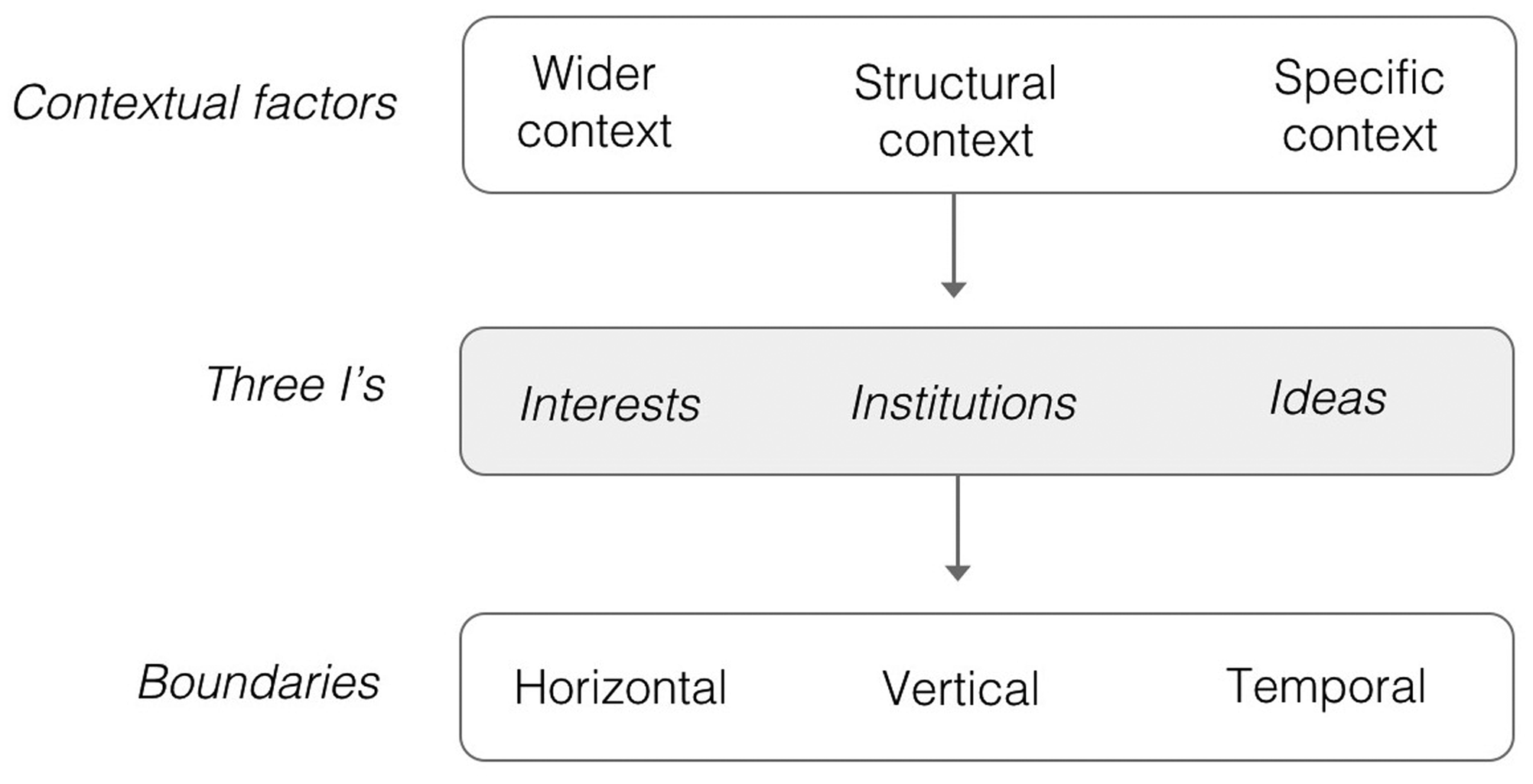
Second, drawing on boundary spanning literature in water management (Bressers and Lulofs, 2010b; Warner et al., 2010) and organisation studies (Ernst and Yip, 2009; Yip et al., 2009), it establishes a synthetic classification of boundaries that need spanning to deliver urban adaptation. It includes horizontal, vertical, and temporal boundaries.
Horizontal dimension entails boundaries across functions and sectoral departments within an organisation, but also across peers operating at the same level or scale, for instance, municipalities within a metropolitan region, or between and organisation and other policy stakeholders, for instance, municipalities and water authorities (water boards) in a given province, to use the Dutch example. Vertical dimension encompasses boundaries across geographical scales and levels of government.
These first two dimensions reflect well the properties of multi-level governance (interaction across levels of government and geographical scales, from local to national; and between actors operating at the same scale/level or even in the same organisation but in different policy sectors, or in different localities). However, the boundary spanning perspective adds to this the temporal dimension, which sharpens the analytical potential of this framework by stressing the role of the different time horizons in which actors and policies operate.
Third, in order to guide and structure analysis, the paper borrows the distinction between interests, institutions and ideas (Hall, 1997) from political economy literature. The ‘three Is’ are used here as a heuristic device. The latter is a practical tool employing an artificial construct to facilitate the exploration of a social phenomenon by defining its characteristics along predefined categories, which in turn improves analytical clarity and offers explanatory value. These three categories are thus used to shed more light on how the various contextual factors – such as politics, political culture, governance structures, networks of actors, specific circumstances, etc. – shape actors’ behaviour and constrain the scope for boundary spanning needed to devise and implement climate adaptation policies in an urban region.
Climate change and flood risk in the South Wing of the Randstad as a case study
The scope of this paper is limited to only one aspect of adaptation policy – mitigating the growing flood risk associated with raising sea level (risk of coastal flooding in case of storm surges) and increasing precipitation (involving greater river discharges and risk of waterlogging). While impacts of climate change such as salt water intrusion into the soil, fresh water scarcity for agriculture, or urban heat islands (see van der Hoeven and Wandl, 2015) are increasingly relevant, flooding is the most palpable and recognised climate change threat in The Netherlands.
The adjacent agglomerations of The Hague and Rotterdam, located in Zuidvleugel, were used as a case study for this research. While The Netherlands, with nearly half of its territory being below the sea level, has a particularly close relationship with water and extremely strong traditions in containing flood risk, there are also a number reasons why Zuidvleugel is a particularly relevant case study. Many of the world's major urban regions are located in deltas, where rivers and sea meet, which makes their populations and infrastructure particularly vulnerable to climate-related flooding (Aerts et al., 2013; Hallegatte et al., 2013; Meyer, 2009; Nicholls et al., 2008; Sierra, 2010). This is aggravated by the fact that the (often rapid) urbanisation in deltas tends to happen at the expense of the degradation of natural buffers against flooding (e.g. wetlands, sand dunes), which negatively affects resilience to climate change (UN-HABITAT, 2011). Such constellation of urban and natural factors contributing to high vulnerability of urbanised deltas to flooding are present in Zuidvleugel, making this urban region a good case to study urban adaptation policies from a regional perspective. The region is extremely vulnerable to coastal, pluvial and river flood risk aggravated by climate change, due to its location in the low-lying Rhine-Meuse delta, its 3.6 million inhabitants and its pivotal role for the Dutch economy (about 25% of Gross National Product is produced in there and Europe's biggest port is located in Rotterdam). According to OECD data (Nicholls et al., 2008), Rotterdam, for instance, is among the top 20 cities in the world that are the most exposed to coastal flooding by 2070. This exposure has also been deepened by the expansion of the region's cities into flood prone areas, such as flood plains or areas outside of the core flood protection system. In the Zuidvleugel, as illustrated by the urban development in unembanked areas of Rotterdam, such as Noordereiland or Kop van Feijenoord (van Veelen, 2013).
Given this vulnerability, however, Rotterdam, and to a lesser extent The Hague, are leaders and pioneers of urban climate adaptation measures in The Netherlands and globally. Rotterdam also is at the heart of the Delta Programme's Rhine Estuary sub-programme, and both of the cities and their regions were the hotspots in the national Knowledge for Climate research programme. However, The Hague and Rotterdam region is also interesting for the study of climate change adaptation governance at a regional scale, because it is characterised by shifting and fragmented arrangements (Zonneveld, 2010) exemplifying one of the key characteristics of the Dutch governance system.
Research methods
The paper draws on a series of 28 semi-structured interviews with the key stakeholders of climate change adaptation policies in the South Wing of the Randstad. The interviewees were selected from among the relevant public authorities operating at various levels, from national (e.g. Ministry of Infrastructure and Environment, Delta Commissionner), regional (e.g. Province South Holland, all the relevant Water Boards, former Stadsregio Rotterdam, former Stadsgewest Haaglanden, Drechtsteden), to local (e.g. Municipalities of Rotterdam, Barrendrecht, Schiedam, Westland). In addition, a number of representatives of other relevant stakeholders were interviewed, including civil engineers and industry experts (e.g. Arcadis, Deltares, TNO), academic experts (TU Delft, Utrecht University), architects and network organisations (Deltametropool), ensuring an extensive coverage of all the relevant types of adaptation policy stakeholders. While semi-structured interviews are the most appropriate research method for this study, as they allow to gain an in-depth understanding of the actors' interpretations of a social phenomenon, their strategies, and interests, this method has obvious limitations. The sample remains relatively small and there is the risk of a certain bias towards the subjective perspectives of the interviewees. To mitigate this problem, the interviewees were selected in a way that ensured that various perspectives on the issues were represented. Moreover, the insights from the interviews were triangulated both across the sample and with other sources. Thus, the data sourced from interviews were cross-validated with secondary data, including national, regional and local policy reports and strategies, as well as other empirical studies.
The governance of climate change adaptation in the South Wing of the Randstad
National and sub-national climate change policies and their key actors
Central government has been the main agenda-setter for climate change policies in The Netherlands; however, these policies tend to be implemented through broad partnerships across levels of government and sectors, reflecting the Dutch ‘polder model’ of decision-making emphasising the participation of a plethora of actors and stakeholders. The National Programme on Climate Adaptation and Spatial Planning (ARK), developed in 2006 in cooperation between the relevant ministries, associations of provinces and municipalities and the association of regional water boards, focused on mainstreaming adaptation into water and flood risk management policies and developing an integrated approach encompassing nature conservation, agriculture and tourism. ARK was complemented by Knowledge for Climate programme intended to generate knowledge on climate change impacts. The programme brought together a vast range of actors from among the central and sub-national governments, water authorities, universities, research institutes, etc. Finally, another noteworthy national programme is Room for the River, providing funding for projects that create space for controlled and safe flooding, while enhancing spatial quality.
The integrated approach characterising ARK, however, was replaced by a one that focused more on water management issues – the Delta Programme introduced in 2010. While also based on a broad partnership between the central government, provinces, municipalities and regional water boards working together with input from social organisations and the industry, the objective was to prevent the country from coastal and river flooding and to ensure adequate supplies of freshwater for the future. Its implementation constituted a major coordination challenge due to the multitude of the actors involved (PBL, 2012), which reflects the drawbacks of the Dutch consensus-based decision-making style.
At the sub-national level, the most emblematic example of climate change policies is the Rotterdam Climate Initiative put forward by the Municipality of Rotterdam. It combines adaptation and mitigation actions with efforts to enhance spatial quality in the city through multi-functional solutions within the built-environment (Lu and Stead, 2013; Molenaar et al., 2013). The programme led to a myriad of projects implemented across the city in collaboration with various stakeholders. Arguably, it has also put the city in the position of the global leader in urban climate change adaptation, not least as a result of the programme being at the heart of the city's branding strategy. However, climate change risks in the Zuidvleugel were also addressed at the regional level, with the (now former) city-regions Stadsgewest Haaglanden and Stadsregio Rotterdam having developed their own climate adaptation strategies.
The national institutional system and the governance of climate change policies in the South Wing
How did this regional climate change adaptation landscape emerge and what shaped it? The insights from the interviews clearly indicate that the features of the Dutch administrative culture and institutional system do influence the patterns of governance in climate change adaptation in the South Wing of the Randstad in a number of ways. The most obvious characteristic of the Dutch governance system that is reproduced in this policy is the multiplicity of organisations operating across different scales in a seemingly messy institutional patchwork with overlapping and mismatched boundaries between the boundaries of the various general- and special-purpose jurisdictions (see Figure 2), including provinces, municipalities, a variety of more or less formalised (and evolving) organisations in charge of coordination of policies in metropolitan areas, and water boards. The latter constitute an additional (and in fact the oldest) layer of sub-national government responsible for construction and maintenance of flood defense infrastructures. This high degree of institutional fragmentation is complemented by a scattered urban pattern in Zuidvleugel (Zonneveld, 2010). It is also reflected in the governance of adaptation policies. For instance, in the case of Rotterdam, to address urban flood risk the municipality has to work with three water boards the boundaries of which cut across the city – Delfland, Hollandse Delta and Schieland en Krimepenerwaard – and it cooperated with a group of seven out of 15 municipalities on an adaptation strategy for the city region of Rotterdam (Interview 9). In the case of The Hague's agglomeration, this setting is no less confusing. Its climate adaptation efforts were mainly coordinated by Haaglanden city-region, working together with the Province of South Holland, the water boards of Delfland and Rijnland and nine municipalities. In this fragmented context, cooperation on the regional adaptation strategy remained uneven with more active participation of the municipalities within the boundaries of Delfland water board and much weaker involvement of municipalities located within the territory Rijnland, like Zoetermeer (Interview 3).
The institutional patchwork in the South Wing of the Randstad.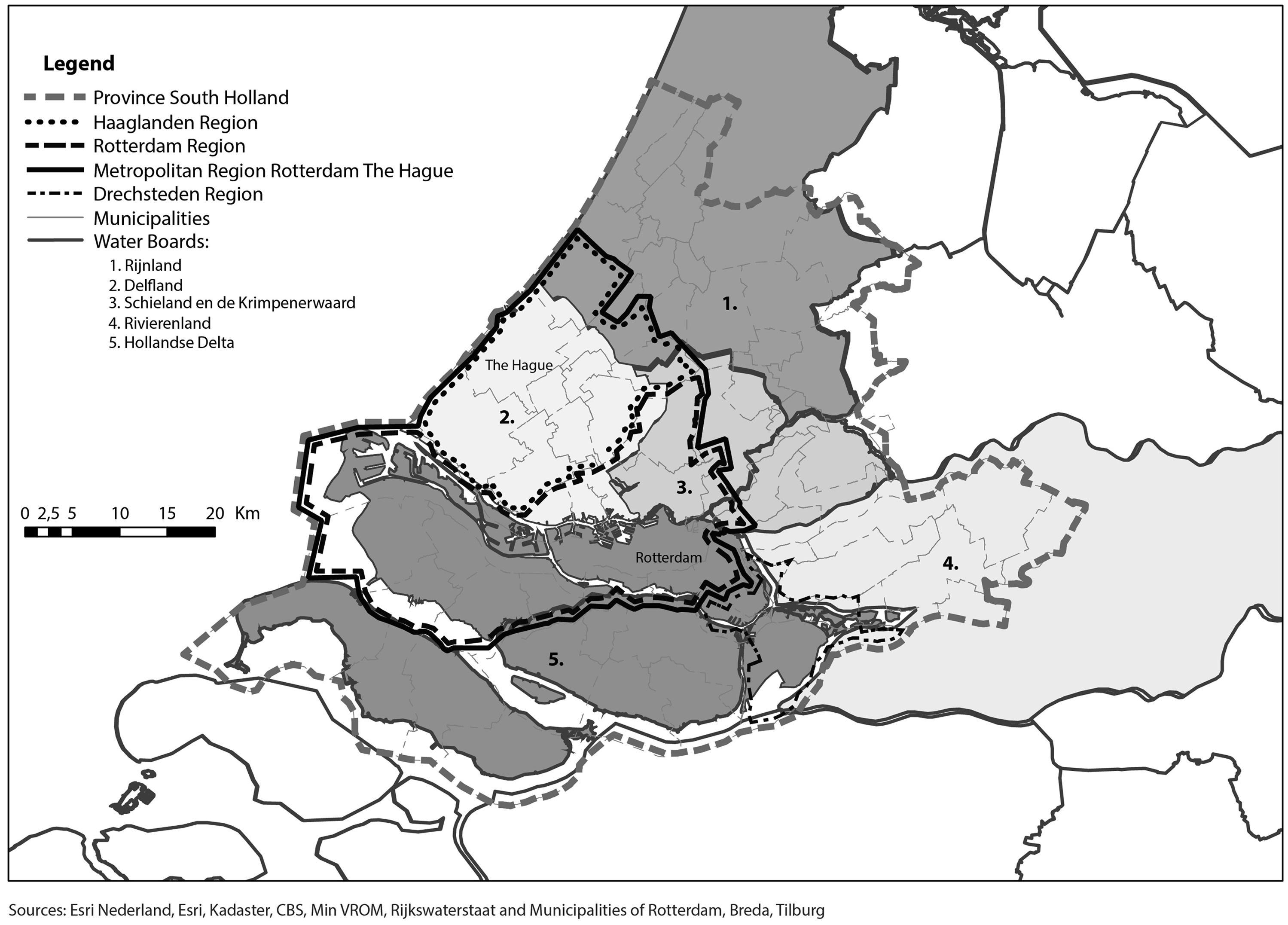
This complexity is also reproduced in the governance system of the Delta Programme, implemented inter alia through regional sub-programmes, the boundaries of which do not match administrative ones, adding a further patch on top of an already complex array of regional institutions. For example, the sub-programme for the Rhine Estuary (with Rotterdam at its heart) and the region of Drechtsteden, was governed by a steering committee including representatives of ministry of the Economy, Ministry of Infrastructure and Environment, Province of South Holland, Water Board Schieland en de Krimpenerwaard, the Port of Rotterdam, and the Municipalities of Dordrecht and Rotterdam. While this approach seems to be typical for the Dutch governance system, it is a challenge for climate change adaptation (Interview 1). Even though the Dutch authorities are used to operating in this complex setting (Interview 12), coordination within it remains difficult and the multiplication of actors blurs accountability lines, an issue to which we will return below.
As highlighted by the vast majority of the actors interviewed, climate change adaptation actions led to establishment of new cross-level, horizontal and cross-sectoral collaborations. In Rotterdam, examples of these new links include the collaboration between the Municipality, Schieland en Krimpenerwaard water board and the Ministry of Infrastructure and the Environment on the flagship urban adaptation project, ‘water plaza’ in Benthemplein combining water storage with recreational functions; or the joint undertaking of the municipalities of Rotterdam and Ridderkerk, the Port of Rotterdam, several water boards, World Wildlife Fund and other organisations on the tidal park on the river bank near Rozenburg area, supposed to absorb excess water and provide space for nature (Interviews 5, 9, 17). In the Hague region, an example of such a collaboration was the EU-funded ‘Sand Engine’ in Kijkduin area, involving collaboration between the Province of South Holland, the Municipality of the Hague, Rijkswaterstaat, and a range of other stakeholders such as dredging companies and knowledge institutions, to create a sandy artificial ‘peninsula’ that would gradually be eroded by the sea and incorporated into the beach and dunes in order to enhance the natural protection of the city against storm surges (Interviews 8, 18). Another one are the experimental projects in Westland, where the municipality, Delfland water board and local farmers worked together to develop water storage facilities under the greenhouses, dominating the landscape in this coastal municipality and being at risk from fresh water shortages, due to draught and salinisation of ground water (Interviews 17, 23).
These new collaborations, however, should be understood as part of wider trends in the Dutch governance system towards proliferation of network organisations, closer collaboration across administrative and sectoral boundaries, and towards decentralisation, started in the 1990s, with a gradual delegation of responsibility for a range of public policies to the provinces and municipalities. This also concerns spatial planning (Zonneveld and Evers, 2014), with the central government withdrawing from this policy area; or water management, where the traditional centralised approach with the predominant role of Rijkswaterstaat and large scale civil engineering infrastructure, is shifting towards decentralisation and local scale ‘soft’ solutions combining water management functions with improvement of the built environment (Interview 4; Meyer, 2009). The growing role of cities in tackling large societal challenges, such as climate change, also reflects the trend towards a ‘shrinking’ state, visible in the Netherlands since the late 1990s and reinforced in the context of the crisis and austerity measures after since 2008, reflecting the idea that the burden and responsibility for policies should be shared with the citizens (represented by the local authorities), businesses and NGOs, while the state should play the role of a facilitator or a referee (Interviews 6, 7, 15). Furthermore, as will be discussed in the next section, making these collaborations across vertical and horizontal boundaries work also faces major barriers.
Barriers for boundary spanning
These barriers for boundary spanning for urban climate adaptation policies can be usefully analysed through the prism of the three dimensions of interests, institutions, and ideas (cf. Hall, 1997).
Interests
From, the rationalist perspective of the actors’ interests and strategies, tackling climate change impacts entails a number of dilemmas and conflicts, which create obstacles for spanning horizontal boundaries. The most prominent one is the question of who foots the bill for the new infrastructures (Interviews 5, 25), ranging from experimental solutions (green roofs and facades, multi-functional solutions in the urban space), to the enlargement of the existing dikes protecting the cities, which in many cases would require removing of existing buildings. For upgrading the dikes, the responsibility lies with the water boards, who face a problem of how, if at all possible, to compensate the dwellers and owners of the houses, which would need to be demolished to accommodate larger dikes. In some cases, the houses concerned are part of the architectural heritage, making their removal hardly possible. However, concerning the ‘soft’ solutions departing from the traditional civil engineering repertoire, the financial responsibility is far less clear. For instance, water plazas entail redevelopment of public space in cities, which is the domain of the municipality, while green roofs are within the remit of housing associations or private house owners. In both cases, the water boards, i.e. the institutions dealing with flood risk, remain reluctant to contribute financially to these solutions (Interview 17), even though these measures are intended to contribute to their goals.
The second interest-related barrier concerns spanning temporal boundaries is political and stems from the mismatch between the long term perspective – characterising climate change adaptation measures that require substantial investment in mitigating a risk that is decades away and largely ignored by the public (electorate) – and the four-year electoral cycle perspective of the local leaders. The latter are under pressure to cater to more tangible and pressing societal interests, such as social welfare, healthcare needs, infrastructure, or education, which tend to more widely recognised by the public. The apparently less urgent climate adaptation measures tend to be relegated to the waiting room, especially in a context of austerity. In such a situation, building regional climate adaptation strategies proves difficult, as only some of the municipalities the South Wing put climate change on their agendas and express interest in collaboration on climate change. Thus, in the Rotterdam region, only seven out of 15 municipalities were actively involved in the preparation of the adaptation strategy (Interview 9), similarly as in the case of The Hague region where the smaller municipalities only nominally supported the development of the regional adaptation strategy, without active involvement (Interview 23). The ambitious regional and local climate change adaptation strategies thus risk remaining dead letters, with their implementation stalling due to lack of commitment of the local leaders and the perception of adaptation being a secondary and distant concern for the electorate. This reflects a wider trend in the Netherlands. According to a survey by the Climate Alliance Netherlands (KVN) only 44% of the Dutch municipalities have invested in research on climate change impacts, two-thirds of them lack capacity (financial, staff, knowledge) to engage in adaptation measures and do not consider this to be an urgent matter. 1
The long-term perspective of adaptation measures also makes it difficult to build convincing positive business cases and encourage businesses to take part in adaptation projects (Interview 27), even though there are examples of synergies between the interests of the public authorities and businesses, as for instance in the case of the Sand Engine (Interviews 8, 27), where dredging companies participated eagerly seeing an opportunity to showcase their expertise.
Institutions
One can also point to several institutional barriers for effective boundary spanning for urban adaptation policies in Zuidvleugel. First, as was recognised by many interviewees, coordination across horizontal and vertical boundaries in such a complex and multi-scalar institutional setting remains a challenge, despite deeply rooted Dutch culture of inter-institutional collaboration, the presence of institutionalised cooperation channels (e.g. as part of the Delta Programme's Rijnmond-Drechtsteden steering group; Knowledge for Climate programme's hotspots in Rotterdam and Haaglanden regions; or the monthly meetings between Rotterdam and the three water boards on the implementation of the city's Water Plan) on flood risk management and spatial planning.
In fact, the new platforms for tackling climate adaptation at the regional level created an extra layer of governance on top of an already complex array of regional institutions. In this institutional patchwork, coordination is hampered by divergent interests, mismatched jurisdictions and uneven endowment in resources among the different municipalities within the two city-regions. This challenge is further reinforced by the Dutch ‘polder model’ itself. While being inclusive, it makes decision-making inevitably slow and tends to result in settling for the lowest common denominator due to the multitude of often competing interests (Interviews 1, 5, 21).
Second, the Dutch administrative system remains in flux, with the on-going decentralisation reforms (entailing a shift down of spatial planning responsibilities to the Provinces, and of the responsibility for a range of policies to the Municipalities) and the related territorial reorganisation intended to enhance efficiency of governance and ‘trim down’ the state apparatus (OECD, 2014). As a result, the municipalities are overburdened with the recently decentralised policies (e.g. healthcare, youth care), which was not followed by a matching increase in fiscal transfers from the central to the local level, while the municipal budgets are stretched as a result of the crisis and austerity measures (Interviews 4, 5). Some of them faced bankruptcy. In the case of Delft, for instance, the Province had to put the city's spending under its temporary supervision to redress its budget. In such a situation, climate adaptation measures, addressing a danger lying decades ahead, risk becoming second-order concerns.
The administrative flux also entailed abolishing the city-regions of The Hague and Rotterdam and the emergence of the new regional entity as of 1 January 2015 – Metropolitan Region Rotterdam The Hague (Metropoolregio). The competencies of Metropoolregio were subject to painstaking debates, in line with the long tradition of the difficult dialogue on cooperation in Zuidvleugel (see Zonneveld, 2010), and created a situation of uncertainty about whether they would include climate change policy, which negatively affected the work on regional climate adaptation strategies (Stadsgeweest Haaglanden, 2014; Stadsregio Rotterdam, 2013) of both former city-regions (Interviews 9, 22). Interviewees expressed skepticism about the metropolitan scale being adequate for addressing climate adaptation (Interviews 14, 15) and feared that the merger would ‘diffuse the look on climate adaptation and make it harder to focus on the concrete issues’ (Interview 14). Thus, the Haaglanden strategy mentioned that climate adaptation policy was supposed to be up-scaled to Metropoolregio, but later it turned out that the new institution would deal mostly with transportation and aspects of economic policy, not with climate change. This left the implementation of the strategy in an institutional vacuum and forced the municipalities within Zuidvleugel to coordinate their adaptation strategies on an informal basis (Interview 22).
Third, perhaps the biggest barrier for spanning both horizontal and vertical boundaries in Zuidvleugel is the fragmented responsibility for flood risk management, a surprising situation given the central place of water management in the country's history. Coastal flooding is a national responsibility, but fluvial flooding is the domain of the regional water boards, while pluvial flooding is the task of the municipalities. All those three types of flooding, however, can coincide and vulnerability to them increases as a result of climate change, which creates a strong case for coordination, which cannot be taken for granted in the Dutch institutional patchwork.
More interestingly perhaps, the case of Rotterdam highlights another accountability-related barrier – the blurred responsibility for the safety of unembanked areas of the city, which over time spread into the areas located between the dikes protecting the core of the city and the Maas river. Protection from flooding of these important residential (circa 40,000 inhabitants) and economic activity areas remains a ‘legal grey zone’ (Interview 25), as neither the city, nor the water boards, nor the central government are legally in charge of keeping them dry. The same applies to Dordrecht where ‘most of the city lies outside the primary defence and [in those areas] it is not clear who is in charge’ (Interview 26). Thus, ‘in unembanked areas people are left to their own devices’ in case of a flooding event, ‘unless it entails huge damage, then it becomes a national issue’ (Interview 25, also interview 9), which is a blaring gap in a country which is widely considered as the provider of the ‘gold standard’ for flood risk management. In practice, in case of flooding in those areas, the citizens and the media tend to blame the municipality. Thus, the latter is obliged to take action outside of its remit to address the issue and seeks solutions in a dialogue with the water boards (see van Veelen, 2013) in which different innovations, such as floating barriers are advanced. However, there is little progress on this in practice since neither party is keen to invest substantially in new infrastructures in unembanked areas, especially in times of economic crisis (Interview 5), while the water boards limit themselves to providing advice and flood warnings, even the inhabitants of these areas still pay taxes to the water boards (Interviews 5, 9, 17, 25). Solving this conundrum would most likely require a revision of the rules governing the responsibility for flood risk, which can only be done at the national level.
Ideas
Finally, let us turn to the ideational barriers. The said dialogue across the horizontal boundary between the municipalities and the water boards is also difficult on a cognitive level (Interviews 17, 21, 25, 26). The two actors have very different approaches and mind-sets. The municipalities are general-purpose jurisdictions with a wide (and expanding) policy portfolio and an even larger set of interests to negotiate and satisfy. The municipal personnel dealing with climate adaptation typically comprises planners or environmental officers. By contrast, water boards are specific-purpose jurisdictions with a narrow responsibility for building and maintaining dikes, flood protection and water infrastructure, supported by a substantial own fiscal income. Their employees tend to be civil engineers for whom the various (and often conflicting) policy concerns with which the city officials have to deal with are alien. This makes the dialogue between them uneasy and prone to misunderstandings and tensions, even though since the late 1990s, as a result of the growing attention paid to water storage issue (requiring considerable space, also within cities), the introduction of municipal water plans and then the Delta Programme, water boards increasingly have to consider spatial issues and work with the municipalities (Interviews 25, 26). A telling example is the water boards' approach to Rotterdam's green roofs initiative. Initially, Delfland supported it, both in terms of knowledge-sharing and financially, however, later it withdrew its support on the grounds of lack of certitude on the green roof's effectiveness in storing water and the restricted access to private roofs preventing monitoring of their performance (Interview 17). Similarly, Rotterdam's water plazas, are not considered by the water boards officials as effective measures to mitigate flood risk, unlike the tried and tested dikes and flood barriers (Interviews 5, 17, 25, 26).
Nonetheless, the water board officials recognise the role of the ‘soft’ solutions, like water plazas or green roofs, as awareness-building devices ‘showing people that even tomorrow there can be a flooding problem’ (Interview 26). In fact, paradoxically, the Dutch public tends to have full trust in the competence of the water boards and Rijkswaterstaat in water management, build over, literally, centuries of experience. However, this high trust actually limits the public awareness of the threat of the sea level rise and undermines public support for adaptation policies, which do not bring immediate tangible effects but focus on the long-term (Interviews 25, 26). This in turn creates a further barrier for spanning temporal boundaries.
Conclusions
The paper shed new light on the question of governance of climate change adaptation policies in cities by investigating the case of the Dutch urban region – Zuidvleugel in the Randstad. By focusing not only on the urban scale, but also on the regional one and on the barriers for spanning vertical, horizontal and temporal boundaries, needed to tackle climate impacts in cities, the study contributes to the literature by underscoring the importance of the contexts within which cities operate. It used the example of Zuidvleugel to show that factors such as political culture, local politics, (changes in) the governance setting and vertical and horizontal institutional linkages, were crucial for determining how cities and urban regions address climate change challenge through working across various boundaries. Thus, these factors have to be considered in order to understand and seek to improve the cities' capacity to become more resilient to the growing flood risk and other impacts of the changing climate.
Contextual factors creating barriers for boundary spanning needed for climate adaptation policy: a summary of findings.
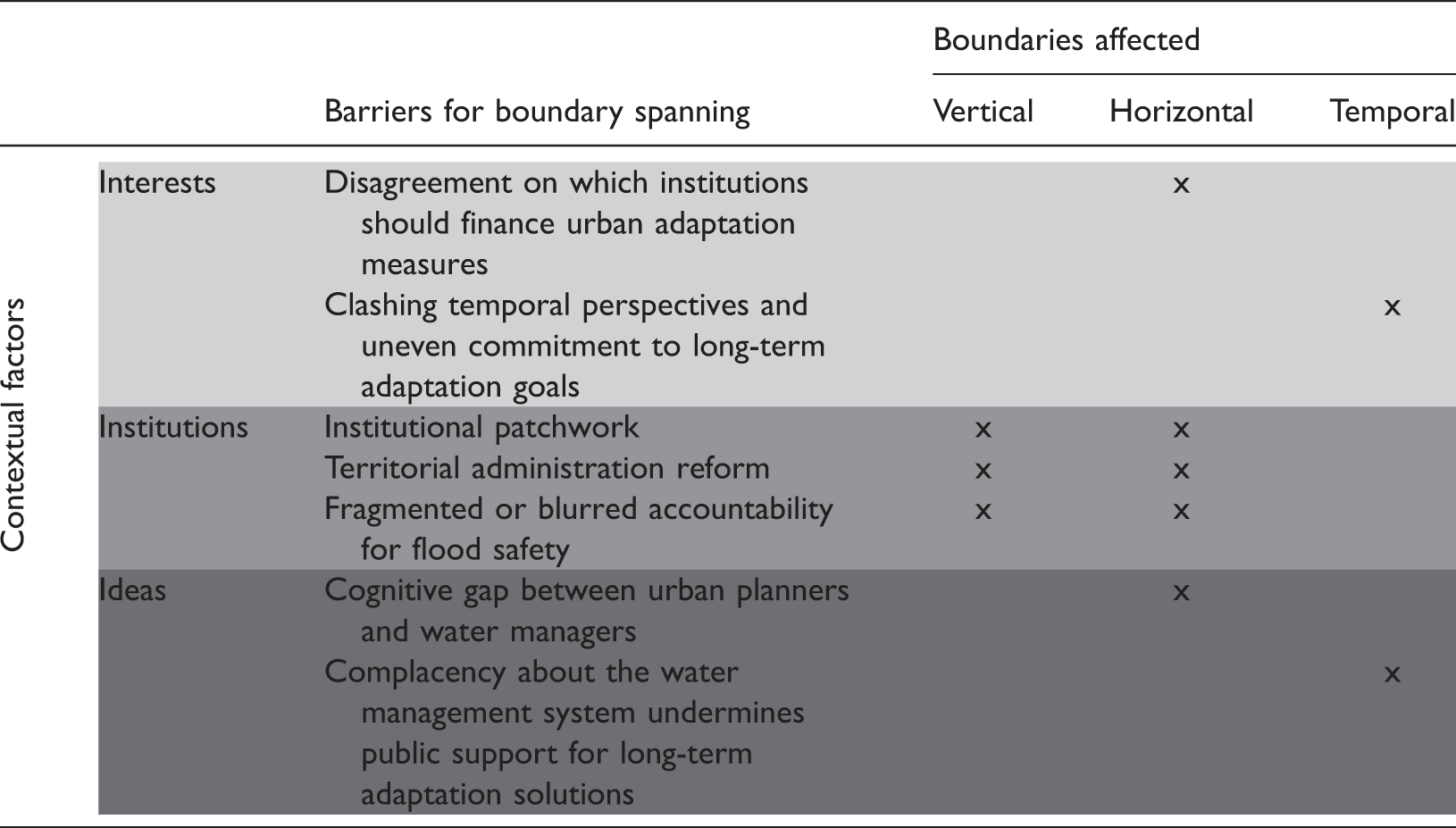
First, horizontal boundary spanning was hindered by misaligned interests of the parties involved resulting in a deadlock and a risk of losing momentum for promoting and financing adaptation measures. Also temporal boundary spanning was hampered by the clashing short- and long-term priorities of the municipalities in the region, resulting in varying degrees of engagement in adaptation policy, which echoed the conclusions from previous research stressing the uneven adaptation efforts of cities (Walker et al., 2014). Second, barriers related with institutional factors also negatively affected both horizontal and vertical boundary spanning. The characteristics of and the on-going changes within the Dutch institutional system resulted, among others, in blurred accountability for flood events in parts of the urban space and uncertainty about the future responsibilities for climate adaptation policy preventing commitment to collaborations on adaptation policies, particularly at the city-region level. Third, ideational barriers negatively impacted on spanning of horizontal and temporal boundaries. Thus, the conflicting understandings and ideas on the solutions to tackle the growing flood risk within the urban space among the municipal officials and civil engineers in water authorities hindered sustained collaboration on new flood-risk management solutions within the urban space, while the complacency about the water management system undermined public support for long-term adaptation solutions.
While there are no quick and easy fixes to such barriers for boundary spanning needed for delivering urban adaptation policies, solutions to at least some of them can be found, paradoxically, not at the local or even city-region scale, but at the national one. There is a clear need for amending the legislation pertaining to the responsibility for flood risk to bridge the accountability gaps concerning the unembanked areas in cities, while the uneven interest for the climate change adaptation agenda among municipalities calls for an incentive scheme, possibly combined with coercive measures, to assist and mobilise all municipalities located in territories highly vulnerable to climate change impacts to draw up adaptation strategies and actions.
The study also points to several avenues for future research. First, there is the question of what actually lies behind the positive and glossy discourse on ‘climate-proof city’. Future research should, in fact, investigate the extent to which the experimental multi-functional adaptation solutions are actually effective in storing water and preventing flooding in the context of increasing precipitation and more frequent extreme weather events. Second, another issue calling for more research is that of climate justice, or more specifically the distribution of benefits and costs of adaptation measures. In other words, investigate who benefits and loses out from these actions. As we saw in the case of the South Wing, innovative adaptation measures can create scope for addressing other concerns, such as quality of urban life, or create business opportunities for maritime or construction companies, but also they can entail harm for the architectural heritage or require relocation of some populations and businesses. Finally, one can point to the need to study in more detail what strategies and tactics actually enable the actors to span the boundaries across scales, sectors and organisations to cooperate on climate adaptation strategies within a fragmented governance setting. While this being challenging even the Dutch context, it is a problem of much greater magnitude in cities located in governance systems with weaker institutions and less collaborative political culture. Possible direction in such research would be to explore the less visible and informal ‘relational space for adaptation’ (Leck and Roberts, 2015: 66) operating in the shadow of the official institutions and hierarchies.
Footnotes
Acknowledgements
The author would like thank the Urban Studies Foundation as well as Dominic Stead and Vincent Nadin for their valuable comments and support in this research, and Alexander Wandl for help in preparing the map.
Declaration of conflicting interests
The author(s) declared no potential conflicts of interest with respect to the research, authorship, and/or publication of this article.
Funding
The author(s) disclosed receipt of the following financial support for the research, authorship, and/or publication of this article: This research is funded as part of the Urban Studies Foundation Postdoctoral Research Fellowship Programme.
Note
Supplementary Material
The supplements for the article are available online.
References
Supplementary Material
Please find the following supplemental material available below.
For Open Access articles published under a Creative Commons License, all supplemental material carries the same license as the article it is associated with.
For non-Open Access articles published, all supplemental material carries a non-exclusive license, and permission requests for re-use of supplemental material or any part of supplemental material shall be sent directly to the copyright owner as specified in the copyright notice associated with the article.
