




Abstract
Recent theoretical literature in social policy argued that climate change posed a new risk to the states and called for transformation from a traditional welfare state to an ‘eco’ state. From a theoretical point of view, different welfare regimes may manage environmental/climate change risks in a similar way to social risks. However, not much has been done to explore the issue empirically. To this end, this paper aims to investigate public attitudes towards environmental and traditional welfare policies given that environmental change is a new social risk the welfare states have to address. Do individuals that care for one area also care for the other? That is, do the preferences in these two policy spheres complement or substitute one another? We test these hypotheses both at the individual- and country-level, using data from 14 countries included in all three waves (1993, 2000, and 2010) of the environmental module in the International Social Survey Programme. Specifically, we investigate the relationship between attitudes towards income redistribution (indicator of support for welfare policy) and willingness to pay for environmental protection (indicator of support for environmental policy). Our findings suggest that attitudes in the two areas are substitutes in the total sample, but that the relationship is very small and only statistically significant in some specifications. When we explore country differentials, we observe clear heterogeneity in the relationship, which can be explained by differences in political and historical contexts across countries.
Introduction
It has become evident that under a business-as-usual practice, greenhouse gas emissions will continue to rise and exceed the 2℃ threshold where global warming becomes irreversible and catastrophic (IPCC, 2014). Thus, the reduction of global greenhouse gas emissions is urgent and at the heart of the climate talks among government representatives of over 190 nations in Paris in December 2015. The urgency of addressing climate change has been recognised not only among climate scientists but also in the social sciences. This is well-reflected in the introductory remark from a special issue of the American Psychologist, stating that ‘global climate change poses one of the greatest challenges facing humanity in this century’ (Swim et al., 2011).
Likewise, from a public policy perspective, the need to integrate climate change issues into public policy making has been readily acknowledged. Given that wealthier countries have greater capacity to afford the costs of carbon emissions cuts than poorer countries (Borghesi, 2001), governments in most high-income countries have recognised that they have a responsibility to act in order to reduce greenhouse gas emissions. However, such cuts will be costly, leading to the question of who should bear the costs. Different policy designs will have different winners and losers in terms of distributional outcomes. For instance, taxes on home energy use usually have regressive effects on low-income households because home energy behaves as a ‘necessity’ good, i.e. its income and price elasticities are small (Jamasb and Meier, 2010). In other words, low-income households spend a relatively high proportion of their income on energy intensive activities such as heating and are unlikely to reduce energy consumption even if taxes are increased. Conversely, targeting emissions from personal transport has been shown to have progressive, inequality-reducing effects since poorer households fly less and are less likely to own a car (Büchs et al., 2011). 1 Public policies introduced to promote transition towards low-carbon and sustainable lifestyles, hence, need to address such inequalities and conflicts. This includes, for instance, designing complementary policies such as transfer payments or tax cuts that compensate the regressive nature of carbon taxes in which the tax burden falls disproportionately onto poorer households.
Whilst climate change is being recognised internationally as a ‘wicked’ or even ‘super wicked’ policy issue (Levin et al., 2012; Rittel and Webber, 1973), ‘traditional’ public policy issues like unemployment, income inequalities and poverty remain prominent at the national level. Over the past two decades, demographic change, a reduction in economic growth rates, increased economic and financial internationalisation and the global economic downturn have put great pressures on public finances. The shrinking work force, coupled with increasing life expectancy, translate into inevitably higher social spending on health care and pensions. Likewise, widening income inequalities in high income countries since the 1980s due to globalisation, technological change and shifts in family structures call for welfare state interventions (Ursanov and Chivot, 2015). With climate change being a source of new social risks on the one hand and ‘traditional’ social problems on the other, it can indeed be problematic for countries to maintain fiscal and environmental sustainability (Bailey, 2015). This raises a question of how the pie should be divided to achieve the best possible synergy between social and environmental policies.
Under the pressure of global environmental change, environmental management and climate change mitigation and adaptation have gradually become a core area of state responsibility. Following the modern environmental movement in the 1960s and the 1970s, sub-disciplines within the social sciences have increasingly addressed environmental issues. In political science the study of environmental governance covering the topics related to environmental politics, natural resource management and environmental policy is well-established (Meyer et al., 1997; Newell, 2008; Paterson, 2009). In particular, the issue of the intersection between economic growth and environmental sustainability has been a dominant research theme.
The findings of the Environmental Kuznets Curve (EKC) in which certain forms of air and water pollution decline as the level of national income increases, raises the puzzling question of why environmental quality improves as countries become wealthier and more industrialised (Cole et al., 1997; Dasgupta et al., 2001; Grossman and Krueger, 1995; but see Bagliani et al., 2008 for an alternative interpretation). Both citizen’s increased demand for a better quality of life once the country is economically developed – the post-materialism theory proposed by Inglehart (1995) – and the capacity of wealthier countries to invest in infrastructure, technological development and pollution control, explain this inverted U-shaped curve (EKC) (Fiorino, 2011). Correspondingly, there is some evidence that individuals who hold higher post-materialist values, tend to be more politically engaged and mobilise more actively – for instance by signing a petition or taking part in a protest – to influence or change environmental policies (Kelly et al., 2007). 2
The crucial role that public opinions play in environmental mobilisation, coupled with the new challenge of integrating climate policies into other policy areas make ‘squaring the public policy circle’ (Taylor-Gooby, 2011) an extremely demanding task for democratic governments. Since citizen’s attitudes towards public policies are partially shaped by self-interest (Blekesaune and Quadagno, 2003), it is possible that public support for social and climate change policies may not go hand in hand. Which policy dimension should be given priorities pose challenges to governments in making costly policy solutions palatable to the public. Since citizens are the recipients of policy, their attitudes have implications for the legitimacy of these policies. In advanced democracies, the relationship between public opinions and policy may be linked to the quality of democracy. 3 As Jacobs and Shapiro (1994) point out ‘[w]hen policies are habitually at odds with public opinion, this is considered undemocratic […]’. Indeed, it has been found that public policy and institutional arrangements are correlated with public attitudes (e.g. Jacobs and Shapiro, 1994; Kumlin, 2004; Skocpol, 1994).
Therefore, under the threat of the changing climate, if we are to succeed in transforming modern democratic states into environmental welfare states or eco-social states, we need to understand what drives attitudes both in the environmental sphere and with regard to welfare policy. Ideally, we should uncover the extent to which the two spheres interact. Since it would give policymakers an indication as to what kind of policies are likely to be unpopular with voters and where there might be greater room for manoeuvre, such knowledge would have relevance for policymaking. However, public attitudes in the two policy fields have rarely been empirically analysed together. Analysis of these policy interactions remains a relatively young research field (Gough, 2010). This article makes another step towards closing this gap by investigating whether there is a relationship between developments in environmental attitudes and attitudes towards income redistribution, using three waves of the environmental modules of the International Social Survey Programme (ISSP).
Research questions and hypotheses
In this study, we ask whether public attitudes towards income redistribution are related to the willingness to pay to protect the environment. We look at two indicators that measure how willing an individual is to give up part of their wealth to reduce social inequalities and to improve the quality of the environment respectively. Here we examine two straightforward competing hypothesis: (1) Crowding out: Environmental and social concerns are substitutes, i.e. persons who attach a high priority to environmental protection are less concerned about governmental efforts to protect against social risks; and (2) Double-worry: Those concerned about ‘traditional’ social questions and who support redistribution through the welfare state also tend to worry about the environment and are willing to pay to protect the environment. We test the two hypotheses both at the individual- and country-level, using the ISSP data as described in Section ‘Data and measurement’.
There is a rich comparative literature on public attitudes on environmental issues (Franzen and Meyer, 2010; Franzen and Vogl, 2013; Gelissen, 2007) as well as on questions like redistribution and the responsibility of governments in providing social protection and care (Blekesaune and Quadagno, 2003; Kulin and Svallfors, 2013; Reeskens and Oorschot, 2013). Whilst these two streams of literature represent a natural starting point for exploring potential interactions between environmental and welfare attitudes, attitudes towards environmental issues and welfare state questions have rarely been explored together. A recent empirical study focusing on Australia by Spies-Butcher and Stebbing (2016) examines the relationship between prioritising environmental and global warming concerns and support for welfare state expansion and finds that there is a strong overlap in preferences towards the two issues. Still, their study does not explicitly investigate attitudes towards welfare and environmental policies. Moreover, looking only at a single country, it does not provide knowledge of differences (or similarities) across countries.
Recently, there has been emerging literature that explores the potential interactions of climate change and climate policies with social policy and welfare state issues (Fitzpatrick, 2014; Gough, 2010, 2013; Koch and Mont, 2016; Meadowcroft, 2008, 2005; Somestad, 2012). In particular, these scholars recognise ecological challenges such as climate change, deforestation and land degradation as sources of new social risks which have implications for social policy arrangements and may require new kinds of policy solutions (see e.g. Johansson et al., 2016; Schaffrin, 2014). In this sense, both welfare states and environmental states play a similar role in addressing negative market externalities.
Duit (2016: 71) uses the term ‘environmental state’ to describe a state that adopts a continuous focus on social–environmental interactions. This concept denotes real-world examples or approximations of an ideal-type green state (or ecological state) (e.g. Dryzek et al., 2003; Eckersley, 2004), conceived as a liberal democracy 4 practicing ‘ecologically responsible statehood’ (Eckersley, 2004: 2). According to Duit (2016: 73) the environmental state comprises four basic resources that the state employs to deal with environmental externalities. These include: (1) environmental regulations, institutions and policies; (2) organisations and agencies for environmental public administration; (3) environmental taxes and spending for the redistribution of resources; and (4) production and dissemination of environmental knowledge through scientific studies and environmental monitoring programmes. In addition to these four policy instruments, one could also add decentralised ‘network governance’, which involve interactions between various agencies such as nongovernmental organisations, corporations, activists and public officials (Dryzek, 2013; Jordan et al., 2003). Whilst some of the alternative environmental policy instruments are market-based, other collaborative governance strategies include voluntary agreements, for instance, between regulators and corporations. The state may share with industry the responsibility to address environmental challenges (see Jordan et al., 2003: 11). Sustainable development, following a path of ecological modernisation (a concept that we return to in the concluding discussion), necessitates broad partnerships, not only between government and business, but also scientific expertise and civil society pressure groups (see Dryzek, 2013: 170–177).
These environmental mandates and strategies may overlap with pre-existing economic and security arrangements which also require state intervention (Duit et al., 2016; Meadowcroft, 2005). Whilst characteristic forms and the instruments for reallocation of obligations and entitlements of the welfare state and the environmental state operate in separate departmental silos (Gough, 2016), they may compete for public resources in terms of funding as well as administrative capacity at the stage of policy implementation.
Subject to tight budgetary constraints, the welfare states are under pressure to ensure equity and justice of policy outcomes and fair distribution of costs and burdens between social groups. Modern states are subject to state ‘imperatives’ in which they are expected to ensure balance between economic prosperity, public services provision, security and environmental protection (Hunold and Dryzek, 2002). In this regard, both social protection and climate policy are rooted in the social justice discourse (Eckersley, 1992). This particularly concerns the issues of distributive justice, i.e. the fair distribution of socio-economic and natural resources. Environmental justice deals with equitable distribution of environmental benefits and risks. Environmentally hazardous sites such as waste disposal, manufacturing industry and energy production, for instance, are often located close to poor and/or minority-dominated residential areas. Such environmental discrimination paved way to environmental justice movements like the one in the southern United States in the 1980s (Bullard, 2000) and in South Africa in the 1990s (Khan, 2002).
Therefore, similar to the provision of public goods like public education, housing and health services to protect against market failure, climate policy, such as investment in cleaner energy production, is a strategy to counteract the effects of the market’s externalisation of environmental costs. Whilst the welfare state already has the institutions, processes and policies in place to accommodate environmental sustainability and climate goals (Duit, 2011), it is possible that climate polices might compete with social policy for resources and attention and weaken the traditional concerns of social justice. Consequently, in the future it will be important to design social policies that are able to mitigate the inequalities and conflicts that may emerge in the transition towards more eco-friendly welfare states as well as are attractive to electorate (Koch and Fritz, 2014).
Unlike the welfare state where class-based interests are at the centre, concerns about the environment which are the base of collective pressure on government, are more often expressed among more educated and affluent groups (Gough, 2016). Whether the public favour redistribution and/or environmental policies thus depends on both individual preferences and the national context. At the individual level, public attitudes towards certain policies are determined by elements of self-interest, ideology and political preferences. According to the self-interest argument, individuals who benefit from given welfare policies or are at risk of becoming financially dependent on the welfare state, are more likely to support such programmes (Hasenfeld and Rafferty, 1989). Hence, those who are socioeconomically vulnerable, e.g. have low income, education and occupational status, are more likely to favour a system in which incomes and wealth are evenly distributed (Blekesaune and Quadagno, 2003; Jæger, 2006). In this sense, whether individuals support only welfare policies or only environmental policies or both, depends on their self-interest. Individuals from low-income households may, for example, be supportive of income redistribution but less sympathetic towards higher tax on home energy use.
Individual opinions towards public welfare provision and environmental policies are also rooted in systems of political orientations and ideological preferences. Empirical studies have documented that individuals’ support for public responsibility for welfare provision are correlated with their subjective position on the left/right continuum, egalitarian ideology and beliefs about social justice and social mobility (Bean and Papadakis, 1998; Calzada et al., 2014; Linos and West, 2003). Whilst typical left and right parties were clearly divided on economic programmes, environmental or green issues were not straightforwardly accommodated in the traditional left/right framework. On the one hand, there are authors who argue that environmentalism represents an additional political dimension orthogonal to the traditional economic dimension (Carter, 2001). If this is the case, pro-welfare voters may not necessarily be pro-environment. On the other hand, some scholars have argued that environmentalism should follow the established left/right party alignment, especially within a leftist identity (Inglehart, 1990; Knutsen, 1995). There is evidence that political parties and individuals who are self-identified on the left of the political spectrum, are more likely to embrace pro-environmental positions including agreeing to pay higher taxes to prevent environmental damages and support publicly financed environmental protection programmes and climate policy (Neumayer, 2004; Torgler and García-Valiñas, 2007; Ziegler, 2017). In this regard, public support for welfare and environmental policies supposedly goes hand in hand.
At the same time, country-level characteristics also affect public attitudes towards social and environmental policies. The development of various regime types of welfare states has been attributed to the history of class coalitions with, for instance, the coalition between the middle classes and the working classes forming the social democratic regimes (Esping-Andersen, 1990). The institutional characteristics of the welfare regimes, in turn, can influence attitudes and opinions towards social programmes (Edlund, 1999). It is expected that social democratic welfare states should be in a better position to handle the intersection between welfare and environmental policies (Dryzek, 2008). Since these states rely on more extensive state intervention, in general, policymakers as well as citizens are likely to accept higher levels of taxation and market regulation (Svallfors, 2013). In such regimes, both environmental and economic values can be mutually reinforcing since both issues require state regulation and collective investment. In contrast, in liberal welfare regimes, welfare support for medium-income groups is comparatively weak resulting in high levels of poverty and social inequality. Hence, there are likely to be conflicts between public welfare and environmental policy since low-income households are less able to face higher energy costs or invest in energy saving measures (Schaffrin, 2014).
According to the literature on individual and country level determinants of public attitudes described above, public support for social and environmental policies can compete with one another (e.g. welfare recipients supporting redistribution programmes whilst people vulnerable to environmental change favour pro-environmental policies) or go hand in hand (e.g. believing in an active state in both spheres). Koch and Fritz (2014) is, to our knowledge, the only study that has empirically investigated the linkages between social and environmental policies. In particular, using a set of questions on environmental attitudes in the ISSP 2010 data, the study explores whether social democratic welfare states are more eco-friendly than conservative and liberal welfare states as measured by country-level ecological performances. They investigated whether individuals living in social democratic welfare states are more concerned about the environment than economic growth, more in favour of government intervention to protect the environment and more willing to cut the standard of living to protect the environment. They find evidence neither of better ecological performances nor of greater support for environmental policies in social democratic welfare states. These findings suggest that there are no spillover effects from states that favour welfare policies tackling socioeconomic inequalities to green policies addressing environmental issues.
Although the work of Koch and Fritz (2014) provides some empirical insight into a possible synergy between welfare and environmental policies, they do not explicitly capture the potential budgetary tensions between the two policy choices. Indeed, social spending on welfare programmes such as pension and unemployment benefits may compete with expenditure for policies to protect the environment. There is evidence that changing governments’ priorities towards pressing financial and social issues due to the economic recession have led to budget cuts in the green economy development such as investments in clean technology and renewable energy schemes (Obani and Gupta, 2016).
Data and measurement
Data
This study is based on the environmental module of the ISSP comprising three cross-national surveys conducted in 1993, 2000 and 2010. The ISSP is an ongoing cross-national collaboration covering topics of importance to the social sciences since 1984. The ISSP surveys employ a common sampling and methodological framework making the data comparable across countries and time. Although sampling procedures vary by country ranging from probability cluster sample, stratified random sample to random equal probability sample, they are designed to ensure national representativeness including at least 1000 respondents per country per year. Respondents were adults aged 18 years and older.
The environmental module includes numerous measures of attitudes towards environmental-related issues including respondents’ behaviour and preferences regarding governmental measures on environmental protection. The data also contain basic demographic information such as age, sex, education and occupation. In order to track development over time, in this study we include the countries participating in all three waves of data collection (1993, 2000, and 2010). This gives a total of 50,516 respondents in 14 countries with valid responses to the attitudinal questions relevant for the present study.
Measurement
Dependent variable
We focus on the willingness to pay as an indicator of the propensity to act to protect the environment using two survey items: (1) ‘How willing would you be to pay much higher prices in order to protect the environment?’; and (2) ‘How willing would you be to pay much higher taxes in order to protect the environment?’. The respondents were asked to state if they were very willing or very unwilling to do this on a five point Likert-scale for each of the two survey items. We reversed the order of the two items, added them together and divided the answers by two to harmonise the scale between 1 and 5.
We focus on the questions related to the willingness to pay for the environment rather than the questions on environmental attitudes such as those indicating the perception towards humans’ contribution in harming the natural environment. As argued by Kachi et al. (2015), it is the policy preferences rather than the risk perception that is important for policy making. They further argue that individuals can be aware of environmental problems without supporting policies that tackle the issues. Moreover, in the discussion about proper measurement of environmental attitudes, Franzen and Vogl (2013) highlight the difference between having insights into environmental problems and being willing to do something about them. Unlike the survey items that capture environmental concern, willingness to pay offers a more precise measure of propensity to act for the environment. Furthermore, willingness to pay for environmental protection corresponds better with the item on redistribution preferences, which will be used as an indicator of welfare attitudes.
Explanatory variable
Whilst the ISSP environmental module is rich on items measuring environmental attitudes and concern, there is only one item related to welfare attitudes. Here we use the question that measures attitudes towards income redistribution: ‘It is the responsibility of the government to reduce the differences in income between people with high incomes and those with low incomes.’ The respondents were asked to state if they strongly agree or strongly disagree to this statement on a five point Likert-scale.
Attitudes towards income redistribution lie at the heart of welfare policies. Redistribution involves transfer of income or wealth from those who have more to those who have less. This means high income individuals have to, for instance, pay higher taxes in order to redistribute to others. Support for redistributive policies, hence, may not coincide with willingness to pay for environmental protection since the latter also requires individuals to give up part for their income for the environment. By using the survey items that capture willingness to pay for the environment and support for income redistribution, we are able to directly test our hypotheses.
Control variables
In addition to the main variables of interest, we also include a set of individual level control variables for the analysis considering the individual level (gender, age, age squared, education and employment), household level (household composition and income), and a set of country level control variables for the time series cross sectional (TSCS) analysis. These control variables are presented in Table A1 in the Appendix.
Descriptive results
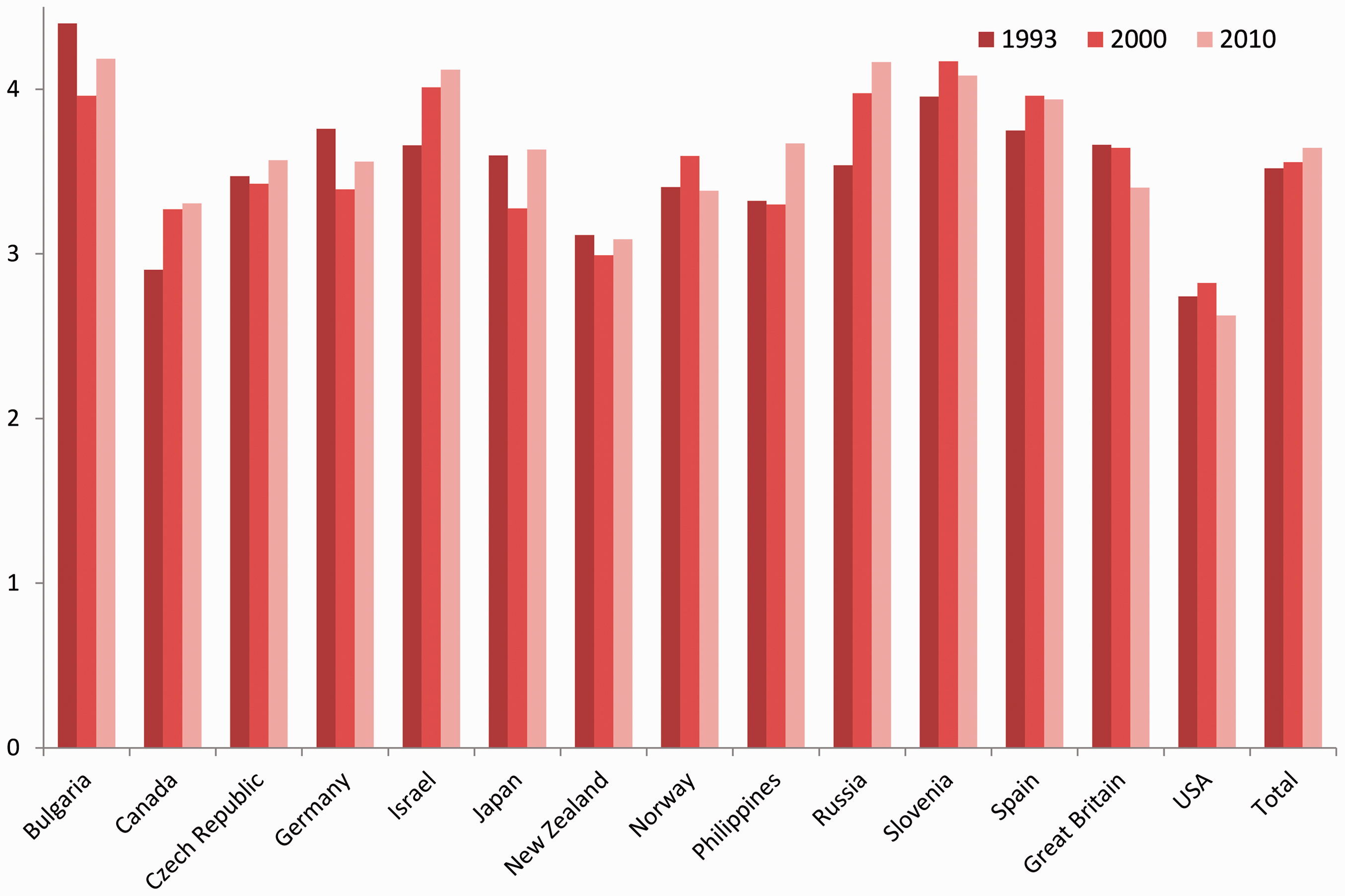
Figures 1 and 2 present average willingness to pay for environmental protection and average redistribution attitudes by country and survey year, respectively. In the total sample, there is a negative trend in the willingness to pay for environmental protection (F(2, 50513) = 754.59, p = 0.000), and a positive trend in redistribution attitudes (F(2, 50513) = 60.09, p = 0.000). The downward trend for willingness to pay for the environment is present for almost all studied countries, not only for the total sample. Regarding redistribution attitudes the trend is slightly mixed for the individual countries but in general most of them have experienced an increase in support for income redistribution.
Willingness to pay for environmental protection by country and survey year. Note: Willingness to pay for environmental protection vary between 1 and 5 where a higher number implies higher willingness to pay. Support for income redistribution by country and survey year. Note: Redistribution attitudes vary between 1 and 5 where a higher number implies more positive attitudes.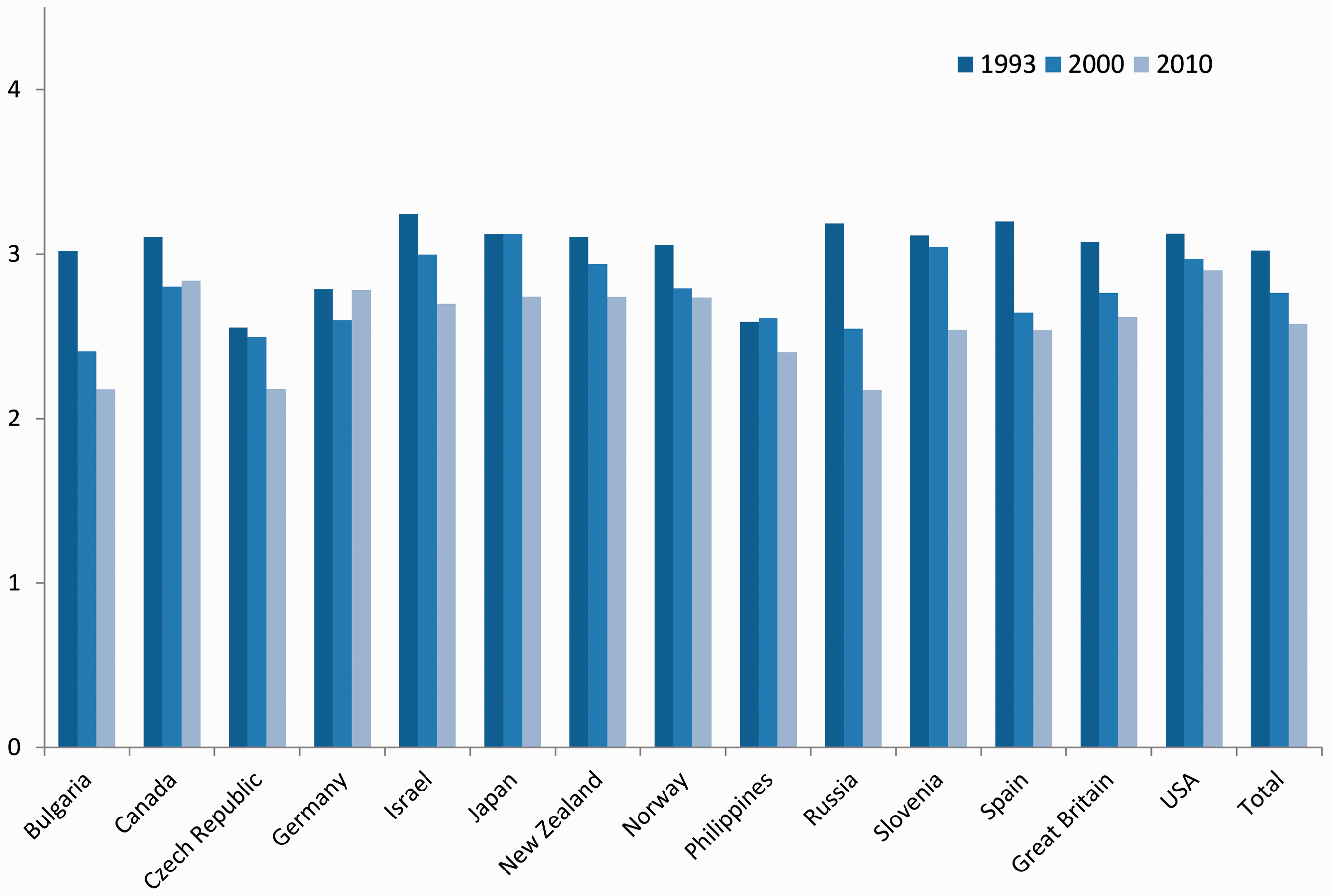
In Figure 3, we present how the attitudes regarding both the willingness to pay for environmental protection and attitudes towards redistribution vary by age in the three waves of data collection. There is a clear pattern showing that for all ages the willingness to pay is considerably smaller in 2010 than in 1993, similar to what shown previously in Figure 1. Thus, we see clear decreases in willingness to pay for environmental protection during the investigated period. As already noted by Franzen and Vogl (2013), for a broader measure of environmental concern, this negative trend takes place in a period where wealth has increased in most of the studied countries. As opposed to the trends in willingness to pay to protect the environment, people tend to be more supportive of redistribution in 2010 than in 1993, at least in the younger age groups.
Willingness to pay and redistribution attitudes by age and survey year in 14 countries.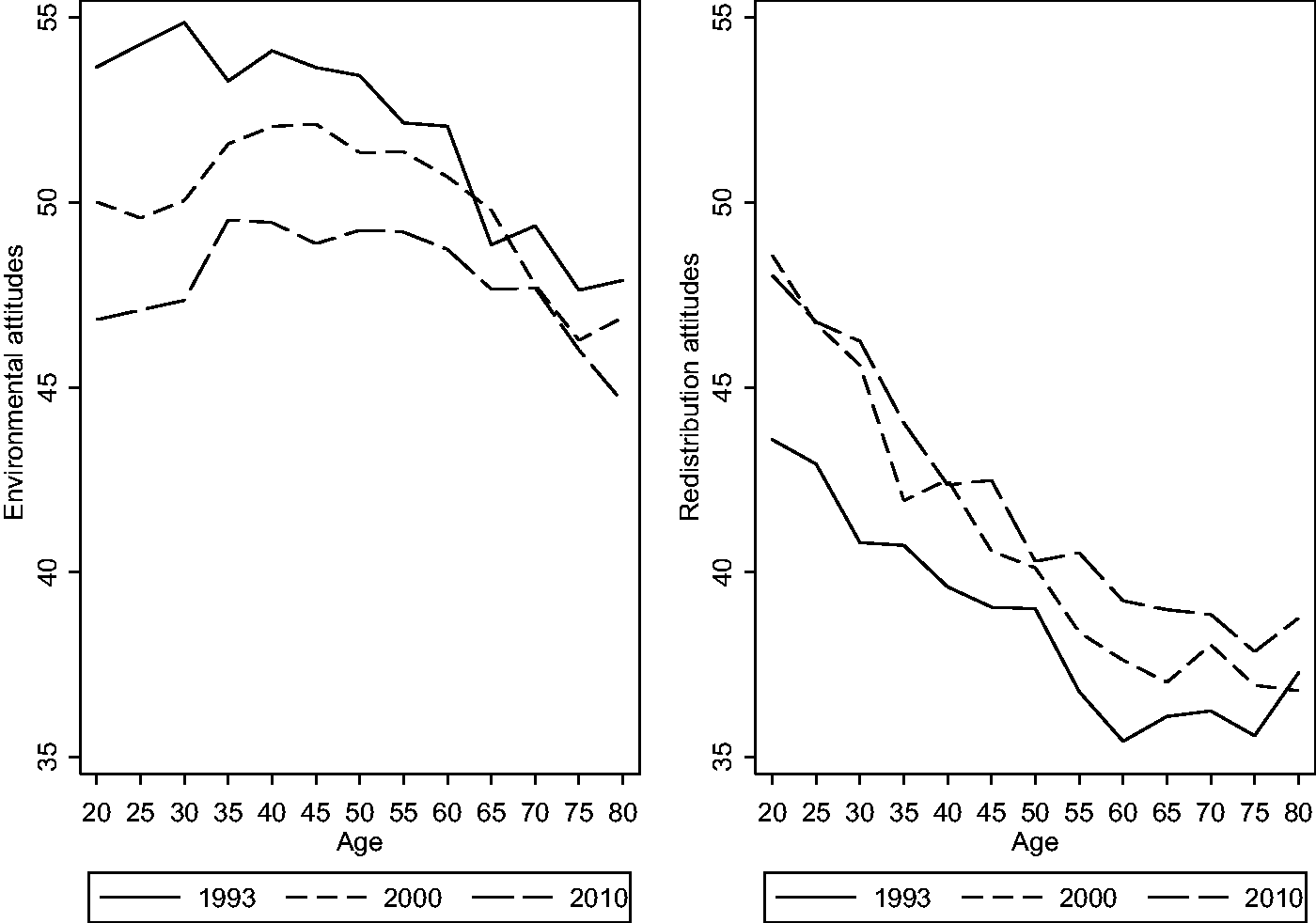
Empirical strategies and results
The next step is to investigate whether these attitudes are in any way related. Do individuals that care for one of the areas also care for the other? That is, do they complement or substitute each other? Here we assess two competing hypotheses as described above: (1) Crowding out: persons who are willing to pay to protect the environment are less supportive of redistributive policies; and (2) Double-worry: persons who care about social inequalities and support for redistribution are also concerned about the environment and have greater willingness to pay for environmental policies.
Evidence at the country level

Country average WTP for environmental protection explained by redistribution attitudes.
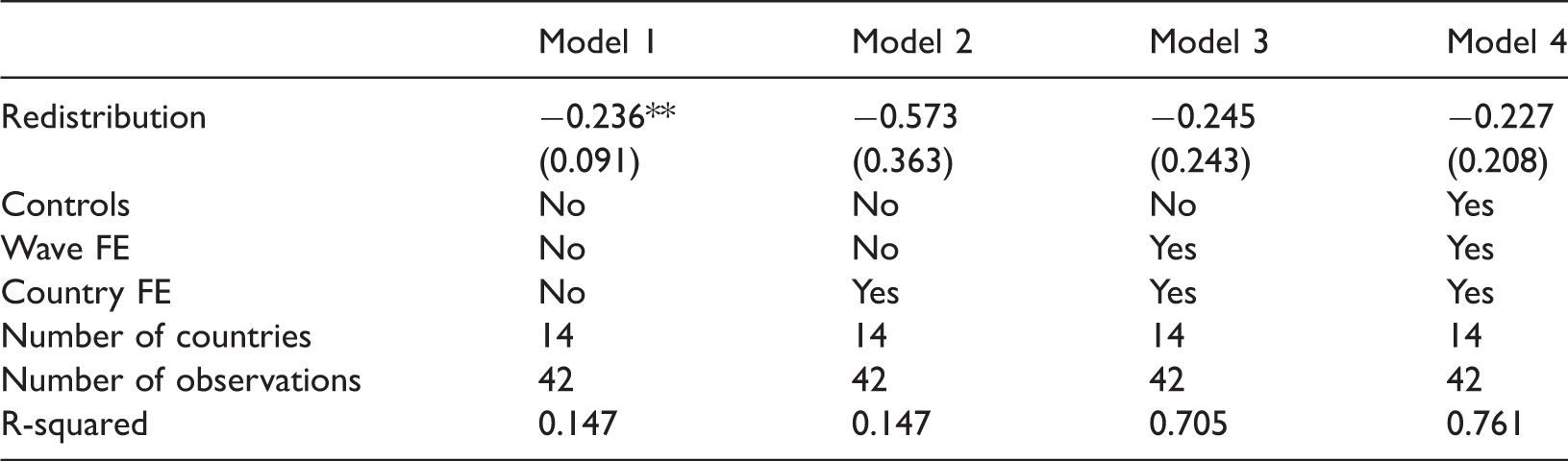
Note: All three models include 14 countries and 42 country/year observations. Control variables are population, GDP, and greenhouse gas emissions. Robust standard errors in parentheses. The full models are presented in Table A2 in the Appendix.
p < 0.001, **p < 0.01, *p < 0.5.
Individual willingness to pay for environmental protection explained by redistribution attitudes.
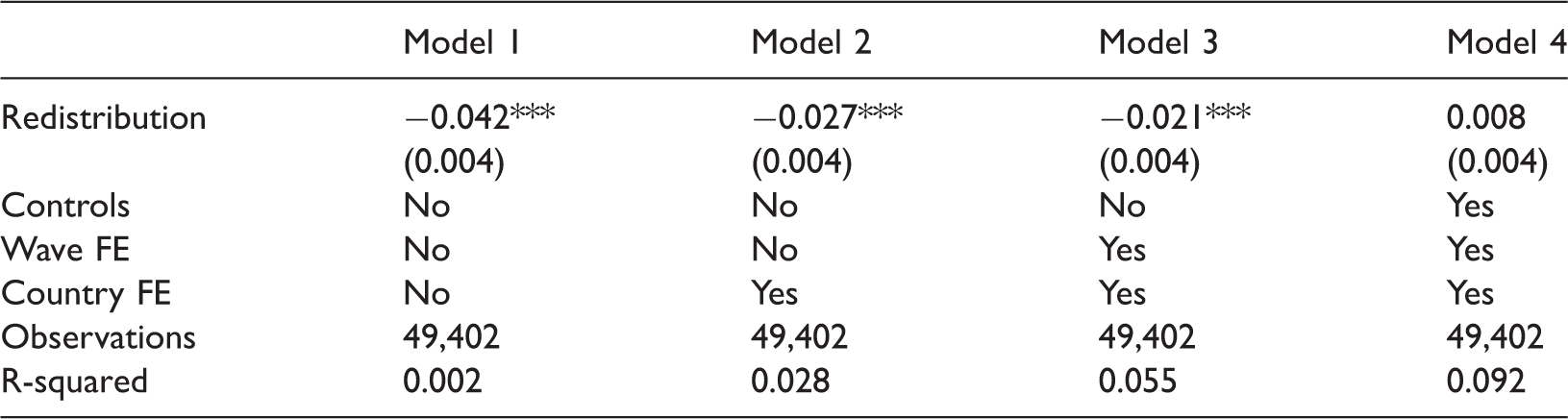
Note: Robust standard errors in parentheses. Control variables are gender, age, age squared, education, household income, employment status and household composition. The full models are presented in Table A3 in the Appendix.
p < 0.001, **p < 0.01, *p < 0.5.
The results using equation (1) are presented in Table 1. Model 1 is a random effects model where country fixed effects and wave effects are not included. Model 2 includes country fixed effects whilst in model 3 wave effects are further added. Model 4 include control variables (population, GDP, and greenhouse gas emissions). The coefficient on redistribution is only statistically significant in the most basic model (Model 1) and indicates that as support for redistribution in a country increases by one unit, willingness to pay for environmental protection decreases by 0.236 units in that country. This observed small negative effect, however, is not statistically significant in Models 2–4. Once we include country fixed effects, wave fixed effects and control variables, the negative relationship between willingness to pay for environmental protection and support for redistribution disappears. At the country level, we thus find no support for the double-worry hypothesis and only very limited support for the crowding out hypothesis.
Evidence at the individual level
Next, we move on to the individual level analysis. As a point of departure, we use the following empirical specification:

In Table 2, we run individual level regressions with willingness to pay for environmental protection as a dependent variable and redistribution attitudes as an independent variable (equation (2)). As can be seen in the first three models, the relationship between willingness to pay and support for redistribution are negative but the magnitude of the coefficient is very small. In Model 4, we include a set of control variables (gender, age, age squared, education, household income, employment status and household composition) and here the coefficient is very close to zero and not statistically significant. Thus, our results at the individual level imply that there are some weak crowding out concerning attitudes towards social and environmental policies, i.e. individuals are more willing to pay to protect the environment tend to be less supportive of redistribution, even though the relationship is fairly small.
Country heterogeneity in individual level willingness to pay and support for distribution
Relationship between WTP and redistribution attitudes by country.
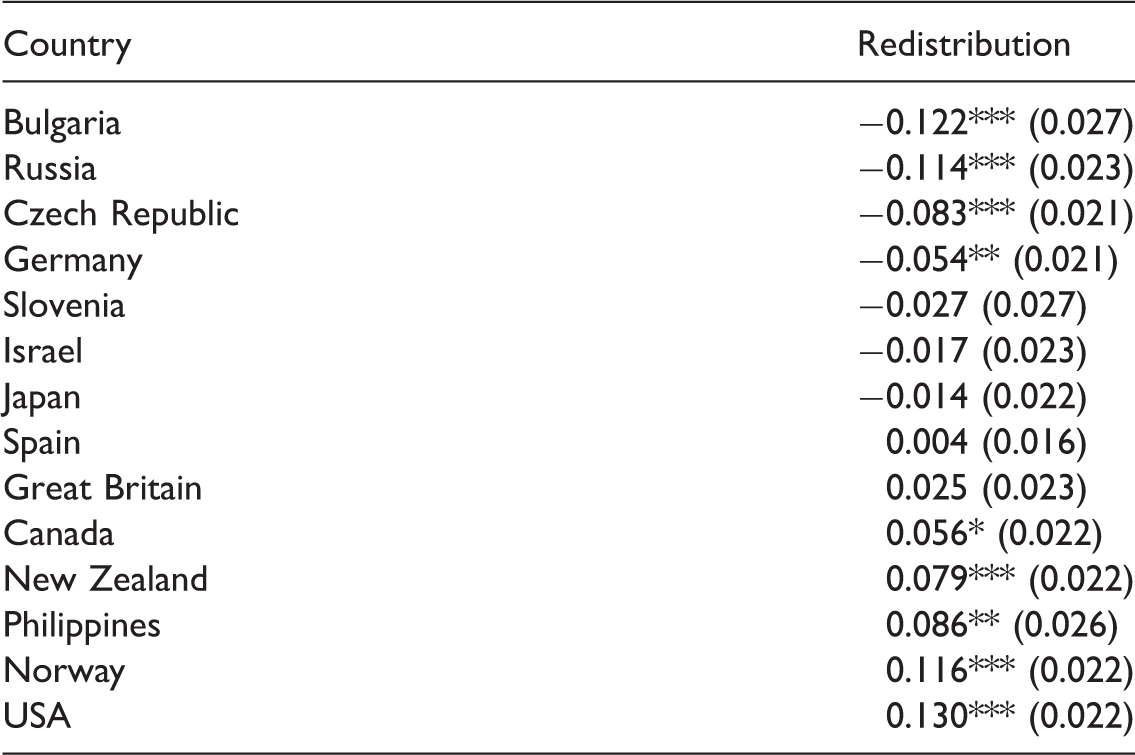
Note: Robust standard errors in parentheses. Control variables are gender, age, age squared, education, household income, employment status and household composition. The full model is presented in Table A4 in the Appendix.
p < 0.001, **p < 0.01, *p < 0.5.
Results for redistribution, by country. Estimation follows equation (2), includes country fixed effects and wave fixed effects. Control variables are gender, age, age squared, education, employment, and household composition. Robust standard errors are used. The full table is presented as in Appendix A Table A4.
Discussion
Using the environmental module of the three rounds of the ISSP surveys, we have empirically investigated the links between public attitudes towards the welfare and environmental responsibilities of the state. More specifically, we asked whether individuals that care for one of the areas also care for the other. That is, do the two dimensions complement or substitute one another? We tested these hypotheses both at the individual- and country-level, using OLS and panel data models. Our findings suggest that attitudes towards welfare and environmental policies, if anything, are substitutes (crowding out), but the relationship is rather small and only statistically significant in some specifications.
This finding is consistent with that of Koch and Fritz (2014) who reported no evidence that social-democratic welfare states (where inequalities are low and support for redistributive policies is high) are in a better position to develop as a ‘green’ or ‘eco’ state. Duit’s (2016) comprehensive study of different types of environmental governance regimes further supported this finding. The latter concludes that there is no evidence that environmental states overlap with the type of welfare states that are likely to be environmentally progressive. In other words, environmental performance of a country with redistributive policies is not necessary better than other countries with high levels of inequalities. Similarly, in our case, at both the country and individual levels, after controlling for relevant characteristics, we did not find any significant relationship between willingness to pay for the environment and support for income redistribution. Whilst this may be considered as good news for policy makers in that public endorsement of environmental policies do not compete with support for welfare policies, the absence of connection also implies that there is no intersection between the two policy spheres.
At the theoretical level, it has been argued that policies to address the risks posed by climate change – the most global and pressing environmental threat of this century – share similarities with conventional social policies (Gough, 2016). Both the consequences of climate policy and the impacts of climate change are not distributed evenly across socioeconomic groups (van Ruijven et al., 2015). Consequently, Meadowcroft (2005, 2008) highlighted that both environmental and redistributive issues require political responses to long-term societal change that cannot be satisfactorily addressed by markets and voluntary actions. We may situate this view within the approach known as ecological modernisation, which suggests potential compatibility between environmental and economic values in capitalist and democratic political economies (Dryzek et al., 2003: 11). The reconciliation of values in the two spheres requires ‘conscious and coordinated intervention’ through a holistic process (Dryzek, 2013: 170). Importantly, ecological modernisation – even in its strong form – does not prescribe that governments abandon capitalism as an economic system, but it demands comprehensive political and intervention (Christoff, 1996). As Dryzek (2013: 170) puts it, one cannot put faith in ‘any supposed “invisible hand” operating in market systems to promote good environmental outcomes (of the sort Promotheans stress).’
Climate change and environmental problems are related to distribution of resources and should be absorbed as part of the collective responsibilities of governments. For instance, taxes on private energy consumption are likely to represent a disproportionate cost for the poor, for whom it is more difficult to reduce their (already low) level of consumption. It is, thus, proposed that carbon or energy taxes should be accompanied by social benefits, tax credits or investments in energy efficiency in low-income households through energy tax revenues (Gough et al., 2008). At least in theory, this shows that a synergy between income redistribution, a traditional welfare policy and carbon pricing policy is, in fact, possible. Whether this relationship exists also in practice, remains an empirical question, which needs to be studied at the level of policy as well as with regards to individual attitudes. The present article does the latter.
Our empirical analysis on differentials between countries depicted clear heterogeneity in the relationships between support for redistributive policy and willingness to pay for environmental protection. In Canada, New Zealand, the Philippines, Norway and the United States, individuals who are willing to pay for the environment are also in favour of income redistribution. Correspondingly, in these countries (except for the Philippines where there seems to be no study on the topic), environmental attitudes have been found to be clearly divided by political ideology and party preference. Individuals with more liberal, egalitarian attitudes and less conservative are more inclined to believe in man-made global warming and seriousness of climate change than are conservatives in Canada (Lachapelle et al., 2012), New Zealand (Milfont, 2012), Norway (Tranter and Booth, 2015) and the United States (Dunlap and McCright, 2008; McCright and Dunlap, 2011).
In contrast, in former communist countries including Bulgaria, Russia and the Czech Republic, the relationship between willingness to pay for the environment and support for income redistribution is negative. One plausible explanation for this finding is that post-communist countries were less democratic and a series of evidence shows that generally less democratic countries perform worse in environmental protection than democratic ones (Farzin and Bond, 2006; Li and Reuveny, 2006; Neumayer, 2002). Meanwhile, post-communist countries, especially central and eastern European states have maintained a strong welfare commitment despite economic liberalisation (Kuitto, 2016). The contrasting environmental performance and welfare policies in these countries may explain our finding of the negative relationship between support for paying for the environment and support for income redistribution. Another explanation is related to the nature of public attitudes in post-communist countries. In fact, the issues of climate change and the environment are less salient in the former communist countries of Eastern Europe as compared to Western European countries (McCright et al., 2016). Not only were post-communist respondents less active in taking measures to protect the environment (Marquart-Pyatt, 2012), they were also more likely to give priority to personal economic security over environmental protection (De Bardeleben, 1997). Furthermore, unlike in Western Europe, the distinctions between the left and the right with respect to the issues of social and economic equality are much weaker in former communist countries (Tavits and Letki, 2009). The crowding out pattern found, thus, implies that citizens of these countries perceive environmental and social welfare policies as substitutes.
Note that we also observe a negative relationship in Germany but the effect is rather small. This is possibly due to the similarity between former East Germany and former Communist countries. In fact, the negative relationship between willingness to pay for environmental protection and support for income redistribution for Germany disappears when focusing the analysis only on the more recent 2010 ISSP survey. For other countries, namely, Slovenia, Israel, Japan, Spain and Great Britain, we found no significant relationship between the two spheres of policies. These countries are diverse in socio-economic and political contexts, but it is beyond the scope of this study to analyse why this is the case.
In fact, it is not an easy task to explain similarities and differences between countries. Whilst it is possible to group countries into different environmental governance regimes based on governments’ environmental strategies such as regulations, taxation and organisations, it is not clear why the countries have evolved into different paths in environmental management (Duit, 2016). Countries classified as environmental states such as the UK and the Netherlands – the so-called liberal welfare state – display similarly strong environmentally-related administrative and redistributive practices and regulations as Sweden, Finland and Denmark – the so-called social democratic welfare state. Likewise, environmental governance regime types do not follow established classification schemes such as capitalism classifications or majoritarian-consensual democracy dimension either (Hall and Soskice, 2001). A comprehensive review of factors associated with national environmental performance by Fiorino (2011) concludes that there is no clear-cut institutional pattern to explain national disparities in climate policies and environmental performance. Duit (2016: 87) noted that the lack of correlation with established classification schemes is possibly due to the abstract level of analysis employed in his study. Correspondingly, our analysis based on public opinions may not reflect the actual eco-social policies in a country.
Our study has two main limitations that should be recognised. Firstly, our indicators of support for social and environmental policy are based on self-reported information. This type of attitudes questions is susceptible to social desirability bias if respondents of certain characteristics systematically answer what is ‘correct’ or socially acceptable. Secondly, although we have employed the questions that involve opinions towards sacrificing one’s wealth/income to reduce social inequality or for environmental protection, by nature of the data, we are not able to measure actual behaviour. Still, since public disapproval can undermine policy development, seeking to understand public opinion is worthwhile even if it is not directly related to behaviour (Corner et al., 2011).
The main contribution of this study lies in our attempt to empirically investigate the potential synergy between social and environmental policies. It was not until recently that social policy scholars began to address climate change and environmental issues as new challenges to the traditional welfare policies (Gough et al., 2008). Most of the extant literature on the topic, however, is at the theoretical level with the exception of the study by Koch and Fritz (2014). Even so, they did not directly compare two potentially competing policy directions like ours in which individuals were obliged to envisage giving up part of their income or wealth for environmental protection or reducing social inequality. In this study, we are able to explore whether supports for social and environmental policy crowd out or result in double-worry patterns.
Conclusion
Although there is substantial country variation, in sum, we found no evidence of a double-worry or synergy between support for environmental and welfare policies in the total sample. One interpretation of our findings is that there are different drivers behind preferences for preserving the environment and preferences for income redistribution. Despite the fact that both environmental and welfare policies address the issue of market externalities, the scale and time horizon may differ. Income redistribution is mainly a domestic issue and may yield a direct benefit to an individual whilst the benefits from paying for the environment such as carbon tax can extend beyond the national boundary and to future generations. Therefore, we cannot expect that positive attitudes towards income redistribution will enhance the willingness to pay for policies that benefit the environment.
This suggests that policymakers are confronted with a considerable challenge in getting the public on-board in the move towards the eco-social state. That is, if we are to succeed in transforming modern democratic states into environmentally friendly welfare states or eco-social states, policymakers have to work on two separate fronts. In conceptual terms, the empirical findings we have presented arguably lend some support to the ecological modernisation approach – particularly in the strong form (Dryzek, 2013: 176–177). We need broad-based intervention and partnerships not only between government and industry, but also other non-governmental actors, including the citizenry itself. This approach is fundamental to the takeoff of the institutional, economic and cultural changes necessary to create environmental states that come close to the ideal green state.
The upshot of strong ecological modernisation is that to see long-lasting changes in patterns of individual behaviour, it is necessary to get popular opinions on-board. 5 That is, if the public do not care or disagree with current measures to protect the climate and the environment, they are unlikely to start behaving in a more environmentally friendly way. For this to happen, we need a better understanding of how attitudes are formed and influenced with regard to redistributive as well as environmental policy. This article has addressed this issue making use of the best data currently available. However, as a final note, it is worth pointing out that the study would have benefitted from access to better data. We would like to see the development of richer datasets that allow for more detailed comparisons of attitudes towards the welfare state and different aspects of environmental protection, including climate change mitigation.
Footnotes
Acknowledgements
We are grateful to the two anonymous reviewers for their construtive comments, which helped us improve the manuscript. We would also like to thank Bjørn Hvinden, Max Koch and Ian Gough for useful comments and suggestions. Niklas Jakobsson would like to thank FBK-IRVAPP in Trento, Italy, for hosting his research stay whilst finalising the manuscript.
Author contribution
All authors contributed equally to this work and author names are listed alphabetically. N.J.,R.M. and M.S. jointly conceived the study. N.J. and R.M. prepared and analysed data. N.J., R.M. and M.S. wrote the paper. R.M. and M.S. revised the paper.
Declaration of conflicting interests
The author(s) declared no potential conflicts of interest with respect to the research, authorship, and/or publication of this article.
Funding
The author(s) disclosed receipt of the following financial support for the research, authorship, and/or publication of this article: Funding for this work was made possible by the research programme Welfare, Working Life and Migration (VAM) of the Research Council of Norway, ‘Sustainable European welfare societies: Assessing linkages between social and environmental policy’ (Project no.: 236930/H20).