



Abstract
Introduction:
The burden of antibiotic self-medication (ASM) is increasing and becoming a global health threat due to antibiotics resistance. However, little is known about ASM among undergraduate pharmacy students who are the future custodians of medicines including antibiotics. Therefore, this study aims to develop, validate and utilize an online survey tool to investigate the prevalence of ASM among undergraduate pharmacy students in Northern Nigeria.
Methods:
A cross-sectional online survey form was developed, validated by face validity, content validity, and pilot study. The hyperlink to the online survey form was shared with undergraduate pharmacy students in northern Nigeria via WhatsApp, Facebook, and Twitter. Data were collected from eligible participants and analyzed using descriptive statistic.
Results:
A total of 217 students responded to the online survey, with a completion rate of 100%. Of the total number of respondents, 200 (92.2%) reported practicing ASM at least once in their lifetime. The major reasons for ASM were previous knowledge (40.4%) and having no time to see a doctor or pharmacist (27.5%). Amoxicillin (32.6%), Amoxicillin/Clavulanic acid (32.1%), Ampicillin/Cloxacillin (21.7%) and Ciprofloxacin (22.6%) were the most commonly implicated antibiotics in ASM. Cough, diarrhea, typhoid, and wound were the most frequently involved conditions. Patent medicine vendors (75.4%) and community pharmacies (29.4%) were the common source of antibiotics subjected to ASM.
Conclusion:
A research tool to assess ASM among undergraduate pharmacy students has been developed, validated and utilized. The prevalence of ASM is high among undergraduate pharmacy students in Northern Nigeria. Interventions to improve knowledge and awareness on ASM are needed among undergraduate pharmacy students to ensure antibiotic stewardship.
Introduction
The World Health Organization (WHO)’s guideline for the regulatory assessment of medicinal products for use in self-medication defines self-medication as the use of medicinal products by the consumer to treat self-recognized disorders or symptoms, or the intermittent or continued use of a medication prescribed by a physician for chronic or recurring diseases or symptoms. 1 It involves the use of medications without a valid prescription, use of left-over medication by oneself or by a family/friend, sharing medication with family and friends and using old prescription or someone else’s prescription to buy medications. 1 Antibiotic self-medication (ASM) is increasing and becoming a public health issue. 2 Globally, it has been estimated that over 50% of antibiotics are purchased and used over-the-counter without valid prescription, from community pharmacies, and medicines vendors in the informal sector.3,4 The inappropriate use of antibiotics through self-medication is practised worldwide particularly in developing countries where the ASM is facilitated by chaotic drug distribution, and weak regulations of the sale of prescription medicines.5,6
ASM is a significant contributor and a risk factor for microbial resistance to antibiotics.1,7 Antibiotic resistance is widespread and has become a global public health problem leading to an increased mortality, morbidity, healthcare cost and hospital stay. 7 ASM is also a contributor to some adverse drug events like incorrect route of administration, inadequate or excessive dosage, missed diagnosis, risk of dependence and abuse, drug interactions, adverse drug reactions and treatment failure. 7
ASM has been studied widely with reported prevalence of 19%–82%. 8 Some were conducted among the general public attending primary health care centres, 8 pharmacies, 9 university staff, 10 college and university students, 11 and undergraduate pharmacy students.12–14 However, accurate findings from these studies depend on the use of a validated instrument for the adequate assessment of the ASM. To our knowledge, a tool for assessing the ASM among undergraduate pharmacy students is limited in the literature. ASM study is significant among the undergraduate pharmacy students as they are the future custodians of medicines and have a potential role in counselling the patients about the disadvantages and other implications associated with ASM. Pharmacy students also differ from the general population based on their acquired knowledge of drugs and diseases. However, it has been shown that pharmacists and physicians are the most commonly implicated in self-medication due to easy access to medication, knowledge of use and self-diagnosis. 15 Despite this, studies investigating the extent of ASM among undergraduate pharmacy students are limited in the published literature. Even though some ASM studies were conducted among undergraduate pharmacy students, the available literature shows that none of the studies used a fully validated online tool to assess ASM among this category of students. Most of the studies employed face-to-face survey using non-validated questionnaires.
The advent of Internet has opened a significant opportunity in information sharing and data collection in research. 16 The Internet-based research has been identified as scientifically valid, with advantages of being cheaper, faster, easier to conduct and higher response rate compared to conventional methods, 16 which are often regarded as tedious, time-consuming and in most cases not all participants are willing to respond. In addition, the use of social media is on the rise; up to 90% of university students are using some forms of social media platforms. 17 It has been shown that 91.8% of undergraduate pharmacy students are using social networking websites. 18 Despite the rapid growth of Internet use among students, it has been scantly utilized for online data collection. Hence, an online survey tool can be developed, validated and utilized using the social networking platforms to assess ASM among undergraduate pharmacy students. The aim of the current study is therefore to develop and validate an online survey tool for assessing ASM among undergraduate pharmacy students as well as determine the prevalence and knowledge of ASM among pharmacy students in Northern Nigeria.
Materials and method
Study design
The current study involves two phases (phase 1 and phase 2). Phase 1 is the development and validation of the assessment tool, while phase 2 is the utilization of the assessment tool.
Phase 1: development and validation of ASM assessment tool
Development of ASM tool
The items included in the tool were generated from a comprehensive review of literature on studies assessing ASM among undergraduate pharmacy students and discussion with research experts in clinical practice. Variables extracted from the literature included items related to ASM information. This includes frequency of ASM, source of antibiotic, types of antibiotic used, reasons for ASM as well as adverse events experienced during use. Other items assessed knowledge and rational antibiotic use. These include knowledge on antibiotic resistance, dosage regimen, minimum duration of use and antibiotic as prescription medication or not. The first draft of the tool was divided into three domains: sociodemographic data, ASM information and knowledge of rational antibiotic use. All the authors reviewed the initial draft of the tool in terms of wordings, relevance and mapping in the domains. The survey tool was made up of closed-ended and partly open-ended items. The draft ASM tool was then tested for validity using the following steps:
Validation process
The validation stage involved a four-stage process. It evaluated the psychometric properties of the tool: (1) face validity, (2) content validity, (3) ease of readability score and (4) pilot study.
Face validity
A face validation was performed to test whether the tool appears to measure ASM among undergraduate pharmacy students, the choice of wordings and the flow of the items. The draft was presented to some selected students and an expert panel consisting of five pharmacists with experience in research and clinical practice. The panel evaluated the tool in terms of clarity, layout, style, and to ensure that the items are appropriate for the target participants. The students were asked to comment on the items regarding their understanding and any item that looks ambiguous.
Content validity
Content validity was performed to ascertain whether the content in the draft tool is appropriate and relevant to the study purpose. A 15-member expert panel consisting of five pharmacists with experience in research, five pharmacists with experience in clinical practice, and five pharmacy students were asked to rate the relevance of each item on the tool used and to suggest other items for the scale which may have been missed. Items deemed irrelevant were dropped.
Ease of readability score
The ease of reading and understanding of the draft tool was assessed using the Flesch–Kincaid reading ease on Microsoft Word. 19 The level of readability of the draft tool was determined based on the final score.
Pilot study
A pilot study was conducted as a trial to measure how the respondents understood and answer the items in the draft. The draft tool was administered to 30 undergraduate pharmacy students selected using purposive sampling. The students were drawn from the five-selected Schools of pharmacy in Northern Nigeria. An online survey format of the tool was created in form of a Google Survey. The hyperlink leading to the survey tool was shared with the included students via a social media platform (WhatsApp). The responses were analysed as appropriate. The results of the pilot study are not shown on the current study. The draft ASM tool was revised based on the result of the pilot study.
Phase 2: utilization of the ASM assessment tool
Online survey
A cross-sectional study design (online survey) was conducted among some undergraduate pharmacy students in some Nigerian universities. Demographic data of the students were obtained. The hyperlink to the online survey was shared via social media groups belonging to the students such as WhatsApp, Facebook and Twitter. The survey was conducted throughout April 2018. Reminders were sent out occasionally to improve response rate. Responding to the survey was regarded as an implied consent.
Study settings
The study was conducted in the Schools of pharmacy in Northern Nigeria (Bayero University, Kano; Ahmadu Bello University, Zaria; Kaduna State University, Kaduna; University of Maiduguri, Borno; Usman Danfodio University, Sokoto; Gombe State University, Gombe; University of Ilorin, Kwara; and University of Jos, Plateau).
Study population and sampling
A purposive sampling technique was used for the selection of social media groups. Purposive sampling has been previously recommended in an online survey (hidden population). 20
Students who use either WhatsApp, Facebook, and/or Twitter social media were targeted in this study. All undergraduate pharmacy students in any of the school of pharmacy in Northern Nigeria were eligible for participation. Other inclusion criteria include having a social media account. A student who just graduated from the university, and postgraduate students registered in the universities were excluded in the current study. Eligible participants were recruited through the presidents of students’ associations of each pharmacy school. Data obtained were extracted using Microsoft excel, it was later rearranged on SPSS version 23.
Ethical considerations
Permission to share the online survey form was sought up from the presidents of the Pharmaceutical Association of Nigeria Students, and class governors of each level. In addition, the voluntary participation was an implied consent by the participants. The online questionnaire conveyed the study information, and a statement that participation is exclusively voluntary.
Statistical analysis
Data were exported from Google form to SPSS. The data generated was analysed using IBM SPSS version 23. Descriptive statistics was used. Numerical data were presented as means (standard deviation), while categorical as frequency and percentages. Knowledge was calculated using six questions from the questionnaire (Table 1). Respondents who answered more than four questions correctly are considered to have good knowledge of ASM. The rest were considered to have poor knowledge.
Characteristics of the undergraduate pharmacy students (n = 207).
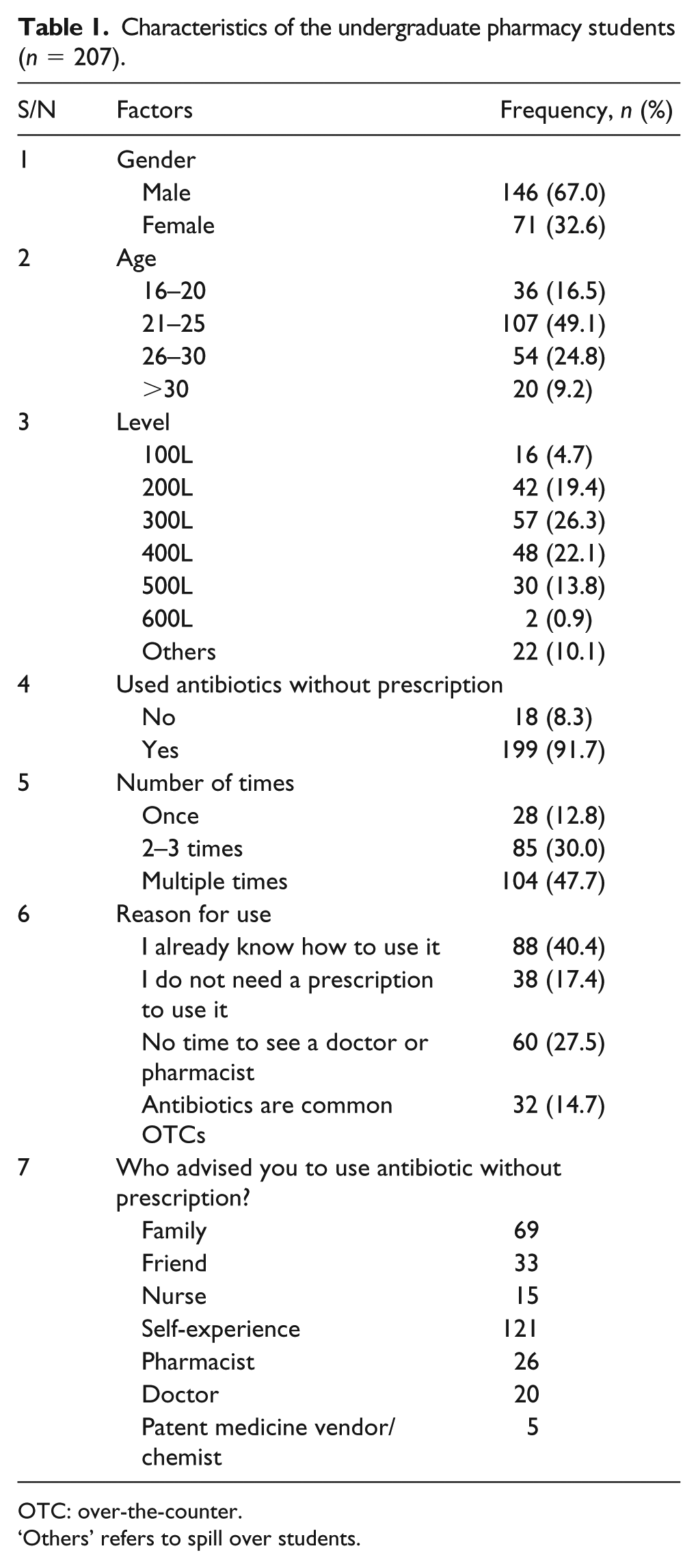
OTC: over-the-counter.
‘Others’ refers to spill over students.
Results
Development and validation of ASM assessment tool
Fifteen items included in the initial draft tool were generated from the literature review and discussion with research experts. In the face validity, items in the draft tool were rephrased based on the feedback from expert panel. Regarding the content validity, items related to sociodemographic data such as age category were re-categorized, and a level ‘other’ was dropped in ‘gender’, the monthly income of respondent was dropped. Other items related to ASM domain were dropped, while some open-ended items were added. The format of submitting the tool after completing the survey was changed to prevent re-submission. The Flesch–Kincaid reading ease score was 30.6, and level 11.7, which is easy and understandable for a university undergraduate student.
Twenty-nine out of thirty participants responded with a response rate of 96.7%. Twenty-three (79.3%) were males with over 25% from 300 and 400L students. Twenty-three (79.3%) claimed using antibiotics without prescription. From the response of the participants, items in the draft that looks ambiguous were reworded to make them easy to read and understand.
ASM tool utilization among undergraduate pharmacy students
A total of 217 students responded to the online questionnaire. There were no missing values in the data entered into SPSS. A higher proportion of the respondents were male 146 (67%). The majority of the respondents were between the age category of 21–25 years, 107 (49.1%). Third- and fourth-year students took part in the study more than other students (Table 1). Of the total number of respondents, 200 (92.2%) reported to have ever practised ASM.
About half of the respondents were involved multiple times 104 (47.7%), while 85 (30%) were involved about two to three times. Of the total students, 88 (40.6%) believed they already have the knowledge of antibiotic use, while 60 (27.6%) of them associated the ASM to inadequate time to see the doctor or pharmacist. More than half of the students recommend antibiotics for themselves while a relatively large number of them claimed it was recommended by family members and friends.
Table 2 shows the most common antibiotics involved in ASM among the students. Amoxicillin and augmentin (a combination of amoxicillin and clavulanic acid) were the most commonly involved. Others include ciprofloxacin and ampiclox (a combination of ampicillin and cloxacillin). Students who had cough/catarrh were most users of antibiotics without prescription (Table 3). Patent and proprietary medicine vendors (PPMVs) were the most common sources of antibiotics implicated in ASM among undergraduate pharmacy students. The common sources of antibiotics involved in ASM among the undergraduate pharmacy students are shown in Table 3. Twenty-three (10.4%) of the participants have previously experienced an adverse drug reaction (ADR) related to ASM, and 142 (64.3%) have admitted that they never completed antibiotic regimen during their previous use.
The most common antibiotics and disease conditions involved in ASM.

ASM: antibiotic self-medication; PMV: patent medicines vendor.
Knowledge of antibiotics among undergraduate pharmacy students.

Knowledge of ASM
In general, the highest proportion of the students had poor knowledge of the appropriate use of antibiotics. Level 500 and 600 students are shown to have moderate knowledge on the effect of ASM, while others had poor knowledge. The detail is shown in Table 3.
Discussion
To our knowledge, the current study is the first to develop, validate and utilize a tool for assessing ASM among undergraduate pharmacy students. In addition, the study specifically reports ASM among undergraduate pharmacy students in Nigeria, particularly, the Northern Nigeria. Our findings indicate that over 90% of the undergraduate pharmacy students who participated in the study involved in ASM. This implies that ASM is common among them. The prevalence of the ASM we found in this study is almost the same with a similar study conducted in Jordan, 86.7%, 21 and higher than another study performed among pharmacy and medical students in India. The prevalence of ASM within 1 year among the pharmacy students in the study was 66.9%. 22 The prevalence of ASM in the current study is higher than another study conducted in Northern Nigeria among medical students. The study investigated the rate of ASM in the preceding 2 months and found a prevalence rate of 38.8%. 23 The reason for the higher rate in our study could be related to the study objective. Our study investigated ever practicing ASM in lifetime, while others considered 2 months or within a year. Almost half of the participants in the current study indulged in ASM multiple times (more than three times). Majority of the similar studies did not assess the frequency for which pharmacy undergraduate students indulged in ASM. Thus, we could not compare our findings with a previous study. The major reason for indulging in ASM by the pharmacy students in our study was because of having previous knowledge of using the antibiotic, and the absence of time to visit a doctor or pharmacists. Other studies from the region and other parts of the world reported past experience with the particular antibiotic, the perception that the ailment is mild and to save time in seeing a doctor or pharmacist.22–25 The undergraduate pharmacy students are the future custodian of drugs including antibiotics. The knowledge of antibiotics they acquire in school may positively influence their use of antibiotics without prescription in the future. Further studies should investigate the association between antibiotic knowledge by pharmacy students and ASM.
Penicillin group of antibiotics, Amoxicillin and combination of amoxicillin/clavulanic acid are the most common group of antibiotics subjected to ASM. This is in agreement with similar studies in Nigeria, 23 and other parts of the world.22,25 The possible reason is because they are cheap, easily available, have wider spectrum of activity and also a wide safety margin (less ADR associated with their use). In addition, the absence of strict laws to restrict the sale of these drugs in Nigeria may have also contributed to the increased use among the respondents. 26 Cough/catarrh and diarrhoea are the commonest illness implicated in ASM among the respondents. This trend may be associated with the common perception that flu and associated catarrh can be treated with antibiotic. 27
Patent medicine vendors (PMVs), community pharmacies, family and friends and left-over medications were the major source of antibiotics subjected to ASM among the participants. Over 50% of the participants sourced their antibiotics without prescription from PMVs. This trend is similar to a study conducted among undergraduate medical students in Northern Nigeria. 23 Community pharmacies and PMVs constitutes private sector that offers significant role in healthcare services in many low- and mid-income countries including Nigeria. 28 In addition, PMVs are the first port of call for healthcare for people in the rural community and are widely distributed in the local communities in Nigeria. 29 However, due to weak laws on drug regulations and enforcement in Nigeria, PMVs stock and sale all sorts of drugs including antibiotics. 26 Thus, these may be the reasons why antibiotics were readily available and easily accessible to the respondents in the current study. About one out of ten of the respondents experienced an ADR related to the ASM. There was no similar data from Nigeria for comparison. However, a similar finding was reported by a study conducted in Northern India. 30 Self-medication has been previously associated with ADRs. 31 Moreover, the fact that the frequency of the ADR related to the ASM in the current study is by self-report, rather than causality assessment, make it inconclusive. Thus, the ADR reported might not necessarily be due to the antibiotic used by the respondents. Future studies may look at the causality assessment. Over 60% of the respondents did not complete the treatment course of the antibiotic. These groups of individuals could be a potential source of antibiotic resistance in the community. ASM has been identified as a contributing factor to antibiotic resistance. 32 Incomplete course of antibiotics is sold by PMVs based on the recommendation of the buyer, just like any other cash commodity, without any consideration to need for purchasing and taking a full course of therapy. 33 This may have contributed to the non-completion of the course by the respondents.
It is expected that pharmacy students should possess a sound knowledge of general and clinical pharmacology and therefore should be aware of the implications and consequences of incomplete course of an antibiotic treatment. However, the fact that lower level students, who have not taken these courses yet, are much in the study, partially explains the paucity of knowledge and attitude to ASM displayed. Findings from the current study indicated that undergraduate pharmacy students in year five had a good knowledge of ASM. This may be related to the adequate knowledge of general and clinical pharmacology they acquired. In addition, year-five pharmacy students may have some clinical experience during the Students’ Industrial Work Experience Scheme. 34
Despite prior knowledge of the consequences associated with ASM, and the presence of drug laws restricting the use of antibiotic without a valid prescription, findings from this study indicated that ASM practice is still high in Nigeria. The high rate of ASM among the future custodian of drugs including antibiotics is of great concern. This emphasizes the need for interventions to increase awareness, and more education among the students. More emphasis should also be given to clinical pharmacology and pharmacotherapeutics to further educate the students on the dangers associated with ASM. In addition, drug laws should be strengthened and reinforced to ensure sanitized drug distribution and use in Nigeria. Finally, measures to improve rational drug use and utilization should be put in place and monitored to ensure rational use of antibiotic in the community.
Strength and limitation
The current study was the first to develop, validate and utilize a tool to assess ASM among pharmacy undergraduate students in Nigeria. Findings of the current study have provided a new knowledge on ASM among undergraduate pharmacy students, who are the future experts on drugs. The findings will assist and guide in the need to take an urgent action to educate and improve awareness among the undergraduate pharmacy students. Preventing ASM among the undergraduate pharmacy students is indirectly saving the community. The current study is not without limitations: (1) The response rate in this study is low, hence cannot be accurate representation of ASM practice among undergraduate pharmacy students of the study population. Therefore, the findings are not generalizable to the general population; (2) the online nature of the survey may have automatically excluded many eligible participants who do not have an online social media account; (3) the study did not take into account to specify the period (in months or years) over which the respondents have been practicing ASM.
Conclusion
A research tool to assess ASM among undergraduate pharmacy students has been developed, validated and utilized. The rate of ASM is high among undergraduate pharmacy students in Northern Nigeria. Interventions to improve knowledge and awareness are needed among the undergraduate pharmacy students, who are the future custodians of antibiotic and antibiotic stewardship.
Footnotes
Acknowledgements
The authors would like to thank and appreciate all members of Young Pharmacists Scholars (YPS) mentoring forum for their support, guidance and data collection. YPS is a mentoring platform supporting research among young pharmacists. The current study is part of the YPS-mentoring programme to mentor the young pharmacists on conducting research and publication.
Authors Contribution
G.M.K., I.A.J., U.I.I., F.M.D., Z.S., A.S. and S.L.B. contributed to this article and all liabilities relating to the content of this article will be borne by them. All authors meet the criteria for authorship outlined by the Uniform Requirements for Manuscripts Submitted to Biomedical Journals.
Declaration of conflicting interests
The authors declared no potential conflicts of interest with respect to the research, authorship and/or publication of this article.
Funding
The authors received no financial support for the research, authorship and/or publication of this article.
