



Abstract
Background:
Many people are turning to online pharmacies for medication purchases leading to a growing number of legal and illegal online pharmacies (IOPs). With a growing number of IOPs, consumers are more likely to receive substandard or falsified medications when purchasing medications online.
Objectives:
This study aims to identify the number of verified, not recommended, and not verified pharmacy websites consumers see using different keywords and medications on an Internet browser based off the National Association Boards of Pharmacy’s (NABP) list of verified and not recommended websites. It also aims to compare which keywords result in more not recommended pharmacy websites compared with verified pharmacy websites for consumers over time.
Design and Methods:
We created an Internet browser extension compatible with different Internet browsers to quickly identify which search results are verified, not recommended, and not verified based on NABP lists. We then utilized an application programming interface to automatically search different key terms and classify the search results as verified, not recommended, and not verified over a 4-week data collection period for analysis.
Results:
A total of 131 key terms were used for the search. There was an average signal determining the number of verified and not recommended search results compared with not verified results of 4.3% over the 4-week data collection period. There was about a 3:1 ratio of not recommended to verified search results noted. Top signal and not recommended search result producing keywords contained words such as “shipped” and “cheap.”
Conclusion:
The Internet browser extension will aid in making it easier to identify which search results are safe and which are not safe when searching to purchase medications online. This study has set the premise on expanding how to use an Internet pharmacy extension to combat IOPs, improve patient safety, and increase safe access to medications.
Keywords
Introduction
A study, conducted in the United States in 2020, showed that roughly 42% of the population was purchasing medications online. 1 With more and more people turning to the Internet to purchase their medications online, it has led to an increase in the number of online pharmacies with a projected pharmacy market size growing from approximately US$68 million in 2021 to US$261 million by 2030.2,3 With increasing legal online pharmacies, there are also a growing number of illegal online pharmacies (IOPs). Currently, there are around 35,000 active IOP websites worldwide. Industry estimates show about 95% of websites selling prescriptions online do so in violation of state and federal laws.4,5 One study found that out of 62 online pharmacy websites selling Adderall® (indicated for the treatment of attention deficit hyperactivity disorder (ADHD) and narcolepsy), 61 of the online pharmacies were illegally acting with all 61 not requiring a prescription to purchase the medication. 6 Another study found that out of 49 online pharmacies selling insulin products, 59% of them were operating illegally showing that various medications are being sold online through IOPs. 7 These IOPs have an increased risk of shipping consumers’ medications that are substandard, counterfeit, and/or noneffective leading to potential patient harm and death.1,8
Although there are many IOPs, there are various endeavors underway to combat them. The National Association Boards of Pharmacy (NABP) has created the Healthcare Merchant Accreditation program (formerly the Pharmacy Verified Websites Program). The program accredits legitimate pharmacies and provides consumers with a list of verified and safe online pharmacies. 9 NABP also identifies and compiles not recommended websites. Not recommended websites commonly facilitate (1) the sale of prescription-only medicine without requiring a valid prescription, (2) the sale of medicine that has not been approved or authorized for sale in the patient’s jurisdiction, or (3) the practice of pharmacy without required licensure in all relevant jurisdictions. 9 NABP has created a consumer website that includes a tool where consumers can verify the online pharmacy they plan to use and make sure it is safe and distributing legitimate products. The US Food and Drug Administration (FDA) distributes warning letters to online pharmacies that are in violation of the U.S. Federal Food, Drug, and Cosmetic Act and can take additional legal action when possible. 10 There are also other projects looking into Internet search results for specific medications to see which results may be compromised by an IOP. 11
Although there are many different projects and endeavors combatting IOPs, there are still substandard and falsified medications reaching patients daily. There are currently no scientific studies which have created a search tool to identify how specific keywords result in verified or not verified online pharmacies. Through this project, we want to find a way to automate and quickly identify in real time which search engine results involving purchasing a medication or online pharmacy are verified or not recommended based off NABP lists. Furthermore, we want to see what search results are seen when a consumer goes to search for medications through an online search engine. Finally, we want to see how different keywords change the number of verified, not recommended, and not verified pharmacy search results and how the results change over time.
Methods
This project was broken into two parts to align with our objectives. These parts include the creation of an Internet browser extension and analysis of keywords with medications to find IOPs.
Part 1: Internet browser extension creation
The Internet browser extension was created to work with Google since it is widely used with consumers.12,13 It was also created to work with DuckDuckGo, which was chosen because it is marketed as a privacy preserving search engine that does not collect personal data and would allow the results from each engine to be compared. The primary goal of the extension was visually classifying the trustworthiness of search engine results in real time by using color. Trustworthiness was determined by NABP publicly available verified and not recommended online pharmacy lists. 9 Copies of both lists are stored statically within the code of the browser extension. There are three levels of classification: verified, not recommended, and not verified. A domain is verified if it appears on the accredited list, not recommended if it appears on the not recommended list, and not verified if it appears on neither list.
When a search is made, the extension functions by parsing through all the search results on the page. It then extracts the domains of all results and checks whether they appear on the lists of accredited or not recommended pharmacies. If the domain is verified, the search result will be highlighted in green. Results which are not recommended are highlighted in red, and the not verified results are highlighted in yellow. This allows the user to quickly discern between trusted and untrusted sources while browsing and performing searches.
Real-time processing was accomplished by utilizing JavaScript and document object notation, allowing the extension to read and modify the contents of the webpage live. HyperText Markup Language and Cascading Style Sheets were used to create an interactive menu for the extension, allowing it to be disabled with a click when not in use. The extension is also designed, such that it can dynamically identify the search engine, Google or DuckDuckGo, being used by the user.
Part 2: Key term creation and analysis
Key terms generated for the search comprised of medications and descriptor keywords. A list of 34 commonly sought-after medications were identified with proprietary processes and shared only for the purposes of completing the research project. A list of additional adjectives a consumer may use when searching the Internet for medications was developed. This list contained descriptors such as “cheap,” “no prescription,” “shipped,” “easy,” “no rx,” “Canada,” “online,” and many more. These lists were not comprehensive and merely served as a manageable starting point for key term analysis. The list of descriptor keywords and medications were combined into a list of potential searches. These potential search terms contained one medication name, and either one or two descriptor keywords, each from the earlier lists. This systematic way of developing search terms allowed for a large dictionary of terms to be quickly developed in a way that covered many different possibilities for searches relating to an individual medication.
The potential search terms were tested on DuckDuckGo over multiple days, by automatically searching and collecting results on each of the terms on a set schedule. Google was not used for key term analysis due to Google’s lacking support for automatic data collection. The results were limited to a maximum of 200 results per key term searched. Advertisements were not collected. Once the test results were collected, the signal that each term generated was analyzed. A signal compares the number of verified and not recommended results to the total number of results collected for each respective search term. The signal was then used to sort the key terms from high to low signal percentage, yielding a ranked list of key terms. The key terms with the lowest signal percentages were removed until a final key term list with an overall signal percentage of 4% remained.
After a final key term list of 131 terms was generated, with keywords and medications of interest, a 4-week data collection period on DuckDuckGo was completed through August 2022. During this data collection period, the not recommended list was updated daily to reflect changes in NABP publicly available list. The data were collected on a server at Butler University, which was configured to collect search results from DuckDuckGo as they would appear within the United States. The key terms were used with the Internet browser extension and automatically uploaded daily to an online server where the results were downloaded into an excel file for data analysis. Descriptive analysis was conducted through Excel.
Results
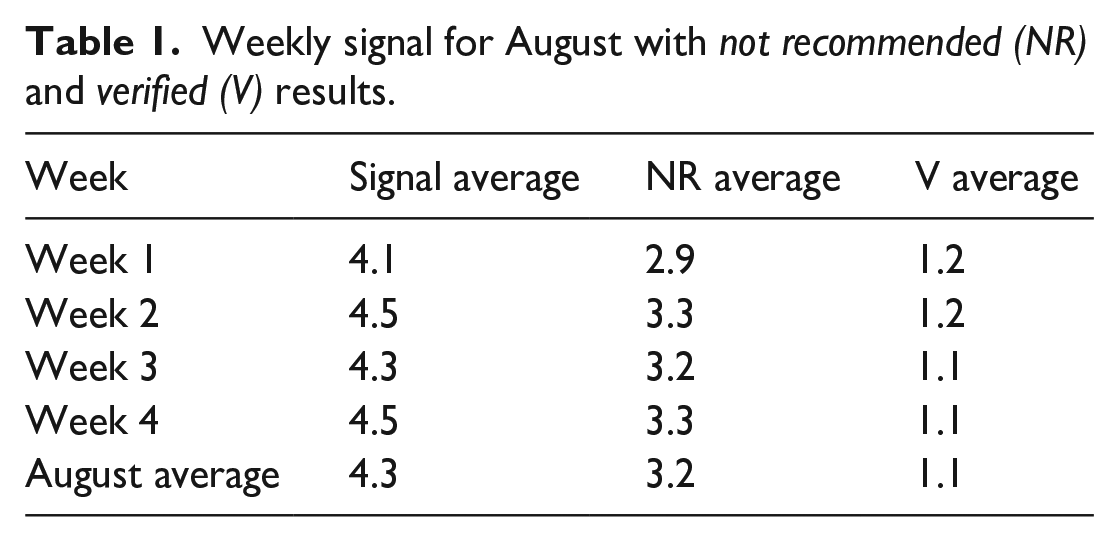
A total of 131 key terms were used that resulted in an average signal of 4.3% over 4 weeks in August 2022. Not recommended and verified search results had an overall average occurrence of 3.2% and 1.1%, respectively. The signal is determined to see how many of the search results for key terms have been classified (verified or not recommended) compared with the total number of search results available to a consumer. The overall signal average, not recommended average, and verified average for Weeks 1–4 were recorded to see how results changed over each week and can be found in Table 1.
Weekly signal for August with not recommended (NR) and verified (V) results.
The top-10 key terms resulting for the highest signal overall for each week were identified and can be found in Table 2. Each result consists of descriptor keywords and medications of interest. Words such as “cheap” and “shipped” were repeatedly seen. The top-10 key terms that resulted in the most not recommended search results for each week can be found in Table 3. Similar descriptor keywords were seen but slightly different medications were noted.
Top-10 key terms for the highest signal overall.

Top-10 key terms for not recommended results.

The second-level domains for the top-10 highest producing signal key terms can be found in Figure 1. The domains consisted of three different top-level domains (seven “.com,” one “.edu,” one “.org,” and one “.gov.ph”). The one government website was based out of the Philippines with the “.gov.ph” being part of the second-level registry. There was only one result verified as a safe online pharmacy while the other nine were not verified at the time of data analysis.

Top domains for the top-10 highest signal key terms.
Discussion
Through this project, we were able to develop an Internet browser pharmacy extension to verify which search results are verified and which results are not recommended for medication purchases based off the NABP accredited pharmacies list. Furthermore, we were able to evaluate keywords and medications to see which resulted in the most verified, not recommended, and not verified search results. This project allowed us to take the first step in identifying what consumers may see when using Internet search engines for medications and online pharmacies.
There was an average signal of 4.3% in August 2022 for the key terms utilized. This signal shows that using the key terms in our study resulted in 3.2% of search results being not recommended and 1.1% of search results being NABP verified results. The remainder of results was not found in the NABP database likely since they have not been identified or examined. If we examine only the not recommended and verified results, there is about a 3:1 ratio for not recommended to verified results. This aligns with previous findings showing a much larger number of not recommended results compared with verified results.4,5,8 However, compared with previous studies, this analysis shows an improved ratio of not recommended to verified results suggesting a possible elimination of more not recommended results. In 2018, there were 11,324 IOPs on the not recommended NABP list. 5 With the number of IOPs on the not recommended NABP list growing over the past 4 years, it is possible that these IOPs have been flagged by the search engine or shut down by legal authorities leading to a better ratio of verified to not recommended results. In 2018 there were approximately 200 verified online pharmacies on the NABP list with more than 300 on the list today.5,9 This increase in verified online pharmacies may also improve the ratio compared with previous studies done in 2017 and 2018.
When analyzing the top-10 highest signal-producing key terms, there were many themes noted. Descriptive keywords such as “cheap,” “shipped,” and “online” show up repeatedly each week. These descriptive keywords likely are used by consumers to find medications online fitting the criteria noted, and therefore, more verified and not recommended pharmacies utilize these terms. However, verified pharmacies generally do not market their website using these descriptive words or advertise specific medications.5,14,15 Therefore, a subanalysis was conducted to see the top-10 highest key terms that produced the most not recommended search results. Similar descriptive keywords such as “cheap” and “shipped” showed up in the top-10 list suggesting that many of the results using these words may lead to not recommended search results. The medications between the two top-10 lists were similar with a few exceptions such as “Xarelto” and “Byetta” only being on the highest signal-producing list. Overall, it can be noted that the common search terms found can result in consumers finding not recommended results for purchasing their medications resulting in them potentially obtaining a substandard or falsified medication without their knowledge and possible patient harm.
With many different domain names available, we wanted to determine the most common domain names that are associated with the top-10 highest signal-producing key terms. Many domain names are not associated with online pharmacies and are more informative such as “drugs.com,” “healthline.com,” “verywellhealth.com,” “medicalnewstoday.com,” and “needymeds.org.” There is only one verified search result, “goodrx.com,” on the list. The other results were not reviewed by NABP at the time of analysis; however, after further review, it can be determined to be selling medications illegally online. For example, when visiting a subpage within the domain “taraka.gov.ph,” it can be found that there are certain medications being advertised and being sold without a prescription. This practice can be deemed illegal in the United States and can result in illegal substandard and falsified products reaching consumers. 10 Another possibility is that the domain holder may not know about this illegal activity as the subpage has not been approved by the domain holder and is being abused. Therefore, the domain has been “hijacked” without the domain holder’s knowledge. This same issue can be seen with “fondren.com,” “pinnacle.berea.edu,” and “sanagelolive.com” on the top-10 list.
In the United States, a “.gov” website, including the top-level domain and subpages, must be approved by the government. 16 With larger information technology security within the federal government in the United States, it may make it more difficult for hijacked activity to be conducted. However, in other countries, this may not be true, and therefore, subpages within the domain can be hijacked without the government’s knowledge as seen with the Philippines website in the list. This allows illegal pharmacy websites to operate covertly, making it more difficult to identify and close these websites. This same concept can be applied to other website domains ending in “.edu” and “.org.” Therefore, using these domain endings does not narrow down which online results are verified and not recommended from the not verified list of results. The “.pharmacy” top-level domain is a safe domain for verified online pharmacies granted by NABP and can be trusted by consumers. Not recommended search results should be avoided to make sure consumers are not purchasing substandard and falsified medications, and consumers should take caution if using a not verified search result for medication purchasing. If consumers find it absolutely necessary to use a not verified search result to purchase medications, avoid websites that advertise specific medications and use another country’s IP address. Another country’s IP address can be identified if the top-level domain has a specific country code ending. For example, “.gov.ph” has the country code “.ph” which represents the Philippines. A full list of country code top-level domains can be found on the Internet Assigned Numbers Authority website. 17 If there is a not verified online pharmacy a consumer finds that may potentially be selling illegal medications, it should be reported to regulators, such as the consumer’s Board of Pharmacy or the FDA.
There were some limitations with our study. First, we were only able to collect data in the month of August 2022. Therefore, online pharmacies and key terms found may be limited by ongoing news trends at that time and may not capture all key terms and medications purchased through verified and not recommended online pharmacies. Our Internet browser extension only captured results using one search engine, DuckDuckGo. Other search engines were not utilized due to incompatibility with the automated data collection process created. DuckDuckGo generally does not track user data and, therefore, has the most unrestrained search results being populated. This likely gives a better representation of the most general results a common consumer may see compared with other search engines which may be more curated to that consumer. However, with other search engines being more curated, it makes it harder to extrapolate the findings to other search engines. The server used was hosted for the United States only, and findings may not represent other countries.
As this was the first time using the Internet browser extension and automated data collection process, there are many future projects to conduct. Next, we hope to integrate the automated collection process with other search engines (i.e. Google and Bing) and explore how they compare to DuckDuckGo. The study should also be run for a longer duration to see how results change over months and years. The data captured through this project give a framework of key terms of interest and should be further expanded to capture more signal-producing key terms. For the Internet browser extension, we hope to expand on solutions for search engines to automatically cross-reference the most up-to-date NABP verified and not recommended pharmacy lists if a search pertains to a medication. Overall, this study has set the premise for expanding on how to use an Internet browser extension to combat IOPs and the sale of illegal medications.
Conclusion
Through this study, we were further able to explore how to utilize an Internet browser extension with an automated collection process to identify verified, not recommended, and not verified online pharmacies. Furthermore, we were able to explore keywords and medications that are repeatedly seen with higher signals and not recommended results. This study has enabled faster and simpler identification of legal online pharmacies for consumer use and IOPs to shut down. Future utility of the extension for both private applications and consumer-facing use should be explored. We hope to evaluate how key terms change over a longer period of time with different search engines to identify different legal and IOPs, ultimately helping make using the Internet to find access to medicine safer.
