




Abstract
This article contributes to the debate on the quality of open access publishing by examining the prevalence and consequences of predatory publishing in Green HRM. Green HRM has grown rapidly as a research area, but the number of journal publications about it remains limited, and we were thus able to study the whole literature in this field over an approximately 30-year period. Our analysis suggests not only that publications in ranked journals have an impact on papers published in questionable (so-called “predatory”) journals, but also the other way around. Through citations, questionable research contributes to the impact of quality publications. Even more importantly, we found that articles published in ranked journals legitimize pseudo-knowledge by referencing to questionable literature and thus facilitate the infiltration of unreliable or misleading findings into the broader body of academic knowledge. Although the sample consists of one specific area of research, we suggest that our findings can be transferred to other areas of HRM and management research. We discuss practical implications to different stakeholders and end with a plea and recommendations for more awareness and responsibility in the publication process.
Introduction
Over the last decades, the internet has transformed commercial and academic publishing practices profoundly. One “technological disruption” (Harzing and Adler, 2016: 153) is the online hosting of published content and the resulting rise of open access (OA) publishing which makes academic research more accessible to the general public (Quinn, 2015). OA lowers the financial barriers to access current research, since it shifts the costs of publishing research output further away from readers, and increasingly toward authors, their universities, and other publicly funded research institutes or academic funding bodies. The largely unremunerated transfer of copyright from authors, translators, and other content creators has played a crucial role in this development (Puehringer et al., 2021). Alongside this trend, changes in universities’ assessment and performance management systems have led to higher competition amongst scholars in terms of publication output (Aguinis et al., 2020; Harley et al., 2004). The resulting and pervasive feeling of publish or perish drives some scholars to engage in what Butler et al. (2017) term “questionable research practices.”
Predatory publishing
This “publish or be damned” attitude leads, in certain academic contexts to an academic culture that puts quantity before quality, and which therefore can act as an incentive to publish more and faster in OA journals. Whereas high quality standards increase rejection-rates and the pricing power that subscription-based journal publishers can wield, OA journals need to lower rejection rates to optimize revenue, as this is determined by the number of articles published (Pohlman, 2025; Siler, 2020). The consequence of low-quality standards and undemanding review processes of some OA journals is that substandard research gets published. Within these niches of gray academic literature, and spurred economically by achievable ways of exploiting the OA publishing system, the phenomenon of journals of questionable legitimacy evolved, which have frequently been called “predatory” (Siler, 2020). A key danger of this phenomenon is the infiltration of unreliable or misleading findings into the broader body of academic knowledge (Shen and Shah, 2023). However, as Sjöstrand (2025) suggests we have to be cautious, as “the figure of the predator redirects critique away from the structural contradictions of the academic publishing economy—its reliance on unpaid labor, prestige economies, and global inequalities.” (Sjöstrand, 2025: 327–328)
A Nature article that unites 35 individuals, including both publishers and scholars, defines predatory journals and publishers as “entities that prioritize self-interest at the expense of scholarship and are characterized by false or misleading information, deviation from best editorial and publication practices, a lack of transparency, and/or the use of aggressive and indiscriminate solicitation practices” (Grudniewicz et al., 2019: 211). Shamseer et al. (2017) showed in their sample of 59 predatory journals that authors get charged a median fee from about US $100. Nevertheless, to contextualize this more broadly, several other journals that the authors do not consider as predatory charge authors far higher “article processing charge[s] (APC)” than the median fee documented by Shamseer et al. (2017).
Returning to our core focus: In addition, and to maximize revenue through high turnaround, predatory publishers can be characterized by their promises of fast processing and publication, without providing, as deeper investigation reveals robust editorial or publishing services (Truth, 2012). From 2010, the Canadian librarian Jeffrey Beall began systematically compiling and publishing information on predatory publishers and journals (cf. Beall, 2010), an online compendium that he called “Beall’s List” from 2014 (cf. Beall, 2014). As early as 2013, Beall suggested that questionable publishing had become widespread, with several 100,000 articles published every year in journals he categorized as “predatory” (Beall, 2013; Kendall, 2021; Perlin et al., 2018; Sjöstrand, 2025: p. 328, reports that Beall’s list had grown to over 1100 publishers by 2016, with each publisher listed hosting up to several dozen journals). Beall’s List has had a major impact, as it raised awareness about predatory journal risks. However, as Krawczyk and Kulczycki (2021) have pointed out, one should be careful about extrapolating from deficiencies in some OA journals unfairly about the entire movement, leading to unfounded bias against these journals in the academic community. Yet addressing the subject more broadly, it can be argued that OA itself is not the central issue. Instead, the crux is the misuse of the “author pays” model in order to create “journals that exist for the sole purpose of profit,” which we can also call predatory (Berger and Cirasella, 2015).
Some literature suggests that certain OA journals, due to their article-based revenue models, may have incentives embedded in their business model to increase numbers and rates of articles published. However, this view is contested and should not be imputed to OA publishing as a whole (Schira and Hurst, 2024). What is more, the present study does not assess business models but classifies publication outlets solely according to the indicators defined in the Methods section below. Efforts to categorize and track such journals through tools like Beall’s List, or its successors such as the Dolos List, have suffered from methodological problems. Many lists vanish without scientific validation or permanence (Dony, 2025; Walters, 2022). This unreliability has spurred the development of alternative evaluation frameworks, such as Compass to Publish, which resists binary classifications by offering a score-based authenticity scale, thereby presenting a more nuanced view of predatory behavior across a continuum (Dony, 2025). Such rating and ranking tools address a situation in which poor professional practice and even academic misconduct extend beyond predatory journals. Fanelli et al. (2019), for instance, found that compromised research practices are more prevalent in environments with weak institutional oversight and incentive structures that reward quantity over quality. In response to these threats, various actors have come forward with solutions. For example, Springer Nature (2025) now uses a “problematic paper screener” that deploys algorithms and other automated tools to identify papers with unusual features including “tortured phrases” at submission.
Macháček and Srholec (2022: p. 860) suggest that “countries with large research sectors at the medium level of economic development tend to be most susceptible to predatory publishing.” Nevertheless, as Siler (2020) notes, “illegitimate journals are also gaining traction in highly developed countries and reputable academic institutions” (p. 1387). Regarding a Canadian business school, Pyne (2017) found that the majority of research-oriented faculty members had published at least one article in a predatory journal. This could be explained by a general lack of awareness about predatory publishing within the scientific community (Mills and Inouye, 2021). Nevertheless, some scholars may deliberately opt for such journals as a strategic career move to enhance their publication records. Young researchers are particularly susceptible to publishing in predatory journals. The allure of quick and seemingly straightforward publication opportunities, coupled with a lack of experience and awareness about predatory practices, often makes early-career scientists vulnerable to inadvertently contributing to these platforms (Kurt, 2018; Mills and Inouye, 2021).
Publishing quickly without quality control such as a profound peer review and consequently low entry barriers into a research field, may create a particular problem for new areas of research such as employee retention or Green Human Resource Management (Green HRM). Investigating predatory journals in the field of Green HRM is particularly relevant, as their expansion has occurred alongside the increasing prominence of this research field (a good conceptualization and overview of Green HRM is given by Renwick et al., 2013). Moreover, Green HRM is a topic that has gained scholarly attention across both industrialized and developing countries. Green HRM is considered as the environmental domain of Sustainable HRM (Aust et al., 2020) and deals with “HRM aspects of Environmental Management” (Renwick et al., 2013: 2). Although focusing on Green HRM as our research object, we also intend to shed light on the magnitude of the problem with fraudulent publishing practices for management research in general. By doing so, we further demonstrate how ranked and predatory journals are intertwined and influence each other. Contrary to former literature (e.g. Harzing and Adler, 2016), but in line with more recent studies (e.g. Budhwar and Cumming, 2020; Mertkan et al., 2021), our research aim is to examine whether research published predatory journals has an impact and whether it infiltrates management research. After presenting our data collection methods and major findings, we draw conclusions and derive practical implications for different stakeholders.
Methods
We conducted a systematic review of the Green HRM literature to collect and summarize “the evidence on a particular construct, practice, relationship, or methodology that meets prespecified eligibility criteria” (Klein and Potosky, 2019: 301). During all stages of the literature review (i.e. planning, executing, reporting), we followed a structured procedure to ensure transparency and traceability (cf. Short, 2009; Tranfield et al., 2003). By building upon extant literature, we seek to give novel insights into different forms of publication in terms of research quality and how these different types of research qualities are intertwined.
Data collection
Our research covers all journal articles about Green HRM. To identify the relevant literature, we used the search engine Google Scholar as well as several data bases relevant to the field (i.e. Business Source Complete, Expanded Academic ASAP, Science Direct, Academic One File) with the following search terms: green human resource management, green HRM, environment + HRM, environment + human resource management, GHRM. As suggested by Briner and Denyer (2012), we also checked reference lists from literature reviews on Green HRM to collect further literature for our sample, such as those by Jackson et al. (2011), Renwick et al. (2016) and Maheshwari et al. (2024).
In the next step, we reduced the collected literature according to four criteria: First, we read all abstracts and included only papers that dealt with Green HRM, generally with environmental issues in HRM or specific Green HRM practices (e.g. environmental training). We excluded papers on Sustainable HRM without a clear focus on environmental issues and papers on green behaviors without a focus on HRM. Secondly, we excluded all articles that were not written in English. In a third step, gray literature, defined as “material available outside, and not subject to, traditional academic peer-review processes” (Adams et al., 2017: 433), such as books, book chapters, conference papers, proceedings and theses were excluded. Fourth, only texts which we could fully access were included. As our university library provides access to most peer reviewed subscription-based management journals, we were able to cover all established journals even though most of their articles were not OA. Through this procedure, we identified 916 articles published between 1993 and 2024 that fulfill the criteria above.
Classification protocol
We coded all 916 articles which fit our inclusion criteria according to the bibliographic information such as journal rating, year of publication, country of first author’s university and type of article (empirical vs conceptual; quantitative vs qualitative vs multi-method). In the next step, we developed an incremental quality check based on “fit-for-purpose quality criteria” as suggested by Adams et al. (2017: p. 442) which is displayed in Figure 1. For this process, we first used the Academic Journal Guide (AJG, 2018) Rating 2018 from the Chartered Association of Business Schools to determine journal quality on a five-point scale from 1 (modest standards) to 4* (journals of distinction). 347 of the articles in our sample were published in journals listed and rated in the AJG. Second in this process, journals of those 569 publications not ranked in the AJG were searched and verified in the Directory of Open Access Journals (DOAJ, 2019) and the Open Access Scholarly Publishers Association (OASPA, 2019). In the third step, the remaining 364 publications from journals not found in AJG and DOAJ/OASPA were searched on Beall’s List (accessed 16 September 2025). We classified the potentially predatory journals as quality 1. For those journals and publishers that appeared on Beall’s List, we performed further cross-analyses to verify their categorization as potentially predatory, as the Beall’s List is no longer updated. As Teixeira da Silva (2022) has shown regarding the example of the Dolos List, while blacklists and whitelists may offer initial guidance, they often lack transparency, completeness, and long-term reliability. This underscores the need for researchers to develop their own critical skills in identifying potentially predatory publishing practices (Shen and Shah, 2023; Teixeira da Silva, 2022). Therefore, we conducted a manual quality assessment (Tranfield et al., 2003). Based on the journal characteristics outlined by Harzing and Adler (2016: pp. 145–152), we categorized the articles into potentially predatory journals (Quality 1) and journals meeting established open-access standards (Quality 2). This classification was grounded in a two-step procedure: we initially examined the articles themselves and assessed their scholarly quality, including their adherence to established academic standards. Second, we evaluated the respective journals according to the characteristics identified by Harzing and Adler (2016). Examples of these characteristics include an extremely broad disciplinary scope, the strategic use of formal markers of legitimacy (e.g. ISSN registration) without corresponding scholarly standards, unclear or questionable information regarding headquarters or publisher location and low quality of published articles. Two authors independently coded classifications, with any discrepancies resolved through discussion. We do not make any statement about the quality of individual reviews; the classification as potentially predatory follows only our pre-defined criteria and publicly available sources as of the stated date.
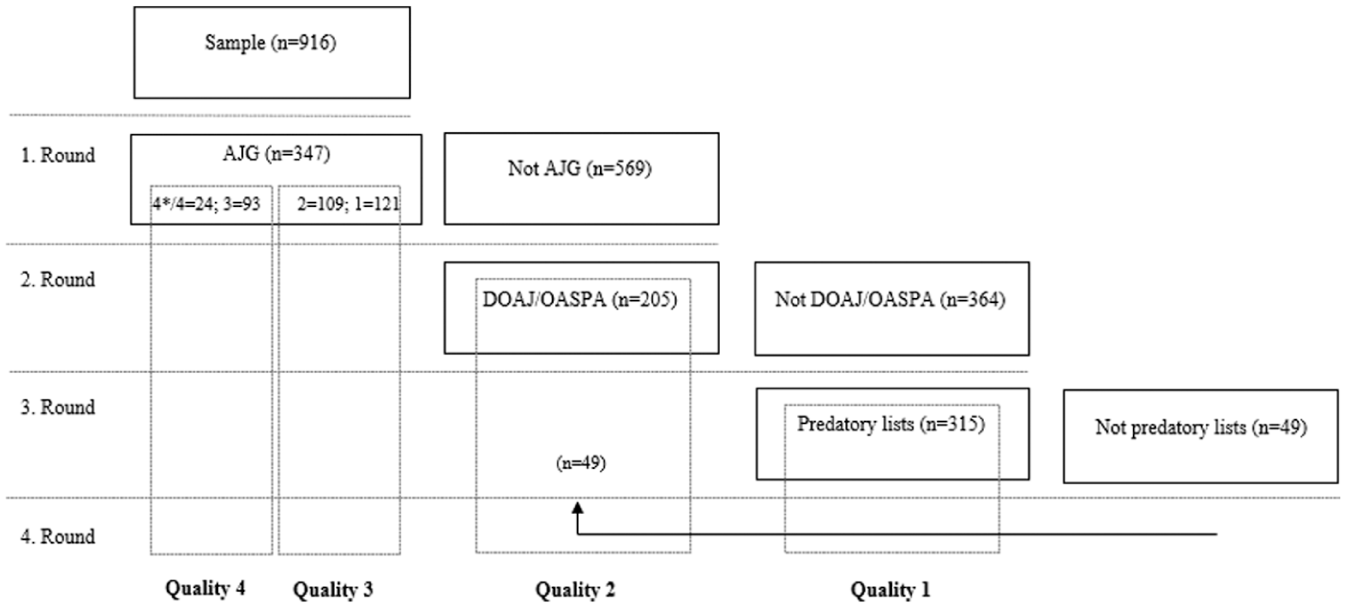
Journal quality assessment.
Results
General overview
Already in the 1990s, when our review started, research on Green HRM was published. However, until the early 2010s the number of studies was limited. One reason for this may be the absence of a clear term for the field. Only in 2008, a working paper by Renwick et al. (2013) appeared in a revised version in International Journal of Management Reviews, introduced the term “Green HRM.” In 2011 the German Journal of Human Resource Management published the first special issue on this topic (Muller-Camen et al., 2011). Whereas until 2012 only very few articles appeared, since then there has been a rapid increase in publications. As Figure 2 indicates this increase occurs across all four quality categories. However, there has been the smallest growth of publications in AJG 3/4 journals (Quality 4) and the highest in journals classified by the authors as potentially predatory journals (Quality 1), based on predefined criteria (see Methods).
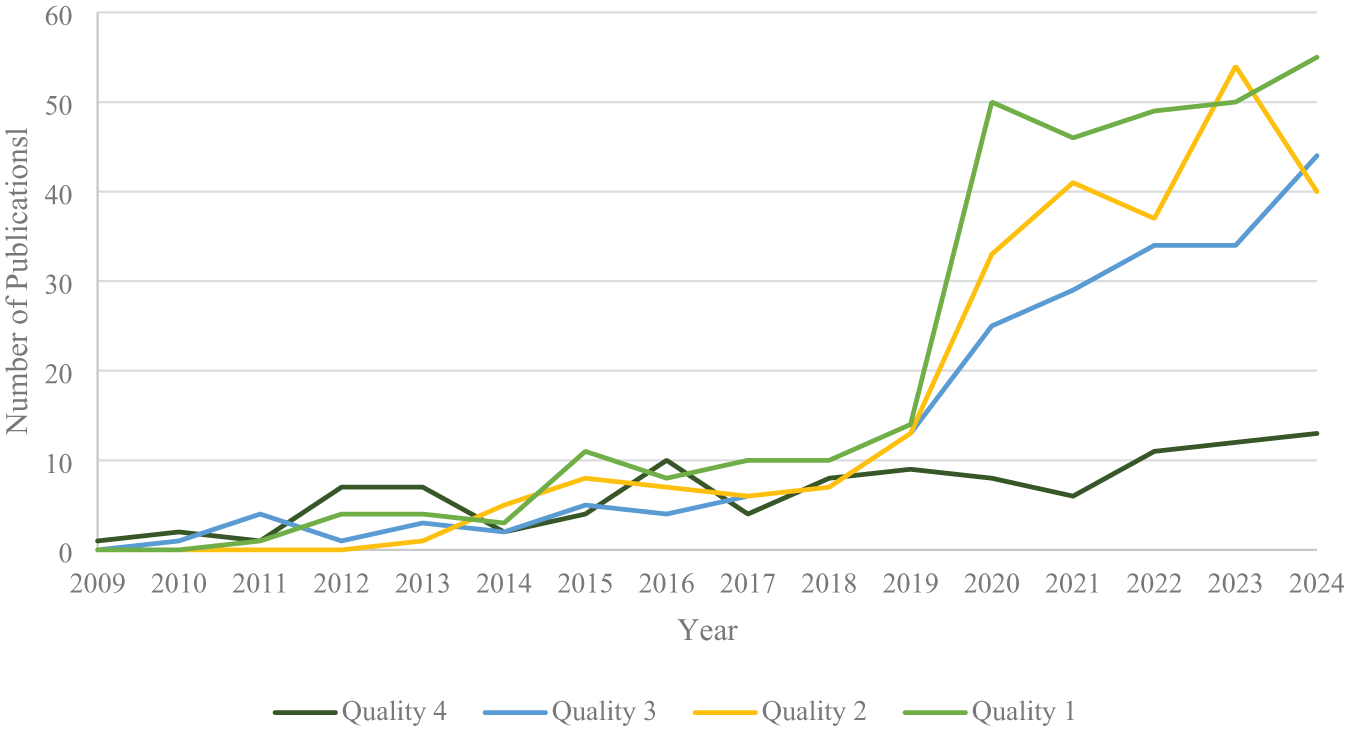
Number of publications from 1993 to 2024 (n = 916).
Potentially predatory journal publications
More than a third of the Green HRM articles we found, we categorized as published in potentially predatory journals. An analysis of these 315 journal articles (of which the 10 most cited ones are particularly revealing see Table 1) shows five common characteristics of these articles which are discussed in this section. We have taken a closer look at the most cited articles, firstly because they serve as an example of low publication quality, and secondly because they are disseminated by means of citations—even by non-predatory publications. For example, Mandip (2012) has almost 100 citations from articles published in AJG journals.
Ten most cited articles in Green HRM published in journals classified by the authors as potentially predatory according to GS (= Google Scholar, classification per Methods section; sources AJG/DOAJ/OASPA/Beall’s List; status September 16 2025; no legal judgment intended). 1
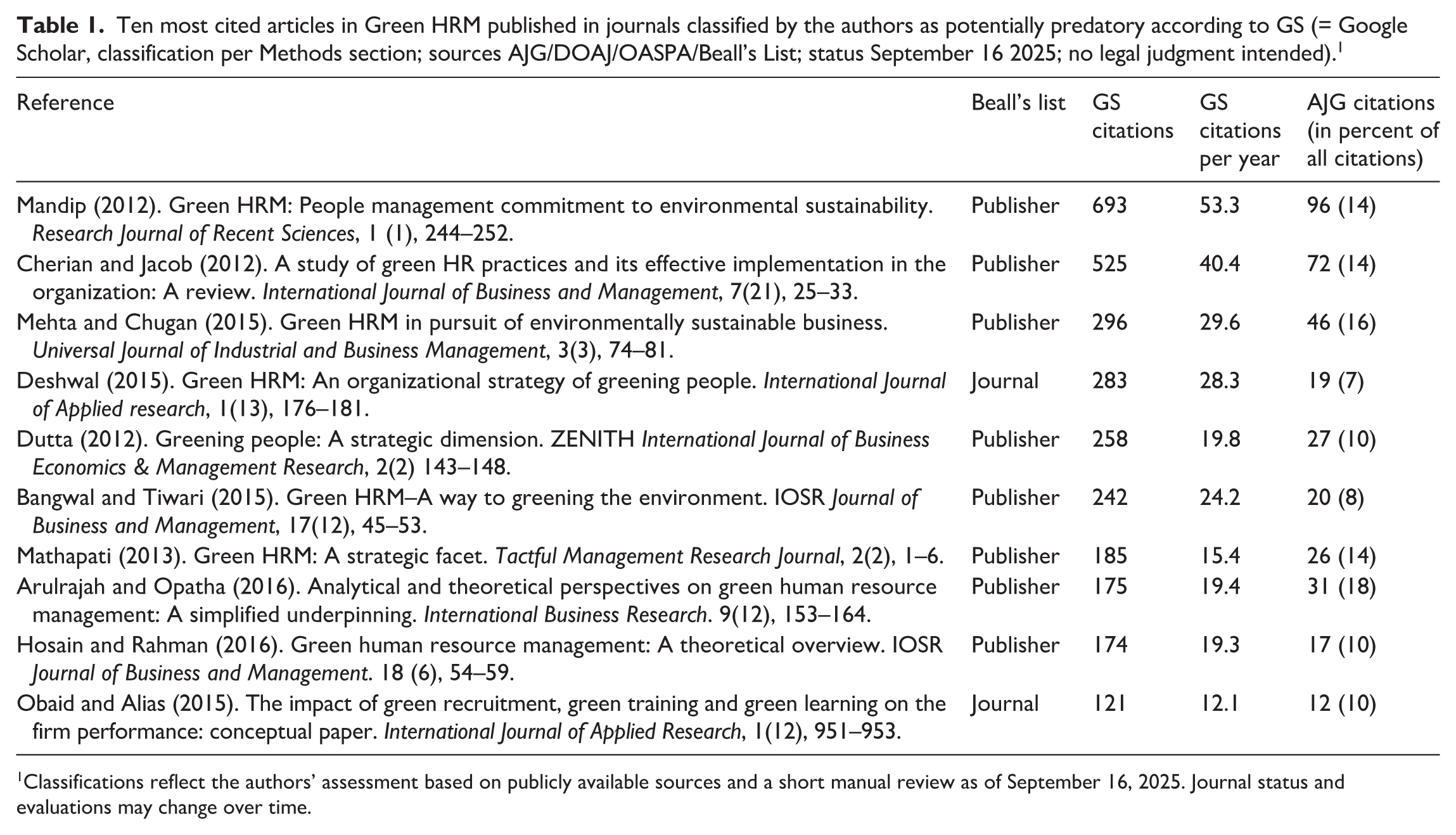
1Classifications reflect the authors’ assessment based on publicly available sources and a short manual review as of September 16, 2025. Journal status and evaluations may change over time.
The first characteristic of the potentially predatory journals in our sample is the generic outlet name and broad scope of disciplines of the published. As Harzing and Adler’s (2016) analysis suggests, many of these journals try to cover a very broad area to maximize submissions. For example, the Research Journal of Recent Sciences article, is among the 10 most cited publications in this category (see Table 1). As of 16 September 2025, this journal is listed on Beall’s List and, on that date, not indexed in AJG/DOAJ/OASPA. Its topical scope spans multiple fields (e.g. Agriculture, Veterinary Medicine, Computer Science, Economics, Journalism). Another example is the International Journal of Applied Research, which accounts for 2 papers among our top 10 potentially predatory journal publications (see Table 1). The journal accepts submissions in all languages and across a wide range of research fields, including the arts, engineering, management, or health sciences (International Journal of Applied Research, 2025).
Secondly, for Green HRM, our sample confirms Harzing and Adler’s (2016) finding that the articles we are investigating cover a very limited scope of the overall subject literature, with references instead to standard textbooks, outdated works, and/or articles in potentially predatory journals. For example, Deshwal (2015) and Mathapati (2013) include 15 and 13 references respectively, reflecting a comparatively limited breadth of the cited literature. They as well as Dutta (2012) quote HR managers and their opinions on the topic, although the papers are declared as literature reviews. In terms of literature, Cherian and Jacob (2012) got several in-text references wrong by misspelling author names and giving incorrect years of publications. Nevertheless, this paper was cited more than 525 times, and 72 of these were from articles in AJG ranked journals.
Thirdly, the potentially predatory publications in our sample are characterized by a low academic standard, often exhibiting unclear language and a lack of coherent structure. They often present fragmented descriptions of studies related to various functions of Green HRM without any critical analysis or synthesis. Moreover, the conclusions typically emphasize the business case for Green HRM, while offering little substantive interpretation of the findings or their theoretical significance. In case they contain empirical data; it is very limited. In our sample, we found examples of empirical studies with as few as 50 survey participants for quantitative paper or qualitative studies with only four interviews. In other cases, the authors gave little information on the method, for example, which scales were used in the survey. Furthermore, there seems to be a lack of a systematic analysis of the data, as for quantitative studies, only descriptive statistics are presented, one case did not provide any results at all. In sum, these findings give us the impression that articles in potentially predatory journals often do not meet the expectations regarding standards of good research practice such as rigor and transparency through precise recordkeeping and documentation of the research process and results.
Fourthly, authors in potentially predatory journals tend to repeat ideas of other authors and/or even plagiarize them. One example is Mandip (2012), whose publisher the International Science Community Association is on Beall’s List (2024; accessed 16 September 2025). At first sight, the article is well written, which could explain that it is even among the 30 most cited articles in Green HRM. It mainly consists of a very concise literature review of different areas of Green HRM. However, a closer look reveals that substantial parts of this paper closely mirror the content and structure of Renwick et al. (2008). A comparison of the two texts indicates a textual similarity of more than fifty percent. Substantial similarities can be identified in conceptual framing, sequence of arguments, structure and cited sources. Moreover, the references cited in this paper are no older than from 2007, which is also the latest publication year of references included in Renwick et al. (2008). In the end, the case study on the first and the final page provides general information about the environmental management of ITC, but none of the content is related to HRM. At this point it is worth mentioning that there is a SSRN working paper by Jyoti (2019) which not only has not the same title as Mandip’s (2012), but also reproduces its structure almost verbatim, with merely reworded content. The paper includes only the first seven references from the earlier article. However, this paper has been cited 120 times (accessed 16 September 2025; https://scholar.google.com/scholar?cites=3192191883785066720&as_sdt=2005&sciodt=0,5&hl=de). Unfortunately, this is not an exception. Dutta’s (2012) and Mathapati’s (2013) articles contain several identical paragraphs without references. Apart from the 10 most cited list, we noticed reoccurring descriptions of company practices (the two Indian companies ITC and ONGC) reported in papers, again without referencing each other. These cases appear to illustrate practices of blatant misconduct in research (Hall and Martin, 2019).
Fifthly, only a few papers that the authors classified as published in potentially predatory journals refer directly to the most frequently used Green HRM definitions (e.g. Renwick et al., 2013). In some cases, the definition of HRM is similar to the original ones but without the original reference. This is exemplified by Deshwal (2015), who provides a definition of Green HRM approximate to frequently used ones, but without citing any of the original publications in which this definition was first stated. It seems that especially in articles published in potentially predatory journals, Green HRM is an elusive concept with different meanings and interpretations. This becomes apparent when looking at definitions of Green HRM that emphasize a triple bottom line approach and consider Green HRM as accountable for social, environmental and economic issues. For example, Obaid and Alias (2015) define Green HRM as “The green HRM is essentially supporting the paradigmatic comprehension of “triple-bottom-line” concept. Stating differently, the green HRM comprises specific practices and policies regarding human resource in line with economic, social, and environmental pillars of sustainability” (p. 951). In this regard, some articles in potentially predatory journals spread new ideas that oppose the current state of knowledge in this field of research. They do not build on the previous literature, but replace or even disrupt common forms of knowledge, such as standard definitions of Green HRM.
Whereas the low quality of articles in our sample of potentially predatory journals is obvious in most cases, this is more difficult with our other low-quality category (Quality 2). This category consists of different types of journals. There are older and more established journals that have not yet been included in AJG such as Industrial and Commercial Training. Then there are country specific journals such as the Sri Lankan Journal of HRM. Although the research published in these journals may not be on the level of AJG listed journals, basic research standards are met. Finally, there are many OA journals. Siler (2020) considers them as journals that occupy niches between legitimate and illegitimate publishing.
One example of a Quality 2 journal in our sample that is particularly relevant for Green HRM is Sustainability. Sustainability is an OA journal established in 2009. According to the publisher’s statistics, it published 11,164 articles in 2024 (https://www.mdpi.com/journal/sustainability/stats, accessed 15 September, 2025). Besides this high number of articles which may be difficult to process in a comprehensive peer review, the timespan from submission to acceptance is remarkably short. Most of the articles completed this process within 1–2 months, which may leave limited time for a rigorous review and revise process. However, the journal is covered by the SSCI and its impact factor was 3.6 in 2024, which suggests that articles published in this outlet have an impact. According to our data, Sustainability is with 63 articles the journal with most publications on Green HRM. In 2023 alone it published 22 articles, whereas we identified only 20 in all AJG 2, 3 and 4* journals together. In 2022, Finland and Norway adjusted their national ratings for the journal and removed Sustainability from its list of journals that researchers get credit for publishing in. The Finish publication forum suggested that “Sustainability also publishes high-quality articles, but the wide scope, large publication volume and fast publication processes have undermined confidence that the journal’s procedures to ensure scientific quality work reliably down the line.” (https://julkaisufoorumi.fi/en/news/sustainability-level-0-2023). We do not offer a quality assessment of this journal, but this paragraph illustrates the differing governance signals that arise across various indexing and national evaluation systems.
Where publications in ranked and potentially predatory journals meet
At this stage, the question arises why we should be aware of literature published in questionable journals. There are two underlying reasons for exercising caution when encountering a publication categorized as potentially predatory. Firstly, articles in such journals frequently cite quality research and thus influence its dissemination. Harzing and Adler (2016), who collected their data in 2012, observed at that time that predatory research is often not covered by Google Scholar. However, all articles in our sample in potentially predatory journals have a Google Scholar record and thus have a potential impact, because they are OA and thus easy to access. As shown in Table 1, the 10 most cited have received between 121 and 693 citations in Google Scholar, with annual citation rates ranging from 12.1 to 53.3, illustrating their visibility and potential influence within the field. For each of the 30 most cited articles in Green HRM, the number of citations by Google Scholar is two–three times higher than those counted by the SSCI. Several factors can explain the “citation gap.” One reason is that the SSCI does not count citations in books, book chapters and unpublished reports. However, part of this discrepancy can be explained by citations from journal articles not covered by the SSCI. In other words, research published in potentially predatory journals may significantly increase citations of research published in quality journals—at least as measured by Google Scholar.
Secondly, even more critically, our findings indicate that low quality research published in potentially predatory journals has become part of the ranked research field through citations in ranked journals (see Table 1). Between 6% and 18% of all citations received by the 10 most cited originate from journals ranked in the AJG. An illustrative example of this dynamic is provided by the article published in International Business Research, which has received 175 citations according to Google Scholar. Of these, 31 citations originate from AJG-listed journals, meaning that 18% of all citations stem from ranked journals. Such citations are consequential, as references in ranked journals may confer symbolic legitimacy and signal relevance and quality to the wider research community. This is problematic, since not only students (Cothran, 2011), but also scholars (Ollé and Borrego, 2010) use Google Scholar frequently. The impact of research published in potentially predatory journals is enhanced by citation leakage which describes the practice of—in this case—articles in these journals citing each other to enhance their impact (Moussa, 2021). At this stage, it is worth mentioning that according to Google Scholar (accessed on September 16 2025), the number of citations of Renwick et al. (2008) working paper (691) is less than the potentially plagiarized version published by Mandip (2012; 693 citations).
In most of these cases, articles in AJG 1 ranked journals account for the citations. Although limited access to quality research and unfamiliarity with the literature may explain why the authors used these references to some extent, it is surprising that citing potentially predatory journals passed the scrutiny of the reviewers and the editor. However, the problem goes beyond AJG 1 rated journals. For example, Google Scholar’s “cited by” function shows that Mandip (2012) was referenced by articles in AJG 2 and AJG 3 ranked journals which could explain its high number of citations. Similarly, the second most cited article in our sample, Cherian and Jacob (2012) was in 2017 cited three times as an example of the emerging literature on Green HRM by Dumont et al. (2017) in Human Resource Management and thus gained legitimacy, which could be a reason for its popularity.
Discussion
We used the example of Green HRM to analyze different publishing practices and illustrated how quality research and potentially predatory journal publications intertwined. In the last decade, the research field has grown substantially. However, we showed that this growth in publications is not only due to more publications in highly ranked journals, but even more fueled by a general trend of OA and a substantial growth of potentially predatory journal publishing. This latter development has also markedly increased the internationalization and qualitative segmentation of the field.
Since 2012 when Harzing and Adler (2016) investigated OA publishing, practices have undergone significant changes. Today, research published in potentially predatory journals have an impact as we have shown at the example of Green HRM. We agree with Mertkan et al. (2021) that predatory publishing is a threat to this discipline, because it infiltrates the research field with appropriated and disruptive pseudo-knowledge. There are two catalyzing mechanisms: predatory publications draw legitimacy by citing ranked journals and influencing the citation impact of the latter. More crucially, using the example of Green HRM, we show that research published in such journals is influencing the development of the field in form of references in publications from ranked journals and thereby gain visibility in Google Scholar. However, Butler and Spoelstra (2020) argue that the appropriation of publications and citations through illegitimate practices, such as copying sections of another author’s theoretical framework, has become more visible in contemporary academic at large. Deviating from appropriate research practice and deliberately stretching the boundaries of questionable conduct as copying short phrases without indicating, and blatant misconduct as reproducing entire sentences, copying whole articles or data fabrication (Hall and Martin, 2019), is not restricted to potentially predatory journals, but is also prevalent in established journals. As articles even in highly ranked journals mix quality and questionable references, it becomes more challenging for scholars, for students as well as the public to assess the quality of research.
This is not only a wake-up call for the field of Green HRM: potentially predatory publishing is a wide-spread phenomenon which endangers research practices in the field of management (Budhwar and Cumming, 2020) and beyond, such as marketing (Moussa, 2021), medical (Barker et al., 2023; Pollock et al., 2024), and other disciplines (Eriksson and Helgesson, 2017; Fadel et al., 2024; Frandsen, 2017; Mertkan et al., 2021). In general, the line between ranked and potentially predatory publications has become blurred. Information asymmetries in journal evaluations (e.g. citation counts or journal ranking systems) contribute to the prevalence of articles in such journals (Bagues et al., 2019). Moreover, as works published even in highly ranked journals may cite articles from potentially predatory journals, assessing research quality becomes more challenging for scholars, students and the wider public (Merga, 2024). Consequently, scalable, system-wide approaches to uphold research integrity are needed in an increasingly complex publishing landscape.
The rise of generative AI technologies, particularly large language models like ChatGPT, has added new dimensions to the problem by enabling paper mills and authorship-for-sale schemes, which can flood the literature with pseudo-academic content and undermine editorial standards (Kendall and Teixeira da Silva, 2024). The misuse of these large language models in scientific publications poses a serious challenge (Bechky and Davis, 2025). ChatGPT allows authors to quickly produce articles written in accurate English. This capability could provide predatory journals with fraudulent, but very readable manuscripts using academic language. Identifying low quality journals may therefore become even more difficult, potentially having a significant impact on the landscape of publications (Currie, 2023; Kendall and Teixeira da Silva, 2024).
Practical implications
Reasons why predatory publications are frequently cited include their easy accessibility, prominent positioning in Google Scholar and in some cases, high citation counts. As noted at the outset of this paper, researchers may face challenges in accurately assessing journal quality and may be exposed to misleading publisher practices, while at the same time experienced scholars increasingly encounter pressure to publish at a high pace. To counteract this dynamic in the dissemination of potentially predatory journal articles, we have four suggestions. The first one should be, not to become an author in a predatory journal. Individual scholars should, before submitting to a journal, take a close look at the recommendations of Harzing and Adler (2016: p. 154) on how to avoid publishing in predatory journals or at Eriksson and Helgesson’s (2017: p. 165) list of characteristics of predatory journals. Besides that, current campaigns such as Think, Check, Submit (2019) try to create more awareness and help authors to identify trustworthy journals. Second, scholars should not cite and hence confer legitimacy to predatory journals. It is not only the legitimacy that is built up by citations, but citing them can disseminate scholarly misconduct, such as plagiarism. Furthermore, it is essential to read the original source before citing it. Taking the San Francisco Declaration on Research Assessment (DORA Declaration) seriously, this means that even predatory journals may publish high quality research. Third, if looking for literature on Google Scholar, citation counts should not be confused with research quality. Our study revealed that citation count alone cannot be a sign of quality. Building on this finding, our recognition of the five key characteristics demonstrates how predatory journals can be identified. Being critical and cautious is also something we want to pass along to editors and reviewers since in the end, it is them who decide if a paper gets published or not. At the same time, it is important to emphasize that individual awareness alone may be insufficient to address the growth of predatory publications and the increasing blurring between ranked and questionable journals. Good academic referencing should not be underrated since its violation can damage the progress and image of research (Harzing, 2002). Therefore, and fourth, publishers also have a responsibility for the quality of knowledge that enters a research field. Like plagiarism checks, they should automatically screen reference lists for citations from predatory journals, to alert the editors and referees.
Conclusion
By identifying the five characteristics of potentially predatory publications from our sample, we showed that these publications inconspicuously infiltrated the research field of Green HRM, raising concerns about similar patterns in other areas of management research. They tend to interfere with common knowledge production patterns by disrespecting peer reviews, research standards and a proper integration into the literary canon. Also, these publications appropriate knowledge from others, for example by merely repeating ideas and plagiarizing. Finally, they go beyond appropriation and replace approved knowledge, as we illustrated with the case of Green HRM definitions. These new forms of knowledge, better called pseudo-knowledge, enter the research field where ranked and predatory journals meet. Our findings suggest that articles from outlets classified by the authors as potentially predatory can enter the field via citation chains and may distort knowledge claims. When articles in these journals cite regular literature, they become visible and easily accessible through the “cited by” function in Google Scholar and incidentally boost citation counts of papers in high quality outlets. Pseudo-knowledge is further disseminated by authors of ranked publications, who cite predatory publications and hence anchor them in the research field by camouflaging them between many other high-quality references.
Overall, our study indicates that the line between articles published in ranked and those in predatory journals is blurred, and we as scholars are closer to the “dark side” than we think. Most of us would not consider publishing in questionable journals, but what about citing them or allowing papers to be published which refer to potentially predatory sources? By doing so, we actively contribute to its dissemination and enable pseudo-knowledge to intrude into a research field. Therefore, we call for a greater awareness and responsibility, no matter if we are currently in the role of authors, reviewers, editors or publishers.
Footnotes
Acknowledgements
This paper was first presented in 2018 at a workshop at the University of Augsburg. Since then, various versions were discussed at research seminars in Bath, Cadiz, Sevilla, Stellenbosch and Vienna as well as conferences such as the Academic of Management, the European Academy of Management, EGOS and the German Academy of Management. We are grateful for the feedback received which made us realize how important the topic is for academic work and how little PhD students and established researchers know about it. Over the years we tried to publish it in several ranked journals but got rejected which may not just have been due to the quality of our research, but also the sensitivity of the topic. Nevertheless, we learned from all the feedback received and would like to give a particular thank you to the two reviewers and editors of the German Journal of HRM who supported us on the last steps. We would also like to thank Julia Brandl and Henry Holland for their language and scholarly editing, as well as for their thoughtful comments on final drafts of this article.
Declaration of conflicting interests
The authors declared the following potential conflicts of interest with respect to the research, authorship, and/or publication of this article: All classifications of journals as potentially predatory in this study reflect the authors’ scholarly assessment based on publicly available sources as of 16 September, 2025. These classifications do not constitute legal determinations regarding journals or publishers. Because journal status, indexation, and evaluations may change over time, the findings should be interpreted with caution. We welcome factual corrections and updates.
Funding
The authors disclosed receipt of the following financial support for the research, authorship, and/or publication of this article: The research on which this paper is based was partially funded by an FWF research grant (I 3342-G16).
