



Abstract
This study complements existing longitudinal research on voice and silence in organizations by addressing how Implicit Voice Theories (IVTs)—for example, the belief that speaking up is risky—can spread and become deeply embedded in organizational culture. Based on a qualitative longitudinal study conducted over nearly 3 years at an automotive production site in Germany, 48 managers at various hierarchical levels were interviewed repeatedly, resulting in a total of 128 interviews. One specific event emerged as particularly significant, providing the basis for an abductive exploration of how IVTs disseminate within organizations. The findings highlight two key mechanisms: storytelling and Coactive Vicarious Learning (CVL). These processes contribute to shaping colleagues’ communication behavior in organizations, fostering a generalized tendency toward silence—persisting even years later and beyond those directly involved.
Keywords
Introduction
Communication is widely recognized as a constitutive element of organizations: it produces, stabilizes, and transforms social structures and serves as a foundation for collective sense-making (McPhee and Iverson, 2009; Weick, 1995). In the context of business and management studies, communication has long been conceptualized as a strategic resource, instrumental in steering organizational processes. Within this perspective, it is frequently associated with ideals of transparency, dialog orientation, and participation—particularly in the realms of change management, innovation cultures, and leadership development (Zerfass and Huck, 2007). Yet, alongside these normative models of communication, there exists a less visible but equally consequential communication dimension: the systematic silence behavior. While communicative action in organizations has been extensively theorized and empirically examined—especially through the lens of voice behavior—silence remains comparatively under-explored, despite its far-reaching implications for knowledge exchange, organizational learning, and resilience (Morrison, 2023). Especially in highly structured or hierarchical environments, it cannot be assumed that employees feel able—or permitted—to articulate their concerns, doubts, or ideas. The concept of organizational silence (Morrison and Milliken, 2000) captures this phenomenon not merely as an individual choice (Employee Silence, Pinder and Harlos, 2001), but as the result of deep-seated cultural and structural dynamics. It offers a critical lens on communication cultures in which speaking up is formally encouraged but informally inhibited, as implicit norms, power asymmetries, and perceived risks create a climate of silence. Silence, in this view, is not simply the absence of speech, but a socially conditioned mode of organizational behavior (Morrison and Milliken, 2000).
While existing research on organizational silence has examined a wide range of its causes, it has paid comparatively less attention to the mechanisms through which a tendency toward silence may spread or become entrenched within an organization. One aspect that has not yet been systematically explored is the narrative transmission of silence—specifically through storytelling. Organizational members use shared accounts and interpretive frames to assign meaning to events, behaviors, and organizational practices (Sonenshein, 2010). The stories that circulate within organizations help define what is considered speakable and unspeakable. They function as sensemaking devices that contextualize incidents and shape shared interpretations (Pentland, 1999). This meaning-making process is critical, as it influences employees’ communicative behavior, including the propensity to voice concerns or to remain silent (Hao et al., 2022). Organizational stories typically convey underlying norms and values, which may be articulated in either affirmative or critical ways. A key feature of such stories is that they often imply behavioral expectations without stating them explicitly. Instead, they embed moral orientations and action guidelines in a tacit form (Swap et al., 2001; Wilson and Sole, 2002). As such, storytelling contributes to the informal regulation of voice and silence within organizations. Detert and Edmondson (2011) have investigated those specific implicit beliefs that are responsible for the variance in voice and silence. They refer to them as implicit voice theories (IVTs; Detert and Edmondson, 2011). However, there is little other published work examining tacit beliefs as an important category of underlying assumptions about speaking up or remaining silent, for example, Hu (2020), Knoll et al. (2021), Şahin et al. (2021), Ellis et al. (2022), Fournier et al. (2024) and Brykman and Maerz (2023). In particular, little is known about how the belief that speaking up is a self-protective strategy or a dangerous act develops, spreads and solidifies over time within an organization (Knoll et al., 2021). Furthermore, there is a lack of process data that could help better understand the evolution of employee silence (Knoll et al., 2021; Meinecke et al., 2016; Perlow and Repenning, 2009; Reissner et al., 2024). Therefore, this study focuses on the following research questions: how and why does storytelling contribute spreading silence and related IVT’s within an organization? The article aims to answer the question of how IVT can lead to sustainable attitudes of silence in an organization.
To address these research questions, the study draws on theoretical perspectives that offer insights into how silence emerges, circulates, and becomes reinforced within organizational settings. By integrating concepts from communication theory, organizational learning, and research on narratives, it develops a conceptual framework that highlights the role of storytelling and implicit conviction in shaping communicative behavior. This framework serves as an analytical lens for interpreting the empirical findings presented later in the article.
Theoretical background
The following section outlines the conceptual framework of this study. First, different forms and dimensions of voice and silence are distinguished, which serve as the basis for perspective-specific motivational interpretations of one and the same voice or silence moment. Building on this, the focus shifts to organizational learning theory, with particular attention to storytelling as a mechanism for sensemaking and informal norm transmission. The normative interpretation of organizationally desired communication behavior represents a key factor influencing the emergence of silence. The concept of Implicit Voice Theories (IVTs) plays a crucial role in the consolidation and spread of organizational silence.
Voice and silence in the context of organizational communication
In examining organizational communication, many approaches primarily focus on formal communication processes, control systems, and top-down messaging. In contrast, the concept of voice centers on employees as active subjects of organizational communication, focusing on the voluntary, constructive articulation of opinions, concerns, or ideas toward organizational authorities (Hirschman, 1970; Morrison et al., 2011). It forms an important counterpoint to approaches that regard communication mainly as a managerial tool, redirecting attention toward the possibilities and limitations of communicative expression within organizational power structures. Employee voice can be defined as “speaking up” regarding organizational problems or suggestions for improvement (Detert and Burris, 2007). In academic discourse, voice is increasingly examined in relation to organizational silence, as they represent different forms of individual responses to organizational communication conditions (Knoll and Redman, 2016; Morrison, 2014).
Prosocial voice (Van Dyne et al., 2003) represents discretionary, change-oriented behavior aimed at improvement. It comprises work-related ideas, information, or opinions based on cooperative motives, altruistically directed toward benefiting the organization. However, not everyone necessarily perceives such statements as positive, particularly those who view the status quo as unworthy of change (Van Dyne et al., 2003). Liang et al. (2012) distinguish prosocial voice into promotive and prohibitive forms. Promotive voice involves innovative solutions and suggestions for improvement, demonstrating concrete innovations with a future orientation. Prohibitive voice, conversely, expresses concerns about work practices, incidents, or behaviors harmful to the organization (Liang et al., 2012: 75), necessarily looking to the past. When concerns are raised about past processes or behaviors, this implies criticism of those previously in charge, potentially leading to negative emotions or conflicts. Consequently, identifying or communicating the prosocial motive behind prohibitive voice is significantly more challenging (Liang et al., 2012).
While employees’ willingness to express ideas and concerns is essential for organizational functioning (Morrison et al., 2011), they often refrain from speaking up. This silence can strain cognitive and social resources and negatively affect both individuals and organizations (Knoll and van Dick, 2013; Pinder and Harlos, 2001). However, silence is not inherently negative. In some contexts, it may support efficiency, autonomy, or conflict avoidance, functioning as a self-determined communication strategy (Fletcher and Watson, 2007; Kirrane et al., 2017). This perspective frames silence as “dialectical empowerment” (Donaghey et al., 2019: 116), allowing individuals to exercise power or act prosocially—for instance, by protecting colleagues or maintaining group cohesion (Szkudlarek and Alvesson, 2024; Van Dyne et al., 2003).
Beyond its absence of speech, silence is increasingly recognized as a distinct form of communication, expressing insight, emotion, or intent (Pinder and Harlos, 2001). Prior research differentiates four primary motives for silence. Defensive silence refers to intentional withholding of ideas to protect oneself from negative consequences, closely linked to low psychological safety (Edmondson, 2003; Van Dyne et al., 2003). Consequences may range from fear and reputational damage to career setbacks. Ineffectual silence stems from resignation or disengagement; employees remain silent believing speaking up would not lead to change (Brinsfield, 2013). Opportunistic silence describes withholding information to maintain one’s own status or advantage, even at others’ expense (Knoll and van Dick, 2013). Prosocial silence, in contrast, is motivated by cooperative intentions, aiming to protect colleagues or support the organization (Van Dyne et al., 2003). Importantly, these motives are not mutually exclusive and may coexist in shaping communicative behavior (Barry and Wilkinson, 2016).
Implicit voice theories and storytelling as a driver of organizational silence
The difficulties associated with speaking up—particularly regarding critical reflections on the past—highlight the importance of how past events are collectively remembered and framed within organizations. In this context, shared interpretive patterns shape whether voice is expressed or withheld. One such pattern emerges through narratives, which can be understood as part of a broader symbolic order where behavioral expectations are communicated through tacit, culturally embedded messages. This logic underlies the concept of Implicit Voice Theories (IVTs), which describe internalized beliefs about the (in)appropriateness of speaking up in organizational contexts. They are considered direct causal factors for silence (Knoll et al., 2021).
Like other implicit theories, IVTs are schema-like knowledge structures (Ross, 1989) that help individuals process situations and attribute appropriate behavior through if-then assumptions. IVTs can be understood as products of automatic cognitive processes that influence behavior without conscious reflection. An automatic evaluation of stimuli occurs unconsciously (Levy et al., 2006), assuming that silence results from an automatically recalled conviction that “speaking up is dangerous” (Detert and Edmondson, 2011). Employees may be convinced that remaining silent is better because they have internalized this attitude. Such attitudes can steer behavior unnoticed for extended periods and may be applied even when there are no actual risks associated with speaking up.
Detert and Edmondson (2011) empirically identified five IVTs: (1) presumed target identification, (2) need for solid data or solutions before speaking up, (3) avoiding bypassing the boss upward, (4) avoiding public embarrassment of the boss, and (5) anticipated negative career consequences of voice. These patterns are systematically analyzed in their study and provide a framework for understanding how implicit beliefs shape silence behavior in organizations. In examining the significance of organizational communication in both research and practice, many approaches primarily focus on the design of formal communication processes, control systems, and top-down messaging. In contrast, the concept of voice centers on the perspective of employees as active subjects of organizational communication. It focuses on the voluntary, constructive articulation of opinions, concerns, or ideas by employees toward organizational authorities (Hirschman, 1970; Morrison et al., 2011). As such, it forms an important counterpoint to approaches that regard communication mainly as a managerial tool, redirecting attention toward the possibilities and limitations of communicative expression within organizational power structures and cultural frameworks. Employee voice can be defined as the regular “speaking up” regarding organizational problems or suggestions for improvement (Detert and Burris, 2007). In academic discourse, voice is increasingly examined in relation to organizational silence. The two concepts are analytically closely linked, as they represent different forms of individual responses to organizational communication conditions (Knoll and Redman, 2016; Morrison, 2014). An integrated perspective enables a deeper understanding of the structural and cultural factors that facilitate or inhibit communicative behavior in organizations.
While IVTs illuminate individual-level cognitive processes underlying silence, they leave open how meaning is constructed and shared collectively within organizations—particularly where not everything can be articulated openly. Silence does not imply the absence of sense-making; rather, alternative forms of communication emerge. Storytelling functions as a collective sense-making framework through which unspoken experiences, implicit norms, and cultural interpretations are conveyed indirectly (Weick, 1995). Whereas IVTs explain individual silence, storytelling reveals how narrative structures shape organizational culture regarding silence—often subtly and symbolically. Anecdotes and organizational myths, rooted in individual experiences, can become institutionalized over time, passed on to colleagues or newcomers and persisting across organizational generations. A single event may thus evolve into a cautionary tale that shapes communicative behavior (Knoll et al., 2016; Swap et al., 2001).
Stories are dynamic and contextual, varying by time, audience, and situation (Boje, 1991). Their messages are socially constructed rather than objectively fixed (Weick, 1995). In organizations, narratives are often transmitted in fragmented forms, with selected aspects emphasized or omitted depending on context. These fragments can precede and influence individual assumptions and actions (Boje, 1991; Dailey and Browning, 2014; Vaara et al., 2016).
Story-based learning and the social embedding of organizational silence
Stories are also relevant for knowledge transfer and interpretation (Barker and Gower, 2010). In the context of narrative learning, listeners relate stories to prior experiences (Clandinin and Connelly, 2000; Fisher, 1987; Polkinghorne, 1988). In doing so, the narrated content is retrospectively rendered meaningful and made plausible through processes of sensemaking (Weick, 1995), thereby forming a foundational basis for the generation of new knowledge (Clark and Rossiter, 2008). One form of new knowledge may consist of knowing when, to what, or in front of whom it is advisable to remain silent in the organization. Telling stories thus leads to learning processes and develops the relationship between the participants. Myers (2018), in particular, emphasizes this functionality of stories and their transmission in the workplace in his Coactive Vicarious Learning (CVL) model, thus creating another relevant link between narration and learning. He proposes an extension of Bandura’s concept of observational learning (Bandura, 1969), which he refers to as Independent Vicarious Learning (IVL), and in contrast describes an iterative process of Coactive Vicarious Learning (CVL). In this process, a model and a learner collaboratively construct and develop an understanding of the model’s experience through discussion and joint reflection—constituting a form of bidirectional learning (Myers, 2018, 2021). His relational model goes beyond mere knowledge exchange; through coactive interaction, it enhances learning capacity as a result of increased trust and a shift in participants’ perspectives (Argote, 2024; Argote et al., 2021).
The CVL interaction has three essential elements: (1) experience, (2) analysis, and (3) support. Firstly, there is (1) an exchange of relevant experiences between employees. The exchange can occur in different ways: through observation or a narrative approach, such as storytelling. Under certain conditions (attention, appropriate level of arousal, personal preferences, etc.), the model or the story attracts the observer’s attention—or, in this context, the learner. (2) This new knowledge is then analyzed, interpreted, and connected to the learner’s prior experiences. Additions can be introduced into the discourse through questions or comments, either reinforcing existing interpretations (confirmation of IVT) or leading to a reinterpretation of the behavior in question (emergence of a new shared IVT; Myers, 2018). During CVL, both the learner and the model are equally engaged in the process of sensemaking (Myers, 2018; Weick, 1995). (3) Expressions of social or emotional support during the interaction can facilitate the processing of an experience. Encouraging statements, in particular, may foster perspective-taking and positively influence the relationship between the participants by building trust and a sense of camaraderie (Myers, 2018, 2022). Such supportive dynamics can contribute to the learner’s adaptation of beliefs (Myers, 2018; Sitkin et al., 1998), for instance by enhancing self-efficacy, or help establish a social or emotional support system for the model and the behavior they demonstrate (Vaara et al., 2016). Myers (2018) also acknowledges the possibility of extended interaction chains and conceptualizes CVL as a process that can involve exchanges not only between the model and the learner, but also with third parties. In this sense, personal stories may be transmitted beyond the original model—expanding the scope of vicarious learning beyond the dyadic relationship proposed in traditional modeling theories. Myers’ model exemplifies recursive process theory, which emphasizes feedback loops and cyclical interactions between the learner and the model (see also Cloutier and Langley, 2020, for a typology of process theory styles and their classification of Myers’ work).
While through the lens of CVL-Theory interaction is seen as the main purveyor of implicit voice theories (IVT), DiMaggio (1997) offers a cultural lens for understanding the underlying causes of resonant narratives. DiMaggio (1997) argues that culture exerts its influence primarily through shared cognitive schemas—deeply embedded, often implicit mental models that shape perception, interpretation, and behavior. Yet, these schemas are not static; rather, they are socially constructed, maintained through interaction, and reproduced in collective practices. In this context, Coactive Vicarious Learning (CVL) can be understood as a potential micro-level mechanism through which such cultural schemas, in DiMaggio’s sense, are formed, reinforced, and transmitted—schemas that, in turn, frame and prefigure future storytelling and learning processes. In this view, silence can be seen as an expression of culturally embedded interpretive frameworks, shaped by organizational norms, routines, and communicative patterns. This aligns with the assumption that silence may emerge from implicit, socially reinforced rules about what is appropriate to say—and when. Organizational silence is therefore increasingly being conceptualized not merely as an individual decision, but as a dynamic process. While such a socially embedded and process-oriented understanding of organizational silence remains rare in empirical research, a small number of studies have begun to explore these dynamics in depth.
Two prominent examples are the longitudinal works of Perlow and Repenning (2009) and Bowen and Blackmon (2003), both of which identify self-reinforcing spirals as a key mechanism in the emergence and persistence of silence. Perlow and Repenning focus on a prosocial dynamic, in which employees refrain from speaking up in order to protect relationships and group harmony. Bowen and Blackmon (2003), by contrast, draw on Noelle-Neumann’s (1991) Spiral of Silence Theory, emphasizing the fear of isolation when holding a minority opinion. Over time, this fear leads to contagious silence, where individuals align their communicative behavior with perceived majority norms. In both cases, the behavior of the social environment becomes a central determinant of whether voice is expressed or withheld. These socialization dynamics form fertile ground for the development of IVT—internalized expectations that are triggered and shaped by collective patterns of (in)communication (Detert and Edmondson, 2011).
Study
The present study aims to investigate how the attitude of silence spreads throughout an organization, as there is limited understanding of this phenomenon (Knoll, 2021; Perlow and Repenning, 2009). Specifically, it focuses on exploring the influence of the IVT as a direct factor that affects this silence (Knoll et al., 2021). For this purpose, an exploratory longitudinal research design was used. Following the mixed methods approach, data was collected through repeated semi-structured interviews, questionnaires, internal documents, and field notes from informal conversations.
Organizational context
Data collection was conducted at a German automotive manufacturer employing approximately 5000 people at the focal site. The production process is divided into nine distinct areas, which are physically separated across the company premises. The workforce is predominantly male and characterized by a high level of company-specific training and long tenure. The organizational structure follows a traditional hierarchical model with cascading communication patterns.
Just 1 year before data collection began, the site underwent a planned transformation, which included both a revised corporate strategy and an internal cultural change. However, communication barriers were repeatedly revealed, such that the opportunities for open and honest dialog proclaimed by the company were increasingly perceived as insufficient. The company therefore proved to be particularly suitable for investigating organizational silence.
Data collection
During the 5-month preparation phase, numerous on-site meetings were held with contacts from the HR department and local change agents. Initial insights were also gained from internal documents, such as the results of the biennial company-wide employee survey. These insights led to early informal discussions about the organizational and communication culture, 1 ultimately highlighting the value of a mixed-methods approach for this study. Such an approach would enable cross-validation of the data. Furthermore, the structure of the regular employee survey provided valuable guidance for designing the questionnaire and developing the interview guidelines.
Figure 1 shows the data collection process in detail. Throughout the data collection period, repeated circular comparisons were made between the state of current research and the data obtained.
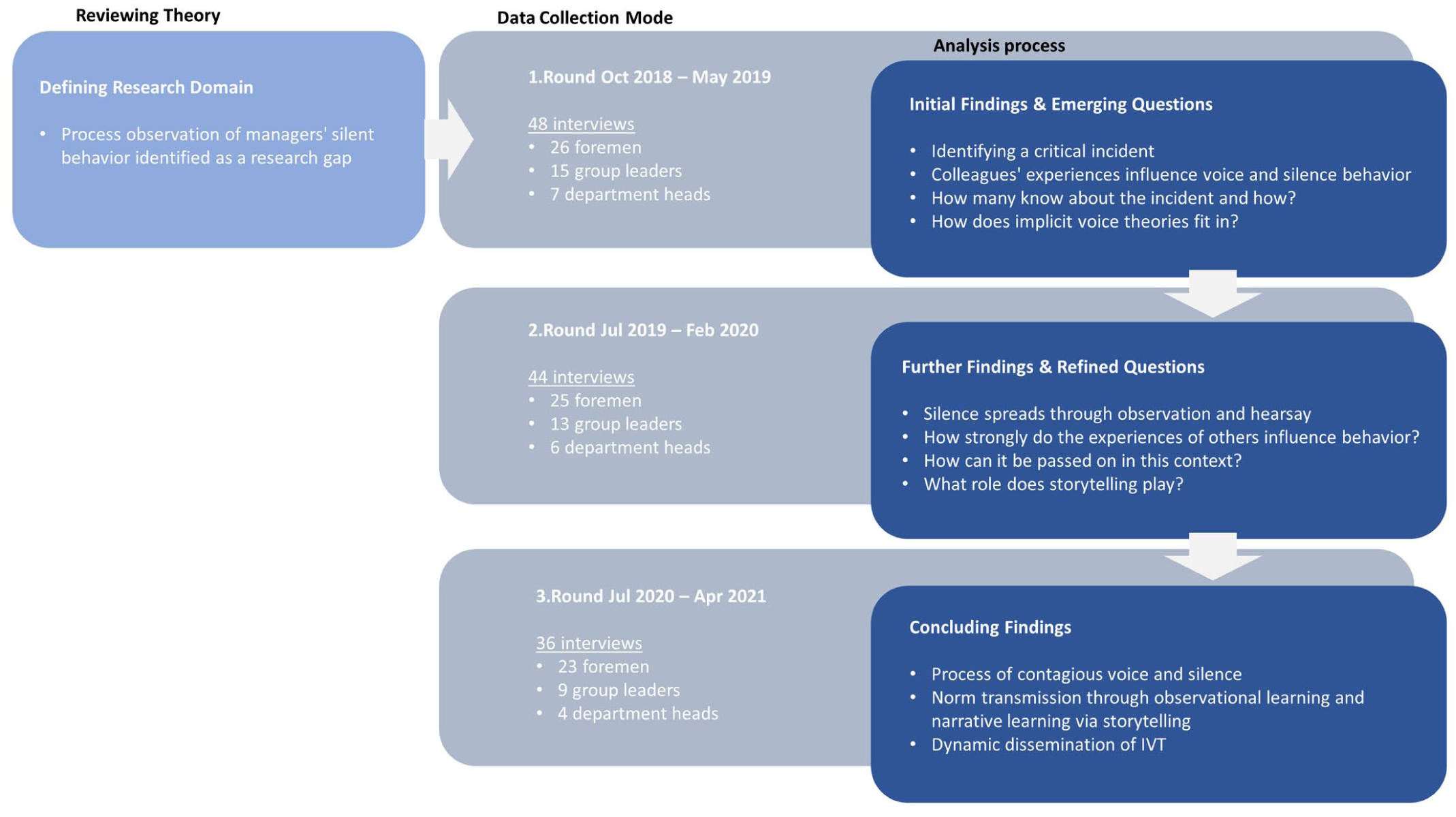
The data collection and analysis process.
As process Figure 1 illustrates, the present data were collected at three points. After the first interview with all participants, a review of all statements and an additional inductive search of the potentially relevant scientific literature took place. Based on this, the new semi-structured and individually tailored interview guidelines were developed for the second data collection phase. There was a standardized part 2 and an individualized question part for each respondent, depending on their statements during the first interview and the statements of colleagues and managers. In addition, all participants were given standardized questionnaires at the second interview, which were completed in the presence of the author to be able to respond to potential questions of understanding from the participants and to ensure the possibility of addressing potential contradictions between the statements of the interview just conducted and the answers to the questionnaire. The same procedure was followed for the third phase. Individual interview guidelines were created and accompanied by the repeated collection of the standardized questionnaire from the second survey. Here, the opportunity was also taken to question the participants about their statements subsequently and to examine any anomalies in more detail. Except for two via video conference or telephone call (due to a stay abroad), all interviews were conducted on-site, in the company, and in person (face to face).
The study analyzes employee silence, with a particular focus on managerial silence across lower, middle, and senior management levels. The data collection structure allows the statements to be mirrored in terms of their self-perception and others’ perceptions, with the aim of increasing data validity. Finally, participants from three hierarchical levels with a direct management relationship were interviewed. Thus, a multi-level study design has been realized (Knoll et al., 2016). These include the level of foremen (as part of lower management), their next higher management level: the group leaders (middle management), and their superiors: the department heads (higher management). For comparability, all participating managers should also be responsible for a production area (in an area directly related to production). Among the 48 participants, 16 direct leadership relationships spanned across all three levels. Hence, the statements of foremen, their group leader, and the direct department head can be compared with each other.
As a result, the study comprises 128 interviews, each with an average duration of 55 minutes. This amounts to approximately 112 hours of audio recordings, transcribed into around 3000 pages of text (excluding field notes). In addition, 74 questionnaires were completed. Parallel to this, internal documents (e.g. the company-wide employee survey) were reviewed, and further insights were gained through informal conversations with other managers, particularly from the HR department. A notable characteristic among the participants was their long tenure with the company: the median length of employment was over 15 years (average start year: 2003; range: 1997–2015; standard deviation: 4.35). The participant group also displayed a high degree of socio-demographic similarity: all interviewees were white, and with only two exceptions, male. Taken together, these features reflect a relatively stable and homogeneous organizational environment.
Prior research has suggested that such structural and cultural conditions—including long tenure, formalized hierarchies, low perceived influence, a strong focus on consensus, and team homogeneity—can be associated with the emergence and persistence of organizational silence (Morrison and Milliken, 2000).
Data analysis
The longitudinal data was structured according to the narrative (process) and temporal bracketing strategies (Langley, 1999). This made it possible to reconstruct complex and multi-stage events in detail and organize the processes addressed meaningfully. The analysis was done in several steps, both during and after the different phases of data collection. The analysis began with an open coding process following the principles of grounded theory (Glaser and Strauss, 1967). During this initial phase, several references emerged in the empirical material that pointed to the same significant initial event. Both the person directly affected and other participants referred to this event in their narratives. This convergence led to a subsequent re-analysis of the material through the lens of learning theory. Using a category-oriented approach, the data were interpreted with particular attention to latent meanings and contextual cues. This approach allowed for a nuanced understanding of the narratives shared by organizational members (Bryman and Bell, 2015). Special attention was given to how participants learned about the event—whether directly, through third parties, or through informal conversations—and whether they expressed support for the affected colleague or did not classify the situation as misbehavior. Storytelling proved to be a crucial mechanism for the dissemination of knowledge and its meaning (see Figure 1, between the first and second data collection phases).
A combination of literature-informed coding practices (Strauss and Corbin, 1990), deductive and inductive category development was applied and led ultimately to abductive insights (see selected excerpts in Table 1). The aim was to develop novel concepts, thereby contributing to the extant literature on organizational dynamics of silence and to develop a deeper understanding of them through iterative theorizing. The central incident that recurred in the narratives eventually has been understood as an “unusual event” (Gaglio and Katz, 2001: 99), serving as a critical incident and anchor example for the emergence and diffusion of interdepartmental voice taboos (IVTs). Informed by the methodology proposed by Gioia et al. (2013), the data were analyzed using a hierarchical, multi-step coding process, moving from first-order concepts to second-order themes, and eventually aggregating them into overarching dimensions. This process enabled the construction of a graphical data structure. In the search for patterns that challenged or extended previous assumptions, several new analytical categories were developed and integrated with the deductive categories (such as the IVT, according to Detert and Edmondson, 2011 and the CVL, according to Myers, 2018; see Table 1). The data were further organized by different areas of influence. Analysis revealed that the experiences of others exerted a particularly notable impact. Consequently, the category “Personal Silence shaped by the experiences of others” emerged as the key analytical category for this article. Table 1 presents an excerpt from the systematic analysis, illustrating the social dynamics underlying the decision to remain silent. In line with the assumed nature of IVTs, particular attention was given to statements that went beyond mere description and conveyed strong normative implications. The analysis emphasized the relevance of communication-related constraints, as several participants explicitly referred to others’ prior experiences as a reason for their own reluctance to speak up. These patterns led to the formulation of the new concept of “Contagious Silence.”
Extract from the category “Personal Silence, shaped by the experiences of others.”
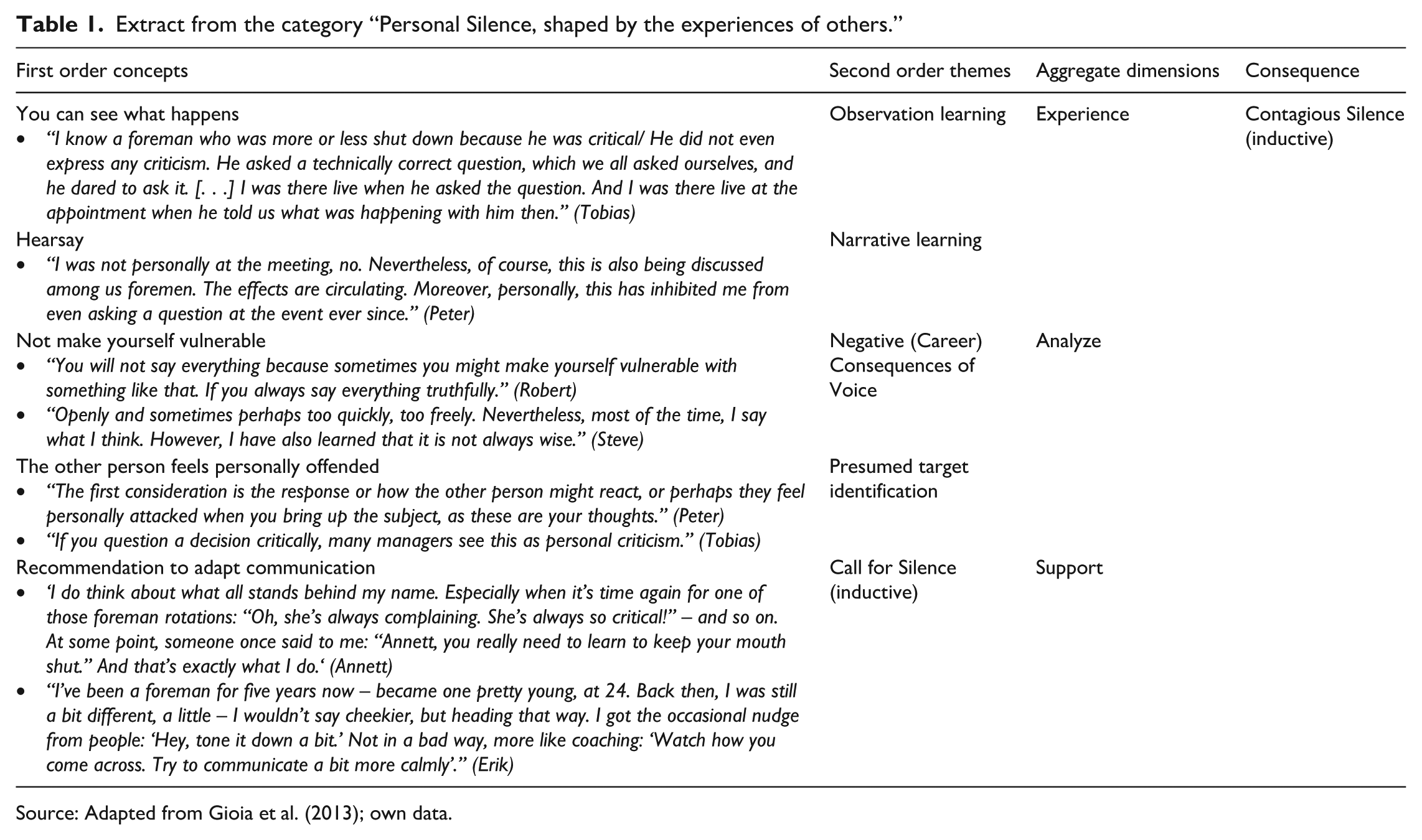
Source: Adapted from Gioia et al. (2013); own data.
Across all stages of analysis, additional categories were developed that reflect change processes over time. These “process categories” describe the evolution of voice and silence over the 3-year study period, particularly in relation to leadership behavior. Examples include relationship development (e.g. unchanged, improved, or deteriorated) and communication development (e.g. unchanged, improved, worsened).
Results
A special focus is placed on the anchor example in the following section. For this purpose, it is first described from the interviewee’s perspective, who serves as a role model for the resulting learning process. His experiences and the consequences he draws from them are particularly relevant here. Subsequently, statements from observers and other knowledge holders are analyzed to trace the incident’s consequences from multiple perspectives. Further examples from the overall study underpin these accounts. In this way, a cross-departmental attitude toward silence can be identified and reinforced through the events illustrated by the anchor example.
The critical incident
In the first interview, one participant—hereafter referred to as Karl—reported long-standing concerns regarding the company’s strategy for materials procurement. He perceived a contradiction between purchasing exceptionally low-priced materials while simultaneously investing substantial resources in quality assurance. From his perspective, overall cost efficiency might be improved by procuring higher-quality, more expensive materials, thereby reducing rework costs (Karl_3, 44–46). 3 Furthermore, he noted that the upstream area in the production chain was assessed using a performance indicator unrelated to quality, in contrast to all other areas, including his own. As a result, material quality issues remained undetected at earlier production stages and subsequently affected downstream processes in his department.
Karl is responsible for quality inspection within the examined industrial company. At the time of the first interview, he had been employed there for over 16 years, including more than 4 years as a foreman in the same department.
Since 2016, a regular management meeting has been held every 4 weeks, involving approximately 100–150 participants, including all department heads, group leaders responsible for production areas, and all foremen. The meeting format is unique in its frequency and participant composition, as it represents the only forum where all managers from all production departments convene—giving the event considerable visibility and a broad audience within the entire company. These meetings, initiated by the CEO, serve to communicate current production and sales figures as well as organizational developments. Participants are explicitly encouraged to raise questions and provide feedback.
During a meeting in autumn 2017, the new head of the quality department was introduced. Alongside this introduction, the current company key figures, including quality-related metrics, were presented. When the floor was opened for questions, Karl addressed a perceived inconsistency: he highlighted that, unlike all other production areas, one specific area was assessed based on a quantitative unit rather than quality metrics (Karl, 20). His intervention was initially met with positive, affirming reactions, followed by a calm and fact-based explanation. It was clarified that quality indicators indeed existed for the respective area; however, the quantitative metric was considered particularly relevant for international production benchmarking. Karl was invited to review the processes on-site, and the meeting continued without further notable discussion of the issue.
A few days after the meeting, Karl was summoned to a meeting with his supervisor and the department head. As a consequence of his inquiry, he received a “disciplinary measure involving personal coaching” (Karl, 22). During this process, he was required to undergo a personality assessment.
A prosocial voice leads to an attitude of being silent
Karl reports the negative consequences of speaking up: ‘They told me that they did not believe that the job of a foreman or a manager would be possible for me, that they doubted it. [. . .] Since then, I have been cautious, and I was told that it was politically incorrect to ask that [question] in this meeting before these participants.’ (Karl, 20)
He clearly explains why he remains silent at work: “Once burned, twice shy.” (Karl, 20). Karl perceives that “you cannot speak openly” due to a lack of an open communication culture within the company (Karl_2, 117).
Reflecting on organizational values, he states: ‘And then you say to yourself: ‘Well, it is not wanted in the company.’ We have our organizational values here [points to the cultural elements’ poster on the wall], our cultural elements and what we want to achieve, where transparency, appreciation, and responsibility should prevail. In the past, dissent and openness were also part of it. Honestly, these are all just words on the posters because we do not act accordingly. One must always be careful with whom one discusses things and through which channels information is shared.’ (Karl, 24)
He expressed concerns about achieving improvements within the company. His voice can be characterized as proactive, positive, and change-oriented, reflecting what Liang et al. (2012) define as prohibitive voice. Subsequently, he drew personal consequences from the effects of his intervention. In addition to describing his insecurities, Karl reflected on his own personality and skills as a foreman. Moreover, he developed a new perspective on the organization and its values, which is expected to influence his future behavior. His statements extend beyond the immediate parties involved in the incident and indicate a clear shift in his attitude toward communication within the organization. Even more than a year after the event, Karl’s accounts reveal a notable reduction in his perceived psychological safety to speak up, consistent with the concepts of Edmondson (2003) and Detert and Burris (2007). During the study, Karl decided to switch to the newly introduced night shift. Since this decision, he reports feeling more relaxed about the future, as he avoids “all this management stress” (Karl_2, 43). He adds that “on the night shift, you have the advantage that management is not on site, which allows you to concentrate better on your work” (Karl_3, 54).
Accounts similar to Karl’s were not isolated within the data. Several interviewees described specific incidents that shaped their perception of organizational communication. In these situations, participants reported having expressed improvement-oriented concerns, only to subsequently experience negative personal repercussions as a result.
For Example: ‘I have also asked questions in such meetings. Afterward, the HR manager knew me personally
4
. [. . .] However, you learn if you are there long enough — and you really do learn — that you cannot change many things anyway. [. . .] Then you get a little bit into this resignation. You withhold asking the question, and if you do not ask the question, you do not tell everything anymore. Because asking the question is the cornerstone of talking about it.’ (Chris, 96) One group leader responded to the question of whether he felt he could openly discuss his perceptions with: ‘Not at all. I do not have the feeling here (in a new department for him, the largest at the Company) that I can talk about things. So even when I moved here, from the previous department, I tried to say and address many things that I noticed, that I experienced differently in comparison, and relatively often only got ridicule and laughter; that is just the way it is, it is not pleasant.’ (Markus, 68)
Experiences from others reinforce individual implicit voice theory
Many participants clearly emphasized that they had experienced adverse consequences within the company as a result of expressing a prosocial voice. Their personal insights align with the core assumptions of Detert and Edmondson’s Implicit Voice Theory (IVT) (2011) and act as direct influencing factors (Knoll et al., 2021), leading to an increased tendency toward silence among employees. As research on implicit theories suggests, it is not only one’s own experiences that shape such attitudes and behaviors. As one participant put it: “It does have a certain influence. You also learn from the mistakes of others. It does not hurt quite as much to learn from their mistakes as it does from your own [. . .]” (Chris_3, 189). In order to complete their attribution processes as comprehensively as possible, individuals also draw on the experiences of colleagues, thereby expanding their understanding of the organization (Garud et al., 2011; Sonenshein, 2010).
The findings indicate that such learning does not necessarily require a combination of one’s own and others’ experiences. There are also respondents who reported no comparably negative personal incidents but nonetheless described a cautious attitude shaped by the experiences of others. Some interviewees even recounted many positive communication experiences, such as open and friendly exchanges with their direct supervisors. However, their overall image of the organization was still significantly influenced by the negative experiences of colleagues.
Knowledge that such incidents have happened to someone close to them at work appears sufficient for individuals to draw personal conclusions and derive behavioral rules—consistent with IVT—for themselves.
‘I am a colleague who has not yet had a bad experience. Some colleagues (voice becomes quieter) who have openly and honestly addressed topics — were technically completely correct (very formulated) — but have not considered the round, the place, and the time — and to put it bluntly — were not rewarded.’ (Peter, 24)
‘An employee [. . .] called me and said: ‘The group leader was not honest with me.’ So that is enough for me when others tell me that. That confirms [for] me again and again [. . .].’ (Matthias_2, 244)
The particular significance of the incident involving Karl, serving as an anchor example, is evident in the fact that 13 other interviewees explicitly referred to this specific event in their statements. They described it as a particularly notable and formative experience within the organization. Their accounts frequently included forms of confirmation or reinforcement of existing perceptions, illustrating how the incident contributed to shaping collective attitudes toward communication and voice behavior.
‘Yes, and that basically confirmed that you should be sparing with your criticism toward certain groups of people.’ (Alex_2, 228)
‘They stopped him cold. They wanted to silence him.’ ‘That is why no one dares to speak up anymore; that is the best example of what happens. No one wants to hear that. It is quite dangerous to stand up against it somewhere.’ (Tobias_2, 124)
‘Yes, then, of course, every foreman says to himself: I will keep my mouth shut. I am not stupid. Because that is just the way it is.’ (Matthias_2, 262)
‘Exactly for that reason, no one will ever speak up [and ask something] again, because many know what happened to the foreman afterwards. (. . .) Yes, of course – those are the kind of snapshots that stick. You don’t want to end up in such a situation yourself. You try to protect yourself a bit – you build a kind of self-protection, and you also protect your foremen by saying, “Guys, if you have questions, ask me before or afterwards.” (Thomas_2, 399)
Their indications that this event had a negative impact on them align with Karl’s account. He reported that colleagues described it to him as “an incisive experience” and that they had observed what happens when someone asks a question in the wrong context—something that could be unpleasant for certain individuals in upper management (Karl_3, 38–39). Importantly, this perception was not only shared by colleagues at the same hierarchical level as Karl but was also confirmed by his direct supervisor. In the first interview, the supervisor responded to the question of whether he would ever raise a question during a company-wide management meeting with a clear “no,” explaining that he had been influenced by one of his foremen who had once asked a “technically absolutely correct” question. As a consequence, the supervisor had been obliged (under pressure from higher management) to issue a disciplinary sanction (Jan, 237–242).
The event’s impact on willingness to speak up during meetings was further confirmed by another account reported to Karl himself. In his second interview, Karl described a “unique” moment, an “aha effect,” triggered by a conversation with the deputy chairman of the works council. A few months after the incident, the works council representative approached Karl and recounted that the CEO had asked him, following the most recent management meeting, why no foreman would speak up or ask questions during the open Q&A session anymore. According to Karl, the works council representative replied to the CEO: “Think about the last time a foreman asked a question and what happened to that one” (Karl_2, 119).
Notably, examples of silence being perceived as the safer strategy in the work context were identified across all three analyzed management levels. For instance, one department head left the company during the study period. In interviews with other participants, several explicitly referred to this department head. Another department head (Eric), as well as a group leader (Frank) and two foremen (Matthias, Steffen), cited his involuntary and premature departure as confirmation of their belief that speaking up entailed personal risk. Similar to Karl’s case, they described how this (indirect) experience had shaped or reinforced their own attitude toward voice behavior. When asked whether it was possible to express one’s opinion openly within the company, Eric responded with a qualified statement, noting that expressing one’s views was possible, but it always depended on who was listening. He then, somewhat hesitantly, explained that his colleague had been “disposed of” by their former supervisor “because he disagreed too often” (Eric_3, 128).
‘Well, they just kicked him out at the end, in our opinion, the opinion of the foremen. They pushed him out.’ (Matthias_3, 150)
‘[. . .] There is no honorable working together or anything — there is not. Moreover, that confirms what is going on here. They have done the same to Joachim, even though he is a senior manager.’ (Steffen_3, 28)
‘The colleague (his former supervisor) was fired, mistreated and he is not the only pawn. [. . .]’ (Frank_3,56)
Sharing implicit voice theory and contagious silence
Many interviewees cited the experiences of Karl or Joachim as decisive influences on their belief that raising concerns is often futile or may even entail negative consequences. Steffen, for instance, stated that he “learns every day” that his voice is ineffective—expressing a deeply entrenched conviction. The findings indicate that IVT can originate from an individual event and subsequently diffuse across broader parts of the organization. Details regarding the place and time of the story’s dissemination were of secondary relevance. The participants’ focus was particularly on explaining why this incident was so significant to them. The data indicate that the respondents were primarily concerned with the gravity of the event itself rather than with a detailed account of how and when they had learned about it. However, two distinct forms of dissemination can be identified from the data. First, many managers were present at the meeting and directly witnessed the incident. Second, knowledge of the event was later transmitted informally among colleagues—through verbal accounts, storytelling (“spread like wildfire” (Peter_2, 160)), or hearsay (“I know the story, yes. Even just by hearing it” (Max_2, 195)). Consequently, knowledge of the incident, and the lessons drawn from it, propagated through both Independent Vicarious Learning (IVL) and Coactive Vicarious Learning (CVL). In this case, as described by Myers (2018), this occurred via extended communication chains, entirely without the involvement of the original actors. The transmission of the informal rule embedded in the story likewise occurred through informal communication. Participants’ accounts indicated that its dissemination, primarily via word of mouth, took place through informal exchanges within the respective hierarchical levels. This shared awareness can be interpreted as a form of shared IVT that fosters collective defensive silence within the organization and exerts a lasting, culture-shaping influence.
‘That brings us back to the feedback culture. He simply said something that was professionally justified and well-founded, and that no one could evade. And the sanctions, of course, came loud and clear.‘ (Michael_2, 179)
‘And since then, I do not think any foreman will ever again ask a question in a management meeting [. . .]. This is a culture all foremen know what happened there. In the future, people will duck away even more [. . .].’ (Tobias, 29)
The respondents indicated that they would also share this incident with future colleagues, thereby turning the story into a specific example of a Call for Silence (see Table 1). The underlying motive is to protect oneself or others, culminating in contagious, prosocial silence.
‘Yes, of course – those are the kind of snapshots that stick. You don’t want to end up in such a situation yourself. You try to protect yourself a bit – you build a kind of self-protection, and you also protect your foremen by saying, ‘Guys, if you have questions, ask me before or afterwards’. (Thomas_2, 399)
‘(. . .) Yes, I would say that it is always a matter of the character of a particular person. So, whoever is very extroverted, you would have to slow them down by telling an anecdote like that: ‘Watch out!’. (Alex_2, 229).
Discussion
This empirical study aims to provide a more detailed understanding of how a generalized attitude toward silence (organizational silence), based on the belief that voice is dangerous (Implicit Voice Theory, IVT), can emerge, spread, and become entrenched over time.
The analysis reveals three particularly relevant findings. First, the emergence or consolidation of one or more IVTs can occur independently of employees’ own disadvantageous or silence-inducing experiences. The application of the CVL approach (Myers, 2018) allows us to understand how experiences reported by others—which do not necessarily have to be directly witnessed (1. Experience)can sustainably influence other employees’ attitudes toward speaking up and reinforce silence within the organization (see Figure 2). The results demonstrate that the Coactive Learning component of this approach, alongside storytelling (Sonenshein, 2010), represents an essential social practice in the sharing of IVTs. The specific combination of CVL and IVT has not yet been systematically examined in the context of theorizing Implicit Voice Theory and therefore expands the existing process-oriented perspective on silence. Furthermore, the findings illustrate why narratives are created and shared, encompassing both one’s own experiences and those of others, and how narrators and listeners alike internalize these experiences in the process (2. Analyze). The shared story conveys a normative message—the IVT—which may not always be expressed explicitly but is nevertheless clear in its intent. Over time, some of these stories are recounted in conversations as indirect or coded warnings, serving to subtly communicate cautionary messages to others without openly addressing sensitive issues. The transmission of this message is often based on a prosocial motive (3. Support): narrators aim to protect others from experiencing similar negative consequences by encouraging caution in communicative behavior. This helps explain the continued relevance of the message even years later and the associated cross-hierarchical dissemination of IVTs within the organization.
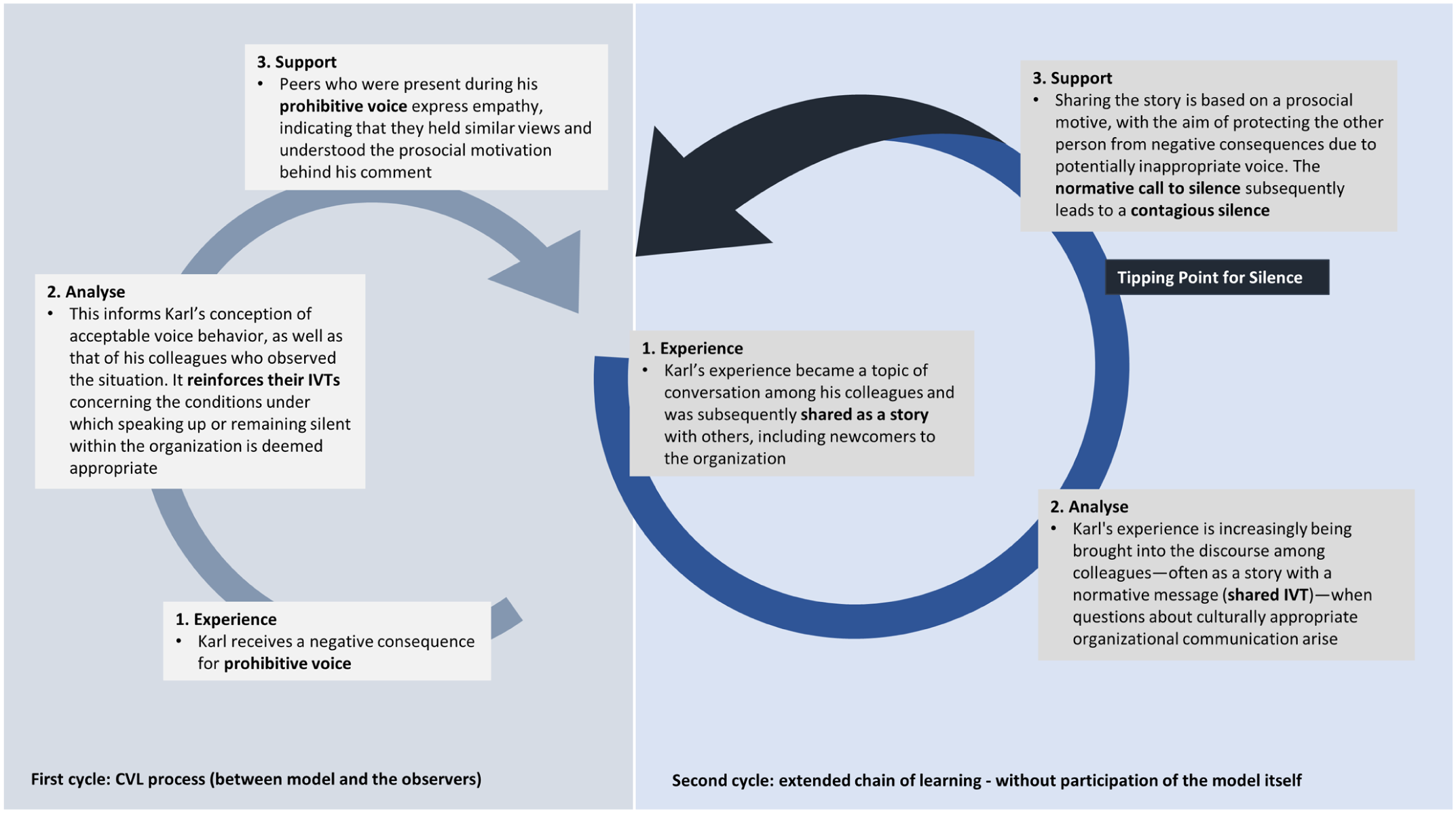
CVL learning loops—Driven by Observation and Storytelling.
The story thus functions as an indirect influencing factor on silence, as it conveys the IVT message, which is directly linked to voice and silence behavior. The mechanism of sharing IVTs shows parallels to the processual dynamics described in the spiral of silence (Bowen and Blackmon, 2003). In both cases, individuals observe their social environment to assess potential support or disapproval for speaking up. However, in contrast to the spiral of silence, where the perceived majority opinion is decisive, the findings of this study suggest a different pattern: in the anchoring example, a single event that confirms existing perceptions is sufficient to have a lasting impact on individuals’ willingness to speak up. Furthermore, interviewees explicitly expressed the intention to pass on stories such as Karl’s experience to other colleagues in the future. This behavior—actively calling for silence—contributes to maintaining and reinforcing contagious silence (see Figure 2). A cumulative spreading effect is the result of the second cycle, corresponding to the CVL. The critical event can thus become part of the organization’s history, independent of those initially involved, and persist as a “story of silence,” much like a founder’s story in organizational culture. New employees who were not yet part of the company at the time of the event may learn that silence represents a safer strategy compared to speaking up, even without having had negative experiences of their own within the organization or with their supervisors.
The second key finding of this study is that such a critical event can retrospectively be identified as a tipping point for silence (Perlow and Repenning, 2009). The event serves as confirmation or validation of employees’ prior perceptions, thereby intensifying their pre-existing IVTs as observers or listeners. Silence becomes normative and, in this sense, pathological (Perlow and Repenning, 2009). Perlow and Repenning describe a threshold beyond which individual acts of silence consolidate into silence norms, creating a self-reinforcing dynamic that results in pathological silence. The present study supports this concept and extends it by identifying an additional trigger for such a tipping point: not only can further acts of silence reinforce the spiral dynamic, but so can acts of voice (see Figure 2, especially the extended chain of learning). In the anchoring example of this study, a misinterpreted prohibitive act of voice marked the threshold for shared IVT and, consequently, a sustained collective attitude of silence. Overall, the results suggest that the tipping point—defined as the moment when an individual becomes aware of the critical event—can be understood as the moment that fosters a “high IVT” (Brykman and Maerz, 2023; Ellis et al., 2022; Hu, 2020; Ren et al., 2022), meaning a strong conviction that a specific IVT accurately guides one’s behavior. However, further research is needed to more precisely define the characteristics and distinctions between “high” and “low” IVT.
A third key finding is the emergence of a micro–macro paradox (Coleman, 1990) concerning voice behavior. At the individual or team level, employees may attribute significant prosocial value to speaking up, even when overall psychological safety within the organization remains low. Participants in this study articulated various IVTs related to social contexts and frequently cited motives for silence such as fear and resignation. Notably, these attitudes were primarily directed toward the “organization,” often understood as top management, while direct supervisors were generally excluded from this perception. In some cases, participants explicitly reported a willingness to share their opinions with their direct supervisors and expressed a higher level of psychological safety in those relationships. As numerous studies have shown (Qu et al., 2015; Wang et al., 2018), the leadership style of direct supervisors is a critical determinant of voice and silence behavior. However, in light of the present findings, it cannot be assumed that organizations with voice-supportive leadership at the immediate supervisory level necessarily exhibit low overall silence or uniformly high psychological safety. Instead, this study underscores the complexity of analyzing voice and silence behaviors, especially in organizations with steep hierarchical structures and multiple management levels.
Last but not least, several factors contributed to the formative effect of Karl’s case. First, the context in which Karl spoke carried considerable organizational weight. As already explained, this meeting format is unique in its frequency and participant composition. This lends the event a distinctive context that plays an important role in explaining why narratives of voice and silence are shared throughout the organization. Second, the perceived legitimacy of Karl’s intervention appears crucial. His direct colleagues and peers at the same hierarchical level, unlike his superiors, clearly recognized his prosocial intention and the optimization motive underlying his question. This discrepancy made the managerial response appear disproportionate, particularly to other foremen. Even those who might not have acted as Karl did understood the constructive intent behind his inquiry, which amplified the perceived injustice of the consequences he faced. Third, this event exhibited a clear cause-and-effect relationship. The disciplinary action taken against Karl was an immediate and direct response to his comment during the meeting. Unlike many accounts in which respondents stated that they remained silent due to unclear or indirect negative consequences, this case provided unambiguous evidence that speaking up entails organizational repercussions. The visibility, perceived injustice, and causal clarity of this event likely combined to make it a powerful symbolic marker of the actual—as opposed to espoused—rules governing voice behavior in the organization.
Limitations and future research
There are several limitations regarding the research design of this study. A multi-perspective approach was chosen to approximate an objective assessment by combining self- and peer perceptions. This mirroring increased validity and helped minimize bias effects such as social desirability (Khalid and Ahmed, 2016; Krosnick and Presser, 2010; Paulhus, 1984, 1986). Nevertheless, common method bias (Podsakoff and Organ, 1986) cannot be entirely ruled out. Moreover, previous research on silence has rarely adopted a process-oriented perspective. Concepts such as ineffectual silence (Brinsfield, 2013) or acquiescent silence (Pinder and Harlos, 2001) suggest that silent behavior often follows prior, ineffectual communication attempts. This underscores the importance of jointly considering voice and silence as interrelated phenomena. The longitudinal design applied here provides initial insights, but further research is needed to fully capture the dynamic interplay of voice and silence. The narrative process strategy applied combines historical, retrospective accounts and real-time data. This entails the risk of distorted memory for events that occurred years ago. To mitigate this, statements from several sources were compared. Narrative data collection also has inherently low generalizability (Langley, 1999). Although longitudinal data were collected, it cannot be excluded that other influencing factors—such as additional personal experiences between interviews—impacted future attitudes (Roe, 2008). To limit this, interview intervals were kept as short as possible, supplemented by informal exchanges with HR managers.
A further observation was that specific anchor examples were described as symbolic stories representing the company’s culture and its implicit norms, even though many other individual examples existed. One explanation may be the broad visibility of Karl’s meeting contribution and his prosocial intent, which resonated with his colleagues. Joachim’s case illustrates that even senior managers are not immune to the negative consequences of voice, reinforcing its relevance. Finally, the silence of managers themselves remains an underexplored area. While prior research has focused on how managers perceive or enforce silence, the active silence of managers—particularly in sandwich positions—has not yet been systematically investigated. Given the likely cognitive tensions in this group, targeted research into their ethical and responsible communication behavior appears warranted. In such a research design, questions of power structures and silencing processes would gain heightened relevance. While these factors are not irrelevant to the present study—given that employee silence is inherently defined by power asymmetries, as it involves withholding information from those who have the authority to act upon it (Morrison and Milliken, 2000; Pinder and Harlos, 2001; Van Dyne et al., 2003)—the conceptual focus here was placed elsewhere. The act of speaking truth to power represents a direct challenge to hierarchical authority relations, and its suppression through silencing mechanisms exemplifies how power structures shape communicative behavior in organizations. An analysis that explicitly foregrounds power dynamics and silencing mechanisms could yield valuable complementary insights and represents a promising avenue for future research.
Implications for practice
The findings suggest that establishing formal voice structures is necessary but insufficient for fostering genuine employee voice. Beyond structural provisions, organizations must critically examine the power dynamics in which voice occurs. Karl’s case exemplifies “speaking truth to power”—a prosocial motivated attempt to address a process inconsistency that directly affected his work. However, in hierarchical authority relations, such fearless speaking can be dangerous (Morrison and Rothman, 2009), as it potentially undermines the authority of the managers addressed and challenges their public representation of power and status.
The disproportionate managerial response reveals multiple tensions that both organizations and managers should recognize for practical reasons. First, while Karl’s choice of forum may have been suboptimal, his behavior did not constitute genuine misconduct. Second, and particularly problematic, is when organizations espouse values of openness and transparency while simultaneously penalizing employees who enact those values. This contradiction undermines organizational credibility and signals to employees that proclaimed values are merely symbolic rather than authentic guides for behavior. Third, and critically, a shared culture of avoidance appears to dominate organizational meetings—where truth is legitimately communicated top-down, not bottom-up. Karl ignored this implicit context of power, knowledge, and truth. His violation was not merely asking a critical question, but doing so publicly, thereby disrupting what Zerubavel (2006) terms the “elephant in the room”—the collectively maintained silence around uncomfortable organizational realities.
Furthermore, the organizational impact extends beyond the individual. Employees who witnessed or learned of Karl’s treatment adopted silence as an active behavioral strategy—precisely the defensive response documented in voice literature (Knoll and van Dick, 2013; Pinder and Harlos, 2001). This silence represents neither empowerment nor strategic choice, but rather a calculated withdrawal based on observed consequences and a rational assessment of risk in an authority context where bottom-up truth-telling is culturally illegitimate.
Therefore, to foster genuine voice, organizations must move beyond rhetoric to critically examine how power is exercised in response to employee participation. This requires managerial reflexivity regarding the cultural foundations of leadership authority: does it rest on unquestioned positional power, or can it accommodate critical inquiry? Additionally, organizations should actively attend to informal narratives circulating across hierarchical levels, as these reveal tacit fears and assumptions that shape psychological safety more powerfully than official communications (Reissner et al., 2024; Wilson and Sole, 2002). Without addressing these underlying power dynamics and cultural norms, formal voice mechanisms remain empty structures.
Conclusion
This study contributes to a more nuanced understanding of how silence emerges and spreads within organizations. The findings emphasize that silence is not a static condition but a dynamic, processual phenomenon, reinforced through communication—particularly through storytelling about negative voice experiences. Such narratives transmit implicit voice theories (IVTs), shaping normative behavioral expectations across employees and over time. Storytelling thus functions as a key mechanism through which collective defensive silence develops and persists, often beyond direct managerial awareness.
The study highlights the importance of examining voice and silence as interrelated, evolving processes, embedded in power relations, rather than isolated constructs. Future research should therefore focus more closely on their longitudinal dynamics. Ethnographic and longitudinal approaches are particularly valuable for identifying tipping points: specific events or communication episodes that decisively shift organizational behavior patterns—either reinforcing silence or reactivating voice. Understanding these moments more precisely could significantly advance both theoretical insight and practical interventions in managing voice and silence in organizations.
Footnotes
Acknowledgements
The author would like to thank Prof. Dr. Schirmer for his valuable guidance and constructive feedback throughout the development of this manuscript. She is also grateful to Prof. Dr. Blagoev and the OMG research group at TU Dresden for insightful discussions. The author further thanks the study participants for sharing insights on issues they might otherwise have remained silent about. Further thanks go to Ms. Kubiak and Ms. Schönitz for their collegial support. The author additionally thanks the handling editor, Prof. Dr. Haunschild, and the two anonymous reviewers for their helpful and constructive comments.
Funding
The author received no financial support for the research, authorship, and/or publication of this article.
