




Abstract
This introduction to the special issue Achieving Sustainable Development Goals through Common-Good HRM: Context, approach and practice draws the links between the United Nations Sustainable Development Goals (SDGs), the concept of Common-Good HRM and the practice of human resource management (HRM) to extend intellectual and empirical insights into this important field. Particular attention is accorded to the collective social and environmental dimensions of SDGs and the place of HRM in contributing to the ‘common good’ within and beyond the workplace. Firms may create space and incentives for HRM to promote sustainability, or actively work to constrain meaningful action in this regard. This collection brings together a broad cross-section of articles dealing with the SDGs and HRM, identifying emerging common ground and contestation as a basis for future HRM theory building, empirical enquiry and practice.
Keywords
Introduction
Sustainability has become a catchword in policy statements and corporate rhetoric. But if communities and businesses are to survive and thrive, collective action is needed (Sarasvathy and Ramesh, 2019). Sustainability has been defined and interpreted in a number of different ways. For this special issue, we take a broad-based view in line with the United Nations (UN) Sustainable Development Goals (SDGs) (United Nations (UN), undated). The natural world is important to us as without well-functioning global, natural ecosystems, the opportunities to develop thriving socio-economic systems are undermined and will gradually be destroyed. Accepting ‘planetary boundaries’ (Richardson et al., 2023) and actively supporting the ability of natural systems to regenerate themselves are a prerequisite not only for the long-term survival and well-being of humans on planet Earth but also for doing business (Aust and Gehrke, 2024). The goal of long-term environmental sustainability, the SDGs, and concerns of human rights, social justice and economic well-being go hand-in-hand. There is already growing awareness that it is in the self-interest of business organisations to contribute to more sustainable socio-economic systems (e.g. UN Global Compact). The question is not whether business organisations need to engage in sustainability and ecological and societal progress but how sustainability transformation and the many systemic transitions needed can best be put into place (Busch et al., 2024; Reppmann et al., 2024).
There has been a surge of literature on how human resource management (HRM) can contribute to the sustainability agenda (Guerci et al., 2023; Ren et al., 2023). Due to need to find an effective antidote to an increasingly unstable socio-economic environment, the past few years have also seen the rapid development of a ‘sustainable HRM’ narrative (Aust et al., 2020). The growing interest in sustainable HRM is for example shown by several Special Issues published in Human Resource Management (Ren et al., 2023), Human Resource Management Review (Westerman et al., 2020), management revue (Ehnert and Harry, 2012), German Journal of Human Resource Management (Jackson et al., 2011) and recent calls for papers in Human Resource Management Review (Shipton et al., 2024) and in management revue (Jebsen et al., 2024). Another indicator is a growing number of review articles on sustainable HRM (e.g. Kramar, 2022; Macke and Genari, 2019; Podgorodnichenko et al., 2022).
The proliferation of sustainable HRM research in the last decade means that the same term, sustainability, may be used to describe different aspects of HRM practices relevant to it. Aust et al. (2020) categorised four types of sustainable HRM: socially responsible HRM (Shen and Benson, 2016), green HRM (Jackson et al., 2011), Triple Bottom Line HRM (Bush, 2020), and Common Good HRM (CGHRM) (Aust et al., 2020). While there are overlaps in these types, the key distinction of CGHRM is that it is based on the recognition that the most important of the grand challenges centre on a breakdown of people’s relationship with themselves, society and the natural world (Aust et al., 2020; Rosa, 2019). Hence, CGHRM is explicitly multi-stakeholder and socio-ecologically focused, and considers not only the immediate direct effects of HR strategies and actions on internal stakeholders, but also the potential indirect and delayed ones, on both internal and external stakeholders. The latter may contribute to negative or positive feedback loops enmeshing a range of socio-ecological systems.
According to Aust et al. (2020), CGHRM can today be found in companies – such as those that are in the B-Corp or the Economy of the Common Good Movement – defining their purpose as being contributions to solving the world’s largest problems (Grand Challenges), instead of generating only profit. However, the authors also suggested that recent developments, in particular the SDGs, provide an incentive for financially-purpose-driven firms to develop their HRM in the direction of CGHRM.
In this Editorial, we understand the ‘common good’ as a socio-ecological perspective encompassing both immediate communities, local and global society (the local and global commons), but also other living creatures and our shared natural, planetary ecosystems. We hypothesise that the effectiveness of the HR function in making that contribution depends on its willingness to genuinely engage with contributions to the ‘common good’ defined above.
The special issue seeks to advance this important field with new intellectual and empirical insights. In this editorial article, we first introduce the debate about the responses to global ecological and social grand challenges in the form of 17 SDGs as an increasingly relevant context for HRM. Next, we interpret sustainability reporting as one of the corporate governance tools for achieving SDGs and as a major driver for sustainable HRM. Third, we briefly review and differentiate sustainable HRM and CGHRM research. In the fourth section, we outline opportunities for future research on HRM and SDGs from a CGHRM perspective. We also introduce the unique contributions of the six articles in this Special Issue.
UN SDGs as a response to grand challenges: An increasingly important context for HRM
It is widely recognised that there has been a lack of progress and continued uncertainty as to how to most effectively address the ecological, social and economic ‘grand challenges’ (Doh et al., 2021; George et al., 2016). Grand challenges have been defined as urgent, complex problems of global relevance such as climate change, prevention of pandemics, loss of biodiversity, plastic pollution (Garlei and Bartel-Radic, 2024), poverty, social inequalities and more. The UN’s ‘2030 Agenda for Sustainable Development’, consisting of 17 SDGs (UN, undated), has emerged as an important response and benchmark for both business in general and HRM specifically as to what needs doing (Aust et al., 2024; Chams and García-Blandón, 2019).
While analysing grand challenges and setting up ambitious goals is one thing, contributing in effective ways to these SDGs is not possible without the active support of business organisations, including HRM policy and practice, around the globe. The UN member states have set themselves a target for achieving the 17 SDGs by 2030. While progress on some of the SDGs has been made, the world community collectively is further away, with none of the goals being on track to be achieved by 2030. Despite this, or maybe even because of this, we argue that the grand challenges and the ability of businesses to choose effective strategies to handle them will shape the management context for business organisations and HRM in the decades to come. Therefore, HRM could find themselves in the role of proactive ‘survival strategists’ (Ehnert and Harry, 2012) or only ‘emergency responders’, as they have been in the case of Covid-19.
The practical relevance of SDGs for business and HRM is increasingly strong. For instance, the UN Global Compact labelling itself as ‘the world’s largest corporate sustainability initiative’ (https://unglobalcompact.org/what-is-gc) organises business support for global sustainable development and for delivering SDGs. In January 2024, more than 12,000+ companies from over 160 countries and nearly every sector and size had signed the Global Compact (https://unglobalcompact.org/what-is-gc, last accessed on 01 Feb 2024). The ambition of the Global Compact is to use ‘business as a force for good’, and to link business strategies and operations to deliver ‘societal goals, such as the UN SDGs’ (https://unglobalcompact.org/what-is-gc/mission). This (relatively) new context and hence increased interest in corporate sustainability has been reflected in management literature highlighting the potential contribution of HRM structures, strategies and practices towards organisations to meet sustainability goals (Ren and Jackson, 2020; Stahl et al., 2020).
The International Labour Organization (ILO) has also developed the notion of ‘human-centred’ HRM to support the achievement of the SDGs (Cooke et al., 2022), such as SDG 8 (sustainable economic growth and decent work for all). The stakeholder-friendly concept of decent work is based on the common good argument that a heightened concern with human well-being, social justice and dialogue, is an integral part of achieving long-term competitiveness, economic prosperity and building a sustainable future – and as a result, needs to be embedded in all areas of business strategic decision-making.
Sustainability reporting as a driver for sustainable HRM
We hypothesise that one of the main drivers for sustainable HRM seems to be sustainability reporting into which HRM strategies and practices are increasingly embedded. In the past two decades, a range of (overlapping) sustainability reporting standards has been introduced to regulate firms’ behaviour and capture their practices/performance that may contribute to achieving SDGs. The main idea behind sustainability reporting is to induce reflections about and measures of non-financial outcomes of business practices as well as to create transparency and accountability. Moreover, it has become normal business practice to link HR practices to SDGs (c.f. Stahl et al., 2020). For example, many business organisations report about their efforts to increase the proportion of women in management positions and link this to SDG 5 ‘Gender Equality’.
However, sometimes there is a thin line between best practices and greenwashing (Parsa et al., 2023; Uyar et al., 2020). For example, Yu et al. (2020: 1) pointed out that the ‘environmental, social, and governance (ESG) data provided in firms’ sustainability reports is often unaudited’ and that firms engaging in greenwashing behaviour may ‘seem very transparent and reveal large quantities of ESG data but perform poorly in ESG aspects’. Lashitew (2021: 184) also identified ‘a risk of corporations misusing the SDGs for “greenwashing” and “impact washing” their activities, e.g. through selective reporting of favorable information’, and this inaccurate ‘and non-transparent disclosure can also introduce information asymmetries that distort decision-making by investors and other stakeholders’. Nevertheless, although greenwashing is often apparent, the people management sections of sustainability reports suggest that companies themselves see their HR function as being highly relevant for the achievement of SDGs.
In other words, the question emerges as to whether voluntarism can be meaningful (Muller et al., 2014), or indeed effective for firms to act responsibly. One indicator is the growing importance of ESG ratings for investors, which may provide non-regulatory incentives for meaningful managerial action (c.f. Tsang et al., 2023). These ratings are based on sustainability reporting and thus not surprisingly these are increasingly renamed as ESG reports. Although this does not seem to make much difference to the reporting of environmental and social aspects in these reports, governance now plays a more central role. In ESG reports, business organisations are required to describe in detail how they assure the implementation of environmental and social sustainability and how top management is involved in its governance. Moreover, whereas in the past sustainability reports may have just been a field of activity for CSR managers and public relations departments, now the issues reported have financial implications for businesses (Baumüller and Sopp, 2022).
In the European Union (EU), and increasingly other regions and countries in the world, the taxonomy has an impact, as this regulates loans from banks. Already today but even more so in the future, banks will consider not only the financial viability of a creditor but also their achievements in regard to ESG criteria. Here, ESG loans are also important. These are loans below the market rate (e.g. 0.5 percentage points) for which creditors promise the achievement of ESG-related goals. For example, Greiner, an Austrian producer of plastic goods, signed a promissory note ESG Green loan of € 147 million in 2022 (Greiner, 2022). The three targets set to be achieved by 2030 were 100% renewable electricity, 40% women in leadership positions (in 2022 the percentage of female managers was 26%), and 99% of strategic suppliers rated with at least 50 points by EcoVadis. For the first time, this and other companies signing such loans therefore link sustainability targets to financial goals. Jia and Shang’s (2024) study also shows the significant role green finance can play in encouraging firms to develop green HRM practices to help them enhance their environmental performance and boost employee happiness in China.
The ESG turn in corporate finance may help drive managerial attention towards greater sustainability, and this may directly impact HR practice, given that it is more straightforward to make directly measurable interventions in this area than in many other areas of corporate activity. However, a few caveats are in order here. The first is that the various ESG ratings are poorly correlated in terms of firm-level outcomes (Gibson Brandon et al., 2021). Indeed, some have been retrospectively revised to make the links between ESG and performance stronger (Berg et al., 2020). The Governance dimension may drive organisations away from, rather than towards progress in terms of the environment and the social, for example, strong shareholder rights may force firms towards excessive short-termism. Conversely, worker representation on the boards may enhance firm social performance, but weaken it in terms of governance performance (Nekhili et al., 2021), or at least how the latter is defined under the various ratings. A second problem is that companies may be overselling their actions and contributions, leading to ‘sustainability reporting washing’, that is, companies doing the minimum. For example, some large corporations may use only part of their business sections, usually those that can meet the ESG standards easily, to obtain ESG certifications. A third issue is that ESG measures/metrics are standardised and lack local relevance in the international business context. For instance, to fulfil their ESG reporting requirements, Western-headquartered MNEs may be forced to implement certain labour standards across their subsidiaries which may not reflect the local conditions appropriately. Moreover, the cost of reporting is borne by the subsidiaries or suppliers, which are forced to adopt practices not suitable or affordable to them. For example, Beddewela and Herzig’s (2013) study of MNEs CSR reporting in Sri Lanka indicated normative pressure by headquarters and their reporting requirements. As a result there was little accountability for the needs of local stakeholders such as separate home country social reports .
We conclude that sustainability reporting is an important tool for business organisations to monitor and report on their contributions to SDGs with substantial impact on all organisational functions, including HRM. It is the role of HRM scholars to identify and support practitioners through evidence-based research and recommendations, which is an issue to which we turn now.
Evidence-based research on sustainable HRM and SDGs
The transformational challenges are huge, and so is the risk that the world community fails because awareness does not mean action (Aust and Gehrke, 2024). In the societal sustainability transformation, HR professionals and the HR function sit in a Janusian – double-faced – role, looking both inside and outside of their organisations simultaneously (Ehnert, 2009; Ren et al., 2023). On the one hand, HRM is inside-looking. HRM sets up strategies, policies, practices and processes to recruit, develop, deploy and retain the right employees in line with organisational goals. All of these employees are already or will be at some point in the not-so-far future affected by what we described as grand challenges. In addition, these employees might search for jobs where they can be part of solving problems related to grand challenges, rather than creating them. Therefore, the strategic role of sustainable HRM is simultaneously outside-looking because HR is subject to institutional pressures, including formal and informal regulation, from the community of stakeholders (Jackson and Schuler, 1995). Strategizing involves understanding local and global management contexts, and taking account of uncertainty (Pucik et al., 2023). Hence, HR professionals should develop a good understanding of the grand challenges and what it means for their business and function (Matthews et al., 2018). It is not enough to leave this discussion with sustainability departments who unlike HR often sit directly next to CEOs (e.g. Reppmann et al., 2024).
Even if HRM is relatively disempowered within a firm, it needs to consider the choices made elsewhere, to seek to ameliorate pressures to inaction or greenwashing, and in case of persistent inaction, to work on devising compensatory HR policies and strategies. The latter is not necessarily that of HRM playing an insurgent function but being able to progress meaningful improvements and mitigations within the available frame of action. Although HR departments may be marginalised, it is rare for them to be completely disempowered, and over-assumptions as to the latter may itself be an excuse for inaction. Instead, HR departments and professionals could and perhaps even should play an active role as institutional actors in driving the sustainability agenda (Ren et al., 2023). By becoming more aware of the real-life consequences of HR practices on grand challenges and by reframing HR strategies, policies and practices, the HR function could contribute to the SDGs (Ghauri and Cooke, 2022). In this regard, Baldassari et al. (2024) describe how sustainable HRM can have a positive impact on all SDGs. For example, a focus on the human rights of employees in the supply chain can help to reduce poverty (SDG 1) and ensure healthy lives and promote well-being (SDG 3). Such HRM practices are underpinned by the moral obligation of the business and put societal well-being as one of their key concerns, which is in line with the CGHRM proposition.
A common-good perspective of sustainable HRM: Emerging literature
Since its publication, Aust et al.’s (2020) article on CGHRM has attracted a growing level of attention and citations. Some of the citations are in regard to their review of the sustainable HRM literature and in particular the typology of the field they introduced. For example, Su et al. (2023) position their research within the typology of socially responsible HRM and suggest that future research could repeat it by exploring it within the three other types of sustainable HRM. However, many scholars, refer explicitly to the CGHRM concept introduced in this article. Interestingly, the concept has generated the most interest in Asia. In the Vietnamese context, Pham et al. (2023) have studied how CGHRM relates to employee behaviours in the workplace. To do this they developed and validated a CGHRM scale composed of four items. Their research indicates that CGHRM positively influences ethical employee behaviours and organisational citizenship behaviours towards the individual. With data from firms in China, Lu et al. (2023) study sustainable HRM based on common good values which they call SHRM-CGV. Their study suggests that SHRM-CGV contributes to both employee well-being and employee performance. As a final example, Taylor and Earl (2023) apply the CGHRM concept to the management of older employees. More specifically, they propose that adopting the outward-looking perspective of CGHRM could lead employers to go beyond just focusing on older workers to adopt a life-course approach. Furthermore, following a stakeholder perspective could draw younger workers into the debate. The focus of CGHRM on equity and fairness could lead to a more meaningful experience of work and a rejection of using early retirement in transition periods. However, with an (overly) strong focus on stakeholder theory, the novelty of CGHRM is limited. This is why we aim at making concrete suggestions for future research including recent and additional theories.
Extending the field: Future research directions and contributions from this Special Issue
Future research on SDGs and a CGHRM perspective
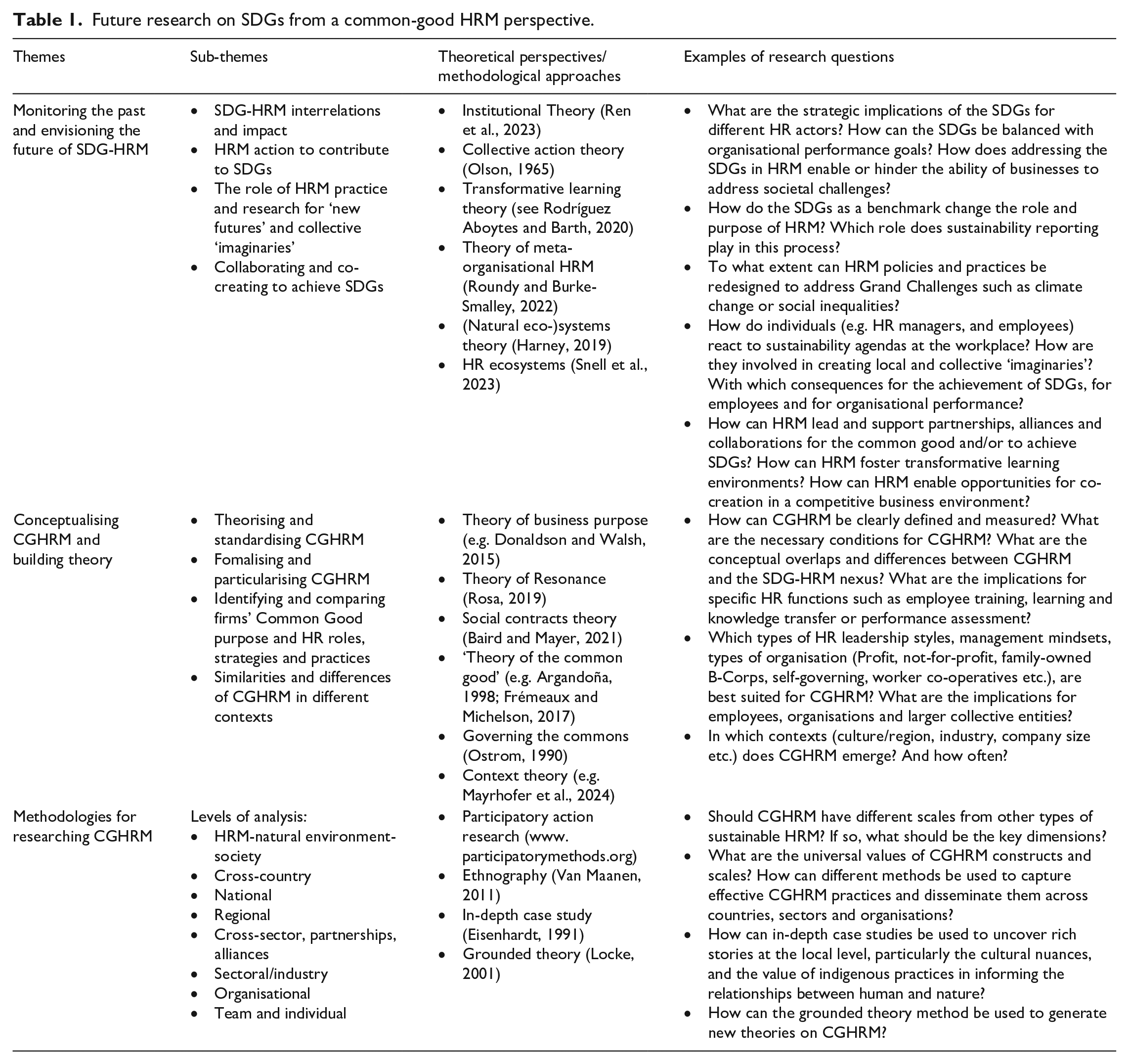
Given the recency of linking SDGs and HRM and the concept of CGHRM coined by Aust et al. (2020), there remain many research avenues to advance the field. In Table 1, we highlight the potential that we see in research on SDGs from the perspective of CGHRM. We describe three broad research themes and make suggestions for multiple theoretical lenses that could be leveraged to examine the link between CGHRM and the achievement of SDGs and provide potential questions for future research. The first research theme is about the role of HRM in monitoring past activities regarding their effectiveness in contributing to SDGs and about imagining more sustainable ‘futures’. The second theme is about the theoretical conceptualisation of the SDG-HRM from a CGHRM approach and about theory-building activities. Finally, Theme 3 is about methodologies to inform empirical research on CGHRM.
Future research on SDGs from a common-good HRM perspective.
Theme 1: Monitoring the past and envisioning the future of SDG-HRM
Sustainability reporting looks into the past and so does empirical HRM research – what organisations have done (or not) and how they communicate about it. Past actions and contributions of HRM to SDGs can be made transparent and monitored in sustainability reports. This is an important step because many business organisations do not yet understand the complexities of their impact on global Grand Challenges and they want to measure progress made towards achieving SDGs. Future HRM research can embrace UN SDG targets and indicators to inform efforts to monitor the past, potentially in combination with existing key performance indicators to monitor progress on SDGs. It will be an important task for HRM scholars to critically reflect on which SDG targets and indicators are useful for establishing a link between SDGs and HRM’s long-term outcomes regarding specific HRM practices (e.g. Brandl et al., 2024) with the goal of ‘helping practitioners to deal with issues that are important to our societies’ (Brewster and Brookes, 2024).
However, there is a broad consensus that looking into the past is insufficient for a successful sustainability transformation. Instead, the sustainability literature suggests that ‘new futures’ and collective ‘imaginaries’ (see Arora-Jonsson, 2023) need to be created to motivate people to act and that transformative learning could be key. Co-creation and collaboration in cross-sector alliances, networks and partnerships are the ‘gold standard’ in sustainability practice for achieving SDGs. Future HRM research could explore the role of HRM in these processes and also in the task of envisioning ‘new futures’ and collective ‘imaginaries’. In addition to well-established HRM theories (Townsend et al., 2019), we encourage researchers to make use of theories in sustainability research and education such as collective action theory (Olson, 1965), transformative learning theory (Rodríguez Aboytes and Barth, 2020) and of theories which allow a deeper systemic analysis of how individual and collective HRM actors could make effective contributions to achieve SDGs (e.g. Harney, 2019; Roundy and Burke-Smalley, 2022; Snell et al., 2023). Developing HRM visions and policies that allow employees to better make sense of how their work for an organisation contributes not only to the business but also to society and the planet, is just one of the potential CGHRM topics.
Theme 2: Conceptualising CGHRM and building theory
CGHRM has been suggested as one possible approach to conceptualising sustainable HRM and these suggestions have been well-received in the research community. However, as Brewster and Brookes (2024) point out, future research needs to consolidate, clarify and if needed redefine existing conceptualisations of sustainable HRM and CGHRM. Important research tasks will be to compare meanings of definitions, concepts, measurement scales and empirical contexts to build theory (see Table 1, see also Solinger et al., 2024). In our view, particularly relevant to the definition and development of CGHRM are theories that examine the purpose of business (e.g. Brosch, 2023; Donaldson and Walsh, 2015), the relationship between HRM and its environment outside the organisation, including the natural environment (e.g. Rosa, 2019), and theories of the common good (e.g. Argandoña, 1998; Frémeaux and Michelson, 2017; Ostrom, 1990). These theories can support thinking about the role and ‘ultimate and enduring’ (Brosch, 2023) purpose of HRM, as well as HRM objectives beyond its contribution to profit and in relation to the SDGs. While the SDGs make a universal claim, their relevance in specific HRM contexts has not been similarly considered (Aust et al., 2024). HRM scholars have a long tradition of contextual research (e.g. Mayrhofer et al., 2024) and studying different contexts of CGHRM is important to understand which ‘commons’ HRM professionals consider, why and how the corresponding practices are implemented. We suggest considering new or specific methodologies for some of these studies of CGHRM.
Theme 3: Methodologies for researching CGHRM empirically
Researching the link between SDGs and HRM from a CGHRM perspective requires empirical research at multiple levels of analysis. Promising empirical methods could be participatory action research, ethnographic research and in-depth case studies, including grounded theory methods. Given the ecological and the outside-in orientation of CGHRM, these methods offer the potential to generate rich insights into local practices and solutions that can be shared across different parts of the world. Where large-scale and compatible data are available, cross-country comparative analysis would be highly valuable to map out differences across regions and countries and to capture the potential causality of HRM policy actions and SDG outcomes. The adoption of these methodologies for data collection and analysis requires the researchers to be open-minded, with an inductive rather than deductive mindset, and be receptive to indigenous practices that may be novel to the Western world.
In short, there has been a proliferation of work on sustainable HRM. Considering the common good can broaden the debates in contributing to theoretical proliferation through the drawing in of theory from other fields, and indeed, in sequential theorising, in extending existing theory through drawing in insights from other, cognate and compatible ones. Of course, common good theory may be taken as a unit theory in its own right. In this latter instance, it could be fitted into more than one programmatic theory; future theoretical work could consider which programmatic theory may provide an overarching framework. On an applied note, authors may be well advised to deploy a healthy scepticism to any off-the-shelf measures of sustainability; critically interrogating their underlying assumptions and probing the reasons behind inevitable disparities in findings that emerge from the comparative deployment of more than one metric devised to assess the same phenomenon.
Contributions from this Special Issue
For this Special Issue, the Guest Editors invited empirical and conceptual papers that examine and theorise the relationship between the UN SDGs and HRM. In our Call for Papers (Aust et al., 2022), we stated that we welcome perspectives from HRM and related fields that deal with people management, work and employment. We asked for submissions that examined how HRM can reframe policies and practices in a way that allows organisations to contribute to the achievement of the UN’s SDGs We expected that research would show differences in how businesses across the world would tackle these challenges and contribute to achieving SDGs. We wanted to not only welcome papers that would challenge mainstream HRM models, but also critically reflect on the ‘Sustainable HRM’ debate. We also explicitly proposed to examine the CGHRM model’s ability to facilitate environmental and societal change. Finally, we were interested to learn more about the potential of the SDGs as a benchmark for HRM.
After the submission deadline, the Guest Editors realised that the authors had on the one hand used all four sustainable HRM types identified by Aust et al. (2020) and on the other hand not yet fully mobilised the potential of research at the UN SDGs-HRM nexus. One reason could be the novelty of the concept of ‘common-good HRM’, especially for empirical studies (which are underway but with a certain delay to the publication of concepts). Second, the idea of explicitly connecting UN SDGs-HRM also is a relatively recent one (Chams and García-Blandón, 2019; Kramar, 2022) and more in-depth exploration is underway (Aust et al., 2024). Our special issue extends the emerging literature on SDGs and CGHRM through six articles that draw our attention to different issues, perspectives and dynamics related to the topic.
Brewster and Brookes (2024) have contributed a conceptual paper to this special issue that addresses possible links between SDGs and HRM. The authors acknowledge that the SDGs have value for HR managers. The SDGs can help HRM to identify crucial aspects of their role that they currently often do not fulfil such as fostering decent work, equality, and fairness in the workforce and thus can act as a valuable compass. The traditional focus of HR on performance leads to an emphasis on aspects such as talent management, flexible working practices and cost-effective workers, an emphasis that contradicts the SDGs. However, Brewster and Brookes (2024) also acknowledge that there are problems with the Sustainable HRM literature as well as the SDGs such as construct clarity which makes it difficult for HR specialists to engage with them. Even if this can be overcome, they are sceptical that HR has any power to change the status quo in their organisations, as long as there is no transformative change.
From a convention theory perspective, Brandl et al. (2024) explore how different institutional actors collectively shape the outcomes of an apprenticeship programme designed to reskill temporary workers in an Austrian manufacturing firm through the mechanisms of ‘consolidation’ (keeping a convention) and ‘conversion’ (changing a convention). The contribution of this exploratory case study is both to analyse the processes and decisions in the realisation of an apprenticeship programme and how these influence its direct outcomes and long-term consequences for achieving (or not) specific UN targets from SDGs 4, 5 and 8 (e.g. decent work, quality education and gender equality).
With an exploratory case study in Norwegian fossil fuel giant Equinor, Crichton et al. (2024) address the grand challenge of global warming and the role of a green HRM in guiding sustainability transformation. Their study contributes to a better understanding of the importance of combining a sustainability-oriented organisational culture and top management in line with a corresponding remuneration scheme for positive effects on organisational environmental performance (here, to reduce carbon emissions). In Equinor’s case, the company is embedded in the context of a national culture and legislation supportive of sustainability values and the scenario of becoming a ‘low emission society’. Despite this, the authors remain critical and highlight one of the challenges that probably many traditional industrial companies encounter: balancing the tension between profit and environmental concern.
Geradine and McWha-Hermann (2024) examine the role of HR managers in advancing decent work by enacting fairness in financial reward in international non-governmental organisations (INGOs). The authors investigate why and how HR managers can influence pay decisions and processes in INGOs to enhance the level of fairness which is central to decent work. They conclude that HR managers can be strategic actors to proactively promote fair reward by adopting one of identified roles, such as ‘visionary’, ‘gatekeeper’ or ‘technical consultant’. Geradine and McWha-Hermann argue that context is critical in shaping these roles of the HR managers in enacting fair reward as they navigate the challenges and constraints stemming from outside their organisations, including focusing on influencing different justice dimensions and leveraging disruption in the external environment. This study exemplifies the proactive role of HR managers in contributing to SDGs in general and decent work specifically.
Järlström et al. (2024) use sustainability reporting to examine the connection between CGHRM and common good values. More specifically they are interested in the common good authenticity of sustainability reporting of HR issues. As reporting is very much determined by reporting frameworks and metrics, reports are not strong in this regard. Based on their research, Järlström et al. (2024) propose that CGHRM should have a strong humanistic-ethical orientation and make human beings and their flourishing a primary concern. In particular, HR should treat employees with respect and dignity and consider them as whole persons, as only then will they live to their full potential. Overall this paper makes an important contribution as it enriches CGHRM with common good values.
Kruse and Wegge (2024) argue that promoting a constructive error management culture (EMC) can help organisations to embrace positive societal and ecological change for addressing grand challenges. The authors identify constructive EMC as a CGHRM practice. In their research, they examine EMC’s effects on employee innovativeness and internal CSR through the study of employees working in teams of a large telecom MNE across its subsidiaries in 10 countries. They found that the embeddedness of employees in different teams (i.e. the complex interplay of team composition) and national cultures are significant factors that influence the effect of constructive EMC. Kruse and Wegge’s research supports the benefits of applying CGHRM practices.
Conclusion
The pressure to achieve SDGs is unlikely to ease, especially in light of the slippage in meeting the targets around the world. Business organisations are subject to growing scrutiny on not only their economic but also environmental, social and governance performance. Sustainability reporting, which is a public demonstration of the organisation’s commitment to the sustainability agenda, is increasingly mandatory for firms and countries. People’s attitudes and behaviours can be (re)shaped, for instance, in resource consumption and environmental protection. However, the achievement of the SDGs requires novel collaborative actions from multiple stakeholders, in which business organisations can play a critical role. To do so, they need a workforce who have sustainability awareness, skills and attitudes and a management committed to socio-ecological transformation.
CGHRM can play a pivotal role in substantiating organisations’ sustainability reporting by fostering a sustainability-oriented organisational culture. A common good approach to HRM is not about ad hoc interventions, rather, it is a holistic system of both subtle and large-scale amendments. The latter is aimed at enhancing working life, promoting greater social good, and minimising and mitigating human impacts on the environment. This special issue is a step towards understanding the challenges and actions needed, as well as how HRM research and practice can contribute towards addressing sustainability issues. The articles in this collection highlight salient issues and debates, trends and counter-tendencies, and foundations for the enhancement of theory and practice.
Footnotes
Acknowledgements
The authors would like to thank the Editors of the German Journal of Human Resource Management (GJHRM) and the reviewers for their continuous and kind support in the realisation process of this Special Issue. We would also like to thank Dr. Brian Matthews for comments on an earlier version of this article.
Funding
The author(s) received no financial support for the research, authorship, and/or publication of this article.