




Abstract
In the face of grand challenges like global warming or social inequality, firms are increasingly expected to make a positive contribution to society. As a result, they are looking for ways to fuse their own and common good interests, for example, by employing so-called Common Good HRM practices. These practices like the promotion of a constructive error management culture (EMC) aim to support an environment that facilitates positive societal and ecological change by enabling firm leaders and employees to contribute to global progress. Yet, to date empirical evidence for proposed positive effects is scarce and the embeddedness of employees in different teams and national cultures is largely neglected in prior research. The current study accounts for these shortcomings by investigating the effects of a constructive EMC as a Common Good HRM practice on employee innovativeness and internal corporate social responsibility (CSR) based on a sample of 82,927 employees working in 9253 teams in a large telecommunication company with subsidiaries in 10 different countries. Applying a comprehensive multi-level design, we find that (i) a constructive EMC has a positive impact on employee innovativeness and internal CSR and (ii) that team member diversity regarding gender, age, and tenure and cultural values affect EMC. Particularly, our analyses uncover that EMC effects differ depending on the kind of diversity and reveal a complex interplay of team composition and cultural values. Despite notable limitations like the examination of only one single organization, our work underpins the theoretically proposed benefits of applying Common Good HRM practices and highlights the need to take both team and cultural influences into account.
Keywords
Introduction
Scholars and practitioners traditionally focus on how HRM practices can be applied to achieve firm goals like financial profitability (Fombrun et al., 1984; Huselid, 1995). However, this perspective of a “hard,” firm-only evaluation of HRM effects neglects the embeddedness of HR in society and ecology and HRM’s multiple roles going along with this. Facing grand challenges like global warming, inequality, and social marginalization (Dyllick and Muff, 2016; Hughes and Dundon, 2023), firms and thereby also their HRM, are expected to contribute their share to addressing these challenges (Barnett et al., 2020; Lindorff et al., 2012; Stephan et al., 2016). A new form of HRM acknowledging the contextuality of HRM, its multiple roles, and the need to go beyond short-term quarterly returns as a success criterion is coined Sustainable HRM (De Stefano et al., 2018; Guerci and Carollo, 2016; Podgorodnichenko et al., 2020).
Whereas Sustainable HRM, commonly referred to as “people-management practices that take the development of social, environmental and human capital into account” (Guerci and Carollo, 2016: 212) is rather an umbrella term and has different types, one type, termed Common Good HRM, stands out (Dyllick and Muff, 2016). Common Good HRM aspires to mobilize and apply firm resources to address challenges like exploitative working conditions or in-work poverty. In contrast to other types of Sustainable HRM that keep their firm-only focus and act rather instrumentally, this denotes a fundamental way of creating firm-external value. In other words, firm and collective societal interests are seen as equally important (Aust et al., 2020). This way, Common Good HRM is conceptualized as a tool serving societal progress, for example, by contributing to the fulfillment of the UN`s Sustainable Development Goal No. 8 to create decent working conditions for all and spark economic growth (UN, 2015).
While this reasoning seems convincing and conceptual research highlights the potential of Common Good HRM, so far, empirical insights supporting this claim are scarce. In fact, examples on how Common Good HRM can be implemented and its positive effects remain illustrative and theoretical (Aust et al., 2020; Dyllick and Muff, 2016; Pinto-Garay and Bosch, 2018) or limited to case studies (Muller-Camen and Camen, 2018). However, solid evidence requires empirical insights taking the embeddedness of Common Good HRM practices in firm-internal (e.g. teams) and firm-external (e.g. cultural) institutions into account. Consequently, scholars call for research “to take an inclusive, contextual, and multilevel approach” (Aust et al., 2020: 9) and generate “more exciting and useful insights into how to build and implement sustainable HRM in a variety of countries” (Cooke et al., 2022: 11). So far, to the best of our knowledge, no such research exists.
Our study addresses this gap and applies a comprehensive multi-level design. We (i) explore the impact of a more or less constructive error management culture as a Common Good HRM practice on employee performance and internal CSR and (ii) shed light on how team diversity and national culture influence the Common Good HRM practice of promoting a constructive error management culture. Our analyses are based on a sample of 82,927 employees working in 9253 teams in a large telecommunication company with subsidiaries in 10 different countries. In the following, we first present Common Good HRM as a new HRM approach. Next, we conceptualize a constructive error management culture as a Common Good HRM practice and derive our related hypotheses and research models.
Theoretical background
Common good HRM as new HRM approach
Looking back at the last 50 years of research on the effectiveness of HRM practices yields a clear dominance of one-dimensional and decontextualized criteria (Aust et al., 2020; Fombrun et al., 1984; Huselid, 1995). So-called “hard HRM” approaches judge HRM effects exclusively based on how HRM contributes to economic firm performance. Despite the gradual emergence of HRM considering employee well-being and a trustful organizational culture as a second dimension (“soft HRM”) in the 1980s (Beer et al., 1984; Guest, 1987), two central shortcomings remained. First, despite the broader scope, soft HRM still exclusively served the goal to secure economic firm success and shareholder wealth. Second, the context the firm operates in was almost entirely neglected and broader societal interests were not taken into account when evaluating HRM measures. In the mid-1990s, driven by the work of Jackson and Schuler (1995) and Legge (1995), the paradigm of decontextualized HRM changed. Scholars increasingly realized that every firm is embedded in society and, therefore, has a broader accountability (Paauwe, 2004). This multiple-role perspective encompasses that, instead of giving priority to firm and shareholder over societal interests, HRM should be a tool to integrate these “to ultimately achieve the desired HR outcomes of performance, fairness, and social legitimacy” (Aust et al., 2020: 3). This paradigm shift toward a multidimensional and contextualized HRM is largely referred to as a development toward a more “Sustainable HRM.”
In the face of a rapidly changing business world more and more firms realize the need to serve multiple purposes and make their HRM more sustainable (Ehnert, 2014; Hughes and Dundon, 2023; Kruse et al., 2019; O’Higgins and Zsolnai, 2017). Also in academia, Sustainable HRM gained a lot of interest as recent reviews illustrate (Aust et al., 2020; De Stefano et al., 2018; Podgorodnichenko et al., 2020). Most scholars agree that Sustainable HRM encompasses “people-management practices that take the development of social, environmental and human capital into account” (Guerci and Carollo, 2016: 212). Thus, Sustainable HRM overcomes the restricted and short-term focus on quarterly returns by considering a firm`s embeddedness, multiple dimensions, and long-term influences like climate change or workforce demography. Notwithstanding this mutually shared basic understanding, Sustainable HRM is rather an umbrella term for all forms of HRM taking long-term and broad societal HRM effects into account.
A recent literature review by Aust et al. (2020) identified four different types of Sustainable HRM, namely Socially Responsible HRM, Green HRM, Triple Bottom Line HRM, and Common Good HRM. While notable differences between all four types exist, one aspect that fundamentally distinguishes Common Good HRM stands out. Whereas all other types take an inside-out perspective, that is, apply sustainability measures as instruments to minimize business risks and please shareholders, Common Good HRM is the only type that has an outside-in perspective. This perspective aims at fundamentally mobilizing and applying firm resources for collective (e.g. societal or environmental) interests outside the firm and embedding good values like solidarity, equality, and reciprocity in all facets of HRM including policies, procedures, structures, and organizational culture (Hoffman and Shipper, 2018; Hollensbe et al., 2014). Thus, the main purpose of HR (and firms in general) changes from an economic to a societal/ecological purpose. As a result, Common Good HRM’s fundamental interest is the creation of an environment that facilitates positive societal and ecological change by enabling firm leaders and employees to contribute to global progress. Thereby, the creation of common good is seen as equal to the fulfillment of firm-related interests (e.g. economic performance or shareholder wealth).
Scholars argue that Common Good HRM is more suitable to address grand challenges than other types of Sustainable HRM with an inside-out perspective. This is backed by findings unearthing the relatively limited positive social and ecological impact of inside-out HRM practices, (see Dyllick and Muff, 2016 for an overview). Similarly, Aust et al. (2020) claim that employing Common Good HRM practices has great potential to tackle exploitative working, alleviate in-work-poverty, or give all employees the possibility to make themselves heard. Moreover, through a business lens, considering millennials’ interest in purposeful work (Kruse et al., 2021; Van Den Bergh and De Wulf, 2017), employing Common Good HRM practices yields the opportunity for firms to attract highly motivated employees and socially-minded customers, that is, improve their competitiveness on the market. In sum, Common Good HRM is conceptualized as a valuable tool to, on the one hand, address grand challenges like the creation of decent working conditions for all (cf. SDG No.8) and, on the other hand, secure long-term economic firm success.
Error management culture as a common good HRM practice
Errors are an inevitable part of human action, regardless of whether actions are performed in everyday life or at work (Senders and Moray, 2020). Yet, in general, errors at work are usually costlier and negative consequences of them tend to increase over time, particularly, when errors are repeated (Reason, 1990). In addition to the negative impact of (repeated) errors on company performance, detrimental effects can also be noted amongst employees. These effects include negative emotional (e.g. fear) and cognitive (e.g. rumination) patterns (see Rausch et al., 2017 for an overview). Examining how organizations deal with errors, organizational behavior and organizational psychology literature identified two fundamentally different cultures (Cusin and Goujon-Belghit, 2019). In error prevention cultures errors are seen as negative, detrimental and costly. They disturb the organizational workflow, damage the organization’s reputation, result in a loss of customers, and, ultimately, are a risk for economic success (Edmondson, 2004; Edmondson and Lei, 2014). Consequently, employees committing errors are stigmatized as weak, lazy or incompetent and, in most cases, sanctioned by their leaders (Gorini et al., 2012). To date, error prevention cultures still dominate and are present in most organizations (Zhao and Olivera, 2006). In contrast, error management cultures (EMCs) acknowledge that total error avoidance at work is unrealistic (Goodman et al., 2011). Thus, a way of managing errors is necessary to adequately deal with them. EMC, as an element of organizational culture, encompasses all common norms and practices within an organization regarding the management of errors. Drawing from Van Dyck et al. (2005) a constructive EMC includes an open communication about errors, sharing error knowledge, helping in error situations, a quick error detection and analysis as well as coordinated error handling efforts, and an effective error recovery. Consequently, errors are primarily seen as learning opportunities (Frese and Keith, 2015).
Through an HR-lens, applying a constructive EMC can be seen as a Common Good HRM practice due to three reasons. First, the change from error prevention to error management is fundamental, as a deep-level change of the underlying organizational culture is required (Cusin and Goujon-Belghit, 2019; Schein, 1990). Second, employing a constructive EMC is value-based, as, instead of blaming employees for error commitment, they are treated in line with good and organizationally embedded values like solidarity and trust. Third, an organization managing errors in a constructive way creates common good, as it can serve as a role model for other organizations and showcase how a constructive EMC can be implemented and used to retain long-term firm viability and success. Furthermore, as research shows, a constructive EMC can help to overcome negative error effects for employees and improve their quality of life, that is, create societal value (Bell and Kozlowski, 2008; Chillarege et al., 2003; Cusin and Goujon-Belghit, 2019).
EMC effects on employee innovativeness and internal CSR
Reviewing studies concerned with effects of a constructive EMC yields that it has the potential to foster employee performance (e.g. innovativeness) and increase employee ethical behavior (internal CSR).
Innovativeness, that is, the “development and intentional introduction of new and useful ideas” (p. 305) at work (Bledow et al., 2009) is widely considered a competitive advantage for for-profit companies due to quickly changing environments and customer needs (Tushman and O’Reilly, 1996) and the positive effect of innovativeness on financial company performance is well-documented (see Crossan and Apaydin (2010) for a review). On the way to the introduction of an innovative good or process, errors play a central role in two ways. First, as Dormann and Frese (1994) outline, innovative ideas are largely driven by an endeavor to prevent or reduce errors. Thus, error detection and open error communication, both central elements of a constructive EMC, are necessary prerequisites to be innovative. Second, the path to a successful implementation of an idea is paved with experiments on how to fix errors best, that is, try-and-error learning (Sitkin, 1992). Thus, for innovative behavior it is essential to consider errors as a learning opportunity as it is done in a constructive EMC. Recently, a study by Fischer et al. (2018) underpinned this theoretical reasoning with first empirical evidence on how a constructive EMC can promote employee innovativeness. Based on these theoretical considerations and findings, we derive the following hypothesis:
H1: A constructive EMC is positively associated with employee innovativeness.
CSR, that is, the contribution of for-profit organizations to social well-being by the creation of positive social change (Stephan et al., 2016) is, so far, primarily linked to organizational outcomes like the improvement of company reputation, shareholder relations or customer loyalty, (see Aguinis and Glavas, 2012 for a review). All of these outcomes are external in nature. Yet, also internal CSR that considers employees as important stakeholders of an enterprise, starts receiving growing attention (Low and Bu, 2022; Turker, 2009; Vives, 2006). According to Low (2014), internal CSR encompasses all actions that deal with “the health and well-being of employees, their training and participation in the business, equality of opportunities, [and] work-family relationship” (p.23). In addition to the benefits internal CSR has for employees regarding working conditions in general, also, positive effects particularly for error management were found. To exemplify, Tuan (2015) uncovered a relationship between ethical CSR, knowledge sharing, and error control. Similarly, Aldehayyat (2021) shed light on the interplay of CSR and EMC regarding image and performance in the hotel industry. While the exact relationship of EMC and CSR is still unclear which is also due to the many different facets of CSR (Carroll, 1979; Wood, 2010), we argue that central elements of a constructive EMC like open communication, fairness, and equal treatment in error management can spark a general improvement of employees’ working conditions. In other words, the implementation of a constructive EMC as a Common Good HRM practice shapes the whole company culture toward more decent working conditions in line with SDG No. 8. As a result, a constructive EMC can contribute to a positive social change for all employees and, ultimately, a stronger internal CSR:
H2: A constructive EMC is positively associated with internal CSR.
Effects of team diversity and national culture on EMC
The last two decades saw a notable increase of diversity in companies’ workforces (Kossek et al., 2006; Wegge and Meyer, 2020). As a result, working teams became more diverse on two different levels First, on the intra-national level, more gender- and age-diverse teams can be found due to a growing share of women entering the labor market and demographic changes resulting in a higher number of older workers. (Harrison and Klein, 2007). Second, to keep pace with globalization speed, particularly large companies increase their areas of operation and open international subsidiaries (Meyer et al., 2020). This leads to cross-national level diversity, mainly driven by intercultural differences, for example, in information processing (Nisbett and Miyamoto, 2005).
This increasing diversity poses a challenge for HR when implementing and comprehensively evaluating Common Good HRM practices like a constructive EMC, as the quantification of their effects needs to take both forms of work-related diversity into account to avoid a simplistic view and ecological fallacies, like an over- or underestimation of effects (Brewer and Venaik, 2014). The necessity of equally considering both diversity forms was highlighted in a meta-analysis by Stahl et al. (2010). Analyzing 108 primary studies with more than 10,500 working teams, their results supported an earlier claim by Tung (2008) that “intra-national variations can often be as significant as cross-national differences” (p. 41). Furthermore, the meta-analysis also showed that cross-level diversity effects can be moderated by intra-national, for example, team level variables like team tenure. This suggests a rather indirect, that is, “subconscious” (p. 9) effect of cross-national diversity (Stahl and Maznevski, 2021). To avoid effects to be unrecognized or misattributed, in our research, we included both diversity forms. Thereby, we focused on team member diversity for intra-national variations on the team level and national culture differences on the cross-national level.
Regarding team member diversity (TMD), that is, “distributional differences among members of a team with respect to a common attribute” (Bell et al., 2011: 711), often, two different perspectives on how performance is affected by this diversity exist. On the one hand, the shared mental model perspective (Klimoski and Mohammed, 1994) suggests that, due to the diverse background of team members, reaching a mutually agreed on mental model on for example, causes and consequences of errors at work is harder and results in communication difficulties detrimental for EMC implementation success. On the other hand, the information processing perspective (Van Knippenberg et al., 2004) outlines that a high diversity in teams can be beneficial, as this triggers creative ideas and new perspectives, for example, on how to detect and avoid errors at work. This should improve EMC implementation success. So far, empirical results are inconclusive, as evidence for both perspectives was found (see Bell et al., 2011; Joshi and Roh, 2009 for meta-analyses). While previous research suggests that TMD should be taken into account as a notable influence on EMC, the direction of this influence is not clear, as various moderating conditions such as team size, task complexity, the appreciation of and salience of diversity attributes in teams, team identification, the mood and tenure of the team leader, or the development of diversity over time come into play (see e.g. Li et al., 2018; Shemla et al., 2020; Shemla and Wegge, 2019; Steffens et al., 2014; Wegge and Meyer, 2020; Stahl et al., 2010). Thus, we decided to explore the effects of TMD regarding gender, age, and tenure on EMC in the following research question:
RQ1: How does team member diversity regarding gender, age, and tenure affect EMC and its effects on employee innovativeness and internal CSR?
Following Hofstede (1983), national culture, that is, the “collective mental programming” (p. 76) of people leads to notable differences between members of a certain cultural group and non-members of this group. As an example, people socialized in one country or region share more common knowledge, experiences, and views compared to people socialized in a different place. Over several years, research identified central dimensions that differentiate cultures, amongst others, power distance, individualism-collectivism, uncertainty avoidance, tightness-looseness, and humane orientation (Hofstede, 2011). Power distance signifies the degree to which status and power differences in a society are accepted by people with a lower status and less power. Individualism-Collectivism describes the preference of people to rather act as individuals or members of a group. Uncertainty avoidance refers to negative affect like nervousness or fear caused by unclear and unstructured situations. Tightness-Looseness reflects the degree to which a society has strong norms and a rather low tolerance for their violation. Humane orientation signifies the extent to which people are more oriented to others’ well-being or their individual needs. Taking an EMC perspective, these cultural dimensions seem particularly relevant. High power distance, collectivism, high uncertainty avoidance, tightness, and a low humane orientation should be detrimental for a successful EMC implementation. To illustrate, high power distance decreases employees’ willingness to report own errors, as they fear negative consequences like job losses. Furthermore, in collectivistic cultures, making others aware of a team member’s error could lead to a team member “losing face” and is therefore avoided. In case of high uncertainty avoidance, conducting usual routines could be preferred to learning from errors and looking for ways to fix them hindering EMC progress. Also, in tight cultures, error commitment could be considered a “rule violation” leading to detrimental effects for an employee committing an error which is not in line with a constructive EMC. Finally, a low humane orientation, that is, a high focus on one`s individual needs could prevent employees from error reporting, as they rather see negative individual effects for themselves than potentially beneficial effects for the team.
While the above reasoning seems logical and some first empirical support predominantly in the aviation sector exists (Jing et al., 2001; Soeters and Boer, 2000), the impact of cultural differences on EMC in a company context is still underexplored. Thus, we derive the following research question:
RQ2: How do power distance, individualism-collectivism, uncertainty avoidance, tightness-looseness, and humane orientation affect EMC?
Sample and methods
Sample composition and acquisition
Our sample was composed of 82,927 employees in 9253 teams working in a large telecommunication company. The study data was acquired in course of a large-scale international research project conducted in 2010 (cf. Zwingmann et al., 2014). All employees participating in our study were non-leaders and performed similar tasks at work. These tasks include the configuration and maintenance of IT and telecommunication networks for companies and private households, network troubleshooting and customer complaint management, IT counseling, and customer-specific training. Typical errors occurring when performing these tasks are, for example, incorrect setups of IT and telecommunication networks, insufficient or inappropriate troubleshooting, or an inadequate handling of customer complaints. Following the recommendation by Zwingmann et al. (2014) only those respondents whose team size ranged between 2 and 40 members were targeted in our study in order to ensure consistency across the sample. As the telecommunication company operates internationally, our sample features subsidiaries in Europe (France, Germany, Great Britain, Hungary, Italy, Spain), South America (Brazil), and Asia (China, Malaysia, Singapore). A summary of central sample characteristics is displayed in Table 1.
Summary of sample characteristics.
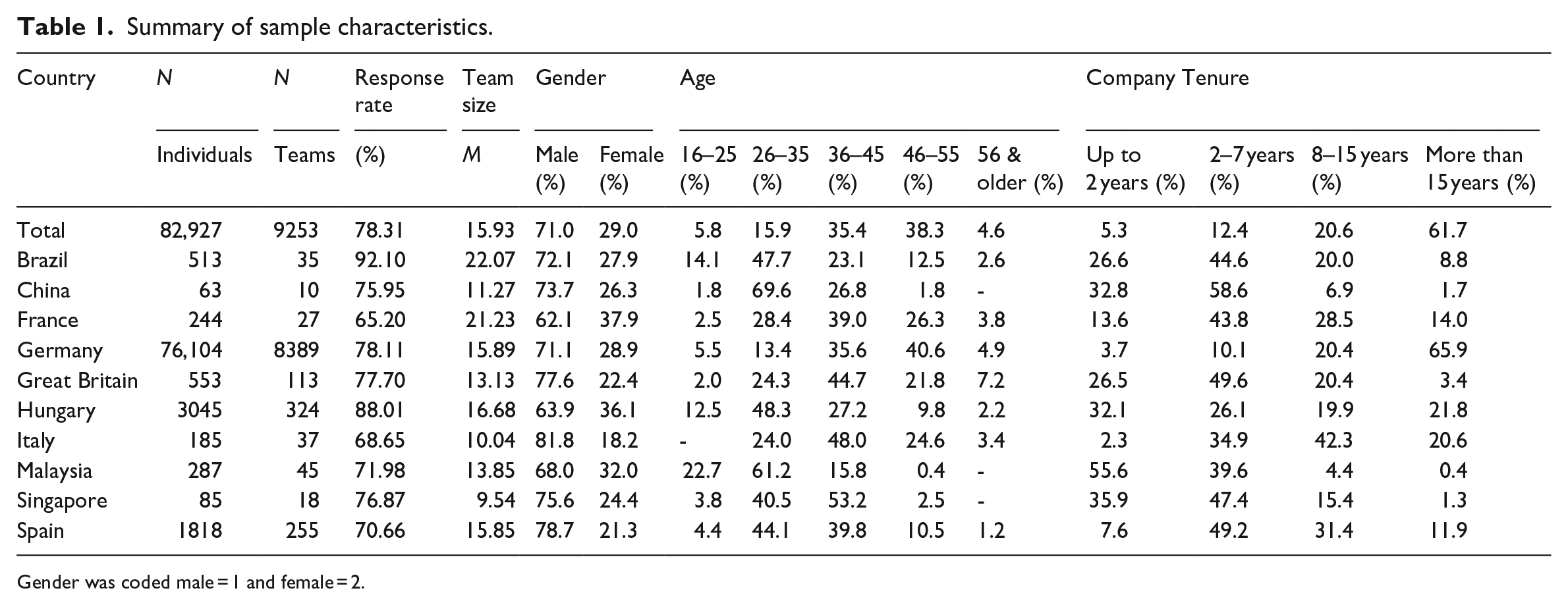
Gender was coded male = 1 and female = 2.
The data for the current study was collected in course of an annual employee survey conducted at the telecommunication company. Participation of employees was voluntary, anonymous, and non-incentivized. Participation rates ranged between 80% and 90%, as the survey had highest priority in the company.
Measures
To avoid systematic biases in responses, all items were presented in the employees’ native languages using translation-back-translation methods (Brislin, 1986). For the sake of consistency, subsequently, only example items in English will be reported.
Employee level
Error management culture as a Common Good HRM practice was assessed with three items rated on a five-point Likert scale (1 = “strongly disagree” to 5 = “strongly agree”). The items originated from a survey specifically tailored to assess features of High Performance organizations (GfK, 2010). A sample item was: “I experience the error communication within the company as open and appreciative.” Internal consistencies ranged from α = 0.63 (China) to α = 0.79 (Singapore). The average α across all nations was α = 0.77.
Employee innovative performance was measured with two items taken from the GfK survey (2010). Items were rated on a five-point Likert scale (1 = “strongly disagree” to 5 = “strongly agree”). A sample item was: “I feel encouraged to come up with innovative ideas and suggestions for improvements.” Internal consistencies ranged from α = 0.67 (Italy) to α = 0.78 (Spain) with an average of α = 0.73 across all countries.
Internal corporate social responsibility was assessed with three items covering the ethical facet of internal CSR. On a five-point scale (1 = “strongly disagree” to 5 = “strongly agree”) employees rated statements like “I am familiar with the Code of Conduct of my company” originating from GfK survey (2010). Internal consistencies ranged from α = 0.73 (Spain) to α = 0.84 (Hungary) for country samples. The overall average was α = 0.78.
Team level
For team composition we used different variables. Team size as the number of team members working in the individual employees’ teams was recorded. Also, unweighted means of team members’ gender, their age regarding five different age groups (“16-25,” “26-35,” “36-45,” “46-55,” “56 and older”), and their company tenure concerning four categorical options (“up to 2 years,” “2-7 years,” “8-15 years,” “more than 15 years”) were assessed. These variables served as a basis for calculating TMD indicators and were included in our calculations as control variables.
Team member diversity regarding gender, age and tenure was objectively assessed through standard deviations of gender, age, and tenure in every team.
Country level
Regarding the cultural values power-distance, individualism-collectivism, uncertainty avoidance, tightness-looseness, and humane orientation, we assigned a standardized value ranging between 0 and 100 to each country based on literature dedicated to a comparative quantification of cultural values (Gelfand et al., 2011; Hofstede et al., 2010; Schlösser et al., 2013).
Statistical analyses
To analyze our data, we followed a three-step procedure. First, to gain a descriptive overview of the data, we calculated means, standard deviations and inter-correlations of all study variables on the respective level (Level 1: Employees, Level 2: Teams, Level 3: Countries). Second, we calculated the intra-class correlation coefficients (ICCs) of EMC, internal CSR, and employee innovativeness to explore the degree to which our data is nested and demands a multilevel analysis strategy (Woltman et al., 2012). Third, we conducted the main calculations to examine our hypotheses based on Research Models 1-3 (Figure 1). Research Model 1 addresses H1 and RQ1 covering the effect of EMC on innovativeness and influences of team composition and TMD. Research Model 2 addresses H2 and RQ1 featuring the effect of EMC on internal CSR and influences of team composition and TMD. Research Model 3 deals with RQ2 and explores the effects of power distance, individualism-collectivism, uncertainty avoidance, tightness-looseness, and humane orientation on EMC.
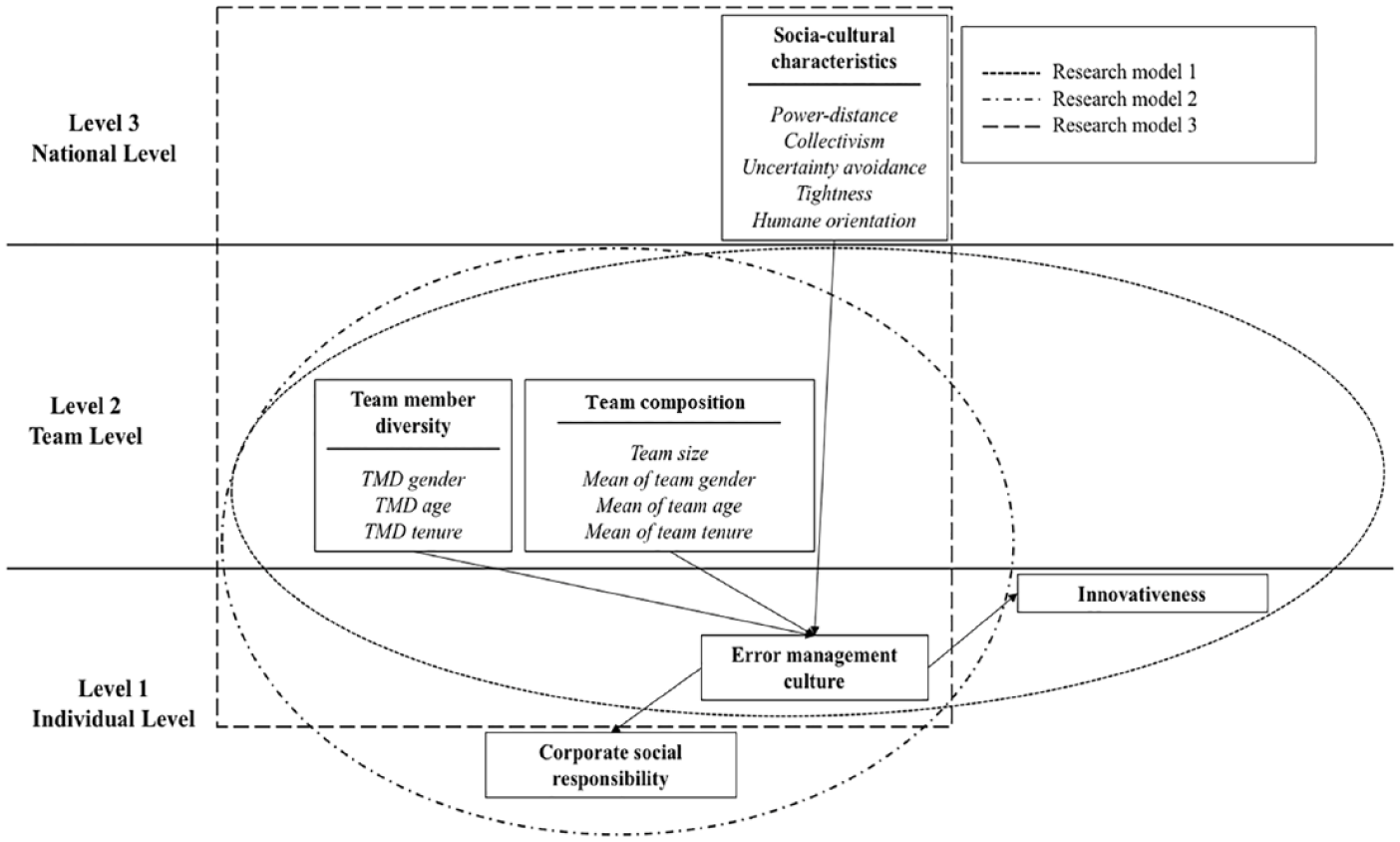
Research models.
Results
Descriptive data overview
Tables 2 to 4 summarize the means and standard deviations of all variables on the employee-, team-, and country level. In Tables 5 to 7 all inter-correlations on the respective levels are displayed. On the individual level, notable correlations between a constructive EMC and innovativeness (r = 0.65; p < 0.01), constructive EMC and internal CSR (r = 0.49; p < 0.01), and internal CSR and innovativeness (r = 0.43; p < 0.01) emerged. On the team-level, unsurprisingly, correlations between TMD of age and TMD of tenure (r = 0.50; p < 0.01), TMD of gender and team mean gender (r = 0.50; p < 0.01), and team mean age and team mean tenure (r = 0.72; p < 0.01) were found. On the country level, high correlations between individualism-collectivism and power-distance (r = -.83; p < 0.01) and tightness-looseness and uncertainty avoidance (r = -.76; p < 0.05) occurred. As these correlations cast doubt on the distinctiveness of these constructs in our data despite their widely accepted conceptualization as different cultural dimensions (Hofstede, 2011), multicollinearity could be a problem (Graham, 2003). This possibility and the potential impact on our findings will be elaborated on in more detail in the discussion section.
Sample sizes, means and standard deviations of the level-1-variables error management culture, corporate social responsibility and innovativeness.
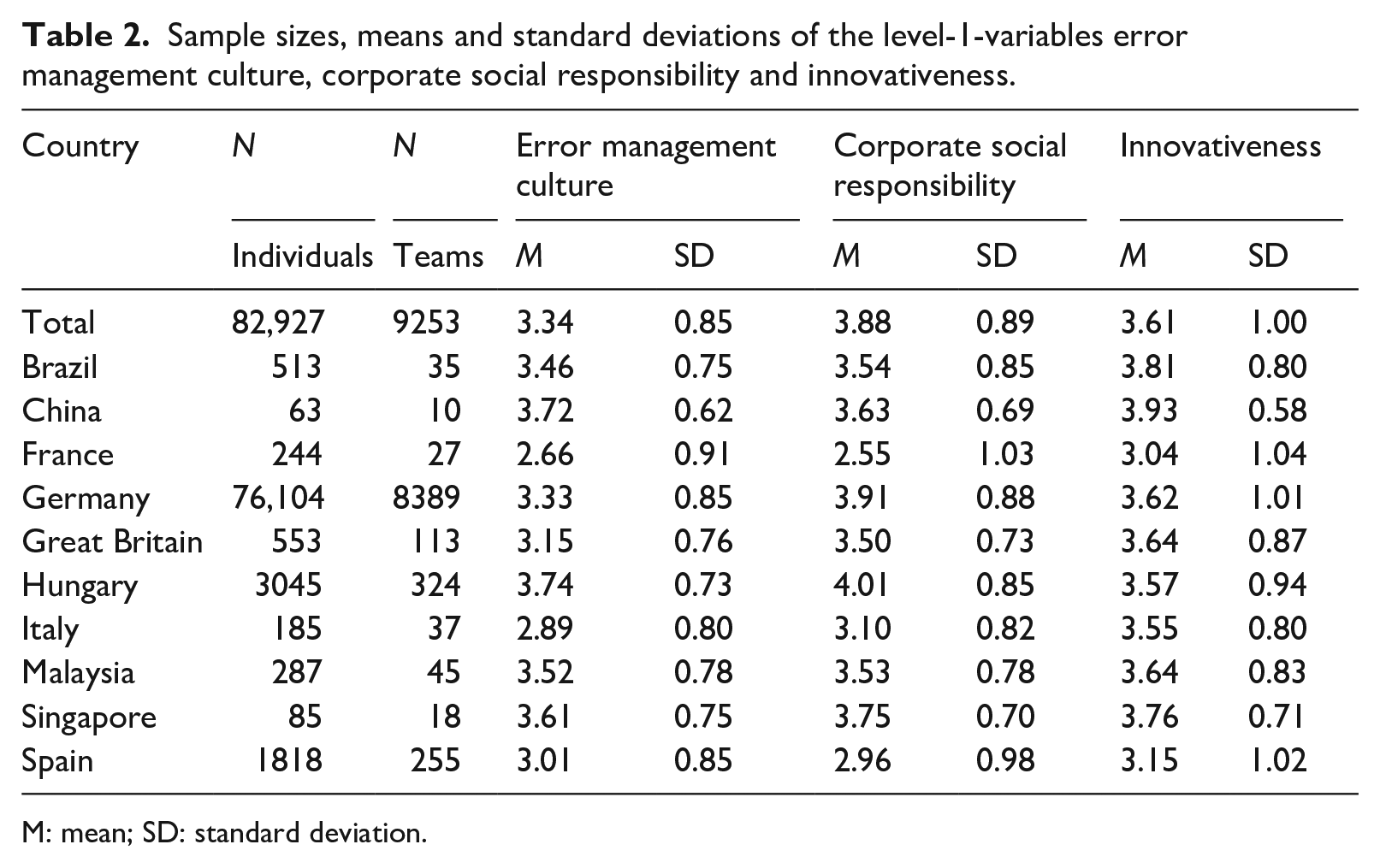
M: mean; SD: standard deviation.
Sample sizes, means and standard deviations of the level-2-variables team size, team member diversity of gender, age and tenure and team mean of gender, age and tenure.
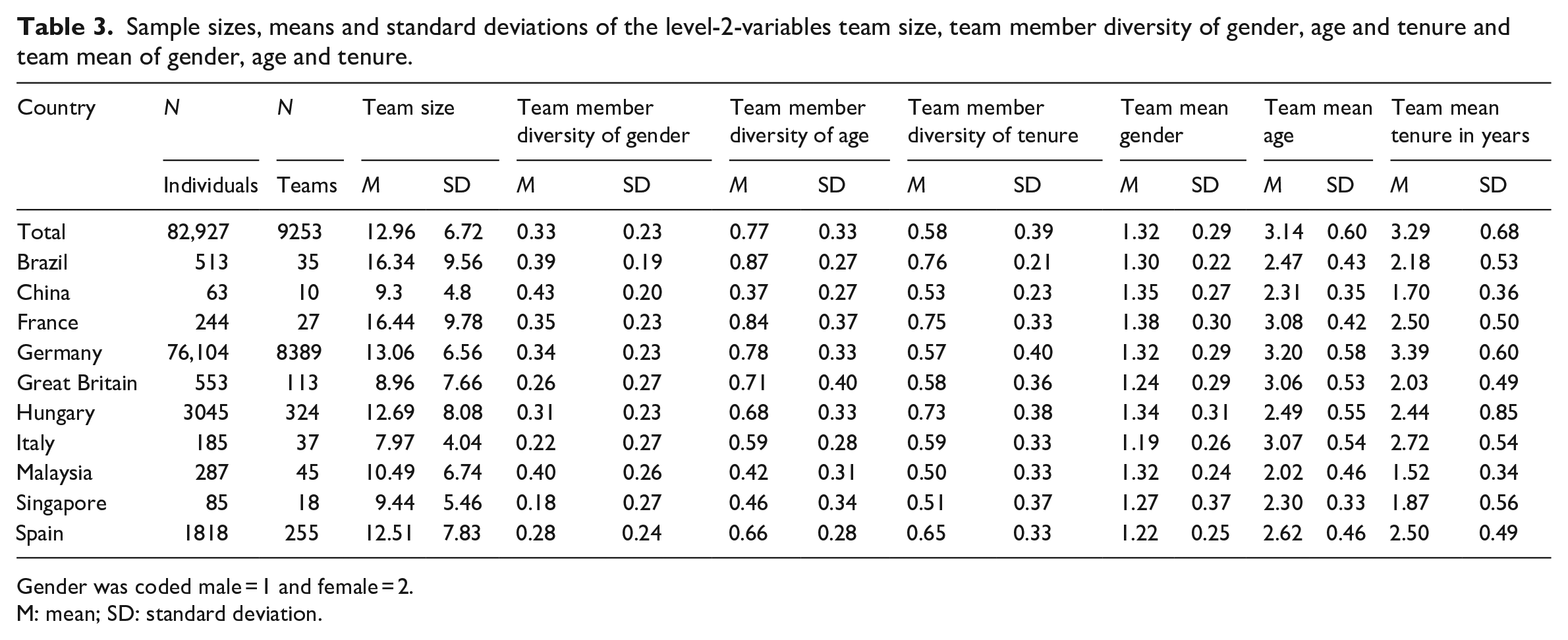
Gender was coded male = 1 and female = 2.
M: mean; SD: standard deviation.
Sample sizes, means and standard deviations of the level-3-variables power-distance, individualism-collectivism, uncertainty avoidance, humane orientation and tightness-looseness.
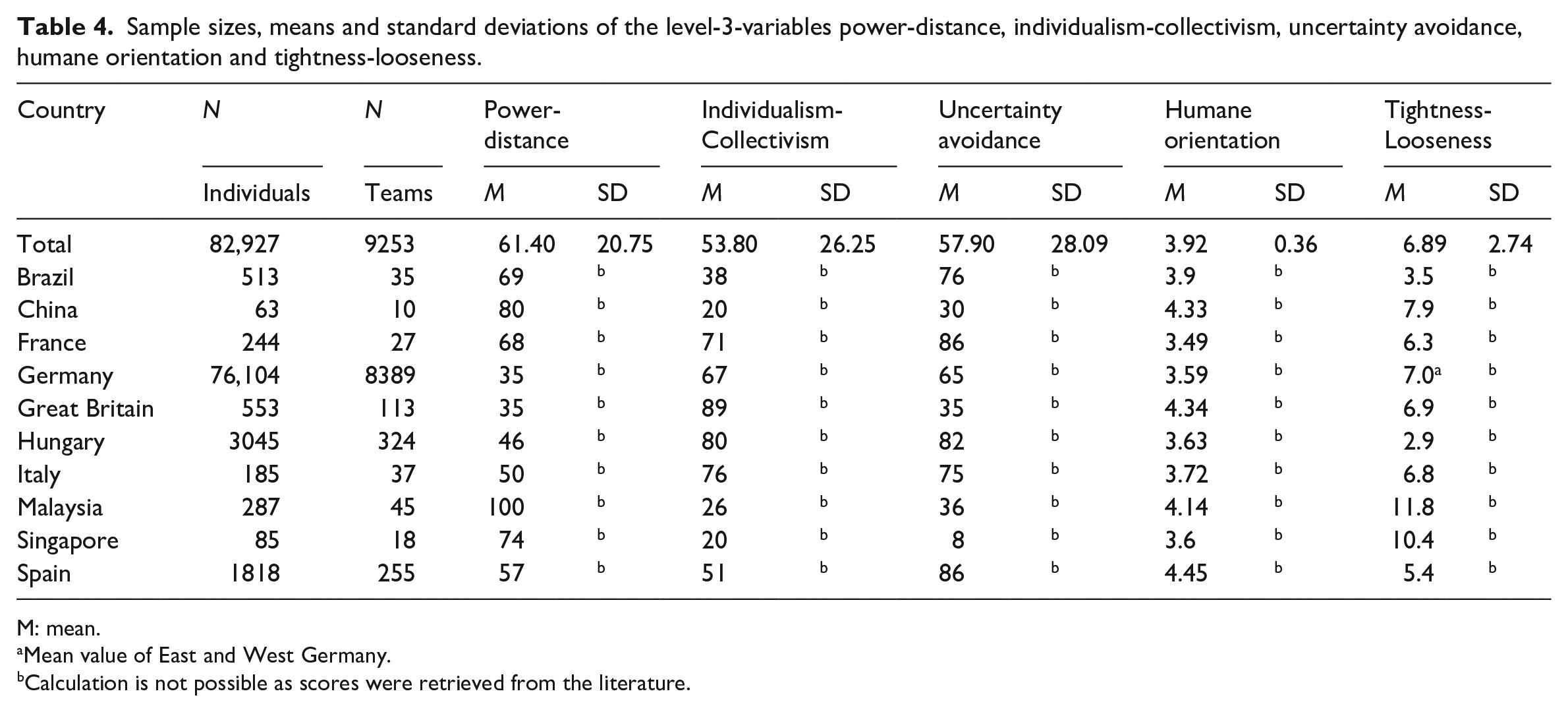
M: mean.
Mean value of East and West Germany.
Calculation is not possible as scores were retrieved from the literature.
Correlations of error management culture, innovativeness, corporate social responsibility, gender, age, and tenure on the employee level (Level 1).
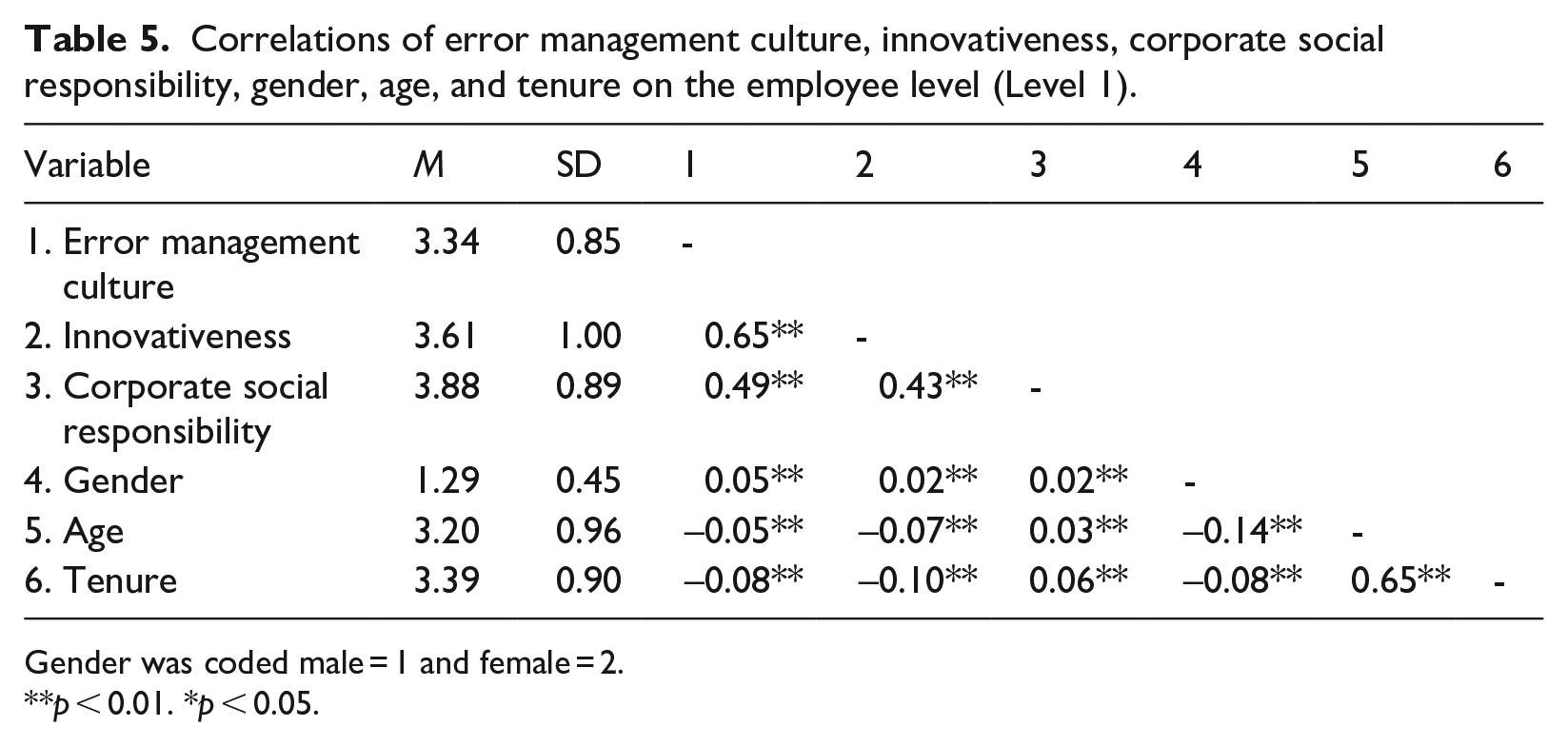
Gender was coded male = 1 and female = 2.
p < 0.01. *p < 0.05.
Correlations of team size, team member diversity regarding gender, age and tenure as well as the team mean of gender, age and tenure on the team level (Level 2).
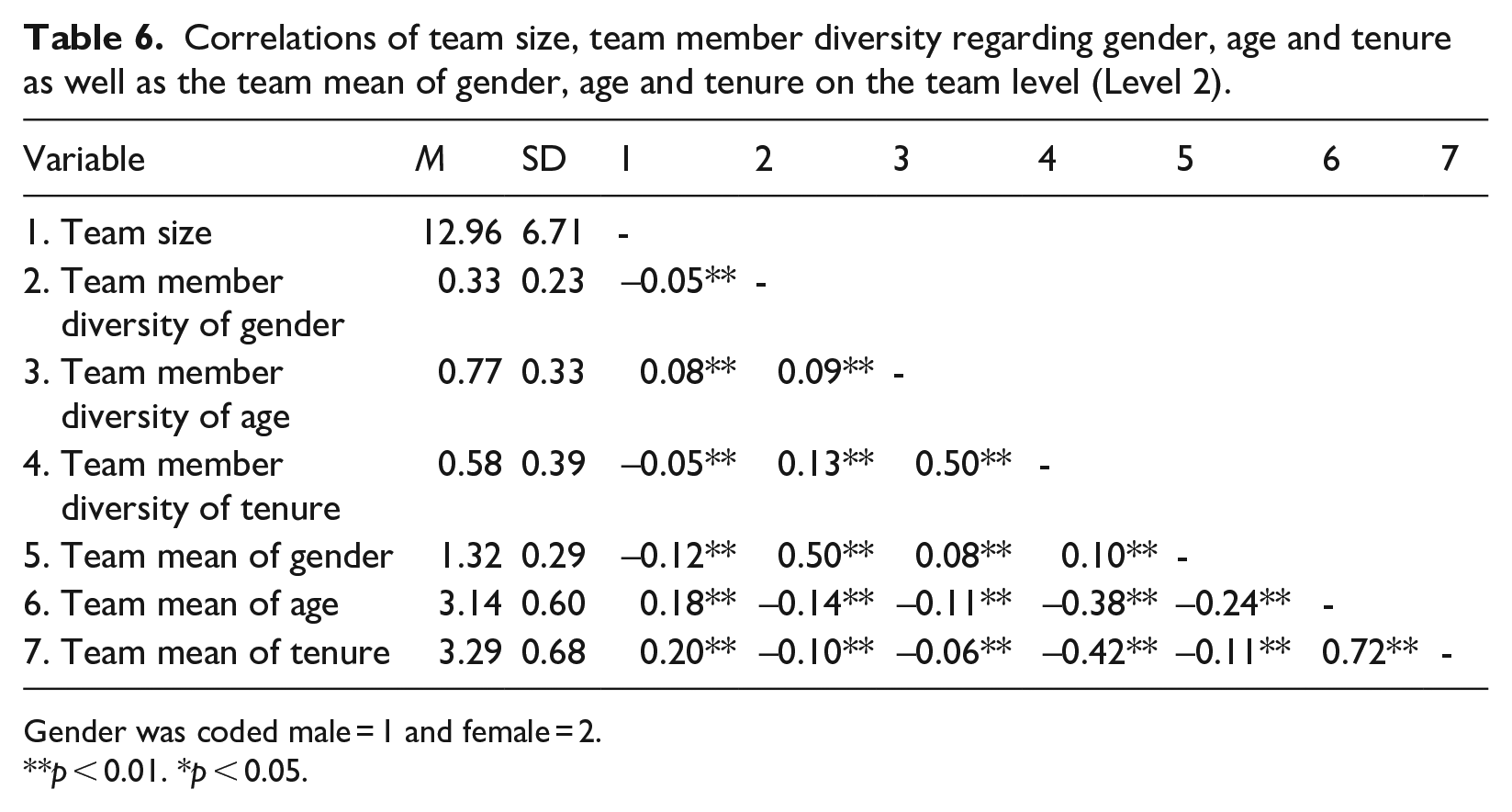
Gender was coded male = 1 and female = 2.
p < 0.01. *p < 0.05.
Correlations of cultural values on the country level (Level 3).
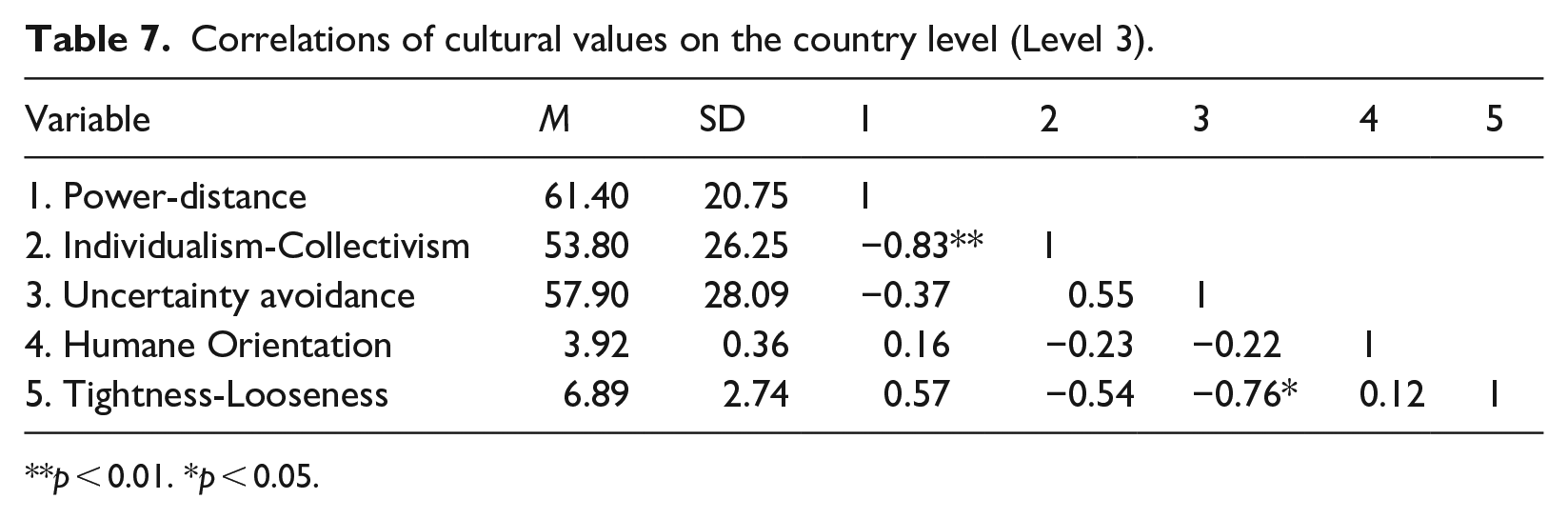
p < 0.01. *p < 0.05.
Intra-class correlation coefficients
Intra-Class correlation coefficients (ICCs) represent the amount of total variability in variables that can be explained by between-unit variations (Field, 2018). In our case, the ICCs signify the amount of team- and country-level variability regarding the Common Good HRM practice of a constructive EMC, internal CSR, and employee innovativeness as employee-level variables. Based on null model calculations, we found 20% of EMC-variance was due to differences between teams (ICCEMC = 0.20) and 15% due to between-country differences (ICCEMC = 0.15). Twelve percent of the variance in internal CSR was due to differences between teams (ICCCSR = 0.12) and 21% due to between-country differences (ICCCSR = 0.21). Regarding employee innovativeness, 21% of the variance was due to differences between teams (ICC innovativeness = 0.21) and 7% (ICCinnovativeness = 0.07) was due to between-country differences. Thus, as ICCs indicated notable between-team and between-country variability, the application of hierarchical modeling was necessary.
Hypotheses examinations
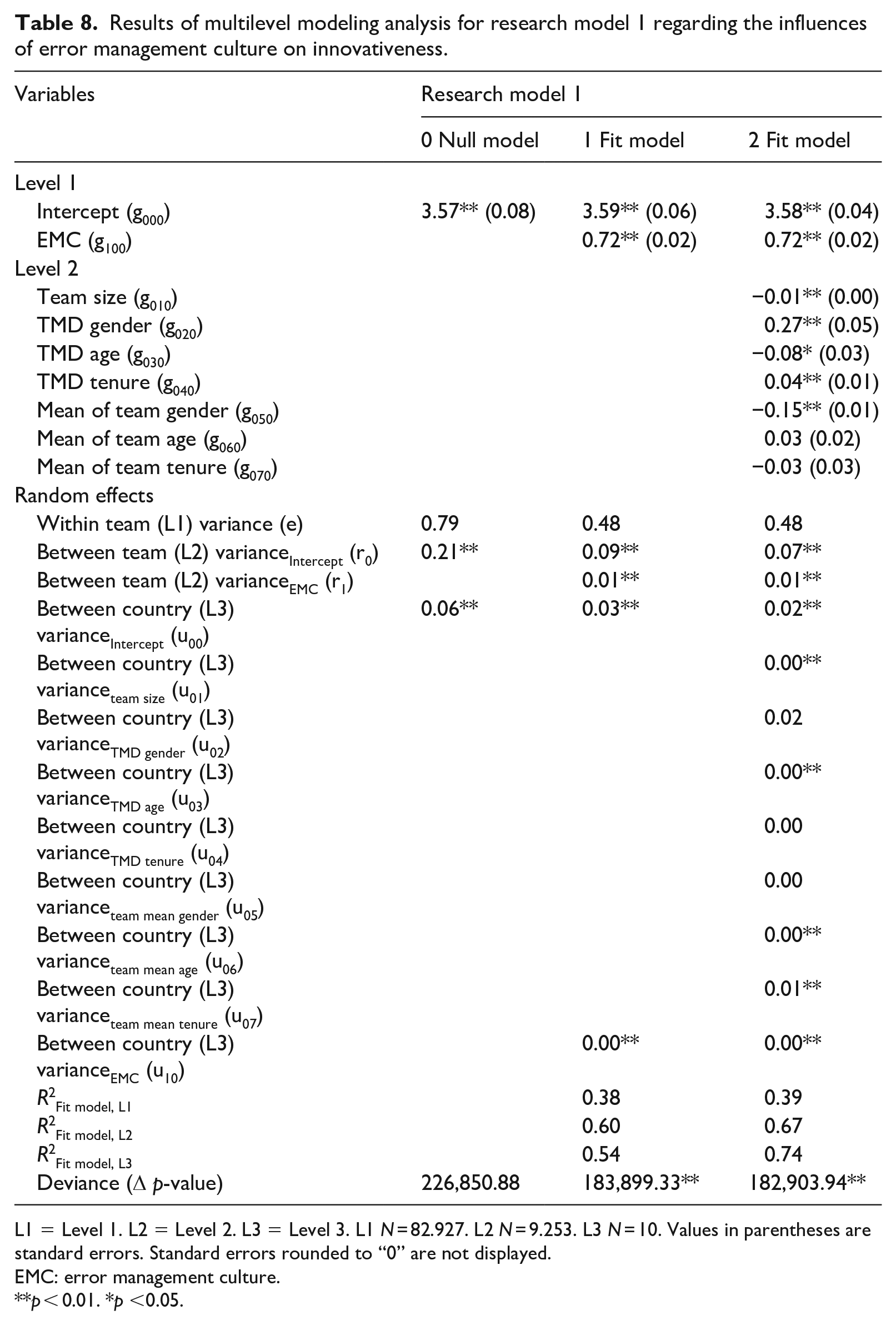
(a) Research Model 1: Research Model 1 explores the effect of the Common Good HRM practice constructive EMC on the performance measure employee innovativeness on the employee level. All analyses are summarized in Table 8:
Results of multilevel modeling analysis for research model 1 regarding the influences of error management culture on innovativeness.
L1 = Level 1. L2 = Level 2. L3 = Level 3. L1 N = 82.927. L2 N = 9.253. L3 N = 10. Values in parentheses are standard errors. Standard errors rounded to “0” are not displayed.
EMC: error management culture.
p < 0.01. *p <0.05.
Fit model 1 depicts the estimation of the linear relationship of EMC with employee innovativeness. EMC showed a significant positive predictive value for employee innovativeness (g100 = .72, p < .01). Thus, a constructive EMC led to a higher level of employee innovativeness confirming hypothesis H1. Moreover, the results of Fit model 1 suggest that approximately 38 % of variance in employee innovativeness was accounted for by EMC (R2
Fit model 1, Level 1
= .38). Furthermore, Fit model 1 had a significantly superior fit compared to the null model (χ2= 42951.54, df = 5, p < .001).
Exploring RQ1, our analyses revealed significant random effects regarding the intercept variance (r0 = 0.09, p < 0.01) as well as the slope variance for EMC (r1 = 0.01, p < 0.01) on the team level. This indicates that team variables influence the degree to which EMC is considered constructive (intercept) and the strength of the EMC-employee innovativeness relationship (slope) on the individual level. To identify the distinct influences of our variables on the team level, we included TMD regarding gender, age, and tenure. Furthermore, team size and the team means of gender, age, and tenure as well as country random effects were inserted as control variables in Fit model 2. As can be seen in Table 8, TMD of gender (g020 = 0.27, p < 0.01), of age (g030 = −0.08, p < 0.05) as well as of tenure (g040 = 0.04, p < 0.01) did significantly influence EMC. Likewise, team size (g010 = -0.01, p < 0.01) as well as the mean of team gender (g050 = −0.15, p < 0.01) were found to be significant predictors. The specific regression coefficients indicate that EMC was higher in teams with a higher TMD regarding gender and tenure, but lower for higher TMD regarding age. Likewise, EMC was higher in teams with a smaller team size and a higher proportion of males. Fit model 2 suggest that approximately 7% of variance was accounted for by the inserted team factors (Δ R2 Fit model 1 and 2, Level 2 = 0.07). Yet, as random effects regarding the intercept variance (r0 = 0.07, p < 0.01) as well as the slope variance for EMC (r1 = 0.01, p < 0.01) remained significant, a share of unexplained variance on the team level still exists. Finally, the analyses revealed significant random effects on the country level, for the EMC intercept (u00= 0.02, p < 0.01). This indicates notable differences regarding the extent to which EMC is considered constructive between the subsidiaries in our sample.
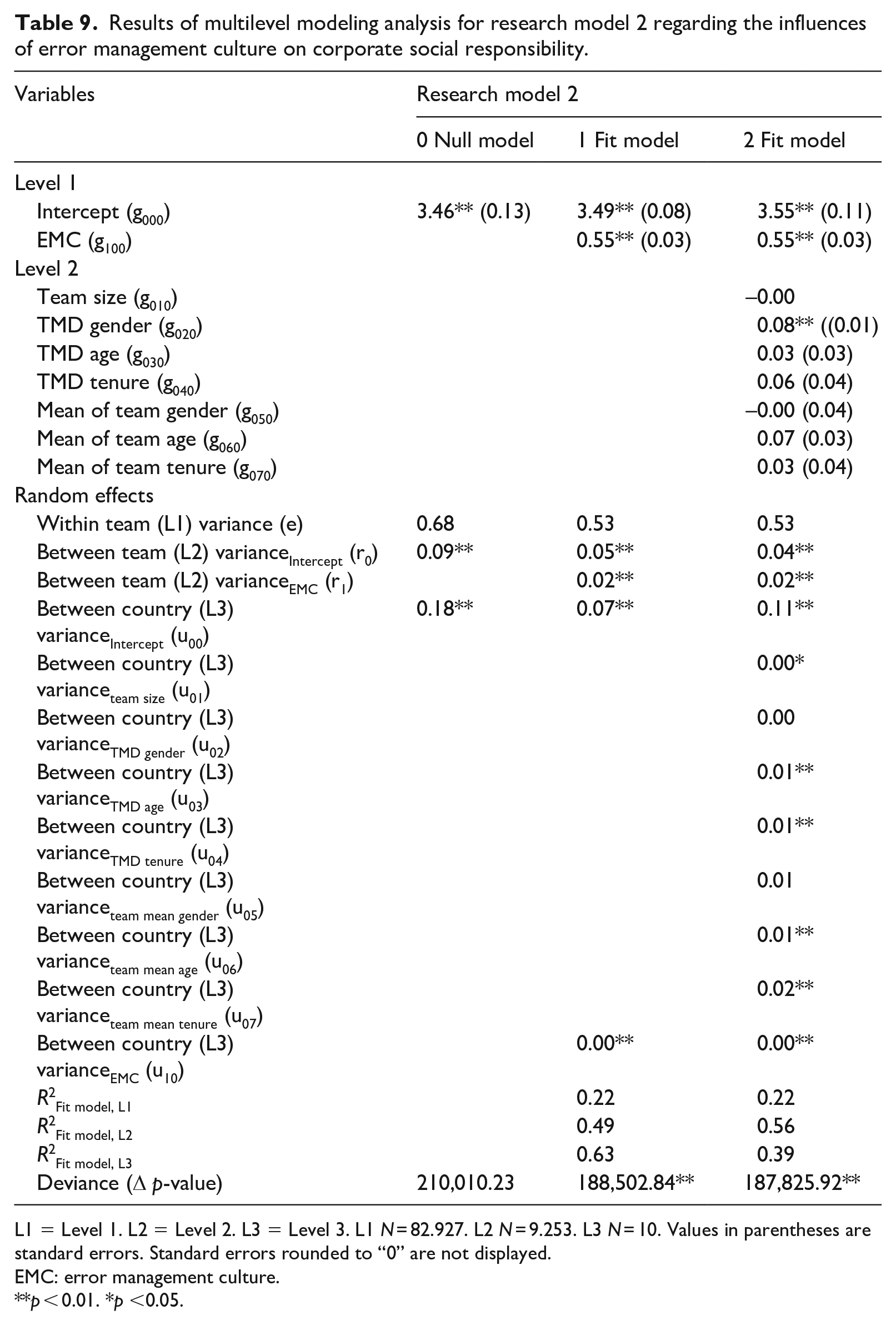
(b) Research Model 2: Fit model 1 in Table 9 depicts the estimation of the linear relationship of EMC on internal CSR on the employee level. EMC showed a significant positive predictive value (g100 = 0.55, p < 0.01). Thus, a constructive EMC is also associated with a higher internal CSR confirming hypothesis H2. Moreover, the results of Fit model 1 suggest that approximately 22% of variance in internal CSR was accounted for by EMC (R2 Fit model 1, Level 1 = 0.22). Furthermore, Fit model 1 had a significantly superior fit compared with the null model (χ2 = 21507.38, df = 5, p < 0.001).
Results of multilevel modeling analysis for research model 2 regarding the influences of error management culture on corporate social responsibility.
L1 = Level 1. L2 = Level 2. L3 = Level 3. L1 N = 82.927. L2 N = 9.253. L3 N = 10. Values in parentheses are standard errors. Standard errors rounded to “0” are not displayed.
EMC: error management culture.
p < 0.01. *p <0.05.
Exploring RQ1, our analysis further revealed significant random effects regarding the intercept variance (r0 = 0.05, p < 0.01) as well as the slope variance for EMC (r1 = 0.02, p < 0.01) on the team level. To identify the distinct influences of our variables on the team level, we included TMD regarding gender, age, and tenure. Furthermore, team size and the team means of gender, age and tenure as well as country random effects were inserted as control variables in Fit model 2. TMD of gender (g020 = 0.08, p < 0.01) exerted a significant influence on EMC. The positive regression coefficient indicates that EMC was more constructive in teams with a higher TMD regarding gender. Moreover, the results of Fit model 2 suggest that approximately 7% of variance was accounted for by the inserted team factors (Δ R2 Fit model one and 2, Level 2 = 0.07). Furthermore, Fit model 2 had a significantly superior fit compared with Fit model 1 (χ2 = 676.93, df = 49, p < 0.01). Yet, as random effects regarding the intercept variance (r0 = 0.04, p < 0.01) as well as the slope variance for EMC (r1 = 0.02, p < 0.01) remained significant, a share of unexplained variance on the team level still exists. Finally, the analyses revealed significant random effects on the country level for the EMC intercept (u00= 0.11, p < 0.01). This indicates notable differences regarding the extent to which EMC is considered constructive in-between the subsidiaries in our sample.
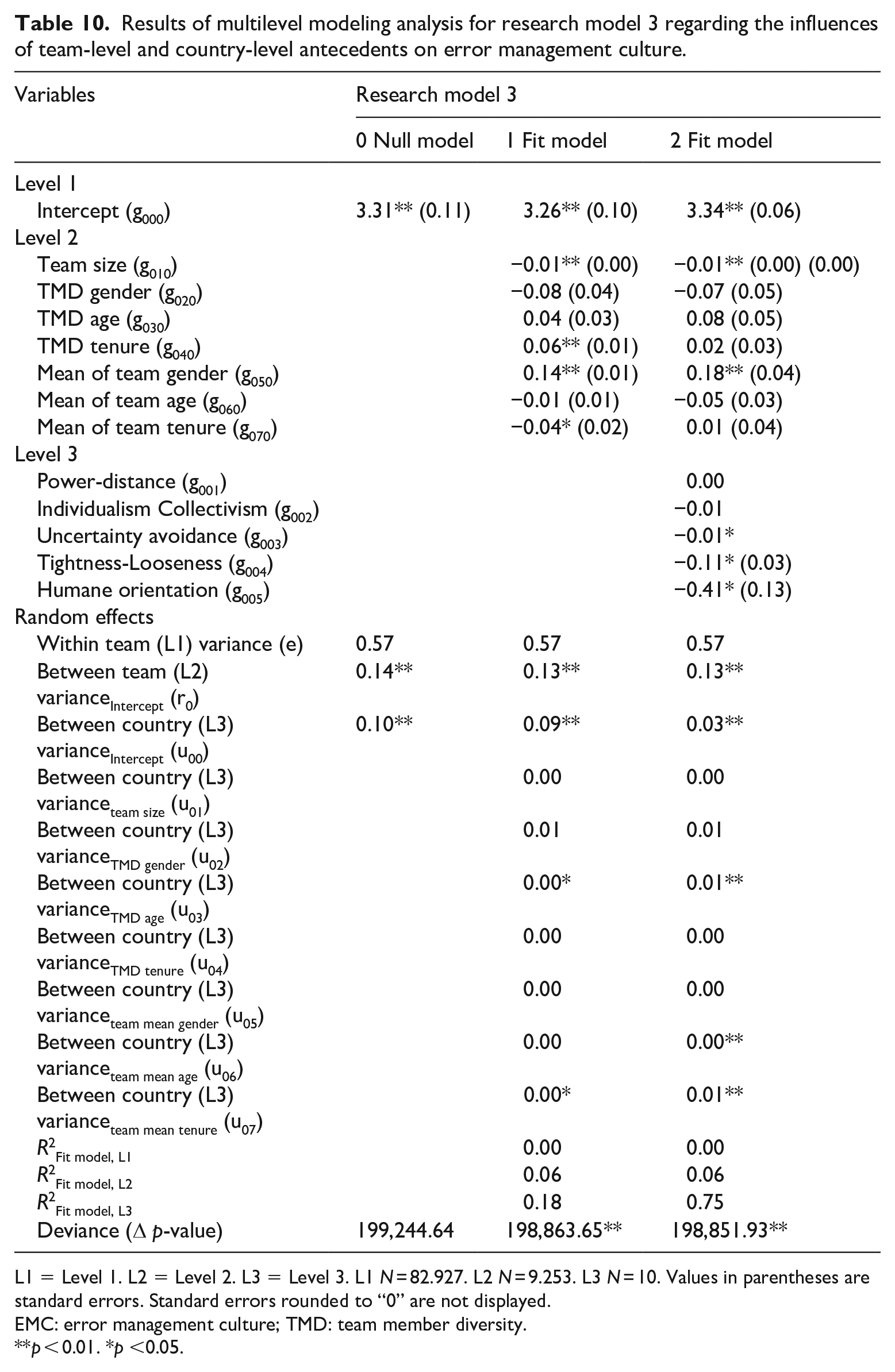
(c) Research Model 3: Examining RQ2, Fit model 2 in Table 10 depicts the linear influences of power-distance, individualism-collectivism, uncertainty avoidance, tightness-looseness, and humane orientation on EMC controlling for team level variables. The analysis revealed that uncertainty avoidance (g003 = −0.01, p < 0.05), tightness (g004 = −0.11, p < 0.05) as well as humane orientation (g005 = −0.41, p < 0.05) showed significant predictive values for EMC. The negative regression coefficients indicate that a constructive EMC was higher in countries with less uncertainty avoidance, less tightness as well as a weaker humane orientation. Adding these cultural values on the country level did also change the significances of some team factors. More specifically, the significant positive influence of TMD of tenure and the team mean of tenure, which were found in Fit model 1, did disappear in Fit model 2. The results of Fit model 2 suggest that approximately 57% of variance in EMC was accounted for by the inserted cultural factors (Δ R2 Fit model 1 and 2, Level 3 = 0.57). Furthermore, Fit model 2 had a significantly superior fit compared with Fit model 1 (χ2 = 226.10, df = 30, p < 0.001). Yet, as random effects regarding the intercept variance for EMC remained significant (u00 = 0.04, p < 0.01), a share of unexplained variance on the country level still exists.
Results of multilevel modeling analysis for research model 3 regarding the influences of team-level and country-level antecedents on error management culture.
L1 = Level 1. L2 = Level 2. L3 = Level 3. L1 N = 82.927. L2 N = 9.253. L3 N = 10. Values in parentheses are standard errors. Standard errors rounded to “0” are not displayed.
EMC: error management culture; TMD: team member diversity.
p < 0.01. *p <0.05.
Discussion
Realizing the embeddedness of firms in bigger societal and ecological contexts, scholars and practitioners acknowledge that the evaluation of HRM measures should go beyond decontextualized, firm-only criteria. Common Good HRM, a form of Sustainable HRM that values firm performance and the contribution to ecological and societal progress as equally important HR goals, overcomes the restricted scope of previous HRM approaches. Conceptual work highlights the benefits of applying Common Good HRM and some empirical studies on Common Good HRM measures like a constructive EMC support this view. However, so far, a comprehensive examination of effects applying a contextual and multi-level approach to adequately model HR complexity does not exist. Investigating a sample of 82,927 employees in 9253 teams working in a large telecommunication company with subsidiaries in 10 different countries, the current study applied multi-level modeling to examine EMC effects on both employee innovativeness and company-internal CSR. Furthermore, the impact of central team characteristics and national culture on EMC was explored to contextualize these effects.
As predicted in hypothesis H1, we found a significant and positive effect of EMC on employee innovativeness. Thus, a more constructive EMC promotes the ability of employees to generate new and useful ideas to solve existing problems. As a constructive EMC encompasses the awareness that errors (i) are inevitable (Goodman et al., 2011), (ii) can only be solved by a good error detection and open error communication (Dormann and Frese, 1994), and (iii) should be considered a chance to learn and improve (Frese and Keith, 2015), the positive relationship with innovativeness is theoretically sound. Furthermore, our results are in line with the study by Fischer et al. (2018) who also revealed a positive EMC effect on individual innovativeness at work. Thus, we can conclude that a constructive EMC is positively associated with employee’s innovativeness.
Regarding internal corporate social responsibility (CSR), hypothesis H2 suggested that a constructive EMC is further positively associated with internal CSR. We find this effect in our data and thus support the notion of a positive EMC-CSR relationship inside a company. As Aguinis and Glavas (2012) stated, the perspective on CSR has long been dominated by an exploration of CSR effects on external stakeholders. Yet, as our results show, exploring internal CSR and its interrelations with Common Good HRM practices like EMC can be fruitful and, in light of the UN`s Sustainable Development Goal (SDG) No. 8 to create decent working conditions, has a high practical relevance.
In addition to the above hypotheses, two research questions (RQs) were examined accounting for the embeddedness of individual level EMC processes in different team and cultural settings.
RQ1 dealt with potential effects of team member diversity (TMD) regarding gender, age, and tenure on EMC as well as EMC`s relationship with employee innovativeness and internal CSR. We find that EMC was (i) more constructive in teams with a higher TMD regarding gender and tenure, but less constructive for higher TMD regarding age examining employee innovativeness as an outcome and (ii) more constructive in teams with a higher TMD regarding gender investigating internal CSR as an outcome. While the beneficial effect of TMD regarding gender and tenure favors the information processing perspective by Van Knippenberg et al. (2004) suggesting that diverse backgrounds can be helpful for the implementation of a constructive EMC, our finding that TMD regarding age lowers a constructive EMC supports Klimoski and Mohammed`s shared mental model perspective (1994). This perspective emphasizes the challenges to reach a common understanding in diverse teams. Due to these ambiguous results it can be concluded that there is no “general” TMD effect on EMC. While TMD regarding gender was beneficial in both analyses, TMD regarding tenure only emerged as a positive predictor in the EMC employee innovativeness relationship. Moreover, TMD regarding age had a detrimental effect in the EMC employee innovativeness relationship but showed no effect in the internal CSR relationship. Consequently, examining TMD effects on EMC requires a differential view regarding the facets of TMD and associated EMC outcomes.
RQ2 dealt with potential effects of culture on EMC. We find several significant effects suggesting that there is indeed a notable culture influence. Our analyses yielded that high levels of uncertainty avoidance, tightness, and humane orientation hindered the implementation of a constructive EMC. The negative effects of uncertainty avoidance and tightness seem reasonable, as (i) a tendency to avoid and dislike uncertain and unstructured situations and (ii) strong norms and rules in society rather disfavor the detection of and open communication about errors (Jing et al., 2001; Soeters and Boer, 2000). Our finding that a culture with a high humane orientation in which people are more concerned with others’ well-being than their individual needs has a negative effect on a constructive EMC seems counter-intuitive at first. However, considering that error reporting as an important facet of a constructive EMC does not only include the reporting of one`s own but also co-workers’ errors, the fear to cause trouble and thus decrease co-worker’s well-being could prevent employees from performing this element of a constructive EMC. In fact, detrimental effects of a high humane orientation have already been reported, for example, in the banking sector providing initial support for our reasoning (Dheera-aumpon, 2017).
Regarding the interplay of individual, team, and cultural variables, and their relative importance for our outcomes, two central insights emerge from the data. First, while in all analyses (Tables 8–10) random effects yield the existence of within-team variances, they are not significant. In contrast, significant variances occur between teams and between countries. This indicates that despite the existence of different perceptions of EMC of individual team members, differences between teams and countries are more important for our outcome variables. Second, we find that, when including culture as a predictor of EMC, some team-level predictors, for example, TMD of tenure “lost” their predictive significance. This provides evidence for a complex interplay of cultural and team characteristics and their influence on a constructive EMC (cf. Stahl and Maznevski, 2021; Tung, 2008).
Implications for theory and practice
Our study has the following implications.
First, our analyses deliver empirical evidence that the Common Good HRM practice of implementing a constructive EMC can promote both employee performance and sustainable employee outcomes in for-profit companies. This way, we complement previous, rather conceptual research with quantitative findings. Future research can build on our work and explore the extent to which other performance indicators like productivity or rather “soft” employee outcomes like job satisfaction or employee well-being are related to a constructive EMC.
Second, revealing the notable influences of TMD and culture on EMC, we emphasize the need to analyze individual-level effects of EMC on employee outcomes in the context of teams and culture. As our data suggests that also team and cultural variables are interrelated in their effects on a constructive EMC, scholars should acknowledge this complexity and apply statistical methods like multi-level modeling to avoid a simplistic view on EMC effects (Aust et al., 2020).
Third, despite finding significant effects of team and cultural values, in all analyses unexplained variance on the team and country level remained. Thus, it is up to future research to explore which additional team and cultural variables could impact EMC. Also, going beyond culture, differences in countries’ economic stage on EMC could be investigated, as this proved a fruitful influence on individual level variables in other business contexts. To exemplify, Kruse et al. (2021) could show that, depending on a higher or lower national economic stage, the importance of individual-level antecedents for social entrepreneurial intention formation varies.
Fourth, our analyses show that, despite the existence of within-team variance, that is, different perceptions of individual team members, these differences have no significant influences. In contrast, differences between teams and countries exert significant effects. Future research should check the robustness of this finding in other contexts. In general, more insights regarding the mechanisms underlying the complex interplay of individuals, teams, and different cultural backgrounds when implementing Common Good HRM practices are desirable.
Fifth, our study is one of only very few creating an explicit link between the largely separate research streams on Common Good HRM as a form of Sustainable HRM and internal CSR. We believe that the creation of firm-internal positive social change like the promotion of ethical behavior at work could be an important missing piece and complement the effects of Common Good HRM practices on economic firm performance and bigger societal and ecological problems outside the firm.
Sixth, taking a practitioner’s perspective, our results highlight a beneficial effect of implementing a constructive EMC as a Common Good HRM practice going beyond a “good way” to deal with errors. Employee innovativeness as a central firm-performance indicator on an increasingly competitive and globalized market bears great potential. What`s more, showing the positive impact of a constructive EMC on internal CSR, this Common Good HRM practice has the potential to improve the organizational climate and thus, contribute to more decent work supporting the fulfillment of SDG No.8. This can serve as a role model for other firms and, thereby, contribute to societal progress outside the firm in line with Common Good HRM`s multiple purposes.
Limitations
The major limitations of our study are the following.
First, our study focused on a constructive EMC as a Common Good HRM practice. Yet, as literature shows, several other practices exist that remain uncovered in our work (see Aust et al., 2020; Dyllick and Muff, 2016 for reviews). Thus, our findings are limited to only one Common Good HRM practice and should not be considered a blueprint for effects resulting from the implementation of other practices.
Second, an additional limitation regarding the generalizability of our work lies in the sample analyzed. Despite including a very large number of individual employees and teams, only one multinational company is examined. Being aware of notable differences regarding climate and culture in organizations (Schein, 1990), results could have been different in another company and in other industrial branches. Furthermore, as our study data was collected in 2010, it would be recommendable to check the robustness of our findings with more up-to-date data.
Third, examining cultural effects on a constructive EMC, we were restricted to the countries in which the company investigated had subsidiaries. As companies usually select countries for their subsidiaries on purpose and thus, exclude some countries considered unsuitable, our sample is biased toward “favorable” countries from the company`s perspective.
Fourth, regarding the measurement of cultural values we used a quantification based on pertinent literature and data (Gelfand et al., 2011; Hofstede et al., 2010; Schlösser et al., 2013). Yet, as high inter-correlations show, some cultural values’ empirical distinctiveness seems questionable. Additionally, and on a more general level, we used Hofstede`s cultural dimensions to measure cross-cultural diversity. However, notwithstanding its popularity in CSR-research (e.g. Mueller et al., 2012), this approach is only one of several research paradigms (see Romani et al., 2018 for an overview) and increasingly criticized (Szkudlarek et al., 2020). Critical points include, for example, methodological flaws in the process of deriving the cultural dimensions (McSweeney, 2002) or the assumed value uniformity of all individuals in one culture neglecting intra-cultural variance (Yoo et al., 2011).
Fourth, despite including TMD as an indicator of intra-national differences and cultural dimensions as an indicator of cross-national differences, we treated both rather separately. This falls short of considering intra-team cultural differences, for example when members of different cultures work together in one team (cf. Nisbett, 2003; Nisbett and Miyamoto, 2005). Due to data protection reasons and in order to guarantee anonymity of all participants, individual team members’ cultural background, however, could not be assessed in our study. This is a notable omission.
Conclusion
Examining the extent to which the Common Good HRM practice of a constructive EMC (i) affects employee performance (innovativeness) and sustainable outcomes (internal CSR) and (ii) is subject to team and cultural influences, we use multi-level modeling and a sample of a large telecommunication company encompassing 82,927 employees in 9253 teams working in 10 different countries. We find that (i) a constructive EMC has a positive impact on employee innovativeness and internal CSR on the individual level and (ii) TMD and cultural values have an effect on EMC. Particularly, our analyses uncover that EMC effects differ depending on the kind of TMD and a complex interplay of team composition and cultural values. Despite notable restrictions concerning sample and company representativeness, our research offers some first empirical evidence on the suitability of Common Good HRM practices to promote employee performance and sustainable outcomes. Thus, the potential of a constructive EMC to emerge as a competitive advantage and a tool to create more decent working conditions in line with SDG No.8 is shown. Furthermore, we emphasize the need to consider the embeddedness of Common Good HRM practices in teams and national cultures to avoid a simplistic view on their individual level effects.
Footnotes
Declaration of conflicting interests
The author(s) declared no potential conflicts of interest with respect to the research, authorship, and/or publication of this article.
Funding
The author(s) disclosed receipt of the following financial support for the research, authorship, and/or publication of this article: Open Access for this paper was financed by the Saxon State and University Library Dresden (SLUB).
