




Abstract
Has anyone heard of organizations giving its employees a gift of sleep? This is given to truck drivers in India who drive miles in all weathers without proper sleep to ensure that the goods consigned reach in specified time. Lack of proper sleep leads to deadly road accidents. Out of 139,000 deaths due to road accidents, around 26,678 drivers die due to lack of sleep (NCRB). The present case based entirely on published sources portrays a CSI initiative of APML which is first of its kind working for improving the condition of drivers thereby curtailing the shortage since 2012.
It was a hot summer afternoon in April 2017, when Mr Ramesh Agarwal, (hereafter Mr Agarwal), mentor of Agarwal Packers and Movers Limited (APML), contemplated the future for driver seva kendras (DSK). APML had set up a DSK in Jaipur in 2012. His trip to Istanbul for a conference had serendipitously exposed him to the appalling conditions of Indian truck drivers. After understanding the problems faced, he subsequently, worked to create a DSK, which would address one of the primary challenges of providing a safe resting space for truck drivers. As he contemplated the future of the trucking industry, the contribution made by DSK, he reflected on the context and background of the industry.
NIDRADAAN FOR TRUCK DRIVERS: THE CONTEXT
Tired minds don’t plan well. Sleep first, plan later. —Walter Reisch
A research organization, Kantar-IMRB study reported that over 50% of Indian truck drivers face driving-related health issues such as lack of sleep (2–4 hours of sleep per day), fatigue joints and back pain (due to awkward and fixed postures and sleeping in tight spaces), eye strain and pain due to long and continued gazing at the monotonous roads, disturbed metabolism due to untimely meals, unhygienic food consumption, dependence on tobacco to keep awake for long hours, spending long periods away from home and family, driving on difficult roads, ramshackle vehicle conditions, and so on (The Financial Express, 2018).
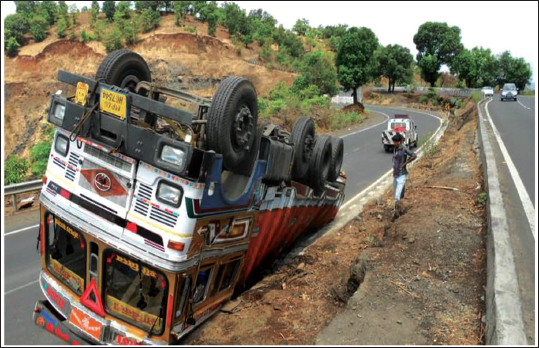
Sleep is a cyclic biological phenomenon (Kryger et al., 2000). Several professions/occupations create conditions that lead to acute sleep deprivation, causing various physical, psychological and performance complications. Notable but obscure among these professionals are Indian truck drivers (cargo carriers) who shoulder the pressure of driving long distances in a range of weather conditions without proper sleep to ensure that the consigned goods reach their destination in time. Truck driving is one of the least respected occupations in the Indian society. Long hours of driving without adequate sleep cause fatigue, leading to deadly road accidents, as drivers lose control while driving, causing the truck to capsize (Exhibit 1). About 40% of road accidents are caused by exhausted drivers dozing off at the wheel (Chhabra, 2019). Thus, improving drivers’ working conditions becomes a priority as specific driving times and rest periods do not exist in India (Dagli, 2016). While on the road, being able to get adequate sleep is a significant challenge for truck drivers.
Given the conditions mentioned above, Mr Agarwal surveyed and found that preference for truck driving as a profession in India began declining, given the risk, unhealthy lifestyle, danger and poor payment, disrespect notwithstanding. Individuals are turning away from this occupation, causing a severe shortage, a shortage that is increasing every year. Alternate job opportunities have also strengthened the decision to disengage from trucking. The upsurge in e-commerce is leading to the need for more trucks and drivers; 700,000–800,000 new drivers are needed every year (PR News Wire, 2014). Driver shortage leads to idling of many trucks, delays, cancellations and poor truck availability in remote areas. Thus, driver shortage signals calamitous consequences since truck drivers are the lifeline of the Indian transportation industry. Can India afford a driver shortage amidst the growing trade volumes?
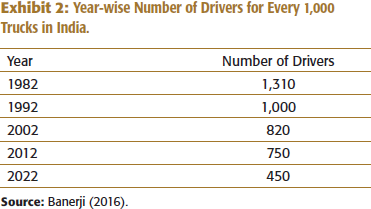
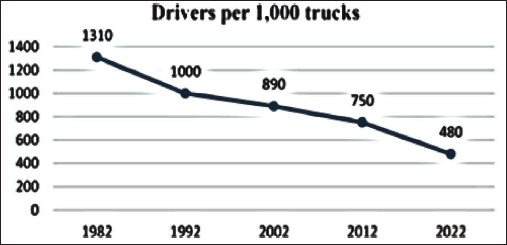
In 2015, a five-day nationwide strike of truck drivers cost the economy a whopping INR 360 million (Raghavan, 2015). Nearly 2.3 million trucks remained idle in 2015 due to driver shortage. In 2020, India had 8.5 to 10 million truck drivers transporting two-thirds of the nation’s cargo (Gupta, 2020). The truck driver shortage increased to about 50% in 2022, leading to underutilization that amounted to billions of dollars in opportunity costs (Banerji, 2016). There are currently 20 lakh truck drivers, and the driver-to-truck ratio is below 750 per 1000. This means that approximately 25% to 30% of India’s trucks lie idle at any given point in time (Abidi & Dave, 2023). Exhibit 2 depicts the decline of drivers over the years warranting an immediate action to re-attract them into the occupation.
Year-wise Number of Drivers for Every 1,000 Trucks in India.
In the stated backdrop, solutions are needed to two pressing problems: (a) What innovative measures can be used to curtail the impending danger of driver shortage in the country? (b) How to motivate individuals to re-enter into truck driving? Skill development, life and health insurance, work–life balance, safety, compensation commensurate with the effort are among the many challenges that need to be addressed. However, the two main issues that need immediate redressal are the lack of sleep and road fatalities. Studies reveal that sleep disorders and accident risks are highly related. In 2018, of the 151,417 fatal road-accident deaths recorded, 15,150 victims were drivers in trucks (Salve, 2020) and the core reason is lack of sleep.The fatalities recorded in 2019 were1,51,113; 1,31,714 in 2020 and 1,53,972 in 2021 (MORTH, 2021). To address this issue of inadequate sleep, a long-term solution is needed. However, an immediate and handy solution could be explored through a facility for sleep/rest for the truck drivers.
Recognizing this need, APML took a step to address this problem of truck drivers’ inadequate sleep while on duty through a distinctive initiative called Nidradaan (gift of sleep). A high-quality nap at the workplace increases productivity, cognition, psychological well-being and patience (Bessone et al., 2020). Nidradaan substantiates this as it facilitates a comfortable sleep in a secure and relaxed environment to relieve the truck drivers of fatigue.
The DSK was launched in 2012 in Dudu, Jaipur, Rajasthan, India, as a facility to provide truck drivers with uninterrupted sleep in a safe and hygienic environment with cots and fans. Such rest periods would significantly reduce road fatalities (Dagli, 2016). This initiative includes free medical check-ups, a vehicle-repair centre and salons.
Nidradaan is an example of CSI for sustainability (Szekely & Strebel, 2013), providing not only much-needed sleep and food to the truck drivers but also providing the much-needed dignity to labour. In the larger picture, Nidradaan attempts to make this occupation more dignified so that drivers may get their place in society.
TRUCKING INDUSTRY IN INDIA
Trucking has recorded remarkable growth in India since 1947. The interconnectivity provided by trucks is unattainable by other types of freight because trucking ensures that every part of the country can be reached (Neelakanta, 2018). Therefore, goods-carrying vehicles increased from 3 million in 2001–2002 to nearly 8.1 million in 2013 (Raghuram, 2015). The road goods industry grew by leaps and bounds with an ever-growing number of trucks. There were 82,000 trucks (road goods vehicles) in 1951; 3.43 lakh in 1971; 13.56 lakh in 1991 and 22.60 lakh in 1996–1997 (Motor Transport Statistics of India, 1997). Road Transport Year Book, published by MORTH for the years, 2017–2018 and 2018–2019, reports that the total number of newly registered trucks/lorries as on 31 March 2018 is 4.96 million and 5.33 million in 2019 exhibiting a rising trend (MORTH, 2017–2018/2018–2019).
Despite the number, the trucking wing is highly disaggregated and unregulated, with many fleet owners and other parties amidst cut-throat competition. Small fleet owners operate through family and friends, and they continue to dominate the sector because they depend on others to perform aggregation, handling, delivery, cargo and marketing. Brokers and suppliers, thus, take the centre stage and act as a bridge between users and booking agents while charging hefty commissions. Since customers move their goods through third-party players, the trucking industry remains commercially dynamic (Raghuram, 2015).
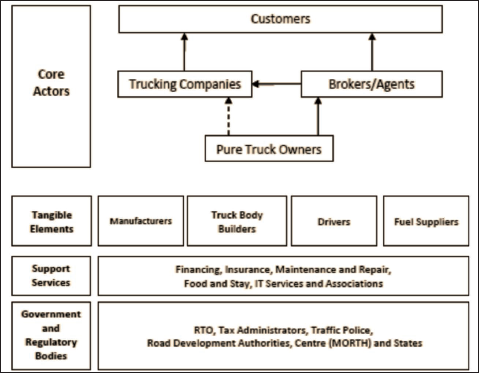
There are multiple actors in the trucking industry (Exhibit 3), namely brokers, booking agents forming the core and pure truck owners (PTO) supporting them. PTOs are supported by manufacturers, truck body builders, fuel suppliers and drivers, are assisted by support services (financing, insurance, maintenance and so on) and are governed by government regulatory bodies (traffic police, RTO officials, tax authorities and so on). Truck drivers, though critical, are at the bottom of this chain, enduring and surviving the socio-economic threats and trials. Trucking is the backbone of the transportation industry. Yet, truck driving is a highly unorganized occupation with paltry salary structures, unrealistic delivery schedules, high work pressures, risky working conditions and lack of sleep (Raghuram, 2015).
The industry is characterized by low operational efficiency, given the poor maintenance and low-quality spare parts, and the low entry barriers for operators and drivers. In India, a typical truck is operational for about 20 years before being scrapped. Globally, 40% of the trucks are less than 6 years old, and 34% are more than 10 years old (IISD, 2013).
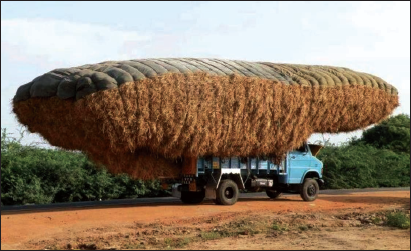
Disaggregation of the industry brings with it a host of unlawful and dangerous practices such as deflation of market rates to earn more; truck overloading for fuel economy; violating speed limits, traffic rules and commercial guidelines; driving long hours with no breaks (thus violating Motor Transport Workers Act); and corruption and use of political connections by truck owners (owners pay huge bribes per year per truck to police and other officials) to avoid being caught for running overloaded trucks. Overloaded trucks (Exhibit 4) cause accidents, damaging the roads and electric lines, crushing pedestrians, destroying trees if the vehicle capsizes/runs into areas covered with trees, and risking the life of the drivers. The Motor Vehicle (MV) Act prohibits overloading, but its provisions are nebulous and, thus, the offence continues.
Given the structure of the industry, most of the small trucking companies/owners do not focus on service quality. Competition is cost-based rather than service-based. The entire burden of hardship is borne by the truck drivers, the workhorses of this sector. The structure is unfavourably affected by cost financing, vehicle technology, absence of wayside amenities, road conditions, detention of vehicles involving additional fuel cost, increase in turnaround time leading to underutilization of vehicles and the legal framework (provisions of the MV Act, Motor Transport Workers Act and Carriage of Goods Act) (Puri, 2000).
In India, a major shift in the truck driver’s profile is being observed over the years. Truck drivers were respected for their disciplined driving behaviour following India’s independence. Today’s drivers have lower socio-economic status and are often disliked by the public and the community. Yet, the trucking industry remains one of the largest employers, providing employment to drivers and cleaners, as well as auxiliary trade and employment opportunities to brokers, booking agents, people engaged in running garages, loading and unloading operations, wayside facilities and so on.
TRUCK DRIVERS IN INDIA
Physical complications apart, public perception of truck drivers is usually negative. They are perceived as traffic blockers, HIV/AIDS transmitters, uncivilized and boorish. An interview with Mr Dayanand Meena, an interstate trucker says:
Truck drivers are the most despised community. People curse us for blocking traffic. But does anyone understand how we feel? It is a wretched life, which includes long, lonely drives coupled with erratic sleeping hours and constantly up against bully cops looking to make a fast buck. Do you know that truck drivers are right down the wish list in the marriage market? Nobody wants his/her daughter to marry a driver. (Gopalan, 2017)
Given the sleepless driving through dreadful territories under tough weather, devoid of urbanization for days together, truck driving in India is like a daring adventure that puts the truck drivers’ life at stake alongside risks to truck and the cargo. Out of the 82,000 reported cases of highway robberies across India, 80% of them are in Uttar Pradesh alone (Tiwary, 2014). The situation is such that drivers cannot leave the truck unattended even to attend to nature’s call.
Despite the hardships faced, it is one of the least respected professions with no dignity, mainly owing to prolonged absence from the family and social community. Truck drivers in Udaipur, Rajasthan, belong to the Dalit communities and are referred to as the 37th caste or the saintisvi jaat as highlighted by Ubhaykar (2019), while the truckdrivers in Punjab belong to the Ramdasiya Sikh community, also a low caste. The social stigma and division of class continues to prevail (Hoppe, 2017).
Truck driving is plagued with issues such as poor payment (INR 15,000–INR 25,000 per month), questionable skill levels (cleaners with low driving skills are promoted as drivers due to long service) and acute illiteracy (exploitation and harassment from police and other government officials leading to heavy bribes). A newspaper article estimates truck drivers pay about INR 47,345 crore towards bribes to traffic and highway authorities annually (Jaswal, 2020).
Coming to health complications, a high prevalence of sleep disorder is observed among truck drivers. Often there is also a dependence on alcohol and psychostimulant drugs, which cause accidents (Souza et al., 2005). According to Sharma and Ganguly (2014), 54% of drivers aged between 18 years and 55 years suffer from lower back pain, visual problems, hypertension, anaemia, high-risk body mass index and genito-urinary and gastric problems (manifested as headaches). Substance abuse (tobacco chewing to stay awake), chronic smoking and alcoholism, and HIV/AIDS are other inevitable health complications. Staying away from home for long periods makes them highly vulnerable to HIV transmission. In 2012–2013, an estimated 2.59% of two lakh truckers had HIV (Paranjape & Challacombe, 2016). About 49% of truck drivers had contacted sex workers in the last six months, of which 21.51% showed sexually transmitted infection symptoms (Thakur et al., 2015). Drivers have unprotected sex with infected sex workers and later transmit it to their regular partners. Infected truck drivers are between the ages of 21 years and 30 years (Atilola et al., 2010). Sadly, the drivers are unaware that they have contracted HIV/AIDS because their job does not provide any medical check-up facility. It is observed that truck drivers also suffer from diabetes, systolic blood pressure, obesity, giddiness and hearing defects (Mathew et al., 2019). The health issues that the truckers face can be directly linked to the hazardous nature of the job and poor working conditions—for 63% of drivers, health is never a priority.
After a long journey on a never-ending highway, truck drivers fall asleep on some isolated roadside on the highway or in a tight space of the truck out of irreparable fatigue (Castrol.com, 2018). Ubhaykar (2019) depicted the miserable and defenceless sleeping conditions of truck drivers as embarrassing contortions of deep sleep in the foetal position. This fatigue is the result of poor quality and quantity of sleep coupled with stress and poor driving conditions. Fatigue leads to zoning out, micro-sleep, inattention, drifting in the lanes, poor speed control and so on, causing grievous injuries or death.
Road/Driving Conditions
India has an extensive network of roads (4.7 million km long), but it is shared by several non-motorized vehicles, causing congestion and, thereby deadly accidents. It is mostly ill-maintained, with no public toilets, service stations, public dormitories and hygienic eating joints. APML did a survey and found that out of 139,000 people who die every year in road accidents, 26,678 die of drowsy driving (Agarwal Packers n.d.-b)
The truck drivers face many challenges. A few are mentioned as follows:
Drivers face poor cabin ergonomics. A typical truck cabin is congested (Exhibit 5) with a worn-out hard seat, damaged cushion/cushion-less seat, manual large hard steering, inability to lean back and fixed posture driving for long hours, causing neck and joint pains (Mishra, 2017). Recently manufactured heavy vehicles have air conditioning (AC), but AC is a distant dream for most lorries and trucks. Adhering to deadlines is another challenge. Delivering cargo undamaged and on time, under rain or sweltering heat creates severe pressure, generating fatigue. As there is no designated start/finish time for driving, the drivers drive 12 to 16 hours without a break to beat the pressure, which may cause deadly accidents due to their drowsiness. They heavily depend on tobacco/opium and roadside tea to keep awake. An interview with a driver, Mr Sandeep, revealed that his eyes get watery when he comes in contact with the light glare from the opposite direction. He turns his gaze away and drives, which is very risky. There are no truck stops in India for the drivers to break the journey and have a good night’s sleep or a place to sit (Exhibit 6). Even if they halt somewhere, they sleep under the chassis, on the roadside, or in the cabin itself. They eat unhygienic food from roadside eateries (dhabas). When trucks break down in remote areas, they get stranded for weeks with no place to bathe or rest. Besides physical stress, drivers experience loneliness and fear while driving on pitch-dark roads (Castrol.com, 2018). As per the rule, truckers should travel during the night only to cross state borders and should not cross state borders during the day. High diesel prices force them to reduce their speed, making the journey longer. Identifying routes to destinations, navigating their trucks on bad roads, tension to reach the destination on time and stops at multiple checkpoints cause mental stress. Illiteracy makes them vulnerable and easy prey to officials and police. Since drivers are hired without written contracts, there is no health insurance, or paid leave. Maintenance of trucks is relatively poor in India. Trucks lack reflector stickers, working headlights/tail-lights, under-run bars, etc. The owners do not bother to repair it; an unsafe truck is a potential threat to the driver and the others on the road. Overloaded trucks tilt the vehicle’s balance and capsize, causing deadly accidents. Overloaded vehicles cause 77,116 accidents and 25,199 deaths every year (Raghuram, 2015). In most cases, overloading, sleeplessness, bad roads and poor street lighting cause the vehicles to crash.
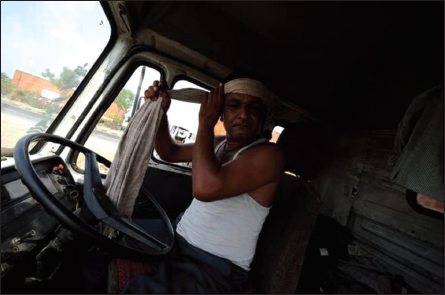
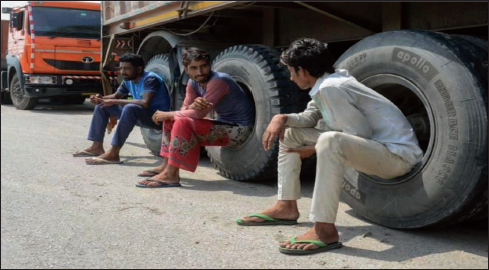
After all this trauma, the driver gets a meagre monthly wage of about INR 15,000 to INR 25,000 a month.
Driver Shortage
The truck driver shortage is spiralling into a global problem (Mittal et al., 2018). Systemic problems such as inadequate sleep, lack of skill and literacy, traffic delays, high accident proneness, loopholes in law enforcement, poor working conditions, harassment at octroi posts, meagre wages and low social status is discouraging individuals from taking up trucking, thus causing an acute shortage (Sharda, 2016). In a nutshell, many demographic, socio-economic, legal and psychographic factors are at play.
How does the shortage affect the economy? The demand for truck deliveries is growing exponentially vis-à-vis the demand for truck drivers. But the industry is struggling to keep up with this demand (Exhibit 7). For instance, the Etawah region in Uttar Pradesh is a stronghold for brick kilns. Bricks from Etawah are supplied to most of the construction sites in the surrounding areas. While the buyers are abundant, logistics is an impediment. There are limited number of drivers to transport bricks on time. Kiln owners lose money if the supply does not reach on time, and production slows down if the stock is not cleared. The kiln owners are not left with any option but to close down the kiln. However, restarting a furnace is infeasible because it is expensive (Banerji, 2016). As illustrated, most of the country’s logistics supply chain remains disorderly and convoluted. About 15% of the fleet at most transport firms is idling at any point in time due to a shortage of drivers (Seth, 2011).
In the early 1990s, transporters hired qualified drivers as apprentices for meagre salaries in a flourishing industry with a gainful career. This practice concretized over time in the form of employing drivers without any written contract.
Idle truck capacity helps estimating the number of new drivers hired. One parameter, driver salary, has not grown in line with driver shortage levels. The associated lack of security due to non-coverage by labour laws demotivates people to opt for trucking. The truck driver availability has declined in the last 40 years (Banerji, 2016). Since the industry is highly unregulated, the lack of robust HR systems has led to driver attrition.
NIDRADAAN AND APML
APML is an Indian family business enterprise operating in a fragmented, unorganized and highly competitive household relocation segment of the Indian logistics industry. After being exposed to the conditions faced by truck drivers in India, Mr Agarwal, decided to understand the situation and work to re-establish the identity of an Indian trucker from a despised status to a respectable one. Mr Agarwal has been instrumental in garnering support from other industry captains’ work on overcoming drivers shortage. He raised the slogan Save the Drivers, Save the Industry.
Mr Agarwal organized a survey to understand the condition of the truckers. The survey revealed many insights such as drivers die at least 10 years before the average human life span; about 22% of the drivers remain unmarried throughout their life; 26% of the total trucks in India (approximately 23 lakh vehicles) remain idle daily due to unavailability of drivers; and drivers have less than 2.5 hours/day of uninterrupted sleep (Agarwal Packers, n.d.-a).
Mr Agarwal thought that a safe, comfortable and uninterrupted sleep would be one of the greatest gift (Nidradaan) for truck drivers because rest boosts productivity. DSK, spread over 50-acres, was thus established in 2012 in Jaipur, Rajasthan. APML took driver well-being as a personal responsibility, not only to empower drivers but to curtail the death rate due to sleeplessness. Mr Agarwal empathized with the plight of drivers—the exploitation, hunger pangs, lack of sleep for days and the absence of amenities.
The DSK at Jaipur has 500 comfortable cots with clean bedspreads and blankets. Amenities such as barbers, saloons, hygienic food, medical facilities, bathrooms, toilets, parking facilities, laundry facility, truck servicing and repair centre and so on, at zero-profit (nominal prices for spare parts, servicing and overhauling) are also available. DSK is an all-India driver empowering initiative that is generating job satisfaction; it highlights that sleep, comfort, health and safety are the fundamental rights of drivers (Exhibit 8).
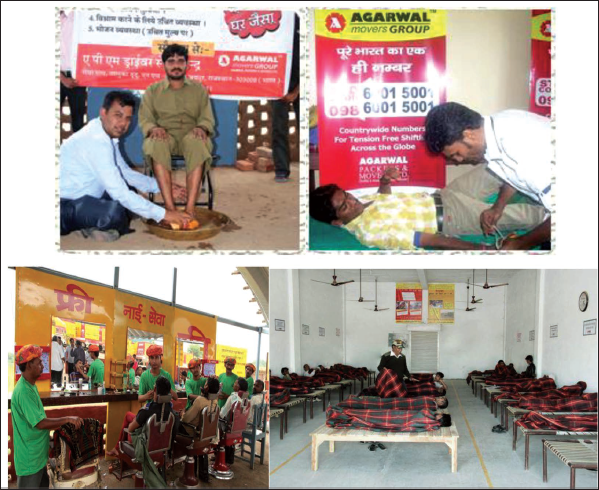
At DSK, drivers are welcomed by the service providers washing their feet. This gesture accords them the long-lost respect. Every day, 400–500 drivers stop at DSK to refresh themselves and use the amenities. While they sleep, their vehicles are checked for maintenance, repaired and overhauled to take-off. DSK provides them with medical check-ups, head massages and quality food. Most importantly, it provides them with a safe and comfortable place to sleep.
The Agarwal Group has recognized and propagated to the world that a truck driver is a soldier of a sustainable economy. Drivers are always on the move, just like soldiers who guard the nation day and night. Drivers thus need to be recognized as vital human resource, and be given their due to ensure an effective logistics system for the nation. The nation heavily depends upon them but seldom acknowledges their sacrifices. DSK was set up to give back to society. It empowers every driver, and thus, it is a ray of hope for every driver. DSK provides amenities that a driver may need. DSK is a home away from home for them.
The uniqueness of Nidradaan lies in the use of socio-environmental sustainability challenges to drive CSI. Nidradaan is not connected to technological change but includes a change in systems, thinking, processes, operating procedures and the like. APML’s innovation is in addressing the social injustice meted out to the drivers and helping them regain respect, empowering them and motivating them to encourage their family and friends to join the profession.
THE WAY FORWARD
Mr Agarwal knew that APML would continue to provide nidradaan to the road soldiers of the Indian economy through DSK. He was thrilled that other organizations were emulating APML. The DSK was unique. This CSI helped differentiate APML from its competitors and gain a competitive advantage while creating a shared value.
However, was Nidradaan proactively solving the impending danger of driver shortage through driver empowerment? What would happen to the transport and logistics industry if it shut down due to lack of drivers? Would mere provision of sleep be able to solve this massive crisis? Will setting up more DSKs solve the immediate problems faced by the Indian trucking industry?
These were a few problems that weighted Mr Agarwal as he looked out of the window…
Footnotes
DECLARATION OF CONFLICTING INTERESTS
The authors declared no potential conflicts of interest with respect to the research, authorship and/or publication of this article.
FUNDING
The authors received no financial support for the research, authorship and/or publication of this article.
e-mail:
e-mail: