




Abstract
Many workers experience their jobs as effortful or even stressful, which can result in strain. Although recovery from work would be an adaptive strategy to prevent the adverse effects of work-related strain, many workers face problems finding enough time to rest and to mentally disconnect from work during nonwork time. What goes on in workers’ minds after a stressful workday? What is it about their jobs that makes them think about their work? This special issue aims to bridge the gap between research on recovery processes mainly examined in Occupational Health Psychology, and research on work stress and working hours, often investigated in the field of Human Resource Management. We first summarize conceptual and theoretical streams from both fields of research. In the following, we discuss the contributions of the five special issue papers and conclude with key messages and directions for further research.
Keywords
Introduction
Work today is often very stressful. In a recent representative survey of some 20,000 German employees, 60% reported multitasking demands, 48% time and performance pressure, 46% work interruptions, and about 34% having to work very fast (Bundesanstalt für Arbeitsschutz und Arbeitsmedizin, 2020). For most of these job demands more than half of all employees report experiencing them as stressful. Moreover, recent changes in workplaces may lead to intensified job demands (Kubicek and Tement, 2016). High levels of work-related stressors have been linked to a variety of negative consequences, such as lower wellbeing and health, impaired performance, and poorer safety at work, potentially leading to organizational and societal costs (Hassard et al., 2018, Sonnentag, 2018). However, it is not only the quality and quantity of work that seems to stress many employees, but also the increasing blurring of boundaries between work and private life. Working long hours, working during evenings and weekends, often connected with telecommuting, make it challenging to find time for leisure activities, family, and friends (Bundesanstalt für Arbeitsschutz und Arbeitsmedizin, 2020). These trends in working life are also reflected in the emerging literature on the importance of leisure time, often including practical guidance for managers to improve their own and their worker’s recovery and mental disengagement from demanding work (see for instance the books recently published by Fitch and Frenzel (2020), Gruman and Healey (2018) and Pang (2016) in English language and Blasche (2020) in German language).
Thus, it seems that not only is stress at work very high, but time for recovery, which would be badly needed in demanding working conditions, is simultaneously reduced. In a representative survey of some 6500 full-time workers in Germany, 30% reported frequently skipping their work breaks, 17% reported that their work breaks were frequently interrupted or shorter than previously planned, and 20% reported rest periods of less than 11 hours between work shifts at least once a month (Vieten and Brauner, 2020). It is no surprise that 44% of all workers surveyed reported feeling not fully recovered when starting their daily work. Sonnentag (2018) has described this as the “recovery paradox”: While the experience of work-related stress calls for effective recovery, high work-related stressors do also impair workers’ recovery (e.g. their recovery activities, processes, and outcomes). It is hardest to recover when one needs recovery most.
One of the recovery problems is highly intuitive for many workers: difficulties to mentally disconnect from work. For instance, you may play with your children on the playground in the afternoon, talk with your partner about plans for the next weekend, or you may try to fall asleep after going to bed—but there is something in your mind that distracts you from these activities or impairs your ability to listen carefully: thoughts about your work. This experience of mental connectedness to one’s work through work-related thoughts during recovery periods has been described in the literature on stress and recovery as low psychological detachment, work-related rumination, problem-solving pondering, and work reflection (Weigelt et al., 2019). Each of these constructs emphasizes a different aspect of cognitive recovery, which we will discuss later in more detail. This impairment of recovery is relevant for both the individual worker and the organization, since it has been related to adverse and stressful working conditions and negative, detrimental outcomes such as poorer wellbeing, poorer health, more negative job attitudes, and lower task performance (Wendsche and Lohmann-Haislah, 2017a).
In order to shed more light on the phenomena associated with recovery of the mind during recovery periods, we called for papers in this Special Issue of the German Journal of Human Resource Management (GHRM). What is it that goes on in workers’ minds after a stressful workday and what is it about their jobs that keeps them mentally engaged or disengaged from their work during recovery periods? We aim to bridge the gap between research on recovery of the mind mainly examined in Occupational Health Psychology (e.g. Sonnentag et al., 2017) and research on work stress and working hours (e.g. Blagoev et al., 2018) published in the field of Human Resource Management. We hope that this integration will not only stimulate theoretical advancement concerning recovery from work but also results in important practical implications that help organizations respond to currently pressing HRM challenges.
In the first part of this editorial we outline conceptual and theoretical streams from the research on recovery of the mind as well as results on the prevalence, the drivers, and the consequences work-related thoughts during nonwork time. In the second part, we introduce and discuss the contributions of the five special issue papers. Finally, we conclude with key messages and propose directions for further research as well as noting implications for human resource management.
Recovery of the mind after a stressful day
Conceptual definitions
Recovery concept
Recovery can by described by its context (e.g. timing, length, and related situational factors) and as an outcome (e.g. feeling recovered), but most of the research in Occupational Health Psychology has defined recovery as a process through which a person’s actual psychobiological state is harmonized with the desired state (Sonnentag et al., 2017; Zijlstra et al., 2014). More specifically, recovery describes the unwinding of a person’s strain level to a hypothetical baseline level (e.g. fatigue) after reducing or removing (work-related) stressors (Sonnentag et al., 2017).
Recovery processes and related strain alleviation might be described more specifically by realized recovery activities. For instance, the meta-analysis by Steed et al. (2021) showed that replenishing, low-duty recovery activities (e.g. socializing or reading a book) are significantly related to lower fatigue (ρ = −0.13) and higher mental wellbeing (ρ = 0.13), whereas demanding, high-duty recovery activities (e.g. job-related activities, taking care of family members, or household chores) are significantly related to higher fatigue (ρ = 0.06) and lower mental wellbeing (ρ = −0.08). However, the weak correlations and often mixed findings regarding recovery activities and work outcomes caused recovery researchers to turn their attention to the psychological recovery processes associated with particular leisure activities. This approach aimed to better explain intraindividual (i.e. within-persons between hours, days, or weeks) and interindividual (i.e. between persons) differences between recovery activities and recovery outcomes as well as individual recovery preferences (Demerouti et al., 2009, Sonnentag et al., 2017). For instance, why is it possible that a person experiences watching a documentary in the evening as relaxing on some days, but not on others (i.e. intraindividual difference)? And why do some individuals feel calm when watching a documentary and some do not (i.e. interindividual difference)? So far, six different recovery experiences have been identified to promote workers’ recovery. These are psychological detachment, relaxation, mastery, control (autonomy), meaningfulness, and affiliation (Newman et al., 2014; Sonnentag and Fritz, 2007). While most of these recovery experiences relate to physiological deactivation, affect regulation, and needs satisfaction processes (e.g. Kujanpää et al., 2021), the concept of psychological detachment directly concerns work-related thoughts, on which we also focus in this special issue (Sonnentag and Fritz, 2007; Virtanen et al., 2020).
Work-related thoughts during nonwork time
Psychological detachment means being mentally and not just physically away from work, ceasing to think about work, and disengaging cognitively from the job during recovery periods (Sonnentag and Fritz, 2007). Therefore, detachment can be conceptualized as the absence of work-related thoughts and “implies ‘letting go’ of work-related thoughts and activities” (Sonnentag and Fritz, 2015: S74). This “absence perspective” is also reflected in the most widely used questionnaires to assess this construct (Wendsche and Lohmann-Haislah, 2017a): the Recovery Experience Questionnaire REQ (Sonnentag and Fritz, 2007: four items such as “In the evening I don’t think about work at all.”) or the Work-Related Rumination Questionnaire WRRQ (Cropley et al., 2012: five items such as “I am able to stop thinking about work-related issues in my free time”). However, de Jonge et al. (2012) suggested that it might be important to differentiate the content of job demands from which workers detach. Therefore, their questionnaire considers cognitive, emotional, and physical detachment. Their results showed that these facets are indeed differently related to creativity, wellbeing, and health (de Jonge, 2020; de Jonge et al., 2012; Niks et al., 2016).
Although the detachment concept stimulated a considerable amount of research (Sonnentag and Fritz, 2015), scholars increasingly recognized some shortcomings. First, from a methodological perspective, we actually do not know what cognitive reference point respondents use when answering questions about the absence of work-related thoughts used in the standard questionnaires. Are “absent” thoughts about work (i.e. detachment measures) actively remembered due to the questions asked and become salient and/or do respondents recall whether work-related thoughts were present? To what extent are work-related thoughts triggered when people are asked about detaching from them? Second, from an empirical perspective, an increase in detachment is not always related to better recovery outcomes. For instance, some studies found curvilinear relations between detachment and work engagement, performance, and mental health (Fritz et al., 2010; Shimazu et al., 2016), which may, as we will see below, contradict theoretical assumptions. Third, from a conceptual perspective, research on detachment has often ignored different ways of thinking about work with the potential to improve recovery and related outcomes (for notable exceptions, see Meier et al., 2016; Sonnentag and Niessen, 2020, Weigelt et al., 2019).
Therefore, recovery researchers started to investigate how the presence and the content of work-related thoughts during recovery periods might affect recovery (Sonnentag and Fritz, 2015). Two concepts have been integrated in this literature. The first is work-related rumination (sometimes called work-related perseverative cognitions; Cropley et al., 2015) which is defined as recurring and intrusive thoughts about work that might relate to past, present, or future work-related stressors (Cropley and Zijlstra, 2011) and builds on the seminal work of Martin and Tesser (1996). Following this conceptualization, the worker is seen as a passive agent overwhelmed by unwanted work-related thoughts. The second concept of work reflection (Fritz and Sonnentag, 2005; Meier et al., 2016) assigns the worker a more active role in reappraising work-related stressors during recovery periods.
While one could describe detachment and work-related rumination as representing the extremes of a unipolar construct “thinking about work during nonwork time” (with not thinking at all about work/fully mentally unwinding from work-related thoughts on the one end, and experiencing highly negative frequent intrusive thoughts about work-related issues on the other hand), two streams of research offer a more nuanced view of the specific content of work-related thoughts.
The first stream of research concerns (re-)appraisal processes and the valence of work-related thoughts. While the concepts of psychological detachment and even work-related rumination have been defined in neutral terms and were also assessed without any reference to the valence of work-related thoughts (Cropley and Purvis, 2003; Sonnentag and Fritz, 2007), Sonnentag and Fritz (2015) have argued that positive thoughts about work can improve recovery, while negative work-related thoughts can impair (affective) recovery from work-related stress. These propositions are based on appraisal theory (Scherer, 1999) and early work on rumination (Martin and Tesser, 1996). Considering positive work-related thoughts, there are related concepts and measures in the literature such as positive work rumination (Frone, 2015), positive work reflection (Fritz and Sonnentag, 2005), or positive thinking about work (Flaxman et al., 2018). Concepts regarding negative work-related thoughts comprise constructs such as negative work rumination (Frone, 2015), affective rumination (Cropley et al., 2012), and negative work reflection (Binnewies et al., 2009), all of which have been studied in the literature.
Finally, the second approach links work-related thoughts during nonwork time with problem-focused coping activities. For instance, the concept of problem-solving pondering is defined as affectively neutral but relates to the cognitive content and process of work-related thoughts. More specifically it is characterized as thinking about solutions to work-related problems (Cropley et al., 2012; Cropley and Zijlstra, 2011; Hamesch et al., 2014).
Empirical distinctiveness of concepts
Little research has investigated how these different concepts are actually empirically distinct or overlapping. As we will see in the next section, this gap has been due to the development of research on psychological detachment and on concepts relating to work-related thinking (e.g. rumination, work reflection, and problem-solving pondering) at the same time. This research was sometimes conducted in isolation, due to the use of different theoretical models and to being rooted in different fields of research, which emphasize either the work and occupational health context, the clinical context or the leisure context.
The study by Weigelt et al. (2019) is an exception here. More specifically, they studied how five types of work-related thinking during nonwork time (i.e. psychological detachment, affective rumination, problem-solving pondering, positive and negative work-reflection) relate to each other and are distinct from the related personality traits (i.e. worry, neuroticism), and strain outcomes (i.e. cognitive and emotional irritation). Their results showed that the concepts can be differentiated empirically. However, the concepts of work-related thinking during nonwork time also share considerable degrees of variance. For instance, detachment was negatively related to negative work reflection, affective rumination, and problem-solving pondering, but not related to positive work reflection. Positive work reflection was unrelated to negative work reflection but positively related to problem-solving pondering and negatively related to affective rumination. Yet the relationship between positive work reflection and problem-solving pondering suggests that the two constructs are clearly distinct as they correlate only moderately. Negative work reflection was positively related to affective rumination and problem-solving pondering. Problem-solving pondering was also positively related to affective rumination. While all these relationships speak for overlap between the constructs, Weigelt et al. underline the uniqueness of each construct. Accordingly, they found that all five concepts were in a different manner the strongest predictors of strain-related and motivational outcomes: detachment was associated with life satisfaction and flourishing, affective rumination was linked to burnout, problem-solving pondering connected with vigor (work engagement) and thriving, positive work reflection was related to dedication and absorption (work engagement dimensions), and negative work reflection explained at least incremental variance for all outcomes with flourishing as an exception. In sum, this study showed that none of the different concepts is redundant. The authors actually showed that the tripartite conceptualization of work-related thoughts (detachment, affective rumination, problem-solving pondering) should be expanded with positive as well as negative work reflection. This research would greatly add to our understanding of the consequences of work-related thoughts. Moreover, the results of this study imply that recovery interventions aiming to reduce work-related strain outcomes should target the reduction of negative work-related thoughts, whereas interventions aiming to improve wellbeing and motivation should target the improvement of detachment, positive and problem-focused work-reflection.
In contrast to variable-centered approaches, other studies have taken a person-centered perspective, investigating relations between the concepts of work-related thoughts. Specifically, such studies aimed to identify typical trait-like personality profiles for how different work-related thoughts are associated within the person. For instance, in a longitudinal study Kinnunen et al. (2017) found five stable individual patterns between affective rumination, problem-solving pondering, and lack of psychological detachment that differently related to job demands and mental wellbeing. Similarly, Gillet et al. (2020) found four consistent patterns between overcommitment, rumination, and psychological detachment that were associated with different outcomes and work-related stressors in two substudies. Finally, in another longitudinal study, Casper et al. (2019) identified six profile combinations between positive and negative work reflection. Their results showed that high negative reflectors reported the highest levels of exhaustion whereas high positive reflectors reported the highest levels of vigor. Two other results from this study are also worth emphasizing. First, about half of all participants reported both positive and negative work reflection (i.e. moderate and high work reflectors). This means that positive and negative thoughts about work may co-occur and affect each other, which corroborates the finding by Syrek et al. (2017) showing an interaction effect between affective rumination and problem-solving pondering on sleep impairment. Second, the profile membership was not stable across the study waves, indicating that employees use different strategies according to their work or personal situation.
A third line of research focuses on intraindividual relationships. These studies analyze the difference in work-related thoughts between hours, days, or weeks within the same person. For instance, a study by Syrek et al. (2017) examined whether employees ruminate more at weekends when they reported more unfinished tasks on Fridays compared to Fridays when they experienced fewer unfinished tasks. Vahle-Hinz (2019) showed that employees ruminate more in the evening on days with higher time pressure or workplace incivility compared to their average time pressure or workplace incivility experiences over the week. Pieper et al. (2007) showed a relationship between hourly measured work-related worry episodes with elevated heart rate.
Summing up, earlier research shows that while concepts on the absence and presence of work-related thoughts during nonwork time are empirically distinctive and differentially predict recovery outcomes, they also covary in systematic ways. This suggests that workers use different cognitive recovery strategies in general (i.e. more trait-like) but also adopt strategies depending on their specific situational circumstances.
Theoretical models
In this section we will briefly summarize the main theoretical models that have been used to explain potential drivers and outcomes of workers’ recovery and work-related thoughts during nonwork time.
Recovery models
Two complementary theories have mainly been used to explain workers’ recovery. The first is the effort-recovery model (Meijman and Mulder, 1998). The model proposes that, depending on personal and situational factors, work-related or private demands create acute physiological (e.g. higher blood pressure) and psychological (e.g. fatigue) load reactions. Such short-term effects are in principle reversible, such that if demands are reduced or removed, adverse consequences of work (i.e. strain) will revert to the baseline level, which is called recovery. In sum, this model suggests a “passive mechanism” of recovery: recovery occurs if demands are reduced (de Bloom et al., 2010). In this sense, recovery will occur if people distance themselves and detach from work-related thoughts as this implies a “cognitive” reduction or relief from work demands.
By contrast, conservation of resources theory (Hobfoll et al., 2018) explains the “active mechanisms” of recovery. The model proposes that individuals strive to build, retain, and maintain factors that are important to them and valued (i.e. resources). Threats of losing or the actual loss of such resources will have adverse consequences of strain similar to the process suggested by the effort-recovery model. With regard to recovery research, this model is interesting since it proposes that recovery does not only occur under the premise of a cessation of resource depletion (as the effort recovery model implies), but that recovery will also occur if individuals increase or replenish their resources (Steed et al., 2021). Thus, this model is helpful in explaining not only why detachment from work-related thoughts will result in recovery from strain but also why positive work-reflection and problem-solving are mental strategies to increase individual resources.
The stressor-detachment model
The stressor-detachment model (Sonnentag, 2011; Sonnentag and Fritz, 2015) is the most widely used theoretical model to explain the functional role of work-related thoughts during nonwork time. More specifically, psychological detachment as absence of work-related thoughts is defined both as a within-person construct, thus varying from day-to-day within one person, and as a between-person construct, thus, varying between different individuals. Accordingly, psychological detachment seems to be both a trait and a state variable (Bakker et al., 2015). This is also supported by the results from the meta-analysis by Podsakoff et al. (2019) revealing about 56% variance on the within-person level for recovery constructs. Similar estimates have been reported for detachment (Sonnentag, 2011; Sonnentag and Fritz, 2015). However, when we later discuss the propositions of the stressor-detachment model, it is worth noting that the relationships between detachment and other variables have been fairly similar at both levels of analysis. For instance, McCormick et al. (2020) reported from an analysis of 46 detachment studies that only in 15% of all cases the within- and between-person parameter estimates between variables differed significantly in size, but in none of the studies was the direction of effects different. Thus, there is some preliminary evidence that the stressor-detachment model fits both under a state and trait perspective.
The stressor-detachment model proposes psychological detachment as having a mediating and moderating element for the relationships between work-related stressors and strain outcomes and wellbeing. With regard to the mediating role, the model suggests that high work-related stressors will impair psychological detachment, which then results in more adverse strain outcomes (e.g. higher fatigue) and lower wellbeing. Regarding the moderating role, the model proposes that the positive relationships between work-related stressors and adverse strain outcomes will be reduced when workers can detach from work.
This basic model was further developed and extended by proposing additional moderators which shape the relationships between variables (Sonnentag and Fritz, 2015). It was proposed that factors improving primary and secondary appraisal will reduce negative relationships between work-related stressors and detachment. This includes an attentional shift away from work (e.g. directing attention toward private life, high capacity and willingness for such shifts, boundary management), and high personal (e.g. self-efficacy) and work-related (e.g. social support) resources. Moreover, the relationship between low detachment and wellbeing was suggested to be moderated by the content of work-related thoughts. More specifically, positive thoughts about work during nonwork time may signal positive reappraisal processes that are beneficial compared to negative thoughts that are expected to be detrimental. Moreover, mental problem-solving experiences may help to reduce subsequent work-related stressors (e.g. planning a strategy for the project meeting to avoid time pressure). Thus, this extended stressor-detachment model (Sonnentag and Fritz, 2015), although so far less frequently researched than the basic model (see Wendsche et al., 2020 for a review), is more specific in defining the boundary conditions of the effects of low psychological detachment.
Sonnentag (2018) has recently introduced a phenomenon, which she called the recovery paradox. The recovery paradox explains why work-related stressors relate to impaired recovery (e.g. less physical activity, poor sleep, lower psychological detachment) via three core mechanisms. In the following, we will briefly discuss these in connection with detachment. The first mechanism is high negative activation resulting from work-related stressors. In line with the mood-congruency hypothesis (Judge and Ilies, 2004), negative cognitions are more salient and accessible when individuals experience negative affective states, which makes detachment less feasible and increases the risks of negative work-related rumination or negative work reflection. The second mechanism refers to the depletion of energy resources. Depleted resources, for instance, generally low self-control resources or motivation and high fatigue, make it more difficult to control cognitive and affective reactions to work-related stressors and impair detaching from work. The third mechanism describes a constant technological connectivity to work, which constitutes a behavioral explanation for difficulties detaching from work in the evening. There are various reasons for staying technologically connected to work during nonwork times, for instance, fear of missing out on something important, pure availability of devices, organizational pressure to stay connected, job-related uncertainty, flexible work arrangements or simply the need to complete important tasks (Bamberg et al., 2012; Dettmers et al, 2016; Van Laethem et al., 2018). Third-variable explanations related to both, high work-related stressors and low detachment, negative organizational climate (e.g. competitive climate, overwork climate), and stable individual-differences (e.g. negative affectivity, neuroticisms, workaholism) (Jalonen et al., 2015; Schulz et al., 2017).
In sum, the revised model extends the stressor-detachment model by proposing mediating and further moderating factors for stressor-detachment-relationships and also by giving more guidance, identifying work-related and person-related factors driving psychological detachment or work-related rumination (Sonnentag and Fritz, 2015).
Models on the presence of work-related thoughts during nonwork time
There are several models in the literature specifically explaining how work-related thoughts during nonwork time develop and how they impact on important workers’ outcomes (Weigelt et al., 2019; Wendsche and Lohmann-Haislah, 2016).
The self-regulation model of ruminative thoughts (Martin and Tesser, 1996) suggests that ruminative thoughts about life events develop from unexpected progress in relation to personal goals. People may ruminate about the past, present, or future and about both positive and negative events. According to the positive or negative valence and temporal orientation of thoughts and to the discrepancy and attainment focus, different modes of rumination can be distinguished that relate to strategies in overcoming specific goal-discrepancies. In turn, individuals will ruminate until they reach their goals or give up their desire for them. In relation to work-related thoughts during recovery periods, this motivational theory stimulated a lot of research investigating, first, how and why different types of work-related rumination (e.g. positive vs negative thoughts, problem-solving pondering) relate to different outcomes since they help to overcome inhibited goal attainment in different ways (Cropley et al., 2012; Cropley and Zijlstra, 2011). Second, these theories gave rise to research on how and why specific work-related stressors relate differently to work-related thoughts. For instance, related to the latter, Weigelt and Syrek (2017) used this theory—in addition to prior theory building by Zeigarnik (1927) and Ovsiankina (1928) —to explain why unfinished work tasks do not only relate to lower psychological detachment but also how workers further strengthen this relationship by investing additional effort in finishing work tasks during recovery periods in order to attain their goals.
When explaining the health-related and physiological consequences of work-related thoughts during nonwork time the cognitive activation theory of stress (Meurs and Perrewé, 2011; Ursin and Eriksen, 2004) and the perseverative cognition theory (Brosschot et al., 2006) are often referred to in the literature. These models propose that individuals react to physical and psychological stressors with cognitive appraisal processes involving stimulus (e.g. expected stressor-event relations) and outcome (e.g. positive or negative) experiences based on learning experiences and resources (e.g. skills and abilities, personal control) to reach actual and desired states. In relation to work-related thoughts during nonwork time, both theories are helpful as they explain, first, that actual but also expected work-related stressors may elicit different work-related thoughts (e.g. positive and negative, problem- or emotion-focused) as part of the appraisal processes. Second, they report that certain work factors (e.g. unpredictable events, low job resources) and individual characteristics (e.g. demands-abilities fit, stress-related traits) increase people’s tendency to think about their work. Third, these theories illustrate that prolonged conscious and unconscious (e.g. during sleep) work-related thoughts relate to sustained physiological activation processes which, in the long run, will translate adaptive stress responses into pathogenic states and organic diseases (McEwen, 1998).
In sum, the theoretical models described above focus on work-related thoughts indirectly (e.g. recovery models such as the effort-recovery model and the conversation of resources theory) or directly, stressing either specific facets of the absence (e.g. the stressor-detachment model, recovery paradox) or presence of work-related thoughts (e.g. the self-regulation model of ruminative thoughts, the cognitive activation theory of stress, the perseverative cognition theory).
Empirical findings
In this section, we report empirical findings from the literature on the prevalence of problems in mentally detaching and disconnecting from work. Additionally, we report findings from systematic reviews on related drivers, consequences, potential interventions, and study approaches in this line of research.
Prevalence of work-related thoughts
Finding representative estimates of prevalence of work-related thoughts is not easy since norm values have not been published for most of the established questionnaires in this research area. However, some of these constructs have been assessed in national German surveys with single items. For instance, data from the first wave of the German Working Time Survey 2015 (Häring et al., 2016) with a representative sample of some 20,000 German workers reveals that work-related thoughts in the evening are quite common: 30% reported thoughts about problems at work, 27% reported thoughts about upcoming work tasks and 17% reported thoughts about planning upcoming tasks. Thus, it seems that negative affective work experiences (i.e. work problems) enter employees’ minds more often than functional work-related thoughts (i.e. anticipation and planning of upcoming work tasks).
More recently, data from the seventh wave of the representative German BIBB/BAuA employment survey 2018 (N = 17,852) showed that 22% of employees reported finding it difficult to detach from work during off-job time (Bundesanstalt für Arbeitsschutz und Arbeitsmedizin, 2020). There were also some differences relating to employee characteristics: older employees reported more problems in fully detaching (e.g. 55–64 years: 24%) than did younger employees (e.g. 25–34 years: 20%), full-time workers (23%) reported more problems than did part-time workers (18%), and employees with supervisory roles reported more problems unwinding from work (26%) than did employees without managerial responsibility (22%). Considering the occupational group’s prevalence, means were above the average for social and education professions (30%), food professions (25%), and health professions (24%).
In another representative German study (N = 4201; Schulz et al., 2020b) more serious forms of mental disengagement were assessed with the FABA questionnaire, for which norm values have been published (Richter et al., 1999). The recovery inability scale asks about problems detaching during the evening but also during vacations and assesses a negative spillover into sleep. This study showed that about 13% reported serious mental recovery problems related to low detachment from work during off-job time. The study further revealed the following characteristics were related to recovery problems: supervisory role (29%), long weekly working hours (more than 48 hours/week, 27%), being a teacher (23%), trust-based flexible working time (20%), temporary employment contract (17%), and service jobs (16%).
In sum, these few but key studies show that many (German) workers experience problems mentally disconnecting from work and that person and job characteristics play an important role in impeding recovery.
Outcomes
The models described earlier propose that psychological detachment and positive work reflection as well as problem-solving pondering are positively related to wellbeing (Cropley and Zijlstra, 2011; Sonnentag and Fritz, 2015) whereas negative thoughts about work during nonwork time (e.g. negative work reflection, affective/negative work-related rumination) are negatively related to psychophysiological recovery and positively related to adverse strain outcomes (Brosschot et al., 2006; Cropley and Zijlstra, 2011). In Table 1, we present an overview of the results regarding these propositions from the meta-analyses that have been published so far (note that results from the meta-analysis by Bennett et al., 2018 have been updated by Steed et al., 2021 and Headrick et al., 2019 and are therefore not reported).
Results from meta-analyses on outcomes of work-related thoughts during nonwork time.
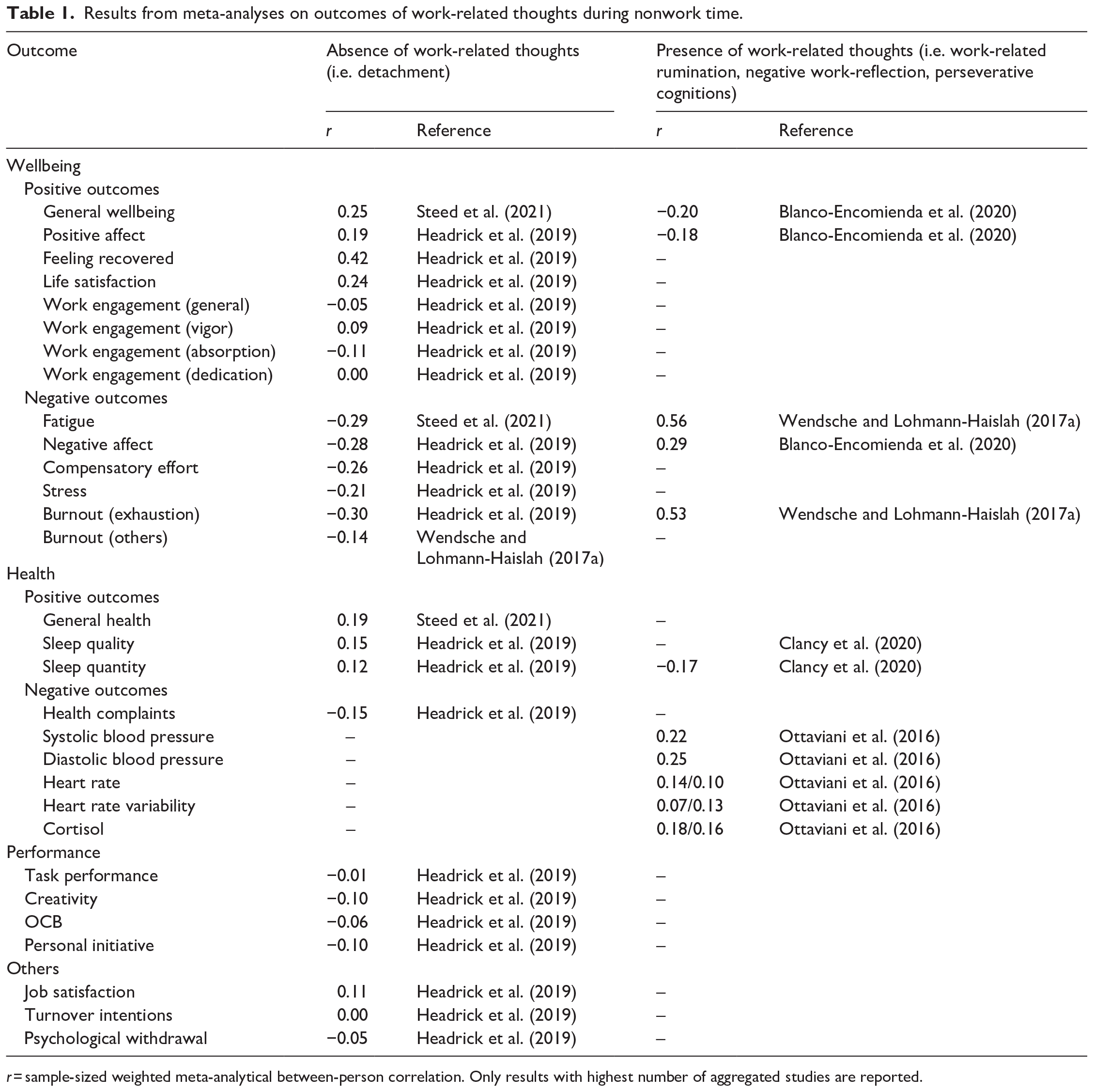
r = sample-sized weighted meta-analytical between-person correlation. Only results with highest number of aggregated studies are reported.
While, as proposed, detachment (i.e. absence of work-related thoughts) is on average positively related to feeling recovered, positive wellbeing indicators (e.g. positive affect, life satisfaction), and negatively related to negative wellbeing outcomes (e.g. fatigue, exhaustion), opposite effects have been found for constructs relating to negative work-related thoughts (e.g. affective rumination, negative work-reflection). It is noteworthy that the relationships between the presence of work-related thoughts and negative wellbeing indicators seem to be stronger than the relationships between detachment and wellbeing. Although some studies found positive work reflection was related to improved wellbeing (e.g. Meier et al., 2016), the meta-analysis by Wendsche and Lohmann-Haislah (2017a) reported somewhat inconsistent findings. For instance, the average correlation between positive affect and detachment was r = 0.29, for negative rumination r = −0.38, and r = 0.02 for positive work reflection. This means that the harmful effect of negative work-related thoughts seems to be stronger than the beneficial effect of not thinking about work.
Considering health outcomes, greater detachment has been found to relate to better general health, better sleep, and fewer health complaints although the effect sizes are weaker than for wellbeing outcomes. By contrast, (negative) work-related rumination relates to poor sleep (stronger associations than for detachment). Moreover, studies show that rumination is related to greater stress-related physiological activation whereas for detachment non-significant relationships have been reported (Wendsche and Lohmann-Haislah, 2017a).
Relationships between detachment and task performance are inconsistent and on average not substantial. This supports findings suggesting more complex and non-linear relationships (Fritz et al., 2010; Shimazu et al., 2016). However, detachment is weakly negatively related to indicators of contextual performance and creativity. This could mean that high work performance often requires work activities and thinking about work problems during nonwork times, which therefore reduces detachment from work. Two studies (Vahle-Hinz et al., 2017; Weinberger et al., 2018) showed that problem-solving pondering, but not affective rumination, was related to creativity, and, interestingly, in the study by Vahle-Hinz et al. (2017) reverse effects indicated that creativity was also related to affective rumination, suggesting reverse or reciprocal relationships. Another study found affective rumination to be negatively related to task performance but not related to contextual performance (Van Laethem et al., 2019). Moreover, in a study by Binnewies et al. (2009) high positive but not negative work reflection positively predicted contextual performance and creativity. Low detachment may therefore not be detrimental to all performance-related outcomes and the valence of work-related thoughts seems important to further shed light on the relationship between the presence work-related thoughts and performance.
Regarding motivational outcomes such as work engagement, job satisfaction, and withdrawal intentions, empirical studies generally found weak to nonsignificant relationships for the absence as well as the presence of work-related thoughts.
The correlations reported above mainly rely on between-person associations. However, Headrick et al. (2019) further investigated the results of McCormick et al. (2020) suggesting homology of between-person and within-person relationships between detachment and different outcomes. This meta-analysis moreover confirmed similar within-person relationships between detachment and positive and negative affect and sleep quality. Only the relationships to state recovery (ρ = 0.11), exhaustion (ρ = −0.05), and sleep quantity (ρ = 0.03) were significantly less strong on the within-person than on the between-person level. Relationships between detachment and wellbeing and health even hold when considering lagged associations from longitudinal studies, although with smaller effect sizes (Steed et al., 2021; Wendsche and Lohmann-Haislah, 2017a). While the same pattern could be expected for affective rumination, problem-solving pondering, and work reflection, the literature is lacking empirical results on these types of work-related thoughts.
During the past few years, scholars have started to investigate specific further outcomes that are important in the context of human resource management. For instance, it was found that psychological detachment was related to better patient and worker safety (Buljac-Samardžić et al., 2018; Chen and Li, 2020), lower counterproductive work behavior (Chen et al., 2017), and better work-life balance (Barber et al., 2019). Considering the different types of work-related thoughts during nonwork time, studies have, for instance, investigated relationships to work-family-conflict and enrichment (Junker et al., 2020), executive functions (Cropley and Collis, 2020; Cropley et al., 2016), and thriving (Weigelt et al., 2019).
All in all, meta-analytical results support theoretical assumptions that work-related thoughts during nonwork time are most strongly related to wellbeing and health with higher correlations for negative work-related thoughts than for detachment. By contrast, relationships between work-related thoughts and motivational and performance-related outcomes are rather weak, suggesting moderating variables on the individual or organizational level. Research also suggests that work-related thoughts and strain effects must persist for a considerable time before performance deteriorates (e.g. Hockey, 2013) and relationships may be curvilinear with medium levels of work-related thoughts showing the strongest connections to performance and motivational outcomes.
Antecedents
Considering the potential antecedents of work-related thinking during nonwork time, most studies investigated work-related factors (Wendsche and Lohmann-Haislah, 2017a). As shown in Table 2, job demands are negatively related to detachment and positively related to work-related thoughts (e.g. for general job demands r = −0.25 and r = 0.30) during recovery periods, which supports the theoretical assumptions. Moreover, one meta-analysis found significant negative relationships between job demands and detachment, significant positive relationships between job demands and negative work-related rumination, while weak positive relationships to positive work reflection (r = 0.14) failed to reach statistical significance. However, effect sizes vary when considering more specific job demands. For instance, correlations are highest for quantitative demands, challenge demands, emotional demands, as well as social and private conflicts. Lower or nonsignificant correlations were found for detachment and physical demands (r = −0.05) or role stressors (r = −0.12). Thus, in line with the theoretical models outlined above, work characteristics that lead to time-related, cognitive, and emotional goal discrepancies or increase the motivational drive to work make it difficult to detach from work.
Results from meta-analyses on antecedents of work-related thoughts during nonwork time.
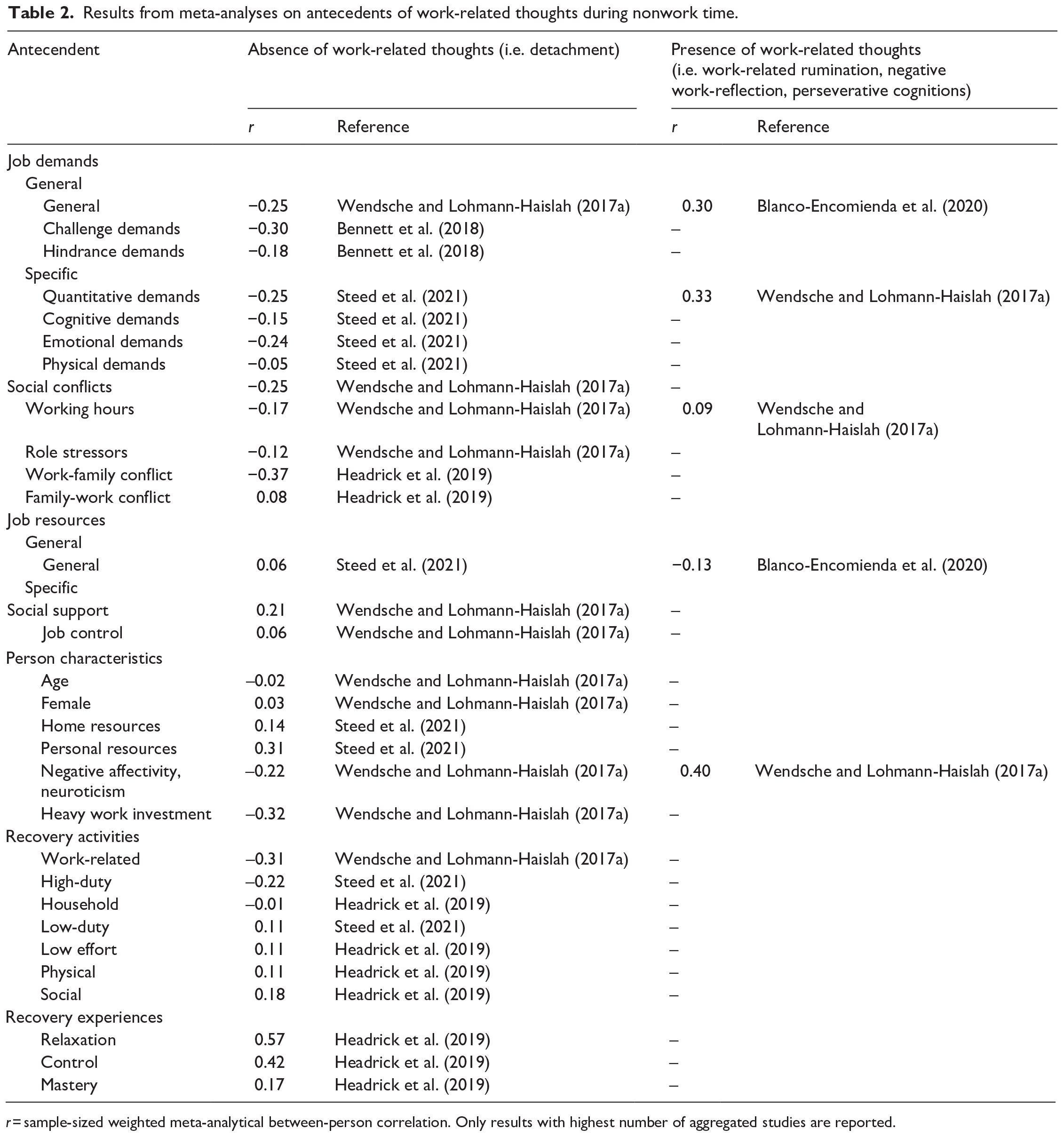
r = sample-sized weighted meta-analytical between-person correlation. Only results with highest number of aggregated studies are reported.
In contrast to job demands, job resources are mostly not related to thinking about work. The only preventive effects were found for social support, which predicted detachment (r = 0.21).
As regards person-related factors, demographic variables seem to have little or no effect. Stable personality characteristics such as negative affectivity, neuroticism, and heavy work investment may impair cognitive recovery from work. By contrast, personal resources (e.g. psychological capital, self-efficacy) help to detach from work.
With the majority of the research on work-related thoughts focusing on detachment, research has also examined how detachment relates to recovery activities and other recovery experiences. Overall, work-related activities and demanding activities during off-job time impair psychological detachment whereas social activities and, to a lesser degree, low-effort activities help to distract mentally from work. Moreover, detachment is moderately related to other recovery experiences such as relaxation and control.
From a theoretical perspective, the stressor-detachment model proposes that work-related stressors are the most important factor reducing psychological detachment. Therefore, given the many other anteceding variables, meta-analyses have further investigated this assumption. It was shown that relationships between stressful working conditions (i.e. high job demands, low job resources) hold even in longitudinal studies (Steed et al., 2021; Wendsche and Lohmann-Haislah, 2017a) supporting the proposed causal order of variables. Moreover, job demands negatively predicted psychological detachment when considering different types of job demands, other recovery experiences, and person factors such as negative affectivity/neuroticism (Bennett et al., 2018; Wendsche and Lohmann-Haislah, 2017b). Therefore, stressful working conditions seem to be a major contributing factor explaining variance in psychological detachment. Studies on work-related thoughts suggest the same antecedents for affective rumination and problem-solving pondering (e.g. Syrek et al., 2017; Vahle-Hinz et al., 2014).
Functional role of work-related thoughts
While the intention of our editorial is mainly to show which factors influence work-related thoughts during nonwork time and how work-related thoughts lead to different outcomes, we want to give a brief description of functional relationships.
First, the stressor-detachment model (Sonnentag and Fritz, 2015) proposes work-related thoughts as a mediating variable connecting stressor-strain relationships. This assumption has been now confirmed in longitudinal studies (Dettmers, 2017; Schulz et al., 2020a) likewise meta-analyses on psychological detachment (Bennett et al., 2018; Wendsche and Lohmann-Haislah, 2017b; see also Sonnentag and Fritz, 2015 for a discussion). Similarly, diary studies (e.g. Syrek et al., 2017) underline the mediating role of affective rumination for the relationship between work related stress (in the form of unfinished tasks) and health-related outcomes (sleep impairment) (see also Berset et al., 2011). In a recent systematic review, McCarrick et al. (2021) provided evidence for the mediating role of rumination for the relationship between stress and physical disease.
By contrast, the literature on the moderating role of work-related thoughts shaping stressor-strain relationships is more inconsistent (Sonnentag and Fritz, 2015; Wendsche and Lohmann-Haislah, 2016). Sonnentag and Fritz (2015) have discussed some potential causes of these mixed findings, which may be an avenue for a further theory building. For instance, some studies have found attitudes toward recovery and work characteristics to be additional variables shaping the moderating role of work-related thoughts. Another idea is that type of work-related thoughts (e.g. cognitive, emotional, physical) should match with type of job demands to reach detachment working in a strain-protective way (de Jonge et al., 2012). Moreover, detachment from work may counteract potential job resources that reduce adverse effects of work-related stressors (e.g. social support from family may also require talking about work topics). Studies have also found support for the moderating role of affective rumination. In a recent study, Haun and Baethge (2020) showed that affective rumination moderated the sleep trajectory during morning shift work for nurses. A study by Kinman et al. (2017) showed that that more rumination and less detachment exacerbates the positive relationship between both job demands and aggression and emotional exhaustion. Additionally, some research indicates that the effects of state rumination depend on the level of trait rumination. For example, Key et al. (2008) showed that low trait ruminators, who ruminated after an emotional stress recall task in the laboratory, experienced impaired physiological recovery, but that among high trait ruminators, physiological recovery was unaffected by state rumination.
Interventions focusing on work-related thoughts
Intervention research focusing on work-related thoughts is so far relatively limited (for a review Karabinski et al., 2021; Lohmann-Haislah et al., 2019; Verbeek et al., 2019; Wendsche et al., 2018a, 2020). Of the various types of work-related thoughts, detachment and positive work reflection have been most frequently addressed in intervention studies. In most of these studies, person-centered training was used and trainings focusing on improving boundary management, stress management, general recovery abilities, sleep, emotion regulation, and mindfulness showed largest effect sizes. Such interventions mainly target appraisal processes within the stressor-detachment model whereas only a few studies have aimed to change work-related stressors (i.e. work redesign interventions). The meta-analysis by McCarrick et al. (2021) summarizes interventions aimed at reducing rumination and finds medium-sized effects for the reduction of rumination. Intervention strategies included, for example, strain management, action planning relating to work-related thoughts, stress management, mindfulness and relaxation, cognitive behavioral and emotion regulation therapy, and expressive writing. While no specific intervention showed advantages over others, effects were larger when healthcare professionals delivered the intervention than in other modes of delivery (i.e. self-administered, trained facilitator).
While there is some evidence for the beneficial effects of individual-level interventions addressing work-related thoughts (i.e. mainly fostering detachment), very little is known about organizational interventions. For instance, there is no empirical evidence on how job redesign or a change in HR practices and policies, thus, the actual change of work-related stressors as primary risk factors, can affect work-related thoughts.
To sum up, research on work-related thoughts looks back on a long research tradition, assuming different perspectives and using various models to examine this phenomenon. The literature, which we aimed to summarize in this editorial, underlines the relevance of the constructs and the important role played by work-related thoughts elucidated by research in recent decades. Yet questions remain open and recent developments in working conditions and the challenges of work-nonwork balance constantly raise new questions. This Special Issue will take a closer look at key aspects of work-related thoughts and shed light on new areas.
Introducing the special issue papers
We opened the call for submission to our special issue in spring 2019 and thirteen research groups sent us their proposals. After several rounds of thorough reviews, we finally selected five papers for publication that we consider innovative in contributing to the existing recovery literature. An overview of these studies is presented in Table 3. What the papers have in common is that they are based on surveys among German-speaking workers and that they focus on work-related thoughts in the evenings.
Overview of special issue papers.
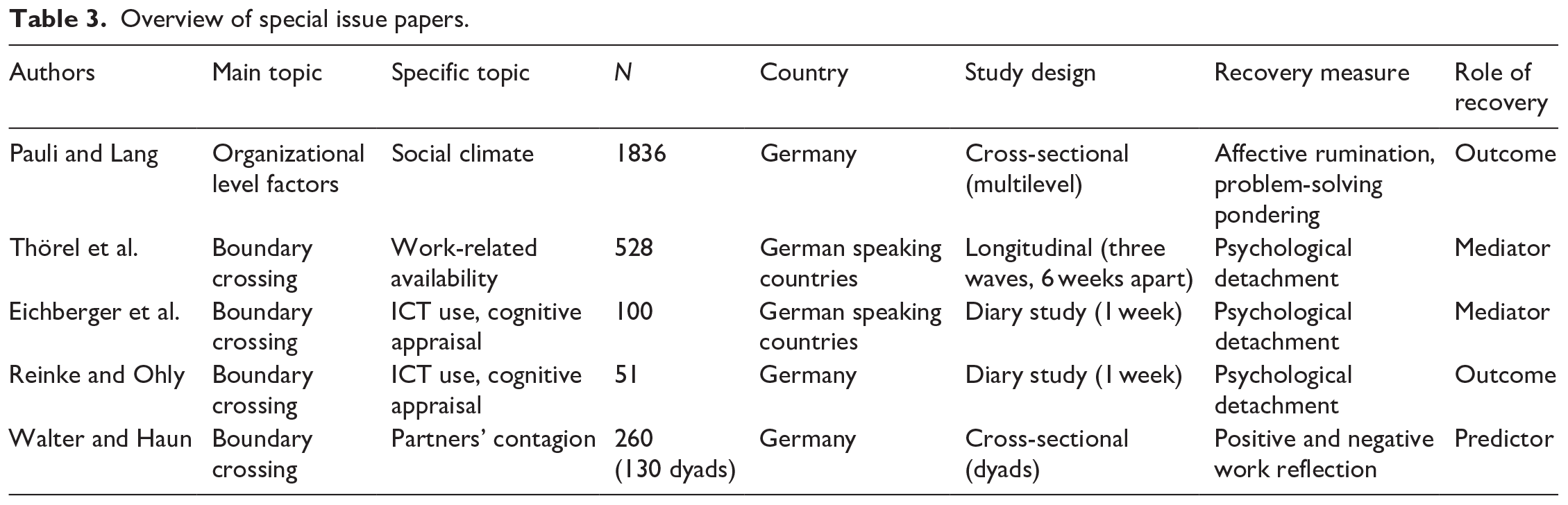
More specifically, these studies focus on either the absence of work-related thoughts through psychological detachment (Thörel et al., Eichberger et al., Reinke and Ohly), or the presence of work-related thoughts in terms of affective rumination and problem-solving pondering (Pauli and Lang), and positive and negative work-reflection (Walter and Haun), thus considering the positive and negative valence and different functionality of work-related thoughts. Moreover, the studies investigate different roles of recovery, for instance, as predictor (Walter and Haun), as mediator (Thörel et al., Eichberger et al., Reinke and Ohly), and as outcome (Pauli and Lange) and they use different study designs such as cross-sectional surveys addressing nested data within organizational levels (Pauli and Lang) or within-partnerdyads (Walter and Haun), diary studies (Eichberger et al., Reinke and Ohly), and longitudinal multi-wave approaches (Thörel et al.). In this sense, these papers show the present richness of approaches to investigating the importance of recovery for employees.
As regards the themes, the first article investigates how organization-level factors such as social climate relate to recovery, while the following studies aim to investigate boundary crossing between work and private life in relation to recovery. More specifically, these four papers concern topics such as work-related availability (Thörel et al.), use of information and communication technologies (ICT) and cognitive appraisal (Eichberger et al., Reinke and Ohly), and contagion processes of work-related thoughts between partners at home (Walter and Haun).
The first contribution (Pauli and Lang) considers how the social context of employees relates to dysfunctional (affective rumination) or functional (problem-solving pondering) work-related thoughts during off job-time. The results of this multilevel study based on data from 118 workgroups show that four different context variables (i.e. collegial climate, supervisory climate, stability of social relations, and job setting) differently affect both outcomes. The stability of social relations is negatively related to affective rumination, whereas a more cognitively demanding job setting is related to more problem-solving pondering. While supervisory climate was not predictive for the outcomes, a strong collegial climate predicted less affective rumination and buffered the relation between work-related stressors and affective rumination. The study extends the existing knowledge by showing that task-related and group-related social context variables explain additional variance in work-related thoughts above the more frequently studied individual-level work-related stressors. This study sets the stage and may stimulate further research on the role of group- and organizational culture variables in relation to recovery.
The second study by Thörel, Pauls, and Göritz investigates if psychological detachment mediates the relationship between work-related extended availability and two fatigue-related strain outcomes (i.e. sleep and exhaustion). Moreover, the authors consider the moderating impact of segmentation preferences as a person-related variable shaping the stressor-detachment relationships as proposed in the extended stressor-detachment model (Sonnentag and Fritz, 2015). From our perspective, it is interesting that the results of the three-wave-cross-lagged modeling analyses seem to contradict theoretical assumptions. For instance, the authors found support for the notion that work-related extended availability negatively was related to detachment 6 weeks later but also found reciprocal and reversed effects, thus, detachment predicted lower work-related extended availability 6 weeks later. The authors speculate that employees may be inclined to be available for work and engage in work-related activities if they do not feel mentally detached from work, suggesting that work availability may also serve as a coping strategy to lower workload. Moreover, detachment was unexpectedly not related to sleep problems and exhaustion. We consider this an important contribution to the literature, because the results indicate that we may need to extend previously established theoretical models and integrate reciprocal or reversed causation pathways. Moreover, the study suggests that future research should examine more closely the time-related dynamics of effects. Additionally, the null results presented point to the importance of differentiating between availability demands and availability behavior in empirical investigations, and also of defining which theoretical models actually apply to which forms of availability.
In the third paper, Eichberger, Derks, and Zacher study how technology-assisted supplementary work as work-related stressor may affect wellbeing by impairing psychological detachment. Using the extended stressor-detachment model (Sonnentag and Fritz, 2015) the authors additionally investigate if cognitive variables such as appraisal and coping moderate the relations between this specific work-related stressor and detachment. While they found support for the notion that technology-assisted supplementary work may translate into stronger negative affect at bedtime by lowering detachment in the evening, they found no support for this assumption when considering positive wellbeing measures. Moreover, cognitive variables did not moderate the relationship between technology-assisted supplementary work and detachment. However, the authors did find that more technology-assisted supplementary work-related to using more frequently cognitive coping strategies such as planning, acceptance and positive reframing in the evening resulted in more positive affect. The authors speculate that technology-assisted supplementary work might be similar to positive and functional work-related thoughts. This study contributes to the literature by showing that one and the same stressor may relate to different functional (cognitive coping) and dysfunctional (low detachment) recovery processes which, in turn, affect wellbeing outcomes in different ways. This suggests that simply “switching the mind off” from work may be neither feasible nor functional during times of high workload. Considering wellbeing, it seems more important to balance detachment from work and functional work-related thoughts when work tasks encroach upon the boundaries between life domains.
In the fourth paper, Reinke and Ohly also consider the relationship between ICT use during nonwork time and detachment and affect by investigating how situational (i.e. ICT-related goal progress, ICT-related overload) and personal factors (i.e. autonomous and controlled motivation) and positive and negative ICT use appraisal processes affect this relation. They found that ICT-related goal progress was related to lower negative and more positive ICT-use appraisal and that ICT-related overload was related to more negative ICT-use appraisal. Regarding personal factors, they found only autonomous motivation to be positively related to positive ICT-use appraisal. Moreover, they showed that positive ICT use appraisal was related to more positive affect and that negative ICT use appraisal was related to more negative affect and lower detachment. With regard to recovery, this study found that, on day-level, the extent of ICT use was negatively related to detachment and that negative ICT use appraisal mediated the negative relationship between ICT-related overload and detachment. The results are interesting because they show that ICT use during nonwork time may not always have detrimental effects on workers’ wellbeing and recovery since these relationships depend on the functional role of ICT-related demands (i.e. goal progress or overload) and related positive or negative appraisal processes. From a theoretical perspective, this means that future research should examine ICT demands (and work-related stressors) in relation to functional and affective appraisal variables when elucidating their connections to work-related thoughts. From a practical perspective, the results imply that an organizational policy of reducing or prohibiting ICT during nonwork time may undermine potentially positive effects on wellbeing whereas a policy of demanding ICT use may inhibit recovery. Organizations should therefore rather try to reduce and monitor their workers’ ICT use outside working hours, explore and understand the related reasons. More specifically, work design interventions or boundary management training may be needed if ICT use is strongly connected to work overload.
In the fifth paper, Walter and Haun report the results from a cross-sectional survey among 130 double-income couples. In line with theories on work-related thoughts and their functional role in providing or depleting resources (Hobfoll et al., 2018), they found that positive work reflection was associated with higher work engagement and lower exhaustion. Correspondingly, negative work reflection was related to lower work engagement and higher exhaustion. For couples with children, the motivational aspect of positive work reflection was reduced, and the harmful impact of negative work reflection exacerbated, suggesting that childcare mostly constitutes an additional demand in double-income couples who have to juggle with the responsibilities of work and private life. Applying the actor–partner interdependence model in their analyses, the authors also show that a person’s positive work reflection does not only affect their own, but also their partner’s work engagement. This crossover effect between partners was not found for negative work reflection and exhaustion. This means that the motivational aspect of positive work-related thoughts seems to be more contagious in couples than the harmful aspect of negative work-thoughts. The authors hypothesized that crossover between partners would be greater for couples who also work together (i.e. working in the same occupation and/or the same company), assuming that these couples would be more likely to talk about their work and more easily identify and empathize with their partner’s work-related thoughts. The results showed that this was actually not the case. The relationships between partners were not affected by work linkages. This study demonstrates that not only the presence or absence of work-related thoughts matters, but also the quality of these thoughts. It seems that particularly positive work reflection can increase people’s dedication, vigor, and absorption in their work. This motivational activation is not confined to the person themselves but even spreads to the social environment.
Discussion
Theoretical and practical implications
The relationship of the effects of ICT use for work-related purposes on cognitive recovery after work was one major theme emerging from the submissions to this special issue. What is evident from the results presented is that the concept and the effects of ICT use for work-related purposes are much more complex, diverse, and rich than can be illustrated by “merely” investigating the frequency and duration of this behavior. The submissions to the special issue point out that cognitive processes involved in ICT use (e.g. appraisal) need to be included in empirical investigations. This can ultimately inform theory to predict the effects of ICT use for work-related purposes on cognitive recovery after work and workers’ wellbeing. In addition, differentiating within the concept of ICT use for work-related purposes may help to shed light on the relationship to recovery after work. For example, differentiating between the demand to respond via ICT to work-related issues, which probably puts workers in a cognitive state of alertness, and the wish for freedom to use ICT for work-related issues any time and any place, which could probably put the worker in a state of alertness while also offering an opportunity to put their mind at ease, might be a sensible conceptualization. Situational factors such as ICT-related goal progress or overload, may help to further conceptualize the construct. Appraisal processes, underlying motivations to engage in this behavior, or organizational climate (e.g. telepressure), can be important boundary conditions that help to determine how, why, and under what conditions ICT use for work-related purposes is harmful or even beneficial for workers.
The papers of this Special Issue illustrate the range of concepts studied under the umbrella term of recovery from work-related thoughts after work. This highlights on the one hand the different angles pursued in order to understand how workers unwind (or not) after a stressful day. On the other hand, it underlines the necessity and the value of an integrated framework that indicates the overlap and unique qualities of each construct related to work-related thoughts. While detachment is the most frequently studied construct, not only in this Special Issue, but in occupational health psychology at large, and as pointed out by Pauli and Lang, the benefit of differentiating affective rumination (negative, dysfunctional cognitions revolving around work-related problems) and problem-solving pondering (functional, solution-focused thoughts relating to work-related encounters) renders new insights. Moreover, the study by Walter and Haun presents the value of focusing on positive and negative work reflection as two sides of the same coin and a contagious experience.
The rise of the home office, not only in these exceptional times of lockdowns and restrictions, but as a trend initiated years ago, underlines the necessity for Human Resource Management to literally encourage workers to switch off from work during nonwork times. Customizable actions on the organizational as well as the individual level seem warranted so that workers can unwind from work depending on their segmentation preferences, work conditions, and work regulations.
Future research directions
Despite the richness of the emerging research on work-related thoughts, there is still a need to advance the methodological diversity and rigor of studies on work-related thoughts.
Assessment of work-related thoughts
From a methodological perspective, it is necessary to develop ideas for the problem that eliciting work-related thoughts in the evening (once, but the problem is even more pronounced when assessments occur during multiple evenings) before going to bed may potentially be perceived as an intervention that triggers work-related thoughts.
Another challenge which future research should address concerns different types of work-related thoughts in combination since they can be differentiated empirically and relate to different outcomes (Weigelt et al., 2019). Such research would also serve to elucidate under what conditions and for what groups of workers detachment or specific types of work-related thoughts during nonwork time might be more or less harmful or even beneficial. Moreover, scholars might also consider developing existing questionnaires further, for instance, by integrating a temporal orientation of work-related thoughts as a reference (i.e. past, present, future work-related topics; Martin and Tesser, 1996).
Study approaches
More theoretical work is necessary in conceptualizing the recovery of the mind as a within- or between-person variable (McCormick et al., 2020; Podsakoff et al., 2019). This especially concerns the need to develop an agenda under which conditions and to what functional role, what conceptualization of recovery applies.
So far, most research has investigated work-related thoughts in the evenings. However, little is known about their role during work breaks (Sianoja et al., 2018), weekends (Fritz et al., 2010), or vacations (de Bloom et al., 2013, Syrek et al., 2018). The few existing studies would need replications of findings but also a more systematic review of the existing literature would be useful. For instance, Wendsche et al. (2018b) conducted a mini-meta-analysis of detachment during work breaks to ascertain if this recovery experience explains the more general positive effects of breaks on mental and physical wellbeing as well as on task performance (Wendsche et al., 2016). Actually, this review found relationships similar to work-related stressor and strain outcomes as for detachment in the evenings. However, it was interesting to note that the few existing studies did also investigate break characteristics and found work-related talk, irregular breaks, breaks at the workplace, and shorter breaks to relate negatively to detachment. Furthermore, Blasche et al. (2017) found that workers’ rest-break intentions are positively associated with the frequency of rest breaks taken and lower levels of fatigue and distress over the workday. Such findings are intriguing since they may have strong implications for organizational rest breaks design and HR practices.
The research on recovery from work highlights that recovery can be understood as a process in which physiological or psychological strain reactions revert to a hypothetical baseline level (McEwen, 1998). However, only few studies have investigated recovery as a process nested in time (for an exception see Baethge et al., 2020; Syrek et al., 2018). More research that investigates the development over time in recovery-related constructs (e.g. energy levels, physiological indicators) can be a step forward to address the seemingly detrimental effect of low detachment in terms of a prolonged stress reactivity (Brosschot et al., 2005).
A fruitful line of untapped research are experimental setups in which different types of work-related thoughts are activated (e.g. Sonnentag and Niessen, 2020) to examine their differential effects on physiological markers (e.g. cardiovascular responses, secretion of stress hormones) as well as performance tasks carried out in laboratory conditions (e.g. tasks which require creative thinking skills, perseverance, or concentration). Concerning physiological indicators, it would also be insightful to study relationships between work-related thoughts and working people’s susceptibility to illness.
Interventions could be developed that teach people to actively utilize different strategies to either suppress work-related thoughts or to shape their thoughts into functional thoughts (see Karabinski et al., 2021 for a first review of detachment interventions). These individual-level interventions could then be complemented with organizational-level interventions that support functional ways to think about or forget about one’s work during off-job time. For certain types of work, these interventions may be particularly helpful (e.g. telework carried out in one’s home, on-call work; van de Ven et al., 2015; Ziebertz et al., 2015). This field of research may also benefit from the emerging line of research on people’s role in actively shaping their recovery process, switching roles and satisfying psychological needs (e.g. Blasche and Marktl, 2011; de Bloom et al., 2020). For instance, studies on “home crafting” and “leisure crafting” have found that demands (e.g. workload) and resources at work and at home (e.g. home autonomy) interact and jointly affect people’s sense of meaning (Demerouti et al., 2020; Petrou et al., 2017).
Anteceding factors
Although the research is fairly broad and rich considering the plethora of anteceding variables which have already been investigated, we want to discuss some emerging and novel aspects from the recent literature—some of these lines of research will be elaborated in more detail by the studies in this special issue. First, there has been some evidence that high levels of strain (e.g. exhaustion) may also be a risk for developing low detachment (Schulz et al., 2020a; Sonnentag et al., 2014). This also fits with meta-analytical results showing that stressor-strain effects are less strong than strain-stressor effects in longitudinal studies, also because workers with high strain levels perceive work-related stressors more negatively (Guthier et al., 2020). Therefore, an avenue for future theory building and research would be to integrate feedback loops (i.e. training and straining effects) into the stressor-detachment model which would be in line with the cognitive activation theory of stress (Meurs and Perrewé, 2011).
Second, a body of research has investigated detachment contagion processes. The idea is that low detachment in one person may affect another person’s level of detachment, for instance by co-rumination (Boren, 2014). Such “infections” have been shown for psychological detachment between partners (Hahn and Dormann, 2013), supervisor-subordinate dyads (Sonnentag and Schiffner, 2019), and between mothers and their children (Mauno et al., 2018). This points to investigating in greater detail social processes affecting mental recovery and the paper by Walter and Haun in this special issue builds on and extends this important area of research.
Third, and relatedly, some studies have investigated leadership styles and leadership behavior in reducing work-related rumination. For instance, lower (more realistic) performance expectations (Syrek and Antoni, 2014), transformational leadership, greater supervisor fairness, and less abusive supervision (Perko et al., 2014, 2017) were identified as protective factors, whereas leader-membership exchange was unrelated to detachment (Sonnentag and Schiffner, 2019).
Fourth, considering variables on a macro-level, such as the organization and the team, investigating recovery cultures and recovery climate would be an interesting extension of present research since the first studies have shown that recovery climate affects recovery behavior and is also positively related to detachment (LeNoble, 2016; Phan, 2020; Wendsche et al., 2019). Finally, considering the increasingly blurred work–life boundaries, new technologies, digitization of work, and information overload research shows that workplace telepressure impairs wellbeing and work-life balance by reducing psychological detachment (e.g. Santuzzi and Barber, 2018). Since the start of the pandemic and the immense scale of teleworking, telepressure, and difficulties to work and to recover in the same physical space at home has become an even more important research topic.
Worker samples
Finally, most studies so far have investigated knowledge workers (e.g. office workers, teachers, university employees, service workers). We think that an interesting avenue for research would also be studies examining entrepreneurs, who often have highly stressful working conditions and work long hours (Wach et al., 2020; Weinberger et al., 2018), and also those jobs that are mainly affected by physical demands and/or combinations of mental, physical, and emotional demands. For instance, research on work-related thoughts in passive jobs (i.e. low job demands, low control) or low strain jobs (i.e. low demands, high control) is scarce but could render new theoretical insights on the underlying processes which engender different types of work-related thoughts and differentially affect wellbeing and performance.
Conclusion
With this Special Issue, we contribute to the increasing interest in Occupational Health Psychology and Human Resource Management as to how workers recover from work-related stress during nonwork time. More specifically, we focus on work-related thoughts as an important recovery process for the following reasons. First, survey studies have found that workers often face problems in finding enough time for rest and to mentally disconnect from work during nonwork time. Second, research has shown that this is related to work-related stressors and person-related factors. Therefore, it is an issue of HRM, for instance, in connection with functions such as job design and learning but also selection and human resource planning. Third and finally, HRM is also challenged by this topic since there is now a body of evidence showing that work-related thoughts during nonwork time relate to important worker outcomes and organizational outcomes, for instance wellbeing, health, and performance.
Importantly, this introductory article and the papers selected for this Special Issue show that relationships to potential antecedents and outcomes, among other factors, depend heavily on how work-related thoughts during nonwork time are conceptualized (i.e. assessment of the absence or presence of thoughts, valence of thoughts, and functional role). Therefore, keeping work in mind during nonwork time may not always be detrimental to all outcomes.
Although our call for papers mainly reached research groups in psychology and, in consequence, this issue further contributes to the critically discussed “psychologization of HRM” (see Godard, 2014 and also the interview with Prof. Sabine Sonnentag and Prof. Ute Stephan in this issue), we hope that it will also stimulate HRM research activities on topics which are important for workers’ recovery but which have been largely neglected from the psychological perspective (e.g. role of employment relations, organizational structures, and human resource strategies and practices). Thus, we see our issue as an attempt to expand this research to a multi-perspective field and to bring together diverse scholarly disciplines (Budd, 2020).
Footnotes
Acknowledgements
We would like to thank all the authors who submitted papers for consideration for publication in this special issue. In addition, we are grateful for the support of the Editors-in-Chief of the German Journal of Human Resource Management Renate Ortlieb, Marion Festing, and Axel Haunschild in putting this issue forward. Moreover, we thank the many European colleagues in Austria, Finland, Germany, Slovenia, and Switzerland who expended so much time and effort reviewing the submissions. Very special thanks are due to Sabine Sonnentag and Ute Stephan, who were willing to share their personal views on the current state of recovery research in an interview. Finally, we would like to thank the Federal Institute for Occupational Safety and Health for providing financial support to publish this editorial open access.
Declaration of conflicting interests
The authors have no actual or potential conflicts of interest related to this article.
Funding
The author(s) disclosed receipt of the following financial support for the research, authorship, and/or publication of this article: Johannes Wendsche was supported by a grant from the German Federal Institute for Occupational Safety and Health during the preparation of this special issue (project F 2431 “Recovery within and beyond the context of work—effects and design approaches in a changing world of work”). Jessica de Bloom was supported by the Academy of Finland (grant: 308718). We would like to thank Virginia Mattila for her excellent language editing of our manuscript(s) and her flexibility in supporting us.
