




Abstract
The transition from human resource management (HRM) to human capital management marks a significant evolution in the way organizations value and develop their workforce. Within the educational sector, this shift reflects a growing recognition of the important role that the knowledge, skills, and capabilities of the school staff play in achieving educational excellence. Whereas traditional HRM emphasizes administrative efficiency and resource allocation, human capital management focuses on the strategic development of individuals as essential to organizational success. This article explores the existing knowledge about human capital management in schools by tracing its roots in HRM and strategic management traditions. Drawing on these frameworks, we examine how schools can move beyond conventional HR practices to better nurture and leverage their human capital. Through this analysis, we aim to identify best practices that align educational goals with the strategic priorities of human capital management, ultimately enhancing both the performance of the school staff and student outcomes.
Keywords
Introduction
Managing human resources has long been central to organizational success. The focus has been on optimizing employee performance to achieve organizational objectives (Chong et al., 2020; Opatha, 2021). Traditionally, human resource management (HRM) has been centered on bureaucratic functions and a control-oriented approach toward employees (Nurata, 2022). However, in recent years, a shift towards a more holistic perspective has emerged, recognizing employees as human capital whose development and retention are essential for maintaining a competitive advantage (Hamadamin and Atan, 2019). While HRM prioritizes administrative efficiency, human capital management emphasizes investment in employees’ long-term potential through their continuous learning and development (Kiran et al., 2022; Shell, 2023). This shift reflects a broader transition from managing resources to strategically cultivating human capital, reinforcing the role of organizations in promoting their employees’ growth (Retzius and Skaar, 2022).
In the context of schools, where educational quality is directly tied to the capabilities of their staff (Misko et al., 2021), this shift is particularly significant. Across Europe and in many other regions, public schools face mounting challenges, such as teacher shortages and burnout, necessitating innovative approaches to staff management and development (Madigan and Kim, 2021; OECD, 2021). Internationally, education systems are increasingly adopting strategies aligned with human capital development, such as professional learning communities, mentoring programs, and targeted retention initiatives, as recommended in policy frameworks by the OECD (OECD, 2024). The COVID-19 pandemic and subsequent social crises have further highlighted the need to rethink HRM strategies, not only for managerial efficiency but also for resilience against external shocks (Qassoom, 2023). This shift aligns with the evolving role of human resource managers as strategic partners, whose influence extends beyond routine activities and encompasses long-term planning and crisis management (Wach et al., 2022).
While teacher human capital is widely recognized as a key resource for school success (Daly et al., 2021; Yamak and Chaaban, 2022), a notable gap remains in the literature concerning how human capital management is cultivated within school contexts (Shell, 2023). Principals have traditionally been seen primarily as instructional leaders focused on teaching and learning processes, rather than as strategic human capital managers responsible for strengthening and retaining the school workforce (Tuytens et al., 2023; Vogel, 2018).
In light of the need for evolving approaches to managing human capital, this article aims to review the accumulated knowledge on the management of human capital in schools. We focus on the lessons learned from the transition from managing human resources to doing so strategically, an approach that underpins the management of human capital (Boudreau et al., 2023; Tuytens et al., 2023). In doing so, we hope to provide insights into best practices for developing the human capital of a school's staff (Belay et al., 2021). Although specific contexts and systems differ across schools, locations, and cultures, the core principles and strategies identified in this review provide a valuable framework that schools can adapt to their unique context (Runhaar, 2017). This review is particularly relevant given the growing body of literature suggesting that the effective management of human capital is linked to better organizational performance in educational systems (Daly et al., 2021; Yamak and Chaaban, 2022).
From HRM to strategic HRM
HRM involves the relationship between employees and employers. Its aim is to ensure that the employees’ work supports the organization's goals (Stone et al., 2020; Vekeman et al., 2018). The general goal of HRM is to maximize organizational productivity by optimizing employees’ effectiveness (Chong et al., 2020). HRM began as an administrative function focused on bureaucratic tasks and professional control. It was rooted in the assumption that employees needed to be managed and controlled to ensure their proper behavior (Nurata, 2022). Over the past 50 years, HRM has undergone two major transformations that emphasize the management of human capital, goal setting, and strategic thinking. The traditional control-oriented model has evolved into the strategic management of human resources. This model focuses on the employees’ commitment to and trust in the organization, and their involvement in decision-making (Runhaar, 2017).
Recent studies also emphasize the importance of addressing employees’ needs and promoting their professional development (Ozkeser, 2019). This emphasis aligns with two underlying theoretical approaches in HRM: the instrumental and humanistic. The instrumental approach focuses on quantitative and strategic aspects, while the humanistic approach prioritizes employees’ motivation, satisfaction, and commitment (Stone et al., 2020).
The evolution of HRM can be summarized in four stages: (1) pre-manpower management, in which people were viewed as production factors, akin to human machines; (2) personnel management, in which people were considered machines with feelings. In this stage, the focus was on job analysis, union relations, recruitment, evaluation, training, and compensation; (3) HRM, in which employees were recognized as individuals. In this stage, the emphasis was on employees’ behavior at work and their motivation; and (4) the strategic management of human resources, which used strategic frameworks to manage people. This stage combines a hard approach focused on organizational performance and a soft approach that considers internal and external stakeholders (Nurata, 2022).
Table 1 outlines the key criteria that distinguish traditional HRM and strategic HRM (Boudreau et al., 2023; Sharma, 2023; Tuytens et al., 2023; Wach et al., 2022).
A comparative framework of traditional HRM versus strategic HRM.
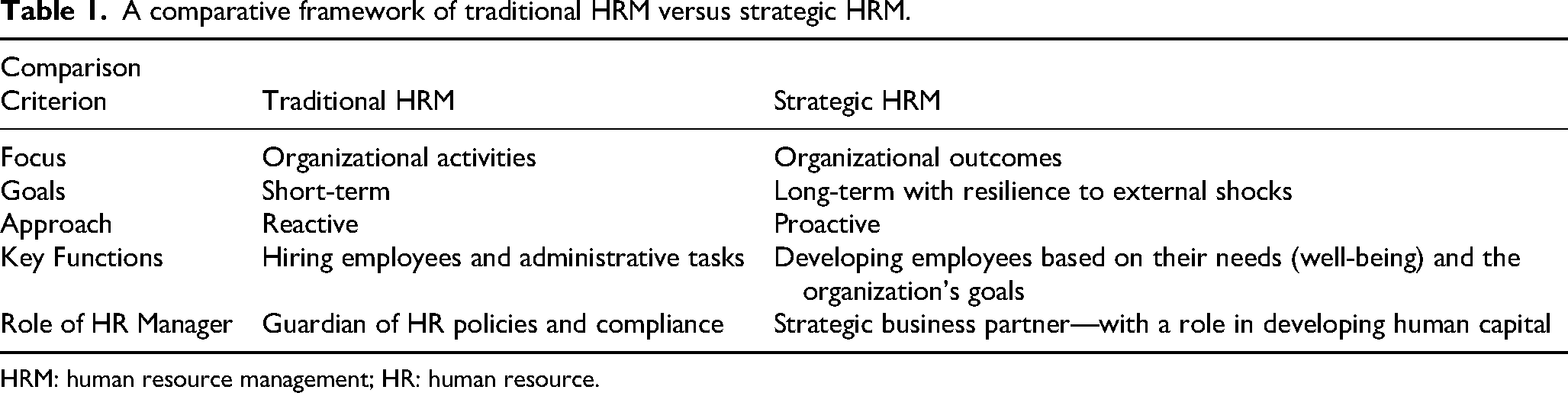
HRM: human resource management; HR: human resource.
While traditional HRM emphasizes administrative efficiency and resource allocation, strategic HRM prioritizes employees’ development as the key to long-term success (Boudreau et al., 2023). This shift is especially pertinent in education, where challenges such as the COVID-19 pandemic and teacher shortages, attrition, and burnout have emphasized the need for a more strategic, proactive approach to the staff's development, retention, and well-being (Madigan and Kim, 2021; Qassoom, 2023).
However, this seemingly linear “progression” in HRM is not without contestation. Both HRM and Strategic HRM, even when framed as valuing employees, remain embedded in a managerialist logic that treats workers primarily as instruments for organizational success. While schools undoubtedly need strategic approaches to staff development, there is a risk that management models imported from business will reduce teaching to a technical function tailored to organizational efficiency, rather than a professional practice rooted in humanistic values. The idea that human capital management is underpinned by fundamental approaches to instrumentalism or humanism may strengthen this argument and underscores the conflict between economic imperatives and educational values.
HRM and strategic HRM in schools
In education, human resources encompass everyone employed in an institution, including principals, teachers, administrative personnel, and maintenance staff, all working to achieve the institutions’ goals (Kurowicka, 2019; Pandey and Sharma, 2021). “Management” involves the methods the institution employs to encourage its staff to meet these goals (Kurowicka, 2019). Unlike traditional HRM in schools, which focuses on organizational needs and accountability policies based on teacher control, strategic human resource management emphasizes teachers’ personal well-being and needs. Strategic human resource management seeks to align the staff's goals with the institution's strategic goals, fostering a balance between personal well-being and organizational success (Tuytens et al., 2023). The strategic approach assumes that teachers, as self-regulating professionals, will take the initiative when provided with development opportunities (Runhaar, 2017).
Studies show that teachers’ sense of personal well-being has the greatest impact on their performance. Thus, this factor is the preferred approach to managing human resources in schools (Pagan-Castano et al., 2021; Zhang et al., 2023). Involving teachers in managerial decisions, providing them with opportunities for continuous professional development, and ensuring that they have a positive attitude about the management of HR in the school help improve their sense of well-being (Pagan-Castano et al., 2021; Veld and Alfes, 2017). For example, a study conducted in 56 elementary schools in Belgium found that HR practices that focus on teachers’ needs and well-being have a greater impact on teachers’ intentions to leave, more so than HR practices that are aimed at the school's goals (Vekeman et al., 2018). Similar findings were obtained in a study conducted in 23 school districts in the southeastern United States. This research reported that having a dedicated HRM department reduced teacher turnover by 1% and helped raise student achievement in math and English by 9.1% above average (Tran and Buckman, 2021). Therefore, when HRM focuses on matching the needs of the system to the needs of the teachers, while maintaining their personal well-being, the teachers feel more motivated and make a greater effort to achieve the school's goals (Sukawati et al., 2020; Tran and Buckman, 2021; Van Beurden et al., 2025).
Strategic HRM that emphasizes teacher well-being is increasingly characterized as adopting a “humanistic” approach, focusing on the needs and welfare of teachers. Even ostensibly instrumental elements, such as setting measurable strategic goals, are often absorbed within this humanistic logic through principles of partnership and teacher involvement in decision-making. However, this integration creates ambiguity regarding how strategic leadership principles aimed at organizational productivity and effectiveness are realized in practice. For example, when decisions made in collaboration with educational teams seek to reflect primarily the interests of individual teachers rather than the broader strategic needs of the school, in whose interest are decisions being made? Who comes before whom? Are teachers the strategy, or the means to implement the strategy? How can schools effectively support teacher well-being while maximizing the realization of school goals?
HRM as a framework for improving educational quality
The overarching goal of HRM in schools is to improve the quality of education in the institution and the students’ performance (Kurowicka, 2019). The school staff is fundamental to the realization of the educational goals, because they are directly involved in the learning process of the students (Pandey and Sharma, 2021). Managing the staff involves activities to recruit, retain, and develop quality teachers (Tran and Buckman, 2021; Van Beurden et al., 2025).
The basic assumption of schools is that quality teachers provide quality instruction. Thus, improving teaching and education requires the recruitment of highly qualified candidates who have excellent training and meet personal, educational, and regulatory criteria (Madigan and Kim, 2021; Malkab et al., 2015). One study noted the key role of the effectiveness of the teacher recruitment process in providing value to the schools’ instructional efforts (Tran and Buckman, 2021). Using HRM functions focused on recruiting, selecting, and hiring high-quality teachers can support and strengthen principals’ expertise (Cameron, 2018). These functions include policies and practices for the recruitment and selection of talented and motivated people to work in the school (Runhaar, 2017). Generally, doing so entails a systematic and strategic planning process aimed at enhancing the quality of education by anticipating the future requirements of the school (Klassen et al., 2021; Yulianti and Munir, 2020). Thus, the recruitment of teachers is a process in which the candidates receive a realistic picture and complete transparency regarding the essence of the work and its conditions (Runhaar, 2017). In this regard, HRM optimizes teacher recruitment by identifying the most effective, contextually suitable candidates (Cameron, 2018).
Several empirical studies have indicated that the way teachers are recruited might be a factor in their remaining in the system (Tuytens et al., 2023). Quality teachers leave the profession as a result of the gap between their expectations about the school's work environment and their work experience in the field (Cheng et al., 2023; Van Beurden et al., 2025). Therefore, the candidates must be apprised of the nature of the position and the working conditions so that their expectations do not clash with the reality, prompting them to leave (Runhaar, 2017). In addition, creating a workplace that considers the needs of the teachers encourages quality teachers to remain in the organization and be involved in and committed to its success and that of their students (Tran, 2022). On the other hand, human resource practices that emphasize supervising and controlling teachers lead to demoralization and stress in the workplace, which increases teacher turnover (Tran and Buckman, 2021).
The school climate and the continuous support that teachers receive through professional development also affect their work experience (Tran, 2022). Improving the performance of teachers and creating a positive organizational climate requires principals to choose quality employees, reward them appropriately, provide them job security, evaluate and acknowledge their achievements, ensure their job satisfaction, and motivate them (Misko et al., 2021). The teachers’ participation in making decisions on technical and administrative issues also helps create a positive climate (Zahed-Babelan et al., 2019). Their participation in such activities may also broaden their perspective on the issues facing the administration and the students, and contribute to their professional development and commitment to the organization (Runhaar, 2017).
The primary goal of HRM is to develop school staff by improving their skills and knowledge (Pandey and Sharma, 2021). Runhaar (2017), for example, proposes a conceptual model based on HRM theories, policies, and practices for the development of the school staff. In this framework, teacher development extends beyond professional development. This aspect is just one of nine practices, which also include strengthening the teachers’ capacity and increasing their motivation and opportunities for growth. As schools face evolving challenges, there is a need for a more strategic and systemic approach to teachers’ development that not only enhances their skills but also promotes their job satisfaction and commitment, ultimately leading to their retention. In contrast to traditional HRM, managing human capital requires a conceptual and systemic change, adapting the approaches of managing the school and the district to the needs of the teachers who drive the system (Murphy and Douglas-McNab, 2019; Shell, 2023). This change involves the principals’ focusing on building capacity and other factors that increase the teachers’ job satisfaction and commitment, ultimately improving their performance in the educational process (Daly et al., 2021).
Human capital management in schools
Human capital management involves strategies that improve employees’ personal and organizational skills, knowledge, and abilities (Yamak and Chaaban, 2022). In the educational field, principals need to make decisions that create the optimal conditions for helping their staff maximize their potential (Kurowicka, 2019). Increasingly, the management of teachers’ human capital is recognized as part of the principal's responsibility (Gumede and Govender, 2022; Kimball, 2011; Wang et al., 2022). Therefore, principals are now required to determine the value and significance of the educational team (Shell, 2023). While principals expect teachers to take the initiative in developing their own human capital, they support them primarily through growth opportunities (Zerrad and Schechter, 2025a). Providing avenues for advancement and professional development through workshops, conferences, and cooperative learning to improve their pedagogical skills is of utmost importance (Belay et al., 2021; Wang et al., 2022). Principals who utilize a “learning leader” model make their staff more effective by providing them with continuous learning opportunities (MacLeod, 2020; Shell, 2023).
In the context of educational leadership theories, it is worth emphasizing that the roots of the human capital management approach can be traced to strategic leadership (Tuytens et al., 2023), where investment in developing human capital functions as a long-term strategy for enhancing school effectiveness (Belay et al., 2021; Gumede and Govender, 2022). This approach aligns closely with distributed leadership, which highlights shared responsibility, collaboration, and interdependence among team members as essential to effective human capital management (Harris et al., 2022; Shell, 2023). By contrast, instructional leadership appears less connected to human capital management, as its primary focus on setting learning goals and monitoring instruction reflects features of traditional human resource management (Alanoglu, 2022).
However, translating this leadership framework into practice presents several challenges. First, the shift from HRM to strategic human resource management reflects a move from short-term, reactive management to a proactive, long-term strategy for improving organizational outcomes (Sharma, 2023; Tuytens et al., 2023). Given recurring global crises such as COVID-19 and wars (e.g. Russia-Ukraine War), adopting a strategic, future-focused approach is increasingly important (Yu et al., 2022). These recent crises have highlighted the need to rethink HRM approaches, emphasizing not only managerial efficiency but also the capacity to adapt to and recover from external disruptions (Qassoom, 2023). For example, the widespread workforce disruptions caused by COVID-19 have exacerbated an already critical shortage of qualified teachers and led to a significant decline in enrollment in teacher preparation programs (Linzer et al., 2022). While improving the efficiency and capabilities of existing staff supports internal functioning (e.g. equipping teachers with skills for remote instruction), it remains unclear how strategic HRM addresses external recruitment and broader staffing challenges. This issue is particularly pronounced in public schools, where salaries and professional status are largely fixed, often constrained by policy, and principals have limited flexibility beyond internal measures such as school climate, performance assessment, or staff welfare initiatives.
Moreover, strategic human resource management emphasizes both organizational goals and individual employee needs, albeit not uniformly. There are two primary approaches: the instrumental and humanistic (Nurata, 2022). The instrumental approach, with its roots in traditional HRM, prioritizes organizational goals without adequately addressing employees’ needs. However, there is little evidence supporting the success of this approach. Indeed, the instrumental approach seems to have an inherent contradiction. It focuses solely on organizational objectives. Therefore, how can it be considered strategic when the essence of strategic human resource management lies in prioritizing an approach to organizational commitment rooted in the trust of the employees and the promotion of their needs?
It is worth noting that teacher development includes complementary HRM practices aimed at increasing the motivation and opportunities of the school staff as a prerequisite for human capital management (Boudreau et al., 2023; Sharma, 2023). These practices, such as performance evaluations, rewards and acknowledgments of achievements, and engagement, support efforts to improve the staff's capabilities. They appear to complement the humanistic strategy of focusing on teachers’ well-being. Therefore, these practices also seem to underscore the inherent contradiction in the instrumental approach, as human capital management cannot succeed without integrating complementary practices that prioritize the staff's well-being.
Despite the growing consensus in the existing research literature about the importance of managing human capital, some scholars caution that the language of “capital” risks reducing people to economic assets, overlooking the ethical, relational, and pedagogical dimensions of their work (Auerbach and Green, 2024; Edeji, 2024). In teaching, for example, these dimensions include teachers’ professional autonomy, ethical obligations, and their membership in collegial and professional communities (Mezza, 2022). This framing highlights a central dilemma: should teachers be managed primarily as resources to be optimized for organizational outcomes, or fostered as intrinsically motivated professionals committed to social and educational responsibilities? The interplay between viewing teachers as instruments for organizational effectiveness and nurturing their intrinsic motivation is particularly pronounced in human capital management strategies that adopt a humanistic orientation, prioritizing the enhancement of teacher well-being as a mechanism for increasing job satisfaction and employee retention (Pagan-Castano et al., 2021; Sutton and Atkinson, 2023; Zhang et al., 2023).
While human capital management aims to maximize employees’ potential by leveraging their abilities and skills (Yamak and Chaaban, 2022), much of the literature focuses on professional development, both formal and informal, and staff involvement in school decisions as key to their well-being (Belay et al., 2021; Gumede and Govender, 2022). However, broader factors related to teachers’ well-being remain underexplored. For example, the empirically validated PERMA model used in studies on teacher well-being identifies well-being as a multidimensional construct comprising positive emotions (P), engagement (E), relationships (R), meaning (M), and achievement (A). These factors have causal effects on job satisfaction (Dreer, 2024). According to this model, certain questions might arise. For example, does improving teachers’ skills result in their having more positive attitudes about their work? How do schools cope with complacent teachers who are uninterested in development opportunities? Moreover, how do schools deal with teachers who do not find professional development opportunities fulfilling? There is also the question of whether teachers can actually use the knowledge gained in professional development programs in a meaningful and impactful way, given systemic constraints such as top-down policies, limited staffing, and rigid curricula. These limitations might even drive teachers to seek opportunities outside their organization if their potential remains unrealized in their current roles. Given that teachers’ well-being is central to human capital management, it is important to refine the humanistic approach by including additional dimensions of well-being beyond those already considered (Pagan-Castano et al., 2021; Sutton and Atkinson, 2023; Zhang et al., 2023).
Implications for policy, practice, and research
Policymakers have an important role in promoting and implementing human capital management. By championing policies that support the staff's well-being, policymakers can create a motivated and effective workforce, ultimately promoting better educational outcomes (Rahm and Heise, 2019). Indeed, the humanistic approach, emphasizing teachers’ motivation and well-being, has proven effective in increasing the school staff's engagement, loyalty, and performance (Patro, 2020). Research further indicates that teachers’ personal well-being has the strongest influence on their performance, making it the preferred focus in managing human resources within schools (Ortan et al., 2021; Pagan-Castano et al., 2021).
Principals need the flexibility to act as strategic partners, balancing administrative duties with a focus on human capital management (Wach et al., 2022). Doing so requires policies that provide principals with the necessary training, autonomy, and resources to nurture healthy workplace relationships and build mutual commitment between management and teachers (Misko et al., 2021). Additionally, policymakers must invest in the effective implementation of human capital management practices, including recruitment and professional development, as well as complementary practices such as performance appraisals and workplace relations (Runhaar, 2017). For example, clearly defining employee roles during recruitment helps align expectations early on. Addressing the context and needs of the school staff to choose tailored professional development opportunities rather than forced participation in programs that teachers regard as useless is an optimal method for managing human capital. By formulating policies that emphasize capacity building and the ongoing development of skills that teachers themselves feel meet their needs, policymakers can reduce turnover, prevent teacher attrition, and establish a quality teaching workforce (Kurowicka, 2019; Sharma, 2023).
The practical implications of this study highlight the need to refine the role of human capital management in schools and to equip principals with the tools to implement its practices effectively. We have four specific recommendations. First, a strong awareness of the importance of human capital management in schools must be inculcated. Methods of doing so involve the redesign of the school's vision, changes in resource allocations, and initiatives aimed at establishing human capital management as a cornerstone of educational management (Kurowicka, 2019).
Second, principals should receive professional training on human capital management strategies and practices. Methods of doing so include integrating such courses into leadership programs or creating on-the-job training sessions (Belay et al., 2021; Shell, 2023). Raising the awareness of principals about the practices of human capital management can help them tailor these practices to their specific school contexts. To do so, the principals must have the autonomy to adapt these practices to their unique challenges and needs in a “bottom-up” manner.
Third, principals can prioritize investments in human capital by focusing on teachers’ well-being (Rahm and Heise, 2019). For example, principals can allocate resources and budgets to initiatives that promote the staff's well-being, organize learning sessions for the management team about teachers’ well-being, and address the staff's needs to ensure alignment with systemic goals, thereby fostering coherence between them.
Fourth, schools can create opportunities for teachers to develop and apply their skills beyond traditional classroom instruction (Kurowicka, 2019; Murphy and Douglas-McNab, 2019). For example, a teacher skilled in technology integration could lead workshops that help the educational staff use new educational tools. Alternatively, a teacher passionate about art or economics might organize clubs or workshops to enrich students’ skills. This approach can promote professional job satisfaction, add value to the educational system through the teachers’ expertise, and encourage them to remain on the job. However, it is important to recognize that in some educational systems, the expectation to take on additional developmental roles may increase teachers’ workload and strain their well-being, particularly if these responsibilities are added without adjustments to time, support, or resources (Skaalvik and Skaalvik, 2017). Such pressures can create a tension between professional growth and sustainable work conditions, leading to potential burnout or diminished job satisfaction (Arnold and Rahimi, 2025). Accordingly, while it is important to provide professional development that maximizes teachers’ potential (Yamak and Chaaban, 2022), these initiatives must be carefully balanced with workload considerations to ensure they remain beneficial rather than burdensome.
We also suggest several directions for future research to deepen our understanding about and optimize human capital management in educational systems. One important area of inquiry involves understanding the balance between institutional demands and individual teachers’ needs. Research can explore how human capital management aligns with system constraints, such as school staff shortages or mismatched roles (e.g. an English teacher teaching mathematics), in terms of simultaneously meeting individuals’ needs and realizing their potential (Kiran et al., 2022; Murphy and Douglas-McNab, 2019).
Future research can also delve deeper into the relationship between teachers’ well-being and human capital management (Sutton and Atkinson, 2023). Areas to explore include examining the potential benefits of incorporating content that is not specific to teaching disciplines, such as employee-employer relations, emotional empowerment, or workplace communication skills, in professional development programs to enhance teachers’ holistic growth and job satisfaction. Given that practices that enhance teachers’ well-being complement human capital management, future research should focus on integrative models of strategic human resources management that use various practices (Botelho et al., 2023; Ho and Kuvaas, 2020). Determining the factors beyond the recruitment of appropriate staff and professional development practices that have the strongest impact on optimizing human capital management in schools (e.g. compensation, performance management, and teacher engagement) will provide actionable insights for policy and practice (Tuytens et al., 2023; Zerrad and Schechter, 2025b).
Finally, given the heavy workload that principals, particularly in secondary education (Shell, 2023) report, research can assess the feasibility and impact of creating a dedicated human capital management role within schools. Whether internal in the form of a school-based HR specialist or external in the form of district-level human capital management consultants, such a role could relieve principals of administrative burdens while ensuring the strategic and effective management of teachers’ development and well-being. Research in these areas could contribute to a stronger and more effective framework for human capital management in educational contexts, ultimately improving teacher retention, satisfaction and performance, and educational outcomes.
Footnotes

Funding
The author(s) received no financial support for the research, authorship, and/or publication of this article.
Declaration of conflicting interests
The author(s) declared no potential conflicts of interest with respect to the research, authorship, and/or publication of this article.
Author biographies
Hodaya Zerrad, PhD student at the Faculty of Education, Bar Ilan University, Israel. Her research areas include educational leadership, strategic human resource management (SHRM) in education, and teacher training.