




Abstract
The concept of digital human resource management and related concepts such as the digitization of human resource management, the digitalization of human resource management, the digital transformation of human resource management, and the digital disruption of human resource management are gaining prominence in scholarly discussion. Frequently, however, the use of these concepts is implicit, heterogeneous, and proliferating. These concepts, thus, lack the “conceptual clarity” necessary in research. Therefore, this article aims at a conceptual clarification of digital human resource management and of related concepts of the digitization of human resource management, the digitalization of human resource management, the digital transformation of human resource management, and the digital disruption of human resource management. To do so, the article references general literature on digital organizations to develop a terminology and typology of digital human resource management. The terminology offers precise and parsimonious definitions of the concepts and relationships between them, offering a basic understanding. The typology offers precise and parsimonious ideal-types, which order and classify phenomena related to digital human resource management, in turn expanding knowledge about these phenomena. Together, the terminology and typology clarify the concept of digital human resource management and related concepts, uncover digital human resource management as an evolutionary advancement of previous conceptualizations of technology-based human resource management, and provide a conceptual basis for future work on digital human resource management.
Keywords
Introduction: growing needs to clarify digital human resource management
Concepts such as “digitization,” “digitalization,” “digital transformation,” or “digital disruption” currently rank among the most prominent and discussed terms. Roughly speaking, such concepts denote an ever-increasing use of technology and corresponding substantial changes in numerous domains of business and society. This notion is also true for the domain of human resource management (HRM). In HRM, the concept of digital HRM (e.g. Pantelidis, 2019; Thite, 2019) and related concepts such as digitization (e.g. Meijerink et al., 2018; Van Kruining, 2017), digitalization (e.g. Dixit, 2017; Parry and Strohmeier, 2014), digital transformation (e.g. Bissola and Imperatori, 2018; Vardarlier, 2020), and digital disruption (e.g. Larkin, 2017; Platanou and Mäkelä, 2016) of HRM are increasingly used. Conceptual components such as “transformation” and even more “disruption” imply substantial changes for HRM, hinting at a clearly considerable importance of these concepts.
Currently, however, these concepts are frequently used in an implicit, heterogeneous, and proliferating manner. First, authors frequently use the concepts in an implicit manner; that is, they do not offer explicit definitions but rather assume that readers understand the intended meaning (e.g. Bajer, 2017; Larkin, 2017). Second, authors use the concepts in a heterogeneous manner; that is, they use concepts with multiple and sometimes contradictory understandings (e.g. understandings of digital disruption of Larkin, 2017, and Platanou and Mäkelä, 2016). Third, authors frequently use concepts in a proliferating manner; that is, they use new concepts to denote well-known old phenomena (e.g. Martini and Cavenago, 2018; Thite, 2019). The current discussion on digital HRM therewith evidently lacks “clarity of concepts” (Suddaby, 2010).
Clarity of concepts, however, is important for different interrelated reasons. First, conceptual clarity is important to preventing a mere proliferation of concepts (Suddaby, 2010). It must be ensured that digital HRM (and related concepts) not merely represent “new designations for old phenomena.” Otherwise, new concepts are just used as synonyms of established concepts and most notably of the prominent concept of electronic (e-) HRM (e.g. Bondarouk et al., 2016; Strohmeier, 2007). Second, conceptual clarity is necessary to avoid confusion and misunderstanding (Suddaby, 2010). It must be ensured that human resource (HR) researchers share a common understanding that facilitates mutual communication on digital HRM. Third, conceptual clarity is necessary to avoid research deficiencies (Suddaby, 2010). The use of ill-defined concepts must be avoided, as they do not allow for precise operationalizations and lead to disparate results of research on digital HRM.
It is against this backdrop that this article aims at a conceptual clarification of digital HRM and related concepts. To do so, the article develops a terminology and typology of digital HRM. Developing a terminology constitutes an initial clarification step that offers precise and parsimonious definitions of concepts and relationships between them, in turn offering a basic understanding (e.g. Suddaby, 2010). Developing a typology constitutes a subsequent clarification step that offers precise and parsimonious ideal-types that order and classify phenomena related to digital HRM, further deepening their understanding (e.g. Doty and Glick, 1994). Together, the proposed terminology and typology can clarify the concept of digital HRM and related concepts and provide a conceptual basis for future work on the topic.
Conceptual clarification—toward an understanding of digital HRM
As a basis for developing a terminology and typology of digital HRM, in the following, existing literature on the general digitalization of organizations is referenced (see, for example, the reviews of Gebayew et al., 2018; Hanelt et al., 2018; Hausberg et al., 2018; Henriette et al., 2015; Ismail et al., 2017; Kahre et al., 2017; Kuusisto, 2017; Morakanyane et al., 2017; Reis et al., 2018; Vesti et al., 2017, 2018; Vial, 2019). This seems appropriate for several reasons: First, digitalization constitutes a general organizational phenomenon, relevant not only for HRM but for all organizational domains (e.g. Gebayew et al., 2018; Hanelt et al., 2018). It is, thus appropriate to conceptualize digital HRM in accordance with the general digitalization of organizations. Second, there are mutual dependencies of the digitalization of the organization and digitalization of HRM (e.g. Amladi, 2017; Bondarouk et al., 2017). It is thus appropriate to conceptualize the digitalization of HRM together with the general digitalization of organization to consider such dependencies. Third, the general digitalization literature is more developed than the literature on digital HRM. It is thus appropriate to capitalize on existing general insights in clarifying digital HRM.
Terminology
Terminology of digital organization
Reviews of the general digitalization research show that diverse explicit definitions of concepts exist and are quite heterogeneous (see, for example, reviews of definitions by Ismail et al., 2017; Kuusisto, 2017; Morakanyane et al., 2017; Vesti et al., 2018; Vial, 2019). In addition, attempts to derive overarching definitions from existing definitions have produced varied results (e.g. Morakanyane et al., 2017; Vial, 2019). Moreover, general research often understands the concepts of digitization, digitalization, digital transformation, and sometimes even the digital disruption of organizations as more or less interchangeable and thus does not delineate between them (e.g. Henriette et al., 2015; Morakanyane et al., 2017). However, certain research contributions have shown that a delineation of concepts is possible and valuable in allowing for the identification and understanding of different related empirical phenomena (e.g. Brennen and Kreiss, 2014; De Clerck, 2017). In sum, general research offers a rich collection of terminological suggestions and insights. Nevertheless, a common and sustainable definition and delineation of digitalization concepts is missing. Thus, in the following, a delineation and definition of concepts of digital organization and of digitization, 1 digitalization, digital transformation, and the digital disruption of organizations is developed.
A first clarification implicit in general research refers to the distinction of process- and result-related concepts. Process-related concepts refer to activities. Result-related concepts refer to outcomes of activities. It is evident that digitization, digitalization, digital transformation, and the digital disruption of organizations describe activities and thus are process-related concepts. “Digital” describes a specific state of an organization, and thus digital organization is a result-related concept. As an obvious relationship between process- and result-related concepts, the former imply the latter. For example, the digitalization of a library involves a process that leads to the creation of a digital library as a result.
A second clarification given by general research refers to the distinction of technical and socio-technical concepts (Brennen and Kreiss, 2014; Hanelt et al., 2018). Technical concepts denote mere technical phenomena. Socio-technical concepts are broader and denote both technical and human phenomena. Following suggestions made in the literature, digitization can be understood as a simply technical concept (Brennen and Kreiss, 2014; De Clerck, 2017). Digitization in turn refers to the technical conversion of analogous information into binary digits (thus, the designation of digitization) with the aim of an automated processing of this information (Brennen and Kreiss, 2014; De Clerck, 2017). Converting analogue books in a library into digital files or converting analogue customer record cards into digital customer data constitute examples of digitization. Conversely, digitalization, digital transformation, and digital disruption integrate technical and human phenomena and thus constitute broader socio-technical concepts (Brennen and Kreiss, 2014; De Clerck, 2017; Hanelt et al., 2018). For example, the digitalization of a library would consider human tasks and purposes. The conversion of books into digital books might be purposeful to shorten wait times for particularly popular books. The conversion of analogue customer data into digital customer data might be purposeful to streamline the library’s lending processes. The digitalization of a domain thus might be understood as the purposeful digitization of the domain. As an obvious relationship between technical and socio-technical concepts, the latter include but extend beyond the former. For example, the socio-technical digitalization of a library involves its mere technical digitization but goes beyond this level in considering human purposes and tasks when digitizing.
A third clarification implicit in general research refers to the distinction of voluntary and involuntary concepts. Voluntary concepts describe processes and results that are desired and therefore actively encouraged by organizations. Involuntary concepts describe processes and results that are undesired and thus are not actively encouraged but instead passively suffered by organizations. Following the literature, the digital disruption of an organization must be understood as an involuntary phenomenon (e.g. Baiyere and Salmela, 2013; Christensen et al., 2015; Møller et al., 2017). Since digital disruption ultimately results in a marginalization or even complete displacement of an organization (e.g. Baiyere and Salmela, 2013; Christensen et al., 2015; Møller et al., 2017), it is certainly highly undesirable. Moreover, disruption emerges based on the activities of external organizations that wish to reap the benefits of digitalization while accepting that it may disrupt other organizations. Digital disruption is thus a passive phenomenon. For example, when a global Internet company decides to offer all books funded by advertising revenues worldwide to all Internet users for free, this decision most likely implies a digital disruption of all pay-based libraries. Conversely, the digitization, digitalization, and digital transformation of organizations and the result of a digital organization denote voluntary phenomena. Digital disruption in turn does not produce a digital organization, but a marginalized or even completely displaced organization. It thus fundamentally differs from voluntary concepts. Voluntary and involuntary phenomena, however, are related in that the former, when performed by external organizations in a specific way, imply the latter.
A fourth clarification implicit in general research refers to the distinction of strategic and generic concepts. Strategic concepts distinctly address the strategic level of an organization. Generic concepts are broader and address the operational and possibly strategic level of organizations. Following the literature, the digital disruption (Møller et al., 2017; Vesti et al., 2017) and transformation (e.g. Hanelt et al., 2018; Ismail et al., 2017) of organizations denote strategic phenomena. Digital disruption poses a strategic threat as elaborated above. Digital transformation denotes a strategic opportunity based on the potential for digital technologies to create innovative business opportunities as expressed by “digital business strategies” (Bharadwaj et al., 2013). Digital transformation thus involves a fundamental strategic change of the entire organization due to the business potential of digital technologies (e.g. Hanelt et al., 2018; Hausberg et al., 2018; Ismail et al., 2017). A library that fully dispenses with analogue books, library buildings, librarians, and so on and instead exclusively offers digitized books via the Internet serves as a simple example of digital transformation. Further concepts such as digitalization are broader and can but must not refer to the strategic level. The above example of the digital transformation of a library thus also serves as an example of digitalization. Contrarily, mere operational changes such as implementing a digital lending system at a library would not count as digital transformation but as digitalization. The strategic concept of digital transformation can thus be understood as a subset of the generic concept of digitalization.
The above clarifications allow for the development of parsimonious definitions for the respective concepts. With respect to clearly differing organizational results, however, two distinct concept clusters emerge (see Figure 1).
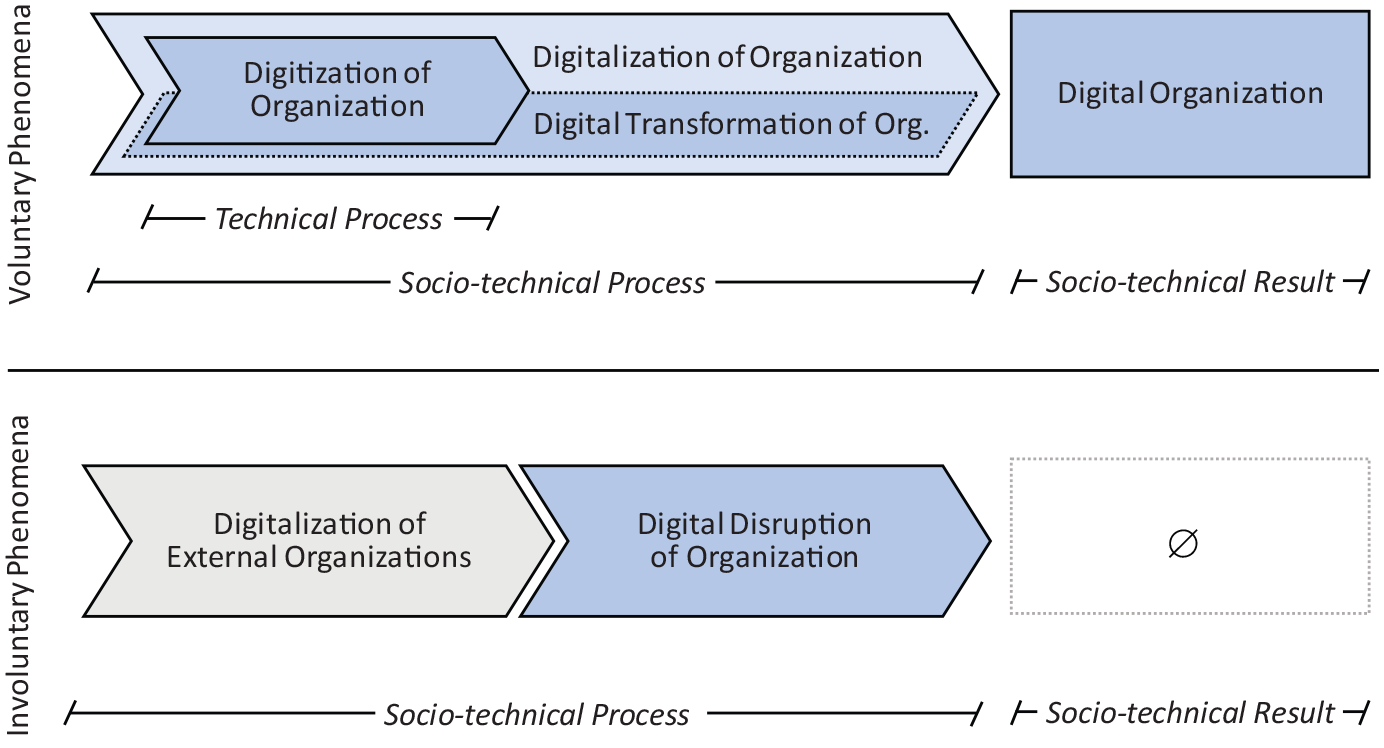
Terminology of digital organizations.
A first cluster covers concepts grouped around the result of a digital organization:
The digitization of organizations denotes the technical process of converting analogue organizational information into digital organizational information for automated processing.
The digitalization of organizations denotes the socio-technical process of exploiting digitization potentials for operational and/or strategic organizational purposes.
The digital transformation of organizations denotes the socio-technical digitalization sub-process of exploiting digitization potentials for strategic organizational purposes.
Digital organization denotes the socio-technical result outcome of the digitalization of organizations.
A second cluster refers to disruption producing a marginalized organization:
The digital disruption of organizations denotes a socio-technical process of marginalization due to the digitalization of external organizations.
Terminology of digital HRM
Based on the above elaboration, the transfer of general terminology to HRM can be discussed. First, a general concept can be transferred if the organizational phenomenon denoted by the concept has a comparable counterpart in HRM. In this case, an already existing HR phenomenon is denoted. Second, however, a general concept can also be transferred if the organizational phenomenon designated by the concept currently has no comparable counterpart in HRM but could be realized in the future. In this case, a potential future HR phenomenon is denoted.
Starting with the digitization concept, in HRM there are also technical processes of converting analogue information into digital information for processing purposes. A simple example refers to scanning paper-based application credentials of applicants. Thus, there is a comparable counterpart in HRM, and the general digitization concept can be transferred.
Second, regarding the digitalization concept, also in HRM, the potential for technical digitization is exploited to achieve operational and limited strategic goals. Digitization potentials are especially exploited for a broad range of operational purposes from payroll processing to course administration. There have also been attempts to exploit digitization potentials for strategic purposes—mainly by aligning digital technologies with functional HR strategies (e.g. Burbach, 2012). However, the frequency and success of such attempts appear to be rather limited at present (see the review of Marler and Fisher, 2013). Thus, regarding a comparable counterpart in HRM, exploitation for operational purposes has been realized while exploitation for strategic purposes has not yet been fully realized. Despite this “hybrid” situation, the digitalization concept can be transferred to HRM.
Third, the exploitation of digitization potentials for strategic purposes is particularly relevant to the digital transformation concept. Fully transferring the concept to HRM implies not merely aligning digital technologies to pre-formulated HR strategies but formulating and executing HR strategies that are directly based on the potential for digitization to create value for an organization. In concretizing this notion, it makes sense to transfer the concept of digital business strategy to HRM whereby a digital HR strategy can be defined as an HR strategy formulated and executed by exploiting digitization potentials to create value for an organization (transferred from Bharadwaj et al., 2013). To the best of my knowledge, such strategies have not yet been realized. However, they might become achievable in the future as can be briefly demonstrated from the example of HR analytics (HRA). Rather than merely improving HR information provisions, HRA constitutes a broad and ambitious concept for the entire HR domain (e.g. Marler and Boudreau, 2017). HRA aims at systematically creating value for an organization by basing all HR decisions on evidence. If such an evidence-based approach of HRM could be established, systematic quality improvements across all HR functions would result. Since such improvements on their part create value for an organization, HRA can be interpreted as (the nucleus of) an HR strategy. Moreover, since the value creation intended by HRA is directly based on digitization potentials, HRA could be understood as (the nucleus of) a digital HR strategy. Thus, even though there has presumably been no full digital transformation in HRM, a future realization is imaginable and the concept can be transferred.
Fourth, regarding the digital HRM concept, the results of digitalization processes can also be observed in HRM. The concept can thus be transferred, and changes induced by digitalization could be subsumed as digital HRM. While minor operational changes of HRM count as digital HRM in the same way as far-reaching strategic transformations, the concept covers a broad range of phenomena. This coverage means that both simple HR payroll accounting and a complex HRA approach constitute examples of digital HRM.
Finally, regarding the digital disruption concept, there is currently no known case whereby HRM has been marginalized or even completely displaced due to external digitalization activities. However, the mere possibility of digital disruption can be illustrated by the following hypothetical example. Ongoing external digitalization might first spur a massive loss of employees due to digitalization-based automation (e.g. Frey and Osborne, 2013) and second spur a massive replacement of remaining employees by self-employed “e-lancers” (e.g. Aguinis and Lawal, 2013). Taken together, both external digitalization developments might drastically reduce the number of employees and consequently marginalize HRM. Despite currently lacking a comparable counterpart in HRM, the concept of digital disruption therewith can be transferred as well.
In sum, in sometimes denoting existing phenomena while at other only denoting imaginable phenomena, general terminology can be transferred to the HRM domain. As in the general delineation and definition, two distinct conceptual clusters emerge. The first cluster covers concepts that focus on the result of digital HRM:
The digitization of HRM denotes the technical process of converting analogue HR information into digital HR information for automated processing.
The digitalization of HRM denotes the socio-technical process of exploiting digitization potentials for operational and/or strategic HRM purposes.
The digital transformation of HRM denotes the socio-technical digitalization sub-process of exploiting digitization potentials for strategic purposes of HRM.
Digital HRM denotes the socio-technical result of the digitalization of HRM.
Distinct from the above, the second cluster refers to disruption:
The digital disruption of HRM denotes the socio-technical process of marginalization due to digitalization external to HRM.
The digital disruption of HRM in turn differs significantly from the other concepts and shows no relation to digital HRM.
Typology
Typology of digital organizations
Reviews of research on general digitalization uncover a certain set of categorizations and frameworks for clarifying the different concepts (see, for example, the overview in Ismail et al., 2017). Moreover, research reviews also offer certain categorizations and frameworks based on the reviewed literature (see, for example, Hanelt et al., 2018, or Vial, 2019). A fully developed explicit typology of digital organizations, however, is missing. Thus, a parsimonious typology of digital organizations is developed in the following. In doing so, methodical suggestions for typology development are considered (Doty and Glick, 1994; Weber, 1904). As with any typology, the aim is to contribute to understanding of an underlying organizational phenomenon rather than describing and categorizing real organizations. The typology thus abstracts from numerous aspects of real organizations on one hand and (over-)emphasizes aspects relevant for understanding on the other (Doty and Glick, 1994; Weber, 1904).
To develop the typology, an implicit categorization inherent in the digitalization literature over time is employed. The general literature discusses digitalization in different phases with different subsequently growing levels of digitalization (e.g. Bharadwaj et al., 2013; Coltman et al., 2015; Henderson and Venkatraman, 1993; Kahre et al., 2017). In this discussion, the intensity of digitalization is determined by whether it supports only operational purposes or additionally different types of strategic purposes. To develop the typology, organizational operations and strategies are employed as description dimensions, which can show the values “digitalized” or “not digitalized.” The application of this procedure results in a parsimonious typology of digital organizations with four ideal-types (see Figure 2).
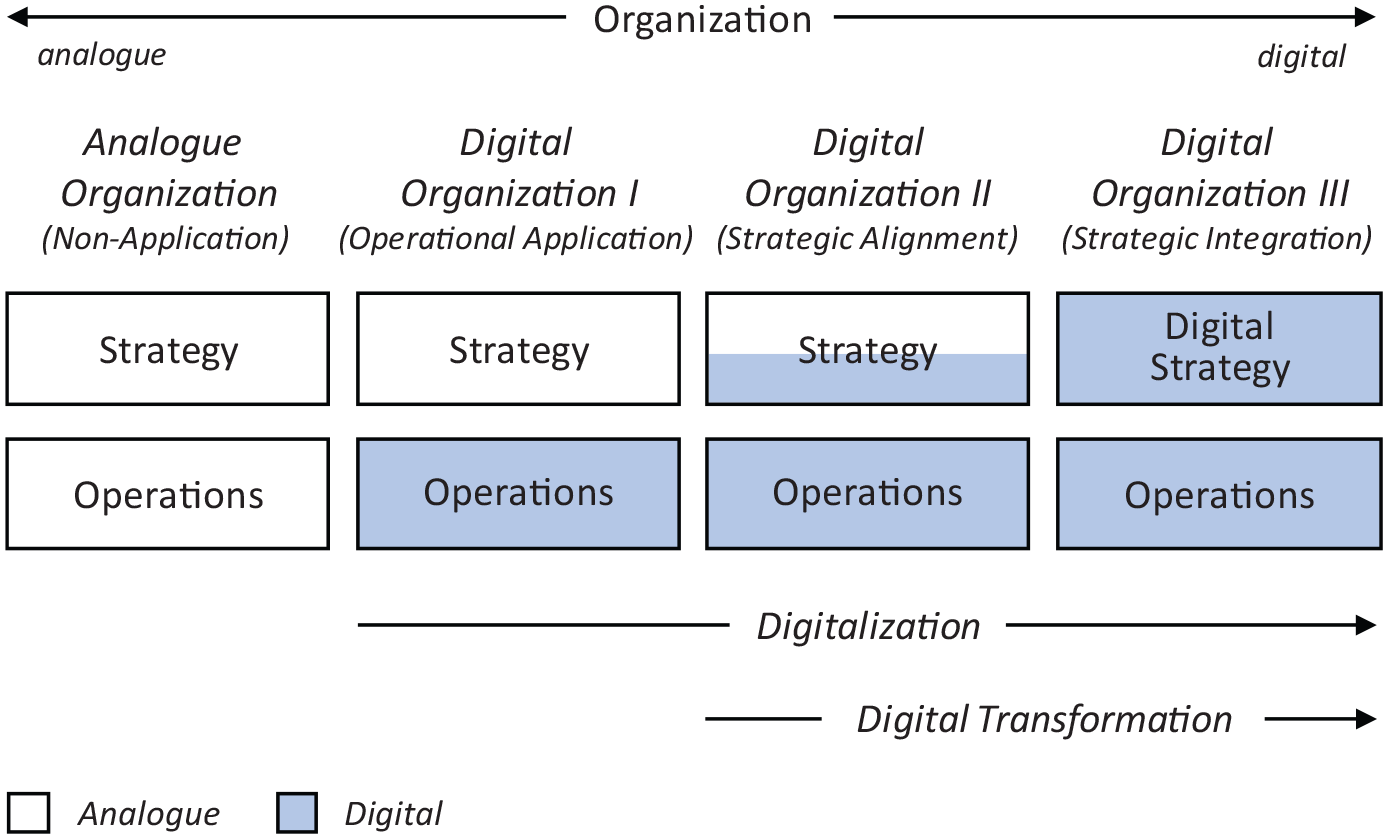
Typology of digital organizations.
A first ideal-type does not exploit the potential of digitization for operational or strategic purposes. It is thus characterized by the non-application of digital technologies. Although this ideal-type is evidently not digital, it is necessary for the typology to prevent the digitalization of organizations from being taken for granted.
A second ideal-type is characterized by the operational application of digital technologies. Potentials of digitization here are employed to support organizational operations. The core goal is to increase the speed, decrease the costs, and increase the quality of organizational operations (e.g. Chan and Reich, 2007; Henderson and Venkatraman, 1993). Examples include applying information systems to manage order processing or inventory control. Strategic goals of an organization are not supported by this ideal-type.
A third ideal-type is characterized by the strategic alignment of digital technologies (Chan and Reich, 2007; Coltman et al., 2015; Henderson and Venkatraman, 1993). This ideal-type goes beyond mere operational exploitation and aims at supporting the execution of strategy. To this end, digital technologies are aligned with strategic objectives to systematically support the execution of an organizational strategy such as cost leadership or differentiation. Strategic alignment thus involves exploiting digitization potentials after the formulation of a business strategy. Functional strategies for digital technologies are thus a derivative of business strategies of this ideal-type (Coltman et al., 2015). As an example, organizations adopting a “prospector” strategy profit from analytical technologies (e.g. data warehouses offering systematic information about markets) while those adopting other business strategies cannot capitalize on such technologies in the same way (e.g. Sabherwal and Chan, 2001). This ideal-type thus describes a first variety of supporting strategic goals by digitalization.
Finally, a fourth ideal-type is characterized by the strategic integration of digital technologies (Bharadwaj et al., 2013; Kahre et al., 2017). This ideal-type extends beyond strategic alignment since digital technologies are already directly integrated in the formulation of strategy. The overarching objective is to exploit digitization potentials to create new business opportunities and identify related strategies. Functional strategies regarding digital technologies are no longer derivative but are integrated with business strategies. As mentioned above, the resulting “fusion” of functional digital technology and business strategies is termed as a “digital business strategy” (Bharadwaj et al., 2013). For instance, a “digitized solution strategy” aims at reformulating the value proposition of a production company by integrating a combination of products and related digital services based on data (see examples given in Sebastian et al., 2017). Understandably, this ideal-type is characterized by the highest degree of digitalization, as the strategy and basic purpose of the organization are essentially digital.
In being organized along a digitalization continuum, the developed typology represents a classic typology type (Doty and Glick, 1994): two ideal-types characterized by minimum and maximum digitalization constitute the respective endpoints of this continuum. Two further ideal-types with successively increasing digitalization intensities are positioned between them. Evidently, the digitalization of organizations starts with the second ideal-type and gradually intensifies to the fourth ideal-type. While the concept of digital organizations remains rather broad on a mere terminological level, three clearly differing sub-categories of digital organizations can be distinguished based on the typology. These three types provide a concretization and categorization of digital organizations. Moreover, the digital transformation of organizations starts with the third ideal-type but fully manifests only with the fourth ideal-type. Executing previously formulated strategies based on digital technologies implies changes (Henderson and Venkatraman, 1993). However, the formulation and execution of digital organizational strategies implies more systematic and fundamental changes (e.g. Hanelt et al., 2018; Ismail et al., 2017; Kahre et al., 2017; Reis et al., 2018). By contrast, the concept of digital disruption necessarily shows no relation to the typology of digital organizations, as digital disruption does not result in digital but marginalized organizations.
As mentioned, the above ideal-types map the scholarly discussion on the digitalization of organizations over time. Since past organizations were analogue, the historic discussion of organizations did not consider digitalization. A first phase of discussion of the digitalization of organizations started over half a century ago and strongly referred to the operational application of digital technologies (Chan and Reich, 2007). A second phase emerged almost three decades ago and brought about an intensive and long-lasting discussion on the strategic alignment of digital technologies in organizations (see the review by Coltman et al., 2015). It was only recently in a third phase that strategic integration was first discussed as a “paradigmatic shift” (Kahre et al., 2017) in exploiting digitization potentials in organizations (Bharadwaj et al., 2013). The idea of a systematic strategic integration of digitization potentials thus constitutes both the core trigger and core subject of the current intensive discussion on the digital transformation of organizations (e.g. Hanelt et al., 2018; Ismail et al., 2017; Kahre et al., 2017; Reis et al., 2018).
Typology of digital HRM
Based on the above-elaborated typology, a transfer to the HRM domain can be discussed. Aiming again at a parsimonious set of comparable description dimensions, there are obvious counterparts of organizational operations and strategy in HRM. The counterpart of organization strategy is HR strategy, which is understood as a deliberate plan to add value to an organization by supporting overarching strategic organizational objectives (e.g. Boxall and Purcell, 2011). The counterpart of organizational operations is HR practices, which are understood as a set of HR activities performed to afford employees abilities, motivation, and opportunities to perform (e.g. Ostroff and Bowen, 2000). Employing HR strategies and practices as description dimensions and the digitalization or non-digitalization of these as values results in a parsimonious typology with four ideal-types (see Figure 3).
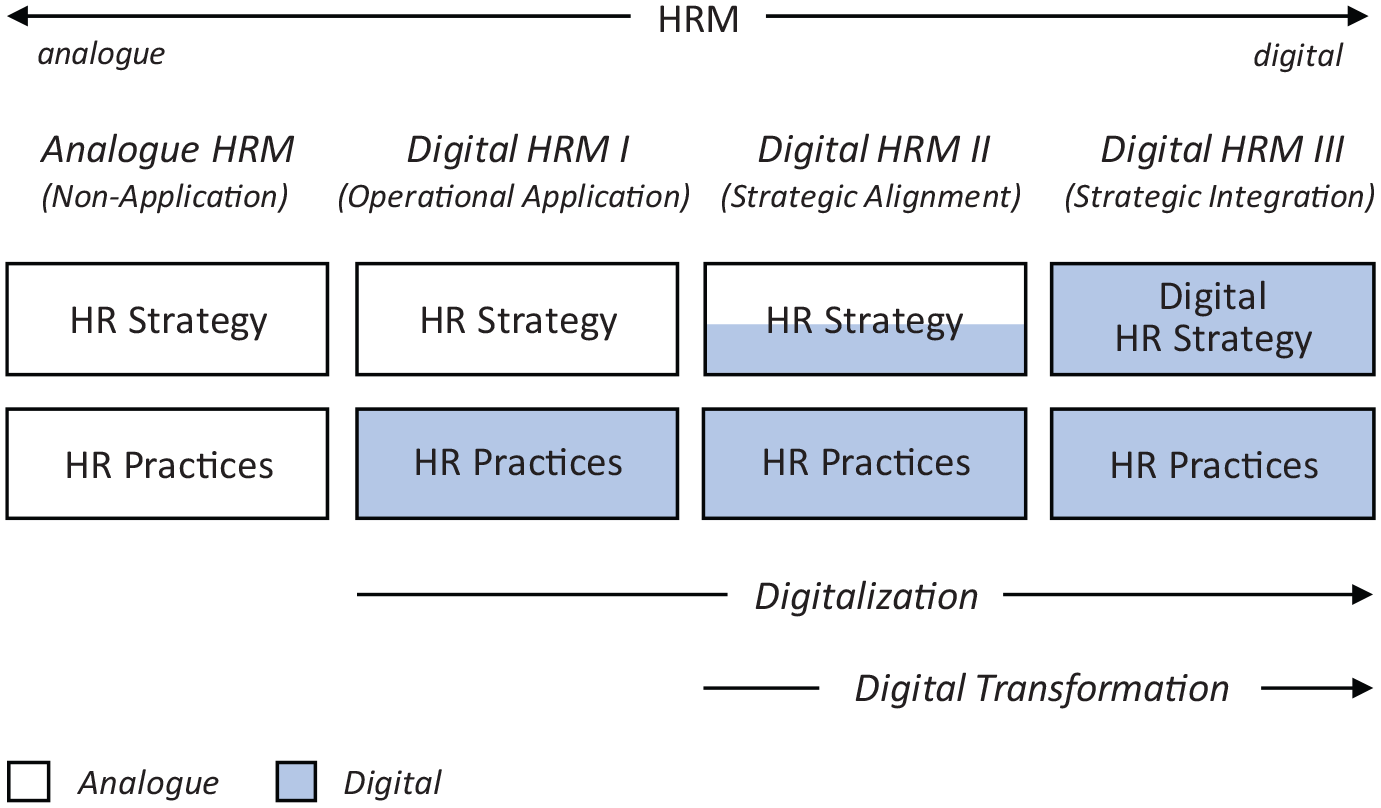
Typology of digital HRM.
The non-application of digital technologies constitutes a first ideal-type. As a major characteristic, this ideal-type is fully analogue; that is, neither HR practices nor HR strategy is supported by digital technologies. Again, while not a digital ideal-type, it has been necessary for a typology of digital HRM since uncovering that the digitalization of HRM is not mandatory.
The operational application of digital technologies constitutes a second ideal-type. As a major characteristic, digital technologies are employed to support operational HR practices such as recruiting or compensation for this ideal-type. This support is realized by automating HR practices with the aim of increasing their speed, decreasing their costs, and improving their quality (e.g. Snell et al., 1995; Strohmeier, 2007). Strategic purposes are not supported by this ideal-type.
The strategic alignment of digital technologies constitutes a third ideal-type (e.g. Burbach, 2012; Marler, 2009; Parry, 2011). Again, this ideal-type aims at the digital support of the execution phase, yet not of the formulation of HR strategies. Thus, the overall idea of providing value is developed without considering digitization potentials. Once an HR strategy has been formulated, a derivative second step refers to aligning digital technologies with an HR strategy to support and execute it (Marler, 2009; Martin and Reddington, 2010). While the concrete technology used depends on the concrete strategy, technologies frequently refer to recruiting, performance management, compensation, and/or the development of employees. For instance, organizations that, based on a “prospector” business strategy, pursue an “internal labor market” HR strategy will heavily invest in learning technologies that support and implement the strategy (Martin and Reddington, 2010).
The strategic integration of digital technologies constitutes a fourth ideal-type. This ideal-type integrates digital technologies already in the strategy formulation phase by directly basing the value proposition of HRM on the potentials of digitization. As briefly outlined above, this integration implies the formulation and execution of digital HR strategies as equivalent of digital business strategies. HRA and Employee Relationship Management (ERM) can be cited as initial examples of such future digital HR strategies: HRA aims at creating value for an organization through digitization-based systematic improvements of HR decisions (e.g. Marler and Boudreau, 2017). ERM aims at creating value for an organization through digitization-based building and maintaining mutually valuable relationships with current and potential employees (e.g. Strohmeier, 2013). Both ideas thus aim at adding direct value to an organization based on digitization potentials.
The above typology is thus likewise based on a digitalization continuum with two ideal-types with minimum and maximum digitalization as endpoints. Again, the digitalization of HRM starts with the second ideal-type and gradually intensifies to the fourth ideal-type. The resulting three different sub-categories of “digital HRM” allow for a concretization and categorization of the concept of digital HRM that has remained rather broad in the terminological discussion. Moreover, regarding the digital transformation of HRM, well-established argumentation claims that the operational application of digital technologies implies a “liberation” of HR professionals from operational burdens that on its part allows for the value-adding strategic activities of HR professionals (e.g. Grant and Newell, 2013; Shrivastava and Shaw, 2003). In this case, however, not digital technologies but humans bring about the transformation. Consequently, an operational application of digital technologies might imply a human rather than digital transformation of HRM. Thus, digital transformation again starts with the third ideal-type but again fully manifests only with the fourth ideal-type. The systematic alignment of digital technologies with HR strategies under the third ideal-type systematically changes the means with which HR creates value. This change is regularly understood as “transformational” (Bondarouk et al., 2016; Ruël et al., 2004). In being directly based on digitization potentials, the fourth ideal-type especially implies a digital transformation of HRM. The fusion of the managerial and technical dimension of HRM implied by this type will be accompanied by complex, deep, and thus “transformational” changes of HRM. Again, the digital disruption of HRM is not related to the digital HRM typology, as it does not result in digital but marginalized HRM.
The above ideal-types partly map yet partly also extend beyond the current scholarly discussion. A historic phase focused on analogue HRM; that is, it did not consider digitalization since it had not yet emerged. A first phase of discussing digital HRM started half a century ago and discussed mainly operational applications of digital technologies (e.g. Walker, 1980). A quarter of a century ago, a second phase of discussing digitalization began and for the first time reflected the strategic alignment of digital technologies (to the best of my knowledge, such “transformational” applications of digital technologies were introduced by Snell et al., 1995; for a review of this discussion, Marler and Fisher, 2013). Under the umbrella concept of “electronic (e-) HRM,” this discussion phase continues to this day. The idea of a strategic integration of digitization potentials as suggested by the fourth ideal-type, however, has so far not been discussed and adds a new dimension to the discussion. The current conceptualization of digital HRM in turn covers the previous conceptualization of technology-based HRM and develops it further. Given this development, digital HRM is best understood as an evolutionary advancement of previous conceptualizations of technology-based HRM.
Integrated typology of digital organization and digital HRM
The above isolated development of a digital HRM typology does not explicitly map numerous managerial as technical dependencies between the digitalization of an organization and the digitalization of HRM (e.g. Amladi, 2017; Bondarouk et al., 2017; Hunt, 2014). The digitalization of both domains implies new mutual possibilities as well as new mutual requirements. The digitalization of organizational production, for instance, might provide numerous sensor data on employees with broad opportunities to (further) digitalize HRM yet might also urge HRM to offer production employees digital real-time scheduling to realize real-time production (e.g. Strohmeier, 2018). To consider such mutual relationships, a combination of both typologies can be proposed (see Figure 4).
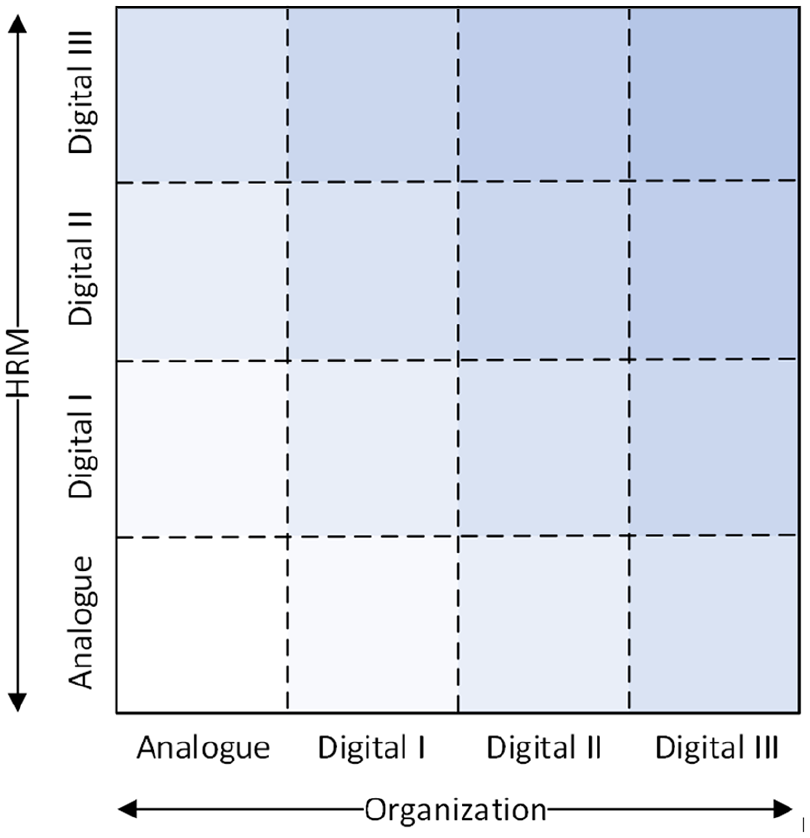
Integrated typology of digital organizations and digital HRM.
The integrated typology produces 16 pairs of possible ideal-type combinations. In addition to “balanced” combinations with similar digitalization intensities, the typology also includes “lopsided” combinations with clearly dissimilar digitalization intensities. These combinations allow for conceptualizing possible synergies and tensions between digital organizations and digital HRM. This explicit consideration of dependencies between the digitalization of HRM and the digitalization of the general organization offers a further conceptual advancement not explicitly considered in earlier conceptions of technology-based HRM.
Discussion: toward a consideration of digital HRM
The above conceptual clarification provides definitions, delineations, and corresponding ideal-types of digital HRM and related concepts. Based on this clarification, digital HRM can be understood as a conceptual advancement of previous understandings of technology-based HRM. In particular, the innovative strategic integration of digital technologies based on “digital HR strategies” evidently entails both great promises and great challenges. Thus, future scholarly consideration of digital HRM requires guidance regarding core tasks to be performed. Based on the above results, core interrelated tasks refer to the theoretical explanation, empirical investigation, and socio-technical design of digital HRM. Given that each of these responsibilities is voluminous and multifaceted, some rough outlines are delineated in the following.
Theoretical explanations of digital HRM
Theoretical explanations are necessary for a deeper understanding of basic regularities underlying both the process of digitalizing HRM and the result of digital HRM. Beyond this necessity, theoretical explanations also form a mandatory basis for empirical and design research in digital HRM. Since the conceptualization of digital HRM mainly focuses on the macro-level, it is compatible to a broader set of macro- or organization-level theories. Given that a broad range of aspects is to be covered, it is to be expected that a broader set of different theories will be necessary. In seeking suitable approaches, the research on digital organizations proposes a set of already employed theories (see the overview given by Hanelt et al., 2018). Since an anthology of theories suitable for explaining (certain aspects of) digital HRM is far beyond the scope of this article, the neo-configurational approach (e.g. Park and El Sawy, 2013) and resource-based view (e.g. Bharadwaj et al., 2013) are briefly mentioned as possible approaches. The neo-configurational approach theorizes digital HRM as a limited set of organizational configurations that emerge within a certain context and comprise of different elements. The elements on their part conjuncturally cause certain organizational outcomes. Thus, the approach allows for a systematic understanding of the emergence of different types of (non-)digital HRM and the causation of relevant consequences. Against this background, the emergence and outcomes of different types of “digital HR strategy” can be also explained by the approach (Misangyi et al., 2017). The resource-based view theorizes that certain resources can provide sustainable competitive advantages when they are valuable, rare, inimitable, and exploited. Against this theoretical backdrop, both humans and digital technologies can be understood as resources of an organization with the potential for a competitive advantage. In particular, digital HR strategies can be understood as (ideas on) the fusion of human and technological resources aiming at producing corporate advantages (Barney, 1991). As briefly indicated, there are diverse recognized theoretical approaches that are directly suitable for explaining and founding digital HRM.
Empirical investigations of digital HRM
Empirical investigations are necessary for gleaning insights into digital HRM. Initially, the conceptualization of digital HRM is not restricted to certain empirical methods and allows likewise for qualitative, quantitative, and mixed-method approaches. Given the anticipatable complexity of digitalization topics such as interrelations between the digitalization of organizations and of HRM, the use of different methodical approaches seems to be frequently indicated. Moreover, the conceptualization of digital HRM is not restricted to certain empirical topics. However, due to the macro-level nature of the concept, mainly macro-level issues are addressed. While a comprehensive elaboration of topics is again far beyond the scope of this article, the two core topical areas of the state and development of digital HRM are briefly addressed in the following.
Investigating the state of digital HRM implies different interrelated aspects. The distribution of organizations across the different ideal-types must initially be examined to uncover existing digitalization patterns (see the example in Figure 5).
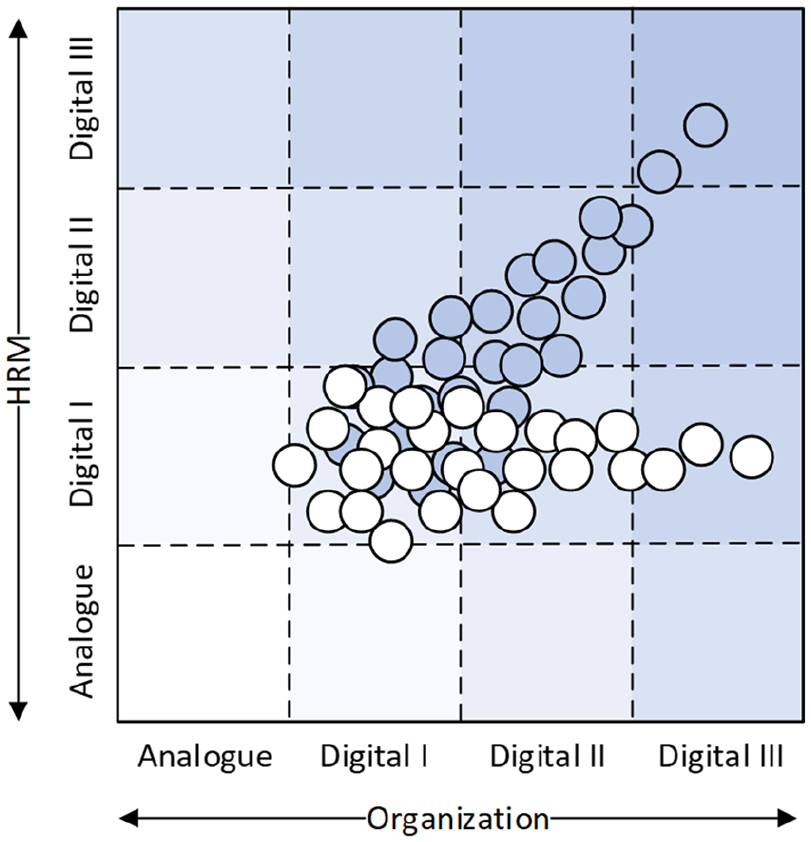
Researching the state of digital HRM.
Moreover, given that HRM has rather struggled in realizing the strategic alignment of digital technologies (see the review by Marler and Fisher, 2013), it is of interest to uncover whether operational application still constitutes the dominant type (as implied by the collection of white points shown in Figure 5) or whether this situation has changed. Related to this challenge, it is of interest to determine whether specific real-types of digital HRM can be detected (e.g. different characteristic real-types of an operational application of digital technologies). In particular, real-types of strategic integration are of interest, and it should be investigated whether and if so, which digital HR strategies already exist. Of course, the interaction of digital HRM with overall digital organization also constitutes a topic for further inquiry. In this regard, it is of interest to determine if the digitalization of organizations and HRM is balanced (as indicated by the collection of colored points shown in Figure 5) or if “lopsided” pairs combine high and low levels of digitalization. Moreover, the concrete managerial and technical interrelations between both digitalization domains are also of interest. Investigating these and further aspects should provide a detailed account of existing real-types of digital HRM. Regarding existing real-types, respective contexts and consequences are also of interest (e.g. Bondarouk and Brewster, 2016; Strohmeier, 2007). Regarding the context, it is of interest to determine which contextual forces contribute to the emergence of certain real-types. Since the context refers to internal and external contexts of digital HRM, the digitalization of an organization, as considered in the integrated typology, constitutes an important but not exclusive contextual component. Regarding consequences, it is of interest to determine which concrete changes are associated with identified real-types. An important consequence doubtlessly refers to the (multiple facets of) digitalization success. Particularly because the success of digitalization is frequently taken for granted, it is important to emphasize that the success of digitalization and different digitalization intensities is an open empirical question. Beyond success, multiple further consequences are of relevance. In addition, unexpected and undesired consequences such as the increased technical vulnerability of HRM or increased surveillance of employees also require particular consideration (Strohmeier, 2007).
Investigating the development of digital HRM expands the above investigation of the mere state. Understanding the digitalization of HRM as an ongoing process that started decades ago broadens the perspective toward dynamic aspects. In aiming at detecting interesting dynamic patterns of digitalization, typical positions that real-types of digital HRM subsequently adopt over time (“digitalization paths”) are of interest. When investigating paths of digitalization, it is important to note that different ideal-types might also constitute ideal-typical digitalization phases that organizations successively pass through—ranging from a historic, fully analogue HRM to current, fully digitalized ones. However, the respective phases do not constitute a mandatory path of digitalization that all organizations must follow. Organizations may persistently relate to a certain (non-)digital ideal-type without the need to switch successively to more digitalized ideal-types. As a variety, digitalization paths may proceed only within an ideal-type (“intra-type digitalization paths”). Moreover, HRM may start directly on a digitalized level without the need to successively traverse the preceding ideal-types (“born digitals”). Finally, organizations may reduce their levels of digitalization over time, introducing the largely disregarded but relevant and interesting phenomenon of “de-digitalization” (and corresponding “de-digitalization paths”). For these reasons, investigating actual digitalization paths constitutes a future relevant topic.
Socio-technical designs of digital HRM
Socio-technical designs are necessary for an appropriate and practical realization of digital HRM. This is realized by developing innovative solutions for digital HRM. Based on the above elaboration, it is obvious that such solutions have a complex socio-technical nature, that is, comprised of interrelated managerial (e.g. Van Aaken, 2004) and technical (e.g. Hevner et al., 2004) components. Rather than waiting for innovations in digital HRM to emerge in practice and investigating them ex post facto, research should accompany and even guide practice by (developing, evaluating, and then) providing appropriate solutions. While design generally refers to all digital ideal-types, it is obvious that the strategic integration of digital technologies constitutes the core challenge of design research. Again, developing different scenarios of a strategic integration of digital technologies is beyond the scope of this article, but a brief example can be drafted. As mentioned, the ideas of HRA and ERM show basic features of and potential for a digital HR strategy. Design thus involves further developing concepts of HRA and ERM toward the creation of a fully digital HR strategy. Another design task involves developing, evaluating, and providing related technical artifacts that can realize HRA and ERM. For ERM, this realization, for instance, refers to the development of prototypes of ERM systems, which offer the collaborative, operational, and analytical functionalities that realize the concept (Strohmeier, 2013). Therefore, a starting point for design research could involve elaborating on the managerial and technical realization of such concepts. While it constitutes only an initial suggestion for design research, it uncovers the complexities and challenges of the third task in considering digital HRM.
Conclusion—taking the next step
Against the backdrop of increased yet unclear consideration in research, this article provides a conceptual clarification of digital HRM and related concepts. Based on general research on digital organizations, a terminology and typology of digital HRM could be developed. The results suggest a perspective that is not fundamentally different from previous perspectives on technology-based HRM but that incorporates and develops the previous perspective further. A core advancement of this article lies in its introduction of the idea of a strategic integration of digital technologies (“digital HR strategy”) and in its corresponding further development of the concept of the digital transformation of HRM. Moreover, the integration of the digitalization of HRM with the digitalization of organizations marks a conceptual step forward. Digital HRM thus constitutes a further evolutionary step in conceptualizing technology-based HRM. As the digitalization of HRM accelerates, the need for corresponding research efforts increases. This article provides a conceptual basis for such research and is intended to support the next step of research on technology-based HRM.
Footnotes
Acknowledgements
I would like to thank Renate Ortlieb, Astrid Reichel, and Stephan Kaiser for their helpful and constructive comments on an earlier version of this paper.
Funding
The author(s) received no financial support for the research, authorship, and/or publication of this article.
