




Abstract
This article examines the developing world expatriates’ experience of homesickness when they are deployed to western countries. The research considers the consequences of being homesick on the expatriates and their organisations; the paper then clarifies the strategies used by the expatriates to cope with the condition. The research employed qualitative research built on unstructured interviews with expatriates from the developing world who have been deployed in western countries by their employing multinational. The findings revealed that homesickness has consequences for both expatriates and organisations. These consequences include psycho-social disorder, deterioration of physical health which damagingly affect individual wellbeing, work outcomes and organisational commitment. The practical implications centre on the opportunity for policy and strategy formulation by international HRM within organisations to improve the mental health of developing world expatriates, thus seeding the ingredients for better performance and job satisfaction. Our study makes significant additions to the expatriate literature in exposing the homesickness experiences of expatriates from the developing world in advanced economies. We identify two main coping strategies used by expatriates. The research explicates how developing world expatriates use these strategies in practices.
Keywords
Introduction
The issue of homesickness has long been a neglected area of investigation in international human resource management. This is despite acceptance in the literature that expatriates go through the critical issue of adjustment (Haslberger et al., 2014) triggers the feelings of separation and missing home, and has been a not-easy-to-achieve situation (Ward et al., 2005). Cross-cultural research has identified significant ties between the cultural environment and human psychosocial development where examinations focus on what ends up happening to individuals who have grown in one cultural background in an effort to recreate their lives in another (Berry, 1997). The field of homesickness is seldom addressed in the human resource management (HRM) literature. The limited coverage is mainly based on the experience of expatriates from the West, thus neglecting the experience of the increasing numbers of developing country expatriates (Fechter and Walsh, 2010; Hack-Polay, 2012; Lan, 2011). Early efforts to examine the experiences of expatriates from developing nations can be traced back to Wells and Warren (1979) research. This research provided an analysis of the psychosocial issues faced by some Asian expatriates. Since then, the coverage of developing world expatriate experience has been patchy.
There is wide support for the view that homesickness is a crucial issue affecting expatriates and causing performance issues in international organisations. Homesickness, an experienced condition of distress, affects people who are away from their usual habitation, navigating unfamiliar socio-cultural and physical environments (Biasi et al., 2018; Van Tilburg et al., 1996). Whilst culture shock means that the experience of moving or living in a foreign culture is an obnoxious surprise, in part because it is unanticipated and in part, because it may cause an unfavourable perception of one’s own culture and/or the other’s (Cleveland et al., 1960; Furnham, 2005), homesickness seems to be an intense obsession with feelings of home, a perceived desire to go home, a feeling of grief for the home (People, things and places) and a contemporaneous sense of unhappiness, sickness and bewilderment in the new location which is, conspicuously, not feeling home (Furnham, 2005). Cultural shock, in general, pertains to the anxiety, stress and the lack of familiar signs and symbols from the country of origin that is the result of being in a new foreign environment (Rajasekar and Renand, 2013). Cultural shock could also result from an ethnocentric attitude of a person. Ethnocentrism is a belief that one’s ethnic group or culture is superior (McCornack and Ortiz, 2020). A combination of ethnocentrism and disrespect for the new culture being experienced has also been found to predict culture shock (Rajasekar and Renand, 2013). Thurber and Walton (2007) perceive homesickness as an essential element of stress that can engender depression and weakening of one’s immune system. This perception is widely supported. Fisher (2016) claims that there is medical evidence reinforces the view that homesickness impacts health. Research advocates that homesickness is prevalent in migrants, but this has not been replicated in expatriate research. The relevance of this is compounded by continuous evidence about the high failure rate among expatriates, and the scarcity of research concerning those from developing countries in particular (Gupta et al., 2012). Despite the criticality of the issue, little in the HRM literature addresses homesickness. In particular, for the growing number of expatriates from the developing world who are now deployed by international organisations to advanced economies. The term developing world is more than only an analogy for underdevelopment. It refers to the entire colonial history, neo-imperialism, and the disparity of social and economic shifts by which significant inequalities in living standards, life expectancy and access to resources are maintained (Dados and Connell, 2012). This research, which is situated in the international HRM context, articulates the following research questions: (R1) To what extent does homesickness in developing world expatriates have personal, emotional and performance implications for expatriates? (R2) To what extent pre-departure training and preparation can help deal with homesickness? (R3) What adjustment mechanisms or responses are deployed by expatriates from the developing world?
Our research represents an explorative inquiry that first discusses Fisher’s (2016) homesickness model as the main research framework in view to applying to the context of expatriate training and adjustment. The distinctive significance of the research lies in the depiction of the expatriate experience of professionals from different emerging countries and the development of models of coping approaches.
Literature review and theoretical framework
Theoretical framework
This research examines homesickness in developing world expatriates in the light of Fisher’s (2016) homesickness model. According to Zapf (1991), people moving across cultures report homesickness as one of the many indicators of culture shock that is driven by the anxiety resulting from the loss of all our familiar social signs and symbols (Oberg, 1960). Thus, culture shock, a term that was first used by Oberg (1960), appears to represent our psychological reaction to a completely unknown or alien setting that is often the result of significant transitional experience (Furnham and Bochner, 1986). Oberg (1960) identifies six aspects of culture shock. The aspects comprise of (Furnham, 2005: 18):
Strain owing to the endeavour required making essential psychological adjustments.
Feelings about losing friends, status, profession and belongings.
Being estranged by/and or avoiding members of the new culture.
Disorientation of the role, role potentials, values, attitude and self-identity.
Surprise, fear and even anger accompanied by an outrage upon being conscious of cultural differences.
Thoughts of impotence considering the lack of ability to adapt to the new setting.
Looking at the ramifications of homesickness, as one indicator of culture shock (Oberg, 1960), not just the psychological and behavioural outcomes should be taken into account but, given the occasionally intense somatic reactions, similar to the loss of appetite, drowsiness, headaches and fever, these should also be taken into account (Vingerhoets, 2005). Therefore, medical and psychological research suggests that homesickness presents behavioural, cognitive and physical symptoms (Fisher, 2016). Physical symptoms include stomach discomforts, lack of sleep, eating disorder, headaches, and chronic exhaustion. Cognitive symptoms comprise thoughts fixated on the homeland and sometimes simultaneously unwanted thoughts regarding the host environments, idealising home, and being distracted (Fisher, 2016; Vingerhoets, 2005). For Van Tilburg et al. (1996), development of apathy and listlessness, deficient initiative-taking and lack of interest in the host context are parts of these characteristic behaviours. Fisher (2016) and Lin (1986) observed multifaceted associations between sociocultural navigation and adjustment from a psychological standpoint. However, the business consequences of such psycho-social and physiological anomalies encapsulate lack of motivation, absence of a collective performance spirit (Deresky, 2017).
Fisher et al. (1984) see homesickness as an episodic condition. They recognise that in severe cases, the period during which the expatriate experiences homesickness could be protracted. Owing to its periodicity, the prevalence of homesickness can be hard to assess as a ‘disease’, even by researchers who adopt the psycho-medical approach. Sufferers experience the condition particularly early into the expatriate assignment (Van Tilburg et al., 1996). Migration between nations, with significant cultural changes, is necessarily subject to relatively serious psychological risks for children (Aronowitz, 1984). In a major study, Fisher et al. (1984) found that only 18% of cases were brought to light among a group of pupils at a boarding school. Conversely, a more profound examination of that educational setting found 60%–70% homesickness prevalence rate. The limited expatriate homesickness literature signals that many incidences of homesickness are unreported (Bonache et al., 2018).
Fisher’s (2016) formulated homesickness prototypes have characteristics similar to the psycho-social framework developed by Lin (1986) based on his study of displaced people. The research examines the characteristics of these models to establish what they can offer to our understanding of the problem of expatriate homesickness. Fisher’s framework has five components detailing how people away from home are affected by homesickness. The first component, loss and attachment model, establishes that separating people from their natural socio-cultural connections is a loss that metamorphoses into angst, unhappiness and resentment. Apathy and helplessness develop as a result of the persistence of these psychological states (Biasi et al., 2018; Hertz, 2005; Naeem et al., 2015; Van Tilburg et al., 1996). These latter characteristics could lead to dependency and depression.
Interruption and discontinuity are the second component of Fisher’s framework. It suggests that disruptions in people’s routines constitute a significant stressor, resulting in the emergence of undesirable emotions, for example, fear, anxiety and distress (Furnham, 2005; Stroebe et al., 2015; Tuan, 1977). Individuals become helpless since the bases of their routines would have been interrupted. They can effectively be remedied only through essential behavioural or cultural changes (Van Tilburg, 2005). The third component is reduced personal control. In reduced personal control, expatriates lack control in their work and social context (Van Tilburg, 2005). Individuals may lack strategies for coping with the fresh socio-cultural, psychological and technological milieu that they perceive to be hostile (Eurelings-Bontekoe, 2005). Burt (1993) contends that feeling homesick can primarily be associated with the diminished control that one experiences. Expatriates are forced to espouse roles that would facilitate their connection with the new place, and this is the perspective supported in the fourth component which is change and transition. This transitioning period has a high degree of stress (Tuan, 1977). The fifth component, the conflict aspect, suggests the expatriates can ‘agree’ to the terms of life in the new environment. In other words, they make adjustments to their own assumptions, behaviour and practices. However, they can resist accommodating irrevocable and uncontainable environmental changes (Hertz, 2005; Levi and Kagan, 1971). The expatriate contemplates returning early. Individuals can traverse one, two or all steps of Fisher’s model depending on several factors as earlier argued (Biasi et al., 2018; Fisher, 2016).
Homesickness and adjustment
The supportiveness of the expatriates’ social and organisational context can determine how the newcomers experience difficulties such as homesickness (English et al., 2017; Naeem et al., 2015; Vingerhoets, 2005). Most studies of homesickness using psychological and medical foundations did not involve as many expatriates as migrants generally. There may be significant differences between migrants who can be homesick but nevertheless are committed to their new country; expatriates who accept assignments in the Western world mainly for career development and know they will go home when their assignment ends can be at higher risk of homesickness. Thus, it is not always possible to read across from one set of literature to another. As Madziva (2018) argues, for migrants who have fled traumatic events or harsh economic realities back home, the host country represents a safe haven that allows them to start afresh, devoting psychological energies to rebuilding a life.
The international HRM literature stresses that expatriates can face the dilemma leading to questions about whether to follow an international career at home as home internationalists - home employees active in cross-border virtual teams (Mayrhofer et al., 2012) – or continue an international career abroad (Fechter and Walsh, 2010; Scharp et al., 2016), regarded as a key objective for well-versed global managers. Expatriates are also anxious about their position and adjustment issues on returning home (Kierner, 2018). The dilemma among expatriates is exemplified in recent articles (Scharp et al., 2016), highlighting the intense stress caused by international experience.
Acculturative stress is often mentioned in articles on expatriate adjustment to new cultures (e.g. Furnham, 2005). Biasi et al. (2018) and Li (2012) associate acculturative stress with the effect of displacement and the novelty of surrounding environments. Though this assertion touches on some critical issues linked to displacement, it does not explicitly address homesickness which has different manifestations. Acculturative stress emanates from the challenges that expatriates face in adapting to different cultures, but this does not necessarily evoke the sense of missing home which, if recurring, aggravates acculturative stress and develops as excessive compulsive disorder or illness. Empirical evidence exists for homesickness and acculturative stress as antecedents to psychological distress during cross-cultural transitions (e.g. Berry et al., 1987; Ponizovsky et al., 1999; Stroebe et al., 2002). Zhu et al. (2018) recommend an elaborate degree of risk assessment of potential expatriates.
Expatriates have a propensity to idealise home, which diverts them from organisational performance and local adjustment efforts (Biasi et al., 2018). As Tuan (1977) argues, home is both place and space of familiarity, which are inseparable from identity. This renders dislocation difficult to accustom to as identities and cultural routines embody self but also a collective identity that operates as a social shield for the individual (Julien, 2015). Feelings about home are critical parameters when investigating acculturative stress and social and work performance in new environments (Florkowski and Fogel, 1999; Zhu et al., 2018). The authors advocate the ‘needto advance from simple linear explanations to multifactorial stress models that will increase our understanding of the acculturative process’ (Gil et al., 1994: 41). In fact, Beaverstock (2012) argues that there is a concentration of multinational headquarters in a few cities, generally in the West. This means that more and more expatriates will come from the developing world, suggesting reverse cultural issues that companies’ HRM needs to manage, through novel paradigms. Reverse cultural issues refers to the changes that would have occurred in the expatriates’ native cultures or countries in their absence which may command re-adjustment.
There have been some questions about the effectiveness of cross-cultural training (CCT) for expatriates (Kealey and Protheroe, 1996) and that has posited Cross-cultural training (CCT) amongst the most researched themes in expatriation scholarship (e.g. Brewster and Pickard, 1994; Osman-Gani and Rockstuhl, 2009; Suutari and Burch, 2001; Wurtz, 2014). However, previous studies have reported mixed results in that regard. On the one hand, some studies support the view that there is a positive correlation between CCT and expatriate adjustment and performance. For instance, Caligiuri et al. (2005) argue that CCT enables expatriates to anticipate, evaluate and later successfully deal with the effects of relocation, for example, culture shock. Nunes et al. (2017) similarly emphasise that CCT engenders cultural intelligence and facilitates cross-cultural adaptation, leading to greater expatriate performance. On the other hand, however, and despite significant research acknowledging the importance of pre-departure CCT, current practices in many organisations are inadequate (Bonache et al., 2018; Brewster et al., 2005; Scullion and Collings, 2006). Besides, it has been conclusively shown that, unlike in-country cross-cultural training (ICCCT), pre-departure cross-cultural training (PDCCT) as a remedy for expatriate stress has limited effect (e.g. Puck et al., 2008; Wurtz, 2014). Therefore a substantial rethinking of CCT is required to render it responsive to expatriate needs (Ko and Yang, 2011). These studies reinforce our assumptions that underlying expatriate adjustment issues, including homesickness, still lack critical attention.
Methodology
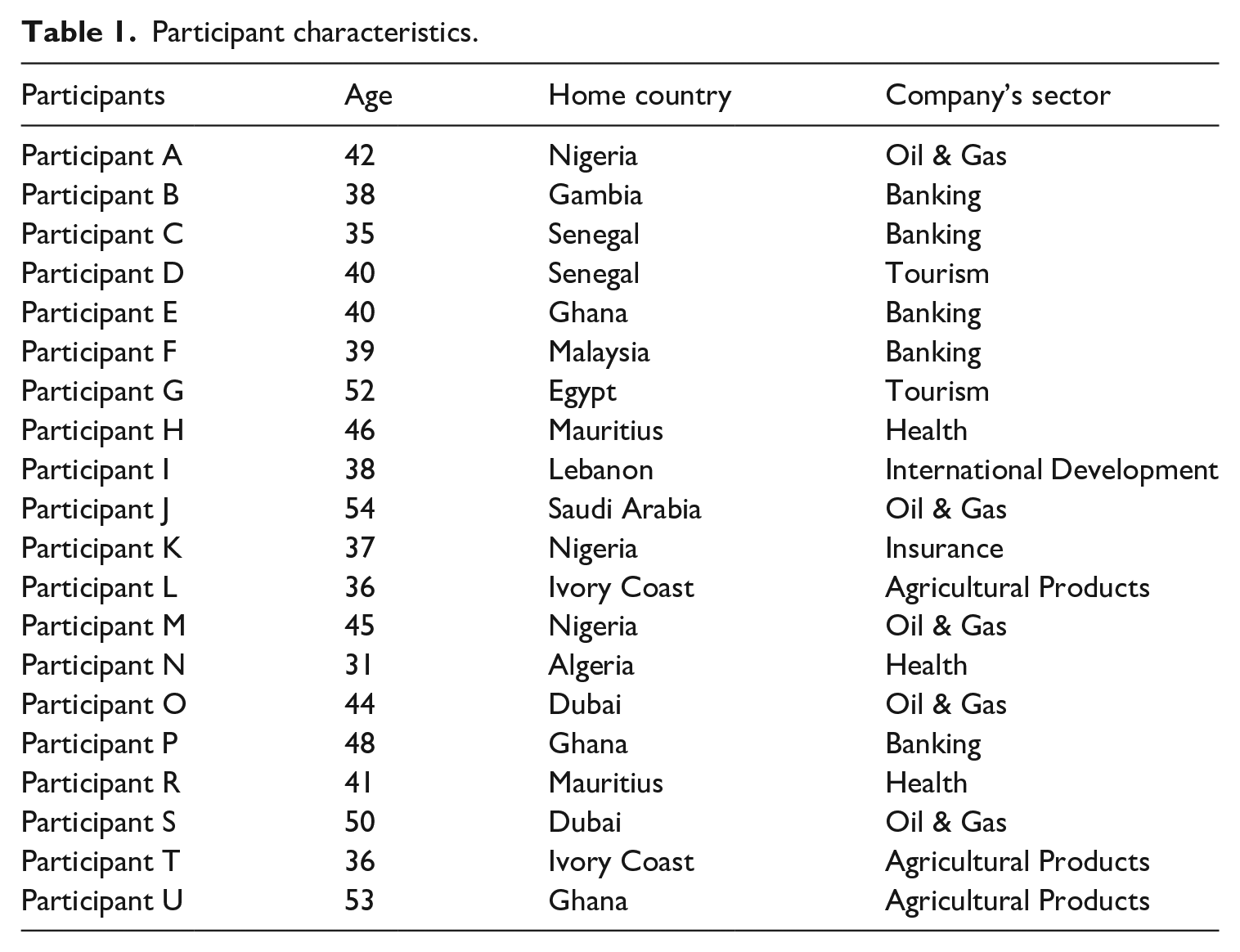
The research used unstructured interviews to obtain data from twenty participants (fourteen men and six women) from Asia, Middle East and Sub-Saharan Africa, working in various multinationals and international development agencies in London, UK. Despite the limitations of this form of interviews (e.g. volume of data, different potential questions for participants), the unstructured interviews were deemed necessary for this research to gather in-depth information from the participants. As there is limited research on expatriate experiences of executives from developing countries, it was important to gather sufficiently detailed information as possible from the participants to develop meaningful analyses. Unstructured interviews also allowed the researcher to focus on the participants’ view of the world (Hammersley, 2012).
The participants were aged between 31 and 54. The base selection criterion was to have been posted in Britain for up to 3 years. Tarique et al. (2016) argue that expatriates typically spend 1–3 years on assignment. We have used this criterion. Measurements of homesickness are not conclusive in terms of how long the phenomenon lasts, with some studies advocating decline in homesickness within 2 weeks, while others recorded a noticeable decline in homesickness only after 7 weeks and in some cases just over 2 years after relocation (Stroebe et al., 2015). We believe that beyond 3 years, the expatriates would have passed the period of acute homesickness and develop adjustment sufficiently to the new environment. This assumption is embedded in Ying’s (2005) study, which found a linear decline in homesickness over the first 2 years following relocation. Table 1 depicts the backgrounds of the participants.
Participant characteristics.
Snowball sampling was used to contact the participants; each expatriate contacted led the researcher to other contacts. Snowball sampling has limitations, for example, issues with reliability and bias, etc. The researcher attempted to make the most of the initial contacts obtained, which eased the search for suitable participants through snowballing. The use of snowball sampling was also commanded by the limited numbers of developing world expatriates who operate in multinationals in Western cities (Lan, 2011). After 24 interviews, we reached saturation, that is, little new information was being yielded. This led the researchers stop interviewing and discard the last four interviews.
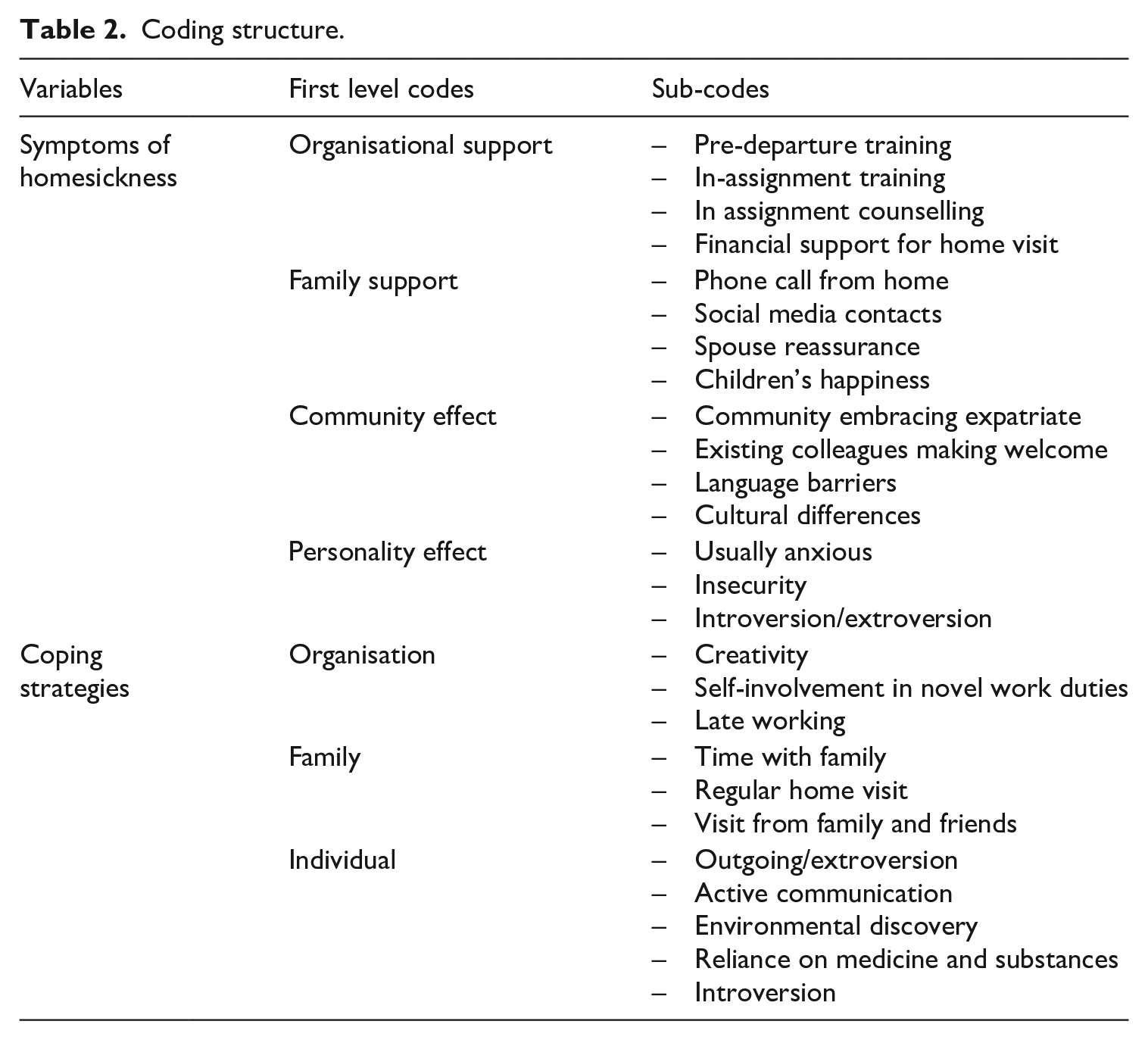
The unstructured interviews explored various topics that are deemed to create or exacerbate homesickness, for example, relocation motivation, preparations before the assignment and early experience in new environments, settlement and family issues and whether they missed the homeland (English et al., 2017). The interviews took place in convenient locations near the participants’ workplace in London to minimise work disruptions and lasted for 1.5 hour on average. The data were analysed through open coding as the researcher reviewed the transcripts to ascertain the meaning of the participants’ narratives. A coding structure was developed which captured the distribution of discourses of the participants and aspects of perspectivization (Graumann and Kallmeyer, 2002). The central aspect of the expatriates’ discourses that frequently appeared was identified and the emerging patterns were organised. Finally, the research evaluated the emotions expressed by the expatriates to identify the expressed positive and negative strategies in coping with homesickness. The participants’ experiences were analysed in stages with participants’ further support in interpreting some assumptions and statements about their adjustment approaches. Table 2 shows the coding structure.
Coding structure.
Findings
This section analyses the situations that the participants faced, the coping strategies they developed and explanations for their choices. All the participating expatriates confirmed traversing periods of homesickness at certain stages of their assignment. The stage at which the homesickness condition surfaced first varied; this was as early as at the point of departure for some expatriates. However, most respondents became actually homesick after arriving in the host country. Participant D felt homesick before departure:
“Two weeks before leaving, I started to have strange feelings about coming to London. My extended family [back home] were happy to meet so often for most religious and social events. I thought about how much I’ll miss that” (Participant D).
A number of participants (14) reported symptoms in the few days preceding departure in the way described by Participant D; however; generally, the strongest symptoms of homesickness were more visible 3 months afterwards. Two other expatriates concurred about feeling the most profound sense of homesickness after a year. The expatriates displayed homesickness symptoms notwithstanding moderating elements, for example, previous expatriate experience, accompanying family members, knowledge of host country. This finding shows the extent of the problem in international assignments.
Impact of culture distance
Many difficulties linked to the experience of our developing country expatriates. This testifies to the cultural distance (the difference in cultural values between two countries (Beugelsdijk et al., 2018) amongst North and South despite increasing international business and the meeting of cultures. The more distant the cultures are, the more painful the experience of adjustment becomes, heightening homesickness. Participant A explained:
To understand British culture was not easy. For example, how to approach people to have a chat; what can offend people isn’t easy to detect. Thus, to avoid conflict, you stay in your corner.
Such a feeling was widely shared. Nine expatriates voiced frustrations and described the segregated culture in the office. Despite many participants having different perspectives departing from these opinions, the encounters of the expatriates mentioned above confirm the integration difficulties which can prompt feelings of missing the homeland. Such an evaluation is corroborated as all the expatriates reported issues intrinsically linked to both societal and organisational culture which caused an unhomely feeling. Participant E concurred:
The office and the physical landscape are reminders that you aren’t at home. The only way you can forget a bit is to have people around that can be friends, not just office mates. But that doesn’t always happen.
Anxiety
This was exemplified by the pressure to close cultural fissures. However, anxiety was moderately present elsewhere, for example, work context (headquarters’ technology, structure, etc.) and in the broader societal fabric (legal frameworks, the pace of life, safety, availability of ethnic commodities). Fearing the new environment was acutely felt among women expatriates. Participant F explained:
It’s intimidating to go out alone with a headscarf, when there aren’t many women there [in South London] dressed like that. You feel a foreigner and scared of people looking at you, but sometimes shouting or attacking you.
This was presented as a gender issue but could also be a religious or ‘visibly different’ issue. Since there were only six women in the sample, further research is needed.
The expatriates were from urban centres, but none like London and the novelty of things, socio-economic structures, the built environment, food and transportation, etc. were reported as overwhelming. Half of the expatriates feared about the organisational and legal appropriateness of their actions that might cause offence to others and harm themselves. Participant A explained:
We heard so many things about attacks in London that as a new expatriate I felt scared of going out. I’ve a different attitude now after 3 years. I go out and socialise. But in the first year I was confined to my apartment; I felt withdrawn and depressed.
Having traversed significant psycho-social interruptions associated with risking career moves and separation, eleven explained that severe anxiety was already taking shape prior to departing the home country. Some expatriates reported irregular pace of the heart and stomach-ache. This stage of homesickness was a foremost phase in the expatriates’ assignment as the less anxious participants but with higher levels of resilience showed a higher probability to integrate successfully. Reduction in the level of anxiety soothed the undesirable feeling which brought to light the adverse effects of cultural distance and unfamiliar realities which, in turn, are perceived as inexorably foreign with the potential to be detrimental to the expatriate.
Pre-departure preparation errors
Over half of the expatriates evidenced issues that increased their sense of missing home, for example, new responsibilities, the novelty of the work and social contexts and multiple issues they must coordinate, etc. Evidently, they could always return all they had to do was resign and go home. Obviously, the expatriates missed home but decided to stay because leaving early will signify a personal failure and possibly damage their future career, as reported:
The reason why I hang on and didn’t leave the assignment was that I’d feel a sense of failure and letting down my employer. That could affect whether they give me another posting in the future or promote me at home (Participant G).
On whether pre-departure training actually achieved its intended aim of smoothening the transition between home and away contexts, there were mixed expatriate reactions as evidenced in the participant narratives below. Ten participants had some limited pre-departure preparation. The expatriates who received training, except one with significant prior expatriate experience, stressed that their work performance decreased in their assignment. A female expatriate argued:
Pre-departure training was ok, but it didn’t really stress sufficiently what was involved in the actual role. If we’d been involved in meaningful overlaps, that’d provide hand-on experience and a steady introduction to the new workplace and cultural environment (Participant F).
Participant F’s perception of pre-departure training was shared by two other females, Participant K and Participant I. Mental pictures of the homeland recurred because of such issues; this became more pronounced due to support shortages from the subsidiary company and headquarters expressed by six of the expatriates. This negatively impacted on their performance. While Participant F and some few other expatriates see some merits in the pre-departure preparation, four expatriates did not find it helpful, and this is exemplified in Participant H’s words:
The local reality’s totally different from what HR covered in pre-departure sessions. They said it was easy to source various foods and leisure facilities here. This isn’t true. We stay home at the weekend because the cinema and theatre don’t always show things that interest us. The shops selling African food are mainly in South and North London.
In-assignment support issues
Grief and loss became part of the experience of expatriation for the participants. As the expatriates became lonely, the absence of relatives and friends was felt more intensely. One would reason that in the technological age with skype, facetime, WhatsApp, Facebook, etc., new expatriates will overcome loneliness more rapidly. Even where internet facilities were adequate and these technologies available, the expatriates did not make extensive use of them, suggesting that they miss the warmth of face-to-face social interactions with families and friends. The grief was for the ‘lost’ homeland as a physical, sociocultural and linguistic space which symbolised a sense of belonging. Participant [I] explained:
I often shook my head and said to myself “why did I bring my husband to this place where he’s unhappy.” I often isolated myself in a room and cried. I was generally restlessness and miserable.
All the expatriates acknowledged going through a similar process, despite their initial joy about the opportunity to further their professional experience. Participant J argued:
We grieved for the lost homeland, the lost paradise. Being so far, culturally, socially and psychologically isolated, you can only see home as a paradise. In the face of this, careers seem to matter less, which means less job focus.
In the later stages of the assignment, with time and the building of new networks, the expatriates attempted to settle in their professional lives.
Symptoms of homesickness
The expatriates experienced homesickness in many ways. This included physiological and psychological states that were pathological. These manifestations varied, but participants stated significant similarities.
The expatriates observed persistent mood changes, and many reported unsettling feelings in the early days of the assignment, which they attributed to dislocation and anxiety. Such fear caused ten expatriates to observe a decrease in their excitement about the role, feeling unhappy and withdrawn. Changes in facial expressions, evasion of personal space, gnashing of the teeth and sometimes becoming aggressive exemplified the deteriorating state of mind in ten expatriates. There was self-realisation of these behavioural conditions, but the expatriates blamed others for their ill-psychological health. Participant J’s experience translates the feeling of many of the participants:
Some expatriates were inappropriately rude when they phoned managers and HR for help in the headquarters. I sobbed in the office openly and sometimes quietly at home.
This phase typifies a situation of diminished control because the expatriates experience helplessness in various contexts. The lack of interest was characterised by the respondents not responding to the normal demands of the body and refusing food. Some participants like a male aprticipant and three female expatriates reported lack of food intake. In Participant K’s words:
I lost weight, experienced frequent mood change. For weeks after arriving, my diet became imbalanced and for some days I didn’t eat.
Medically, some expatriates noted weakness in their joints, had constant headaches. Others fell ill-health physically but were unable to describe their condition explicitly. Some expatriates declined social interactions and confined themselves into isolation. Participant D said:
Loneliness connected me to the past. Past memories kept me going knowing that I’ll one day return to live these realities.
All participants articulated the feeling of being overwhelmed. Organisational structures, work systems, technology, team dynamics, etc. appeared very different from those in place in the homeland. These, combined with the psychological effects of separation, became an uneasy situation. There were performance issues associated with this phase, particularly early in the assignment. Reports of soldiering meant lower productivity at personal and organisational levels. Participant L admitted:
Managers were concerned about the many errors I made in my work, causing backlogs and numerous complaints from customers.
To help Participant L through the transition into the new position, HR managers provided counselling and support. The lack of focus affected eight other expatriates.
The data revealed that psychological and social disruption in the expatriates was the result of homesickness and lack of preparation and in-assignment support. Homesickness also affected the participants’ physical health. The issue was graver for expatriates who received limited PDCCT. What were their approaches to coping with homesickness? This section identifies some moderating elements that helped manage the homesickness condition.
Coping strategies
Some participants got more involved in the local communities and social events within the company to avoid social isolation which triggers and exacerbates homesickness. Participant H, who was an accompanied expatriate, explained his fight against homesickness:
I took my wife and kids to several local cultural events which were good to relax and know the locals. We went to parks, and my children played with the locals. Frequently, we got a childminder for the kids so we could attend social events.
Other expatriates took cultural awareness classes which they claimed helped them meet locals and become less isolated and sad. Some expatriates kept in contacts with their new colleagues in the foreign assignment and at home via emails, traditional letters, telephone and skype. A female expatriate explained how this approach helped cope with expatriate life in the West:
In Indonesia, the social and office atmospheres were enjoyable because the culture was similar to my country. However, in London, I feel lonely because my boyfriend wasn’t granted a visa to accompany me. I write several letters to him weekly (Participant M).
Personal efforts led some expatriates to be ‘hooked up’ on host television programmes to learn British culture. For Participant K:
The daily BBC TV series Eastenders became a ‘religious ritual’ for me. I’ll watch it daily. When I couldn’t make it, I’d set up automatic recording to view later (Participant K).
While education and personal efforts had a positive impact on the expatriate, other coping strategies were less constructive. For example, some expatriates became addicted to drugs to help them relax and deal with the pain of isolation and acculturative stress. Participant N reflected on her experience:
When you take medication, at first it’s fine. Drowsiness leads to sleep. However, medication doesn’t clear the thoughts about home when you wake up. Sometimes, you suffer even more from homesickness.
Some expatriates saw leaving their companies to join rivals as an essential coping mechanism. Participant O contended:
You find other companies whose support package is more attractive and supportive. I know a company that uses community support to help new expatriates. They invite community leaders to come welcome the new expats. I went to an event with MaltCompany (name substituted) which I later applied to.
Other participants attempted to leave their companies, though unsuccessful; but the intension remained firm. Participant P explained:
I thought looking for new opportunities will provide me fresh challenges and stop me thinking that I made a mistake to leave home. It isn’t about more money or better position but change that could heal my feeling homesick.
The next section discusses the main perspectives of the participants and constructs a model of expatriates’ strategies for coping with homesickness during their assignment.
Discussion
The findings demonstrate the severity of homesickness and its disruptive effect on expatriate mental health, performance and commitment to the organisation. The fact that it is under-explored within HRM and expatriation studies is a disturbing literature omission. Evidence (Nardon et al., 2015; Deresky, 2017; Thurber and Walton, 2007; Stroebe et al., 2002; Van Tilburg and Vingerhoets, 2005; Van Tilburg et al., 1996) indicates that homesickness has profound negative impacts on both expatriates and organisations. According to psychologists, it is an illness that should be seriously researched to find remedies (Fisher, 2016; Van Tilburg et al., 1996; Van Tilburg and Vingerhoets, 2005). This study shows that expatriates suffering from homesickness display negative attributes, for example, irritability, sadness, uncooperativeness, and lack of initiative (Research Question 1), which is in line with previous research where homesickness has been blamed for developing such symptoms (e.g. Fisher, 2016; Furnham, 2005; Thurber and Walton, 2007). The frustrations about the incapacity to melt into the new social context increased homesickness which even the career development motive for accepting an assignment in the West could not always mitigate. This echoes some findings reported in previous research. For instance, Berry et al. (1989) found that integration is linked to the lowest level of psychological distress; whilst, marginalisation is associated with the highest level of distress. Those expatriates who could speak a second language or a plurality of languages had an advantage in building multiple initial relationships with people from a variety of backgrounds and nationalities (Clément, 1986; Welch and Welch, 2008).
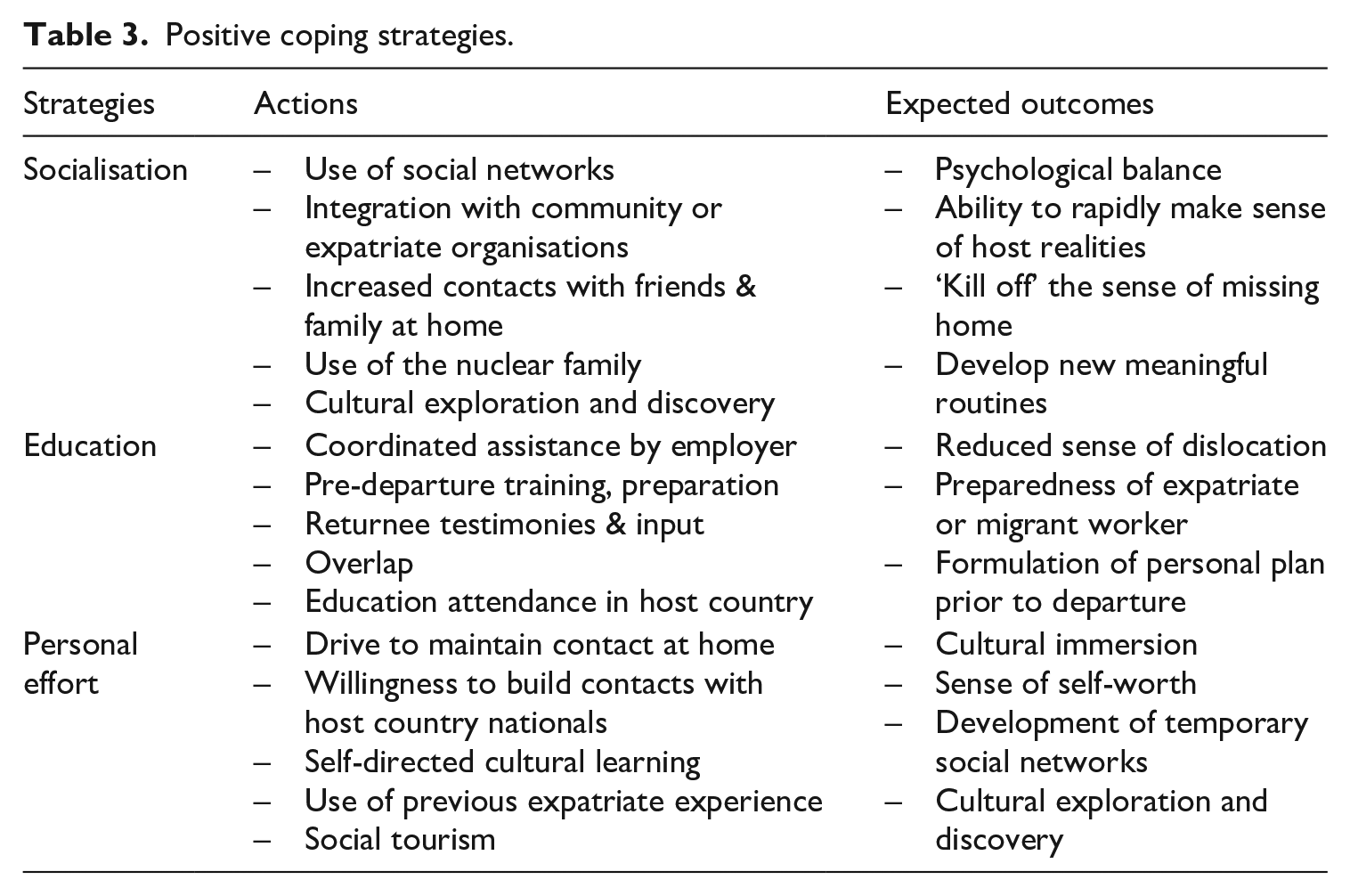
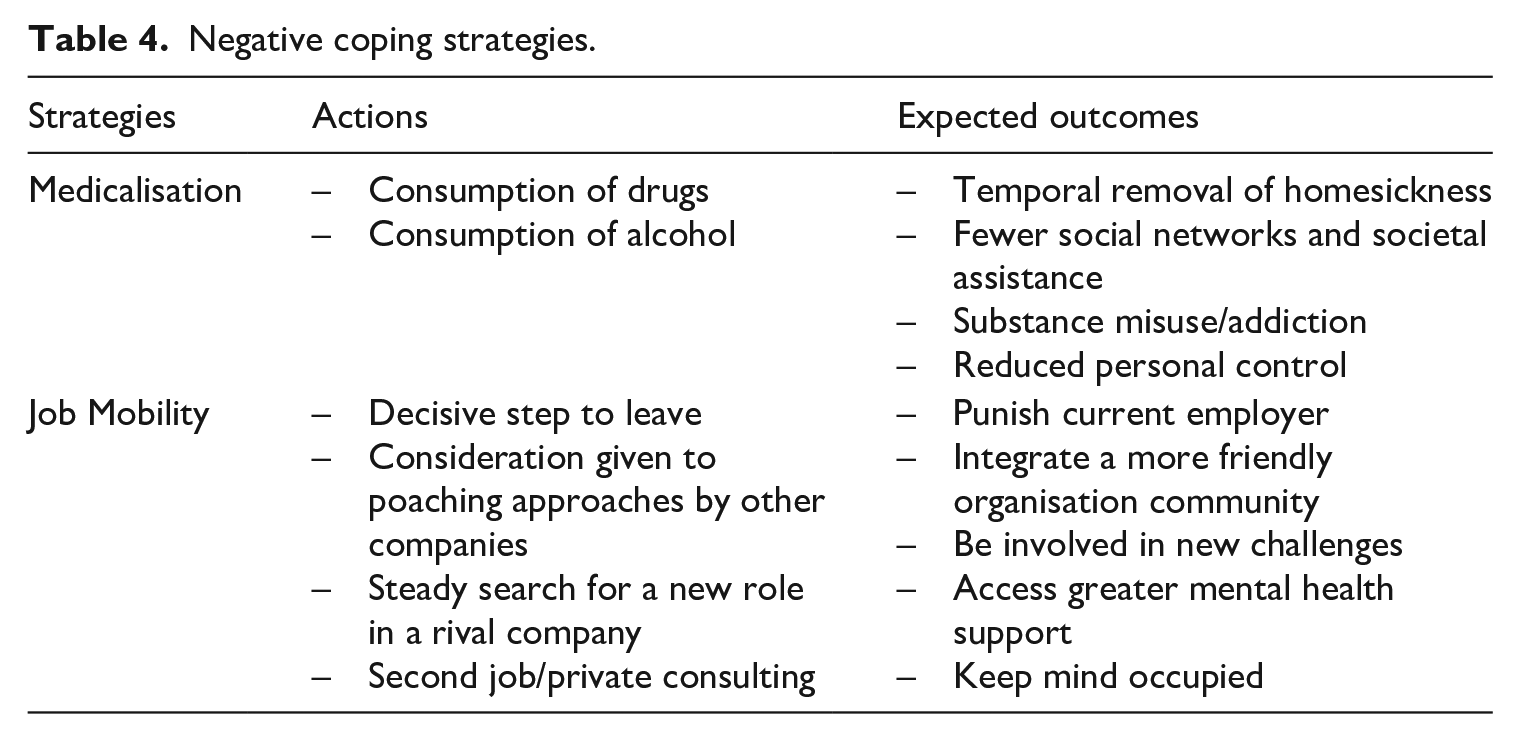
Determining the additional factors that could intensify homesickness in developing countries expatriates constitutes the first step in improving individual well-being and engendering a better return on investment from expatriate assignments. Van Tilburg et al. (1996) argued that interventions are limited, although Fisher’s (2016) ‘stress management’ framework found several practical interventions. Zhu et al. (2018) see the necessity to address acculturative stress. Thurber and Walton (2007) are optimistic and present medical and social interventions which should draw on family support and employers’ roles. As the impact of culture shock may be unavoidable (Thurber and Walton, 2007), the homesickness coping model proposed in this study is an initial step to address the psycho-social and performance-related trauma faced by developing countries expatriates. Tables 3 and 4 detail the coping strategies.
Positive coping strategies.
Negative coping strategies.
Analysis of the coping strategies
The expatriates reacted differently to evolving homesickness symptoms. They developed their own coping mechanisms centred on five key strategies: socialisation, education, personal effort, medicalisation and job mobility - based on the data. These strategies are divided into two main categories: Positive practices and negative practices (see Tables 3 and 4) and explained hereunder (Research Question 3).
Positive practices
Positive practices (Table 3) capture homesickness coping approaches that have some positive impact on expatriate wellbeing.
Socialisation
The expatriates use social networks to deal with homesickness (Hack-Polay, 2012; Lazarova et al., 2015). Three expatriates interacted with various people, for example, host country nationals and foreign colleagues from various countries to achieve a relatively psychologically balanced life. More participants admitted that having contacts with people that they were not familiar with did not yield the helpfulness they expected soon after locating. This is because they were searching for private spaces to help them organise their thoughts and find meaning in the current reality. These expatriates used counter-productive self-inflicted isolation. Self-inflicted isolation was counter-productive because the expatriates using this strategy deprived themselves of the much needed socio-cultural exposure, a critical aspect to combat homesickness (Julien, 2015; Lazarova et al., 2015).
Notwithstanding, this might be an implicit, unannounced or unrecognised struggle with socialisation. For example, according to Aetna (2020), dating was the most challenging thing for single people, as 76% of the expatriates surveyed found it quite challenging. The same survey reported that establishing a support network (e.g. making new friends, finding a community, etc.) ranked 3rd amongst the most challenging aspects of moving abroad (Aetna, 2020). This accords with our finding showing that accompanied expatriates experienced less the symptoms of homesickness. Twelve respondents that kept regular contacts with close friends and family back home reported less intense homesickness than their counterparts. The socialisation strategy is summarised in Table 3.
Education
This aspect encapsulates harmonised employer support, for example, pre-departure preparation and briefings, pre-departure visits to host locations and some conversation with returnee expatriates. Many expatriates accepted that preparation afforded valuable insights of the country of assignment and the scopes of the new roles. Ten expatriates accepted that hearing from former assignees provided a good picture of the new place and reassurance. Four first-time-expatriates had overlapped with previous post-holders within the preparation for the posting, which allowed them to receive useful guidance from the sitting expatriates.
Cross-cultural management was an integral part of the expatriate pre-assignment preparation. In contrast to some earlier findings (e.g. Puck et al., 2008; Wurtz, 2014) and consistent with others (e.g. Nunes et al., 2017), our results revealed that expatriates who had such preparation, even limited in scope, believed that it had merits. Expatriates, who had too little or no training, felt left out and isolated in London. The expatriates who took formal cultural awareness courses had higher chances of meeting locals and living more socially and professionally fulfilling lives. The education strategy is shown in Table 3.
Personal effort
Personal effort has three main aspects: the disposition to sustain host and home contacts, self-initiated informal cultural acquisition, and utilisation of past experiences. The first aspect is about the participant attempting every possibility to remain in contact with newly formed relationships and home networks, using letters, email, phone, skype and home visits (Ward et al., 2005). In this regard, Baldassar (2008) argues that voice-enabled communication technologies receive higher preference by migrants, which, arguably, makes people develop higher levels of perceived closeness and more presence. Another strategy of the personal effort approach (Table 3) is a self-initiated cultural acquisition. Unconsciously or consciously, the participants constructed a knowledge acquisition programme intended to abate homesickness. The expatriates keenly invested in understanding the host societal and organisational practices. Some participants ‘got hooked up’ on host television programmes to learn British culture. Previous research shows that the higher the levels of self-motivated cultural learning are, the more likely expatriates will ace their cultural adjustment (e.g. Hack-Polay, 2012). The third aspect, reported by our sample, links to the employment of expatriates’ previous international experiences as a coping approach. This result aligns with those obtained by previous research. For example, Koo Moon et al. (2012) found that prior international nonwork rather than work experience is more positively related to cultural intelligence which in turn transmits those positive impacts to cross-cultural adjustment.
Negative practices
Negative practices (Table 4) capture homesickness coping approaches that do not relieve the expatriate from homesickness but on the contrary, worsen their condition.
Medicalisation
Medicalisation was the least used strategy – only two of the participants used it. The expatriates who used this approach took medicines or drugs for most pains, even if when a medication was not required. They took pills daily to treat fatigue, headaches and stomach-aches. A participant admitted taking pills to relax after a long day (e.g. Rajasekar and Renand, 2013; Vingerhoets, 2005). The other expatriate took sleeping pills to ‘bury’ their obsessive thoughts about home (e.g. Biasi et al., 2018; Van Tilburg et al., 1996). Table 4 summarises the medical approach.
Job mobility
The final aspect identified in the expatriates’ coping strategy is job mobility. This involved looking for a new job, sometimes with rivals. With the significant numbers of multinationals in London, expatriates can easily be poached by rival companies. In this regard, previous research pinpoints the criticality of the role of organisational career support in predicting expatriates’ turnover intentions (e.g. McCaughey and Bruning, 2005). For instance, Naumann (1993) found the relationship between perceived lack of career support and intentions to leave during or shortly after international assignments to be significantly positive.
The coping strategies developed by the expatriates could reduce the negative impacts of homesickness on the expatriate and the organisation (Thurber and Walton, 2007). In the context of international HRM, Deresky (2017) and Florkowski and Fogel (1999) noted the need for adequate expatriate pre-departure preparations which should be complemented with practices and robust organisational HRM policy frameworks. Another approach to boost the expatriates’ immunity against homesickness-triggered anxiety is through providing proper pre-departure training for cultural intelligence to international assignees. In reviewing the literature, we found studies that recommended the adoption of CQ to reduce anxiety amongst expatriates upon international assignments (e.g. Bücker et al., 2014; Bücker and Korzilius, 2015). HRM could embed such activities in a bundle of mechanisms to reduce the anxiety resulting from acculturative stress. Preparations could focus on information about host country realities and the possible temporary or protracted periods of psycho-social isolation. In attempting to reduce the occurrence of homesickness, expatriate briefings need to provide for regular home visits and building socio-cultural networks in the expatriates’ new ‘home’ (Naeem et al., 2015). Thurber and Walton (2007) advocate the maintenance of contacts with home, stressing family factors in preventing and treating homesickness.
Support framework for developing country expatriates
Within the preparation initiatives, some have suggested the use of new technology for expatriates to keep in touch with family, friends and colleagues back home (Nardon et al., 2015) – Research Question 2. However, other international HRM authors have argued that most expatriate literature continues to blithely ignore social media, skype, facetime, WhatsApp, etc. (Bonache et al., 2018). Though new technologies are significant in mending some psychological fissures left by displacement, in the case of developing country expatriates, it appears that the cultural determinant is greater. The literature has emphasised the importance of the role of generational differences in the use of technology including social media channels which millennials and later generations utilise better than any other generation (Mahmoud et al., 2020a, 2020b). Hence, considering the technology-savvy nature of younger generations (Mahmoud et al., 2020a, 2020b), a change in the role of the person who manages and provides technology advice is evident, as younger generations are the ones who provide their ancestors with advice on technological choices (Bacigalupe and Bräuninger, 2017). This is a critical issue when investigating homesickness amongst expatriates as a homesick individual are more likely to make use of communication technologies (Humphries et al., 2006).
Reducing the adverse effects of homesickness could involve the development of HRM frameworks encompassing headquarter and subsidiary cultural networks (Scharp et al., 2016). Many participants alluded to missing cultural aspects of the home country and family. This could be a sharp departure from the experience of traditional Western expatriates who are from individualistic countries and therefore could tolerate reduced extended family presence better than developing countries expatriates whose cultures largely fall with collectivism.
Social networks help members to learn from their own adjustment strategies (Nardon et al., 2015). Such successes, which can reduce the deleterious impacts of homesickness, ought to be captured and widely shared amongst current and future expatriates from different countries. In this perspective, the central role of the international human resource department is central (Bonache et al., 2018). There is a case for explicitly adopting a systematic HRM approach to managing developing countries expatriates. In fact, the medicalisation model found here is a key aspect affecting developing countries expatriates, who due to cultural reasons, are reluctant to seek counselling or professional mental health assistance (Arday, 2018; Memon et al., 2016).
Cultural spheres (e.g. social clubs, religious and educational institutions) can have a positive effect on the mental health, performance and commitment of the expatriates. The effectiveness of these socio-cultural resources is subject to being adequately researched and deployed by HRM to create dynamic capabilities. This is because HRM is a driver for fulfilling the organisational strategy (Wan, 2019) and supporting the international assignees with maintaining, developing and building up essential work qualifications and skills which can be detected through the levels of flexibility and ability to adjust successfully in new cultures (Bücker et al., 2016). Socio-cultural resources publicised by HRM could be necessary ‘healing’ networks for dislocated and homesick expatriates.
Conclusion
Summary
The research answers the first research question by demonstrating that homesickness is a crucial issue and prevalent in expatriates from the developing countries operating in advanced economies such as the UK. Homesickness has significant negative personal and organisational ramifications when there are no systematic HRM interventions, and institutional framework to support expatriates with different needs, that is, developing countries expatriates. This is linked to the insufficiency of expatriate preparation before departure, the deficiency of in-assignment support generally (Bonache et al., 2018), and culture distance.
In the absence of systematic organisational support mechanisms, developing countries expatriates are left to devise individual strategies for coping with homesickness. When this happens, uncoordinated untested individual strategies could, in some cases, be detrimental to individual performance. For instance, in this study, medicalisation has proved to worsen the homesickness condition. Even the other approaches that showed a degree of success presented some issues. For instance, the state of dependency and disconnection with work since more effort is deployed trying to combat homesickness as opposed to focusing on the expatriate role. More significant at the individual level is the impact on the individuals’ health and wellbeing. Expatriation is designed to enhance careers, creating a sense of achievement (Kierner, 2018). If HRM inadequately manages the psychological effects of expatriations, the knock-on effect is the long-term damage of the expatriates’ professional confidence, family and social networks. HRM has a responsibility to ensure the expatriates’ new location has a sense of ‘home’.
Homesickness can pause challenges for developing world expatriates and their organisations. These challenges include decreased team dynamic and performance, loss of contacts and networks, and decreased organisational commitment. Further, failed expatriation can deter potential good expatriates, thus reducing the talent pool (Deresky, 2017; Kierner, 2018).
Implications, limitations and further research
The research has practical implications in that it can help international HRM within organisations to formulate policies and development strategies that contribute to better mental health for expatriates, thus seeding the ingredients for better levels of performance and job satisfaction. Within the preparation initiatives, the use of new technology can be critical to keeping in touch with family, friends and colleagues back home. This study’s results reject the linearity in the homesickness model presented by Fisher (2016) and detailed in our theoretical framework.
The generalisability of our findings is subject to certain limitations. For instance, we drew our results based on a relatively small sample. Though this limitation was mitigated by the diversity of sectors and nationalities of the participants, more extensive studies, perhaps drawing on quantitative studies using large sample sizes, will allow for more generalisation. Such studies will be strengthened by a cross-border approach, looking at participants in various Western developed countries. With increasing talent being sourced in the developing world due to labour shortages in the West, at the same time as expanding the international business to culturally and geographically distant localities, HRM is key to [organisational] mission accomplishment (Wan, 2019). Academic and HRM practitioner research are axiomatic to better understand the adaptation issues of developing world expatriates given the recentness of increased deployment of developing world expatriates to the West.
Finally, our study took place in the UK. This limitation implies that our results need to be interpreted cautiously when aiming for generalisations to other countries or contexts in the West. However, replication studies based on our findings and taking place in other nations in the Western world would be highly encouraged as that could better determine the external validity level of our conclusions.
