




Abstract
Background and aims
Little evidence exists for the effectiveness of intervention for older adolescents and young adults with language disorders, particularly for those over 16 years. This study involves college-aged students aged 16–19 years with Language Disorder and Word-Finding Difficulties and investigates whether progress in word finding following 1:1 semantic intervention is greater than progress during a baseline period as measured by a standardised test.
Methods
Twenty-five college-aged students (20 males and 5 females) with Language Disorder and Word-Finding Difficulties (aged 16;4–18;4 years) participated in a single baseline design study comparing progress on the Test of Adolescent and Adult Word Finding during an intervention period with progress during a baseline period of equal length. Intervention was focused on semantics of different words from those in the Test of Adolescent and Adult Word Finding and was delivered 1:1 by the participants’ usual Speech and Language Therapist, 30 minutes per week, for eight weeks.
Results
The participants made significant progress in raw score on the Test of Adolescent and Adult Word Finding during both the baseline (d = 1.4) and intervention (d = 2.5) periods, but progress during the intervention period was significantly greater than during the baseline period (d = 1.16). Individual data showed reliable change for five participants during the baseline period and for 20 participants during the intervention period. At the start of the study, all participants had standard scores below 85, but after intervention, 10/25 participants scored above 85.
Conclusions
Four hours of semantic intervention led to significantly greater gains on a standardised test of word finding than during a baseline period of equal length in 16–19 year olds with Language Disorder and Word-Finding Difficulties. The words in the standardised test had not been included in the intervention, indicating generalised gains.
Implications
This study shows that intervention (at least for Word-Finding Difficulties) can be effective for this older age group of college-aged students with Language Disorder and therefore the effectiveness of Speech and Language Therapy services for this age group in a wider range of areas of language should also be investigated.
Keywords
Introduction
Approximately 7% of children starting school meet the diagnostic criteria for Developmental Language Disorder (DLD) and 10% for wider Language Disorder (Norbury et al., 2016). Their language difficulties persist into later childhood, adolescence and young adulthood (Conti-Ramsden & Durkin, 2012; Stothard, Snowling, Bishop, Chipchase, & Kaplan, 1998). Adolescents with DLD exhibit a range of impairments, including difficulties with complex syntax (Nippold, Mansfield, Billow, & Tomblin, 2008), vocabulary (McGregor, Gordon, Eden, Arbisi-Kelm, & Oleson, 2017; McGregor, Oleson, Bahnsen, & Duff, 2013) and word finding (German, 1992). Young adults with DLD also score lower on self-esteem and on social self-efficacy, and higher on shyness than age-matched peers (Durkin, Toseeb, Botting, Pickles, & Conti-Ramsden, 2017). Longitudinal studies show that young people with a history of DLD tend to have lower academic and vocational qualifications and less skilled employment, rarely achieving professional roles (Conti-Ramsden, Durkin, Toseeb, Botting, & Pickles, 2018).
The effectiveness of intervention for adolescents with Language Disorder up to 16 years has been investigated in a few studies. This includes interventions aiming to improve vocabulary (Lowe & Joffe, 2017; Spencer, Clegg, Lowe, & Stackhouse, 2017; Wright, Pring, & Ebbels, 2018), receptive and expressive syntax (Balthazar & Scott, 2018; Ebbels, 2007; Ebbels & van der Lely, 2001; Ebbels, Maric, Murphy, & Turner, 2014; Ebbels, van der Lely, & Dockrell, 2007) and word finding (Ebbels et al., 2012; Hyde-Wright, Gorrie, Haynes, & Shipman, 1993). These all indicate positive changes with intervention.
Whilst longitudinal studies have shown that Language Disorder persists into adulthood and the literature describes the nature of these impairments, we are aware of only one research study into interventions with college-aged students with Language Disorder (focusing on job interview preparation, Mathrick, Meagher, & Norbury, 2017). The scant research in this age group is probably because intervention is rarely provided to this group, despite their continuing difficulties and functional impairments (RCSLT, 2017). This is likely to be, at least in part, because we have no evidence of effectiveness of intervention with this age group. As such, we have a vicious circle where a lack of evidence leads to a lack of intervention being provided, which in turn leads to a lack of research, and so forth.
Word finding
Many theories of lexical access or word finding (e.g. Levelt, Roelofs, & Meyer, 1999) propose a staged process with an activation spreading network. When accessing a word, first its ‘lexical concept’ is activated; this is a concept (e.g. female horse) which can be represented by a single word in the user’s language (e.g. mare). As the level of activation of a lexical concept increases, activation spreads to its conceptually related neighbours (e.g., horse, stallion). Lexical concepts are linked to ‘lemmas’ (abstract semantic and syntactic representations) and lemmas to ‘word forms’ (phonological representations). Activation spreads from lexical concepts to their related lemmas (e.g. mare, horse, animal, stallion and donkey), and then on to their word forms. When the activation of a word form crosses its activation threshold, it will be selected for production. If two lemmas have equal activation, both of their word forms will have equal activation and then the word form with the lowest threshold (the higher frequency word) will be selected for production.
Word-finding difficulties
Word-Finding Difficulties (WFDs), where a known word cannot be retrieved for production, are a common feature of DLD and can occur at single word level or within discourse (German & Simon, 1991). WFDs are characterised by hesitations, fillers, substitutions, use of filler words and false starts. Most people occasionally experience the ‘tip of the tongue’ phenomenon. However, clinically significant WFDs can repeatedly disrupt the fluency of conversation and also affect a student’s ability to write fluently and to produce the quality and quantity of written output required for academic progress (Newman & German, 2002).
Children with WFDs make predominantly semantic errors (Dockrell, Messer, & George, 2001; Faust, Dimitrovsky, & Davidi, 1997; McGregor, 1997). The most common semantic errors are coordinates (e.g. producing ‘cat’ for ‘dog’, McGregor, 1997), and these errors are associated with less detailed semantic representations (McGregor & Appel, 2002; McGregor, Newman, Reilly, & Capone, 2002), indicating that ‘sparse’ or ‘fragile’ representations could lead to such errors. Sparse representations could lead to semantic errors if both lemmas are equally activated because there is little to differentiate them and thus either word form may be selected. However, if the coordinate is higher frequency (i.e. with a lower activation threshold), it is more likely to be accessed than the target.
Phonological errors are much less common than semantic errors for all children (Dockrell et al., 2001; Faust et al., 1997; McGregor, 1997) and are associated with good drawings and definitions, therefore semantic information does not appear to be ‘sparse’ (McGregor & Appel, 2002). Phonological errors could result from activation of the correct lemma, but difficulty accessing an accurate word form or phonological representation (Constable, Stackhouse, & Wells, 1997). Phonological errors are predicted by a word’s frequency (German & Newman, 2004), perhaps due to the higher activation thresholds of low frequency words.
Intervention for WFDs in children and adolescents
Intervention studies for children and adolescents with WFDs have focused on semantics and/or phonology (building up the details in the representations and highlighting the semantic/phonological links between words) and generally report positive results, but with varying degrees of generalisation. Studies focusing on phonology are small scale within participant designs, comparing progress on targeted versus control words. These have found significant progress on targeted words but not control words (Best, 2005; McGregor, 1994) in five or two children, respectively, with relatively isolated WFDs. Studies focusing on just semantics have been mainly with children with Language Disorder and WFDs. These have found significant progress in naming of targeted words in within-participant designs comparing progress on targeted versus control words (Marks & Stokes, 2010; Wilson et al., 2015) with one or 12 children, respectively. Some generalisation was found to untreated items in the same semantic category (Wilson et al., 2015). In a slightly larger scale randomised control trial with 15 participants (Ebbels et al., 2012), progress was measured using a standardised test of words not included in the intervention and this showed progress on these untreated items. Generalisation of progress to discourse has not been found (Ebbels et al., 2012; Marks & Stokes, 2010).
Those studies which have considered the progress of children receiving semantic versus phonological approaches in (non-randomised) between participant designs, report conflicting findings. Hyde-Wright et al. (1993) showed that eight participants receiving semantic intervention made more progress than their controls, but seven participants receiving phonological intervention did not. In contrast, Wing (1990) found significant progress in five children receiving intervention focused on phonology (and perceptual features of objects), but not in five children receiving semantic intervention. Best et al. (2018) describe a randomised controlled trial with 20 6 to 8-year-old participants. Five children received semantic intervention, six received phonological intervention and nine served as untreated controls. The intervention group (combining those receiving semantic and phonological intervention) made more progress than controls on treated (but not untreated) words. In none of the three studies discussed above was the progress of those participants receiving semantic versus phonological interventions directly compared, probably due to the small numbers of participants and hence limited power; however, they provided individual data, so these analyses can be carried out. For all three papers, we found no significant differences in the amount of progress made between the phonological versus semantic intervention groups when we compared them directly. Two studies using case series designs with two and four children, respectively (Best et al., 2015; Bragard, Schelstraete, Snyers, & James, 2012), provided indications that children with different language profiles may respond differently to the two intervention approaches. However, studies with larger numbers of participants is clearly required to establish whether one method is more effective than the other and for which children.
The evidence for the effectiveness of intervention for WFDs in the studies described above is relatively limited. The numbers of children receiving intervention are small and generalisation to non-targeted words has only been shown in two studies (Ebbels et al., 2012; Wilson et al., 2015). These two studies are also those with the largest numbers of children receiving intervention (15 or 12 children), respectively, and both used a semantic intervention. Further consideration of these studies is therefore warranted. Ebbels et al. (2012) describe a randomised controlled trial using a semantic intervention with 15 students with Language Disorder and WFDs aged 10–16 years within a specialist school. These children and adolescents received 4 hours of intervention (two 15-minute sessions per week over eight weeks) targeting one specific semantic category. The approach focused on the semantic features of words and the links between them and use of these as a strategy when naming words, rather than on practising naming words per se. Blind assessment, pre- and post-intervention, showed significant gains on the standardised Test of Adolescent and Adult Word Finding (TAWF; German, 1990) for the intervention group, which were significantly larger than the gains of the waiting control group. However, when the waiting controls also then received the intervention, they made a similar amount of progress. The effect of intervention for the two groups combined was large (d = 1.2). Progress was maintained after five months, but did not generalise to discourse on the Test of Word Finding in Discourse (German, 1991).
Ebbels et al. (2012) suggested that the intervention improved the detail in the semantic representations of targeted words, so that they were less sparse, and strengthened semantic links between words. We suggest that they may also have become more aware of the level of detail needed to distinguish between related words. Generalisation to untreated words could occur if the participants are able to generate semantic cues which encourage more detailed lexical concepts, thus enabling them to distinguish between the target lemma and other related lemmas (which differ only in their more precise details) and thus activate the phonological representation of the target word rather than that of a semantically related lemma (see also Boyle, 2004 for similar approaches in aphasia). Ebbels et al. (2012) also suggested that older children may be more able to take advantage of this more meta-cognitive approach as meta-cognitive skills improve with age (Schraw & Moshman, 1995). This could go some way to explaining why semantic therapy appears to be more effective in their study (and that of Hyde-Wright et al. (1993), involving 8–14 year olds), than in Wing’s (1990) study, which involved younger children (aged 6–7 years).
Wilson et al. (2015) was a partial replication of Ebbels et al. (2012), using the same semantic intervention within a different specialist school with younger children aged 7–11 years with Language Disorder and WFDs, and found similar gains. In their within-participants design study, participants received 3 hours of intervention (two 15-minute sessions per week for six weeks). They made significant gains with a moderate treatment effect for both treated (d = 0.7) and non-treated items within the same semantic field (d = 0.5) but not for control items in different semantic fields. Progress was maintained at follow-up.
The evidence summarised above indicates that children with WFDs in the context of wider Language Disorder aged 7–16 years can make good progress with semantic intervention (Ebbels et al., 2012; Hyde-Wright et al., 1993, Wilson et al., 2015), which can lead to generalisation to other words (Ebbels et al., 2012), especially within semantic categories (Wilson et al., 2015). We know of no word-finding intervention studies with young adults over the age of 16 years with persisting Language Disorder and WFDs, but given the current evidence, we hypothesised that a semantic approach would also be effective for college-aged students with Language Disorder and WFDs.
In this study, we investigated progress on a standardised test of word finding for college-aged students aged 16–19 years with Language Disorder and WFDs following the semantic word-finding intervention approach used by Ebbels et al. (2012). We chose to replicate the Ebbels et al. (2012) study using a semantic intervention approach, because that study and its partial replication (Wilson et al., 2015) showed significant gains with intervention, including generalisation to non-targeted words with comparatively large numbers of participants (at least relative to other studies on WFD intervention). The participants in our setting also had very similar language profiles to those in Ebbels et al. (2012), i.e. WFDs in the context of wider Language Disorder and thus we hoped our older participants would show similar gains.
Method
Context
Our specialist school has been working with children and adolescents with Language Disorder (most of whom meet the criteria for DLD) for over 70 years. In 2012, in response to the clear need for students in our setting to continue to receive support and intervention after the age of 16 years, we opened a college for 16–19 year olds with Language Disorder. Since then, we have been providing a range of interventions to this age group, targeting a wide range of areas. We are therefore in an ideal position to carry out research into intervention effectiveness with this age group. The study reported here was the first intervention research project we carried out with this group. We chose to focus on WFDs, an area of language which many of the students had themselves identified as an area of difficulty and where we had carried out a previous randomised control trial with younger children and adolescents with a similar profile of needs (Ebbels et al., 2012). The current study was carried out in a real clinical and educational setting as part of normal practice for that setting, with all the limitations and restrictions that imposed. Because it is based on a previously evaluated intervention, it could therefore be viewed as an effectiveness study, but involving a new age group.
Students’ normal Speech and Language Therapy intervention package in the college includes: one individual session, one social skills group and one language group per week. In addition to this, the Speech and Language Therapist (SLT) provides direct support during onsite and offsite lessons and jointly plans English and Maths with the teacher.
Participants
Twenty-five students participated in this study (20 males and 5 females, aged 16;4–18;4 years at the start of the study). All participants were diagnosed with language difficulties during their primary years and were in specialist education for their secondary school years and now into post-16 college provision. SLTs used clinical judgement and observations of the participants’ conversational skills throughout the curriculum day during the previous year to identify presence of WFDs. SLTs then spoke informally to identified participants during their usual SLT session to gauge their awareness of and insight into their WFDs. All students involved in this study identified themselves as having WFDs and felt frustrated as these were impacting on them both academically and socially. One student described his WFDs as ‘basically like a cupboard in your brain that most people have organised, but for me it is a very messy cupboard that is all over the place’ and another described it as ‘my brain is like a not organised filing cabinet and I am looking for something that I know is there but I just can’t find it because it is a mess’.
All of the 25 participants met the criteria for Language Disorder as defined by Bishop, Snowling, Thompson, Greenhalgh, and Catalise-consortium (2017) with 11 having an associated diagnosis (six Autism Spectrum Disorder (ASD) two epilepsy and three Hearing Impairment (HI), one of whose hearing impairment was related to a genetic syndrome). The remaining 14 could be classified as meeting the Bishop et al. (2017) criteria for DLD, although few had a formal diagnosis using this terminology due to the variable use of terminology in previous years (Bishop, 2014). One student spoke Spanish at home and all the others spoke only English. Detailed information regarding social economic status was not collected beyond entitlement to free school meals; no participant was entitled to this.
SLTs administered the TAWF to confirm WFDs as shown by a standard score below 85. Students selected for the intervention had a mean standard score at the start of the study of 64.9 with a range of 55–80.
The intervention was delivered as part of the participants’ usual intervention package. However, the participants consented to the study design with three testing points, to a term of intervention focused on word finding and to the group results being analysed and submitted for publication. The study received ethical approval from the Moor House ethics forum.
Study design
This study was carried out in a special school by regular SLTs as part of the participants’ regular intervention. We used a single baseline design where the participants served as their own control. The participants were tested on the TAWF at baseline (September), pre-intervention (December) and post-intervention (March). Intervention took place for eight weeks during the January and February. During the baseline period, participants continued with their normal intervention package, but word finding was not targeted (see Appendix 1 for details of the focus of intervention during this baseline term). During the intervention term, the word-finding intervention was delivered as part of the participants’ normal intervention package (see Appendix 2 for details of other interventions running concurrently with the WFD intervention). The total amount of intervention received did not differ in the two terms. Thus, we could compare progress during the baseline term (where they received intervention targeting other areas of language), with progress during the term when they received word-finding intervention. This can help to control for effects such as maturation, practice and placebo effects and also regression to the mean (Ebbels, 2017).
Mean standard score (standard deviation, range) on TAWF for each cohort separately and combined when first assessed.

TAWF: Test of Adolescent and Adult Word Finding.
Measurements
There are no tests for WFDs for this age group standardised in the UK, so we selected to use the TAWF as this was standardised for the age group (albeit in the US) and was used in the Ebbels et al.’s (2012) study, which we were replicating with an older age group. The TAWF is a standardised test for adolescents and adults (aged 12–80 years) with a test–re-test reliability of 0.93. The complete test takes 30 minutes to administer. The TAWF consists of 107 items and requires participants to name pictures accurately (nouns, verbs and categories), complete sentences with missing words, name items from descriptions and name categories on hearing a list of members read by the examiner.
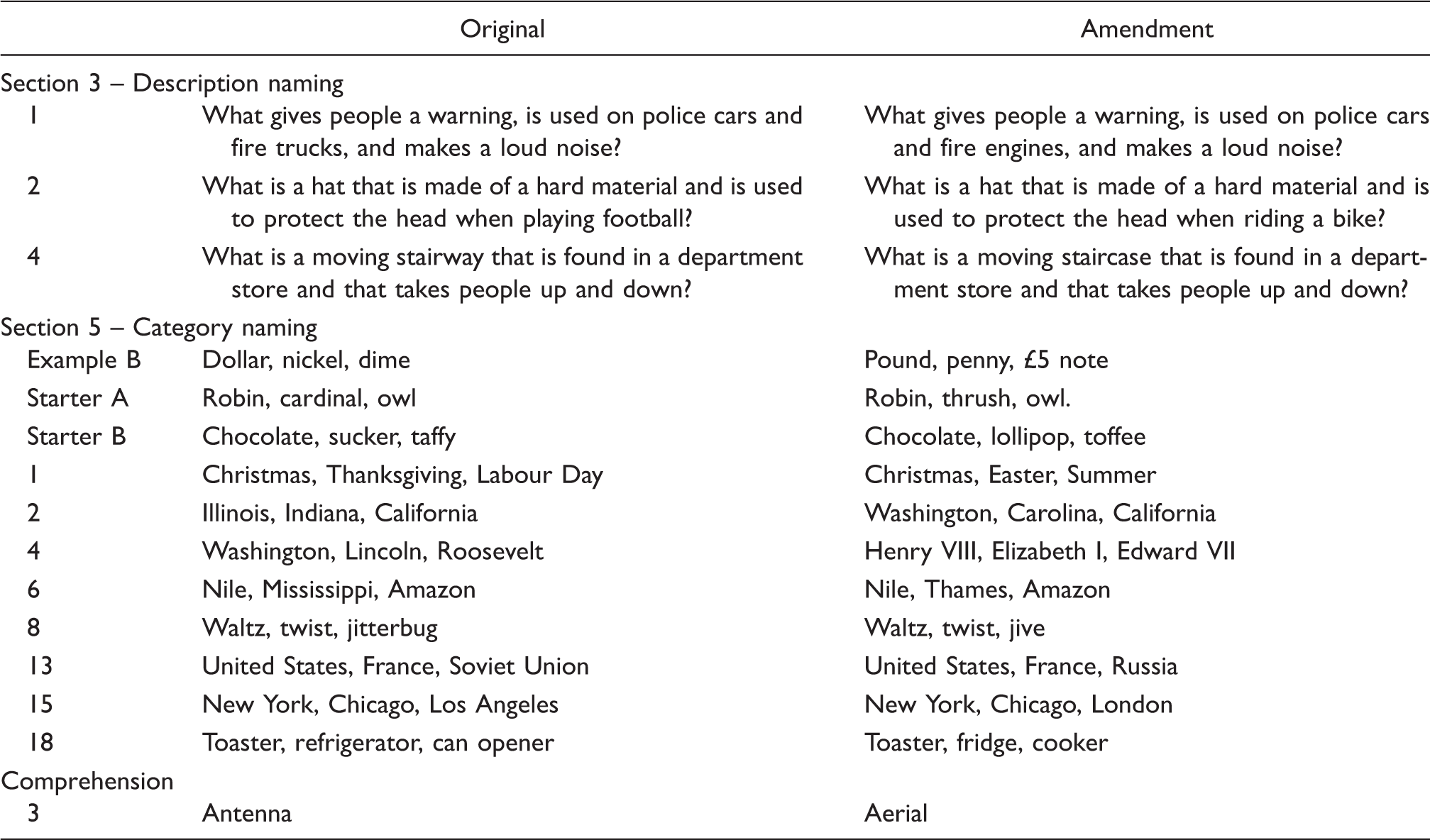
As the TAWF was created in the US, some terms may not be familiar to our students and so we accepted certain responses from the individuals or used certain terms in our administration in place of the American terms. These are listed in Appendices 3 and 4. This adjustment renders the standard scores less reliable. We analysed changes in raw scores as our primary outcome measure, partly because of the unreliability of the standardised scores, given our adjustments for UK participants but also because birthdays, and therefore a change of age-bracket during the study can cause sudden changes in standard scores (even if raw scores have not changed), thus making the results more difficult to interpret.
Individuals with WFDs have difficulties in naming words in the presence of good comprehension of those same words. The TAWF manual describes a method of scoring for low comprehension, recommended for any individual who scores below 90% on comprehension of target items, but this was not required. We used the complete TAWF (in preference to the brief version which is also available) at all testing points. The intervention targets did not include any of the TAWF test items, and therefore this assessment was used not only to measure participants’ progress, but also the generalisation of any improvement in word-finding skills to untreated words.
Intervention
The structure of the intervention broadly replicated that of Ebbels et al. (2012). This intervention was focused on semantics and did not target phonology. We chose to replicate Ebbels et al. (2012) as it had a strong design, with participants with similar profiles and the results indicated progress with word finding on more than just the targeted words. However, there were a few differences, mainly due to the feasibility of providing the intervention within the normal college timetable. During the intervention period, the participants received one weekly individual 30-minute semantic intervention session (instead of two 15 minute sessions) for eight weeks. Thus, the total amount of intervention was the same (4 hours), but distributed differently. As in the Ebbels et al.’s (2012) study, these sessions were mostly provided by the participants’ usual SLT as part of their normal intervention package. If the SLT was absent, the intervention was delivered by another SLT within the college provision. In total, four different SLTs were involved in delivering the intervention. All of these SLTs were trained in the intervention methods by one of the authors.
Intervention for each participant targeted nouns from specific semantic categories. Each participant was taught using photo cards (Franklin, 1990) or tailor-made photo cards that were made to meet students’ interests based on SLTs’ knowledge of the individuals. Cohort 1’s intervention used only one set of photo cards (transport), whereas the participants in cohorts 2 and 3 used four sets of photo cards, covering four of six possible categories: all used transport, food and animals and then each chose one final category out of hair and beauty, occupations or sports according to their interests. More sets were introduced to cohorts 2 and 3 to increase engagement and learning potential, as the SLTs found that using just one category with cohort 1 had led to some decrease in engagement in the later sessions.
For cohorts 2 and 3, each set of photo cards was used for two weeks of the eight-week intervention period. None of the items on the TAWF were pictured on the photo cards, but a few came from the targeted semantic categories (starfish, unicorn and seahorse) or could have been mentioned during the intervention (paw, eyebrow, bangs/fringe, braiding/plaiting, parachuting and marching). Because it was not possible in the routine clinical setting to make and analyse recordings of sessions, we cannot be sure that these items were not mentioned, but the SLTs reported it was unlikely they used any of these words. However, one item on the TAWF (the category label ‘transport(ation)’ may well have been influenced by the intervention, as this category was targeted by all participants. Thus, an increase of one point in raw score could be predicted following the intervention.
Intervention plan.

The hypothesis is that by focusing on the semantics of words, when a participant struggles to name a word, they activate the most distinguishing semantic attributes for the lexical concept. This increased activation then activates the correct lemma which activates the phonological representation and enables the participant to produce the target word. This approach is similar to Semantic Feature Analysis in aphasia intervention (see for example Boyle, 2004). Phonological or orthographic cues were not used in this intervention as we were replicating a previous study which did not use these (Ebbels et al., 2012). As in the Ebbels et al.’s (2012) study, the focus was not on naming the words and therefore it is difficult to quantify the ‘dose’ as defined by Warren, Fey, and Yoder (2007) as ‘the number of properly administered teaching episodes during a single intervention session’ (p. 71). In a session focusing on meta-cognition, rather than behaviour (e.g. discussing different ways of dividing a group of pictures into broad and then more detailed categories and subcategories rather than naming pictures), it is unclear where one teaching episode stops and the next one starts. Justice (2018) conceptualises dose as ‘the time in which the speech-language pathologist is actively targeting language growth in any one domain (e.g. grammar, vocabulary and narrative) using any number of techniques’ (p. 320). Our sessions were not recorded; however, the SLTs reported that the participants arrived and left on time and there were no issues with behaviour. Aside from quick greetings at the beginning, the remainder of each session was solely dedicated to the intervention, with a summary at the end. Thus, we estimate that the dose (in Justice’s 2018 terms) was 25 minutes out of a 30 minute session, once per week for eight weeks; leading to (for those who missed no sessions) a total cumulative intensity of 3 hours 20 minutes.
Some of the participants received intervention focussing on vocabulary during the baseline term. This consisted of discussing the phonology, syntax and definition of specific Tier 3 words (Beck, McKeown, & Kucan, 2002) related to their academic studies. This differed from the WFD intervention as there was no analysis of semantic features, unlike the word-finding intervention, and the word-finding intervention targeted Tier 1 or 2 everyday nouns, rather than Tier 3 words. However, we considered whether this vocabulary intervention had any effect on the results in our analyses.
Attendance and fidelity
Word-finding intervention was provided as part of the participants’ normal SLT intervention package. The word-finding intervention was delivered during the weekly individual session for one term. The actual attendance of the participants is listed below:
Cohort 1: All six participants received the word-finding intervention as planned; eight 30-minute weekly 1:1 sessions (with a dose of 25 minutes focused on the target per session leading to a cumulative intensity of 3 hours 20 minutes).
Cohort 2: Two participants received six 30-minute weekly 1:1 sessions (dose 25 minutes per session = cumulative intensity: 2 hours 30 minutes) and three participants received seven 30-minute weekly 1:1 sessions (dose 25 minutes per session = cumulative intensity: 2 hours 55 minutes), i.e. none received all eight sessions as planned.
Cohort 3: All 14 participants received the therapy as planned; eight 30-minute weekly 1:1 sessions (dose 25 minutes per session = cumulative intensity: 3 hours 20 minutes).
According to the participant progress notes, which were completed within 24 hours of each session and checked throughout the intervention period by the first author, each weekly intervention session followed the intervention plan outlined in Table 2.
Results
The raw scores on the TAWF for the three cohorts at the three points are shown in the boxplot in Figure 1, and individual data in Table 3. These show small increases during the baseline period (between times 1 and 2) and larger increases during the intervention period (between times 2 and 3). As this study is a within-participants design (and because any change during the baseline could be due to non-intervention-specific factors such as maturation, practice or placebo effects, or regression to the mean), the main comparison of interest is: change during the baseline period (time 2 minus time 1 score) versus change during the intervention period (time 3 minus time 2 score). This can reveal any additional progress during the intervention period which cannot be attributed to those non-specific factors which would be likely to affect both the baseline and intervention periods. The changes in raw scores for the three cohorts are shown in the boxplot in Figure 2.
Raw scores on TAWF for the three cohorts at the three timepoints. Change in raw scores on TAWF for the three cohorts during the baseline versus intervention period. Individual scores on TAWF at all three timepoints and reliable change index (RCI). TAWF: Test of Adolescent and Adult Word Finding; ASD: Autism Spectrum Disorder; HI: Hearing impairment. Bold and * denote statistically significant RCIs (p < .05).


Tests of normality on these change scores showed that the change in raw score during the baseline period in the third cohort, and when the three cohorts were combined, differed significantly from normality due to participant 17 who showed much greater progress than the others during the baseline period (see Figure 2 and Table 3). Change during the intervention period also deviated from normality for cohort 3, also due to participant 17, who made less progress than the others. 1 When participant 17 was excluded, all change scores were normally distributed. Therefore all analyses are reported with this participant excluded. However, including or excluding this participant did not change pattern of significance versus non-significance of the results.
We carried out a mixed ANOVA on the TAWF change scores, with time period (baseline versus intervention) as the within-participants repeated factor and cohort (1–3) as the between-participants factor. This showed no main effect of cohort, F(2,21) = 2.7, p = .09 and ηp2 = .20 or interaction between cohort and time period, F(2,21) = 0.3, p = .76 and ηp2 = .03. However, the main effect of time period was highly significant with a large effect size, F(1,21) = 19.5, p < .001 and ηp2 = .48, with greater change seen during the intervention period than during the baseline period, d = 1.16.
Single sample t-tests comparing the change scores of the three cohorts combined to zero showed that progress differed significantly from zero during both the baseline (mean 4.5, SD 3.2, t(23) = 6.9, p < .001, d = 1.4) and intervention periods (mean 11.1, SD 4.4, t(23) = 12.4, p < .001, d = 2.5), both with large effect sizes. However, consistent with the finding from the ANOVA that progress during the intervention period was significantly greater than that during the baseline period; the effect size during the intervention period was larger than that during the baseline period.
Seventeen of the participants had focused on vocabulary during the term of the baseline period. This could be responsible for the significant (although smaller) improvement during the baseline period. We therefore considered the effect of vocabulary intervention in the first term by carrying out a mixed ANOVA on the change scores of the combined group of participants (all three cohorts combined) with time period (baseline versus intervention) as the within-participants factor and vocabulary intervention during the baseline period (received versus not received) as the between-participants factor. This showed no main effect of whether or not they received vocabulary intervention in the baseline period, F(1,22) = 1.5, p = .23 and ηp2 = .07 or interaction between this and time period, F(1,22) = 1.2, p = .29 and ηp2 = .05, indicating no effect of the vocabulary intervention on TAWF scores. The main effect of time period was again highly significant with a large effect size, F(1,22) = 21.3, p < .001 and ηp2 = .49.
Individual data
For the individual data, we used the Reliable Change Index (RCI) (Unicomb, Colyvas, Harrison, & Hewat, 2015). The RCI statistic calculates whether an individual’s change score is statistically significant by using the reliability values of a standardised test. The RCI is calculated using the formula x2–x1/Sdiff, where x1 is the participant’s pre-test score, x2 is the same participant’s post-test score and Sdiff is the standard error of difference between the two test scores, calculated from レ2S2E, where SE is the standard error of measurement (we used the values in the test for 11th grade for 16–17 year olds and 12th grade for the 17–18 year olds). An RCI above 1.96 is considered statistically significant at a 0.05 significance level. Table 3 shows the RCIs between times 1 and 2 and times 2 and 3, with significant RCIs shown in bold and with a star. This shows reliable positive change for five participants during the baseline period and for 20 participants during the intervention period.
Even though the standard scores of the TAWF can only be indicative due to adaptations made to the scoring, it is still of interest whether the change in raw scores affected the standard scores. Individual data in Table 3 show that at time 3 (post-intervention), 10/25 participants scored within one standard deviation of the mean (>85) on the TAWF as compared to 0/25 at both pre-intervention testing points. All participants whose time 1 standard scores were 68 or above (and one whose time 1 standard score was 62) scored above 85 post-intervention. The mean change in standard score from immediately pre-intervention (time 2, mean 68.9) to post-intervention (time 3, mean 80.5) for the whole group was 11.6 (SD: 6.9). This is greater than the quoted standard error on the mean (SEM) for the test (which ranges between 4.23 and 4.62 at these scores). However, the change during the baseline period, from 64.9 to 68.9, is lower than the SEM of the test.
Discussion
Three hours 20 minutes of semantic intervention led to significantly greater gains in raw score during an intervention than baseline period on a standardised test of word finding for college-aged students with Language Disorder and WFDs. The greater progress seen during the intervention period is unlikely to have been due to a placebo effect as the participants received the same amount of intervention with the same SLT during both the baseline and WFD intervention period, but during the baseline period, WFDs were not targeted. Maturation and practice effects are also unlikely to account for the findings as the length of time between each testing point was the same, but the progress was greater following the intervention than baseline period. Regression to the mean is the phenomenon whereby extreme scores are more likely to be closer to the average on subsequent testing. This can be an issue when the same test is used to select participants and to measure progress, as participants with extreme high scores are excluded, but those with extreme low scores are included. When both regress to the mean on subsequent testing, only the improved scores of the extreme low scorers will be seen (as the extreme high scorers were previously excluded). This can lead to mean scores of the selected low-scoring group improving. This may well account for some of the progress seen during the baseline period. However, our comparison of the baseline versus intervention period allows us to consider progress during the intervention period over and above the effects of regression to the mean, maturation, practice and placebo effects, which could also influence change during the baseline period.
The semantic intervention may have helped with both improving semantic representations of targeted words so that they are less ‘sparse’ (Dockrell, Messer, George, & Ralli, 2003; McGregor & Appel, 2002; McGregor et al., 2002) and/or by increasing the semantic links between words (Sheng & McGregor, 2010). We found no effect of the vocabulary intervention provided to some of the participants during the baseline period. We also found no effect of cohort, despite differences in the number of semantic categories targeted and the slightly lower dose in cohort 2. This indicates that increasing the range of categories for cohorts 2 and 3 in order to increase motivation, did not affect the effectiveness of the intervention, either positively or negatively. Given that the words targeted during the intervention were different from those on the outcome measure, it seems that the actual words targeted during this semantic intervention may be of little importance. This indicates that the main mechanism of the intervention is likely to be increasing semantic links between words (Sheng & McGregor, 2010). However, the focus on building up detailed semantic representations may also have encouraged the participants to think in more detail about the semantics of all pictures to be named, thus enabling them to activate the phonological representations of the targeted rather than semantically related words which may otherwise have similar levels of activation as the target (as suggested by Boyle, 2004 and Ebbels et al., 2012). It also indicates that the SLT and participant could select targets which are of interest to the participant. However, one caveat is that there need to be sufficient number and variety of targets within the semantic category such that broad and detailed semantic classification can be carried out, enabling discussion of a range of semantic links.
For the individual data, 20/25 participants showed reliable change during the intervention period, while only 5/25 did so during the baseline period. For 10 of the 25 participants, post-intervention standard scores on the TAWF were within one standard deviation of the mean (>85) despite all being below 80 at the start. The change in mean standard scores from immediately pre- to immediately post-intervention (68.9–80.5) was greater than the quoted SEM for the test. Even with the likely increased SEM due to modifications in test delivery and scoring to account for non-UK terms, this change is likely to be clinically significant. The change in mean standard score was also very similar to that in Ebbels et al. (2012), where the change was from 67 to 77. The smaller amount of progress on standard scores during the baseline period (from 65 to 69) in the current study was also very similar to the progress made by Ebbels et al.’s (2012) waiting controls during their baseline period (from 69 to 72) and is below the SEM for the test, so unlikely to be clinically significant. It is not possible to compare raw scores from the two studies as Ebbels et al. (2012) used the brief version of the TAWF, whereas this study used the full version.
The similarity of the findings from the two studies in terms of standard scores is striking given that the age groups were different (aged 10–16 years in the earlier study versus 16–19 years in this study). However, in many other ways, the studies were similar; they were carried out in the same setting with two of the same authors involved, with similar participants (apart from their age), using the same intervention method. The differences between the studies (age of the participants, delivery 1 × 30 minutes per week instead of 2 × 15 minutes, use of more than one semantic category of pictures for cohorts 2 and 3 and different SLTs) do not seem to have affected the outcomes.
Intervention for each participant in this study targeted words from one or more semantic categories, but testing was on a standardised assessment (TAWF), which did not include the words targeted in intervention (with the exception of the category label ‘transport’). This indicates that the intervention promoted generalisation of word-finding skills to untaught words (and the TAWF includes both nouns and verbs perhaps indicating generalisation to other parts of speech). This finding adds to previous evidence (Ebbels et al., 2012; Hyde-Wright et al., 1993; Wilson et al., 2015) that semantic intervention can improve naming of words not targeted in intervention. The generalisation to non-targeted words indicates that increasing participants’ awareness of the semantic detail of words can help them to retrieve other words which have not been targeted, perhaps by self-generating semantic cues which increase the details of the lexical concepts and thus leading to access of the target word only and not other related words.
Clinical implications
We are unaware of any published evidence showing that speech and language intervention can be effective with older adolescents and young adults with DLD or wider Language Disorder beyond the age of 16 years (with the exception of one study on job interview preparation, Mathrick et al., 2017). This study therefore demonstrates for the first time that SLTs can have a positive effect on the language skills of this group (in this case, their word finding after less than 4 hours of direct semantic intervention). This intervention is of relatively short duration and intensity and therefore potentially achievable where services are provided outside specialist settings. Much work remains to be done to investigate the effectiveness of intervention for other areas of language and communication with this age group. Given that this intervention showed very similar effects in this age group to those in a study with younger adolescents (Ebbels et al., 2012), it is not unreasonable to suggest that other interventions that have been found effective with secondary aged children (for example, vocabulary, Spencer et al., 2017; Wright et al., 2018; or receptive and expressive syntax, Balthazar & Scott, 2018; Ebbels et al., 2007, 2014) might also be effective with college-aged students and indeed adults with similar profiles, although this awaits empirical investigation.
Limitations and future directions
This study was carried out as part of routine clinical practice. In line with this, the TAWF assessments were sometimes administered by the participants’ own SLT and thus, regrettably, assessment was not blind in several cases. Given the age of the participants, their involvement in target-setting and the meta-cognitive nature of the intervention, another potential limitation was that the participants themselves were not blind to the intervention focus. In future studies, a blind assessor, analysis of video recordings for treatment fidelity and the addition of a maintenance test would be desirable, as would further repeated measures in a multiple baseline rather than a single baseline design, or use of a control group of participants. However, these more robust design features were not feasible in the setting at the time of the study.
The semantic intervention in this study was effective in improving word-finding abilities in confrontation naming tasks. However, word finding in discourse was not assessed. The earlier study using this intervention (Ebbels et al., 2012) found that it was not effective for improving word finding in discourse and therefore this was not considered in this study. We hypothesise that specific intervention may be required to explicitly target word finding in discourse, perhaps delivered following an intervention such as that described in this study. Future research is needed to investigate this area.
The focus of the intervention was on nouns, but the TAWF included verbs. Therefore, future studies could also include a focus on verbs (and indeed other parts of speech) to see whether this increases effectiveness and generalisation. A wider range of more functional outcome measures would also be desirable.
This research aimed to replicate that of Ebbels et al. (2012) with an older age group and therefore phonological and orthographic cues were not used in the intervention. This should be explored further in future studies to ascertain whether there are potential benefits of phonological and orthographic cues to support word finding in this age group.
The research presented here was small in scale (although large compared to other studies on word finding) and was based in one college provision. Thus, it cannot be assumed that the results will generalise to other groups of young people with Language Disorder WFDs in different settings. So, further research is required to investigate whether these findings replicate elsewhere. Measuring maintenance of the improvements of students would have been advantageous to investigate the long terms effects of the intervention. However, the intervention was delivered by practising SLTs in the course of the working week, with a realistic duration and intensity and is thus potentially of great interest to practising SLTs and managers.
Conclusions
College-aged students with Language Disorder and WFDs receiving less than 4 hours of semantic intervention made significant progress in their word-finding skills as shown by their significantly improved raw scores on a general standardised test of word finding. This demonstrates that direct SLT intervention can be effective with this age group. While more evidence is required to establish whether other interventions for other areas of language and communication are also effective for this age group (we have more studies in progress), our preliminary findings indicate that intervention, at least for WFDs, can be effective and thus support the provision of SLT services to this age group.
Footnotes
Acknowledgements
The authors would like to thank the following speech and language therapists who helped to carry out the therapy: Lauren Cox, Hannah Leniston and Jemma Colclough. The authors would also like to thank Susan Pope, Lisa Wright and Vicky Roberts and SLT students on placements (Rachelle Pressnail and Camellia Taylor) who carried out some of the assessments.
Declaration of conflicting interests
The author(s) declared following potential conflicts of interest with respect to the research, authorship, and/or publication of this article: The authors are employed in the school and college where this study was carried out. The authors are responsible for the content and writing of the paper.
Funding
The author(s) received no financial support for the research, authorship, and/or publication of this article.
Note
Appendix
Range of interventions delivered during baseline period. One student had half their sessions focusing on vocabulary and half on grammar. Range of interventions delivered in intervention period. Accepted participant responses instead of the American terms outlined in the TAWF. Terms used by SLTs when administering the TAWF instead of the Americanised terms. Intervention plan with examples of how participants categorised.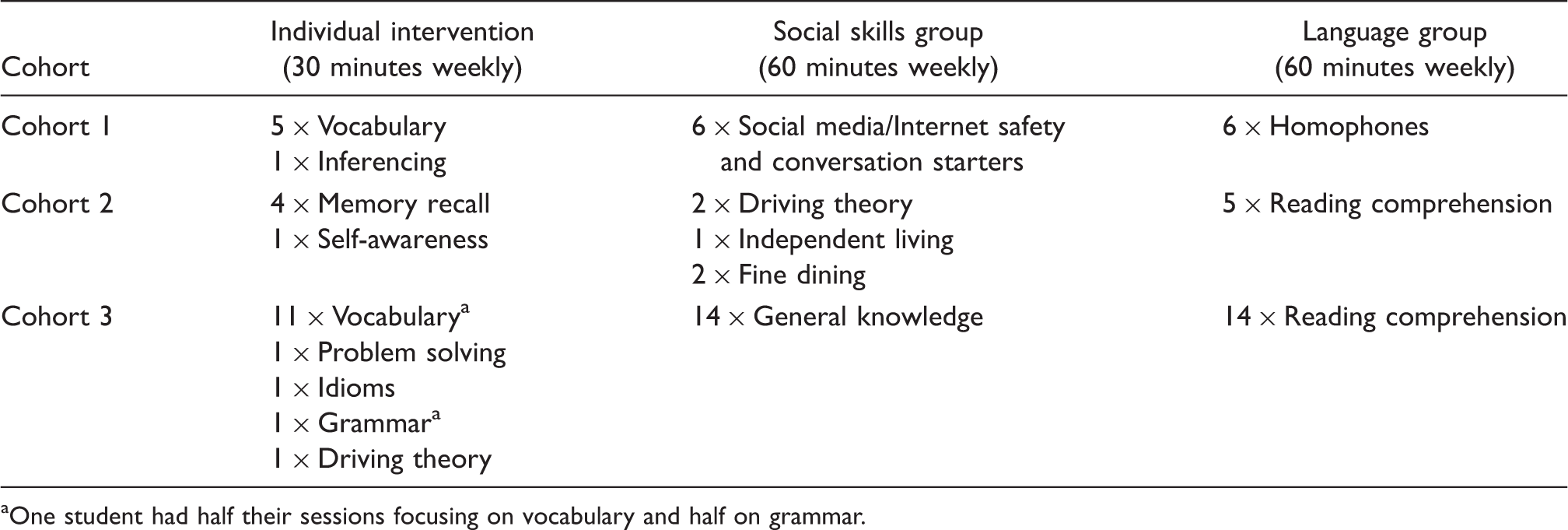
Cohort
Individual intervention (30 minutes weekly)
Social skills group (60 minutes weekly)
Language group (60 minutes weekly)
Cohort 1
5 × Vocabulary 1 × Inferencing
6 × Social media/Internet safety and conversation starters
6 × Homophones
Cohort 2
4 × Memory recall 1 × Self-awareness
2 × Driving theory 1 × Independent living 2 × Fine dining
5 × Reading comprehension
Cohort 3
11 × Vocabulary
a
1 × Problem solving 1 × Idioms 1 × Grammara 1 × Driving theory
14 × General knowledge
14 × Reading comprehension

Cohort
Individual intervention (30 minutes weekly)
Social skills group (60 minutes weekly)
Language group (60 minutes weekly)
Cohort 1
6 × Word finding
6 × Text abbreviations and lyrics
6 × Punctuation and writing styles
Cohort 2
5 × Word finding
2 × Independent living 1 × Driving 2 × Discussion skills
5 × Public speaking/Planning presentations
Cohort 3
14 × Word finding
14 × Current affairs
14 × Writing styles

Original term
Accepted term
Section 1 – Picture naming: Nouns
3
Antenna
Aerial
6
Suspenders
Braces
23
Harmonica
Mouth organ
Section 2 – Sentence completion naming
5
Leash
Lead
8
Diploma
Certificate
11
Peak
Summit
Section 3 – Description naming
10
Hamper
Linen basket/ Washing basket
11
Bangs
Fringe
Section 4 – Picture naming: Verbs
10
Braiding
Plaiting
Section 5 – Category naming
Starter B
Candy
Sweets
3
Presidents
Kings/Queens
11
Silverware
Cutlery
Original
Amendment
Section 3 – Description naming
1
What gives people a warning, is used on police cars and fire trucks, and makes a loud noise?
What gives people a warning, is used on police cars and fire engines, and makes a loud noise?
2
What is a hat that is made of a hard material and is used to protect the head when playing football?
What is a hat that is made of a hard material and is used to protect the head when riding a bike?
4
What is a moving stairway that is found in a department store and that takes people up and down?
What is a moving staircase that is found in a department store and that takes people up and down?
Section 5 – Category naming
Example B
Dollar, nickel, dime
Pound, penny, £5 note
Starter A
Robin, cardinal, owl
Robin, thrush, owl.
Starter B
Chocolate, sucker, taffy
Chocolate, lollipop, toffee
1
Christmas, Thanksgiving, Labour Day
Christmas, Easter, Summer
2
Illinois, Indiana, California
Washington, Carolina, California
4
Washington, Lincoln, Roosevelt
Henry VIII, Elizabeth I, Edward VII
6
Nile, Mississippi, Amazon
Nile, Thames, Amazon
8
Waltz, twist, jitterbug
Waltz, twist, jive
13
United States, France, Soviet Union
United States, France, Russia
15
New York, Chicago, Los Angeles
New York, Chicago, London
18
Toaster, refrigerator, can opener
Toaster, fridge, cooker
Comprehension
3
Antenna
Aerial

Categorise pictures into broad semantic categories
Transport: Air, Land, Sea Food: Fruit and Vegetables, Main Meal, Snacks Animals: Land, Water, Sky
Categorise broad categories into more detailed semantic categories
Transport Air: things with engines; things that are fast, slow; used for hobbies; go high in the sky. Land: things with 2 wheels, 4 wheels; things that go on tracks, road; things you’d find on a construction site, in London, on a farm; things that transport things; things on the motorway. Sea: things used for fun; with a motor; found in the sea, lake, ocean; used for holidays; can live on them Food Fruit and Vegetables: things with seeds, skin, have to peel; tropical; found on trees, in the ground; can eat raw. Main Meal: take away food, home cooked; breakfast, lunch, dinner; healthy, unhealthy, carbohydrate, protein. Snacks: sweet, savoury; at the cinema, at home; crunchy, soft, hard Animals Land: animals in the Zoo, pet, farm, from Africa, Australian; things that climb, crawl, slither, jump, walk; reptile; pet, farm animals; 4 legged, no legs; huge, tiny; patterned, soft, furry, rough. Water: reptile, mammal; legs, fins, flippers; pets, zoo Sky: fast, slow; predator, prey; nocturnal; colourful, camouflage.
Discuss attributes of the pictures Comment on their similarities and differences.
What category is it in? What does it look like? When would you see it? How does it taste. Where would you find it? What is the difference between these images?
20 Questions: Participant to give semantic cues and SLT to guess chosen picture.
Is it something you use in your hair? Is it something you use on your face? Is it make-up? Do you use it on your lips? Do you put around your eyes? Is it kept in a container? Is it black?
Dice Strategy Game: Throw a dice with semantic strategies on it, pick up card and use named strategy.
Who uses it? When do you see it? What does it look like? How does it feel? Where would you find it? Why would you have it?