




Abstract
Background and aims
Difficulties with aspects of morphosyntax, phonology and/or vocabulary are the hallmark of Development Language Disorder (DLD). Yet, little is known about the linguistic-pragmatic abilities of young children with DLD. Previous studies suggest that children with DLD are experiencing difficulties with idioms, sayings and slang expressions, often interpreting them in a literal or unconventional fashion. However, it is unclear whether this is caused by difficulties to make pragmatic inferences in general or whether it stems from their semantic abilities. We therefore investigated novel metaphor understanding in young children with and without DLD.
Methods
We assessed novel metaphor comprehension using a reference assignment task with 15 children with DLD diagnoses (ages 42–49 months) as well as typically developing peers matched on chronological age (n = 15) and on language (n = 15).
Results
Children with DLD performed worse than their age-matched peers but in a comparable manner to the (younger) language-matched typically developing children. Performance was not related to non-verbal intelligence in the children with DLD.
Conclusion
The findings indicate that young children with DLD have difficulties with metaphor comprehension but also suggest that these difficulties are in line with their general language difficulties and linked to their overall linguistic competence rather than reflecting additional specific issues with deriving pragmatic inferences.
Implications
Our study adds to a growing body of literature showing that children with low language abilities are also likely to display more difficulties in understanding figurative language independently of any other symptomatology of their clinical diagnosis. It also supports the argument that deficits in the pragmatic domain are a secondary impairment rather than a core deficit in children with DLD. Nonetheless, children with DLD do show difficulties in understanding metaphors. Understanding figurative language is necessary for everyday communication and should therefore be targeted alongside traditional treatments by clinicians treating children with DLD.
Keywords
Introduction
Developmental Language Disorder (DLD) 1 is diagnosed when a child has selective difficulties in mastering language but displays no additional cognitive, motor or auditory impairments (American Psychiatric Association, 1994). Traditional accounts of DLD highlight a pronounced delay in production and/or comprehension of morphosyntax, phonology and vocabulary (Bishop, 1997; Leonard, 1998). While there is wide agreement that children with DLD display particular difficulties with the structural aspects of language, their abilities in other domains, such as pragmatics, have been studied less thoroughly and give rise to some controversy (Bishop, 2000; Leonard, 2014).
Pragmatics is a broad term under which very different phenomena can be classified; it is generally defined as the study of communication in context. As such, it encompasses, on the one hand, non-verbal means of communication (such as pointing and eye contact), conversational skills and narrative abilities (Huilt & Howard, 2001) as well as various types of linguistic inferences (metaphors, implicatures and irony), on the other hand. The first set of abilities is generally reported to be relatively strong in children with DLD, thus deficits seen in these domains are considered as secondary impairments (Bishop, 2002; Hadley & Rice, 1991; Leonard, 1998; Miller, 1991). However, children with DLD are a heterogeneous group and not all cases of DLD fit this description. Indeed, findings indicate that within the DLD population, a subgroup has pragmatic difficulties which might not be accountable as secondary consequences of more basic limitations in grammar, phonology or vocabulary (Katsos, Roqueta, Estevan, & Cummins, 2011; Osman, Shohdi, & Aziz, 2011). Several studies report conversational pragmatic difficulties in children with DLD: they appear to be less responsive to adults’ utterances compared to their typically developing (TD) peers (Bishop, Chan, Adams, Hartley, & Weir, 2000); they are less likely to initiate a verbal interaction with others, and when they do, they are more likely to do so in conversations with adults rather than children (Rice, Sell, & Hadley, 1991). Finally, they are shown to exhibit difficulties in turn-taking and topic maintenance (Adams & Bishop, 1989).
If the picture of the communication and conversational pragmatic abilities of children with DLD is a bit rough, our knowledge of their linguistic pragmatics abilities is still on the drawing board. Some of the phenomena falling under the pragmatics umbrella are rigorously linguistic in nature and generally refer to aspects of meaning that are non-literal or go beyond the literal interpretation, such as implicatures, presuppositions, metaphor, metonymy or irony. Currently, these phenomena are often analysed within a Gricean or post-Gricean, framework. According to Grice (1989), understanding implicit meaning or tropes involves making an inference based on the literal meaning of the utterance and the context in which it was uttered. Very little experimental research has focussed on the ability of children with DLD to derive linguistic pragmatic inferences. Most studies concentrate on conversational pragmatics by observing children in interactions with parents or peers. This method brings some interesting findings concerning the lexical ability of children with DLD: they are described as experiencing difficulties with idioms, sayings and slang expressions, often interpreting them in a literal or unconventional fashion (Dewart & Summers, 1995). Yet, it is unclear whether the difficulty is with pragmatic inferences in general, with meaning shifts more specifically or whether it stems from their semantic ability. One of other few empirical studies investigating linguistic pragmatic inferences looks at the understanding of scalar implicatures: Katsos et al. (2011) report that while their participants with DLD do not compute scalar implicatures at the same rate as TD age-matched controls, their performance is on a par with that of TD children matched on their linguistic ability. Thus, while children with DLD experience difficulties with scalar implicatures, they do so in a manner corresponding to their language ability and one cannot conclude that they have any specific issue with pragmatic inferences.
Among linguistic pragmatic phenomena, metaphors are of particular interest. Not only do they require a pragmatic inference but, unlike implicatures or other meaning shifts, their interpretation generally involves a category violation forcing the hearer to perceive similarities between two entirely distinct entities. Systematic research on the development of metaphor in DLD is limited. Nippold and Fey (1983) examined the comprehension of metaphors in 10-year-old children with DLD who had first been diagnosed during their preschool years. These children performed significantly worse than a group of age-matched controls whose scores on literal aspects of sentence comprehension seemed comparable. On the other hand, in a study testing a mixture of idioms and metaphors, children with DLD aged 7 to 13 years performed comparably well to younger language-matched controls, aged 6 to 8 years, though no age-matched controls were tested (Vance & Wells, 1994).
More recently, Norbury (2005b) investigated the role of theory of mind and language ability in metaphor understanding. She compared children with autistic disorder (with or without language impairment) with children with DLD aged between 8 and 15 years. Her analysis showed that children with language impairment, with or without concurrent autistic features, have difficulties with figurative language. She stresses that semantic abilities in general was the strongest predictor of performance on metaphor comprehension.
So far, no experimental research on metaphor understanding has been conducted on younger children with DLD. Behavioural problems, such as hyperactivity and the lack of prosocial behaviour, can occur secondarily to pragmatic difficulties (Ketelaars, Cuperus, van Daal, Jansonius, & Verhoeven, 2009; Whitehouse, Watt, Line, & Bishop, 2009). It is well established that language difficulties predict problems in literacy and reading comprehension in children (Law, Charlton, & Asmussen, 2017). Figurative language is pervasive in the school setting (Lazar, Warr-Leeper, Nicholoson, & Johnson, 1989), thus early identification of difficulties in all aspects of language functioning is critical.
In this paper, we explore whether young children with DLD perform differently on a metaphor comprehension task than TD age-matched and language-matched controls. Although it has long been thought that metaphor comprehension comes late even for TD children, it is now generally agreed that they understand various types of meaning shifts including metaphors from very early on (Grigoroglou & Papafragou, in press; Falkum, in press; Falkum, Recassen, & Clark, 2017; Pouscoulous & Dulcinati, 2019; Rabagliati, Marcus, & Pylkkänen, 2010; Vosniadou, Ortony, Reynolds & Wilson, 1984). A number of studies suggest that TD pre-schoolers, indeed three-year-olds, can understand metaphors when the task is age appropriate and does not involve metalinguistic judgements (Deamer, 2013; Özçaliskan, 2005, 2007; Pearson, 1990; Stites & Özçaliskan, 2013; Waggoner & Palermo, 1989). For instance, Pouscoulous and Tomasello (2011) investigated comprehension of novel metaphors using an act-out paradigm. Young TD three-year-olds (3; 0–3; 3) performed well on this task and chose the correct object referred to by a metaphor (73%), they also did so more than they would in a simple object preference task using the same material and procedure.
To probe the understanding of novel metaphor in children with DLD at early stages of language development, the current study uses the reference assignment task specifically designed by Pouscoulous and Tomasello (2011) to investigate novel metaphor in young TD children. Little is known about the metaphorical abilities of young children with DLD, and this study will allow us to explore the precursors of any potential later difficulties. We focus on novel metaphors that do not require any previous exposure and are inferred on-line using the literal meaning of the expression, world knowledge and relevant contextual information. The perceptual metaphors used in this task correspond to young children’s world knowledge and linguistic abilities. 2 In this act-out task, children have to choose one of the two similar looking toys based on a metaphoric description. In order to control for the children’s semantic knowledge of the words used in the metaphor task, we also used a naming-and-pointing picture book, which assesses understanding and production of both the literal and figurative meanings of the metaphorical expressions. Only if children understand the relevant literal meanings, can their performance on the metaphor task be taken as genuine indicator of their comprehension of novel metaphors – i.e. if children do not master the literal meaning, they cannot derive the metaphorical interpretation, and they could mistakenly overextend the conventional literal meaning to encompass the figurative one (as it has sometimes been argued for early metaphor production; for discussion, see Pouscoulous, 2011).
Experiment
Participants
Forty-five children, Swiss German native speakers, participated in this study. The children were from the area of Zürich, Switzerland, and were referred to the study by either their nursery teachers for TD children or their paediatricians and speech and language therapists from clinical institutions specialised in the therapy of children with DLD. They displayed no major delay in general development, including neurological, non-verbal cognitive ability and sensory development, and no emotional or behavioural difficulties. Parents were provided with specific information sheets and consent forms to complete prior to the assessments according with the ethics approval (number: 001345673789) from the UCL Research Ethics Committee.
Our participants included one group of 15 children with a diagnosis of DLD (four females; mean age: 45.5 months; range: 42–49 months) and two control groups of TD children, one matched on chronological age (TD-CA) and the other on a language measure (TD-LANG). The older TD-CA control group consisted of 15 children (nine females; mean age: 44.9 months; range: 42–48 months) and did not differ significantly on age to the DLD group (p = .547). The younger TD-LANG control group included 15 children (nine females; mean age: 36.5 months; range: 29–41 months, significantly younger than the DLD group (p < .001)) who were matched on the raw score of a language screening test to the children with DLD (see below for more details).
Means and standard deviation for age, scores on standardised tests of language and cognition and naming-and-pointing picture book for DLD, TD-CA and TD-LANG groups.

Note: Matching measures are in boldface.
Word-comprehension and word-production scores are missing for one child from the DLD group, and non-verbal IQ score is missing for another child from the same group. In both cases, this was due to lack of concentration.
DLD: development language disorder; TD: typically developing; CA: chronological age; LANG: language measure.
Background measures
Participants with DLD had been diagnosed by independent and experienced speech and language therapists from specialised clinical institutions according to the standard procedure in the German-speaking cantons of Switzerland. The battery of assessments used by the clinicians consisted of a non-standardised developmental test gauging abilities such as practical experience with daily objects, imitation, symbolic play, social-communicative speech acts and expressive and receptive language (Zollinger, 2000) and several standardised language assessments assessing specific language abilities: the ‘Sprachentwicklungstest für drei-bis fünfjährige Kinder’ (SETK 3-5; Grimm, 2001), the ‘Patholinguistische Diagnostik bei Sprachentwicklungsstörungen’ (PDSS; Kauschke & Siegmüller, 2005) and the ‘Aktiver Wortschatztest für 3- bis 5-jährige Kinder – Revision’ (AWST-R; Kiese-Himmer, 2009). These assessments consist of subtests that investigate language comprehension, acquisition of plurals, non-word repetition (NWR), sentence repetition and auditory memory span for words, where children are asked to label pictures, act-out instructions or repeat words and sentences presented orally by the therapist. Children were diagnosed with DLD when they displayed a delayed onset of language (including morphosyntax, lexicon, phonology and/or pragmatics) relative to the other areas of development assessed. While we were not able to obtain these scores due to data-sharing restrictions from the clinics the children attended, the clinicians provided us with children who fulfilled the following inclusion criteria: to qualify for the study, the children had to score −1.25 standard deviations (SDs) below the mean on two or more standardised language assessments (following Tomblin, Records, & Zhang, 1996) and had to be receiving speech and language therapy at the time of the study.
To match our participants with DLD to our TD participants, our team administered an NWR subtest of the ‘Sprachscreening für das Vorschulalter’ (SSV, Grimm, 2003). The mean NWR score for the DLD group (M = 2.2, SD = .86) was not significantly different to the score of the younger TD control group (M = 2.3, SD = .90) (t(28) = .414, p = .682) but was significantly lower than that of the older TD control group (M = 6.2, SD = 1.2) (t(28) = 10.445, p < .001).
The SSV is a validated and reliable measure of language competence in young children. It consists of a set of nonsense words that increase from one to four syllables in length in which the word likeness and articulatory difficulty of the stimuli are carefully controlled. Scores on the NWR task have been argued to successfully identify children’s language status with regard to DLD with a high degree of accuracy (Bishop, North, & Donlan, 1996; Conti-Ramsden, 2003; Dollaghan & Campbell, 1998; Gathercole & Baddley, 1990; Weismer et al., 2000). The NWR impairment has been established to be a hallmark of DLD (see Roy & Chiat, 2004, for review) and has been stated as a clinical marker of DLD (Conti-Ramsden, 2003; Dollaghan & Campbell, 1998). However, in our study, it was used primarily for matching purposes.
Non-verbal cognitive ability in the two older groups – DLD and TD-CA – was assessed using the Snijders–Oomen non-verbal intelligence tests appropriate for children from two and a half to seven years (SON-R 2½–7, Tellegen, Winkel, Wijnberg-Williams, & Laros, 1998). The children all performed within the unimpaired range, i.e. within one SD of the mean (≥85) on this test. The non-verbal IQ of the DLD group, though unimpaired (M = 99.14), was still statistically significantly different from that of the TD-CA group, whose mean (M = 109.87) was in the slightly higher than average range (p = .016). Note, however, that this somewhat lower average IQ score of our group with DLD compared to TD controls is in line with the reports in the literature, where researchers have suggested that a lower than average non-verbal IQ may even be integral to the DLD profile (see, e.g. Conti-Ramsden, Hutcheson, & Grove, 1995; Montgomery, 2003; Plante & Vance, 1994, 1995). 3
The children in the TD-LANG control group, who were younger than those in the other two groups, were not assessed on the SON-R 2½–7 due to time restrictions, as the session would have taken too long for them to stay focussed. However, parents’ and teachers’ reports confirmed that these children had no known non-verbal cognitive impairments.
Procedure and materials
Each participant was seen for an individual session at their clinic, day nursery or home. Some of the younger children were accompanied by a parent or nursery staff member. Caregivers were sitting next to the children and not interacting or helping throughout the given tasks. All children were given the same set of procedures, and assessments were administered in a fixed order. Children first spent 5 minutes with a caregiver in a room decorated with toys and pictures. After this, children were presented with the metaphor comprehension task, followed by the naming-and-pointing vocabulary book. The standardised tests of cognitive and verbal abilities were administered last. All participants were filmed during the time spent in the decorated room and during the administration of the metaphor tasks.
Experimental task: Metaphor understanding
Metaphor with target and distracter toy.

Note: Metaphors were adapted from Pouscoulous and Tomasello (2011). Sentences in italic are the metaphorical expression in Swiss German.
There were four familiarisation trials with literal expressions and six metaphor trials. In the six test trials, the order of appearance of the metaphorical expressions was randomised, and the position of the correct toy was counterbalanced. No child made more than two errors on the familiarisation trials. Therefore, all the children were included in the analysis.
Additionally, a specifically designed picture book was used to test for the children’s understanding and production of the words relevant in the metaphor task – both literal and figurative meanings. This book included one section to assess children’s comprehension and one section to test for their vocabulary production. In each section, there was one page corresponding to each of the six test metaphors in the metaphor task. Each page displayed both images of an object representing what the metaphorical expression means literally (e.g. hat) and what it referred to metaphorically (a roof). Additionally, each page included a ‘nameless’ object (e.g. the picture of a little used kitchen tool children would have no label for). This was included to prevent children from choosing the correct picture using deduction by elimination, i.e. associating a label they do not understand to an object they don’t have a name for. At the end of both sections, there was a page with a picture of a boy or a girl to examine children’s knowledge of body parts. Children from all three groups showed a mastery of the concepts and literal meaning of the expressions used in the metaphor task; they all understood 90% or more of the words in the vocabulary picture book (see Table 1).
Results
Children’s responses on the metaphor task were analysed using the generalised linear mixed model in SPSS 24. This model treats the outcome variable as binary, since each participant’s forced choice answer is either correct or incorrect, and has been argued to be more suitable for data that are not normally distributed (for advantages of logistic mixed models in psycholinguistic research, see, e.g. Jaeger, 2008).
The fixed effects built into the model were Group, Metaphor and Group × Metaphor interaction. There was a highly significant effect of Group: F(2, 172) = 3.469, p = .033, and Metaphor: F(5, 76) = 3.948, p = .003, but no significant Group × Metaphor interaction: F(10, 94) = 0.794, p = .634.
Figure 1 presents the estimated mean probabilities correct for the metaphor task for the three groups: DLD group M = .68, 95% (0.5, 0.79), TD-CA control group M = .85, 95% (0.78, 0.9), TD-LANG control group M = .78, 95% (0.65, 0.87).
Estimated probabilities correct on the metaphor task for DLD, TD-CA and TD-LANG groups, with standard error bars. DLD: development language disorder; TD: typically developing; CA: chronological age; LANG: language measure.
Sidak-corrected post hoc analyses included in the model revealed that the DLD group performed significantly worse than the age-matched TD-CA control group on the metaphor comprehension task (t(203) = 2.470, p = .042) but not significantly worse than the language-matched TD-LANG group (t(147) = 1.208, p = .405)). The difference in the performance of the two control groups was not significant either (t(152) = 1.01, p = .405). 5
Children’s performance on individual metaphors (groups collapsed) is given in Figure 2, revealing that the effect of Metaphor was driven by the high performance on one particular metaphor, ‘the tower with the hat’. Sidak-corrected post hoc analyses confirmed that this metaphor was comprehended significantly better than M_backpack ((t(74) = 3.513, p = .011), M_bottles (t(64) = 3.771, p = .005) and M_cars (t(62) = 3.439, p = .014). There were no other significant differences between different metaphors tested.
Estimated probabilities correct on individual metaphors collapsed across groups: DLD, TD-CA and TD-LANG, with standard error bars.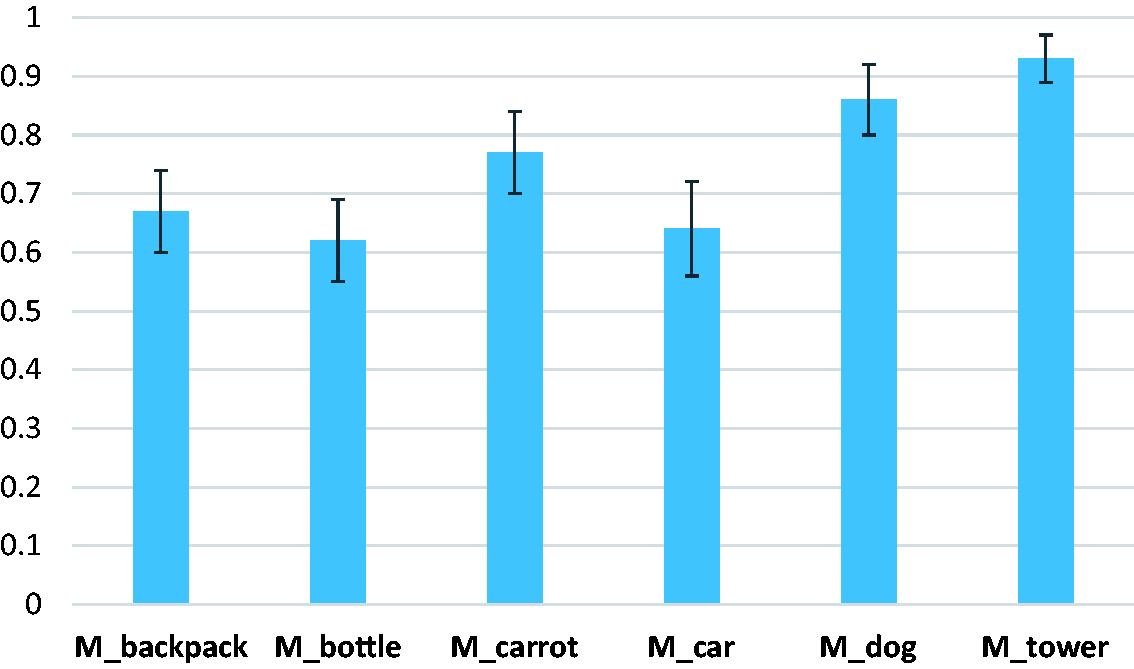
Discussion
In this study, we investigated whether young children with DLD have the ability to understand novel metaphors in an experimental setting. Children with DLD performed worse than their age-matched TD peers on a task assessing novel metaphor understanding; however, their performance was comparable to that of younger language-matched TD children. These results indicate that while young children with DLD do display difficulties with understanding metaphors, they are in line with their overall poor language competence, the hallmark of DLD.
Our findings therefore suggest that young children with DLD do not experience difficulties with making pragmatic inferences but rather with the linguistic skills involved in the process of deriving a pragmatic inference. The thesis that difficulties with metaphor may have little to do with an inability to derive pragmatic inferences or a deficit in theory of mind, but are a correlate of poor general language abilities, is both intuitive and compelling. Yet, one can wonder why. Why would poor grammatical and semantic skills cause difficulties with pragmatic inference? Of course, if the children do not master the literal meaning of the expressions used in a metaphor task or if they do not grasp the grammatical structure of the sentence, they are unlikely to derive any appropriate metaphorical interpretation for the utterance. This does not seem to be what is happening in our study: our participants’ performance cannot be explained by task-specific linguistic elements. Children from all groups, whether with a diagnosis of DLD or TD, understood the literal meaning of the expressions used metaphorically in the experimental task fairly well, as shown by their good performance on the comprehension part of the vocabulary naming-and-pointing picture book. The semantic ability of the children in the DLD group might not have been within the normal range, but their understanding of the expressions they were tested on was adequate. Similarly, the grammatical structures used in the metaphor task were simple enough and were shown to be unproblematic in the familiarisation trials, which children from all groups generally managed flawlessly. Thus, the link we observe is between metaphor comprehension and general grammatical and semantic competence rather than the specific notions or grammatical skills needed for this particular task. How precisely these general abilities influence the process of making a pragmatic inference remains an open question.
A possible concern with early metaphors is that they might be understood as pretence rather than metaphorical expressions (Pouscoulous, 2011; Rubio-Fernández & Grassmann, 2016). Indeed, a prominent theory even argues that metaphor is a type of pretence (Walton, 1993). It is notoriously difficult to distinguish some perceptual metaphors from cases of linguistic pretence, since both can refer to non-literal attributes. Yet, while it is theoretically possible that children interpreted the metaphorical utterances as pretend play in Pouscoulous and Tomasello’s (2011) study as well as in ours, it is highly unlikely they did so. First, there is independent evidence that TD three-year-olds understand metaphors in paradigms where confusion with pretence is not possible (Deamer, 2013; Pearson, 1990). Second, children in both studies never acted with the props in a manner consistent with pretence, despite having had ample opportunity to do so.
Our study adds to a more general picture on linguistic pragmatic abilities in children with DLD. There is little data on how these children fare with Gricean pragmatic inferences such metaphor, implicatures, presupposition, metonymy and irony. In this regard, our findings are very much in line with those of Katsos et al. (2011) who assessed scalar implicatures in Spanish-speaking children with DLD. Their participants displayed difficulties in this domain compared to age-matched TD peers but performed similarly to their language-matched younger TD controls. Taken together, our study and theirs suggest that children with DLD have difficulty deriving linguistic pragmatic inferences of different kinds – both implicatures and metaphors. Yet, these difficulties seem to be based on their low general language competence, and no element indicates that children with DLD have specific issues with pragmatic inferences.
Interestingly, the importance of general language abilities for metaphor understanding has recently been highlighted in another clinical population. Several reviews and studies emphasise the relation between overall language competence and pragmatic abilities for individuals with autism spectrum disorders (ASD) (e.g. Brock, Norbury, Einav, & Nation, 2008; Chahboun, Vulchanov, Saldana, Eshuis, & Vulchanova, 2016; Gernsbacher & Pripas-Kapit, 2012; Whyte & Nelson, 2015; Whyte, Nelson, & Scherf, 2014). Gernsbacher and Pripas-Kapit (2012), for instance, argue that children and adults with ASD display difficulties with understanding figurative language only when they also have difficulties with language comprehension in general. This argument builds on a series of findings showing that, regardless of autistic symptomatology, only children with a general language comprehension disability also display difficulties with metaphorical language (Norbury, 2005b), with understanding idioms (Norbury, 2004; Whyte et al., 2014), with drawing inferences (Norbury & Bishop, 2002; Young, Diehl, Morris, Hyman, & Bennetto, 2005) and with understanding of potentially ambiguous terms (Norbury, 2005a). Thus, difficulties with figurative language found to be characteristic for ASD may not be exclusively linked to the autistic symptomatology or a deficit related to theory of mind, but rather be the result of these individuals’ linguistic, and especially semantic, difficulties (for more detailed and nuanced discussions including the role of other cognitive abilities, see Chahboun et al., 2016; Vulchanova, Saldaña, Chahboun & Vulchanov, 2015). 6
Overall, our study adds to a growing body of literature showing that children with low language comprehension abilities are also likely to display more difficulties in understanding figurative language independently of any other symptomatology of their clinical diagnosis. Moreover, it adds to the argument that deficits in the pragmatic domain are a secondary impairment rather than a core deficit in children with DLD (Bishop, 2002; Hadley & Rice, 1991; Leonard, 1998; Miller, 1991). Nonetheless, this conclusion should not obscure the fact that children with DLD show difficulties in understanding metaphors when compared to age-matched TD children. Understanding figurative language is necesarry for successfull everyday communication, and it has been found that children who display difficulties in this domain are often not able to adapt their speech to different listeners and therefore show problems in establishing and maintaining friendships (Ketelaars et al., 2009; Whitehouse et al., 2009). For this reason, clinicians might want to target understanding of figurative language alongside traditional treatments of children with DLD.
Footnotes
Declaration of conflicting interests
The author(s) declared no potential conflicts of interest with respect to the research, authorship, and/or publication of this article.
Funding
The author(s) disclosed receipt of the following financial support for the research, authorship, and/or publication of this article: This work was supported by British Academy (77140).