




Abstract
Background and aims
Both developmental language disorder (DLD) and autism spectrum disorder (ASD) are characterized by language and communication deficits, and the extent to which commonalities in syntactic difficulties are shared between DLD and autism plus language impairment (ALI), a subtype of ASD, is a matter of debate. Thus, this study aims to further explore the extent of overlapping vulnerabilities in the syntactic profiles of children with DLD and ALI.
Method
We investigated the comprehension and production of two complex syntactic structures, ba constructions and bei constructions in Mandarin by 18 children with DLD (mean age = 5;03) and 17 children with ALI (mean age = 5;05), compared to their 24 typically developing peers matched on chronological age.
Results
The results show that children with DLD and children with ALI differ in the errors committed when producing these two constructions. Specifically, children with DLD are prone to produce ungrammatical responses, use simple sentences, and misuse ba/bei constructions, while children with ALI produce pragmatically inappropriate responses which are scarce in the productions of children with DLD. In addition, the comprehension and production of bei constructions by children with DLD were significantly correlated with their nonverbal working memory (NVWM), while no such correlation was found in the ALI group. Finally, while ba and bei constructions yield higher comprehension than production in the DLD group, only ba constructions showed this pattern in the ALI group.
Conclusions
These findings suggest that children with DLD and children with ALI do not constitute a continuum of the same language disorder despite their superficial resemblance on performance accuracy.
Implications
This study highlights the need for tailored interventions to enhance mastery of ba and bei constructions: for children with DLD, focus on explicit instruction in complex syntax and NVWM training; for children with ALI, emphasize syntactic and pragmatic language development through context-rich activities integrating complex syntax and contextual cues.
Introduction
Language and communication deficits are manifested in both developmental language disorder (DLD) and autism spectrum disorder (ASD) (Georgiou & Spanoudis, 2021). There is currently no agreement in the literature concerning whether DLD and ASD constitute a continuum of the same language disorder. On the one hand, DLD and ASD appear to stem from different etiologies since children with DLD display severe syntactic deficits, with mostly intact pragmatic abilities (e.g., Friedmann & Novogrodsky, 2011; van der Lely, 1998); while children with ASD mostly show pragmatic challenges and appear in various studies to be preserved in the domain of syntax (e.g., Baron-Cohen, 1988; Tager-Flusberg, 1989). On the other hand, syntactic difficulties have been observed in subgroups with ASD (e.g., Durrleman & Delage, 2016; Modyanova et al., 2017) and pragmatic deficits in subgroups with DLD (e.g., Andrés-Roqueta & Katsos, 2020; Spanoudis, 2016). The current work aims to inform this debate by exploring autism plus language impairment (ALI), a subgroup of ASD, alongside peers with DLD matched on age and nonverbal intelligence on specific linguistic constructions involving syntactic complexity: Mandarin passives (the bei construction) and its active counterpart, the ba construction. Both ba and bei constructions are two related complex Mandarin structures with non-canonical word orders, whose derivations involve movements (Huang et al., 2009).
The acquisition of these two constructions by typically developing (TD) children (e.g., Cheung, 1992; Ji et al., 2023) and children with DLD (e.g., Durrleman et al., 2023; Yu et al., 2022; Zeng et al., 2013) has been well documented, yet little is known about whether these complex structures pose challenges to children with ALI (although see Du et al., 2024, also discussed below). Thus, the current study compares the comprehension and production of ba and bei constructions by Mandarin-speaking preschoolers with DLD, those with ALI, and their age-matched TD peers to shed light on whether syntactic difficulties in DLD and ALI show similarities or differences both quantitively and qualitatively (Sukenik & Friedmann, 2018).
Syntactic Difficulties in Children With DLD and Those With ALI
DLD is a developmental disorder which is characterized by persistent deficits in language acquisition, mainly in the phonological and morphosyntactic domains (Jakubowicz & Tuller, 2007). The widely reported syntactic deficits of DLD are related to the processing of complex sentences with non-canonical word ordering (involving syntactic movement), i.e., sentences which differ from canonical Subject-Verb-Object (SVO) word order of languages like English and Mandarin. For decades, children with DLD have been found to display severe deficits in different complex structures which involve syntactic movement and a long-distance dependency between a moved constituent and its canonical position: passives (Durrleman et al., 2023; van der Lely, 1996; Yu et al., 2022), relative clauses (Adani et al., 2014; Wang & Yu, 2023) and wh-questions (Marinis & van der Lely, 2007).
Unlike consistent results on deficits in complex syntax of DLD, however, studies of syntax in children with ASD have yielded mixed results. Early work investigating syntactic abilities through spontaneous production (such as the Index of Productive Syntax and the Mean Length of Utterance, MLU) have claimed that children with ASD show similar performance to their TD peers matched on mental age (Pierce & Bartolucci, 1977; Tager-Flusberg et al., 1990). In contrast, later studies on autism have identified deficits in non-word repetition and grammatical tense marking (Kjelgaard & Tager-Flusberg, 2001; Roberts et al., 2004)—impairments that are also recognized as clinical markers of DLD (Conti-Ramsden et al., 2001; Joanisse & Seidenberg, 1998). Of note is that most of these studies were quantitative, focusing mainly on the rates of accuracy between children with ASD and children with DLD. Similar levels of syntactic performance can only suggest that a subgroup of children with ASD share the same extent of syntactic difficulties with DLD, but do not imply that the nature of the difficulties associated with these conditions is the same. Recent studies involving qualitative analyses (such as error pattern) have shed light on the different underlying syntactic deficits of these two types of disorder (Sukenik & Friedmann, 2018; Sukenik et al., 2021). One recent finding that qualitatively supports differences in error patterns between ASD and DLD school-aged children is provided by Sukenik and Friedmann (2018). The authors directly compared the comprehension and production of children with ASD (mean age = 13;4, N = 18) with those of children with DLD (mean age = 12;6, N = 93) and TD children (mean age = 9;2, N = 166) through different syntactic tests. The results showed that the ASD group and the DLD group shared similar performance on the overall accuracy. However, children with ASD differed from children with DLD in the error types: pragmatically inappropriate responses emerged in the ASD participants, whereas such errors are not evinced in those with DLD nor in their TD counterparts.
The ba Construction and the bei Construction and Their Acquisition
In Mandarin, ba and bei constructions are often classified as complex syntax due to the movement and thematic role assignment processes involved. As noted by Riches et al. (2010), complex constructions like passives, questions, and relative clauses are “characterized by a long-distance relationship between moved arguments (or fillers) and the site where they are assigned their thematic role (the gap)” (p. 49). Similarly, in ba and bei constructions, the thematic roles of arguments are assigned across syntactic distance (Huang et al., 2009), requiring children to grasp these abstract dependencies. Mandarin allows NP-NP-VP (NNV) constructions that often co-occur with morphosyntactic markers between the two NPs (Zhou et al., 2016). Both ba and bei constructions are NNV constructions including morphosyntactic markers, ba and bei respectively. The two markers disambiguate the thematic roles of the two adjacent NPs involved in the event indicated by the verb (Li, 1990; Li & Thompson, 1981). Ba usually indicates that the NP following it is being acted upon and affected in a specific way, while bei indicates that the NP preceding it is affected by an action, often with a sense of adversity. In (1a), the VP yao-le “bit” involves an agent and a patient. The morphosyntactic marker ba appears between the first NP Xiaogou “dog” and the second NP Xiaomao “cat,” which demonstrates that Xiaogou “dog” is the agent and Xiaomao “cat” is the patient. Therefore, (1a) means that the dog bit the cat. And the thematic roles of the two NPs are reversed if the morphosyntactic marker ba is replaced by bei. As in (1b), the first NP Xiaogou “dog” becomes the patient and Xiaomao “cat” becomes the agent. So (1b) means that the dog was bitten by the cat.
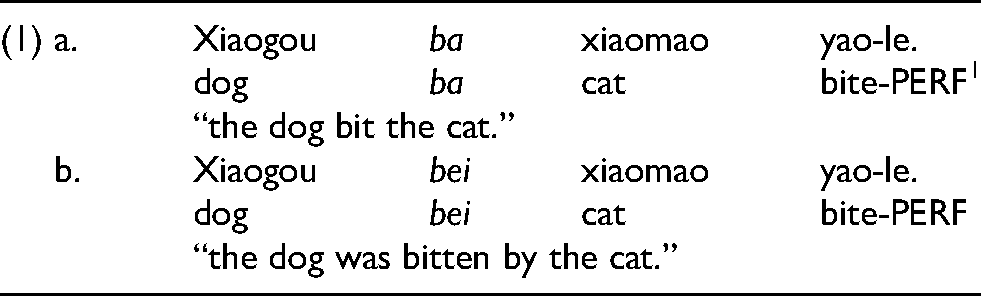
Like passives in English and French (see Durrleman et al., 2017; Siewierska, 2011), the non-canonical order of ba and bei constructions is due to the patient NP undergoing syntactic movement. The patient NPs Xiaomao “cat” in (1a) and Xiaogou “dog” in (1b) are base-generated in post-VP positions and they have to undergo “syntactic movement” to pre-VP positions in the course of derivation, an operation that yields a non-canonical order and consequently complicates the acquisition of these (ba and bei) constructions. An asymmetry between ba and bei in movement can be explained by the Relativized Minimality (RM) approach (Rizzi, 1990) 1 . According to RM, the local relation between X and Y is disrupted if another similar element, Z, hierarchically intervenes, as shown in (2).

While the patient NP Xiaogou “dog” moves across another NP Xiaomao “cat,” the intervener (shares the same lexical feature N with Xiaogou), in bei constructions as in (3b). However, this is not the case with the patient NP Xiaomao “cat” in ba constructions which involve no intervener as in (3a). This asymmetry explains why bei constructions pose difficulties until age 5 and are thus acquired later than ba constructions which are mastered at age 4 in typical development (e.g., Cheung, 1992).

Acquisition of ba Constructions and bei Constructions by Children With DLD and Those With ASD
Thus far, related studies have only examined ba constructions or bei constructions in children with DLD separately (e.g., Durrleman et al., 2023; Yu et al., 2022; Zeng et al., 2013). Zeng et al. (2013) first comprehensively studied 11 Mandarin-speaking children with DLD by comparing their 24 TD peers (12 children matched on chronological age and 12 children matched on MLU) on their production, comprehension, and repetition of ba constructions. The results showed that the performance of the DLD participants on the three tasks was worse than that of their chronological age-matched and MLU-matched peers, while significant differences only emerged when children with DLD were compared to their age-matched peers. However, these results are questionable due to the experimental design, particularly the instructions. In the comprehension task, experimenters used a ba construction to describe an event and presented participants with two pictures—one showing an agent and the other a patient. Participants were asked to identify which character was the patient in the event. This approach may complicate the assessment of children's understanding of the event conveyed by the ba construction, as the focus is on selecting a character rather than interpreting the event itself.
The passive has been cross-linguistically documented as a construction posing difficulties for children with DLD (e.g., Bishop, 1979; Leonard et al., 2006). Specifically, the movement of a patient NP from its interpreted position (post-VP position) to its pronounced position (pre-VP position) would be the source of this difficulty for children with DLD (van der Lely, 1996). A recent study by Yu et al. (2022) involving fine-tuned experimental tasks has shed light on the potential syntactic challenges in DLD (mean age = 62 months; N = 15) with bei constructions. Unlike in the work by Zeng et al. (2013), Yu et al. (2022) replaced the character-only picture with a picture presenting an event, and they also refined the instructions so that the participants could understand that they were choosing an event rather than a patient character or an agent character. Compared to short passives (bei construction without an overt agent), long passives (bei construction with an overt agent) have been found to be more severely impaired for Mandarin DLD children in the comprehension task. However, Du et al. (2024) found no clear advantage for short over long passives in a repetition task administered to Mandarin-speaking DLD (mean age = 60.06 months; N = 15), ALI (mean age = 64.44 months; N = 18), and TD children (mean age = 61.94 months; N = 22) matched on chronological age; both children with DLD and those with ALI had difficulties repeating both long and short passives. This discrepancy may arise for different reasons. First, the study in Du et al. (2024) involved production while Yu et al. (2022) assessed comprehension, and these modalities may imply differing task demands. Producing bei constructions could be more challenging than comprehending them, eliminating any advantage of short passives in a repetition task. Second, Du et al. (2024) equated the length of long and short passives by inserting a manner adverb in short passives. However, they themselves suggest that this addition to short passives may have increased complexity for reasons independent of passive complexity, yielding a similarity in performance between short and long structures (see pages 16–17 of their study).
Recent studies have further linked performance on bei constructions to cognitive domains, such as working memory (WM). Zhou et al. (2016) suggested that non-linguistic factors contributed to the poor performance of high-functioning children with ASD. Despite having language abilities comparable to their TD peers, these children performed worse on bei constructions, indicating that extralinguistic factors, such as impaired WM, might play a significant role. However, Zhou et al. (2016) were unable to empirically investigate this possibility, as WM was not measured in their sample of high-functioning children with ASD, leaving the potential relationship between WM and performance on ba/bei constructions unexplored.
WM involves the temporary storage and manipulation of information that is assumed to be necessary for a wide range of complex cognitive activities (Baddeley, 2003: 189). WM can be categorized further into verbal working memory (VWM) and nonverbal working memory (NVWM). Numerous studies have found positive correlations between VWM and syntactic abilities of children with DLD (e.g., Contemori & Garraffa, 2010) and those with ASD (e.g., Durrleman & Delage, 2016). However, less is known about whether higher NVWM also supports syntactic development. This extralinguistic ability has been observed to correlate with morphosyntactic abilities in children with DLD (Ellis Weismer et al., 2017), and even specifically with performance on bei constructions in a recent study on Mandarin-speaking children with DLD (Durrleman et al., 2023). The authors compared the comprehension and production of bei constructions between preschool-aged children with DLD (mean age = 61 months; N = 17) and their age-matched TD peers (mean age = 62 months; N = 23) through a sentence-picture matching task and an elicited production task. The results showed that children with DLD performed significantly worse than their TD peers, which suggests that they have difficulties comprehending and producing bei constructions. Moreover, the performance on bei constructions was significantly correlated to the DLD children's NVWM. However, the strength in NVWM of most DLD children indicates that the underlying syntactic impairments cannot be attributed to NVWM whereas NVWM can enhance the performance on complex syntax during tasks with a high visual component (i.e., processing the visual information from trial pictures). Thus, questions arise as to the relationship between NVWM and syntactic performance in children with ALI as well, and the extent to which it resembles that attested in DLD.
The Current Study
The primary objective of this study is to determine whether the syntactic profiles of children with ALI and DLD are similar. Researchers have highlighted differences between these disorders, cautioning against overshadowing their distinct characteristics based on superficial similarities (Durrleman & Delage, 2016; Riches et al., 2010). Moreover, studies often treat ASD as a homogeneous group, overlooking variability in language abilities. Focusing on ALI allows for a clearer comparison with DLD, as both involve language impairments. We will investigate two aspects of syntactic profiles: (1) a quantitative comparison of accuracy in the comprehension and production of Mandarin ba and bei constructions between children with ALI and DLD, and (2) a qualitative analysis of error patterns to determine whether both groups make similar errors. We will explore comprehension-production asymmetries for Mandarin passives in both groups. While some studies report a production advantage (Charman et al., 2003; Lloyd et al., 2006), recent work using online methods, such as the Intermodal Preferential Looking Paradigm (IPLP), suggests the opposite (Su & Naigles, 2019). These findings indicate that children with ASD can understand basic grammar, such as SVO sentences, even with expressive difficulties, warranting further investigation into their comprehension of complex syntax. Finally, we will examine the relationship between language skills and cognitive development in these groups. Recent research shows a positive correlation between passive sentence tasks and NVWM in children with DLD (Durrleman et al., 2023). Determining whether this relationship exists in ALI could inform clinical interventions for language disorders. We sought to provide concrete answers to the following specific research questions (RQ):
RQ 1: To what extent do children with ALI and children with DLD resemble each other in their comprehension and production of ba and bei constructions, as evidenced by overall performance and error patterns? RQ 2: Does the receptive-expressive asymmetry of ba/bei constructions exist in the ALI group and/or the DLD group? RQ 3: What is the relationship between NVWM and the comprehension and production of ba and bei constructions in children with ALI, and is this relationship similar to that observed in children with DLD?
Methods
Participants
In this study, participants included 18 children with DLD aged 4;00–6;08 (mean age = 5;03), 17 children with ALI aged 3;09–6;04 (mean age = 5;05) and 24 TD children aged 3;08–6;03 (mean age = 5;02). They were recruited from special education schools, hospitals and kindergartens in Xi’an, China. Basic information of the three groups is provided in Table 1.
Basic Information of Participants.

Note: PPVT = Peabody Picture Vocabulary Test; RSPCLD = Rating Scale for Pre-school Children with Language Disorder; LC = language comprehension; LP = language production. p1 = comparison between DLD group and TD group; p2 = comparison between ALI group and TD group; and p3 = comparison between DLD group and ALI group.
Participants with DLD were recruited from kindergartens in Xi’an. Teachers and therapists were asked to fill out Specific Language Impairment Checklist for Pre-school Mandarin-speaking Children (He, 2010). They were also interviewed to exclude those children with hearing loss, behavioral disorder, neurological damage, or any physical damages and autistic symptoms. Children with ALI were recruited from hospitals in Xi’an and their diagnoses were reconfirmed by qualified psychiatrists and clinicians according to the Diagnostic and Statistical Manual of Mental disorder, Fourth Edition, Text Revision (DSM IV-TR). All parents of the child participants signed a consent form, which was approved by the Medical Ethics Committee of the Xi’an TCM Hospital of Encephalopathy (Reference No. 2017–01).
The participants’ intelligence was assessed using the the fourth edition of the Wechsler Preschool and Primary Scale of Intelligence-Chinese vesrion (WPPSI-IV; Li & Zhu, 2014), and those who scored higher than 70 were retained for the actual experiments. Their language abilities were assessed with the Chinese vesrion of the Peabody Picture Vocabulary Test-Revised (PPVT-R; Sang & Miao, 1990) and Rating Scale for Pre-school Children with Language Disorder-Revised (RSPCLD-R; Lin, 2008). Their vocabulary comprehension scores on PPVT-R and language comprehension and language production scores on RSPLCD-R were collected. At least two of the three scores for children with ALI and those with DLD were 1.25 standard deviation (SD) below the norms for their age (following Tomblin et al., 1997); on the contrary, these three scores of their typical controls were within the norms for their ages. One child with DLD and two children with ALI were excluded because they did not complete the WPPSI-IV test.
The TD participants were recruited from kindergartens in Xi’an, China. They were screened by using the same tools mentioned above. The Specific Language Impairment Checklist for Preschool Mandarin-speaking Children was completed by parents or teachers to confirm the absence of physical or neurological disorders. Children with an IQ score above 70, as assessed by the WPPSI-IV, were retained. A final sample of 24 children was included, as their scores on the PPVT-R and PSPLCD-R fell within the age-appropriate norms, indicating typical language development. Three children were excluded, as one child did not complete the WPPSI-IV test and two children dropped out during the experiment. Consent forms, approved by the Medical Ethics Committee of the Xi’an TCM Hospital of Encephalopathy, were signed by all parents of the participating children.
The Sentence-Picture Matching Task
Materials
This task employed 30 test items consisting of 15 items for ba constructions and 15 items for bei constructions. In this task, the sentence-picture matching task was adopted to investigate children's comprehension of ba constructions and bei constructions. Each task began with a practice trial in the target structure to familiarize participants with the procedure. Subsequently, the 15 test items for the same structure were administered, with filler items featuring unrelated simple constructions (e.g., SVO sentences) interspersed between each test item. Each picture described an event involving two characters 2 (e.g., a biting event involving the cat and the dog). A preliminary trial was conducted prior to the experiments to ensure that participants recognized the character (e.g., xiaomao “cat” and xiaogou “dog”) and actions (e.g., yao “bite” and da “hit”) depicted in the tasks. For instance, the experimenter asked each child, “What is this?” while pointing to a picture of the character, and “What is this action?” while pointing to a picture depicting the action. All children successfully passed this trial. In the test trials, P1 described a biting event in which the dog is the agent and the cat is the patient, and P2 also depicted a biting event but the thematic roles of the two characters were reversed: the cat is the agent and the dog is the patient. Different from P1 and P2, P3 showed no events but only two characters. Among these three pictures, only one picture matches the test sentence. For example, the test sentence for the ba construction is “xiaogou ba xiaomao yaole.” (the dog bit the cat), matching P1; the test sentence for the bei construction is “xiaogou bei xiaomao yaole” (the dog was bitten by the cat), matching P2.

Example pictures for the comprehension of the ba construction.
Procedures
All participants were tested in a quiet room without any disturbance. The two comprehension tests were carried out by two experimenters, one (E1) giving instructions and the other (E2) marking every participant's choice. For instance, in ba construction task, E1 presented a prompt using a ba construction “Qing zhi yixia nazhangtu shi ‘xiaogou ba xiaomao yaole.’” (Please point to the picture in which “the dog bit the cat”), and the participant was expected to point to the P1 in which a dog was biting a cat.
Scoring
A response was rated correct if the child chose the target picture, even if the initial choice was incorrect but switched to the target shortly afterward. It was rated incorrect if the child selected the non-target pictures or made no choice. The scores were then converted to percent accuracy (%).
The Priming Picture-Description Task
Materials
This task employed 25 test items including 15 items for ba constructions and 10 items for bei constructions, with filler items consisting of object naming placed between each test item. A preliminary trial, similar to the one used in the comprehension task, was conducted prior to the experiment to ensure that participants recognized the characters and actions presented in the tasks. A practice item was provided at the beginning of both the ba and bei construction tasks to ensure that each child fully understood the task requirements. Each picture described an event involving two characters (e.g., a pushing event involving the boy and the girl). The verbs and the nouns were similar to those in the comprehension task. Each test items contained two pictures as illustrated in Figure 2, a priming picture on the left and a target picture on the right, which depicted two characters carrying out a reversible action. The left picture depicted a kicking event in which the hore is the agent and the monkey is the patient, and P2 described a pushing event which also involves two characters: the monkey is the agent and the bear is the patient. For instance, the test sentence for the ba construction is “Zhezhangtu shi ‘xiaoma ba xiaohou tile. Na zhezhangtu ne?’” (The (left) picture shows that the horse kicked the monkey. What about the (right) picture?); the test sentence for the bei construction is “Zhezhangtu shi ‘xiaohou bei xiaoma tile. Na zhezhangtu ne?’” (The (left) picture shows that the monkey was kicked by the horse. What about the (right) picture?).

Example pictures for the production of the bei construction.
Procedures
For each test item, one experimenter (E1) described the priming picture using a bei construction and prompted the participant to describe the target picture using the same construction. For example, in bei construction task, an instruction of priming a bei construction was given by E1: “Zhezhangtu shi ‘xiaohou bei xiaoma tile. Na zhezhangtu ne?”’ (The (left) picture shows “The monkey was kicked by the horse. What about the (right) picture?). The child was expected to describe the target picture as “Xiaoxiong bei xiaohou tuile” (The bear is pushed by the monkey). E1 would repeat the priming sentence if the child did not make any response. The response of the child was written down by another experimenter (E2).
Scoring
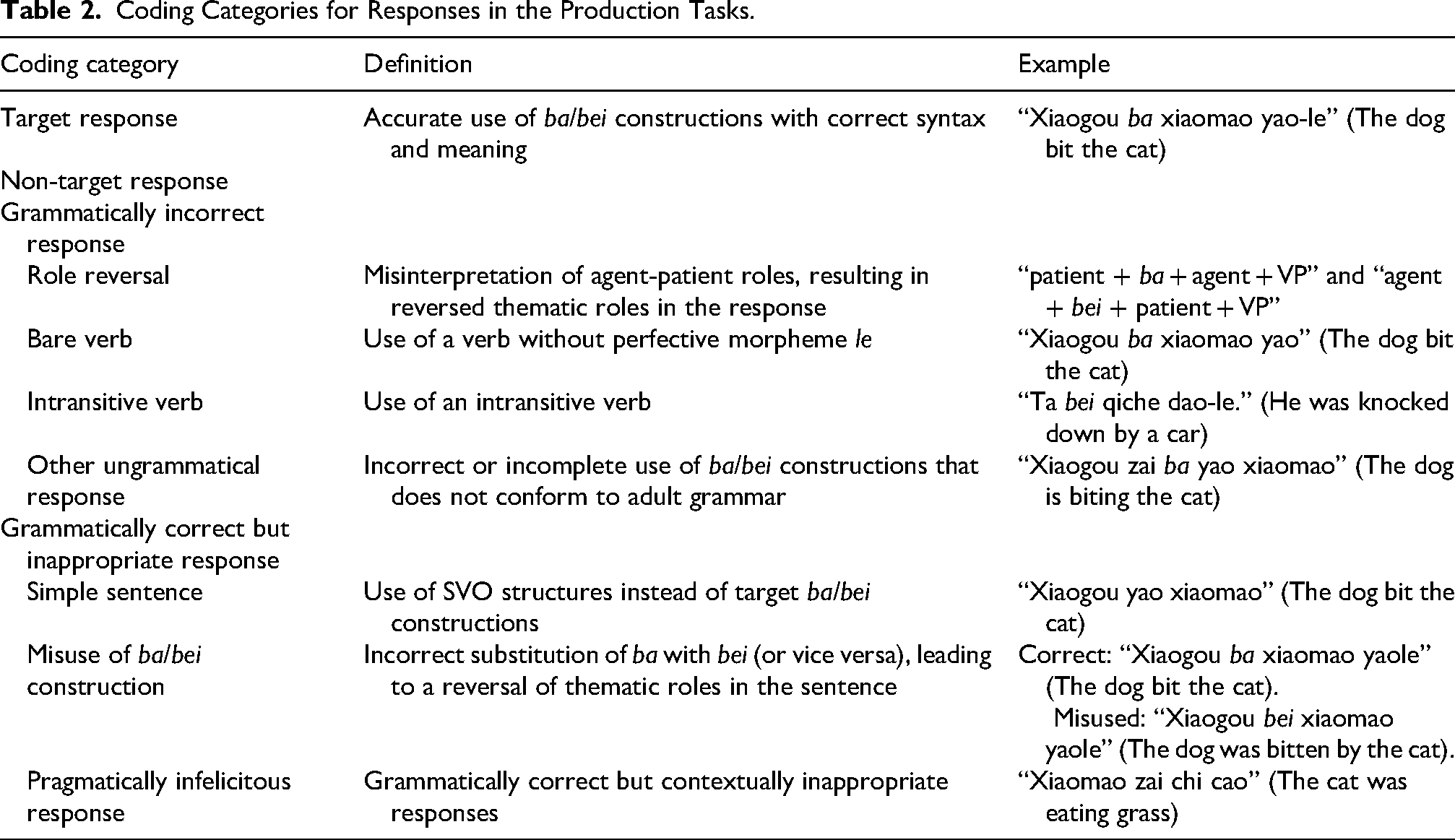
Responses which were full or partial ba/bei constructions were viewed as correct responses. The ellipsis of sentence subjects is allowed in Mandarin when the context permits. Thus, the following structures were regarded as attempts at ba constructions: a) NP1 + ba + NP2 + VP; b) ba + NP2 + VP and bei construction: c) NP1 + bei + NP2 + VP; d) NP1 + bei + VP; e) bei + NP2 + VP. The responses of participants were mainly divided into two types: target responses and non-target responses. Since the ability to produce ba and bei constructions basically reflects grammatical ability, some ungrammatical responses were coded as grammatically incorrect responses when the thematic roles were reversed or the constraints of ba/bei constructions were violated (including bare verbs without perfective morpheme le and the use of intransitive verbs). Other responses were coded as grammatically correct but inappropriate responses if they were not target responses but grammatically correct: simple sentences, the misuse of ba/bei constructions and pragmatically infelicitous responses. Table 2 displays the coding categories along with their definitions and examples.
Coding Categories for Responses in the Production Tasks.
The Tasks for NVWM
Participants’ NVWM was evaluated using two sub-tests from the Working Memory Index (WMI) in the WPPSI-IV: the Picture Memory test and the Zoo Locations test.
Picture Memory Test
This is a core WMI subtest that measures NVWM (Li & Zhu, 2014; Soares & McCrimmon, 2013; Wechsler, 2012).

Example picture for picture memory test Procedure: Participants began with sample B and started the test from the seventh item. For each item, they viewed a target picture on the first page for 5 s. Then, they turned to the next page and were asked to identify the target picture from the options. The test stopped if they missed the target in four items in a row. Scoring: Participants received 1 point for correctly identifying the target picture. They received 0 points for choosing incorrect options or for items they didn’t complete.
Zoo Locations Test
The Zoo Locations test is a supplemental WMI subtest that also measures NVWM (Li & Zhu, 2014; Soares & McCrimmon, 2013; Wechsler, 2012). Materials: This test includes one practice item and 20 test items. Each item displays 1 to 7 animal picture cards and 2 to 9 squares representing different zoo locations.

Example picture for zoo locations test Procedure: For each item, the examiner showed participants where specific animals “live” in the zoo (represented by squares). Participants then tried to place the animals in the correct locations from memory. The test stopped if they misplaced the animals in three consecutive items. Scoring: Participants received 1 point for each item if they correctly recalled all animal locations. Otherwise, they received 0 points.
Generating the Standard WMI Score
The raw scores from both subtests were input into the Web-based Scoring and Reporting Platform to calculate the standard WMI score. In the WPPSI-IV, scores range from 40 to 160, with a score between 90 and 109 considered average, as most children score within this range (Wechsler, 2012).
Data Analysis
SPSS 26.0 was used to analyze the data, and a significant level of .05 was selected for all the analyses. The normality of the variables was checked by the Kolmogorov-Smirnov test prior to the conduction of the statistical analyses. The nonparametric tests were performed since the Kolmogorov-Smirnov test showed that the data in the comprehension and production tasks were not normally distributed. Kruskal-Wallis tests were used to observe the significant differences among the three groups in terms of the proportion of correct choice in the comprehension task and that of correct response in the production task. Post hoc (Bonferroni corrected) tests were used to further determine whether significant differences exist in any two groups, especially DLD and ALI. Wilcoxon's signed-rank tests were conducted to see the asymmetry between comprehension and production of these two constructions in each group. The Spearman's rank correlation was used to examine the correlation between children's performance on ba/bei constructions and their NVWM.
Results
Do Children with ALI Resemble with those with DLD in the Comprehension and Production of ba and bei
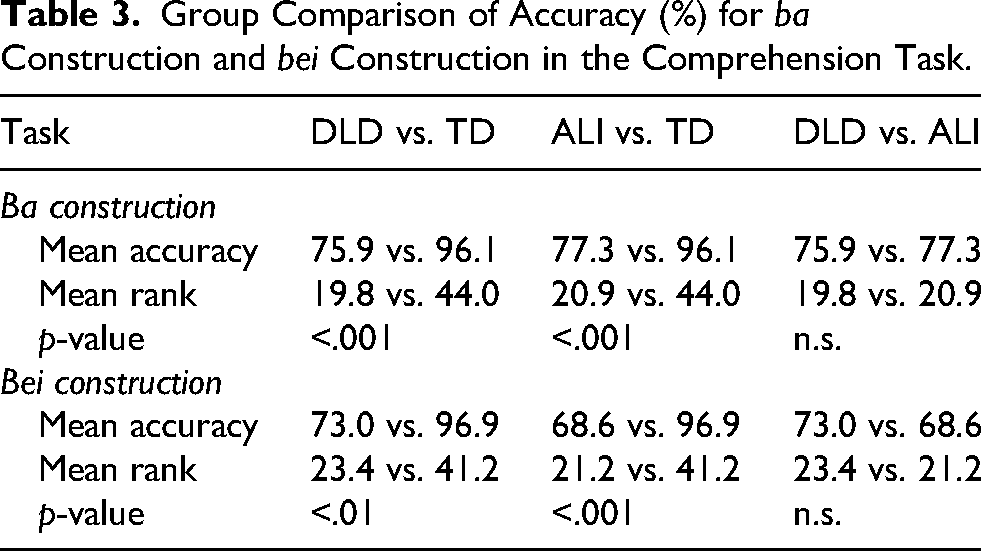
Kruskal-Wallis tests indicated significant differences among the three groups in comprehending ba constructions (H(2) = 28, p < .001), with mean ranks of 19.8 for children with DLD, 20.9 for children with ALI, and 44.0 for TD children. For bei constructions, the test also indicated significant differences (H(2) = 19, p < .001), with mean ranks of 23.4 for children with DLD, 21.2 for children with ALI, and 41.2 for TD children. As shown in Table 3, pairwise comparisons (Bonferroni corrected) demonstrated that both the DLD group and the ALI group understand a significantly lower percentage of ba and bei constructions than did the TD group (ps < .001). However, there are no significant differences between the DLD group and the ALI group in the comprehension of the two constructions (ba construction: p = .846; bei construction: p = .683).
Group Comparison of Accuracy (%) for ba Construction and bei Construction in the Comprehension Task.
In terms of production, Kruskal-Wallis tests revealed significant differences among the three groups for ba constructions (H(2) = 18, p < .001), with mean ranks of 20.4 (DLD), 24.9 (ALI), and 40.8 (TD). Similarly, for bei constructions (H(2) = 21, p < .001), mean ranks were 18.9 (DLD), 23.0(ALI), and 43.2(TD). As depicted in Table 4, pairwise comparisons (Bonferroni corrected) showed that both the DLD group and the ALI group were less successful in producing ba constructions (DLD vs. TD, p < .001; ALI vs. TD, p < .001) and bei constructions than were the TD group (p < .05). No such significant differences were found between the DLD group and the ALI group in the production of both ba constructions (p = .485) and bei constructions (p = 1.000), although the DLD participants achieved lower accuracy than the ALI participants in producing correct ba constructions (37.4% vs. 50.98%) and bei constructions (44.4% vs. 53.5%).
Group Comparison of Accuracy (%) for ba Construction and bei Construction in the Production Task.

Do ALI and DLD share patterns in producing ba and bei.
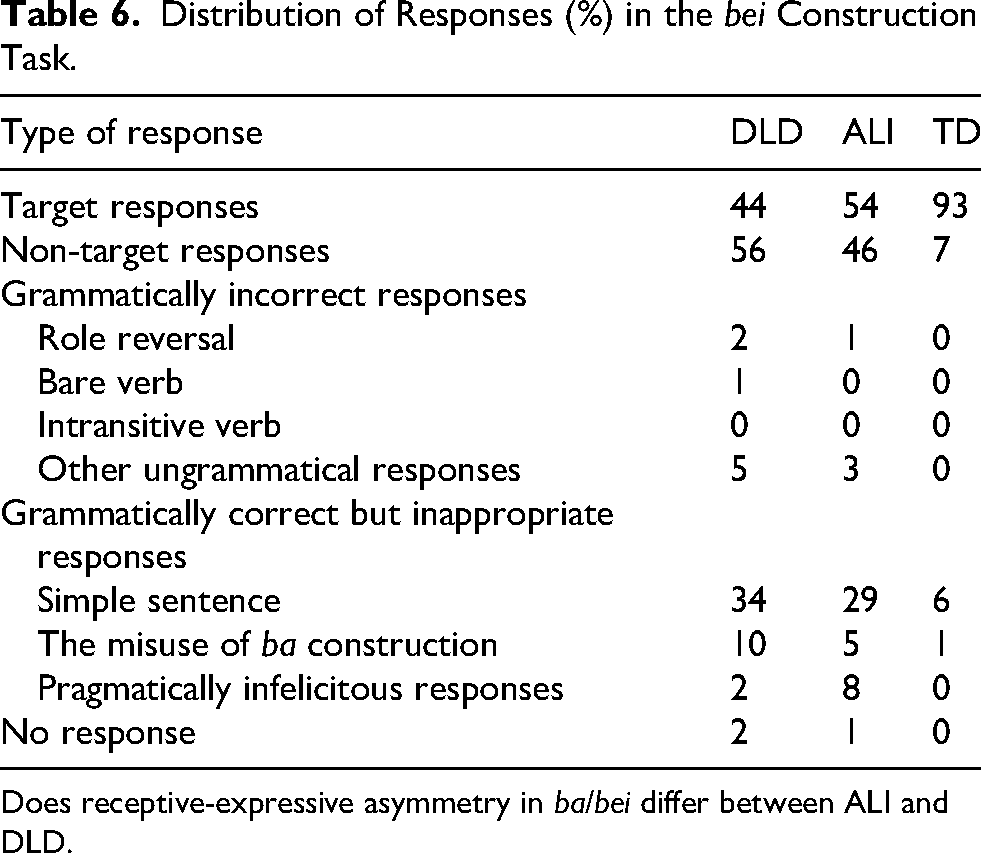
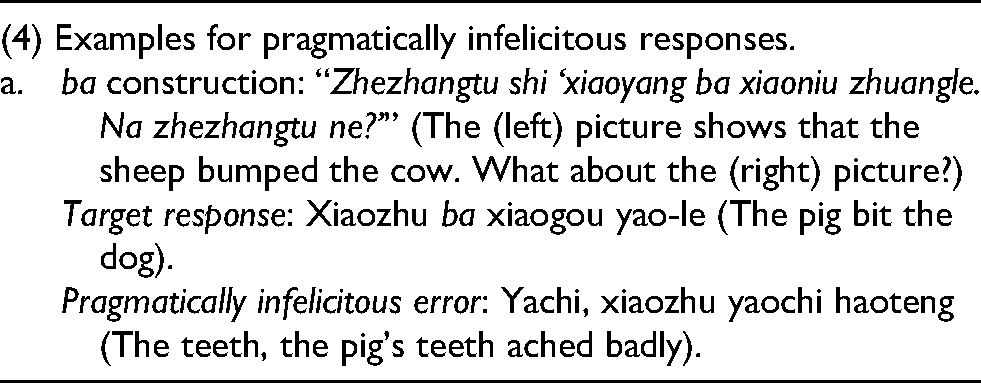
An analysis of errors by the DLD and ALI participants sheds further light on the similarities and differences between these groups (see Tables 5 and 6). Descriptively, the DLD group produced more non-target responses (63%) than did the ALI group (49%). Specifically, the ALI group committed more grammatical errors than the DLD group. The ALI group markedly differed from the DLD group in terms of two specific error types: 1) pragmatically infelicitous responses as in (4) were evinced in the ALI group (6%) whereas this type of error was not seen in the DLD group (0%); 2) the misuse of the bei construction, describing an event in contrast to the ba construction, was only observed in the DLD group (9%) despite the fact that it was absent from the data of the ALI group (0%).
Distribution of Responses (%) in the ba Construction Production Task.

Distribution of Responses (%) in the bei Construction Task.
Does receptive-expressive asymmetry in ba/bei differ between ALI and DLD.
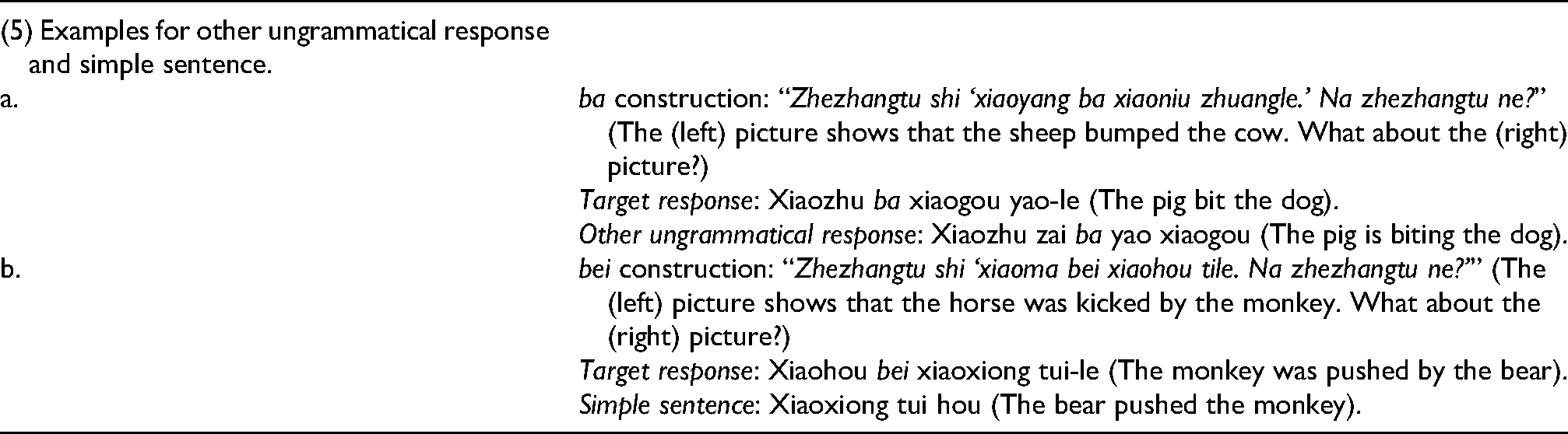
Other two potentially different error patterns between the children with DLD and the children with ALI are “other ungrammatical responses” and simple sentences as in (5). Other ungrammatical responses here refer to unacceptable sentences which are not allowed by the adult grammar. In (5a), the patient xiaogou did not move to the post-ba position. The DLD group was found to produce other ungrammatical responses less frequently than the ALI group (DLD vs. ALI: 3% vs. 8%). Simple sentences can be viewed as an avoidance strategy by children with language impairment who failed to produce sentences with movement or high structural complexity. In this task, both two language disorder groups produced a nontrivial number of simple sentences especially SVO sentences and they were more frequent in the data for the DLD group (44%) than for the ALI group (27%).
In the production task of bei constructions, too, the ALI group produced more non-target responses than the DLD group. It is worthy of note that the DLD group committed more grammatical errors than the ALI group (DLD vs ALI: 7% vs 4%), which is contrary to what was observed in the production of ba constructions. In addition, pragmatically infelicitous responses were also evinced in the ALI group (8%) despite the fact that the DLD group produced a few of these responses (2%) in this task (see (6)). Consistent with the distribution in the ba construction task, simple sentences were used more frequently in the DLD group (34%) than in the ALI group (29%), and this is also true for the misuse of ba constructions (DLD vs. ALI: 10% vs. 5%). Interestingly, in this task, the DLD group produced a higher proportion of other ungrammatical responses than the ALI group (DLD vs. ALI: 5% vs. 3%).

We conducted within-group analyses to investigate the symmetry and asymmetry between comprehension and production of ba and bei constructions. The results revealed that in the DLD group, significant differences between comprehension and production were observed for both ba constructions (Z = −3.187, p < .01) and bei constructions (Z = −3.183, p < .01), indicating superior comprehension-over-production performance. In contrast, the ALI group showed a significant difference only in ba constructions (Z = −2.961, p < .01), not bei constructions (Z = −1.934, p = .053), although both demonstrated greater comprehension-over-production performance. Similarly, in the TD group, a significant difference was noted only in ba constructions (Z = −3.474, p < .01), with no significant differences in bei constructions (Z = −1.490, p = .136), despite both showing enhanced comprehension-over-production performance.
We also compared ba and bei constructions within each group for comprehension and production separately. For comprehension, no significant differences were found between the two constructions in any group (DLD: Z = −.342, p = .732; ALI: Z = −1.260, p = .208; TD: Z = −.471, p = .638). In production, no significant differences were observed in the DLD (Z = −.466, p = .641) and ALI group (Z = −.336, p = .737)); however, the TD group showed a significant difference between ba and bei constructions (Z = −2.422, p < .05).
Does NVWM Support Comprehension and Production of ba and bei in DLD and ALI
Kruskal-Wallis tests revealed significant differences among the three groups for NVWM (H(2) = 11, p < .01), with mean ranks of 27.9 (DLD), 20.6 (ALI), and 38.3 (TD). As depicted in Table 7, pairwise comparisons (Bonferroni corrected) indicated no significant differences between the DLD and ALI group (p = .613) and no significant differences between the DLD and TDA groups (p = .153). However, significant differences were observed between the ALI and TDA groups (p < .01), with the ALI group performing worse.
NVWM Performance Across the DLD, ALI, and TD Group.

A significant correlation was found between NVWM and the comprehension of bei constructions in the DLD group (r = .581, p < .05), but no significant correlations were found between NVWM and the comprehension of ba constructions in the DLD group (r = .404, p = .096). In the ALI group, no significant correlations were found between NVWM and the comprehension of ba constructions (r = .066, p = .801) and bei constructions (r = .309, p = .227). Similarly, no significant correlations were found between NVWM and the comprehension of ba constructions (r = −.059, p = .785) and bei constructions (r = .212, p = .321) in the TD group.
In terms of production, the DLD group showed no significant correlation between NVWM and the production of ba constructions (r = .296, p = .233). However, a positive correlation was observed between NVWM and bei constructions (r = .562, p < .05). In the ALI group, no significant correlations were found between NVWM and the comprehension of ba constructions (r = .272, p = .290) and bei constructions (r = .436, p = .080). And no significant correlations were found between NVWM and the comprehension of ba constructions (r = −.247, p = .245) and bei constructions (r = .064, p = .765) in the TD group.
Discussion
The current study compared the comprehension and production of two complex Mandarin structures, ba and bei constructions, by preschool children with DLD and ALI with three overarching goals in mind: first, to explore to what extent children with ALI show syntactic deficits which are similar to those attested in children with DLD, second, to determine whether receptive and expressive modalities for these constructions are associated in the two populations, and third, to shed light on whether NVWM is linked to performance on ba/bei constructions (previously attested for DLD) in children with ALI.
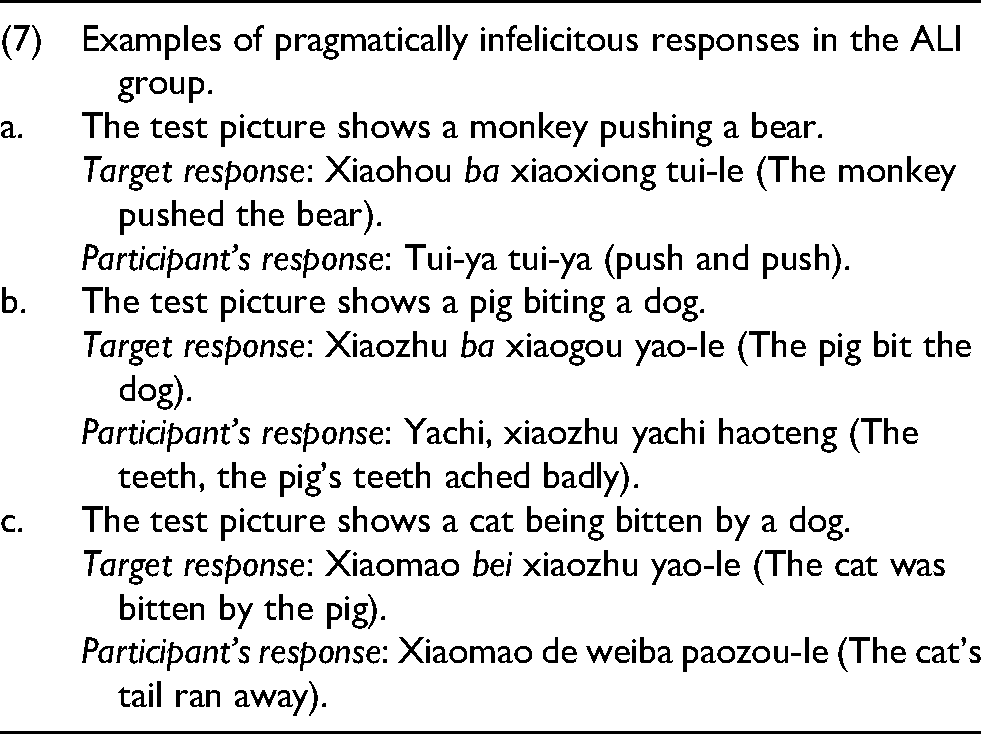
At first glance, the results suggest that the superficial resemblance in syntactic profiles of children with ALI and children with DLD stems from globally low scores on complex syntactic constructions, confirming language delays in both groups (see also Sukenik & Friedmann, 2018). Other differences between the ALI group and the DLD group are revealed by the analyses of their error patterns. The marked difference in error types between these two language disorders is that the ALI group produced many pragmatically infelicitous responses which rarely appear in the DLD group who mostly produced grammatical errors. This is similar to the findings from Sukenik and Friedmann (2018). They found that pragmatically infelicitous responses were only seen in the ALI group whereas such errors were not evinced in the DLD group. Modyanova et al. (2017) also found that children with ALI behaved differently from children with DLD in producing irrelevant sentences. Schaeffer (2018) also found 4 of 27 DLD children failed to pass a pragmatic-driven test, the article choice task. This result indicates that a minority of children with DLD has an additional pragmatic impairment. In our data, pragmatically infelicitous responses in the bei construction task accounted for 8% of all responses in the ALI group, and only 2 such responses were produced by 1 DLD participant, representing 2% of their responses. Similarly, in the ba construction task of the current work, the ALI group produced 6% of such errors while this type of error did not occur in the DLD group. This suggests that a subset of productions of children with ALI during a syntactic task are in line with their well-known impairment in pragmatics, while the errors committed by children with DLD do not relate to pragmatics to the same extent, with the current study not yielding any such mistakes. Following the criteria of Sukenik and Friedmann (2018:10), we classified an error as pragmatic when it bore no relation to the target sentence, the question asked, or the picture presented (see examples 7a–c). Upon closer examination, a clear pattern emerged: children with ALI frequently focused on specific actions or isolated parts of the characters depicted in the pictures. These responses appear to be linked to weak coherence control—a well-documented deficit in autistic children that impairs the integration of disparate elements into a coherent whole (Frith, 2003; Happé & Frith, 2006). In other words, rather than constructing a response that captures the overall intended meaning of the event, these children tend to fixate on individual details, leading to pragmatic errors.
We also observed some advantages for comprehension over production in the DLD group for ba and bei constructions and in the ALI group for ba constructions. This finding generally indicates asymmetries between the receptive and expressive skills of children with DLD and those with ALI in processing complex structures. To be specific, these two types of language disorders have more difficulties producing ba and bei constructions than comprehending them. This asymmetry could reflect the different extents of processing difficulties between the comprehension task, on the one hand, which mainly relies on the integration of visual information of the picture and syntactic and semantic information (i.e., from the instructions) and, on the other hand, the production task, which in addition to requiring the successful integration of visual and verbal information also requires building the correct syntactic structures (including movement and language-specific constraints). Moreover, the priming production task involves analogical reasoning—a domain-general cognitive ability. Specifically, children must analogize the priming sentence provided by the experimenter to produce the correct syntactic structure for the target test sentence. This process places additional cognitive demands on children, as they must not only comprehend the priming sentence but also generalize its structure and apply it appropriately to the target sentence, further exacerbating the comprehension-production asymmetry.
Advantages for comprehension over production were spotted in ba constructions across the three groups while such an advantage for the bei construction was only found in the DLD group. This might be due to the different availability of processing strategies for ba constructions and bei constructions. According to Zhou et al. (2016), children can use two types of cues, i.e., word order and morphosyntax, to comprehend ba and bei constructions. However, word order cues lead to the correct interpretation only of ba constructions and not of bei constructions. By using word order cues to comprehend bei constructions, children wrongly assign an agent role to the first NP and a patient role to the second NP when processing this passive structure (as suggested for passives in other languages, Tager-Flusberg, 1981), although such a word-order-to-thematic-role-mapping would yield an accurate interpretation of ba constructions. Morphosyntactic cues would allow for successful processing of both ba and bei constructions since the morphosyntactic markers ba and bei indeed disambiguate the thematic roles of their two adjacent NPs. In sum, both word order cues and morphosyntactic cues are available for participants to correctly interpret ba constructions, which enhances performance in the ba comprehension task than in the bei comprehension task for which solely morphosyntactic cues could be used to derive accurate meaning.
In comparing acquisition differences between ba and bei constructions across the three groups, our within-group analyses revealed no significant differences between the two constructions for comprehension in any group. However, in production, a significant difference emerged only in the TD group, with higher accuracy for bei constructions compared to ba constructions. At first glance, this might suggest that while children with DLD and ALI have a similar degree of difficulties with both constructions, TD children find ba constructions more challenging than bei constructions—contrary to the RM prediction that bei constructions should be more difficult. A closer examination of response types in the TD group, however, indicates that this asymmetry may not simply reflect the inherent difficulty of the two constructions. In the ba construction task, TD children produced the target response for 79%, with 18% of non-target responses being simple sentences, especially SVO sentences. Since both SVO sentences and ba constructions are active structures in Mandarin, it appears that TD children sometimes substituted ba constructions with SVO sentences when describing the pictures. In contrast, in the bei construction task, TD children produced the target response for 93%, with only 6% being simple sentences. The infrequent substitution of bei constructions with SVO sentences likely reflects the fact that SVO sentences, as active structures, cannot serve as acceptable alternatives for passive bei constructions. Thus, for TD children, the lower production accuracy for ba constructions is influenced by the alternative use of SVO sentences, whereas such substitution rarely occurs in the bei construction task.
The analyses revealed significant correlations in the DLD group between NVWM and both the comprehension and production of bei constructions. This is in line with the findings of Durrleman et al. (2023), who observed similar correlations in this population. However, since no other NVWM-associated relationship (between the comprehension and production of ba constructions) was found in the DLD group, the results of this study cannot confirm a robust relationship between WM and complex structures in the DLD group, as has been claimed in other work (see e.g., Delage & Frauenfelder, 2020). We hypothesize that the lack of NVWM-related effects in the ba construction, contrasted with their presence in the bei construction, is associated with the non-canonical thematic role order inherent to bei constructions. Specifically, bei constructions require the patient to precede the agent, which disrupts the default agent-first processing strategy typically seen in canonical sentences. This non-canonical ordering likely increases cognitive demands, requiring children with DLD to rely more heavily on memory resources, even in their non-verbal modality, i.e., NVWM. In addition, NVWM resources would also contribute to correctly interpreting the non-canonical thematic relationships (patient-agent) depicted in the pictures of bei constructions-while formulating an utterance based on the priming sentence. In contrast, the ba construction aligns more closely with the canonical agent-first processing order, reducing the need for additional memory resources. The difficulties attested in ALI with the comprehension and production of ba and bei constructions seem even more clearly disconnected from NVWM, given that no significant correlation at all was found between NVWM and performance on these two constructions. Moreover, the ALI group demonstrated significantly lower NVWM compared to the TDA group, suggesting that although NVWM is impaired in children with ALI, their processing of bei constructions does not seem to be affected by NVWM. This pattern aligns with findings reported by Durrleman et al. (2017), who found that the performance of French-speaking children on passives was not related to WM deficits.
Based on the above findings, we postulate that DLD children have more severe grammatical deficits in producing ba and bei constructions than ALI children despite the fact that both the DLD group and the ALI group performed significantly below their TD peers in the two tasks.
Conclusions
This study administered a picture-choice task and a priming picture-description task to investigate the comprehension and production of ba and bei constructions by Mandarin-speaking children with DLD and children with ALI. While the groups did not differ quantitatively on the (number of) errors produced, a fine-grained analysis of these errors revealed that they differed qualitatively. Descriptively, the two groups showed different error patterns in the production task. On the one hand, ba and bei constructions were more likely to be misused by the children with DLD, while on the other hand, pragmatically infelicitous productions were evinced in the children with ALI, although these were not attested in their peers with DLD. Thus, the difficulties of using ba constructions and bei constructions can be ascribed to different underlying deficits for the DLD children and the ALI children. That is, children with DLD have more severe syntactic impairments than children with ALI, while children with ALI demonstrate pragmatic-based impairment which is not manifested in children with DLD in the current study. Other differences between children with ALI and children with DLD are further evidenced by the correlation arising between NVWM and syntax in the DLD group but not in the ALI group. This implies that although children with ALI exhibit significantly lower NVWM, their processing of bei constructions is not affected by NVWM. In contrast, children with DLD seem to rely on NVWM to support their syntactic performance. This divergence suggests that the language impairments in ALI and DLD may be underpinned by distinct cognitive profiles. In addition, the distributions of asymmetries between comprehension and production differ between the two groups: in the DLD group, both ba and bei constructions show higher comprehension than production, whereas in the ALI group, only ba constructions exhibit this pattern. These findings further confirm that children with DLD display more difficulties with deriving complex structures (in order to produce them) than children with ALI. Taken together, these findings indicate that children with DLD and those with ALI do not constitute a continuum of the same language disorder, despite the superficial resemblance between their correct performance on the comprehension and production of ba and bei constructions.
Limitations
The current study has the following limitations. Offline tasks were used to evaluate the sentence comprehension and production of participants, which required their social-pragmatic skills. This could have negatively impacted the performance of children with marked challenges in this sphere, namely those with ALI, and thus might have to a certain extent underestimated their formal language abilities. Future research is needed to test if this is indeed the case, for instance by using online tasks (such as IPLP) which do not require explicit responses and social interaction. In addition, further research is required to include more complex structures in Mandarin (like wh-questions, relative clauses, etc.) to chart the similarities and differences in the formal language profiles of children with ALI compared to their peers with DLD. Finally, we did not directly assess cognitive factors such as Theory of Mind deficits (which impact perspective-taking and intention understanding) or Executive Function difficulties (which affect contextual integration and response selection). These factors may contribute to pragmatic errors in ALI, and future research should examine their role alongside ba and bei constructions.
Implications
The findings of this study suggest distinct patterns of language difficulties in children with DLD and those with ALI, highlighting the need for tailored interventions. For children with DLD, interventions could focus on enhancing their ability to process and derive complex syntactic structures, such as ba and bei constructions, through explicit instruction in sentence construction. Since NVWM appears to influence their syntactic performance, incorporating NVWM training into therapy may also be beneficial. For children with ALI, the observed differences in syntactic performance underscore the importance of targeted interventions that address both syntactic development and pragmatic language use. Educational programs could emphasize structured exposure to complex syntax in meaningful, context-rich activities, leveraging both syntactic structures and contextual cues to support comprehension and production.
Footnotes
Acknowledgments
We are grateful to the children, parents, teachers, and therapists who participated in the study and to our research team at Guangdong University of Foreign Studies, whose collaboration made the study possible.

Ethical Approval and Informed Consent Statements
This study received ethical approval from the Medical Ethics Committee of the Xi’an TCM Hospital of Encephalopathy (Reference No. 2017-01) on Jan 6th, 2017.
Funding
The authors disclosed receipt of the following financial support for the research, authorship, and/or publication of this article: This study was supported by grants from the Chinese National Social Science Foundation (Nos. 17AYY08 and 20BYY086), the Swiss National Science Foundation (SNSF; No. PR00P1_193104/1), the Hunan Provincial Natural Science Foundation (No. 2024JJ5421), and the Changsha Science and Technology Plan Project (No. kq2402200).
Declaration of Conflicting Interests
The authors declared no potential conflicts of interest with respect to the research, authorship, and/or publication of this article.
Data Availability Statement
Data are available on request to the corresponding author. The data are not publicly available due to privacy/ethical restrictions.