




Abstract
Background and aims
Recent research indicates that children with Developmental Language Disorder (DLD) often also score lower than their peers with typical development (TD) on tasks testing nonverbal executive functioning (EF). This study investigated whether there is evidence that children with DLD use linguistic and EF resources to support their lexical and syntactic development. Three questions were addressed: (1) How do children with DLD develop in the domains of lexicon and syntax, and how does their development compare to TD controls? (2) To what extent do children with DLD show reciprocal relations between lexical and syntactic skills, and how does this compare to TD controls? (3) Is EF ability related to DLD children’s lexical and syntactic skills, and how does this compare to TD controls?
Methods
Data from 117 children (NDLD = 78; NTD = 39) were collected three times with yearly intervals. At time 1, the children were 5 or 6 years old. Standardized receptive vocabulary and sentence repetition tests measured lexicon and syntax, respectively. Nonverbal EF tasks tested selective attention, interference control and working memory. Cross-lagged analyses were conducted to determine the direction of relationships.
Results
Both groups showed stable lexical and syntactic growth. In children with DLD, but not in TD controls, syntactic skills predicted lexical skills. In the DLD group, EF predicted lexical skills. Reversely, in the TD group, lexical skills predicted EF.
Conclusions
The results of this study are consistent with the hypothesis that the lexical development of children with DLD is supported by both their verbal abilities in the domain of syntax and their nonverbal EF abilities.
Implications
Interventions that improve the syntactic and EF abilities of children with DLD may have spreading effects and positively impact on word learning by children with DLD.
Keywords
Introduction
Children with a Developmental Language Disorder (DLD) have persistent and profound language difficulties (Leonard, 2014). The children’s language weaknesses raise questions about their reliance on and ability to use prior linguistic knowledge for acquiring new linguistic knowledge. For example, the language development of children with typical development (TD) shows reciprocal relationships between lexicon and syntax, indicating that previously established lexical knowledge supports syntactic learning and vice versa (Dionne, Dale, Boivin, & Plomin, 2003). It is, however, unknown if the same patterns are found in children with DLD. The primary goal of this study was to investigate reciprocal relations between lexical and syntactic skills in children with DLD. The secondary goal was to investigate whether there is evidence in support of the hypothesis that the lexical and syntactic development of children with DLD is impacted by nonverbal cognitive abilities, specifically their nonverbal executive functioning (EF). Children with DLD have often weak EF skills (Pauls & Archibald, 2016; Vissers, Koolen, Hermans, Scheper, & Knoors, 2015; Vugs, Cuperus, Hendriks, & Verhoeven, 2013), prompting the question if EF can support the language development of children with DLD. The present study compared how prior linguistic abilities and EF are related to the lexical and syntactic development of children with DLD and TD controls.
Reciprocal relationships: Syntactic and lexical bootstrapping
Language acquisition researchers make use of the notion “bootstrapping”. In general use, bootstrapping is the leveraging of a small initial effort into something larger and more significant, and in the field of language acquisition it has been used metaphorically to describe children’s use of knowledge already established in one linguistic domain for acquiring further linguistic knowledge within either the same or another domain (Höhle, 2009). It is an umbrella term that covers different kinds of bootstrapping (Höhle, 2009); for the purpose of the current study, we focus on syntactic (Gleitman, 1990) and lexical bootstrapping (Bates & Goodman, 1997).
The syntactic bootstrapping approach was originally proposed by Gleitman (1990) describing the way that children use syntactic structure to learn the meaning of verbs. This mechanism is demonstrated in experiments in which 2 year old children listened to novel verbs in transitive (Jane blicked the baby) or intransitive (Jane blicked) syntactic structures (Yuan & Fisher, 2009). Children who listened to verbs in transitive structures looked in the testing phase more often to events that involved two participants than to events with only one participant. The syntactic bootstrapping hypothesis by Gleitman pertains to children’s use of argument structure, but the notion could be applied more broadly referring to children’s use of structural information in general to support word learning (Samuelson & McMurray, 2016). For example, young children use co-occurrences of words (“syntactic frames”) to derive information about the category of content words and learn more about their meaning (e.g. action, objects) (Chemla, Mintz, Bernal, & Christophe, 2009; Christophe, Millotte, Bernal, & Lidz, 2008; Mintz, 2003), and syntactic knowledge can facilitate input processing and word learning through predictive processing (Lew-Williams & Fernald, 2007).
The notion of lexical bootstrapping is often linked to Bates and Goodman’s (1997) statement that “grammar emerges from the lexicon”, and refers to children’s use of previously acquired lexical knowledge to derive and break-down morphological, morphosyntactic and syntactic patterns (Bates & Goodman, 1997; Marchman & Bates, 1994). For example, Marchman and Bates (1994) argued that children need a certain critical mass of lexical information (verbs, regular and irregular word forms) before they productively use morphological rules. Accumulated lexical diversity may also help children to figure out sentence structure, as indicated by research showing that the amount of words that children know predicts their abilities to combine words (Dionne et al., 2003; McGregor, Sheng, & Smith, 2005). This may reflect that with learning a greater variety of lexical items that are contained within specific multiword constructions, children learn to generalize over specific multiword constructions resulting in more abstract sentence representations (Kidd, Lieven, & Tomasello, 2010; Lieven, Pine, & Baldwin, 1997). Having more abstract sentence representations at their disposal, children can go beyond the input and combine new words in a productive way.
Previous research has found that TD children show reciprocal relations between lexical and grammatical development, suggesting bidirectional bootstrapping (Dionne et al., 2003). However, this could be different for children whose language abilities are compromised, as suggested by research on late talkers (Moyle, Weismer, Evans, & Lindstrom, 2007; Schlesiger, 2013). Moyle et al. showed that children with TD exhibited patterns consistent with lexical bootstrapping until age 2 years and 6 months (2;6) while patterns consistent with syntactic bootstrapping were observed from age 2;6 until 3;6. The late talkers in their study demonstrate patterns that are consistent with bidirectional bootstrapping, but they had a delayed onset and protacted bootstrapping that showed a longer duration than the TD controls.
Children with DLD often start out as late talkers (Rescorla, Roberts, & Dahlsgaard, 1997; Rescorla & Schwartz, 1990; Thal, Tobias, & Morrison, 1991), but their language problems are more severe and persistent. Consequently, children with DLD may show more delayed and protracted bootstrapping than late talkers. Word learning experiments suggest moreover that 5 year old (Shulman & Gruberman, 2007) and 6 year old (Van der Lely, 1994) children with DLD may be less able to successfully use syntactic bootstrapping as a word learning strategy than their peers with TD. The primary aim of the current study was to investigate this issue by focusing on reciprocal relations between lexicon and syntax in children with DLD, compared to TD controls. In addition, we examined if children’s EF ability contributed to their lexical and syntactic skills. EF could provide children with resources for learning language outside the verbal domain (Cowan, 2014; Gomes, Molholm, Christodoulou, Ritter, & Cowan, 2000), but it is largely unknown how EF is related to children’s lexical and syntactic development and whether this is the same for children with DLD and TD. This last question is prompted by research, which shows that children with DLD have EF impairments (Ebert & Kohnert, 2011; Pauls & Archibald, 2016; Vissers et al., 2015; Vugs et al., 2013).
Executive functions predicting lexical and syntactic skills?
EF refers to a family of domain-general top-down executive processes used to direct actions and thought (Diamond, 2013; Miller & Cohen, 2001; Miyake et al., 2000), to attend to information, suppress interference from external and internal (as in distracting thoughts or habitual responses) sources, retain information in working memory in an accessible state, and prevent information from decay. As such, EF may play a role in language learning (Cowan, 2014; Gomes et al., 2000).
Various studies indeed report correlations between EF and children’s lexical (Kapa & Colombo, 2014; Khanna & Boland, 2010; Vugs, Knoors, Cuperus, Hendriks, & Verhoeven, 2016; Yoshida, Tran, Benitez, & Kuwabara, 2011) and syntactic abilities (Kaushanskaya, Park, Gangopadhyay, Davidson, & Weismer, 2017; Khanna & Boland, 2010; Montgomery, Magimairaj, & O’Malley, 2008; Verhagen & Leseman, 2016; Vugs et al., 2016). A stronger empirical basis for understanding the nature of these relations comes from longitudinal research, which can provide insight into the directionality of relations through cross-lagged analyses (Hamaker, Kuiper, & Grasman, 2015; Kearney, 2017). The few studies using such a design arrive at different conclusions. Some studies suggest that EF facilitates the vocabulary development of children with TD (Bohlmann, Maier, & Palacios, 2015; Weiland, Barata, & Yoshikawa, 2014) and language development in general (Slot & Suchodoletz, 2018). Bohlmann et al. (2015) and Slot and Suchodoletz (2018) found relations in the reverse direction, which probably reflects the use of verbal strategies and labelling to help solve EF tasks (Vygotsky, 1962). Recent research with deaf/hard-of-hearing children suggests that language is more relevant for EF development, than the other way around (Jones, Atkinson, Marshall, Botting, St Clair, & Morgan, 2019). However, Gooch, Thompson, Nash, Snowling, and Hulme (2016) observed stable language and EF development but no direct relations between EF and language or between language and EF. Gooch et al. (2016) investigated 4 to 6 year old children, who were at risk of reading difficulties.
For the present study, we investigated 5 to 8 year old children diagnosed with DLD and TD controls. Unlike Gooch et al. (2016), we separated lexical and syntactic measures which allowed us to investigate differential relations between EF and lexical and syntatic development, respectively. In the process of word learning, EF is involved in at least two critical steps: fast mapping and retention. In fast mapping, children bind known words they hear to known referents, paving the way for unknown words and referents to be paired (Carey, 2010; Carey & Bartlett, 1978). EF may facilitate inhibiting and selecting lexical competitors that are activated in children’s mental lexicon upon hearing a new word in the input (Yoshida et al., 2011). Retention is important as well: children need to remember labels, store visual and semantic information, and form a durable link that allows them to retrieve the word (Samuelson & McMurray, 2016), and for this updating of the working memory contents is relevant. In syntax, children may use EF to recover from incorrect sentence interpretations (Mazuka, Jincho, & Onishi, 2009; Woodard, Pozzan, & Trueswell, 2016), but overall, the role of EF in syntactic development appears less prominent and fundamental. In a recent study children’s syntactic knowledge was found to be associated with EF while their lexico-semantic knowledge was not (Kaushanskaya et al., 2017), however, warranting further research of relationships between EF and children’s lexical and syntactic development.
The current study
The overarching goal of this longitudinal study was to investigate linguistic and nonverbal resources that may support lexical and syntactic skills of children with DLD. Three research questions guided our study: (1) How do children with DLD develop in the domains of lexicon and syntax, and how does their development compare to TD controls? (2) To what extent do children with DLD show reciprocal relations between lexical and syntactic skills, and how does this compare to TD controls? (3) Is EF ability related to DLD children’s lexical and syntactic skills, and how does this compare to TD controls? In answering these three questions, the study provides insight into the mechanisms that children with DLD potentially utilize to learn language, which, in turn, is relevant for designing language interventions.
Three sets of predictions were formulated. The first set of predictions concerned the development of lexical and syntactic skills in both the DLD and TD groups. DLD can affect different domains of language, including lexicon and syntax (Leonard, 2014). Longitudinal research on DLD has shown that, despite a delayed onset of development of about two years, the shape of the growth curve and rate of growth is the same in children with DLD as in children with TD, both in the domains of lexicon and grammar (Rice, 2013). This research shows that the gap between DLD and TD is larger for grammar than vocabulary, but while the vocabulary gap remained, the grammar gap disappeared around the age of 8, at least for some aspects of grammar (i.e. use of finiteness, mean length of utterance). We thus expected lexicon and syntax to show stable growth in both DLD and TD groups. Moreover, we anticipated that the children with TD would outperform the children with DLD on vocabulary and syntax, with possibly a larger between-group difference for syntax. Regarding syntax, the children with DLD may, however, be more likely to catch up because syntactic development may level off in TD children (Rice, 2013) due to the different nature of lexical and syntactic knowledge: in development, syntax has a natural end point, whereas lexicon is a moving target.
The second set of predictions concerned comparisons between the two groups. Given the patterns observed by Moyle et al. (2007), who found that children with TD showed evidence for bootstrapping until age 3;6, it may be the case that the TD children in the age range investigated in the current study—between ages 5 and 8 year old—are beyond this phase. Children with DLD may show a delayed onset of bootstrapping and protracted bootstrapping, similar to the late talkers studied by Moyle et al. (2007), or even more because DLD is a more severe condition than late talking. In late talkers, Moyle et al. (2017) found evidence for bootstrapping at least until age 5;6, which was the children’s age at the end of the study. We therefore predicted to find cross-domain relationships in the DLD group only, but also thought that the children with DLD might show limited syntactic bootstrapping (Shulman & Gruberman, 2007; Van der Lely, 1994).
Third, we tentatively expected that EF would predict lexical and syntactic development in children with DLD and TD (Bohlmann et al., 2015; Kaushanskaya et al., 2017; Slot & Suchodoletz, 2018; Weiland et al., 2014; Yoshida et al., 2011; but see Gooch et al., 2016). Asymmetries may be found for lexical and syntactic development owing to the different nature of lexical and syntactic knowledge and learning. As a result, relationships between EF and lexical development may continue longer and could be stronger than between EF and syntactic development. Note that similar asymmetries could apply to bootstrapping, resulting in prolonged effects of syntactic bootstrapping as compared to lexical bootstrapping.
Material and methods
Participants
Characteristics of the participants in the DLD and TD samples.

Note: Parental education = highest education level of both parents measured on a nine-point scale; NVIQ = standardized nonverbal intelligence score.
All participants with DLD were diagnosed by independent professionals before the first time of testing. In accordance with the official criteria that are used in the Netherlands (Stichting Siméa, 2014), they obtained a score of at least 2 standard deviations (SD) below the mean on an overall score of a standardized language assessment test battery, or a score of at least 1.5 SD below the mean on two out of four subscales. The most commonly used test batteries include the Dutch version of the Clinical Evaluation of Language Fundamentals (CELF-4-NL; Kort, Schittekatte, & Compaan, 2008) and the Schlichting Test for Language Production and Comprehension (Schlichting & Lutje Spelberg, 2010a, 2010b). Exclusion criteria were the presence of a hearing impairment, neurological damage, intellectual disability, or severe articulatory difficulties. All participants with DLD included in this study met these criteria at time 1 and a total of 52 children (67%) met these criteria at all times of testing. The remainder did not meet these criteria anymore, either at time 2 (9%; N = 7) or time 3 (23%; N = 18). This information was missing for one participant. We decided to not exclude these children, given their history of DLD and the long-term persistence of the language problems (Scarborough & Dobrich, 1990).
Measures and procedures
The current study was part of a large-scale project which aimed to investigate the cognitive and linguistic development of Dutch children who varied in terms of their Dutch language skills. This project was approved by The Standing Ethical Assessment Committee of the Faculty of Social and Behavioral Sciences at Utrecht University. Children were recruited through schools: regular education and special educational programmes for children with language and communicative problems. Informed consent forms were signed by parents of participants. Children were individually tested by a native speaker of Dutch in two separate sessions that each lasted approximately one hour. Testing took place in a quiet room at school. Similar procedures were used for each time point.
Language development
Lexical development was measured with the Dutch version of the Peabody Picture Vocabulary Test (PPVT-III-NL; Schlichting, 2005), The PPVT-III-NL is a standardized receptive vocabulary test designed for a wide age range (2;3–90 years). Participants hear a target word and have to pick the correct referent out of four pictures. The task is divided in 17 sets, which increase in difficulty, with 12 target words in each set. We administered the PPVT-III-NL according to the official guidelines and thus determined the starting set based on a child’s age. The task was terminated when a child picked the incorrect referent picture nine or more times in a set. Raw scores were used in the analyses.
Syntactic development was evaluated with a sentence repetition task that was part of the Dutch Language Proficiency Test for All Children (Verhoeven & Vermeer, 2001), the TAK sentence formation test. The TAK sentence formation test is a standardized sentence repetition task which requires children to repeat a sentence uttered by the experimenter. The task includes 20 sentences and, within each sentence, one function word and one sentence pattern is targeted. Examples are given in (1) and (2), with the target function word in bold and the target sentence pattern underlined. Crucial sentence patterns in Dutch are, for example, sentence-final placement of finite verb in subordinate clauses, as in (1), or subject-verb inversion, illustrated in (2).
(1) When we outside came, began it suddenly to regenen. rain (2) Vandaag Today must he inside stay, but tomorrow may hij weer naar buiten.
he again to outside
Accuracy was scored offline by a native speaker of Dutch. Points were only awarded for the 20 target function words and 20 target sentence patterns. Other elements in the sentence, which do not belong to the target function word or sentence pattern, were ignored in scoring. The maximum score is 40: 20 points for each correctly repeated target function word and 20 points for each correctly repeated target sentence pattern. Although sentence repetition is also supported by lexical knowledge (Klem et al., 2015) and verbal short-term memory (Alloway & Gathercole, 2005), it can be considered a measure of syntactic competence (Frizelle & Fletcher, 2014; Polišenská, Chiat, & Roy, 2015). This is furthermore ensured by the scoring method used in the present study.
EF development
To exclude the interference of verbal abilities, the present study made use of visual EF tasks. Three tasks were included that tested respectively selective attention, interference control and visuospatial working memory.
Selective attention was tested with the Visual Sky Search, a subtest of the Test of Everyday Attention for Children (Manly, Robertson, Anderson, & Nimmo-Smith, 1999). In the first part of the Visual Sky Search, children had to encircle identical pairs of spaceships on an A3 sheet of paper. Twenty identical pairs were the targets and 108 non-identical pairs were the distractors. Children were instructed to encircle the targets as fast as possible while ignoring the distractors. They were familiarized with the procedure during a practice phase. To control for drawing speed and children’s motor abilities, a second A3 sheet of paper was given to the children after they had completed the first part of the task. On this motor-control sheet, only the twenty identical spaceships were displayed and children were again asked to encircle them as fast as possible. Children’s selective attention score was calculated by subtracting the mean time per target of the motor-control sheet from the mean time per target of the sheet on which both targets and distractors were displayed.
Interference control (or executive attention) was measured with a Flanker task from Engel de Abreu, Cruz-Santos, Tourinho, Martin, and Bialystok (2012), who adapted the task from Rueda et al. (2004). The Flanker task was administered on a laptop using the experimental software E-Prime 2.0 (Schneider, Eschman, & Zuccolotto, 2002). A horizontal row of five equally spaced yellow fish was presented to the children. The children were asked to indicate the direction of the central fish by pressing the corresponding left or right response button as quickly as possible. On congruent trials (50%), the flanking fish were pointing in the same direction as the central target fish, and on incongruent trials (50%), the flanking distractors pointed in the opposite direction. Each trial started with a fixation cross in the middle of the screen (1000 ms), followed by the presentation of the five fish. A response had to be made within 5000 ms and was otherwise considered incorrect. All children completed two blocks of twenty trials in which presentation of congruent and incongruent trials was randomized. Eight practice trials preceded the test phase.
Both accuracy and reaction times (RTs) were documented, but we focused on RTs, as mean accuracy scores were generally high (>75% correct in both groups at all three times). In addition to the RTs in the congruent and incongruent condition, we calculated the flanker effect (i.e., RTs incongruent minus RTs congruent). Both RTs and the flanker effect deviated from normality. After a log-transformation the distributions of the RTs were acceptable, unlike the distribution of the flanker effect, and we decided to focus on the RTs in the incongruent condition. In this condition, the children also had to resist interference. RTs in the incongruent condition showed a strong and positive correlation with the flanker effect at all three times (time 1: rs(117) = .65, p < .001; time 2: rs(117) = .52, p < .001; time 3 rs(115) = .65, p < .001), in contrast with RTs in the congruent condition which were not significantly correlated with the flanker effect (time 1: rs(117) = −.11, p = .26; time 2: rs(117) = .11, p = .25) or only weakly (time 3 rs(115) = .21, p = .03). Following Engel de Abreu et al. (2012), mean RTs were calculated excluding incorrect responses, RTs below 200 ms and RTs above three standard deviations of children’s individual means (∼10% of all incongruent trials).
Visuospatial working memory was assessed with the backward Dot Matrix, similar to the test from the Alloway Working Memory Assessment “AWMA” (Alloway, 2012). In this task, children were presented with a four by four matrix in which sequences of dots appeared. After the last dot disappeared, children were asked to point out the position of the dots in reverse order. In the first block, only one dot appeared, but the number of dots increased in subsequent blocks. Each block had six trials and there was a maximum of six blocks. The AWMA procedure was applied for scoring, which meant that one point was given for each correct trial (maximum score of 36). If the first four trials of a block were correct, children automatically continued to a subsequent block and were awarded the maximum of six points. The task stopped when children responded incorrectly to three trials within the same block. Trials were scored as incorrect if children recalled the position of one or more dots incorrectly, if the sequence was incorrect, or if they omitted one or more dots.
Component loadings for selective attention, interference control and visuospatial working memory at time 1, 2 and 3.
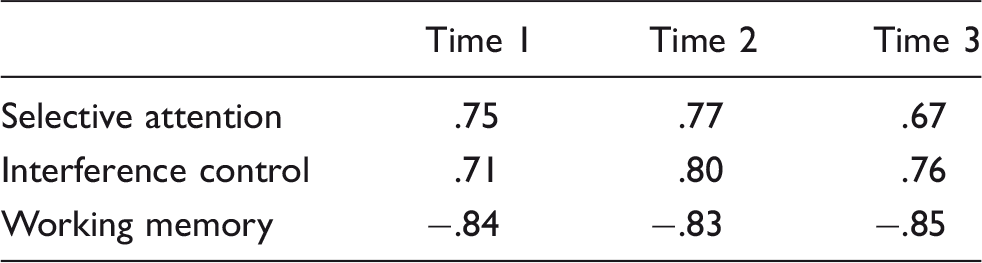
The saved factor scores were used in further analyses as a measure of EF. Lower scores indicate better performance. For the sake of interpretability, we coded the variables positively.
Data analysis
To determine how the two groups of children develop over time, mixed-design ANCOVAs were run with Group (DLD, TD) as the between-subjects variable, Time (time 1, time 2, and time 3) as the within-subjects variable, nonverbal intelligence and parental education as covariates and the raw scores of the PPVT receptive vocabulary and TAK sentence formation tests as dependent variables.
Relationships between lexicon and syntax were investigated through cross-lagged models. The models are called “crossed” because they estimate relationships between one variable and another, and vice versa, and they are “lagged” because they estimate relationships between different time points. As such, cross-lagged models are suited for establishing the direction of relationships between variables and provide a basis for making causal inferences. For example, more shared variance between variable X measured at time 1 (X_T1) and variable Y measured at time 2 (Y_T2) than between Y_T1 and X_T2 would be more consistent with X causing Y than Y causing X. To strengthen the basis for making causal inferences, it is important to control for synchronous relationships and stability of constructs over time (Kearney, 2017), as well as stable between-subject variation, if relevant (Hamaker et al., 2015). Structural equation modelling provides a powerful design to control for all these effects, but as the sample size in the current study did not allow running such complex models, less complex analyses were conducted in the following three steps.
First, zero-order correlations provided insight into the shared variance across measures within times and within measures across times. Second, partial cross-lagged correlations were performed to control for synchronous correlations and pinpoint sequential relations (e.g., Lexicon_T1 and Syntax_T2, controlling for Syntax_T1). The first two steps were performed for the DLD and TD samples separately to provide insight into differences and similarities in the correlational structure of the two samples. In the third and final step, significant partial correlations were followed by moderation analyses in which we combined the two samples to investigate if the variable Group (DLD, TD) impacted on the observed relationship and establish whether there was any statistical support for differential relationships between the DLD and TD groups. Moderation analyses were run using the SPSS PROCESS macro (Hayes, 2013). Nonverbal intelligence, parental education and the variable relevant for synchronous relationship (e.g., Lexicon_T1 in an analysis that targets the relation between Syntax_T1 and Lexicon_T2) were entered as control variables. Group was entered as the moderator variable (e.g. Group*Syntax_T1). Regarding the identification of relationships between EF and language, a similar three-step procedure was followed for both the relation between EF and lexical development and EF and syntactic development.
Results
Lexical and syntactic skills
Descriptives lexical and syntactic development in the DLD and TD groups.
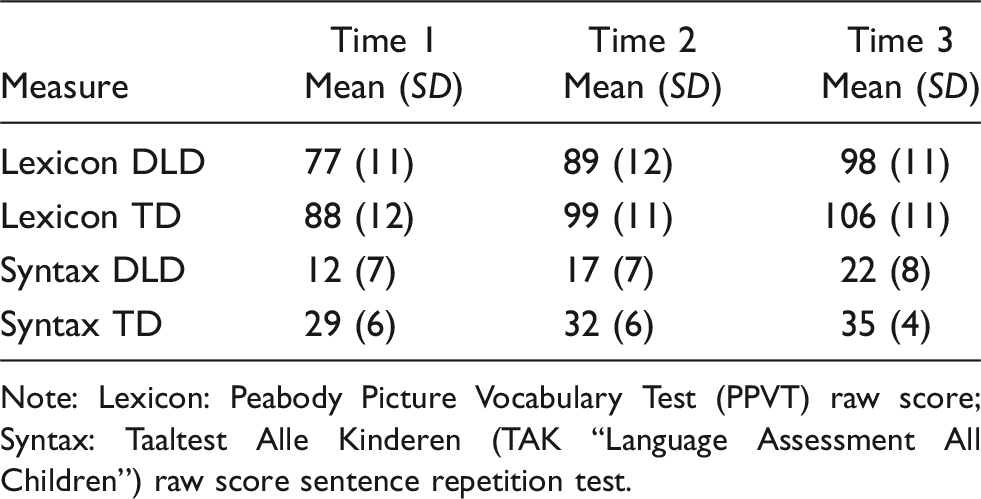
Note: Lexicon: Peabody Picture Vocabulary Test (PPVT) raw score; Syntax: Taaltest Alle Kinderen (TAK “Language Assessment All Children”) raw score sentence repetition test.
A mixed ANCOVA revealed a main effect of Time (F(1,106) = 7.33, p = .008,
Syntactic development showed a large main effect of Group; children with TD scored higher than children with DLD (F(1,105) = 109.36, p < .001,
Lexical and syntactic bootstrapping
The correlations between lexicon and syntax at the three time times for the DLD and the TD samples are summarized in Figures 1 and 2. In both groups, intradomain relationships were significant and strong (r ≥ .60), demonstrating stable development. Interdomain correlations varied in strength between moderate (r ≥ .30) and strong, and were all significant.
Intra- and interdomain correlations between lexicon and syntax in the DLD sample at times 1, 2 and 3. Intra- and interdomain correlations between lexicon and syntax in the TD sample at times 1, 2 and 3.

Partial cross-lagged correlations are illustrated in Figures 3 and 4. Sequential interdomain relationships were not significant anymore after controlling for synchronous relationships, except for the relation between Syntax_T1 and Lexicon_T2 in the DLD sample (r(71) = .25, p = .03).
Sequential correlations between lexicon and syntax in the DLD sample at times 1, 2 and 3, controlling for synchronous correlations. Sequential correlations between lexicon and syntax in the TD sample at times 1, 2 and 3, controlling for synchronous correlations.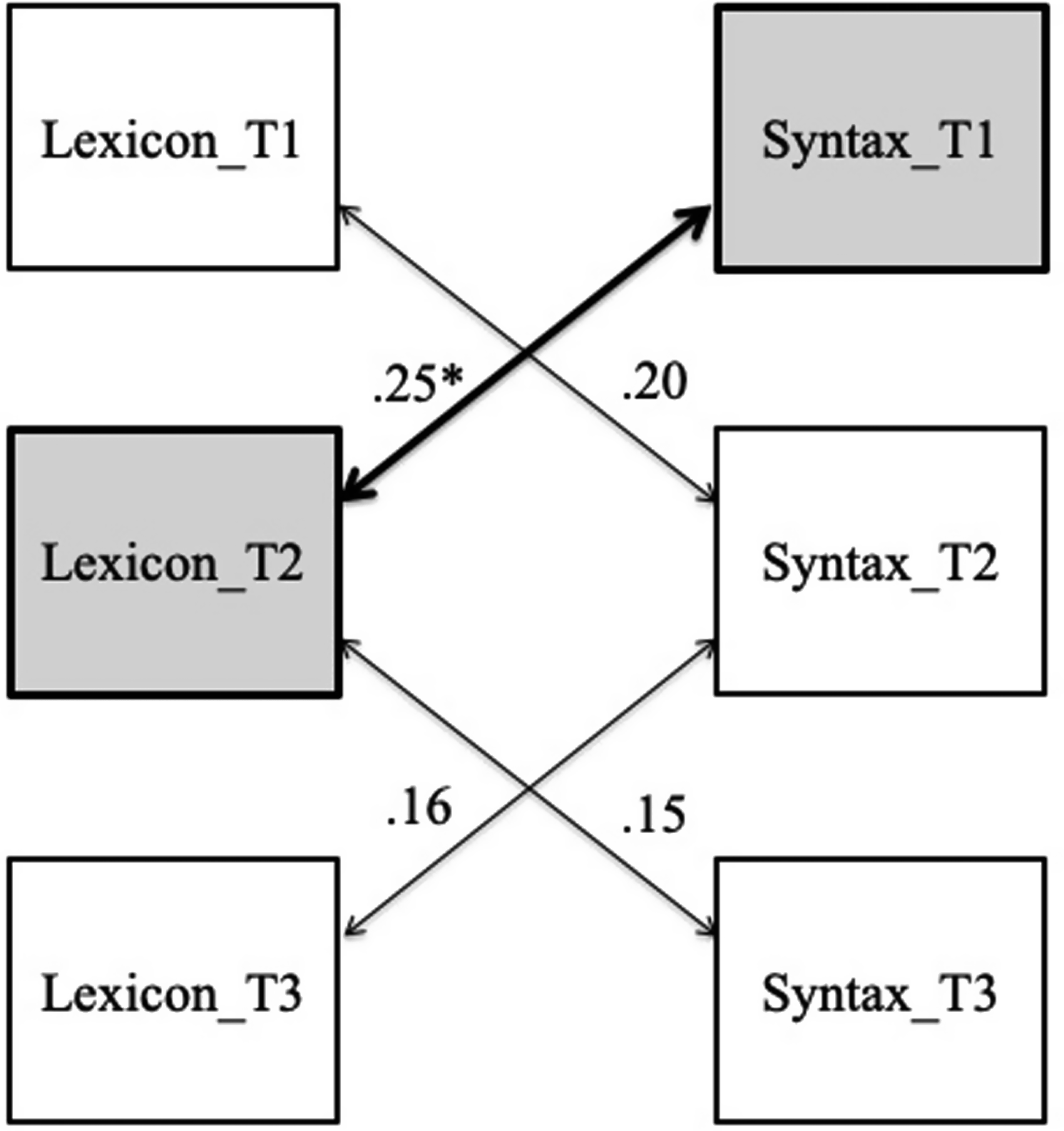

A moderation analysis was run on the combined DLD and TD samples with Lexicon_T2 as the outcome variable, nonverbal intelligence, parental education and Lexicon_T1 as control variables, Syntax_T1 as independent variable, and Group as the moderator. The regression model was significant (F(6,102) = 22.48, p < .001; R2 = .57). Adding the interaction term (Group*Syntax_T1) to the regression model did not lead to a significant increase of explained variance (F(1,102) = .07, p = .79), indicating that Group did not moderate the relationship between Syntax_T1 and Lexicon_T2.
Predictive effects of EF
Descriptives nonverbal EF development in the DLD and TD groups.

Note: Selective attention: selective attention score on Sky Search task; Interference control: reaction times in milliseconds on incongruent condition of the Flanker task; Working memory: accuracy score on backwards Dot Matrix test.
EF and lexical skills
The outcomes of the correlational analyses are shown in Figures 5 and 6 (with EF variables positively coded, so that positive correlation coefficients for lexicon-EF relations indicate that higher lexical scores are associated with better EF scores). In both the DLD and the TD group, relationships between EF scores across times were strong and significant, demonstrating stable development. Correlations between lexicon and EF were moderately strong and significant, except for the correlation between EF_T1 and Lexicon_T2 in the TD sample, which did not reach statistical significance.
Intra- and interdomain correlations between lexicon and EF in the DLD sample at times 1, 2 and 3. Intra- and interdomain correlations between lexicon and EF in the TD sample at times 1, 2 and 3.

Partial correlations (Figures 7 and 8) revealed that in the DLD sample, the relation between EF_T1 and Lexicon_T2, controlling for Lexicon_T1, was significant (r(69) = .26, p = .03). In the TD sample, the reverse effect was observed: Lexicon_T1 was significantly associated with EF_T2, controlling for EF_T1 (r(35) = .47, p = .004).
Sequential correlations between lexicon and EF in the DLD sample at times 1, 2 and 3, controlling for synchronous correlations. Sequential correlations between lexicon and EF in the TD sample at times 1, 2 and 3, controlling for synchronous correlations.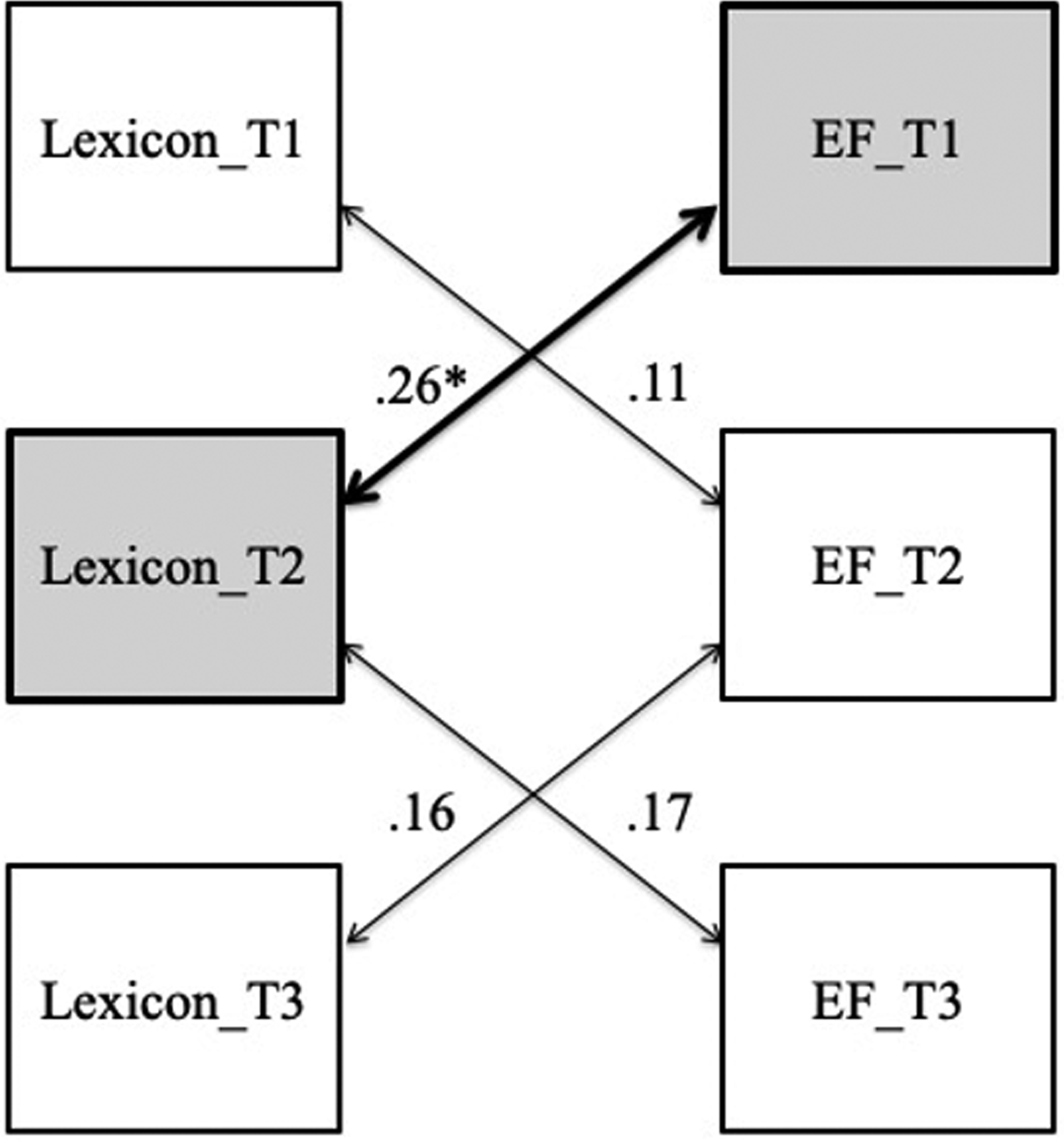

A moderation analysis was run with Lexicon_T2 as the outcome variable, nonverbal intelligence, parental education and Lexicon_T1 as control variables, EF_T1 as independent variable, and Group as the moderator. The regression model was significant (F(6,100) = 20.20, p < .001; R2 = .55). Adding the interaction term (Group*EF_T1) to the regression model revealed a trend (F(1,100) = 3.23, p = .08), indicating that the association between EF_T1 and Lexicon_T2 is more relevant for children with DLD than for TD controls. Group did not moderate the relationship between Lexicon_T1 and EF_T2: addition of the interaction term did not reveal a significant increase in the explained variance (F(1,100) = .10, p = .75).
EF and syntactic skills
The outcomes of the correlational analyses are presented in Figures 9 and 10 (again with the EF variables positively coded). Most correlations between syntax and EF in the TD group did not reach significance, in contrast with the DLD sample.
Intra- and interdomain correlations between syntax and EF in the DLD sample at times 1, 2 and 3. Intra- and interdomain correlations between syntax and EF in the TD sample at times 1, 2 and 3.

None of the partial correlations in the DLD sample reached statistical significance. In the TD sample, the relationship between EF_T2 and Syntax_T3, controlling for Syntax_T2, was significant (r(35) = −.39, p = .02); see Figures 11 and 12.
Sequential correlations between syntax and EF in the DLD sample at times 1, 2 and 3, controlling for synchronous correlations. Sequential correlations between syntax and EF in the TD sample at times 1, 2 and 3, controlling for synchronous correlations.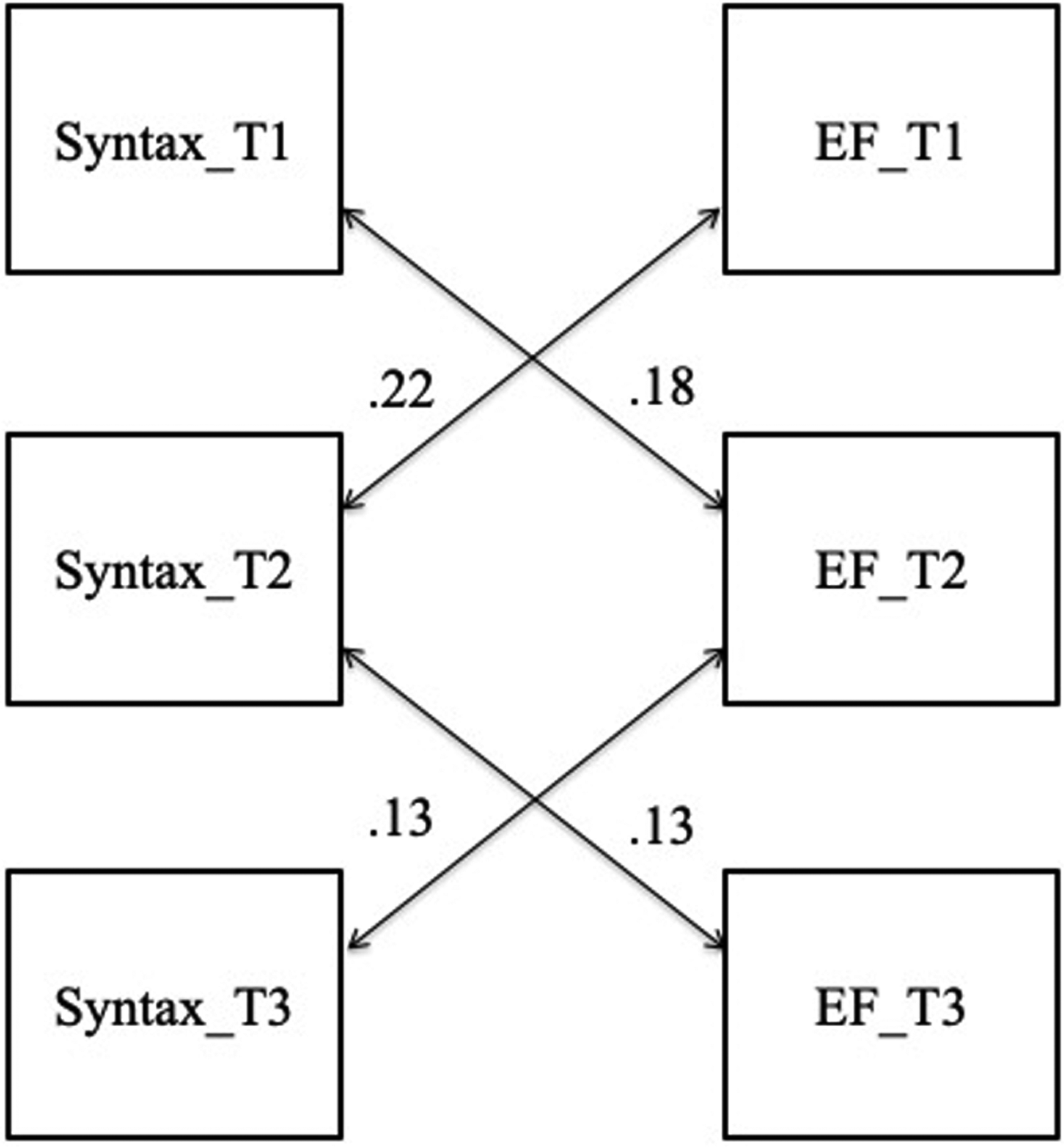

The negative coefficient points to a surprising effect: TD children with higher EF_T2 had lower Syntax_T3. In contrast, the zero-order correlations between EF and Syntax in the TD sample showed that there is either a weak positive relationship between EF and Syntax (EF_T2 and Syntax_T2) or no relationship (EF_T2 and Syntax_T3). Due to an overall lack of variation on Syntax_T3, the scores of a few children disproportionally affected the partial correlation. These children scored below average on Syntax_T2 en EF_T2, but scored on average on Syntax_T3, resulting in the unexpected negative effect.1 For these reasons, we refrained from performing a moderation analysis.
Discussion
The overall aim of this study was to investigate which resources children with DLD might use to develop lexical and syntactic skills. Cross-domain relationships between lexical and syntactic development were investigated to better understand children’s use of syntactic and lexical bootstrapping. Relationships between nonverbal EF, and lexical and syntactic measures were studied to establish if nonverbal EF provides children with DLD with a language learning resource. Children with DLD were compared to TD controls.
Predictive effects of language: Lexical and syntactic bootstrapping
The children with DLD scored lower than their TD peers on lexical and syntactic measures, respectively a standardized receptive vocabulary task (PPVT-III-NL) and sentence repetition task (TAK sentence formation). Comparisons of the effect sizes indicate that for syntax the gap was wider than for vocabulary (Leonard, 2014; Leonard, Miller, & Gerber, 1999; Rice, 2003).
In the DLD group, Syntax_T1 predicted Lexicon_T2. These results contrast with previous research, testing the original syntactic bootstrapping hypothesis by Gleitman (1990), that showed that 5 and 6 year old children with DLD make limited use of argument structure for learning the meaning of verbs (Shulman & Gruberman, 2007; Van der Lely, 1994).
Syntactic knowledge could affect children’s word learning in more general ways, however. For example, children use sentence patterns and functions words for learning word categories (Chemla et al., 2009; Christophe et al., 2008; Mintz, 2003), and structural information facilitates children’s predictive processing (Lew-Williams & Fernald, 2007), which in turn is likely to support word learning. Our study may have picked up on these more general effects of syntactic knowledge beyond argument structure and effects on vocabulary beyond verb vocabulary; in this respect, it is comparable to the approach used by Moyle et al. (2007) who investigated bidirectional bootstrapping in late talkers. Moyle et al. (2007) investigated children until the age of 5;6. At the age of 5;6, they observed syntactic bootstrapping in late talkers only, whereas TD children only made use of bootstrapping at younger ages. This converges with our findings which showed that 5 or 6 year old children with DLD used syntactic bootstrapping, but their TD age peers did not.
Syntactic bootstrapping should not be viewed as an all-or-nothing mechanism, but rather as a learning mechanism that children utilize in different degrees, and in tandem with other mechanisms. This is confirmed by the observation that the relations between Syntax_T1 and Lexicon_T2 were rather similar in the DLD and TD groups, as indicated by almost equal partial correlation coefficients in the two samples (r = .25 in DLD, r = .21 in TD). In addition, there was no moderation effect between the two groups for this relationship. These findings suggest that syntactic bootstrapping may be happening in both groups, but with a stronger effect in de DLD sample. The conclusion that syntactic bootstrapping is less used by children with a higher language level is supported by the observation that in the DLD group, syntactic bootstrapping effects were found only between times 1 and 2, and not between times 2 and 3. The effect of language level may reflect that syntactic bootstraping contributes relatively little to figuring out more detailed semantic properties of words, which becomes more important for the lexical growth of linguistically more mature children. Instead, other skills may become increasingly relevant for children’s lexical development, such as, for example, reading ability (Verhoeven, van Leeuwe, & Vermeer, 2011).
In all, the results support the hypothesis that 5 to 6 year old children with DLD employ syntactic bootstrapping as a learning mechanism. It suggests that children with DLD make use of their knowledge of function words and word order patterns for learning words, even though they find these aspects of syntax challenging, as indicated by the relatively large accuracy gap between the DLD and TD groups on the sentence repetition task. An applied implication of these results is that language interventions designed to improve children’s syntactic skills could have spreading effects and also support children’s lexical skills.
Predictive effects of executive functioning on lexicon and syntax
The observation that DLD is associated with lower EF performance suggests relationships between EF and language development (Kapa & Plante, 2015). Such relationships would be consistent with hypotheses that propose that language deficits are caused, at least in part, by more general deficits (Leonard et al., 2007; Miller et al., 2006). We explored if EF predicted children’s language but also examined reverse relationships to investigate the directionality. Based on previous literature (Carey, 2010; Carey & Bartlett, 1978; Yoshida et al., 2011), we hypothesized that EF is involved in fast mapping and retention, which are critical steps in word learning. The results indicated that EF_T1 is indeed related to Lexicon_T2 in the DLD sample.
The relation between EF and lexical development replicates the results of research with younger children with no known language difficulties (Bohlmann et al., 2015; Slot & Suchodoletz, 2018; Weiland et al., 2014; Yoshida et al., 2011), suggesting that EF is more relevant in earlier developmental phases and for children with lower language levels. This is confirmed by the trend that emerged from the moderation analysis which suggested that the children with DLD rely more on EF for lexical learning than their peers with TD. Samuelson and McMurray (2016) point out that word learning involves multiple domain-general processes, that work together with social competencies, and growing knowledge of linguistic structure. How these processes interact and what their relative contribution is may change as function of development as the different processes that support word learning dynamically unfold during development. Cascading theories predict that the developmental dynamics may be different in cases of psychopathology (Masten & Cicchetti, 2010). Conceivably, because of the severe language difficulties of children with DLD and for many of them also literacy issues (Bishop & Snowling, 2004), children with DLD rely more on EF for word learning than same-aged children with TD, which suggests that EF is a compensating mechanism but also that word learning is relatively effortful for children with DLD.
The different developmental dynamics of the two groups also surfaces in the observation that only the TD group showed an effect in the opposite direction, as Lexicon_T1 predicted EF_T2. That vocabulary supports children’s EF performance has been found in a number of studies (Bohlmann et al., 2015; Fuhs & Day, 2011; Jones et al., 2019; Kuhn et al., 2016; Slot & Suchodoletz, 2018) and may reflect children’s use of verbal strategies and labelling of actions and objects when they perform EF tasks (Vygotsky, 1962). Not all studies find that vocabulary facilitates EF (Weiland et al., 2014), however. Weiland et al. (2014) suggest that skills in language production may be more relevant for supporting EF than receptive ability, but this cannot be the full explanation for diverging findings, as in our study receptive lexical abilities were measured. Although the absence of a relationship between Lexicon_T1 and EF_T2 in the DLD group could point to children’s inability to use verbal mediation as a task strategy, we are hesitant to propose this interpretation as the moderation analysis did not suggest between-group differences. Whether and how children with DLD use verbal mediation is a topic that requires further research (Kapa & Plante, 2015).
In our study, significant EF-language relations were found for lexical development, while syntactic development was unrelated to EF. We anticipated these differential findings. Several EF skills, including selective attention, interference inhibition, and working memory are expected to support word learning. Direct relations between EF and learning of syntax seem more limited and specific to certain structures and tasks. For example, previous research found associations between EF and syntactic tasks that included competing representations (Mazuka et al., 2009; Woodard et al., 2016) and tasks in which children had to decide on the correctness of sentences (Kaushanskaya et al., 2017). Compared to these tasks, repeating word order patterns and function (which was children’s task in the current study) may be less demanding and requires less involvement of EF. A more general difference between lexical and syntactic development is that lexical knowledge has no inherent end point, and contrasts in this respect with syntax. This difference may contribute to both the absence of lexical bootstrapping effects and absence of effects of EF on children’s syntactic development.
In sum, the present study found a contrasting pattern across children with DLD and TD, suggesting that EF supports lexical skills of children with DLD whereas lexical skills support EF in TD controls. Overall, cross-domain EF-language relations were limited, however, consistent with Gooch et al. (2016). Also consistent with their study is the observation that correlations across times either within the domain of language or EF are stronger than cross-domain correlations. Our study showed that within the domain of language, correlations between different language abilities (lexicon, syntax) are stronger than correlations between EF and lexicon, and stronger than correlations between EF and syntax.
Limitations of the study and future directions
In the present study, general measures of children’s lexical and syntactic skills were used, which is a common method in research on bidirectional bootstrapping (cf. Dionne et al., 2003), but not the ideal method. As lexical bootstrapping is thought to work through the accumulation of specific words that appear in specific multiword constructions (e.g. high-frequency verbs in transitive sentences; based on Matthews, Lieven, Theakston, & Tomasello, 2005, 2007), the use of general measures may have prevented us from observing that lexicon drives syntax. We therefore recommend research with more specific lexical and syntactic linguistic measures that are, hypothetically, more directly related and better suited to measure lexical and syntactic bootstrapping. Another limitation of our research was that the tasks to measure lexicon and syntax may not only differ in language domain but could also, potentially, differ in involvement of nonverbal EF load as the lexical picture-matching task required integration of visual and verbal information, whereas the syntactic sentence repetition task was entirely verbal. Future research should not only disentangle the extent to which EF’s are relevant for language development/learning or language performance, which we attempted to tease apart through investigating sequential relations (controlling for synchronous relations), but also investigate the extent to which EF effects are task-dependent.
The results of our study, and those of others (e.g. Moyle et al., 2007), emphasize the relevance of longitudinal research, and the comparison of the developmental dynamics across different groups of language learners. In order to get a handle on the dynamics of development, it is relevant to investigate a wider age range. This is relevant for understanding the developmental processes, but also for designing early interventions that can prevent later negative cascading effects (Masten & Cicchetti, 2010). Consistent group assignment creates a challenge, however. In our study, 23% of the children who were diagnosed with DLD at time 1 did not meet criteria for DLD anymore at time 2 or 3. The larger the age span covered by the longitudinal design, and the earlier age at which children are included, the fuzzier the boundaries between the initial groups may become over time.
Another challenge concerns floor and ceiling effects. For example, the correct use of verbal morphology is difficult for many monolingual English 5 and 6 year old children with DLD, but raises no issue for many 8 year old children with DLD (Rice, 2013). In somewhat older children with DLD, the ability to use multi-clausal sentences may constitute a more reliable measure of grammatical development (Frizelle & Fletcher, 2014). A strength of the sentence repetition task in our research is that it targets both grammatical morphology and sentence patterns in complex clauses, making it appropriate for identifying DLD in a fairly wide age range. However, the task is less appropriate for measuring variation and growth in the syntactic abilities of somewhat older TD children due to ceiling effects, which led in our study to an unexpected negative significant relationship between EF_T2 and Syntax_T3.
The aim of the present study was to obtain insight into causal pathways. In this study, bidirectional effects within the domain of language were investigated separately from effects of EF on language. We acknowledge that the potential influence is not from one variable on another (e.g. syntax or EF on lexicon, lexicon or EF on syntax) but of at least two variables on another (e.g., syntax and EF on lexicon, and lexicon and EF on syntax), and probably even more. In this respect, we subscribe to a view according to which language development is a multi-causal process in line with developmental theories such as Dynamic Systems Theory (Van Geert, 2008). Longitudinal research, and particularly cross-lagged analyses are a way of drawing tentative conclusions about complex bidirectional developmental relationships that are typically expected from this theoretical perspective. The empirical basis for directionality and causal inferences to test this developmental approach can be strengthened using structural equation modelling, which allows for controlling both autoregressive and synchronous relations (Kearney, 2017), as well as stable between-subject variation (Hamaker et al., 2015). Such models do require substantial sample sizes, however, which was the reason why such methods could not be used in the present study.
Conclusions
The purpose of this longitudinal study was to investigate which resources children with DLD use for developing lexical and syntactic skills. A group of 5 and 6 year old children with DLD was tested three times with one year between each measurement point, and compared with same-aged TD controls. The children with DLD scored lower on lexical and syntactic measures than their TD peers, but demonstrated stable growth in both language domains. In the DLD group, syntactic skills predicted lexical skills, pointing to delayed syntactic bootstrapping in line with previous research on late talkers. In addition, nonverbal executive functioning predicted the lexical development of children with DLD, in contrast to TD controls for whom the opposite effect was found. The results of this study suggest that the lexical development of children with DLD is supported by their syntactic and executive function skills, despite facing limitations in both domains. In TD controls, no evidence was found for syntactic bootstrapping, which confirms that syntactic bootstrapping is more relevant for the lexical development of children with a lower language level. The children’s syntactic skills were not associated with their lexical or executive functioning development, neither in the TD nor in the DLD group. The results of this study demonstrate the importance of distinguishing between lexical and syntactic development and illustrate the different developmental dynamics of children with and without a language disorder.
Footnotes
Acknowledgments
This work is part of the research program ‘Cognitive development in the context of emerging bilingualism: Cultural minority children in the Netherlands’ which is financed by a VIDI-grant awarded to dr. Elma Blom (PI) by the Netherlands Organization for Scientific Research (NWO; grant number 016.124.369). We thank the children, parents and schools that participated in the study.
Declaration of conflicting interests
The author(s) declared no potential conflicts of interest with respect to the research, authorship, and/or publication of this article.
Funding
The author(s) disclosed receipt of the following financial support for the research, authorship, and/or publication of this article: Authors received funding from the Netherlands Organization for Scientific Research (NWO), grant number 016.124.369.