




Abstract
Background and aims
Young people’s parents often play a key role in facilitating friendships and have their own views on these friendships. Yet parents have rarely been asked to report on the friendships and peer relationships of their autistic children. This study therefore sought to examine parents’ perspectives on the friendships and social difficulties of their autistic daughters, and their views and concerns about their daughters’ futures.
Methods
Twenty parents of autistic adolescent girls, aged between 11 and 18 years, took part in semi-structured interviews on the topics of friendships, conflict and thoughts about adulthood and the future.
Results
Results demonstrated that parents often have significant involvement in their daughters’ social lives and friendships and have a range of views on these relationships. They highlighted both benefits and pitfalls of their daughters’ peer interactions, and the perceived negative influence of these interactions on their daughters’ mental health. Most parents had significant concerns about their daughters’ futures, either about their ability to live independently, or their potential vulnerability to exploitation. Despite these concerns around sexual relationships, some parents were avoiding raising the issue with their daughters.
Conclusions
Adolescent autistic girls often have positive, close friendships, but can also be the victims of bullying, with significant negative impacts on their mental health, at least according to their parents. Concerns about girls’ development into adulthood were commonplace, with parents taking a range of approaches to attempt to talk about the future with their daughters.
Implications
There is an urgent need for more open conversations to help autistic girls stay safe and secure as they mature, supporting their ability to understand and negotiate more intimate social relationships. Future research should examine these changing relationships as autistic girls’ transition to adulthood and should seek to combine the views of parents alongside the young people themselves.
Existing research on friendships and relationships in autistic people has tended to either involve researcher observations of children’s play (Bauminger et al., 2008; Kasari, Locke, Gulsrud, & Rotheram-Fuller, 2011), social network analyses (Chamberlain, Kasari, & Rotheram-Fuller, 2007; Locke, Kasari, Rotheram-Fuller, Kretzmann, & Jacobs, 2013) or eliciting views and experiences directly from adolescents (e.g. Bauminger & Kasari, 2000; Daniel & Billinglsey, 2010; Sedgewick, Hill, Pickering, Yates, & Pellicano, 2016). This emphasis is encouraging since the voices of autistic people are so often ignored (Milton, Mills, & Pellicano, 2014). Yet, parents are often central in facilitating and supporting the friendships of young autistic people (Laugeson, Frankel, Mogil, & Dillon, 2009), and will therefore have their own views and opinions of the friends of their child. For example, in the case of neurotypical adolescents, parents and children may disagree over whom a child should be friends with, especially in terms of their increasing the likelihood of their child developing risky behaviours such as smoking or drinking alcohol (Reifman, Barnes, Dintcheff, Farrell, & Uhteg, 1998; Wood, Read, Mitchell, & Brand, 2004). Parents’ views have not usually been examined, however, within the context of young autistic people’s social relationships.
In those few cases, when parents’ views have been elicited (Calder et al., 2013; Frankel et al., 2010; Frankel, Myatt, & Feinberg, 2007), the research has demonstrated that parents try to focus on communication skills, building the friendships or friendship ‘potential’, of their autistic children through entering them into social skill interventions or through peer-based interventions at school (Calder et al., 2013; Frankel et al., 2007). These strategies can have beneficial effects in terms of improvement in target communication skills, such as turn-taking in conversations or scripting appropriate responses when talking to peers (see White, Keonig, & Scahill, 2007, for review). Yet, this research, such that it is, has predominantly focused on male children on the autism spectrum (see Petrina et al., 2014) – largely due to the preponderance of boys and men diagnosed with the condition (e.g. Banach et al., 2009; Loomes, Hull, & Mandy, 2017) – raising questions regarding whether comparable results are found for autistic girls. This is especially important as there is evidence that autistic girls reach greater linguistic and communicative skill levels earlier than their male counterparts (Goddard, Dritschel, Robinson, & Howlin, 2014). This apparent communicative competence may lead to greater social difficulties for autistic girls, as demonstrated in some research (Mandy et al., 2018; Ratto et al., 2018; Sedgewick et al., 2016), as peers respond to their verbal skill rather than their deeper social understanding.
Only two previously published studies have elicited parents’ views on the friendships of autistic girls specifically – and only indirectly, with their daughters’ peer relationships discussed by parents in the context of discussions about their child’s education (Cridland, Jones, Caputi, & Magee, 2014; Sproston, Sedgewick, & Crane, 2017). Cridland et al. (2014) asked six mother–daughter pairs (with girls aged between 12 and 17 years) to take part in semi-structured interviews that explored their experiences of ‘being a girl in a boys’ world’ (p. 1261). Mothers and their adolescent autistic daughters largely agreed on the social challenges that the girls faced in their everyday lives. Most relevant to the current study, mothers and their daughters talked about the girls feeling socially excluded due to incomprehensible social ‘rules’ with which the girls struggled to comply during the transition to secondary school and the corresponding changes in social expectations, especially in terms of communication strategies (‘she could not read what people expected of her, she didn’t know how to do the conversation thing of I talk then you talk’ (mother of an autistic girl); p. 1267). In another small-scale (n = 8) study, this time examining autistic girls’ experiences of school exclusion, Sproston, Sedgewick, and Crane (2017) also highlighted how parents reported that their daughters found it challenging to keep up with these expectations and, as a result, had difficulties with friendships because they did not communicate as their peers expected. Common to both studies were autistic girls’ reports of feeling highly anxious around their peers, including concerns of ‘doing the wrong thing’, which in turn was felt to impact upon their ability to make and maintain successful relationships.
The existing (albeit-limited) studies on parents’ views of their children’s social relationships – even in autistic boys – have focused upon friendships. To our knowledge, no research has examined parents’ perspectives on their children’s current or future romantic relationships, which form an important part of neurotypical adolescents’ social development. Indeed, it has often been assumed that autistic people are less interested in romantic or sexual relationships – largely because the results of outcomes studies suggest that few autistic adults are in long-term relationships (Magiati, Tay, & Howlin, 2014). Yet, there is growing evidence that this is not the case, particularly for autistic women. Recent work has shown that more than half of autistic women are in romantic relationships (Baldwin & Costley, 2016), and that autistic women are more likely to be in a long-term romantic relationship than autistic men (Magiati et al., 2014). Also, and rather worryingly, research is beginning to reveal that autistic women may be especially vulnerable to sexual exploitation and domestic abuse (Bargiela, Steward, & Mandy, 2016; Sedgewick, Hill, & Pellicano, in press), often due to miscommunications of intent or desire.
Research has shown that the parents of autistic children tend to provide them with less sex education, and do so later, than the parents of neurotypical children (Mehzabin & Stokes, 2011; Stokes & Kaur, 2005) – possibly because parents are not expecting autistic children to have any interest in romantic and sexual relationships, due to the nature of autistic people’s social difficulties and an apparently lower level of social motivation (Chevallier et al., 2012). Parents might also be embarrassed, or nervous of bringing up the subject, in case it encourages young people to think about relationships that had not previously occurred to them (Pownall, Jahoda, & Hastings, 2012). Whatever the reason, there is evidence that autistic boys do engage in sexual behaviours and think about romantic relationships (Hellemans, Colson, Verbraeken, Vermeiren, & Deboutte, 2007), and anecdotal reports that romantic relationships and ‘crushes’ can be the focus of intense interest for autistic girls (e.g. Hendrickx, 2015). These relationships are therefore also important topics for research to investigate, as they play a significant role in the social lives of women and girls on the spectrum.
Recent advances in research suggest that autism presents differently in males and females (Lai et al., 2015) – including with regard to friendships and peer relationships. Sedgewick et al. (2016) found that autistic girls rated their best friendships similarly to non-autistic girls, rather than autistic boys. Head, McGillivray, and Stokes (2014) also showed that autistic girls have better social and emotional skills than their autistic male counterparts. More recently, Sedgewick, Hill, and Pellicano (2018a) showed, in a mixed-methods study of 102 adolescents, that the friendships of the autistic girls were quantitatively and qualitatively different to those of the autistic boys and were in many ways like those of neurotypical girls. For example, autistic and neurotypical girls rated their best friendships as similarly close and supportive, but autistic boys said that their relationship with their best friend was less so. When discussing their friendships in interviews, autistic and neurotypical girls had many similar social experiences. Their friendships were just as focused on talking and sharing as those of neurotypical girls, suggesting that communication skills are central to their friendship experiences. This was also true of the type of conflict autistic girls had faced, and the distinct nature of the social situations in which they found themselves, relative to boys. The friendships of autistic girls are therefore important to examine in their own right and understanding parents’ views and involvement is a central part of that process.
The current study
The current study sought to address two key aims: (1) to examine parents’ perspectives on their daughters’ friendships and relationships, both currently and in childhood and (2) to investigate parents’ thoughts about their daughters’ futures, and how they were helping them prepare for adulthood. To achieve these aims, we conducted semi-structured interviews with the parents of 20 adolescent autistic girls, whose daughters had taken part in a larger study (see Sedgewick, Hill, & Pellicano, 2018a). We asked parents for their views on their daughters’ friendships, peer relationships and social development to date, and whether they had concerns for their daughters as they grew up, especially in light of the apparent vulnerabilities that exist for adult autistic women (Bargiela et al., 2016; Sedgewick et al., 2018b).
Method
Participants
Participant characteristics of the autistic girls (n = 20) whose parents were interviewed for the current study.
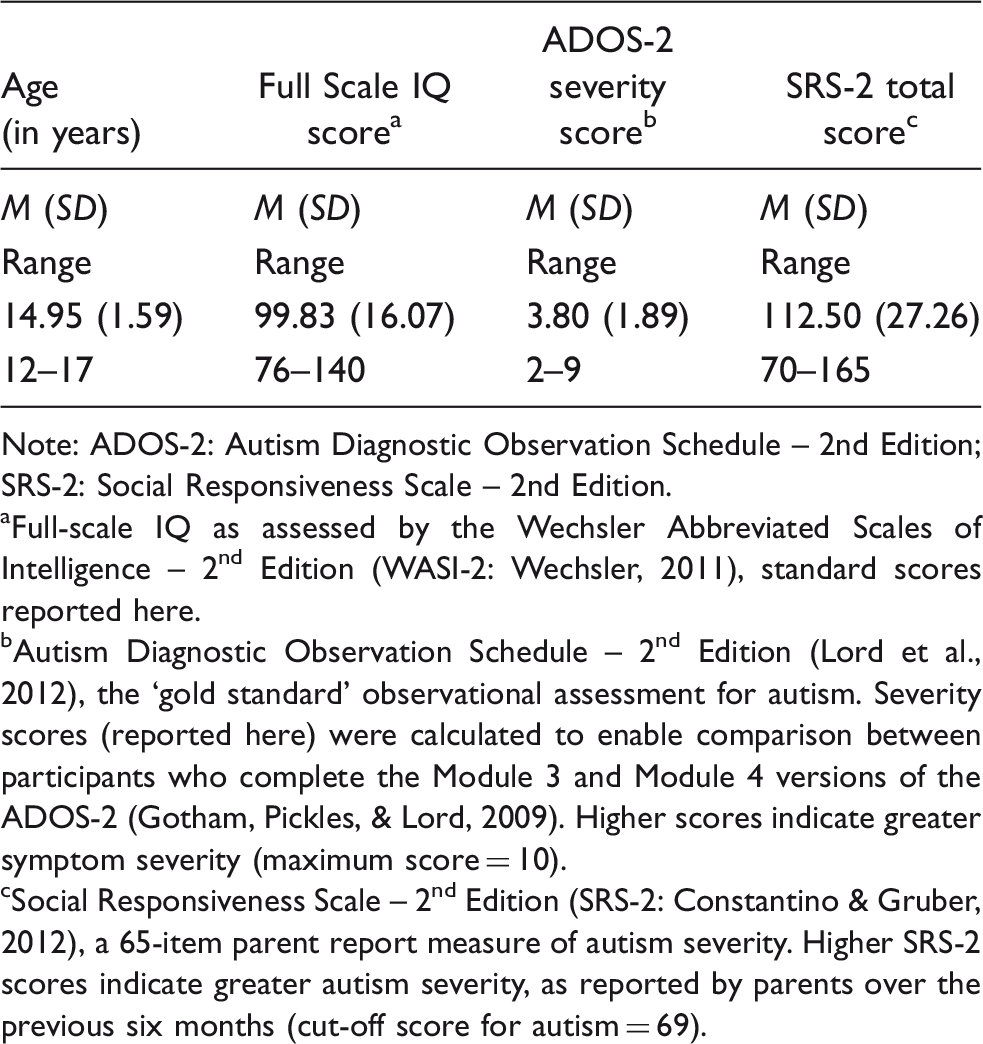
Note: ADOS-2: Autism Diagnostic Observation Schedule – 2nd Edition; SRS-2: Social Responsiveness Scale – 2nd Edition.
Full-scale IQ as assessed by the Wechsler Abbreviated Scales of Intelligence – 2nd Edition (WASI-2: Wechsler, 2011), standard scores reported here.
Autism Diagnostic Observation Schedule – 2nd Edition (Lord et al., 2012), the ‘gold standard’ observational assessment for autism. Severity scores (reported here) were calculated to enable comparison between participants who complete the Module 3 and Module 4 versions of the ADOS-2 (Gotham, Pickles, & Lord, 2009). Higher scores indicate greater symptom severity (maximum score = 10).
Social Responsiveness Scale – 2nd Edition (SRS-2: Constantino & Gruber, 2012), a 65-item parent report measure of autism severity. Higher SRS-2 scores indicate greater autism severity, as reported by parents over the previous six months (cut-off score for autism = 69).
Measures
Semi-structured interview
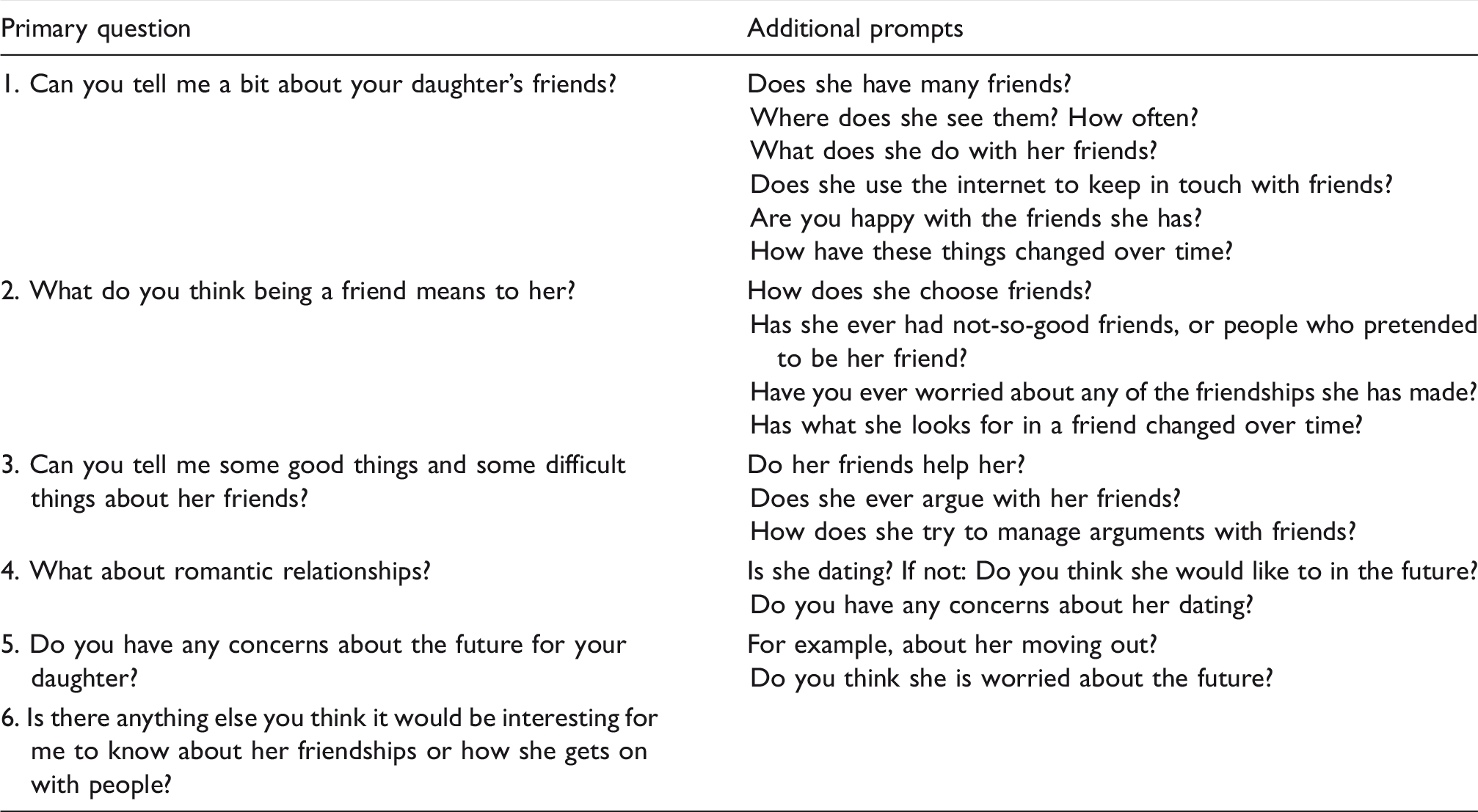
Interview schedule used with the parents of autistic girls. All parents were asked all six primary questions. Additional prompt questions were used when necessary to elicit more specific information.
Ethics
Ethical approval for this study was awarded by the UCL Institute of Education Research Ethics Committee. All participants gave fully-informed written consent. Participants were aware of the topics that were going to be discussed before agreeing to take part. As some topics could have been upsetting to participants, we made efforts to avoid any distress by offering to change topic or skip questions that were deemed too difficult. We also offered signposting to relevant services when appropriate.
Data analysis
All parents consented to be recorded. Interview recordings were transcribed verbatim and subjected to thematic analysis following Braun and Clarke (2006). The phases of thematic analysis include: (1) data familiarisation, (2) generation of initial codes, (3) searching for themes, (4) reviewing themes, (5) defining and naming themes and (6) report production (i.e. write-up of results). We adopted an inductive approach, providing descriptive overviews of the key features of the semantic content of data within an essentialist framework. The analytic process was iterative and inductive in nature, in which the first author coded transcripts line-by-line after initial data familiarisation, and the two other authors read and independently blind-coded 20% of the verbatim transcripts line-by-line for initial codes, seeking to counter potential analytic biases. The authors then met several times to discuss codes, identify discrepancies and reach consensus. The final themes and subthemes identified were decided upon following this process, ensuring that there was internal coherence within a theme and strong distinctions between themes (Paton, 1990). All authors approached the coding and discussions from the perspective of autism researchers.
Results
We identified seven themes (italicised below) in the interviews of parents of autistic girls, as can be seen in Figure 1. Participant ID numbers and the ages of the girls being discussed by their parents is indicated in brackets after each quote, in order to clarify both the differences over time seen by parents and to emphasise that quotes reflect views from the whole range of participants. Diagram showing the themes identified in interviews with parents of autistic girls.
Parents described the nature of autistic girls’ friendships in a remarkably similar way, regardless of the age of their daughters. First, shared interests were often seen as key in forming friendships. Parents described girls as ‘bonding over shared interests’ (03; 12-year-old) and that this was ‘the easiest way to get talking to someone’ (03; 12-year-old). One mother gave an example of how her daughter had been at a concert with her friend and had started talking to a stranger who had overheard her conversation about an anime show and told her how cool she thought it was, in contrast to how her daughter normally acted, usually being very shy and avoidant of strangers (05; 15-year-old). Parents felt that these shared interests made it simpler for their daughters to make and maintain friendships with other young people because it gave a focus to their interactions: ‘they do arts and crafts and things so they can talk about that and there is an excuse not to make eye contact’ (06; 13-year-old). Having friends who were into the same things also meant that autistic girls had the opportunity to talk about their interests, which parents felt played to their strengths: ‘they can talk for hours about books and she gets to be the one who knows the most or is “best” at it, which she usually isn’t’ (19; 17-year-old).
Parents also reported that their autistic daughters’ friendship networks were quite small, often consisting of one or two close friends. Parents talked about how their daughters had ‘a couple of girls [they are] close to’ (04; 14-year-old) or ‘one special friend’ (07; 12-year-old), and that they would ‘have one friend, and then have a new best friend, but one after the other, not both at the same time’ (14; 18-year-old). They felt that this was because girls found it difficult to maintain multiple close relationships at the same time: ‘she finds it hard to follow what everyone is saying or thinking in a group, she’s better one-on-one’ (12; 15-year-old). Interestingly, parents commented that their daughters often found friends who were also autistic or who had some other form of special educational need: ‘she tends to have friends who are vulnerable…[her friends have] learning difficulties’ (02; 16-year-old); ‘her best friend, the school have just assessed and say she has high levels of autistic traits, which is kind of funny to me because we’ve known for ages’ (12; 15-year-old); ‘she has two best friends, and they both have different things – one has severe anxiety and the other has difficulties at home’ (19; 17-year-old).
Parents spoke of their daughters’ frequent and often intense difficulties with friends and peers. They provided examples of instances where their daughters had been bullied at school, such as ‘people push into her’ (03; 12-year-old) or ‘they’d set her up to get her in trouble’ (11; 11-year-old). Some girls had also been targeted because of their sexual identity. One parent recounted a story of how a girl at school had pretended to be attracted to her daughter and arranged a ‘date’, only to turn up with a large group to laugh at her instead (05; 15-year-old). These bullying experiences were common to most of the girls, according to their parents, although they had generally taken place during primary school. Parents also spoke about how these negative experiences had appeared to shape their current difficulties engaging with their peers: ‘she’s a lot more guarded… you have to swim the moat, cross the drawbridge, climb the walls, and then if you’re lucky, she’ll let you into her friendship circle’ (19; 17-year-old). This perceived aloofness could lead to its own problems for the autistic girls, as parents felt that ‘people think she doesn’t want friends, so they leave her alone’ (03; 12-year-old) when in fact ‘she’d like friends, she just doesn’t know how to start a friendship’ (11; 11-year-old).
That autistic girls struggle to manage conflict with their friends was also a common theme. Parents described their daughters as frequently becoming distraught over conflicts with their friends: ‘she’ll go up to her room and cry and cry’ (04; 14-year-old). For some girls, their distress over these incidents could reach a level of unhappiness that it caused them to react by self-harming: ‘I have to watch for her wearing long sleeves, especially if she stops talking about a friend’ (05; 15-year-old). This extreme reaction was mentioned by several parents, suggesting that self-harm, particularly in relation to social situations, may be worryingly common amongst autistic teenage girls.
Some parents also reported that their daughters would abruptly end friendships that had become difficult for them (‘she’ll just stop talking about someone, and when I ask about them say “we’re not friends any more”’ (11; 11-year-old); ‘it’s a shame, but she just acts like that girl never existed now’ (04; 14-year-old)). Parents, however, also recognised that their daughters had sometimes ended friendships over minor things because they had misunderstood or had very ‘black and white thinking about people – once you’ve upset her, that’s it, she’s done, no matter if you say sorry’ (12; 15-year-old). For example, one mother talked about how her daughter had ‘rang me to say people were bullying her outside school, but all I could hear in the background was people saying “hi!” and obviously you’re not there but there was no laughing or anything. I think she was just wanting to be quiet and, because they weren’t being quiet, she thought it was bullying’ (03; 12-year-old).
These negative experiences, potential isolation, and difficulties managing their own responses when things went wrong were discussed by parents as contributing to relatively high levels of mental health issues amongst the autistic girls in the study. Several girls had a history of self-harm, depression and anxiety. Parents were naturally worried about these behaviours and conditions, but reported to struggle to find support: ‘it takes so long to get through Child and Adolescent Mental Health Services (CAHMS) that we just don’t know what to do’ (05; 15-year-old). In the meantime, they felt that there was a lack of appropriate support for their daughters: ‘most people don’t know what to do with a girl who has autism and something else on top… she doesn’t fit their models’ (05; 15-year-old). Another parent raised that this lack of support contributed to her daughter struggling even more with her friendships: ‘when she’s really down, she won’t go out, so they give up asking her, and then she feels even worse’ (02; 16-year-old). This negative feedback cycle appeared to intensify the difficulties that parents see their daughters having with their peers, which they felt feeds into their low mood and social anxiety.
When talking about their daughters’ futures, parents were particularly concerned about ‘wanting her to have a normal life’ and the risk of exploitation. Many parents talked about wanting their autistic daughter to ‘be able to go to uni, have a job, live on her own’ (02; 16-year-old) and not knowing ‘if that will ever be possible’ (11; 11-year-old). Parents were worried about how girls would cope with the practicalities of moving away, such as one mother who said, ‘she wouldn’t eat if she didn’t have someone reminding her, she wouldn’t always shower or brush her teeth… I wouldn’t want her living on her own’ (05; 15-year-old).
Several parents talked about hoping that their daughters would find what they considered to be more ‘typical’ friendships, for example saying, ‘maybe I have to accept that this is how she does it, but it would be nice if she could find a group of friends like her sister’ (02; 16-year-old), because they thought that those relationships would be more fulfilling that the ones they currently saw their daughters having. Others, though, were very accepting of how their daughter socialised, even if they would not want those relationships themselves: ‘you look at her and her friends, and they’ll all be talking about their own thing and none of them listening, or they’ll all sit and read their books in silence. I wouldn’t think that’s friendship, but they’re happy with it, which is fine’ (06; 13-year-old).
Parents’ other major concern centred on the girls’ potential risk of exploitation as they approach adulthood. They worried both socially and romantically for their daughters, either that someone might try to take advantage of the girls’ trusting nature – ‘she thinks the best of people, so she would trust what they said’ (04; 14-year-old) – or of their desire to be liked – ‘if someone said, “Do this and I’ll be your friend,” she’d do it, and that gets dangerous’ (18; 11-year-old). One mother said that she was concerned about her daughter’s future interactions with men, because ‘they might say “I’ve given you a drink, have sex with me,” and she might do it’ (06; 13-year-old). Parents also worried about their daughters ending up in exploitative, abusive or controlling relationships – ‘all her friendships have had a power dynamic, and I think it would be the same with boys’ (04; 14-year-old); ‘I’d be worried about her staying with someone who was bad for her because in her head, someone is better than no-one’ (19; 17-year-old).
This area of concern linked to the next theme identified from the interview data, romantic relationships. Parents were generally unconcerned about their daughters’ sexuality: ‘we’ve said to her, we don’t mind if it’s girls or boys’ (04; 14-year-old), ‘she has a girlfriend now, which is really sweet’ (05; 15-year-old), ‘she’s declared herself asexual, which I think is one less thing to worry about’ (19; 17-year-old). Several girls had boyfriends at the time of the interviews, which they were mostly open about with their parents: ‘she talks to me about things, so I know who she likes and when they started dating’ (05; 15-year-old). Yet, those who were interested in dating or actively dating were still seen by their parents as uninterested in the physical aspect of these relationships: ‘I don’t think she’d want someone touching her’ (05; 15-year-old); ‘I think she’d just like a romance story’ (02; 16-year-old). This attitude persisted even when parents knew that the girls were becoming sexually active, such as one mother who said: ‘I got a bit of a surprise when I found out that they’d kissed’ (13; 14-year-old), and then shortly after also said ‘I don’t think she’s interested in kissing and things’ (13; 14-year-old). Similarly, another parent reported, ‘I think she likes the sensory aspect of people, stroking and touching… she likes that her girlfriend is squishable! I know they’re cuddling on sleepovers and things’ (05; 15-year-old) and followed this up with ‘I don’t think she’s interested in a physical relationship’ (05; 15-year-old).
Parents did not always link these future concerns to their daughter’s current relationships however. Some parents remarked, ‘sex ed[ucation] and all that is up to school, I know she knows about the biology of it all from there’ (03; 12-year-old), and suggested that because schools are responsible for Personal, Social, Health and Economic (PSHE) education, they did not need to discuss relationships with their daughters as much. Parents who felt embarrassed about these conversations, or who thought they were unlikely to be relevant to their child (‘I just can’t see it being an issue, from where we are right now’ (11; 11-year-old)) were in the minority in this sample, but were notable nevertheless.
Notwithstanding, some parents reported making efforts to discuss healthy relationships with their daughters, both in terms of friendships (‘we read a lot of books about friends and talk about what good and bad friends are’ (04; 14-year-old)) and romantic relationships (‘we’ve talked about how you don’t have to do something just because your boyfriend wants to’ (01; 16-year-old)). These parents tended to have fewer concerns about their child being taken advantage of or being vulnerable in that way, even if they were still worried about her future independence: ‘I’m very proud of her because she told him “no, I don’t have to” and she walked away’ (02; 16-year-old). These parents were the most confident about the future and about their relationship, saying that they were ‘pretty open with each other’ (05; 15-year-old).
Despite the many and varied difficulties and concerns which parents discussed having about their daughters’ friendships and relationships, there was a strong theme that there had been a marked improvement with age. Parents reported that the worst instances of bullying and peer aggression had happened when their daughters were in primary school and in the first couple of years of secondary school: ‘in Year 5 some of the girls just stopped talking to her and started leaving her out of everything’ (02; 16-year-old). While they felt that there were undeniably still some on-going difficulties with peers for many of the girls (‘they’ll do things like test her friendship, and say I’m not walking to school with you anymore, and if she doesn’t protest then they tell the others that she doesn’t really want to be their friend and they should leave her alone’ (04; 14-year-old)), these difficulties had reportedly abated over time: ‘it’s better now because she’s got her couple of friends, and everyone else is more mature and let them get on with it’ (19; 17-year-old); ‘people seem to care less about being cool and just accept that their group is the odd, geeky group and that’s fine’ (01; 16-year-old).
Discussion
This study used semi-structured interviews to examine the perspectives of adolescent autistic girls’ parents on their daughters’ friendships, relationships, and futures. In general, parents’ stories of relationships, satisfaction, and self-assurance improve as autistic girls grow up – a perhaps unexpected and encouraging finding. Nevertheless, all parents discussed difficulties and perceived future challenges with their daughters’ friendships and romantic relationships. Parents were particularly concerned about the vulnerability of girls on the autism spectrum as they matured into adults.
One positive finding of this study is that parents were confident that their daughters were talking to them about problems in their lives and asking for support in managing these issues. Research with neurotypical adolescents has shown that those who have strong, open and supportive relationships with their parents are less likely to engage in risky behaviour (Wight, Williamson, & Henderson, 2006), have better resilience (Olsson, Bond, Burns, Vella-Brodrick, & Sawyer, 2003), fewer mental health issues (Armsden & Greenberg, 1987), and better academic outcomes (Jeynes, 2007). This work suggests that autistic girls might also be benefitting from these types of relationships with their parents.
One less positive finding was parents’ discussions of mental health difficulties amongst their autistic daughters. Parent interviews revealed that conditions such as depression and anxiety began early in life for their autistic girls. This finding is in line with existing research, which has shown that autistic adolescents are significantly more likely to be anxious and depressed than their neurotypical peers (Ghaziuddin, Ghaziuddin, & Greden, 2002; Kim et al., 2000; White et al., 2009; see also Crane, Adams, Harper, Welch, & Pellicano, 2017). Baldwin and Costley (2016) showed that mental health issues are prevalent amongst autistic women in Australia. Although these authors did not attempt to examine the onset of these issues in their study, the findings from the current study suggest that mental health issues may develop in late childhood and early adolescence. This apparent developmental trajectory is like that seen in neurotypical girls, who are more likely to develop internalising symptoms (such as depression and anxiety) than their male peers, symptoms which emerge with puberty. Parents felt that the existing mental health service provision Child and Adolescent Mental Health Services (CAMHS) was slow and unwieldy, and felt that improving these services to the specific needs of autistic girls would be valuable, particularly tailoring strategies to the communication needs of their daughters, who might struggle to engage with traditional ‘talking therapies’. This attitude is supported by emerging research on the mental health needs of young autistic people. For example, Crane et al. (2017) highlighted that many young people feel that mental health professionals lack confidence or knowledge to support the intersection of mental health issues and autism. Participants in that study raised the issue of specific needs amongst girls on the spectrum, with one parents saying ‘there wasn’t anything out there for girls…this group is just four or five boys’, and highlighted that this gender imbalance could hinder their daughters’ engagement with support services – ‘why would she want to go to a group with boys?’.
The current findings suggest that autistic girls may benefit from mental health and social support from the beginning of the transition to secondary school, a time that is widely recognised by researchers, educators and parents as especially challenging for young autistic people (Ashburner, Ziviani, & Rodger, 2010; Makin, Hill, & Pellicano, 2017; Sproston et al., 2017). This transition may be particularly difficult for autistic girls, however, as they face a significant jump in what is expected of them socially in adolescence, with peers suddenly communicating in more sophisticated and complex ways, alongside managing the practicalities of high school that are described by autistic boys in the existing literature (Humphrey & Lewis, 2008; Makin et al., 2017). Although our data cannot speak to the potential similarities and differences in the school transition experiences of autistic girls and boys, as we did not interview the parents of autistic boys, this would be an important focus for future research.
One clear and challenging theme of this study was parents’ concerns of their autistic girls’ potential vulnerability to being exploited, especially considering evidence of such exploitation among adult autistic women (Bargiela et al., 2016; Sedgewick et al., 2018b). Parents in this study felt that their daughters tended to be trusting and take people at face-value, rather than understanding implied messages in communications. They worried that girls might therefore struggle to ‘see’ potentially exploitative behaviours within a relationship that was valuable to them, either a friendship or a romantic relationship. This is especially the case because parents highlighted that their daughters often handled conflict incidents by assuming that they were in the wrong. This could potentially leave girls vulnerable to manipulation, as victim-blaming and ‘gas-lighting’ (where someone insists that the victim has misinterpreted or imagined an abusive situation) are common tactics in abusive relationships (Engel, 2002). Autistic girls, who even in adolescence talk about ‘knowing that [they] get things wrong’ in how they act and interpret social situations (Sedgewick et al., 2016), may be especially affected by these tactics that play on that existing insecurity and insists that they have misunderstood what the other person has said or done. The tendency for autistic girls to end friendships over seemingly minor incidents, and their struggle to understand that something may have been an innocent mistake, is another way in which autistic girls’ difficulties with social awareness and communication might impact on their friendship experiences. These difficulties may leave them feeling bullied or isolated, and this isolation could play into an abusive power dynamic within a relationship.
Indeed, parents were especially worried about how their daughters were ‘desperate’ to have friends and boyfriends like their peers or siblings, a desire to fit in that is echoed both in camouflaging research (Hull et al., 2017; Lai et al., 2017) and in writings by autistic women (Hearst, 2015; Steward, 2014). The findings of this study emphasise the importance of having open and frank discussions, both at home and in schools, around consent and healthy relationships to help protect autistic girls. That parents were generally having these conversations with their daughters is encouraging, and is supported by other research (e.g. Cridland et al., 2014). At times, however, parents reported being reticent in discussing these issues with their daughters, as are the parents of girls with other developmental and learning disabilities (Ditchfield & Burns, 2004), and this may leave autistic girls vulnerable as they are therefore unprepared for how to safely handle such a situation if it does arise.
Despite the often-significant social challenges parents described of their daughters, parents felt that their daughters’ friendships and relationships had changed for the better with age. Parents identified clear instances of homophily regarding their friend choices – autistic girls had found friends who were ‘like them’ and with whom they felt comfortable – similar in nature to many young people (autistic or not) (Buhrmester, 1990; Johnson, 2004). The role of ‘special’ interests in forming friendships is not unique to autistic people, although some literature on the subject has described them as so (Boyd et al., 2007; Wing, 1992), positing that they may interfere with engaging in reciprocal conversations if an autistic person monologues on their personal interests. More recent research, however, has shown that autistic girls tend to have age- and gender-appropriate intense interests (Lai et al., 2015; Mandy et al., 2012). These interests can help autistic girls to form bonds with peers who are interested in the same things, giving a focus for communication and reducing anxiety around what to talk about. Having clear interests can also be beneficial to social relationships because it gives autistic people a community to seek out where they know that their passion is shared and respected, such as joining online fan forums (Jordan & Caldwell-Harris, 2012).
Parents talked about a general reduction in bullying as their daughters grew up and their peers matured. Research on bullying has also shown that most types tend to abate as young people mature (Scheithauer, Hayer, Petermann, & Jugert, 2006), although cyberbullying appears to be an exception to this pattern, often because of the phenomenon of ‘trolling’ on social media (Ortega, Elipe, Mora-Merchán, Calamaestra, & Vega, 2009). While a few parents discussed concerns around their daughters’ online presence, this was not something most parents identified or appeared to be worried about. This progression should be reassuring to both autistic girls themselves and their parents, who often expressed concern about the consequences of the conflict their daughters had with their friends.
One other potentially encouraging possibility is that having an autism diagnosis in adolescence – and coming to terms with being autistic as part of one’s identity (Davidson & Henderson, 2010; Huws & Jones, 2008; Punshon, Skirrow, & Murphy, 2009) – may help to support the development of better relationships. Research with late-diagnosed adult women has highlighted that many women find receiving a diagnosis to be a ‘relief’, helping them to understand themselves better (Bargiela et al., 2016; Jones, Goddard, Hill, Henry, & Crane, 2014; Sedgewick, Crane, & Pellicano, submitted-B). It is possible that autistic girls who are diagnosed earlier in life may have the opportunity to develop relationships that account for their autistic behaviours (such as anxiety or communication patterns) earlier than the adult women in the above studies, as they have that understanding of themselves and their needs from a younger age. Both cross-sectional (comparing early- and late-diagnosed autistic women) and longitudinal studies examining the developmental trajectory of autistic girls’ social relationships, identity formation, and self-efficacy would be important avenues to pursue. Considering the variation in Social Responsiveness Scale – 2nd Edition (SRS-2) scores within this group, future work could also usefully examine whether adolescents’ friendship experiences are associated with levels of social difficulty or related to different types of autistic behaviours, especially communication difficulties and styles.
Limitations
This study is not without its limitations. First, the parents of neurotypical girls were not interviewed, so it is not possible to identify potential (dis)similarities regarding parents’ perceptions of autistic and neurotypical daughters’ social experiences. Second, we did not include a group of parents of autistic boys, and therefore were unable to draw any conclusions on possible gender differences. One might expect to find significant differences in the social experiences of autistic boys and girls, both based on research in neurotypical adolescents (Aukett, Ritchie, & Mill, 1988; Paquette & Underwood, 1999; Rose & Rudolph, 2006; Sedgewick, Hill, & Pellicano, 2018a) and emerging work on gender differences in autism (Head, McGillivray, & Stokes, 2014; Lai et al., 2015; Sedgewick et al., 2016). It may be that, although the experiences of autistic boys and girls might differ, their parents feel similarly about some issues, especially regarding mental health issues, which are common in autism (Kim et al., 2000; Strang et al., 2012). It is also the case that this sample was not particularly representative, being mostly White and mostly highly educated. It may be that parents of autistic girls from other ethnic and socio-economic backgrounds have different experiences. Third, most of the parents interviewed were mothers. Previous research has indicated that mothers and fathers of autistic children may report different experiences (Hastings et al., 2005), and therefore it would be valuable to also gain the views of a similar sample of fathers. Finally, it is important to note that the autistic girls whose parents were interviewed in this study were all verbal and cognitively able, which means that the themes may not be representative of the experiences of girls and women across the spectrum. The findings, however, are similar to those studies that have involved autistic girls with additional behaviours that challenge and mild learning disabilities (Sedgewick et al., 2016; Sproston et al., 2017), suggesting that the social experiences of girls on the spectrum might be similar for this broader group.
Conclusion
This study showed that parents have a range of views and concerns about their autistic daughters’ relationships and futures. While some parents appeared to underestimate their daughters, particularly regarding romantic relationships, they all discussed notable improvements in their social experiences over time. These improvements were attributed to increasing peer maturity and gains in social and communicative skills with age. Despite these positive sentiments, parents also voiced concerns about mental health issues, and about their daughters’ transition to adulthood, particularly around romantic and sexual relationships and their potential vulnerability to exploitation. Parents’ recognition that friendships and relationships were central to their daughters’ overall quality of life echoes the views of autistic girls and women themselves (Bargiela et al., 2016; Sedgewick et al., 2018a; Webster & Garvis, 2017), making it imperative to develop tools to help young autistic women enjoy social relationships and negotiate the potential challenges within these relationships as they ‘move on up’ into adulthood. Encouragingly, the parents in this study appeared to be informed about the realities of their daughters’ social lives, and well-placed to support them in forming safe and satisfying relationships into adulthood.
Footnotes
Acknowledgements
We acknowledge and thank the parents who took part for sharing their time and experiences with us.
Declaration of conflicting interests
The author(s) declared no potential conflicts of interest with respect to the research, authorship, and/or publication of this article.
Funding
The author(s) disclosed receipt of the following financial support for the research, authorship, and/or publication of this article: This research was supported by a PhD scholarship from the Economic and Social Research Council (ESRC) to FS. EP was funded by a Philip Leverhulme Prize awarded by the UK’s Leverhulme Trust.