




Abstract
Background and aims
The quality of parent verbal input—diverse vocabulary that is well-matched to the child’s developmental level within interactions that are responsive to their interests—has been found to positively impact child language skills. For typically developing (TD) children, there is evidence that more advanced linguistic and social development differentially elicits higher quality parent input, suggesting a bidirectional relationship between parent and child. The purpose of this study was to evaluate if toddlers with ASD also differentially elicit parental verbal input by (1) analyzing the quality of parent input to the communicative behavior of their toddlers with ASD, (2) examining if parents respond differentially to more advanced toddler communicative behavior, as measured by the coordination of multiple communicative behaviors, and (3) exploring the relationship between parental responsiveness to child communicative behaviors and change in child communication and social skills.
Methods
Participants were 77 toddlers with ASD age 18-39 months and a parent who participated in a larger RCT. Ten-minute parent–toddler interactions were recorded prior to a 12-week intervention. Parent response to child communicative behaviors was coded following each child communicative behavior as no acknowledgment, responsive, directive, or nonverbal acknowledgment. Parent number of different words and difference between parent and child MLU in words were calculated separately for responsive and directive parent utterances. Child growth in language and social skills was measured using the Vineland II Communication and Socialization domain scores, respectively.
Results
(1) Parents were largely responsive to their toddler’s communication. When being responsive (as opposed to directive), parents used a greater number of different words within utterances that were well-matched to child language; (2) when toddlers coordinated communicative behaviors (versus producing an isolated communicative behavior), parents were more likely to respond and their replies were more likely to be responsive; and (3) parent responsiveness to child coordinated communication was significantly correlated with change in Vineland II Socialization but not Communication. A unique role of gaze coordinated child communication in eliciting responsive parental behaviors and improving growth in child social skills emerged.
Conclusions
Our results support a bidirectional process between responsive parent verbal input and the social development of toddlers with ASD, with less sophisticated child communicative behaviors eliciting lower quality parent input.
Introduction
Autism Spectrum Disorder (ASD) is a complex, heterogeneous neurodevelopmental disorder defined by impairments in the development of social communication and interaction (American Psychiatric Association, 2013). These impairments may manifest as reduced gaze shifting, sharing affect, initiating joint attention, and coordinating communicative behaviors as compared to typically developing (TD) peers (Choi, Shah, et al., 2020; Heymann et al., 2018; Landa et al., 2007; Parladé & Iverson, 2015). In addition to this limited sophistication of social skills, children with ASD often present with comorbid deficits in language development (Coonrod & Stone, 2004; Landa & Garrett‐Mayer, 2006). Thus, it is important to understand both social and language development in this population.
Social interactionist (Bruner, 1981; Snow, 1999; Vygotsky, 1978) and transactional theories (Sameroff, 2009) describe language and communication as usage-based systems, influenced by the continuous dynamic interactions of the child and the experience provided by the social environment (Sameroff, 2009). A core tenet of this approach is that the construction of the child’s communication and social systems is bidirectional and best achieved when the caregiver’s input is adapted to the child’s level of development within reciprocal interactions that are responsive to the toddler’s interests (Rowe & Snow, 2020; Sameroff, 2009). For toddlers, both the quantity and quality of parent verbal input have been found to predict later language (Cartmill, 2016; Rowe & Snow, 2020). The quality or richness of the interaction is reflected in the diversity of words a child hears, the match or fine-tuning to the toddler’s linguistic level, and how responsive the parent is to the child’s focus of attention or communicative intention (Cartmill, 2016; Division for Early Childhood of the Council for Exceptional Children, 2014; Schertz et al., 2012). In particular, the diversity of parent language (i.e. the number of different words spoken) is a significant positive predictor of toddlers’ vocabulary skills, over and above total number of words (Huttenlocher et al., 2010; Rowe, 2012). Further, children are able to comprehend increasingly lengthy utterances and more complex sentence structure as they develop (Rowe & Snow, 2020). Parent input that models slightly more complex versions of a child’s speech is associated with later language skill (McDuffie & Yoder, 2010; Tamis-LeMonda et al., 2001).
The interactional quality of responsive parental input has consistently been found to facilitate child language and social communication skills in TD children and children with ASD and developmental delays (Rollins, 2003; Masur et al., 2005; McDuffie & Yoder, 2010; M. L. McGillion et al., 2013; Patterson et al., 2014; Ruble et al., 2008; Siller & Sigman, 2002; Tamis-LeMonda et al., 2001; Yoder & Warren, 2004). Responsive parent behaviors are those that are semantically and temporally contingent to a child’s communication and focus of attention (Bornstein et al., 2008; McDuffie & Yoder, 2010; M. L. McGillion et al., 2013), as opposed to directing the child’s attention elsewhere or placing demands on the child (Carpenter et al., 1998). Parental responsiveness thus provides a referential framework in which the toddler does not need to shift their attentional focus, increasing their capacity for word learning (Rollins, 2003; Bruner, 1983; Snow, 1999). In contrast, directive parental behaviors—those that attempt to change the child’s focus of attention (Shire et al., 2016; Flynn & Masur, 2007)—have been negatively correlated with children’s subsequent language and social skills (Akhtar et al., 1991; Masur et al., 2005; Nelson, 1973; Patterson et al., 2014; Tomasello et al., 1986). While much research has looked at parent responses to child attentional focus broadly, less is known about parent responses to child communicative behaviors specifically, particularly to those of children diagnosed with ASD.
For TD children, the coordination of communicative behaviors and the sophistication of a child’s pre-linguistic/emerging linguistic communication (i.e. vocalizations and gestures) influences the verbal input a child receives, thus creating the type of social interaction that facilitates language and social development (Albert et al., 2018; Donnellan et al., 2020; Gros-Louis et al., 2006; Leezenbaum et al., 2014). For example, Gros-Louis et al. (2006) found more advanced child vocalizations were more likely to be met with imitation or expansion as compared to less advanced vocalizations. Leezenbaum et al. (2014) found parents of TD children were more likely to translate developmentally advanced point/show gestures than developmentally prior give/request gestures. And Donnellan et al. (2020) found gaze coordinated vocalizations/gestures were more likely to be met with a parent response than vocalizations/gestures produced in isolation; further, parental responsiveness to gaze coordinated communication predicted later language skills.
These findings suggest a bidirectional relationship between parent and child in which the child’s communicative abilities influence the parent’s responses, which in turn impact the child’s communicative and social development (Adamson et al., 2020; Albert et al., 2018; Rowe & Snow, 2020). However, there is a paucity of research concerning the relationship between child communicative abilities and parent responses in children with ASD. Choi, Nelson, et al. (2020) found parents of children at high familial risk for ASD were similarly responsive to child communication as parents of TD children. Likewise, Choi, Shah, et al. (2020) found parents of children later diagnosed with ASD were equally responsive to infant gestures as parents of TD children. In contrast, Leezenbaum et al. (2014) found different patterns of responsiveness in parents of children at high familial risk for ASD as compared to parents of TD children. Of note, the samples included in these studies consisted primarily of non-Hispanic Caucasian participants, limiting generalizability. This is a particularly important area of exploration as the limited linguistic and social sophistication of the communicative behaviors of many children with ASD may fail to elicit the very parental behaviors that have been shown to benefit their language development, resulting in a negative developmental cascade (Leezenbaum et al., 2014). Acquiring a better understanding of how the communicative behaviors of young children with ASD influence parental responses and the effect this may have on later communication and social development has the potential to inform intervention practices.
The purpose of this study was threefold. We first sought to describe parent temporally contingent responses to child communicative behavior by examining the categories of responses (e.g., responsive, directive) used and the linguistic input provided within each response category. Our second goal was to explore the extent to which parents responded differentially to the communication of their toddlers with ASD when their toddler communicated using one behavior in isolation (e.g., vocalization) as compared to coordinating two or more behaviors (e.g., vocalization with eye gaze). Finally, our third goal was to explore the relationship between parental temporally contingent responsiveness to child communicative behavior and change in child communication and social development. Three research questions guided this study:
RQ1: What is the quality of parents’ interactions (e.g., responsiveness) and linguistic input when responding to their toddlers’ communicative behaviors, prior to participating in the intervention phase of a research study? RQ 2: Are parents of toddlers with ASD more likely (1) to respond to their toddlers with ASD and (2) to be more responsive when their toddlers coordinate two or more communicative behaviors versus when they produce a single behavior in isolation, prior to the intervention phase of a research study? RQ 3: Is parent responsiveness to child communicative behaviors associated with positive change in child communication and social skills, measured before and after an intervention study, above and beyond the effects of intervention?
First, we hypothesize parents will exhibit a primarily responsive interactional style to the communication of their toddlers with ASD; we further propose that parents will use more diverse vocabularies and will more closely match their utterance length (equal to or slightly above their toddlers’) when they are being responsive than when they are being directive. Second, we hypothesize parents of toddlers with ASD will be more likely (1) to respond to their toddlers’ communicative behaviors and (2) to be responsive when toddlers coordinate two or more communicative behaviors versus when they produce a single behavior in isolation. Finally, we hypothesize parent responsiveness to child communicative behavior will be positively associated with growth in child communication and social skills.
Data for this study was drawn from a randomized control trial (RCT). The first 2 RQs were examined at Time 1 prior to randomization; growth in communication and social skills for RQ 3 was determined as change from Time 1 to Time 2 (post-intervention).
Methods
Participants
Participants for this study were 78 toddlers with ASD age 18–39 months (M = 28.2 months, SD = 5.2 months) and a parent. 1 The participating parent completed all assessment measures and intervention procedures. One dyad was missing data at Time 1; thus, the current study includes data from 77 participants. Families were recruited through local infant-toddler programs, community centers, advocacy groups, physicians’ offices, social media, and word of mouth. Inclusion criteria included: having a chronological age of less than 39 months at baseline; receiving an “autism” classification on the Autism Diagnostic Observation Schedule, Second Edition (ADOS-2, Lord et al., 2012), administered by an ADOS-2 reliable examiner; having no other known medical, neurological, or genetic concerns or disorders; and having a primary home language of English or Spanish.
Toddler and family characteristics at the start of the study are summarized in Table 1. Of note, average autism symptom severity was classified in the “High” range on the ADOS-2. Mean toddler nonverbal IQ on the Mullen Scales of Early Learning (MSEL; Mullen, 1995) as well as communication and social skills measured by the Vineland Adaptive Behavior Scales, Second Edition (Vineland II; Sparrow et al., 2005) were significantly below the average range for TD children. Approximately 77% of participating caregivers identified as a racial/ethnic minority, and about 47% of families were CHIP/Medicaid eligible. Overall, this constitution mirrored the statewide Early Childhood Intervention (ECI) estimates (Texas Health and Human Services, n.d.). All parents consented to the study using an informed consent procedure approved by the university’s Internal Review Board.
Toddler, participating parent, and family characteristics at Time 1 (n = 77).

Note. ADOS-2 Total CSS = Autism Diagnostic Observation Schedule, Second Edition Total Calibrated Severity Score (8–10 = high level of ASD-related symptoms); Nonverbal IQ is based on the fine motor and visual reception scales of the Mullen Scales of Early Learning; VABS Communication = Vineland Adaptive Behavioral Scales, Second Edition (Vineland II) Communication domain standard score; VABS Socialization = Vineland II Socialization domain standard score; Nonverbal IQ and Vineland II domain scores are standard scores based on M = 100, SD = 15; CA = communicative act; †Data is missing for one participating parent; Other = ethnicities for which there were few participants (e.g., Black/African American, Asian); CHIP = Children’s Health Insurance Program.
Study design
Participants took part in a larger randomized control trial that examined the efficacy of Pathways Early Autism Intervention (Pathways), a parent-mediated early autism intervention in improving early communication and social skills in toddlers with ASD over a 12-week period (Rollins, 2018; Rollins et al., 2020). Pathways was a low dose (1.5 hours/week) parent-mediated naturalistic developmental behavioral intervention that coached parents on strategies to embed mutual eye gaze in face-to-face reciprocal interactions. The Pathways group was compared to a communication group and a services-as-usual (SAU) group. The communication group was similar to the Pathways group but focused on embedding communication—rather than mutual gaze—in dyadic social interactions. The SAU group received community based ECI services. The magnitude of the effect of the intervention on child social skills was large compared to the SAU group and medium compared to the communication group. There was no effect on child communication in terms of frequency and diversity of communication (Rollins et al., 2020).
For the current study, we examined Time 1 videos of parent–toddler interactions collected prior to the start of the intervention phase (RQs 1-2). In addition, we examined the effects of parent responsiveness, over and above the effects of group, on change in the Communication and Socialization domains of the Vineland II parent interview. These interviews were administered prior to the start of the intervention phase (Time 1) and within 2 weeks of completing the intervention phase of the study (Time 2; RQ 3).
Procedures
Each parent/toddler dyad participated in a 10-minute naturalistic play session in the family’s home prior to the start of the intervention phase (Time 1) and again within 2 weeks after completing the intervention (Time 2). Parents were instructed to play with their toddler the way they typically would; no other instructions were provided on how to conduct the interaction. Fifty-three dyads interacted primarily in English and 24 in Spanish. Parents were free to choose the toys they typically used when interacting with their toddler, or to interact with them without toys. In addition to toy play, observed activities included (but were not limited to) book reading, reciprocal social routines (e.g., peek-a-boo), and singing. Play sessions were digitally recorded using an iPad 2 for a wide-angle view and hidden camera glasses worn by the parent to capture the toddler’s eye gaze. For each recording, the two streams of video (iPad and glasses) were time linked, transcribed, and coded using the conventions of the Child Language Data Exchange System (CHILDES; MacWhinney, 2000). Transcription was conducted at the level of the communicative act and included all verbal, vocal, and gestural behaviors bounded by a pause or change in conversational turn (Pan et al., 2005). For Spanish speaking dyads, bilingual (Spanish/English) research assistants transcribed in Spanish and provided English translations on a secondary coding line. Coding was conducted by research assistants who were trained on a specific coding system and were blind to group assignment and time (Time 1 versus Time 2). Coders were trained on practice videos until they achieved substantial inter-rater agreement, measured by obtaining a Cohen’s kappa coefficient of .80 or above. Cohen’s kappa accounts for agreement that occurs by chance (Yoder et al., 2018). To protect against coder drift, coders attended weekly lab meetings to discuss coding, and their reliability was checked by a master transcriber/coder every three months.
Measures
Assessment batteries were administered to participants by researchers in the participants’ home or at a location convenient for the family. Researchers were blind to group assignment at Time 1 but not at Time 2. Three researchers had master’s degrees and one a bachelor’s degree with 15 years of assessment experience. Researchers were trained to reliability on all assessment procedures prior to the start of the study. Specifically, the researchers reviewed administration and scoring procedures and obtained 90% reliability on all standardized tests with a licensed psychologist who was research-reliable on the ADOS-2. Two researchers were present for child assessments (one administered while the second assisted). Only one clinical researcher administered the adult standardized interviews. All tests were independently scored by two researchers to check accuracy.
ASD classification
The ADOS-2 was administered by the researchers at Time 1 prior to randomization to confirm a research diagnosis of ASD. The ADOS-2 is a semi-structured evaluation of communication, social interaction, play, and restricted/repetitive behaviors for children who are suspected of having ASD. The ADOS-2 is available in five versions (modules) that are selected based on the child’s age and expressive language level. For the present study, the ADOS-2 Toddler Module and Module 1 were administered by a researcher who was trained on site to be ADOS-2 reliable. The Toddler Module, which is intended for children 12–30 months of age, was administered to 60 toddlers. Module 1 of the ADOS-2, which is intended for children aged 31 months and older whose language abilities range from no speech to simple phrases, was administered to 17 toddlers. All ADOS-2 scores were converted to Calibrated Severity Scores (CSS) to allow comparisons across modules.
Nonverbal IQ
The MSEL (Mullen, 1995) was administered by the researchers at Time 1 prior to randomization to estimate nonverbal IQ scores. The MSEL is a standardized, direct assessment of development for young children (ages 0–68 months) that yields age equivalency scores for gross and fine motor skills, visual reception, and receptive and expressive language. Using the procedure outlined by Bishop et al. (2011), we used MSEL age-equivalency scores for fine motor skills and visual reception to estimate nonverbal IQ scores.
Communication and social skills
The parent interview form of the Vineland II was administered by the researchers at Time 1 prior to randomization and at Time 2. The Vineland II is a standardized test of adaptive functioning for individuals from birth to age 90 years. The test yields an adaptive behavior composite score and domain scores for communication, daily living, socialization, and motor development and has good test–retest reliability (.88–.92). For the current study, we used data from the Communication and Socialization domains.
Video-coded measures
Complexity of child communicative behavior, parent response to child communicative behavior, total number of different words, and MLU in words (MLU-w) were extracted from the 10-minute coded transcript files, using the utilities of the Computerized Language Analysis software package (CLAN; MacWhinney, 2000). All transcripts were checked for errors in accordance with the procedures in the CHILDES MOR manual (page 27; MacWhinney, 2000). A final inter-rater reliability assessment was conducted for each video-coded measure after project-related coding was completed. Specifically, a second rater independently coded 20% of the Time 1 videos, chosen at random, and 20% of the Time 2 videos, chosen at random, for each measure.
All transcripts were first run through the English or Spanish version of the MOR parser, which segments word stems and parts of speech. The MOR program parses the English language with 99.18% accuracy and the Spanish language with 95% accuracy. Final study reliability (Cohen’s kappa) for transcription was M = .80, SD = .10 (English-speaking participants: M = .78, SD = .10; Spanish-speaking participants: M = .82, SD = .09). Only Time 1 videos were used in the current analyses.
Complexity of Child Communicative Behavior
Following Heymann et al. (2018) and Rollins et al. (2020), child communicative acts formed by simultaneously producing two or more communicative behaviors (i.e., coordination) and those formed with by producing only one behavior (i.e., isolation) were used to measure the social complexity of child communicative acts. Communicative behaviors included vocalizations (non-word vocal sounds that appeared to have communicative intent but not vegetative or non-speech sounds), words (including word approximations), and gestures produced by the toddler that were either initiations or responses. For the present study, three coordination measures were used: overall coordination consisted of two or more temporally overlapping communicative behaviors OR one or more communicative behaviors and temporally overlapping eye gaze. Eye gaze was coded using the view afforded by the parents’ hidden camera glasses. Gaze coordination consisted of one or more communicative behaviors and temporally overlapping eye gaze. Finally, gesture coordination consisted of a gesture and one other temporally overlapping communicative behavior and/or temporally overlapping eye gaze. Note that the categories of gaze coordination and gesture coordination are not mutually exclusive (e.g., a toddler can produce a gesture coordinated with eye gaze). Final study reliability (Cohen’s kappa) for complexity of child communicative behavior was M = .99, SD = .03 (English-speaking participants: M = .99, SD = .05; Spanish-speaking participants: M = .99, SD = .01).
Parent Response to Child Communicative Behavior
Parent response to child communicative behavior was used to measure interactional input and was coded at the level of the communicative act from the transcripts of parent–toddler interactions (Pan et al., 2005). This coding system was adapted from Flynn and Masur (2007) and McDuffie and Yoder (2010) and captures the parent’s temporally contingent responses to the child’s communicative behaviors. Temporally contingent responses occur within 3 seconds of a child communicative behavior (McDuffie & Yoder, 2010). Parents’ responses were coded as one of five mutually exclusive categories: ignoring, onlooking, responsive, directive, or nonverbal acknowledgment (Table 2). For the present study, ignoring and onlooking were collapsed into a single category to capture that the parent did not verbally or nonverbally acknowledge the toddler (no acknowledgment). To control for frequency of child communication during the interaction, these measures were calculated as proportions (i.e. number of parent responses within a given category divided by total number of child communicative acts). Final study reliability for parent response to child communicative behaviors was M = .88, SD = .12 (English-speaking participants: M = .89, SD = .13; Spanish-speaking participants: M = .86, SD = .11).
Parent response to child communicative behavior category definitions.

Number of Different Words
Number of different words produced by the parent was used as a measure of linguistic diversity in response to child communication. Number of different words was calculated using the automated functions of the CLAN KIDEVAL program, which calculates number of different words based on the output from the MOR parser (see above for final study reliability for transcription). In the current study, number of different words was calculated separately for parent utterances that were responsive and parent utterances that were directive to the child’s communicative behavior.
MLU-w Difference
The difference between parent and child MLU-w was used as a measure of the degree to which parent verbal input was well-matched to their toddler’s verbal language skills. We chose MLU in words (versus morphemes) because Spanish is a highly inflected language and English is not. To obtain MLU-w difference, parent and toddler MLU-w were first calculated using the automatic functions of the CLAN KIDEVAL program, which calculates MLU-w based on the output from the MOR parser (see above for final study reliability for transcription). Next, we subtracted child MLU-w from parent MLU-w to obtain the measure of MLU-w difference. Negative numbers indicated the parent responded using fewer words than the child whereas positive numbers indicated the parent responded using more words than the child. We interpreted an MLU-w difference of 0–1.75 (equal to or slightly more complex than the toddler’s MLU-w) to be well-matched to the child. In the current study, MLU-w difference was calculated separately for parent utterances that were responsive and parent utterances that were directive to the child’s communicative behavior.
Data analytic strategy
We first describe the characteristics of the toddlers in our sample. Means and standard deviations were reported when variables had symmetrical distributions, and the median and spread were used for highly skewed distributions. The latter provides an accurate and concise summary of skewed variables. For analysis of the RQs, nonparametric statistics were chosen when the data did not satisfy the conditions of parametric statistics.
For RQ 1, we analyzed the quality of parents’ interactions when responding to the toddlers’ communicative acts (i.e. proportion of each responses category to total child communicative acts) using a Friedman test (non-parametric equivalent of a repeated measures analysis of variance). Post-hoc testing was conducted with Wilcoxon signed-rank tests (non-parametric equivalent to paired samples t-test). The effect size measure r was used and is calculated as z/√N (Field, 2009). For the analysis of parent linguistic input (number of different words and MLU-w difference in responsive versus directive), we used paired samples t-tests with Cohen’s d as the effect size measure. Note that these analyses could only be conducted with parents whose toddlers communicated at least once.
To examine parents’ differential responses to child communicative behaviors produced in isolation versus in coordination (RQ2), we used Wilcoxon signed-rank tests. Because this is a within-person analysis, only data from toddlers who used both communicative behavior in isolation and coordination could be used in these analyses.
Finally, we analyzed the relationship between parent responsiveness to child communicative behaviors at Time 1 and subsequent change in communication and social skills that was above and beyond the effects of intervention (RQ 3). To address this question, we first calculated difference scores (Time 2 minus Time 1) for Vineland II Communication (Δ VABS Comm) and Socialization domain raw scores (Δ VABS Social). Raw scores were used because standardized scores would compare some toddlers (but not all) to a different reference group at Time 1 and Time 2. Concerns regarding regression to the mean were addressed in the larger study through randomization of participants and analysis indicating equivalency of groups on baseline characteristics (Allison, 1990; Barnett et al., 2004; Kelly & Ye, 2017). Next, we conducted preliminary analyses to evaluate bivariate relationships among the background variables and the outcome variables to identify potential covariates. Following the principle of parsimony, only background variables related to an outcome variable were retained as covariates for subsequent analyses. As we were interested in the effect of parents’ response to child communication over and above progress attributable to group, we included group assignment as a covariate in all analyses of change to account for variation that could be attributable to intervention. To test the research question, partial Spearman’s rho correlations were performed between the parental responsiveness to child communication variables (isolation, overall coordination, gaze coordination, and gesture coordination) and the outcome variables (Δ VABS Comm and Δ VABS Social) after adjusting for group and relevant covariates. Of note, only children who produced a given type of communication (isolation, overall coordination, gaze coordination, and gesture coordination) could be used in that analysis.
Statistical analyses were performed using IBM SPSS Statistics (Version 26). Statistical significance was set at .05 based on a two-tailed test for RQ 1 and all preliminary statistics and at .05 based on a two-tailed test for RQs 2 and 3 due to the directional nature of our hypotheses.
Power analyses
Sensitivity power analyses were conducted to determine detectable effect sizes given defined α (.05) and power (.80) and achieved sample sizes. For RQs 1 and 2, analyses were conducted using the program G*Power version 3.1.9.4 (Faul et al., 2007). Results indicated small effects could be detected for our analyses of parent response categories (dz = .33) and linguistic input within responsive and directive parent responses (dz = .32). For our second RQ (parent response to isolated and coordinated child communicative behaviors), results indicated small effect sizes could be detected (overall coordination dz = .40, gesture coordination dz = .42, and gesture coordination dz = .49). Web-based WebPower (Zhang & Yuan, 2018) was used to conduct the sensitivity analysis for the relationship between parental responsiveness and change in communication and social skills (RQ 3) because it allows for the inclusion of covariates in power analyses for correlations. Results indicated medium to large effect sizes could be detected (responsiveness to isolation r = .337, overall coordination r = .421, gaze coordination r = .453, and gesture coordination r = .526).
Results
Sample characteristics
Sample characteristics for the full sample are presented in Table 1. Characteristics of the toddlers who produced communicative behavior in both isolation and coordination as compared to those who used only one or neither type of communication are presented in Table 3. Toddlers who used both isolation and coordination were statistically older and less cognitively and linguistically impaired with lower levels of autism symptom severity than those who used only one or neither type. However, their average scores still fell significantly below the population mean on the measures of nonverbal IQ and communication, and their average level of autism symptom severity still fell in the “high” range. This pattern of results was similar for the subsequent analyses of gaze coordination and gesture coordination. See supplementary materials for these comparisons.
Characteristics of toddlers who produced isolation and overall coordination (n = 42) vs toddlers who produced only isolation, only overall coordination, or neither (n = 35).

Note. ADOS-2 Total CSS = Autism Diagnostic Observation Schedule, Second Edition Total Calibrated Severity Score (8-10 = high level of ASD-related symptoms); Nonverbal IQ is based on the fine motor and visual reception scales of the Mullen Scales of Early Learning; VABS Communication = Vineland Adaptive Behavioral Scales, Second Edition (Vineland II) Communication domain standard score; VABS Socialization = Vineland II Socialization domain standard score; Nonverbal IQ and Vineland II domain scores are standard scores based on M = 100, SD = 15; CA = communicative act; Language is the primary language used by the child during the parent-child interaction; d = Cohen’s d; V = Cramer’s V.
Significance set at .05 based on a two-tailed test.
The toddlers in this study infrequently communicated with their parents (Table 4). Of the nine toddlers who did not produce a behavior in isolation, two produced only behaviors in coordination; the remaining seven did not produce any communicative acts in isolation or coordination.
Minimums, maximums, and quartiles for number of child communicative acts produced in isolation, with overall coordination, with gaze coordination, and with gesture coordination (n = 77).

Parent responses to child communicative behaviors
Five number summaries for the frequency of occurrence of the four parent response categories are presented in Table 5. Parents rarely provided nonverbal responses to their toddlers, so this category was removed from subsequent analyses.
Minimums, maximums, and quartiles for frequency of parent response by category to total child communicative acts (n = 77).

Results of a Friedman test indicate there was a significant difference in the proportion of parent response categories (no acknowledgement, responsive, directive) to total child communication (χ2[2] = 85.10, p < .001, n = 70). Post hoc Wilcoxon signed-rank tests with a Bonferroni correction to account for multiple tests (resulting in a significance level of p = .017) revealed a toddler’s communicative act was more likely to be followed by a responsive parent response than a directive response (Z = −6.014, p < .001, r = .714) or no acknowledgment (Z = −6.618, p < .001, r = .785), with large effect sizes. Thus, parents were largely responsive to child communication.
Paired samples t-tests revealed parent number of different words was significantly greater in responsive utterances as compared to directive utterances with a medium effect size, t(69) = 5.663, p < .001, d = .55 (responsive: M = 26.34, SD = 24.96; directive: M = 14.99, SD = 15.40). Conversely, the difference between parent and child MLU-w when parents were being responsive was significantly smaller than when parents were being directive, with a medium effect size, t(69) = −3.206, p = .002, d = .56 (responsive: M = 1.71, SD = 1.46; directive: M = 2.79, SD = 2.28). Thus, parents used more diverse vocabularies and more closely matched their utterance length to the toddler’s level of communication when they were being responsive as opposed to directive.
Parent responses to child communicative behaviors in isolation vs coordination
Results of Wilcoxon signed-rank tests indicate parents were significantly less likely to not acknowledge (i.e. were more likely to respond to) child communication produced with 2+ coordinated behaviors, with coordinated eye gaze, and with coordinated gesture as compared to one behavior isolation, with large effect sizes (Table 6). Parents were also significantly more likely to be responsive to child communication produced with 2+ coordinated behaviors, with coordinated eye gaze, and with coordinated gesture as compared to one behavior in isolation, with medium effect sizes. Parents were infrequently directive to their toddlers’ communication, and there was no significant difference in parent directiveness to child communicative behaviors produced in isolation as compared to any of the three coordination measures.
Wilcoxon signed rank tests: parent response to child communicative behaviors produced in isolation versus with overall coordination (n = 42), gaze coordination (n = 38) and gesture coordination (n = 28).

Note. Significance set at .05 based on a one-tailed test.
Parent responsiveness to child communicative behaviors and change in communication and social skills
Bivariate correlations revealed Δ VABS Social was related to nonverbal IQ and Time 1 Vineland II Communication (Table 7). Δ VABS Comm was related to nonverbal IQ and Time 1 Vineland II Communication and Socialization (the two Vineland II subtests were highly correlated with each other; the Communication domain was retained because it was more strongly correlated with the outcome). Analyses of variance revealed parent ethnicity and child gender were not related to the outcome measures.
Correlation coefficients (Spearman’s rho) among background variables (1–8) and outcome variables (9–10; n = 77).
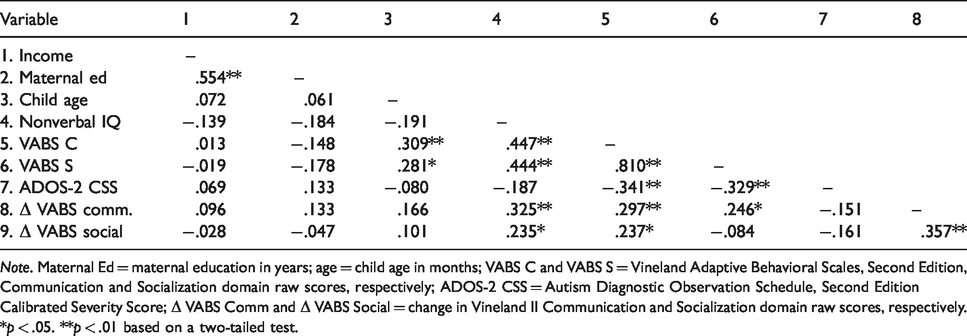
Note. Maternal Ed = maternal education in years; age = child age in months; VABS C and VABS S = Vineland Adaptive Behavioral Scales, Second Edition, Communication and Socialization domain raw scores, respectively; ADOS-2 CSS = Autism Diagnostic Observation Schedule, Second Edition Calibrated Severity Score; Δ VABS Comm and Δ VABS Social = change in Vineland II Communication and Socialization domain raw scores, respectively.
*p < .05. **p < .01 based on a two-tailed test.
Partial Spearman’s rho correlations (partial rs) revealed parental responsiveness to communicative behaviors produced with coordinated eye gaze was significantly correlated with Δ VABS Social but not Δ VABS Comm after adjusting for group, nonverbal IQ, and Time 1 Vineland II Communication (Table 8) Further, parent responsiveness to communicative behaviors produced in isolation, with overall coordination, or with coordinated gesture was not correlated with Δ VABS Social or Δ VABS Comm when controlling for group, nonverbal IQ, and Time 1 Vineland II Communication.
Partial Spearman correlations (partial rs) among isolation/coordination variables and outcome variables, adjusting for nonverbal IQ, time 1 Vineland II Communication Score, and Group.
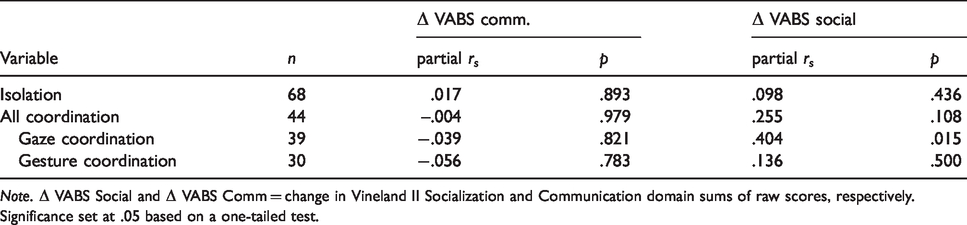
Note. Δ VABS Social and Δ VABS Comm = change in Vineland II Socialization and Communication domain sums of raw scores, respectively.
Significance set at .05 based on a one-tailed test.
Discussion
Children with ASD frequently exhibit social interaction difficulties coupled with language deficits (Choi, Shah, et al., 2020; Coonrod & Stone, 2004; Heymann et al., 2018; Landa & Garrett-Mayer, 2006; Landa et al., 2007; Parladé & Iverson, 2015). Studies of TD children have indicated parents respond differentially to the linguistic and social sophistication of children’s communicative behaviors, suggesting a bidirectional relationship between parent input and child development. Specifically, parents are more likely to respond to more advanced child communication (Donnellan et al., 2020; Gros-Louis et al., 2006; Leezenbaum et al., 2014), and these responses are more likely to be responsive (Donnellan et al., 2020). Thus, for young children who have difficulties developing communication skills—such as many children with ASD—parents may not be using the very behaviors that facilitate their communication and social development.
The purpose of the current study was to examine the quality of parent input to the communicative behavior of their toddlers with ASD and to analyze the effect of parent responsiveness on change in child language and social skills above and beyond the effects of intervention. The participants in our sample were culturally and economically diverse, and the toddlers were largely cognitively and linguistically impaired with high levels of autism symptom severity; thus, our sample was representative of the ECI population in our state.
While studies have found that parents of children ASD tend to be directive to their children’s attentional focus (Kasari et al., 2014; Kim & Mahoney, 2004), the present study found parents of toddlers with ASD were largely responsive to child communicative behaviors. Further, when being responsive, parents were more likely to provide diverse linguistic input that was well-matched to the child’s language. Thus, when toddlers with ASD communicate, they are more likely to elicit the type of linguistic and interactional input that is most likely to benefit their language and social development.
Consistent with our hypotheses, we found parents were more likely to acknowledge their toddler with ASD when the toddler communicated using two or more coordinated behaviors rather than one behavior in isolation; further, these parental responses to coordinated behaviors were more likely to be responsive. Analyses of gaze coordination and gesture coordination revealed similar patterns of results. These findings are consistent with work conducted with TD children indicating the social (e.g., coordination of behaviors) and linguistic sophistication of a child’s communication influences the quality of input they receive (Albert et al., 2018; Donnellan et al., 2020; Gros-Louis et al., 2006; Leezenbaum et al., 2014). This suggests children with ASD and their TD peers similarly influence their communication and social environments.
Finally, we conducted analyses to explore the relationship between parent responsiveness to child communication and change in language and social skills (change in Vineland II Communication and Socialization domain raw scores). In partial consistency with our hypothesis, we found parent responsiveness to child communicative behavior produced with coordinated eye gaze was related to change in parent-reported social—but not communication—skills. As noted previously, parents were more likely to (1) respond to their toddler with ASD and (2) provide responsive input when their toddler communicated with gaze coordinated behaviors as compared to with one behavior in isolation. Thus, a gaze coordinated behavior increased the chances that a toddler subsequently engaged in a social interaction with their parent. Over time, this accumulation of social experiences may have led to improved child social skills. Our finding that there was no relationship between parent responsiveness to child communicative behavior produced with eye gaze and change in child communication skills is inconsistent with findings from Donnellan et al. (2020) who found parent responsiveness to the gaze coordinated behaviors of cognitively intact 11-month-old infants was predictive of later language skills. This discrepancy may be due, in part, to the difference in the child population and duration between the two studies: Donnellan et al. measured child language skills up to 13 months after baseline, whereas the present study measured change after only 3 months. Three months may not have been enough time for cognitively and linguistically impaired toddlers with ASD to exhibit growth in communication skills (the emergence of which follows that of many social skills in development). Future research should explore if parent responsiveness to the communication of toddlers with ASD is related to growth in communication skills over a period longer than 3 months. Sample demographics may also explain, at least in part, differences in outcomes between these two studies. Direct comparisons cannot be made on factors such as family income, parent educational level, or participant race/ethnicity given the information reported (see McGillion, 2017 for detailed sample characteristics of the Donnellan et al., 2020 study). For example, race/ethnicity data was not provided; however, given that the sample recruited by McGillion and colleagues consisted of British monolingual English speakers while the present sample consisted of families who were residents of a large southern US metroplex (31% of whom were monolingual English speakers), it is possible there were differences in race/ethnicity between the samples. Differences have been found across race/ethnicity in parent responsiveness to child attentional focus (Tamis-LeMonda et al., 2012). However, no differences emerged in the present study of parent responsiveness to the communication of toddlers with ASD. Our findings are consistent with work from Weisleder et al. (2019) who found no differences in the temporal contingency of parent responses between Hispanic and Non-Hispanic parents of children with ASD. Given the paucity of data, the role of cultural differences on parental responsiveness to child’s communicative behaviors should be considered for future research in order to inform culturally sensitive early intervention for children with ASD.
Interestingly, the effect sizes for parent responsiveness to communicative behaviors that were coordinated with gaze were consistently larger than for overall coordination or gesture coordination. Further, only parent responsiveness to gaze coordinated behaviors was associated with change in child social skills. These results suggest a unique contribution of eye gaze on the development of child social skills and extend our recent findings that mutual eye gaze was a key component in improving social skills of young children with ASD (Rollins et al., 2020). As suggested by Heymann et al. (2018), a communicative behavior coupled with eye gaze may signal an intentionality to communicate to parents, which may increase the likelihood it will be met with a responsive parent response. These results are consistent with Donnellan et al. (2020), who found parents of TD children were more likely to respond to communicative behaviors produced with coordinated eye gaze than to a behavior in isolation.
A potential limitation of this study is that data was gathered from a single parent–toddler interaction. As suggested by Manning (2019), a single interaction may not be representative of the ongoing interactions between a parent and child. Further, social interactions between parent and child occur in various contexts and it may be appropriate to observe dyads in more than one of these contexts (Flynn & Masur, 2007). However, the structure of the parent–toddler interaction we employed allowed for a variety of naturalistic activities to occur, as chosen by the dyad.
Parent–toddler interactions occurred in the families’ homes and the dyads were free to use any toys they chose (or no toys). Although this maximized the naturalness of the interactions—and thus may reflect the most natural parent language behaviors—a potential limitation is that we could not control for the number of toys available to each dyad. Replication of these study results with a standardized set of toys would strengthen the findings presented here.
Another potential limitation of this study is that the hidden camera glasses changed the parents’ appearance (particularly of those who did not wear glasses regularly). While maximizing the naturalness of the parent–toddler interactions was a priority, we judged this to be an acceptable tradeoff for the eye gaze data afforded by this device.
Future work should consider if other types of developmental sophistication of communicative behaviors of toddlers with ASD differentially elicit parent responsiveness. Domains to consider include vocal/verbal (e.g., words versus word approximations versus vocalizations), social/interactional (e.g., the ability to persist in have a message be understood), and motor (e.g., gesture production).
Our results support the bidirectional process between the social sophistication of child communication behaviors—in particular the integration of eye gaze with other communicative behaviors—and the quality of parent’s verbal input in toddlers with ASD. Specifically, more socially sophisticated communication (particularly coordination with eye gaze) elicited more responsive verbal feedback from parents that was more diverse and better matched to their developmental level, which was associated with greater growth in child social skills. Conversely, less socially sophisticated communication (i.e. communicative behavior produced in isolation) elicited lower quality feedback from parents which in turn was associated with less growth in child social skills. Thus, without intervention, significantly impaired toddlers with ASD may experience a negative developmental cascade (Leezenbaum et al., 2014). These findings highlight the critical role of early parent-mediated intervention for children with ASD generally, and to enhance eye gaze through parent responsivity more specifically. The results from our RCT found that parents in the Pathways intervention group—who were coached to embed mutual gaze within reciprocal face-to-face interactions—exhibited greater growth in responsivity to the child’s attentional focus compared to the SAU group (Rollins et al., 2019). In addition, Pathways had medium to large effects on child’s social eye gaze, coordination of communicative behaviors, and parent reported social skills (Rollins, 2018; Rollins et al., 2020). Taken with the findings from the current study, these data underscore the importance of early intervention for children with ASD.
Supplemental Material
sj-pdf-1-dli-10.1177_2396941520984892 - Supplemental material for Differential responses to child communicative behavior of parents of toddlers with ASD
Supplemental material, sj-pdf-1-dli-10.1177_2396941520984892 for Differential responses to child communicative behavior of parents of toddlers with ASD by Adrienne M De Froy, Megan E Sims, Benjamin M Sloan, Sebastian A Gajardo and Pamela Rosenthal Rollins in Autism & Developmental Language Impairments
Footnotes
Acknowledgements
The authors would like to thank the children and families who participated in this study, the research clinicians, and the graduate students who assisted in coding the data. This project has received IRB approval (IRB 16-81) from the University of Texas at Dallas.
Author Note
Benjamin M. Sloan is now at Texas A&M College of Medicine. Megan E. Sims is also at Teachers College, Columbia University.
Declaration of conflicting interests
The author(s) declared no potential conflicts of interest with respect to the research, authorship, and/or publication of this article.
Funding
The author(s) disclosed receipt of the following financial support for the research, authorship, and/or publication of this article: This work was supported by a grant from the Texas Higher Education Coordinating Board’s Autism Grants Program. The opinions and conclusions expressed are those of the authors and do not necessarily represent the opinions or policy of THECB.

Supplemental material
Supplemental material for this article is available online.
Note
References
Supplementary Material
Please find the following supplemental material available below.
For Open Access articles published under a Creative Commons License, all supplemental material carries the same license as the article it is associated with.
For non-Open Access articles published, all supplemental material carries a non-exclusive license, and permission requests for re-use of supplemental material or any part of supplemental material shall be sent directly to the copyright owner as specified in the copyright notice associated with the article.
